



Abstract
In the past few decades, both the local and international press have addressed flaws within the juvenile justice systems in Chile. However, very few studies have examined the support provided to social workers working in this field. This article, using exploratory survey research methods, explores the perspective of social workers about how these systems support their well-being and overall work functioning. The survey uses a snowball sampling technique to reach social workers who work in nonprofit organizations serving juvenile offenders in the metropolitan region in Chile. The results show that social workers are experiencing moderate levels of compassion fatigue. Different issues emerged centered on a lack of organizational support related to teamwork, training, and pay.
Keywords
Introduction
The causes of juvenile criminal behavior are multiple. Scientific evidence indicates that many of these causes are associated with exposure to violence at an early age, parental abandonment and neglect, drug use, peer group influence, and school dropout (Farrington, 2005; Lynch et al., 2012; Reyes, 2014). While we understand that youth motivation to commit crimes is related to the social vulnerability to which children are exposed, we recognize that these social determinants can be modified through interventions that promote positive youth development and well-being. Social workers in the juvenile justice system in different countries often serve as an important resource for these youth to assist them in changing the negative pathways and developing positive pro-social behaviors.
In fact, the United Nations Children’s Fund (UNICEF) describes the role of social work in juvenile justice at different levels of prevention (Cantwell, 2013). At the primary level, social work responds to families when children are at risk. Here, it is necessary to know the causes of the behavior and work with the family and the child. At the secondary level, practitioners work with children who are under the minimum age for prosecution and are in conflict with the law. At the tertiary level, social workers engage with children/youth who have been arrested.
Research evaluating the impact of compassion fatigue among social workers in juvenile correctional and parole community service settings at the global level is limited. Most studies focus on child welfare and mental health social work practice as well as social work in the adult correctional system. A few studies examined the interaction among juvenile justice educational staff and traumatized youth (e.g. Schnavia et al., 2011), and clinicians working with adolescent sex offenders (e.g. Thomas, 2013; Wagaman et al., 2015). Unsurprisingly, a meta-analysis of secondary traumatic stress in trauma workers shows very similar results to what has been found for social workers who work in settings other than juvenile justice (Hensel et al., 2015). The trauma workers were more likely to experience secondary traumatic stress or compassion fatigue if they had high caseloads and if they had a personal trauma history. It is important to begin to explore how secondary traumatic stress or compassion fatigue is experienced by social workers and professional staff or clinicians who work with juvenile offenders. As noted earlier, juvenile offenders usually have high levels of trauma due to child abuse or exposure to violence early in their lives (Craig et al., 2020; Yohros, 2022). Social workers in juvenile justice settings in their day-to-day work with these youth who have experienced trauma may be at risk of compassion fatigue and burnout similar to social workers in other fields of practice.
This exploratory study centers on the experiences of social workers in one country but the work that they do with juvenile offenders is similar to work done by social workers in other countries. The study focuses on Chilean social workers who work at the tertiary level with children/youth already arrested. The Chilean social work practitioners work as parole officers and with other professionals during custodial sentences in juvenile detention centers. Their tasks consist of assisting youth from the moment of sentencing, providing the court with background information on the youth, and overseeing supervision court orders. Social workers mobilize resources and services for the youth and are the primary contact with the family. They also prepare the youth for her or his release (Servicio Nacional de Menores [SENAME], 2011, 2017b). In this stage of preparation to reenter society, the practitioners work with the youth to increase the their motivation for positive behavioral changes.
In 2007, the Chile an government passed Law No. 20.084 (2005), which created a new legal system ordering juvenile offenders to the Criminal Courts (Juzgados de Garantía) for their charges. Prior to this law, there was no way to distinguish between, for example, a child who needed protection from abuse and a youth who committed a crime. In both cases, the law would sentence a youth to restriction of freedom (e.g. foster care, juvenile detention centers, residential programs) without a time limit.
Until January of 2021, the Child Welfare Department at the National Service of Minors (SENAME) was responsible for finances, supervision of workers, and monitoring child welfare and juvenile offenders programs. In January 2021, a new law was approved (Law 21,302). This law created a new National Service for the Specialized Protection of Children and Adolescents, which is responsible for child welfare. Unfortunately, to date the changes that this new law requires for children’s services have not yet been implemented. Today, SENAME still manages juvenile offenders programs by direct administration (e.g. juvenile prisons, semi-closed prisons) and indirectly through grants to nonprofit organizations that provide probation programs and community services. SENAME is also in charge of the development and implementation of standards for the role of social work practitioners, caseload size, and services.
SENAME documented 9521 juvenile delinquency cases in 2017. SENAME directly served 3050 (32%) juvenile offenders. In addition, SENAME granted funding to nonprofit organizations that provided services to 6471 (68%) youth. The majority of interventions juvenile offenders received were through community service or probation services. However, based on Law No. 20,032 (2005), most grant funding is given through 1- to 2-year grant cycles. Due to the uncertainty of funding, nonprofit organizations cannot offer long-term positions to their social workers, which creates high turnover rates.
The high turnover rates adversely affect the work environment and the experiences of youth in the system (Strolin et al., 2006; Strolin-Goltzman, 2010; Surji, 2013). The instability of the workforce was highlighted by the Instituto Nacional de Derechos Humanos (National Institute of Human Rights, 2017), reporting that there is a high turnover rate among managerial positions in juvenile prisons. The relationship between practitioners and juvenile offenders when turnover is high has a negative impact on building trust. If a youth does not have trust in the practitioners, it is more difficult for behavioral changes to occur (McMurran and Ward, 2004).
With the workforce instability and a large number of juvenile offenders who need services, it is critical to explore how current social workers are coping with these high-stress jobs and ways to support and prepare them in an ever-changing environment.
Compassion fatigue and compassion satisfaction
This study uses the Professional Quality of Life Measure version 5 (ProQOL5) developed by Stamm (2010) to capture compassion fatigue and compassion satisfaction as it relates to the quality of life for social workers. Compassion satisfaction refers to the fulfilling feelings received after helping individuals who are traumatized and ‘being able to do one’s work well’ (Stamm, 2005: 5). Compassion fatigue has been identified as a condition that distresses practitioners whose work serves individuals who have experienced trauma (Figley, 1995). Studies have shown that compassion fatigue impairs practitioners’ decision-making ability of child risk (McGee, 1989), reduces job satisfaction (Jayaratne et al., 1986), increases their absenteeism (Maslach and Jackson, 1981), and escalates turnover rate (Cahalane and Sites, 2008; Drake and Yadama, 1996; Salloum et al., 2015). In addition, studies have shown the negative correlation between compassion fatigue and compassion satisfaction (Conrad and Kellar-Guenther, 2006; Figley, 2015; Van Hook and Rothenberg, 2009). Secondary trauma indicates ‘work-related, secondary exposure to extremely stressful events . . . that have occurred to others’ (Stamm, 2005: 5). Burnout is ‘a syndrome of emotional exhaustion, depersonalization, and reduced personal accomplishment that can occur among individuals who do “people work” of some kind’ (Maslach, 1982: 3). In ProQOL5, burnout and secondary trauma are two branches of compassion fatigue (Stamm, 2010: 8).
Many studies have indicated both internal and external variables that put practitioners at risk of exposure to compassion fatigue (Geoffrion et al., 2015; Jenaro et al., 2007; Sánchez-Moreno et al., 2014). On an individual level, personal experience, cultural background, age, and perception of organizational conditions contribute to professional burnout (Boyas et al., 2012; Gardell and Harris, 2003; Newell and MacNeil, 2010). Because the nature of the social work profession demands social workers to actively listen and empathize with clients (Gelfand, 1973; Hepworth et al., 1997; Mullins, 2011), research indicates that social workers whose work involves direct practice are more likely to experience compassion fatigue and burnout (Bride, 2007; Cuartero and Campos-Vidal, 2018; Slattery and Goodman, 2009). On an organizational level, high caseloads, a lack of peer support, opportunities for promotion, ambiguous role definition, and autonomy lead to worker burnout (Craig and Sprang, 2010; Font, 2012; Lloyd et al., 2002; Maslach and Leiter, 1997; Mor Barak et al., 2001; Strolin-Goltzman, 2010). The severe emotional and physical effects of compassion fatigue and burnout experienced by practitioners are reflected in high turnover rates in juvenile crime programs (White et al., 2015) and it causes soaring financial costs in agencies (Rhineberger-Dun and Mack, 2020). In Chile, there have not been studies that raise awareness of the needs of social workers working in juvenile offender programs. Therefore, this exploratory study will measure compassion fatigue and compassion satisfaction experienced by practitioners working in juvenile offender programs in one of the largest metropolitan areas in Chile. Accordingly, the greatest number of juvenile offenders (39%) and programs (42%) are concentrated in this region (SENAME, 2017b). The study will also uncover different perceptions of organizational support noted by participants as helpful to their coping and well-being.
Methodology and data collection
This study employed a survey research methodology. The sample comprised practitioners in juvenile offender programs such as probation programs in nonprofit organizations and prisons directly managed by SENAME. Data were collected using an online Qualtrics® survey software. A snowball sampling technique was utilized and the online survey reached social workers located in the metropolitan region in Chile between December 2015 and January 2016. An email was sent to key staff at different organizations within the region with a survey link that described the purpose of the study. These individuals sent the survey to workers in their organizations who served in the social work positions. Email reminders to the key staff to invite participants to voluntarily complete the survey were sent 3 days, 1 week, and 14 days after the initial email communication.
Participants are anonymous. Only the information they wanted to share was collected. The survey took approximately 15 minutes to complete. When each participant submitted the survey through the email link, he or she was giving informed consent to participate in the study. Because there is good Internet connectivity in this area compared with other regions in Chile, online participation in the study was feasible.
Measures
The online survey consisted of one measure of compassion fatigue (ProQOL5) and several open-ended questions focusing on participant perceptions of organizational support. The ProQOL5 was translated into Spanish and was tested for local language coherence with a small group of professionals. The questionnaire included 30 questions that measured three primary constructs: compassion satisfaction, secondary traumatic stress, and burnout. Each item in the response categories ranged from 1 ‘never’ to 5 ‘very often’. After calculating the individual final score in each dimension, a simple sum of the responses was generated.
The open-ended questions included questions about organizational support that participants (P) identify in their workplaces that help them cope with compassion fatigue and the challenges of high caseloads and job insecurity.
Data analysis
The data collected from the ProQOL5 Scale were analyzed using descriptive statistical analysis procedures, using the software Statistical Package for the Social Sciences (SPSS) version 24. The open-ended questions were analyzed at two different stages according to Creswell’s (2007; Creswell and Poth, 2018) general guidelines. This process consisted of a thematic analysis of common themes across participants. The data are organized by conducting a preliminary reading through the database, coding and organizing themes (Creswell and Poth, 2018: 181). The second stage consisted of content analysis, following Paillé’s (2006) recommendations, which allowed for comparing and contrasting themes that emerged from the participants. Two independent raters reviewed the qualitative data independently, discussed themes that emerged from the independent reviews, and confirmed themes. The study received ethical approval from the University of Michigan Health Sciences and Behavioral Sciences Institute Review Board, HUM00107362.
Results
In general, the social work participants had supervision and/or direct service responsibilities with staff and juvenile offenders and their families in their organizations. A total of 50 online surveys were completed. Over 75 percent of participants (n = 38) identified as female and almost 25 percent of the participants (n = 12) had worked at the organization for over 2 years. Most participants reported working more than 44 hours a week.
Compared with Stamm’s (2010) norm scales, the compassion satisfaction levels for this sample were moderate, with a mean score of 35.6 (SD = 4.6); the secondary traumatic stress levels were moderate but close to a high of 26.87 (SD = 5.21); and the burnout levels were moderate, with a mean score of 23.53 (SD = 4.96). These results suggest that the sample participants did not experience the highest levels of compassion fatigue nor compassion satisfaction (Table 1).
Result of Professional Quality of Life Scale (ProQOL).
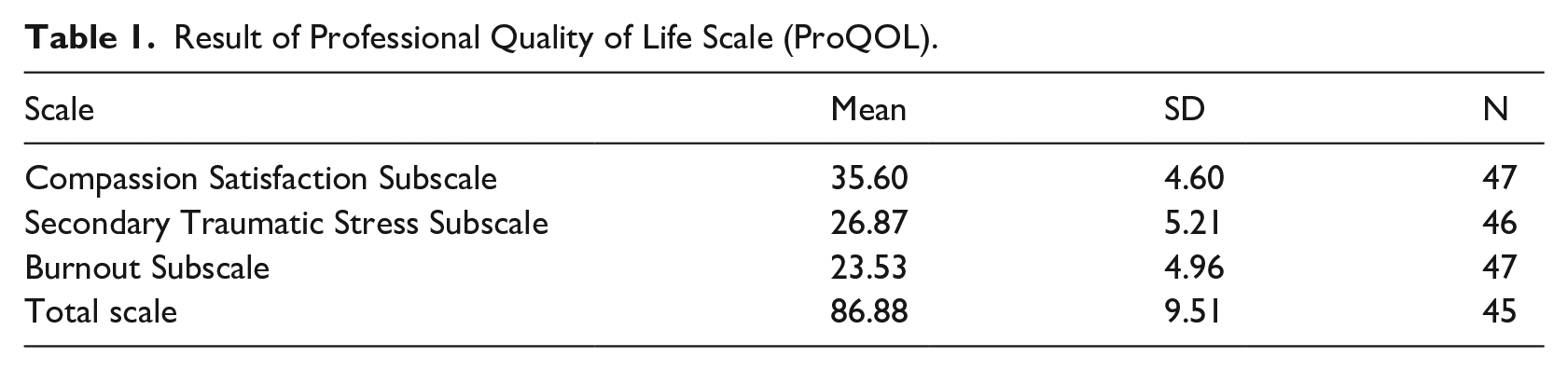
The moderate level of secondary traumatic stress experienced by the participants indicates that they may have been exposed to stressful events in their work with juvenile offenders and their families. For these participants while not experiencing the highest level of compassion fatigue and burnout, the moderate scores may indicate emerging problems related to worker well-being.
Open questions
Three themes related to challenges were captured in the open-ended responses. These themes included (1) high caseload expectations and responsibilities, (2) inadequate peer support, and (3) low pay rates for the amount of time spent at the job.
The high caseload expectations and responsibilities were mentioned by several of the participants. A few of the key quotes that support this theme development include the following: The organization should have more knowledge about the time that it takes for interventions, and the institution should not over demand . . . We work with people and we depend on numerous factors to achieve the organizational demands, which oftentimes are impossible to achieve. (P34) Working with a person with problems is heavy work that requires reduction in the working hours per week so that we can revive ourselves, rest well, disconnect and start again. (P10)
In addition, 14 participants argue that they work at home or exceed the working hours in order to achieve the organizational goals and fulfill the clients’ needs. They express that they have difficulties to keep limits between their personal life and their work. In addition, many participants reported having difficulty finding time to engage in healthy lifestyle practices (e.g. regular sleep schedule, eating regular foods, exercising).
The second theme of inadequate peer support highlighted the difficulties workers had in getting needed support during times of high stress. This group of workers expressed that they ‘feel alone to face work difficulties’ and they want more ‘team communication and team participation in the case analysis’ (P13).
The final theme related to challenges focused on low pay rates for the amount of time spent on the job. The participants spoke of the perceived lack of value that the workplace has for the type of work they do each day. One participant stated, ‘Hopefully, public agencies should give more importance to their workers and give them the chance to study and improve their work’ (P8).
In these answers, it can be observed that the professionals perceive an imbalance between what the organization expects from them and what the organization offers them to meet the expectations.
For the open-ended question that asked about workplace support currently in place and what they hope could be implemented in their work sites, participants had several suggestions for ways to improve the work site climate and enhance workers’ sense of well-being. Participants valued (1) flexible schedules, (2) adequate pay, (3) supervision support and training, and (4) some level of self-care support. One of the participants reported, ‘[Their agency] has implemented scheduled meetings to discuss cases and learn from those workers who have more experiences and managed similar cases . . . [Their agency encourages] self-care, focuses on promoting life quality of teams’ (P16). Meanwhile, other participants indicated that their agencies have started to work to improve the relationship between team members as it relates to supporting one another with difficult cases.
Discussion
Burnout and secondary trauma are two branches of compassion fatigue, and in this study only secondary trauma experienced by participants. A moderate level of secondary trauma was experienced by these participants. This finding supports earlier research in other fields and reflects the challenges that social workers in juvenile justice face in their work with juvenile offenders who have experienced trauma. On a positive note, the syndrome of emotional exhaustion, depersonalization, and reduced personal accomplishment is low in this sample. Hence, practitioners who work in juvenile offender programs are experiencing moderate levels of compassion fatigue. While they perceive some levels of organizational support to help them cope with their high demand jobs, these supports do not seem to be adequate for them in balancing their personal and professional life. The themes that emerged centered on a lack of organizational support related to teamwork, training, and pay. This finding is consistent with the earlier research reported in the meta-analysis study done by Hensel et al. (2015).
This study raises some important perspectives on the experiences of social workers and other practitioners working in high-stress positions as it relates to compassion fatigue, burnout, and organizational support. For this group of workers, the low salary, difficulty in completing work during regular work hours, and the feeling of isolation contributed to worker stress and frustration. This perceived absence of recognition for the work they do can lead to worker dissatisfaction (Fisher, 2009). While some limited support was noted for self-care activities and training supports, most participants had difficulties managing a healthy work–life balance.
Participants recommended that organizations need to (1) pay more attention to reducing caseloads, (2) raising salaries, (3) building in more flexible working hours, (4) promoting more professional training, and (5) encouraging stronger worker support systems. An interesting finding from a subsample of these participants focused on wanting to see more team building activities to decrease a sense of isolation they experience in their high-stress jobs. These results on compassion fatigue are consistent with previous studies (Font, 2012; Maslach and Leiter, 1997; Mor Barak et al., 2001; Strolin-Goltzman, 2010) with other populations of social workers in different countries.
For many participants, an organizational culture exists with minimal awareness of the moderate levels of compassion fatigue present in workers and how exposure to trauma and traumatic events may impact worker performance and well-being. Developing norms within the organization to support flexible work hours, more peer support and training of workers who deal with high-stress situations may improve worker satisfaction and reduce worker turnover. In a narrative literature review over the past 10 years completed by Ashley-Binge and Cousins (2020), it was noted that we need to move away from looking at individuals to create the work–life balance but to organizations to change their cultures to better support workers and promote safety and reduce the impacts of vicarious or secondary trauma. One promising outcome of this study is that for some of the participants their organizations have developed programs to support training to prevent compassion fatigue, burnout, and promote self-care. Indeed, continuing professional development reduces occupational stress and enables social workers to be supported by and network with other professionals (Lombard et al., 2014).
In Chile, the working hours per week are 44 hours, and in the past few years, discussions have surfaced to reduce the time to 40 hours. One of the reasons focused on the amount of time workers spent in traveling to work, especially when they live in large cities. The travel times limit the opportunities for workers to be with their families. Less time with family and limited opportunities for workers to engage in recreational activities to improve their quality of life and mental health were additional reasons given to support reducing the number of hours (CiperChile, 2019). The professionals who work with vulnerable people do not have any special accommodation under Chilean labor law. Furthermore, many of the practitioners do not receive employment benefits because they are hired part-time. While these are conditions in Chile, many other countries also have similar workplace issues.
While external clinical supervision is a rare practice in these organizations, the practitioners value technical meetings where challenging cases are analyzed and they receive feedback from team members. Although this practice does not have the same impact as external clinical supervision, it helps practitioners to feel supported. Another issue that surfaces in these findings is the limited knowledge practitioners have about how to manage their personal and professional lives to minimize stress and enhance well-being.
SENAME’s guidelines for juvenile offenders programs vaguely give instructions about the need for compassion fatigue prevention. Organizations voluntarily decide whether or not to implement policies or practices to minimize turnover due to compassion fatigue and burnout.
It is crucial that the Chilean state support public policies that safeguard the mental health of the workers who care for children and young people who have suffered traumatic events. Indeed, seven of 10 young people who are in juvenile prisons have been victims of child abuse (Reyes, 2014). Other studies have found that social workers who are affected by secondary traumatic stress most often reported symptoms such as intrusive thoughts, avoidance of reminders of clients, and numbing responses (Bride, 2007). These symptoms not only affect the practitioners but also the quality of the user services. Bercier (2013) argues that the cost of not attending to the problems of compassion fatigue is to put these workers at risk of short-term and long-term physical and emotional disorders, strains on interpersonal relationships, and shortened careers. Fortunately, secondary traumatic stress is reversible and trauma workers can minimize or improve the negative impact of trauma work (Macritchie, 2006). This implies that public policies, organizations, and practitioners work together to improve prevention programs to minimize compassion fatigue and burnout.
While this sample is relatively small, the study is a first step to understanding compassion fatigue among practitioners in juvenile justice settings in Chile. The study findings suggest that organizations might consider building more peer support and training to decrease worker isolation. Being in high demand jobs with high-risk vulnerable populations adds an additional burden on workers when making critical decisions related to their casework responsibilities. The study captured perceptions of a small sample of workers and assessed their levels of compassion fatigue.Future studies need to expand to more practitioners and continue to explore how organizations can support workers experiencing moderate to high levels of compassion fatigue and burnout.
Conclusion
The findings in Chile, where both job turnover and job insecurity are high, are similar to the findings reported in the literature related to working in other high demand settings. Understanding how compassion fatigue can be addressed in organizations to increase worker well-being and positive youth outcomes is a critical area that requires further study.
The Chilean social work practitioners’ experiences may contribute to understanding not only what needs to happen to support workers in Chile but also in other countries where compassion fatigue has resulted in high turnover rates and poorer quality of services for these high-risk youth. Exploring the importance of establishing institutional policies to support social work practitioners as they meet the challenges of working with youth in juvenile justice settings needs to be a top priority for global social work practice. The absence of a public or institutional policy, which recognizes the social work practitioner in the juvenile criminal justice system as an important resource in the process of social reintegration of juvenile offenders, not only damages the quality of services, but also the opportunity for youth to re-enter the community with critical pro-social skills and behaviors that support their growth. More studies that raise the awareness of compassion fatigue experienced by social workers in the juvenile criminal justice system are needed.
This study highlights social workers’ experience of compassion fatigue when working in juvenile offenders programs in Chile. While the sample was limited, the study raises important questions that require a deeper examination of how social workers can be better supported by organizations when they are working in high demand jobs to improve well-being and job performance.
Footnotes
Correction (November 2023):
This article has been updated to correct an author’s institutional affiliation in the author biographies section.
Funding
The authors received no financial support for the research, authorship, and/or publication of this article.
