



Abstract
This article examines the position of Bangladesh in the field of international social work with women. It explores the country’s women’s development initiatives in the context of the global debate over indigenization, universalization and imperialism. To identify the strategic position, the article examines the literature on social work, the evolution of social work and the web contents of some development agencies in Bangladesh. The findings reveal that Bangladesh follows a process of reconciliation in the indigenization–internationalization dispute by employing both top-down (think globally, act locally) and bottom-up (act locally, proceed globally) approaches to international social work and women’s development.
Keywords
Introduction
International social work involves a wide range of endeavours, including working for international development organizations such as CARE and Save the Children, United Nations (UN) agencies such as United Nations Development Programme (UNDP) and United Nations High Commissioner for Refugees (UNHCR), and foreign aid departments such as United States Agency for International Development (USAID). It entails working on global problems, including human rights, women’s empowerment, poverty reduction and environmental issues on a global or local scale (Gray and Fook, 2004). Domestic social work involving clients from different countries or cultures, such as immigrants or refugees, is also referred to as international social work (Midgley, 2001; Payne and Askeland, 2008). The list also includes involvement in global conferences, programmes for expert exchange and social work research run by professional associations like the International Federation of Social Workers (IFSW). Healy (2008) divided international social work projects into four categories: internationally informed domestic practices and advocacy, professional interaction, international practices, and international policy formulation and advocacy. Originating in Europe and North America, social work first reached Asia and Africa through Western missionaries and colonial agents, and then through UN agencies and bilateral aid operations in post-colonial independent states (Healy, 2012). However, the flow of aid, models and expertise from Western donors to receiving countries, as well as the fulfilment of evangelic missionary zeal, can sometimes fuel imperialism and Western dominance (Gray, 2005; Webb, 2003). From the standpoint of developing countries, this might result in scepticism towards internationalization and opposition to any unfavourable effects of globalization that impede international social work.
To elaborate on the aforementioned idea, Gray and Fook (2004) outline four categories of tensions in international social work practices: globalization against localization, westernization versus indigenization, multiculturalism versus universalization and global versus regional standards. Some scholars argue that these tensions are, in fact, complementary rather than the opposite (Payne and Askeland, 2008). Walton and el Nasr (1988) propose two parallel notions to address the disparity between international and domestic social work practices: indigenization or adaptation of global social work models to fit in local settings and authentization (a word coined from authentication) of local models to form a new standard with universal acceptance. Link and Ramanathan (2011) emphasize the importance of international collaboration in research and practices while respecting the uniqueness of local traditions and cultures. International collaboration could also be networking or a partnership between diverse social actors (Ahmadi, 2003). Dominelli (2005) proposes a straightforward solution to the debate by defining international social work as actions that localize the global and globalize the local. Lyons (2006) uses the popular top-down catchphrase ‘think globally, act locally’ to emphasize indigenization when addressing global issues like HIV/AIDS outbreaks and the recent COVID-19 pandemic. The phrase ‘act locally, proceed globally’ can be used to describe authentization (coined by Walton and el Nasr, 1988), a bottom-up approach to social work in which local devices, such as microfinance in Bangladesh, traverse state boundaries to address global issues like poverty and gender disparities. Hong and Song (2010) propose a ‘glocalization’ (a word made up of combining globalization and localization) of social work methods, arguing that global and local responses might interact to boost world citizenship.
Against this background, the article investigates the strategic position of Bangladesh in the field of international social work, focusing on disadvantaged women facing the challenges of globalization. There exists a volume of literature on social work in Bangladesh, including the works of Taher and Rahman (1993), Hossain and Mathbor (2014), Islam (2017), Ali et al. (2020) and Hussain and Ahmad (2020). The majority of the papers focus on social work issues and challenges, with little to no emphasis on international perspectives. Furthermore, except for a few papers such as Islam (2017), there is little discussion of the indigenization–internationalization debate in Bangladeshi social work studies. The current article aims to address this knowledge gap. First, it focuses on the global debate on the dilemma surrounding indigenization, universalization and imperialism (emphasized by Gray, 2005). The article then looks at the history of social work and community services in Bangladesh before exploring Bangladesh’s perspectives on the indigenization–internationalization dilemma with a focus on the advancement of women. The study employs qualitative approaches to investigate the role of development agencies such as Grameen Bank, BRAC and Save the Children, as well as to identify Bangladesh’s position in international social work with underprivileged women. Data and methods in the study include the review of international social work literature, social work chronology and browsing the web contents of significant organizations involved in women’s development in Bangladesh. A thorough literature search was carried out for this study between October 2021 and March 2022 using a variety of web search engines and research repositories, including Google Scholar, JSTOR and ResearchGate. The qualitative data were processed manually.
Indigenization–internationalization debate
International social work faces a dilemma surrounding indigenization, universalism and imperialism (Gray, 2005; Tsang and Yan, 2001). While social work practices become more indigenized by adapting to local and universal principles (universalism), they also become more internationalized as a result of westernization and imperialism. Imperialism in social work is an extreme form of internationalization that promotes Western dominance over diverse local and indigenous cultures. Western social work models dominated the social service industry throughout colonial and post-colonial contexts, exploiting inherent power imbalances driven by missionary zeal and imperialist enthusiasm. Based on the belief that indigenous social work practices were inadequate and inferior, Western models, together with technical assistance and resources, were transplanted into developing countries. In its most extreme manifestation, Western social work has ignored, undervalued or disqualified indigenous voices (Hokenstad and Midgley, 1997; Midgley, 1992; Nagpaul, 1993; Gray, 2005; Healy, 2001). During the 1970s, a major movement known as indigenization formed in opposition to the import of foreign models, claiming that they were unfit to address local socio-economic issues (Healy, 2001, 2005). Indigenization refers to the idea that social work activities should be in line with local realities and cultural values. It challenges the cultural supremacy of dominant discourses and reacts against the negative aspects of globalization, such as neo-colonialism and cultural imperialism (Wong, 2002). Indigenous social work emerged as a new social work discourse that went beyond the traditional one-way global flow of knowledge and practices, motivated by self-reliance, spirituality and cultural heritage.
Universalism aims to give social work practices a global face by incorporating commonalities across varied contexts, allowing social workers to share values and goals. Universal social work refers to social work theory and practices that transcend national boundaries (Gray and Fook, 2004). While indigenization opposes the imperialistic transfer of social work models to developing countries, universalism promotes reconciliation through seminars, conferences and the exchange of ideas and resources. Universalism is about collaboration and mutual understanding rather than the one-way export of so-called superior models to developing countries. Tsang and Yan (2001) argue that striking a balance between importing social work models and developing indigenous methods for social work practices is extremely difficult. They do, however, claim that culture can play an important role in facilitating indigenization and preserving universalism while avoiding imperialism (Gray, 2005).
The discourse of social work is heavily influenced by cultural factors (Gray, 2005; Tsang and Yan, 2001). Western culture is based on certain generic principles, including individualism, self-determination and confidentiality, derived from Western liberalism. As a result, Western social work focuses on psychosocial issues through individual casework. In contrast, indigenous or local cultures hinge upon spirituality, collective efforts, shared ideas and communal activities. Socio-economic issues have a greater impact on families and communities than psychosocial issues. As a result, social work evolves in this context with a developmental focus to address socio-economic issues such as poverty, inequality and injustice. Developmental social work aims to achieve social justice by strengthening the livelihood capabilities of people and their communities within the context of the dynamic development process (Manyama, 2018). International social workers can contribute to the resolution of the indigenization–internationalization debate by modifying their perspectives. Instead of solely relying on Western models (mostly top-down approaches), they can learn from and interact with a variety of cultures (through bottom-up approaches). International social work would then be a blend of diverse discourses with eastern, Western and indigenous flavours (Midgley, 1990, 1997). The following section shows how social work and community service approaches have strategically evolved in Bangladesh.
Strategic evolution of social work and community services in Bangladesh
The history of social services in Bangladesh can be divided into four major segments: the pre-colonial era (from documented history to AD 1757), British colonial rule (1757–1947), the pre-liberation Pakistan period (1947–1971) and the post-liberation modern period (1971 onwards). Since pre-colonial times, several spiritually motivated charitable endeavours have prospered in society, including zakah and sadakah (compulsory and voluntary support to the destitute), waqf (public charity), langor khana (free meals for the poor and travellers), dan-dokshina and khairat (almsgiving to the extremely poor and persons with disabilities) (Ali et al., 2020; Taher and Rahman, 1993). During colonial rule (1757–1947), administrators and Christian missionaries occupied a major part of the social services, targeting two opposite but interconnected goals: administrative exploitation and evangelic devotion. Radical activists were also active in social services as part of their movement against colonial rule. The establishment of educational institutions, orphanages and the implementation of social reforms were among the major social services given during this time (Taher and Rahman, 1993).
Pakistan period (the 1950s and the 1960s): A post-colonial attempt at organized social work
British colonial authority over India came to an end in 1947 with the conclusion of World War II, leading to the declaration of independence for both India and Pakistan. Post-colonial reconstruction and development programmes imposed by international organizations like the World Bank and International Monetary Fund (IMF) in the newly established nations have resulted in serious socio-economic problems such as work–life imbalance, unhealthy working conditions, inequality and vulnerability. This created a solid ground for organized social work practices. A team of social welfare consultants from the UN organized a pilot project called Urban Community Development in Dhaka City in 1955. To assist non-profit social welfare organizations, the government established the National Council of Social Welfare the same year. The Council implemented hospital social work at the Dhaka Medical College Hospital with funding from the International Red Cross Society. Through this programme, post-colonial East Pakistan saw the introduction of Western social work paradigms (Taher and Rahman, 1993).
Post-liberation rebuilding and rehabilitation (the 1970s and the 1980s): A paradigm shift
The liberation war in 1971 divided Pakistan, and consequently, East Pakistan became independent as Bangladesh. During the 1970s, the country faced four major disasters that shook the social work scenario: a cyclone in 1970, the liberation war in 1971, a worldwide oil price shock in 1973–1974 (and again in 1978–1979) and flood and famine in 1974. As a result, the entire decade was committed to providing relief and rehabilitation services, and social development organizations created a new development strategy known as the ‘basic needs’ approach, which aims to directly assist the poor rather than indirectly through macroeconomic measures (Harris, 2000). This approach caused a paradigm shift in Bangladeshi social work practices, moving from psychosocial work to developmental social work. People in Bangladesh are more upset by difficulties meeting their basic needs than by psychosocial problems (Islam, 2017). Development agencies, including the Grameen Bank, BRAC and ASA (previously known as the Grameen Project, Bangladesh Rural Advancement Committee and the Association for Social Advancement, respectively; they are now simply the Grameen Bank, BRAC and ASA), started small-scale rehabilitation projects to help war-affected people, rebuild their homes, open up medical centres and provide collateral-free microloans to rural women. They formed solidarity groups of 15–20 rural residents (comprising 5- to 7-member small groups), the majority of whom are women (more than 95%) and gave group members microloans to support their microenterprises. They also held weekly group meetings to discuss overcoming capability deprivation and advancing social justice. The main aim of a solidarity group is to empower rural women through microfinance and social campaigning. This kind of group social work has been created locally utilizing a ‘learning by doing’ strategy to achieve self-sufficiency with little to no dependence on foreign aid and models (ASA, 2019; BRAC, 2019; Grameen Bank, 2021). However, critics such as Karim (2011) raise questions about the cohesiveness of the group, arguing that women are frequently stuck in debt traps and that group sessions are primarily focused on loan repayment rather than resolving social issues.
In the 1980s, the World Bank and IMF urged developing countries to reduce government spending on health and education to make room for non-governmental organizations (NGOs). The Bangladesh government agreed to grant NGOs a greater development role and let foreign donors work intensively with NGOs (Haque, 2002). This neoliberal agenda has reduced the space for both the public sector and professional social work. However, developmental social work continued to flourish during the 1980s, along with the exponential expansion of NGOs and microfinance institutions. The Bangladesh microfinance model is being adopted by more and more countries worldwide, including Genesis in Guatemala and the Foundation for International Community Assistance (FINCA) in Bolivia (Brooks, 2014). USAID and other international development agencies (IDAs) start funding the global adoption of the Bangladesh model. However, critics such as Bateman (2010) and Muhammad (2015) argue that such replication and adaptation processes were initially seen as anti-neoliberalism but eventually proved to be complementary mechanisms. In contrast, proponents of model replication perceive this as a South–South collaboration competing with North–South imperialism (Hossain and Sengupta, 2009).
Triumph of the neoliberal agenda (the 1990s, 2000s and onwards)
The decade of the 1990s witnessed an undisputed victory for the neoliberal agenda and globalization against opposite forces (as the Cold War ended in the early 1990s). In Bangladesh, NGO operations – particularly microfinance – have dominated the social service landscape and have persisted into the new millennium. Bangladeshi social service models crossed the border at an enormous pace to promote South–South cooperation and establish the notion of ‘act locally, proceed globally’. BRAC International covers 11 countries in Asia and Africa, reaching over 100 million people to provide various socio-economic programmes, including microfinance, health, education, disaster management, other livelihoods and humanitarian support to the poor (BRAC, 2020). Another NGO, ASA, reaches 13 countries in Asia and Africa (ASA, 2019). The millennium began with a goal-setting approach to lift millions of people out of poverty, empower women, and improve health and well-being. Following the successful completion of the Millennium Development Goals (MDGs), the United Nations announced the Sustainable Development Goals (SDGs) in 2015 (UNDP, 2015). The SDGs are designed to achieve 17 major goals by the year 2030, including ending poverty and hunger and eliminating discrimination against women and girls. The main focus is now on building a world with environmental sustainability, social inclusion and economic development. International social work in Bangladesh is now focused on the SDGs.
Bangladesh as a field of women-centred international social work
Muhammad Yunus pioneered women-centric models in Bangladesh in 1976, focusing on women rather than men, going to clients’ homes rather than waiting for them to come to the office, providing microfinance and other services to the poor rather than the wealthy and not requiring collateral for loans, as traditional models do. With a remarkable loan repayment percentage of 99 percent, women have continually shown that they are creditworthy and outstanding change agents for development. The idea of including women in development activities finally became the focal point of social work and community services in Bangladesh (Yunus and Jolis, 2003). International social work and community services are provided by a variety of groups, such as NGOs, international non-governmental organizations (INGOs), faith-based non-governmental organizations (FNGOs) and IDAs. The Ministry of Social Welfare is in charge of regulating the roles and pursuits of social service providers.
Non-governmental organizations
NGOs are registered with the NGO Affairs Bureau (NGOAB), Bangladesh. There are currently 2530 registered NGOs in Bangladesh, the most influential of which are BRAC and ASA (NGO Affairs Bureau, 2021). The growth of Bangladeshi NGOs exhibits a distinct set of characteristics: (1) focusing on underprivileged groups, particularly women; (2) organizing them to provide financial and non-financial assistance, including microfinance, awareness-building and humanitarian assistance; (3) accepting foreign and domestic funds to run their projects; and (4) aiming for self-sufficiency and less reliance on outside funds.
International non-governmental organizations
A total of 265 INGOs are registered with NGOAB, Bangladesh (NGOAB, 2019), and some of them have been active and vibrant since the country’s independence in 1971. Their social services include rights-based, women-centric programmes, such as the reduction of violence against women and children, livelihood security and climate change adaptation. Over the years, INGOs have transformed their programmes to fit the Bangladeshi model. For example, CARE Bangladesh has, in recent years, implemented 35 projects in partnership with local NGOs to improve food security, promote gender equality and ensure child health and nutrition, together with microfinance support (CARE, 2021). Save the Children has been working in Bangladesh since 1970, implementing child-rights-based programmes, including child health and nutrition, child poverty reduction and education (Save the Children, 2021).
Faith-based NGOs
Many Christian and Muslim NGOs worked in Bangladesh throughout the post-colonial era to provide social assistance to vulnerable populations, notably women and children (Clarke, 2008; Salehin, 2011; Thompson, 2012). According to a recent NGOAB report, of the 2530 registered NGOs, 28 are Christian and 27 are Islamic (NGOAB, 2021). Christian missionaries are accused of using people’s poverty and adversity to forcefully evangelize them to Christianity by influencing their culture, education and lifestyle through financial and non-financial support (Ali and Nurullah, 2007). Faith-based NGOs, on the other hand, claim that they do not use religion as a tool for development but rather link it to programmes like providing marginalized people with access to health care and education (Clarke, 2008; Manji and O’Coill, 2002; Thompson, 2012). Secular NGOs with neoliberal and modernist goals have also been targeted for criticism. They are blamed for ignoring the role of religion in development (Thompson, 2012) and manipulating women’s beliefs and modesty in the name of empowerment (Salehin, 2011).
International development agencies
Multilateral aid organizations like the World Bank and UNDP, as well as bilateral donors like USAID and Danish International Development Assistance (DANIDA), have contributed enormous sums of money to development initiatives in Bangladesh since the country gained its independence in 1971. This top-down approach to development was justified by the assumption that such large-scale endeavours would inevitably eradicate all socio-economic challenges. The ‘basic needs’ approach to development evolved in the 1970s, with the tenet that direct, micro-level aid to marginalized people is more efficient than macro-level assistance. Development organizations like BRAC, Grameen and ASA started to develop methods for utilizing local resources and assisting poor individuals, mainly women, on a grassroots level in the late 1970s. These models eventually gained global recognition and replication. Major IDAs in Bangladesh have joined the course of action, either by supporting local agencies or by running small projects themselves. For example, USAID (2011) programmes now focus on food security, environmental resilience, health, education and humanitarian assistance to the grassroots population. As for humanitarian support to refugees, USAID (2021), together with other IDAs, provides basic life-saving assistance, including food assistance and urgent nutrition services, to nearly 1 million Rohingya refugees from Myanmar to Bangladesh. The development of local models (by local NGOs) and their adoption by donor agencies (INGOs and IDAs) justify the interconnection between the two approaches: ‘think globally, act locally’ and ‘act locally, proceed globally’.
Indigenization–authentization nexus: Bangladeshi footprint on women’s development
This section shows how women-focused groups that were initially created locally in Bangladesh evolved into global organizations (authentization). It also demonstrates how organizations that focus on assisting women and children localize the global agenda for child welfare and gender equality (indigenization). The second group of organizations also comes with two case studies. They were taken from a co-author of this article who provides free referral services to victims of domestic abuse.
Bangladeshi models going global: Act locally, proceed globally
Grameen Bank, the 2006 Nobel Peace Prize co-winner with its founder, Muhammad Yunus, has successfully used microcredit as an instrument to fight poverty and improve the socio-economic conditions of the poor, particularly women. It provides financial and other development services to over 9.5 million borrowers (of which 97% are women), covering almost 100 percent of the total number of villages in Bangladesh. As Yunus argued, ‘These millions of small people with their millions of small pursuits can add up to create the biggest development wonder’ (Grameen Bank, 2008). Microcredit has proven to be an important liberating force in societies where women, in particular, struggle against repressive socio-economic conditions. Grameen Bank has been a source of ideas and a model for many social development institutions around the world. Its success has inspired development practitioners to replicate similar projects in more than 40 countries and motivated the World Bank to finance Grameen-type schemes. The Grameen success story is an ideal example of the authentization of the social service model that started in a remote rural area in Bangladesh, and eventually achieved widespread recognition and awarded the Nobel Prize (Grameen Bank, 2021).
Another example of authentization is BRAC. It takes a comprehensive approach to transform people from aid recipients to capable citizens. Born in Bangladesh in 1972, BRAC has been a self-sustaining network of social enterprises and investments. Like in Grameen, women and girls have been central to BRAC’s anti-poverty approach because of their vulnerabilities and urge for change. By 2020, BRAC will have covered all 64 districts of Bangladesh with an integrated package of services for rural and urban communities (BRAC, 2019). By pioneering new techniques in important areas of development, BRAC aspires to reach beyond Bangladesh to support poverty reduction activities in other developing nations. In 2002, BRAC started its first initiative for a global partnership for development in Afghanistan. Now, BRAC has become the largest NGO, covering more than 10 Asian and African countries. The process of globalizing the profile of BRAC started in 2006 with two affiliates: BRAC USA and BRAC UK. They have been collaborating with international counterparts to design the global compatibility of BRAC’s social development innovations. Three years later, in 2009, a Netherlands-based entity, ‘Stitching BRAC International’, was established to govern and manage all BRAC entities outside Bangladesh. Its international initiatives in social development include social transformation through various priorities, such as poverty elimination, financial choice expansion, creating employability skills, addressing climate change and natural disasters, gender equality, universal health care and pro-poor urban development (BRAC, 2019).
Localizing the global agenda: Think globally, act locally
We chose two organizations to exemplify the idea of localizing the global agenda in Bangladesh: (1) Women’s Support Programme, a governmental organization (GO)–INGO partnership, seeks to empower Bangladeshi women to end family violence, and (2) Save the Children, an international NGO, strives to improve the lives of underprivileged children in Bangladesh.
Women’s Support Programme
The governments of Bangladesh and Denmark jointly arrange the Multi-Sectoral Programme on Violence against Women in compliance with the UN Convention on the Elimination of All Forms of Discrimination against Women (CEDAW) and the gender equality policy of the international donor DANIDA (MoWCA, 2021). This initiative, run by Bangladesh’s Ministry of Women and Children Affairs, assists poor women in becoming self-sufficient and empowered against deprivation and exploitation. Poor women in Bangladesh face a variety of dangers, including domestic violence (physical abuse, abandonment, harassment and dowry claims by husbands) and health risks (malnutrition, etc.). They are frequently exploited as a result of a lack of adequate education brought on by poverty and/or early marriage. Development organizations in Bangladesh, such as Grameen Bank, BRAC and many other NGOs, have established women’s development initiatives throughout the country to prepare them for these vulnerabilities. They offer microcredit and support women’s microenterprises through training and technical help.
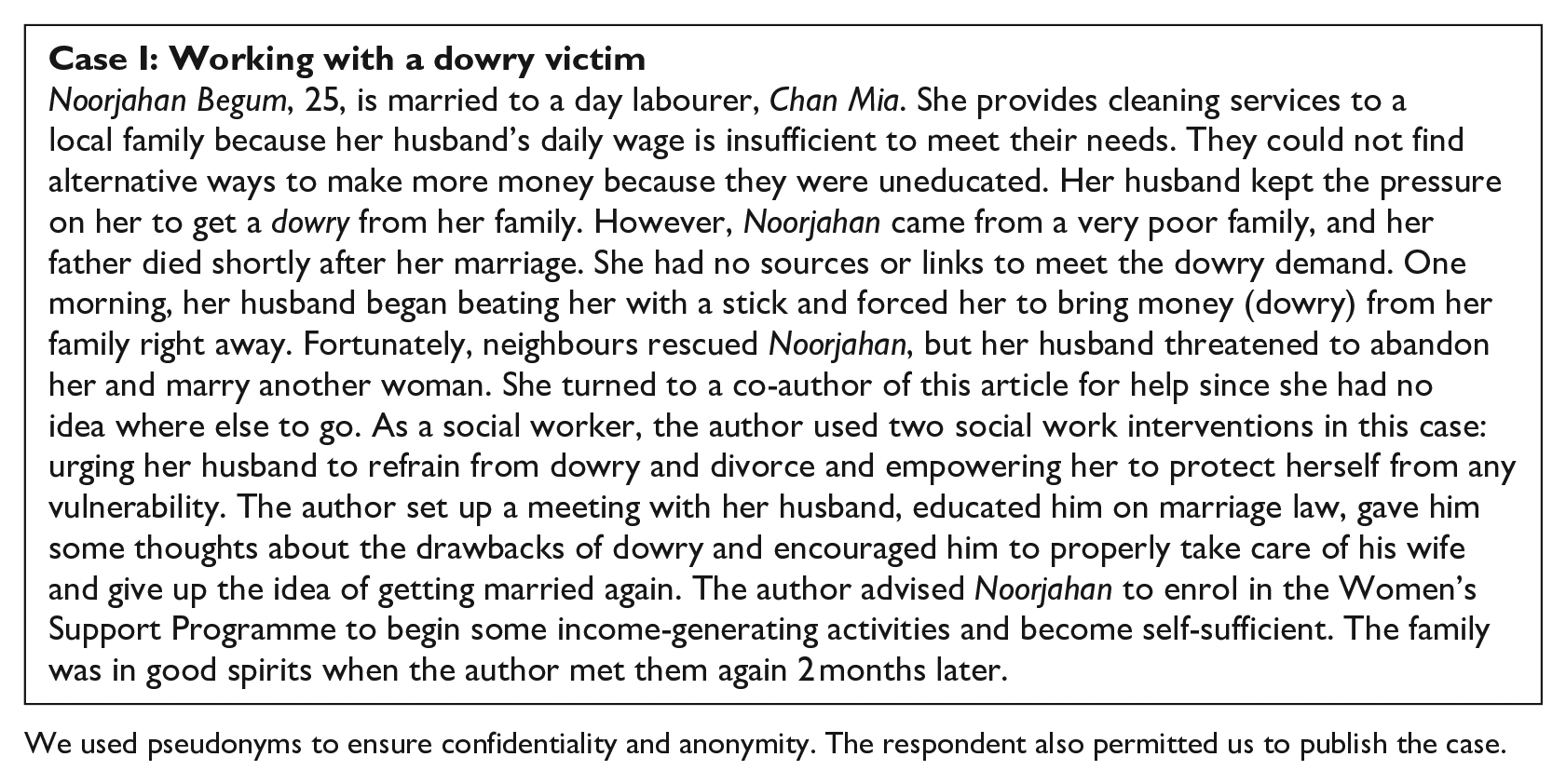
We used pseudonyms to ensure confidentiality and anonymity. The respondent also permitted us to publish the case.
Save the Children, Bangladesh
The UK-based organization Save the Children focuses on maximizing its impact on vulnerable and socially excluded children. It serves 48 million children in over 50 countries. Since 1972, the Bangladesh chapter of Save the Children has served more than 15 million children and adults across all 64 districts (Save the Children, 2020). Save the Children Bangladesh has been developing livelihood initiatives to reduce child poverty and improve children’s health and education. Its nutrition-sensitive livelihoods programme, Shuchana, achieved a remarkable success in terms of child food security. Evidence from the intervention area shows that the minimum acceptable diet among 6- to 23-month-old children increased from 10.4 percent to 24 percent. Furthermore, the intervention reduced overall food insecurity in the area by 45.3 percent. The Education for Youth Empowerment (EYE) programme of Save the Children Bangladesh helps poverty-stricken children transform into empowered citizens. It facilitates successful transitions of disadvantaged adolescents to decent job opportunities in the future. According to statistics (Save the Children, 2020), over a million young people have obtained basic skills and vocational training.

We used pseudonyms to ensure confidentiality and anonymity. The respondent also permitted us to publish the case.
Among the various child-focused initiatives of Save the Children, the Rohingya Response Programme is remarkable. Fleeing a cycle of violence and human rights abuses in the northern Rakhine state of Myanmar during the last two decades (most recently in 2012 and 2016), over 1 million Rohingya refugees migrated to take shelter in the refugee camps in Cox’s Bazar, Bangladesh. More than 50 percent of refugees are children, who are in dire need of humanitarian support. Save the Children has been working with Rohingya refugees since 2012.
The case studies demonstrate the influence of ‘think globally, act locally’ on international social work in Bangladesh. Helping the victim of a divorce threat, who was advised to contact Save the Children, falls under the second category of the international social work practices outlined in Healy (2008): participation in and utilization of international exchange. The organization itself follows Healy’s third and fourth components: international practices; and international policy formulation and advocacy (Healy, 2008). In Bangladesh, Save the Children is the apex child aid organization. It works with families and children both directly and in collaboration with other development organizations like GOs and NGOs. The Women’s Support Programme, a GO–INGO collaboration, is an example of Healy’s first component of international social work: internationally informed domestic practice and policy advocacy (Healy, 2008). Working with the dowry victim who was instructed to enrol in the Women’s Support Programme is also included in this category. As we can see, the case studies cover each of the four facets of international social work that Healy (2008) emphasized, and they cooperate to localize the global agenda for children’s welfare and gender justice.
In both of these case studies, the social worker (one of the co-authors) serves as a liaison between clients and service providers, reducing cultural misunderstandings and superstitions. Women are victims in both situations, and men seek a solution in a second marriage, which is culturally acceptable but frequently misinterpreted. Muslim males are allowed to have up to four wives, but only under certain conditions, such as when the wife is suffering from a chronic illness or separated from them, an orphan woman is seeking protection, there is a higher female-to-male ratio during times of war and so on. The husband must always defend equity and justice among his wives, which is very difficult for a human to achieve; if he cannot, he must wed one (Al-Quran, 4:3). Thus, the compulsion to marry one is implicit but frequently ignored or misused by people with a vested interest. Adaptation to this type of misconception in the local culture is an enormous challenge for international social workers in NGOs and INGOs. From an ethical standpoint (IASSW, 2018), social workers value human dignity but must also deal with those whose views and actions devalue or stigmatize themselves or others. Local social workers are well-positioned to intervene in Bangladeshi family dynamics since they are familiar with the culture and history. Thus, in this dynamic setting, adapting to indigenous models rather than replicating standardized ones is a better option. However, there is a risk that indigenous social workers might exploit negative cultural norms such as excluding women from economic and social activities in the name of purdah or veiling for traditional modesty (Salehin, 2011). International social workers must address cultural misconceptions while enlisting the assistance of local resources.
Conclusion
This article is an attempt to review the strategies and scope of international social work and its implications for women’s development in Bangladesh. Globalization has been accompanied by various social problems worldwide, and Bangladesh is no exception. The country faces multidimensional socio-economic problems, against which international social workers employ various strategies to fight. The popular catchphrase ‘think globally, act locally’ has particular relevance for international social work practices. For instance, preventing violence against women and children is a global idea that is put into practice and is being fought locally in many developing nations, including Bangladesh. The article argues that the reverse phrase, ‘act locally, proceed globally’, has similar implications for international social workers. In this situation, social service providers devise local solutions to a particular social problem, like empowering women or reducing poverty, and put them into practice to achieve acceptance around the world. Bangladesh has set a milestone in developing local models with universal recognition. It is an example of the indigenization–internationalization issue being reconciled, that is, flourishing local models while internationalizing them without renouncing universalism. Poverty reduction strategies through women’s empowerment developed by Grameen and BRAC in Bangladesh during the 1970s have gradually been replicated or implemented in many developing countries and turned into universal concepts. Overall, we can achieve more if international social workers execute community development programmes using a learning-by-doing method (e.g. learning from local culture) rather than a one-size-fits-all approach (e.g. importing standardized models).
Footnotes
Declaration of conflicting interests
The authors declared no potential conflicts of interest with respect to the research, authorship and/or publication of this article.
Funding
The authors received no financial support for the research, authorship and/or publication of this article.
