




Abstract
Lesotho recently experienced a paradigm shift from social welfare to social development. The study was aimed at assessing achievements and challenges that resulted from the transition. A sequential mixed-methods approach was used. In the quantitative strand, a sample of 150 social workers and 300 beneficiaries was randomly selected, out of which a sample of four social workers’ focus groups were purposively formed. Data were collected through questionnaires, structured interviews and focus group discussions. The community development programme serves as a means to incorporate a social development approach. The article recommends integration of the social development approach in specialised programmes.
Introduction and background
The Department of Social Welfare in Lesotho was established in 1976 under the then Ministry of Health. The Department mainly provided curative and remedial services (Government of Lesotho, 2013). It mostly rendered selective social services to people who could not be supported by their families and the private market, more especially children in difficult circumstances, the needy and people with disabilities (Dhemba and Marumo, 2016; Government of the Kingdom of Lesotho, 2013). In the late 1970s to early 1980s, a different approach to development emerged as a result of a shift in focus from economic growth to social and individual wellbeing, thus the social development approach. ‘The evolution of development theory towards this welfare-centered paradigm led to greater involvement of social work in social development’ (Gaba, 2014). The notable significance of development in social welfare influenced social work to develop its critical theoretical framework on development issues.
This framework gained more popularity in the work of social welfare scholars and social work practitioners. As Patel and Hochfeld (2012) indicate, developmental social work became a new paradigm in social work internationally that sought to infuse social developmental theory and practice into social work processes: For many countries in Africa, the neoliberal shift to social development began at the World Summit on Social Development held in Copenhagen in May 1995 with a commitment to eradicate poverty, and that led to the development of the Millennium Development Goals (MDGs). (Gray et al., 2018: 975)
Considering the varying social, economic, structural and environmental challenges hampering various African countries, the United Nations (UN) and others embraced the social development approach within the Millennium Development Goals (MDGs). In pursuing this effort, in 2000, the Millennium Summit was held in South Africa to examine the position of social development in the MDGs. Among others, the summit called for all governments to establish national social development organisations (Gray et al., 2018: 975; Midgley and Pawar, 2017: 12). The introduction of Sustainable Development Goals (SDGs) was not only instrumental in overcoming the shortcomings of MDGs, but also indicated a new direction for social development (Mohamed et al., 2019; Rasool, 2017). Therefore, many countries in Africa consequently considered adopting the social development approach (Gray et al., 2018: 12).
In particular, the social work profession then infused the social development theory and practice into its interventions and that resulted in developmental social work (Patel and Hochfeld, 2012: 261). A social development approach has been widely espoused in most developing countries, especially in Africa, and is in turn influential in social work theory and practice (Gray et al., 2018: 975; Spitzer, 2019: 573). It is viewed as a vital tool that can be used in efforts to fight poverty and its manifestations. Notably, African countries such as South Africa, Zimbabwe, Ghana, Botswana, Lesotho, Kenya, Rwanda and Tanzania also realised the need for change in social work practice and hence adopted the social development approach (Government of the Kingdom of Lesotho, 2013; Spitzer, 2019: 574).
Later on, social work education, social work practice and social development bodies, specifically the International Association of Schools of Social Work (IASSW), the International Federation of Social Workers (IFSW) and the International Council for Social Welfare (ICSW), collaboratively with the UN and other stakeholders joined efforts to deal with problems that exacerbate poverty, inequality and unsustainable human environments (IASSW et al., 2020). The Global Agenda for Social Work and Social Development is one such partnership; it commenced in 2010 and set a strategy for 10 years (Lombard and Twikirize, 2014: 314). It was during this period, in 2013, when Lesotho also responded by formulating the National Social Development Policy (NSDP). The MDGs, Copenhagen Social Development Commitments and social development goals shaped the development agendas of some countries, such as the National Strategic Development Plan in the case of Lesotho (Ministry of Social Development [MoSD], 2014). However, with the realisation that the MDGs had not reached the set goals, leaders from 193 countries introduced a new concept for development, namely, the Sustainable Development Goals (Lombard, 2015; Midgley and Pawar, 2017). With the primary focus on economic, environmental and social sectors as well as the principle of sustainability, the SDGs gave a new direction for social development (Gray et al., 2017; Mohamed et al., 2019).
Generally, all these served to guide Lesotho on its path of integrated socio-economic development. The international professional associations of social workers, which the Lesotho Association of Social Workers was part of, equally became highly involved in responding to the need for greater participation of social work in development through the creation of the Global Agenda for Social Work and Social Development (2012) (Gaba, 2014). Similarly, the constitution of Lesotho and the Lesotho Vision 2020 all form the legal framework for national development, including developmental social welfare.
From inception, the Department of Social Welfare had been endlessly moving between government Ministries. It was first under the Ministry of Health, then moved to the Ministry of Interior Affairs, then shifted to the Ministry of Justice, later on to the Ministry of Employment and eventually merged with the Ministry of Health, hence the name Ministry of Health and Social Welfare, which it assumed in 1993 (Dhemba and Marumo, 2016). The continuous shift could have been attributable to several reasons, which include, among others, lack of understanding of the field of social welfare or social work. The continuous shifting between the Ministries also deeply affected the stability and performance of the Department of Social Welfare. Resultantly, the social work profession in general and the Department of Social Welfare in particular were being accorded a low profile and status and hence receiving very poor recognition and minimal support from the government (Dhemba and Marumo, 2016). In addition, social welfare services were mainly criticised for focusing on addressing the symptoms of structural problems as opposed to the root causes of social problems, and this constituted part of the primary reasons behind the paradigm shift from a welfare approach to a developmental approach in Lesotho (Government of the Kingdom of Lesotho, 2013).
In an effort to enhance service delivery, the Department formulated the Lesotho Government (2003) and the National Social Welfare Strategic Plan 2005–2010. The National Social Welfare Policy was the first official document to propose a developmental approach in social welfare in Lesotho. In addition, it emphasised the need for autonomy and for the Department to become an independent Ministry. To facilitate this transitional process and in recognition of the critical role played by the Department, it was designated its own Principal Secretary in 2010. In 2012, the Department was elevated to the current MoSD. Governments in many African countries have signalled the need for social service professions to focus on developmental activities by renaming the Department of Social Welfare to the Ministry of Social Development (Dhemba and Marumo, 2016). Alongside these changes, Lesotho formulated the National Social Development Policy (2013). It was the first step towards preparing social work for its developmental role. So far, there is no evident literature relating to developments made since this paradigm shift; therefore, this article intends to close that gap.
Statement of the problem
Since its inception, the Department of Social Welfare had been subdued within various Ministries. Its services were consequently being compromised and that caused it immense difficulties. As a result, the Department was being charged with inefficiency, which to a greater extent could have been largely attributable to limited financial and human resources and the nature of social welfare services that were being provided, which were mainly curative and remedial and hence brought very little if any change in clients’ general livelihoods. Due to all those challenges, there was an outcry for the Department to be a stand-alone Ministry hoping that it would gain the desired recognition and be afforded the support it required. After the transition, the expectation was for there to have been a shift in a developmental direction and for all issues that influenced the transition to be resolved. Research has also shown that although there are several studies relating to developmental social welfare service delivery in various countries, there is limited evidence of the shift made towards a development approach by government social workers in particular (Chavalala, 2016). Most of these studies have been undertaken in South Africa, Kenya and Uganda and they show that there are challenges hampering progress towards the developmental approach in the welfare sector (Green, 2012; Patel, 2015). Having noted this gap in research undertaken in social development and in Lesotho in particular, this article intends to add to existing knowledge on social development by establishing changes that have taken place since the transition to developmental social welfare approach started.
Aim
The aim of this article is to determine the achievements and challenges resulting from the transition from social welfare to social development.
Specific objectives
Specific objectives which guide this study are as follows:
To explain social welfare interventions and achievements in the social welfare agencies which came as a result of the transition.
To study the challenges encountered in service provision as a result of the transition.
To identify measures that can help facilitate implementation of a developmental approach in social welfare agencies.
Research methodology
The study population consisted of 210 social workers, 76 auxiliary social workers and 18,000 beneficiaries of social welfare services. They are designated as directors, managers, coordinators, social workers, child welfare officers, rehabilitation officers, community development workers, elderly care officers, probation officers, counsellors and auxiliary social welfare officers. The population was drawn from 4 Government Ministries, 5 private-sector agencies and 12 non-governmental organisations (NGOs) that render social welfare-oriented services across the country. A mixed-methods approach was used in this study and in particular a sequential mixed methods sampling was employed. The sample was selected through the sequential use of probability and purposive sampling strategies in two separate phases. In sequential sampling, information from the first sample (derived from a probability sampling procedure) is used to draw the second sample (typically derived from a purposive sampling procedure) (Creswell, 2013). The probability sampling method was first used to randomly draw a sample for the quantitative phase, while the purposive sampling method was employed in forming focus groups in the qualitative strand.
The country was divided into three regions, namely, southern region, northern region and central region. The focus group discussion (FGD) guide was used to extract information. The following issues guided the discussion: reasons that influenced the transition from the Department of Social Welfare to the Ministry of Social Development; what programmes were being run by the MoSD; prospective effects of the transition on the welfare of the clientele; what new policies MoSD had introduced after this change; how the developmental approach had been incorporated into the programme; how the paradigm shift influenced or affected services that were previously rendered through the Department of Social Welfare; what challenges were being experienced as a result of the transition and how the participants handled them; and recommended measures to facilitate achievement of the social development approach.
In the quantitative strand, a sample of 150 social workers and 300 clients/beneficiaries was selected using a simple random sampling method. The sample was randomly drawn from each of the three regions. Of this sample, four focus groups made up of social workers were purposively formed of two focus groups from the central region and the other two from the southern and northern regions, respectively. Participants were selected on condition that they had been in practice for a period of at least 10 years, assuming that they would have obtained experience prior to the shift. Each group was made up of six members from the MoSD, three other Ministries combined, one NGO, and one private agency. Therefore, social workers in the qualitative strand added up to 24, while 109 others and 300 beneficiaries/clients participated in the quantitative strand.
In this strand, cluster sampling was used to select both social workers and beneficiaries. The regions were considered as clusters, and within them, the Ministries, NGOs and private agencies also resembled other clusters, out of which the samples were randomly drawn. In the southern and northern regions, 30 social workers were selected, while 49 were drawn from the central region as it had a relatively higher population. Beneficiaries were also selected using the simple random sampling method. From each region, 100 were chosen across all categories and thus adding up to a total of 300.
The researcher engaged research assistants to assist with data collection. These were trained and qualified Social Work graduates who had also successfully completed courses in research methods and also undergone training on the data collection process in general and administering the questionnaire specifically. The researcher personally administered structured-interview guides for conducting FGDs with social workers and also scribed and facilitated the discussions. Some questionnaires were e-mailed and hand-delivered, collecting quantitative data. Clients were interviewed by research assistants through the use of self-administered questionnaires. The researchers followed ethical guidelines and observed informed consent, avoiding deception of participants, anonymity and confidentiality among others.
The FGDs were recorded using an audio recorder, they were transcribed, and then data were coded and themes were formulated before making conclusions based on findings. Qualitative data were analysed using coding, which is an interpretive technique that both organises and interprets data. The qualitative analysis also captured quotes extracted from the FGDs. The Statistical Package for Social Sciences (SPSS) was used for analysing quantitative data.
Achievements of the Ministry of Social Development following the transition
Responses indicated that since the adoption of the social development approach, the Ministry has formulated new policies, established new programmes and departments, introduced self-reliance activities, improved coordination of social welfare programmes and also introduced the auxiliary social worker cadre. The discussion below gives an in-depth explanation from participants.
Formulation of new policies
All directors and managers from the government Ministries indicated that the National Social Development Policy (2013) was introduced immediately after the formation of the MoSD and they cited that as one main achievement. In addition, the MoSD directors and managers specifically stated that additional other policies have been introduced while one has been reviewed, which therefore adds to some achievements reached by the MoSD in particular. These are
The Orphans and Vulnerable Children (OVC) policy (reviewed),
Human Resources Management Strategy 2015–2017,
Elderly Care Policy (2014),
National Social Protection Strategy (2014), and
Community development model 2014.
Social workers in MoSD mentioned that these new policies focus more on empowerment of clients and means of enhancing their general wellbeing. Except for a few, many other managers and directors in the private organisations and NGOs also mentioned the National Social Protection Strategy (2014) as another great achievement which came as a result of the transition. The National Social Development Policy reflected the desired transition from purely welfare-based assistance to social development as an approach to sustainable human development, driven by a human rights-based principle of social equity and inclusion (Government of the Kingdom of Lesotho, 2013). The adoption of a social development policy introduces a new paradigm for social welfare and hence developmental social work (Lombard, 2019). Therefore, the expectation would be for all other policies in MoSD in Lesotho to bear the social development approach. Social development as a policy approach to social welfare and social development must inform and inspire developmental social work (Lombard, 2019). Similarly, in Lesotho, changes in policy would have a significant influence in changing social work.
Government Ministries, NGOs and private organisations that rendered specialised social welfare services in the areas of community development, child welfare and elderly care were also aware of the national policies that guided their specific programmes which had been introduced after the transition, and therefore referred to their formulation as great achievements. However, none of the clients was aware of the newly introduced policies.
Establishment of new departments and programmes
Table 1 below presents respondents’ knowledge about newly established Departments and programmes. As presented in the Table, participants from MoSD mentioned that three other programmes, specifically, elderly care services, community development and social assistance had been introduced. Privately owned agencies and NGOs that offer services related to older persons and community development also made reference to the establishment of these services as a great achievement. These programmes were decentralised to all 10 district offices falling under the Ministry.
Respondents’ knowledge about newly established departments and programmes 13 March 2021.

All respondents knew that there was a newly formed department of social assistance while all respondents from government Ministries knew about all departments and programmes that were introduced after the establishment of the Ministries. Nearly all social workers in NGOs and private sectors knew about all the newly established departments. The majority of older persons were aware of the existing elderly care services department. Only 15 percent of older persons did not know that there is an office that is established to serve them. However, they were not aware of other services that they could get from the office except for old-age pensions.
In the FGDs, one participant indicated that Although we aspired to provide the best services for older persons, this was difficult because all along we had no policy or government office that we were directly answerable to. As an old age home, in some cases we felt we needed government support but we did not really know who to contact, so this has been a huge relief.
Another participant from an organisation that has started community development and a women’s empowerment project also stated that When our Donor ceased to support us two years ago, we had been given an impression that MoSD would give us the required technical guidance but that was not possible as the office responsible for community development had not been introduced yet. The Ministry has linked us up with potential partners and usually offers training on capacity building, financial management and basic administrative skills.
Participants who work in MoSD confirmed that government and donor agencies offer funding for community development projects. They also referred to the fact that the Department of Community Development is considered as a means through which social development will be incorporated into social work services. Dhemba and Marumo (2016) affirm this by indicating that community development is part of the Ministry’s transformative social development agenda. Participants from MoSD further indicated that community development within Lesotho’s social development framework is seen as a strategy to reduce welfare dependency and enhance community self-reliance. Participants in MoSD further explained that in this case, clients in consultation with social workers decide on the most preferred community development project and become fully involved and take charge. Dhemba and Marumo (2016) explain that groups comprising 15 to 20 members have been formed in the district offices and they are connected with microfinance institutions that provide counselling on financial management. It was, however, established that there are few such projects across the country and the vast majority of the clientele are still reliant on social grants. Community development makes it easy for social workers to tap people’s mutual abilities and arrange for them to address issues that they have in common. This allows social work to join multi-sectoral development initiatives like water and sanitation projects as well as agricultural and micro-enterprise development programmes (Gray et al., 2018). The structure of the MoSD resembles that of most of the Departments and Ministries of Social Development in other African countries such as South Africa and Zimbabwe (Gray and Lombard, 2022; Kurevakwesu et al., 2022; Patel, 2015).
Introduction of the auxiliary social worker cadre
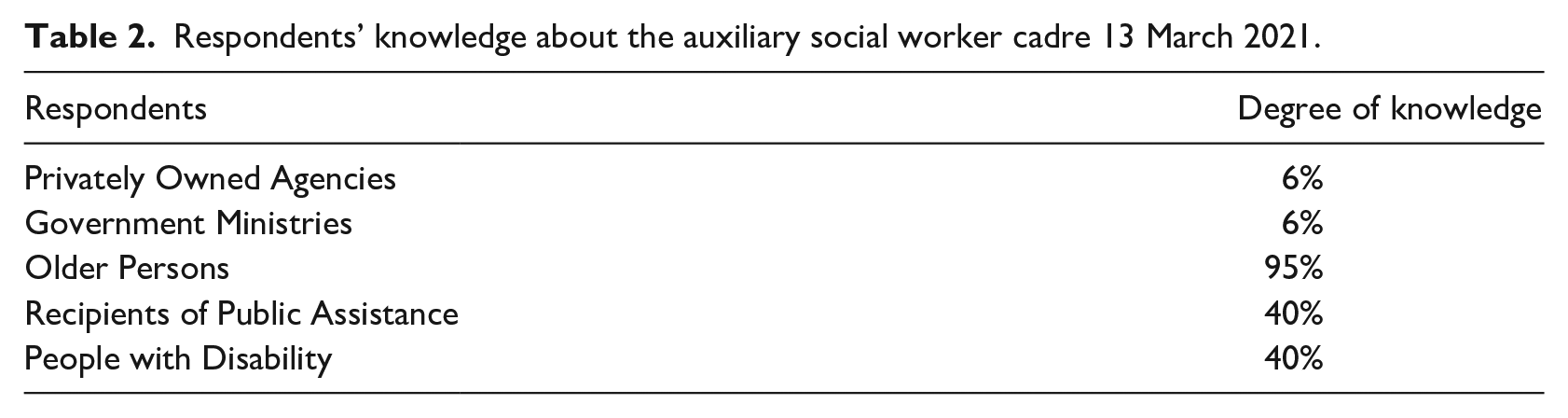
Table 2 below presents respondents’ knowledge about the auxiliary social worker cadre. Participants who work in various government Ministries indicated that there has been a newly introduced cadre of auxiliary social workers or para-professionals in social work. They indicated that they are placed in all community councils to serve as links between communities and District Social Development offices. They assist government Ministries by conducting home assessments and recommending appropriate interventions. According to participant responses from MoSD, the aim is to have one auxiliary social worker per community council in the country.
Respondents’ knowledge about the auxiliary social worker cadre 13 March 2021.
One response from the social worker in a focus group was that Auxiliary social workers are an arm to all offices that offer social welfare services. They don’t only support the Ministry of Social Development, but they also help us as by making referrals to our offices. When we are not able to respond on time due to reasons like unavailability of transport, they help us by making assessments, when there are cases that need our urgent attention, they inform us on time.
As reflected in Table 2 above, most of the social workers in NGOs and private organisations did not know about this cadre. Only 6 percent of those who were interviewed knew about them. It was established that these were only social workers working in agencies that are based in community councils.Furthermore, 60 percent of the clientele in all categories of those interviewed were not aware that there were such officers in their councils. Part of the reason was that most of them lived far from the community council offices, while others never required services from them. MoSD is said to be one of the pioneer Ministries to place auxiliary social welfare officers, at community council level. ‘Properly capacitated, these auxiliaries will be able to play an important role in the front line: verifying beneficiaries, resolving issues, identifying problems, and providing advice on access to wider benefits’ (Government of the Kingdom of Lesotho, 2013). Similarly, in many countries such as South Africa, tasks that used to be undertaken by professional social workers are now provided by para-social workers (Engelbrecht, 2015). This arrangement has proven to be more popular as it reduces employment costs and also made services much more accessible (Gxubane, 2017).
Coordinated social welfare programmes
As reflected in Table 3, most of the participants from government Ministries, NGOs and private organisations also observed that unlike before, there is improved coordination of services in MoSD.
Improved coordination of social welfare programmes 13 March 2021.
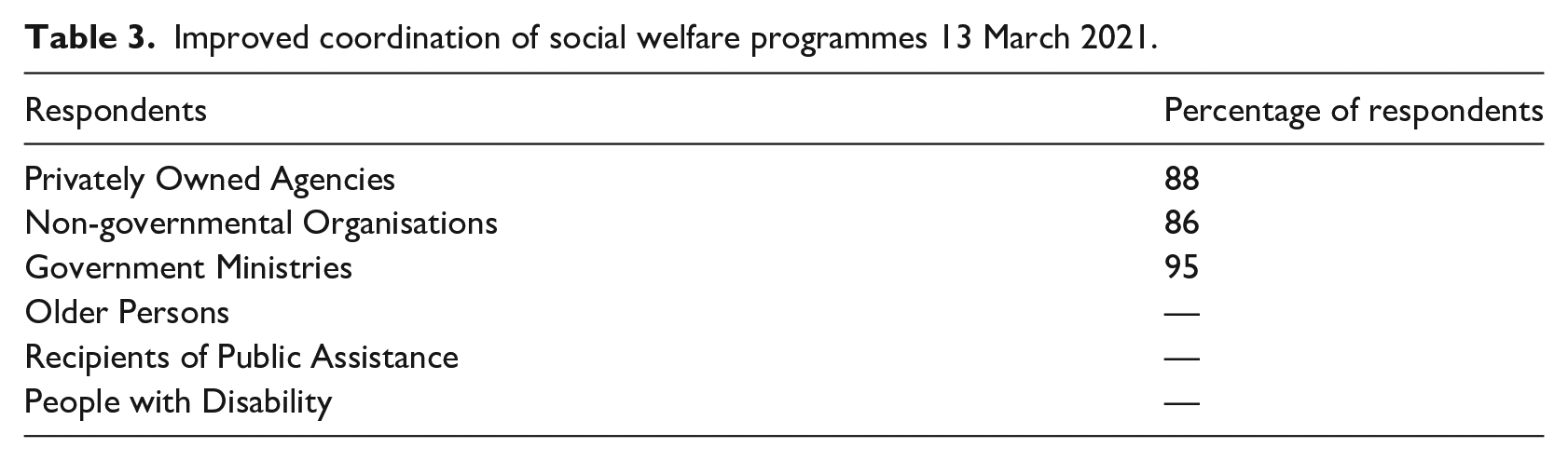
They indicated that programmes work hand in hand in addressing the needs of the clientele; thus, there is use of an integrated approach which involves an integration of social assistance/cash transfer programmes and in particular three main social safety nets, namely, Child Grants Programme (CGP), Public Assistance Programme and Orphans and Vulnerable Children (OVCs) bursary. Participants who work in MoSD further stated that the Ministry also introduced an information system called National Information System for Social Assistance (NISSA) which is a single registry for all social assistance and social security programmes. It contains social and economic data of all clients and households served by the Ministry and the services they receive. This database is used for targeting, planning, managing and monitoring social protection programmes. In an FGD, one of the participants from the NGOs alluded to the improved coordination of services in the Ministry. He indicated that NISSA has made it easy for us to get data about our target clientele without having to physically go to the field. This is so helpful. We all make reference to the same statistical data. Recently we received an approval of a proposal that we developed using statistical data that we got from the NISSA database.
The NSDP also supports the implementation of the NISSA in order to make social protection assistance efficient and it also institutionalises NISSA as a national registry and a harmonised targeting, integration and coordination programme (Government of Lesotho, 2018). Participants from MoSD further mentioned that complementarily, a new Monitoring and Evaluation System (MIS) was also introduced to support integration and management of cash transfer programmes. MIS is key in monitoring and evaluation of social welfare and social development services (Makhetha, 2015). In the same way, the social development policy framework of Botswana, social protection policy of Namibia and national social development policy of Swaziland also highlight that the departments have integrated the MIS tools for targeting, registration, payments and reconciliation into their systems (Ellis et al., 2010; Government of Swaziland, 2010; Republic of Namibia, 2019; Republic of Botswana, 2010). They ensure that there is an up-to-date database on all social development programmes and have developed a National Management Information System for social services to inform policy formulation, planning and monitoring.
Promotion of self-reliance among clients
Results showed that one of the issues that MoSD emphasised a lot on was the promotion of self-reliance and independence among clients. To promote that, some of the clients ceased getting social grants (public assistance allowance) and were helped to start community development projects as a collective.
‘At first, this move was not well received by the majority but with time they welcomed it’, said one of the participants from MoSD.
A major shortcoming of public assistance is that it is operated on a remedial basis as it does not foster independence on the part of recipients. It should be linked to programmes that can build the capacity of beneficiaries to be self-supporting, including poverty alleviation strategies (Dhemba, 2013). A good number of clients have been enrolled into community development projects and are being given all the technical and financial support they require.
‘Most of our clients are now engaged in various income-generating projects such as chicken broilers and piggery projects. Most of them have become successful. They have also acquired skills on how to manage the projects on their own’, said one of the participants from MoSD.
Notably, NGOs and private organisations have always been engaged in activities that promote self-reliance among clients, while the then Department of Social Welfare and other Ministries that offer social welfare services were mainly inclined to the residual approach. One of the participants who works in an NGO lamented that It was really surprising that MoSD was not delivering services that encourage self-reliance amongst clients. Social work has to curb dependence and encourage clients to fend for themselves but the kind of services that were being offered by the Department did not promote that . . . we are happy to see that the Ministry has also introduced a policy that supports that. Government should set an example by introducing initiatives that encourage community development and self-reliance.
Another participant also added that such groups have motivated other communities to start similar projects and are starting to appreciate their potential to bring about change in their lives. She further said that more community representatives have approached her organisation with proposals for funding to start some income-generating projects. According to Spitzer et al. (2014), research conducted in the East African countries of Kenya, Rwanda, Tanzania and Uganda has also revealed that there is some extent of adoption of a developmental approach in practice with social workers engaged in various activities that support a developmental perspective. They further contend that the most common activities of a developmental form of social work include facilitating the formation of well-functioning micro-saving and micro-credit schemes within communities, assisting poor households to start income-generating activities, supporting youths in vocational skills training programmes, and supporting vulnerable children to enrol in school.
Responses from clients also showed that they feel empowered to use their capacities to initiate ideas for new projects. They realise that they are responsible for meeting their own needs and those of their communities at large.
As one social worker said, Clients’ thinking has changed, most of them are now coming to our offices with ideas of starting projects, it is promising that they appreciate their capacities. We help them with training in order to equip them with skills required for running the projects.
Directors also mentioned that clients are becoming aware of their strengths and their capabilities to meet their own needs. Notably, social workers are using a strength-based approach to build on the already existing strengths, resilience and coping mechanisms of the clients. Developmental social work utilises the strength-based approach in assisting service users to appreciate and use their inner resources, skills and abilities for growth (Runganga, 2017). ‘In macro social work, practice, strengths and empowerment are integral elements in bringing about change at community level and are similar to Sen’s notion of capabilities, which has been widely invoked in social development circles’ (Steyn and Lombard, 2013).
According to some participants from government Ministries, some of the clients are at the stage where they manage without the government’s support. They have become independent. This has reduced government expenditure and also led to the growth in household economies.
A welfare system has to facilitate self-reliance in caring, conducive and enabling environment (Du Plessis, 2017). Self-reliance of all inhabitants is fundamental in developmental social welfare (Muinjangue, 2020). In line with the current hegemonic notions in social work, its importance is also highlighted in social development policies in many countries such as Zimbabwe, Botswana, Namibia and South Africa (Dugmore, 2013; Reynaert et al., 2018). Nhapi and Dhemba (2020) indicate that among other outcomes of social development interventions are self-reliance and self-employment.
Challenges met by the Ministry of Social Development following the transition
Slow implementation of developmental activities
Most of the participants who work in government Ministries alluded to the fact that there seems to be very slow progress in a developmental direction. They stated that this could be a result of laxity commonly evident in government Ministries. Usually, there are rigid and stringent procedures to follow before change can be effected and that delays progress (Dhemba and Marumo, 2016). Thus, slow implementation can be a result of bureaucratic processes and that impacts on social service delivery and the achievement of social development goals (Lombard, 2014). On the contrary, the competency of social workers as well as participation of all players and their level of understanding of social development policies can have a significant influence on implementation processes. This was mainly alluded to by social work professional staff. In the words of one of the participants, Effecting change in Government departments can be a long process that is usually derailed by red tape and protocols. Regular change of senior management, thus Ministers and Principal Secretaries also adds to administrative deadlocks. Suffice it to say that, they are usually not conversant with the Social Work profession and cannot comprehend the field quite well.
Some responses also raised the fact that there seems to be confusion on what the social development approach entails. Social work practice in Lesotho is still generally residual and casework-oriented. Related to this, Lombard (2019) contends that ‘social workers are still glued to short-term issues and individual interventions, with hardly any time for longterm development efforts because of the survival needs of client systems and acute poverty issues’. Many developing countries require a developmental perspective in social work education and practice, and all social workers can benefit from learning social development knowledge and abilities (Pawar, 2014).
They view this as a challenge for developmental social work, especially regarding bridging micro and macro interventions and balancing the rehabilitative, promotional, preventive and developmental functions of social work. Patel and Hochfeld (2012) also contend that while developmental social work is founded on national welfare policy and widely endorsed by the social work fraternity, there is still a substantial knowledge gap about the theory and practice of the approach which has hindered its translation into practice. All participants further raised a grave concern of the lack of human and financial resources. The Ministry is not able to carry out some of its duties due to chronic underfunding. Notably, it was hoped that the Department of Community Development, which is tasked with facilitating the transition, would receive adequate funding and resources in general, but it is similarly underfunded and therefore unable to execute its planned activities (Dhemba and Marumo, 2016). The absence of resources and infrastructure is identified as one of the most common difficulties facing social workers (Alpaslan and Schenck, 2012). There is also a huge shortage of social workers with specialised skills. It was established that with an average of five social workers in a district, with no specialised training, it is quite difficult to carry out some activities.
Other participants contend that understaffing and limited knowledge in the area of social development are barriers to executing the social development agenda. Some further mentioned that there are constraints of material resources such as transport. An acute shortage of vehicles in the Ministry also makes it quite difficult to conduct home visits or generally run programme activities. The issue of inadequate office space was also highlighted as one of the challenges.
Lack of recognition by other Ministries
Social workers at all levels lamented that some government Ministries still failed to give MoSD the recognition it deserves. They mentioned that the Ministry was still being considered and treated as a Department and hence being allocated very meagre resources. Others stated that some Ministries felt that MoSD was taking over their roles, for instance, in the case of helping clients to start small-scale enterprises. They pinpointed the government’s failure to recognise the contribution of the Ministry to national social development. This challenge has also been encountered in other countries like Namibia and South Africa. Gray and Lombard (2022) and Chiwara and Lombard (2017) emphasise that there is still a lack of recognition of the contribution that social work can make in national development.
Clients’ fear about the possible implications resulting from the shift
It was also established that clients had great uncertainties about the new Ministry. They felt frustrated, confused, insecure, anxious and sceptical about the shift. Participants also raised a concern that the clientele had not been well prepared about the paradigm shift, and as such, they are still expecting to be assisted in the same old way, thus being given handouts and social grants especially public assistance, even in the case where they can still be helped to start other means of survival. Some clients confirmed that when they heard about the transition, they got confused about the change of name and the explanation they got about the changing system of service delivery. One middle-aged respondent said, I recall the social worker saying that according to the new policy we are expected to start projects that would provide for our families and that meant we would cease getting public assistance. I was worried about whether I would have money to start a project and what kind of a project that would be . . . I had no skills and I had never been involved in a project before. I am on public assistance because I cannot work as I have to take care of my 10 year child who has severe mental retardation. I really thought this transition was not going to benefit us . . . I was confused and frustrated until I had a clear explanation from the rehabilitation officer regarding how we would be helped to gradually be able to get on our feet.
Recommended measures for facilitating the achievement of the developmental social welfare approach in Lesotho
Participants suggested that as more programmes have been formed, additional professional staff should be employed in order to promote efficiency and effectiveness in service delivery. They also raised an observation that this transition has come with expanded services and, as a result, requires more specialised staff at all levels of operation. In line with this recommendation, Dhemba and Marumo (2016) indicate that specialist training is needed for staff deployed into the restructured departments within the Ministry since there are few specialist-trained social workers in the respective areas. They also pinpointed the need for coordination of structures and programmes within the Ministry. They suggested that there should be proper coordination of services by the head office to ensure that frontline social workers, community development workers and auxiliary social workers have clearly defined, harmonised and distinct roles to play. Considering the rate at which social problems are increasing, especially in the rural areas, there was also a recommendation for the government to increase the number of auxiliary social workers. Notably, other countries such as South Africa have also realised the need to engage more specialised staff as well as para-professionals for purposes of ensuring effectiveness and efficiency in social work service delivery (Midgley and Pawar, 2017).
It was further mentioned that as they are based at community level, they could easily assist in starting and supporting community development projects. Although the responses indicated that some clients no longer receive social grants and in particular social assistance, there was also mention of the fact that there is a need to establish a graduation model that would curb dependency on government aid and ensure that clients attain self-reliance. This is also supported by Olivier (2013),who recommends creating exit and graduation modalities as far as possible for those dependent on social transfers. According to Rasool (2017), ‘Graduation’ out of programmes is important in the design of social protection programmes, by combining consumption support (cash transfers, access to savings) and livelihood support (asset transfers and training). It is a way of moving poor people out of dependence on social assistance and into self-reliance and resilient livelihoods.
Based on the results of the study, the researcher also added some recommendations that would enable the Ministry to function effectively. First, it is critical that the profession demonstrates its functions and contribution to addressing social development goals, such as the SDGs more directly. Social workers’ obligation and responsibilities relating to removing the social, political, cultural and structural determinants of poverty and inequalities should be reflected in their strategies, actions and achievements in addressing injustices and social exclusion (Masuka, 2015; Mohamed et al., 2019). In line with the SDGs, the Social Development Policy 2013 should direct strategies of eradicating poverty in all its forms and dimensions, inclusive of extreme poverty (Lombard, 2015). Moving social work towards more sustainable development outcomes requires clear targets and indicators for social work practice and education, in relation to the 17 SDGs (Lombard, 2015).
It is recommended that the National Social Development Policy 2013 should be reviewed; it should not focus on empowering the targeted vulnerable groups alone but it should also stress on empowering the entire communities. A similar approach has been used in Uganda and South Africa whereby self-help groups and the indigenised social work approach have been used to improve social work intervention (Patel and Hochfeld, 2012; Wamara et al., 2022). In response to the social development mandate, social work in South Africa draws heavily on comprehensive community development and this has proved to be an effective means (Gray, 2014). In addition to that, all specialised policies, namely, child welfare, elderly persons, social assistance and disability, should reflect the social development approach. This will ensure that all services bear the developmental element. The policy should also be revised in consideration of the 2030 Agenda for Sustainable development and the Global Agenda for Social Work and Social Development in order for social work to be taken more seriously in policy circles for its contribution to sustainable development. Complementarily, countries such as Uganda have proven that as part of improving social work policies in order to make them developmental, they should also be culturally relevant and indigenised (Wamara et al., 2022). Adopting this in the case of Lesotho will also make room for people’s voices, which is what is emphasised in developmental social welfare.
The Lesotho context also shows that for the social work profession to grow, it needs recognition. Social work must be recognised as an important profession by the government of Lesotho and the general public, and the government must be willing to provide moral and financial support if it is to succeed (Nhapi and Dhemba, 2020). The results of a study that was conducted in the four East African countries of Kenya, Rwanda, Tanzania and Uganda have also shown that social workers in those countries have alluded to the fact that they receive limited recognition for their contribution (Spitzer et al., 2014). The same situation has also been observed in Zimbabwe and South Africa (Masuka, 2015). Social work should be regulated in order to position itself as a role player in social development (Spitzer et al., 2014). This recognition should be supported by a political mandate drawn from broad national policies and legislation regulating the profession. ‘Regulation of social work by law implies that the government has a statutory obligation to develop social work [and] would therefore be more committed to developing the profession’ (Spitzer et al., 2014).
In addition, social workers have to engage in planning, monitoring and evaluation processes that influence social development. They should have representation on national structures that formulate and take responsibility for national development plans and actions. To gain the desired promotion and recognition, that requires a united front among social workers. That means social workers in Lesotho need an active and well-functioning national body that will instil the need for implementing social development either in the form of a National Association or in the form of a National Council. Unlike in other African countries such as Zimbabwe and South Africa which have similar social problems and challenges facing the social work profession, in Lesotho, the National Association for Social Workers is dormant and there is no established council in place (Nhapi and Dhemba, 2020). The social workers’ competency and ability to implement developmental social work will make it possible for other professions to realise and appreciate the existence of the profession.
As mentioned earlier, there has to be a common understanding of the developmental social work mandate; otherwise, this will also have a serious impact on progress in developmental social work in Lesotho. Social work practitioners at all levels require training in developmental social work to gain re-orientation towards their developmental role (Patel and Hochfeld, 2012). Spitzer et al. (2014) indicate that since social development is an emerging approach, it presents ‘pressing implementation challenges’, and in many developing countries, social workers are involved in developmental activities for which they have received little if any training. They further emphasise that the social development approach requires that the above developmental roles be given priority in education and practice to adequately prepare practitioners for effective interventions.
Like elsewhere in Africa, in order to bring about the social development approach, social work in Lesotho should first and foremost deal with the manifold manifestations of poverty, social exclusion and social inequality (Spitzer et al., 2014). The proportion of the poor in Lesotho has been increasing from the mid-1980s and the absolute number of poor people has been increasing significantly. Although it is still necessary for MoSD to assist the needy and vulnerable people at a micro level, it is also important to introduce macro-level interventions and policies. In line with this argument, Spitzer et al. (2014) assert that ‘this is probably the major future challenge for social work in East Africa: to transcend the micro-macro divide and re-conceptualise its professional mandate towards both grassroots interventions and macro policies’. From responses obtained in the study, it is evident that social welfare services are mainly focusing at a micro level. However, the transition has to consider development at a meso level as that is where the social development approach should mainly be undertaken.
Although Lesotho has formulated the National Social Development Policy, it is evident that for the Ministry to enforce the implementation of a social development approach in all its services, it requires a clear policy that gives formal legitimacy to developmental social work. In relation to this recommendation, with South Africa being the pioneer, more other countries in the Southern African region such as Botswana, Zimbabwe and Eswatini have also introduced social development policies with the intention of transforming into developmental social work (Nhapi and Dhemba, 2020). However, it has also been noted that in some African countries like Kenya, the developmental social work method was not fully implemented because there was no all-inclusive legislation or policy that directly and precisely restricts itself to the developmental social work method (Manyama, 2018). Social work must be recognised as an important profession by the government of Lesotho and the general public, and the government must be willing to provide moral and financial support if it is to succeed (Nhapi and Dhemba, 2020).
At the core of social work practice in Lesotho should be its transformative potential in driving towards developmental social work and a new eco-social world that is inclusive of all people. Social work should uphold its commitment to promote social and economic equality, the dignity and worth of people and environmental and community sustainability.
Conclusion
The overall conclusion is that although MoSD has introduced new programmes and policies, the progress of social welfare service delivery towards the developmental approach is very slow. As discussed in this study, social welfare service delivery in the rural setting is traditionally more difficult and challenging due to the chronic shortage of infrastructure and resources (Alpaslan and Schenck, 2012). The minimal involvement of social workers in facilitating sustainable livelihoods, integrating social and economic development and social entrepreneurship has become a barrier to the developmental approach. Notably, there is no evidence of tangible developmental social welfare service delivery to other groups of service users and vulnerable groups. All in all, social services are concentrated at micro level and not at macro level as expected in developmental social service delivery.
Footnotes
Funding
The author received no financial support for the research, authorship and/or publication of this article.
