



Abstract
This study aims to relate the sociodemographic and work-related variables that characterize social work professionals with the presence or absence of burnout. A single-group ex post facto prospective descriptive design questionnaire was created incorporating sociodemographic data and the Maslach Burnout Inventory. The study involved 442 members of professional social workers’ associations in Spain. The results indicated a burnout prevalence of 11.4% among the participants and a strong tendency to suffer from it. Significant differences were also found in the sociodemographic and work-related variables collected.
Keywords
Introduction
The concept of Burnout was defined by Freudenberger in 1974 as the exhaustion stemming from a high number of responses to many demands. Maslach and Jackson (1986) characterized it in three dimensions: emotional exhaustion (the wearing down of emotional resources when feeling unable to cope with the situation), depersonalization (the development of negative, distant, and cold attitudes, thoughts, and feelings toward users and coworkers), and personal accomplishment at work (the negative evaluation of one’s own work and results, considering them to be a failure).
This situation is experienced daily by social workers who struggle to balance their large workloads with insufficient resources, both material and complex social situations, role ambiguity, a lot of bureaucracy, and little social recognition (Gómez-García et al., 2019).
With these working conditions, burnout has a high prevalence among social workers in Spain (González-Rodríguez et al., 2020). The risk factors that favor the appearance and subsequent development of burnout syndrome according to previous literature focus on environmental/organizational factors and individual factors (McFadden et al., 2015). In previous research linking burnout to sociodemographic and work-related variables in social workers, Romero-Martín et al. (2020) found burnout prevalence scores ranging from a minimum of 25.3% (Expósito & Huerta, 2010) to a maximum of 29.9% (Caravaca-Sánchez et al., 2019) among social workers. With regard to the scale of burnout, Spanish social workers have also reported high levels of emotional exhaustion ranging from 33.2% to 62% (Caravaca Caravaca-Sánchez et al., 2019; De la Fuente & Sánchez, 2012; Facal-Fondo, 2012; Gómez-Garcia et al., 2019; Sánchez-Moreno et al., 2015); depersonalization levels of between 22.1% and 70.1% (Caravaca-Sánchez et al., 2019; De la Fuente & Sánchez, 2012; Gómez-García et al., 2019; Ramiro, 2014; Sánchez-Moreno et al., 2015) – with the single exception of one study which showed a depersonalization level of 6.7% (Facal-Fondo, 2012); and low levels of personal accomplishment ranging from 21.2% (Sánchez-Moreno et al., 2015) to 77.9% (Caravaca-Sánchez et al., 2019).
Romero-Martín et al. (2020) also found that With regard to sex, many studies note that social work is a mostly female profession (Báñez, 2012), with women being found to display greater emotional exhaustion and depersonalization (Caravaca-Sánchez et al., 2019; Vilá et al., 2015) and to have a statistically more significant susceptibility to burnout (Caravaca-Sánchez et al., 2019; Gillespie, 2013; Kim et al., 2011) than their male coworkers.
With regard to age, some articles indicate that the highest levels of emotional exhaustion occur among younger workers (Vilá et al., 2015) or that emotional exhaustion decreases with age (Morilla-Luchena et al., 2019). Others conclude that being younger than 40 acts as a protective factor against emotional exhaustion and low personal accomplishment (De la Fuente & Sánchez, 2012). On the other hand, Vilá et al. (2015) suggest that high personal accomplishment increases with age, and depersonalization levels are higher between the ages of 34 and 43 than among younger people. This concurs with the conclusions drawn by Soto-Rosales & González-Losada (2018).
With regard to family status, single people have been found to have a statistically significant relationship with burnout presence (Caravaca-Sánchez et al., 2019; Wagaman et al., 2015) while having children is linked to a lower risk of emotional exhaustion (Gómez-García et al., 2019). In the workplace, some studies report high burnout (De la Fuente & Sánchez, 2012), greater emotional exhaustion (De la Fuente & Sánchez, 2012; Facal-Fondo, 2012), and depersonalization (Caravaca-Sánchez et al., 2022) among professionals involved in primary social care. The results obtained for depersonalization and low personal accomplishment are more varied, ranging from 10% (Facal-Fondo, 2012) to 70% (Caravaca et al., 2019) for the first dimension, and from 21.2% (Sánchez-Moreno et al., 2015) to 77.9% (Caravaca et al., 2019) for the second. In this sector, working in primary social care would appear to imply a higher risk of burnout than working in specialized social services (Gómez-García et al., 2019). The same article also indicates higher levels of personal accomplishment in the private sector than in public administration.
With regard to the size of companies, it has been found that the lower the number of workers, the lower the presence of burnout and its different dimensions (De la Fuente & Sánchez, 2012). One study, focusing on working conditions, showed that staff with indefinite contracts experienced less emotional exhaustion (Soto-Rosales and González-Losada, 2018) while another suggested just the opposite (Vilá et al., 2015). Emotional exhaustion would appear to increase with the number of hours worked (De la Torre and Jenaro, 2019). In addition, full-time employees display higher levels of depersonalization than part-time employees (Gómez-García et al., 2019).
In the career development analysis carried out by De la Torre and Jenaro (2019), it was found that levels of depersonalization are lower in first jobs than in subsequent jobs, while emotional exhaustion increases with work experience. Longer job tenure is also associated with the presence of burnout (Ben-Porat and Itzhaky, 2015; Kim et al., 2011), with some articles suggesting that seniority may increase emotional exhaustion (De la Fuente & Sánchez, 2012; Morilla-Luchena et al., 2019). Specifically, Morilla-Luchena et al. (2019) found statistically significant differences, for both emotional exhaustion and burnout presence, between staff with less than 3 years of seniority in the company and staff who had occupied their posts for between 3 and 15 years (showing susceptibility to burnout). They also found that people with more than 15 years of seniority may have higher levels of depersonalization.
A link has also been identified between different dimensions of burnout and levels of job satisfaction (Caravaca-Sánchez et al., 2019; Hombrados-Mendieta and Cosano-Rivas, 2013).
Regarding the relationship between burnout and health, one study shows that social workers who have been on leave experience the syndrome to a greater extent (Gómez-García et al., 2019), while others have associated burnout and its different dimensions with psychological distress (Gil-Monte, 2005; Gil-Monte & Peiró, 1997) in 42% of social workers (De la Fuente & Sánchez, 2012). Barrera et al. (2015) reported that 60.77% of workers are exposed to physical or psychological risks attributable to their professional activity. Burnout has also been linked to a decrease in the perception of support at work (Hombrados-Mendieta & Cosano-Rivas, 2013; Maslach & Jackson, 1986; Sánchez-Moreno et al., 2015) and, specifically, to the absence of informal social support (Koeske & Koeske, 1989; Sánchez-Moreno et al., 2015). On the other hand, suffering from a chronic illness has been associated with high levels of emotional exhaustion (Gómez-García et al., 2019).
In view of the above, social work is considered a high-risk profession for burnout (Lloyd et al., 2002), with very demanding sociodemographic characteristics and working conditions that directly influence the prevalence of the syndrome. Due to the shortage of specific studies on Spanish social workers, however, more research was required. This study, therefore, includes 48 sociodemographic and work-related variables which will facilitate a broad, detailed description of the link between these variables and burnout and thereby alleviate the consequences of this syndrome for professionals, users, and society as a whole (Gil-Monte, 2001). Moreover, burnout is a topic of great interest and currency, especially after a pandemic such as COVID-19, in which it is hypothesized that the risks may have increased because this pandemic is characterized by a period of population confinement, feelings of helplessness, a lack of enthusiasm, and low self-esteem, which could have been very present due to the workload and the danger of contagion as well as implementing new intervention models such as teleworking (Martínez-López et al., 2021).
The aims of this work is (a) to look into the sociodemographic and working conditions of Spanish social workers, (b) to update burnout prevalence rates in Spanish social workers, and (c) to establish links between the different sociodemographic and work-related variables that characterize social work and the presence or absence of burnout.
Method
Design and procedure
Using a single-group ex post facto prospective descriptive design, data were collected from a sample of social workers registered in different professional social workers’ associations in Spain.
To collect the data, each association was invited to distribute a questionnaire among their members. We explained to them the reason we were carrying out the research and the importance of their collaboration, informing them of the purpose and the data processing that would be carried out. Each social work professional was informed individually that participation in the survey was completely voluntary and that there would be no problem if they preferred not to collaborate in the study. If they did decide to take part, they were assured that they could drop out at any time with no repercussions. They were also assured that the survey was anonymous and in compliance with the Declaration of Helsinki and (Spanish) Organic Law 3/2018, of December 5th, regulating personal data protection and the guarantee of digital rights. This study had been approved by the Ethics Committee of the University of Cordoba (Spain) and all participants have provided either verbal or written consent. Finally, they were given the assignment and contact details of the people running the project, in case they had any queries.
Participants
To predetermine the sample size, a simulation was carried out using the GPower 3.1 application. For an expected frequency of 5% and a margin of error of 0.05, it was established that a minimum of 300 persons should be sampled. Systematic random sampling was used, and the sampling design was incidental clustering. The subjects belonged to 29 professional social workers’ associations from 36 professional associations existing in Spain. Professional associations are organized territorially on a provincial, autonomous, or multiprovincial level. All of them make up the General Council of Social Work, which is the representative, coordinating, and executive body of the 36 professional associations (Almeria, Cadiz, Huelva, Jaen, Cordoba, Granada, Malaga, Seville, Alicante, Valencia, Castellon, Araba, Biscay, Gipuzkoa, Avila, Badajoz, Caceres, Burgos, Leon, Palencia, Soria, Galicia, Aragon, Asturias, Madrid, Castile-La Mancha, Catalonia, Cantabria, La Rioja, Murcia, Navarre, Balearic, Las Palmas, Santa Cruz, Valladolid–Segovia, Salamanca–Zamora). These professional associations are recognized as public law corporations by the Spanish Constitution and created by public authorities to carry out an independent and impartial control of the professional activity that enables citizens to exercise their rights with total guarantees. The study finally involved 442 social workers, all of whom met the abovementioned condition.
Instruments
An ad hoc questionnaire was developed which included the following instruments:
Sociodemographic and labor questionnaire
A self-elaborated questionnaire was designed ad hoc specifically for our study, reviewed by a group of social work experts from the governing board of the professional social work association in Cordoba (Spain), as this study is part of an industrial doctorate program with this institution (see supplementary material online for questionnaire).
The questionnaire, which was created based on the literature review included in the previous section, included 48 sociodemographic and work-related variables associated with burnout, that are shown in, Tables 1, 2, and 3.
Maslash Burnout Inventory
Burnout was assessed with the Maslach Burnout Inventory (MBI; Maslach and Jackson, 1986). The MBI is a 22-item scale including three dimensions: emotional exhaustion (EE; the wearing down of emotional resources when feeling unable to cope with the situation), made up of items 1, 2, 3, 6, 8, 13, 16 and 20; depersonalization (DP; the development of negative, distant and cold attitudes, thoughts and feelings toward users and co-workers), made up of items 5, 10, 11, 15 and 22; and personal accomplishment at work (PA; the negative evaluation of one’s own work and results, considering them to be a failure), defined by items 4, 7, 9, 12, 17, 18 and 21. To specify the cut-off points, the Spanish version developed by Seisdedos (1997) was used, dividing up the scores into three categories for each dimension, as follows: low EE (less than 18 points), medium EE (from 19 to 26 points) and high EE (more than 27 points); low DP (less than 5 points), medium DP (from 6 to 9 points) and high DP (more than 10 points); low PA (less than 33 points), medium PA (from 34 to 39 points) and high PA (more than 40 points). In general, scores higher than 21 in EE and 5 in DP and lower than 36 in PA determined the presence of burnout. The Cronbach’s α coefficients ranged from .71 to .90.
Territorial distribution of the simple.

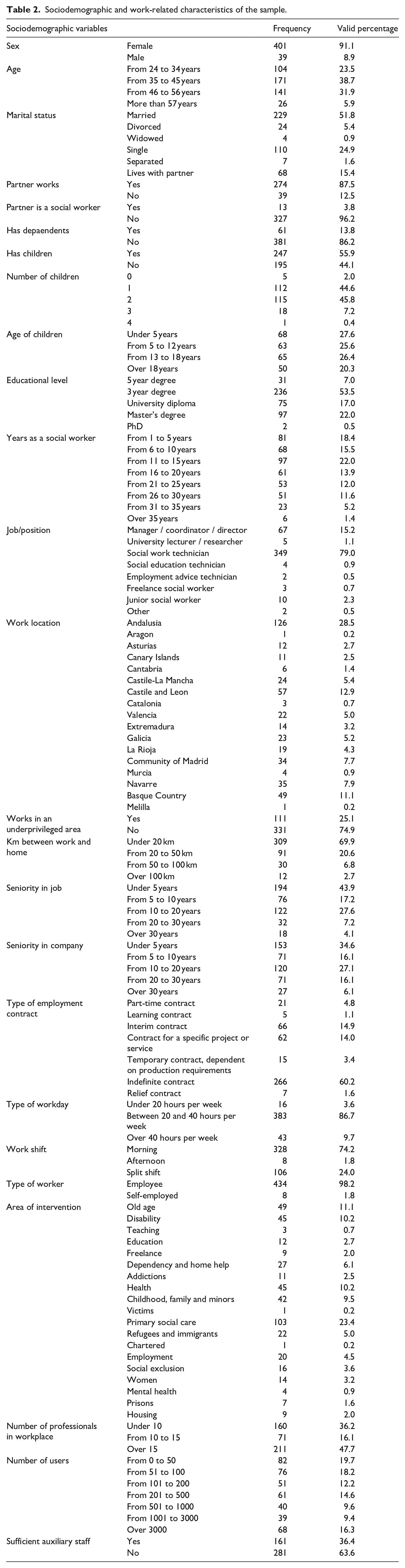
Sociodemographic and work-related characteristics of the sample.
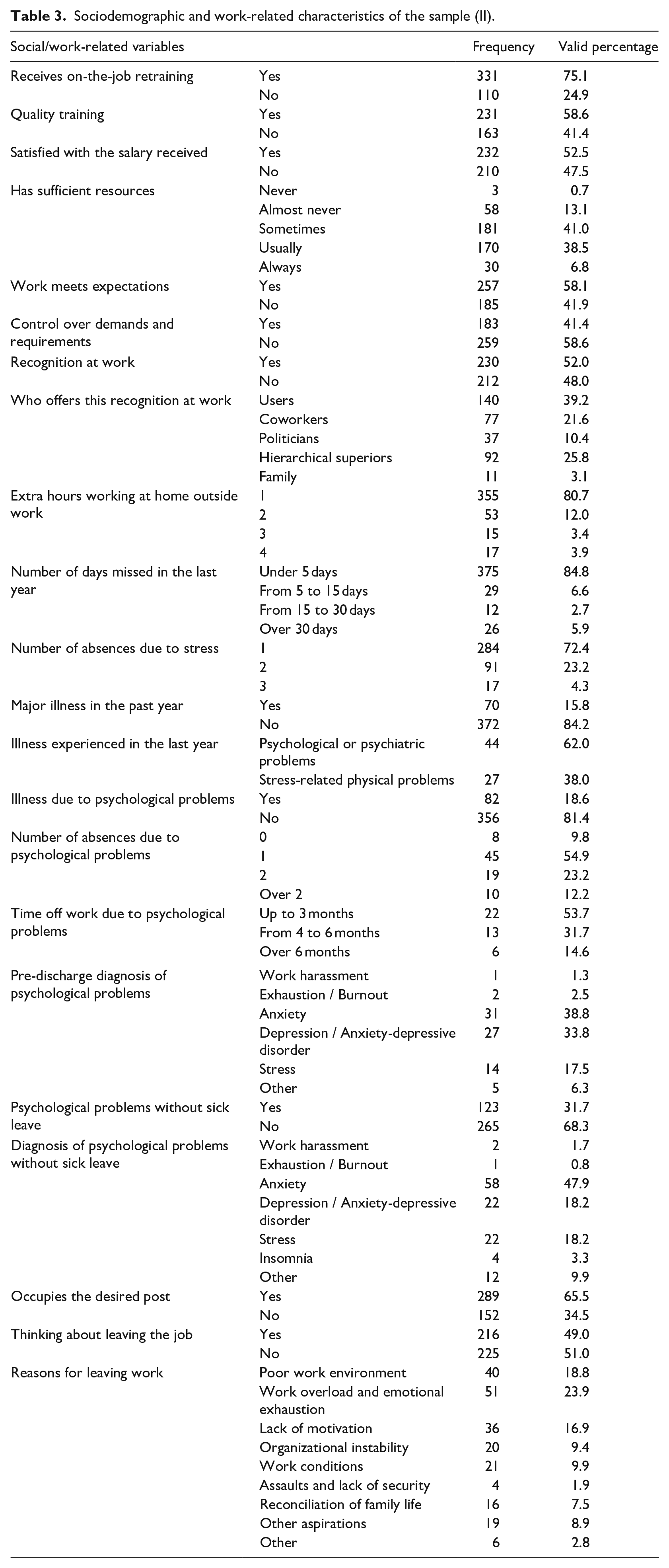
Sociodemographic and work-related characteristics of the sample (II).
Data analysis
Once the data had been collected, they were analyzed using SPSS statistical software v.24. The sample was analyzed descriptively, and a chi-square correlation analysis was performed between the sociodemographic and work-related variables collected and the scores obtained for burnout and its different dimensions. Finally, an analysis of variance (ANOVA) was performed to determine the differences between the sociodemographic and work-related variables with regard to the total burnout variable.
Results
Sociodemographic and social–occupational description
To begin with the first objective, the sociodemographic and social-occupational characteristics of the participants were described. The territorial distribution of the sample is shown in Table 1, the socio-demographic distribution is shown in Table 2, and the social-occupational distribution is shown in Table 3.
It can be seen in Table 1, 91.1% of the respondents were women and 8.9% were men. The average age was 42.02 years, being the most represented age group between 35 and 45 years (38.7%). In all, 73.5% of the social workers were married or living with a partner and 55.9% had children, 90.4% of them had between 1 and 2 children of very different ages, mainly under 5 years (27.6%). Among those who had a partner, 87.5% of their partners worked, 96.2% of them in other professions than social work. In all, 86.2% of the social workers surveyed recognized that they did not have dependants. Regarding working data (see Table 1), the profile of the social workers surveyed was the following: This was a social worker with a diploma in Social Work (53.5%), who had been working as a social worker between 11 and 15 years (22%), who worked as a technician in social work (79%), in Andalusia (28.5%), whose job was not in a disadvantaged area (74.9%), and it was less than 20 km from home (69.9%). They had been in this job for less than 5 years (43.9%) as well as in the company (34.6%). In all, 60.2% of the respondents had an indefinite contract, worked between 20 and 40 hours per week (86.7%) in the morning shift (74.2%) and were employed (98.2%). The majority of the sample work in Primary Care of Social Services (23.4%), in entities with more than 15 professionals (47.7%) who attended from 0 to 50 users (19.7%), who did not have enough auxiliary staff (63.6%).
In relation to working conditions, Table 2 shows that 75.1% of social workers surveyed received retraining in their work and 58.6% of them thought that it was of high quality. Furthermore, 52.5% of the respondents were satisfied with the salary they received, 41% thought that they only sometimes had sufficient resources to do their job, 58.1% admitted that their work met their expectations, although 58.6% felt that they did not have the control over the demands and requirements of their job. Besides, 52% of professionals felt recognized in their work, especially by users (39.2%). They also confessed that they spent an extra hour at home outside work (80.7%). Moreover, 88.4% of the social workers had missed less than 5 days of work in the last year, 72.4% of them missed due to stress. In all, 84.2% of the respondents had not had any major illness in the last year, and among those who had it was due to psychological problems (62%), which had caused time off work (54.9%) lasting for 3 months (53.7%). The diagnosis of time off due to psychological problems, in 38.8% of the cases, was due to anxiety. In addition, 68.3% of the cases reported that they had not suffered psychological problems without sick leave. However, 47.9% of those who had had psychological problems without sick leave also showed a diagnosis of anxiety. On the other hand, 65.5% of participants confessed that they were in the job they wanted and 51% of surveyed said that they would not leave their job, although those who would leave their job said that it would be because they were in a bad working environment (18.8%).
Prevalence of burnout
Regarding the second objective of the study – the updating of burnout prevalence in Spanish social workers – it was found that the participants had scores for emotional exhaustion and depersonalization higher than the previously reported cutoff points, and average scores for personal accomplishment (see Table 4). In all, 57.3% of those questioned had high EE, 62.6% of them also had high DP attitudes, and 20.8% had feelings of low PA at work. Considering the overall scores for burnout, it was found that 11.4% of the 442 professionals experienced the syndrome.
Distribution of the sample according to burnout.

Relationship between the sociodemographic and social-occupational variables with the presence or absence of burnout
To achieve the third objective – that of exploring the relationship between the sociodemographic variables that characterize social work and the presence or absence of burnout – a correlational analysis was carried out based on the chi-square test. The results are shown in Table 5.
Relationship between burnout and socio-demographic and work-related variables.

EE: Emotional Exhaustion; DP: Depersonalization; PA: Personal Accomplishment.
p < 0,05.
Sociodemographic
Statistically significant differences were observed between the sex variable and the EE dimension (χ2 = 6.216; p = 0.045), indicating a higher prevalence of emotional exhaustion among women, but the low number of male participants does not allow us to present conclusive results on burnout in male social workers. A link was also found between the has children variable and PA (χ2 = 6.718; p = 0.035), suggesting that personal accomplishment levels were higher among people who did not have children.
Work conditions
On the other hand, quality of training was found to be related to the presence of burnout (χ2 = 7.599; p = 0.006); to EE (χ2 = 14.993; p = 0.001); and to DP (χ2 = 6.114; p = 0.047). When the training received was of poor quality, there was an increase in the presence of burnout, emotional exhaustion, and depersonalization.
Burnout was also found to be related to the work location variable (χ2 = 38.135; p = 0.002), with the risk of experiencing the syndrome being higher in regions such as Andalusia than in other regions; to the seniority in company variable (χ2 = 11.674; p = 0.020), with the presence of burnout increasing the longer a person has worked in their company; and to the type of employment contract variable, with the presence of burnout being significantly greater (χ2 = 14.519; p = 0.024) in indefinite contracts.
Regarding the type of workday, a relationship with emotional exhaustion was observed (χ2 = 13.568; p = 0.009), with EE levels rising as the length of the workday increased. The satisfied with the salary received variable was also related to EE (χ2 = 9,168; p = 0.010), with higher levels of EE being found in people dissatisfied with their salary. In the area of intervention variable, statistically significant differences were also found with EE (χ2 = 54,958; p = 0.022) and DP (χ2 = 71,756; p = 0.000), with the highest incidence rates being found in primary social care.
Having sufficient resources was also associated with the EE dimension (χ2 = 67.957; p = 0.000) and with DP (χ2 = 38.602; p = 0.000). Here, emotional exhaustion and depersonalization levels seemed to be lower when sufficient resources were available with which to do the job.
A relationship was also found between the number of professionals and the presence of burnout (χ2 = 6.429; p = 0.040): the more professionals there are in a place of work, the lower the presence of burnout.
The number of users is also related to DP (χ2 = 22.332; p = 0.034): the higher the number of users, the greater the sense of depersonalization.
With respect to whether a workplace had sufficient auxiliary staff, a relationship was detected between this variable and the presence of burnout (χ2 = 6.486; p = 0.011); EE (χ2 = 29.380; p = 0.000); and DP (χ2 = 8.186; p = 0.017): the fewer the auxiliary staff, the greater the presence of burnout, emotional exhaustion, and depersonalization.
Satisfaction on job
The work meets expectations variable was found to be related both to EE (χ2 = 38.881; p = 0.000) and to DP (χ2 = 17.103; p = 0.000). The less a person’s work met their expectations, the greater the emotional exhaustion and depersonalization they suffered.
Significant links were found between control over demands and requirements and the presence of burnout (χ2 = 17.119; p = 0.000); EE (χ2 = 99.628; p = 0.000); DP (χ2 = 29.198; p = 0.000); and PA (χ2 = 9.777; p = 0.008): the lower a person’s control over the demands and requirements of their job, the greater the presence of burnout, emotional exhaustion and depersonalization, and the lower the feeling of personal accomplishment.
Significant differences were also found for recognition at work with regard to the presence of burnout (χ2 = 11.234; p = 0.001); to EE (χ2 = 74.604; p = 0.000); to DP (χ2 = 26.934; p = 0.000); and to PA (χ2 = 11.086; p = 0.004). The lower a person’s perceived recognition at work, the higher their levels of burnout, emotional exhaustion, and depersonalization, and the lower the feeling of personal accomplishment.
With regard to who offers this recognition at work, this variable is also linked to EE (χ2 = 36.341; p = 0.000); to DP (χ2 = 16.443; p = 0.036) and to PA (χ2 = 17.867; p = 0.022), with recognition mostly coming from users.
The occupies the desired post variable was also related to the presence of burnout (χ2 = 9.781; p = 0.002) and EE (χ2 = 18.44d9; p = 0.000): the less a person is in the job they want, the greater the presence of burnout and emotional exhaustion.
The thinking about leaving the job variable was related to the presence of burnout (χ2 = 8.477; p = 0.004); EE (χ2 = 42.723; p = 0.000); and DP (χ2 = 13.899; p = 0.001). The less a person thinks about leaving their job, the lower the presence of burnout, emotional exhaustion, and depersonalization. A relationship can also be seen between the reasons for leaving the job and EE (χ2 = 51.267; p = 0.000), which may rise due to work overload.
Health
A relationship was also found between the number of days missed in the last year and EE (χ2 = 17.583; p = 0.007): the higher the number of days missed in the last year, the greater the emotional exhaustion experienced.
About the number of absences due to stress, a relationship was found between this variable and the presence of both burnout (χ2 = 15.952; p = 0.000) and EE (χ2 = 34.951; p = 0.000): the higher the number of absences due to stress, the greater the presence of these two syndromes.
With regard to having had a major illness in the last year, this variable was also found to relate to the presence of both burnout (χ2 = 6.072; p = 0.014) and EE (χ2 = 17.933; p = 0.000). Not having had a major illness in the last year was found to decrease the presence of these two syndromes.
Regarding illnesses experienced in the last year, a link was found between this variable and the presence of burnout (χ2 = 5.102; p = 0.024), EE (χ2 = 9.765; p = 0.008), and PA (χ2 = 7.155; p = 0.028). This was mainly attributable to psychological or psychiatric problems.
It was also found that the pre-discharge diagnosis of psychological problems was related to EE (χ2 = 19.079; p = 0.039), especially anxiety.
Regarding having suffered psychological problems without sick leave, significant differences were found with the presence of burnout (χ2 = 4.706; p = 0.030); and also, with EE (χ2 = 28.633; p = 0.000): the fewer the psychological problems suffered, the lower the presence of burnout and emotional exhaustion.
No significant differences were observed for the rest of the variables:
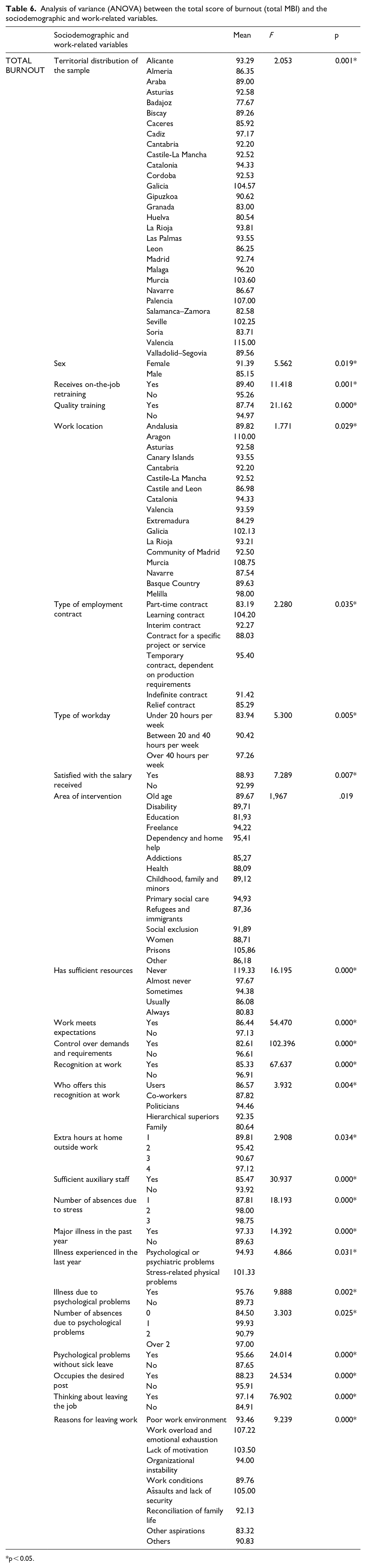
Afterwards, an ANOVA was also performed to compare the total score of burnout according to each sociodemographic and work-related variables. The results can be seen on Table 6, finding differences statistically significant such as a territorial distribution of the sample (F(1.785) = 2.053; p < 0.05); sex (F(0.046) = 5.562; p < 0.05); receives on the job retraining (F(1.049) = 11.417; p < 0.05); quality of training (F(1.289) = 21.162; p < 0.005); work location (F(1.760) = 1.771; p < 0.05); type of employment contract (F(0.838) = 2.280; p < 0.05); type of workday (F(1.210) = 5.300; p < 0.05); satisfied with the salary received (F(0.090) = 7.289; p < 0.05); area of intervention (F(0.820) = 1.967; p < 0.05); has sufficient resources (F(2.579) = 16.195; p < 0.05), work meets expectations (F(0.048) = 54.470; p < 0.05), control over the demands and requirements of their job (F(1.137) = 102.396; p < 0.05), recognition at work (F(1.339) = 67.637; p < 0.05), who offers this recognition (F(1.061) = 3.392; p < 0.05), overtime (F(1.599) = 12.908; p < 0.05), sufficient auxiliary staff (F(0.446) = 30.937; p < 0.05), number of absences due to stress (F(1.151) = 18.193; p < 0.05), major illness in the past year (F(6.185) = 14.392; p < 0.05), illness experienced in the last year (F(1.914) = 4,866; p < 0.05), time off work due to psychological problems (F(0.006) = 9.888; p < 0.05), number of absences due to psychological problems (F(0.710) = 3.303; p < 0.05), psychological problems without sick leave (F(0.033) = 24.014; p < 0.05), occupies the desired post (F(0.005) = 24.534; p < 0.05), thinking about leaving the job (F(0.912) = 76.902; p < 0.05), and reasons for leaving work (F(1.295) = 9.239; p < 0.05).
Analysis of variance (ANOVA) between the total score of burnout (total MBI) and the sociodemographic and work-related variables.
p < 0.05.
Discussion
The objectives of this study were to look into the sociodemographic and working conditions of Spanish social workers, update the figures for burnout prevalence among Spanish social workers, and relate the sociodemographic and work-related variables that characterize social work with the presence or absence of burnout. These objectives can be said to have been accomplished.
In this study, burnout prevalence was 11.4% of the social workers surveyed, with an EE dimension in 57.3% of cases, DP in 62.6%, and PA in 20.8%. The value obtained for burnout prevalence was lower than that reported in other articles focusing on social work (Romero-Martín et al., 2020), which set the minimum at 25.3%. Within the dimensions of burnout, however, high levels of emotional exhaustion and depersonalization scores were reported, coinciding with other studies (Caravaca-Sánchez et al., 2019; De la Fuente & Sánchez, 2012; Gómez-García et al., 2019; Sánchez-Moreno et al., 2015).
Personal accomplishment levels were found to be lower than the 21.2% mentioned by Sánchez-Moreno et al. (2015) but remained at a medium level, coinciding with Ramiro (2014). Only 20.8% of the professionals surveyed assessed themselves negatively enough to suggest that their mental state affected how they performed their duties and that they felt dissatisfied with their work. Being less than the cutoff value of 21.2%, this percentage is in theory not high enough to indicate a low level of personal accomplishment in the sample. It is, however, high enough to suggest that there may be many more people with a burnout in the sample.
Regarding the relationship between sociodemographic and work-related variables and the presence of burnout, the results coincided with previous studies in which social workers who had been on sick leave suffered more burnout (Gómez-García et al., 2019) and in which psychological distress was related to the presence of burnout and its different dimensions (Gil-Monte, 2005; Gil-Monte Peiró, 1997; Ríos et al., 2008), with symptoms of anxiety and stress strongly associated with burnout. The female sex was also found to be more susceptible to emotional exhaustion (Caravaca-Sánchezet al., 2019; Vilá et al., 2015), perhaps because women have greater difficulty in balancing work and family life. Here, however, it should also be kept in mind that social work is a highly feminized profession.
Not having children was also found to be positively related to burnout (Gómez-García et al., 2019), probably because having children and being involved with the family improves a person’s ability to manage emotional conflicts.
Previous studies had already confirmed a positive relationship with emotional exhaustion (De la Fuente & Sánchez, 2012; Facal-Fondo, 2012) and depersonalization (Caravaca-Sánchez et al., 2022) among primary social care professionals, this being the most representative field in the profession.
Regarding the number of professionals, the literature suggests that the lower the number of workers, the lower the presence of burnout and its dimensions (De la Fuente & Sánchez, 2012). In this study, however, we found the opposite, perhaps due to the work overload experienced by social workers, with decreases in human resources contributing to the appearance of burnout (Santa Fernández, 2004).
Having a stable type of employment contract, such as an indefinite contract, has been found to be positively related to burnout (Vilá et al., 2015), probably because the staff who have been working in a position for a long time tend to burn out. A longer type of workday has also been related to an increase in burnout (De la Torre and Jenaro, 2019; Gómez-García et al., 2019).
Regarding seniority in the job, Morilla-Luchena et al. (2019) agreed that people with more than 15 years of seniority in a company were susceptible to burnout. Earlier studies have also coincided in pointing out the link between burnout and the absence of recognition at work (Hombrados-Mendieta & Cosano-Rivas, 2013; Maslach Jackson, 1986; Sánchez-Moreno et al., 2015). Regarding training, Ramiro and Montaño (2017) affirmed that receiving quality training is essential for preventing burnout and developing professionals’ capacities to handle this syndrome. On the other hand, the inability to cope with the demands and requirements of the job (Cox et al., 1993; Muñoz de Arenillas Castro, 2020; Spaniol & Caputo, 1979), as occurs when the work performed does not meet previous expectations (Santa Fernández, 2004), was also positively related to burnout. Again, this coincided with other studies. When the salary received is perceived as low, inadequate for the duties performed, or inappropriate considering the academic qualifications held, this too can lead to demotivation and dissatisfaction with the job and, subsequently, burnout (González García & González González, 2018). In this study, attending to many users was positively related to burnout because it increases overload. This would appear to contradict the study by De la Fuente & Sánchez (2012) in which attending to more users seemed to be a protective factor. Work overload prevents appropriate concentration on a job, leading to thoughts of leaving the job, and this in turn is also related to burnout (Gil-Monte & Peiró, 1999; Morales-Llamas et al., 2020). Regarding work location, three studies carried out on burnout among social workers in Andalusia have shown a high prevalence of the syndrome (Barrera et al., 2015; Hombrados-Mendieta & Cosano -Rivas, 2013; Soto-Rosales & González-Losada, 2018). This may also be since most of the participants came precisely from that region. Santa Fernández (2004) linked not having sufficient resources with the appearance of burnout, implying that having sufficient resources would therefore be negatively related. This was corroborated in this study. Finally, a link was found between the presence of burnout and not occupying the desired post, as indicated by Roca (2016).
One of the limitations of this study was its method of data collection since a survey was carried out by the different professional social workers’ associations in Spain to which professionals interested in the subject responded voluntarily, and this may have entailed a certain amount of selection bias and the results may have been somewhat underestimated. It is also necessary to consider the social desirability bias inherent in self-reporting in order to give the best possible image, despite having guaranteed anonymity. In addition, the sample includes 401 women and only 39 men because social work is a profession that is feminized; but the low number of male participants does not allow us to present conclusive results on burnout in male social workers.
Moreover, it should be noted that the results were obtained in 2019 and subsequently, the COVID-19 has changed the models of social work intervention, following the confinement of the population, implementing teleworking which forced entities to innovate and digitalize their activities, in a context characterized by a low level of innovation, such as the Spanish situation (López Peláez et al., 2021).
This accelerated social change has produced a reorganization of work and new occupational risks associated with telework have appeared, with previous literature reporting possible negative effects such as psychosocial risks like burnout of the teleworker and lack of motivation of workers (Golden et al., 2008; Murray & Rostis, 2007).
So, as future lines of research, it would be very interesting to identify the sociodemographic and work variables that act as risk and protection factors for the burnout syndrome; to study the characteristics of social workers in relation to burnout in more specific contexts; to study the attitudes and behavior patterns displayed by social workers depending on whether or not they suffer from burnout; and to look at how social workers cope with the different sociodemographic and work-related variables that characterize their job, comparing the data between the situation before and after COVID-19.
Finally, it is important to note that this study has made it possible to explore social work professionals’ susceptibility to burnout and its different dimensions and to learn more about the syndrome’s relationship with sociodemographic and work-related variables as a means of preventing its appearance and alleviating its consequences.
Supplemental Material
sj-pdf-1-isw-10.1177_00208728231167037 – Supplemental material for The link between burnout and social-occupational variables in Spanish social workers
Supplemental material, sj-pdf-1-isw-10.1177_00208728231167037 for The link between burnout and social-occupational variables in Spanish social workers by Leonor Belén Ariza Toledano and Rosario Ruiz-Olivares in International Social Work
Footnotes
Declaration of conflicting interests
The authors declared no potential conflicts of interest with respect to the research, authorship, and/or publication of this article.
Funding
The authors received no financial support for the research, authorship, and/or publication of this article.

Supplemental material
Supplemental material for this article is available online.
Author biographies
References
Supplementary Material
Please find the following supplemental material available below.
For Open Access articles published under a Creative Commons License, all supplemental material carries the same license as the article it is associated with.
For non-Open Access articles published, all supplemental material carries a non-exclusive license, and permission requests for re-use of supplemental material or any part of supplemental material shall be sent directly to the copyright owner as specified in the copyright notice associated with the article.
