




Abstract
This study examined the relationship between structural empowerment and affective commitment, mediated by work engagement, in frontline social workers in Spain. Based on two samples (240 participants from public agencies and 226 participants from private agencies) and using linear regression models (bootstrapping method), our results showed two effects in the relationship between structural empowerment and organizational commitment: a direct effect fostering experiences of power and an indirect effect by increasing engagement at work. Empowering human resources management (HRM) practices (access to opportunities, information, resources, and support) is a useful tool for managers and administrators, with strong benefits for both social workers and agencies.
Introduction
Recent socio-demographic and economic changes have caused demands and challenges to the social services systems in Spain (Ariza Toledano and Ruiz-Olivares, 2023; Gómez-García et al., 2020). In addition, the COVID-19 pandemic has created significant and vulnerable work situations for social workers, especially those professionals who are on the frontline of intervention (e.g. residences for the elderly and hospitals) (Muñoz-Moreno et al., 2020). Social workers have effectively carried out their professional responsibilities, demonstrating exceptional personal and professional dedication, thanks to their adaptability to new demands and their strong commitment to both users and agencies. In this sense, the COVID-19 pandemic has brought about significant changes in the roles of social workers and social services agencies, especially in terms of digitization in the work organization (i.e. non-face-to-face professional contact and meetings) and the learning and development of new skills to address these new social, digital, and technological demands (Fronek and Smith Rotabi-Casares, 2022; López Peláez et al., 2020, 2021).
In addition, according to data collected by the Spanish General Council of Social Work in a report about the main characteristics of the job of social workers in social services in Spain (Morilla-Luchena et al., 2021), almost 70 percent perceived that they did not have the necessary professional competences to carry out their work, and about a third (31.8%) were unclear about their responsibilities and roles. Around 1 in 4 social workers (26.3%) carried out their activities without the necessary resources (e.g. time for paperwork, lack of availability of office space). Eight out of 10 professionals (83.0%) felt overloaded in their work and 42 percent of social work professionals maintained a high service-to-person ratio, which did not facilitate quality and care in their work. As a result, they could not focus on support and decision making in addition to resource management in order to develop an appropriate intervention project.
Given this social and work context, it is more necessary than ever for social services agencies, both public and private, to adopt human resources practices that will foster highly motivated frontline social workers with a high organizational commitment, key elements for the success of the organizations (Safadi et al., 2021). Organizational affective commitment, or emotional attachment to the organization, is defined as the emotional bond of the employee toward his or her company in the form of feelings of loyalty, attachment, and affection (Meyer et al., 1993). This type of commitment is expressed as a desire to continue working for the company. According to Mercurio (2015), affective commitment is an important core essence of organizational commitment, and this type of commitment is more predictive of major organizational consequences, such as turnover or absenteeism. Specifically, several studies have shown that affective commitment has been negatively related to absenteeism and intention to leave the organization, and positively related to the quality of user care relationship, work motivation, job satisfaction, and citizenship organizational behaviors (Astvik et al., 2020; Geisler et al., 2019; In-Bong, 2020; Safadi et al., 2021).
While the relevance of social workers’ organizational commitment is well documented and justified, the mechanisms and processes by which social services agencies can influence employees’ commitment have been little explored (Safadi et al., 2021). Moreover, studies have focused on scattered elements without a common theoretical framework to integrate them. Faced with this heterogeneity of theoretical approaches, we propose the structural empowerment model (Kanter, 1993; Laschinger et al., 2004) as a valid theoretical framework for studying and understanding the affective bond with the organization. This model makes connections between empowering human resources management (HRM) practices (e.g. structural empowerment) and employees’ perceptions of their organizations (i.e. commitment). Therefore, the study of these relationships based on Kanter’s theory of power would provide further insights into the processes and mechanisms between workplace empowerment and affective commitment on frontline social workers.
Furthermore, there is a lack of empirical research focusing on the underlying mechanisms that may explain how empowering HRM systems (i.e. HR practices based on structural empowerment, that is, HR practices that facilitate support, information, access, and autonomy) can affect social workers’ work attitudes and behaviors (e.g. organizational commitment). In response, we frame our study on structural empowerment theory (Kanter, 1993) and explore the mediating role of work engagement on the relationship between structural empowerment and employees’ outcomes (i.e. affective organizational commitment).
The theoretical model of structural empowerment is based on Kanter’s (1993) insights on power in companies. This author affirms that work attitudes and behaviors are largely determined by the work environment, giving a secondary role to personal characteristics and predispositions (e.g. personality traits). The work environment has the capacity to empower employees when they have access to the sources of power in organizations, considering power as ‘the ability to mobilize resources and achieve objectives’ (Kanter, 1993: 68). Afterwards, Laschinger et al. (2004) identify four organizational elements with the capacity to empower employees: access to opportunities, information, support, and resources. Power is ‘on’ when employees have access to lines of information, support, resources, and opportunities to learn and grow. These four elements define the concept of structural empowerment, that is, the result of employees’ perceptions of the sources of power that facilitate the mobilization of resources and the achievement of goals (Laschinger et al., 2004; Read and Laschinger, 2017).
Access to information is associated with the informal and formal knowledge to effectively perform work and tasks, especially professional (e.g. protocols defining procedures workers are to follow in at-risk situations) and technological (e.g. web applications) ones. This structural element is highly relevant to social workers’ empowerment, given the role of digital skills in the user–social worker interaction. For example, technological and digital skills are necessary in the relationship between young people and social workers who work with these native digital users (López Peláez et al., 2018, 2020). Access to opportunities refers to the acquisition and use of skills related to professional development in the workplace, especially digital skills as a result of the COVID-19 pandemic and the subsequent digitization (López Peláez et al., 2020, 2021).
Access to support consists of receiving both instrumental and emotional feedback and guidance (e.g. useful advice) from colleagues, subordinates, and supervisors in relation to job performance and quality care. Finally, access to resources relates to the ability to obtain the financial, material, and temporal means (e.g. time to do the paperwork) to respond to the job’s demands (Laschinger et al., 2004).
Previous studies suggest that the effect of structural empowerment on work attitudes and behaviors appears to be indirect, that is, mediated by work engagement (García-Sierra and Fernández-Castro, 2018; Monje Amor et al., 2020; Orgambídez et al., 2022; Zhang et al., 2018). When employees experience high levels of structural empowerment, they are more likely to invest more time and energy in their work, feel more engaged in their professional roles, and concentrate more easily during the working day (García-Sierra and Fernández-Castro, 2018; Kim and Beehr, 2023; Monje Amor et al., 2020; Orgambídez et al., 2022; Zhang et al., 2018). In other words, they are more likely to experience high levels of work engagement. In this sense, Hakanen et al. (2021) concluded, after analyzing cross-sectional (n = 3912 participants) and longitudinal (n = 2334 participants) data, that skill discretion, job feedback, and group empowerment (e.g. support, information, and opportunities) influence employees’ work engagement. Thus, we hypothesize that structural empowerment is positively related to work engagement:
H1. Structural empowerment is positively related to work engagement.
In turn, high levels of engagement at work facilitate employees’ improved performance, well-being, and commitment to the organization (Borst et al., 2020; Geisler et al., 2019; Lin et al., 2020; Lombardero-Posada et al., 2023). For example, Borst et al. (2020) conducted a meta-analysis to explore the relationship between work engagement and organizational commitment among public, semipublic, and private sector employees (k = 36, n = 22,757 participants). They found that work engagement was strongly related to organizational commitment in the three sectors.
This facilitator role of work engagement can be explained by attending to its motivational component. Work engagement can be defined as a positive psychological state characterized by three elements: vigor, dedication, and absorption (Schaufeli et al., 2002). Vigor refers to high levels of energy and perseverance at work. Dedication refers to high task involvement, pride, and meaning in the work being done. Finally, absorption relates to the focus on work, meaning the person feels immersed in his or her tasks and role (Schaufeli et al., 2002). Consequently, we hypothesize the following:
H2. Work engagement is positively related to affective organizational commitment.
In that sense, it is not surprising that high levels of engagement at work have been associated with high levels of affective organizational commitment (Borst et al., 2020; Geisler et al., 2019; Lin et al., 2020; Lombardero-Posada et al., 2023). Moreover, it seems that work engagement is the result of being under structural empowerment conditions (García-Sierra and Fernández-Castro, 2018; Kim and Beehr, 2023; Monje Amor et al., 2020; Orgambídez et al., 2022; Zhang et al., 2018), which, in turn, may affect frontline social workers’ affective commitment with the organization (for a meta-analysis, see Fragkos et al., 2020). When social workers have access to information (e.g. practice standards and guidelines), opportunities (e.g. use of their skills at work), support (e.g. useful advice and guidance), and resources (e.g. time for bureaucratic tasks), they feel empowered and able to cope with the demands and requirements of the job, showing high levels of vigor, dedication, and absorption. As a consequence, job performance and task accomplishment improve due to workers’ positive emotions and experiences at work. These feelings foster the emergence and development of a positive affective bond with the agency, that is, affective organizational commitment. Thus, we hypothesize that work engagement mediates the relationship between structural empowerment and affective organizational commitment in frontline social workers.
H3. Work engagement mediates the relationship between structural empowerment and affective organizational commitment.
Several studies draw attention to the differences in the management and organizational structure of public and private social services agencies (e.g. red tape, frequent changes of political leadership, and different reasons to work as a public servant; see Borst et al., 2020). For example, some of the characteristics of the public sector are its high formalization, administrative routines, and hierarchical control, which might prevent employees from being empowered in the workplace. Also, public organizations tend to be more dependent on political decisions and their goals are socially oriented. In contrast, private companies are guided by economic criteria (e.g. customers). Regarding HRM practices, private agencies typically adopted a ‘hard’ model of HRM, primarily aimed at improving organizational performance, while public agencies adopted the ‘soft’ model, primarily aimed at improving employee well-being (Borst et al., 2020; Knies et al., 2022).
Thus, the question arises to what extent the relationship between HRM practices based on structural empowerment, work engagement, and organizational commitment can be generalized in both public and private agencies. In this sense, we decided to use an analytic generalization strategy (Polit and Beck, 2010), testing the hypotheses related to the mediation model of our study (see Figure 1) in two independent samples of frontline social workers: workers from public agencies (sample 1) and workers from private agencies (sample 2). Obtaining similar results in both samples provides the results with greater robustness and offers further empirical support to the structural empowerment model in the research. In addition, our findings may help managers to design and implement interventions for the development of organizational commitment in social services agencies, a key element for the quality of care and the retention of their workers (Astvik et al., 2020; Geisler et al., 2019; In-Bong, 2020; Safadi et al., 2021).
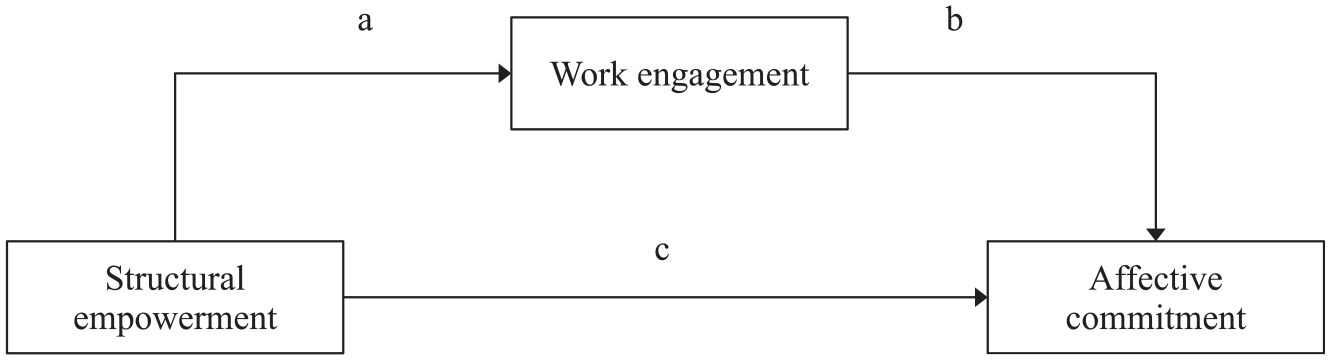
Mediation model: work engagement (M) operates as a mediator between structural empowerment (P) and affective organizational commitment (R).
Method
Design and sampling
This study was developed using a cross-sectional and correlational design with convenience sampling, using questionnaires as a method of data collection. The selection criteria were the following: (1) to be a frontline worker (no supervisory position); (2) to be employed in a public or private social services agency at the time; and (3) to have been employed in the same function in the organization for at least 12 months. Social services agencies are considered in Spain as those that provide services aimed at the entire population, with a general and multipurpose character, and are understood as a first level of social and community care (Law 2/88 of 4 April, Social Services).
Prior to data collection, a power analysis was carried out to calculate the minimum sample size to test the study’s hypotheses. This power analysis was performed using the statistical program mc-power-method (Schoemann et al., 2017), which allows this calculation using Monte Carlo confidence intervals. The results of the analysis showed a minimum sample size of 212 participants considering the following parameters: 95 percent confidence level, standard power of .80 (1–beta), and 5000 replications with 20,000 Monte Carlo draws per replication. Information on the correlation matrix was entered using values extracted from studies on the model variables (Schoemann et al., 2017).
Participants
Two groups of frontline social workers were analyzed in this study. The first group (sample 1, public agencies) consisted of 240 social workers, with a mean age of 43.72 years (SD = 8.63). Most of the participants in sample 1 were women (87.5%). In relation to years of professional experience, the mean number of years was 13.05 (SD = 9.52). More than half of workers (n = 131, 55.50%) reported having an open-ended contract compared with 105 participants with a temporary contract (44.50%).
The second group (sample 2, private agencies) consisted of 226 social workers, with a mean age of 36.45 years (SD = 8.59). More than three-quarters of the participants (83.18%) in sample 2 were women. Participants from sample 2 reported a mean number of years of professional experience of 6.75 (SD = 4.49). Approximately half of the participants (n = 110, 50.23%) indicated having temporary contracts compared with 109 participants with an open-ended contract (49.77%).
Measures
Structural empowerment
To measure structural empowerment, we used the Spanish version (Mendoza Sierra et al., 2014) of the Conditions for Work Effectiveness Questionnaire-II (CWEQ-II) (Laschinger et al., 2004). This questionnaire consists of 12 items divided into four dimensions (three items each): access to information (e.g. ‘The current state of the organization’); support (e.g. ‘Specific information about things you do well’); resources (e.g. ‘Acquiring temporary help when needed’); and opportunities (e.g. ‘Challenging work’). Each item is answered on a Likert-type scale from 1 (none) to 5 (a lot). The omega reliability coefficients (Peters, 2014) obtained in this study were .89 for sample 1 and .91 for sample 2.
Work engagement
To assess work engagement, we used the reduced version of the Utrecht Work Engagement Scale (UWES) in its Spanish version (Schaufeli et al., 2002). The nine items of the scale are distributed in three dimensions (three items each): vigor (e.g. ‘At my work, I feel bursting with energy’); dedication (e.g. ‘I am enthusiastic about my job’); and absorption (e.g. ‘I am immersed in my work’). Each item is answered using a Likert-type scale from 0 (never) to 6 (always/every day). The omega reliability coefficients in this study were .89 for sample 1 and .93 for sample 2.
Affective organizational commitment
To measure affective organizational commitment, we used six items related to affective commitment from the Spanish version (De Frutos et al., 1998) of the organizational commitment scale (Meyer et al., 1993). The six items are answered using a Likert-type scale from 1 (strongly disagree) to 7 (strongly agree). The omega reliability coefficients obtained were .89 for sample 1 and .94 for sample 2.
Procedure
The ethics committee of the principal investigator’s university approved the conduct of the research (ref: 2018-6754). The data collection was carried out online. For this purpose, the researchers contacted the main Association of Social Workers in Spain, requesting the link to the online questionnaire to be sent to the members via email distribution list. The questionnaire collection period lasted from November 2018 to April 2019. After sending the questionnaire to 1435 potential participants, we obtained a total of 486 responses (33.86% response rate). During data collection, appropriate strategies were put in place to ensure that the aim of the research was understood (explanatory text and contact information for questions and clarifications), as well as the mechanisms to ensure anonymity and confidentiality throughout the process. Before completing the questionnaires, participants gave written consent to collaborate in the research and were given the opportunity to withdraw from the study at any time.
Data analysis
For the analysis of the data, we used the statistical software R (R Core Team, 2023) and the following packages: psych, lavaan, and MBESS. The descriptive analysis of the variables (mean, standard deviation) and the calculation of correlations (Pearson’s r coefficient) were carried out with the MBESS package. Finally, the analysis of the measurement models of the scales and the mediation model (path analysis) was done using the lavaan package. The following parameters were used to check the fit of the measurement models (Kline, 2016): comparative fit index (CFI) and Tucker–Lewis index (TLI) values above 0.90, and standardized root mean square residuals (SRMR) and root mean square error of approximation (RMSEA) values below 0.08.
The estimation of the direct and indirect effects was carried out following the recommendations of MacKinnon (2008). According to this author, the product of coefficients estimation of the mediation effect, ab, is the most general approach with the best statistical properties. We used the bootstrapping method for confidence interval estimation and significance. Following Hayes’s (2013) suggestions, 10,000 resamples were calculated for the construction of percentile confidence intervals (PC–CI 95%). The indirect effect can be considered significant (p < .01) if the confidence interval does not contain the value 0. According to the scientific review, age, gender, and years of professional experience were entered into the mediation model as control variables (covariates) (Borst et al., 2020; Fragkos et al., 2020).
Results
Measurement models
Using confirmatory factor analyses, the validity of the measures of the variables was tested. Two models were checked: M1 and M2. The M1 model proposes that all the items of the scales saturate in a single factor. The M2 model represents an eight-factor structure model (access to opportunities, information, resources, support, vigor, dedication, absorption, and affective commitment) with their corresponding items. Table 1 shows the fit indicators of each model in samples 1 and 2.
Measurement models in samples 1 and 2.
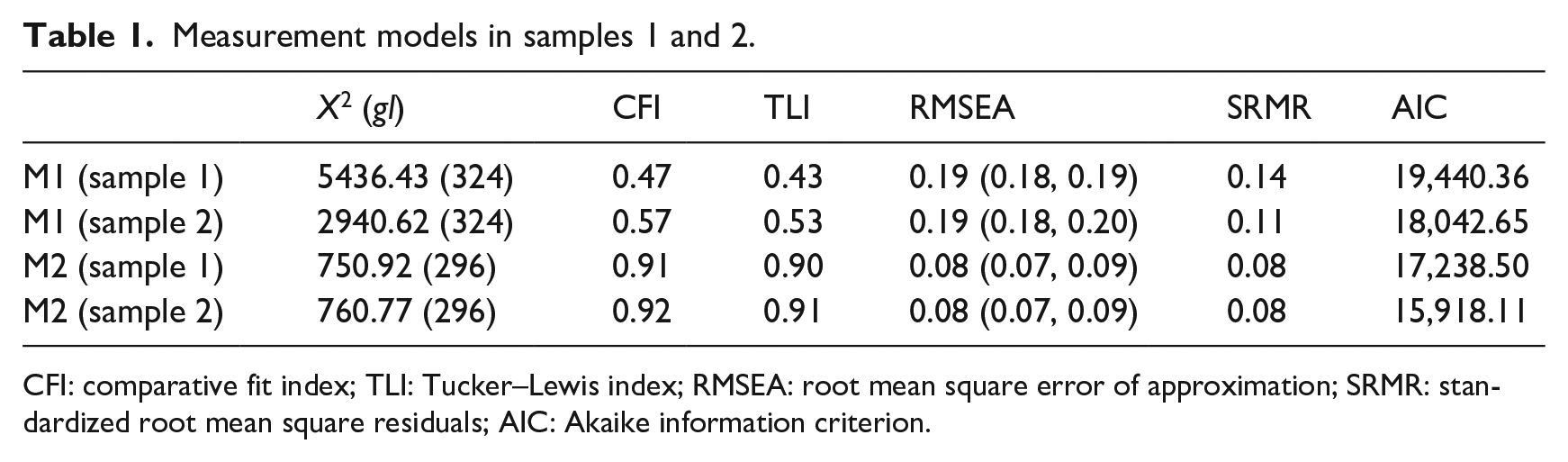
CFI: comparative fit index; TLI: Tucker–Lewis index; RMSEA: root mean square error of approximation; SRMR: standardized root mean square residuals; AIC: Akaike information criterion.
In both samples, the fit of the M2 model was superior to the fit of the M1 model: CFI and TLI values were equal to or higher than 0.90, and RMSEA and SRMR values were equal to or lower than 0.08 (Kline, 2016). In this sense, the variables measured in this study can be considered to be independent constructs.
Descriptive statistics and correlations
Table 2 presents the descriptive statistics of the variables, the correlations between them, and the confidence intervals of the omega coefficient reliability. In both groups, positive and significant (p < .01) relationships between affective organizational commitment and structural empowerment were observed: r = .48 for sample 1 and r = .67 for sample 2. Similarly, work engagement was positively related to affective organizational commitment (p < .01): r = .55 for sample 1 and r = .61 for sample 2. Regarding the relationship between structural empowerment and affective commitment, a statistically significant difference in the strength of the correlation between these two variables was obtained in public and private organizations (sample 1: r = .48; sample 2: r = .67; z = 3.09, p < .01).
Descriptive statistics and associations between variables by sample.
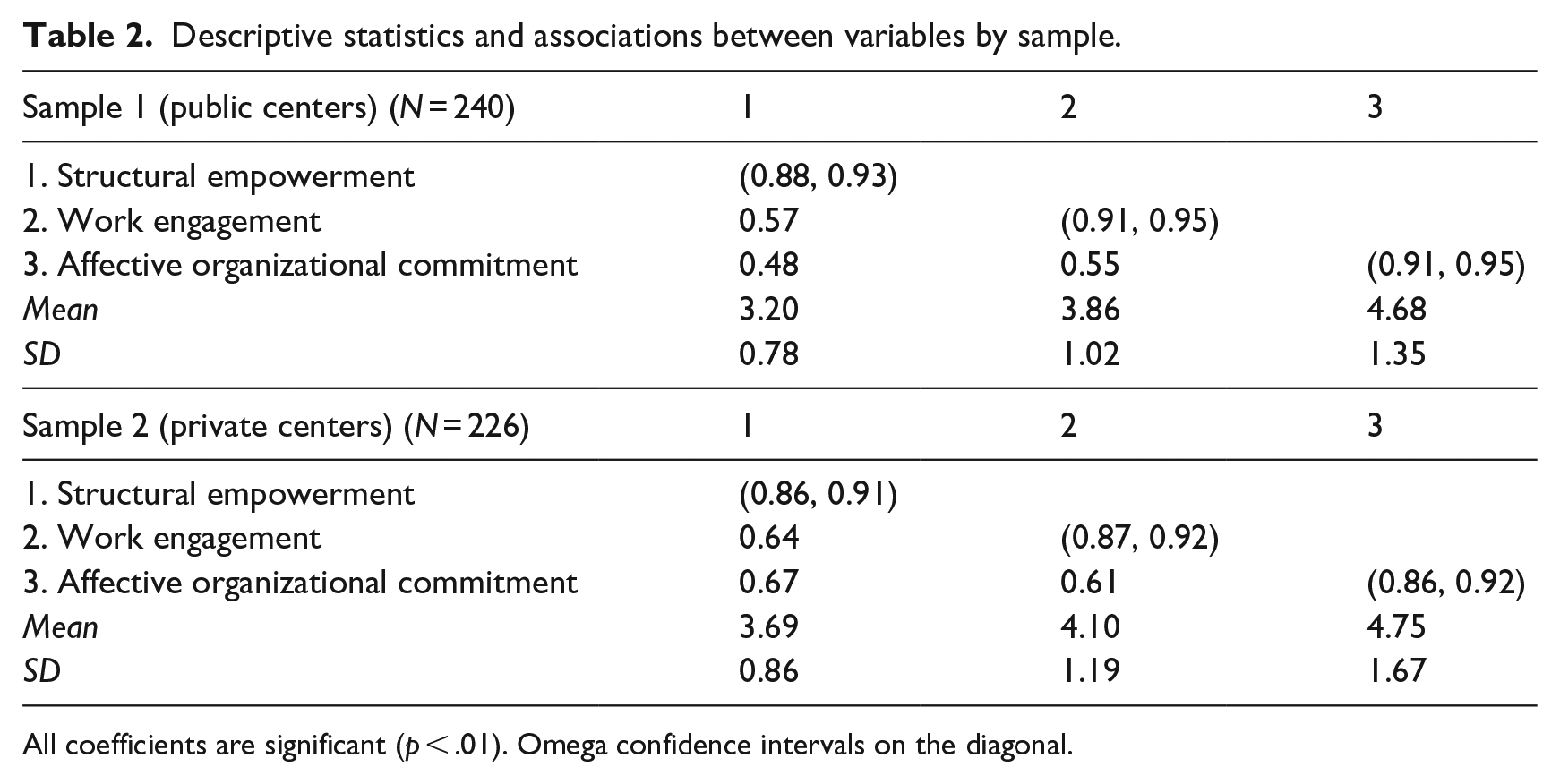
All coefficients are significant (p < .01). Omega confidence intervals on the diagonal.
Mediation analysis
Our study model proposes a causal path from a predictor variable (structural empowerment) to an outcome variable (affective organizational commitment) through a mediating variable (work engagement). The mediation model was tested controlling for the effect of three covariates: gender, age, and years of professional experience (Borst et al., 2020; Fragkos et al., 2020).
Professional experience was a significant predictor (p < .05) of affective commitment in sample 2. After controlling for the effect of the covariates, the total effects of structural empowerment in both samples were significant (B = 0.82 for sample 1 and B = 1.50 for sample 2, p < .01), explaining a variance in affective organizational commitment of 34.8 percent in sample 1 and 54.1 percent in sample 2 (Figure 2).

Relationships between structural empowerment, work engagement, and affective commitment with the organization.
The analysis of direct and indirect effects is presented in Table 3. In both samples, structural empowerment had positive associations with work engagement (B = 0.71 and B = 0.88, p < .01, respectively), confirming hypothesis H1. Also, the correlations between work engagement and affective commitment were significant (p < .01) and positive: B = 0.54 for sample 1 and B = 0.54 for sample 2. Thus, hypothesis H2 was supported.
Direct, indirect, and total effects of the mediation model.
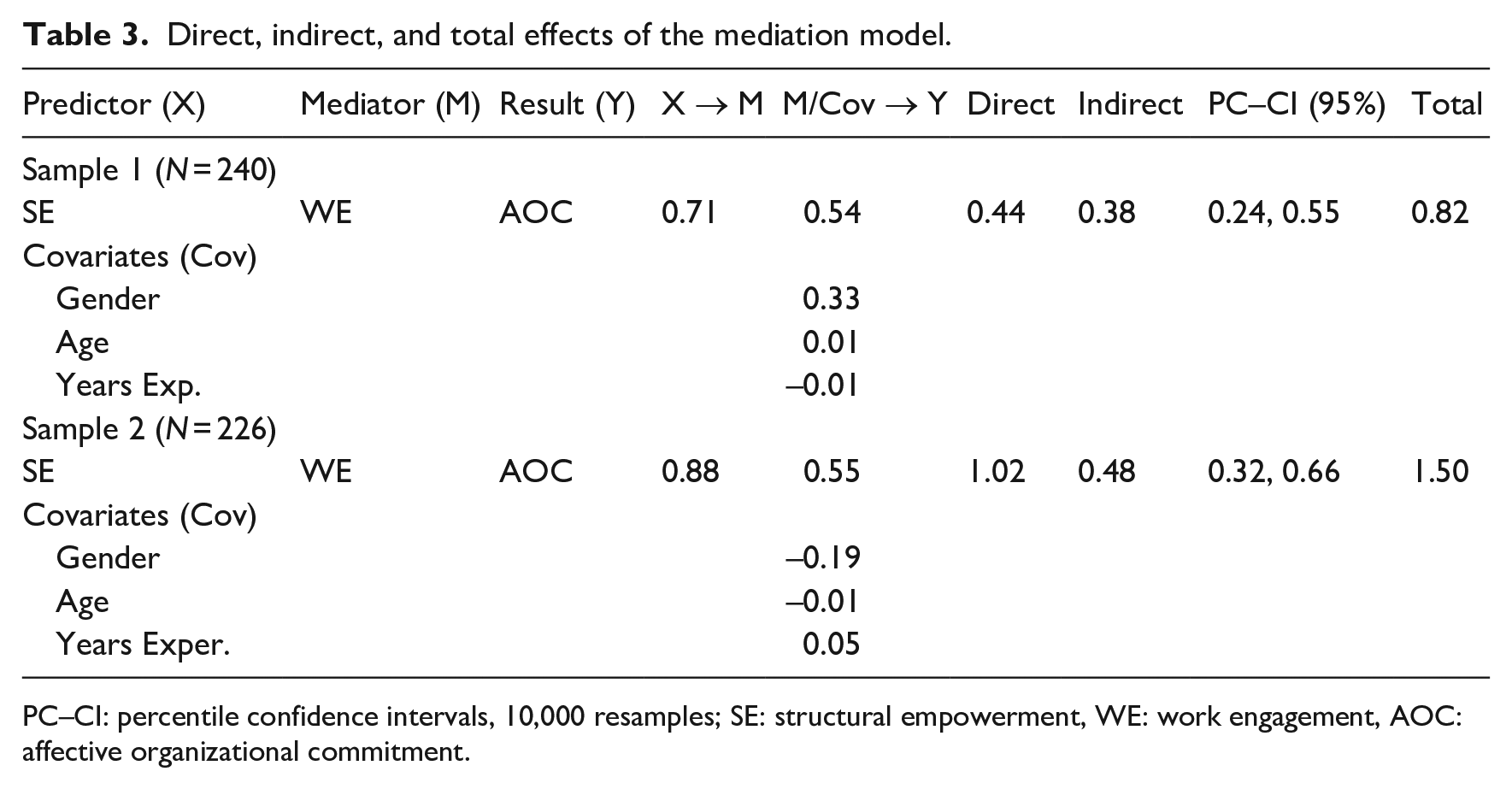
PC–CI: percentile confidence intervals, 10,000 resamples; SE: structural empowerment, WE: work engagement, AOC: affective organizational commitment.
The third hypothesis of our study proposes the mediating role of work engagement in the relationship between structural empowerment and organizational commitment. The results presented in Table 3 do not support hypothesis H3: structural empowerment had both a direct and indirect effect, through work engagement, on affective commitment with the organization (e.g. partial mediation). The indirect effects were 0.38 for sample 1 and 0.48 for sample 2. In the case of public agencies (sample 1), the direct effect was 53.34 percent and the indirect effect was 46.66 percent. In the case of private agencies (sample 2), the direct effect was 66.77 percent and the indirect effect was 32.23 percent.
Discussion
Considering the consequences of affective organizational commitment on frontline social workers and social services agencies (Astvik et al., 2020; Geisler et al., 2019; In-Bong, 2020; Safadi et al., 2021), the main concern of this article was to provide insights that enhance our understanding of empowering HRM practices related to the emergence and development of a positive emotional attachment to the organization. Specifically, this study focused on the relationship between structural empowerment, work engagement, and affective organizational commitment by analyzing a mediation model in two independent samples of frontline social workers in Spain. In doing so, we extend the application of the structural empowerment model beyond healthcare organizations (Read and Laschinger, 2017). Our results showed that pathways or mechanisms through structural empowerment have a positive effect on affective commitment: a direct pathway related to organizational structures which empower social workers, and an indirect pathway through the development of high levels of engagement at work. While these two mechanisms were observed in both samples, the direct effect was much larger than the indirect effect in the sample of social workers from private agencies.
In relation to the first hypothesis (H1), a positive relationship was found between structural empowerment and work engagement. Empowering HRM practices related to access to opportunities, information, support, and resources seem to largely determine work engagement experiences. When frontline social workers can learn and apply their skills at work, have information on how to perform their functions and roles, have sufficient resources (e.g. time to complete paperwork), and receive support from colleagues and supervisors, they feel more competent to cope with job demands, showing more energy, dedication, and concentration. These results agree with other studies which have shown a positive relationship between structural empowerment and work engagement (García-Sierra and Fernández-Castro, 2018; Kim and Beehr, 2023; Monje Amor et al., 2020).
Our results also confirmed hypothesis H2: higher levels of work engagement were associated with high levels of affective organizational commitment. These results are consistent with previous studies in health and social care professionals (Borst et al., 2020; Geisler et al., 2019; Lin et al., 2020; Lombardero-Posada et al., 2023). When frontline social workers feel energized, are engaged in their work role, and have long periods of concentration at work, they experience positive feelings and emotions in the workplace. These feelings and experiences facilitate the emergence of a positive bond with the organization in which they work, which can be conceptualized as experiencing high affective organizational commitment (Meyer et al., 1993). Therefore, our results confirm previous research on the positive outcomes of work engagement on employees’ job attitudes.
Concerning the mediation hypothesis (H3), this hypothesis was rejected: a partial mediation was observed in both samples. HRM practices based on structural empowerment were shown to have a direct and indirect effect, through engagement at work, on affective organizational commitment. The direct effect can be explained by the empowerment of frontline social workers through access to opportunities, information, resources, and support. Access to these elements increases employees’ psychological states of determination, meaning, and autonomy at work (Kaiser et al., 2020; Laschinger et al., 2004), enabling effective coping with different job demands. Therefore, social workers perceive their workplace context positively, resulting in an affective bond of loyalty and commitment (Albasal et al., 2022; Fragkos et al., 2020).
The indirect effect of structural empowerment on affective commitment would be caused by generating high levels of engagement at work. HRM practices based on structural empowerment increase employees’ perceptions of vigor, dedication, and absorption which, in turn, facilitates the emergence of affective commitment related to positive feelings in the workplace (Fernandez and Moldogaziev, 2015; García-Sierra and Fernández-Castro, 2018; Kim and Beehr, 2023; Monje Amor et al., 2020; Zhang et al., 2018). In brief, these findings support the fact that affective organizational commitment would be determined in part by work engagement but also by empowering HRM practices based on access to support, opportunities, information, and resources.
The indirect effect of structural empowerment on affective organizational commitment, through work engagement, was higher in sample 1 (public agencies). This difference between the two samples may be due to the effect of empowering HRM practices in each type of organization. According to Borst et al. (2020), certain characteristics of public services agencies could enhance the effect of structural empowerment in public servants’ work engagement. For example, access to information, opportunities, resources, and support would allow social workers to deal with burdensome rules through the usage of different job resources, causing these resources to increase their motivational effects. Furthermore, structural empowerment (i.e. advice and helpful information) would reduce role ambiguity perceptions related to goal ambiguity, increasing workers’ positive psychological states in the workplace.
Limitations and future research
The interpretation of these results should be made with caution, considering several aspects related to the design of the study and the type of sampling. First, the cross-sectional and correlational study does not allow causal relationships to be established between the variables studied. However, the formulated hypotheses are based on a theoretical framework with empirical evidence in its favor (Read and Laschinger, 2017). Second, the use of questionnaires may be affected by response biases, such as desirability or fatigue bias. Third, the samples obtained by convenience samplings do not allow statistical generalization of our results to the population, although obtaining similar results in two independent samples implies greater empirical support for the proposed model (Polit and Beck, 2010). Fourth, the distribution of questionnaires exclusively to members of the Association of Social Workers in Spain may have introduced a bias in the selection of participants. There might be a number of social workers who are not registered with the Association. Finally, our sample is composed exclusively of frontline social workers, so it might be questioned whether ‘empowering’ social workers who are frontline workers may be different than ‘empowering’ social workers who are managers and administrators.
Future research should aim to illustrate the relationship between these variables in more detail, so as to overcome some of the limitations indicated above. To begin with, this study should be replicated using representative samples from both the public and private sectors. In the second place, the dynamic nature of the relationships between structural empowerment, work engagement, and organizational commitment could be better understood through longitudinal designs, such as diary studies. In the third place, further studies should consider the influence of the accelerated organizational changes that have occurred after COVID-19 (i.e. new digital work environment) on the processes related to empowerment in the workplace (Su and Wong, 2023). To conclude, future research should explore the issue of stratification within social service organizations and its impact on empowering HRM practices and their consequences.
Implications for social work
Considering the social and work context in which social workers in Spain carry out their work (Morilla-Luchena et al., 2021), we highlight the importance of human resource practices based on empowerment to improve working conditions, motivation, and organizational commitment, as well as the quality of care and services provided by these professionals. Access to opportunities allows the learning of competencies demanded as basic by social workers (i.e. digital competencies to attend to digital natives). The lack of resources is also one of the most frequent complaints given by social workers, as well as the lack of support for the design and implementation of social intervention projects. In sum, access to power-generating organizational structures improves the organization of work and the performance of social workers’ tasks and roles, with positive consequences for personal well-being and for achieving the goals of public and private agencies (i.e. quality of care).
Given the benefits of HRM practices based on structural empowerment and work engagement for both social workers and agencies, several interventions can be considered for the development of these at various levels. At an organizational level, interventions can focus on providing access to resources, information, support, and opportunities. Sharing information about objectives and performance and providing access to job-related knowledge and skills are effective ways of ensuring access to information by social workers. The empowerment practice of providing social workers with opportunities to acquire job-related knowledge and skills (e.g. individualized training plans) and the practice of giving them discretion to change and improve work processes (e.g. reorganizing tasks and schedules) have positive and substantially sizable effects on organizational commitment (Fernandez and Moldogaziev, 2015). In terms of support at work, initiating discussion groups about the core of work may contribute to improving social support from supervisors and work-related community in the workgroup. It would also be advisable for group discussions aiming at a mutual understanding of what level of quality is realistic and appropriate, allowing for the establishment of clear guidelines and directives for social workers’ work (Geisler et al., 2019). Examples of resources to be considered could be an adequate number of hired professionals, an adequate service-to-people ratio, and the necessary software to support interventions.
On an individual level, high levels of work engagement can be promoted by increasing employees’ job and personal resources. Training in time management (e.g. learning to prioritize, identifying time ‘thieves’), interpersonal skills (e.g. assertiveness, emotional intelligence competencies), or coaching by supervisors are actions that have been effective in fostering engagement at work. One strategy that is particularly focused on engagement is job redesign. The increasing automation and digitalization of work tasks support the redefinition of tasks and roles, allowing for a more effective use of social workers’ personal resources. For example, the automation of administrative tasks (e.g. manual verification of receipts and documents) frees up time for professionals to focus on analyzing social groups and designing interventions. In short, managers and administrators of social services agencies can establish HRM practices and systems which enhance affective commitment with the organization, improving the quality of care and services and reducing social workers’ intention to leave.
Conclusion
Despite the above-mentioned limitations, our results suggest that both structural empowerment and work engagement are important predictors of affective organizational commitment. Indeed, these findings point out that the structural empowerment model is a valid theoretical approach for studying and understanding frontline social workers’ emotional bond with the organization. In brief, the organizational context, when providing information, resources, support, and opportunities, is capable of engaging social workers in their work roles and promoting high levels of affective organizational commitment. These outcomes translate into substantial financial and service costs for companies and strengthen the relationship between social workers and their users, a key element for the effective delivery of human service interventions.
Footnotes
Declaration of conflicting interests
The authors declared no potential conflicts of interest with respect to the research, authorship, and/or publication of this article.
Funding
The authors received no financial support for the research, authorship, and/or publication of this article.
