



Abstract
From time immemorial, hard power has been seen as the key driver of international relations. However, in the early 1990s, Joseph Nye, through his concept of soft power, proposed that countries can persuade others to do what they desire without using hard power. Nations rely on economic, cultural or non-hard-power-centred approaches to achieve their goals. Cultivating soft power takes substantial effort and resources, and has the potential to have an immense impact on the intended country. The present study is based on a questionnaire responded to by 84 Indian nationals and one non-resident Indian on the soft power influence of the USA, UAE, Israel and China on Indian citizens. Though the study size is not substantial, the subjects chosen are largely intellectuals. Hence, the study results provided deep insights into the respondents’ degrees of association and disassociation with the four countries studied. Simple quantitative and qualitative tests were administered on the data. The results also have significant policy implications.
Introduction
From time immemorial, discussions in international relations have centred on the role of hard power in designing the international order. Hard power in the form of military power always had its limitations—fear stalks, but not beyond a point. Contemporary theorists have realized this and experts have begun to argue that there are facets beyond hard power that bind people together and affect their decision-making processes. This realization soon led to the formulation of the ‘Soft Power’ concept. Joseph Nye introduced this seminal concept to international relations. Nye postulated that beyond the US military’s impact, another power source could elicit favourable reactions from countries to the US overtures. This was the non-coercive power that Americans possessed and was aptly titled soft power. Unlike hard power, which depends on the capability of a country’s armed forces to inflict damage on the men, infrastructure and machinery of adversaries, soft power is regarded as the power of non-coercive persuasion. According to Nye, power stands on three pillars: cultural, ideological and institutional (Li, 2018). Nye stated that if a country’s culture, ideology and institutions are attractive to other populations, it is unlikely to encounter significant hurdles in eliciting what it wants from the latter (Li, 2018). The present study analyzes the soft power impact of four countries—China, Israel, the United Arab Emirates (UAE) and the United States of America (USA)—on Indians.
Sources of Soft Power
Moving further, according to the research conducted by ‘Soft Power-30’, the following are the major constituents of ‘Soft-Power’ - Digital, Cultural, Entrepreneurial, Educational, Global engagement, Governance (McClory, n.d). The current study has been conducted based on the above criteria. This section will delve into explanation of the above criteria.
Digital Power
Technology has emerged as a significant game-changer in international relations. Countries project themselves using digital means. Twitter, Facebook and Telegram can now achieve what billions of dollars’ worth of propaganda material could not achieve in the past. One would be well placed in stating that Twitter and Facebook have done much more to benefit American soft power than McDonald’s and Hollywood could in the last seven decades. The Chinese have also used technology unabashedly to promote Chinese ways of life in Southeast Asia and debt-ridden Afro-Asian countries. Promoting Chinese and American digital games is another example of using technology to influence young and impressionable minds. For instance, the ‘Age of Empires’ series of games did a lot to imprint the American exploits in the young minds in several countries, even though the series allowed the players to choose the civilization they liked to play.
The Power of Culture
Culture, as an instrument of soft power, has potential beyond any other alternative. When countries project cultural values that are palatable to the inhabitants of other countries, soft power can be harnessed efficiently. The cultural element is very prominent in the nature and contours of American soft power. Even the last man in the shanties in any LDC knows more about Jurassic Park than his country’s national park. Hollywood has created a lasting impression on people worldwide. The world’s link to Hollywood gradually translated into the acceptance of fundamental American values of consumerism and free thought, even among ordinary people in Sub-Saharan Africa. The openness towards American brands such as Levi, Adidas, Puma and Poison owes a lot to Hollywood. Another brand that is today a household name is McDonald’s. It is often said that there may be places without water on Earth, but one cannot find one without a McDonald’s store. The impacts of American TV soaps and serials were similar. Similarly, the ‘Hippy Culture’ of the late 1960s also had its appeal among the subaltern narrations in developing countries.
The Appeal of the Entrepreneur
Entrepreneurs carry the soft power of the country they represent. Entrepreneurs transfer their entrepreneurial skills, work culture and business organization practices to the countries in which they set up their businesses. For instance, the lure of the free market based on American business models has long influenced entrepreneurial paradigms in many East Asian countries, including modernization of Japan. Similarly, the Japanese model has been an inspiration for most East and Southeast Asian countries, in terms of economic development. Typically styled as the Flying Geese model, most Southeast Asian countries followed their inspiration of Japan. Furthermore, many Japanese business principles, such as Just in Time (JIT), Total Quality Control (TQC) have come to associate with the Japanese business culture. Since the year 2000, some countries have attempted to follow the Chinese model of aggressive capital accumulation as their core business principle.
The Power of the Educational System
The world is indeed a knowledge society. Knowledge and its counterpart innovations determine the growth trajectory adopted by a nation. The greater the amount that the government invests in education, the higher the quality of education, and the greater the number of people attracted from abroad to pursue education in a country. If we adopt the purview of modes of supply of services presented by the General Agreement on Trade in Services (GATS), there are four ways in which educational services can move across borders. The first is the cross-border supply mode, in which the service-providing institution provides education in the country where the learner is located. This is an excellent way to enhance the soft power of a nation.
The second supply mode is Consumption Abroad, in which students can move to their country of choice to acquire education. This mechanism has the most significant impact on cementing soft power since the learner would have assimilated into the ways of life of the host country. When he returns to his country, he would have, in all probability, become an advocate of the former. The third supply mechanism is Commercial Presence, in which the service provider from one country can establish campuses in another to educate the learners there. Soft power can emanate from these institutions. Finally, we have the Presence of Natural Persons, in which the persons from the service-providing country move to the recipient country to provide the requisite services.
Understanding the importance of education as a source of soft power, many countries promote educational exchange programmes wherein students from foreign countries study in the educational institutions of sponsoring countries. Through this mechanism, a favourable feeling is instilled in the minds of people who benefit from the scheme. Later, when such persons become decision-makers in their own countries, they will exhibit a soft corner towards the country that had sponsored their education earlier.
Global Engagement of the Country
The Global Engagement Index ‘measures a country’s foreign policy resources, global diplomatic footprint, and overall contribution to the international community. Essentially, it captures the ability of states to engage with international audiences, drive collaboration, and ultimately shape global outcomes’ (McClory, 2015).
If we take the case of the USA, its global engagement has been a hallmark of foreign policy for well over a century. One of the foremost instances through which the USA exhibited global engagement was the formation of the United Nations (UN). The UN was symbolically the USA’s first global engagement if we left aside the world wars. The USA incidentally had pulled out of the League of Nations. The Marshall Plan, which followed the Second World War, showcased the nation’s commitment to becoming a key stakeholder in world affairs. Since then, the USA has emerged as a world power and a decisive force on the global stage. The USA has collaborated with most nations in one manner or another. In the military realm, the country guarantees the security of countries such as Japan and Taiwan. On the economic front, the government provides aid to many countries, besides being a fund provider for most international organizations. The country is also part of several need-based collaborations, such as the recently formed ‘Quad’, where it primarily collaborates with India, Australia and Japan on maritime and cybersecurity issues. The nation is undoubtedly a major draw for international audiences, as the headquarters of many institutions in the UN. Further, if we look at the most recent international events, the US position has impacted global international relations outcomes in a significant manner. The US stands on Afghanistan, the Middle East, and its sanctions against Iran have all massively affected global alignments.
However, France ranks first in global engagement (McClory, 2015). France is well known to have vibrant linkages with its former colonies, where it still runs numerous citizen-exchange policies. A reasonable free entry and exit policy meant that large sections of the population from its colonies settled in France. Further, France plays a significant role in humanitarian assistance programmes and intervenes effectively in conflict zones ranging from the Dardanelles to the Middle East. France also houses the headquarters of important UN offices, such as UNESCO. France is also a significant donor for international organizations.
Governance
Governance is a critical factor that provides thrust to the soft power exerted by a country. The key parameters of governance are adherence to democracy, protecting rights such as equality, liberty and fraternity, and scoring high on Human Development Indices (McClory, 2015). Scandinavian countries have emerged at the top (McClory, 2015). It is not uncommon for an average person to look up to countries that score high on the aforementioned parameters. Countries such as India have long advocated for universal brotherhood and amity. Through the Non-Alignment Movement, the country held peace and global fraternity as cornerstones of its foreign policy. Further, it is a fact that real democracies do not go to war with each other. Oligarchies and autocracies do the opposite. The shared values in governance are a definite draw to liberal countries. Liberal democratic countries have also reached out across the world to protect these values. For instance, ‘Operation Enduring Freedom’ and ‘Operation Desert Storm’ were purportedly conducted to defend democratic values. These values also help countries to elicit favourable responses from like-minded countries.
The Current Study
The researcher seeks to find whether the four countries—China, Israel, the UAE and the USA—influence the Indian mind through questionnaire-based research. Differences in levels of influence were documented throughout the study. The choice of countries has been deliberate. They have been chosen because of distinctive bilateral engagements that they have with India. At the formal level, the relationship between India and China deteriorated over time. Logically, this should have an impact on the minds of the people in the country. On the other hand, Israel is seen as a friend and an ally who has helped India tide over difficult times. The UAE is closely related to India; many expatriates work and send back large remittances. Finally, the USA has a mixed relationship with India. The USA and India were in opposing camps throughout the Cold War period. However, since the end of the Cold War, the USA has been a source of critical technology and geopolitical support. Logically, these practical realities should impact the minds of the people of a country. The study, therefore, examines the influence of soft power of these nations on Indian citizen through a questionnaire survey to explain through quantitative data analysis.
A study of literature on the subject revealed that each of the countries under consideration implemented policies to create an image of their nations. Often, these were reflective of the foreign policy followed.
An Analysis of the Soft Power of China
Scholars who have worked in the field extensively have opined that the Chinese government has devoted considerable resources and energy to augment its soft power through a wholehearted promotion of cultural and educational exchanges–a process aided by Confucius Institutes, albeit with debatable results (Albert, 2018), (Huang, 2013). The significant mismatch between the domestic political realities in China and its cultural narratives has not only made its soft power underwhelming but also misleading (MacDonald, 2013). The same impact is noticed in the case of China’s foreign policy signalling, where a significant gap between authoritarianism at the domestic level and proactive posturing at the foreign policy level has not gone unnoticed (Albert, 2018).
Scholars have identified sources of Chinese soft power: cultural attractiveness, political values, development model, international institutions, international image, and economic temptation, which are based on Confucian philosophy (Li and Worm, 2009). However, other sources exhibit a degree of scepticism generated by China’s domestic contradictions (Albert, 2018). Other studies bolster this line of thinking. Quantitative analysis of multidimensional data (enterprise, culture, digital, government, engagement, and education) has revealed that the USA stands 3rd and Israel 26th in the ranking of the top 30 countries in terms of soft power, while China ranked last on this list (McClory, 2015). Reiterating the same line of reasoning, other studies have revealed that while the sources of Chinese soft power influence have increased substantially during the pandemic by proficiently utilizing social media, there has been a downturn in sentiments related to political issues, issues related to debt traps, and difficulties in the assimilation of cultural facets, including mandarins (Kim et al., 2023), (Rana, 2022). These studies reinforce the stand taken by (MacDonald, 2013) regarding the mismatch between Chinese domestic realities and international posturing.
An Analysis of the Soft Power of the US
The US has been ranked among the top three soft powers of our times based on the ranking of multidimensional data such as enterprise, culture, digital, government, engagement, and education (McClory, 2015). Other studies support this observation. A recent study states that a considerable section of the respondents in 23 countries across the globe consider that American universities, technology, military and entertainment are the best in the world (Wike, 2023). They also believe that the USA is one of the most politically stable countries. Four out of ten respondents from India also hold this view, adding to its soft power influence in the Indian context (Wike, 2023). Some scholars have argued that the concept of soft power has seen a decline in its importance since its heyday in the 1990s. However, the efforts of the Chinese to establish their predominance in the world could lead to the resurrection of soft power in the times to come. (Li, 2018). This renewed interest in American soft power is clearly visible during the reign of president Obama and is most appropriate in handling issues related to “Balance of Power” and “Nuclear Proliferation” (Mukan, 2020).
An Analysis of the Soft Power of Israel
Unlike other countries, Israel’s state presents a picture of contrast. The formation of the Jewish state in the aftermath of World War II was an epoch-making event in world history. However, it came with its own share of conflicts and blood-sheds. A ranking of 26 (McClory, 2015) on the Soft Power ranking highlights the strides made by Israel in the projection of its cultural, economic, and technological prowess. There have been umpteen outreach efforts from Israel to reach out to its estranged Arab neighbours, which have prompted many of its former Arab adversaries to compete among one another in establishing stranger ties (Vohra, 2021). Scholars have also underscored Israel’s apparent inability to counter anti-Israeli propaganda through robust diplomacy, despite the country possessing both hard and soft power (Gerstenfeld, 2021). The apparent dichotomy of being a successful nation with feeble diplomatic outreach is a challenge that confronts Israel.
An Analysis of the Soft Power of UAE
The UAE has taken conscious and effective measures to enhance its soft power under the leadership of Sheikh Mohamed bin Zayed (Suwaidi, 2023). The UAE has established itself as a dynamic centre of cultural pluralism and peaceful coexistence between religions and races over time. The country’s cultural, economic and sporting influences are unparalleled. (Suwaidi, 2023). Through a plethora of meaningful steps, such as the commemoration of the “Year of Tolerance” in 2019, the UAE has tried to portray itself as a moderate and forward-looking Gulf state (Chatterjee, 2024). Bolstering its image as a moderate state, the UAE has also taken coherent efforts to promote scholars and institutions associated with moderate Islam rather than political Islam (Baycar, 2022). Cultural diplomacy, celebrity endorsements, and readiness to accept positive change- all provide the UAE with substantial soft power (Enser, 2017).
Cross-linkages Revealed in Available Academic Literature
We can now examine some of the major cross-linkages revealed by the review of literature. The review shows that while China’s soft power has a distinct digital and economic flavour, the US has an edge in cultural and educational appeal. However, Chinese efforts to build its soft power has suffered because of its authoritarian domestic politics. Conversely, a comparison between Israel and the UAE offers a clear contrast. India’s traditional ties with Israel provide significant leverage for Israel’s soft power among Indians, but its diplomatic finesse is lacking, preventing it from emphasising this influence as effectively as the UAE, which capitalises on its image as a liberal and inclusive nation.
The extent of soft power of nations is a direct function of their international approach. The highly centralized and illiberal approach of the Chinese polity contrasts with the inclusive and substantial nature of US soft power. The image-centric soft power of the UAE driven by lifestyle and publicity is a contrast to the soft power of Israel. Israel’s leverage over Indians is rooted in a deeper understanding created under the umbrella of civilizational ties.
The literature reviewed clearly indicates that while the concept of soft power per se has been studied, cross-country studies with emphasis on “intangibles”, especially attitudes and culture, are rare to find. Further adding to this gap is the fact that studies with a focus on Indian public perception on the soft power of various countries are found to be conspicuous by their absence. This gap is a clarion call for India-specific opinion studies. Furthermore, no study has compared the comparative soft power of four countries–the USA, the UAE, China, and Israel – on Indians. This gap needs urgent redress, given that all four countries have a major impact on Indian foreign policy. Sentiment analysis is rarely used in International Relations, particularly in the Indian context. While Kim et al. (2023) used this technique in the context of China, it can be effectively used in the Indian context to compare the four countries mentioned above.
It is clear that the “The Soft Power Influence of the USA, UAE, Israel and China on Indian public opinion” is an understudied academic segment. The present research aims to address the significant gaps in academic discourse associated with this area of study.
On the basis of a comprehensive review of the literature, the objectives of the current research were framed. It was seen from the review of literature that there exists a research gap on the extent to which China, Israel, the UAE and the US exercise soft power on the Indian minds. The study therefore seeks to understand whether China, Israel, the UAE and the US exercise soft power on the Indian minds.
The review of literature has also revealed that the extent of soft power influence (if any) on the Indian minds by the above-mentioned countries has been relatively unexplored. This research gap led to the second research objective, which is to explore the extent to which China, Israel, the UAE and the US exercise soft-power on the Indian minds.
Based on the research objectives, the study seeks to answer three major research questions. First, whether the four countries—China, Israel, the UAE, and the USA—exercise significant soft power over the Indian mind? Second, to what extent is the soft power exercised by the four countries different? And third -What are the implications of the study results?
A questionnaire based, study was attempted to understand the above raised questions. The choice of the four countries—the USA, the UAE, China and Israel for the study was based on well-defined criteria.
All four countries are ranked in the top 25 nations with the maximum soft power in the world: the USA (ranked 1), China (ranked 4), the UAE (ranked 15) and Israel (ranked 23) (Finance, 2022). Second, the soft power ranking of all four countries has improved over the previous year, consolidating their status in the global soft power ranking (Finance, 2022). Third, all the four countries have special relations with India, China being the largest trading partner and a country that has ancient ties; the USA being India’s closest economic partner and a growing defence partner, and a country that shares values such as democracy with India; the UAE, which houses one of the largest Indian diasporas of more than 3.5 million (migrants) (GoI, 2022); India has strong cultural ties with India and Israel, with which India has a close defence and historical partnership, and strong cultural ties dating back several centuries (apart from the fact that India was a safe haven for Jews, even when they were persecuted elsewhere).
Further, a random sample was used for the study. A questionnaire was administered online, eliciting the general public’s views on the critical aspects of soft power. The platform used to administer the questionnaire was Google Forms. A link for the questionnaire was generated and distributed through WhatsApp groups and emails. The questionnaire was administered to nearly 500 individuals. 85 responses were received from a cross-section of society to 14 questions. Thirteen questions were based on numerical scoring, with ‘1’ being the lowest and ‘5’ being the highest. The last question, the 14th, was a question eliciting respondents’ sentiments. None of the responses were nullified due to insufficiency of data. All respondents, except two, were permanent residents of India. The reactions were subjected to quantitative and qualitative analyses. Responses were registered between 7 May 2023 and 20 July 2023. Sentiment analysis uses R software to understand the public’s perception of various parameters.
Demography of the Participants
For this steudy, the term ‘demography’ is used in a broad sense. It includes details such as age, occupation and state of domicile. The demographic information of the participants is as follows:
Distribution of the respondents based on their age
Based on the age of the respondents, their distribution is given as follows:
It is evident from Figure 1 that nearly 40% of the respondents fall into the age group of 36–50 years, indicating a blend of youth and experience. The 51–75 age group accounts for 43.5% of the respondents, possessing extensive real-world experience and the benefit of hindsight. The youth demographic of 20–35 years comprises 21.2%, providing the study with insights into how younger individuals perceive different nations.
Age-wise Distribution of the Respondents.

The distribution based on the occupation of the respondents is shown in Figure 2.
Occupation-wise Distribution of the Respondents.
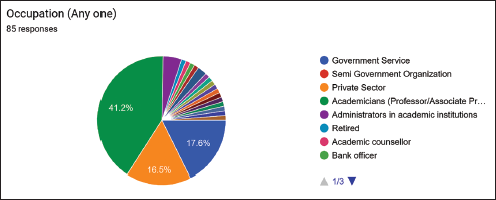
Although many of the respondents were from academic circles (41.2% + 4.7% = 45.9%), the survey succeeded in eliciting the views of a cross-section of professionals, including retired officials, private sector employees, government and semi-governmental employees, bank officials and others. Respondents working in the government sector formed 17.6% of the respondents, while those in the private sector formed 16.5%.
Further, there is almost equal gender-based segregation of the respondents in the study, as depicted in Figure 3.
Gender-wise Division of the Respondents.

Males represented 51% of the respondents, while females represented 49%, which gives equal gender-based weightage to their respective opinions.
Overall, the respondents were in a position to give informed responses on the various issue areas discussed since the questions asked in the questionnaire were related to matters of day-to-day impact, such as appreciating a foreign language movie, enjoying a foreign song, and consuming multi-cruisine. The significance of such questions is that answering them does not require specialized knowledge in international relations and, at the same time, the impact of soft power can be easily discerned. Further, the disciplines and training possessed by the respondents did not have a significant bearing on their responses. For instance, the fact that a respondent is a doctor, banker, advocate, priest or academician may not cloud one’s predisposition towards cultural matters. The author could not identify any studies that supported the correlation between these factors.
Analysis of Data
Eighty-five responses were received for the online questionnaire. Questionnaire length was a prominent issue that restricted the number of responses received. However, such a detailed questionnaire is justified for receiving comprehensive feedback on complex issues. First, let us examine each country’s average score for each question (Questions 1–13).
The first question put forth to the respondents was, ‘How likely are you to see a Chinese/Israeli/US/UAE film (MOVIE) without English or native language subtitles?’. The responses are listed in Table 1.
Average Scores of Countries on the Parameter ‘How Likely Are You to See a Chinese/Israeli/US/UAE Film (Movie) Without English or Native Language Subtitles?’
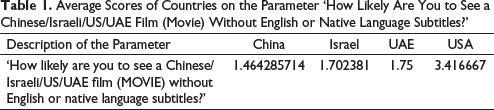
In the case of this parameter, it is evident that a higher average score indicates a greater affinity of the respondents for the country concerned. The fact that the respondents were ready to view a movie from a country without English or native language subtitles shows that people can easily relate to the film’s content. On this count, the respondents found films from the USA to fit this bill most effectively. The average score of the USA on this count is 3.41, which is much higher than the scores received by other countries. The scores obtained by the UAE and Israeli films were almost on par, while the Chinese films scored the lowest. Respondents had a clear preference for American films.
The second question on which responses were sought was, ‘How likely are you to see a Chinese/Israeli/UAE/US film (Movie) with English or native language subtitles?’. Responses to this question are presented in Table 2.
Average Scores of Countries on the Parameter ‘How Likely Are You to See a Chinese/Israeli/UAE/US Film (Movie) with English or Native Language Subtitles?’
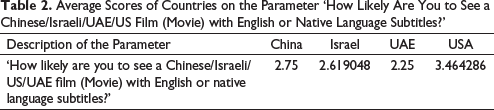
In addition, while the popularity of American films is undisputed and even strengthened, it is surprising to see that the respondents would prefer to watch a Chinese film with subtitles compared to Israeli or UAE films. This indicates that, despite the underlying animosity between India and China, there is a general interest in knowing more about the latter.
The third parameter discussed was ‘How likely are you to listen to a Chinese/Israeli/UAE/ US song?’. This parameter is critical as songs are bearers of culture and ways of living. Table 3 presents the results.
Average Scores of Countries on the Parameter ‘How Likely Are You to Listen to a Chinese/Israeli/UAE/US Song?’

Table 3 again establishes the predominant hold of American culture in the Indian mind. The average score obtained in favour of American songs was 3.1, which was much higher than that of any other country. However, the close association of Indians with the UAE has also been established because its average score is higher than that of the other two countries, with China recording the lowest score.
The following parameter discussed is ‘How likely are you to consume Chinese/Israeli/UAE/US food?’. Food is another factor that binds people. The respondents’ preferences concerning the staple diet in the three countries studied here are tabulated in Table 4.
Average Scores of the Countries on the Parameter ‘How Likely Are You to Consume Chinese/Israeli/UAE/US Food?’

Responses to the consumption of food parameters from different countries are fascinating. While the USA’s score was marginally higher than that of the others, the difference was minimal. This implies that the respondents were open to trying cuisine with little mental block.
On the question, ‘In the time of an environmental or political crisis, the Government of India will get substantial assistance from the Chinese/Israeli/UAE/US governments’, the responses received were mixed, as is tabulated in Table 5.
Average Scores of the Countries on the Parameter ‘Assistance at Times of Environmental or Political Crisis’.
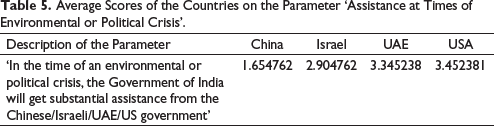
Political and environmental crises are the most debilitating ones in the present era. As expected, most respondents believed that India would receive little help from China during political and environmental crises. However, it is surprising that the UAE ranked just below the USA for this parameter. Although the respondents trust the USA most when it comes to assistance in times of crisis, the reposition of similar levels of faith in the UAE speaks volumes about the image of the Arab country on Indians.
The following parameter for which response was received was the question, ‘How likely are you to visit Chinese/Israeli/UAE/US territory if given an opportunity?’. The results obtained are tabulated in Table 6.
Average Scores of the Countries on the Parameter ‘How Likely Are You to Visit Chinese/Israeli/UAE/US Territory If Given an Opportunity?’
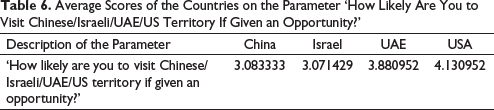
It is clear that most respondents would visit the USA without a hitch. This corroborates the immense interest of Indians in visiting the USA, as seen in the massive passenger traffic. As a traditionally preferred destination, the UAE follows the USA. The surprising result was the respondents’ interest in visiting China. China scores marginally above Israel as the preferred destination, which is incredible. This result points to the long-standing cultural relations between the two countries, and many still desire to revisit the association.
The next issue posed to with the respondents was whether they would welcome visits by Chinese/Israeli/UAE/US travellers to India. The responses are presented in Table 7.
Average Scores of the Countries on the Parameter—Visits by Chinese/Israeli/UAE/US Travellers.

According to the respondents, Americans are most welcome to the country, followed by travellers from the UAE and Israel. However, the Chinese are also as welcome as the Israelis are, indicating no inherent bias against them, even though there is much political disagreement. This suggests that people-to-people ties have remained relatively stable despite the recent border skirmishes.
On the question, ‘How likely are you to study in China/Israel/UAE/US?’, the responses were exciting and are tabulated in Table 8.
Average Scores of the Countries on the Parameter ‘How Likely Are You to Study in China/Israel/UAE/US?’

As expected, the USA was the preferred destination for Indians to pursue their academic objectives. However, the surprising response here concerns the UAE, where we do not have any significant academic institutions of repute, except for a few franchisees. Despite this, the UAE is preferred to Israel and China, which have better educational institutions.
Marriage is an institution that indicates bonds of cultural affinity among the residents of countries. The responses received to the question, ‘How likely are you to marry a Chinese/Israeli/UAE/US national?’ are tabulated in Table 9.
Average Scores of the Countries on the Parameter ‘How Likely Are You to Marry a Chinese/Israeli/UAE/US National?’

As a group, Indians are generally averse to marrying foreigners. In this case, respondents usually indicated this trend. Given this premise, Americans are preferred marriage partners. However, Israelis have been marginally preferred over Arabs and Chinese in establishing a marriage alliance.
In response to the question, ‘How likely are you to work in China/Israel/UAE/US?’, the responses are tabulated in Table 10.
Average Scores of the Countries on the Parameter ‘How Likely Are You to Work in China/Israel/UAE/US?’

Once again, we find that the preferred destination for working outside India is the USA. Considering the long-standing association with Arab nations, the second-preferred destination, the UAE, does not come as a surprise. China is last at the level of preference, just below Israel.
On an important question, ‘Do you think there can be mutually beneficial economic relations between India and China/Israel/UAE/ US?’, the responses were mixed, as indicated in Table 11.
Average Scores of the Countries on the Parameter ‘Do You Think There Can Be Mutually Beneficial Economic Relations Between India and China/Israel/UAE/US?’
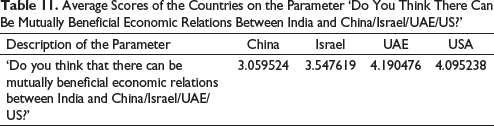
This question elicited a different ordering of countries. The respondents ranked another country other than the USA in the top spot. They felt that more beneficial economic relations could be carried on with the UAE than with the other three countries. The USA came second to the UAE in this parameter. However, the ranking of China below that of Israel is a surprise given that the trade between the two countries stood at nearly $136 billion in 2022 (The Wire Staff, 2023).
The response to the question, ‘Would you be able to identify similarities between the Indian and Chinese/Israeli/UAE/ US cultures?’ was on the expected lines as tabulated in Table 12.
Average Scores of the Countries on the Parameter ‘Would You Be Able to Identify Similarities Between the Indian and Chinese/Israeli/UAE/US Cultures?’
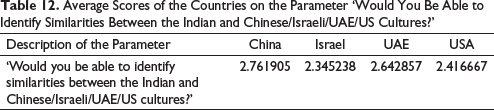
It is well known that cultural ties between India and China date back several centuries. The survey results show that the respondents could still trace cultural similarities between nations. This is the only parameter in which China scores higher than other countries. The USA and Israel had almost identical scores on this parameter. Overall, the respondents did not see a close identification with the cultures of any of the studied countries.
The combined average scores for all parameters for the four countries are listed in Table 13.
Combined Average Scores for all Parameters.

Table 13 indicates that the USA’s soft power influences respondents far more than any other country being studied. The UAE is the next country with a substantial soft power impact, followed by Israel. The country with the least soft power is China.
Sentiment Analysis on the Soft Power of China, Israel, the UAE and the USA on Indians
The final question in the questionnaire was intended to assess respondents’ verbal sentiments towards China, Israel, the UAE and the USA. The question was framed as, ‘What is your general opinion about China/Israel/UAE/USA and Chinese/Israeli/Arab/American people? Please answer in a sentence or two’.
The responses received were tabulated and sentiment analysis was conducted. The following section provides a bird’s-eye view of the respondents’ sentiments towards each country.
China
In recent times, the sentiments of Indians towards the Chinese have undergone a sharp deterioration. In a public opinion survey conducted in 2020, there was a deep sense of distrust and bitterness towards China following Chinese acts of aggression in Galwan and Arunachal Pradesh (Staniland, 2020). Even in previous surveys, Chinese power and influence were viewed as a source of deep concern by Indians (PEW Research Center, 2014). Recently, opposing views on China have spiked by nearly 21% (Patrick, 2023). Given this background, the word cloud of respondent sentiments is given in Figure 4.
Respondents’ Sentiments Towards China.
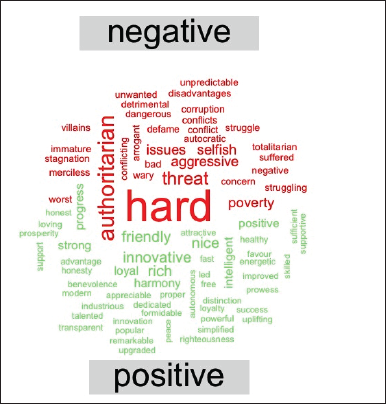
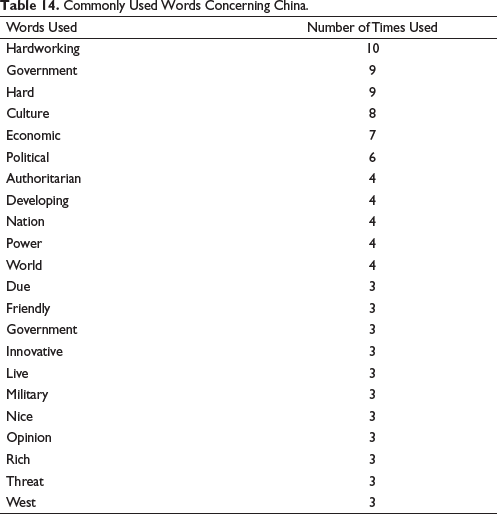
It is clear from the above figures that the respondents used several terms with negative connotations. However, there is an explicit acceptance that the Chinese are ‘hardworking’, as indicated by the frequency of 10, the highest for any attribute related to the Chinese. The high frequency with which the respondents have used the term ‘culture’ indicates an implicit recognition of the ancient Chinese culture and traditions. Such positive sentiments are few and far apart, as shown in Figure 4. Many negative terms have also crept into the response concerning China. These include ‘authoritarian’, ‘government-controlled’, ‘hard’, ‘military’, ‘conflicting’, ‘selfish’, ‘threat’, ‘aggressive’, ‘arrogant’ and so on. The term ‘friendly’ is to be viewed negatively as it is often prefixed with a negative tone such as ‘not’. Furthermore, most respondents used the term ‘powerful’ negatively.
Table 14 provides the word count for the words commonly used by respondents in the survey concerning China.
Commonly Used Words Concerning China.
In the age group 20–35, the respondents had a fairly positive view of the Chinese.
It is clear from the word count that the number of words used with a negative connotation was at least seven. This indicates a high level of negative sentiment towards China among the respondents. This is distinct from the seven words with neutral connotations. Only four words had a clear positive sentiment.
Israel
India and Israel have shared a close relationship since the formal establishment of diplomatic relations in the 1990s. In a survey conducted in 2009, it was observed that 58% of Indians supported Israel (Sen, 2020). In another survey, nearly 35% of the Indians supported Israel’s Palestinian policy (Raj, 2011). Given this background, the current questionnaire is expected to reflect positive vibrations about Israel. The sentiments revealed by the survey were mixed (Figure 5).
Respondents’ Sentiments Towards Israel.
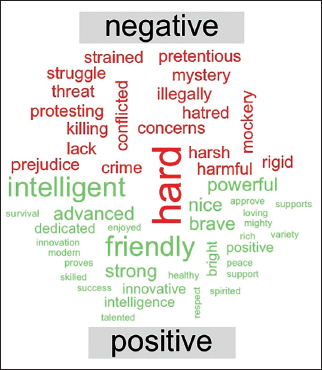
While there were many strong positive sentiments expressed, such as ‘hardworking’, ‘intelligent’, ‘powerful’, ‘friendly’, ‘brave’ and ‘advanced’, there were equally harsh terms used for the country, such as ‘illegal’, ‘hatred’, ‘threat’, ‘struggle’, ‘killings’ and ‘concerns’. Many of these terms were used in the Palestinian conflict and not in the direct context of India-Israel relations. However, the battle between Arab states and Israel’s occupation of the West Bank seems to strongly echo the results.
Table 15 indicates the word count for words commonly used by respondents in the survey concerning Israel.
Commonly Used Words Concerning Israel.

For words with a minimum frequency of at least three, only one precise negative term is used: ‘hard’. This indicates that the general sentiment towards Israel is generally favourable.
The UAE
The UAE is a close associate of India in world politics. The recent initiative, I2U2, is one of the most significant partnerships between the two countries. It would be appropriate to state that it was the Indian worker who built the UAE. In return, he filled the Indian coffers with remittances. The UAE is a major trading partner and a significant source of foreign direct investment (FDI) in India (Khushnam, 2021). While the researcher could not find any considerable survey on Indian sentiments towards the UAE, there has been a symbiotic relationship between the two countries. There are overlapping interests such as shared economic prosperity, the need to maintain Islamic extremism at bay, securing land routes and consistently maintaining hydrocarbon flows. Figure 6 clearly shows that there is a mix of sentiments regarding the Indian attitude towards the UAE.
Respondents’ Sentiments Towards the UAE.
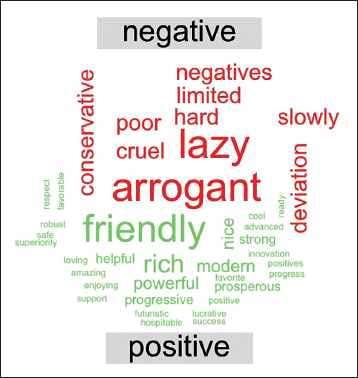
The respondents indicated several negative attributes regarding the UAE. These include terms such as ‘conservative’, ‘lazy’, ‘arrogant’, ‘hard’ and ‘cruel’. On the other hand, several positive attributes have also been indicated in the word cloud, including terms such as ‘friendly’, ‘rich’, ‘modern’ and ‘prosperous’. Table 16 indicates words with a minimum frequency of at least three.
Commonly Used Words Concerning the UAE.
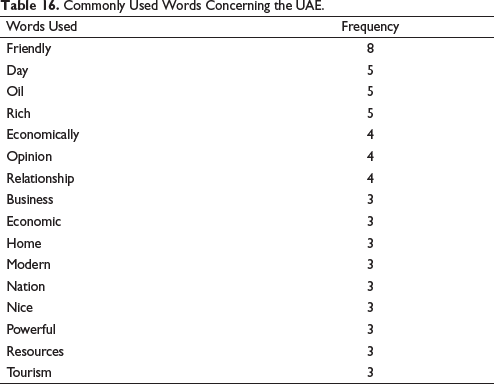
It is clear that none of the 14 words identified had a negative connotation. This indicates a generally positive sentiment towards the UAE.
The USA
The USA is arguably the dominant superpower of our times. Although some scholars predict the imminent decline of the USA, this remains speculative. In the present context, nations need to have strong ties with the USA. In a survey conducted in 2014, 58% of Indian respondents viewed the USA favourably, irrespective of their economic status. Similarly, the same study revealed that Indians considered US policies to be inclined in favour of India rather than towards Pakistan (PEW Research Center, 2014). Another survey was conducted by a publication in 2021 against the backdrop of the USA’s hasty withdrawal from the Afghan scene. Of all the countries surveyed, Indians held the most favourable view of Americans. 78% of Indians viewed Americans favourably (Yokley, 2021). Against this backdrop, the sentiment analysis results of the respondents were interesting (Figure 7).
Respondents’ Sentiments Towards the USA.

The respondents used a broad mix of words to describe the USA. These include favourable terms such as ‘freedom’, ‘friendly’, ‘superpower’, ‘trust’, ‘respect’ and ‘strong’. In addition, some negative terms have been used, such as ‘selfish’, ‘aggressive’, ‘arrogant’ and ‘ruthless’. The word count in Table 17 provides a clear picture of respondents’ sentiments.
Commonly Used Words Concerning the USA.

Table 17 indicates words with a minimum frequency of at least three. It is clear from the table that only two terms with negative connotations have been used concerning the USA. This indicates that there is generally a positive sentiment towards the USA.
Sentiment Analysis Based on Age of the Respondents
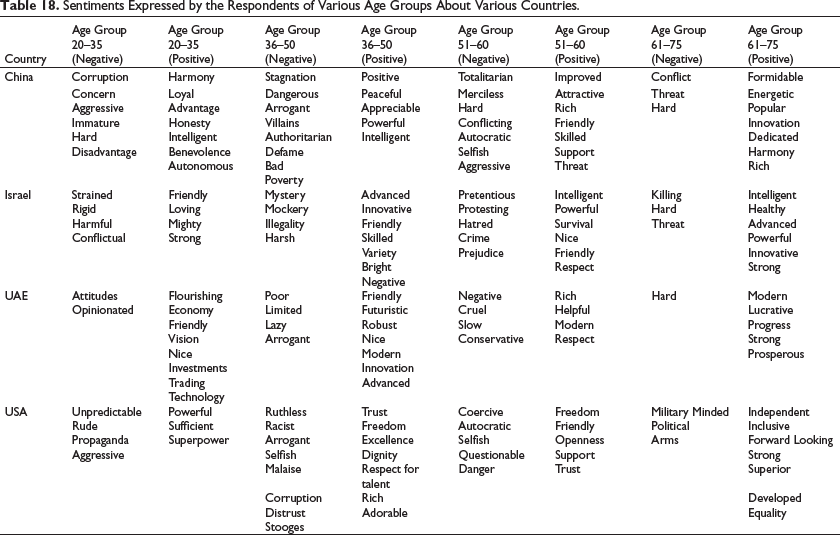
The results of the sentiment analysis performed age/country-wise are given in Table 18.
Sentiments Expressed by the Respondents of Various Age Groups About Various Countries.
China
The first category of respondents was in the age group 20–35. The age group of 20–35 represents the youngest group of respondents. While on the one hand, they have used positive terms such as ‘honesty’, ‘benevolence’, ‘intelligent’, ‘nice’, ‘free’ and ‘harmony’ for the Chinese, on the other hand, they have also used negative terms such as ‘aggressive’, ‘immature’, ‘corruption’, ‘hard’ and ‘aggressive’.
The process of breaking down the responses into further subunits limited the frequency of word use, as shown in Table 18. There is a fair sprinkling of positive, negative and neutral words as far as the age group of 20–35 is concerned with regards to China.
The next category of responses examined here falls within the age group of 36–50.
The intermediate age group of 35–50 years exhibited a wide range of sentiments while referring to the Chinese. While they have used words such as ‘poverty’, ‘dangerous’, ‘stagnation’, ‘authoritarian’ and ‘bad’ to indicate their negative sentiments, they have also used words such as ‘positive’, ‘appreciable’, ‘powerful’, ‘rich’ and ‘powerful’ to indicate the positive sentiments towards the Chinese.
The major positive ‘ping’ words are ‘hardworking’ and ‘innovative’ in this age group of respondents, while the negative ping words are ‘military’, ‘power’, and ‘authoritarian’.
The respondents in the age group 51–60 expressed a wide range of sentiments. The list of negative sentiments expressed by the respondents includes words such as ‘totalitarian’, ‘merciless’, ‘conflicting’, ‘autocratic’ and ‘aggressive’. The positive sentiments exhibited by the respondents are expressed through words such as ‘skilled’, ‘healthy’, ‘rich’ and ‘improved’.
The ping words indicate a mix of both positive and negative sentiments for respondents aged 51–60.
The word cloud of the respondents in the age group 61–75 displays more words, indicating a positive sentiment towards the Chinese. Positive-sounding words such as ‘formidable’, ‘rich’, ‘fast’, ‘energetic’ and ‘modern’ have been used to denote Chinese.
Israel
In the case of Israel, the respondents uniformly expressed strong positive sentiments across age groups. The terms commonly used in the word cloud pertaining to Israel are ‘friendly’, ‘skilled’, ‘innovative’, ‘nice’, ‘powerful’, ‘respectable’ and so on. This is not to ignore the negative sentiments expressed by respondents, such as ‘strained’, ‘rigid’, ‘mockery’, ‘illegality’, ‘prejudice’, ‘threat’ and ‘hard’. The proportion of negative sentiments to positive sentiments is almost equal in the case of the age group 20–35.
The UAE
In the case of the UAE, there is a predominantly positive sentiment expressed by the respondents across all age groups. The common positive words are ‘innovation’, ‘rich’, ‘investment’, ‘technology’, ‘modern’ and ‘advanced’. This does not mean that negative ping words are conspicuous in their absence. The researcher also tabulated some negative ping words such as ‘lazy’, ‘arrogant’, ‘cruel’, ‘slow’, ‘hard’ and ‘conservative’ used by the respondents. While positive ping words were abundant in the age group 20–35, negative ping words were seen to a higher extent in the age groups 36–50 and 51–60.
The USA
There is a higher mix of positive and negative ping words as far as sentiments towards the USA are concerned. On the whole, the general positive ping words are ‘super power’, ‘freedom’, ‘excellence’, ‘dignity’, ‘respect for talent’, ‘adorable’, ‘rich’ and so on. However, there is a similar mix of negative sentiments that need to be taken care of such as ‘unpredictable’, ‘rude’, ‘propaganda’, ‘danger’, ‘selfish’ and ‘aggressive’. In general, the most significant instances of positive Ping words were seen in the age groups 31–50 and 61–75, while most of the negative sentiments were expressed in the age group 31–50.
Gender-wise Sentiment Analysis
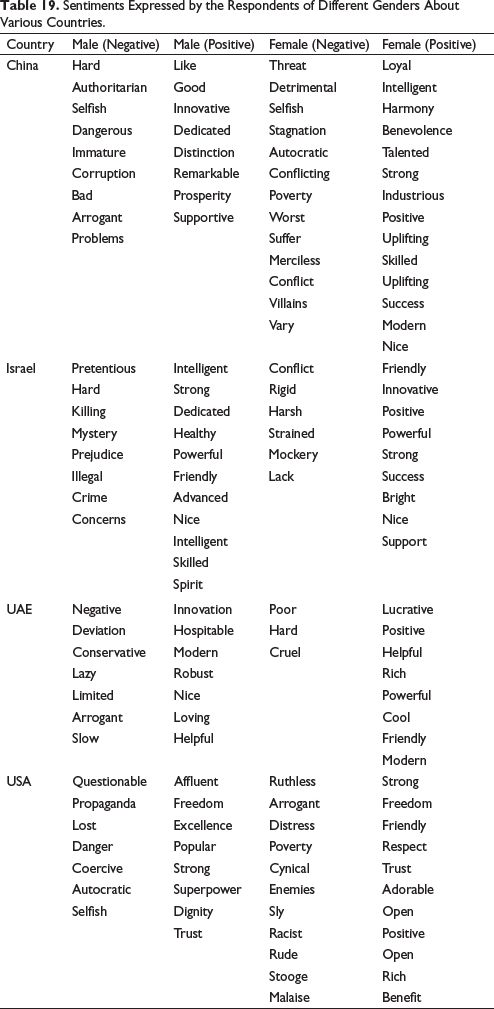
Another analysis of significant academic interest is the gender-wise division of sentiments. There is a broad mix of sentiments pertaining to each country based on gender. This complex mix of sentiments expressed by the respondents is tabulated in Table 19.
Sentiments Expressed by the Respondents of Different Genders About Various Countries.
China
Concerning China, female respondents expressed more intense negative and positive sentiments compared to males. While the male respondents have expressed negative sentiments such as ‘hard’, ‘authoritarian’, ‘corruption’, ‘immature’ and ‘bad’, the female respondents have expressed sentiments such as ‘threat’, ‘detrimental’, ‘authoritarian’, ‘merciless’, ‘conflict’ and ‘villains’. Female respondents also expressed more favourable sentiments towards the Chinese compared to their male counterparts. While the males have expressed positive sentiments such as ‘like’, ‘good’, ‘innovative’, ‘dedicated’, ‘prosperity’ and ‘supportive’, the female respondents have indicated sentiments such as ‘loyal’, ‘intelligent’, ‘harmony’, ‘benevolence’, ‘talented’, ‘strong’, ‘industrious’, ‘positive’, ‘uplifting’, ‘success’, ‘modern’ and ‘nice’.
Israel
As far as Israel is concerned, respondents of either gender have expressed a fair mix of sentiments, although the scale leans more towards positive sentiments. While the male respondents have used words such as ‘pretentious’, ‘hard’, ‘killing’, ‘mystery’, ‘prejudice’ and ‘crime’ to express negative sentiments, their female counterparts have used words such as ‘conflict’, ‘rigid’, ‘harsh’, ‘strained’ and ‘mockery’. However, both male and female respondents expressed far greater positive sentiments regarding Israel. The male respondents have used positive sentiments such as ‘intelligent’, ‘strong’, ‘dedicated’, ‘healthy’, ‘powerful’, ‘friendly’, ‘advanced’, ‘nice’, ‘intelligent’ and ‘skilled’, while the female respondents have used positive terms such as ‘friendly’, ‘innovative’, ‘positive’, ‘powerful’, ‘strong’, ‘success’, ‘bright’, ‘nice’ and ‘support’.
The UAE
The male and female respondents expressed predominantly positive sentiments towards the UAE with a sprinkling of negative sentiments. The male respondents have expressed negative sentiments such as ‘negative’, ‘deviation’, ‘conservative’, ‘lazy’, ‘limited’, ‘arrogant’, and ‘slow’. In contrast, the female respondents have expressed far fewer negative sentiments such as ’poor’, ‘hard’ and ‘cruel’. However, both male and female respondents were effusive in expressing positive sentiments. The male respondents used terms such as ‘innovation’, ‘hospitable’ ‘modern’ ‘robust’ ‘nice’ ‘loving’ and ‘helpful’ for the UAE in their expression of positive sentiments. In contrast, the female respondents used terms such as ‘lucrative’, ‘positive’, ‘helpful’, ‘rich’, ‘powerful’, ‘cool’, ‘friendly’ and ‘modern’.
The USA
There was an equal measure of positive and negative sentiments expressed about the USA by the respondents. The male respondents expressed negative sentiments through the use of words such as ‘questionable’, ‘propaganda’, ‘lost’, ‘danger’, ‘coercive’, ‘autocratic’ and ’selfish’. In contrast, the female respondents used words such as ‘ruthless’, ‘arrogant’, ‘distress’, ‘poverty’, ‘cynical’, ‘enemies’, ‘sly’, ‘racist’, ‘rude’, ‘stooge’ and ‘malaise’. On the positive side, a plethora of sentiments were expressed by both male and female respondents. The male respondents used terms like ‘affluent’, ‘freedom’, ‘excellence’, ‘popular’, ‘strong’, ‘superpower’, ‘dignity’ and ‘trust’, while the female respondents used terms like ‘strong’, ‘freedom’, ‘friendly’, ‘respect’, ‘trust’, ‘adorable’, ‘open’, ‘positive’, ‘open’, ‘rich’ and ‘benefit’ to express their positive sentiments towards the USA.
Discussion
The study results are an eye-opener to how the educated and professional sections of Indian society view the influence of various countries. The overall numerical scores obtained by the countries for the 13 quantitative parameters are as follows:
China: 29.69
Israel: 31.92
The UAE: 37.58
The USA: 43.85
The influence of the USA is paramount across all parameters. The USA scored the highest of the 13 quantitative parameters examined in the study, except for 1. One exception is the question, ‘Would you be able to identify similarities between the Indian and Chinese/Israeli/UAE/US cultures?’ Sentiment analysis was carried out on the verbal responses to the question, ‘What is your general opinion about the country China/Israel/UAE/USA and the Chinese/Israeli/Arab/American people? Please answer in a sentence or two’, also paint a favourable picture of the USA. This has resulted from close ties between the two countries in the military, technological, economic and cultural fields. Such a strengthening of relations has been well documented in contemporary academic literature (Chikermane, 2023).
If we leave aside the USA, the next country that Indians favour the most is the UAE. Only on three parameters does the UAE have a lesser score than China or Israel. These are the following questions:
‘How likely are you to see a Chinese/Israeli/US/UAE film (Movie) with English or native language subtitles?’ ‘How likely are you to marry a Chinese/Israeli/UAE/US national?’ and ‘Would you be able to identify similarities between the Indian and Chinese/Israeli/UAE/US cultures?’.
In question (a), the UAE scored lower than China and Israel. This is surprising because Arab, Chinese and Israeli films are not easily screened in Indian cinema halls. The Indian audience is exposed to these films through OTT services. Over the OTT period, there is an equal probability of coming across films from all three countries. In question (b), it is seen that Indians have a general disinclination to marry foreigners, as seen in a recently published work (Fok, 2015). However, the preference for marrying persons of Israeli origin over Arabs is interesting given the close links between India and the Arab world. Regarding question (c), the fact that the respondents identified more remarkable similarities with the Chinese is understandable given India’s long-standing cultural ties with that country. Furthermore, sentiment analysis revealed a favourable disposition towards the UAE.
Israel ranks third in terms of the overall score of the numerical parameters. Most social analysts consider India and Israel all-weather friends (Carmon, 2018; Network, 2018; Pandey, 2016). Despite this popular perception, the results of the survey show that Israel stands just above China in terms of the respondents’ responses. This was evident from the results of the numerical parameters. Israel does not dominate the narrative on any parameters and is barely ahead of the Chinese in scores. However, there have been many positive references to Israel in sentiment analysis.
The border clashes in Galwan have marked a sharp downturn in India-China relations (Gokhale, 2021). In addition, India has had a turbulent relationship with China, starting with the 1962 war. Many analysts feel that this relationship will likely deteriorate further in the coming times (Pathak, 2023). Against this backdrop, the current survey results are significant. The respondents expressed quite a few positive and negative sentiments. Furthermore, China obtained the lowest scores in the numerical parameters, with the exception of two. Nevertheless, the scores obtained by China were closer to those of Israel, which is generally considered to be a friendly country. This indicates that extreme emotions did not sway the respondents. A similar pattern was observed in the gender- and age-wise expression of sentiments.
The results obtained in this study have several implications. These can be summarized as follows:
The widespread negative sentiment towards China among highly educated segments of society significantly influences policymaking. Academics often participate in think tanks and pressure groups, thereby shaping decision-making at the highest levels. Unless the Chinese government takes appropriate and tangible confidence-building measures with India, the chances of de-escalating and normalising relations remain slim.
The relationship between India and Israel has been robust at the highest political and strategic levels. However, Israel is unable to convert general goodwill into soft power. One reason may be that the country has not been able to showcase its cultural products to Indians effectively. Furthermore, sentiment analysis seems to reveal that Israel’s policy in Palestine, Gaza and the West Bank partially affected the views of some of the respondents. In this scenario, Israel would strengthen people-to-people contact so that the social capital possessed by the country would not be lost.
The UAE has the advantage of intense people-to-people contact and economic relations from time immemorial. These ties have grown more robust with Indians accessing the Middle East to gain employment. The study results indicate that the extensive goodwill of the UAE in India can further deepen the relationship. While economic ties can be boosted by implementing a Free Trade Area and introducing rupee trading in the UAE, cooperation on cultural activities, such as tourism and filmmaking, can reap rich dividends. The cooperation envisaged under the I2U2 framework can prove to be a strategic game changer in the future.
Relations with the USA are substantial at the politico-strategic and cultural levels. The USA has not only emerged as a source of cutting-edge technology and military equipment but is also a preferred cultural partner. From students to professionals, the USA is considered a preferred destination. Furthermore, the multiple levels of partnership between the two countries, from the Quad to COMCASA, have established the inevitability of a shared destiny. Undoubtedly, the soft power of the Americans over the respondents in the current study is predominant. Such a scenario augurs well for deepening ties between the two countries at all levels in the future.
In general, where there is a higher level of association through diaspora, economic factors, and workforce engagement, the sentiments of the respondents appear to be more positive. This factor has especially favoured the UAE.
The present study has certain limitations that should be acknowledged when interpreting its findings. First, the data collection period was limited to the period from 7 May 2023 to 20 July 2023. Consequently, any shifts in public opinion that may have occurred after this period are not captured in the analysis, which may affect the relevance of the results in light of more recent developments. Second, the respondents selected for the study possessed exposure to the English language. While this facilitates comprehension of the survey and its concepts, it also introduces a possible bias in favour of English-speaking countries. Such a bias may influence perceptions of soft power, thereby affecting the objectivity of the results. Third, the study’s scope does not extend to a detailed investigation of the respondents’ direct exposure to the cultural elements of the four countries under examination. Instead, the findings are based primarily on the respondents’ opinions. While valuable, opinion-based data may not fully reflect the depth or nature of actual cultural influence experienced by individuals. Taken together, these limitations highlight the importance of interpreting the results with caution and recognising that further research, with broader timelines, more diverse language backgrounds, and deeper cultural exposure assessments, may provide a more comprehensive understanding of the subject.
Conclusion
The study reveals the extent to which the soft power of four countries influences Indians under reference: China, Israel, the UAE and the USA. While it is clear that the soft power of the USA weighs heavily over the Indians, it is also influenced to varying extents by the soft power of other countries. The dynamic relationship with the USA has resulted in a favourable opinion among the respondents towards that country. The UAE also has a significant soft power influence over the study respondents, presumably owing to the historical ties with the region that Indians have. The UAE has employed many Indian nationals, especially from the southern Indian states, during the preceding six decades. Israel’s smooth political ties with India have not percolated down in terms of people-to-people contact, as evidenced by respondents’ lukewarm responses. Finally, the negative political vibes shared by India with China have been reflected in the study. The border skirmishes, the burgeoning trade deficit and unilateral Chinese actions have all given China an unfavourable image in Indian minds. Future studies in this area could explore further aspects that influence soft power and its general impact on bilateral relations among countries.
Footnotes
Acknowledgement
The author thanks Dr M. Rahul for his research support.
Declaration of Conflicting Interests
The author declared no potential conflicts of interest with respect to the research, authorship and/or publication of this article.
Funding
The author received no financial support for the research, authorship and/or publication of this article.
