



Abstract

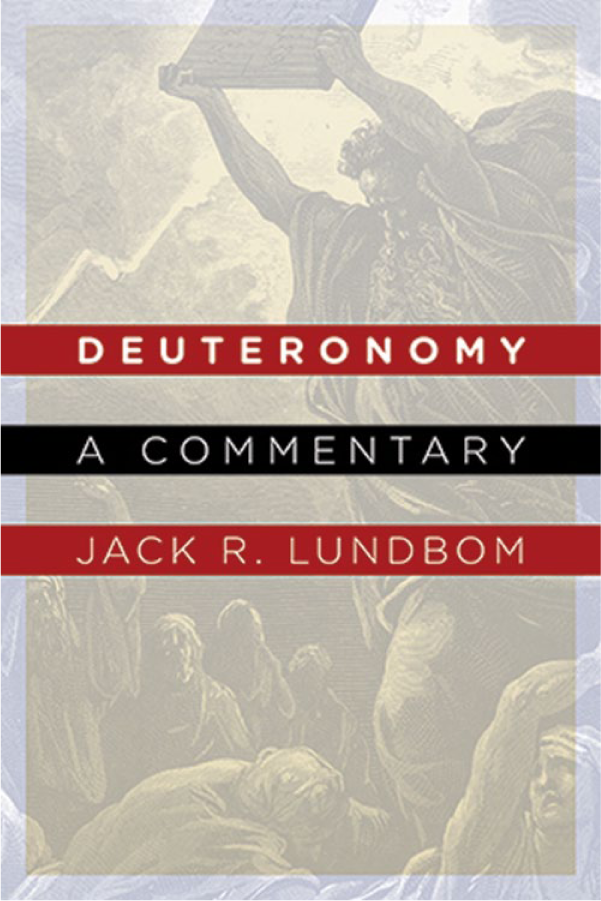
Sixty pages of bibliography provide citations for essential reference works, textual editions, commentaries—including seminal commentaries from the nineteenth century, works of Jewish interpretation, and secondary literature in the form of books, monographs, and articles. Ninety-eight percent of the more than one thousand bibliographic entries were published prior to 2006. A Scripture and author index, as well as a list of citations of Deuteronomy in the New Testament, concludes the volume.
Lundbom’s comprehensive endeavor extends beyond his introduction and bibliography to his comments proper. Copious references to relevant Hebrew, Septuagint, Vulgate, and other textual witnesses, as well as to Old and New Testament texts, ANE and Jewish sources, lexical citations, and other sources appear throughout the commentary. In fact, the cross-referencing can function, for the general reader and specialist alike, as a kind of index for primary and secondary literature. For this feature alone, the commentary is a valuable resource, though Lundbom offers much more.
Lundbom organizes his comments according to his assessment of the structure of Deuteronomy. For each literary unit identified, he offers a translation, a discussion of rhetorical signals and composition, a phrase-by-phrase explication of the text (in which the phrase, rendered in English translation, is often followed by its Hebrew equivalent), a summary of the unit’s message, and a description of the audience addressed. Three excurses treat the topics of centralized worship, divorce, and scholarly discussion of the Song of Moses.
Lundbom’s exegetical approach to the text is rhetorical. He observes that “the controlling structures in Deuteronomy” are “inclusio and framing” (p. 23). Rhetorical signals inform not only his exegesis of specific texts but also his analysis of structure and the development of the text, including the Deuteronomic History. For example, Lundbom argues that the lost law book discovered in 622 BCE, during Josiah’s reign, was the Song of Moses (Deut 32:15–22) rather than Deuteronomy 1–28. The evidence he cites in support of his argument is composed of three parts, at least two of which are rhetorical: l) the thematic correspondences between the Song of Moses and Huldah’s oracle (2 Kgs 22:16–20), which place the two texts in association; 2) the prose frame to the Song of Moses (Deut 31:24–30 and 32:44–46), where a key-word chiasm “makes” the “words of this law” into “the words of this song” (pp. 15 and 844–45), equating the Song with the law book; and 3) the occurrence of the phrase “book of the law” in both Deut 31:26, where it refers to the scroll on which the Song of Moses was written, and 2 Kgs 22:8, where it refers to the temple law book. Rhetorical signals thus inform Lundbom’s understanding of the Song of Moses, which he places at the core of the second supplement (Deut 31–34) to the first edition of Deuteronomy (Deut 1–28). That first edition is itself “held together by an inclusio” (p. 73). Rhetorical signals also provide support for his resolution to the chronological problem posed by Josiah’s purge of the high places in 628 BCE (2 Chr 34:3–7) and the discovery of the law book in 622 BCE (2 Kings 22–23). He proposes that 2 Kings 22–23 is a conflation of two separate accounts, one pertaining to a purge and the other to a legal reform. The conflation is supported by a key-word chiasm, similar to the key-word chiasm in the structure framing the Song of Moses (Deut 31:24–30 and 32:44–46) (p. 17). For Lundbom, rhetorical style also resolves the problem of the abrupt shifts from second person plural to second person singular in the verbs of Deuteronomy. Although Lundbom gives a brief overview of the history of rhetorical criticism, he does not situate that exegetical approach in the context of other major exegetical approaches to the text. A paragraph on this topic in his introduction would have been useful for the general reader.
A notable lacuna in his comments is attention to gender polarization in texts treating issues pertaining to women, particularly Deut 21:10–14; 22:13–23:1; 24:1–4; and 25:5–10. Lundbom’s excursus on divorce offers an extensive collation of ancient sources, and his comments review much of the secondary literature, but the issue of gender polarization is largely missing from the discussion in both places. Describing the six laws in Deut 22:13–23:1, Lundbom states that “the present collection of laws is concerned with improper commerce between the sexes, aiming to preserve chastity and marriage among the people of Israel” (p. 627). But he does not discuss the gap between conceptualities inherent in the gender polarizations of the text and conceptualities inherent in twenty-first-century categories like “chastity,” “marriage,” and “adultery.” He does not discuss how these laws (and others like them) protect the sexual property rights of men. Lundbom does acknowledge that in Deut 22:22 “the woman belongs to the husband because he paid money to her father to get her” (p. 635); but the property issues concerning women in such texts merit far more commentary.
Despite this drawback, Lundbom’s commentary is an impressive work. It strikes a remarkable balance between brevity and satisfactory coverage of subjects immensely broad in scope. Lundbom’s writing style is concise and accessible, reflecting an ease that comes from years of teaching and research within the discipline of Old Testament studies. This accessibility, along with Lundbom’s fastidious cross-referencing, makes the commentary an especially valuable resource for pastors, religious educators, students, and laypersons. The specialist will find that much detail is omitted in Lundbom’s prodigious work, but the result is readable prose, easily graspable overviews, and effective orientation to basic issues. This will ensure the commentary’s longevity. In any case, the specialist will appreciate the succinct yet satisfactory nature of the overviews and the extensive citations throughout the commentary proper. In addition, the commentary can serve as an excellent resource for plumbing a rhetorical-exegetical approach to Deuteronomy. General readers will appreciate particularly Lundbom’s review of scholarly works on the composition of the text. A note for the non-specialist concerning scholarly use of the terms “Deuteronomistic” and “Deuteronomic” would have been useful.
While the commentary is written for a Christian audience, it will appeal to readers of other faith traditions interested in the history of scholarship, basic issues at stake in the study of Deuteronomy, and in a rhetorical approach to the text. Lundbom acknowledges his indebtedness to the commentaries of S.R. Driver, Moshe Weinfeld, and Jeffrey Tigay. His work undoubtedly will rank and endure with theirs.