




Abstract
In the context of totalism—imperial rule in the biblical world and in today’s market-driven economy—those who are in power attempt to silence the voices calling for justice and fullness of life. Biblical theology gives voice and testimony that breaks the silence of totalism. Biblical theology is practical theology that speaks to what is sustainable in the death-dealing totalism that we face. The biblical witness is not defeated, and totalism has not won, because of the emancipatory nature of God, who cannot be silenced.
Introduction
In my book Theology of the Old Testament, I organized my study around the rubric of “testimony.” 1 I appealed to the rubric of testimony and the metaphor of litigation to suggest two matters: first, such testimony is originary; it evokes reality that is not explicitly uttered. Second, such testimony is endlessly contested, both within and beyond the bounds of the text, so that our own practice of interpretation is participation in that ongoing contestation.
Implied in my appeal to such a practice of testimony and such an image of litigation is the claim that
Testimony amid Totalism
I had not seen clearly when I pursued the rubric of testimony as a use for biblical theology that “testimony” is a match for “totalism.” By “totalism” I mean a social-political, economic, cultural, theological enterprise that is comprehensive, that monopolizes both technology and imagination, and that will allow no voice that contradicts the claims and power of the prevailing ideology. The best rendition of such totalism known to me is that of Robert Lifton, who has studied recent forms of totalism and who enumerates the “deadly sins” of such enterprises that concern “milieu control” and “mystical imagination.” 2 A more philosophical approach to the same issue is offered in the defining study of Emmanuel Levinas, Totality and Infinity. By “totality” Levinas means a completely self-contained arrangement of reality that resists the open-endedness of “infinity.” 3 In the ancient world of the Bible, totalism took the form of empire that occupied territory, taxed its subjects, relied on great liturgically enacted myths, and insisted on compliance in a way that often precluded local tradition and local freedom. Thus in the Old Testament we get a series of empires—the paradigmatic account of Pharaoh and the historical sequence of Assyrian, Babylonian, and Persian rule, culminating in Hellenistic imperial culture and finally the severe power of Rome. 4
Contemporary interpretation of the Bible lives and works amid a totalism that controls both the technologies of power and the limits of imagination, so that nothing is imaginable outside the control and administration of the political, economic oligarchy that goes under the banner of “market ideology” that in the United States is linked to the broad claims of patriotic exceptionalism accompanied by immense military force. The visible expression of this totalism is the huge concentration of wealth in the hands of a few. The measure of the effectiveness of that totalism is that it is nearly impossible, even for communities of religious passion and resolve, to imagine anything outside the control of the totalism. Such market ideology is not to be confused with the actual market, but now has become a “principle for regulating social relations.”
5
A triumphant market ideology schematizes all social relationships: Schematically three categories of people result from such forced development. First, a small class of ultra-rich who can accumulate much wealth while spending ostentatiously. Second, a varying number of people in an intermediate position. They represent the middle classes, those who balance production and consumption. Finally, there are the poor, excluded from the sharing of wealth, and preoccupied by problems of mere survival.
6
The economic outcome of such social relationships is this: Development tends to produce shortages for a great number of people as the condition of excess for a small minority.
7
This political-economic monopoly is ordered by Enlightenment rationality. The consequence of such an arrangement is described by Enrique Dussel in this way: Modernity must be understood to include its peripheral alterity. Modernity would then encompass all of the following: (1) its hegemonic core; (2) the dominated peripheral colonial world, as part of the “world system”; and (3) the sectors of the world that have been excluded from this system, as its exteriority.
8
Such totalism, ancient or contemporary, has such force that its impact is characteristically to silence views to the contrary.
9
In the Old Testament I suggest that the paradigmatic narrative of such silencing is the confrontation of the prophet Amos with the priest at Bethel. The political regime of Israel (the Northern Kingdom) finds the voice of Amos unbearable, and so issues a verdict of silence: O seer, go, flee away to the land of Judah, earn your bread there, and prophesy there; but never again prophesy at Bethel, for it is the king’s sanctuary, and it is a temple of the kingdom (Amos 7:12–13).
The priest representing the regime understands quite well that control of religious discourse and cultic centres is intimately linked to the control of political/economic possibilities. For that reason, silencing the prophet perpetuates a unjust status quo.
When we consider the interface of interpretation and silence, we may entertain an awareness that the rise of “historical criticism” in the eighteenth and nineteenth centuries, perhaps designed to thwart religious scholasticism and fundamentalism, served to conform interpretation to the requirements of dominant rationality. That is, historical criticism, with its effective capacity to “explain away” so much in the text, left the text more-or-less amenable to dominant rationality. Thus, historical criticism became a form of silencing. One may notice, moreover, that much so-called “progressive Christianity” lives comfortably with the canons of Enlightenment rationality and is ready to explain away or disregard what does not fit this Enlightenment point of view. Such an interpretive strategy constitutes a willingness to be silenced by the force of the rationality of the dominant regime. It is characteristically evident that such conformity assures that the radical imperatives of the textual tradition are safely toned down.
Testimony that Breaks the Imposed Silence
Testimony has a capacity to break the silence that is imposed by the totalizing regime. Thus I propose that the paradigm of “totalism-testimony” is a useful way to think about the future of biblical theology, because it is likely that the silencing capacity of our current totalism will only become more aggressive and comprehensive. The silence cannot be broken by staying safely within the confines of the totalism, but requires speech “from elsewhere” that in the textual tradition is grounded in the character and purpose of Bartolome de Las Casa would not have been able to formulate and articulate his critique of the Spanish conquest of the Americas if he had not himself lived in the periphery and heard the cries and witnessed the tortures to which indigenous people were being submitted. It is that Other who is the actual origin of this counterdiscourse that took root in Europe.
11
Dussel insists, then, that a study of thought in Latin America, Asia, and Africa: …is not a task that is anecdotal or parallel to the study of philosophy as such (which would be that which is European in character) but instead involves the recovery of a history that incorporates the counterdiscourse that is nonhegemonic and that has been dominated, silenced, forgotten, and virtually excluded—that which constitutes the alterity of Modernity.
12
It is my thought that testimony, in ancient Israel and in the early church, constituted counter-discourse that spoke out against the several totalisms that dominated the ancient map.
13
The comprehensive power of market totalism today calls for an either/or—either market ideology or gospel covenant—but not both/and. We have reached a crisis point that requires a choice, even if that choice may be strategically in the form of dialogue. That either/or can be found in Josh 24:14–15 and 1 Kgs 18:21, and it is stated boldly by Robert Jenson: We must summon the audacity to say that modernity’s scientific/metaphysical metanarrative… is not the encompassing story within which all other accounts of reality must establish their places, or be discredited by failing to find one… As pop scientists urge over and over, the tale told by Scripture and creed finds no comfortable place within modernity’s metanarrative. It is time for the church simply to reply: this is certainly the case, and the reason it is the case is that the tale told by Scripture is too comprehensive to find a place within so drastically curtailed a version of the facts. Indeed, the gospel story cannot fit within any other would-be metanarrative because it itself is the only true metanarrative—or it is altogether false.
14
Thus the testimony of Scripture—and the derivative testimony of theological interpretation—cannot be confined to the critical categories of modern Enlightenment rationality, because such containment silences the One to whom testimony is made. Such testimony thus must refuse to dwell in the narrative of the market and see that the counterdiscourse in fact attests a counter narrative that is unacceptable to the dominant rationality and to the dominant forms of political economic power that depend upon that rationality. It is an appeal to an alternative metanarrative that it takes—with Jenson—as “the only true metanarrative.” 15
Current attention to “trauma theory” may be important for the grounding of testimony outside totalism. Trauma theory makes clear that acute pain and loss evoke truth-telling in the face of silencing. Most helpful in this regard is the rereading of the book of Jeremiah by Kathleen O’Connor according to trauma theory. O’Conner sees the cluster of realities that lie behind the testimony of the book of Jeremiah: Haunting memories, broken language, benumbed souls, and impenetrable grief compounded by the collapse of faith—these common effects of disaster and trauma coalesce into heavy burdens that victims can carry for decades and even for generations.
16
The most remarkable reality in O’Connor’s acute study is that in this environment of unbearable wound, when language was destroyed, language was rediscovered. It was given: “Thus saith the Lord.” It is speech beyond the aegis of the regime, beyond the cadences of the liturgy, and beyond the permit of the Torah. In oracle and in narrative,
O’Connor’s insight concerning this uncompromising text has been given programmatic articulation by David Carr, who proposes that the biblical literature has emerged within and in response to a series of traumatic events. 17 If Carr is correct that testimony arises from trauma, then it should not surprise that the speech of trauma comes from outside the totalism and bears witness to Reality that the totalism is unable to contain, even as it is unable to silence the witnesses to that Reality.
Biblical Theology as Testimony: A God Who Cannot Be Silenced
One possible future for biblical theology is to take seriously, contend with, and extend the speech of testimony that is propelled by pain to tell the truth that contests the totalizing regimes that generate the pain. Many interpretive voices outside the longstanding Western hegemony now refuse conformity to totalizing rationality. On the one hand, the various liberation trajectories of interpretation—feminist, queer, and postcolonial among them—no longer accept the canons of the old hegemony and its old methods. On the other hand, the influence of Mikhail Bakhtin’s philosophy of language and literary theory represents new possibilities. 18 Bakhtin’s attentiveness to multi-voiced possibility and dialogic interaction within the text gives the lie to any single, settled meaning. The ideology of the market, like any totalizing regime, cannot tolerate such dynamic pluralism because it specializes in certitude and control. The restless openness of newer, less regulated interpretive methods means a refusal to let the text settle in one meaning.
There is no doubt that the Western church has been largely co-opted by Enlightenment rationality and the demands of market ideology. The theological result of such cooptation has been either fundamentalism that reduces God to a formula or progressivism that yields such an anemic God that there can be no lively witness to bear. In the hands of many churches, the God of the Gospel has withdrawn to safe familial life and has retreated from the public domain. That is, God has been rendered innocuous.
But of course the church in its fidelity cannot accept such a course. For that reason, biblical theology in the service of the church is attentive to testimony that takes issue with totalism. There is a reason that much of the great growth of the church in venues outside Western hegemony is marked as “Pentecostal.” Faithful Pentecostalism is led by the Spirit that refuses to be contained in any form of totalism. Thus, the Spirit has a capacity for speech and action and to generate zones of freedom that make human life possible. It is my hunch that as the totalism of market ideology grows more ominous, it will fall to the church, even in the modern West, to find voice to bear witness to the opposition.
The church may bear witness, as did ancient Israel and the early church, to the character of the God who in sovereign freedom accepts no accommodation to totalism, who is an embarrassment to Enlightenment rationality. This is a God who breaks the silence of the regime. At the outset of Israel’s testimony, in its paradigmatic narrative, the God of Israel speaks: “Let my people go” (Exod 9:1).
The phrase is an imperative addressed to Pharaoh. Pharaoh is not accustomed to being addressed at all, and certainly not with an imperative. That imperative, to be sure, is finally performed by human agents. Moses and Aaron do the heavy lifting. They do so, however, only after and because of the holy authorization from elsewhere to break open the totalism.
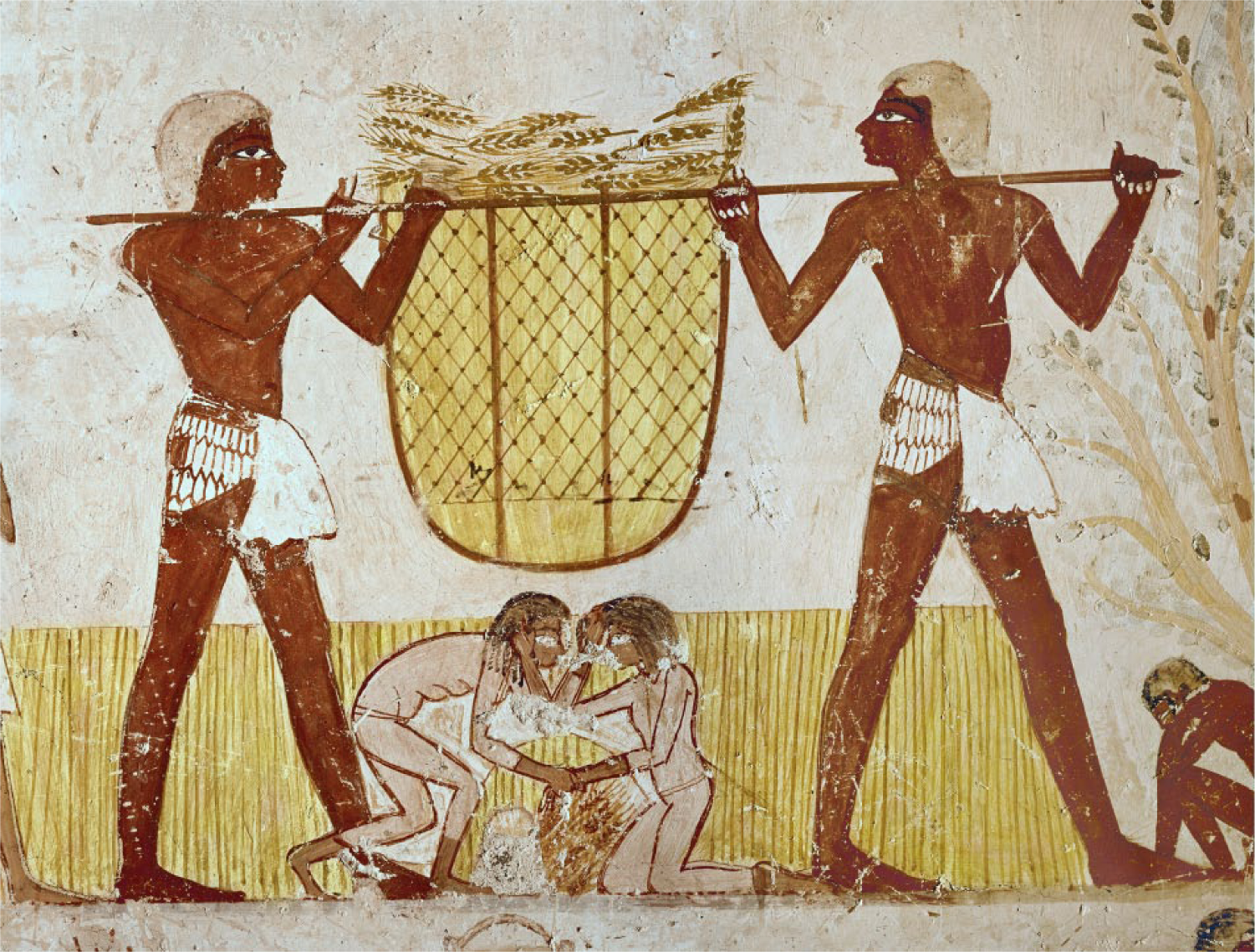
In this detail of an Egyptian wall painting, men transport grain while slaves fight for the leftovers. Scribe of the fields and estate inspector under Pharaoh Thutmosis IV (18th Dynasty, 16th–14th cent. BCE). Location: Tomb of Mennah, in the cemetery of Sheikh Abd al-Qurnah, Thebes, Egypt. Photo Credit: Erich Lessing / Art Resource, NY.
At the end of Israel’s canonical testimony, the God of Israel confronts the law of the Medes and the Persians. The great mark of that law is that it cannot be changed, violated, or circumvented (Dan 6:8). It is an absolute, as that regime attests. Every totalizing regime claims that it is an absolute beyond change! The issue is joined, however, between Daniel, a quintessential Jew, who is committed to another law, the Torah of Moses. The contest is law verses law. The Torah of God, however, is vouched for by a God who is an agent of change: Blessed be the name of God from age to age, for wisdom and power are his. He changes times and seasons, deposes kings and sets up kings; he gives wisdom to the wise and knowledge to those who have understanding. (Dan 2:20–21)
This capacity for change guarantees that the absolutism of Nebuchadnezzar cannot be sustained. The advocates of the law of the Medes and the Persians continue to insist: Now, O king, establish the interdict and sign the document, so that it cannot be changed, according to the law of the Medes and the Persians, which cannot be revoked (Dan 6:8; see vv.12, 15, 17).
The narrative, however, testifies that in the end, even Nebuchadnezzar is glad for the change wrought by For he is the living God, enduring forever. His kingdom shall never be destroyed, And his dominion has no end (Dan 6:26–27).
Between the paradigmatic narrative of the Exodus and the narrative testimony to the God who can change in Daniel, there was a long contestation about the relevance of They have spoken falsely of the Lord, and have said, ‘He will do nothing. No evil will come on us, and we shall not see sword or famine’ (Jer 5:12; Zeph 1:12).
This verdict might be the mantra of human hubris or the sorry chant of human despair. Either way, the alleged speakers do not deny the existence of
But of course Israel refuses the totalism of a managed earth and a silenced heaven. In contrast to the idols who are given full mocking characterization, the God of Israel receives only one verse: Our God is in the heavens; He does whatever he pleases (115:3).
But that one verse is enough; God is elsewhere (in heaven), not on earth to be administered by the dominant regime. This God, moreover, acts in complete freedom, doing what is pleasing to God. God has no need to conform, no rule to obey, no limit to honor, and no overlords to appease. The lyric doxological affirmation of vs. 3 concerns a God who can say, “Let my people go,” and deliver, a God who can change the unchangeable laws of the Medes and the Persians, a living God capable of wonders. This God, via the poet, will break the imposed silence: For a long time I have held my peace, I have kept still and restrained myself; Now l will cry out like a woman in labor. I will gasp and pant (Isa 42:14).
The poetic witness reveals that
Nihilism and the Restless Breath of God
Two concessions concerning that argument are to be faced. First, I am aware that Jack Miles and Richard Friedman have made a compelling argument that in the later parts of the Old Testament the agency of God fades away, and we are left with human agency. Friedman begins his book in this way: God disappears in the Bible… The Bible begins, as nearly everybody knows, with a world in which God is actively and visibly involved, but it does not end that way. Gradually through the course of the Hebrew Bible… the deity appears less and less to humans, speaks less and less. Miracles, angels, and all other signs of divine presence become rare and finally cease.
20
He concludes: With over two hundred years still left to the story, there are no more fires from the sky, no more miracles, public or personal, no more angels, seen or unseen, no more cloud and glory, no more “and Yahweh said to X.” The only remaining visible channel to God is the Temple, housing the ark in Jerusalem, and it is destroyed by the Babylonians in fire.
21
His conclusions lead him into a reflection on the modern formulation of the nihilism or the “Death of God,” a lá Friedrich Nietzsche and Fyodor Dostoevsky. Jack Miles, in a thicker presentation, reaches a similar conclusion: At length, the Israelites took charge of their own lives. Eloh and Yah were still honored, but their home was understood to be in heaven now; little was expected of them on earth… Annually, a religious drama was celebrated recalling the epic of Israel and the gods.
22
God has withdrawn as a visible, palpable agent in the world. This conclusion does not lead Miles, like Friedman, to the modern question of the “Death of God.” It leads him, rather, back to the ancient Greek tragedies, to a God who is “trapped within its contradictions… He cannot escape. He is trapped as Hamlet is trapped—in himself.” 23 In his final assertion, Miles offers a trace beyond tragedy: “That God is the divided original whose divided image we remain. His is the restless breathing we still hear in our sleep.” 24
Both of these acute readings of the text mount an immense challenge to any straight-forward notion of testimony amid totalism, for there would seem to be not much left to say by way of testimony. With a God dead (Friedman) or trapped (Miles), totalism would seem to prevail. The text itself, however, does not readily give into such a modernist surrender to totalism of a tragic kind. The reality is that the immediacy of God has been lost, and we are left with mediation. Miles himself acknowledges this: If the Tanakh were tragedy, God having learned the truth about himself through his relationship with mankind, above all his relationship with Job, would end in despair. But the Tanakh is not tragedy, and the Lord God does not end in despair. … The Tanakh refuses tragedy and ends, as a result, in its own kind of muddle, but its protagonist ends alive not dead.
25
The mediation is officially left to Torah and to Temple.
26
But in fact the most compelling mediation is in narrative that refuses to be reduced to a memo.
27
Narrative, such as Ruth or Esther, leaves open the possibility of inexplicable newness that is performed by human agents but that hints regularly of another agency that is beyond the administration of any human agent, whether Ahasuerus or Nebuchadnezzar or Cyrus or even Boaz. There is a defiant emergence in such narratives that is not directly credited to Biblical interpretation is not surprised by the “disappearance” or hiddenness of God: What calls for chief mention here is that fact that the experience of God’s hiddenness, just as the experience of his presence, is an integral part of Israelite faith. Both experiences derive from the nature of God himself. He is both hidden and present, both near and far away. This is precisely the dilemma which faith in God presents. It is not, however, a dilemma that undermines Israel’s faith, though it does stretch it to its farthest dimensions.
28
In Balentine’s knowing hands, it is clear that the “disappearance” of God is not a belated “running out of steam” or “God losing interest” in the human and/or Israelite project. It rather belongs recurringly to the reality of life in the world. It is only our trepid tradition of interpretation that is surprised or troubled by that hiddenness.
It is clear that amid seasons of divine “disappearance” or hiddenness, Israel kept to its testimony. In oracle, song, and narrative it intended to mediate defiant emergence and inexplicable possibility. The old narratives could be taken as a “hidden transcripts” that sustain peculiar identity in the face of totalism.
29
Such narratives attest defiant emergence and inexplicable possibility that continue to draw upon the older, more explicit claims for
They are, however, claims that that cannot be said loudly in seasons of acute totalism. They are however, kept at the ready for the time when the moment is right, when courage is mustered and freedom is performed. Thus it is, in my judgment, a mistake to imagine that we have a linear and unilateral movement from the big public God to the hidden, disappearing God, as Miles and Friedman propose. We have rather an ongoing two-track testimony, covert and overt, that surfaces or not, depending on the prospect for such testimony amid totalism. That prospect for testimony depends not only upon the opinions and permits of the empire, but upon the nerve and courage of the testifying community. The witnessing community is not defeated by absence. The divine character is not nullified by disappearance. Miles’s “restless breathing” is the same restless breathing that dismisses the adherents of totalism who are “no help” because they have no “restless breath” (Ps 146:3–4).
Biblical Theology is Practical Theology
It is clear that the testimony of Israel is not a consistent, unilateral attestation to the emancipatory character of
But then, such acknowledgement of totalism within the text and such readiness to conform to totalizing practices is simply evidence that the testimony of Israel (and of the interpretive trajectories) is inescapably contested and in dispute. We may notice one example of such contestation. In the narrative of the dedication of the temple, the totalizing quality of Solomon’s pageant is on full display in the anthem of 1 Kgs 8:12–13. That totalizing affirmation shows But will God indeed dwell on the earth? Even heaven and highest heaven cannot contain you, much less this house that I have built. (8:27)
This is not, as Friedman might suggest, witness to the disappearance of God into the heavens; it is rather a refusal of the king’s totalism.
This example could be readily multiplied but is enough to suggest that the testimony of Israel is endlessly contested, and interpreters of that testimony participate in that ongoing contestation. If this reading of “testimony amid totalism” is useful, then our interpretive work is to see when, how the textual tradition conforms to a totalizing propensity and when it concerns emergent defiance that refuses totalism. Focus on this question means that biblical theology is indeed practical theology. I have no doubt that the overriding human question for us is how viable life (human life and the life of all creatures) is sustainable in the death-dealing totalism that we face. This is the recurring question in this textual tradition. One can see over time how the emancipatory text and its contestation can be preempted (often by Christians and now by some Jews) to serve legitimated brutalizing totalism. The text, however, is not defeated and totalism has not won, even in our own time, because the text is occupied by this emancipatory character that is the subject of both the testimony and our interpretation of the testimony.
Testimony amid Totalism in the New Testament
It is not very difficult to carry this framing of “testimony amid totalism” into the New Testament. The Gospel texts are alert to the prospect of persecution and being called before “the authorities” (Matt 10:18–19; Luke 12:11; 21:12). The officials of the Roman Empire continue to perform the burdens of totalism.
30
In the “testimony” of Luke, the disciples may anticipate that their own faithful future will be a replication of the destiny of Jesus who was called before the authorities, the masters of Roman totalism, who finally executed him: The arrests and persecution of the disciples will become occasions for them to give testimony… The persecution of the disciples, however, does not exceed what Jesus himself experiences. He, too, is about to be arrested and brought before Pilate and Herod.
31
The disciples will be called to account, precisely because their testimony contradicts and becomes unbearable to the totalism of Rome (Luke 21:12–15).
In the book of Acts, the Apostles are regularly called into imperial courts to explain and justify their testimony. Their preaching has been insistently about the resurrection of Jesus, the impact of which is to “turn the world upside down” (Acts 17:6). That is, testimony to Easter unsettles and challenges the settled hegemony of Rome: “They are all acting contrary to the decrees of the emperor, saying that ‘there is another king named Jesus’” (Acts 17:7). The programmatic effect of the early church in the book of Acts is to articulate and perform a way of life that subverts the life authorized by the totalism.
Brigitte Kahl’s recent reinterpretation of Paul’s letter to the Galatians understands Paul’s critique of “the law” as a reference to Roman law and thus a reference, not to the Torah of Judaism, but to the sum of Roman totalism.
32
In light of Kahl’s thesis, we can see that the gospel is an emancipation from the yoke of slavery, a declaration that is hauntingly reminiscent of the emancipatory work of
Conclusion: Biblical Theology as Contestation
It is entirely possible that I have overstated the case and have been too reductionist about the framing of “testimony amid totalism.” I have no doubt that readers will make their own judgments. I offer this framing of our interpretive work because I believe that the current claims of market ideology, managed by a greedy, indifferent oligarchy, is the defining social reality of our time. If subversion of that totalism is at all possible, I have no doubt that it will be seeded by texts that feature an emancipatory character that authorizes an emancipated existence. My insistence is that biblical theology is not a fringe exercise in the work of the institutional church. It is, rather, an exercise that concerns life or death. Those who engage in such biblical theology have an opportunity to participate in this great contestation. I am filled with hope that new methods and new voices that elude the Western hegemony will lead us in fresh directions that call into question every easy coming to terms with the present totalism.
Footnotes
1
Walter Brueggemann, Theology of the Old Testament: Testimony, Dispute, Advocacy (Minneapolis: Fortress, 1997).
2
Robert Jay Lifton, Witness to an Extreme Century: A Memoir (New York: Free Press, 2011), 67–68, 381, and passim.
3
Emmanuel Levinas, Totality and Infinity: An Essay in Exteriority (Pittsburgh: Duquesne University Press, 1969).
4
See Richard A. Horsley, ed. In the Shadow of Empire: Reclaiming the Bible as a History of Faithful Resistance (Louisville: Westminster John Knox, 2008).
5
Gerald Berthoud, “Market,” in The Development Dictionary: A Guide to Knowledge as Power, ed. Wolfgang Sachs, 2nd ed. (New York: Zed Books, 2010), 79.
6
Ibid., 87.
7
Ibid. See also the concept of “market fundamentalism” in Naomi Oreskes and Erik M. Conway, The Collapse of Western Civilization: A View from the Future (New York: Columbia University Press, 2014), 37.
8
Enrique Dussel, Ethics of Liberation in the Age of Globalization and Exclusion (Durham: Duke University Press, 2013), 46.
9
See Sue Curry Jansen (Censorship: The Knot that Binds Power and Knowledge [Oxford: Oxford University Press, 1991]) for a compelling exposé of silence imposed from above.
10
Walter Brueggemann, “Silence Broken from ‘Elsewhere’,” SBL Seminar Paper, 2014.
11
Dussel, Ethics of Liberation, 45.
12
Ibid., 46.
13
Ibid.,45. Dussel proposes that such counterdiscourse from the periphery is an “essential co-constitutive dialogue.”
14
Robert W. Jenson, Canon and Creed, Interpretation: Resources for the Use of Scripture in the Church (Louisville: Westminster John Knox, 2010), 120.
15
Ibid.
16
Kathleen M. O’Connor, Jeremiah: Pain and Promise (Minneapolis: Fortress, 2011), 26–27.
17
David Carr, Holy Resilience: The Bible’s Traumatic Origins (New Haven: Yale University Press, 2014).
18
On the importance of Bakhtin, see Barbara Green, Mikhail Bakhtin and Biblical Scholarship (Atlanta: SBL Press, 2000).
19
The God who speaks defiantly in these verses is surely a companion in the company of the Hebrew midwives Shiphrah and Puah (Exod 1:15–22).
20
Richard Elliott Friedman, The Hidden Face of God (San Francisco: HarperSanFrancisco, 1995), 7.
21
Ibid., 25.
22
Jack Miles, God: A Biography (New York: Knopf, 1995), 401.
23
Ibid., 408.
24
Ibid.
25
Ibid., 404.
26
See Brueggemann, Theology of the Old Testament, 567–704.
27
See Walter Brueggemann, “Poems vs. Memos,” in Ice Axes for Frozen Seas: A Biblical Theology of Provocation (Waco: Baylor University Press, 2014), 87–113.
28
Samuel E., Balentine, The Hidden God: The Hiding of the Face of God in the Old Testament (Oxford: Oxford University Press, 1983), 172.
29
See James C. Scott, Domination and the Arts of Resistance: Hidden Transcripts (New Haven: Yale University Press, 1990).
30
See Empire in the New Testament, Stanley E. Porter and Cynthia Long Westfall, eds. (Eugene, OR: Pickwick, 2011) and Douglas E. Oakman, Jesus, Debt, and the Lord’s Prayer: First Century Debt and Jesus’ Intention (Eugene, OR: Cascade, 2014).
31
R. Alan Culpepper, “The Gospel of Luke: Introduction, Commentary, and Reflections,” NIB 9 (Nashville: Abingdon, 1995), 401.
32
Brigitte Kahl, Galatians Re-Imagined: Reading with the Eyes of the Vanquished (Minneapolis: Fortress, 2010).