



Abstract
The move from biblical theology to theological interpretation of Scripture is less a methodological shift and more a transformation of perspective marked by the location and interests of those of us who engage the Bible as the church’s book. I demonstrate this transformation by reflecting on different ways of reading the story of Jesus’s ascension in Acts 1:9–11.
Keywords
What Did You Expect to See?
Luke’s account of Jesus’s ascension in Acts 1:9–11 is peppered with sight-language: After Jesus said these things, as they were watching, he was lifted up and a cloud took him out of their sight. As they were staring toward heaven as he was going away, suddenly two men in white robes stood next to them. They said, “Galileans, why do you stand here, looking toward heaven? This same Jesus who was taken up from you into heaven will come in the same way that you saw him go into heaven.”
To these five references to their “seeing,” we can add a sixth from v. 10 simply by adjusting the translation somewhat: “Look! Two men in white robes stood next to them.” 1 Luke thus invites his audience, too, to witness what happens on the Mount of Olives. In this case, emphasis falls not only on what Jesus’s followers saw, but also on what we who read or hear Luke’s account ought to see.
The Ascension. Flemish or Spanish school, 17th century. Gallery of the Golden Age. Château de Villandry, France. Photo Credit: Gianni Dagli Orti/The Art Archive at Art Resource, NY.
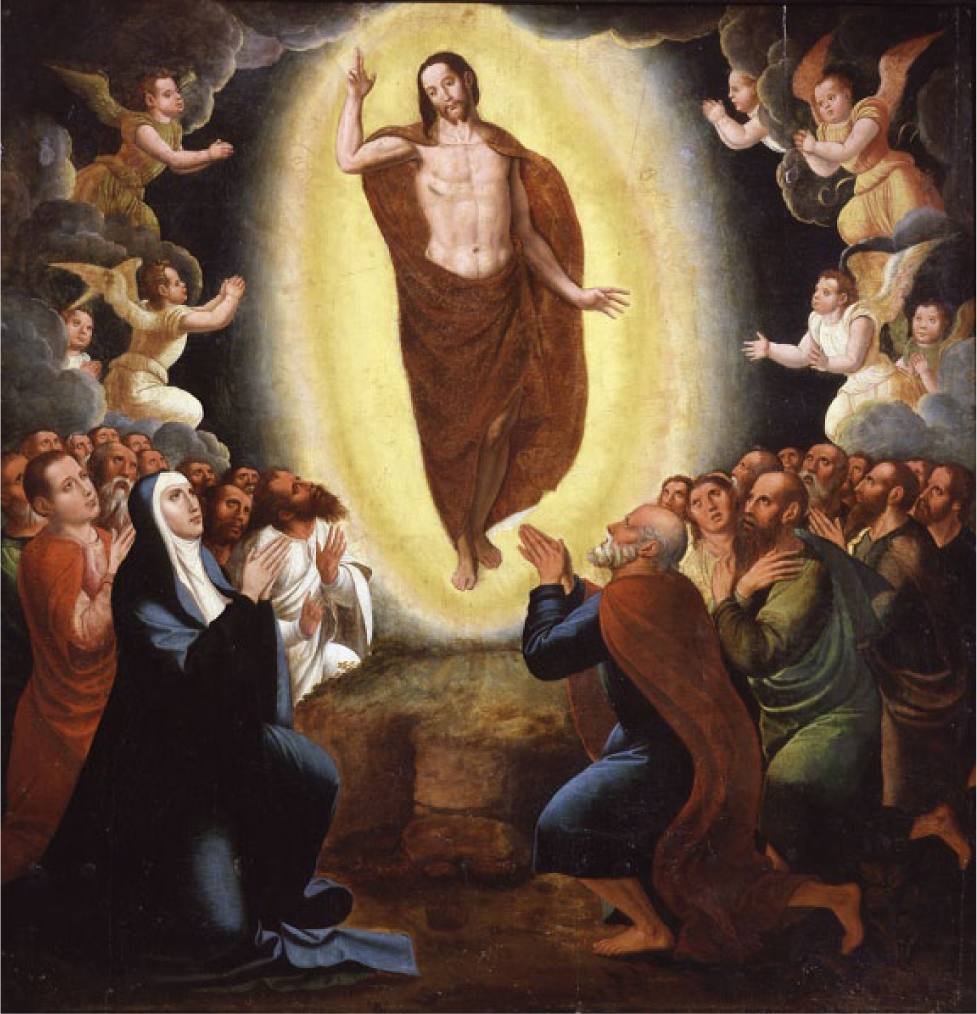
The significance of vision in this account can be developed along various lines. First, this scene furthers Luke’s representation of Jesus’s followers, particularly those involved in the ongoing mission, as eyewitnesses. Typically, this motif centers on their bearing witness to Jesus’s death and/or his resurrection (Luke 24:46–48; Acts 1:9, 2:22–32; 4:33; 10:39–41; 13:27–31), but it can also reach as far as his having been “glorified” or “lifted up” (3:13–15; 5:32). Second, even if Luke invites his audience to see what Jesus’s followers see, to take their turn with the field glasses, as it were, the scene as a whole is related from the perspective of Jesus’s followers as their visionary experience. Accordingly, this scene has significance for our understanding of early Christian religious experience. 2 Third, the question directed to Jesus’s followers—“Galileans, why do you stand here, looking toward heaven?” (1:10)—implicitly identifies a disparity between what these Galileans see and what they should be seeing. We can debate the nature of this tacit criticism, 3 but it is hard to escape the view that the white-robed men (angels?) regard their Galilean companions on the Mount of Olives as having already spent enough time standing around with their eyes directed skyward. Self-evidently, Jesus’s ascension is an event in need of interpretation, so it is important to attend to the patterns by which Jesus’s followers, then and now, conceptualize what they witness.
In fact, cognitive science has long recognized this problem with what we see, that incoming sensory data are generally inadequate to substantiate an unambiguous interpretation on our part, with the result that our minds disambiguate the data according to what we have learned to expect to see. Having noted these limitations, the neuroscientist Christof Koch remarks that “cortical networks fill in. They make their best guess, given the incomplete information…. This general principle, expressed colloquially as ‘jumping to conclusions,’ guides much of human behavior.” 4 Through “filling in,” we find a human face in the full moon, recognize dogs and rabbits in cloud formations, or prejudicially categorize people by any number of criteria (e.g., accent, gender, race, or hair color). We interpret the present and visualize the future according to past patterns, generally applying old paradigms in new contexts. As a vehicle travelling a country road drops into the deep ruts left by earlier travelers, so our patterns of thought, belief, and response follow our brain’s well-worn pathways. Our interpretive schemes are conceptual (a way of seeing things), communal (patterns of beliefs and values to which a group and its members are deeply attached), and conative (action-guiding). To put it differently, we extend significance to life-events according to the way we conceptualize them, following well-marked paths in our brains. 5
Our hermeneutical equipment thus provides the conceptual schemes or imaginative structures by which we make sense of the world around us. Data may be subject to different modes of engagement and different hypotheses, but our minds order the data according to what we have learned to expect. Embodied human life performs like a cultural, neuro-hermeneutical system, locating (and, thus, making sense of) current realities in relation to our grasp of the past and expectations of the future. 6
Any number of phenomena display our neuro-hermeneutical systems at work. Staunch Democrats and Republicans hear the same data but, predisposed to interpret them differently, they walk away with opposing conclusions. With partisan beliefs calcified, people tend to learn very little from new information. 7 The same can be said of racial bias, with its evolutionary-psychological roots in a natural human alertness regarding members of unfamiliar groups. 8 And patients who have experienced certain brain injuries demonstrate an inability to see what they cannot believe to be true, 9 just as the rest of us operate normally with a strong hermeneutical bias on the basis of prior beliefs, so that we actually perceive stimuli when none are physically presented. 10
How human beings process data, including visual data, has immediate ramifications for our understanding of Luke’s account of Jesus’s ascension. Jesus’s followers had just queried Jesus on the basis of old, unreconstructed patterns of expectation and belief concerning Israel’s restoration (Acts 1:6). Similarly, they now seem not to recognize the significance of what they have seen on the Mount of Olives. We may be reminded of the similar problem at the empty tomb.
“Look! Two men in dazzling clothing stood beside them. . . . They said to them, ‘Why do you seek the living among the dead? He is not here, but has risen.’” (Luke 24:4–6) “Look! Two men in white robes stood next to them. They said, ‘Galileans, why do you stand here, looking toward heaven?’” (Acts 1:10–11)
In the Gospel account the women are reminded of the past (“Remember what he told you. . .” [24:6b]) so that they might interpret the present correctly, whereas in Acts Jesus’s followers are given a future promise (“This same Jesus . . . will come” [1:11]) so that they might understand the present.
These neuro-hermeneutical reflections also shine the spotlight on the taken-for-granted interpretive schemes by which students of Luke’s narrative probe the significance of scenes like this one concerned with Jesus’s ascension. Questions raised about why Galileans stand, looking skyward, pull back the curtain on how and why Luke’s narrative is understood today.
Consider, for example, the interpretation of Thomas Hatina, for whom it seems obvious that the pressing questions raised by Jesus’s ascension in Acts 1 are grounded in the conventional, erroneous cosmology it assumes. Failing to see that ancient Jewish and Greco-Roman ascension stories, including Luke’s, operate with a world divided into three levels (the world of death and punishment below, the level of daily living, and the world of divine bliss above) raises all sorts of scientific issues for Hatina: For example, how does a body (let alone a resurrected one) defy gravity? . . . How is it that a cloud can envelop someone? Is Jesus still ascending? Given what we know today about cosmology, if Jesus is travelling at the speed of light, he would not even be halfway through the Orion Arm of the Milky Way galaxy, which is 80,000 to 100,000 light years in diameter at its main disk, composing 200–400 billion stars. Where is he going?
11
Of course, Hatina is hardly the first to raise questions about the historical veracity of Luke’s account, or to find a way forward with reference to comparative study of similar, ancient accounts. More than 150 years ago, David Friedrich Strauss identified the problem with characteristic scorn: [A]ccording to a just idea of the world, the seat of God and of the blessed, to which Jesus is supposed to have been exalted, is not to be sought for in the upper regions of the air, nor, in general, in any determinate place;—such a locality could only be assigned to it in the childish, limited conceptions of antiquity. . . . Thus there would be no other recourse than to suppose a divine accommodation to the idea of the world in that age, and to say: God in order to convince the disciples of the return of Jesus into the higher world, although this world is in reality by no means to be sought for in the upper air, nevertheless prepared the spectacle of such an exaltation. But this is to represent God as theatrically arranging an illusion.
12
More recently, James D. G. Dunn has repeatedly raised historical questions, 13 and others, theologians and philosophers among them, have charted other paths in their efforts to take seriously the portrait Luke has given us. For example, Peter Brunner writes, “It is simply so that if the Bible told us that the Lord Jesus flew into heaven like a balloon, on and on until he reached his heavenly palace, that would indeed be only a fairy tale” 14 —this before urging that the reality of Jesus’s ascension is God’s exalting the Crucified to divine power and honor. More interesting, perhaps, is Stephen Davis’s argument that Luke speaks in metaphor, that Jesus’s ascension is simply a way of saying that Jesus passed from the presence of his followers to the presence of God. “The Ascension of Jesus was primarily a change of state rather than a change of location. Jesus changed in the Ascension from being present in the realm of space and time to being present in the realm of eternity, in the transcendent heavenly realm.” 15 For his part, Robert Jenson wonders, “Can one really—and even if one be the Christ—get to God by space travel?”—this before offering his own view, that heaven describes not so much a reality “up there” as “‘the place in the world from which’ God’s inner worldly movement begins.” 16
These concerns with interrogating Luke’s account in the courtroom of scientific exegesis, or rescuing Luke from such interrogation, make perfect sense to those whose interpretive schemes have been sculpted in the studio of the modern historical paradigm. To shift the metaphor, such students operate with hermeneutical equipment designed to inquire, first and foremost, into the truth of an account like this, with truth measured in terms of historical veracity. 17 It only seems natural that Luke’s account of Jesus’s ascension would raise the eyebrows of modern scientific inquiry and modern historicism. These are the questions we have been trained to pursue. These, after all, are the stuff of those well-worn pathways by which modern folk make sense of the world.
Actually, for most, study of Jesus’s ascension in Luke’s narrative has moved away from such straightforwardly historical questions. This is because, for many, Luke’s account does indeed read like a “fairy tale,” with the result that critical inquiry has moved away from questions of historical veracity as such and in the direction of reflection on the ascension in literary and mythological terms. Indeed, form-critical study has led to the view among some that Acts 1:9–11 represents an adaptation of parallel accounts in Jewish and/or Greco-Roman literature, and thus to the conclusion that Luke has created his account by drawing on traditional themes from the wider literature of antiquity in order to describe how Jesus came to occupy his place at God’s right side. 18 Luke’s account has points of contact with Old Testament and Jewish as well as Greco-Roman accounts of “heavenly journeys” and “raptures,” though its closest kin are to be found among Jewish traditions. 19 None follow the particular sequence of Luke’s narrative (death → resurrection → earthly interlude → ascension), however, with the result that its significance can be determined on the basis of literary precedents only in general terms. Painting with the broadest of strokes, such accounts bear witness to the exalted status of the one taken up and address the crisis of divine presence, serving to reaffirm the relationship of God to God’s people. Additionally, in a number of Jewish accounts, ascent signifies investiture and enthronement as a royal priest, sometimes with the character of a scribe and prophet, sometimes in order to share God’s reign. 20 These motifs invite further exploration with reference to Luke’s narrative. For example, even though Jesus’s ascension breaks the pattern of the ascended one who typically returns to earth to communicate a divine revelation, this emphasis on divine presence remains important to Luke. This is because it is especially by means of the Holy Spirit that Jesus is present with his followers, and it is as a consequence of his ascension that Jesus now pours out the Spirit (Acts 2:33); although enthroned in heaven, Jesus is actively present in the life and mission of the church. Beyond such general considerations, though, form criticism provides only limited assistance in our reading of Luke’s account. 21
My primary concern is not to show that typical historical and form-critical study of Luke’s account of Jesus’s ascension has offered us little constructive help in grasping its significance. Instead, my point is that, whether on the basis of scientific concerns or against the backdrop of roughly comparable literary accounts in Jewish and Greco-Roman literature, study of Jesus’s ascension has generally followed the protocols of “biblical theology.” Such interests are primarily descriptive. They focus on what the ancients might have experienced or thought or believed. They prioritize historical reconstruction and historical meaning. Biblical theology in this sense seems natural to modern people. These are the expected questions that arise when reading an account like Luke’s. These are self-evidently appropriate questions, legitimate questions, questions stemming from pervasive and communally shared ways of ordering the world of biblical studies. Proponents of theological interpretation of Scripture have no need to cry foul when such questions are pursued, but do want to cry foul when such questions are the only ones allowed, or when these are identified as the only properly critical questions for serious study. Texts like Luke’s account can be studied from all sorts of perspectives. If what we see depends a great deal on what we went looking for, on what we were primed to see, then theological interpretation simply posits alternative vantage points than those occupied by biblical-theological denizens.
One of these alternative vantage points would begin with the Creed, where we read these words:
anelthonta eis tous ouranous
ascendit in cœlos
He ascended into heaven. . . .
That is, rather than seek literary precedents for Luke’s account, we might adopt a position from the standpoint of the church’s rule of faith. From this perspective, the theological problematic of Jesus’s ascension might take a different form. For example, one might consider the apparent disconnection between the witness of the New Testament and this creedal affirmation. Although numerous New Testament texts presuppose something like an ascension when they speak of Jesus’s exaltation to the place of honor at God’s side, the ascension itself is described only twice, both in Luke’s writings, at the end of Luke’s Gospel (24:51) and the beginning of the Acts of the Apostles (1:9–11). 23 Accordingly, what might seem from the perspective of the New Testament taken as a whole to be a minor point has itself been exalted to creedal prominence. Of all the things that could be said of Jesus, how did these words, “he ascended into heaven,” propel themselves from a few lines taken from the entirety of Scripture to such eminence in the church’s précis of its own faith?
Hindsight
The old adage “Hindsight is 20/20” works in many contexts, but would have little appeal over the last couple of hundred years of “biblical theology.” The idea that later interpretations of Jesus’s ascension—from the perspective of the rule of faith that emerged in the second century CE, a perspective later codified in the ecumenical creeds of the church—might help us understand Luke’s words would seem counterintuitive from that perspective. For moderns, including modern study of the Bible, after all, anachronism is the unforgivable sin. Nevertheless, I propose that we listen to three voices from the second-century (CE) reception of Jesus’s ascension as a way of asking whether our reading backwards (so to speak) might allow us to see what we might otherwise have overlooked. We turn briefly, then, to the writings of Justin Martyr from the mid-second century, the apocryphal Acts of Peter from the second half of the second century, and the work of Irenaeus from the last quarter of the second century.
For our purposes, Justin Martyr’s principal contribution was his effort to secure the ascension within the church’s confession. We find in his work two interrelated strategies. The first is his appeal to Scripture—particularly Pss 19; 24; 47; 68; 110—to corroborate Jesus’s ascension: “we prove that all things which have already happened had been predicted by the prophets before they came to pass. . . .” (First Apology 52 [ANF, 1:176]). Scripture testifies to the truth of the christological kerygma, in which Jesus’s ascension figures (First Apology 21), over against myths uttered by those to whom Justin refers as demonized poets concerning those whose careers were mere imitations of Christ (First Apology 54 [ANF, 1:181]): For you know how many sons your esteemed writers ascribed to Jupiter; Mercury, the interpreting word and teacher of all; Aesculapius, who, though he was a great physician, was struck by a thunderbolt, and so ascended to heaven; and Bacchus too, after he had been torn limb from limb; and Hercules, when he had committed himself to the flames to escape his toils; and the sons of Leda, and Dioscuri; and Perseus, son of Danae; and Bellerophon, who, though sprung from mortals, rose to heaven on the horse Pegasus. For what shall I say of Ariane, and those who, like her, have been declared to be set among the stars? And what of the emperors who die among yourselves, whom you deem worthy of deification, and in whose behalf you produce someone who swears he has seen the burning Caesar rise to heaven from the funeral pyre?
Justin urges that “wicked devils perpetrated these things” (First Apology 21 [ANF, 1:170]). In short, ascension marks one as a god, but the only true ascension is the one predicted beforehand, namely, that of Jesus Christ.
The Acts of Peter evidences a similar interest in ascension as a sign of divine legitimation. 24 This document narrates an encounter between Peter the apostle and Simon the sorcerer (cf. Acts 8:5–25). Simon claims that he is “the great power of God,” and people wonder whether he might be the Christ. When Simon is acclaimed in Rome as “God in Italy” and “saviour of the Romans,” he responds with an aerial display by which he arrives at the city gate in a dust cloud (Acts Pet. 4). The ensuing narrative prepares us for a final showdown between Peter and Simon. Having promised that he will “fly up to God” (Acts Pet. 31[2]), Simon challenges Peter with these words: “Peter, now of all times, when I am making my ascent before all these onlookers, I tell you: If your god has power enough—he whom the Jews destroyed, and they stoned you who were chosen by him—let him show that faith in him is of God; let it be shown at this time whether it be worthy of God. For I by ascending will show to all this crowd what manner of being I am.” When Simon is carried up into the air, Peter calls out to God, the Lord Jesus Christ, so that Simon might fall and be crippled but not die—and this is precisely what happened. In this way, Christ-followers were rescued from deception and their numbers grew.
The association of ascension with divine legitimation in Justin and the Acts of Peter suggests that, both within the church and between the church and its wider world, ascension served as a marker of divine sanction. In turn, this suggests the ease with which we might consider early readings of Luke’s account of Jesus’s ascension as a means of undermining imperial Rome, with its tales of heavenly assumption or deification on the occasion of death. 25 This is true even though Luke’s narrative shares more with Jewish than with Greco-Roman accounts of heavenly journey, and even though Luke seems not to have developed in an explicit way the significance of Jesus’s ascension in anti-imperial terms.
For his part, Irenaeus locates Jesus’s ascension in his précis of the faith, received by the whole church from the apostles and disciples: [I]n one God the Father Almighty, the Creator of heaven and earth and the seas and all things that are in them; and in the one Jesus Christ, the Son of God, who was infleshed for our salvation; and in the Holy Spirit, who through the prophets preached the Economies, the coming, the birth from a Virgin, the passion, the resurrection from the dead, and the bodily ascension into heaven of the beloved Son, Christ Jesus our lord, and His coming from heaven in the glory of the Father to recapitulate all things, and to raise up all flesh of the whole human race, in order that to Christ Jesus, our Lord and God, Savior and King, according to the invisible Father’s good pleasure, Every knee should bow [of those] in heaven and on earth and under the earth, and every tongue confess Him, and he would exercise just judgment toward all. . . . (Haer. 1.10.1)
26
This “Rule of Truth” appears after Irenaeus has explained the Valentinian Gnosticism known to him (chs. 1–8) and critiqued it (ch. 9). Therein, he accuses his opponents primarily for their bad exegesis, offering this analogy: Someone might glean from Homer phrases and names, recasting them in a poem that the naïve might regard as Homeric. In the same way, Gnostics collect expressions and names scattered throughout Scripture, then place them in a narrative they have constructed—but a narrative that should not be confused with the hypothesis (or narrative sense) of Scripture. Their “system” does not derive from the words of the prophets, or from the teaching of the Lord Jesus, or from the traditions delivered by the apostles, but from sources outside the Scriptures. They disregard “the order and the connection of the Scriptures” (Haer. 1.8.1). 27 Those who recall the Rule of Truth from their baptism recognize immediately the proper order and position of scriptural expression and so understand Scripture rightly (1.9.4). With this as backdrop, then, Irenaeus articulates the unity of the church’s faith, the Rule of Truth. His argument, then, is an exegetical one, but one that is ordered in relation to Scripture’s hypothesis. 28
Among the issues Irenaeus discusses, the nature of the human person is central. The Gnostics understood the composition of humans as comprising three classes—the psychic, the somatic, and the pneumatic—and this division had its christological counterpart. Accordingly, for them the ascension would have signaled the Savior’s return to the spiritual from the spiritual, after he had possessed a psychic body. This will not do for Irenaeus, who counters with reference to John’s Gospel: the Word became flesh (1:14). Irenaeus therefore marks the beginning of Jesus’s career with his having been “infleshed for our salvation” and its end with Jesus’s “bodily ascension.” Moreover, as Jesus recapitulates the life of human beings in his own career, so now embodied humanity may likewise be raised up. In other words, the consequence of Jesus’s ascension for humanity, in all its physicality, is this: embodied human life in God’s presence, reflecting God’s image and likeness (cf. 5.31.2). For Irenaeus, this emphasis on human embodiment is non-negotiable.
This collocation of human embodiment and ascension may seem strange to readers of Luke-Acts today, and more at home in the work of systematic theologians. Consider the words of theologian Cynthia Rigby. Noting that “the Incarnation is no ‘thirty-three-year experiment,’” she concludes that “the ascended Christ exalts us, via our humanity with him, to participation in the very life of the triune God.” 29 My concern is not whether a theological claim like this constitutes the superstructure built on the foundation of Luke’s account. Rather, my question is whether reading Luke-Acts from the perspective of later theological reflection on the ascension might generate interesting and important interpretive insight.
Reading from a second-century vantage point we see, first, that Luke’s account of Jesus’s ascension is in fact no stranger to an interpretation that emphasizes Jesus’s elevated status. The fact that “he was lifted up” (passive of epairō in Acts 1:9) confirms that his exalted status was God’s doing. Perhaps it is not surprising, then, that theological readings of Luke’s ascension narrative have lately emphasized its importance to Luke’s divine Christology. 30
Second, might Jesus’s status in Acts be linked with anti-imperial challenge? One possibility for reflecting on this question further might be Acts 4, where Jesus’s having been chosen by God as the cornerstone opens the way for Peter to press this claim: “Salvation can be found in no one else. There is no other name under heaven given among humans through which we must be saved” (v. 12). Given Jesus’s abode in heaven (1:9–11; 3:21) and Luke’s phrase “no other name under heaven,” might these words counter alternative claims concerning the imperial source of salvation? 31
Third, concerning the humanity of the one who ascends, we can begin with Luke’s portrait of the post-resurrection existence of Jesus in Luke 24, where the evangelist demonstrates Jesus’s corporeality without allowing his physicality to determine exhaustively the nature of his existence. On the one hand, Jesus’s post-resurrection, bodily existence was exceptional. He disappears and appears suddenly (24:31, 36), as though he were an angel. 32 His appearance is elusive to the two disciples on the Emmaus road (24:15–16). His followers in Jerusalem “thought they were seeing a ghost” (24:37). On the other hand, Jesus goes to great lengths to establish his physicality. He grounds the continuity of his identity (“It’s really me!”) in his physicality: “Touch me and see, for a ghost doesn’t have flesh and bones like you see I have” (24:39). For Luke, Jesus’s post-resurrection existence is one of transformed embodiment. And it is this embodied Jesus of whom Luke reports, “He was lifted up” (Acts 1:9).
Caravaggio, Supper in Emmaus (detail). Piacoteca di Brera, Milan, Italy. Photo Credit: Scala/Art Resource, NY.

Reflection on Jesus’s post-resurrection physicality shines the spotlight on two apparently inconsequential details within the ascension account. The first is the two men’s address to Jesus’s followers in Acts 1:11—“Galileans”—an address that recalls the lengthy journey they had undertaken from Galilee to Jerusalem (where “Jesus was to be taken up into heaven,” Luke 9:51; cf. Acts 13:31) and the way Luke designates Galilee as the beginning point of Jesus’s mission (see Luke 22:59; 23:5, 49, 55; 24:6). The second detail is the two men’s reference to “this Jesus” (Acts 1:11), which adamantly identifies the Jesus of the Galilean ministry, the Jesus of the journey to Jerusalem, the Jesus who was crucified and resurrected, the Jesus with whom the disciples had spent forty days after his resurrection, the Jesus concerning whom Luke had written in his first volume everything he “did and taught from the beginning” (1:1)—“this Jesus”—as the same Jesus whose ascension they had witnessed and the very Jesus who would come again.
Reflection on Irenaeus’s dual emphases on the ascension as the culmination of Jesus’s earthly, bodily career and on the physicality of the ascension therefore turns the spotlight on aspects of the Lukan narrative that we might otherwise have overlooked, but that bear witness to the embodied humanity of the ascended Jesus. The Jesus who reigns from heaven may share in God’s own identity, as some Lukan scholars have recently urged, but, with the benefit of hindsight, we find that, in his ascension, Jesus brings humanity, embodied humanity, to his heavenly place.
Conclusion
Both biblical theology and theological interpretation of Scripture invite a close reading of the biblical text, but they do so from different vantage points. 33 This is clear enough from a comparison of different ways of interpreting Luke’s account of Jesus’s ascension in Acts 1:9–11, from the perspective of historical description and from the perspective of second-century theological reflection. Biblical theology locates meaning in the past; theology is “contained” within the biblical text; and the text’s potential ongoing significance is discerned through a process that moves from left to right (historical description → theological synthesis → constructive theology) or from bottom to top (foundation → superstructure). Theological interpretation locates meaning in the dynamic interaction of the past and present (and expectations of the future); 34 theology (and thus ongoing significance) is the outcome of that interaction. Undertaken from different locations, conceptualizing the same data yet doing so differently, these interpretive approaches serve different aims and so order their questions differently.
Reading Luke’s account with the benefit of hindsight—that is, with interests more reflective of second-century theological reflection than of modern biblical studies—we find theological emphases that speak through the centuries. And we find that those theological emphases cannot be dismissed out of hand as alien intrusions into the Lukan narrative. To point to a single example, let me recall my earlier comments regarding the continuity of Jesus of Nazareth, known to his family and followers throughout his life and his ministry from Galilee to Jerusalem, with the ascended, exalted Jesus, Lord and Christ. This continuity is biographical, to be sure, but we have seen that it is also grounded in Jesus’s physicality, which continues beyond Easter and is taken up in his exaltation. This continuity challenges the theological tendencies of docetism and affirms the enduring significance of Jesus’s shared humanity, now taken up into the very life of God. If some recent Lukan scholarship has focused on Jesus’s ascension in an attempt to find in Luke-Acts a high Christology of divine identity, this emphasis should never be untethered from this central affirmation of Jesus’s continuing humanity, his ongoing corporeality.
Footnotes
1
Translations are my own. Although contemporary translations typically translate ἰδού with the English term “suddenly” (e.g., CEB, NAB, NIV, NRSV), it can be used in order to prompt attention.
2
See John B. F. Miller, Convinced That God Had Called Us: Dreams, Visions, and the Perception of God’s Will in Luke-Acts, BIS 85 (Leiden: Brill, 2007), 168–70.
3
Ernst Haenchen’s view that Luke thus challenges early Christian notions of an imminent expectation has proven popular, for example (The Acts of the Apostles: A Commentary [Oxford: Basil Blackwell, 1971], 150). For his part, Robert Tannehill reads v. 11 against the backdrop of the servant parables in Luke 12:35–48; 19:12–27: “The rebuke is a call to action, and it is supported by a reminder of the responsibility placed upon Jesus’ witnesses by the master who will one day call them to account” (The Narrative Unity of Luke-Acts: A Literary Interpretation, vol. 2: The Acts of the Apostles [Minneapolis: Fortress, 1990], 19).
4
Christof Koch, The Quest for Consciousness: A Neurobiological Approach (Englewood, CO: Roberts, 2004), 23.
5
Cf. Mark Johnson, Moral Imagination: Implications of Cognitive Science for Ethics (Chicago: University of Chicago Press, 1993), ch. 8.
6
See Stephen P. Reyna, Connections: Brain, Mind, and Culture in a Social Anthropology (London: Routledge, 2002).
7
Cf. Drew Westen et al., “Neural Bases of Motivated Reasoning: An fMRI Study of Emotional Constraints on Partisan Political Judgment in the 2004 U.S. Presidential Election,” Journal of Cognitive Neuroscience 18 (2006): 1947–58.
8
E.g., Andreas Olsson et al., “The Role of Social Groups in the Persistence of Learned Fear,” Science 309, no. 5735 (2005): 785–87; Jason P. Mitchell et al., “Dissociable Medial Prefrontal Contributions to Judgments of Similar and Dissimilar Others,” Neuron 50 (2006): 655–63; cf. David M. Amodio and Chris D. Frith, “Meeting of Minds: The Medial Frontal Cortex and Social Cognition,” Nature Reviews Neuroscience 7 (2006): 268–77.
9
Cf., e.g., V. S. Ramachandran and Sandra Blakeslee, Phantoms in the Brain: Probing the Mysteries of the Human Mind (New York: William Morrow, 1998); V. S. Ramachandran, A Brief Tour of Human Consciousness: From Imposter Poodles to Purple Numbers (New York: Pi, 2004), ch. 2.
10
See Aaron R. Seitz et al., “Seeing What Is Not There Shows the Costs of Perceptual Learning,” Proceedings of the National Academy of Sciences 102, no. 25 (2005): 9080–85. More generally, see William Hirstein, Brain Fiction: Self-Deception and the Riddle of Confabulation (Cambridge, MA: MIT Press, 2005).
11
Thomas R. Hatina, New Testament Theology and Its Quest for Relevance: Ancient Texts and Modern Readers (London: Bloomsbury T&T Clark, 2013), 55.
12
David Friedrich Strauss, The Life of Jesus Critically Examined, ed. Peter C. Hodgson, trans. George Eliot, Life of Jesus Series (Philadelphia: Fortress, 1972 [1840]), 750–51.
13
See James D. G. Dunn, “The Ascension of Jesus: A Test Case for Hermeneutics,” in Auferstehung—Resurrection, ed. Friedrich Avemarie and Hermann Lichtenberger, WUNT 135 (Tübingen: Mohr Siebeck, 2001), 301–22; as well as the earlier exchange between Dunn and D. W. Gooding: Dunn, “Demythologizing—The Problem of Myth in the New Testament,” in New Testament Interpretation: Essays on Principles and Methods, ed. I. Howard Marshall (Grand Rapids: Eerdmans, 1977), 285–307; Gooding, “Demythologizing Old and New, and Luke’s Description of the Ascension: A Layman’s Appraisal,” IBS 2 (1980): 95–119; Dunn, “Demythologizing the Ascension—A Reply to Professor Gooding,” IBS 3 (1981): 15–27; Gooding, “Demythologizing the Ascension—A Reply,” IBS 3 (1981): 46–54.
14
Peter Brunner, “The Ascension of Christ: Myth or Reality?” Dialog 1, no. 2 (1962): 38–39 (38).
15
Stephen T. Davis, “The Meaning of Ascension for Christian Scholars,” Perspectives 22, no. 4 (2007): 13–19 (16). Bruce M. Metzger had sketched an analogous understanding in “The Meaning of Christ’s Ascension,” in Search the Scriptures: New Testament Studies in Honor of Raymond T. Stamm, ed. J. M. Myers, O. Reimherr, and H. N. Bream, Gettysburg Theological Studies 3 (Leiden: Brill, 1969), 118–28 (123–25).
16
Robert W. Jenson, “On the Ascension,” in Loving God with Our Minds: The Pastor as Theologian: Essays in Honor of Wallace M. Alston, ed. Michael Welker and Cynthia A. Jarvis (Grand Rapids: Eerdmans, 2004), 331–40 (334, 337).
17
The characteristics of this paradigm are sketched well in Elizabeth A. Clark, History, Theory, Text: Historians and the Linguistic Turn (Cambridge, MA: Harvard University Press, 2004), 14; Peter Novick, That Noble Dream: The “Objectivity Question” and the American Historical Profession, Ideas in Context (Cambridge: Cambridge University Press, 1988), 1–6.
18
Cf., e.g., Gerhard Lohfink, Die Himmelfahrt Jesu: Untersuchungen zu den Himmelfahrts- und Erhöhungstexten bei Lukas, SANT 26 (München: Kösel, 1971); Leslie Houlden, “Beyond Belief: Preaching the Ascension,” Theology 94 (1991): 173–80.
19
For this material, see, e.g., Lohfink, Himmelfahrt; Alan F. Segal, “Heavenly Ascent in Hellenistic Judaism, Early Christianity and Their Environment,” ANRW 2.23.2 (1980): 1333–94; Mary Dean-Otting, Heavenly Journeys: A Study of the Motif in Hellenistic Jewish Literature, JU 8 (Frankfurt-am-Main: Peter Lang, 1984); Martha Himmelfarb, Ascent to Heaven in Jewish and Christian Apocalypses (Oxford: Oxford University Press, 1993); A. W. Zwiep, The Ascension of the Messiah in Lukan Christology, NovTSup 87 (Leiden: Brill, 1997), 36–79; idem, “Assumptus est in caelum: Rapture and Heavenly Exaltation in Early Judaism and Luke-Acts,” in Auferstehung—Resurrection, ed. Friedrich Avemarie and Hermann Lichtenberger, WUNT 135 (Tübingen: Mohr Siebeck, 2001), 323–49.
20
See Himmelfarb, Ascent to Heaven.
21
Dean-Otting, e.g., has identified eleven elements that she regards as constitutive of the form of a Jewish heavenly journey (Heavenly Journeys, 4–5), but only two of these—the ascent is initiated by God rather than by the visionary, and the journey ends with the visionary returning to earth—are also found in the ascension account in Acts.
22
Greek and Latin texts from The Creeds of Christendom, 6th ed., 3 vols., ed. Philip Schaff, rev. David Schaff (Grand Rapids: Baker, 1983 [1889]), 2:60; the Latin Version of Dionysus reads ascendit in cœlum [cœlos] (2:57), and the Received Text of the Roman Catholic Church reads ascendit in cœlum (2:59). Affirmations of the ascension of Jesus Christ are found already in the old (4th cent. CE) Roman form of the Apostles’ Creed (1:21; ascendit in cœlos—2:49) and the Athanasian Creed (ascendit ad [in] cœlos—2:69).
23
Cf. Mark 16:19, which belongs to the inauthentic “Long Ending” of Mark’s Gospel. For New Testament testimony, see, e.g., Douglas Farrow, Ascension and Ecclesia: On the Significance of the Doctrine of the Ascension for Ecclesiology and Cosmology (Grand Rapids: Eerdmans, 1999), 275–77; elsewhere, Farrow urges that Jesus’s ascension is woven into the fabric of Scripture (Ascension Theology [London: T&T Clark, 2011], 1–14).
24
English translations are borrowed from Wilhelm Schneemelcher, “The Acts of Peter,” in New Testament Apocrypha, 2 vols., ed. Wilhelm Schneemelcher, rev. Edgar Hennecke (Louisville: Westminster John Knox, 1992), 2:271–321.
25
Cf. N. T. Wright, The Resurrection of the Son of God, Christian Origins and the Question of God 3 (Minneapolis: Fortress, 2003), e.g., 76–77, 656.
26
English translations from Irenaeus, Against Heresies, trans. and ed. Dominic J. Unger, rev. John J. Dillon, Ancient Christian Writers 55 (Mahwah, NJ: Paulist, 1992) (here, p. 49; italics added).
27
Irenaeus, Against Heresies, 41.
28
Cf. his exegesis of Ps 68:17–18 in Proof of the Apostolic Preaching 83; Against Heresies 2.20.3. On Irenaeus’s view of the ascension, see Douglas B. Farrow, “The Doctrine of the Ascension in Irenaeus and Origen,” Arc: The Journal of the Faculty of Religious Studies, McGill University 26 (1998): 31–50.
29
Cynthia L. Rigby, “Divine Sovereignty, Human Agency, and the Ascension of Christ,” QR 22 (2002): 157, 163.
30
E.g., Max Turner, “‘Trinitarian’ Pneumatology in the New Testament? Towards an Explanation of the Worship of Jesus,” AsTJ 57–58 (2002–2003): 167–86; Andy Johnson, “Resurrection, Ascension and the Developing Portrait of the God of Israel in Acts,” SJT 57 (2004): 146–62.
31
See, e.g., OGIS, 2:458 (which has it that, in Augustus, Providence sent a savior); more broadly, Georg Fohrer and Werner Foerster, “σωτήρ,” TDNT 7:1004–12; MM 621.
32
Cf. Acts 10:30. On the connections of this material with angelophanies, see Crispin H. T. Fletcher-Louis, Luke-Acts: Angels, Christology and Soteriology, WUNT 2/94 (Tübingen: Mohr Siebeck, 1997), 62–70.
33
Of course, “biblical theology” is susceptible to many definitions. Edward W. Klink III and Darian R. Lockett, for example, develop a fivefold typology that designates what I am calling “theological interpretation of Scripture” as a species of biblical theology (Understanding Biblical Theology: A Comparison of Theory and Practice [Grand Rapids: Zondervan, 2012]).
34
That is, theological interpretation works with a chastened view of “history”; see, e.g., Raymond C. Van Leeuwen, “The Quest for the Historical Leviathan: Truth and Method in Biblical Studies,” JTI 5 (2011): 145–58; Joel B. Green, “Rethinking ‘History’ for Theological Interpretation,” JTI 5 (2011): 159–74; Seth Heringer, “Worlds Colliding: The Problem of ‘History’ and Theological Interpretation” (PhD diss., Fuller Theological Seminary, 2016).