



Abstract
The twentieth-century composer Igor Stravinsky’s setting of the psalms can resonate with faithful communities today that find themselves in complex and often confusing relationships with God. In the Symphony of Psalms, Stravinsky’s use of Scripture shapes the listener’s sense of the Psalter as a whole and can lead worshipers in an honest, bold alleluia.
Introduction: Hearing the Psalms
I sat alone in a cubicle at the top floor of the music library. I opened up the score and turned on the CD player. As it started to hum, I put on the headphones. Twenty minutes later I was weeping. It was my sophomore year in college, and my music history professor had assigned Igor Stravinsky’s Symphony of Psalms.
I thought I knew the psalms. I had grown up with them. We sang them in church. Our family read them together each morning at the breakfast table. Some of them—short ones—I had even memorized. But in the music library that day, it was as if I had been introduced to a whole new Psalter. This one was dry, imperative, angular. This Psalter had the requisite alleluias, but they sounded strange to my ears. As a sophomore, I didn’t know much about Stravinsky. I had heard in class about the riotous premier of The Rite of Spring, so I knew that Stravinsky could provoke strong responses. Tears, however, did not seem to be an appropriate reaction to the work of a composer who so thoroughly eschewed sentimentality. I was embarrassed, but I could not help myself. At the final laudate dominum, as the last chord decayed into silence, my head was in my hands, my shoulders quivering.
Over the past twenty years, I have often thought about that day in the music library. It was the beginning of a long relationship with the Symphony of Psalms. 1 I have listened to it hundreds of times and performed it as a member of various orchestras. I have discussed it frequently in my courses in the Candler School of Theology. It continues to have an effect on me. And, in a way unlike any work of biblical scholarship, it has shaped my understanding of the message of the Psalter.
Stravinsky’s Symphony of Psalms provides a compelling example of how music can organize our hearing of the biblical text. Listening to music like this reminds us that the text of the psalms is actually but one part of the experience of the Psalter. The greater part, the music of the psalms, is largely lost to history. What remains is simply the libretto of Israel’s great symphony of petition and praise. We do not have access to the score, so we must now provide the melody, harmony, and rhythm at each reading, at each performance of the psalms. And since the original performative aspects of these texts are lost to us, generations of composers have been free to use music to organize the hearing of the psalms in new ways. These musical settings are as important to the meaning of the Psalter as the words themselves.
In describing the Symphony of Psalms to a friend, Stravinsky wrote: “it is not a symphony in which I have included Psalms to be sung. On the contrary, it is the singing of the Psalms that I am symphonizing.” 2 This essay explores how Stravinsky “symphonizes” the singing of psalms, how he shapes our apprehension of the entire Psalter by distilling its message into three discrete passages from the Vulgate. 3 The instrumentation, tonal painting, and harmonic structure of Stravinsky’s work portray God as supremely powerful, a deity who can function as both an oppressive force (Ps 39) and the eventual source of salvation (Pss 39–40). This God ultimately elicits worship from the community (Ps 150) that can sometimes emerge quietly, as if in exhausted resignation. Even so, as an acknowledgement of God’s utter sovereignty, the community’s worship is extensive, all-encompassing, and unwaveringly faithful.
This discussion of Stravinsky’s musical exegesis is an exercise in reception history. But more importantly, it is an attempt to describe how and why Stravinsky’s setting of the psalms can resonate with faithful communities today in complex and often confusing relationships with God. The Symphony of Psalms is an unflinchingly honest and unsentimental way for modern communities to join the music of those throughout history who have turned to the psalms amidst the struggle to live in relationship with God.
Stravinsky: A Religious Composer?
Stravinsky’s chronicler and friend, Robert Craft, described the composer this way: “Having lived close to Stravinsky for nearly a quarter of a century, I knew him to be, as the expression goes ‘profoundly religious’. But what this means in his case I am unable to say.” 4 Craft’s comment captures the ambiguities and contradictions within Stravinsky’s Christian identity, which has been the source of extensive speculation and comment both during and after his life. 5 Many scholars have sought to determine whether or not Stravinsky’s “religious” works, including Symphony of Psalms, actually provide an expression of his own piety. 6
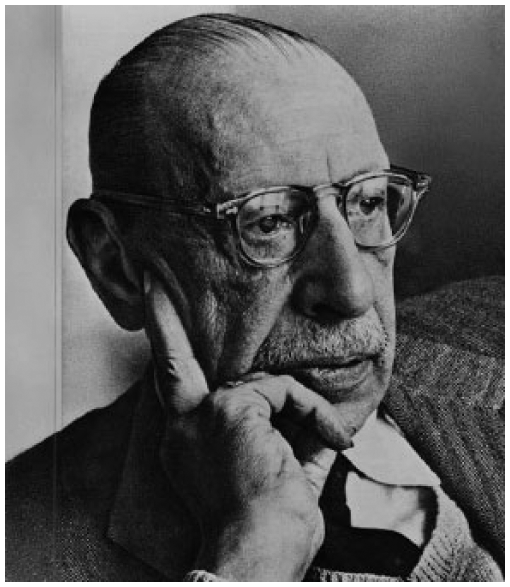
Portrait of Igor Stravinsky (1882-1971). Photo Credit: Album/Art Resource, NY
At times, Stravinsky argued forcefully against the expressive capability of the Symphony of Psalms, suggesting that “people will always insist upon looking in music for something that is not there.” 7 He wanted his listeners to appreciate the intrinsic value of this and all of his music, not to have the music serve as a representation of something outside of it, like a particular emotion. To focus on the expressive capacities of music is to use music as a drug: “dope,” as he put it. 8
Yet it is hard not to hear the Symphony of Psalms as an expression of his piety. 9 In a different conversation about the Symphony, Stravinsky revealed that he initially chose Psalm 150 as a subject because of his “eagerness to counter the many composers who had abused these magisterial verses as pegs for their own lyrico-sentimental ‘feelings.’” 10 He was apparently very interested in expressing other types of feelings, however, for he states immediately afterward: “The Psalms are poems of exaltation, but also of anger, judgment, and even curses.” 11 Thus, it seems that Stravinsky was attempting to broaden the expressive range of the musical settings of this text.
Stravinsky composed the Symphony in 1930 on a commission from the Boston Symphony, four years after his reconversion to Russian Orthodoxy during a period of self-described “religious and musical ebullience.” 12 He inscribed the score “Cette Symphonie composée à la glorie de Dieu” and his sketchbook for the Symphony had a drawing of the crucifixion of Jesus pasted alongside the phrase: Adveniat regnum tuum (“Thy kingdom come”). 13 Stravinsky commented later, “The Church knew what the Psalmist knew: music praises God. Music is as well or better able to praise Him than the church building and all its decoration; it is the Church’s greatest ornament.” 14
It is not my intent to determine whether and how the Symphony of Psalms reflects Stravinsky’s piety or religious identity. That is, I think, a nearly impossible task. 15 Instead, as a biblical scholar, I am exploring how Stravinsky’s musical interpretation of Scripture shapes the meaning of those texts for the audience—how this particular constellation of texts and tones constructs a listener’s sense of the Psalter as a whole.
The Form of the Symphony of Psalms
Stravinsky scored his symphony for four-part chorus (Soprano, Alto, Tenor and Bass) and an orchestra without violins and violas but augmented by two pianos, harp, and a full complement of lower strings, woodwinds, brass, and percussion. The first movement sets the text of Ps 39:12–13 (Vulgate 38:13–14). The second movement takes up the subsequent verses, in canonical order (Ps 40:1–3; Vulg. 39:2–4). This sequence of four verses encompasses a remarkably wide emotional range, from desperate cries to a testimony of God’s saving acts. The third and final movement sets the all-encompassing song of praise in Ps 150:1–6.
Movement 1: Psalm 39:12–14
The piece begins with an orchestral exclamation point: an accented E-minor chord in the woodwinds, low brass, low strings, and percussion. This chord is followed by rapidly ascending and descending sixteenth-note arpeggios in the first oboe and first bassoon, with the writhing, reedy sound of these woodwinds then punctuated by the return of the E-minor chord (Example 1. For this example and others throughout the article, see accompanying audio files at int.sagepub.com/supplemental).
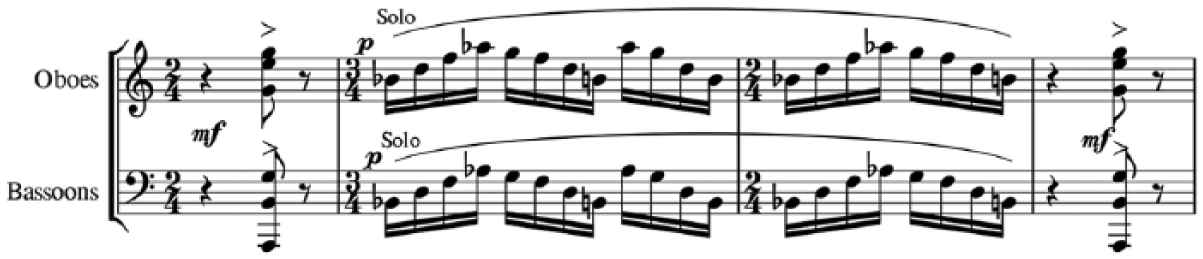
Movt. I, mm. 1–4.
The sixteenth-note arpeggios in the winds recommence and develop over the course of several measures, with interruptions again and again by the E-minor chord. This recurrent chord and the gyrating arpeggios, along with the frequently changing time signatures (2/4, 3/4, 2/4, 1/4, 2/4, 1/4), combine to give the piece an off-balanced, angular quality from the outset. The character of this section matches well the repeated anxious pleas of the psalmist in the text from Ps 39:12–13 (Vulgate Ps 38:13–14) (Chart 1).
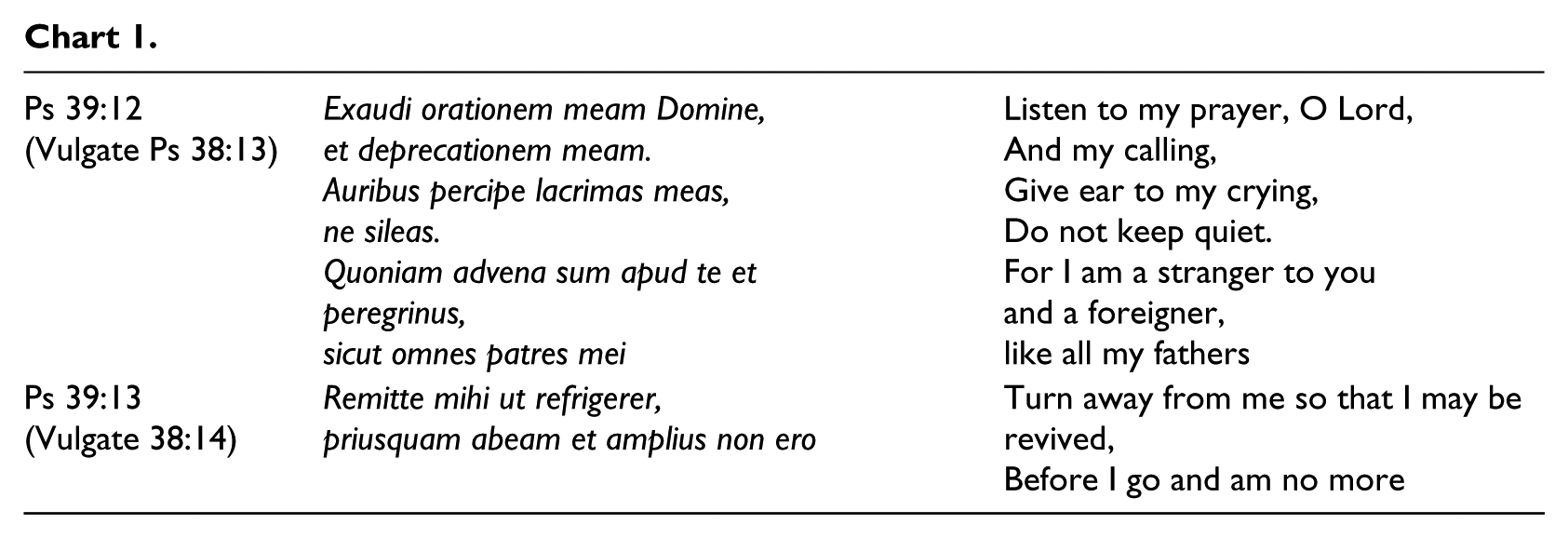
The text is marked by numerous imperative verbs, calling God “to listen” (exaudi, auribus percipe, v. 12), “not to keep silence” (ne sileas, v. 12), and “to turn” or “to forgive” (remitte, v. 13). Thus the entire text can be characterized as an extended plea and complaint, with constant petitions serving to catch and hold the attention of the Deity. The repeated E-minor chords have the same aural effect as these repeated verbs, forcing the listener—at once God and the audience of the Symphony—to pay attention to these sharp bursts of sound.
After a series of insistent E-minor chords, the orchestra assumes a more regular rhythmic patterning in 2/4 time with a series of rising and falling sixteenth notes in the pianos. As the pianos drive the orchestra forward as in a procession, Stravinsky introduces the movement’s essential melodic motif, a slowly ascending and descending minor second in the horns and celli. As a melody, it is very simple, but also extraordinarily effective in creating a sense of tension, especially when coupled with the dry, resolute arpeggiated figures in the pianos. 16 These arpeggios undergird the first presentation of the text of Psalm 39: exaudi orationem meam, Domine (“Listen to my prayer, O Lord”). This entire phrase occurs within the tonal range of a minor second, slowly rising and falling in the alto voice (Example 2), and doubled in the first and third oboes. The phrase appears in the lower-middle range of the altos, creating a particularly haunting, pleading quality reminiscent of chant.

Movt. I, mm. 1–6 of rehearsal no. 4.
Standing in poetic parallelism with the first phrase, the second colon of v. 12 intensifies the plea, providing a new urgency as all four voices join the alto with et deprecationem meam (“and my calling”). The melody, such as it is here in the soprano, augments the initial minor-second rise and fall in the alto voice by introducing a minor-third ascent and descent (Example 3).
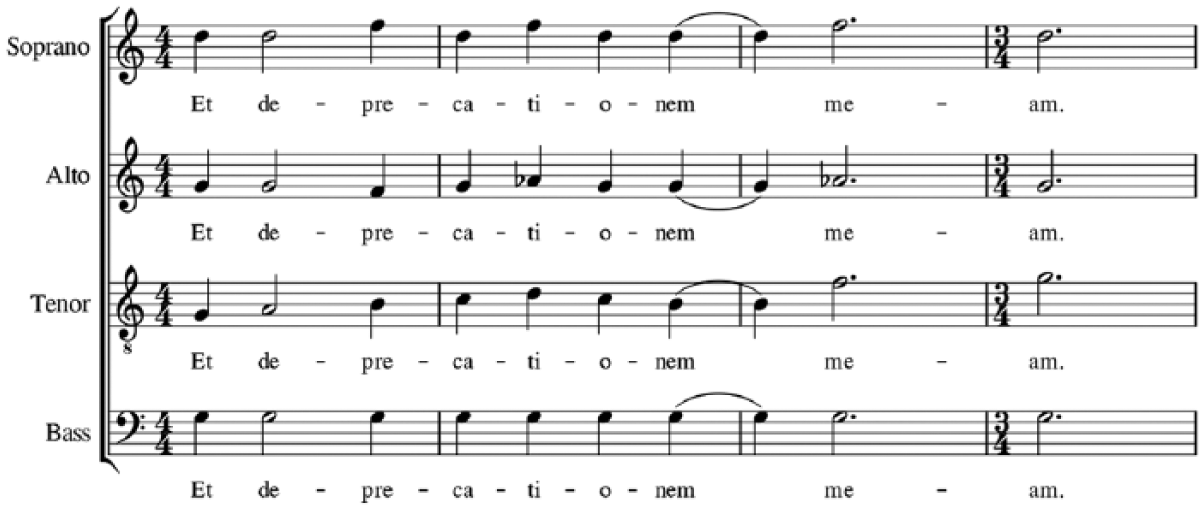
Movt. I, mm. 1–4 of rehearsal no. 4.
After a brief interlude containing a gyrating sixteenth-note figure in the oboe, the alto alone begins again its plea for God’s attention with the rising and falling minor-second figure on the phrase auribus percipe lacrimas meas (“give ear to my crying”) (Example 2). This time the alto is doubled by one oboe while another oboe plays the same melodic line two octaves higher. The resulting melody sounds intensely constrained by virtue of its movement between minor seconds. Yet it simultaneously dominates the tonal landscape as it is doubled in the piercing upper register of the oboe. With this stark accompaniment, the alto’s cries cannot be ignored.
At the conclusion of this phrase, the orchestra sounds its own plea for hearing. Another sudden, percussive E-minor chord initiates a series of sixteenth-note arpeggios in the flutes, pianos, harp, and bassoons, driving the prayer forward with even more urgency. Amidst all of this action in the orchestra, the text of the prayer sounds with no intervallic motion at all. It is instead a loud assertion, set for the tenors on an E in their strong upper register: ne sileas (“do not keep quiet!”). This plea has a double function: in the context of the psalm it is a summons for God to speak, to respond to the cries of the psalmist. And in the context of the Symphony, the phrase ne sileas provides a call for the choir and orchestra to make itself heard. Indeed, the orchestra is marshaling its fullest strength to that effect. The alto responds to the tenor’s cry, joining an octave higher.
This repetition of ne sileas marks Stravinsky’s first expansion of the text of the psalm. To be clear, the Vulgate does not repeat ne sileas, but Stravinsky does, drawing the listener’s attention to the line. The voices call for an end to divine silence through an insistence on a human sound, repeated and in a steady, unrelenting quarter-note figure (Example 4).
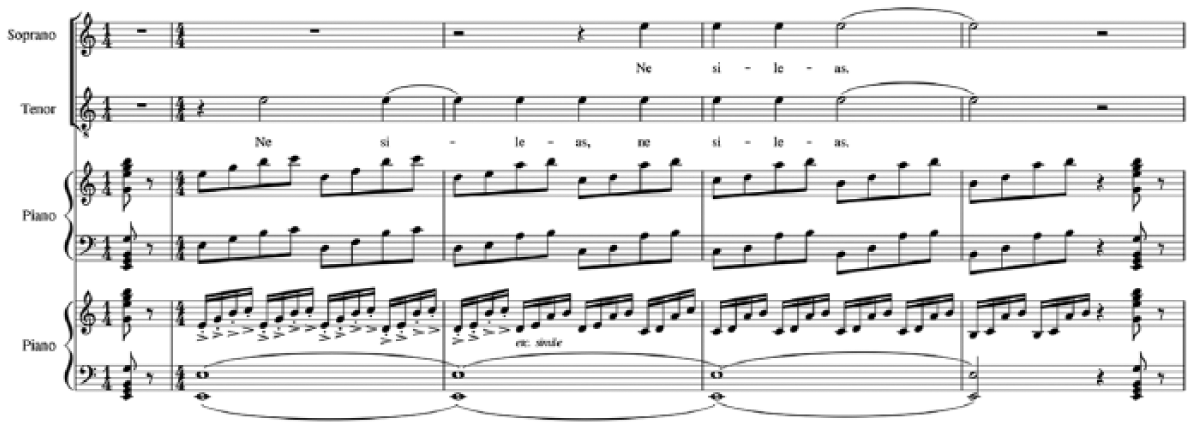
Movt. I, m. 4 of rehearsal no. 8 and mm. 1–4 of rehearsal no. 9.
The percussive E-minor chord brackets the repeated ne sileas. The repetition of the phrase on an E in octaves alongside the repeated E-minor chord suggests that this E-minor chord throughout this movement is an orchestral expression of this particular phrase: “do not keep silent!” Having appeared at the beginning of the piece and reappearing suddenly and jarringly throughout the movement, this E-minor chord becomes an orchestral crystallization of the plea for God to respond, to act, not to keep silent. Yet it is also functions as an exhortation to the community to utter its own pleas before the Deity.
After this E-minor orchestral punctuation mark, a new statement from v. 12 begins in the alto and bass. Until now, the largest melodic interval in the movement has been a minor third, with the most commonly occurring melodic interval being a minor second. Yet at the outset of this new line from v. 12, Stravinsky employs the interval of an ascending octave as the bass and alto sing quoniam advena (Example 5).

Movt. I, mm. 1–3 of rehearsal no. 10.
This ascending octave provides a counterpart for the ascending minor second that began the choral statement at v. 12 on exaudi (Example 3). The prayer has developed from the smallest ascending interval to the largest ascending interval within the tonal system. The first interval of a minor second is a tensile and incremental rise, while this latter interval conveys a sense of boldness arching upward through the octave. The smallest and the largest intervallic motion indicates the entire range of the ascending voice of the petitioner.
The psalmist describes himself here as advena (“a stranger”). Such a self-description is uncommon within the Psalter. Most often, the psalmist seeks God’s attention on the basis of his or her longstanding relationship with the Deity and that of his or her family (see e.g., Ps 22:1, 4, 9–10). Here however, the opposite situation obtains. The psalmist’s alienation from God is consistent with his family’s experience as well. The psalmist is a foreigner, from a family of foreigners. The word peregrinus (“foreigner”), with another ascending octave in the soprano, is followed by two other ascending minor sevenths. With all of this intervallic leaping and stretching, the complaint of the psalmist grows in intensity until we reach a dynamic highpoint of the movement in the phrase omnes patres mei (“all my fathers”) which is marked fortissimo, amidst full orchestra sounding marcatissimo ascending eighth-notes and sixteenth-notes (Example 6).

Movt. I, mm. 1–6 of rehearsal no. 11 and m. 1 of rehearsal no. 12.
Up to this point, Stravinsky has separated discrete phrases of the psalm with the percussive E-minor chord. Here, however, the punctuating chord is absent as the chorus moves directly from omnes patres mei to the next line of poetry: remitte mihi (“turn from me,” with other possible translations discussed below). It is as if the psalmist has found a new confidence in the midst of the lament. Or perhaps his desperation has finally broken down any sense of constraint or decorum (Example 7). In any case, the psalmist’s complaint about his profound alienation that extends back for generations gives way immediately to a plea for help now.
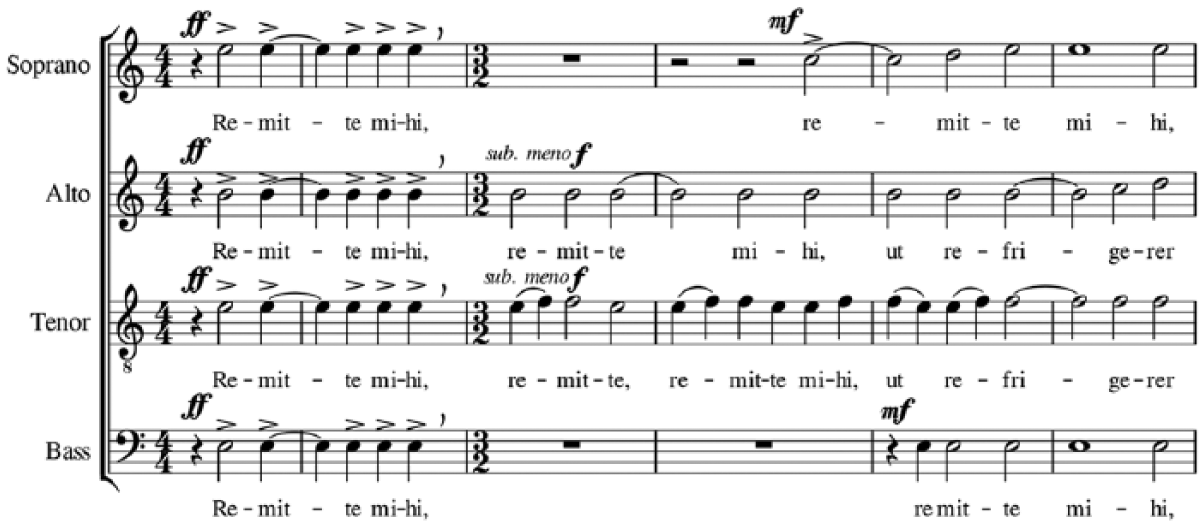
Movt. I, mm. 2–7 after rehearsal no. 12.
Stravinsky then repeats the phrase in a contrapuntal section in which each voice introduces remitte independently and with a unique prosodic treatment. The tenor employs the ascending and descending minor-second motif (E-F-E) (cf. see Example 1), while the alto maintains a slow drone on B, with no intervallic movement. The next entrance is the soprano, whose line begins on a C, a minor second above the alto’s B. The ascending and descending minor-second interval that appears so frequently throughout the movement now occurs simultaneously to create even more dissonance.
The aural effect of all of this text painting on remitte mihi is utterly unique within this movement. The phrase first sounds as a loud exclamation for two measures and then for four measures with a more pleading quality, a complex and halting restatement, as if the psalmist has been shocked at the boldness of his own words and then utters them again with a totally different tone. Indeed, remitte mihi is the only phrase repeated to this extent in the movement and the only text that Stravinsky sets in a polyrhythmic texture among the four voices.
What does remitte mihi mean, both in the context of this psalm and in Stravinsky’s setting? The Latin phrase can be rendered “forgive me,” but it can also have the sense of “leave me alone,” “turn from me,” or “let me go.” The Septuagint version of the psalm, upon which the Vulgate here is based, more clearly reflects this latter meaning: anes moi, ina anapsuxō (“Let me be, that I may revive”). 17
Stravinsky’s choice to set only the last two verses of this psalm contributes to the multiple possible renderings of remitte mihi. The prior verses in the psalm seem to suggest—obliquely in the Hebrew and many modern English translations, but more clearly in the Septuagint and Vulgate—that the psalmist’s sin has contributed to the present suffering. That is, the psalmist’s cries and tears (v. 12) are the results of divine punishment. However, removed from this larger context, it is not at all clear that the pain results from the psalmist’s sin, simply based on the text of vv. 12–13.
In Stravinsky’s excerpt, the immediate source of pain is the divine presence itself. “Forgive me” is a plausible translation for remitte mehi. Yet, decontextualized as it is here, remitte mihi suggests that the presence of God is an oppressive force, the cause of the psalmist’s suffering. Thus the psalmist is asking God to “leave me alone,” “let me go,” or “turn from me” in v. 13. Ironically, however, the psalmist also seeks the presence of God through supplication in the prior verse. Thus in Stravinsky’s version, there is a fundamental paradox that God’s presence functions both as the source of the suffering and the solution to the suffering. God oppresses and saves.
The perceived absence of God is absent in that the psalmist cries out for God to hear and to speak, not to be silent (v. 12). Yet, the presence of God is also the cause of suffering, a force too terrible to endure (v. 13a). It is the reason that the psalmist’s life is about to expire (v. 13b). Hence one could render v. 13 literally as “turn away from me so that I may be revived before I go and am no more.” The presence of God, so often synonymous with divine protection and salvation in the Psalter (see e.g., Ps 46) is seen here as a force capable of utterly annihilating the psalmist.
The musical expression of this paradoxical plea for divine absence occurs through a reversal of the rising and falling minor-second motif in the soprano. The phrase prius quam abeam (“before I depart”) is set with quarter notes on F and E, which fall first and then rise on the minor second interval. This presentation contrasts to all other expressions of the motif as it has appeared up to this point in the movement (Example 8).
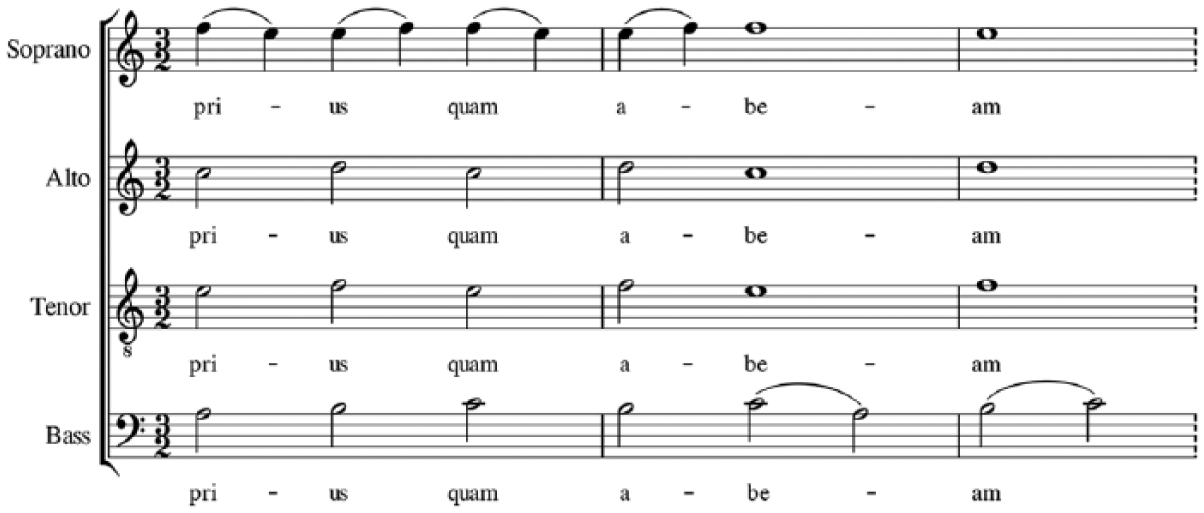
Movt. I, mm. 1–3 of rehearsal no. 13.
Stravinsky marks this concluding section pesante, as the consistent half-notes in orchestra and chorus suggest the slow, heavy march toward non-existence, ending on the phrase et amplius non ero (“and I am no more”). Yet even as the text describes the threat of death, there is nevertheless an unmistakable boldness and even hopefulness at this final phrase of the psalm. The movement ends on a loud, sustained G-major chord, the relative major of the E-minor tonality that has largely dominated this movement. The move to the related major tonality at this climactic moment is an audacious assertion of the will to live, a movement from a depressive minor tonality to a bright major tonality. Though the text of the psalm ends in fear, the musical setting prefigured at this final chord indicates hope for salvation and conviction that the present suffering is not the end. The G major chord, marked senza diminuendo, allows for no slacking in volume to the end. It is a forceful insistence of the psalmist’s plea and an implicit affirmation of the power of God to bring about salvation. Indeed, the fact that the psalmist can pray with such honesty and forthrightness suggests, somewhat paradoxically, that he is confident that God can powerfully intervene and restore the relationship.
Movement 2: Psalm 40:1–3
Much of the second movement takes the form of a four-voiced double fugue, first executed by the woodwinds, then undertaken in the voices. The initial subject of the fugue is characterized by frequent intervallic leaps in a C-melodic minor tonality, which begin with three measures that repeat four notes four times: C–E-flat–B–D. Yet the contraction and variation of the rhythm and the alternating octaves create an exceedingly fragmented and angular sound, especially with the chromaticism and wide intervals of the last two measures of the subject (Example 9).

Movt. II, mm. 1–5, opening subject for first oboe.
The subject on its own creates harmonic tension similar to that of the oscillating minor-second motif in the first movement (Example 2). In slow, deliberate 4/8 time, the fugal subject moves through the first oboe, first flute, third flute, and second oboe. After 28 measures at this pace, the listener is thoroughly entangled in a web of arching, disjointed chromatic motion.
At precisely this point of aural disorientation the chorus begins its statement of the text of Ps 40:1–3 (Vulgate: Ps 39:2–4) (Chart 2):

This portion of the psalm is a testimony of one who has waited for a very long time for God to act. Most English translations of Ps 40:1 render the verse “I waited patiently for the Lord” (NRSV) or something closely akin to it: “I put all my hope in the Lord” (CEV). Such translations lack the repetition of the verb “to hope” or “to wait” that is present in the Hebrew: qavvōh qivvιˆtιˆ, a Piel infinitive followed by the Piel perfect that conveys an intensification of the main action of the verb. A translation closer to the Hebrew would be “I waited and waited” or “I hoped and hoped” or “I really, really, really hoped/waited.” The Vulgate translation does preserve this sort of repetitive intensification of the verbal action through the present participle expectans followed by the perfect from the same root expectavi. The arching instrumental fugue at the beginning of this movement, in fact, conveys this profound sense of waiting, of being stretched to the limits of one’s endurance.
After a long period of waiting through the instrumental fugue, a choral fugue commences on a new subject. Yet in a brilliant and complex process of layering, the new choral subject in the soprano is superimposed upon the first instrumental fugal subject, which appears here in the celli and contrabasses (Example 11, below). Each voice begins with a descending fourth followed by stepwise movement throughout the words expectans expectavi. At Dominum, the melody reaches up a minor sixth before resolving down a minor second. The large vocal leap on the word Dominum functions as a high point of each statement, with each voice rising toward the Lord (Dominum) from the “pit of misery” (lacu miseriae) and the “miry sludge” (luto faecis) (Example 10).

Movt. II, mm. 1–4 of rehearsal no. 4.

Movt. II, mm. 1–4 of rehearsal no. 10 and mm. 1–5 of rehearsal no. 11.
The voices enter the fugue from the top down—soprano, then alto, then tenor, and finally bass. Soon after all four voices have engaged the subject, the development of the fugue suddenly changes. The soprano and alto fall away at just the point when the tenor reaches v. 1b: et exaudivit preces meas (“He heard my prayers”). Thus far, the soprano and alto have rendered the text exactly as it is in the Vulgate. However, the tenor voice now expands the phrase through repetition: Et exaudivit. Et exaudivit preces, preces meas (“He heard. He heard prayers, my prayers”). This unique textual expansion highlights this particular passage, making the second movement a response to the first. In the first movement, the psalmist pleads exaudi oriationem meam (“Hear my prayer”) (v. 12). The second movement describes the result: exaudivit preces meas (“He heard my prayers”). After a long and tense period of waiting, God has finally heard.
At this point, a new contrapuntal section begins. Like the setting of expectans expactavi, this one begins with a falling perfect fourth and also follows the pattern of soprano, alto, tenor, and bass (cf. Example 10, mm. 1–2). However, here the entrance for each voice is separated by just one beat rather than 4–6 measures. This text from Ps 40:2 describes God ordering the psalmist’s ways: et statuit super petram pedes meos: et direxit gressos meos (“And he set my feet upon a rock: and he directs my way”). The music suggests God’s ordering work by bringing the various voices together, as Stravinsky makes a transition away from the polyphony and counterpoint that characterized the text’s description of waiting for God to act. The dynamic marking is piano here, with a gradual diminuendo as the soprano line slowly descending stepwise from an E-flat to C (Example 11, mm. 6–9). By the end of these nine measures the steps of the psalmist are brought together so that gressus meos (“my way”) sounds in all four voices at the same time (Example 11, mm. 9–10).
With the psalmist’s steps so ordered, a few tranquil measures of interlude unfold, with various instruments taking up excerpts of the two fugal subjects in an expressive style. Then the trombone quietly reintroduces the initial fugal subject with a new, somewhat martial rhythmic pattern: a dotted-sixteenth note followed by thirty-second note. This marcato rhythmic texture is immediately taken up by the voices on the phrase et immisit in os meum canticum novum, carmen Deo nostro (“And he put in my mouth a new song, a hymn to our God”).
This new song (canticum novum) is not so much a new melody but the melody from the choral fugue flipped on its head and with a different rhythmic inflection. In the first statement of the fugal subject on expectans (see Example 10), the soprano begins on an E-flat and descends a perfect fourth B-flat, followed by chromatic stepwise motion down to an A-flat, with the four measure phrase ending on the tonal sequence B-flat–G-flat–F. The song of praise that Stravinsky uses for the text of v. 3 is integrally bound to the song of the psalmist’s waiting. In this case, the soprano ascends a perfect fourth from B-flat to E-flat, followed by ascending stepwise motion, and concluding with a tonal sequence B-flat–F–G (Example 12). These two melodies are reflections of one another and thus reinforce the fundamental relationship between waiting for God (v. 1) to act and praising God for acting (v. 3). These two activities seem so vastly different, one marked by suffering and the other by joy. Yet the Psalter constantly binds them together through the structure of discrete psalms, with a movement from lament to praise. Moreover, the structure of the Psalter as a whole reflects this integration, with lament predominating in the first third of the Psalter but gradually giving way to praise until the final great crescendo of praise culminates in the last five psalms. Stravinsky has recognized this essential unity of waiting for God and praising God, and subtly woven them together here and throughout the symphony.
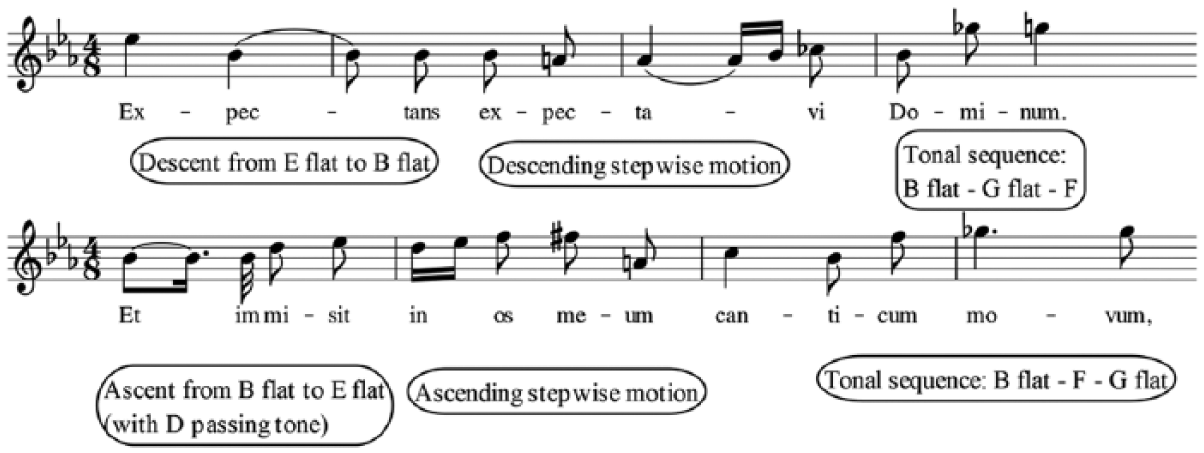
Movt. II, mm. 1–4 of rehearsal no. 5 compared with mm. 1–4 of rehearsal no. 14. Soprano.
There are further echoes that bind together these two modes of interacting with the Deity: the song of waiting (v. 1a) and the new song of praise (v. 3). Beginning on the phrase carmen Deo nostro (“a hymn to our God”), Stravinsky slightly modifies the rhythmic and intervallic movement of the first choral fugal subject on expectans expectavi Dominum (Examples 10 and 12, mm. 1–4). The original expectans theme occurred over the span of four measures. The new modified theme is three-measures long (Example 13, mm. 1–3) and appears in a descending melodic sequence that brings the soprano chromatically down from a starting point of G (carmen Deo nostro, “our God”) to F-sharp (videbunt multi, “many will see”) to F (videbunt et timebunt, “they will see and fear”), a phrase which ends on an F-flat (E) (See Example 15, below).
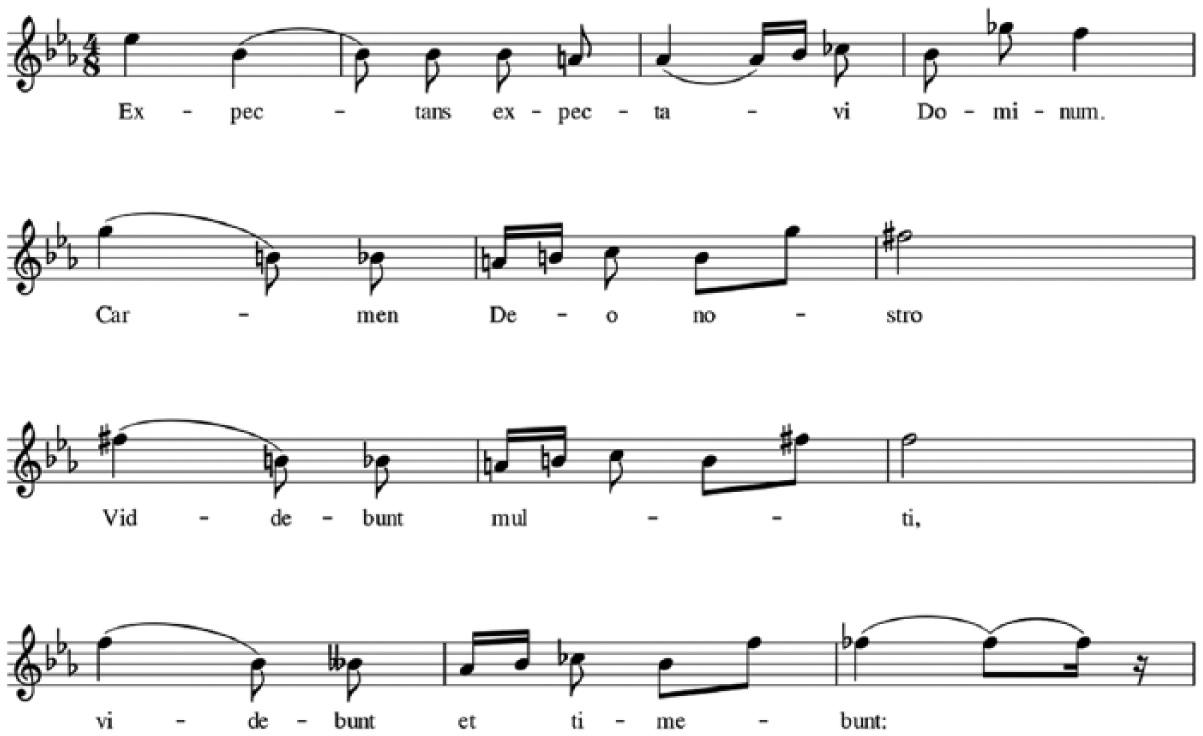
Movt. II, mm. 1–4 of rehearsal no. 5 compared with mm. 1–4 of rehearsal no. 15 and mm. 1–5 of rehearsal no. 16. Soprano.
Indeed, this “new song, a hymn to our God” is an emboldened version of the earlier melody, with new rhythmic intensity and in a compressed form. Yet one thing is completely new about this song: all four voices sing together with a strong homorhythmic character. Indeed, since the psalmist’s steps have been organized (et direxit gressus meos, v. 2), the voices move as one, completely integrated. The polyphonic vocal texture has completely vanished by the last five measures of the movement, in which the choir quietly and deliberately intones on an E-flat: the final phrase of Ps 40:3. Stravinksy’s version of Psalm 40:3 repeats the verb “to hope” by way of emphasis: et sperabunt, sperabunt in Domino (“and they will hope, they will hope in the Lord”) (Example 14).

Movt. II, mm. 1–5 of rehearsal no. 17.
The angular fugues have given way to the integrated voice of the psalmist, which sounds in octaves throughout the chorus. Yet the listener cannot forget the long period of waiting that the psalmist has endured. A high muted piccolo trumpet recalls the initial fugal subject slowly and deliberately, in a timbre similar to that of the oboe at the beginning of the movement. With a mute, this trumpet sounds as if it were off-stage, a clear and distinct memory of suffering and hoping for God to act.
Thus far, narrative of salvation has developed across the seam of Psalm 39 and Psalm 40. In Stravinsky’s setting of these two texts, the experiences of alienation, suffering, fear, trust, and hope are not incompatible. Instead, these seemingly contradictory aspects of the relationship with God are layered one on top of the other like so many lines of counterpoint. The voices and instruments come together to express the complexity of the life of faith. These two movements track a longsuffering psalmist who languishes in the pit of misery while calling out to God to hear and answer. And eventually God reaches down into the miry sludge and brings about salvation.
Movement 3: Psalm 150:1–6
As a response to God’s saving action, praise is the final element in the complex divine-human relationship. It is entirely fitting then, that an alleluia concludes Stravinsky’s symphony, just as it does the Psalter. Yet, Stravinsky’s alleluia is unlike any other (Example 15).

Movt. III, mm. 2–3.
This probing alleluia has more in common with an appeal than a burst of joyous praise. Eric White describes it well: “a whispered alleluia like a sigh.” 18 The alleluia occurs at a ponderously slow 48 beats per minute, in a drawn-out rhythmic figure: two eighth notes—quarter note—half note, a marked deceleration of rhythmic movement.
Stravinsky’s alleluia thus has none of the sheen and verve of the alleluias of the classical masters or even most modern composers. 19 Instead, Stravinsky offers a tentative, aching alleluia that occurs in the context of a divine-human relationship fraught with tension and uncertainty. Psalm 40:3 described “a new song” (canticum novum) that would inspire many to fear (videbunt multi et timebunt). This new alleluia reflects that fear.
After the opening alleluia from all four voices, the tenor and bass introduce a laudate figure that will dominate the movement. It is marked by a quarter note – half note – quarter note pattern that is repeated in octaves in the tenors and basses and then joined by the altos and sopranos (Example 16).
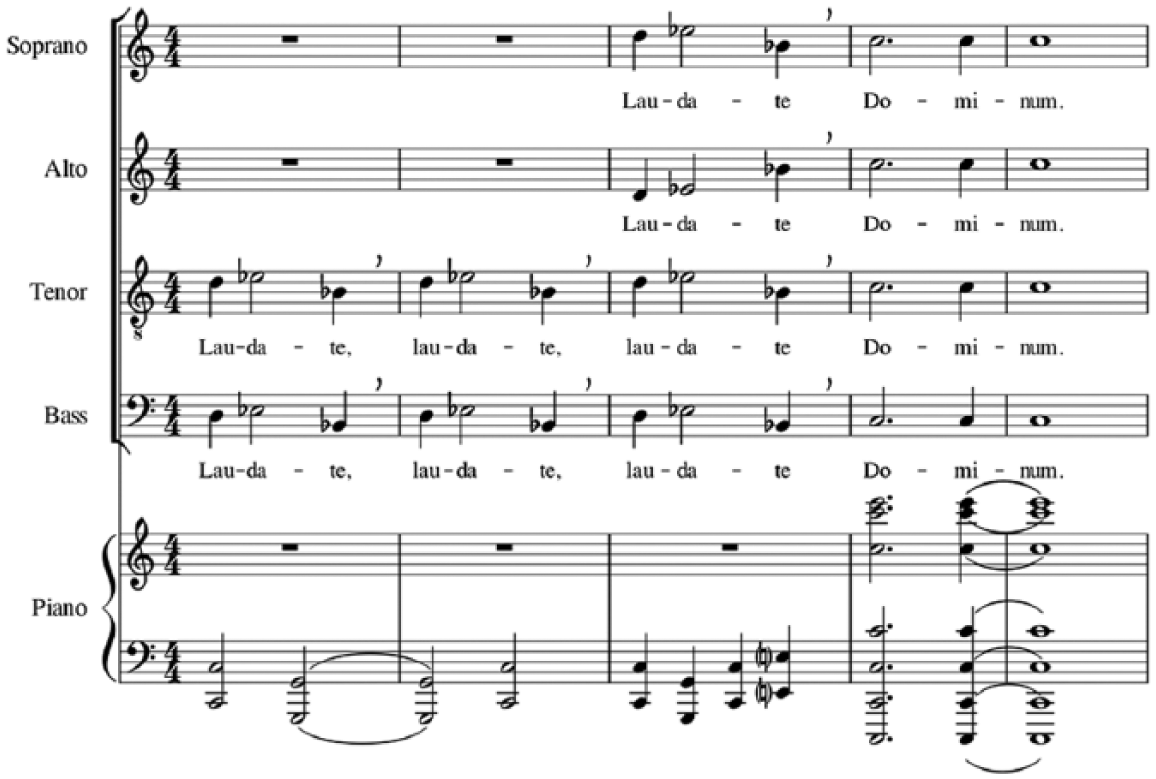
Movt. III, mm. 1–5 of rehearsal no. 1.
This laudate figure begins with the same ascending minor-second interval that was the dominant motif in the first movement, where it sounded initially through the phrase exaudi orationem meam, Domine (“Hear my prayer, O Lord”) (Example 3). These phrases typically convey radically different rhetorical freight, yet the similar settings suggest a fundamental coherence between the cry of praise and the cry of pain, both of which are uttered with the abiding confidence that God can hear the songs of humans.
The laudate figure, repeated three times, again shows Stravinsky’s penchant for expanding the psalm’s text to highlight critical ideas or themes. In fact, Stravinsky makes significant modifications the text of Psalm 150, especially as compared with his treatment of Psalms 39 and 40. He modifies through repetition, but also notably by the insertion of versions of the laudate figure throughout the verses of the psalm. To illustrate the pervasiveness of this tactic, I have included the libretto below with changes from the Vulgate indicated. Underlining indicates Stravinsky’s additions to the Vulgate, while brackets indicate omissions (Chart 3):
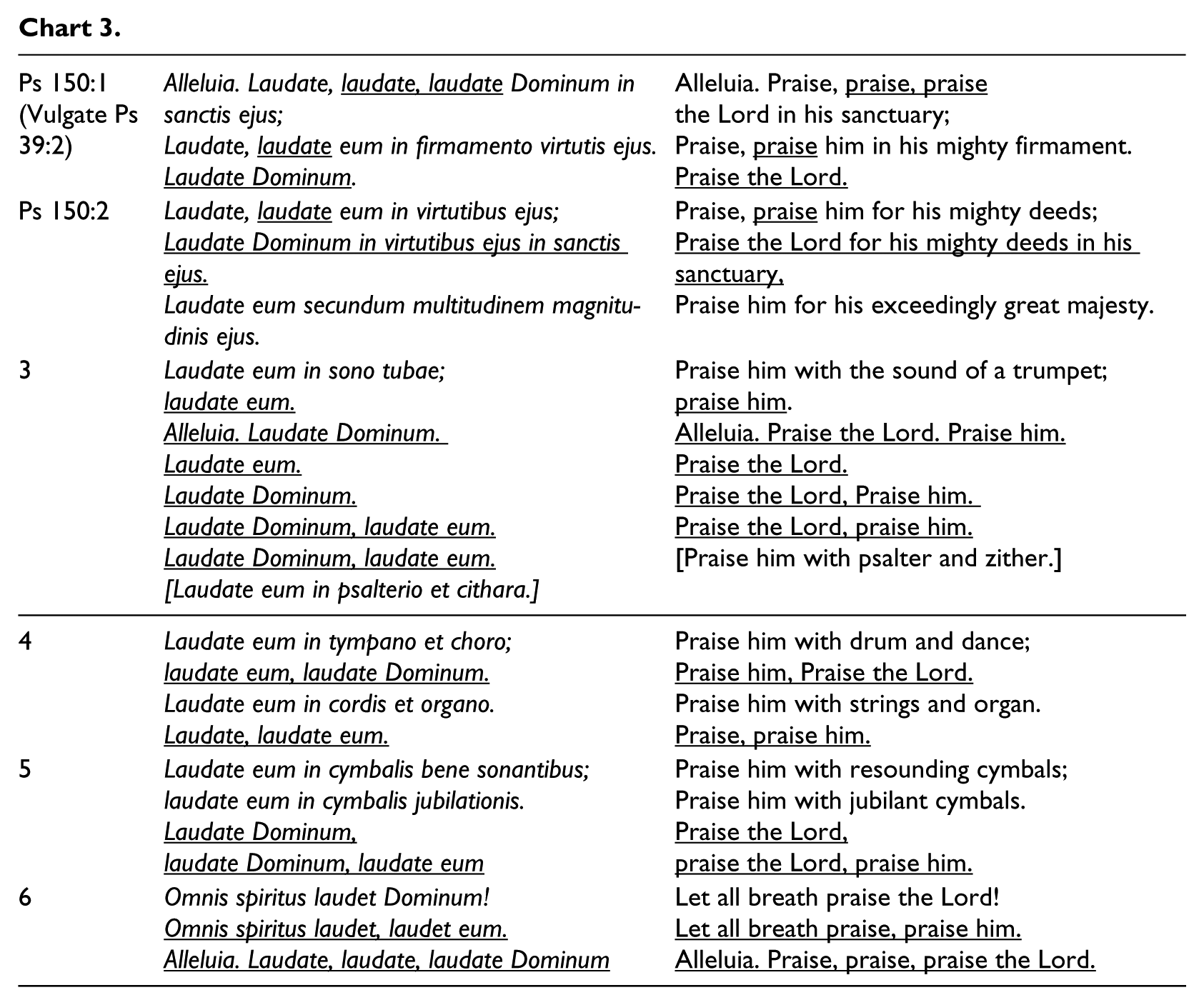
On the basis of these repetitions and insertions, the call to praise the Lord (laudate Dominum / laudate eum / alleluia, “Praise the Lord / praise him / alleluia”) utterly dominates the movement, even more than it does the original text of the psalm itself. But what is the nature of this praise? How should this praise sound? Is it boisterous or subdued? Somber or vivacious? Is the praise in a major or minor key or no key at all? In short, what sort of effect should this praise have on both the singer and the listener? Over the course of this movement, Stravinsky explores the many and complex ways that the community sounds its praise.
The triple calls to praise at the beginning of the movement (Example 16) appear in a C-minor tonality with the repeated laudate figure. 20 However, the phrase culminates in a vast and expansive C-major chord on the word Dominum with the voices sounding on a C across three octaves, accompanied by two pianos with Cs covering six octaves, while woodwinds, low strings and low brass fill out the C-major chord. Then, immediately, the tonality shifts back to C-minor with the phrase in sanctis ejus (“in his sanctuary”) (Example 17). But within this phrase, illustrated in Example 17, the tonality oscillates between C-major and C-minor, marked by the alternation of a minor second (E–E-flat) in the tenor and alto.
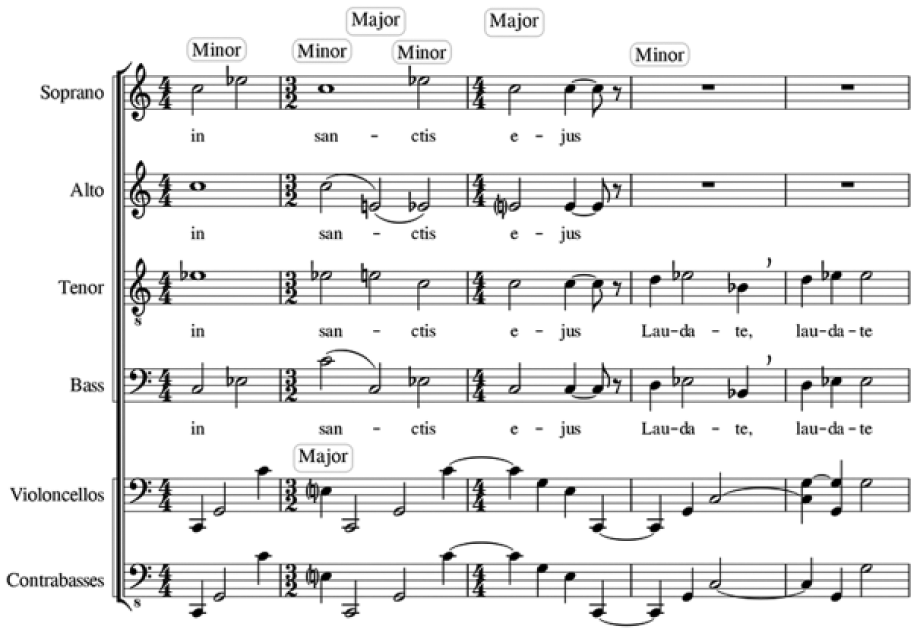
Movt. III, mm. 7–9 of rehearsal no. 1.
This slippage between C-minor and C-major tonalities occurs over and over again throughout this movement, suggesting an ambiguity of emotional state—or, perhaps, a plurality of emotional states—within the context of prayer. Indeed, in the first beat of m. 2 in Example 17 (the 3/2 measure), the strings are in C-major while the voices are in C-minor, an overlapping of major and minor tonalities. Such movement captures the complexity of the human discourse with God. The sound of the psalmist’s praise is changing constantly, oscillating between minor and major inflections. The music of the psalmist’s prayer cannot be characterized simply, as either joyous or somber. The psalmist’s praise is complex and polytonal, alternatingly bright and dark, and at moments, bright and dark at the same time. In doing so, Stravinsky is honoring the place that Psalm 150 has within the Psalter, as the conclusion to a long, complex chain of prayers that cover the full scope of human emotion.
The four voices intone the phrase in sanctis ejus (“in his sanctuary”) in homorhythmic texture (Example 17, mm. 7–9). Yet, this rhythmic texture soon shifts to parallel the complicated oscillation between major and minor tonalities—and the ambiguous emotions implicit in the psalmist’s praise. The tenor and bass reiterate the laudate figure of the ascending minor second followed by descending perfect fourth on the phrase laudate eum in firmament virtutis ejus (“praise him in his mighty firmament”) (D–E-flat–B-flat). These voices are effectively in a time signature of 3/2 (a main pulse every six beats), while the soprano and alto are in 4/4 time (a main pulse every four beats). Simultaneously, the French horns with the descending and ascending minor second motif recalling movement 1 are effectively in a 4/2 time (a main pulse every eight beats). Finally, the surrounding orchestra (condensed to a piano part in Example 18) is in 3/4 time (a main pulse every three beats). In Example 18, I have highlighted the first iteration of the rhythmic sequence in the horn, tenor-bass, and piano. The effect of all of this polyrhythm is that the fundamental pulse is constantly shifting, slipping between instruments and voices until all the instruments and voices sound together on the final word of the phrase, Dominum, at which time the C-minor tonality again shifts back to C-major.
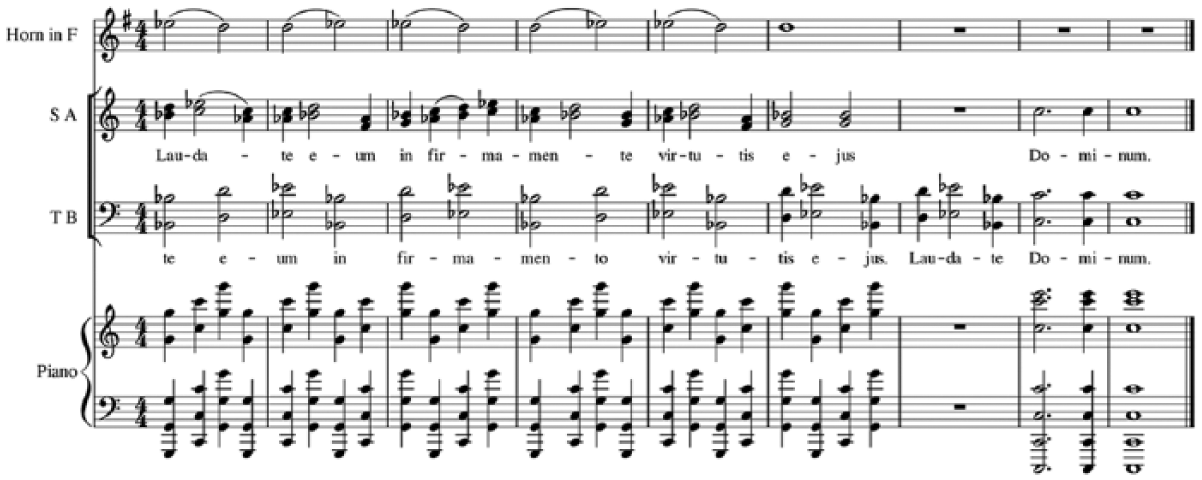
Movt. III, mm. 1–9 of rehearsal no. 2.
The rest of the movement is comprised of three sections, in which Stravinsky sets vv. 2–3, v. 4, and vv. 5–7. Each of these sections has a unique rhythmic profile, but they all explore the alternation of triple and duple meter—again, reflecting the shifting sounds of praise. The setting of vv. 2–3 has a driving rhythmic intensity, marked by an interchange of staccato eighth notes in duple groupings and eighth-note triplets. By contrast, the setting of vv. 5–7 is slow and sonorous, with a trancelike polyrhythm in which the percussion runs in duple meter while the rest of the orchestra and chorus proceed in triple meter. The setting of v. 4 lies between these two larger sections. It facilitates a slowing of the rhythmic energy by introducing a recurring rhythmic pattern consisting of a dotted-quarter note followed by an eighth note. This intermediate pattern bridges the gap between duple and triple meter.
Stravinsky’s programmatic alternation between triple and duple meters throughout this movement provides a parallel to the oscillation between C-major and C-minor tonality that we have already observed. Just as the tonal texture is not easily characterized, so too the rhythm of praise shifts constantly. Indeed, at many points, the praise maintains both triple and duple at the same time, especially at the end of the piece in the setting of vv. 5–7.
Verses 2–3
Stravinsky’s setting of Ps 150: 2–3 has a distinctly percussive quality. It contains numerous staccato attacks and utilizes the full dynamic resources of the orchestra. The essential rhythmic element of this section is an eighth-note figure comprised of six repeated tones. Stravinsky initially sets this figure on the elements of a C-major chord in the horns and bassoons (Example 19a), and then later in the voices (Example 19b), at which point, the listener realizes that the eighth-note figure is based on the prosody of laudate Dominum.

Movt. III, mm. 1–8 of rehearsal no. 3.

Movt. III, m. 6 of rehearsal no. 16.
At an assertive 160 beats per minute in 4/4 time, this sequence of six eighth notes in the horns and bassoons (Example 19a) is surrounded on all sides by stacattissimo (“sharply separated”) quarter notes and eighth notes. These accompanying figures punctuate the downbeats and rise in groups of three or four notes. The eighth-note figure returns over and over again in the horns but starting on different beats within the measure at each sounding. In a gradual crescendo the first horn ascends steadily, reiterating the figure no less than eight times. As the dynamic reaches forte, a flourish of woodwinds suddenly breaks skyward in eighth-notes triplets that climb and fall along an E-major arpeggio. Then the whole orchestra gives way to the triple meter, abandoning the duple meter that characterized the horns’ initial eighth-note figure.
Stravinsky himself admits to tone painting here, as he consciously evokes the chariot of fire that brought Elijah up to heaven (2 Kings 6), the rolling triplets imitating galloping hooves and spinning wheels. 21 The chariot exits the scene after a few stampeding measures, and as if stunned by the revelation of such power, the soprano and alto respond quietly and deliberately with a reiteration of v. 2a. laudate, laudate, laudate eum in virtutibus ejus (“praise, praise, praise him for his mighty deeds”). With this text, Stravinsky is interpreting the preceding orchestral flourish as an illustration of God’s “mighty deeds.” Such an illustration is particularly appropriate for this context, given that Elijah’s assumption into heaven was a manifestation of God’s power to save a righteous one from death, akin to God’s saving acts that are described in Ps 40:1–3. Moreover, the text from 2 Kings 6 pictures God’s self-revelation in a particularly fearsome form. Psalm 40:3 suggests that “many will see and fear.” Stravinsky’s musical setting portrays a God whose power terrifies even as it delivers.
As the chorus reiterates its response to God’s revelation, a soft, but relentlessly driving statement appears in the altos and tenors. They provide the lyrics to the eighth-note figure that was first introduced by the horns: laudate Dominum (Example 18b). The following text—in virtutibus ejus (“for his mighty deeds”) and in sanctus ejus (“in his sanctuary”), a reiteration from v. 1b—occurs in short, punchy bursts. These measures also layer duple meter over triple meter, as the harp (right hand), pianos, solo cello, and solo bass cycle through a series of three half notes climbing an octave E–G–E (Example 20).
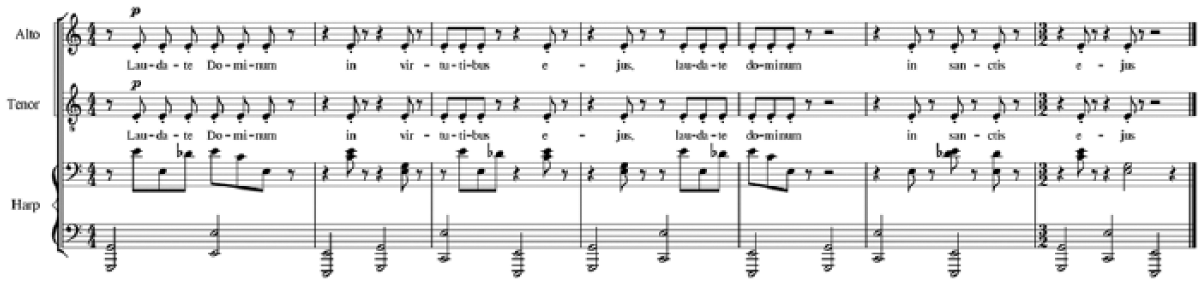
Movt. III, mm. 1–7 of rehearsal no. 8.
The next line from the psalm praises God for “surpassing greatness.” At this point, the vocal melody broadens to intervallic leaps rather than the incremental stepwise motion that has characterized the vocal melodies in this movement. The leaps of major sixths and perfect fifths have a particularly heroic quality as they appear in the bass. Alongside this bold intervallic movement, the woodwinds and brass present sharply articulated eighth notes, either on static pitches or rising and falling chromatically. Low brass and woodwinds forcefully sound alongside the bass with accented half notes (Example 21). All of this gives musical shape to God’s surpassing greatness (secondum multitudinum magnitudinis ejus, “his exceedingly great majesty”). These broad intervallic movements are then picked up by entering altos and tenors. The soprano line, when it enters, simply alternates back and forth between C and E, establishing even more clearly the C-major tonality that endures throughout this section despite the constant chromatic movements in the orchestra’s eighth-note figures.
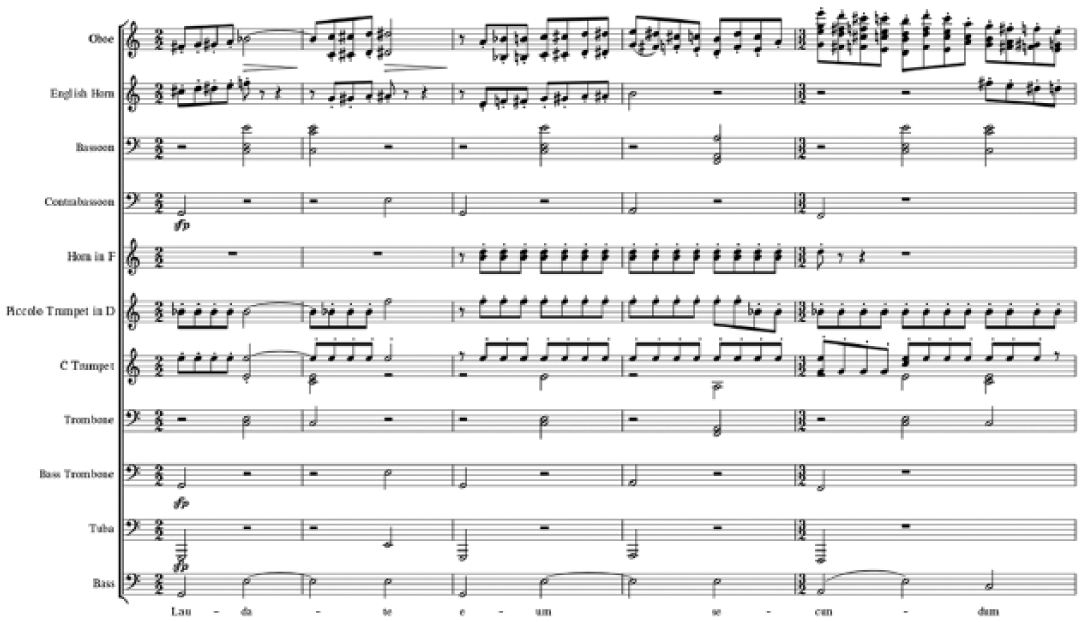
Movt. III, mm. 1–5 of rehearsal no. 9.
The bold, even heroic C-major praise for God’s mighty deeds in the voices proceeds alongside the winds that have morphed static eighth notes into constant chromatic movement. Then, just, as the hymn of praise is finding a new level of harmonic and rhythmic intensity, the tone shifts again, back to the opening alleluia (Example 15). This alleluia, with its incremental stepwise movement from C to E-flat, sounds a pause for breath within the context of the fierce laudate that preceded it. Moreover, this sighing alleluia recalls the complexity of the relationship with God, a God who is both the source of salvation and an oppressive presence, a God for whom the psalmist had to wait and wait and wait, but one who eventually answered.
After several pensive measures of alleluia, there is a frightening change, with the brass sounding a violent, percussive C-minor seventh chord. The laudate recommences (Example 22) having shifted back from the C-major tonality of its last iteration.
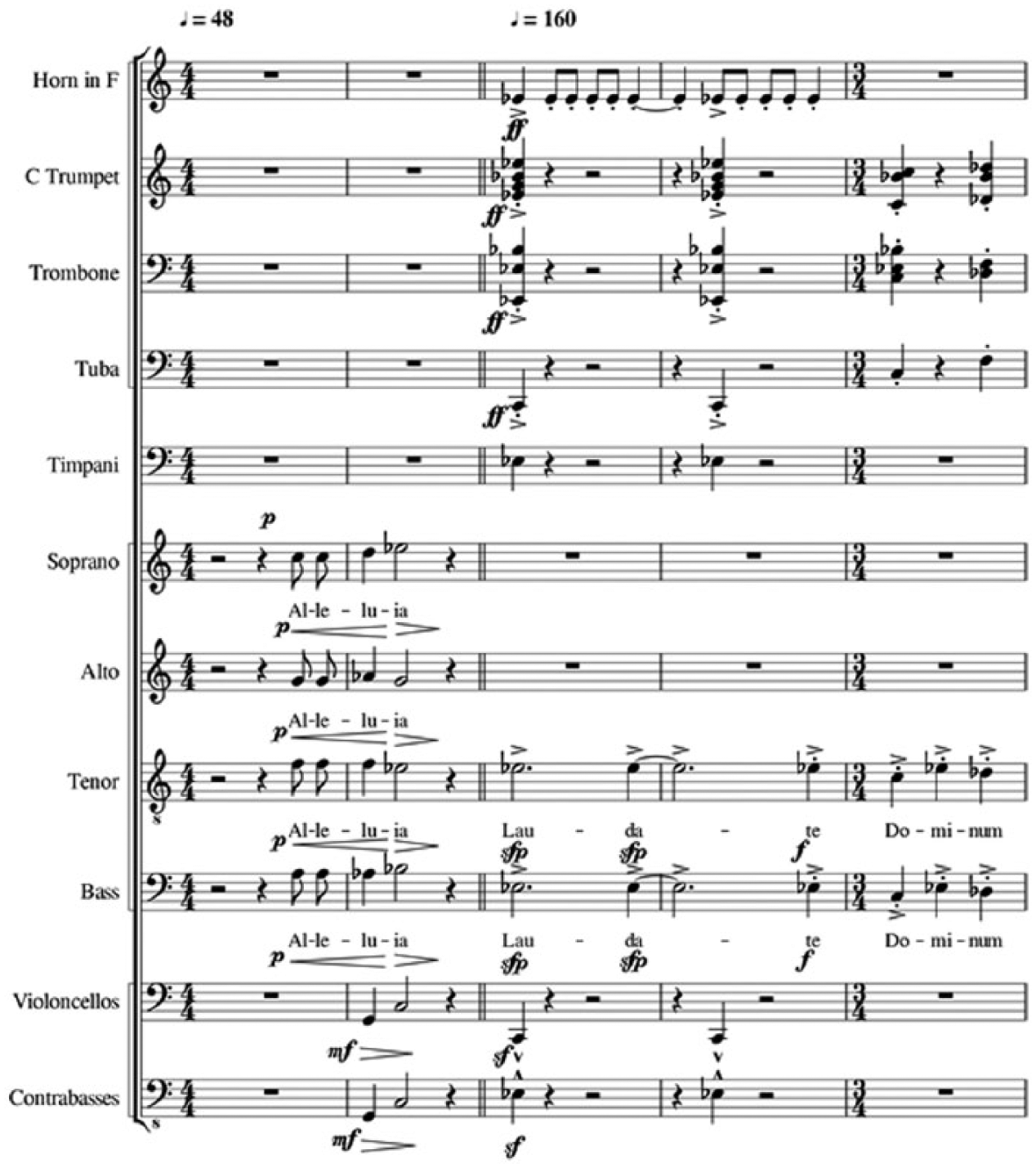
Movt. III, mm. 3–5 of rehearsal no. 12 and mm. 1–3 of rehearsal no. 13.
While the chromatic movement continues in the orchestra, the voices utter over and over again laudate Dominum, laudate eum. These words do not occur at this point in the psalmic text, and so we see them here as Stravinsky’s intentional affirmation of the imperative, frightful praise that has now gripped the chorus and orchestra, which soon gives way to a reiteration of the triplet figures evoking the chariot of fire.
Verse 4
Once the chariot has ascended into the clouds, the static eighth-note figure reappears, but slower now and softer in the flutes and first trombone, another expression of emotional shifts that occur in the context of praise. The ferociousness of the earlier laudate is now giving way to a more meditative mode of adoration. Correspondingly, the tempo slows here from 160 beats per minute to 120 beats and finally to 96 beats at the setting of v. 4, laudate eum in tympano et choro (“praise him with drum and dance”). For this text, the soprano outlines a D-major chord in a dotted-quarter note and eighth note figure. This rhythm, along with the arpeggiated melodic line, has a skipping quality that continues as the voices are introduced: first soprano, then bass, and finally tenor and alto together (Example 23). The text describes the praise of God with drum (tympano) and dance (choro), but there is no tympani or any other kind of drum at this point in the movement. Instead, Stravinsky has employed a dancelike figure of the dotted quarter note and eighth note. It is a slow and stately dance, but one that is employed in the praise of God.

Movt. III, mm. 1–7 of rehearsal 20.
As the dotted pattern moves to the altos and tenors, the soprano begins a long stepwise movement upward in half notes, with a gradual crescendo ending in broad intervallic leaps on cordis et organo (“strings and organ”). The harmonic progression is extraordinarily complex at this point. As such, we have a subtle form of text painting of “strings,” or more literally “chords,” and “organ.” It might have seemed obvious to use the two pianos and harp in setting this text. But those instruments are absent. Instead, Stravinsky paints cordis et organo by creating a dense progression of chords that moves forward with every pulse of 3/2 time. The progress ends on a C-Major-7th chord in orchestra, yet another assertion of the C-major tonality (Example 24, mm. 1–2).
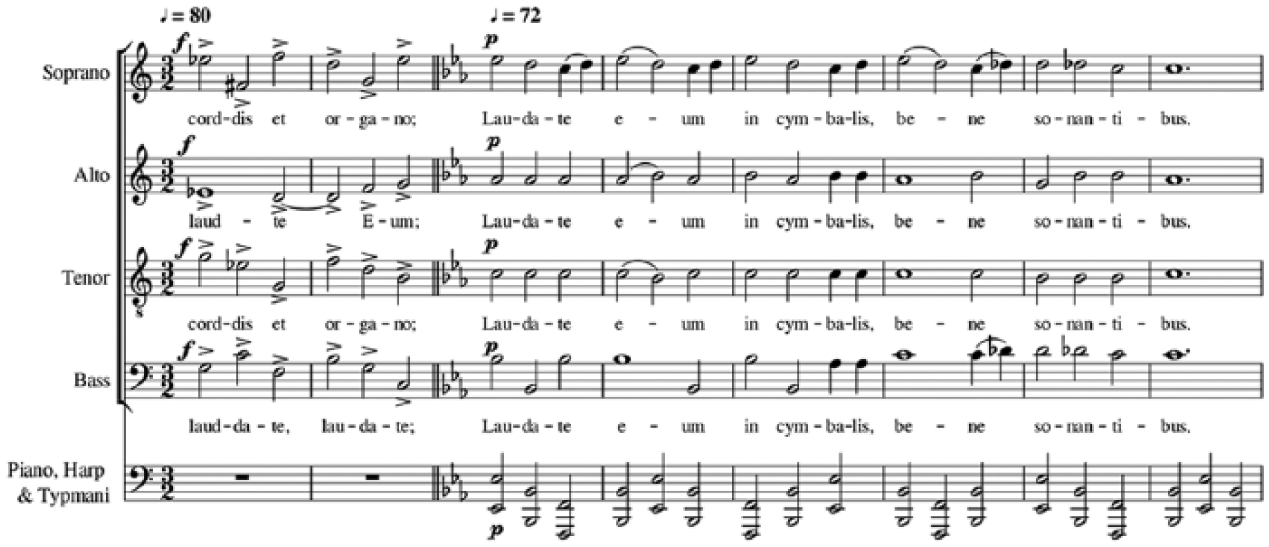
Movt. III, mm. 1–6 of rehearsal no. 22.
Verses 5–7
Having just sounded this bright C-major-7th chord, Stravinsky moves on to v. 5 by utterly obscuring the C-major tonality. Such a joyous sound of praise is only temporary. It gives way immediately to a tonal cluster with some elements of B-flat major, but with an unclear tonal center for a new laudate Dominum. The four-note ostinato that commences in the piano, harp, and tympani further contributes to the tonal ambiguity, with tones that descend two perfect fourths successively and then rise a perfect fourth: E-flat–B-flat–F–B-flat. In addition to creating ambiguous tonality, the four-note ostinato appears in duple meter as the voices are in triple meter, with their three-note phrases based on the three syllables of lau-da-te. The result of this interchange is a thorough confounding of any clear rhythmic center.
As the ostinato cycles through its series of fours and the chorus on its series of threes, it is notable that the soprano voice never proceeds beyond the interval of a minor third (C to E-flat), it simply ascends and descends in stepwise motion (Example 25, mm. 3–8), a strong contrast to the soprano’s setting of cordis et organo, which was marked by wide intervallic leaps. The marked change in the melodic line creates a sense of gravity in this section. Indeed, Stravinsky instructs the orchestra to proceed rigorosamente (“rigorously” or “gravely”), an ironic gesture given the text he is setting: laudate eum in cymbalis, bene sonantibus; laudate eum in cymbalis jubilationibus (“Praise him with resounding cymbals; praise him with jubilant cymbals”). There are no cymbals here (or anywhere in the symphony). And there is no jubilance here. Quite the contrary, since jubilation is not emotionally consistent or honest given the experience of the psalmist across the scope of the Symphony, with its pleading cries (Psalm 39) and long waiting for God (Psalm 40). The psalmist does utter praise here in the third movement. It is unyielding, fierce, vigorous praise. It is faithful, but it is also exhausted at this point. It is not jubilant.

Movt. III, mm. 1–8 of rehearsal no. 29.
In the setting of v. 5, the text is accompanied by subdued long tones in the brass and low strings alongside the ostinato. The woodwinds enter and the brass fall out in a recapitulation of the first line of the psalm, laudate Dominum, laudate eum in exceedingly slow melodic rhythm, which has the effect of highlighting the ostinato in the piano and again suggesting a deliberateness to the praise of God that eschews any saccharine, euphoric praise. This is a rigorous, dutiful praise and it is in no hurry.
As the movement concludes, the praise encompasses everything. The full orchestra returns at the second colon of verse 6: omnes spiritus laudet eum (“let all breath praise him”). The entire orchestra breathes together here, united in praise. The soprano line, rising and falling along the minor third, conveys a steady inhaling and exhaling. It is hard to overstate the mesmerizing effect of this setting of vv. 5–7. Yet this way of breathing together is not simple or uniform. It is, on the contrary, complex and diverse. There is a persistent half-note beat that sounds constantly here, yet with the ostinato in duple meter and the voices and orchestra in triple meter. The primary grouping of these beats alternates, such that they only occasionally align. Thus there is an effect of a deliberate and forward progress. But the gait has a hitch, as if limping from an old wound. The experience of suffering and waiting for God has had a clear effect on this praise. This laudate slowly limps forward, an unyielding, angular insistence on worshiping God even amidst an obscured tonality.
Recapitulation
The movement ends with a restatement of the opening phrase of the movement: alleluia, laudate, laudate Dominum. To be clear, the Vulgate does not include these words at this point in the psalm, so Stravinsky is again modifying the text to serve his interpretive agenda. The praise that emerges here at the end of the piece is that probing, hesitant alleluia, with a melody that rises only a minor third and slows down as it rises.
Alleluia is a transliteration of the Hebrew hallelu-yah (“Praise Yah[weh]!”). It is an imperative verbal phrase addressed to a community. The piece ends with the Latin translation of alleluia / hallelu-yah: laudate Dominum (“Praise the Lord”). This call to praise in uttered first in tenor and bass in octaves and the joined by soprano and alto, arriving on a C in octaves at last. At numerous points in the movement, there has been an oscillation between the C-major and C-minor tonality (see, e.g., Example 17) along with a significant obscuration of a tonal center at many points. Here in the last few measures the ambiguity of tonality returns, with the alleluia sounding in a minor tone, while the final Dominum rests on a C-major chord, anticipated by the E-natural in the celli and bass in their penultimate tones.
The chorus, like text of the psalm itself, does not indicate this tonal coloring of the final chord. The voices stay on C in octaves. The surrounding orchestration fills out the sentiment and indeed endures beyond the choir’s final utterance, carrying the tone forward past the end of speech (Example 25). As such, these final measures reinforce the essential role that orchestration has on our experience of the Psalter. It is the instrumentation, harmonization, the setting that surrounds the text that fills out its meaning.
Conclusion
From the perspective of biblical theology and the reception history of the Psalms, there can be no doubt that Stravinsky’ work is a remarkable piece of biblical interpretation. By setting these particular texts through this music, he has isolated the essence of the entire Psalter.
Stravinsky has compressed the Psalter into one exquisite alleluia. This praise is not exuberant or boisterous, at least not always. The alleluia is instead an exhaled call to praise, as it is uttered by someone who has experienced both God’s action and God’s inaction in the world. It is an alleluia shaped as much by the reality of fear and pain as it is by the experience of salvation. Since my first hearing of this symphony, Stravinsky’s alleluia has sounded more authentic and thus more beautiful than any other, for it honors the complexity and challenge of living a life in relationship to God. Hearing the psalms with Stravinsky can lead us into an honest alleluia. It may sound quiet and even tentative at times, yet this alleluia is nevertheless courageous. It boldly acknowledges the full range of God’s activity as well as the painful reality of God’s inactivity for those who suffer while they wait for God to act. Despite this suffering, despite the long and difficult period of waiting, the Psalms and this Symphony insist on praise.
Footnotes
1.
How to read this essay: If you have never heard Stravinsky’s Symphony of Psalms, or if you have not heard it recently, please listen to it before reading the section entitled: “The Form of the Symphony of Psalms.” If you do not own a copy, there are many ways to access recordings of this piece, including free online music streaming services such as Spotify. My preferred version is the 1991 recording on the Telarc label by the Atlanta Symphony Orchestra and Chorus under the direction of Robert Shaw (CD-80254, Telarc). A search on YouTube will also yield a number of recordings, though the quality varies. You might find it helpful to listen to a movement and then pause to read the analysis of that section. For readers of this essay in electronic format, there are .wav files available at the Interpretation website  . These excerpts are synthesized versions of one or more instrumental or vocal parts. They are certainly no substitute for the recordings, but do provide immediate aural reminders of what is being discussed and pictured in the excerpts from the score. Note, too, that the vocal parts do not contain lyrics in these synthesized examples. Ideally, after reading the whole essay, one would return to listen again to the full symphony and allow the music to express itself, free from the constraints of my commentary.
2.
Vera Stravinsky and Robert Craft, Stravinsky in Pictures and Documents (New York: Simon and Schuster, 1978), 297.
3.
The Vulgate is a fourth-century Latin translation of the Bible that became the standard Scripture for worship in the church until the Reformation.
4.
Robert Craft, Stravinsky: Glimpses of a Life (London: Lime Tree, 1992), 288.
5.
See, for example, Tatiana Baranova Monighetti, “In Between Orthodoxy and Catholicism: The Problem of Stravinsky’s Religious Identity,” in Igor Stravinsky: Sounds and Gestures of Modernism, ed. Massimiliano Locanto, Speculum Musicae 25 (Turnhout: Brepols, 2014), 3–29; Marianne Gillion, “Eastern Orthodox Spirituality in the Choral Music of Igor Stravinsky,” The Choral Journal 49 (August 2008): 8–25; Gilbert Amy, “Aspects of the Religious Music of Igor Stravinsky” in Confronting Stravinsky: Man, Musician and Modernist, ed. J. Pasler (University of California Press: San Diego, 1982), 195–206; Wilfrid Mellers, “1930: Symphony of Psalms,” Tempo 97 (1997): 19–27; Robert M. Copeland, “The Christian Message of Igor Stravinsky,” The Musical Quarterly 68 (1982): 563–79. H. Lindlar, Igor Strawinskys sakraler Gesang: Geist und Form der christkultischen Kompositionen (Regensburg: Boose, 1957).
6.
See Michael Oliver, Igor Stravinsky (London: Phaidon, 1995), 124.
7.
Igor Stravinsky, An Autobiography (London: Calder & Boyars, 1975), 162.
8.
Stravinsky, An Autobiography, 163.
9.
Steven Walsh (The Music of Stravinsky [Oxford: Clarendon, 1993], 148) writes: “it is obvious that the Symphony of Psalms directly articulates a personal faith, and that its power comes from the composer’s recognition that this act of faith was absolutely compatible with his aesthetic theory.” See also Michael Oliver, Igor Stravisnsky, 124.
10.
Igor Stravinsky and Robert Craft, Dialogues (San Diego: University of California Press, 1982), 44.
11.
Ibid.
12.
Stravinsky and Craft, Dialogues, 45.
13.
Vera Stravinksy and Robert Craft, Stravinsky in Pictures and Documents (New York: Simon & Schuster, 1978), 294–95. See Walsh, The Music of Stravinsky, 148.
14.
Igor Stravinsky and Robert Craft, Memories and Commentaries (San Diego: University of California Press, 1981), 222.
15.
See Susanna Pasticci, “Stravinsky and the Spiritual World of Orthodox Theology,” in Igor Stravinsky: Sounds and Gestures of Modernism, ed. Massimiliano Locanto, Speculum Musicae 25 (Turnhout: Brepols, 2014), 31–48.
16.
Many listeners will recognize the oscillating minor-second figure as the same one that John Williams used to such great ominous effect in the soundtrack to the movie Jaws.
17.
Translation from A New English Translation of the Septuagint, ed. Albert Pietersma and Benjamin G. Wright (Oxford: Oxford University Press, 2007).
18.
White, Stravinsky, 363.
19.
Consider, e.g., the alleluias of modern composers as diverse as Olivier Messiaen, Randall Thompson, John Rutter, Eric Whitacre, Ned Rorem, and Steve Reich.
20.
Musicologists have described the tonality in the third movement in a number of different ways. Gilbert Amy describes it as “neotonal” or “neomodal” with a general cadential movement toward C-Major (“Aspects of the Religious Music,” 203–206). Stephen Walsh analyzes the alleluia phrase as an “implied” plagal cadence in B-flat: E-flat major at alleluia to B-flat major on laudate. He adds, “[H]ere, however, there persists an ambiguity, in that B flat is never once treated as a final goal, since it continually fails to escape the influence of that key of which E flat is the median, C minor” (The Music of Stravinsky, 150).
21.
Stravinsky writes “Never before had I written anything quite so literal as the triplets for horns and piano to suggest the horses and the chariot” (Stravinsky and Craft, Dialogues, 46).
Supplementary Material
Please find the following supplemental material available below.
For Open Access articles published under a Creative Commons License, all supplemental material carries the same license as the article it is associated with.
For non-Open Access articles published, all supplemental material carries a non-exclusive license, and permission requests for re-use of supplemental material or any part of supplemental material shall be sent directly to the copyright owner as specified in the copyright notice associated with the article.
