




Abstract
Set in the context of Judean resistance against the Seleucid Empire, Daniel addresses issues such as diaspora, identity, empire, and power. The first biblical apocalypse models how to survive faithfully within a hostile foreign culture, and it voices a full-throated rejection of foreign domination. In contrast, American religious media domesticate Daniel into a morality tale, a fable that promotes personal integrity and trust in God. The Americanized Daniel cannot or will not ask what “empire” means or what it means for believers to inhabit an empire themselves. This essay explores what modern readers can gain by reintroducing categories like “empire” and “resistance” in Daniel.
Apocalyptic Literature and Anti-Imperial Resistance
The great literary apocalypses testify to anti-imperial resistance. The first historical apocalypses, Daniel and (sections of) 1 Enoch, model different ways of resisting the Seleucid repression of Antiochus IV Epiphanes. Daniel models a nonviolent path, while Enoch’s The Animal Apocalypse (chs. 83–90) and Apocalypse of Weeks (93:1–10; 91:11–17) in 1 Enoch conjure military conflict. A second round of historical apocalypses responds to the first Jewish revolt against Rome, with Revelation and 4 Ezra as prominent examples. Both Revelation and 4 Ezra invite the faithful to pursue righteousness as they wait upon the great conflict in which the messiah destroys Rome. Responding to imperial violence, historical apocalypses like Daniel call forth a vigilant fidelity. 1
The books of Daniel and Revelation, as literary apocalypses, often function as case studies in faithful resistance to imperial hegemony. Sophisticated research has teased out the imperial contexts of both works and the ways in which apocalyptic discourse empowers their witness. 2 However, when white North American interpreters turn to these apocalypses to sort through our own current issues, we tend to legitimate our own political theologies by means of biblical interpretation. What happens when white Americans who, by and large, feel comfortable in middle and upper-class American culture and who benefit from American imperialism, read the book of Daniel? How do Americans accustomed to many comforts define and relate to “empire,” and what do we think “resistance” looks like?
This essay will examine some Americanized interpretations of Daniel, especially those created for younger readers, and suggest that these interpretations have tamed the court stories and apocalyptic themes, so that we perceive Daniel no longer as resistance literature but as bland advice on individual morality. After all, the United States remains the world’s most powerful nation both economically and militarily. Our patterns of consumption appropriate labor and natural resources from around the globe, destabilizing the global climate and often exploiting ordinary people and communities. Christian citizens value the United States as a force for economic relief and global development and as an advocate of human rights, yet we rarely explore the Christian implications of living within a military and economic empire. Daniel offers a compelling site for precisely those conversations.
What Does Resistance Look Like?
I’d like to begin by comparing two examples of resistance, one reflecting the imagination of biblical scholarship and the other from my personal experience.
Daniel as Resistance Literature
Anathea Portier-Young has composed a particularly sophisticated account of apocalyptic resistance, with detailed attention to Daniel. 3 She surveys multiple definitions of resistance in social scientific literature and investigates the circumstances that gave rise to the Maccabean Revolt. By attending to resistance as an analytical category, Portier-Young’s work adds sophistication to a general consensus that regards Daniel as resistance literature. She also provides an analytical narrative of the Seleucid domination of Judea that sharpens our appreciation for Judean grievances.
In the end, Portier-Young highlights two particular forms of resistance: “articulating and promulgating counterdiscourse” against the claims of imperial powers and “religious practices that testify to a competing account of reality.”
4
Among other things, an apocalypse like Daniel creates a grand picture of reality that counters the totalizing claims of Antiochus and other despots. Daniel brings into relief the empire’s practices of violence and domination, characterizing them as “monstrous or demonic precisely to enable full-fledged resistance of the mind, spirit, and body.”
5
Daniel portrays Antiochus IV and his empire as the greatest in a series of beastly empires, overcome by the Son of Man and the Ancient of Days. Safwat Marzouk puts it this way: [T]he embodiment of empires in the form of abnormal monsters not only speaks of the terror the imperial hegemony inflicts on the subjected peoples (socially, economically, militarily, and politically), but it also forms a script for resistance to the imperial politics of sameness mediated through the otherness of the monstrous body.
6
The Greek word apokalypto means “revelation.” Over against prevailing regimes of power, an apocalypse reveals the world’s true nature. Daniel reveals Antiochus’s persecution as monstrous and envisions a human(e) reign brought about by God. In short, Daniel turns the empire on its head.
To the “counter-discourse” that reveals the monstrosity of Antiochus’s empire and envisions its demise, Daniel narrates “religious practices that testify to a competing account of reality.” That is, Daniel and his colleagues observe their own dietary restrictions and refuse to participate in idolatry. Daniel’s court legends—the diet, the writing on the wall, the stories of the fiery furnace and the lion’s den—portray a kind of nonviolent resistance to imperial culture. These sections of Daniel depict foreign rulers as arrogant, yes, but harmless almost by accident. Remember how poor Darius loses sleep after throwing Daniel into the lion’s den, and how quick he is to punish those who had conspired against Daniel (6:16–24)? In such a world one resists by refusing to comply. In Jan Willem Van Henten’s words, Daniel and his compatriots “can be considered exemplary Judean figures.” 7
Daniel’s apocalyptic section is far more pessimistic about Judea’s imperial overlords: their arrogance is murderous, their intentions malicious throughout. They are, in Daniel’s imagery, animals and not humans. Only war and divine intervention can deliver the people. Daniel does not encourage its audience to take up arms, but neither does its final section envision any possibility of compromise. Some Jews fought their Hellenistic overlords and won. Others found assimilation the reasonable path. Daniel calls for an extremely risky form of cultural resistance: the righteous expose themselves to “sword and flame,” to captivity and to plunder (11:33). Unlike the court legends, Daniel’s second half offers no heroes with happy endings; instead, it de-legitimates Seleucid pretensions of authority by constructing an alternative symbolic world. 8
A Modern Example of Resistance to Empire
Let us consider another moment of resistance to empire. For two years I served as a Southern Baptist home missionary in Richmond, Virginia, right at the peak of the violent cocaine wars. Newspapers routinely reported Richmond’s ranking as a particularly deadly city in the United States. It is one of six cities to have ranked as the nation’s “murder capital” since 1985, a distinction accomplished in 1997. The neighborhood in which I served was almost entirely white and largely free of drug murders. I coached a church league basketball team based in this neighborhood, and we were pretty good. But another team, from one of the more violent black neighborhoods, dominated my team and the rest of the league. In games that lasted only 32 minutes, the Shalom Baptist team won games by scores like 117–24.
Their domination began even before the tip-off. Most teams straggled into the gym individually, sweat suits covering their game uniforms until just prior to game time. Shalom marched in together. Wearing gray suits, white shirts, red bow ties, and carrying gym bags in their right hands, they made one circuit around the gym before sitting together. Prior to game time, they’d exit the gym together and return in their uniforms for a well-choreographed warm-up session.
I asked Shalom’s coach, “What’s up with the suits and the bow ties?” He interpreted the routine as an act of solidarity—I would call it resistance. These kids lived in a deadly neighborhood defined not only by drugs but by intertwined systems of poverty and racism. Their basketball team functioned as a lifeline. To play on the team, young men had to do a lot more than practice: they maintained good school attendance and participated in various church activities. These disciplines united the team by providing both identity and structure in a culture that was hostile to them. Shalom’s young men deviated from common social norms by demonstrating increased conformity to a certain traditional model of heavily disciplined masculinity. Among other things, they resisted the violence and desperation society imposed upon their community by exceeding conventional expectations of good deportment.
The Shalom Baptist Church basketball team offers an example of life-giving resistance to an oppressive dominant culture that resonates with the book of Daniel. I describe Shalom’s basketball team in order to complicate our culture’s assumptions about the book of Daniel. In the context of white, un-oppressed Christianity in the United States, Daniel has been tamed. It is known primarily for the splendid stories of faith learned in Sunday School rather than for cultural and political resistance. For most American Christians, Daniel demonstrates how to trust God in the face of cultural pressure. However, what “cultural pressure” looks like, and what practices constitute faithful “resistance” depend on one’s social location. Following are two examples that show how Bible study publishers appropriate Daniel today in a way that reflects an “Americanized apocalypse,” marketed to a culture whose social location is far different from resistance to empire.
Daniel as an Americanized Apocalypse
Identifying Daniel as an Americanized apocalypse has to do with the ways in which we read and appropriate Daniel in Christian religious culture. In the computer animated short films VeggieTales and in study Bibles targeted to young people, we observe the process by which market forces appropriate Daniel for popular consumption. The process avoids dealing with questions like empire and domination by exchanging political and cultural critique for individual integrity and faith.
VeggieTales: Daniel in Popular Imagination
The short films called VeggieTales provide a good example of how American Christians have domesticated Daniel. Launched in 1993 and now on Netflix, the VeggieTales films frequently adapt biblical storylines to provide moral and spiritual lessons for children (and evidently for the adults who watch alongside them). 9 Anthropomorphically goofy cucumbers, tomatoes, and berries convey the action, which is supplemented by silly songs. The VeggieTales founders met as Bible college students, and the franchise found its first and most natural home in Christian bookstores. The franchise grew to include all sorts of merchandise, which appeared in places like Costco and Walmart, but its home lies in the heart of American evangelicalism. As VeggieTales never strays into the more controversial territories within evangelicalism such as gender and family roles, Pentecostalism, and rapture theology, the videos have found a warm reception well beyond the evangelical movement. One might criticize the series for a kind of bland conservatism—where are the female veggies?—but it steers clear of the culture wars. 10
During my daughters’ childhood, VeggieTales provided one of those guilty pleasures I would rarely disclose in polite company. Without crediting the creators with high brow motives, there is a delicious genius to the series. (Creator Phil Vischer has claimed, “I’m going to make them think a little harder” than some might expect.) 11 My daughters and I giggled a lot. I was grateful they received positive “life lessons” from a very funny show. However, in my gut I also felt the sense of compromise. I sensed that the series trivialized the sublime.
It is hardly surprising that VeggieTales has received a sharply divided reception. Evangelical theologian Telford Work asserts that the “morally complex” series draws upon multiple ethical models and credits the series with cinematic subtlety akin to Clint Eastwood’s anti-Western Unforgiven. 12 In his view our veggie protagonists cleverly subvert the “defective literary form” of the hero narrative. On the other hand, Work complains that the series omits distinctive Christian values like the story of Jesus and the role of the church. In the end Work credits VeggieTales with representing a sophisticated evangelical intervention in a post-Christendom America, one that deploys humor to tell Christian stories and promote Christian values to a broad audience. 13
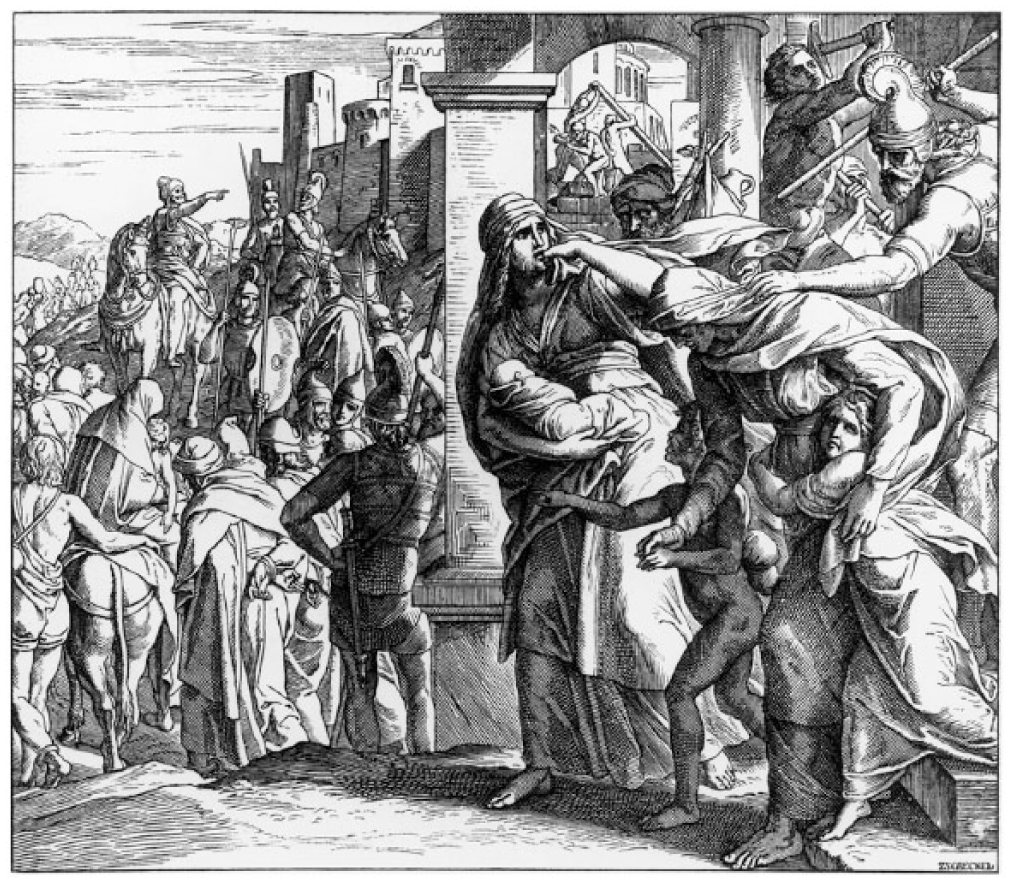
Carl August Zscheckel (1824–1870). The Destruction of Jerusalem under Nebuchadnezzar in 586 BCE. Woodcut. Bildagentur/Art Resource, NY.
Others sharply disagree. Among biblical scholars, Alice Bach has provides the most thorough take on VeggieTales to date. Responding to a digital media columnist who appraised the series as “silly but profound,” Bach counters, “Caution: Profound is a stretch.” Bach adds other choice comments. The tales blend “rock, jazz, and funk music with plenty of treacly dialogue, resulting in stew that evokes a naughty F word from me.” 14 Bach’s critique runs much deeper than aesthetics. She argues that VeggieTales trivializes the biblical narratives. Bach has written children’s books and insists that good children’s literature can tackle complex topics. Thus, she asks why, in an episode called “Rack, Shack, and Benny,” featuring Shadrach, Meshach, and Abednego (Dan 1 and 3) reduces the king’s non-kosher diet to an offer of all-you-can eat chocolate and Nebuchadnezzar’s golden statue to a ninety-foot-tall chocolate bunny. The episode reduces imperial assimilation and deadly persecution to lessons in nutrition and peer pressure. She asks, “What are children to do” with that? 15 Bach also accuses the series of poor exegesis and misogyny: almost all the protagonists are male, and “there is a prevalent disparagement of female Veggies.” 16 Her gender indictment has merit. Not all female Veggies are disparaged, but prominent and stereotypical examples come readily to mind.
It is remarkable that four stories from the book of Daniel occur in the first four VeggieTales videos. And yet none of these stories deals with Daniel’s apocalyptic material. Two episodes interpret stories from Daniel’s court legends. The debut film Where’s God When I’m S-Scared? draws upon Daniel’s interpretation of Nebuchadnezzar’s dream in Daniel 2 and the lions’ den narrative of Daniel 6, and the fourth installment, Rack, Shack, and Benny, spins the twin narratives featuring Shadrach, Meshach, and Abednego: the young Judeans’ diet (Daniel 1) and the fiery furnace (Daniel 3).
The episode Rack, Shack, and Benny opens with Larry the Cucumber wearing an oven mitt as a hat. Despite the fact that the oven mitt covers his eyes, Larry wears it in an effort to be cool, because “They’re all the rage.” A letter from a fictional kid in Tuscaloosa seeks advice concerning pressure to watch a questionable television show, clearing the way for a lesson on peer pressure. Babylon’s empire—the one that sacked Jerusalem and deported a chunk of its population—now appears as Mr. Nezzar’s chocolate factory with deteriorating working conditions. With a wreath of white hair, Mr. Nezzar vaguely resembles a Veggie-Caesar. The three co-workers face two temptations: an opportunity to eat all the chocolate bunnies they want for thirty minutes, and the expectation that they sing the praises of Mr. Nezzar’s ninety-foot bunny: “I gave everything that I had for the bunny.” To the latter challenge, Bob the Tomato meekly asks, “Um, what would happen, say, if someone didn’t quite agree with everything in that song so they didn’t, um, didn’t sing it? What would happen?” Declining a direct answer, Mr. Nezzar suggests that such a miscreant could be thrown into the furnace. The three boys refuse to bow and sing the song (as Laura the Carrot encourages them to), instead singing their trust in God. In the style of a James Bond villain, Mr. Nezzar offers the boys one chance to recant before tossing them into the furnace. Meekly defiant, the boys confess their faithfulness to God. But Laura the Carrot intervenes to rescue them, complete with chase scene and hanging over the flames suspense. Eventually a shiny fourth figure joins the boys in the furnace, and Mr. Nezzar acknowledges that God has saved them. In the end the boys teach Mr. Nezzar one of their songs celebrating divine providence, parental authority, and faithfulness: “Stand for what you believe in.” In the end, Mr. Nezzar converts, avoiding the demise that meets his biblical counterpart.
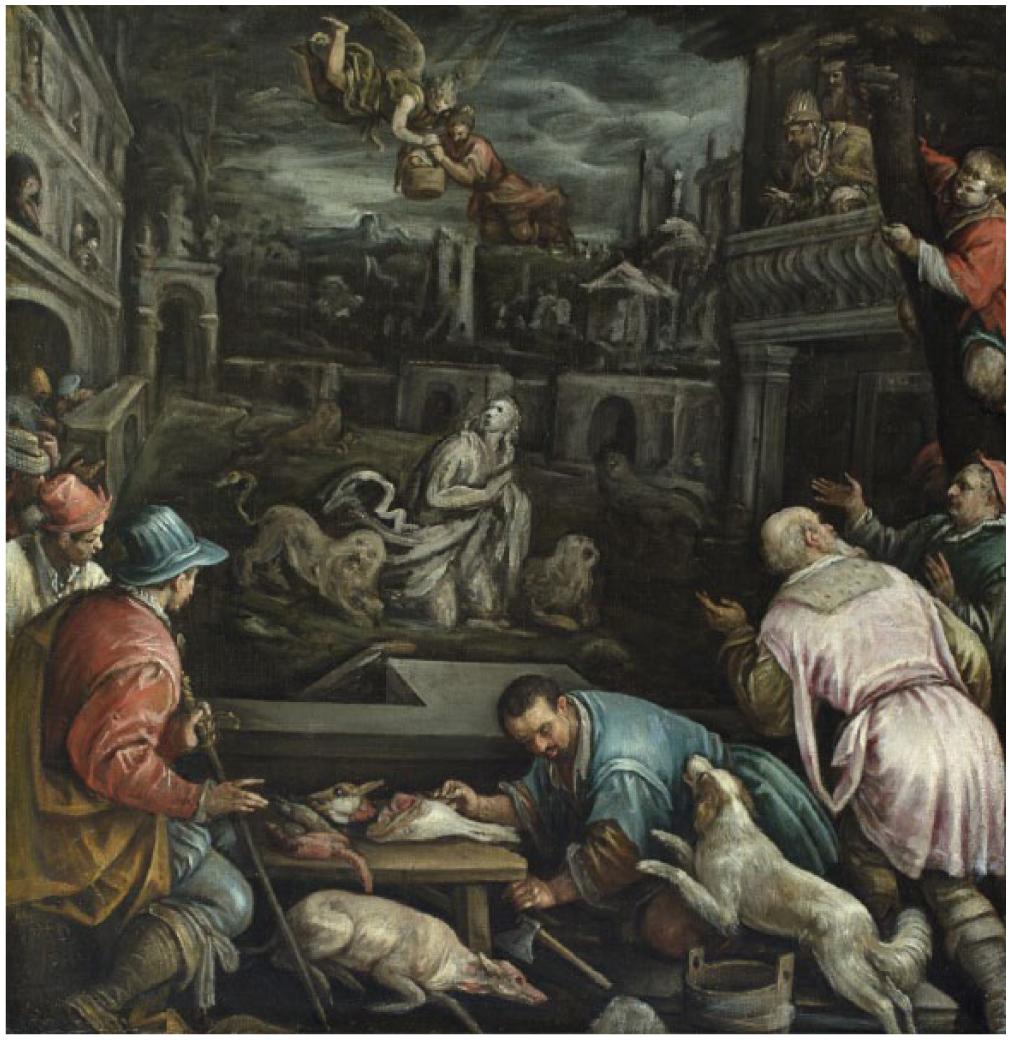
Jacopo Bassano (1515–1592). Bassano’s depiction of Daniel in the Lion’s Den (Daniel 6) suggests the violence inherent in resistance to empire by depicting butchers in the foreground and menacing buildings and sky in the background. Location: Ham House, London. Photo Credit: John Hammond. National Trust Photo Library/Art Resource, NY.
Where’s God When I’m S-scared? begins with a letter expressing fear of monsters in the closet, then transitions to Junior Asparagus having nightmares after watching Frankencelery. Bob and Larry appear, singing “God is Bigger Than the Boogie-Man” and assuring Junior that “That’s why we don’t have to be afraid.” Comforted, Junior falls asleep, and after Larry sings a silly song new credits introduce the story of Daniel and the Lion’s Den. With some literary license, a narrator tells Daniel’s story, including the interpretation of Darius’s dream. To one who knows the Daniel stories, the episode clumsily blends material from the two different court legends of Daniel 2 and 6. The biblical Daniel wins a promotion by interpreting Nebuchadnezzar’s dream in ch. 2, not Darius’s. But the story of Darius and the lion’s den occurs in chapter 6, including an entirely different promotion for Daniel and after the drama involved in chapters 3–5. We may chalk all this up to artistic license.
In the end, a heavenly light shines upon Daniel in the lion’s den, accompanied by a feminine voice assuring Daniel’s safety. The narrator adds an important detail to the biblical account: “Daniel felt better when he remembered that God was taking care of him.” Darius spends the night praying (not fasting, as in the biblical account), and his conniving advisors (scallions, in VeggieLand) escape into the wilderness (rather than being thrown into the den themselves, per biblical Daniel).
In short, Where’s God When I’m S-scared? takes quite a few liberties with biblical Daniel. The most significant changes create a continuous story line that melds two separate accounts, the interpretation of Nebuchadnezzar’s dream in Daniel 2 and the story involving Darius and the lions’ den in Daniel 6. Smaller changes soften the brutality of the biblical tales, presumably for the sake of young viewers. Still other changes interpret the story into the language of evangelical piety: Daniel “felt better” by relying on God, while Darius prays for Daniel while he’s in the lion’s den. VeggieTales does not eliminate the notes of persecution and terror from the biblical account entirely, although humor goes a long way to ameliorating these reactions. The episode shifts the focus of Daniel’s account from faithfulness under persecution to feeling better when one is scared. In both the biblical and VeggieTale versions of Daniel, God delivers the righteous from danger.
The Americanized Daniel, both in VeggieTales and in popular usage, relies heavily on the court tales and marginalizes Daniel’s apocalyptic material. Exceptions reside in the Bible prophecy movement, where Daniel “predicts” geopolitical affairs in the last days and feeds into millenarian speculation by providing a timeline for Jesus’s return.
Study Bibles for Young Christians: Moralizing Daniel
Beyond millenarian speculation, however, many modern interpretations of Daniel feed into one of two American Christian narratives: (a) a generic appeal to moral integrity in the face of peer pressure and cultural decay; and (b) a less widespread but socially significant persecution complex.
These patterns prevail in modern study Bibles marketed to young people, particularly gender-specific Bibles. Because these study Bibles provide helps at regular intervals throughout the Bible, they engage Daniel’s apocalyptic visions, usually by pointing out that God is sovereign over the nations and with reflections on visions as a source of revelation. With respect to the court legends, these study Bibles transcend individualism by encouraging young believers to pray that “the right people” will find positions of influence and by praying that their country will do the right things. 17 Otherwise, generic moral integrity holds the day, with traces of a mild persecution complex. Empire is not a concern.
The appeal to moral integrity tends to foster an individualized, spiritualized, and commodified spirituality. Sometimes this appeal provides universal positive messages, like encouraging youth to resist pressure to participate in bullying. Consider this reading from The 252 Boy’s Bible (Zondervan imprint Zonderkidz), marketed as “your ultimate MANual” and bearing the logo, “smarter, stronger, deeper, cooler.” Regarding Daniel 1:4 (“young men without any physical defect, handsome, showing aptitude for every kind of learning, well informed, quick to understand, and qualified to serve in the king’s palace. He was to teach them the language and literature of the Babylonians,” NIV), this study Bible asks, “Have you been taught anything in school that contradicts the Bible? Write it on a sticky note, then draw an ‘A’ through it.” 18 On Belshazzar’s dream in Daniel 5, the study Bible says “Only God can be our security. If we look to him and trust him, he will take care of us.” 19 Despite their distinctive packaging, study Bibles for young women follow similar lines. Likely to feature pink and brown (hip!) covers and features called “love notes,” such as “In what ways have you been a ‘star’ for God?” 20 they encourage young women to trust God in their integrity: “A hot furnace for you might be walking into your school and sharing the gospel,” 21 and “Sometimes being a leader requires you to take a stand for what is right, as Daniel did.” 22
Scholars and journalists alike have identified an “evangelical persecution complex” In our culture. This term unfairly stigmatizes all evangelicals but identifies a widely shared sensitivity. 23 Some Christians major in the persecution complex, even to the point of associating florists who will not serve same-sex couples with actual Christian martyrs in the Middle East. 24 Recent films like God’s Not Dead and God’s Not Dead 2 imagine embattled Christians prevailing against entrenched secularist opposition. 25 God Is Not Dead 2 features a public school teacher suspended for answering a direct question from a student by showing how the Sermon on the Mount influenced Mahatma Gandhi and Martin Luther King, Jr. 26 In general, however, study Bibles for young people tend to avoid social conflicts and emphasize faithfulness under peer pressure rather than outright persecution.
In some study Bibles marketed for young adults, we encounter milder hints of a persecution complex, with the basic assumption that standing up for Christ can be hard in this secular culture. Citing Dan 3:8–30 and 6:1–23, passages in which court officials scheme against the Jews, including Daniel, a study Bible for young women advises, “You can maintain a Christian witness, no matter how difficult the people around you try to make it for you.” 27 Marketed as “real faith for real life,” the Extreme Teen Study Bible exhorts, “People who are not willing to be different and stand alone if necessary won’t make a difference with their lives.” 28 This study Bible’s profile emphasizes Daniel’s “tough choices” that came from having “already dedicated his life to God,” but it does not mention Daniel’s apocalyptic revelations. 29
As an Americanized apocalypse, then, Daniel functions to build moral character. Marketers do not avoid the book’s political messages entirely, but they do reduce them to exhortation to pray for righteous leaders and by teaching that God controls history. Resistance to empire is absent, reduced to fortitude in the face of vague cultural pressure.
Reading Resistance and Empire in the United States
This discussion of Daniel’s place in the American cultural and religious imagination does not aim to elevate critical biblical scholarship at the expense of popular or commodified piety. Instead, maintaining a focus on Daniel, I aim to complicate the relationship between biblical scholarship and popular piety. If modern American interpretations domesticate Daniel’s court legends and largely abandon its apocalyptic visions, what can readers gain by reintroducing categories like “empire” and “resistance” in Daniel?
In biblical scholarship “empire studies” and “postcolonial criticism” denote diverse, somewhat competing, approaches to interpretation. Neither approach is sympathetic to empires, ancient or contemporary. Empire studies approaches tend to regard empire and resistance as monolithic and opposed realities. To take one classic example, we might consider Richard A. Horsley’s interpretation of Jesus. Horsley briefly sketches a narrative of American imperialism as a context in which to show how “Jesus spearheaded a program of renewal of the people” over against their Roman overlords. 30 Drawing heavily upon contemporary cultural and literary theory related to postcolonialism and resistance, postcolonial interpretation adopts a more ambivalent voice. Empire itself amounts to a diffuse set of relationships and practices rather than monolithic nation-states or alliances, and no one can stand completely outside of those relationships and practices. Even resistance to empire carries the symptoms of empire within itself. 31 Thus, no one completely stands over against or under empire. Moreover, postcolonial reading extends beyond reading Daniel only in its ancient context to critical reflection upon Daniel’s reception in various contexts related to culture, power, and identity. 32
Let us reflect critically on the language of empire and resistance as applied to Daniel. When we compared Portier-Young’s account of resistance in Daniel with that of a church league basketball team, we saw that resistance can take multiple shapes. Indeed, Antiochus’s persecution itself provoked diverse forms of resistance, even within the apocalyptic literature of the period. Like Daniel, the most relevant sections of 1 Enoch embody cultural resistance through the symbolic resources of apocalyptic literature. But the Animal Apocalypse (chs. 83–90) and the Apocalypse of Weeks (93:1–10; cf. also 91:11–17) endorse armed revolt at several points, while Daniel counsels nonviolent resistance.
Resistance and empire take diverse shapes within Daniel as well. The court legends locate themselves in the diaspora. They imagine Jews living as minorities in foreign lands. There danger can pop up quickly, although Jewish protagonists may enjoy lengthy success even within foreign courts. In this respect Daniel’s court legends resemble works like the stories of Joseph (Gen 37–50) and Esther. A little over forty years ago, scholars read Daniel 1–6 as lessons in how to succeed in the diaspora by almost blending in, including “the possibility of a life, rewarding and creative.” 33 A more recent consensus regards these stories as harsh critiques of imperial contexts. 34 More specifically, postcolonial interpretation foregrounds the court legends’ diasporic context. Rather than serving as a survival guide for diaspora living, Daniel ridicules the empire through satire and humor. Daniel Valeta regards the legends as “a devastating assault upon the mythology that earthly kings and kingdoms are the holders of everlasting power.” 35 Appropriating Valeta, Barbara M. Leung Lai regards the court legends as a coping strategy, in which satire and humor compensate for interior pain. 36 Daniel is not mapping a path to success in the foreign court; instead, it mocks the pretensions of the powers that rule diaspora Jews. 37 Getting the last word among the court tales, even Darius implicitly testifies to his own demise, proclaiming the eternal kingdom of Israel’s God (6:26). 38 These strategies are familiar to diaspora communities in which success is elusive and loyalty is provisional at best. Consider again the Shiloh Baptist church league basketball team, which appropriated the markers of mainstream success in order to survive a hostile cultural climate that regarded young black men as potential threats.
When readers appropriate Daniel without engaging key questions that shape its story—like diaspora, identity, belonging, and power—we domesticate the stories. The common reading of Daniel 1–6 in privileged quarters of American culture reduces the stories to a series of moral lessons. The themes of exile and diaspora are replaced with how to cope with cultural pressure while ignoring questions of ethnic belonging and power that provide the diasporic context for the heroism demonstrated by Daniel and his friends.
Daniel’s apocalyptic section, chapters 7–12, lays out a different context in which Jews confront division within and violent suppression from without. The apocalyptic chapters of Daniel do not even imagine the possibility of cooperation with empire. Total resistance is the only option. 39 Daniel’s prayer in ch. 9 proves crucial for this reading. Building repentance upon lament, Daniel seeks Jerusalem’s restoration. Gabriel’s response reflects the common apocalyptic pattern: things will get worse, war and desolation are on the way, but the desolator will meet his end (9:26–27).
The frequently superficial American interpretation of Daniel displaces the story, not only by largely ignoring Daniel’s apocalyptic material but also by placing Daniel in the context of friendly engagement. It says, “Yes, the larger culture can be hostile to Christian values, but Daniel shows you how to negotiate the challenges.” However, Daniel 7–12 does not simply locate “faithful ones” over against a problematic culture; it acknowledges diverse responses to imperial hegemony. Daniel observes how “the lawless among your own people” contribute to the trouble (11:14; see 11:30–35). Elites who receive wealth from the tyrant’s hand will undermine the people (11:23–24, 39). “Veggie” Daniel and Bible-consumer Daniel raise the possibility that rulers might turn wicked, but they do not contemplate the danger of living in a land that is thoroughly polluted, as biblical Daniel does. With these diluted, tamed readings of Daniel, we can hardly expect a society’s dominant groups to find their own society entirely compromised.
Resisting an Americanized Apocalypse
Historians have reached general agreement concerning Daniel’s compositional history and the social concerns that gave rise to the court legends (Dan 1–6) and the apocalyptic section (Dan 7–12). Historians regard Daniel as an example of cultural resistance against empire. Arising from diaspora communities, the court legends mock the powers of the day. They show clever young Jewish men who outfox unreliable and dangerous rulers and expose the incompetence of their retainers, 40 winning outright hostility from well-placed enemies. The legends also insist that imperial rule is fleeting, while God’s order prevails. These are not mere how-to lessons on surviving the imperial court; they are satires with an edge. Daniel 7–12 reflects a different social setting and set of concerns, but it performs similar functions. In this apocalyptic section we are no longer in the diaspora but in occupied Jerusalem. The imperial powers have transformed from unpredictable buffoons to beastly menaces, and the faithful community itself is fractured. For the wise, safety resides only in steadfast resistance and in God’s ultimate deliverance. Some of the righteous will die in the conflict, but their hope resides in both the new reign of God and in the resurrection (12:1–3).
Texts do not control their readers. Adapted for mainstream American culture consumption, Daniel provides a mild lesson in personal integrity and trust in God, perhaps with an invitation to discern culture with a critical eye. The (white) American Daniel perceives its cultural environment as risky but not wicked. Americanized interpretations of Daniel know about cultural laxity, but they do not question the integrity of the righteous community or its implication in globalization, militarism, and economic exploitation. They do not examine issues like culture, immigration, and language. The Americanized Daniel cannot or will not question what we mean by empire and whether its participants inhabit an empire themselves. In contrast, biblical Daniel highlights Antiochus’s rule as beastly, violent, arrogant, and idolatrous. Daniel does not settle for a simple indictment of Antiochus as an external nemesis. Biblical Daniel also acknowledges conflict within God’s people. It names “those who forsake the holy covenant,” seduced into aligning themselves with Antiochus’s program (11:30; see 8:25; 1 Macc 1:29–32). Daniel’s resurrection vision includes “everlasting contempt” along with “everlasting life.”
Biblical Daniel locates itself in the diaspora setting of ancient Babylon, a factor Americanized versions of Daniel do not take seriously. Contemporary diaspora readings foreground questions like empire, identity, and belonging. Andrew M. Mbuvi transitioned from life as a professor in Kenya to one as a graduate student and now professor in a historically black American theological seminary. Along the way he found himself working odd jobs to pay his way through school. He confesses struggling to maintain his Kenyan identity while appropriating new opportunities here in the United States. He also remembers the transition from using (his emphasis) a blackboard as a professor in Kenya to cleaning blackboards as a seminarian in Michigan. 41 Mbuvi identifies with Daniel trying to be faithful to both his Jewish heritage and to his “new home in exile,” but unlike mainstream American interpretations, Mbuvi also names the political and religious ambivalence that attend diaspora status. 42 Mbuvi’s reading elevates some of the aspects of Daniel neglected in mainstream interpretation: the power of naming and changing names, the significance of dreams and visions, and encounters with xenophobia. Mbuvi analyzes the Negro spiritual “Didn’t My Lord Deliver Daniel?” He claims that African American slaves identified with the theme of powerlessness in Daniel, and they amplified the hope for deliverance. But the inhumane treatment imposed upon them alienated them from the privileged status Daniel and his colleagues enjoyed in the Babylonian court. 43
Grounded in the “very paradoxical and alienating situation” of diaspora life, ever posed between two (or more) cultures in which one at once belongs and does not fully belong, diaspora interpretations tend to foreground ambivalence. 44 Telling his own success story as a Cuban immigrant, Francisco O. García-Treto identifies with the reeducation of Daniel and his colleagues, citing Dan 1:4: “Let them be taught the literature and the language of the Chaldeans” as a step toward success in the king’s court. 45 Bilingualism distinguishes García-Treto’s experience, as it does for many Latino/a Americans and members of other diaspora communities. Although speaking “with an accent” brings stigmatization, it also provides a strategic resource. One can mix languages to add “flavor” or nuance to communication and to characterize “others” who do not know a language as ignorant or arrogant. García-Treto interprets Daniel’s bilingualism as “an intentional device used by a bilingual author to address a bilingual audience about the specific conditions of cultural ‘tension and mediation’ in which they found themselves.” 46 Daniel, he suggests, resonates with people whose bilingual education offers them opportunities for promotion, accompanied by the threat of losing their ethnic identity. 47
In the American context, the anti-imperial message of Daniel has been tamed to reflect the experience of a dominant white culture and religion. The VeggieTales Daniel attests to a vague alienation between Christian discipleship and the larger culture, a society in which readers feel basically at home. “Mr. Nezzar” may overwork his employees and demand absolute loyalty, and he may even turn murderous, but he learns his lesson. Biblical Daniel, on the other hand, situates itself in two locations, the diaspora of the court tales and the imperial domination of the apocalypse. One part expresses the cultural resistance of living among the powerful in exile; the other rejects outright the occupying empire. At no point does biblical Daniel reflect the sense of feeling at home.
Conclusion
Canonical Daniel unites court legends with apocalyptic visions. It reflects an unstable and unsafe world. In the court legends well-meaning kings pose mortal threats to faithful Judean young men, but God rewards faithful resistance with survival and success. The apocalyptic visions totally dehumanize Antiochus and his empire, rendering them as beast-ly and murderous. There’s no guarantee of survival, only the wise remain faithful, and only some will attain the resurrection. Both “parts” of Daniel deal with questions of cultural difference and imperial domination, and both provide models of faithful resistance.
A very different kind of empire defines the consumerist context of Americanized Christianity. Contemporary empire no longer implies nation-states governing foreign territories. Contemporary empire is transnational and market-driven. Empire conceals itself behind veils of globalization, interdependence, and free trade. The capitals of contemporary empire might rest as much in New York, Shanghai, and Mumbai as in Washington, London, or Brussels. 48 The Americanized Daniel, however, avoids topics of empire, ethnicity, and belonging, substituting instead a vaguely Christian ethos of moral rectitude. A fresh engagement with the biblical Daniel opens readers to a world of questions we often avoid—and into engagement with our own dazzlingly diverse and interconnected society. It further challenges us to assess our own implication in systems that enforce conformity and enact exploitation.
Footnotes
1.
Christopher Rowland (“The Book of Daniel and the Radical Critique of Empire: An Essay in Apocalyptic Hermeneutics,” in The Book of Daniel: Composition and Reception, ed. John J. Collins and Peter W. Flint, 2 vols. [Boston: Brill, 2002], 2.447–57) traces how Thomas Muentzer, Gerrard Winstanley, and William Blake appropriated Daniel and the notion of apocalyptic revelation for resisting and judging the political circumstances of their own times.
2.
See Stephen D. Moore and Fernando F. Segovia, eds., Postcolonial Biblical Criticism: Interdisciplinary Intersections (London: T&T Clark, 2005). For everyday resistance, see James C. Scott, Weapons of the Weak: Everyday forms of Peasant Resistance (New Haven: Yale University Press, 1995).
3.
Anathea Portier-Young, Apocalypse against Empire: Theologies of Resistance in Early Judaism (Grand Rapids: Eerdmans, 2011).
4.
Ibid., 12.
5.
Ibid., 35.
6.
7.
“Daniel 3 and 6 in Early Christian Literature,” in The Book of Daniel: Composition and Reception, ed. John J. Collins and Peter W. Flint, 2 vols. (Boston: Brill, 2001), 1.153.
8.
This common division of Daniel into two sections, the court legends of chs. 1–6 and the apocalyptic revelations of chs. 7–12, is far more complicated than the impression given here. Daniel also divides into Aramaic (2:4b–7:28) and Hebrew (1:1–2:4a; chs. 8–12) sections. Source and redactional considerations further muddle the picture, especially as the first apocalyptic revelation (7:1–28) occurs in Aramaic and bears signs of having been updated to address the context of the Maccabean Revolt. For an incisive discussion with attention to these considerations, see Carol A. Newsom, Daniel, OTL (Louisville: Westminster John Knox, 2014), 6–21. See also Anathea Portier-Young, “Languages of Identity and Obligation: Daniel as Bilingual Book,” VT 60 (2010): 98–115.
9.
VeggieTales was created by Phil Vischer and Mike Nawrocki, who voice two of the main characters, and is produced by Big Ideas Productions. The first installment aired December 21, 1993.
10.
VeggieTales avoids debates over authoritarian and paternalistic (“complementarian”) family styles (Heather Hendershot, Shaking the World for Jesus: Media and Conservative Evangelical Culture [Chicago: University of Chicago Press, 2004), 42–44).
11.
Phil Vischer, “Pirates Who Don’t Mention God,” Christianity Today 52 (Jan 2008): 62.
12.
Telford Work, “Veggie Ethics: What ‘America’s Favorite Vegetables’ Say about Evangelicalism,” Theology Today 57 (2001): 473–77.
13.
Ibid., 483.
14.
15.
Bach, Religion, Politics, Media, 55.
16.
Ibid., 56.
17.
Rick Osborne, ed., The 252 Boys’ Bible (Grand Rapids: Zonderkidz, 2002), 1108.
18.
Ibid., 1115.
19.
Ibid., 1118.
20.
NIV True Images: The Bible for Teen Girls (Grand Rapids: Zondervan, 2012), 1180.
21.
Ibid., 1166.
22.
Ibid., 1170.
23.
Elizabeth A. Castelli, “Persecution Complexes: Identity Politics and the ‘War on Christmas,’ differences 18 (2007): 152–80; Candida A. Moss, The Myth of Persecution: How Early Christians Invented a Story of Martyrdom (San Francisco: HarperOne, 2013), esp. 8–13, 251–59; Alan Noble, “The Evangelical Persecution Complex,” The Atlantic (August 4, 2014), online: http://www.theatlantic.com/national/archive/2014/08/the-evangelical-persecution-complex/375506/; Randal J. Stephens, “’Religious Liberty’ and the Origins of the Evangelical Persecution Complex,” Religion Dispatches (January 12, 2016), online:  .
.
24.
25.
God’s Not Dead, dir. Harold Cronk, Pure Flix Productions, 2014.
26.
God’s Not Dead 2, dir. Harold Cronk, Pure Flix Productions, 2016.
27.
Ibid., 1167.
28.
Extreme Teen Study Bible (Nashville: Thomas Nelson, 2012), 1089.
29.
Ibid., 1089.
30.
Richard A. Horsley, Jesus and Empire: The Kingdom of God and the New World Disorder (Minneapolis: Fortress, 2003), 79.
31.
See Donald C. Polaski, “Mene, Mene, Tekel, Parsin: Writing and Resistance in Daniel 5 and 6,” JBL 123 (2004): 649–69 (esp. 668–69).
32.
For a brief discussion of the distinction between empire critical and postcolonial approaches to biblical criticism, see Kwok Pui-lan, “Geopolitical Hermeneutics,” in Soundings in Cultural Criticism: Perspectives and Methods in Culture, Power, and Identity in the New Testament, ed. Francisco Lozada Jr. and Greg Carey (Minneapolis: Fortress, 2013), 165–76 (esp. 165–71).
33.
Lee L. Humphreys, “A Life-Style for Diaspora: A Study of the Tales of Esther and Daniel,” JBL 92 (1973): 211–23 (221).
34.
Newsom, Daniel, 15.
35.
Daniel Valeta, “Court of Jester Tales? Resistance and Social Reality in Daniel 1–6,” PRSt 32 (2005): 309–324 (320).
36.
Barbara M. Leung Lai, “Word Becoming Flesh [On Appropriation]: Engaging Daniel as a Survival Manual,” in Global Voices: Reading the Bible in the Majority World, ed. Craig S. Keener, Edwin Yamauchi, and M. Daniel Carroll R. (Peabody, MA: Hendrickson, 2012), 65–77.
37.
Daniel L. Smith-Christopher, A Biblical Theology of Exile, OBT (Minneapolis: Fortress, 2002), 175–88. But see John J. Collins, Apocalypse, Prophecy, and Pseudepigraphy: On Jewish Apocalyptic Literature (Grand Rapids: Eerdmans, 2015), 294–96.
38.
Matthias Henze, “The Narrative Frame of Daniel: A Literary Assessment,” JSJ 32 (2001): 6–24 (24).
39.
Portier-Young, Apocalypse Against Empire, 227.
40.
Polaski, “Mene, Mene, Tekel, Parsin,” 655, 658.
41.
Andrew M. Mbuvi, “Daniel,” in The Africana Bible: Reading Israel’s Scriptures from Africa and the African Diaspora, ed. Hugh R. Page et al. (Minneapolis: Fortress, 2010), 273–79 (274).
42.
Ibid.
43.
Ibid., 274–78.
44.
Fernando F. Segovia, “Toward a Hermeneutics of the Diaspora: A Hermeneutics of Otherness and Engagement,” in Reading from This Place, Volume 1: Social Location and Biblical Interpretation in the United States, ed. Fernando F. Segovia and Mary Ann Tolbert, 2 vols. (Minneapolis: Fortress, 1995), 57–74 (62).
45.
Francisco O. García-Treto, “Exile in the Hebrew Bible: A Postcolonial Look at the Cuban Diaspora,” in They Were All Together in One Place? Toward Minority Biblical Criticism, ed. Randall C. Bailey, Tat-Siong Benny Liew, and Fernando F. Segovia, SBL Semeia Studies 57 (Atlanta: Society of Biblical Literature, 2009), 65–78; see Philip Chia, “On Naming the Subject: Postcolonial Reading of Daniel 1,” in The Postcolonial Biblical Reader, ed. R. S. Sugirtharajah (Oxford: Blackwell, 2006), 171–84.
46.
Ibid., 69–70. See Portier-Young, “Languages of Identity and Obligation,” and her brief discussion in “Daniel,” in Fortress Commentary on the Bible: The Old Testament and Apocrypha, ed. Gale A. Yee, Hugh R. Page Jr., and Matthew J. M. Coomber (Minneapolis: Fortress, 2014), 809.
47.
García-Treto, “Exile in the Hebrew Bible,” 69–70.
48.
Michael Hardt and Antonio Negri, Empire (Cambridge: Cambridge University Press, 2000).