




Abstract

The nineteenth-century artist Gustave Doré captured the haunting trauma of Hagar’s story in an engraving of Hagar and Ishmael in the desert (Fig. 1). The skin of water Abraham gave to Hagar lies empty on the ground; Ishmael lies nearly empty of life a few feet away, his small body almost invisible against the desert sands. Behind them, Hagar lifts her arms, in desperation and supplication. Even in her obvious pain, the long, bold lines of her body display strength. It is an image of a woman who has nothing left but her own right to grieve.
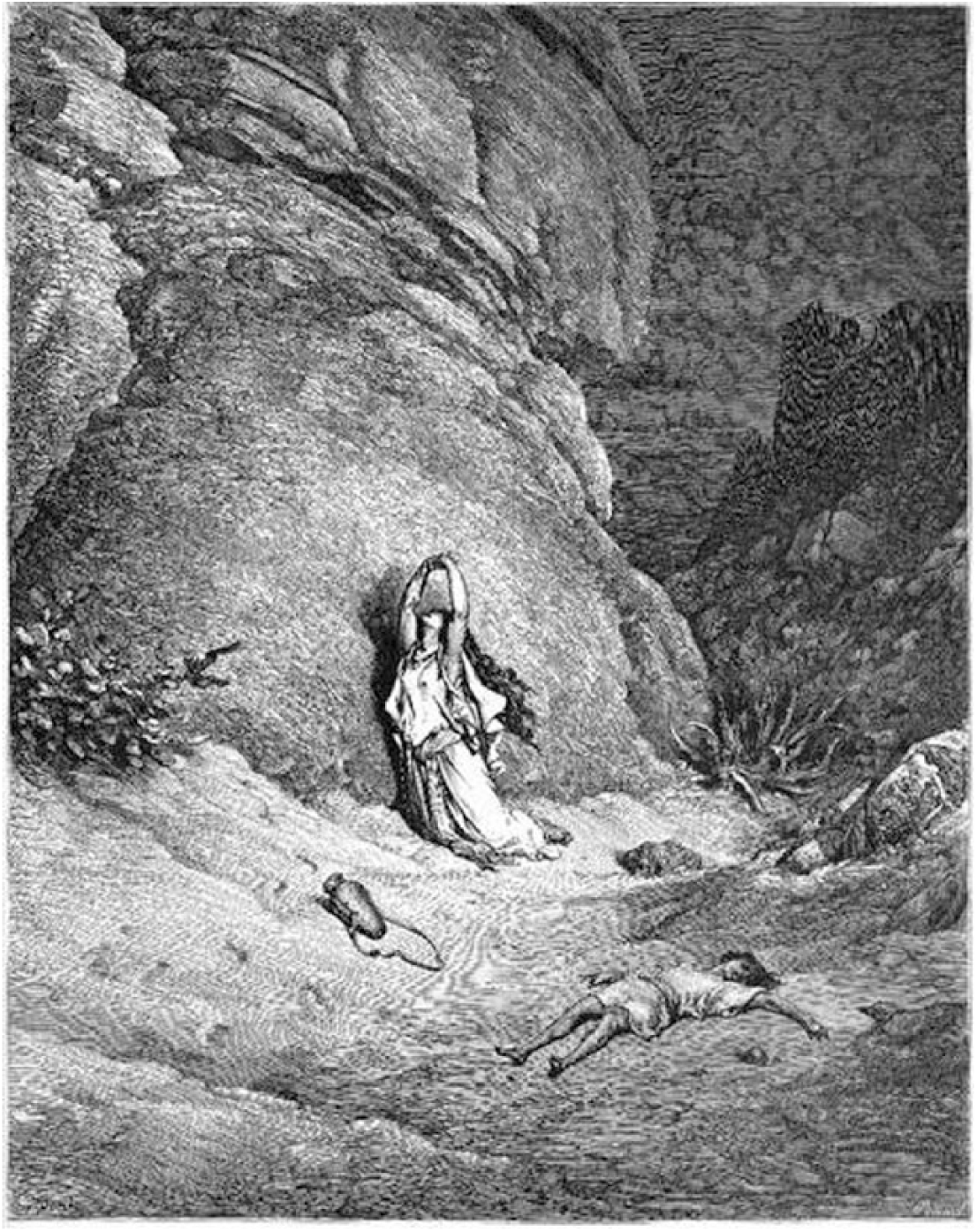
Gustave Doré, “Hagar and Ishmael in the Desert.” 1870. Engraving. In the public domain.
In the season after Pentecost of Year A, the lectionary gives us a highlight reel of the stories of Genesis. The previous week offers the story of the birth of Isaac, but it does not introduce us to Hagar the Egyptian slave. Genesis 21:8–21 is the final chapter of a much larger and richer story. Therefore, the preacher should review Hagar’s relationship with Abraham and Sarah (then called Abram and Sarai), beginning in Gen 16, to remember that Hagar was their slave, sexually exploited as their forced surrogate; that her tension with Sarah is long-standing; that she has already had a conversation with the Lord and received her own promise to be the matriarch of a great people (16:7–13). Throughout this history, Abraham and Sarah have treated Hagar more as a pawn than a person, but in this pericope, she finally has autonomy, if only the autonomy of lament.
The conflict that sparks Hagar’s expulsion from Abraham’s household seems slight. Sarah sees Ishmael “laughing” with her son Isaac (21:9). The NRSV chooses “playing,” but the Hebrew participle here is from the verb sāhaq, the same root from which Isaac’s own name (meaning “laughter”), derives. Put simply, Isaac and Ishmael could just be laughing together in the story. Just a few sentences before (v. 6), laughter is a positive thing, as Sarah exults that everyone who heard of Isaac’s birth would laugh with her. Yet Ishmael’s laughter sends her into a rage. Sometimes sāhaq is translated “mocking,” as if Ishmael were echoing his mother’s disdain for Sarah (16:4–6). Or perhaps Sarah only heard the boy’s laughter as mocking because she was so sensitized to it from the time Hagar looked on her “with contempt” (16:4). There is also a third possibility, that Ishmael’s laughing with Isaac signaled a sense of social equality between the two boys. For a woman whose own social standing in life relies on adherence to strict economic and cultural hierarchies, to see two boys playing together as joyous equals is a threat. Ishmael, as Abraham’s elder son, traditionally should inherit at least some of Abraham’s wealth and lineage; but Sarah believes that her son Isaac is to receive that inheritance. Therefore, they must remain rivals, and she cannot afford for them to bond.
Since Hagar’s story is ultimately in service to the story of Israel’s founding patriarch Abraham, it should come as no surprise that the concept of patriarchy—in the strictest, most classical sense—dominates this text. Both Sarah and Hagar must endure the abuse of a system that places the value of a woman in the productivity of her womb. Sarah may have power and wealth from being Abraham’s wife, and, at this point in the story, the status of being a mother, but she knows how precarious her position is. Twice—twice—in her life, Abraham has effectively prostituted Sarah in order to save his own skin (Gen. 12:15, 20:2). Her safety and well-being rely entirely on his decisions and actions. And like many women in her situation, she has learned to play the game, how to survive, sometimes at the expense of someone with lower social status such as the Hagar.
Complicating this story is God’s intervention, not on behalf of the oppressed Hagar, as we might wish, but in support of Sarah. God encourages Abraham to cede to Sarah’s desires to cast out Hagar, telling him the very thing he most wants to hear: that both his sons will have many offspring (21:10–13). It is a strange moment, in which God both encourages Abraham to cast out Hagar and Ishmael while simultaneously reminding him that “it is through Isaac that offspring shall be named for you,” (v. 12), but Ishmael will become a great nation, too. Sarah’s fear has forced Abraham to choose between her and Hagar; God is determined to bless them both.
Abraham sends Hagar and Ishmael into the wilderness with some bread and water—his final, brutal child support payment—and leaves them to wander on their own. Bread and a skin of water are an especially callous gift in contrast to the “great feast” for Isaac that begins this passage (v. 8). It is more a token of guilt than a real attempt to provide for his son and Sarah’s slave. The story takes its inevitable turn; the water runs out, Hagar has no one to help her, and she and Ishmael are left to die. Paradoxically, it is at this point that the characterization of Hagar is brought bursting to life. She places her son under the shade of a bush—the only comfort she can give him—and prays that she does not have to watch her son die (vv. 15–16). She finds her voice at last, and it is a voice of powerful lament. It is a voice that speaks not only to hierarchies and covenants but to the real pain of a human mother about to lose her child.
Her lament breaks through to heaven. God hears—not her, but the voice of her son, the one the angel of the Lord told her to name Ishmael, which literally means God hears (16:11). The angel of God speaks to Hagar, supplementing her lament with hope. She is not as abandoned as she thought, but is under God’s care. God opens her eyes to a well of water to keep her and her son alive (21:19). The last time Hagar stood by a spring of water in the wilderness, the angel of the Lord sent her back into slavery (16:7–9). This time, it is the beginning of her new freedom. She becomes, not God’s slave, but God’s co-parent in raising Ishmael (21:20).
For a story from millennia ago, the parallels between our culture and Hagar’s are depressingly strong. We still labor under structures of oppression, structures that are exacerbated by racial and economic difference. Women still compete against each other to gain favor in a patriarchal society. People who are inconvenient are cast out into a wilderness of despair.
In looking at the Doré engraving of Ishmael lying near-dead in the desert, I could not help but be reminded of other images on the news of brown bodies crossing the desert to escape violence or splayed out in the streets, murdered because their lives were not deemed valuable. And in looking at Hagar, lifting her hands in power and in grief, I cannot help but see the mothers of these boys, who stand on national television and turn lament into a demand that God—and we—hear their cries. I see Hagar in women like Sybrina Fulton, mother of Trayvon Martin, who has taken her right to grieve and transformed it into the opportunity to lift up other mothers affected by gun violence. Hagar’s story is one of oppression, abuse, and abandonment, but it is also one of a woman who finds favor with God and the strength to continue through the power of her own grief. It is her lament that fuels her transformation.
We see just one more glimpse of Ishmael, in Genesis 25:9, when Abraham dies. Isaac and Ishmael, who once laughed together as boys, come together to bury their father. It is a testament to the power of grief to unite, and a glimmer of hope of reconciliation for a family torn apart by greed, prejudice, and anger. We who preach Hagar’s story can trust that the lines that divide Abraham, Sarah, Hagar—and us—do not have to be eternal.