



Abstract
At first consideration, it would appear that Donald Trump would be the least likely Republican presidential candidate to win the votes of conservative white Evangelicals. And yet the thrice married, crude-talking, religiously unsophisticated, reality show star who has been accused of sexual assault won 81% of the white Evangelical vote in the 2016 presidential election. This essay explores the remote but interesting possibility that some of Martin Luther’s ideas about the “Christian Prince” may have seeped into the collective consciousness of today’s Evangelicals. Luther’s tractate “On Secular Authority: How Far Does the Obedience Owed to it Extend?” meshes interestingly with how white Evangelicals conceptualize their support for President Trump.
Keywords
“Trump is most certainly not a secularist—someone who lives his life apart from religious belief or practice.”
1
At a moment in American history where the value of humanistic inquiry is being questioned as never before, it may be worthwhile to remind others—and perhaps even ourselves—that the humanities can, at least, try to explain happenings in the so-called “reality-based community.” By the latter, I refer specifically to the sphere of politics, discussions about which have absolutely dominated civil discourse in the United States since the 2016 presidential election. Donald J. Trump’s ascension to the highest office in the land has raised innumerable questions for researchers. The question that will preoccupy us below is one that has stumped numerous scholars of religion: how could it be that nearly 81% of conservative Evangelicals—who, incidentally, constitute 26% of the nation’s electorate—cast their ballot for the individual in question? 2
Donald Trump holds campaign rally in Mobile, Alabama. Photo Credit: Mark Wallheiser ©Getty Images News.

On first glance, this statistic “utterly defies reason.” 3 Since the rise of the Reverend Jerry Falwell during the Reagan era, white conservative-Christian advocacy groups have depicted themselves as steadfast defenders of moral standards. These “values voters,” as they came to be called after the 2004 election, have championed sexual probity. 4 Sin looms large in their imaginations; adultery and creaturely excess are their nemesis. In turn, they have identified a slate of hetero-normative “family values” by which all of their compatriots must abide. They have often taken the requisite judicial and legislative steps to achieve precisely these goals.
None of this explains their enthusiastic embrace of a frequently divorced, reality-television impresario who boasted about his reputation of ostentatious womanizing, engaged in (and also sometimes boasted about) numerous sexual assaults, and possibly participated in a dalliance with a porn star while his wife nursed their newborn child. On first glance, it would appear that Donald Trump would be the least likely GOP presidential hopeful (in history) to garner the ballot of conservative Evangelicals. Indeed, it was once assumed that these Christians “would never vote for a thrice married, crude-talking, religiously unsophisticated, business man.” 5
From another perspective, however, Evangelical backing of Trump was neither surprising nor unprecedented. As Frances FitzGerald has noted, over the past few decades the Christian right has gradually become less of “a movement” and more of “a faction within the Republican party.” 6 In this reading, its enthusiasm for Trump is not an aberration, but the continuation of a historical realignment away from the New Deal status quo. Starting with Jimmy Carter’s failed 1980 reelection bid, white Evangelicals embarked on an exodus away from a Democratic party that many of them had supported since the era of Franklin Delano Roosevelt. 7 Far from representing a shift, their vote in 2016 exemplifies a long-term trend. 8
Nor should we underestimate the role that race played in bringing these voters to Donald Trump. As Penny Edgell has observed: “White evangelicals surely voted for Mr. Trump because they want him to appoint conservative Supreme Court justices who will overturn Roe v. Wade. 9 But White evangelicals also voted for him because their identity as White became increasingly salient as Mr. Trump played on fears of White political, economic, and cultural decline.” 10 In a similar vein, Randall Balmer has cautioned scholars against “viewing evangelical political activism since the late 1970s as principled engagement.” 11 Instead, argues Balmer, it might be better understood as “naked partisan loyalty with roots in racism.” 12 For Anthea Butler, Trump represented the “eventual end of all evangelical political action. . . a white male candidate who reinforces biblical sexual and gender norms, is suspicious about immigrants and Islam, and most importantly, believes in white America.” 13
Were we to work within this paradigm, we might say that Evangelical support for Trump was overdetermined. Trump was a Republican. Trump was a Republican appealing to Evangelicals who had been steadfast Republican voters for nearly forty years. Trump was also a Republican who made often quite explicit appeals to white grievance politics.
To this point we have offered political explanations of why the white Evangelical ballot went to Donald Trump. The voters in question, however, define themselves as a religious group; they claim that their every action is suffused by the spirit of Christ and Scripture. It is, therefore, not unreasonable to probe for a theological rationale for their electoral behavior.
There are likely dozens of relevant ways to think of how theological considerations impacted upon Evangelical voting behavior in 2016. In what follows, I’d like to identify one possible, though admittedly unlikely strand of Christian theology that explicates the figure of 81% cited above. I want to stress that I do not believe that the strand I have identified provides the “correct” interpretation of the phenomena we are exploring. The following exercise is imaginative; it imagines that complex and long forgotten ideas are germane to current events. It also imagines that humanistic inquiry has a role to play in making sense of our world today.
Luther and the Double Disarticulation
What percentage of the 81% of white Evangelicals who voted for Donald Trump read the sixteenth-century reformer Martin Luther today? In the absence of any hard data—is there a polling organization that would conduct such an esoteric survey? I would surmise that his masterworks are engaged only by movement theologians and intellectuals. This means that establishing a direct link between Luther’s musings and Evangelical behavior five hundred years thereafter is an iffy operation. Of course, it is possible that Luther’s ideas, like those of his Reformation contemporaries Ulrich Zwingli or John Calvin (especially), have simply seeped into the collective consciousness of Evangelicals by a process of trans-historical osmosis. It is also plausible that today’s Evangelicals have inadvertently come to positions akin to those of the great reformer.
These provisos about causation rendered, I want to focus on Luther’s conception of “the Christian Prince”—an idea that meshes interestingly with how white Evangelicals conceptualize their support for President Trump. In order to make this case, I restrict myself here to one particular text, Luther’s 1523 “On Secular Authority: How Far Does the Obedience Owed to it Extend?” 14 This is a spectacular and spectacularly contradictory piece of work. 15 Its “Two Kingdoms” hypothesis has preoccupied and perplexed scholars for centuries. Luther himself, as William Wright observes, was always astonished by how little people understood it. 16
John, Duke of Saxony, recipient of Martin Luther’s “Christian Prince” sermons. Oil on wood by Lucas Cranach the Elder (1472–1553). © The Metropolitan Museum of Art, New York, NY. Art Resource, NY.
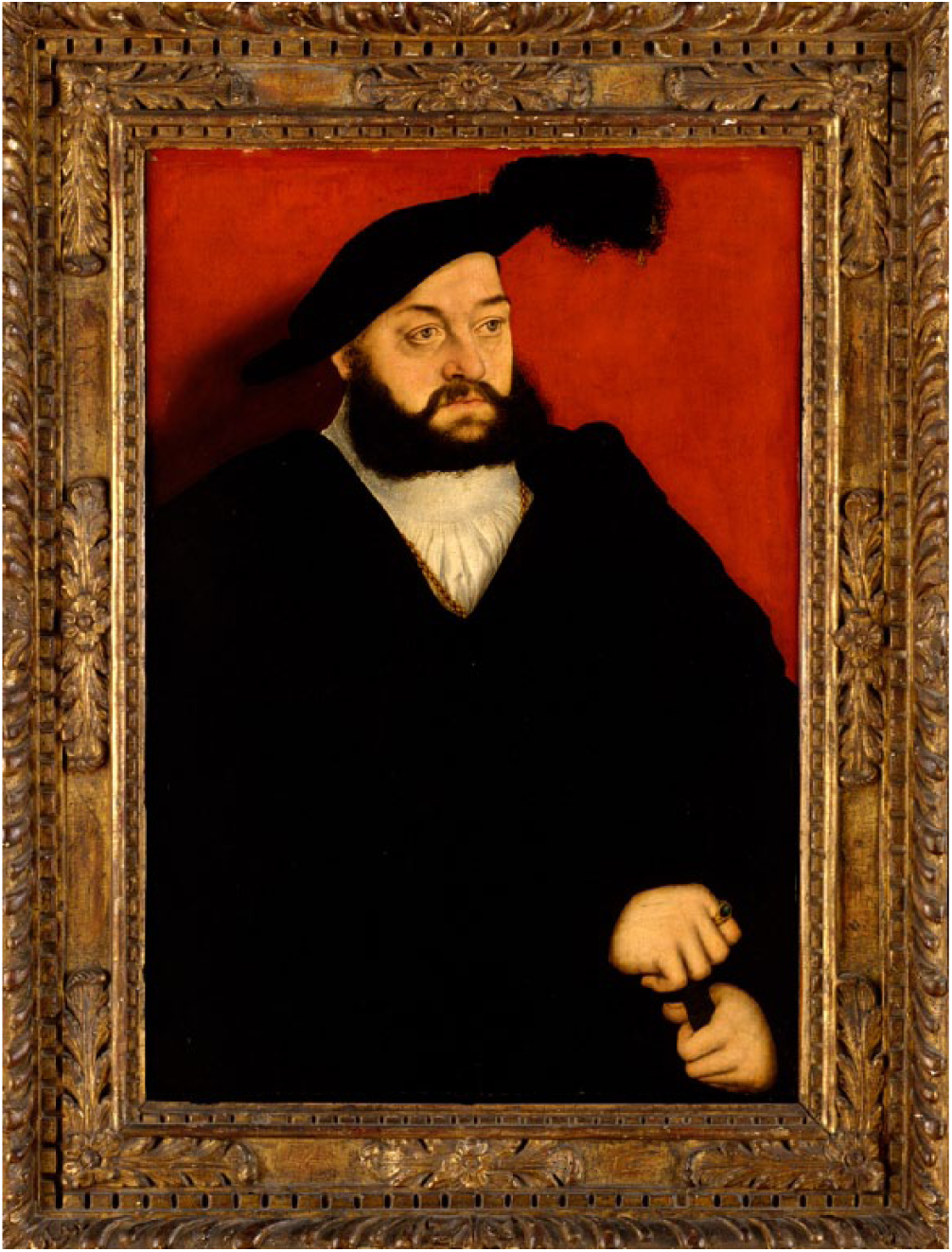
The tractate is also of interest today for scholars of secularism. Luther, it would seem unintentionally, put into play many core arguments for modern secular systems of governance. 17 These clues would later be seized upon by figures like Roger Williams, John Locke, Thomas Jefferson, and James Madison. 18 That modern secular political governance is so indebted to Luther is an irony that will become more salient momentarily.
The letter itself is couched as an instruction to a prince, John, Duke of Saxony, to whom these sermons were preached in 1522. 19 What makes the document so relevant and interesting is Luther’s juggling of two distinct truths. The first is that princes are ordained and empowered by God to do his bidding on earth. The second is that princes, by personal disposition, are not usually paragons of Christian virtue.
Let’s start with the latter truth. “Everyone knows,” sighs Luther, “that a prince is a rare bird in heaven.” 20 Luther describes these vice-ridden leaders who exult in the “princely delights, the dancing, the hunting, racing, gaming, and all the other worldly pleasures of that sort.” 21 Again and again, Luther laments that these “scoundrels” crave worldly things. 22 Reflecting on the princes he himself knows, Luther fulminates: “God almighty has driven our princes mad; they really think they can command their subjects whatever they like and do with them as they please.” 23 Does this mean that all princes are bad? Luther holds out the theoretical possibility that a prince can be a Christian brother—especially those princes who don’t idolize the pope. 24
Yet there is a deeper, older theological principle at work that renders Luther’s generalized suspicion of princes more or less irrelevant. As with Calvin after him, Luther preaches submission to the authorities and condemnation of any idea of tyrannicide. 25 Following the apostle Paul’s teaching in Romans, Luther believes that, a few exceptions not withstanding, princes are owed total obedience by Christians.
Let every person be subject to the governing authorities, for there is no authority except from God, and those authorities that exist have been instituted by God. Therefore, whoever resists authority resists what God has appointed, and those who resist will incur judgment. (Rom 13:1–2)
So in a way, the moral standing of a particular prince is beside the point. A Christian is a loyal subject of the prince or king. 26 Full stop. And it is here where Luther’s thought negotiates with itself intriguingly.
A prince, Luther reasons, can provide a valuable service for God and for those whom he calls “true Christians.” 27 As far as Luther is concerned, true Christians are a tiny minority. They are few and far between, “scarcely one human being in a thousand.” 28 They are cast into this world, surrounded by hordes of untrue Christians whom Luther likens to wild animals. 29 One thing a Christian prince can do—regardless of his personal probity—is to protect these good people.
Luther’s tractate, I just observed, is often contradictory. One wonders why true Christians even require a prince’s assistance. After all, Luther says explicitly that these followers of Christ are willing to suffer injustice. 30 They wouldn’t even resist evil done to them by a tyrant. 31 Yet elsewhere in the same text, Luther claims that the lawful protection offered by the secular authority (i.e., the Christian Prince) might permit these true Christians to make the world a better place. 32 The faithful are always willing to provide for a neighbor in need. 33 Christians use the office of the prince to “seek retribution, justice, protection and help for others.” 34 Ultimately, the prince, or any secular authority, is there to “protect, acquit, defend, and save the good.” True Christians call upon that office “for the sake of others, so that evil may be prevented and justice upheld.” 35
Let’s look at the logic of the argument. The Reformer seems to endorse the proposition that a flawed and dissolute prince can rule in ways that accrue to the good of true Christians. A double disarticulation takes place in Luther’s theory. First, the office is disarticulated from the office-holder; and true Christians respect the office regardless of its occupant. Second, the prince’s policy initiatives are disarticulated from his own creaturely inadequacies; morally compromised leaders can do morally useful things. 36
I will try to explain below why Luther can place so much faith in creatures as besotted as princes. At present let me just demonstrate how, in crude terms, this logic is mimicked by today’s white Evangelicals. They would appear to concur that an authority of dubious or low character can nevertheless provide benefits for Christians. James Robison, one of Trump’s spiritual counselors, makes precisely this observation when he remarks: “God uses imperfect people to accomplish his perfect will. He always has and always will.” 37
The theological point that all of us are imperfect (an idea with which Luther wholeheartedly concurred) is invoked frequently in defenses of Trump. 38 In an interview with National Public Radio, Kristan Hawkins, an anti-abortion activist and president of Students for Life America, reflected, “I mean, we are all sinners. And the way I look at it is President Trump’s a sinner. I’m a sinner. Every politician is a sinner. And when I’m voting for a politician, I’m not voting to endorse what they’ve done in their life or the sins that they’ve committed. . . I’m voting for my issue. I’m voting to advance that issue.” 39
Tony Perkins, president of the Family Research Council, observed in an interview with Politico that he could countenance Trump’s flaws. What was crucial for Perkins was that God’s will was accomplished insofar as the president appointed anti-abortion justices and carried water for issues of interest to conservatives. “Whenever the policy stops,” clarifies Perkins, “and his administration reverts just to personality . . . that’s where I believe the president will be in trouble.” 40 This is precisely the second disarticulation I noted above: ethical policies may spring from unethical people.
White Evangelicals recognize, like Luther, that morally suspect princes can perform valuable, policy-oriented services for Christians. “You have to choose the leader,” counsels Jerry Falwell Jr., “that would make the best king or president and not necessarily someone who would be a good pastor. We’re not voting for pastor-in-chief.” 41 Franklin Graham drives the point home when pondering Trump: “There’s a difference between defending the faith and living the faith.” 42 The same leader elsewhere opined: “He is the president. So I have to respect the office of the presidency.” 43
What makes this Evangelical disarticulation of interest is the converse proposition. Namely, that just as an unethical prince can help Christians, an ethically sound prince can endanger Christians. By all accounts, Trump’s predecessor Barack Obama was an upright individual. His comportment as a husband, father, non-adulterer, and non-practitioner of sexual assault would place him much closer to the professed Evangelical ideal. Yet many Evangelicals held Obama in contempt. There was a peculiar comic riff on CNN with Jerry Falwell Sr. and Jr. exclaiming “Osama, Obama, and yo mamma.” 44 There was Tony Perkins’s charge that Obama has “done everything he can to promote Islam” in America. 45 There was Franklin Graham saying that his policies were “against Christ and against his teachings.” 46 In other words, they disarticulated the office from the office-holder, and the upright man (who just happened to be black) from his what they considered to be immoral policies.
Popery and Secularism
What permits Luther, a notorious scold, to extend such magnanimity to morally inadequate Christian princes? Why he is willing to look past the ethical inadequacies of these reckless, power-hungry, self-absorbed scoundrels?
Rudolf Siemering (1835–1905). Monument to Martin Luther in market square, Eisleben, Germany. Detail depicting “The Leipzig Debate” of 1519. Luther confronts the Roman Catholic Church about the power of the pope, free will, and indulgences. Alfredo Dagli Orti/Art Resource, NY.
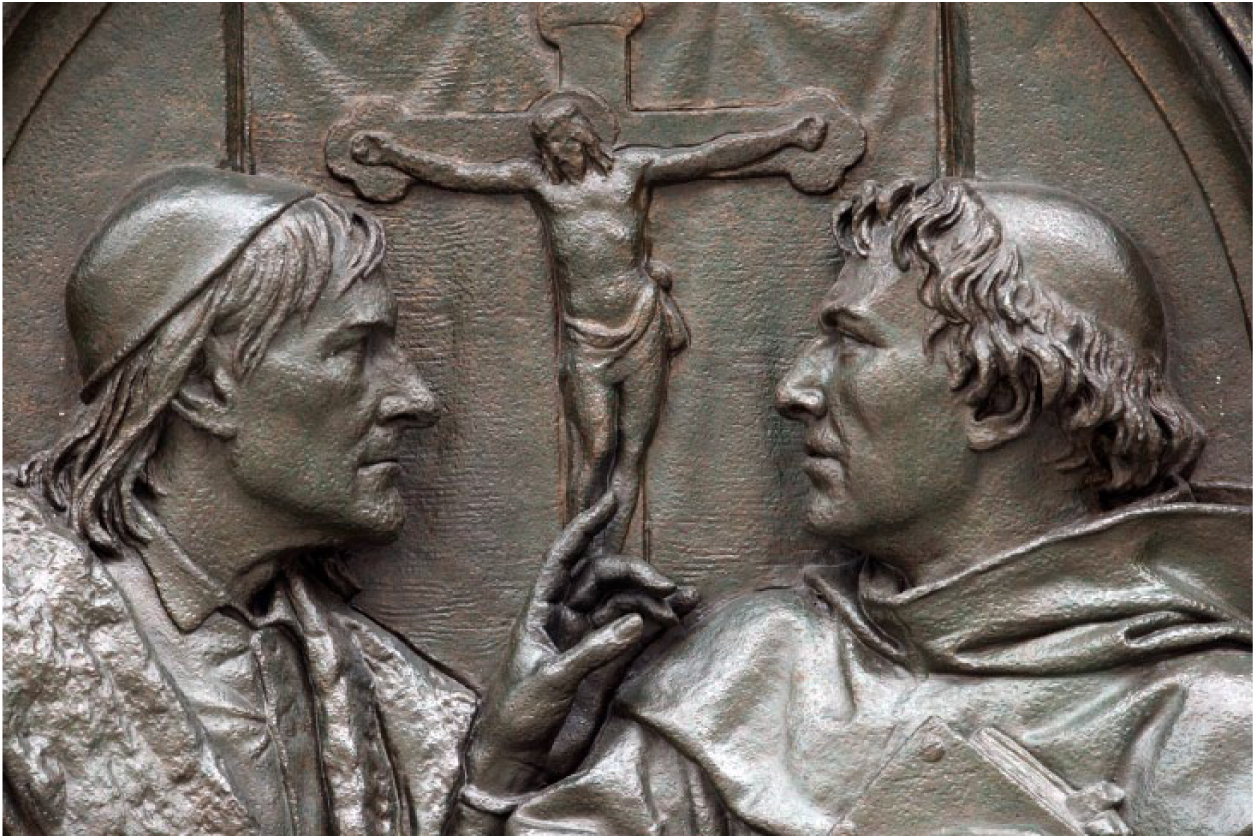
The first explanation was adduced above. Namely, it is a staple of his political philosophy that the faithful owe near-total obedience to their rulers. Hans Hillerbrand has observed that Luther “arguably offered the most rigid exegesis of Romans 13 in Christian History.” 47 His theology appears to consign Christians to almost complete submission to a ruler. 48 If a “government tried to obstruct their faith or access to the gospel,” then, yes, Luther permits measured defiance. 49 In all other cases, however, a Christian acquiesces. After all, according to Paul, even a tyrannical prince is set on his throne by the will of God (Rom 13:1–2). 50
But there is a second explanation that accounts for why Luther was willing to countenance bad princely behavior. In Luther’s moral universe there is one immense, unparalleled evil, and that is the evil of the papacy. One need not be an expert in Luther’s writings to sense that his dislike of the Roman Church was unbounded, bordering on fanatical. In his careful study of Luther’s relation to Rome, Scott Hendrix sees the years 1522–1546 as marking the pinnacle of the reformer’s hatred. As Hendrix describes Luther’s position: “The papacy is illegitimate because it works under the aegis of the devil to seduce souls and to bring them under the devil’s sway. . . . As the agent of satanic power, the papacy qualifies better than the Turk for the label of Antichrist.” 51 “Luther,” Hendrix continues, “described the Roman Church as every kind of whore which he could name (and the list is impressive).” 52 In Luther’s estimation the church has usurped Christ’s role. 53
Perhaps we can now better understand Luther’s call for obedience to the prince or secular authority. We just saw that he taps into a traditional, Scripture-based deference to governmental power. But this injunction synergizes with a tactical concern. The types of princes that Luther is extolling are plausible allies against a demonic foe, namely the pope and his bishops. Volker Leppin has argued that it was “Luther’s deep conviction about the devil’s activity that prompts him to demand strong government.” 54 As James Estes points out Luther eventually—and not with great theological consistency (see below)—counted on secular authorities to “intervene in ecclesiastical affairs in the interest of orderly and effective reformation.” 55
I propose that today’s Evangelicals also view themselves as confronted by an unspeakable and demonic foe. That foe, however, is not Catholicism and the Roman Church, but modern “secularism.” Let us never forget that the secularism of today deviates immensely from the “secular authority” of Luther’s age. In the medieval and early modern periods, the secular authority (sometimes referred to as “temporal authority” or the “civil authority”) was a fundamental component of an integrated Christian polity. These “secular” governments, as they were called, were staffed by Christians who wished to serve Christians, in a polity where nearly every member was a Christian. 56
What distinguished the secular arm and its prince from its ecclesiastical counterpart was not a commitment to Christian precepts. Rather, the two branches performed completely different functions towards the shared greater goal of glorifying God. As one of Luther’s translators, Theodore Tappert, put it “the state, as well as the church, is of divine origin.” 57 For Luther, the secular authority committed itself to maintaining order. In his 1520 treatise, “To the Christian Nobility of the German Nation,” he writes: “[S]ince the temporal [secular] power is ordained of God to punish the wicked and protect the good, it should be left free to perform its office in the whole body of Christendom without restriction and without respect to persons, whether it affects pope, bishops, priests, monks, nuns, or anyone else….” 58
The secular authority concentrated on “earthly matters,” which Luther referred to as “taxes, duties, honour, fear, outward things.” 59 The care of souls, by contrast, was entrusted to the ecclesiastical authorities. The two spheres were meant to be complementary—they served “the will of God in cooperation with the other.” 60 Luther’s dissent, then, was the heir of a medieval tradition that lambasted popes and bishops for meddling in secular affairs. The demand of critics such as William of Ockham and Marsilius of Padua and countless others was for the pontiff to “stay in his lane”; he must attend to the spiritual and not the secular dimension. 61 Papal overreach upset the divine balance between the ecclesiastical and the secular (naturally, as we saw above, Luther had no compunction about letting the secular authorities drift out of their lane in the name of checking the Roman Church).
Nowadays, “secular” is understood to be something completely different by both Evangelicals and the population at large. Today, secularism is construed as either meaning atheism or separation of church and state. 62 There are, as I have noted elsewhere, many other ways of understanding this most complex “-ism.” 63 What is fascinating about conservative Christians is the way they have amalgamated these two definitions. Secularism, for the Christian right, is seen as a form of separation promulgated by nonbelievers in the sinister hope of rendering the country godless. The canniness of this rhetoric is that it denies the existence of religious people who may prefer separation of church and state for pragmatic reasons (religious minorities, for example), or even theological reasons (e.g., Baptists in the early history of the United States).
Far from being God-ordained, as it was in the age of Luther, today’s conservatives view secular authority as affiliated with all that is demonic. The Evangelical caricature of secularism gives rise to florid oratory, in which the secular is correlated with every menace known to creation. Or as Franklin Graham put it: “[F]orces of godless secularism [in the United States] want to remove the name of God and his son Jesus Christ.”
64
For Tony Perkins secularism is a huge menace, albeit one that is about to be replaced by ISIS: Radical secularism that has driven the defining characteristics of our Western culture, our Judeo-Christian heritage, from our schools, our entertainment and even our government has left in its place a void, a vacuum. And we should know from experience that a vacuum will be filled by something. Without a creedal vision that a society can unify around, the people, the nation, will perish. Unless we are content to allow ISIS or some other radical belief system to fill the void left by secularism, we must rediscover America’s founding, Christ-centered vision.
65
If my surmise is correct, then the specter of secularism also helps explain why Evangelicals support Trump. Why can conservative Christians accept a man like Donald Trump? Because he knows precisely how to slay the secular beast, his personal shortcomings be damned. Of Trump, Graham reflected to the BBC: “He [Trump] does care about religious liberty… which as a Christian I appreciate. And he’s been defending Christians against the secularists in our country.” 66
Trump, for his part, understands the power of this recognition. “As long as I’m President,” he thundered, “no one is going to stop you from practicing your faith or from preaching what is in your heart.” 67 During his campaign, Trump was eager to sharpen contrasts with Obama: “I’m proud to be a Christian, and as president, I will not allow Christianity to be consistently attacked and weakened, unlike what is happening now with our current president, OK? Believe me.” 68
In Luther’s mind frame, a flawed Christian prince can be tolerated if he is not a papist. In the modern Evangelical mind frame, a flawed president can be tolerated because he is not a secularist.
Conclusion
To my mind, the mystery is not why white Evangelicals tolerate Donald Trump. As we have just seen, many Evangelicals are inclined to extend toleration to their rulers. They do so because they interpret their Scriptures as discouraging sedition or civil disobedience. Their toleration extends even to leaders who act in ways that contravene their moral principles. This is not a precept invented by or even unique to Luther. He is just one of many Christian commentators who abide by it, albeit in a rather extreme manner.
No, the mystery is not why conservative Christians tolerate Trump, but why they enthusiastically support him, as he blatantly contravenes all of their self-professed values. As part of a thought experiment, I interrogated Luther’s 1523 essay to identify a clue that might explain this enthusiasm. Luther suggests that even an immoral prince can provide tangible benefits for servants of Christ and the world at large. The prince can serve the essential function of countering an epic existential threat, like the papacy was for the reformers. My hunch is that Trump is popular among Evangelicals because he vows to stave off the threat of modern secularism, as defined by modern conservatives. Give white Evangelicals a national figure of legitimate authority who fights their cultural and political battles, goes my hypothesis, and they’ll support him (or her?), regardless of quality of character.
My analysis—which, I stress, even I don’t fully believe—raises innumerable questions. To what extent is the Christian part of being a “Christian prince” important? What about whiteness? If a Jewish President Joseph Lieberman, or a Muslim President Keith Ellison proposed the exact same policies as Donald Trump and patronized the exact same porn stars, would white, conservative Christians still support him with such relish? Or, is the fact that that the president is white and Protestant a major factor?
Does the possibility that Trump eventually might “come to Christ” figure in the Evangelical thought process? In this reading, there is a “cherry on top” for conservative Christians. They hope that Trump will love what he hated and hate what he loved. In other words, in addition to getting their policy preferences, they hope that the president will embrace the(ir) faith somewhere along the way. 69 Is this what Franklin Graham means when he says Trump is “a work in progress”? 70
Conversely, I wonder if white Evangelicals are being “merely” pragmatic in supporting Trump. Are they toggling between public embrace and private disdain for a scoundrel? Do they privately hold their noses in regard to his personal comportment? Or, do they genuinely believe in the man? It is awfully hard to figure this out, but their public pronouncements indicate a sincere fondness for the president. Nothing in Luther’s writings or in the New Testament demands sincere fondness for the prince. Christians are simply enjoined to be obedient, not obsequious. Then again, the reformer had such respect for the office and such hopes for its ability to undermine popery; it just might be that prince-fetishism is an unintended dividend of his teachings.
In a way, my theory tries to restore to white Evangelicals the dignity of their religious scruples and intellectual heritage. It tries to find a theological explanation for electoral behavior that baffles outsiders. If I could criticize my own analysis, I would charge that it misrecognizes crass political impulses for religious ones. My explanation finds a theological motivation for white Evangelical voting behavior. But what if they are motivated by a simple and base desire to exert power over others? What if their embrace of Trump has everything to do with racist, nativist, and homophobic attitudes and nothing to do with Luther’s dense and obscure tractate?
Or, what if it is a little bit of both, a mix of politics and theology? The operative assumption in our political discourse is that the two concepts are partitioned. But maybe the separation does not exist in the white Evangelical mind frame. The relations between their theology and their politics are porous. Like Luther’s ideal Christian society described above, they deploy the theological and the political toward the goal of achieving their version of God-ordained polity. In other words, they aspire to a certain vision of the good, and they use both politics and theology to get there. Their politics serve their theology, and their theology serves their politics. Neither stays in its lane. It might be hypocritical and shameless to many of us. Yet in their view, the ends justify the means. Hypocrisy and shamelessness in the pursuit of God’s will—which they believe they alone understand—are not vices.
Whether correct or not, this analysis demonstrates how exploration of long-forgotten texts can reveal ways they might still influence our thinking and can raise interesting questions about the world we live in today. Those of us who peruse and analyze these texts need to remember the value of this exercise. So do those who question the usefulness of what we, as scholars, do.
Footnotes
1.
David Brody and Scott Lamb, The Faith of Donald J. Trump: A Spiritual Biography (New York: Broadside, 2018), xvii.
2.
3.
See Randall Balmer, “Forum: Studying Religion in the Age of Trump,” Religion and American Culture: A Journal of Interpretation 27 (2017): 3–7 (3).
4.
John Green, Mark Rozell, and Clyde Wilcox, eds., The Values Campaign: The Christian Right and the 2004 Elections (Washington DC: Georgetown University Press, 2006). Jacques Berlinerblau, Thumpin’ It: The Use and Abuse of the Bible in Today’s Presidential Politics (Louisville: Westminster John Knox, 2007).
5.
Ryan Burge and Andrew Lewis, “Measuring Evangelicals: Practical Considerations for Social Scientists,” Research Note (June 22, 2017), 2 ( ). Also see Mark Rozell, “Donald J. Trump and the Enduring Religion Factor in US Elections,” in Religion and the American Presidency: The Evolving American Presidency, ed. M.J. Rozell and G. Whitney (New York: Palgrave Macmillan, 2018), 285–98.
6.
Frances FitzGerald, The Evangelicals: The Struggle to Shape America (New York: Simon & Schuster, 2017), 623.
7.
See John Green, “Seeking a Place: Evangelical Protestants and Public Engagement in the Twentieth Century,” in Toward an Evangelical Public Policy: Political Strategies for the Health of the Nation, ed. Ronald Sider and Diane Knippers (Grand Rapids: Baker, 2005), 15–34. Also see Andrew Flint and Joy Porter, “Jimmy Carter: The Re-emergence of Faith-based Politics and the Abortion Rights Issue,” Presidential Studies Quarterly 35 (2005): 28–51 (48); George Hunter III, Christian, Evangelical and Democrat (Nashville: Abingdon, 2006); Michael Hout and Andrew Greeley, “Interests, Values, and Party Identification Between 1972 and 2006,” in Evangelicals and Democracy in America, Volume II: Religion and Politics, ed. Steven Brint and Jean Schroedel (New York: Russell Sage, 2009), 57–82. On Southern Evangelicals and their fealty to the Democratic Party prior to the 1960s see Lydia Bean, The Politics of Evangelical identity: Local Churches and Partisan Divides in the United States and Canada (Princeton: Princeton University Press, 2014), 29.
8.
As Corwin Smidt (“The Role of Religion in the 2016 American Presidential Election,” Zeitschrift für Religion, Gesellschaft und Politik 1 [2017] 133–62 [159]) has observed: “The election of Trump does not reflect any major shift in the political alignment of those associated with the major religious traditions in American life—nor in the religious coalition of votes won by each party’s nominee.”
9.
Roe v. Wade refers to the controversial 1973 U.S. Supreme Court decision that affirmed a woman’s right to have an abortion under the Fourteenth Amendment to the U.S. Constitution.
10.
Penny Edgell, “An Agenda for Research on American Religion in Light of the 2016 Election,” Sociology of Religion 8 (2017): 1–8 (5).
11.
Balmer, “Forum” 3.
12.
Ibid.
13.
Anthea Butler “Forum: Studying Religion in the Age of Trump,” Religion and American Culture 27 (2017): 12–16 (13).
14.
The translation used here is Harro Höpfl, Luther and Calvin on Secular Authority (Cambridge: Cambridge University Press, 2008), 3–43.
15.
Höpfl, Luther and Calvin, xi. On the “inner tension” in all of Luther’s thinking about the secular authority see James Estes, “Luther on the Role of Secular Authority in the Reformation,” Lutheran Quarterly 17 (2003), 199–225 (199).
16.
William Wright, Martin Luther’s Understanding of God’s Two Kingdoms: A Response to the Challenge of Skepticism (Grand Rapids: Baker Academic, 2010), 17. Also see Volker Mantey, Zwei Schwerter—Zwei Reiche: Martin Luthers Zwei-Reiche-Lehre vor ihrem spätmittelalterlichen Hintergrund (Tübingen: Mohr Siebeck, 2005).
17.
Jacques Berlinerblau, How to Be Secular: A Call to Arms for Religious Freedom (Boston: Houghton Mifflin Harcourt, 2012), 5–8.
18.
Jacques Berlinerblau, “Political Secularism,” in The Oxford Handbook of Secularism, ed. Phil Zuckerman and John Shook (Oxford: Oxford University Press, 2017), 85–102.
19.
Höpfl, Luther and Calvin, p. 3: Volker Leppin, “The Scope and Limits of Secular Authority: On the Origins and Context of Luther’s Doctrine of the Two Kingdoms,” Lutheran Theological Journal 4 (2014): 89–98 (91). The letter is likely geared at the Christian nobility in general: see Hans Hillerbrand, “‘Christ Has Nothing to Do with Politics’: Martin Luther and the Societal Order,” Seminary Ridge Review 13 (2011): 9–24 (12).
20.
Höpfl, Luther and Calvin, 36.
21.
Ibid, 36.
22.
Ibid, 5.
23.
Ibid.
24.
Ibid, 6.
25.
J.-F. Collange, “Droit a la résistance et réformation,” Revue d’Historie et de Philosophie Religieuses 65 (1985): 245–55 (246).
26.
See S.W. Haas, “Martin Luther’s ‘Divine Right’ Kingship and the Royal Supremacy: Two Tracts from the 1531 Parliament and Convocation of Clergy,” Journal of Ecclesiastical History 31 (1980): 317–25 (318).
27.
Ibid, 10, 11.
28.
Ibid, 11 (also10, 20).
29.
Ibid, 10, 11.
30.
Ibid, 10, 11, 14, 15, 20.
31.
Manfred Hoffman, “Martin Luther: Resistance to Secular Authority,” The Journal of the Interdenominational Theological Center 12 (1985): 35–49 (40).
32.
Höpfl, Luther and Calvin, 21 (also 14).
33.
Ibid., 13, 15.
34.
Ibid., 20.
35.
Ibid., 21.
36.
On the “absurdity” of some of these distinctions see Estes, “Luther on the Role of Secular Authority in the Reformation,” 215.
37.
Quoted in Brody and Lamb, The Faith of Donald J. Trump, xix.
38.
Höpfl, Luther and Calvin, 10.
39.
40.
42.
43.
45.
Michael Chapman, “Tony Perkins: Obama has ‘Done Everything He Can to Promote Islam in this Country” CNSNews.com (April 20, 2016), .
46.
47.
Hillerbrand, “‘Christ Has Nothing to Do with Politics,’” 15–16.
48.
Hoffman, “Martin Luther: Resistance to Secular Authority,” 48.
49.
Scott Hendrix, “Luther,” in The Cambridge Companion to Reformation Theology, ed. David Bagchi and David Steinmetz (Cambridge: Cambridge University Press, 2004), 39–56 (49). Also see Höpfl, Luther and Calvin, 40.
50.
As Hillerbrand notes, Luther: “extoll[ed] a biblical vision of a just society, while placing the realization of this vision solely in the hands of the properly established political authorities.” (“‘Christ Has Nothing to Do With Politics,” 17; also see 18).
51.
Scott Hendrix, Luther and the Papacy: Stages in a Reformation Conflict (Philadelphia: Fortress, 1981), 152.
52.
Ibid., 153.
53.
Bernhard Lohse, Martin Luther’s Theology: Its Historical and Systematic Development, trans. Roy Harrisville (Minneapolis: Fortress, 1999), 282.
54.
Volker Leppin, “The Scope and Limits of Secular Authority,” 95, 98. Also see Lawrence Buck, The Roman Monster: An Icon of the Papal Antichrist in Reformation Politics (Kirksville, MO: Truman State University Press, 2014), 111–14.
55.
James Estes, “Secular Magistrate, Office Of,” The Oxford Encyclopedia of the Reformation, ed. Hans Hillerbrand, 4 vols. (New York: Oxford University Press, 1996) 4:40–42
56.
Berlinerblau, “Political Secularism.”
57.
Theodore Tappert, Selected Writings of Martin Luther, 1520–1523 (Philadelphia: Fortress, 1967), 270. Also see Michael Laffin, The Promise of Martin Luther’s Political Theology: Freeing Luther from the Modern Political Narrative (London: Bloomsbury, 2016), 15.
58.
Martin Luther, “To the Christian Nobility of the German Nation Concerning the Reform of the Christian Estate,” in Tappert, Selected Writings of Martin Luther, 266.
59.
Höpfl, Luther and Calvin, 23, 28.
60.
Estes, “Luther on the Role of Secular Authority,” 218.
61.
Berlinerblau, “Political Secularism.” Also see Jarrett Carty, God and Government: Martin Luther’s Political Thought (Montreal: McGill Queen’s University Press, 2017), 18–21; Arthur Stephen McGrade The Political Thought of William of Ockham: Personal and Institutional Principles (Cambridge: Cambridge University Press, 1974); Thomas Molnar, “The Medieval Beginnings of Political Secularization,” in Essays on Christianity and Political Philosophy, ed. G. Carey and J. Schall (Lanham, MD: University Press of America, 1984), 41–54; Joseph Canning, “Power and Powerlessness in the Political Thought of Marsilius of Padua,” in The World of Marsilius of Padua, ed. Gerson Moreno-Riaño (Turnhout: Brepols, 2006), 211–25.
62.
63.
Jacques Berlinerblau, “Secularism and its Confusions,” in Secularism on the Edge: Rethinking Church-State Relations in the United States, France, and Israel, ed. Jacques Berlinerblau, Sarah Fainberg, and Aurora Nou (New York: Palgrave MacMillan, 2014), 1–16.
64.
65.
66.
68.
69.
Luther hold out such hopes for his prince as well. Höpfl, Luther and Calvin, 41.