




Abstract
In of the face of mass extinctions, this essay proposes that animals’ praise of God is more than a metaphor but an actual event happening in real time without human mediation. To make the case, it explores the God-animal relationship attested in the Bible and contemporary theology, where animals’ praise nests within the praise of all creation. The resulting insight gives support to an ecological ethic that aims to keep the song alive.
The wild animals will honor me, the jackals and the ostriches (Isa 43:20) Praise the Lord from the earth, you sea monsters and all deeps . . . wild animals and all cattle, creeping things and flying birds (Ps 148:7, 10)
Introduction
In the course of a major letter on ecological responsibility addressed to “every person on this planet,” Pope Francis made a startling claim about animal extinction: Each year sees the disappearance of thousands of plant and animal species which we will never know, which our children will never see, because they have been lost forever. The great majority become extinct for reasons related to human activity. Because of us, thousands of species will no longer give glory to God by their very existence, nor convey their message to us. We have no such right (LS 33).
1
Underlying the moral mandate to cease human destructive behavior is a strong religious assessment of animals, namely, that in their lives they glorify God and reveal truth to human beings. Such an idea begs for theological exploration. Not only has it seldom if ever been a central theme in Christian discourse, but the very opposite has been the dominant teaching. Some biblical texts, however, do convey this positive view of animals. Attending to these texts has the potential to refresh our religious imagination and lead it in an ecological direction.
Biblical texts that describe animals actually “praising” God are relatively few in number. Yet passages that use wide-ranging synonyms for praise, such as bless, give thanks, give glory, sing, shout for joy, roar, tell, acclaim, declare, give honor, magnify, glorify, exult, clap, or make a joyful noise, expand the range of such activity. At times individual animals are named; the wild jackals and ostriches in Isaiah give honor that parallels the peoples’ praise for God who is bringing the exiles home (Isa 43:20). At other times animals are bundled together in the praise arising from part of creation: “Let heaven and earth praise him, the seas and everything that moves in them” (Ps 69:34). Yet again animals are categorized by type and, as happens in the celebrative Psalm 148, placed in the midst of the music arising from sun, moon, and stars, mountains and hills, snow and stormy winds, fruit trees and cedars, and human beings young and old, all singing praise of God who creates and saves (Ps. 148:7, 10). The climactic text that closes the book of Psalms makes animal praise well-nigh universal: “Let everything that breathes praise the Lord!” (Ps 150:6).
Giovanni Castiglione (1609–1664), Creation of the Animals. Oil on canvas. Photo: Roman Beniaminson. Private collection. Photo credit: bpk Bildagentur/Art Resource, NY.

The biblical depiction of animals praising God poses a challenging subject for interpretation. How can we do justice to the animals’ praise without anthropomorphically attributing to them the kind of rational human consciousness that offers intentional, linguistic praise? How can we avoid the pitfall of dismissing the construal as mere metaphor, delightful poetry without substance? This essay proposes that we interpret animal praise by nesting it theologically within all creation’s praise of God. This wider framework brings into play the relation between God and the world and avoids both anthropomorphic and metaphorical reductions. As one aspect of that encompassing relationship, divine relation to the living fauna of our planet underpins the response of animal praise, imbuing it with a genuine integrity all its own. What I hope to show is that animals do praise God in their own animal way, and have been doing so for millions of years before humans ever arrived on the scene. In the bigger picture, praise is not the only animal response to the life-giving God. They suffer and die, and their cries of pain continuously lament unto God. Given the limits of one article, we follow here only the thread of praise, knowing there is more to be done.
The reader may detect the strong ethical commitment that results. In an age of ecological crisis marked by the extinction of thousands of species and by the struggle of millions of still-existing animals to find food, water, shelter, and migratory routes in the face of human encroachment, the reality of animals’ praise of God can become one more thread in the dynamism of a religious faith that invites, persuades, even obliges human beings to act responsibly for the flourishing of these fellow creatures.
Creation’s Praise of God: Multiple Meanings
The whole of creation praises God. Found most often in the psalms, this biblical theme runs through prophetic, apocalyptic, and wisdom writings alike. “Make a joyful noise to God, all the earth; sing the glory of his name; give to him glorious praise” (Ps 66:1–2); “Sing for joy, O heavens, and exult, O earth; break forth, O mountains, into singing,” (Isa 49:13). Embedded within this cosmic chorus is the praise of animals. “Bless the Lord, you whales and all that swim in the waters … Bless the Lord, all birds of the air … Bless the Lord, all wild animals and cattle; sing praise to him and highly exalt him forever” (Dan 3:57–59).
The quest to understand the meaning of this phenomenon has given rise to a wide range of interpretations. Reviewing salient ones at the outset will both highlight important positions in the field and at the same time put into relief the distinctiveness of holding the view, arising from a theology of creation, that animal praise is a genuine act occurring in real time.
It is no exaggeration to say that for long stretches in the West, creation’s praise of God received little or no interpretation at all. With few exceptions, such as the Celtic and Franciscan traditions, those who dealt with the Bible focused mainly on God’s gracious deeds that deliver, forgive, help, and redeem human beings. The natural world and its creatures, while certainly present in the text, functioned as a stage or scenic backdrop for the main events concerning humanity. In such an anthropocentric salvation-history approach, creatures who are other than human do not function as a vital part of the story. They drop even further from view in the long tradition of spirituality, which held that the earth with its bodily pleasures and sufferings was something to be left behind in the ascent to union with the all-holy God. 2
If and when attention was paid to creation’s praise, a typical strategy was to place human beings at the center of the picture and funnel other creatures’ relation to God through them. Augustine’s commentary on Psalm 148 is a classic example of this anthropocentric approach. Presented as “A Sermon to the People,” it argues that animals and plants praise God by inspiring human beings to praise God. Warming to the subject, he extols a flea: Let me have your attention, please, beloved. Who was it who so arranged the bodily parts of a flea or a gnat, that they would enjoy coordination, life, and movement? Study any tiny creature, any one you choose. I want you simply to consider the disposition of its organs and the life that animates it: look how it avoids death, loves life, seeks pleasures, avoids painful conditions, deploys its various senses, and flourishes in the mode proper to itself. Who gave the flea a stinger with which to suck blood? How tiny is the pipe through which it drinks! Who arranged matters so? Who made these things?
3
After more such marvelous description, Augustine concludes, “But anyone who has eyes will study many of this world’s creatures, and in studying them, will find delight in them. When these things delight us we praise them, but not for themselves. We praise God who made them, and thus all creatures praise God.” 4 The well-made flea, then, becomes an occasion for human prayer, but the flea does not praise in its own right. This assigns to the insect only what is today called instrumental rather than intrinsic value. Humans become the sole conduit for animals’ praise of God. This position is not only intellectually inadequate in light of a robust theology of creation, but it carries a relatively weak ethical charge to prevent species extinction.
In a groundbreaking survey essay, Terence Fretheim set forth a series of other key interpretations arrived at by contemporary biblical scholarship. 5 Seeking to understand the historical world of the biblical writers, one view holds that psalmists and prophets had a polemical intent when they called upon the sun, moon, and stars as well as the animals to praise God. In other ancient Near Eastern religions some of these beings were held to be gods. But here in Israel’s prayer, instead of being worshiped, they themselves are creatures who praise the one God who created them all. While undoubtedly insightful, this interpretation cannot be pressed too far, however, because a wealth of hymns in Egyptian and Babylonian-Assyrian literature depict animals called upon to praise the gods, and these undoubtedly influenced some of the biblical psalms.
Another line of interpretation sees creation’s praise as an eschatological event. This position recognizes that the whole created order has been skewed by human sinfulness that leaves all creation groaning (Rom 8:19–23). On the last day when violence will cease, justice will be established, and God will reign over a new heaven and a new earth (Rev 21:1), all creatures of the world will join in giving praise. The book of Revelation carries this profoundly hopeful vision of the worship of God at the end of days: “Then I heard every creature in heaven and on earth and under the earth and in the sea, and all that is in them, singing, ‘To the one seated on the throne and to the Lamb, be blessing and honor and glory and might, forever and ever!’” (Rev 5:13). Relegating creation’s praise to the future in this way at least gives it a place in the religious imagination. However, it says nothing about what such activity might mean in the present.
Yet another explanation posits creation’s praise as an expression of a world pervaded with panpsychic vitality. Far from being simply inanimate, natural elements like the stars and rocks have a diffused energetic affinity with human beings. So much the more can animals, alive with their own consciousness, respond psychically to the rule of their Creator. Terence Fretheim notes how difficult it is to assess this explanation “because the sources and argumentation for this perspective are not carefully documented in OT studies.” 6 Proponents claim that ancient Israel saw the universe as thoroughly alive with consciousness, with natural objects having a will and personality of their own, but evidence from the texts and deeper exploration are not forthcoming. While there is benefit in suggesting that there is a certain inwardness or interiority in creatures, the lack of biblical evidence coupled with scientific ambiguity regarding precisely how this can be understood prevents this account from swaying the field.
A more commonly held view takes a literary approach that interprets animals’ praise of God as a metaphor. This versatile figure of speech, used from high literature to popular slang, juxtaposes two different objects, images, or thoughts which then interact with each other: you are my sunshine; war is hell; all the world’s a stage; the Lord is my shepherd. In a tensive exchange the elements play off each other. At times the more well-known subject illuminates the lesser known, opening up a dimension that might otherwise remain hidden. At other times the meaning of both terms drawn from separate domains illuminate each other. Far from being a simple rhetorical flourish, metaphor has a cognitive function insofar as it changes perceptual awareness. It enables us to perceive a subject differently, to see it in a new light; and thus to experience it differently. 7 When animals’ praise is taken to be metaphor, a supposed quintessentially human act sheds light on animals’ more unknown relationship to God. While this can be productive of insight, the difficulty, as I see it, is that by its very nature metaphor cannot be taken as stating a claim in a literal sense. Its very power as figurative language requires a break in the juxtaposed pair. You and the sunshine are two different things; the Lord and a shepherd are in reality not identical. Using metaphor as a tool of interpretation results in thinking that animals do not actually praise God.
This essay’s proposal interprets animal praise as a dimension of creation’s praise of God happening in real time, independent of human mediation. This leads thought in another direction. Among human beings the act of divine praise enacts a relational orientation to God; individuals and communities answer back to the Source of all blessing. To build the interpretation that the same basic dynamic exists among animals, we turn first to the way this view is buttressed in the Bible and then to the way it is further supported by a contemporary theology of creation.
The Bible’s Zoological Gaze
The biblical depiction of animal’s praise of God places it in the context of God’s creating and saving relationship to the world. Not all biblical writers, of course, consider animals in their work. But pursuing this theme leads to the realization that on balance the Bible is pervaded with what Ken Stone felicitously calls a consistent “zoological gaze.” 8 This gaze sees a mutual relation existing between God and animals, a direct relation that does not pass through human consciousness or activity. Consider the following texts.
From the divine side, so to speak, God creates animals, blesses them and calls them good; makes a covenant with them; feeds and waters them; finds them suitable homes; delights in their ways; watches over them; cares about their deaths; saves them; and fills them with good things, foremost being the breath of life. The intimacy of this relationship comes to expression in a text that expresses broad knowledge and deep affection: For every wild animal of the forest is mine, the cattle on a thousand hills. I know all the birds of the air, and all that moves in the field is mine. (Ps 50:10–11)
Animals respond to this loving-kindness in their own unique ways by the working of their neurologically sensitive lives. They carry out the vocation to increase and multiply, thus participating in the ongoing work of creation; cry to God for food, groan to God when it is lacking; make intelligent use of their habitats; look to God for help; teach and reveal divine truth; and praise divine goodness that is so concerned with their lives. Their orientation to God is captured in a telling image: The eyes of all look to you, and you give them their food in due season. You open your hand, satisfying the desire of every living thing. (Ps 145:15–16)
Let us parse this relationship more closely. The foundational act is creation. Reading the two creation stories in Genesis with the issue of the Creator’s relationship to animals in mind reveals an intensity that may surprise. Swarms of creatures of every kind that move in the sea! (Gen 1:20–23). Multitudes of winged birds of every kind that fly though the air! (Gen 1:20–23). Living animals of every kind that dwell on land! (Gen 1:24–25). The exuberant repetition of the phrase “of every kind” in the first chapter of Genesis points to what we would call today the vast biodiversity that the Creator calls forth. Speaking directly to fishes and the birds, God blesses them, giving them the vocational charge to be fruitful and multiply: let’s have more of your kind! Over all the animals the unassailable judgment rings forth: “And God saw that it was good” (Gen 1:21, 25).
In the Genesis 2 account the picture is of an artistic sculptor carefully fashioning shapes from the dust of the ground. Made of the same muddy clay, both humans and animals become living creatures thanks to the divine gift of “the breath of life” (Gen 2:7 and 7:15, 22). At the outset then, the hordes of creatures dwelling in sea, sky, and earth, the multitude of fish, crabs, winged birds, snakes, and wild and domestic mammals, along with plants and humans, all have their common origin in the overflowing generosity of the Creator who gives them life and pronounces them good.
To this relationship the Genesis flood stories add the fierce closeness of a covenant. Before the flood, lest there be any thought of leaving some animals behind, Noah is instructed thus: “And of every living thing of all flesh you shall bring two of every kind into the ark, to keep them alive with you; they shall be male and female” (6:19). When the deluge recedes, God commits to a future free from universal destruction saying to Noah, “I am establishing my covenant with you and your descendants after you, and with every living creature that is with you, the birds, the domestic animals, and every animal of the earth with you” (9:9). The sign of this committed relationship will be the rainbow. “When the bow is in the clouds, I will see it and remember the everlasting covenant between God and every living creature of all flesh that is on the earth” (9:16). The designation “flesh” connects humans with animals in a materiality that is at once beautiful and vulnerable, filled with energy and subject to decay in time. Along with human beings every animal of the earth, whether furred, feathered, or finned, is in a covenant relationship with the living God. Such a bond means that animals are included in promises of future salvation when “I will pour out my spirit on all flesh” (Joel 2:28). And it gives rise to a stunning divine title: “I am the Lord, the God of all flesh” (Jer 32:27). The creating, covenanting Holy One of Israel self-defines as the God of the animals.
Getting and consuming food and water is essential to staying alive. The One who creates and covenants is active on this front: “He gives to the animals their food, and to the young ravens when they cry” (Ps 147:9); “Look at the birds of the air; they neither sow nor reap nor gather into barns, and yet your heavenly Father feeds them” (Matt 6:26). Conversely, animals know whom to ask: “The young lions roar for their prey, seeking their food from God” (Ps 104:21). Abundance of water, too, is a sustaining gift: “You make springs gush forth in the valleys … giving drink to every wild animal; the wild asses quench their thirst” (Ps 104:10–11). Animals know where to direct their groans when water is lacking: “the wild animals cry to you, because the watercourses are dried up” (Joel 1:20). Yet they are counseled: “Do not fear, you animals of the field” (Joel 2:22), because God is restoring fertility with refreshing rain. Note that animal sounds, whether of ravens, lions, or suffering wild animals, are understood as cries to God. The speeches from the whirlwind in Job 38–39 and the cascades of ecologically-attuned poetry of Psalm 104 depict the loveliness of diverse habitats that God provides for different species, from leafy trees for the songbirds to high mountains for the wild goats. Divine care is all-encompassing and enduring, as is divine delight in the funny ways of different animals. The startling ending of the book of Jonah carries the tenor of the relationship: “And should I not be concerned about, Nineveh, that great city, in which there are more than a hundred twenty thousand persons … and also many animals?” (4:11).
Central biblical texts characterize the Creator as a God of loving kindness and fidelity who not only creates but is bent on redeeming and saving what has been created. This includes animals. While expressed in many prophetic oracles, Psalm 36 asserts this insight outright: Your steadfast love, O Lord, extends to the heavens, your faithfulness to the clouds. Your righteousness is like the mighty mountains, your judgments are like the great deep; you save humans and animals alike, O Lord. (vv. 6–7 [5–6])
Parsing this text, Ken Stone observes that the verb translated as “save,” yāša‘, is not a minor word in the Hebrew Bible. It is a common verbal root used in many different contexts for salvation, deliverance, and liberation, and in references to God as savior. His analysis leads to a powerful insight: “By making animals as well as humans the objects of God’s salvation, and using such vocabulary to do so, Psalm 36 . . . places animals firmly within the redemptive activity of God that is often understood as central to biblical religion.” 9 In response, animals look to and wait for the Lord (Ps 145:15), activities described with the same verb used elsewhere when a human speaker hopes for God’s salvation (Ps 119:166). Encompassed within the circle of salvation, animals rely on their Maker whose loving-kindness cares about their lives.
Pursuing even these few biblical texts about the direct, interactive relationship between God and animals sets in high relief the realization that such relationality indeed exists and is mutual in both directions. God is deeply concerned for all the animals; they in turn respond to the life-giving presence of God in accord with their own nature.
Key Theological Ideas
In response to the ecological crisis a great deal of scholarship to date has emphasized human ethical responsibility to care for the earth. But while focus on moral behavior is vital and indeed irreplaceable, it is not enough. As Daniel Horan argues, we cannot simply “address the symptoms of climate change and environmental degradation without substantively asking whether the way we articulate our doctrinal commitments is sufficient or if they are in need of reexamination.” 10 One such doctrine undergoing reexamination is creation. Theologians are retrieving ancient ideas and finding robust new meanings in the quest to shift dangerous presuppositions about the human place in the world that have led to blatant disregard for the rest of life.
While animals’ praise of God has not been a major subject of study, certain insights emerging in theology of creation provide a strong, supportive rationale for the richly realistic interpretation being proposed by this essay.
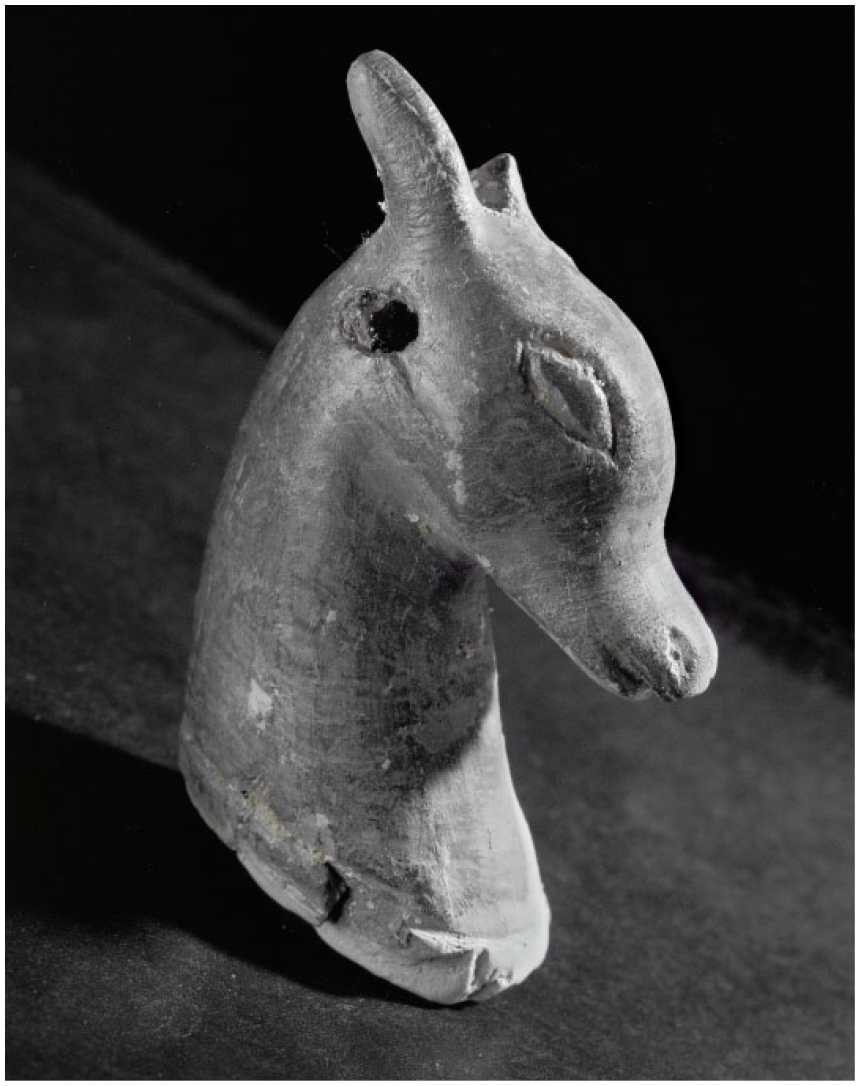
Gazelle’s head sculpture. Foss Temple, Lachish. Israelite period. Bronze Age. Israel Museum (IDAM), Jerusalem. Photo credit: Erich Lessing/Art Resource, NY.
Continuous Creation or the Dynamic Indwelling of the Spirit of God in All Things
In common parlance the act of creation often gets pinned to the past beginning of things, and rightly so. However, it is a doctrine with unsuspected depths. Classical theology speaks of creation in three senses as creatio originalis, creatio continuo, creatio nova, that is, original creation in the beginning, continuous creation in the present here and now, and new creation at the redeemed end-time. In truth, these meanings cannot be neatly separated, for they are all intertwined actions of the life-giving love of the creating, redeeming, re-creating holy mystery whom people call God. Continuous creation, however, largely overlooked in the past, stands out with special relevance when explored with an ecological eye.
An unbroken flow of divine goodness sustains the existence of the universe in every instant, while creatures exist with an absolute reliance on this life-giving power for their own being and action. All creatures, including animals, are held in existence and empowered to act at every moment by the Giver of life; without this sustaining power they would sink back into nothingness. A beautiful metaphor from a twentieth century philosopher expresses this insight: the Creator “makes all things and keeps them in existence from moment to moment, not like a sculptor who makes a statue and leaves it alone, but like a singer who keeps her song in existence at all times.” 11 Divine creativity is immanently active here, now, in the next minute, or there would be no world at all.
Theology traditionally speaks about this music in language of the Spirit, the personal presence of the transcendent God: “The spirit of the Lord has filled the world” (Wis 1:7). Such presence does not set up a competitive relationship with creatures. A monarchical image of God would lead in this direction. But a theology of the Creator who brings forth out of self-giving love envisions this love conferring a certain integrity on creatures, enabling them to participate freely in the life of the world, while accompanying them at every moment. Blowing like the wind in, with, and under all creation, God creates the world by empowering the world to make itself. Its unfinished character comes to expression in the universality of suffering and death. 12
If the Giver of life be always and everywhere present, then the world of life is not devoid of blessing but is itself a site related to God. This is not to say it is divine. But unlike views that cut off the natural world from the holy, continuous creation argues for the unbroken presence of the Creator God to every creature, to every animal, every turtle, bee, and bear. This makes them, in turn, revelatory sites of the power, wisdom, fierceness, and beauty of the One who gives them life.
Community of Creation
The whole world comes from the hand of the one gracious God who created everything out of love. Not only that, but throughout time every creature is held in existence by the same vivifying Giver of life. At the end, all will be gathered into a new heaven and a new earth by the same ineffable love. Such is the doctrine of creation in its threefold fullness. From this perspective, all living beings form one universal, interconnected community. “Endless forms most beautiful” have evolved on the earth, yet undergirding the tremendous variation lies a profound kinship forged by the shared identity of being creatures. The photographs of planet Earth from space make this theological claim easy to imagine. There it is, a beautiful blue marble spinning against the vast black background of space. Under its shielding atmosphere there exists a network of living creatures ranging in size from wee microorganisms to giant sequoias and massive blue whales, including humans toward the larger end of the scale, all interacting with the land, water, and air of their different ecosystems. In scientific terms this enveloping skein of life is called the biosphere. In faith terms it is called the community of creation.
The model of interdependent community stands in sharp contrast to the medieval picture of a hierarchy of being, which placed rational human beings at the apex of a world order that proceeded progressively downward in value to animals, then plants, then non-living matter. Amplifying this picture first drawn by ancient Greek philosophy, theology further privileged humans because they were made in the image of God and given dominion over all other creatures (Gen 1:27–28). Biblical scholarship today reveals that dominion in Gen 1:28 in no way authorizes humans to dominate animals in an exploitative manner, an interpretation that emerged with a vengeance in the modern era. Nor is dominion itself even the primary human-animal relation promoted in biblical writings, which for the most part place human beings within, not over, the community of life. 13 Conviction of human superiority, however, perdures with an ingrained, tenacious grip.
Envisioning creation as a community has radical ramifications for human identity. Instead of lording it over other creatures, humans are meant to give and receive in mutual relationship. This is a radically theocentric vision. When broken down to its most basic element, it bespeaks the truth that all beings in this evolving world share the same non-negotiable character of being creatures. To put this in blunt terms, human beings and other animals have more in common than what separates them. This does not mean they are all the same; their distinctiveness is part of the glory of the world. But in their beautiful, terrible, fragile, and vulnerable lives, they share the fundamental identity of belonging to the same generous God, sharing together in one community. Think animals as kin rather than commodity.
Intrinsic Value
A third key insight closely related to the previous two is the genuine worth of creatures in their own right. Rather than being made primarily for human use, plants and animals have a value of their own that derives from their relation to their Creator. In technical terms they have intrinsic rather than instrumental value. Put into wide play decades ago by the theme “Justice, Peace, and the Integrity of Creation,” 14 this view finds renewed expression in Pope Francis’ ecological encyclical (cited above).
We humans do not own the earth, the pope declares. It is God’s; it was here before us; it is a gift of love which extends to embrace every creature. Without impinging on its autonomy, “God is intimately present to each being” (LS 80). With these theological commitments in place, the drumbeat of intrinsic value begins to sound. Clearly the Bible has no place for a monopoly of human beings unconcerned for other creatures. Instead, “we are called to recognize that other living beings have a value of their own in God’s eyes” (LS 69). Redefining upward what Western philosophy and church teaching had assessed as of lesser worth, the encyclical continues forthrightly: “In our time the Church does not simply state that other creatures are completely subordinate to the good of human beings, as if they had no worth in themselves and can be treated as we wish” (LS 69). Rather, “They have an intrinsic value independent of their usefulness” (LS 140). And why? Because God loves them. “Even the fleeting life of the least of beings is the object of God’s love, and in its few seconds of existence, God enfolds it with affection” (LS 77). Ultimately, “the final purpose of other creatures is not to be found in us. Rather, all creatures are moving forward, with us and through us, towards a common point of arrival, which is God” (LS 83). Our responsibility is to live in mutual relations with nature, benefitting from its bounty and protecting its life.
The continuously active presence of God in the world, the interconnected community of all created beings, and the intrinsic value of creatures who are not human: taken together these interwoven insights set up a theological framework that renders animals’ praise of God intelligible as a dimension of the praise of all creation. Animals are continuously held in being by the ongoing creative activity of God’s Spirit; they share kinship with other creatures in the community of creation; they have an intrinsic value of their own in God’s eyes. The zoological gaze of the Bible finds support in these major insights of the theology of creation.
Animals’ Praise of God
To say that animals praise God is a faith statement. It is an interpretation shaped by belief in God, who creates and continuously empowers the world with loving kindness beyond imagining. The idea does not add to scientific knowledge about animals, nor change biological discoveries in any way. Rather, the claim respects such data while placing animals in reference to the ultimate origin, support, and goal of their world. One task of theology is to help elucidate faith statements when questions are asked about their meaning. In the way it has gone about gleaning biblical insights and framing up doctrinal ideas, this essay has been working out the understanding that animals’ praise is neither an anthropomorphic projection nor a beautiful fiction, but a real action that occurs in real time. The following considerations aim to illuminate this interpretation further.
When we speak of offering praise to God, the primary referent is obviously a particular human activity. In human experience praise arises as a response to the great, life-giving presence of God and what God has done, this Holy One who made everything and is wonderful and redeems all. Most often praise is uttered in words, but it can also be expressed non-verbally in instrumental music or dance or body posture. At times it “will pass over the linguistic horizon into silence,” 15 the silence itself being a salute to the incomprehensible Mystery who cannot be captured in concepts or words. Whether verbal or non-verbal, human praise has at least a three-fold aspect. It points to the greatness of God; it becomes a vehicle for giving oneself over in trust and gratitude; and it bears witness in some way to the world.
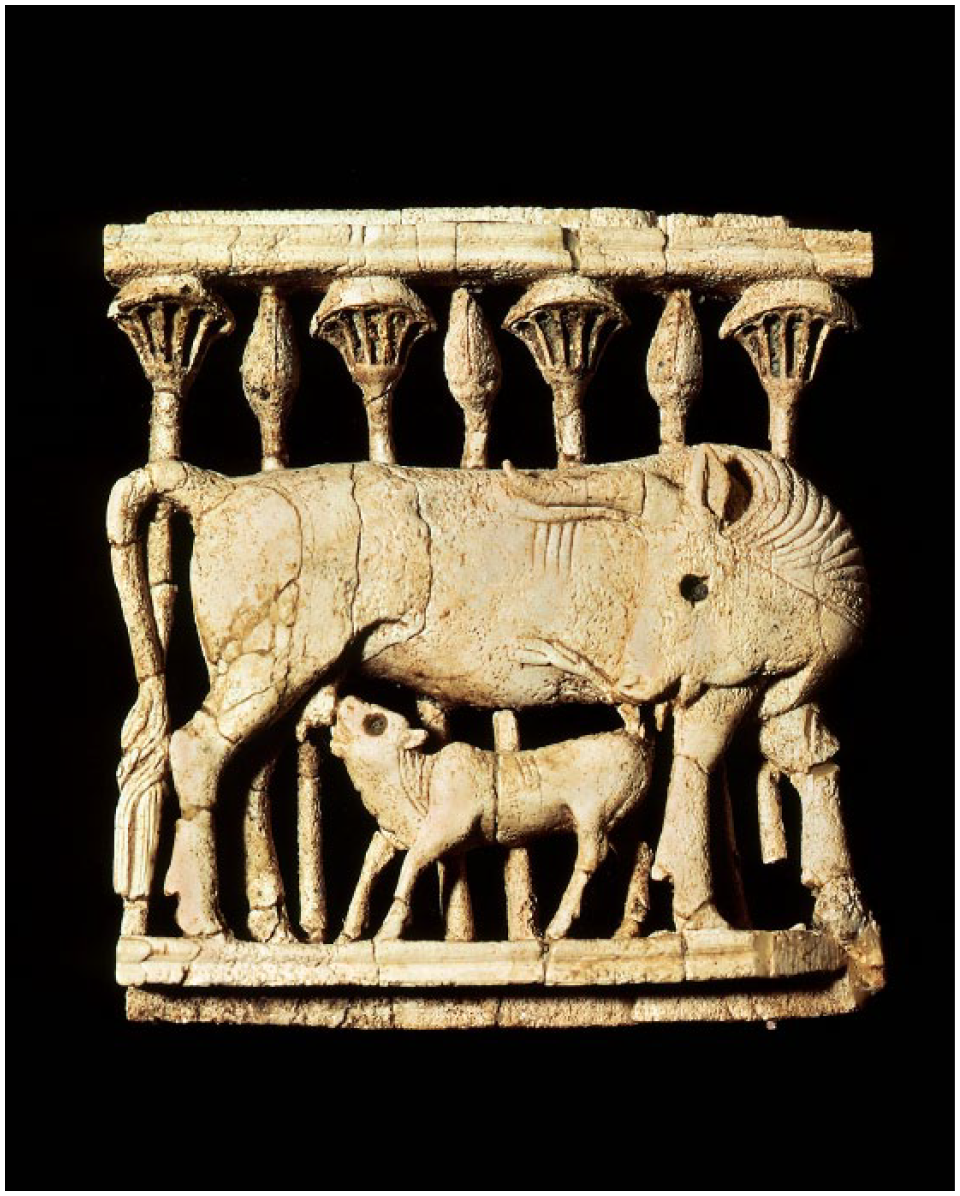
Cow with calf. Phoenician. National Museum, Badhdad, Iraq. Photo credit: Scala/Art Resource, NY.
As a descriptor in human language, praise when ascribed to animals asserts that they, too, live in relation to God. They go about their business as subjects of divine love, respond by moving toward what is good and attractive in accord with their natures. And they bear witness with their very existence to the creative power that is the Source of all. True, they do not articulate praise with the knowingness of human reflective consciousness. But they do so in accord with their created natures, ontologically, by which I mean in a way rooted in being, in reality. While they do not praise in the vehicle of human language, words are not of the essence. Recall the insight of the psalmist speaking of the beauty of the skies: the heavens are telling the glory of God! Day by day they pour forth speech; night by night they declare knowledge. How do they do this? “There is no speech, nor are there words; their voice is not heard; yet their voice goes out throughout all the earth, and their words to the end of the world” (Ps 19:1–4). There is more than one way to communicate. Many who have experienced the awe of a starry night sky, a brilliant dawn, or an approaching thunderhead have heard the wordless words of praise described in the psalm. 16
As with the skies, so too with animals. In their own distinctive ways they give glory to God. Though there is no use of human language, their voice goes out throughout all the earth. When Psalm 148 includes creatures of the sea, wild animals, cattle, creeping things, and flying birds in its depiction of all creation’s praise, it is referring to something taking place in the actual world. Its portrayal is not a rhetorical device but a revelation. What it reveals is that animals are fellow creatures with their own relationship to God, responding with their lives to the Creator who has care for them.
An influential principle used by Thomas Aquinas clarifies this insight further: “whatever is received, is received according to the mode of the recipient,” or more colloquially, each creature receives and responds to the love of God according to its own nature. By virtue of their being created and continually empowered by the Creator Spirit, animals give praising glory to God simply by living according to their natures, which are oriented to God. In their very existence, their concrete quiddity, the way they interact in an evolving universe, they extol the excellence of their Maker. Augustine saw this when he wrote: Let your mind roam through the whole creation; everywhere the created world will cry out to you: “God made me.” … Go round the heavens again and back to the earth, leave out nothing; on all sides everything cries out to you of its Author; nay, the very forms of created things are as it were the voices with which they praise their Creator.
17
“A tree,” comments Bauckham, “does not need to do anything specific in order to praise God; still less need it be conscious of anything. Simply by being and growing it praises God;” 18 (so too, I would add, by dying naturally to provide nourishment as a nurse log for other creatures). In the words of theologians Daniel Hardy and David Ford, “Creation’s praise is not an extra, an addition to what it is, but the shining of its being, the overflowing significance it has in pointing to its Creator simply by being itself.” 19 According to this line of thought, the way animals live precisely as animals articulates their praise. Stone eloquently summarizes the point: “In the roar of lions, the flight of birds, and the surfacing and splashing of distant, mysterious sea creatures, the psalmists and other biblical writers heard or saw what they considered responses to a God who was believed to save—and also sometimes to judge—both human and animal. They heard and saw what [Kimberley] Patton calls ‘animal veneration of God.’” 20
Conclusion
Without hearing the voices of other creatures lifted in praise, our human minds could well overlook the real orientation to God embodied within the natural world. With this hearing, animals witness for us a most profound truth. All of us animals, humankind and otherkind alike, are fellow creatures of the same life-giving God. Together, we are all members of the community of life on earth, engaged in complex interactions, sharing the world as a gift. Under threat of mass extinction, animals pierce through our distraction in a particularly poignant way, kindling our affections and inviting us as co-praising creatures to participate in saving their lives. Responsible, self-sacrificing commitment to care for the earth and its species can flow as an ethical result.
Toward the conclusion of the ecological encyclical, Pope Francis looked forward with hope despite the struggles of our current, multi-faceted crisis. Painting the creatio nova in stunning terms, he envisioned that “At the end, we will find ourselves face to face with the infinite beauty of God,” and each creature, “resplendently transfigured,” will share with us in unending plenitude (LS 243). In the meantime, we come together to take charge of this home which has been entrusted to us. The journey is arduous and the task before us enormous, but God’s love does not abandon. So that we do not lose heart, “Let us sing as we go” (LS 244).
The shared capacity to sing points to the many deep genetic connections that link humans to other animals. Pondering those connections, Rhodora Beaton eloquently writes, “The image of singing as we go invites a broader vision of the journey song, one that includes the duets of gibbons, the beat-keeping dances of parrots, and the elaborate and distinctive calls of whales and other aquatic mammals.” 21 We humans do not sing alone but raise our voices with a world of singers sharing the journey of life together in praise of God.
Footnotes
1.

2.
The Christian history of disregard for the earth along with more positive streams of tradition are carefully spelled out by Paul Santmire, The Travail of Nature: The Ambiguous Ecological Promise of Christian Theology (Minneapolis: Fortress, 1985).
3.
Augustine, “Exposition of Psalm 148,” Expositions of the Psalms, Vol. III (Psalms 121–150), trans. Maria Boulding (Hyde Park, NY: New City Press, 2004), 476–91 (485).
4.
Ibid., 486.
5.
Terence Fretheim, “Nature’s Praise of God in the Psalms,” Ex Auditu 3 (1987), 16–30. Fretheim’s analysis focuses more on nature’s non-living elements than on animals as such. The title of this present essay pays tribute to his work and signals that I hope to develop his argument further with regard to other-than-human animals.
6.
Ibid. 20.
7.
Sallie McFague, Metaphorical Theology: Models of God in Religious Language (Philadelphia: Fortress, 1982) offers a classic and most useful thick description of the function of metaphor.
8.
Ken Stone, Reading the Hebrew Bible with Animal Studies (Stanford, CA: Stanford University Press, 2018), 139. This excellent book gathers and analyzes a great deal of biblical material on animals in light of contemporary scientific and ecological studies.
9.
Ibid., 142. Denis Edwards ventures a theological explanation in “The Redemption of Animals in an Incarnational Theology,” in Creaturely Theology: On God, Humans, and Other Animals, ed. Celia Deane-Drummond and David Clough (London: SCM, 2009), 81–99.
10.
Daniel Horan, All God’s Creatures: A Theology of Creation (Lanham MD: Lexington Books/ Fortress Academic, 2018), xi.
11.
Herbert McCabe, God, Christ and Us, ed. Brian Davies (New York: Continuum, 2003), 103.
12.
See Elizabeth Johnson, Ask the Beasts: Darwin and the God of Love (New York: Bloomsbury, 2014), 122–180 for further explanation of this position.
13.
Richard Bauckham, The Bible and Ecology: Rediscovering the Community of Creation (Waco, TX: Baylor University Press, 2010) makes a superb case for placing the mandate for dominion within the larger biblical context of the community of creation.
14.
World Council of Churches, Signs of the Spirit: Official Report, Seventh Assembly, Canberra, Australia, ed. Michael Kinnamon (Grand Rapids: Eerdmans, 1991); the theme drew worldwide attention as the subject of the Assembly.
15.
Geoffrey Wainwright, Doxology: The Praise of God in Worship, Doctrine, and Life (New York: Oxford University Press, 1980), 39.
16.
William Urbrock, “The Earth Song in Psalms 90–92,” in The Earth Story in the Psalms and the Prophets, ed. Norman Habel (Sheffield: Sheffield Academic Press, 2001), 65–83, works out a strong terracentric hermeneutic of voice.
17.
Augustine, “Second Discourse on Psalm 26,” in On the Psalms, Ancient Christian Writers, Vol. 29 (New York: Newman Press, 1960), 272.
18.
Bauckham, Bible and Ecology, 79.
19.
Daniel Hardy and David Ford, Jubilate: Theology in Praise (London: Darton, Longman & Todd, 1984), 82.
20.
21.
Rhodora Beaton, “Let Us Sing as We Go: Language Origins and the Sung Response of Faith,” Horizons: Journal of the College Theology Society 44 (2017): 56–79 (79).