




Abstract
This essay honors the teaching legacy of Katie Geneva Cannon. The renowned social ethicist, theologian, and womanist scholar was foremost a beloved teacher. Her former student reflects on Cannon’s embodied teaching praxis that contends for the historical survival of the particular self. Weaving personal narrative and curriculum theory, the essay supplies intimate glimpses into the expansive and liberative learning space Cannon nurtured in her classrooms.
Keywords
“I come from a place where when people talk about field work they literally mean field work—work in the fields—not ethnographic research.”
1
Sometimes the soul of a place is so large it engulfs every pretense and disquiet fidgeting in its presence. Dr. Cannon was the soul of every place. Her majestic, humble presence was the soul of every classroom. The texture and temperature of the classroom changed when Dr. Cannon entered it. The intensity of her piercing attention and the roundness of her earthly welcome set a temperature that made you want to take off your outer cloak. You would feel the garment’s tired weight in ways you had not before. The heavy cloak holding detached abstractions and academic jargon that kept us in safe, elegant distances from one another had little currency here. The climbing ego and the timid voice alike had no place to hide.
As deep calls to deep, the depth of Dr. Cannon’s soul would sweep past the clutter and clatter of little things that erudite Ph.D. students had learned to bring to a classroom. Her truth summoned each of us to show up with depth and truth sufficient for genuine encounter. She had a way of calling out the soul from its hiding place.
My soul followed the sure call from deep to deep. I found that the cold fright of my defenseless soul was only momentary. Soon I recognized—in part then and more fully now—that the call from the deep was an invitation to a kind of learning, a kind of teaching, a wondrous kind of encounter that would impart road maps to memory and imagination, tool kits for releasing the poetry stuck in my bones, and certifications that assured my stunningly particular self a legitimate position in the collective singing of our world.
Courtesy Union Presbyterian Seminary.
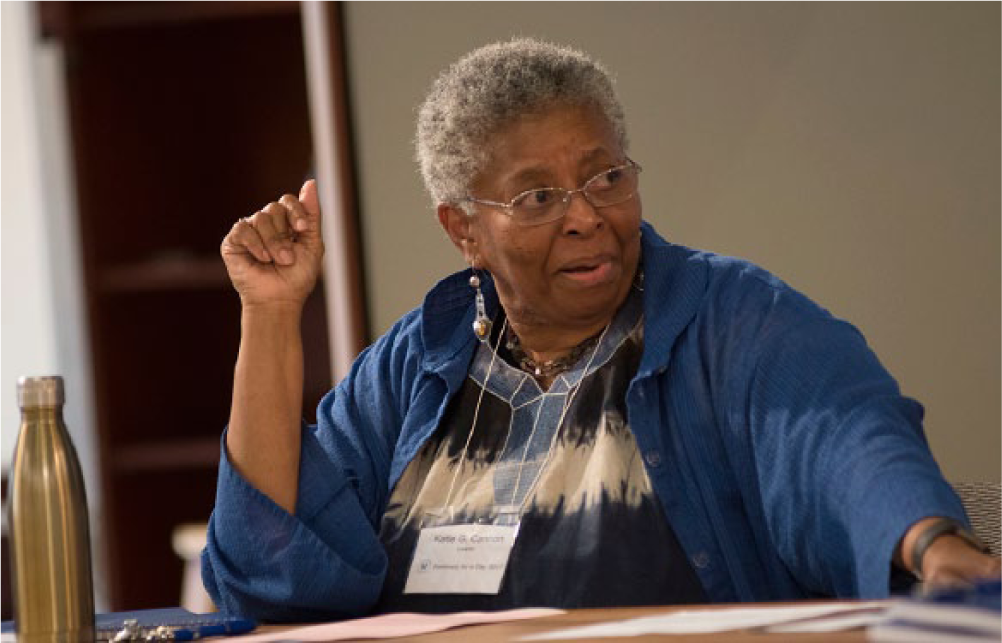
Dr. Cannon had a way of looking at you when you spoke: a look that made you believe she was expecting to hear something important that only you could deliver. She looked at you waiting to learn. You did not want to disappoint the anticipation of this intellectual giant by attempting a sputtering of premium words at discount substance. You would not get by for long, because her equally giant soul would be startled by your disembodied statements and let you know you had to re-member your body and do some work to build muscles around your soul. She would let you know this by blinking her eyes at an indeliberate speed. It was her instinctive reaction to the shock that anyone would waste time trying so hard to be an impressive talking head, a glossy shell of ideas without the warmth of flesh floating here and there, making appearances but incapable of engendering worthwhile knowledge, worthwhile action—worthy theology, worthy ethics.
To have as my primary source text the living praxis of a masterful teacher who knew how to engender worthy learning is to have a deep well from which to nourish my soul’s work today. In honoring Dr. Cannon, I draw some water from this well and share my cup with those who, like me, are responding to a call to be the soul of a place. As teachers, preachers, theologians, ethicists, as peacemakers, truth-tellers, and repairers, may our souls grow large enough to imitate the giant soul of this proto-womanist, whose radical generosity invited my soul to incubate in her attentive love. Following Dr. Cannon’s own words, I offer a nourishing cup from her teaching praxis.
But Don’t Listen for Too Long. Interrupt. Announce!
It was my first doctoral seminar in Dr. Cannon’s classroom on the second floor of Watts Hall where I found my voice. Dr. Cannon amplified it by adding hers to mine, then fading away, until one day I heard the fullness of my solo sound. At times the sound of my silence breaking palpitated with boom-boom, 2 surprising myself at the cadence and rhythm of my own truths. In Watts Hall, the four of us and our professor sat around a pentagon configuration of tables. We read aloud—announced, she would say—our long and boring papers to one another. I can still hear the rustle of autumn leaves within arms-reach outside the half-open window, as we tried patiently to listen to one another. Dr. Cannon listened. She listened as if we were scholars. She regarded our sentences, the baby ideas still incubating in them, with concise curiosity, and she engaged them with a depth of intellectual inquiry that we knew the caliber of our papers did not merit. Soon, we were writing as if we were scholars. And, indeed, we were on the way to our own paths of scholarship, teaching, ministry, and life. There was magic in her pedagogy.
A challenging part of this announcing work is in the question about legitimate knowledge. What kind of knowledge is legitimate? Whose knowledge is legitimate? In the womanist classroom, epistemological hegemony is reordered. Dispassionate objectivity is debunked, and passionate subjectivity enters the central discourse. Multiple texts occupy the learning space and share the responsibility of teaching. In Dr. Cannon’s classroom, legitimate knowledge was found in the voicing of living texts each of us carry, in forgotten narratives emerging with public language, in the muted voices of struggle excavated from the brittle rocks of unrecorded history, and in the printed pages of “textbooks.” The liberative possibilities of this dialogical understanding of curriculum are especially critical for those whose social and political situation demand a new synthesis. For those whose lived texts are inadequately grasped by existing categories, a reassessment of epistemological value assignments creates new channels for announcing. Having dug underground and aboveground channels for her own announcing work, Dr. Cannon accompanied us in working through our embedded self-afflicting subscriptions to the established hierarchy of knowledge. I learned the responsibility of interrupting public knowledges with discourse particular to my location and identity. This learning began when I sat across from the renowned scholar who expected to learn from me.
Many years after leaving Richmond, I often think about Dr. Cannon while moving heavy desks. In my own years of teaching, I have configured pentagons, hexagons, squares, and amoebas, mostly. From small graduate seminars to undergraduate classes of thirty to forty students, I created my versions of the womanist classroom. In these spaces, we see one another, we listen, we announce, and we earnestly wait to be transformed by the interruption of the unfamiliar voice. In the first years, I was tempted to prove myself as the “professor” in the room. Then, I remembered the powerful language of humility in Dr. Cannon’s praxis; I contend that humility is the secret language of good teachers. Recalling Dr. Cannon’s claim that a professor is simply “one who professes,” I embrace my vocation and announce my professions with agency and substance of my truthful voice. I have learned that this is more than enough to be a good teacher.
Expose Your Home Point of View
The praxis of interrupting and announcing informs a generative narrative curriculum theory grounded in the “surprise of the recognizable self.”
3
The self, once the object of one’s history, takes an active role not only as the subject of the biographic situation, but as the critical interpreter of public events and of one’s inner responses to them. The particularity of the self is made significant, and the complexity of experience is probed in a curricular paradigm where the interjection of autobiographical narratives shapes the subject matter. From this heightened sense of the self rise new narratives, new histories, and new texts in the dialogue that is education. From this perspective, education emerges as a metaphor for a person’s dialogue with the world of her or his experience. To delete dialogue from [the] concept of educational experience would be to relegate learning to a series of reactive, conditioned behaviors best described as training.
4
Education understood as a dialogue is to recognize teaching and learning as primarily a human project made up of memories, imagination, and reinterpretations that move, shift, and sometimes uproot the text occupying the central space. Legitimate knowledge is negotiated with additional text sources at the main table.
Courtesy Louisville Theological Seminary.

Dr. Cannon’s narrative emerges as a metaphor for dialogue between the intersubjective self and her world. This praxis is poignantly notable in the appendix of her widely-lauded monograph, Katie’s Canon. 5 The conscious memoire of her biographic situation in Kannapolis and its textured realities illuminate the hidden subtexts of her scholarly work. The surprise of the recognizable self interrupts an incisive treatise of womanism and theoethical imperatives by inscribing mothers and grandmothers, names and geography, earthly details and painful lament into the scholarly transcription.
My mother’s name is Corine Emmanuelette Lytle Cannon. She always wanted to be a schoolteacher or a businesswoman. She had so many dreams. When she realized that she couldn’t fulfill her dreams, she just gave those dreams to us. Most people think she is a teacher because of the way she carries herself, proud-like, a real survivor. My mother took us everywhere. Most Black kids stayed home, but we’d get dressed up and we’d go. We got exposed to Jim Crowism because we were always going out.
6
The pages of the appendix grant us access to dense subtexts, and we are nurtured into an ever-wide welcome to bring to worthy scholarship our own inheritances of dignity, resentment, and truth. In these pages saturated with granular coarseness of life under Jim Crow, Dr. Cannon offers her complicated inheritance. I believe her offering is meant to ease and to discomfort: They would pay you two dollars for two hours of work, but you had a list of things to do and if it took you longer than that, that was your business. All the work they wanted you to do, you could never do in two hours. You never did just what you were asked [to prove you were worthy of the job]. I remember you never ate the food. That was just not a sign of a good domestic. They had food like baloney, which was considered White people’s food anyway, so you brought your own food. I’d bring potted meat, sardines, or Vienna sausages. I resented those Chapman kids. I resented the fact that my mother was always gone and didn’t have time to take care of her kids and here I was a kid having to take care of kids who were my same age.
7
I cried poring over Katie’s Canon the first time I read it. Shocked into new awareness 8 by the work’s astute descriptions of anguish and ambiguity, injustice and incompleteness, I recognized that the common labor for our collective freedom is too big to fit in theoretical constructs and too urgent to remain in theological systems. The work required warmth of flesh, the embodied theoethical praxis expressed in real time, among real people, on real soil, buoyantly holding its truth in what W. E. B. Du Bois calls the beautiful-ugly nature of the human experience. 9 Dr. Cannon’s large soul and agile constructs allow ample room to sustain the tension of dualities, to problematize accepted categories, and to patiently persist in the incremental and exhausting work of truth telling. By the end of my first reading of Dr. Cannon’s womanism canon, I was at the same time filled with despair and covered over with hope.
When I got to the appendix chapter, I cried and laughed intermittently. I cried for the beauty of the giant soul I was lucky to call Professor. I laughed with sorrow for the absurd possibility that this extraordinary sage, whose wisdoms I would rely on for many forthcoming years, could have spent her life’s brilliance on the Chapman kids. With brave delight, I determined to bring my own food to every table. “Expose your home point of view,” 10 Dr. Cannon would later challenge me.
Soon, I took risks to give voice to my own particular experiences. I spoke about always living incompletely in the borderlands of presumably distinct places. Taking these risks has had a useful consequence: I became a fluid traverser and translator in diverse communities that lived segregated in any ways that mattered. Through this work, I have learned to remain firmly buoyant in the liminal, third space between analysis and emotion, didactic structures and poetry, certitude and faith. My comfort in the discomforts in between saturations began with a returning to examine the quality of the roots tangled up beneath me. There were rotted roots, and there were nurturing ones. I had first to see them and recognize their worthy part, not only for understanding my personal identity, but in my academic and vocational endeavor.
A writing project I assign students in the spirituality courses I teach is called “The Observant Autobiography.” It is a guided re-membering of one’s identity, voice, and contexts through narrative schema. It is my attempt at concretizing embodied epistemological praxis. I require every student to begin her/his writing with the same words: “The ground where I was born…” Each paper will take its own course of swirling, leaping, crawling, and dancing along an examination of one’s currere.
11
The ending point of each Observant Autobiography is unprescribed and unscripted. However, each one begins the same. I have designed the assignment this way because of five words in Dr. Cannon’s writing: “I come from a place.” These words capture for me the essence of embodied liberation. They enable the historical survival of the particular. They demand an expansive space for a diversity of locus theologicus. They lead us to transcribing multivocal interpretations of experience, place, and language. They lead us to nuances of the human experience. They push aside the elegant distances between us and lead us to encounter one another: I come from a place where when people talk about field work they literally mean field work—work in the fields—not ethnographic research. I come from a place where there isn’t but one kind of doctor, the person who takes care of you when you are sick…”
12
The subtext of the womanist classroom is found in these words: I come from a place. Having contextualized this subtext for the learning communities to which I have been called, I can testify to the universality of the redeeming power of those five words.
Love the Graces and Gifts
The formidably integrated humanity of Dr. Cannon knew how to navigate systematic argumentations and institutional politics with expert precision while knowing how to love with exceptionally generous affection. Most wondrous ways, her life and work prove it is possible for one to be simultaneously a skillful scholar, a church woman, a lover. All with integrity.
Dr. Cannon spoke often of the “graces and gifts” in individuals. She was ready to see these in the people she engaged. Sometimes, she would have to look painstakingly hard to see them, like the time the sole white male student registered for her doctoral seminar, only to drop the course after the first week, citing a sudden schedule conflict. Not unlike the time decades before when a group of young freshmen in an Ivy League classroom, awestruck by a Black female-bodied professor, dropped the course in unison. Dr. Cannon had sympathy for the existential shock of those young men who could not sustain the cognitive dissonance of encountering Dr. Cannon’s authority when, throughout their lives, Black women waited on them in the muted perimeters of the family dining room. Dr. Cannon spoke often of the graces and gifts in individuals.
As her student, I received Dr. Cannon’s kind and roomy attention over the graces and gifts she saw and named in me. She lived compassionately in radical generosity, genuine curiosity, and deliberate attention: in love. Her love was expressed in a disposition of teaching that made students feel safe enough to take off heavy outer cloaks dressed up with impressive little things. Her love, like her soul, engulfed the prickly peaks of egos and the passive pleasantries of fear. Her kind and roomy love made you recognize, perhaps even for the first time, the graces and gifts dwelling in you. I remember this every time I encounter those I recognize as God’s people entrusted to my attention. I can love without calculating the transaction. I can extend a lopsided kind of love, an unfairly generous kind of love, because I have learned that this is what remarkable teachers do.
The day after Dr. Cannon was born to more life, I quickly jotted down my heart in a tribute. The first words burst out of my swollen heart in one breath: Thank you for teaching me, showing me how to teach: how to love. It’s love. Love is what remains. Love is what endures. It’s love.
I shall proclaim it again: it’s love! What remains prominent from Dr. Cannon’s lifelong work of tenacious scholarship, advocacy, teaching, pioneering, preaching, mentoring, standing up and speaking up, is love. She will smile with satisfaction as I close my reflections with Zora Neale Hurtson’s poetic truth. I offer it here not for extra points—although I am certain that Dr. Cannon gave extra credit any time a student referenced Hurston in a discussion comment or when Hurston was cited in students’ papers. I offer Hurston’s poetry here because it purely describes Dr. Cannon’s womanist praxis converging on my life: Love makes the soul crawl out from its hiding place.
13
My growing soul wishes to be the love of every place. As I step into a new season in my vocation—for the first time without Dr. Cannon’s prophetic wisdom as my dialoguing companion 14 —I will lean into my graces and gifts, emulating the largest soul I have known.
Footnotes
1.
Katie Geneva Cannon, Katie’s Canon: Womanism and the Soul of the Black Community (New York: Continuum, 1995), 13.
2.
In 2002, when I was Dr. Cannon’s teaching assistant at Union Presbyterian Seminary, I frequently accompanied her to outside speaking engagements. One such occasion was a lecture given at Virginia Union University. She stood on the stark stage of an enormous and packed auditorium and filled the space with her presence. Her voice resounded with volume and inflections I had not heard at the Seminary. Her words sang and bounced, quite literally danced and beat. Onomatopoeia was the literary device of that afternoon’s oration. I wrote in my pocket notebook, “boom-boom.” I vividly recall thinking that one of these days, I will grow within me a muscular soul that can voice out “boom-boom” in a lecture, too.
3.
Janet Miller, “‘The Surprise of a Recognizable Person’ as Troubling Presence in Educational Research and Writing,” Curriculum Inquiry 24 (1994): 503.
4.
Madeline Grumet, “Existential and Phenomenological Foundations of Autobiographical Methods,” in William Pinar and William Reynolds, eds., Understanding Curriculum as Phenomenological and Deconstructed Text (New York: Teachers College Press, 1992), 29.
5.
Cannon, Katie’s Canon.
6.
Ibid., 168.
7.
Ibid., 170.
8.
Education philosopher Maxine Greene describes education as a disruptive new idea that shocks us into new levels of awareness. See Maxine Greene, Releasing the Imagination: Essays on Education, the Arts, and Social Change (New York, Jossey-Bass, 1995).
9.
W. E. B. Du Bois, The Soul of Black Folk (New York: Routledge, 1991), xi.
10.
Reference to Appendix title in Cannon, Katie’s Cannon, 162.
11.
Reconceptualist Curriculum Theorizing commonly refers to curriculum as currere (“on the course,” Latin) to reconceptualize curriculum from an objectives-oriented agenda/product to life texts unfolding, becoming. See Dwayne Huebner, “Poetry and Power: The Politics of Curricular Development,” in William Pinar, ed., Curriculum Theorizing: The Reconceptualists (Berkeley, CA.: McCutchan, 1975), 271–78; Pamela Joseph et al., Cultures of Curriculum (Mahwah, NJ: Lawrence Earlbaum, 2000).
12.
Sarah Lawrence Lightfoot, foreword to Cannon, Katie’s Canon, 13.
13.
Zora Neale Hurston, Their Eyes Were Watching God (Philadelphia: Lippincott, 1938).
14.
“Dialoguing” was Dr. Cannon’s word for affectionate discussion. It is an insistent, mutual commitment to “staying with the questions” and bringing one another’s questions to our respective “prayer alters.” Sustained by Dr. Cannon’s generous mentorship through various seasons of my personal and professional journey the past eighteen years, I press forward with her final email message tucked in my heart: “Let’s keep dialoguing until we are crystal clear about your next move.”