



Abstract
The Book of Revelation is a map of the end time. Its apocalyptic story is full of monsters, from the throne room to the abyss. Using new studies in literary cartography and spatiality studies, I argue that the text of Revelation can be read as a map, and that it is itself a monster.
Keywords
Introduction
The book of Revelation, like all worthy apocalypses, is full of monsters. While it is not the only book of the Bible to house monsters in its pages, monsters are plentiful and roam every chapter. These apocalyptic monsters in John’s vision mirror Daniel’s zoomorphic beasts (Daniel 7), with exaggerated features and frighteningly mismatched body parts, often with multiple eyes and mouths. Asa Simon Mitman and Marcus Hensel call these apocalyptic beasts in Revelation “disordered and disturbing heralds of the end of time.” 1 These monsters are terrifying and seductive at once. They bring the (ultimately) unrecoverable past, while holding before us the present reality and future possibility of monsters. These apocalyptic monsters span time—and space—and there is no certain escape.
I want to explore the monstrous space of the book of Revelation as a literary “map” of the end of the world, complete with monsters. The space of these apocalyptic monsters is the literary text. John lays out a map of the end time and shows us where all the monsters are. John—like Odysseus, Alexander the Great, and Herodotus before him—was a traveler and encountered monsters on his apocalyptic journey. These border-crossing travelers saw monsters on the sea and especially in foreign lands. They used monstrous imagery to create fearful stereotypes of peoples of distant lands and religions. Even before the medieval maps of the Crusades, monsters made demands on the imagination. In the fifth and sixth centuries CE Christian theologians incorporated monsters as part of God’s creation. 2 Monsters are explained as central to God’s plan and were useful for adding spice to the biblical narrative. Where there is apocalypse, there is paradise, and in both there are monsters.
Frans Hogenbergh (1540–1592) and Georg Braun (1541–1622). Denmark and the Baltic Sea, detail with marine monsters. From “Civitates Orbis Terrarum,” 1572. Private Collection. Alfredo Dagli Orti / Art Resource, NY.
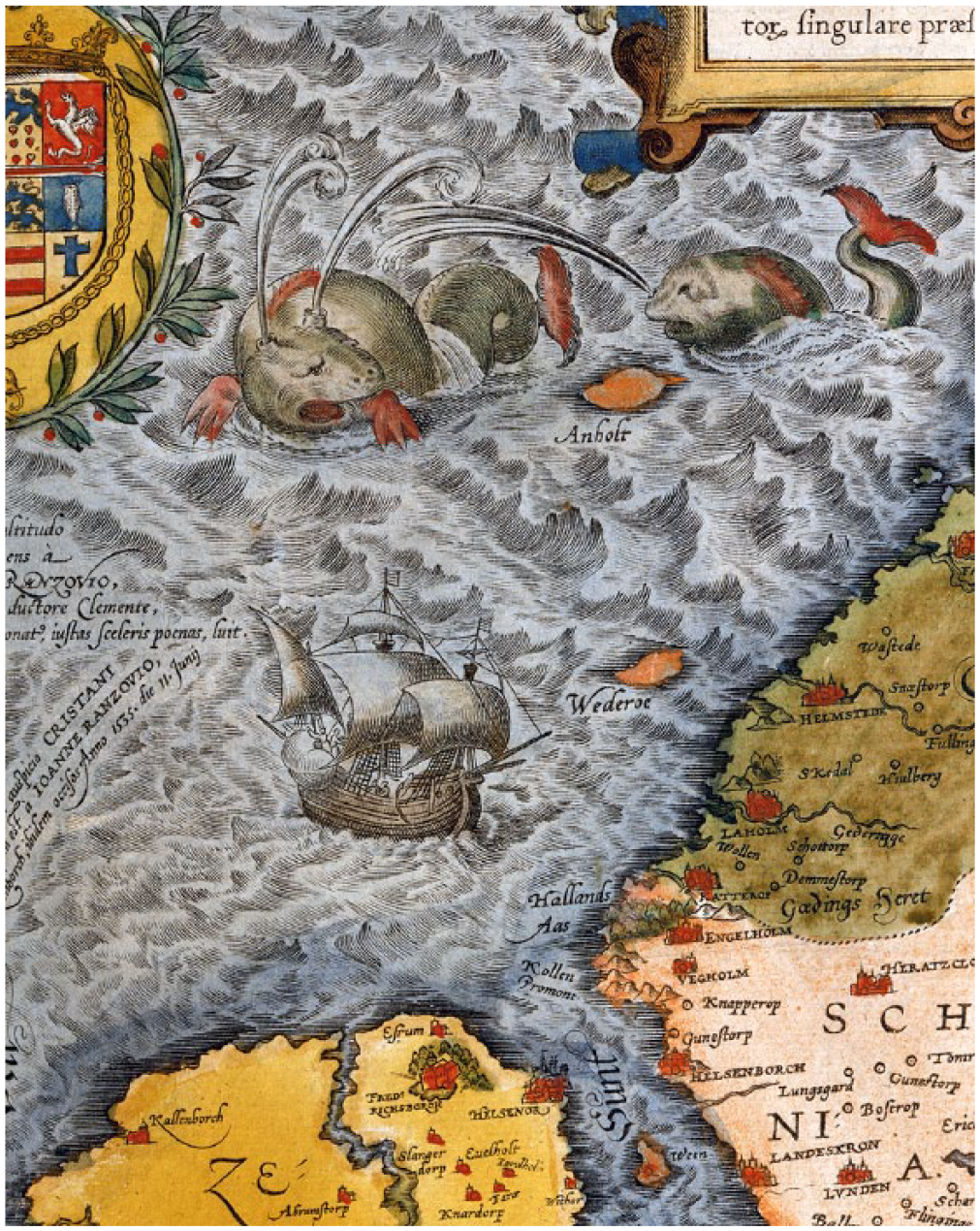
I am reading the book of Revelation over a variety of apocalyptic maps, including the text of Revelation. As a map this text can be read over time, in the changing apocalyptic landscapes of climate and war, with particular time spent with medieval world maps (mappae mundi). Mapping a text provides new ways to read. 3 The field of geomorphology helps describe the processes that produce the “change over time” to landscapes. According to Andrew Goudle and Heather Viles, geomorphology “. . . focuses on three fairly simple elements: that is, landforms, processes, and the development of landscapes over time.” 4 In Rev 21:1: “Then I saw a new heaven and a new earth; for the first heaven and the first earth had passed away, and the sea was no more.” There is ecocide of the “old” earth to make way for the new, sea-less earth. The New Jerusalem—that supposed safe haven—is at the edge of the biblical story, and it is surrounded by monsters (Revelation 21), ironically like the sea monsters on the edges of medieval map.
The land and heavenscape of Revelation changes with John’s visions. The map extends past the canon—into Dante’s Inferno and Paradise and medieval mappae mundi, such as the Hereford Map of 1300 CE. John the Revelator drew no maps; like Dante his narrative is a map. Mapping the end in fiction, fantasy, and science fiction shows the morphing of biblical apocalyptic, from its roots in ancient ideas of the end of the world and time, through its wrestling with empire and crisis. It is impossible in this brief study to map all the apocalyptic maps, but I want to call out a few to show the ideological mapping of the biblical as well as the political landscapes from Revelation to the present. I have found helpful conversation partners in medieval studies and literary geocriticism.
In this issue on biblical monsters, I want to argue that the text of Revelation is a map, a monstrous map, and therefore a monster itself. Not only are monsters strewn throughout the text—the armed and dangerous Son of Man, the autocrat on the heavenly throne surrounded by his beastly minions and sycophants—the text itself is a monstrous map, and thereby a monster, and one that we follow at our own peril as a guide.
A Map of Monsters
In Revelation monsters are all over the apocalyptic map. They dwell above and below and on the earth. They appear with a divine figure with a two-edged sword in his mouth (the Son of Man), are in the seven churches (Jezebel, in particular), riding the earth in battle (Four Horsemen), destroying enemies (the Two Witnesses, and the Beast who kills them), battling the angel Michael and his armies (Beast/s, Whore of Babylon), and dwelling in the throne room, especially sitting on the throne (God and the Lamb).
The monstrous imagery gets all mixed up; there is a Beast with “two horns like a lamb and it spoke like a dragon” (13:11). Stephen Moore analyzes the “animal Christology” of Revelation through the animality works of Jacques Derrida: “Revelation is a bizarre bestiary, more thickly populated with nonhuman animals than any other early Christian text.” 5 With so many apocalyptic monsters, I choose to focus here on one, the Lamb of God.
In his study of the Lamb in Revelation, Stephen Moore begins with the Son of Man “clothed in a robe dipped in blood” (10:13; 19:16). 6 He explains these fashion choices: “Clothes do not make the man or Son of Man in Revelation so much as remind us that he is always liable to be unmade and remade as animal. Jesus’s humanity flickers indecisively in Revelation and is ultimately eclipsed by his animality.” 7 The Lamb, in all its wounded/slaughtered form (Rev 5:12) and reigning glory, is also a shepherd (Rev 7:17) and ultimately king of all human and animal beasts in Revelation. As Moore understands the animal imagery, “Revelation’s Lamb, then, is at once a human-animal hybrid and a divine-animal hybrid. And for now, at least, its sharp little horns seems proleptically to be ripping the Cartesian human/animal hierarchy to shreds.” 8 Moore is following Derrida here in his description that there is “a hyphen between the sovereign and the beast, between God and cattle.” 9 Along with four living creatures and the indescribable one on the throne, the Lamb is part of the ruling elite.
Moore elaborates further on the monstrosity of the ruling elite: “Bestiality has always been a convenient figure for political despotism.” 10 He continues, but why is divine power in Revelation also accorded an animal face, that of a Lamb (see especially 5:6–14)? Is it because the divine sovereign, too, and his messianic agent, are also outside and above the law, even (or especially) the law of God, including the divine command, “Thou shalt not kill”? (Exod 20:13; Deut 5:17). Mountains of corpses, both human and animal, loom over the landscapes of Revelation as the direct result of actions initiated by God or the Lamb. For all who do not acknowledge their sovereignty, God and the Lamb are monstrous agents of terror, beastly objects of horror. 11
The imperial elite who oppose God and the Lamb “. . . hid in the caves and among the rocks of the mountains, calling to the mountains and rocks, ‘Fall on us and hide us from the face of the one seated on the throne and from the wrath of the Lamb; for the great day of their wrath has come, and who is able to stand?’” (Rev 6:16–17). Moore concludes, “The figure of the Lamb is fraught with paradox in Revelation. The Lamb is a nonhegemonic symbol for a hegemonic entity, a docile (indeed, domesticated) trope for domination.” 12 The Lamb is a deceptive monster.
In a similar vein Christopher Frilingos explores the spectacle of the Lamb as both deity and monster. The wounded Lamb becomes the one who wounds, and the penetrated one becomes the penetrator. Revelation 14:9–10 “reveals more than a mere vengeful streak in the Lamb.” 13 Frilingos explains further: “The Lamb presides over the punishment delivered to these prisoners, a scene that transforms the creature from passive victim to active ‘victimizer.’ A gendered mutation, under the penetration grid, from effeminacy to masculinity. Here the penetrated Lamb is an agent of discipline, issuing divine retribution to its former persecutors, ‘even those who pierced him’ on the cross (Rev. 1:7).” 14 By the end of Revelation’s story the Lamb recedes in the background, becoming a shepherd in Rev. 19:15. 15 Frilingos concludes, “Not only does Revelation ‘reveal’ the beastly nature of the pagan persecutors, it also provides Christians with their own monster upon which to rest their gaze.” 16 The heavenly city is not a monster-free zone after all.
The realm of the fantastic provides a special place for monsters and their uncanny existence. 17 The book of Revelation puts a twist on the Pythagorian “all is number,” with its numerological ordering of the end; it also leaves space for “all is monster,” for the end remains a haunting, not a happy-ever-after. John does not assure the reader of the demise and absolute non-return of the monsters, for outside the gates of the heavenly city “the dogs and sorcerers and fornicators and murderers and idolaters, and everyone who loves and practices falsehood” (Rev 22:15) are organizing a city of their own, with monsters of a different kind. Referencing the monsters in the Odyssey, Bertrand Westphal observes, “To the contrary, it is the monster that blazes the trail to infinity.” 18 So too in the biblical vision of the end time, monsters blaze their trail of destruction straight into their capital city.
Monstrous Spaces
As the maps in fantasy narratives such as Homer, Dante, Ursula Le Guin, J.R.R. Tolkein, and Philip Pullman show, there are interesting possibilities in mapping a story, whether done by the author or others. I have been fascinated by the maps of these fantasylands. These maps follow a logical mapping; for example, Lyra’s Oxford in Pullman’s imagination. 19 Geocriticism argues that even without these drawn maps, these texts are maps. To clarify further, Robert Tally states that “the stories perform the function of maps.” 20 Thus geocriticism reveals the aesthetic as well as political dimensions of literary texts. 21 In narratological terms, Tally explains that plot, or the sequencing of events in a story, is paramount: “Plotting or emplotment can already be understood as establishing a setting, setting a course, or marking features of an imaginary landscape.” 22 In Revelation, John’s vision on Patmos sets a wild and unpredictable course across a brutal earthly landscape. Heaven is no brief reprieve, for the space of heaven is monster infested.
Thus the genre of fantasy offers a frame for reading Revelation. Fantasy takes the reader out of the “real” to deposit them back into it with new insights. Tally offers, “In theory and in practice, the alterity of fantasy makes possible new ways of seeing, and thus of interpreting, and perhaps even changing, the world in which we actually live, for better and for worse.” 23 Fantasy narrative, as text and map, opens up critique of the present political and cultural structures, as well as visions of the future.
Tally’s description of the mapping of Utopia in Thomas More’s Utopia is instructive here: In the troubled waters surrounding Utopia on the map, we might discern the old warning, hic sunt dracones (“here there be dragons”). But that is a zone where the modern imaginary grapples with an unrepresentable real, where bureaucrats and monsters jostle each other, and the fantastic mode of mapping such fictional spaces may disclose an image of the world we live in and, perhaps, of other worlds not yet visible on the horizon. 24 What Tally has discovered in imaginary maps is “. . . a sort of cartographic anxiety [that] animates the desire for narrative itself. . . . As a practical matter, this anxiety reflects not only one’s sense of being lost, unable to locate oneself in space existentially, but also the quasi-scientific angst of feeling unable to map one’s place and one’s surroundings in a meaningful way: a crisis of representation.” 25 Reading Revelation creates a crisis, and a sense of ultimate loss. Those who calmly claim a clear path through the text are traveling in circles, fiddling as the earth burns.
Plan of the island of Utopia, 1518. From Utopia, Thomas More’s work depicting an ideal state where reason ruled, first published in 1516. HIP/Art Resource, NY.
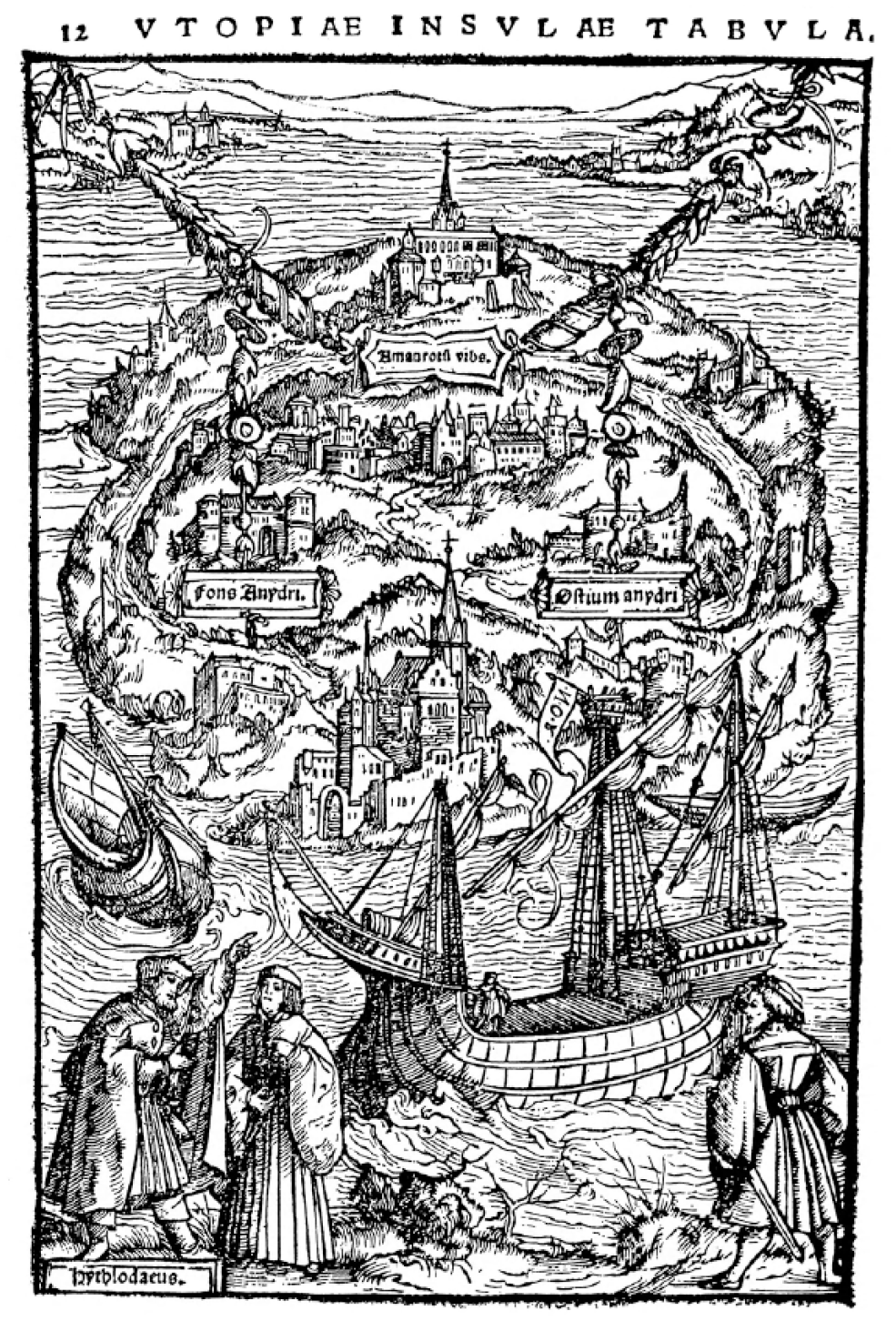
Maps are supposed to function as guides, giving direction, and hope for arriving at a desired and desirable destination. In the case of Revelation, the destination feigns to be the utopia of the New Jerusalem in the very near future. But there is always a problem with utopias. Tally, drawing on Jameson’s concept of cognitive mapping, situates utopia and utopian impulses in the twenty-first century as “. . . neither an ideal state elsewhere in world geography nor a realization of some ideal future. Rather, utopia today must function as an imaginative effort to map the world system itself. Utopia is best imagined as a form of literary cartography, and utopian theory is a necessary component for critical practices aimed at making sense of the world.” 26
Louis Marin specifies further: “Utopia as ideology is a totality and when political power seizes it, it becomes a totalitarian whole. The utopian representation always takes the figure, the form, of a map.” 27 John’s literary cartography, in his jumble of dystopia leading to utopia (or not, depending on your point of view), is about politics and power. The dream of a future utopia taints the present. Even as it opposes empire, it invites a reclaiming of imperial space, as the link between rapture theology and conservative politics in the U.S. shows.
Revelation as Map
The ideology exposed by cognitive mapping also exposes the frayed edges of John’s utopian map. Returning to spatiality theory, what I am interested in here is the literary text as map, as a visual representation of the apocalyptic monster story. Literary studies, along with human geography theory, provide guidance on the cartography of narrative. The interdisciplinary fields of geocriticism, literary cartography, and spatiality theory provide guidance for reading the apocalyptic text as a map. Christina Ljungberg explains: “Map and literature are both about orienting ourselves in the world. While a map serves to orient ourselves in real space, a literary text serves to orient us in fictional space.” 28 Reading the book of Revelation as a textual map of the end of the world creates a different way of reading. Although (like Dante) John the Revelator does not include a drawn map with his text, he has the end of earth all mapped out, so to speak, and the time is always, continually near. Michel Foucault might call this a story at “the fatal intersection of time and space,” with the reader positioned at this apocalyptic juncture. 29 The narrative constructs a map as the story unfolds.
Biblical scholars attempt to map Revelation with seven-fold structures, chiasms, and other forms to make sense of the nonsense.
30
What are we mapping when we map apocalypse? The apocalypse displaces everything: narrator, reader, earth, and even the God of most mainstream Christianities. The text slips out of these frameworks, for it has its own narrative space that attempts, like Jorge Luis Borges’s story of the cartographers’ map that is the exact size of the space being mapped. Borges imagined a map of the empire that was the size of the empire: “. . . the Cartographers’ Guild struck a Map of the Empire whose size was that of the Empire, and which coincided point for point with it.”
31
“Map is not territory,” says J.Z. Smith in his foundational article.
32
But the fantastic crosses into alterity, where maps mirror the telling of the tale. Neil Gaiman explains in a story that map mirrors territory, mirrors tale: One describes a tale best by telling the tale. You see? The way one describes a story, to oneself or to the world, is by telling the story. It is a balancing act and it is a dream. The more accurate the map, the more it resembles the territory. The most accurate map possible would be the territory, and thus would be perfectly accurate and perfectly useless. The tale is the map that is the territory. You must remember this.
33
For Gaiman, in his novel American Gods, the map is a mirror into the soul of America.
I find this mirroring in the shelves of rapture books in Christian bookstores. The apocalyptic map causes confusion—the equation of the map with its territory, as in the Christian pre-millennialist rapture tales of the Left Behind books and films. 34 With the rise of dispensational Christianity, timeline maps of the end of the world emerged. In biblical prophecy, God’s plan is all mapped out since the beginning of time. The space is predetermined. The desire for the end is palpable; Jerusalem once again becomes central, as in medieval maps during the Crusade period. In the post-World War II surge of prophecy belief, Cold War 1 and now Cold War 2 provide the political battlegrounds leading to Armageddon. The biblical text becomes a determiner of political views.
Is John a reliable tour guide? It is easy to get lost on John’s doomsday map, take a wrong turn, and get confused in the chaos of smoke and blood and monsters. Despite the certainty and multitude of millennial maps, John’s map is non-sense, a map of fantastic dreams. “You are here” is a constant stressor for readers, for the movement through the apocalyptic spaces activates all the senses, and induces an adrenaline rush. It begs the question: Where, exactly, are you on John’s map? After all, like the Hereford Map, it is a metaphorical map. Tally observes, The figure of the “map” here is metaphorical, but only just so, since I also believe that a sort of cartographic anxiety animates the desire for narrative itself. . . . As a practical matter, this anxiety reflects not only one’s sense of being lost, unable to locate oneself in space existentially but also the quasi-scientific angst of feeling unable to map one’s place and one’s surroundings in a meaningful way: a crisis of representation.
35
John takes us on an adventure, and his itinerary is fast and furious, and terrifying. Using chaos to tame chaos is impossible to map. Maybe the little edible scroll in Rev 10:1–11 is a map to accompany his apocalyptic adventure story.
What does the map of Revelation represent? Maps are guides; they give direction from one place to another. Maps have also been used as weapons of war, collected by generals to strategize battle. 36 The apocalyptic war map at the end of the Christian canon bears the scars of war—the blood, destruction, body count, wild beasts, magical figures, fantastic other worlds. It is a war map, marking the end time battles leading to Armageddon, and beyond.
John maps his vision and his journey through it, but not his return to his island prison. John leaves his hearers/readers, and himself, at the holy city. Peter Turchi, in his study of writers as map makers, states: “The writer’s obligation is to make rewarding both the reader’s journey and his destination.” 37 John draws the hearer/reader into his space. Along with the monsters, the imaginary and imaginative geography of the text seduces the reader. The end goal, the holy city, is seductive, as utopias are, in their dangerous ways. What world/s are we imagining when we imagine the apocalypse? Is Revelation the map we need?
All paths lead to utopia, but apocalyptic utopia is unsettling at best. According to Tally, “Utopian mapping is necessarily fantastic, and literature offers perhaps the most effective form for envisioning the utopian project. The worldly otherworldliness of literature, the real-and-imaginary domain of dragons, characterizes the utopian cartography of the world system.” 38 Apocalyptic spaces are open, gated, urban, rural, celestial, earthly, subterranean, sacred, and profane. These spaces fill the text, and the whole earth; there is nothing left untouched by the catastrophic events. These spaces are similar to Foucault’s notion of “heterotopia:” that is, real, but alternative space that mirrors the utopia/dystopia of apocalyptic. 39 Revelation is full of heterotopias from top to bottom, and side-to-side. Utopia is compromised, and the promise of salvation is blood-stained.
But what does map have to do with monster? Marina Warner describes the connection between map and monster: “Yet in many ways maps and monsters would appear antithetical: maps are about measurements and evidence . . . by contrast, monsters are fantasies, mostly sparked by terrors, but sometimes of curiosity.” 40 Early world maps were loaded with sea monsters, and the Bible begins with a sea monster, tehom, the deep.
The Christian Bible begins and ends with the defeat of the chaos monster. In Genesis 1:1 God/Elohim breathes over the face of the deep, the tehom, with links to the Babylonian creatrix goddess Tiamat. God’s breath here is both creative and destructive. As God subdues the deep/chaos, a new creation begins to emerge. 41 The chaos monster Tiamat’s body becomes the earth in the Enuma Elish. The last days’ destruction of the earth is an excessive repeat of the original violence. The ritual of defeating the primordial dragon/serpent, the first enemy of a ruling God, has to be repeated. The Apocalypse of John details this ritual battle. Theodore Gaster relates: “The defeat of the monster is therefore retrojected into cosmogony and projected into eschatology: Leviathan Vrta, Azhi Dahaka, and Fenrisúlfr of Norse mythology, for instance, are said to be imprisoned but not slain and will eventually burst their bonds and have to be subdued again.” 42 What we know of monsters is their destructive strength, their evil intentions, and their singular, determined focus.
Monsters take multiple forms, both visible and invisible. And they “devour” in multiple ways. They inflict a lot of damage, in stiff competition with the angels with their deadly judgment trumpets, bowls, plagues, and ecocidal/genocidal rampage. Monsters are good and evil in the final apocalyptic monster showdown. In this last book of the Christian Bible, beasts come from all directions to devour and slaughter (e.g. Rev 9; 13). God and son and angel armies emerge victorious: “And the devil who had deceived them was thrown into the lake of fire and sulfur, where the beast and false prophet were, and they will be tormented day and night forever and ever” (Rev 19:10). All the monsters have zoomorphic attributes (echoing Daniel 7): birds, horses, locusts, dragons, dogs, and lamb; they are all hybrid creatures, uncanny to create more terror. The beasts and hell mouth (abyss) of the Apocalypse take up a lot of space, but not near as much as the heavenly throne room and God’s renovated capital city.
Like Pythagorus’ “all is number” to begin to explain the universe, the Bible’s message is “all is apocalypse.” If Jeffrey Jerome Cohen is correct that cultures engender monsters, 43 then the book of Revelation is a monster factory, providing the cast for the production of endless end time monsters. These monsters emerge from the culture and politics and ideology of their times. Cohen reports, “The monstrous body is pure culture. A construct and a projection, the monster exists only to be read: the monstrum is etymologically ‘that which reveals,’ ‘that which warns,’ a glyph that seeks a hierophant. Like a letter on a page, the monster signifies something other than itself; it is always a displacement, always inhabits the gap between the time of upheaval that created it and the moment into which it is received, to be born again.” 44 Cohen puts his thesis in incarnational terms: “The monster is difference made flesh, come to dwell among us.” 45 The “second coming” is one of monsters.
Apocalyptic Geography
The maps of the medieval world (ca. 1100–1500) were not intended to provide accurate directions. Rather, these maps steered the viewer to make the right decisions for God’s coming apocalypse and the final judgment. Alessandro Scafi relates, “The challenge of the Christian compilers of maps was to combine geographical knowledge with the biblical worldview.” 46 The placement of various cities, biblical events (e.g. the Garden of Eden, the Flood, the Tower of Babel, the crucifixion, the Red Sea/Exodus, last judgment), classical mythology, and beasts and demons is intentional, to draw attention to the hierarchy of the center and the edges. There are monsters from beginning (the demon-headed serpent in Eden) to end (the hell mouth at the judgment). The map monsters in these early world maps cover sea and land, disrupting biblical stories and travel.
The monsters on the medieval mappae mundi were warnings to all travelers—pig-dog fish, giant whales, unicorns, humanoid fish and mermaid sirens, dog-headed humans, headless men with faces on their chests, and one-legged and footed men who used their giant foot as an umbrella. The center of the map might be Jerusalem, 47 the holy city of the apocalyptic kingdom of God, but the more interesting parts of the map are the margins and the gaps that monsters fill. 48 These monsters call out, often by stoking desire with a wicked ideology of race. The placement of these monsters outside of Europe, in the “east,” is obviously tainted with anti-Jewish, anti-Islamic sentiments. 49 Every culture has monsters; on mappae mundi the monsters are strategically placed to evoke a response.
The Hereford Mappa Mundi, ca. 1300, at Hereford Cathedral in Hereford, England. It is the largest medieval map known to still exist. The map is signed by or attributed to one Richard of Haldingham and Lafford and is drawn on a single sheet of vellum measuring 158 cm by 133 cm. Taken from A Book of Discovery, published by T. C. & E. C. Jack Ltd., 1912. Photo Credit: HIP / Art Resource, NY.

David Williams explains this marginal placement of monsters as “a frame to orient the viewer to beginning, end, and continuity:” Why are the monstrous races placed at the edges of the world in mediaeval maps when, while branding them as exiles, such a location identifies the monsters as God’s only neighbors and suggests their proximity to the Divine? It is insufficient to interpret locus in this case as merely indicating a place outside the world of order. A consideration of symbolic dimension reveals that “edge” is not the outside so much as it is the threshold and conductor between outside and inside.
50
These map monsters guard and threaten. In addition, they are “God’s only neighbors,” William’s observation that speaks also to God’s (and the redeemed’s) neighbors on the ruined landscape outside the gates of the heavenly city in Revelation.
At the top of the largest of the medieval mappae mundi, the Hereford Map (ca. 1300 CE), 51 is the Last Judgment. Christ is at the center, with the naked damned being led into a beastly hell mouth on Christ’s left. One his right, the clothed saved rise from their graves and are guided to heaven. Below Christ is his mother, the Virgin Mary, accompanied by angels and exposing both breasts in prayer and supplication to her son. 52 All the marginal monsters are ruled by the monster at the top of the map, Jesus Christ, the judge.
These map monsters also represent, from anything deemed abnormal or deviant, to the racist ideologies of the Crusades, to the realities of human sin. Edward Ingebretsen observes: “An unexpected consequence followed: monstrosity gave human failure a legitimate place, at least marginally, on human maps. Monstrosity became a flexible tool of civil repudiation—sometimes literal, sometimes metaphorical.” 53 Monsters “speak” through their presence on apocalyptic maps. Ingebretsen elaborates: “Medieval maps demarcated the alien by leaving it nameless, and thus, voiceless, appropriately consigned to edges and outer boundaries: “The way the monsters lie” is one way of saying evaluative tools do not exist. Thus, as a final consequence, the refusal of speech reinforces the alignment with alienness—the enduring reason why we make monsters in the first place.” 54
These maps indicate an imminent end of the world. Alessandro Scafi discusses the “relation of history to eternity” in medieval Christianity: “. . . the heavenly Jerusalem of the medieval tradition was not only a remote reality distanced in a future heaven, but it was also linked in some mysterious way with the earth.” 55 Time and space are earthly and also eschatological on these mappae mundi (e.g. the Hereford Map and the Psalter Map), for they show history from Eden to the end of the world. 56 “By the late thirteenth century, Jerusalem moved to the center of the mappae mundi, clearly notable on the Psalter and Hidgen maps. The ancient city of David, the center of early Christian drama, was a rallying point for the religious Crusades of the era.” 57 Jaynes describes the round map as “almost like an immense wheel of fortune.” 58 I imagine prophecy believers spinning the map of the book of Revelation; every event in the Middle East warrants a new spin.
The Jerusalem on the medieval maps is geographically central as an earthly city. Thus Scafi points out that Jerusalem is not one that descends from heaven, for all the holy places are earthly (and real places fought for in the Crusades): “Therefore, the Apocalypse is not represented on maps by explicit depictions of the Celestial Jerusalem, but rather by images associated with the end of the world. . . . The entire content of these medieval maps can be considered as a composite allusion to the end of the world.” 59 The holy sites from Eden to Babel to the flood to the cross, and more, are earthly stops on the eschatological maps. Outside these holy places lie dangerous monsters.
If monsters are at the ends of the earth, then the (New) Jerusalem is the ultimate city of monsters. The heavenly city is not on the medieval maps, for conquest was at stake. The eschatological significance of the earthly city serves as a honing beacon for believers. Is it a trap?
Conclusion
The Apocalypse of John is the monster at the edge of the Christian canon. The Bible is framed by monsters, from the chaos monster in Genesis to her return in Revelation (as “bad women” Jezebel and Whore of Babylon, to abyss and sea).
Revelation swallows up the reader. It is all consuming, even for the secular humanist scholar thinking she is at a safe distance. There is no safe distance. Like there is no safe apocalypse. They do not save you or anyone in the end. They carry only the narrative of destruction, by war, economic devastation, fire, toxic pollution, and monsters.
Apocalyptic maps show the worst of human politics and phobias. The medieval maps are anti-Jewish, anti-Muslim, and anti-pagan/barbarian (as are many of the maps in the afterlives of Revelation). There is an ever-delayed dream of utopia, and of knowing the map to arrive there. Tally considers the incomplete map of utopia: “The power of utopia lies not so much in producing a fully formed and accurate cartography, as in the persistent attempt to imagine alternatives to the present state of affairs while remaining assiduously of the world. This worldly otherworldliness, the real-as-imaginary domain of dragons, characterizes the utopian projection, and in the fantastic maps produced, a novel image of our own world emerges.” 60 Throughout its existence in the Christian Bible, Revelation has reflected the current political contexts, or rather, been imposed on these contexts, as the Hereford Map shows.
Revelation as map is God’s territory, and the divide between utopia and dystopia is thin (or non-existent) in apocalyptic fantasy. The monsters continue to roam the map, thereby creating the need in the late twentieth-century of a focus on the rapture and a (almost) final battle at Armageddon. The problem of empire for John gets translated in rapture fiction to naming the enemies of God’s chosen (people and country, the United States of America) in an ultimate battle led by the army of God (angels and U.S. Christian patriots). The monsters morph into new identities, and the map provides new spaces for apocalyptic terror.
John makes sense of his world by making non-sense, with a map of the end of everything that also follows no rational plan. Literary cartography lays a utopian reading on top of utopia. I think these utopias cancel each other out, and what we are left with is dystopia. History has shown how mapping the apocalypse is a dangerous activity, full of racism, orientalism, anti-Semitism, anti-Islamism, Christian supremacy, and nationalism. John’s imaginary future is full of these possibilities if his text falls into the wrong hands, and it always falls into the wrong hands.
I return to the Hereford Map, with its circle of death, its monstrous edges, and its Judgment Day-saturated themes. The monsters remain scattered over its face, static and in motion all at once, as the Crusades and the quest to regain Jerusalem as the apocalyptic center continue. The monsters have not really morphed that much; they remain the religious and geographical and racial “other,” although in new globalized forms. This war map, influenced by Revelation and a demand for its harsh and exclusivist justice, continues to form U.S. foreign (and economic) policy in the present, especially in the Middle East.
Borges’s famous fantasy map was left to rot: “In the Desert of the West, still today, there are Tattered Ruins of that Map, inhabited by Animals and Beggars; in all the Land there is no other Relic of the Disciplines of Geography.” 61 But are we, like the character Eli in The Book of Eli, dragging the biblical apocalyptic map, one that covers the post-apocalyptic world completely, across the American West, to save the last remaining Bible (a KJV in the film) from extinction? 62 Why are we giving this map authority?
Where is this map of the apocalypse taking us? We walk with John through a trail of politics of war, destruction, exclusion, to see a gated community we might not be eligible for or desire to enter (speaking for myself). I imagine another map in my NRSV Bible, coming right after the journeys of the apostle Paul. This map of Revelation is a jolt of violence, and taps into our worst fears, of death and of apocalypse. It is not the map of any future I want to happen—to the earth or its inhabitants.
In the dynamic but chaotic spaces of apocalypse, the imaginary map is unreadable. The irony is that the attempt to control chaos has ultimately failed. In its attempt at order, what is left is disorder; the map is a labyrinth of destruction and death. Does hope remain outside the gates of the city, where the “other” is deemed monstrous? The “other” as horned, hooded, dark, animal-like and beastly fills the stories of horror. Revelation thrives in these afterlives of extreme prejudice, war, and dreams of annihilation. The biblical map sets the tone for maps to follow: from the medieval world maps, the Eurocentric colonial world maps, dispensational maps of the end time, to the nuclear maps of the Cold Wars, and to UAV (unmanned aerial systems, or drones) maps. All of these maps have a connective thread with a geopolitical apocalyptic vision.
What if we redraw the map, reimaging John’s exclusionary, patriarchal, misogynistic, eco/genocidal apocalyptic spaces, and refuse the inevitability of biblical prophecy? Revelation is a palimpsest; no matter how much I scrape the vellum and overwrite another story/stories, John’s story re-emerges through the layers. The apocalyptic unconscious 63 is what I carry. I’ve ingested the scroll, and it is bitter.
Footnotes
1.
As a Simon Mittman and Marcus Hensel, “Introduction: A Marvel of Monsters,” in Primary Sources on Monsters Demonstrare, Vol. 2, ed. Mittman and Hensel (Leeds, UK: ARC Humanities, 2018), 17.
2.
See Rudolf Wittkower, “Marvels of the East: A Study in the History of Monsters,” Journal of the Warburg and Courtauld Institutes 5 (1942): 159–97. For the earliest written report, see Herodotus (History, Book III, 97–106).
3.
Anastasia Lin, “Mapping Multiethnic Texts in the Literary Classroom: GIS and Karen Tei Yamashita’s Tropic of Orange,” in Teaching Space, Place, and Literature, ed. Robert T. Tally, Jr. (London/New York: Routledge, 2018), 44.
4.
Andrew Goudie and Heather Viles, Landscapes and Geomorphology: A Very Short Introduction (New York: Oxford University Press, 2010), 4–5.
5.
Stephen D. Moore, Untold Tales from the Book of Revelation: Sex and Gender, Empire and Ecology (Atlanta: SBL, 2014), 202–3. See also Catherine Keller, God and Power: Counter-Apocalyptic Journeys (Minneapolis: Fortress, 2005) on “cosmic bestiary” (72); see discussion in Moore, 203, n. 3.
6.
Moore, Untold Tales, 209.
7.
Ibid.
8.
Ibid., 210. For another discussion of “destabilizing the human-animal binary” see Ken Stone, Reading the Hebrew Bible with Animal Studies (Stanford: Stanford University Press, 2018), 33–40.
9.
Moore, Untold Tales, 210; Jacques Derrida, The Beast and the Sovereign, Vol. 1, trans. Geoffrey Bennington (Chicago: University of Chicago Press, 2009), 13.
10.
Moore, Untold Tales, 230. See a different approach in Peter R. Carrell, Jesus and the Angels: Angelology and the Christology of the Apocalypse of John (Cambridge: Cambridge University Press, 1997), 226.
11.
Moore, Untold Tales, 231. See Moore’s discussion God is a “beastly figure” (Derrida, The Beast and the Sovereign, 57).
12.
Moore, Untold Tales, 234. Moore names one of the paradoxes of Revelation: “To my mind, Revelation is emblematic of the difficulty of using the emperor’s tools to dismantle the emperor’s palace.” (Moore, Untold Tales, 30).
13.
Christopher A. Frilingos, Spectacles of Empire: Monsters, Martyrs, and the Book of Revelation (Philadelphia: University of Pennsylvania Press, 2004), 80. On the Lamb as a beast, see Frilingos, 56; also Greg Carey, Elusive Apocalypse: Reading Authority in the Revelation to John (Macon: Mercer University Press, 1999), 153.
14.
Frilingos, Spectacles of Empire, 81.
15.
Ibid., 86..
16.
Ibid., 112.
17.
On the Bible as fantasy literature, see George Aichele and Tina Pippin, eds., “Fantasy and the Bible,” Semeia 60 (1992).
18.
Bertrand Westphal, Geocriticism: Real and Fictional Spaces, trans. Robert T. Tally, Jr. (New York: Palgrave Macmillan, 2011), 168.
19.
Philip Pullman, Lyra’s Oxford (New York: Knopf, 2003).
20.
Tally, Spatiality, 2. Tally is drawing on the work of Ricardo Padrón, “Mapping Imaginary Worlds,” in Maps: Finding Our Place in the World, ed. James R. Akerman and Robert W. Karrow Jr. (Chicago: University of Chicago Press, 2007), 255–87, esp. 258–59.
21.
Tally, Spatiality, 113.
22.
Tally, Spatiality, 49–50. See also Marie-Laure Ryan, “Space,” The Living Handbook of Narratology (2014), ihn.uni-hamburg.de: “All narratives imply a world with spatial extension, even when the spatial information is withheld . . . .”
23.
Robert T. Tally, Jr., Topophrenia: Place, Narrative, and the Spatial Imagination (Bloomington: Indiana University Press, 2019), 151. See also Frank Kermode, The Sense of an Ending: Studies in the Theory of Fiction (Oxford: Oxford University Press, 1967).
24.
Tally, Topophrenia, 152. Thomas More, Utopia, trans. Paul Turner (New York: Penguin, 2003).
25.
Tally, Topophrenia, 131.
26.
Tally, Utopia in the Age of Globalization, xi; Fredric Jameson, Archeologies of the Future: The Desire Called Utopia and Other Science Fictions (London: Verso, 2007), xv.
27.
Marin, “The Frontiers of Utopia,” 413.
28.
Christina Ljungberg, “Reading as Mapping,” in The Routledge Handbook of Literature and Space, ed. Robert T. Tally, Jr. (New York: Routledge, 2017), 95.
29.
Michel Foucault, “Of Other Spaces,” trans. Jay Miskowiec, Diacritics 16 (1986): 22–27.
30.
For example, James L. Blevins, Revelation as Drama (Nashville: Baptist Sunday School Board, 1984) has the text as a seven act play with seven scenes in each act; Adela Yarbro Collins, Crisis and Catharsis: The Power of Apocalypse (Louisville: Westminster, 1984).
31.
Jorge Luis Borge, “Of Exactitude in Science,” in Collected Fictions, trans. Andrew Hurley (New York: Penguin), 325; see the discussion of Borges and other fictional maps in Tally, Spatiality, 146–54.
32.
See Jonathan Z. Smith, Map Is Not Territory: Studies in the History of Religions (Leiden: Brill, 1978), 309.
33.
Neil Gaiman, American Gods (New York: HarperCollins, 2011), 485; also in the parable of “The Mapmaker,” in Gaiman, Fragile Things: Short Fictions and Wonders (New York: Harper, 2006), xix–xx.
34.
The most famous of the pre-millennial political narratives is in Tim LaHaye and Jerry Jenkins, Left Behind series.See the website:  .
.
There are other numerous examples of mapping the end times with current right-wing, conservative, pro-Israel political agendas; here are two: the DVD documentary, Nathan Todd Sims, dir., The Harbinger Decoded (Fusion Productions, 2013); John Hagee, Earth’s Last Empire: The Final Game of Thrones (Franklin, TN: Worthy Books, 2018). An example of a popular map of the millennial kingdom used by John Hagee and other dispensationalists: https://www.blueletterbible.org/study/larkin/dt/13.cfm#c56. For more complete timelines see Tim LaHaye and Thomas Ice, Charting the End Times: A Visual Guide to Understanding Biblical Prophecy (Eugene, OR: Harvest House, 2001). See also the Pre-Trib Research Center: .
35.
Tally, Topophrenia, 131.
36.
Anders Engberg-Pedersen, “Cartographies of War: Star Charts, Topographic Maps, and War Games,” in Literature and Cartography: Theories, Histories, Genres, ed. Anders Engberg-Pedersen (Cambridge, MA: MIT Press, 2017), 411.
37.
Peter Turchi, Maps of the Imagination: The Writer as Cartographer (San Antonio: Trinity University Press, 2004), 22.
38.
Robert T. Tally, Jr., Utopia in the Age of Globalization: Space, Representation, and the World System (New York: Palgrave Macmillan, 2013), 94.
39.
Foucault, “Of Other Spaces,” 23.
41.
There is no return in the Bible, after the world is burned by fire, to the watery chaos, as there is in the “proto”-apocalyptic fragment of the Atrahasis epic. See J.Z. Smith, Map Is Not Territory, 69. See also Catherine Keller, The Face of the Deep: A Theology of Becoming (New York: Routledge, 2003).
42.
Theodore H. Gaster, “Monsters,” in The Encyclopedia of Religion, ed. Mircea Eliade, Vol. 10 (New York: Macmillan), 76–80.
43.
Jeffrey Jerome Cohen, “Monster Culture (Seven Theses),” in Monster Theory: Reading Culture, ed. Jeffrey Jerome Cohen (Minneapolis: University of Minnesota Press, 1996), 3. Louis Marin, “The Frontiers of Utopia: Past and Present,” Critical Inquiry 19 (1993): 400, n. 8.
44.
Cohen, “Monster Culture,” 4.
45.
Ibid., 7. See also David D. Gilmore, Monsters: Evil Beings, Mythical Beasts, and All Manner of Imaginary Terrors (Philadelphia: University of Pennsylvania Press, 2003).
46.
Alessandro Scafi, Maps of Paradise (Chicago: University of Chicago Press, 2013), 46. See also Alessandro Scafi, Mapping Paradise: A History of Heaven on Earth (Chicago: University of Chicago Press, 2006).
47.
On the significance of Jerusalem on medieval maps, see Anna-Dorothee von den Brincken, “Jerusalem on Medieval Mappaemundi: A Site both Historical and Eschatological,” in The Hereford World Map: Medieval World Maps and Their Context, ed. P.D.A. Harvey (London: British Library/Chicago: University of Chicago Press, 2008), 355–79.
48.
“Even in the middle ages, while mappae mundi weren’t intended to map the physical works, their aim was, arguably, more ambitious: To diagram history and anthropology, myth and scripture.” (Turchi, Maps of the Imagination, 130).
49.
For a discussion of race (and sex) in medieval mappae mundi, see, for example, John Block Friedman, The Monstrous Races in Medieval Art and Thought (Cambridge: Harvard University Press, 1981). For Jeffrey Cohen, “Dark skin was associated with the fires of hell, and so signified in Christian mythology demonic provenance.” (“Monster Culture,” 10).
50.
David Williams, Deformed Discourse: The Function of the Monster in Mediaeval Thought and Literature (Exeter: Exeter University Press, 1996), 17.
52.
While Mary’s exposure of one breast is common in medieval and Renaissance art, both breasts is rarer. The consensus is that these images of Mary’s breasts are non-sexualized and relate to the humanity of Jesus. See Margaret Miles, A Complex Delight: The Secularization of the Breast: 1350–1730 (Berkeley: University of California Press, 2008, and Miles, “The Virgin’s One Bare Breast,” in Expanding the Discourse: Feminism and Art History, ed. Norma Broude and Mary D. Garrard (New York: Icon, 1992), 26–37.
53.
Edward J. Ingebretsen, At Stake: Monsters and the Rhetoric of Fear in Public Culture (Chicago: University of Chicago Press, 2001), 6.
54.
Ibid., 150.
55.
Alessandro Scafi, “Mapping the End: The Apocalypse in Medieval Cartography,” Literature and Theology 26 (2012): 400–1.
56.
Scafi, “Mapping the End,” 405–6.
57.
Jaynes, Christianity Beyond Christendom, 130.
58.
Ibid., 145.
59.
Scafi, “Mapping the End,” 407. Scafi calls this “mapping with theology” in his Maps of Paradise (Chicago: University of Chicago Press, 2013), 46: “The challenge of the Christian compilers of maps was to combine geographical knowledge with the biblical world view.”
60.
Tally, Utopia in the Age of Globalization, xii. See also W. Scott Poole, Monsters in America: Our Historical Obsession with the Hideous and the Haunting, 2nd ed. (Waco, TX: Baylor University Press, 2018).
61.
Borges, Of Exactitude, 325.
62.
The Hughes Brothers, dir., The Book of Eli (Warner Brothers, 2010).
63.
This term apocalyptic unconscious is a take on Fredric Jameson’s “political unconscious”: The Political Unconscious: Narrative as a Socially Symbolic Act (Ithaca, NY: Cornell University Press, 1982).