



Abstract
Contemporary Christian witness about the death of Jesus moves in a culture already saturated with an aesthetic or intuitive ethic of the crucifixion. That aesthetic has many features acquired though Christianity’s long social dominance. This essay focuses on one aspect, authentically derived from the distinctive understanding Christian faith attributed to the crucifixion. First, I describe the Roman context, and the natural “reading” of the image of a crucified person there, as the background to considering the absence of that image in early Christianity. This leads to exploration of the ways that early Christianity used a variety of typological images to weave a new frame of meaning around the crucifixion of Christ. Then, using Tom Holland’s recent historical synopsis of Christianity, I indicate how this new aesthetic of the cross lodged itself in shared cultural assumptions and perceptions. Finally, I consider the crucial American case of lynching, in which White Christian churches betrayed this distinctive meaning of the crucifixion, Black churches affirmed it, and the cultural aesthetic of crucifixion proved itself a key medium for resistance to lynching. Finally, I suggest some implications for church preaching and teaching in relation to the surrounding culture today.
Contemporary Christian witness about the cross moves in a culture already saturated with an implicit aesthetic or intuitive ethic of Jesus’s crucifixion, sparking ready associations. That aesthetic has been imprinted on our culture from Christian sources and communities, and has a powerful life of its own. The rapid ebb of Christendom coexists with a vigorous cultural memory of the cross that flourishes without any necessary theological articulation. Christian teaching about the crucifixion swims in its own wake, a current polluted with the legacy of disputed theological interpretations of this event. Even for those nominally in a church, the cultural aesthetic often provides the default reference point.
This aesthetic has many facets. Specific Christian meanings are partially swamped by generic ones that the death of Jesus has acquired as a coin of common discourse. The cross is a conventional sign of grief at “normal” death (the marker over graves), of general hope for life after death, or restitution in a worldly sense. It is an image of patriotic sacrifice for country. These generic roles accrued to it from Christianity’s social dominance. They belong to the cultural aesthetic of the cross, though some (that identify the “sacrifice” of the solider with the “sacrifice” of Christ) find no basis in the gospel story. The cross figures authentically in Christian life as a paradigm for individual narratives of conversion and stories of deliverance from emptiness, addiction, or moral fall (“was lost and now am found”). It serves as a thoroughly secular trope to signify unexpected turnarounds, profound or less so (a professional athlete has made a comeback after being “crucified” by fans last year).
What I have most in mind in this essay is one dimension of this cultural aesthetic, one that reflects a genuine and transforming feature of Jesus’s death: not where the general culture has absorbed Christian theological dysfunctions or generated new ones, but where it has gotten something right about the meaning of the cross. In this aspect, the aesthetic intuitively perceives and parses instances of suffering or victimization, assimilating them to “crucifixion” by an implicit connection to Jesus’s death. For instance, the title of a Vanity Fair article, “The Crucifixion of Matthew Shepard,” effectively summarized its interpretation of the killing of a young gay man, even for those who read no further. 1 Protest posters pose images of those they seek to defend in the posture of tortured bodies on crosses, entirely confident that this communicates a demand for justice on their behalf.
Nov. 4, 2003. Prisoner identified as Abdou Hussain Saad Faleh standing on a box with a hood over his head and arms in a crucifixion pose at Abu Ghraib prison in Iraq. Used by permission of the Associated Press.
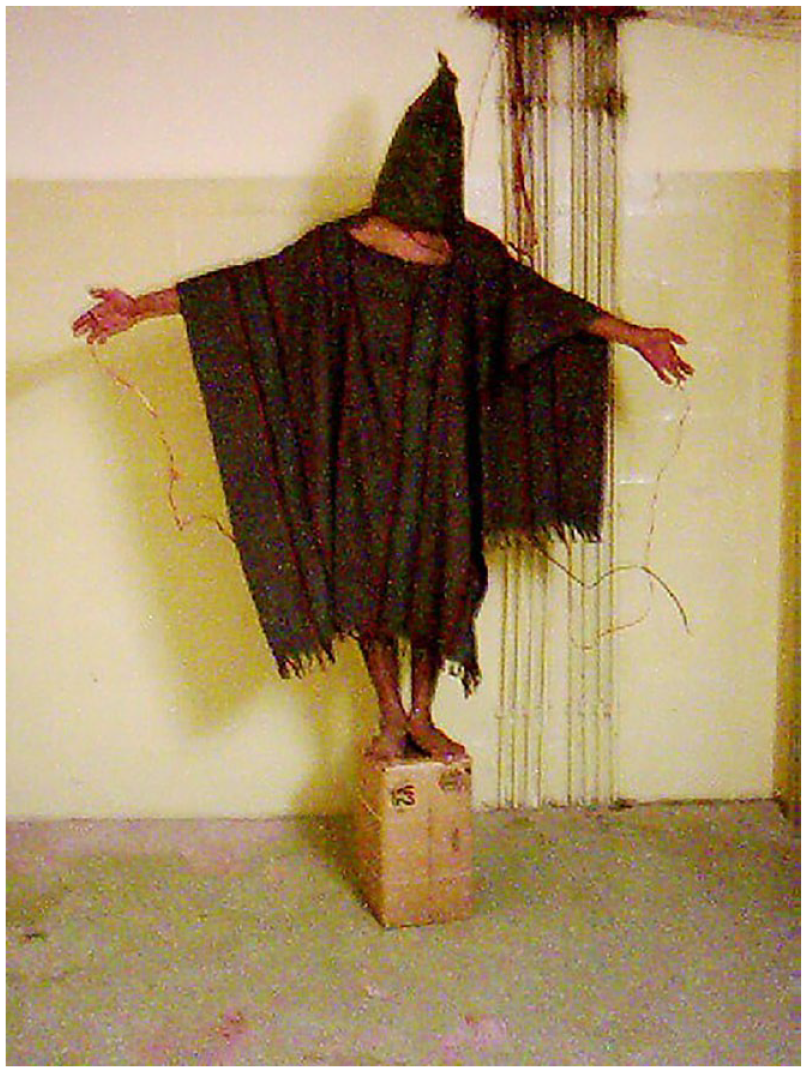
One of the U.S. military guards at the infamous Abu Ghraib prison in Iraq was haunted by the image of one prisoner, chained to a wall in what was called a “Palestinian Hanging.” In a letter home she said it was this sight that shocked her into the recognition she was participating in crime: “He looked like Jesus Christ.” 2 It is no accident that the iconic image of that scandal was not one of the available graphic pictures of cadavers or wounds. Such pictures have a numbing, clinical sameness, the quality of pornography. What is immediately recognizable is the hooded figure of a prisoner posed on an elevated block with arms extended in the crucifixion pose. 3
The sensibility of this cultural aesthetic has two main components. The first is a moral dimension: what is done to Jesus is wrong. The second is a rescue dimension: Jesus dies to save everyone, which makes us in some way responsible. The former draws a line to indicate that siding with the afflicters is evil. The latter establishes a connection, indicating this event inescapably implicates and obligates us. As a secular friend once put it to me, “if you see a crucifixion, you know two things: you owe that person something, and you don’t want to be one of the crucifiers.” This is not a bad summary of the cultural valence of the image of the dying Jesus, an image whose meaning in this sense is regularly perceived, affirmed, and communicated, as much by those unconnected with Christianity as those committed to it.
When the Crucifixion Was Missing
In Western culture we are awash in explicit representations of the crucifixion, allusions to it, and the many interpretations and emotions attached to it. For that reason, we may benefit from a cleansing of the imaginative palate by revisiting the earliest phase of Christian history, where the situation was reversed. There was no image of the crucifixion at all. The open secret of the first four centuries and beyond is that explicit representations of the dying Jesus on the cross are entirely absent from the visual world of Christians. 4 They are hardly common until the later Middle Ages. The cross itself (enthroned, bejeweled, or coded in the form of a ship’s mast or a military standard) is a constant in early Christian art. But the event to which the cross refers is not. This visual gap was not only present in the church’s public face, but in its innermost life, in catacomb art, for instance.
Why this is the case, no one can definitively say. No early Christian author directly explains it. Perhaps the early Christians were ashamed of this humiliation of their messiah. Perhaps they regarded it as a mystery too sacred to be displayed. Perhaps they feared the image would stoke an already excessive attraction to martyrdom. Or, perhaps the death of Jesus was simply not viewed as an important part of Christ’s work or as a focal point of faith: out of sight meant in large measure out of mind. 5
Yet in this same time period, Christians put into common circulation the four Gospels (which Martin Kähler famously characterized as “passion narratives with extended introductions”) and the letters of Paul, notable for an attention to Jesus’s death and its significance that he said he inherited: “we preach Christ, and him crucified” (1 Cor 1:23). 6 The void in the visual record is not matched in the written one. And it is hard to believe the insistent imagery of the cross represented indifference to that death.
It is helpful to start from “ground zero,” where Christians began with the death of Jesus as an image and sign. Let us imagine a representation of a crucified person—on a wall, in a mural or mosaic, carved in a public monument. And let us imagine a passer-by in Antioch or Jerusalem or Rome. Such a viewer saw there something that belonged to their ordinary world, something they expected to be repeated in the future. If it was a symbol, it was first of all a fact.
At the first level, there is a human response to the sight of another human being suffering torture and execution. There is a biological baseline in us that registers with empathetic revulsion what it would mean to be that suffering body, our limbs in that position, with those wounds. We know, sadly, that this involuntary neurological recognition does not translate into a human solidarity. In fact, our response varies depending on whether we see ourselves as objects of the threat that is here carried out or as belonging to those carrying it out.
What is the effect of this sight upon those who stand on the side of its perpetrators or with immunity from it: Roman citizens, for instance, for whom crucifixion was a forbidden mode of execution? Here the bodily knowledge that senses the effect of the violence readily turns to two kinds of response: toward a sense of satisfaction (I am, thankfully, not the one who is suffering this merited justice/vengeance), or toward a contempt for the weakness and unworthiness of those so brutalized. Abuse of distanced others all too easily arouses satisfaction and evokes a plausible rationale.
To see this same violence inflicted on those we intuitively perceive to be “one of our own” turns that same immediate identification in a different direction. It calls forth rage, hatred, and a thirst for revenge against the perpetrators or, alternatively, crushing despair and hopelessness. The Romans intended it to induce that despair of resistance in their subject peoples, though the rage could never be far from hand. In these ways, the picture of a crucifixion, as of any atrocity, is a volatile image, an incitement or an assault, touching deeply seated emotions.
We see the dilemma of early Christians in relation to our imaginary second century by-passer or neighbor. Quite apart from the impracticality of a sometimes persecuted and officially illicit group hanging out a public sign in the first place, what would such a naked image convey? The viewer might take it as Roman propaganda, an advertisement reminder of the real thing: this is what happens to those who oppose the empire. One could take it as a covert sign of Judean resistance, a “bloody flag” raised to inspire revolt: look at what they do to our sisters and brothers. What the image could not be was a shorthand communication of the meaning Christians distinctively made of this death, which was none of those things, though it referred to the identical event.
Alexamenos Graffito. Graffito mocking the worship of Jesus. Second or third century CE. Originally located at the Paedagogium of the imperial palace, Palatine Hill, Rome. Museo Nazionale Romano (Terme di Diocleziano), Rome, Italy. Photo Credit: © Alinari Archives / Art Resource, NY.

One example from the early centuries is the exception that illustrates our rule. The earliest image generally agreed to represent Christ on the cross comes from the hand of a non-Christian. It is a fragment of grafitti, etched on a public wall, in which a human figure points to a crude representation of a crucified man with the head of an ass, above an inscription that says “Alexamenos worships his god.” 7 To judge from this vagrant data point, word on the street testified that the Christian attitude veered toward some kind of reverence for the crucified and criminalized: incomprehensible and ridiculous.
Meeting people who had never known Jesus, Christians recounted his death, suggesting it had been “for our sins” and was key to humanity’s redemption. 8 They saw in it something that was not visible to the onlookers on Good Friday and that could not be communicated simply by a picture of what they had seen. This is particularly true because crucifixion as an event was already a public display, with an intended public meaning. It was not just an execution: troubling people could be removed more quickly and efficiently by other means. It was a display of ruthless power and of humiliation, where the executors found underlining the ruthlessness and the humiliation worth any extra trouble. And this specific character, the humiliation and degradation of it, was (to judge by the earlier confession contained in Phil 2:6–11) included in its meaning. It was what Romans intended it to be, and thereby was part of what Christians recognized it was.
Christians maintained that in this case the result of the event was a complete reversal of the normal one: the nonviolent deliverance and exaltation of the one crushed, over against the power of those doing the crushing. This view of Jesus’s death fell into none of the four natural “baskets” we noted before: rage or despair for those subject to the same fate; satisfaction or contempt for those with supposed immunity. It could not be identified with any of these, though the passion narrative always carries their raw materials with it.
One perennial option, in characterizing this Christian departure from the normal matrix of responses to a crucifixion, is to suppose that they did not identify with those intuitive reactions because they believed the cross had nothing to do with the plane on which these responses operate. Instead, Jesus’s death had to do with an entirely otherworldly destination (eternal life), and with an otherworldly transaction (removing our guilt in God’s eyes or recalling us to our purely spiritual nature). This meaning was transcendently important but had no direct bearing on the world in which revenge, power, terror, and despair are the normal accompaniments of crucifixion. Its apparent location in the realm of society and oppression was but a parable for something abstracted from that realm. Jesus’s death was an outward sign of a heavenly event or a gnostic illumination.
This does not seem right. Certainly, early believers were convinced that the resurrection gave assurance of a life to come, and the cross was a portal to new life. Yet, so could any form of death have been. The natural meaning of a naked crucifixion was not the gospel message. But crucifixion was not incidental to that message. Around it, Christians interpretively wove another web of meaning. In both written and visual spheres, one of the primary ways they did this was to use figures and stories drawn from the Hebrew Bible and the Apocrypha to frame the death of Jesus. In contrast to the missing crucifixion, these markers fill the early Christian visual repertoire in abundance, providing a kind of commentary on that absence.
I will mention four of these: Jonah, Daniel, Susanna, and Abraham/Isaac. Jonah is the figure most often represented in early Christian art, and the other three are prominent as well. These are often put in proximity to images relating to Jesus’s passion. 9 They stand in similar liturgical and literary proximity to the passion, in that these stories figured in the lectionary for Lent and Holy Week, as well as in early theologians’ reflections on Christ’s passion. None of these analogies point to the primacy of a “spiritual parable” view of Jesus’s death. They all reinforce the connections of the cross with concrete concerns on the plane in which it took place, rather than divorcing it from them.
In these types we find a dramatic parallel to the “missing” image of Jesus’s death in early Christianity. These are victim rescue stories. In them, none of the protagonists actually die. The deaths are missing because they are averted. All four are stories of deliverance from an imminent execution, one organized with legal/communal consent and/or supposed divine authority. Jonah is rescued by God in order to call Jonah’s enemies to repentance, and so to deliverance from destruction at God’s hands. Daniel is delivered from a persecuting death at the hands of followers of a false god. But Isaac and Susanna are delivered from deaths proposed in the name of their own (we may say “our”) God—in Isaac’s case from the very mouth of God. 10
If we take these types seriously, Jesus’s death implies a rescue from death—not only the cosmic rescue of humanity from corruption into eternal life, but a coordinate deliverance from the human violence driven by false accusation and supposed divine authorization. The cross is best understood when what happened to Jesus is prevented from happening to others. This train of interpretation bends the image of a crucified one toward evoking sympathy and identification on the one hand, and anticipated deliverance and justification on the other. The conversion of the apostle Paul could hardly be a more apt instance of this dynamic. Paul, who has been doing to Jesus’s disciples what was done to Jesus (as in the stoning of Stephen), encounters Christ in a vision, receiving a one sentence message: “I am Jesus, whom you are persecuting” (Acts 9:5). Changing sides from the crucifiers to solidarity with their victims is the complete, initial substance of his conversion. 11
Bending the Arc in the Meaning of the Crucifixion
The English historian of antiquity, Tom Holland, has recently written a book that traces this bending arc in the cultural meaning of the crucifixion, though he acknowledges that he only realized this was his actual theme in the writing itself. 12 He argues that Christian impact on Western history in this regard has been so massive as to become invisible. As a scholar and lover of classical antiquity (explicitly in preference to Christianity) throughout his life, Holland says he came late to this recognition. His utter familiarity with the Roman and Greek world made him increasingly aware of how dramatically his own personal values diverged from the norm in those cultures. Nowhere was this more manifest than in the attitude toward the weak and the damaged, as with a crucified peasant.
Classical leaders would have reveled in or coolly inflicted the crucifixions they deemed requisite to political needs, their number and the extremity of the suffering an unapologetic public measure of the glory of their power. The profound difference is that Roman emperors cause others to die and are themselves deified precisely because of their victories and the associated body counts. In Christ, the God above all becomes one of the uncounted bodies, a victim taking a place with the defeated. Holland reaches the same conclusion Jürgen Moltmann did: “If the crucified one is the ‘Son of God,’ then Pharoah and Caesar are no longer ‘God’s son,’ though that may be what they have called themselves.” 13
Holland found himself instinctually concerned for the weak and repulsed by the attitude of his Caesars. 14 This was not, he realized, a conscious choice or idiosyncratic individual sentiment. It was something he had absorbed from his upbringing and culture, quite at odds with his espoused sources of inspiration. As he tried to explain this fact about himself historically, he could find no plausible source other than the revolution whose “molten heart” was “the image of a god dead on a cross.” 15
He notes, as I have, that the literal image of that “molten heart” was nowhere to be found in the early church. This does not seem odd to him, vividly as he can identify with the natural readings of the image in that setting. He is more taken by the trajectory, by the fact that by the late Middle Ages not only had the image appeared, but the suffering it depicts had become ever more realistic and gruesome. What strikes him about this is that people have come to look upon such an image and to feel not the revulsion, disdain, or rage he knew would be typical in the classical age, but compassion, pity, and a certain kind of guilt, an uneasy sense of their own moral failings.
That such a response to the image of a tortured and subjugated victim could become “second nature” is an index to what happened in culture more generally. Christian use of the cross comes eventually to be reproached, not without reason, for an oppressive evocation of guilt, morbid and excessive. Holland observes that prior to Christianity it is impossible to imagine a crucifixion image, an image of brutalization of the weak, possessing or being charged with the “defect” of proactively arousing guilt in the observer. In this sense, the values by which we judge the failures of our Western democracies and religion are Christian through and through.
Holland unsparingly catalogs the ways Christian societies have terrorized, brutalized, and dominated others. With Constantine, the cross (and decidedly not the crucifix), became an imperial sign, the insignia of a military faction and then of a Christian Caesar. In early Christian art, the cross had been placed on thrones, draped in royal clothes, and superimposed on military standards, visibly replacing the ruling emperor with a contesting authority. Constantine wedged his way onto the throne alongside the cross, pulling its significance in the opposite direction. 16
Holland describes the process by which Christian tradition formed an aesthetic/ethic of the cross, a new normal in our perception of the crucified. Coordinate with this process, Christians just as steadily found a way to weaponize this aesthetic in support of the continued exercise of violence and domination. That history illustrates rationales for oppression developed to cope with an internal contradiction that was alien to classical ancestors.
Christian anti-Judaism figures in Holland’s catalog of Christian horrors. But it merits particular attention, for in many respects it is the paradigm case for this shift. Christian persecution of Jews differs from the standard “us and them” pattern by virtue of the peculiarity in its primary persecuting rationale. That rationale was the libel that Jews were Christ killers, that they uniquely were crucifiers. Christian preaching and piety turned Jesus on the cross precisely into the kind of incitement natural to a “naked” crucifixion, incitement against those already named as enemies.
The weak and innocent minority of Jews among Christians were oppressed by the strong, on the charge that the Jews were the strong ones who had victimized the weak and innocent Jesus. They were scapegoated in reality for being imagined scapegoaters in the past. Christians are arguably the first to weaponize, to the point of massacre, what today we call political correctness. The novel rationale for victimization that emerges with the aesthetic of crucifixion casts its objects as victimizers, those who side against the weak.
Early Christians worked against the grain to make the image of a crucified person something other than the emotional adjunct to oppression or despair that was its natural impact. The dignity of the crucified, and the hope for their deliverance, were woven into the space where the image should be, until the image took on this signification and could even convey it to a viewer’s glance. The history of the cross has been the tension between the power of that image to pick out its likeness in the world’s victims and to be recognized by them as a sign of vindication, and the powers at work that numb the nerves of such associations and overwhelm them with others.
Crucifixion and Lynching
The original “aesthetic” responses to the crucifixion, those that so dominated the world of the early church so as to leave no apparent space for anything else, are never far away from us.
The Roman option remains close at hand. This is demonstrated in the United States in the brutality most characteristic of our modern history: lynching. I started with the absent image of Jesus’s death among the early Christians, in contrast to the inescapable reality of crucifixion around them. I end with the ubiquity of the image of Jesus’s death in American Christianity, in the face of the studied indifference of White Christians to the lynching of African Americans, a crucifixion all around them. The failure to register that connection is as profound as any heresy could be. As James Cone argued in The Cross and the Lynching Tree, the connection between crucifixion and the lynching tree was not his peculiar insight, nor a recent discovery of African Americans. What cried out for explanation was the White Christian determination not to see it, and the silence about it. 17
The image of the dying Jesus was now everywhere within Christian America, in its churches, its art, its visual imagination. But the most obvious shock of recognition that image should have prompted in his followers, went almost unremarked in wider Christian culture. 18 The death of Jesus is the missing image in the early church, because everyone knew what it looked like, but its obvious meaning was out of synch with the faith about it. The greatest void in the story of the cross in America is that the image of the death of Jesus was everywhere at hand, having acquired in the Christian telling the capacity to point to the worth of the weak and the wrongness of their brutalization, but White Christians segregated that meaning, dropped it from view. For racial purposes, they dragged the crucifixion back to its Roman meaning. 19
Conversely, as Cone wrote almost thirty years ago, “it was the cross of Jesus that attracted the most attention of Black people.” 20 What they had seen virtually immediately on their exposure to Christianity, and what their music and poetry, as well as the preaching of the Black church, mirrored continuously, was that the crucifixion was descriptively their story. As W.E.B. DuBois wrote, “He was poor and we are poor; He was despised…and we are despised; He was persecuted and crucified, and we are mobbed and lynched.” 21 As Cone quoted James Baldwin, “Whites discovered the cross by way of the Bible, but Blacks discovered the Bible by way of the cross.” 22
Lynching was a revival of the Roman approach to crucifixion, to a stunning extent. All that Rome had meant crucifixion to communicate to its subject peoples was communicated in the White brutalization of African Americans. It was a public spectacle, and the publicity was crucial to its message. To be among the lynchers was not a private crime but often a proud claim. Here, as in the crucifixion itself, was the same open revelry in persecution, the evident satisfaction at the pain and degradation of the victim, the service to a wider, systemic subjugation. Here, too, were other staples of the gospel crucifixion scene: the false accusations, the frenzied crowd, complicit religious and political authorities. The crosses burned by lynchers were Constantinian signs of the White, racialized Christianity that was this new Rome.
A lynched man can be seen in the figure of Christ carrying the cross in “I Passed This Way,” by E. Simms Campbell. Used by permission of the Library of Congress, Washington, DC.

The crimes commonly alleged against the victims dropped any veneer of a gospel-tinted political correctness. The pretexts were either false (or exaggerated) accusations of ordinary crimes or nakedly hierarchical ones. Those lynched were said to have stepped out of their place, showed insufficient submission by threatening the sexual, political, and economic domination of the White race. The Christianity of lynchers was a vehicle for the strong, confident in their subjugation of the weak. Its burning cross was again a militant Constantinian party sign. This Christianity clung to other dimensions of the aesthetic of the cross (patriotic ones, individual narratives of redemption), but resolutely purged the subversive and liberatory ones.
The four natural meanings of crucifixion (satisfaction and contempt, rage and despair) are always at hand. In lynching they drove out all else. To lynchers the image of the suffering brought satisfaction and contempt, reflected in the aesthetic of postcard commemorations and grisly souvenirs. For those they terrorized, they intended the only results to be despair and hopelessness.
African Americans, as a community, defeated the attempt to condemn them to these responses alone. “Whites used Christianity to lynch Blacks, but Blacks used it to survive and to resist whites.” 23 This capacity came in large part from their ability to sustain the meaning early Christians had added to the cross: to find in it an affirmation of their dignity, worth, and triumph over evil. As Shawn Copeland wrote of Black women, “by their suffering and privation they freed the cross of Christ. Their steadfast commitment honored the cross and the One who died for all and redeemed it from Christianity’s vulgar misuse.” 24
As crucifixion was the open secret of the early Christian world, for which new meaning was proposed, so lynching was the crucifixion of the post-reconstruction White Christian world in America, to which the application of that meaning was generally evaded. The protest aesthetic persisted nonetheless. For instance, in 1935, in the midst of widespread cultural indifference to lynching, the NAACP and the American Communist party sponsored separate anti-lynching art exhibitions. The drawings, paintings, and sculptures submitted to those exhibitions are dramatically replete with representations of crucifixion. 25 In this, they reflected the language and imagery of the wider anti-lynching movement. 26 The aesthetic of the cross, in the dimension most relevant to this issue, still had a voice. Indeed, alongside the shameful silence of White churches, this cultural aesthetic was the primary medium though which a judgement on both lynching and the churches was communicated.
Cone recounted how in 2000 he visited an exhibition of lynching photographs and noted the intense emotional responses of viewers like himself. 27 The volatility of such an event, then or now, is fraught with the fear that such images in any setting can continue to play the emotional role they were originally intended to play, satisfying racists and re-wounding African Americans. Cone remarked upon the profound distinction he drew between the photographs of lynched victims, produced by perpetrators as continuous with their violence, and the work of anti-lynching visual artists who graphically represented the same reality but who “sought to convey the underlying meaning of these events.” 28 He identified what another writer called “the precariousness of empathy and the uncertain line between witness and spectator.” 29 In the photographs, the relation of Jesus’s death to that of the victims is present in fact, but not in truth. In the representations, the artists seek to make the truth of the connection manifest in the image.
Even concrete images of the crucifixion itself are liable to the same volatility that Cone described. This tension was powerfully reflected in the controversy surrounding Edwina Sandys’s 1975 sculpture, Christa, which depicted a partially nude female form in the traditional crucifix pose. Many objected to the image as a departure from tradition and an assault on the historical particularity of Christian faith. But it was also criticized by those who feared it fed into an objectification of women, that it could inflame or satisfy sadistic male sexual inclinations, retraumatize victimized women, or encourage women to accept and idealize their own suffering. When presented with a relatively novel image like this, our visceral responses testify to the way that the default options we began with are very much in play.
The “protest” dimension of the image may seem so secure that we do not (culturally) need its archetype at all. We care for victims and do not need the authorization of Christ’s example to do so. But this example and Cone’s consideration of the lynching photographs remind us that simple images of brutalization and violence can still readily “read” as incitement or despair. Those who objected to the sculpture because it did not represent the historical Jesus, and who wanted no explicit parallels drawn “in competition” with that story, missed the point that part of the saving effect of that death must be enabling us to see others in the same place. Those who would willingly have replaced emphasis on the cross of Jesus entirely with an array of representations of the oppressed, misunderstood the ambiguous nature of such images in themselves and the continual need to draw them into a liberatory aesthetic.
The Churches and the Aesthetic
What does all this mean then for our understanding of the cross in our setting today? Christians may carry the source code of the crucifixion story, but discourse of the cross has long become a kind of dance between the voices of the churches interpreting the scriptural story, and the culture’s aesthetics of the cross, manifested in myriad social forms. One might expect that when the source code intersects with its social echoes, the result would be greater purity and strength, as with two merging beams of light on the same frequency. And there are moments when something like this happens. But just as often we have an interference pattern, where static and signal are hard to disentangle.
I have stressed a dimension of the aesthetic I believe flows genuinely from a saving feature of the death of Jesus. That dimension may rightly be turned upon Christianity itself. In this case, it is the gospel in the aesthetic that is the true witness. A case in point would be Marc Chagall’s famous “White Crucifixion,” which he painted in the wake of Kristallnacht. Images of Christian persecution of Jews revolve around a crucified figure in a prayer shawl. Here, an intuitive aesthetic of the meaning of the cross speaks powerfully back to the supposed proprietors of the image. It is only because everyone knows that we owe something to the persecuted, and it is wrong to be among the crucifiers, that Chagall can be sure what the painting will convey. It will not communicate despair and hopelessness to a Jewish viewer, but protest and resistance. To Christians it will communicate not just a condemnation of Christian violence, but an evocation of the perfect perversity with which such violence turns its own revelation inside out.
One moral of our analysis is that Christians have good reason to receive the correction of their own gospel in this particular dimension, coming back to them in a cultural medium. This is so whether that aesthetic speaks through a social movement like Black Lives Matter or in popular culture. There is much for Christians to resist in our culture. But it is a tragedy to find ourselves resisting precisely what we need to receive, because it is gospel returning to us. This is no alien imposition, but a benefit from one of the better ways Christianity has shaped culture. 30 As Moltmann said, for the church whose identity rests on being the church of the crucified Christ, “any outside criticism which really hits the mark is…an indication of its inner Christological crisis.” 31
The cultural aesthetic of the cross today is as often thoroughly and aggressively secular as it is generically religious. Just as the churches struggle internally to sort out their theologies of the cross, there is a parallel “theological” struggle within secular culture around the aesthetic. At play are the default emotions of the Roman world that are always available in our response to suffering, the protest/liberation aesthetic of the crucifixion, and the legacies of weaponization of that aesthetic. Our social media world regularly generates virulent examples of all of these: satisfaction at the real or virtual destruction of others, protests on behalf of those whose unjust suffering is identified with crucifixion, internecine conflict devoted to purging the crucifiers. Even communities struggling explicitly for social justice can be consumed by the tensions among these dynamics.
The completely secular version of the aesthetic manifests itself in an ironic way in an explicit critique of Christian theology about the death of Jesus. What the church is heard to be preaching about Jesus’s death is that he died to save us from something entirely unworldly (God’s wrath and punishment in the life to come), for something unworldly (life in heaven), and the wrong done to Jesus (his innocent suffering) was required by God as the charge for this benefit. The church is heard to say this because it sometimes actually does say this, and often does not say something clearly different. This specific version of Christian teaching about Jesus’s death is condemned on the grounds that this “saving” is not directed at what really needs transformation in human life now, particularly the state of the oppressed, and on the grounds that in this picture God is the one doing something wrong, by being the effective crucifier of Jesus. The aesthetic of the cross (the product of the bending of the crucifixion into an image of God’s identification with the weak and victimized) speaks back to the church that initiated that bending. Though the voice is hostile, it should sound familiar.
A second moral of this analysis is that Christian preachers and teachers should highlight the connection of our theology of Christ’s death with what is authentic in the cultural aesthetic/ethic of the crucifixion. Christian apologists and their antagonists often debate the uniqueness of the death of Jesus. Apologists tend to insist on its unparalleled character, while critics object that one cross in Roman Judaea is a literal drop in a sea of similar atrocities the world around. Christians often miss that it is precisely the theological understanding of the cross that requires and recognizes it to be just like all the others. It is God’s identification with and experience of that reality of victimization—the one that so many humans share directly and to which all of the rest of us are connected either as collateral damage, beneficiaries, perpetrators, or some combination—that is key to what the cross accomplishes and means. If there is something distinctive about Jesus’s crucifixion, it depends upon being no different in this dimension. For Holland, as someone outside the church, it was precisely this identification that drove his recognition of a uniqueness in Christianity that he could discover no other way.
If, when we look at the cross, we see only and always the face of Jesus, its saving power has not truly reached us. If it had, by its light we would be able to see others. But if we substitute there only our preferred others, we have warded off its power as well. Continuing conversion calls us to receive judgment from the gospel that speaks within the cultural aesthetic of crucifixion, and to connect the crucifixion source code with all its authentic offspring.