




Abstract

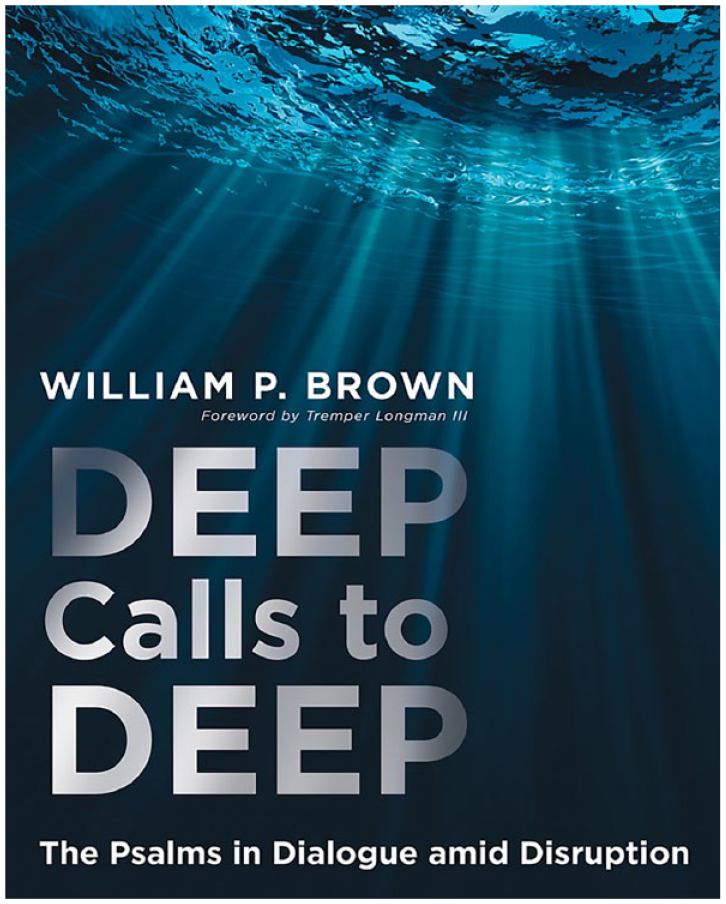
In Deep Calls to Deep William P. Brown responds to the “profound disruption and rancorous division” of current American life with the hope that the book of Psalms might provide a model of conversation “to help cultivate inclusive, mutual dialogue within the church as a transforming witness to our collective life” (p. 9). The character of the psalms as “a little Bible” makes them uniquely suited for this role.
Brown develops his argument in twelve chapters that include an introduction and four parts. In the introduction (ch. 1) Brown highlights the many aspects of disruption and division in American society today (e.g., COVID-19, environmental catastrophes, White supremacy and racialized hatred, demographic change, partisan polarization) and suggests that the church, with all its flawed participation in these divisions, has features that might allow it to broker peace among the warring factions. The church’s main tool for this work is Scripture. Brown notes that the Bible itself is “a work of theological and literary diversity” (p. 11) and therefore offers a hopeful model for dialogue. This is possible in part because the Bible took shape during periods of disruption and trauma (e.g., the Assyrian and Babylonian devastation of Israel and Judah, respectively) and presents “solutions” to these divisive events with a diverse set of stories, poems, and oracles. These diverse texts sometimes complement each other and sometimes speak against each other. Taken together as Scripture, however, we find in the collection a dialogue that offers a model for contemporary discourse.
The Psalms embody this dialogical character more than any other book, and Brown presents them as the centerpiece of this inter-biblical conversation. The Psalms exhibit a diverse conversation among themselves (an “intrapsalmic dialogue,” p. 29) and represent a summation of the diverse conversations in the rest of Scripture. Thus, Brown puts the Psalms at the center of what he terms “a hermeneutic of dialogue.” By this, he means an approach to Scripture that recognizes its “rich variety of different ‘voices’ without any one of them dominating” the outcome (p. 33). Such a hermeneutic assumes and searches for shared meaning among the different voices, but “does not necessarily seek common ground or resolution” (p. 31). Rather, the goal is to listen respectfully and to learn from the other.
Parts I, II, and III of the book mirror divisions of the Hebrew canon: Torah (Part I), Prophets (Part II), and Writings (Part III). Part I outweighs the other sections both in the number of chapters (five, compared to two in Parts II and III) and in pages devoted to them (171, compared to 114 in Part II and 87 in Part III). This disproportionate division reflects the foundational character of Torah and the dominant influence Torah has on the other parts of the canon and specifically on the Psalms. Brown gives appropriate attention to creation (ch. 2), the ancestors (ch. 3), the exodus (ch. 4), and the wilderness experience (ch. 5). He astutely outlines the different perspectives on these subjects in the Pentateuch and shows how the Psalms draw from, extend, and interpret each of them. Chapter 6 caps off the exploration by recognizing that Torah is itself a subject, both within the Pentateuch (e.g., Deut 31:26) and especially in the Psalms (see Psalms 1, 19, and 119). Here Brown’s dialogical approach clearly comes to the fore as he observes that Torah “in the Psalms is not a charter for establishing Israel’s sociopolitical order. It is something more personal and intimate, while at the same time transcendent” (p. 179). As this comment reveals, Brown’s project does not highlight diversity simply for the sake of diversity. Rather, it points to the differences within Scripture as expressions of truth for the sake of particular circumstances and settings. The Psalms do not deny Torah’s sociopolitical role but bring other dimensions of its role to light. They forge new and rich ways of meditating on Torah and of conceiving its sources, locus, and authority.
Parts II and III, though briefer than Part I, touch on crucially important themes in the Prophets and Writings. Brown essentially divides his treatment of the prophetic corpus (Part II) into two chapters that cover the Former Prophets (ch. 7) and Latter Prophets (ch. 8). The figure of David dominates the Former Prophets, and this makes for an easy, if complex entrée into the Psalter’s portrait of him. In the Latter Prophets, “justice” is the key word. This language also appears prominently in the Psalter (e.g., Psalm 82). Brown begins Part III (Writings) by probing the depths of “wisdom” as a subject (ch. 9). This too makes for easy interaction with the wisdom characteristics in in the Psalter, both in individual psalms (e.g., Psalm 78) and the book as a whole (with Psalm 1 as introduction). In ch. 10 Brown takes the familiar designation “twin psalms” and shows how various psalms that appear side-by-side complement and interact with each other. In a different type of psalm pairing, he treats Psalms 8 and 142, which appear on opposite ends of the Psalter and reflect competing ideas about the nature of humanity. In this treatment of psalm pairs, Brown highlights perhaps the ultimate display of “dialogue” in the Psalter.
Part IV concludes the book with two chapters of reflection on the nature of biblical authority. Here Brown shows why this discussion of dialogue within Scripture matters so much, namely, because it provides a model of authority “from the bottom up” (p. 423). Biblical authority, Brown asserts, always requires interpretation and attention to the fractures, dissonances, and disruptions in the text. For those who read carefully and in sympathy with the differences within the text, a genuine sense of authority can indeed emerge.
In the past twenty-five years, Brown has proven himself one of the most astute biblical scholars, and this book should enhance that reputation. On one level, the book reads like an insightful, detailed, though selective theology of the Old Testament. To see it this way, one hears throughout Luther’s description of the Psalter as eine kleine Biblia (“a little Bible”). Brown effectively presents the variegated strains of the Psalms as variations on themes that appear elsewhere in the canon. On another level, however, Deep Calls to Deep is an evocative theology of Scripture that seizes on the polyphonic character of the Bible as a model for biblical engagement and as a suggestive template for human dialogue in general. What some see as an inherent weakness in Scripture, to be denied or smoothed over, Brown highlights as a central quality of enduring value. His view of the authority of the Bible may resonate best with those familiar and sympathetic with a Reformed understanding of Scripture, though his is no formulaic treatment of biblical authority. The book reflects Brown’s talent for fresh and creative approaches to problems of the world and displays his impressive exegetical skills as the primary tool for crafting solutions. It is must reading for all who believe Scripture is a key to understanding difference and who truly desire to learn from “the other.”