



Abstract
In the 16th century, Protestants rejected the possibility of mystical encounters between humans and God. Catholics responded in various ways, but perhaps most forcefully by continuing to claim mystical experiences and by emphasizing extreme forms of mysticism. This paper analyzes how that rejection affected the development of Catholic mysticism at that time, especially in the case of Saint Teresa of Avila (1515–82), whose ecstasies were closely examined by the Spanish Inquisition, but were subsequently approved and promoted as exemplary of the truths professed by the Catholic Church.
I saw in his hand a long dart of gold, and at the shaft’s tip there seemed to be a little bit of fire. He appeared to me to be thrusting it at times into my heart, and to pierce my very inner depths; when he drew it out, he seemed to draw them out also, and to leave me all aflame with a great love of God. The pain was so great, that it made me moan; and yet so surpassing was the sweetness of this excessive pain, that I could not wish to be rid of it, and the soul is satisfied now with nothing less than God. The pain is not bodily, but spiritual; though the body has its share in it. It is a caressing of love so sweet which now takes place between the soul and God, that I pray God of His goodness to make him experience it who may think that I am lying.
What are we to make of this strange mystical ecstasy reported by Saint Teresa of Avila—known as the transverberation—or of the text in which she describes it, written in the 1560s? What are we to make, in turn, of Gianlorenzo Bernini’s marble rendition of this event, so monumental, so outrageous, sculpted nearly a century later? (See Figure 4.) What is the historical significance of the experience claimed, of the text that describes it, and of the many images that sought to depict it?
Nowadays, any such experience could easily be diagnosed in our secular Western culture as a psychotic episode. Mystical raptures and visions such as Teresa’s were considered extraordinary in their day, but nonetheless possible, at least in Catholic circles, both monastic and lay. Nonetheless, visions of this sort could be dismissed as demonic delusions. So, given the potential instability of such experiences, how was it that Teresa’s ecstasies and visions came to be promoted not only as genuinely divine in origin, but also as quintessentially Catholic?
To answer such questions, we must first come to terms with the historical context of the ecstasy itself, that is, with the religious crisis of the early modern age, otherwise known as the era of the Protestant and Catholic Reformations. Texts and images such as these—and claims such as these—had a key role to play in this time period, not just as objects of devotion and expressions of religious fervour, but as flash points for disagreement, and as markers of difference. For, while Protestants renounced religious imagery as idolatrous, the medieval concept of sainthood as delusional, and all mystical ecstasies as blasphemous or demonically inspired claims, Catholics embraced all three with renewed fervour in the 16th century, largely in response to those Protestant denials.
Here I will analyse the role played by mystical ecstasies in the forging of a Catholic identity in the early modern age, and more specifically of the ways in which ecstatic claims such as those of St Teresa acquired a sharp adversarial edge in anti-Protestant polemics. My central focus will be the ecstasies of St Teresa, especially those described in her autobiography, which are among the most extreme to be described at that time. A few other illustrative examples of ecstatic claims will be examined too, as points of comparison.
Saint Teresa (1515–82) embodied so many Catholic traits so intensely that she could be called the perfect saint, the ultimate paradigm of the Catholic Reformation. She not only reformed her own Carmelite order, but actually reified Catholicism itself, especially those features of it that ‘proved’ Protestantism wrong. And no proof was stronger—or more dramatic—than her ecstatic life of prayer. Mystical ecstasy was one of the most significant markers of difference between Catholics and Protestants. While the Catholic world teemed with men and women who claimed union with God, conversed with Jesus Christ and his mother Mary, or flew or levitated, or bilocated, or read minds, or were stigmatized with the wounds of Christ’s passion, Protestants denied that any such phenomena were possible, or simply ascribed them to the devil.
Catholics could be sceptical too, of course, because fraud was always possible, along with heresy and demonic deception. Church authorities kept a sharp eye out for such things. So sharp an eye, in fact, that many of the canonized saints of that era—including Saint Teresa—were scrutinized by the Inquisition at one time or another. This vetting process sifted the wheat from the chaff constantly, and yielded remarkable results, exposing feigned sanctity and lending extra weight to those mystics it judged to be genuinely holy. Spain, in particular, seemed gripped by mystical fervour. As one observer put it in 1600, Spain had become ‘a republic of enchanted beings, living outside the natural order of things.’
1
In the 20th century, some scholars were irked by the mystics and would-be saints who thronged Spain during the reigns of Philip III and Philip IV, and thought it best not to pay attention to them. As one Spanish historian put it:
If you have seen one you have seen them all. It would be vain and useless verbosity to speak at length about cases of this kind … It would be better to leave all these cases lying in oblivion. Let them be brought to light, in due course, by those who are researching folk customs or those who wish to satisfy a childish sort of curiosity.
2
But serious historians do need to deal with these mystics, especially with those who passed muster with the Inquisition. Their power over Spanish society and culture and within Catholicism as a whole was immense, because they reified the ultimate religious values. Take but one of the more extreme examples, Sor María de Ágreda (1602–65). This Franciscan nun, who was cloistered at a very early age when both of her parents decided to turn their house into a monastery, and never set foot outside of remote Ágreda, yet ended up becoming one of the closest confidantes of King Philip IV, even something of a mother confessor. 3
Hard to believe as it is in our day and age, this powerful monarch was drawn to Sor María like a metal pin to a magnet, all because of the religious values of the age, and the significance of mystical claims. It so happened that Philip IV believed reports he had heard about Sor María’s ability to be in two places at the same time while in mystical ecstasy. In 1643, he went out of his way to visit the bilocating nun, eager to encounter holiness up close, along with the heavenly powers inherent in it. This meeting was a great turning point in the lives of the king and the nun: for the next 30 years, the two would exchange over 300 letters, and establish a bond unique in the annals of church–state relations. 4
Bilocation was not the only extraordinary effect of Sor María’s mysticism. The cloistered nun from Ágreda also claimed that during her ecstasies, the Virgin Mary had dictated the story of her life. This ‘autobiography’ of the Virgin Mary, penned in a trance-like state by Sor María, would be published posthumously in 1666, under the title La Ciudad Mística de Dios. Sor María’s 3,000-page long Mystical City of God reveals all sorts of details about the life of Jesus, Mary, and the Apostles which cannot be found in the New Testament. Although it was condemned by the theologians at the Sorbonne in Paris, this ‘autobiography’ was approved by the theological faculties of Salamanca and Louvain, and several other prominent universities throughout Catholic Europe.
Sor María’s astonishing claims are highly representative of the core religious values of the day. Monks and nuns throughout Spain were immersed in a culture of mysticism and miracle in which disbelief was suspended in the face of seemingly implausible phenomena. Many monastics claimed to experience visions and ecstasies on a daily basis, even while performing the most mundane tasks. Ana de San Bartolomé, a Carmelite nun and a close companion of Saint Teresa, wrote two autobiographies that are replete with accounts such as the following:
One day, as I was sitting near the spinning wheel doing some chores—for the sisters tried to distract me by keeping me busy with many jobs—my soul began to burn more than usual with the love of my spouse, and as this was happening the Lord appeared to me, and he looked just as when he had been in this world.
5
He approached me softly from behind, as would any other man in love who would want to surprise his wife. As he came near, he placed his hand over my heart, and it felt as if it were being ripped out; and I felt such pain at that moment that I unwittingly cried out. It was beautiful, this ravishing of my heart; and He left it in such a shape that it hurt a great deal and it seemed as if it wanted to leave my body.
6
This world of visions, apparitions, ecstasies, and levitations was a resounding denial of Protestantism. And one of the most extreme exemplars of this mystical realm was Saint Teresa.
Contemplation
Saint Teresa describes herself as an ordinary and somewhat lethargic nun who did not begin to dedicate herself to the pursuit of contemplation until the age of 40. Throughout the Middle Ages and up until Teresa’s day, the term ‘contemplation’ was a synonym for what we now call ‘mystical experience,’ and the term ‘contemplative’ stood for the noun ‘mystic’ as well as for the adjective ‘mystical.’ Contemplation was considered the earthly goal of every monastic, and, ultimately, the eternal destiny of every human being. As Saint Augustine put it eleven centuries before Teresa’s day: ‘the contemplation of God is promised us as the goal of all our actions and the eternal perfection of happiness.’ 7 This statement was an echo of the prayerful line Augustine addressed to God in the first paragraph of his Confessions, with which Teresa was very familiar: ‘You awaken us to delight in Your praise; for You have made us for Yourself, and our heart is restless, until it rests in You.’ 8 Medieval theologians and mystics shared this belief and elaborated on it. Some of them, such as Saint Thomas Aquinas, emphasized the mental and intellectual dimension of contemplation, asserting that it was the highest of all human activities, and that its culmination was the beatific vision that the saints enjoy in heaven for eternity. ‘The contemplation of divine truth is the goal of the whole human life,’ 9 said Aquinas, because ‘the contemplative life is according to that which is most proper to man, namely his intellect.’ 10
Saint Teresa embraced the pursuit of contemplation and eventually claimed to have reached the most exalted mystical experiences, but nonetheless had some trouble explaining the ineffable.
I would like, with the help of God, to be able to describe the difference between union (unión) and rapture (arrobamiento), or elevation, (elevamiento) or what they call flight of the spirit (vuelo de espíritu), or transport (arrebatamiento)—which are all one. I mean that all these different names refer to the same thing, which is also called ecstasy (éstasi).
11
So says Teresa in her autobiography, struggling for precision, fully aware that inquisitors would be scrutinizing her every word, to determine whether or not her extraordinary trances were really of divine origin. Ordered by her superiors to write about her own life, and especially about her ecstasies and visions, Teresa had no choice but to put pen to paper and hope for the best. Given that her claims were so extreme and that some in Avila and beyond its walls suspected her ecstasies might be feigned or demonic, Teresa was closely scrutinized. 12 Her autobiography, then, was as much a test of her orthodoxy as a testimony of her holiness. 13
And no other ecstatic rapture of hers would attract more artists than the transverberation.
Protestant Contradictions
A central and most essential component of the Protestant Reformation was the rejection of the pursuit of contemplation in this life and the concomitant rejection of the monastic lifestyle that was inextricably linked to it. Despite their disagreements on many theological issues, all of the leaders of the Protestant Reformation could agree that mystical ecstasies of the sort described by Teresa and the miraculous phenomena associated with such altered states of consciousness were not just impossible for humans to attain, but that all such experiences were delusional or demonic in nature. At the root of this rejection lay a new and very different conception of the relationship between the divine and human natures and the spiritual and material spheres.
Martin Luther sometimes employed terms and phraseology he had picked up from medieval mystical texts, but his dismissal of the chief assumptions of those texts was as severe as it was paradoxical. In his 1520 treatise On Christian Freedom, for instance, Luther spoke of union with Christ through faith, saying: ‘just as the heated iron glows with fire because of the union of fire with it, so the Word imparts its qualities to the soul.’ But his understanding of this union excluded any ecstatic, revelatory, or miraculous phenomena. For him, this ‘union’ was strictly soteriological rather than metaphysical or ontological. Luther’s ‘union’ related to salvation alone, not to the attainment of some ecstatic transcendent state of consciousness. This union in faith was all about justification by faith alone rather than works, and about assurance that God’s promises could be trusted. In other words, this ‘union’ brought about a change in attitude toward God rather than ecstatic trances, amorous raptures, or a merging of divine and human realities. Similarly, though he spoke of the human soul as the bride of Christ, the union Luther envisioned was one between severely unequal partners: ‘Christ is full of grace, life and salvation; the soul is full of sins, death and damnation,’ he said, adding: ‘Here this rich and divine bridegroom Christ marries this poor, wicked harlot, redeems her from all her evil, and adorns her with all his goodness.’ 14
Luther’s ‘faith alone’ principle and his condemnation of ‘works righteousness’ led him to have nothing but contempt for monasticism, that way of life dedicated to the pursuit of contemplation. As he put it, attaining a ‘superior’ state of being was impossible and all of the praying and fasting monks carried out led to nothing special or otherworldly: ‘However numerous, sacred, and arduous they may be, these works, in God’s sight, are in no way whatever superior to the works of a farmer labouring in the field, or of a woman looking after her home.’ 15
In the Reformed Protestant tradition, opposition to mystical ecstasy was even more emphatic and more directly based on metaphysical principles, summarized in the formula ‘finitum non est capax infiniti’ (the finite is not capable of the infinite). In other words, God is conceived as so radically transcendent and ‘wholly other’ as to preclude any union of the sort sought by mystics. This was a principle espoused by the Swiss reformer Ulrich Zwingli, and it was vigorously reaffirmed by his younger follower John Calvin, for whom God was ‘as different from flesh as fire is from water,’ and whose reality was inaccessible to human beings. 16 In addition, Reformed Protestants also emphasized the demonic origin of all supernatural claims made by the Catholic Church and its mystics. As Calvin put it, ‘Satan has his miracles, which, though they are deceitful tricks rather than true powers, are such a sort as to mislead the simple-minded and untutored.’ 17
The Prayer of Quiet and the Prayer of Union
Teresa’s autobiography, the Vida, brims over with accounts of extraordinary ecstatic states of contemplation, all of which were an affront to the core beliefs of Protestantism. Like most medieval mystics, she employs distinctions to differentiate between these various altered states of consciousness. The most significant of these distinctions involved the difference between the prayer of quiet and the prayer of union.
The prayer of quiet, according to Teresa, is infused contemplation, that is, a state in which God reaches out to the soul and makes his presence felt directly. This prayer is a gift, ‘a little spark given by God to the soul, like a sign or pledge of his having chosen it for great things,’ and since God gives the gift whenever he sees fit, the soul can do nothing to attain it. 18 In this state, the soul enjoys an unearthly sense of peace and ‘a very great joy and repose of the faculties and a most sweet delight.’ 19 It is called the prayer of quiet because the mind and soul are so overwhelmed by the divine presence that one is left thoughtless and speechless, or ‘witless,’ as the 14th-century mystical treatise The Cloud of Unknowing put it in Middle English. This ecstatic state is transformative too, for it improves one’s behaviour by rendering the will entirely captive to God, and by making the intellect and memory much less interested in worldly affairs. Since, as she says, one is ‘verging on the supernatural’ in this kind of prayer, one now begins to transcend the senses and the material world and to experience and contemplate otherworldly realities.
The prayer of union is also infused contemplation, but of a much more intense and higher sort, and so unlike any other experience that Teresa can only describe it hesitantly. ‘The way in which this that we call union comes, and the nature of it, I do not know how to explain,’ she says. ‘It is described in mystical theology, but I am unable to use the proper terms and I cannot understand what is meant by “mind” or how this differs from “soul” or “spirit.” They all seem the same to me.’
20
Teresa has far less trouble describing the physical effects of this ecstatic state, which are intense. The soul and the body are both overwhelmed, she says, and left suspended between the spiritual and material realms. And since it is the soul that animates and controls bodily functions, the soul itself feels the physical effects of this ecstasy very intensely:
With a very great and sweet delight the soul feels that it is fainting away almost completely, in a kind of swoon. It begins to lose breath and all bodily strength; it cannot even wiggle the hands without great pain; the eyes close involuntarily, or, if they remain open, they can hardly see anything; and if it tries to read, it can hardly spell out a single letter or recognize it … It hears, but cannot understand what it hears. It can apprehend nothing with the senses … Speaking is impossible, for it cannot bring itself to form a single word, and even if it could, it would not find sufficient strength to pronounce it; for all external strength vanishes, while the strength of the soul increases, so that it may the better enjoy its bliss.
21
Teresa is not as precise about the duration or frequency of these unitive ecstasies as she is about their effects. She knows that ‘union’ means the merging of two different things, and that the prayer of union brings the human self to the very edge of death in a paradoxical mix of spiritual bliss and bodily pain. But when it comes to details about the ineffable experience itself, she is always ready to admit that it is ‘a most difficult matter,’ and that it would be far easier for her to speak Greek—a language she did not know—than to fully explain such ecstasies. With self-deprecatory humour, she also adds that anyone who has not experienced the prayer of quiet will probably find her descriptions of it ridiculous, but that she cannot blame anyone for feeling that way: ‘For someone like me to speak of such a thing and to make comprehensible something that seems impossible and cannot even begin to be described in words may very well be ridiculous.’ 22
Mystical Phenomena
If all that could be found in the Vida were the sorting and numbering of different states of prayer, along with details of Teresa’s life, the book might have never made it to print or, if published, it might have sunk into the same obscurity as many other texts authored by early modern nuns. But the Vida does contain much more than that, and the additional content, which relates to Teresa’s many mystical experiences, gives the book a unique edge that helps explain its resounding success and its remarkable longevity.
The Vida is full of accounts of Teresa’s otherworldly phenomena: visions, locutions, trances, ecstasies, levitations, encounters with angels and demons, glimpses of heaven and hell, and intimate moments with God himself. In sum, the Vida is a journey to another dimension, a gripping narrative as full of marvels as Homer’s Odyssey, which also happens to be about an exile straining to go home. It matters little that Teresa’s goal is to reach heaven rather than Ithaca or any other spot on earth. Her story is that of an arduous wonder-filled journey to the place she considers her true home, where her beloved awaits. And what a journey it is.
Visions
For Teresa, visions of otherworldly realities were constant events of her mystical life, and she did not think of herself as deluded or insane. ‘That all this is merely imagined is the most impossible of all impossibilities,’ she said about her visions. 23 These visions of hers were so constant and so intense, in fact, that she had this to say about how they affected her: ‘Everything I see is like a dream and what I see with my bodily eyes is a mockery. What my soul desires is what it has seen with its eyes, and seeing that it is all so far away makes it wish for death.’ 24 Yet, mystical visions were the wildest of all wild cards in the religious climate of 16th-century Spain, for anyone who claimed to see spiritual realities, that is, anyone who claimed to have direct access to the supernatural, could be perceived as a fraud or as a threat to the hierarchical and sacramental order of the Catholic Church. Consequently, Teresa’s accounts of her visions in the Vida were among the most potentially explosive of all issues. At the very same time, however, they were also the most potentially powerful proof of the falsehood of Protestantism.
Teresa had done enough reading in mystical texts to know that there were distinctions to be made concerning visions: some were corporeal and involved the bodily eyes, some were wholly spiritual and involved the eyes of the soul, others were imaginative 25 and involved the eyes of the mind, and yet another kind were intellectual and involved the mind itself. Visions had a hierarchy. Corporeal visions were the least trustworthy because they were the most susceptible to demonic deception. Since Teresa never claimed to have any such visions, they need no attention here. 26 Spiritual visions were much more common for her, and so were imaginative visions, which were far more trustworthy than corporeal visions. Teresa also claimed to have intellectual visions, which were the highest kind of all and the most delectable. In these visions God transmitted truths directly to her mind in an ineffable way and she suddenly acquired a profound understanding of even the deepest mysteries, such as that of the Trinity.
One of the most unique of Teresa’s visions—the transverberation—was fully interactive, and it involved an angel rather than Christ. This vision, described by Teresa in the passage quoted earlier, at the very beginning, has deep roots in mystical literature and is an echo of the Bible’s ‘Song of Songs’ and of affective mystical texts that spoke of love as a ‘fire’ or a ‘wounding,’ such as the pseudonymous ‘Meditations of St Augustine,’ in which the author asked Christ to wound him in the same manner as the angel would wound Teresa:
Wound this sinful soul, for which you were willing to die! Wound it with the fiery and most powerful spear of your abundant love! … Transfix my heart with the spear of your love, so that my soul might say to you, ‘I have been wounded by your love. Strike, Lord, strike this hard heart of mine with the sharp spear of your love and by your power pierce deep into my inmost self.’
27
Similar expressions could be found in in texts such as Richard of St Victor’s ‘Four Degrees of Violent Love,’ (12th century), or Richard Rolle’s ‘The Fire of Love’ (14th century).
After Teresa’s canonization in 1622, no other mystical experience of hers was depicted more often than the transverberation, not only in painting and sculpture, but in engravings that were produced by the thousands and made their way into the hands of the Catholic faithful around the world. 28 The very first engraving was published in 1613, in anticipation of Teresa’s beatification, and this image by Adriaen Collaert, which depicted Teresa as surrounded by several angels and divine figures, would influence many subsequent renditions 29 (Figure 1). The first painting was also completed that same year by Bernardo Strozzi, but is quite different, for it depicts no one other than Teresa and the wounding angel (Figure 2). Even more distinctive was another engraving made in 1622 by Anton Wierix III, who chose to represent Teresa’s ecstasy figuratively rather than literally (Figure 3). In this engraving—which inspired many subsequent paintings—Teresa is not wounded by a dart-wielding angel, but rather by a bow-and-arrow-wielding Christ Child who resembles Cupid and is accompanied by the Virgin Mary and Saint Joseph. Above Teresa, a choir of angels sits on clouds, up in heaven, playing musical instruments, while two angels in flight approach her, one about to place a crown of roses on her head—a bridal symbol– and another bearing a palm frond in his right hand—a symbol of martyrdom. This engraving would also serve as inspiration for many subsequent renditions.

Adriaen Collaert, 1613.
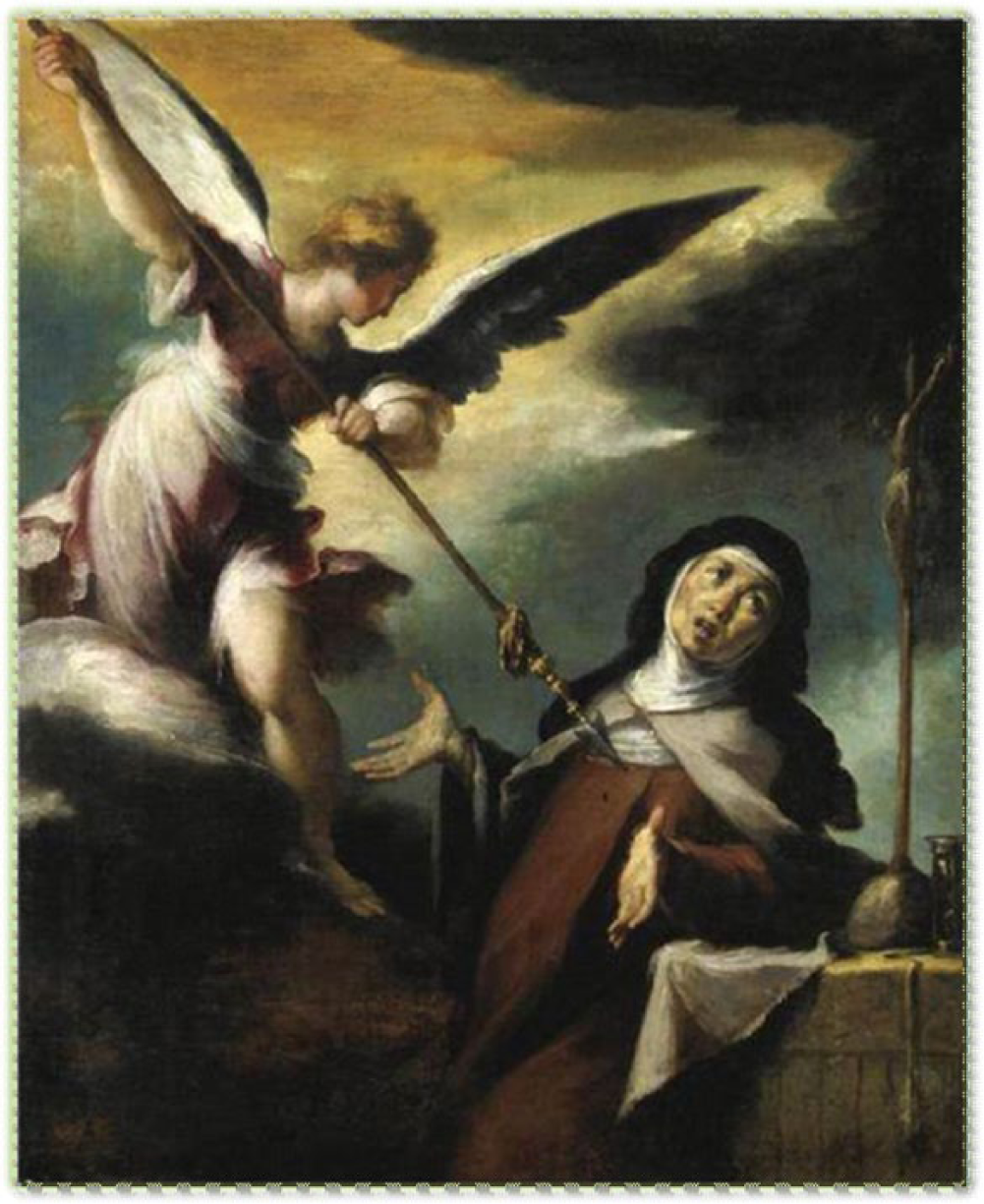
Bernardo Strozzi, 1614.

Anton Wierix III, 1622.
The best-known depiction of the transverberation is the marble sculpture by Gianlorenzo Bernini, completed in 1652 for a cardinal’s funerary chapel in the church of Santa Maria della Vittoria in Rome (Figure 4). Bernini’s rendering is at once very faithful to Teresa’s text and also highly imaginative and metaphorical. 30 In it, Bernini captures with consummate genius an essential characteristic of Catholic belief inherent in the transverberation itself and all depictions of it: the coincidence of opposites. Teresa is a virgin experiencing a nuptial encounter with Christ; she is ecstatic, suspended between heaven and earth, evincing pain and bliss simultaneously, physically as well as spiritually; and she is dying a martyr’s death, but yet very much alive, perhaps more alive than ever. Teresa’s strange ecstasy is a mirror image of Mary the virgin who is impregnated with God incarnate, of the suffering Christ who brings eternal bliss to all humans, and of the dying Christ who rises from the grave and lives eternally embodied. Throw in a weaponized angel for good measure—because Teresa’s text makes it necessary to do so—and you add yet another mirroring coincidence of opposites, in double reverse: the angel who stops Abraham from carrying out the sacrifice of his son Isaac, which had been commanded by God, as a test of faith. Teresa is a sacrificial victim, a martyr for sure, who is at once slain and spared by God through the agency of one of his angels.

Gianlorenzo Bernini, 1652.
The Transverberation as Symbol
After Bernini, all depictions of the transverberation—despite the brilliant artistry of many of them—seem to pale in comparison. Nonetheless, many depictions of the transverberation continued to be produced for four more centuries, especially in the 17th and 18th. Some of the best among them matched or even surpassed Bernini’s ability to convey essential Catholic beliefs and values, such as Michelangelo Unterberger’s 1750 rendering (Figure 5), which brims over with overt symbolism and theological lessons, but perhaps none of them were able to surpass his artistry or to win equal renown.

Michelangelo Unterberger, 1750.
It could be argued that the main reason for the popularity of this vision was its iconic potential. The transverberation cried out for reduplication and wide dissemination because it could function as a powerful deeply encoded universal symbol of Catholic belief and Catholic identity. As is the case with all symbols, this vision could convey multiple messages all at once, too many to list. But among the most significant of the Catholic themes encoded in the transverberation and conveyed by it, we can focus on three that were central themes of Teresa’s mysticism: love, mystical ecstasy, and martyrdom.
Love, the first of these three themes, is one of the key elements of Teresa’s mystical experiences. The narrative of her autobiography is a love story, a spiritual romance in which Teresa and the triune God seek each other out and have moments of intimacy during which the deity and Teresa convey their affection for one another. Teresa’s visions, raptures, and ecstasies are these intimate moments, and during these supernatural encounters her emotions transcend reason. Much of what Teresa has to say about her mystical experiences relates to love, and to her emotions: how she felt, and what she felt, and how she discerned the meaning of these feelings. This theme of love was central to the theology and piety of the Catholic Reformation. Early modern Catholicism stressed the need for an affective relationship between the human and the divine. This emphasis on love of God was not new. It was the very essence of medieval spirituality, and the erotically charged imagery of the Song of Songs was a favourite subject of medieval biblical commentators. As further proof of the antiquity and longevity of this theme, one only needs to consider the parallels between the mystical marriages with Jesus experienced by Catherine of Alexandria in the fourth century, Catherine of Siena in the 14th, and Teresa in the 16th. Nonetheless, something had changed in Teresa’s day that placed such bridal mysticism in a new context. Against the backdrop of the Protestant Reformation, with its emphasis on faith alone, and its low estimation of the power of the human will, Catholics tended to intensify not only their focus on the freedom of the will, but also on the human ability to love God and to feel his love in return. And very few other symbolic representations of the human–divine love relationship could rival Teresa’s transverberation, an ecstasy which she herself identified as emblematic of the ‘amorous banter exchanged by the soul and God.’ 31
Mystical ecstasy, the second of these themes, is another key element of all of Teresa’s writings, especially her autobiography. And ecstasy was not just naturally related to the theme of love between God and humans: it was actually a consequence of that love, and proof of its reality. Belief in the human capacity for divine ecstasies was part and parcel of the Christian religion—especially among monastics—and it could be traced all the way back to the first century and St Paul’s reference to an ecstatic experience in 2 Corinthians 12.2: ‘I know a man in Christ who fourteen years ago was caught up to the third heaven.’ Stressing the possibility of such experiences was nothing new, therefore, but in Teresa’s day believing in mystical ecstasies became a definitive marker of difference between Catholics and Protestants. As previously mentioned, Protestants denied the possibility of mystical ecstasies or of intimate relations with the divine such as those claimed by Teresa. While every vision, locution, and ecstasy described by Teresa in the Vida was an affirmation of Catholic belief in the possibility of mystical experiences and a stark denial of the Protestant disdain for them, few were as dramatic, or symbolically rich or as affirming of Catholic identity on this issue as her transverberation.
Martyrdom, the third of these key themes, might seem an unlikely subject to link with ecstasy, but in Teresa’s writings pain and suffering are inseparably intertwined with ecstasy, along with death and martyrdom.
32
The purgative and redemptive value of suffering and self-sacrifice was another core Catholic belief reified by Teresa, and when it came to suffering, or dying, nothing could top martyrdom, which was an ideal of self-immolation that she began to yearn for early in childhood. ‘I used to discuss with this brother of mine how we could become martyrs,’ she recounts in the first chapter of the Vida, ‘and we agreed to run away to the land of the Moors … so that they might behead us there.’
33
One need not search very long or hard to find passages in the Vida where Teresa links wounding, death, or martyrdom and mystical ecstasy, such as when she says:
No words will suffice to describe the way in which God wounds the soul and the great pain which he causes it, so that it hardly knows what it is doing. Yet this pain is so delectable (es esta pena tan sabrosa) that no delight in life can bring greater happiness. As I have said, the soul would gladly always be dying of this affliction (este mal).
34
In another passage, she says that this mal, or ‘affliction,’ causes the soul to feel ‘crucified between Heaven and earth.’ Teresa then explains that this tortured soul ‘suffers without finding help from any quarter … and it seems as though it were on the verge of dying, except that this suffering brings with it such great delight that I know of nothing to which it may be compared. It is a martyrdom, severe, but also delectable.’ 35 And it was not just ecstasies that could be compared to martyrdom by Teresa, for she also saw her life as a nun as a more painful form of martyrdom than an execution. In another book, The Way of Perfection, she minced no words: ‘And do you know, sisters, that the life of a good nun, who wishes to be among the closest friends of God, is one long martyrdom? I say ‘long’, for by comparison with decapitation, which is over very quickly, it sure deserves to be called long.’ 36
Again, as in the case of the themes of love and mystical ecstasy—which are inseparably intertwined with martyrdom—it is easy to see why Teresa’s transverberation became so uniquely representative of Catholic beliefs, values, and identity, and why it attracted the attention of so many artists. After all, on a purely visual plane, the piercing of a woman’s heart with a flaming weapon can easily be interpreted as a martyr’s execution.
Teresa’s earliest biographers elaborated on this theme, too. Francisco de Ribera argued that her death was reminiscent of Christ’s crucifixion, and Diego de Yepes affirmed the following: ‘Though she was not a martyr in blade and blood, she was one in spirit, and her travails earned her the crown that others earned through the sword.’ 37 Her constant companion Ana de San Bartolomé also described her death as ‘a prolonged martyrdom’ 38 during which she was ‘aflame with the love of her Bridegroom.’ 39 Conversely, her cause of death itself came to be interpreted as an overwhelming ecstasy that ripped her soul from her body, making her a martyr through love and ecstasy. ‘The knife that finally killed her was the great force of God’s mighty and powerful love,’ said Yepes. 40 A Dominican preacher at a celebration of her beatification was even more graphic with his bridal and martyrdom imagery. ‘Her soul was wrenched loose by the force of God’s love, amidst the delight of his hugs and kisses.’ 41
Teresa’s visions might have raised some questions in the minds of her confessors as they read the first draft of her autobiography, but eventually these extrasensory revelations would come to represent the essence of Catholic belief and Catholic identity. When it came to divine experiences, her visions could take her to the ultimate reality of heaven or simply seem like visits from close relations within the walls of her convent. One of her visions of heaven—part of which involved no images—reveals few details and leaves much to the imagination. ‘I thought I saw, not a door into the heavens, as I have seen on other occasions, but the heavens wide open. There was revealed to me the throne which … I have seen at other times, and above it, another throne on which (I did not see this, but learned it in a way I cannot explain) was the Godhead.’ Teresa not only admits that she cannot explain how she ‘saw’ this, but goes on to say: ‘I felt that all things that can be desired were there at one and the same time, yet I saw nothing. They told me—I do not know who—that all I could do was to understand that I was incapable of understanding anything.’ 42
This kind of infused knowledge beyond speech and images strains the bounds of comprehension, for it is the very essence of ineffability, and Teresa’s confessors knew that such extrasensory supra-rational cognition made her visions legitimate. As they saw it, if the revelations had been more detailed and comprehensible, they would have been fraudulent or demonic, for the divine realities are supposed to be ineffable. The same rules apply to two of the grandest claims made by Teresa, which appear in the final chapters of the Vida. One of these is her claim to have grasped the reality of the Trinity itself, the highest of all mysteries: ‘Once I was shown so clearly how it was possible for there to be one God alone and three persons that it caused me both amazement and much comfort.’ 43 The other is her claim to have comprehended the relation between God and everything that exists, including the human soul and the sins committed by every human being. ‘Once, when I was in prayer, I saw, for a very brief time and without any distinctness or form, but with perfect clarity, how all things are seen in God and how within Himself He contains them all. I cannot describe it, but this vision remained firmly imprinted upon my soul.’ In this vision, which was at once sublime and terrifying, she comprehended God as a ‘very clear diamond’ that ‘contains everything within itself.’ 44
Saint Teresa, Reluctant Aethrobat
Claiming intimate relations with the divine and with realities invisible to others is one thing. Claiming physical phenomena that defy the laws of nature is quite another. And levitation was the most extreme of these impossibilities. Teresa had no choice but to confirm what others had already reported numerous times: that she often fell into ecstatic trances and sometimes rose into the air. Given the fact that eyewitness accounts of her levitations had spread far and wide, and that some of these reports were very graphic, Teresa had to dwell on the outrageous details.
Once, when we were together in choir, and I was kneeling and about to take communion, it disturbed me greatly [to levitate], for it seemed to me a most extraordinary thing and I thought it would create quite a stir; so I ordered the nuns not to speak of it … At other times, when I have felt that the Lord was going to do the same thing to me (as happened once during a sermon … when some great ladies were present), I have lain on the ground and the sisters have tried to hold me down, but everyone has seen me enraptured anyway.
45
Her analysis of this phenomenon is a cautious interweaving of opinions, questions, and statements of fact, in a voice that has both the ring of authority and a measure of deference. Differentiating between ‘rapture’ and ‘union,’ she explains that what she has experienced is uncontrollable, precisely because it is a divine event and totally beyond her willpower or physical strength. ‘When I tried to resist these raptures, it seemed to me that a tremendous force was lifting me up from beneath my feet, a force so powerful that I can’t think of anything comparable, for it overcame me with a much greater intensity than any other spiritual experience, and left me feeling torn to shreds.’ 46
Whether or not one believes Teresa, the fact remains that she provided a logical explanation of a strange phenomenon that her culture believed in—and that Protestants denied or ascribed to the devil—and that she did so in a way that avoided negative judgements by her superiors. Perhaps even more remarkable than her annoyance and embarrassment in the face of such a divine favour is her bargaining with God Himself. Unable to fathom what purpose levitation could serve, Teresa asked God to do away with it, and her request was granted. 47
What are we to make of this ambivalence of hers? Perhaps this is as clear a testimony as we can have of the potential danger behind every levitation. In Teresa’s day and age, in a land crowded with a surplus of would-be saints, the Inquisition looked askance at anyone who drew attention to themselves. 48 The best way not to be found guilty of feigned sanctity was to convince the inquisitors that one did not seek to exalt oneself. 49 Teresa summed up the value of levitation in precisely such a way, as a lesson in humility and selflessness.
Yet, no matter how much Saint Teresa sought to distance herself from levitation, belief in this phenomenon only intensified among Catholics. During the 17th century, the beginning of the so-called Age of Reason, levitators seemed to pop up throughout the Catholic world, not just in Europe, but also in those places where Spain, Portugal, and France had colonies. Many of these Baroque aethrobats followed the paradigms established by the likes of Saint Teresa. Others, however, flew higher and more spectacularly than ever before. 50 To fully appreciate the inflationary spiral that drove 17th-century levitating, and to come face to face with the history of the ‘impossible,’ one only need examine the most extreme case, Saint Joseph of Cupertino (1603–63), whose levitations were so frequent and spectacular that his Franciscan superiors had to keep moving him to ever more remote locations because of the crowds he attracted, and eventually had to keep him locked up in his cell because of how much his flights distracted his brethren. 51
God’s Answer to Luther
Although some of her contemporaries distrusted St Teresa and continued to denounce her to the Inquisition or to condemn her writings even after her death, the vast majority of the clerical elites revered her as a saint, and as living proof of the errors of Protestantism. Whereas Luther had stressed the unlikeness between the soul and Christ, and Calvin and Zwingli the gulf between the human and the divine, Teresa’s ecstasies now proved them wrong. No such chasm existed as the Protestants proclaimed. ‘She was totally permeated by God, and barely seemed to show her womanhood … she seemed a human angel, a divine woman, a spirit almost wholly divinized,’ said one preacher in 1622, when she was canonized. 52 Another preacher called her body ‘heaven itself.’ 53
Diego de Yepes, one of Teresa’s first biographers, had a heightened awareness of the polemical dimensions of Teresa’s life and ecstasies: ‘It should cause ceaseless admiration to see the birth of a new resplendent sun during these miserable times, in these most wretched centuries during which the darkness of heresy and other sins have seemed intent on blotting out the light of the Church.’ According to Yepes, Teresa was an impressive weapon in God’s hand, and she was most effective because of her life of prayer, her ecstasies, and her conscious desire to counteract the ‘offenses’ committed against God by ‘miserable’ heretics in her own time. In brief, Teresa was God’s answer to Luther.
54
This, too, was planned by God that at almost the same time that the wicked Luther began to plot his lies and deceptions, and to concoct the poison with which he would later kill so many, God should be forming this sainted woman so she could serve as an antidote to this poison, so that whatever was withdrawn from God on one side by Luther should be gathered and collected on another side by her.
55
Yepes was far from alone in thinking this way. The Jesuit Juan de Herrera exclaimed that Teresa had crushed Luther’s head with the rock of Christ.
56
The Dominican Juan Gonzalez boasted that Teresa had waged war from her convents against heretics in far-off lands.
57
The Augustinian Luis de León went further, arguing that she had triumphed against the devil himself:
God willed at this time—when it seems that the devil is triumphant among the throng of infidels who follow him, and in the obstinacy of so many heretical nations who take his side … to disgrace and ridicule him by putting before him not some valiant and learned man, but a lone poor woman, to sound the challenge and raise the battle flag, and to openly beget people who can trample, humble, and defeat him.
58
Conclusion
Ultimately, levitations and trances may seem a ridiculous subject to many educated elites in our day and age, so one needs to ask why—in the large scheme of things—Teresa’s contemporaries should have ascribed such a high value to these phenomena.
Teresa had no trouble ranking the significance of her own claims: she reckoned her mystical ecstasies to be conclusive proof of the Triune God proclaimed by the Catholic Church. What makes the mysticism of the Vida so remarkable, and so influential, is its focus on the content of Teresa’s ecstasies, raptures, and transports and on the transformation they effected in her life rather than anything else, including her levitations.
Teresa did not conceive of her Vida as an anti-Protestant polemic, but one cannot rule out the possibility that this dimension of the text may have been on the minds of those confessors and religious superiors who ordered her to write it. Extreme times call for extreme measures. Those few clerics who were the first to read Teresa’s Vida in manuscript gave her plenty of advice on how to express herself as correctly as possible. In other words, they acted more as coaches and mentors than as inquisitors. They wanted her ecstasies to be judged as unassailably orthodox, and as exemplary. The fact that her mentors knew of other clerics who disapproved of Teresa’s ecstasies made them all the more determined to ensure her orthodoxy, for they had obviously grasped the significance of Teresa’s distinctive Catholicity and of its usefulness in an age of religious crisis.
It could be argued, then, that if it had not been for the threatening presence of Protestants, Teresa’s extreme ecstasies could have easily been judged differently. We have proof that some clerics disapproved of her strongly enough to demand that the Inquisition keep her writings under lock and key, and that others even continued to accuse her of heresy after she had died and was already under consideration for canonization. For instance, one of these detractors, Alonso de la Fuente, a Dominican theologian who worked for the Inquisition, had this to say about Teresa’s Vida after it was published:
This book … has the venom of heresy within it, so secretly expressed, so well disguised, so smoothly varnished, that those who are ignorant as well as those who are subtlest of theologians in the world can use it as a sealed and closed manual or as scripture read in the dark of night, unnoticed by Catholic ears.
His denunciation also lashed out at the publisher for promoting Teresa’s work as inspired by the Holy Spirit. The only inspiration Teresa could have received, charged Fray Alonso, was from ‘an evil angel, the same one who fooled Mohammed and Luther and all other heresiarchs.’ And the most convincing proof of its demonic derivation, he added, was the fact that Teresa dealt with subjects that ‘exceeded the capacity of any woman.’ 59
As it turned out, Fray Alonso’s condemnations fell on deaf ears at the tribunal of the Inquisition, as did those of several other Spanish theologians. The extremity of Teresa’s mystical ecstasies—the outrageousness of her divinized self, so near to God—might have unnerved some clerics accustomed to tamer sorts of mysticism and unaccustomed to female assertiveness, but these were new and difficult times in which a good measure of outrageousness was needed. Teresa’s ecstasies served to reassert central Catholic beliefs that were being challenged by Protestants at the time. In many ways, the mysticism of the Vida could be interpreted as one of the strongest assertions of Catholic identity ever written, and also as a theological manifesto far more effective at challenging Protestant beliefs than any text written by a university-trained theologian. Of course, Teresa’s theology was mystical rather than systematic, experiential rather than scholastic, but it was precisely those characteristics that gave it a uniquely powerful punch. The narrator of the Vida had no real understanding of Protestantism and could not argue against Protestants point by point with razor-sharp theological precision, but every page of her text screamed out as loudly as humanly possible: ‘Protestants are wrong, and my life proves it.’
Teresa reified Catholicism, embodied it, made evident many of its truths. She denied so many Protestant beliefs and reaffirmed so many Catholic ones that trying to list them all would be foolish, especially in a brief study such as this one. The most important issues involved, however, can be easily identified. Protestants denied the attainability of moral and spiritual perfection was possible; Teresa claimed she had aimed for it and achieved it. Protestants denied that one could have intimate ecstatic encounters with God; Teresa claimed she had many such encounters. Protestants denied the value of asceticism and did away with monasticism; Teresa showed how effective monasticism was at leading human beings to their highest proper end. Protestants rejected Catholic ritual; Teresa embraced it and proved its efficacy. Protestants denied the existence of divinely given visions, locutions, and miraculous events such as levitation; Teresa was living proof of their existence. Protestants tended to be uncomfortable with the mingling of matter and spirit, or openly opposed to it; Teresa thrived on it. Protestants claimed that the Catholic Church was in the grip of Satan and the Antichrist; Teresa proved them wrong every time she chased away demons with holy water consecrated by that Church.
Most significantly, Teresa affirmed that whatever she had accomplished could be aimed for and attained by anyone who set their mind and will to it, for humans had free will, and how one employed that will actually determined one’s relationship with the divine in this life as well as the life to come. This was no small claim. It was as bold an assertion of the potential for divinization inherent in human nature as any Christian mystic had ever voiced, and perhaps the most detailed too. In sum, her mysticism bristled with everything loathed by Protestants and stridently denied by them. In an age when rival Christian churches defined their identities as much by their differences, negatively, as by their beliefs, turning fine distinctions into weapons and constantly insisting that God was in the details of these differences, the mysticism of Teresa’s Vida was the equivalent of a thermonuclear bomb in the Catholic arsenal.
In our own age, which is sorely lacking in mystics and highly sceptical of their outrageous aims and claims, the Vida is no longer any kind of weapon, but is nonetheless a sharp-edged affront to doubters and both a challenge and an inspiration for those who yearn for possibilities beyond our ken, especially that of eternal bliss and of foretastes of it in the here and now which require intensely high doses of self-denial.
Footnotes
Author’s Note
The annual Patrick Corish Lecture at St Patrick’s College, Maynooth given on 18 October 2016.
Funding
This research received no specific grant from any funding agency in the public, commercial, or not-for-profit sectors.