



Abstract
George Airy, the Astronomer Royal between 1835 and 1881, was the most prolific public scientist and governmental adviser in nineteenth-century Britain. His contributions to parliamentary commissions, like his management of the Royal Observatory in Greenwich, have been characterised as an attempt to impose order across Victorian society. However, the cultural subtext to this governmental work has not been explored. By profiling his non-professional investigations into ancient history and scriptural criticism, recorded in the Royal Observatory archives, this article examines the ideas and beliefs that framed Airy’s contribution to Victorian governance. In doing so, it reveals intimate connections between science, administration and cultural heritage in Victorian Britain.
In July 1876, a lecture was delivered at St German’s Chapel, Blackheath, by the Reverend Andrew Johnson, discussing a controversial text: A Book has lately been published, as many of you are aware, bearing the highly-honoured name of a distinguished philosopher and neighbour of ours, and that work has given rise to much anxiety and some offence in the minds of those who have read or heard reports of it.
1
Following a decade of ecclesiastical controversies, George Airy’s Notes on the Earlier Hebrew Scriptures engaged with fundamental questions about scriptural authority and rational enquiry. 2 Disregarding Biblical literalism and the principle of divine authorship, Airy had produced an historical analysis of the earliest traditions of the Israelite nation. However, far from undermining the solemnity and significance of the Hebrew scriptures, Airy’s work demonstrated profound belief in their continuing legacy within Victorian Britain.
Drawing on the work of the controversial Bishop John Colenso, Airy ascribed the authorship and documentation of the earliest Hebrew traditions to the prophet and law-giver Moses. The monograph represented Moses as a nation-builder, interpreting his organisation of shared mythologies as a technique of government: “As a patriot towards his own people, as the introducer of a pure religion, as the author of a legislation pure, merciful, and just, he stands, in my opinion, above all other men.” 3 The results of this enlightened governance were observed in nineteenth-century standards of order and justice. Airy described the delivery of the law to the people of Israel as a defining event in human history, one that “has produced a greater effect on the history of the civilised world than any single transaction (one excepted) on record.” 4
Airy’s concern with the historical precedent of Moses and the Israelites reflected his own role in the organisation and government of Victorian Britain. Insights produced through astronomical observations and mathematical analysis provided the knowledge and data through which an industrial and urbanised society was regulated. 5 Not only did the Royal Observatory track star positions and trajectories, but Standard Time was calculated from its observations of “clock stars.” Alongside the communication of Standard Time, the Astronomer Royal was a key figure in the establishment of metrical standards. The definition and stabilisation of these organising systems was an essential form of social and technical engineering, underpinning national prosperity by facilitating transport timetables, manufacture and exchange, and the coordination of labour. 6
Airy’s conception of public science, and his contribution to the administrative apparatus of Victorian government, was layered with antiquarian precedent. Not only did ancient history and philology inform Airy’s conception of public science, they also provided him with an administrative language and an effective vehicle for communicating expert knowledge. Accordingly, this article understands his historical and scriptural research as parallel and integral to his civil administration.
The Historical Meridian
Despite Airy’s engagement with scriptural and antiquarian history, the intellectual and religious commitments of the seventh Astronomer Royal have never been seriously considered. Historians of astronomy have profiled his management of the Royal Greenwich Observatory following his arrival in 1835. Succeeding the retired John Pond, Airy redefined Greenwich as a centre of meridian astronomy. 7 This rigorous pursuit demanded intense labour, procedural uniformity, and the moral organisation of the Observatory’s staff. 8 From a broader perspective, historians of science and technology have described a similar professional character, focusing instead on Airy’s contributions to government. 9 The growing influence of technical experts as administrative figures within Victorian society has its own literature. 10 Airy was entrusted with the rating of admiralty chronometers, with the establishment of new standards of weight and length following the parliamentary fire of 1834, and with solving technological problems such as compass deviation. 11
Both historians of Astronomy and historians of science depict Airy as a Victorian technocrat imposing order across an empire rescaled by railways and telegraphy. 12 However, while united in their description of the character of his public science, neither scholarly tradition has considered the private beliefs expressed in this work. Airy’s devotion to public service, his management of the Computing Room, and his faith in systems of standardisation and order, all require explanation. Furthermore, the two distinct historiographical traditions invite an attempt at synthesis. An understanding of the values that underpinned Airy’s work, and a consolidation of extant scholarship, can be achieved by exploring his beliefs and intellectual commitments.
Such insight is provided by exploring the intellectual topics and amateur investigations that dominate Airy’s private correspondence. He maintained a lifelong interest in the British invasion campaigns of the Roman emperors Caesar and Claudius. Alongside this, he engaged enthusiastically with an emerging canon of rationalist analyses of Biblical texts. Reconstructing past events, like the painstaking construction of standards of time and measurement, was a work of dedication and national service. Both sets of activities involved techniques that have come to be associated with governmental science: measurement, accountancy, reduction of evidence, and physical analysis. This article suggests that Airy’s technical contributions to Victorian governance and his scholarly investigations of national heritage must be understood as complimentary activities.
In the remainder of this article, I will profile the institutional context that helped shape Airy’s worldview, exploring the values represented by his alma mater, Trinity College, Cambridge. Following this, I will outline the central themes of Airy’s historical and scriptural research, highlighting the theoretical commitments that informed his analysis. Finally, I will demonstrate the close connection between Airy’s antiquarian research and his public science, focusing on his role as an arbiter for standard measurements and as a promoter of Standard Time.
“Our Sacred Zion”
An insight into George Airy’s religious perspective and his understanding of history can be gained by exploring the cultural values of an institution with which he was personally and professionally associated throughout his life: Trinity College, Cambridge. The college exerted a powerful influence over the political and intellectual shape of nineteenth-century Britain. However, as with Airy himself, analyses of this institution have often divorced its scientific and political activities from the cultural context in which they operated.
Airy entered the College in 1819. His journal records the institution’s religious character; college dinners were organised around traditional church fasts, and students were expected to attend religious service regularly: “It was the College regulation that every student should attend Chapel four mornings and four evenings (Sunday being one of each) in every week: and in this I never failed.”
13
Alongside this routine piety, the college’s institutional character was closely associated with classical knowledge. Examinations for scholarships and fellowships combined mathematical problems and questions relating to Greek or Roman texts. Having been educated at the Colchester Grammar School of Edward Crosse, Airy was competent in the translation of Latin and Greek.
14
His son, Wilfred Airy, the editor of his personal diaries, observed, The Classical knowledge which he thus gained at school and subsequently at Cambridge was sound, and he took great pleasure in it: throughout his life he made a practice of keeping one or other of the Classical Authors at hand for occasional relaxation.
15
Following his arrival at Cambridge, Airy was warmly greeted by the mathematician George Peacock. Peacock had been a founding member of the Analytical Society, a group of mathematicians that agitated for the introduction of Continental ideas within the Cambridge curriculum. 16 The society pressed for the adoption of analytical mathematics, as represented in the work of Lagrange and Laplace, emphasising practical applications to physical problems. The new syllabus was intended to redefine and reflect the relationship between mathematics and society.
Peacock’s campaign to introduce symbolic algebra throughout the Cambridge Tripos was underpinned by antiquarian research. By this time, Cambridge was an intellectual centre of the British Empire, receiving ethnographic data and material objects from around the world. Peacock used this information to compile a comprehensive natural history, outlined most clearly in his contribution to the Encyclopaedia Metropolitana. 17 The entry explored the anthropological roots of counting and arithmetic, presenting algebra as the culmination of a social and biological progress-narrative. Peacock’s model was also articulated in reports to members of the Cambridge Philosophical Society, of which Airy was a member. From the beginning of his university education, Airy was introduced to a carefully curated meta-history that brought early civilisations together with nineteenth-century Cambridge.
At a breakfast meeting organised by George Peacock in Airy’s second term, he was introduced to the mathematician and linguist William Whewell. Whewell’s work spanned classical linguistics, natural philosophy, and mathematics.
18
As with Peacock’s history of mathematics, Whewell’s work was embedded within an historical meta-narrative that defined the political and religious inheritance of nineteenth-century Britain. On 15 June 1835, he delivered a sermon at the Church of St Nicholas in Deptford to the gathered representatives of Trinity House, a brotherhood of sailors with responsibility for navigational and lighthouse duties. Central to Whewell’s history was a conception of Britain as heir to the civilisations of Greece and Rome. As he explained to the elder brethren of Trinity House, the Roman Empire had served a providentially ordained purpose as a vessel for the spread of Christianity: When we see how the political power of ancient Rome, the extent and unity of the great empire of antiquity, ministered to the diffusion first, and afterwards to the ascendency, of the religion of Christ can we doubt that God uses the institutions of men for the furtherance of his own secret counsels?
19
Whewell and Peacock, senior figures within the college, exercised a continuing influence over George Airy. However, these authority figures were also part of a wider institutional milieu expressed in the communal activities of the College. At the beginning of Michaelmas Term, freshmen were addressed in the college chapel. Sermons and prayers offered at this event represented the college as a citadel of spiritual piety. For example, the 1840 Michaelmas Term sermon was delivered by the popular minister Thomas Thorp, whose message, entitled The Student’s Walk, described the accumulation of knowledge as a spiritual journey: “My dear young friends, walk with God – ‘walk and be agreed’ with the college which has adopted you, and the University which will shortly embrace you in her bosom.” 20
Annual sermons marking another of the college’s important dates, the Commemoration Day celebrations at the end of Michaelmas Term, reinforced the connection between Christian faith and knowledge. Delivering the Commemoration Day sermon of 1828, William Whewell affectionately compared Trinity College to the Hebrew Zion: “This ‘our Zion, the city of our solemnities, our quiet habitation, our enduring tabernacle’, depends on our unfailing and combined support for the continuance of her solemnities, her quiet, her security.”
21
The idea of Trinity College as a new Zion provided imagery for a number of Commemoration Day sermons. The Reverend Thomas Thorp concluded his 1835 sermon in similar terms: Thus, ever ready to abide our adversary’s challenge, if to our charter he appeal, and to answer for the faithfulness of our trust, we shall find our foundations to be upon the holy hills; we shall feel that the Lord loveth the gates of our Zion more than all the dwellings of Jacob.
22
The invocation of Zion at Commemoration Day services provides an important insight into the form taken by Airy’s religion. Introspective rather than evangelical, Airy’s faith was expressed most clearly in the quiet institutional communities of the Royal Observatory and Trinity College. Such private spaces provided a spiritual sanctuary for perhaps the most public scientist of the nineteenth century. This paradox was not peculiar to Airy; the institutional character and aims of Trinity College incorporated both insularity and public leadership. The Reverend Thomas Thorp’s 1835 Commemoration Day Sermon outlined what was expected of Trinity College graduates: Our statutes require, as well as our opportunities prepare us, to labour for the glory of God and the good of his people … With them no one once admitted amongst us is free from the obligations of industry and example.
23
The influence of Trinity College over the life of George Airy has not been fully appreciated, with most accounts of his life and work focusing on the Observatory. The closeness of Airy’s association with the college, and the realisation of its values in his work, was made apparent by William Whewell in the dedication he wrote for a treatise on liberal education. Addressing Airy directly, he wrote, Though it is now several years since you were called from a sphere of academical to one of more direct national influence, we still enjoy the benefit, both in our scientific activity, and in our educational methods, of the paths which you traced for us, and of the spirit which you diffused among us. I know too, that you continue to take a lively interest in the proceedings and character of your ancient home.
24
When seen in the context of this formative place, work that has previously been ignored, such as Airy’s contributions to the history of ancient Britain and his analysis of Biblical scripture, can be shown to have been part of the same worldview that framed his technocratic interventions and astronomy.
Reading the Sinaitic Law
Airy’s research on the early Hebrew scriptures first became public with a paper he submitted to the Athenaeum on 29 October 1849. Writing to the editor Thomas Hervey, Airy introduced his paper as a response to the Bible scholar and Egyptologist Samuel Sharpe. Sharpe had produced a revised translation of the Old Testament, as well as a number of histories of Egypt and early Christianity. 25 Airy’s paper considered the differences between the Septuagint, an early Greek translation of the Old Testament, and the more familiar text derived from the Vulgate: “My attention being much excited by the remarkable theory of Mr Sharpe, I referred to the account given in the Septuagint,–and I found that it differs in some small particulars from that given in our received translation.” 26 Using the Septuagint account, Airy attempted to map the route taken by the Israelites following their exodus from Egypt. By comparing this account with modern military surveys of the Levant, Airy made a number of modifications to Sharpe’s conclusions.
Airy suggested that the body of water crossed by the Israelites, following its parting by Moses, was not the Red Sea: From this tracing of the route we are led then to the conclusion, that the sea which the Israelites crossed was not what we now call the Red Sea, but the Bitter Lake, at the distance of a few miles north-west of Suez.
27
Alongside this claim, Airy suggested a reinterpretation of another iconic feature of the Exodus account: the pillars of fire and dust that led the Hebrews during their march through the desert. Reconstructing the events described in the Septuagint account, Airy argued that these pillars occupied a fixed location in the direction of Mount Sinai. With this in mind, he argued for a striking interpretation of the text: Within six weeks, Sinai was covered with fire and smoke, in the manner of a volcano; it is probable that it was so covered, perhaps in a different degree, at this time. What, then were the pillar of smoke by day, and the pillar of fire by night, which the Israelites saw as they were marching directly towards Sinai?
28
In addition to this initial publication, two further papers on the subject were printed in the Athenaeum in the following March. The first made simple additions to the original paper, based on a study of French geographical reports of the area surrounding the Isthmus of Suez. 29 The second responded to comments from the Biblical scholar Marie Corbaux, who had published a series of essays in The Athenaeum on the subject of Biblical geography. 30 Following these articles, Airy declined to publish any further insights from his scriptural investigations. However, he continued to explore Biblical texts, as can be seen from his “Remarks on Bishop Colenso’s Examination of the Pentateuch,” an unpublished essay of 1866, which was included as an appendix in his Earlier Hebrew Scriptures.
In the mid-1870s, a series of events motivated Airy to re-enter the field of scriptural criticism. In his monograph, Notes on the Earlier Hebrew Scriptures, these were listed as, “the publication of Dr. Donaldson’s ‘Book of Jasher’, that of the ‘Essays and Reviews’, and that of Bishop Colenso’s tracts on the ‘Pentateuch’; and the controversies to which these works have given rise.” 31 Airy’s publication was an intervention in the cultural conflict surrounding the application of rational enquiry to scripture.
From the beginning of the century, readings of the Bible as a literal or inspired account had been challenged by a new form of historical analysis. In 1829, a history of the Jewish people produced by the poet and scholar Henry Milman had caused controversy by historicising Old Testament events and marginalising their miraculous aspects. 32 More virulent forms of scriptural criticism were emerging in the German lands, where historicist analysis and philology were practised in ambitious revisions of classical and religious subjects by writers such as Barthold Niebuhr, Wilhelm Vatke, Heinrich Ewald, and David Strauss. 33 These ideas were made available to British audiences through translations and through the application of philological techniques by British scholars. 34 One such writer, the master of Rugby School and Regius Professor of Modern History at Oxford University, Thomas Arnold, adopted the historicist analysis and providential worldview of Barthold Niebuhr in his sermons, lectures, and essays. 35
Three mid-century publications turned these theological challenges into public controversies. The first was Charles Darwin’s Origin of Species. 36 The publication of a material explanation for species differentiation provided a rallying point for those seeking to challenge the cultural authority of scripture. 37 Following this, in 1860, a group of churchmen contributed chapters to John Parker’s edited volume Essays and Reviews. 38 This publication openly challenged tenets of belief such as Biblical literalism and the reality of miracles. Finally, in 1862, the Bishop of Natal, John Colenso, authored a controversial volume of Biblical criticism entitled The Pentateuch and the Book of Joshua Critically Examined. 39 Subjecting the Old Testament to both historical and moral questioning, Colenso’s work was denounced by conservative voices within the Church of England and resulted in his temporary deposition.
While Airy had always been careful to cultivate a professional identity as a disinterested public servant, his autobiography and his Notes on the Earlier Hebrew Scriptures reveal a clearly defined perspective on these controversies. He explicitly endorsed Colenso, writing to him on 24 July 1865 and praising his application of “severe and extensive verbal criticism” to the Bible: I am not the less grateful for the amount of erudition and thought carefully directed to definite points, and above all for the noble example of unwearied research and freedom in stating its consequences, in reference to subjects which scarcely ever occupy the attention of the clergy in our country.
40
In his monograph on the Hebrew scriptures, Airy applied the same process of historical and textual analysis as that developed by European scholars such as Niebuhr and free-thinking churchmen such as Colenso. This technique involved collecting the translations and interpretations produced by previous scholars, and interrogating these according to his own topographical, archaeological, and administrative insights. 41
Airy identified Moses as the probable author of the earliest Hebrew traditions. Rather than a spontaneous folk tradition, the Pentateuch account of the Israelite nation’s origin story was interpreted as a carefully constructed and politically active narrative. Interrogating Old Testament events according to Victorian models of geography and the physical world, Airy described the earliest Hebrew traditions as tools of social governance. Fundamental aspects of the scriptures were viewed in the context of Moses’ political aims.
This interpretive model shaped Airy’s reading of the story of Creation. Rather than an inspired account, the narrative was understood as a collation of the traditions to which its author had been exposed: “The character of the legends and histories in the beginning of the book, derived apparently in part from Egyptian and in part from Arabic tradition, agrees with what might be expected from the personal history of Moses.” 42
Airy identified two separate elements within the Hebrew creation narrative. The first, ending at chapter 2, verse 4, was considered to be Egyptian in origin. The second, ending at chapter 2, verse 24, contained an alternative sequence of events. Airy suggested that these were both maintained because of their value in organising the early Hebrew nation: “What, then, can have been the object of Moses in keeping these two discordant accounts at the head of his book? To answer this we must refer to the religious and civil legislation of Moses.” 43 Airy argued that the first creation narrative, of “Elohistic” origin, was used by Moses to justify governmental structures such as, “the blessed institution of hebdomadal rest.” 44 This personal and societal principle, to which Airy ascribed his own good health, required unilateral commitment. To secure this, cultural practices were embedded in religious traditions: “to give sanction to this precept, the authority of at least a myth was requisite.” 45
According to Airy, the second creation narrative was included as a means of establishing the institution of monogamous marriage. This practice was considered distinctive within the history of civilisations, and ensured the protection of women in vulnerable circumstances. One notable feature of the text was the sudden transition from metaphysics to present-tense precept at verse 24: “Therefore shall a man leave his father and his mother, and shall cleave unto his wife: and they shall be one flesh.” 46 Airy understood these authorial decisions as a form of cultural engineering: “it was one of the first objects of Moses, in establishing the laws of society among the Israelites, to confirm the solemnity of marriage; and that for this purpose only, or chiefly, the second history of creation was preserved.” 47
For Airy, Moses was more than simply a religious figure, he was a pioneer of nationhood and statesmanship. The Israelites, under subjection in Egypt, were disunited: “there seems to have been no sufficient means of uniting the Israelites in a resistance to their oppressors; and the oppression and the degradation went on increasing.” 48 The Exodus story documented their unification and organisation, through skilled social engineering, by a visionary leader: “Then arose Moses, the most extraordinary man, the greatest man, recorded in history.” 49 In order to secure political and social cohesion, Moses established a unifying cultural identity articulated through oral and written traditions.
Not just the metaphysics detailed in Genesis, but the religious prescriptions of Exodus, too, were read in the context of governmental exigencies. Moses’ rigorous adherence to monotheism was related to his political needs. In order to escape servitude, the Israelites would have to endure exceptional privations: “It was an essential and necessary part of the plan of Moses, that the Israelites should be led through a difficult desert, as the only way of avoiding pursuit.”
50
In order to govern a large populace during such an ordeal, considerable discipline and unanimity was required. The establishment of a monotheistic religion, providing societal cohesion, was related to the political circumstances facing Moses: It was the fundamental part of his system, from the time when he received the inspiration on Horeb, that the Israelites should be bound into one nation by the worship of Jehovah, to the absolute exclusion of all other religions.
51
The rationalist analysis of Biblical texts did not undermine Airy’s religious belief. Instead, it reaffirmed his sense of the distinction between necessary and peripheral aspects of the Christian faith. This same distinction was advocated in an article he published in The Athenaeum, in response to suggestions that the requirement of chapel attendance be removed for non-Anglican members of Cambridge colleges. Although not considered a source of ultimate truth, chapel service, like the metaphysics outlined in Genesis, was an essential source of sobriety and good character: All will hear what concerns all, and what is indispensable for the welfare of the future man that the present boy should hear: -that man is feeble and erring; that Omnipotence is, as we trust, merciful though just; and that a deeply-grounded feeling of religious humility is the only foundation upon which dignity of character can be built.
52
Airy’s work was motivated by an intuitive association of Victorian Britain with Old Testament Israel. He made repeated comparisons between the two nations, drawing examples from his own society whenever a sense of scale was needed. For example, when interpreting the “numbering” of the people, described in the book of Samuel, Airy drew parallels with his own time: What could this “numbering” mean? The explanation will be found in Exodus xxx.12. On occasions of “numbering” the people, every person was to pay a half-shekel … The “numbering” then was the levy of a poll-tax.
53
This commonality was most apparent in the prescriptions of the New Law, outlined following Moses’ third visit to Mount Sinai. The New Law introduced a series of rules and guidelines that had shaped the social organisation of subsequent civilisations: The arrangement of the ritual went on; and with it, the formation of a code of social laws, to which nothing, then existing, was comparable for purity and for clear definition of justice in the infinity of social relations. I imagine that every thing good, in the legislation of modern times, has had its origin in the Sinaitic laws of Moses.
54
Airy’s interpretation of Moses as a social and cultural engineer highlights the worldview that shaped his own public science. Nationhood and law, underpinned by a shared sense of humility and reverence, were instinctively prioritised. The positioning of Moses as simultaneously the author of the Hebrew scriptures and the leader of the Hebrew nation, gives an indication of the way Airy understood his own form of social leadership. The expert administrator applied his intellect and training to the enlightened government of his people: “Moses, a man well fitted for the task by his talents, his education, and the experience of his early life, raised his nation from a state of great debasement to one of comparative power and independence.” 55
The Heresy of Pevensey Bay
Airy’s scriptural investigations reveal a particular worldview and a strong sense of his country’s religious destiny. 56 Alongside his study of Hebrew scripture, Airy was interested in the Victorian inheritance from ancient Rome. Throughout the 1850s, he was involved in a long-running scholarly dispute surrounding the places described in accounts of the Roman invasion of Britain. As with his technical contributions to public life and his recording of astronomical data, this historical programme applied rigorous systems of data reduction and rationalist analysis in order to define shared governmental structures.
Classical subjects operated as shared cultural texts in the mid-nineteenth century. Ancient civilisations provided a reference point for national introspection and self-representation. There was growing interest in archaeological sites, such as the remains at Bath, the Antonine Wall, Hadrian’s Wall, and the ruins at Colchester. 57 This led to the widespread establishment of amateur antiquarian societies, whose interest in local history both complemented, and competed with, scholarly histories. 58 Rome was both an intellectual resource and a symbolic territory, invoked during conflicts for cultural authority. 59
Airy’s amateur interest in Classical history focused on the long-running controversy surrounding the correct translation and interpretation of Julius Caesar’s account of the invasion of Britain. This aspect of history had particular currency due to the ongoing threat of invasion from Continental Europe, and the role of Caesar as an icon for European expansionists. 60 Not only was Caesar’s invasion an important feature of British national history, but it also illustrated important facts about the military character of British geography. Airy exchanged letters on the subject with naval authorities such as the Admiralty Captain John Worthington. These correspondences involved many of the same officials that Airy worked with in his contributions to maritime technology, and highlight the close connection between his historical research and his public science. 61
On 8 March 1851, Airy wrote to the hydrographer and admiralty official Captain Beechey with three questions about the mid-channel tide-streams off Dover and Hastings: “You would oblige me much if you could in 2 sets of figures give me answers on these points.” 62 The first question related to the rate of the tide when rising: “What is the greatest velocity of tide-stream (not tide wane) in mid-channel off Dover?” 63 Airy asked for corresponding information on the channel waters off Hastings. In a note scribbled later on the same day, Airy presented a third hypothetical question: “On the day of Full Moon, a ship is anchored one mile off Hastings. At what hour will she find the tide stream begin to run to the west?” 64
These enquiries were related to Airy’s historical research. Using the information returned to him, he attempted to identify the location of Caesar’s arrival on the British coast. The second Astronomer Royal, Edmund Halley, had presented a paper to the Royal Society in the seventeenth century, upon which subsequent investigations of the Caesarean invasion had rested. Since that time, it had been generally accepted that Caesar landed around Dover or Deal. However, using geographical and hydrographical data, combined with a close reading of Caesar’s account, Airy arrived at different conclusions.
Airy’s translations suggested Caesar’s departure point was located on the eastern side of France’s northern coast. In an article published in The Athenaeum, on 29 March 1851, Airy announced, “All things considered, I am inclined to think it most probable that both in the first and the second expedition Caesar sailed from the mouth of the Somme.”
65
Locating the point of arrival, however, was more complicated. Airy identified three beaches that corresponded with the topographical features mentioned in Caesar’s narrative: One is, the cliffs of Dover, the corresponding open beach being that of Deal. The second is the cliffs of Folkestone, the corresponding beach being that of the N. E. angle of Romney Marsh … The third is the cliffs of Hastings, the corresponding beach being that of Pevensey Bay.
66
Airy observed that these sites had all been identified as susceptible to invasion by military officials: “these three beaches are all very vulnerable points, and were all strongly fortified in the late war.” 67
Comparing the local geography to that described in Caesar’s account, Folkestone was immediately dismissed as a possible site, “because there is no river at the distance of 12 miles inland from the corner of Romney Marsh.” 68 This left the site traditionally identified with the invasion, the coastal stretch between the cliffs of Dover and the beach at Deal, and one alternative candidate, the cliffs at Hastings and the beach at Pevensey Bay. In deciding between these, Airy turned to another factor in the Caesarean account that helped to identify the place of arrival: “On the fourth day after the first landing … there was a full moon with a spring tide.” 69 This meteorological detail had informed Halley’s earlier account: “Dr. Halley saw clearly the importance of this circumstance taken in connexion with the tidal stream which (as above mentioned) assisted to carry Caesar’s ships from the cliffy coast to the open beach.” 70
Using Captain Beechey’s descriptions of the channel tides off these two coastal stretches, Airy questioned whether an arrival at Dover would match Caesar’s account: “Supposing, therefore, that the day of landing was four days before full moon … the direction of the current is absolutely opposed to that which would carry him from Dover to Deal.”
71
By contrast, an arrival at Hastings would have exposed the Roman fleet to exactly the tides described in Caesar’s account: a few miles off Hastings, the stream ran towards the west from ten o’clock to half-past four: this includes the time of Caesar’s short voyage along the coast:–and the direction of the current is that required to carry him from Hastings to Pevensey.
72
The article in The Athenaeum was a significant intervention in the scholarly debate. Not only had Airy revised the centuries-old history of Edmund Halley, he had also contradicted the claims of the eminent antiquarian Edwin Guest. Following this publication, Airy wrote to Guest in a triumphant tone: “You remember my heresy concerning the landing place of Julius Caesar. A certain A B G has transplanted my arguments into the Athenaeum. I send you a copy, which pray read. I have no misgiving whatever about the conclusion.” 73
This investigation was motivated in part by patriotic considerations and the symbolic value of historical precedent. Airy’s identification of the mouth of the Somme and Pevensey Bay as the locations described in Caesar’s account undermined the historical parallels that had been drawn between Caesar and Napoleon Bonaparte. 74 In the early years of the nineteenth century, Napoleon had planned an invasion of Britain from the port of Boulogne. Identifying Caesar’s invasion instead with the Somme Estuary, the point of departure chosen by William the Conqueror, undermined any association between the French and Roman empires.
The investigation also offered historical military insights. Airy’s article noted, “In their places of starting, their places of landing, and even in the first part of their marches into the interior, the courses of the first recorded Invader and of the last Conqueror of Britain were precisely the same.” 75 Airy’s work deconstructed vast spans of chronological time, overlaying historical and contemporary events. In doing so, it helped to define the antiquarian heritage of Victorian Britain.
Despite Airy’s confident identification of Pevensey Bay as the landing site for Caesar’s invasion, the following years saw further publications from rival historians and antiquarians disputing the claim. His principal adversaries were Edwin Guest, who argued for a landing at Deal, and Thomas Lewin, who had published a recent treatise suggesting Caesar departed from Boulogne and arrived at Romney Marsh. Correspondence with historical authorities and Admiralty officials convinced Airy that his interpretation of Caesar’s account was correct. They also reaffirmed his belief in the military significance of his investigations. On 1 February 1859, he wrote to Sir William Wood, an Admiralty official, presenting this point: “I think it not without military importance at the present day, as showing that – probably for centuries before any written history – one particular point on our coast was known as the vulnerable point.” 76
Airy’s new researches on the site of the invasion were laid out in an article for The Athenaeum on 10 September 1859. In this article, Airy once again insisted that Caesar had departed from the mouth of the Somme and arrived in Pevensey Bay: “I believe that I have shown that the hypothesis of the Boulogne-Lympne passage is absolutely untenable, and that the evidence for the St. Valery-Pevensey passage is at least as strong as I formerly supposed.” 77 In congratulation, the numismatist and antiquarian William Henry Smyth wrote a letter to Airy in which the former was presented as a victorious Roman general: “I heartily read the statement, and were I sovereign of Utopia the honours of a full triumph – none of your ovations – should await you.” 78
Airy’s antiquarian investigation incorporated a number of the techniques that characterised his public science. The process of applying reductions to observational data was reversed, in order to arrive at the particular time and place in which Caesar’s recorded observations took place. In addition, the work required a systematic and mathematical analysis of natural phenomena, in this case meteorological conditions. The correspondents involved in Airy’s antiquarian investigations were the same admiralty figures he worked alongside in his contributions to maritime navigational technologies. Captain Worthington and Admiral Fitzroy, both of whom were intimately involved in the identification of Caesar’s landing place, were simultaneously involved in Airy’s plan to introduce Standard Time signals to South Coast lighthouses. 79
Airy’s contributions to ancient history give us clues about the worldview that attended his governmental activities. First, they demonstrate his belief in the importance of heritage and tradition as organising structures for society. Second, considerations relating to ancient history were used to inform contemporary policy. This included suggestions about how the coast might be defended from invasion. More generally, Airy’s researches reveal his intellectual and emotional investment in a global meta-history that brought together Victorian Britain and the ancients.
The Imperial Yardstick
A search for meaning in antiquarian research and a belief in Britain’s spiritual inheritance provided the intellectual context for Airy’s management of the Observatory and his contributions to Victorian governance. This occasionally took a direct form, as with Airy’s exchanges with Admiralty figures concerning coastal defence, but more often expressed itself through the values that informed his work and the symbolic literacy he brought to civil administration. Subjects of national interest occupied him throughout his career, including issues such as railway gauges, the Ordinance Survey, international exhibitions, lighthouse optics, and meteorology. 80 The remainder of this paper will explore the role of historical and scriptural precedent in two examples of Airy’s governmental work.
The first of these is his contribution to the re-establishment of standard measures of weight and length in the aftermath of the 1834 parliamentary fire. This metrological commission, upon which the stability of economic and societal intercourse relied, required both technical precision and fluency in the language of civil governance. The second example is Airy’s role in the distribution of Standard Time, a programme designed to integrate and discipline society. In both cases, technical work conducted by the Astronomer Royal provided the administrative tools of Victorian government.
On 11 May 1838, the Chancellor of the Exchequer, Thomas Spring Rice, wrote to George Airy to request that he form a commission to re-establish standard measures of weight and length: “to replace those which were destroyed by the burning of the Houses of Parliament.” 81 This was significant work; contemporaries were acutely aware of the importance of metrical accuracy to national prosperity. Reliable measurement facilitated exchange, and therefore commerce. Precision allowed for more efficient use of resources and extended the extreme scales at which engineering could be undertaken. Like the prescriptions of the Sinaitic Law, standards of measurement were facilitating structures for civic intercourse.
Alongside serious technical concerns were equally grave considerations about identity and integrity. The value of a system of measurement depended on both its practical usefulness and its cultural authority. In 1745, Professor John Greaves had established the Saxon origin of the English yard, and the Roman origin of the mile, giving these measurements legitimising historical associations. 82 However, the origins of traditional standards were often traced to more ancient places than Roman Britain. For example, a popular account of the nation’s standards produced in 1896 noted, “Our units of weights and measures, like those of other European countries, appear to have come from the East, through Greece and Rome, and their origin is almost pre-historic.” 83 The cultural significance of metrical standards and their history was reflected in the fierce resistance to decimalisation during the mid-century “battle of the standards.” 84 Despite the advantages for international co-operation presented by the decimal system, the historical and cultural value of British measurements inspired resistance to change.
The commission met for the first time on 22 May 1838, 11 days after the delivery of Rice’s letter, and produced its report on 21 December 1841. 85 This report made a series of initial recommendations, such as the abandonment of the “troy” pound in favour of the “avoirdupois” equivalent. This was based on the testimony of medical professionals and traders. 86 However, the laborious work of defining, representing, and producing standards for weight and length, to replace those which had been destroyed, occupied the following two decades.
The composition of the committee organised by Airy illustrates the commission’s association with a particular worldview. Airy served simultaneously as secretary and chairman, assisted by an assembly of astronomers and antiquarians, most of whom were Trinity College graduates. Alongside Airy was the astronomer Francis Baily, familiar to Airy from his role in the establishment of the Astronomical Society. 87 Like Airy, Baily’s worldview was informed by an interest in antiquities. His Epitome of Universal History outlined 2900 years of major nation states and their political and ethnological histories. 88 Other members of the Astronomical Society, also on Airy’s Committee, were the astronomer Richard Sheepshanks, and Airy’s old college tutor George Peacock. 89
The committee first had to decide whether to recreate the old measures from surviving copies, or to determine new measures from natural quantities. The imperial yard had previously been defined by a supposed constant: “the length which shall bear a certain proportion to the length of the pendulum, vibrating seconds of mean time, in the latitude of London, in a vacuum, at the level of the sea.” 90 However, the committee found that many of the procedures applied in this process were unreliable. 91
Despite the appeal of standard measurements based on “natural” constants, the commission found it impossible to identify constants to which sufficient reductions could be applied. Nature simply did not supply quantities regular enough for use as metrological standards. As a result of this, it was decided that material copies, rather than experimental procedures, would be used to establish and recreate the standard yard and the avoirdupois pound: “we are fully persuaded that, with reasonable precautions, it will always be possible to provide for the accurate restoration of standards, by means of material copies, which have been carefully compared with them.” 92
The physical embodiment of the standard pound was to be carefully manufactured from a non-corrosive and inert material, while the yard was to be defined according to four identical metal bars carefully distributed for public reference. A laborious course of precision engineering followed, in order to produce the required objects. The decisions taken by the committee illustrate their awareness of the need to engineer both technical and cultural aspects of the standards. Tradition was a legitimate consideration and led to the adoption of the line principle, which used etched markings on a longer bar to indicate distance. This was different to the approach used in the recently constructed Prussian Standard, created by Friedrich Bessel, which used the entire bar to indicate length. Nevertheless, precedents from national history informed the committee’s approach: “The end-measure has never, so far as we know, been applied to any scientific determination in England.” 93
The shape, presentation, and materials also had to be carefully determined, with softness, heaviness, and improper constitution, likely to result in a gradual deformation of the standards. When completed, the standard pound was created out of platinum, and assumed the shape of a sphere with a surrounding groove for transportation. The yard was defined according to a gun metal bar, resting on eight roller-cylinders to support its weight evenly, and incorporating mechanisms to compensate for temperature. 94
Alongside precision engineering, the labour of the commission was directed towards ensuring the cultural authority of the standards, a quality based on their perceived, as well as physical, integrity. Airy’s historical consciousness was reflected in the means he improvised for stabilising the metrological standards. Ritual and symbolism played an important part in this process. Copies of the standard yard and pound were sent to the Royal Mint, the Royal Society, and the Royal Observatory, where they could be used as public references. A further copy was “immured” in the new Parliamentary building at Westminster. The commissioners recommended, That one set of the Parliamentary Copies be enclosed in a case hermetically sealed, and imbedded within the masonry of some public building; and that the place in which it is enclosed be pointed out by a conspicuous inscription on the outside; and that this set of Copies be not disturbed, without the sanction of an Act of Parliament.
95
On 19 August 1853, the ritual internment of the standards was conducted in the presence of Airy, Peacock and Sheepshanks. Also present were William Simms and the architect of the new Westminster Palace, Charles Barry. The mahogany cases for the yard and pound were delivered by George Airy, and placed in a series of further casings: The several boxes above-mentioned were closed in our presence, and were placed together in a lead box which was soldered in our presence under the superintendence of Mr. Simms; and the lead box containing the mahogany boxes was placed in a box of oak-wood which was screwed close in our presence.
96
This casket was then transported to its intended place of residence in a small alcove within the walls of the New Palace of Westminster.
The burial of the standards was a deliberate, and symbolically sophisticated, act of cultural engineering. Using a building with symbolic importance as an archival repository for administrative standards was a recognised practice, with powerful associations. 97 The stabilisation of arbitrary maxims, achieved by preserving them in a culturally significant space and restricting access to them, was a nation-building technique whose ancient precedents were familiar to Airy.
A city that is set on a hill
In the decades following the governmental commission on standard measures, Airy was involved in another aspect of national organisation and government. Making use of new galvanic apparatus, he worked to extend the Observatory’s provision of Standard Time. 98 Like standard measures, shared time systems had significant social and cultural consequences, underpinning integrated timetables, facilitating industry and transport, and incorporating disparate localities into a simultaneous nation. 99
Responsibility for the provision of accurate sidereal time was already a feature of the Observatory when Airy arrived in 1835. A Time Ball had been in operation on the north-east turret of Flamsteed House since 1833, dropped at 1 o’clock each day according to adjustments from the latest clock-star observations. Alongside this, metropolitan clockmakers relied on the Greenwich Observatory to correct the regulators in their workshops.
100
In 1849, Airy announced a new plan to communicate Standard Time across vast distances through the growing network of telegraph cables. This vision for mass automation and centralisation was detailed in his journal: I fully expect in no long time to make the going of all the clocks in the Observatory depend on one original regulator. The same means will probably be employed to increase the general utility of the Observatory, by the extensive dissemination throughout the kingdom of accurate time-signals, moved by an original clock at the Royal Observatory.
101
In 1851, a system of “sympathetic clocks,” sharing a single circuit, was displayed at the Crystal Palace by the engineer Charles Shepherd. Airy requested a similar system for Greenwich, and by the summer of 1852 the observatory was home to a network of timepieces. 102 In the same year, telegraph wires were installed across Greenwich Park, connecting the observatory to the train station at Lewisham. 103 Once these two systems were connected, and a final “sympathetic clock” at London Bridge incorporated, hourly or daily signals could be sent to any post office, railway station, or governmental building with telegraph connections.
That the organisation and dissemination of time was recognised by Airy as an important form of societal management can be seen from his close involvement with the two most significant public clock projects of the mid-nineteenth century: the Royal Exchange clock (1842–1844), and the Westminster Clock (1846–1860). 104 The Westminster Clock, a prominent public installation with important symbolic associations, combined national heritage and precision science. Describing recent additions to the Houses of Parliament, the Illustrated Magazine of Art asserted: “the adherence to antique forms, combined with the gorgeous magnificence, which modern science and research have introduced into the art of decoration, are emblematic of the spirit which now animates the English nation.” 105
The provision of Standard Time was intended to enhance the productivity and prosperity of the nation. At the annual inspection of the Observatory’s Board of Visitors in 1853, Airy proudly declared: “I cannot but feel a satisfaction in thinking that the Royal Observatory is thus quietly contributing to the punctuality of business through a large portion of this busy country.” 106 This standardisation and organisation of time gestured towards the historical precedent according to which Airy defined his public work. The hebdomadal week prescribed by Moses, and the calendar established by Julius Caesar, were examples of Britain’s cultural inheritance.
In 1865, George Airy’s daughter Christabel, one of the younger members of the family’s Flamsteed House community, produced a watercolour sketch of the Royal Observatory (see Figure 1). The image shows how the Observatory was understood from inside, presenting the institution and its famous Time-Signal Ball above an annotation taken from the gospel of Mathew: “A city that is set on an hill cannot be hid.” 107 The famous allegory, from the “Salt and Light” section of the Sermon on the Mount, draws parallels between Christian discipleship and the Hebrew Zion, both of which were represented as beacons for the world. The analogy between the figurative “city on a hill” and the Observatory reflected its role in the organisation and government of Victorian Britain, while placing this role firmly within the cultural context described in this paper. The “obligation of industry and example” conferred by Trinity College, Cambridge, the Biblical precedent of the Hebrew law-giver, and the sense of social and political scale conferred by antiquarian investigations, all found expression in the administrative cynosure on Greenwich hill.
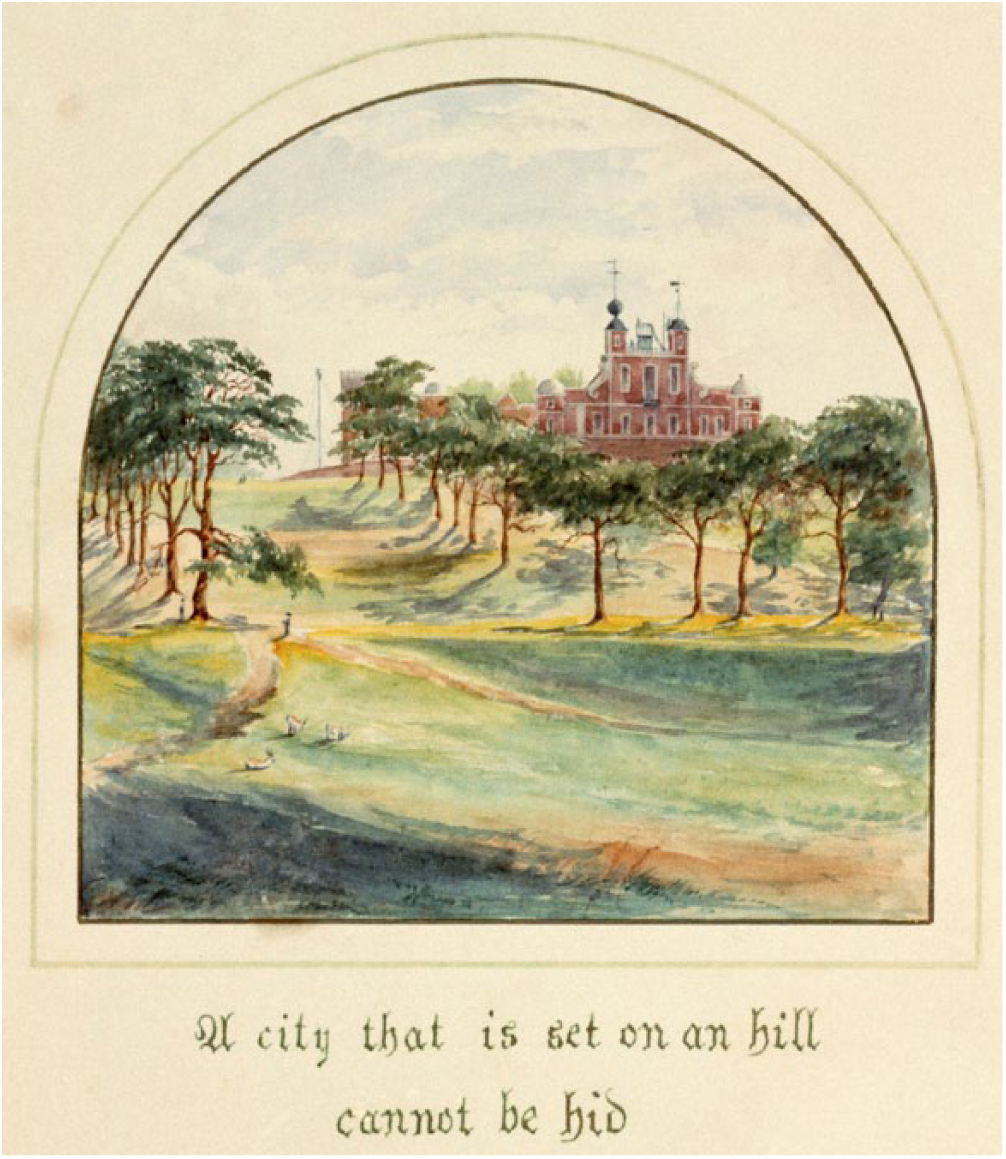
Watercolour sketch of the Royal Observatory made by Christabel Airy in 1865. National Maritime Museum, Image Reference L8633.
In providing the time service that regulated visual and electric signals, the Observatory computing room contributed to the safety and efficiency of everyday life and maritime navigation. As a repository for metrical standards, the institution also contributed to the ease and security of trade. Involved in numerous other public works, George Airy served as the most prolific technical administrator of Victorian Britain. Antiquarian research and scriptural criticism formed the cultural context for a thoroughly modern and highly sophisticated governmental science.
Conclusion
Airy exercised a powerful and sustained influence over British society in the nineteenth century. He contributed to a number of significant parliamentary commissions, introduced technological solutions to everyday problems, and oversaw the production of the sidereal data upon which naval power and shared time depended. By studying his amateur interests, this public work can be placed in a cultural context. Investigations into world events such as the invasion of Britain by Julius Caesar, and rational analysis of scripture, reveal an intuitive conception of Victorian Britain’s place in a global meta-history. This religious and antiquarian consciousness was reflected in the scale and the character of Airy’s contributions to Victorian government.
Not only did antiquarian research inspire Airy’s work, it also equipped him with the tools to encode and communicate his expertise. Making use of the historical, symbolic, and architectural resources at his disposal, Airy translated new forms of knowledge into a familiar governmental language to provide effective organisational structures. The work of turning Victorian Britain into a cohesive and efficient nation, often described in terms of modernity, was accomplished through appeal to an ancient precedent.
Footnotes
Acknowledgements
I would like to thank Professor Simon Schaffer, Doctor Louise Devoy, and Doctor Richard Dunn.
Funding
This paper developed from research funded by the Arts and Humanities Research Council and benefitted from a research placement at the National Maritime Museum in 2015.