




Abstract
A set of tables devoted to the sun and the moon, titled the Candrārkī (“Related to the moon and sun”), was compiled in Sanskrit by Indian astronomer Dinakara along with a short accompanying text, intended to give guidance on how to construct a calendar (pañcāṅga) for any desired year and geographical circumstances. The epoch of this table-text is 9 April 1578. We present here an edition of the text, a literal translation, and detailed technical commentary.
Introduction
The Candrārkī (“Related to the moon and sun”) 1 is the name given to the table-text composed by Dinakara, an astronomer working in the latter half of the sixteenth century. The work comprises a short treatise and a set of numerical tables whose epoch is Śaka 1500 which corresponds to 9 April 1578 (Gregorian calendar), which happens to be a Sunday. The last verse of this text reveals that Dinakara composed the work while residing in a village called Vāreja (Bāreja?), which has been tentatively identified as the modern city of Bariya in Rewa Kantha, Gujarat. 2 He can also be linked to the patrilineal Kuśikasa lineage (gotra) and the Moḍhajñāti family; one manuscript (Baroda 3119) reveals Dinakara’s father’s name to be Rāmeśvara.
Dinakara is of special interest to second millennium Sanskrit astronomy because, as far as we can tell based on extant sources, he is one of the few astronomers who composed original works exclusively in the table-text genre. His other works include table-texts titled the Kheṭasiddhi (epoch Śaka 1500) and the Tithisāraṇī or Dinakarasāraṇī (epoch Śaka 1505). He also composed a commentary (ṭīkā) on the Grahalāghava of Gaṇeśa Daivajña and a gloss (ṭippaṇa) on the Candrārkī. 3
As is explicitly stated in the opening verse, Dinakara’s overall intended purpose of this work is to provide the reader with the means to create their own customised calendar (pañcāṅga) for a specific year and their local circumstances. Accordingly, the text contains details on how to compute the various elements associated with the calendar in addition to the true longitudes and velocities of the sun and the moon. These involve the lord of the year, the epact, and the lunar anomaly; the so-called Rāmabīja corrections; the local time and local sunrise; the tithis, karaṇas, yogas, and nakṣatras; and the placement of intercalary months.
Along with the text, there are four sizeable numerical tables, the data in which can be used either directly or indirectly to obtain the true positions of the sun and the moon (an example of one of them can be seen in Figure 1). The first is a table of true solar longitudes and the corresponding velocities for 0 to 365 days. The second is a table of the mean motion of the moon and anomaly for 0 to 365 days, and after that, a third table for the same phenomena for 1 to 60 ghaṭikās. The fourth and final table contains the lunar equation for 0 to

The beginning of the solar positions and velocities table from a manuscript of the Candrārkī (RORI 20220 f. 1v).
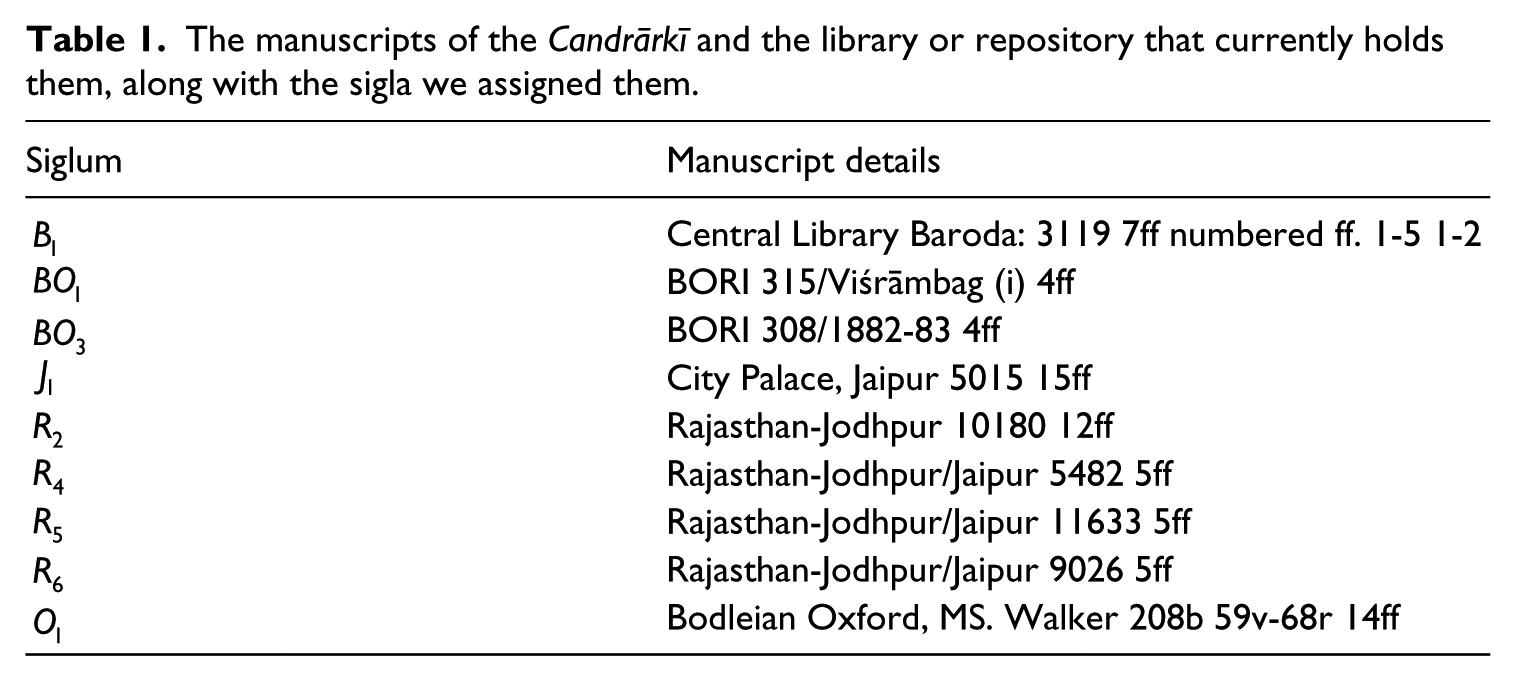
The Candrārkī was obviously a popular text as it survives in over 150 manuscripts (Pingree, 1970–1994, A3 102–104, A4 109, A5 138–139). Accordingly, the state of the manuscript tradition of the Candrārkī is complex; the work exists in manuscripts containing the text only, or the tables only, as well as the text and tables together. On the basis of nine manuscripts which were accessible to us (see Table 1), we present here an edited version of the text, a translation, and a detailed technical commentary. We defer the publication of the critically edited text along with the critical apparatus until more manuscripts can be sourced and a better sense of the text and its variants can be recorded. We hope that this current study serves as a foundation for further study on the work. Furthermore, given the size and scope of the table-text, we have focused on the text here, with due acknowledgement of the tabular data where appropriate. We leave the critical edition and analysis of the tables and the numerical data they contain to future studies.
The manuscripts of the Candrārkī and the library or repository that currently holds them, along with the sigla we assigned them.
Remarks on the title
The title of the text Candrārkī is rather puzzling when one attempts to try to interpret the word as a compound to refer to “something related to the sun and the moon” based on standard rules of Pāṇinian grammar. In order to obtain such a compound as per these standard rules, one would expect the form of such a compound to be either Candrārkī or Candrārkīyam just like the more familiar titles such as the Āryabhaṭīyam (a famous work in astronomy by Āryabhaṭa) or the Kirātārjunīyam (a beautiful literary work by Bhāravi).
However, this not being the case, the name of the text seems to have been coined in the same spirit as other famous titles like the Pañcadaśī (a text in Advaita Vedānta) or the Dinakarī (an erudite commentary on the text Nyāyasiddhāntamuktāvalī). As the title seems to be grammatically anomalous, it may be appropriate instead to consider it as a proper name (saṃjñā), which of course is thoughtfully coined as it immediately conveys the content of the text.
Remarks on the date
In verse 4, Dinakara indicates the epoch of the Candrārkī to be Śaka 1500. Śaka 1500 corresponds to year 4679 of the Kaliyuga. Using the year length given by Dinakara (see “Relation of this work to other astronomical texts” section), the kalyahargaṇa corresponding to (mean) Meṣasaṅkrānti in Śaka 1500 is thus

This day corresponds to a Sunday. When one considers the epochal lord of the year parameter for Śaka 1500, that is, तैर्नभस्त्रिभिरगैर्भ्रमः क्रमात् स्वांशशुद्धिशनिवारपूर्वयोः ॥ ५ ॥
tair nabhastribhir agair bhramaḥ kramāt
svāṃśaśuddhiśanivārapūrvayoḥ || 5 || When they (i.e., the cumulative tithis and days) [are divided] by thirty and seven, the fractional part of the cycle [obtained gives] the epact and [the weekday] commencing with Saturday, respectively.
It is also confirmed by a commentary on the Candrārkī, which, while discussing an example, obtains a value of
Brief description of the tables that accompany this text
The versified text is to be read in conjunction with four distinct numerical tables. A critically edited version of the tables, along with a detailed analysis of their contents, will appear in a forthcoming study.
5
In summary, the first table concerns the sun, the other three, the moon. Their contents provide the data to determine the true positions and velocities of the sun and the moon. Essentially, in the Indian tradition, because the solar apogee is fixed (at
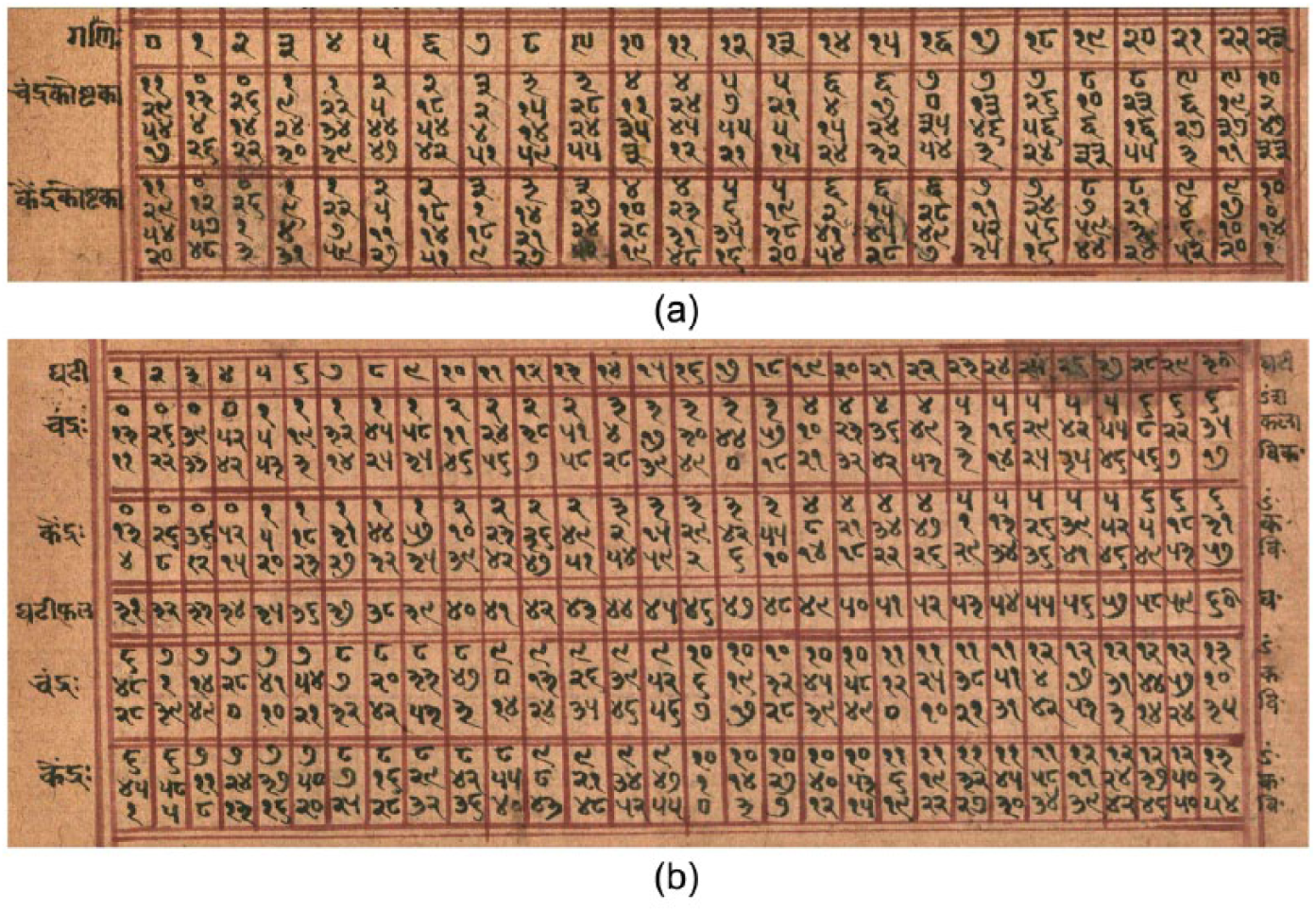
Tables for the mean motion of the moon and anomaly from a manuscript of the Candrārkī (RORI 20220): (a) per day (beginning, f. 4v) and (b) per ghaṭikā (f. 8r).
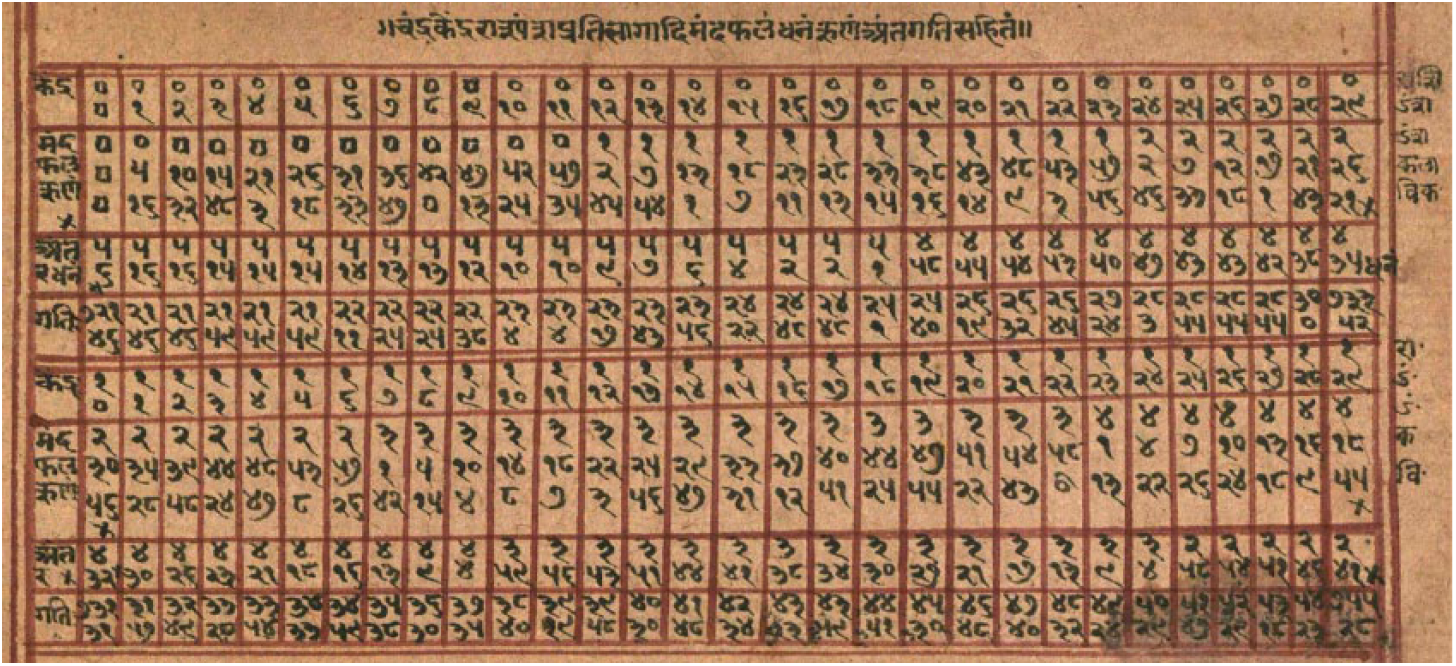
The beginning of the lunar manda-equation and velocity table from a manuscript of the Candrārkī (RORI 20220 f. 8v).
Relation of this work to other astronomical texts
The Candrārkī stands connected in both direct and nuanced ways to other Sanskrit astronomical works, particularly table-texts. While listing the parameters that are to be employed for the construction of tables in verse 2, Dinakara mentions their origins to be that of the Brahmapakṣa. Indeed, the foundational parameter of calendrics—namely, the length of the sidereal year—can be traced back to the Paitāmahasiddhānta. The canonical sidereal year length in days in the Brahmapakṣa is given as (Paitāmaha 3.32) 6

This parameter, however, was modified by later authors, most notably in the Rājamṛgāṅka by Bhojarāja (1042). This work was significant for its updated planetary mean motion parameters by means of the so-called bīja-corrections. In the case of the sidereal year, Bhojarāja updated its length by 0;0,0,54,47,19 days 7 so that the revised length of the sidereal year became

This year length was adopted by others, most notably by Mahādeva in his eponymously named Mahādevī, a table-text which proved to be widely popular (epoch Śaka 1238, or 1315
In comparison, the modern value of the sidereal year is

It is evident that the year length first proposed by Bhojarāja and adopted by Mahādeva and Dinakara is cruder compared to the original Brahmapakṣa value. 8
Verses two to four present data related to important calendric parameters, including the annual multipliers (guṇaka) of the lord of the year (varṣeśa), the epact (śuddhi), and the scaled lunar anomaly (kendra) as well as their epoch adjustments or additives (kṣepaka), which can be linked back to prior sources (see Table 2). In addition to these parameters being woven into verse, many scribes have included these data in a table alongside the verse (see, for instance, Figure 4 or 8).
Annual increments and epoch adjustments for the Candrārkī.
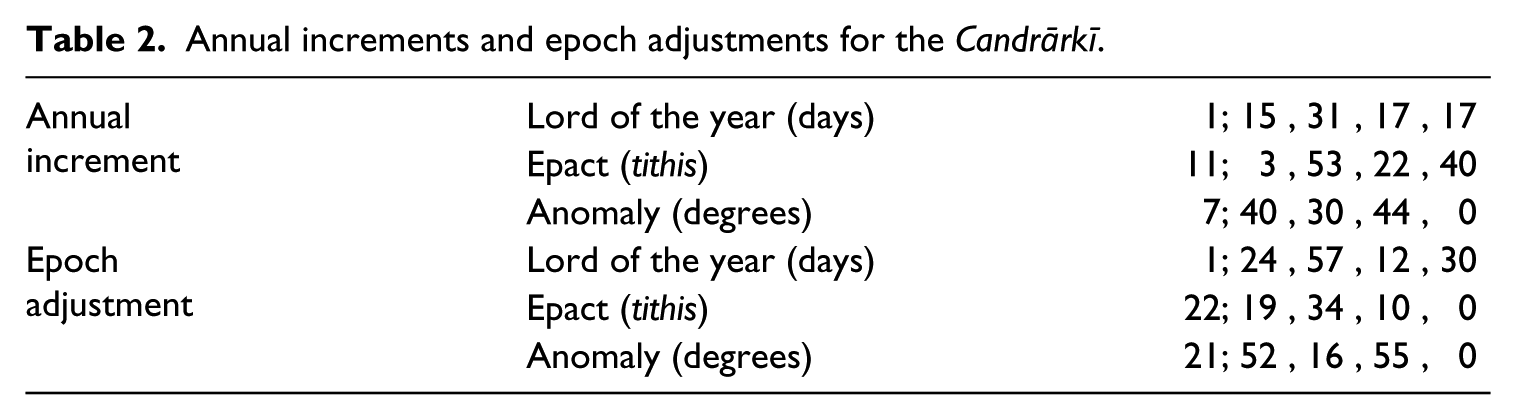
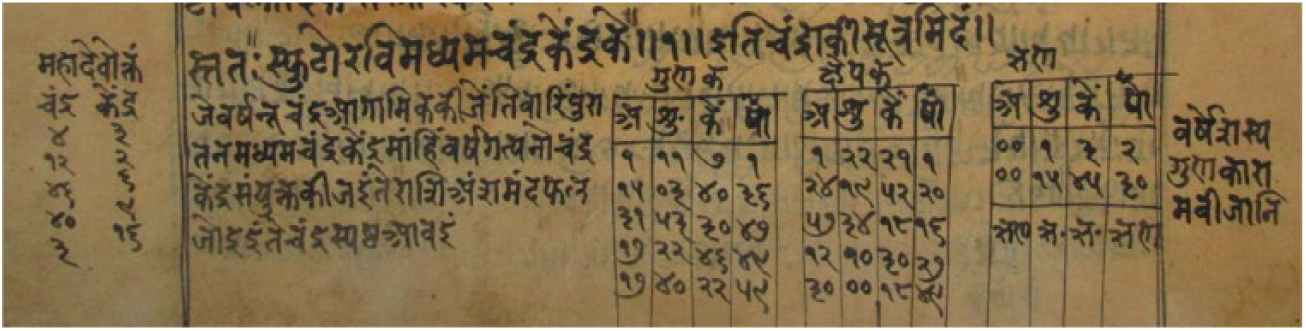
Table of annual increments included in the left-hand margin of a manuscript of the Candrārkī from the Mahādevī of Mahādeva (MS RORI 11633 f. 4r).
These annual parameters are in fact based on those given in the Mahādevī of Mahādeva, as are the Rāmabījas (which are included in versified form later on in the text). In fact, one manuscript of the Candrārkī gives the annual lunar longitudinal displacement and the anomaly values in the margin explicitly linking them to the Mahādevī (see Figure 4).
One particular manuscript of the Mahādevī (MS. RAS Tod 24) includes a set of numerical parameters rather like the one found in the Candrārkī (see Figure 5). But much to our astonishment, further down in the text, the scribe of this manuscript had also included two tables containing the Candrārkī’s annual parameters and epoch adjustments (see Figure 6) as well as the Rāmabīja corrections (see Figure 7) with an explicit acknowledgement of the Candrārkī as their source in the right-hand margin.

Table of kṣepakas, guṇakas, and Rāmabījas from a manuscript of the Mahādevī of Mahādeva (RAS Tod 24, f. 2v).
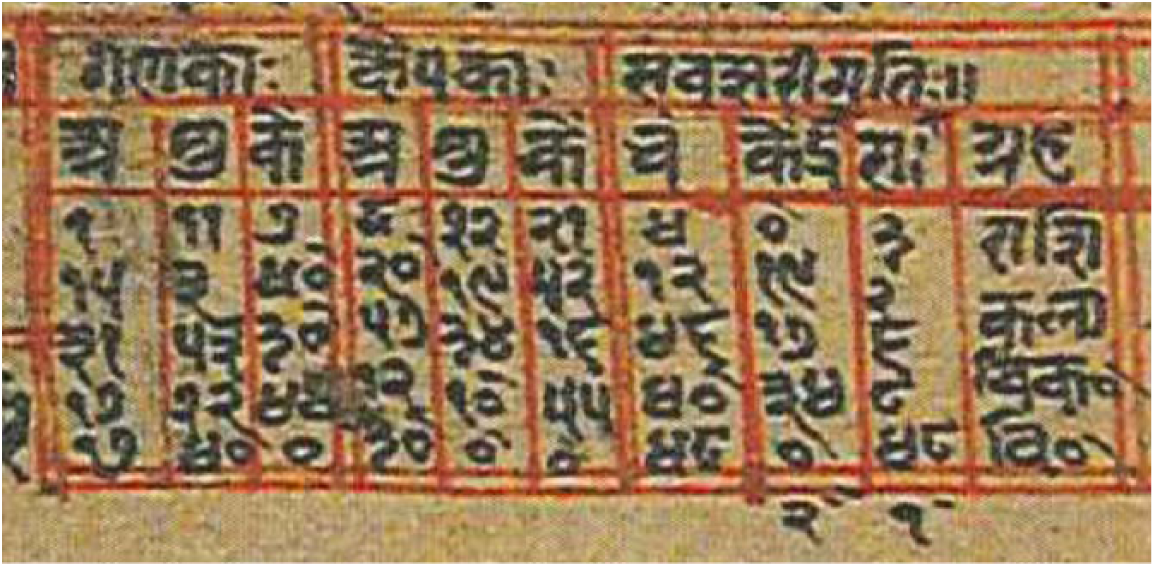
Table of Candrārkī’s kṣepakas and guṇakas included in a manuscript of the Mahādevī of Mahādeva (RAS Tod 24, f. 2v).

Table of Candrārkī’s Rāmabījas, included in a manuscript of the Mahādevī of Mahādeva (RAS Tod 24, f. 2v), along with a marginal note explicitly linking them to the Candrārkī.
Text and translation
In this section, we present the text of the Candrārkī, first in Devanāgarī script, then in transliteration, followed by a translation and a technical commentary. The text has been established on the basis of a thorough study of the nine manuscripts which were available to us. Important editorial remarks, where appropriate, have been included in the discussion after the verse translation.
In our translation, square brackets [ ] represent an addition to the translation for sense and meaning. In addition, round brackets ( ) indicate an editorial gloss to clarify the text. Each verse has had the metre identified.
Invocation and the purpose of the work
श्रीगणेशाय नमः ॥ श्रीसूर्याय नमः ॥ सूर्यं चन्द्रं सद्गुरुं भक्तिपूर्वं नत्वा वक्ष्ये सूर्यचन्द्रोद्भवं च । पत्रं पञ्चाङ्गाभिधं बुद्धिवृद्ध्यै ग्राह्यं तज्ज्ञैर्युक्तिमत् तन्मयोक्तम् ॥ १ ॥॥ शालिनी ॥ śrīgaṇeśāya namaḥ || śrīsūryāya namaḥ ||
sūryaṃ candraṃ sadguruṃ bhaktipūrvaṃ
natvā vakṣye sūryacandrodbhavaṃ ca |
patraṃ pañcāṅgābhidhaṃ buddhivṛddhyai
grāhyaṃ tajjñair yuktimat tanmayoktam || 1 |||| śālinī || Homage to Lord Gaṇeśa. Homage to the Lord Sūrya.
Having paid homage to the sun, the moon, and the great guru with complete devotion, I am going to spell out tables (patra), generated from the positions of the sun and the moon, called pañcāṅga. This rationale-based (yuktimat) [pañcāṅga] stated by me may be received by the specialists of that for expanding their knowledge.
Technical analysis
In line with tradition, Dinakara pays obeisance to his preferred deities. Then, in keeping with his title, Candrārkī, he indicates that the focus of this work is solar and lunar phenomena, which is all that is required for reckoning the various time units, the so-called pañcāṅga, or “five elements”: tithi, vāra, nakṣatra, yoga, and karaṇa.
More broadly, Dinakara’s invocatory verse also gives the reader a glimpse into the motivation of this work: to present a set of tables with accompanying verses for the reader to construct their own customised calendar for any desired year and local geographical circumstances. This sentiment is reinforced in verse 10 and again in verses 15 to 17, when Dinakara gives specific instructions for filling in table entries.
Parameters related to the lord of the year, epact, and lunar anomaly
चन्द्रो घस्राः क्वग्नयोऽत्यष्टिदृष्टी रुद्रास्त्रिस्त्रीष्वश्विदस्राः खवेदाः । शैलाभ्राब्ध्यभ्राग्निवेदाब्धयश्च वर्षेशादेः स्युर्गुणा ब्रह्मपक्षे ॥ २ ॥॥ शालिनी ॥ मही कृताक्षीणि नगेषवश्च सूर्याः खरामाश्च समेश्वरस्य । क्षेपो द्विदस्रा नवचन्द्रतुल्याः कृताग्नयो दिग्गगनं च शुद्धे ॥ ३ ॥॥ उपजाति ॥ एकाधिकाविंशतिदस्रबाणा नृपाः शराक्षा गगनं च केन्द्रे । शाको विहीनो गगनाभ्रघस्रैः निघ्नो गुणैः क्षेपयुतो ध्रुवः स्यात् ॥ ४ ॥॥ उपजाति ॥
candro ghasrāḥ kvagnayo’tyaṣṭidṛṣṭī
rudrāstristrīṣvaśvidasrāḥ khavedāḥ |
śailābhrābdhyabhrāgnivedābdhayaś ca
varśeṣādeḥ syur guṇā brahmapakṣe || 2 |||| śālinī ||
mahī kṛtākṣīṇi nageṣavaś ca
sūryāḥ kharāmāś ca sameśvarasya |
kṣepo dvidasrā navacandratulyāḥ
kṛtāgnayo diggaganaṃ ca śuddhe || 3 |||| upajāti ||
ekādhikāviṃśatidasrabāṇā
nṛpāḥ śarākṣā gaganaṃ ca kendre |
śāko vihīno gaganābhraghasraiḥ
nighno guṇaiḥ kṣepayuto dhruvaḥ syāt || 4 |||| upajāti || One (candra), fifteen (ghasra), thirty-one (ku-agni), seventeen twice (atyaṣṭi-dṛṣṭi); eleven (rudra), three (tri), fifty-three (tri-iṣu), twenty-two (aśvi-dasra), forty (kha-veda); seven (śaila), forty (abhra-abdhi), thirty (abhra-agni), forty-four (veda-abdhi) are the multipliers (gunas) of the lords of the years and so on according to the Brahmapakṣa. One (mahī), twenty-four (kṛta-akṣi), fifty-seven (naga-iṣu), twelve (sūrya), thirty (kha-rāma) is the additive quantity (kṣepa) of the lord of the year. Twenty-two (dvi-dasra), nineteen (nava-candra), thirty-four (kṛta-agni), ten (diś), zero (gagana) is the [additive quantity] of the epact (śuddhi). Twenty-one (ekādhikāviṃśati), fifty-two (dasra-bāṇa), sixteen (nṛpa), fifty-five (śara-akṣa) is [the additive quantity] for the anomaly (kendra). The [desired] śaka year diminished by 1500, multiplied by the guṇakas and increased by the kṣepa are the [three] epoch corrected parameters (dhruva) for the current year.
Technical analysis
In order to prepare the calendar (pañcāṅga) for a particular year, among other things, one needs to know (a) the weekday of the first day of the year, (b) whether that year requires the insertion of an intercalary month, and (c) what the true position of the moon is at the beginning of the year. These can be determined from the lord of the year, the epact, and the lunar anomaly, respectively.
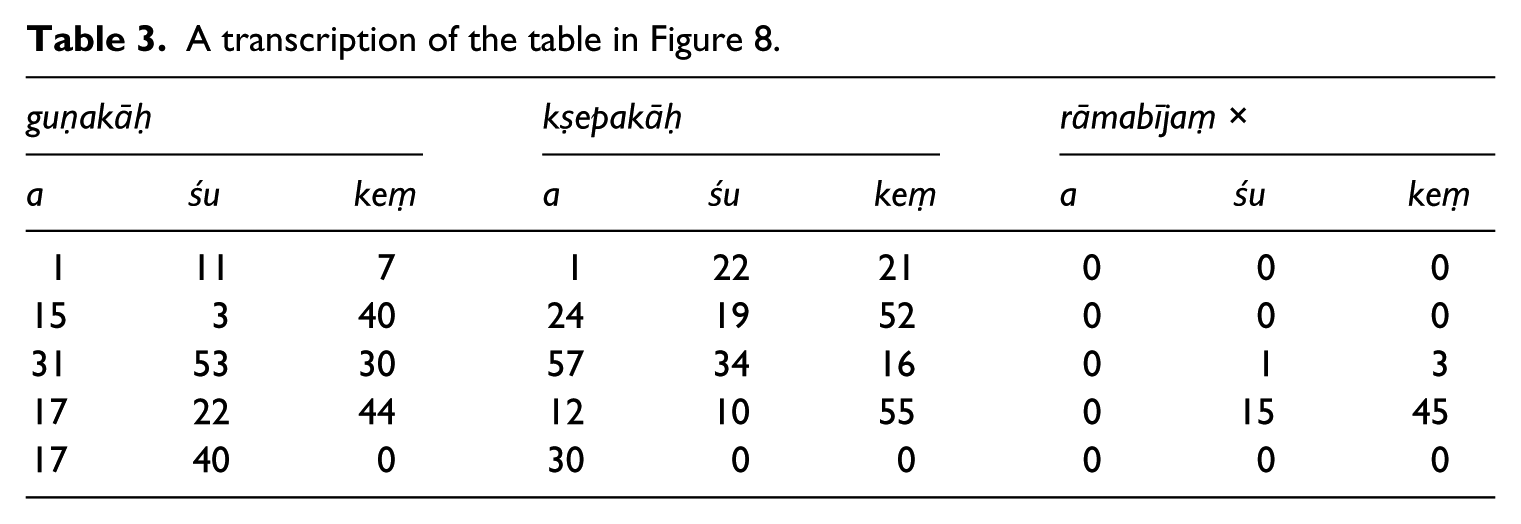
This trio of verses presents numerical data related to these quantities, namely, the lord of the year (varṣeśa), the epact (śuddhi), and the lunar anomaly (kendra), each with respect to their epoch position (kṣepaka) and their annual increment (guṇaka). Almost all manuscripts include a graphical table alongside the text containing these parameters (see Figure 8/Table 3 for an example as well as Rāmabīja corrections which are stated in verse 6). These are Brahmapakṣa parameters (see Pingree, 1978, Table V.53).
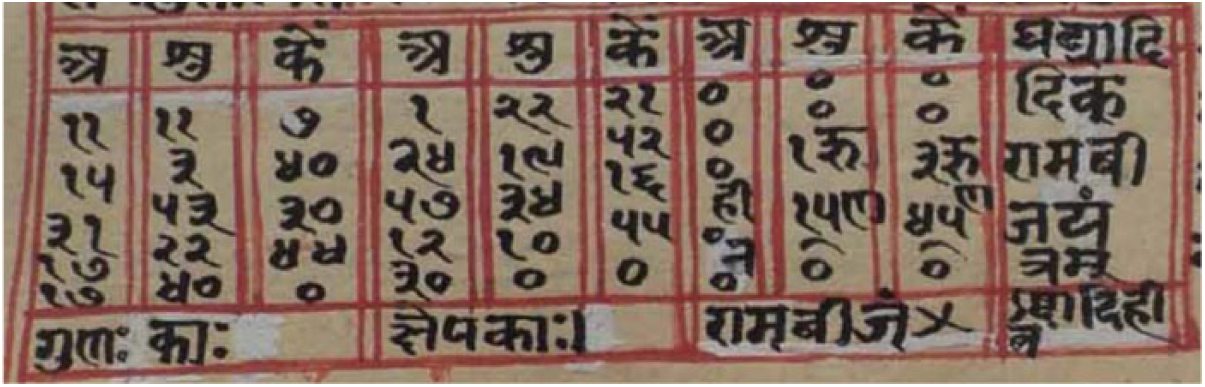
An image of the table containing data on the lord of the year, the epact, and the anomaly. The contents of this table are expressed in verses 2 to 4 (MS Jaipur 5015, f. 1v).
A transcription of the table in Figure 8.
In what follows, we explain briefly what these parameters stand for and how the values of the guṇakas specified in the text have been arrived at.
Lord of the year
The lord of the year is the excess measured in integer and fractional days that a sidereal year Y exceeds a “year” of fifty-two 7-day weeks. In other words

Among other things, the lord of the year parameter allows one to keep track of the weekday in which the beginning of the year falls. While it is never explicitly stated, this parameter confirms the length of the sidereal year to be
Accordingly, the mean daily motion of the sun

It may be noted that this is the same as the value given in the Āryabhaṭīya, namely,
Epact
The epact is the number of tithis 9 by which the solar year is in excess of the lunar year. The moon’s mean daily motion, given later in the text (verse 14), is

From equations (1) and (2), the mean rate of increase in the elongation between the sun and the moon is

Using this value, the duration of the mean synodic (lunar) month in civil days is found to be

From the above value expressed in the units of a civil day, 10 one can obtain the duration of a mean tithi as follows

Now, the duration of a lunar year y (with no intercalary months), in terms of civil days is given by

In order to determine the epact, the difference, in tithis, between the sidereal year and the lunar year is to be calculated. For this, we first need to obtain the duration of a sidereal year in terms of tithis. This is done by dividing the sidereal year by the duration of the tithi in terms of civil days given by equation (5). That is

As there are 360 tithis in a lunar year, the epact is

This value is slightly higher than the value 11;3,53,22,40 given in Table 3; the reason for this could be intermediate rounding at various stages of the computation.
Lunar anomaly
The annual lunar anomaly is the difference between the degrees of longitude of the moon and its apogee accumulated over the course of 1 solar year, with integer rotations removed. The mean rate of increase in the lunar anomaly in 1 day is given in verse 14 as

Therefore, the change of anomaly per sidereal year is

This is not the value given by Dinakara, however. Dividing this by 12, we obtain a scaled value of the anomaly

This is close to the tabulated value of 7;40,30,44,0 which we will refer to as the scaled kendra. The purpose of scaling by a factor of 12 is essentially to bring in much simplification to the numerical computation, which will become evident later. 11
Derivation of the epoch adjustments
Given the apparent connection between the Mahādevī and the Candrārkī as established in the “Relation of this work to other astronomical texts” section, we posit that the epoch adjustments can also be derived from Mahādevī parameters. The epoch of the Mahādevī is Śaka 1238, so that the number of elapsed years between the two works is

Given the Mahādevī’s epoch adjustments for the lord of the year and the epact are
for the lord of the year

and for the epact

which are exactly the same as the values given by Dinakara (see Table 2).
Due to its mean-to-true tabular structure, namely that true planetary positions can be directly retrieved from the table (and equations do not have to be applied), the Mahādevī does not tabulate the lunar anomaly directly. Therefore, we cannot trace the details of the numerical values of Dinakara’s lunar anomaly in the same way as we could do for the lord of the year and the epact.
Combining these parameters for the desired year
The final quarter of verse 4 prescribes how these data are to be combined. Decreasing the desired Śaka year by 1500, 12 one finds the number of years n elapsed since the epoch. The dhruva or numerical offset for the beginning of the desired year defined by

is then computed for each parameter (lord of the year, epact, and lunar anomaly) as follows. If



The above expressions give the values of the dhruvas in the units of days, tithis, and degrees, respectively. The semicolon introduced among the numerals indicates the separation between the integer and the fractional parts of the respective units. As discussed above (see equation (9)), the lunar anomaly has been scaled by 12 for arithmetical convenience (for a fuller discussion of this, see verse 5). Numerical reconstructions reveal that the kṣepaka too has been scaled by 12 as has the guṇaka. 13
A note on the variant readings of the verse
Given notable manuscript discrepancies which may point to scribal confusion, we have taken the liberty to emend the compound in the first quarter of verse 2 to the unattested dṛṣṭī (“two,” “twice”), as the numerical parameter associated with the annual lord of the year increment (attested in the table in Figure 8/Table 3, and elsewhere) requires the reading of
Also, on the basis of these attested data, we have followed a single manuscript (
Determination of the lord of the year, the epact, and the anomaly
वर्षपे सप्तभिः शेषं शुद्धिकेन्द्रे च त्रिंशता
14
। अर्कघ्ने शुद्धिकेन्द्रे च लवाद्ये चन्द्रकेन्द्रके ॥ ५ ॥॥ अनुष्टुभ् ॥
varṣape saptabhiḥ śeṣaṃ
śuddhikendre ca triṃśatā |
arkaghne śuddhikendre ca
lavādye candrakendrake || 5 |||| anuṣṭubh || When the lord of the year [is desired, divide the dhruva] by 7. The remainder [gives the result]. The [accumulated] epact [in tithis] and the [scaled-]anomaly [in degrees are to be divided] by 30. [The remainders will give the tithi-number and the degrees corresponding to the dhruva]. [The resulting] epact and [scaled-]anomaly when multiplied by 12 give the moon’s longitude and its anomaly in degrees and so on [respectively].
Technical analysis
Verses 2 to 4 described in the previous section laid down the necessary parameters and procedures for obtaining the dhruvas. In the above verse, Dinakara succinctly outlines how to obtain the lord of the year, the epact, and the lunar anomaly at the beginning of the current year using those values. The accumulated values (dhruvas) of the above quantities from the start of the epoch to the desired year can be determined using equation (10). As the lord of the year gets completely determined from the length of a sidereal year in excess of a full 52 weeks, it is obvious that the remainder obtained by dividing the accumulated value of this quantity by 7 gives the number of weekdays, in excess of full weeks, elapsed since the start of the epoch. The weekday at the start of the current year (

Adjusting this for the known difference between the start of the lunar and the sidereal year gives the weekday of the first day of the desired lunar year.
Similarly, the remainder obtained by dividing the accumulated epact by 30 gives the number of tithis, in excess of complete lunar months, elapsed since the beginning of the epoch. Denoting the epact at the start of the year by

Depending upon the value of the epact, and other considerations, 15 one can decide whether or not to introduce an intercalary month in the succeeding lunar year. This is discussed in a later verse.
Finally, dividing the scaled lunar anomaly by 30 gives the true lunar anomaly at the beginning of the year. It may be recalled that the value of the guṇaka for the lunar anomaly given in the text was obtained by scaling the actual value by a factor of 12, as indicated in the previous section (see equation (9)). That is, the scaled anomaly is 1/12th of the true anomaly. Thus, the RHS of equation (13) gives only 1/12th of the actual change in anomaly.
Now, dividing the accumulated scaled anomaly by 30 is equivalent to dividing the accumulated true anomaly by 360. The remainder obtained by this division gives the true lunar anomaly at the beginning of the year. Denoting the true lunar anomaly at the start of the year by

The second half of the verse presents two shortcuts to determine the longitude and anomaly of the moon. First, it states simply that by multiplying the resulting epact by 12, we obtain the longitude of the moon. This is because the longitude of the sun at the start of a year is zero, and a tithi is nothing but the time taken by the moon to overtake the sun by 12°. Thus, it is obvious that the epact at the start of the year multiplied by 12 gives the longitude of the moon. Denoting the longitude of the moon by

Similarly, as the scaled anomaly (

Incidentally, this verse highlights a common theme in Dinakara’s work, namely, to employ arithmetical tricks to make the numerical computations easier for the table-user.
Rāmabīja corrections
ऋणं शुद्धौ घटी चैका पलं घस्रमितं ऋणम् । केन्द्रे राममिता घट्यः पञ्चवेदाः पलम् ऋणम् ॥ ६ ॥॥ अनुष्टुभ् ॥
ṛṇaṃ śuddhau ghaṭī caikā
palaṃ ghasramitaṃ ṛṇam |
kendre rāmamitā ghaṭyaḥ
pañcavedāḥ palam ṛṇam || 6 |||| anuṣṭubh || A measure of 1 ghaṭī and 15 palas [should be applied] negatively to the epact. To the anomaly, 3 ghaṭīs [should be applied] negatively [and] 45 palas [also] negatively.
Technical analysis
This verse gives the so-called Rāmabījas in versified form. In many manuscripts, these are given in a graphical table as well (see Figure 8/Table 3 for details). These are identical to the ones given in a manuscript of the Mahādevī (see Figure 4). 16 The precise details on how these should be applied to the mean longitudes in this context are not clearly understood. We assume that these are one-off corrections.
The words ghaṭī and pala employed do not seem to be used in the normal sense of ghaṭikās and palas referring to the time units, but rather the 60th part of whatever quantity is in question. This is because, as per the prescription in the verse, a certain amount of ghaṭīs and palas have to be applied to the kendra. We know that the dimension of kendra is not in time units but is an angular measure.
Obtaining the local time at Meṣasaṅkrānti
स्वदेशान्तरयोजनैश्चतुर्थांशेन वर्जितैः । वर्षेशस्य विनाडीषु स्वमृणं पूर्वपश्चिमे ॥ ७ ॥॥ अनुष्टुभ् ॥ svadeśāntarayojanaiś caturthāṃśena varjitaiḥ | varṣeśasya vināḍīṣu svam ṛṇaṃ pūrvapaścime || 7 |||| anuṣṭubh || [Depending on whether one’s place is] to the east or the west [of the standard meridian], the separation in yojanas of one’s own place [and the meridian] reduced by one-fourth of it [is to be applied] positively or negatively to the vināḍīs of the lord of the year.
Technical analysis
The above verse essentially provides the necessary correction for obtaining the time that has elapsed since the sunrise at the observer’s location to the time of meṣasaṅkrānti. The time of meṣasaṅkrānti, that is, the transition of the sun into zodiacal sign Meṣa (Aries), at the standard meridian is the same as the fractional part of the lord of the year.
The three celestial spheres that are depicted in Figure 9 all have the same stellar configuration, namely, the sun at meṣasaṅkrānti. While Figure 9(a) corresponds the celestial sphere for an observer on the standard meridian, Figure 9(b)
17
and (c)
18
correspond to observers to the east and the west of the standard meridian, respectively. If

and

Since
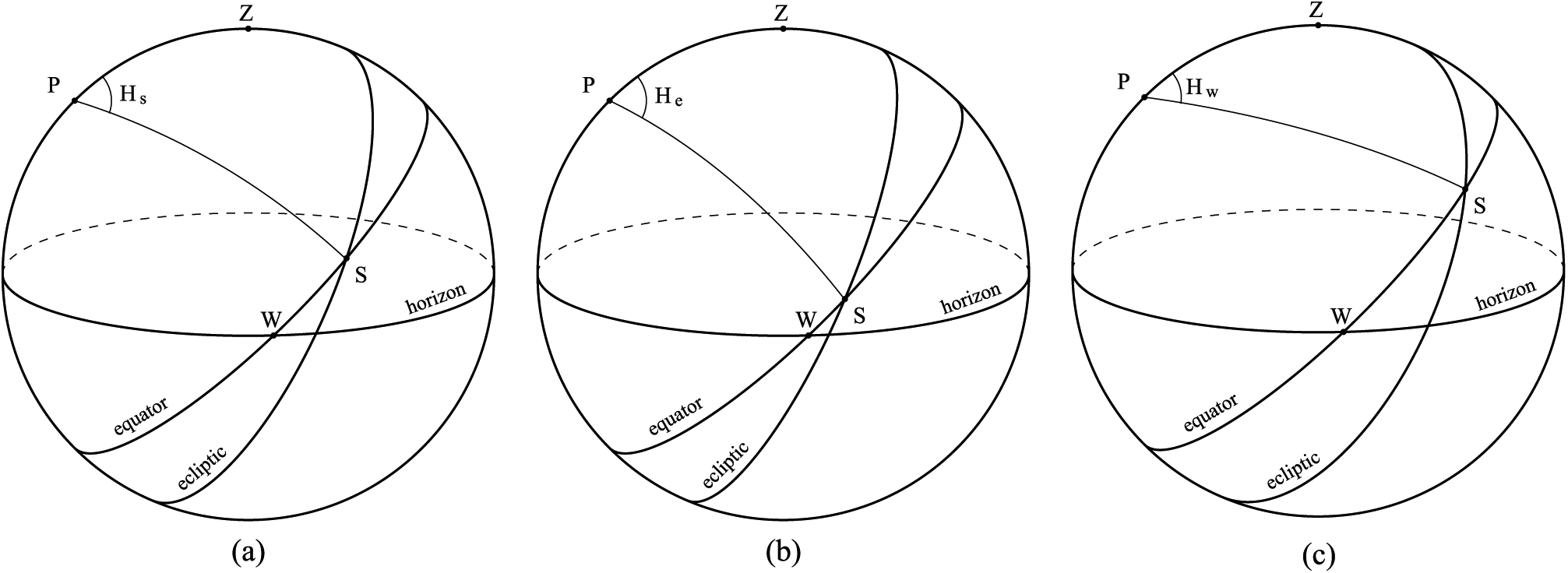
Schematic representation of certain configurations of the celestial sphere at meṣasaṅkrānti. (a) for an observer at the standard meridian, (b) for an observer to the east of the standard meridian, and (c) for an observer to the west of it.
In general, if

This is what is stated succinctly in the verse by the phrase svamṛṇaṃ pūrvapaścime.
The procedure for obtaining

This proportion gives rise to the rule expressed in the verse, namely

where L is the distance in yojanas between the standard meridian and the local meridian along the equator.
Let

where
The longitude of the sun at local sunrise
तस्य नाड्या गतिर्निघ्ना तरणेर्निजकोष्ठजा । षष्ट्या लब्धफलं सूर्ये ऋणं सूर्योदये रविः ॥ ८ ॥॥ अनुष्टुभ् ॥ यावद्वर्षपतौ त्रिंशद्घटी तावदयं विधिः त्रिंशद्भ्योऽभ्यधिका यत्र गम्याभिर्धनचालनम् ॥ ९ ॥॥ अनुष्टुभ् ॥
tasya nāḍyā gatir nighnā
taraṇernijakoṣṭhajā |
ṣaṣṭyā labdhaphalaṃ sūrye
ṛṇaṃ sūryodaye raviḥ || 8 || || anuṣṭubh ||
yāvad varṣapatau triṃśadghaṭī
tāvadayaṃ vidhiḥ |
triṃśadbhyo’bhyadhikā yatra
gamyābhir dhanacālanam || 9 || || anuṣṭubh || The daily motion of the sun found in its appropriate tabular cell should be multiplied by the nāḍīs of that (i.e., the time elapsed from sunrise until meṣasaṅkrānti). The result divided by the 60 is applied negatively to [the longitude of] the sun. This gives [the longitude of] the sun at sunrise. This is the rule as long as [the fractional measure of] the lord of the year is [less than or equal to] 30 ghaṭīs. If it exceeds 30 ghaṭīs, [then] the longitude correction is additive and [is to be determined] from the time that is yet to elapse [till the next sunrise].
Technical analysis
The above verses describe how to obtain the longitude of the sun at local sunrise on the day in which meṣasaṅkrānti occurs. This can be computed by finding the change in the longitude of the sun since sunrise, which in turn can be found by simply multiplying the time that has elapsed since sunrise (which was computed in the previous verse) by the true daily motion of the sun
Let

By applying this correction, we get the true longitude of the sun at local sunrise time on the day in which the year commences.
The corrected longitude of the sun at local sunrise at the beginning of the year is therefore

where
Having specified the magnitude of the correction, the text then elaborates when to add or subtract
The two cases have been depicted in Figure 10(a) and (b), where we find the sun at meṣasaṅkrānti to be above and below the horizon, respectively. In Figure 10(a),
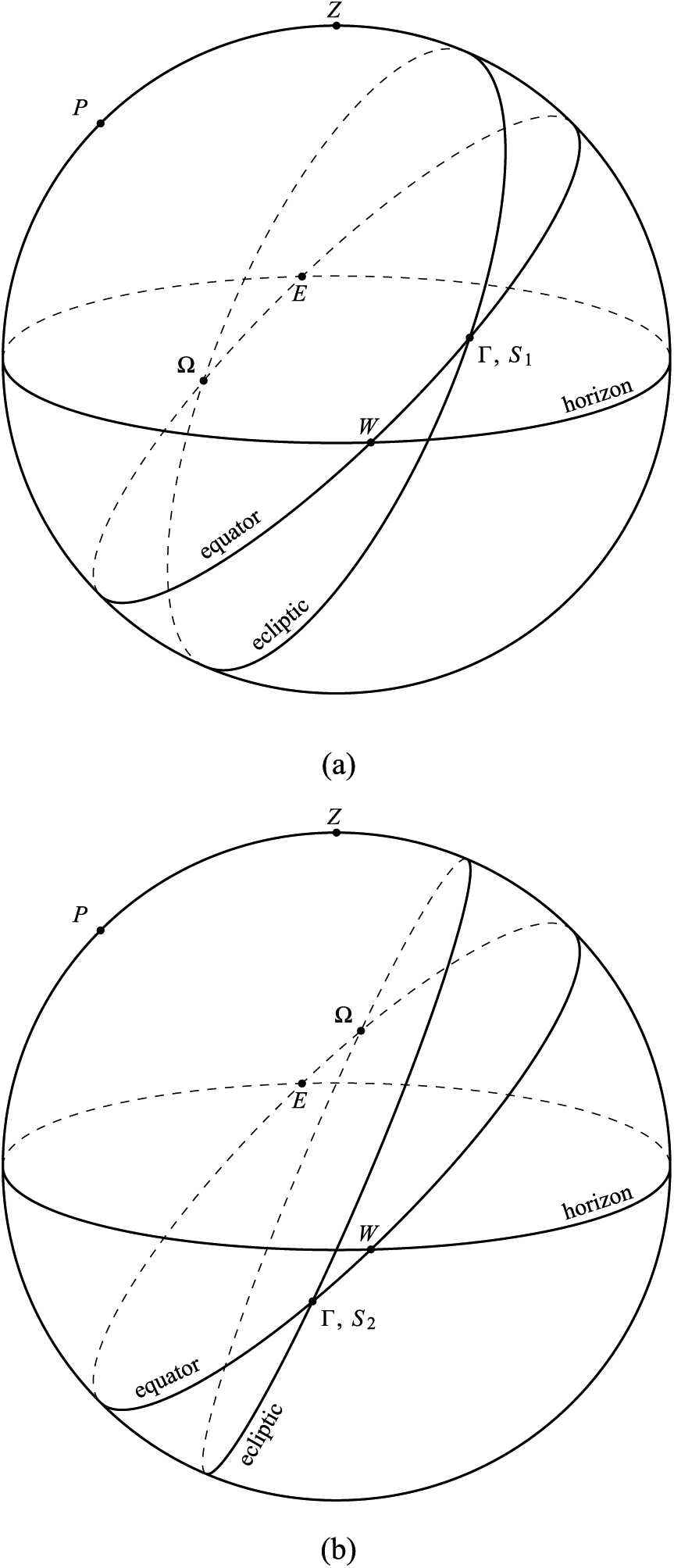
Meṣasaṇkrānti when the sun is above and below the horizon. (a) Case 1: Meṣasaṇkrānti when the sun is above the horizon. (b) Case 2: Meṣasaṇkrānti when the sun is below the horizon.
We illustrate the second case with a numerical example. Let the local meridian be

Obtaining the true daily motion of the sun from the tabulated longitudes of the sun
एवं सूर्योदये सूर्यः कर्तव्यः प्रतिकोष्ठके । विवरं स्पष्टतरयोः गतिः स्पष्टतरा भवेत् ॥ १० ॥॥ अनुष्टुभ् ॥ evaṃ sūryodaye sūryaḥ kartavyaḥ pratikoṣṭhake | vivaraṃ spaṣṭatarayoḥ gatiḥ spaṣṭatarā bhavet || 10 |||| anuṣṭubh || In this way, the longitude of the sun at sunrise is to be computed [and filled] in each of the tabular cells. The difference of the true positions [thus tabulated] gives the true motion of the sun [for each table entry].
Technical analysis
This verse 23 describes in general terms the practical task of building customised solar tables for one’s own location. For this, tabular cells are to be filled in with solar longitudes corrected for longitudinal and latitudinal variations, based on various rules noted above. In the second half of the verse, Dinakara states that the values of the true daily motion of the sun are to be computed by taking the difference between two successive longitudinal entries.
To demonstrate this, we continue with our example from the previous verse. The tabulated values of the true longitude and the true rate of motion one civil day after the beginning of the mean solar year are

Then the true rate of motion between mean sunrises on day 1 and day 2 is

In the siddhāntic approach, if an almanac maker wants to compute the true rate of motion at his own mean sunrise for each exact anomaly value, they would have to do it using the formulae that involve the computation of the sine function, its inverse, and the cosine function as well. This would indeed defeat the purpose of ease of calculation for which the table-texts are created. This explains the rationale behind the prescription in the latter half of the above verse.
Calculation of the number of civil days from the tithis and vice versa
मधोर्गताः स्युः खगुणैर्विनिघ्ना युक्तास्तिथीभिर्गतसंख्यकाभिः । शुद्ध्योनिताः षष्टिविभागहीनाः गणो भवेद्वर्षपतेः सकाशात् ॥ ११ ॥॥ उपजाति ॥ गणः स्वषष्ट्याप्तफलेन युक्तो शुद्ध्या च युक्तो विभजेत् खरामैः । लब्धं मधोः स्याद्गतमाससंख्या शेषाः सितादेः तिथिरत्र मासे ॥ १२ ॥॥ उपजाति ॥
madhorgatāḥ syuḥ khaguṇair vinighnā
yuktās tithībhir gatasaṃkhyakābhiḥ |
śuddhyonitāḥ ṣaṣṭivibhāgahīnāḥ
gaṇo bhaved varṣapateḥ sakāśāt || 11 |||| upajāti ||
gaṇaḥ svaṣaṣṭyāptaphalena yukto
śuddhyā ca yukto vibhajet kharāmaiḥ |
labdhaṃ madhoḥ syād gatamāsasaṃkhyā
śeṣāḥ sitādeḥ tithir atra māse || 12 |||| upajāti || The months elapsed from the beginning of Madhu (i.e., Caitra) multiplied by 30 are increased by the elapsed number of tithis [in the current month]. [This] when decreased by the epact and diminished by its sixtieth part gives the group of days (gaṇa) from the lord of the year (i.e., the beginning of the solar year). This group of days (gaṇa), increased by its sixtieth part (i.e., giving tithis) and added to the epact is to be divided by 30. [The result] obtained will give the number of months elapsed from Madhu (i.e., Caitra). The remainder gives the number of tithis elapsed since the beginning of the bright-half of the lunar month (sitādi).
Technical analysis
The set of verses above prescribes the necessary procedures to be adopted for converting solar days into lunar tithis, as well as outlines the procedure for obtaining the occurrence of an intercalary month, based on the tithis elapsed since the epact. The procedure commences with the determination of the number of civil days elapsed since the beginning of the solar year. One is to multiply the number of lunar months elapsed since the beginning of the lunar year by 30 and increase this amount by the tithis elapsed in the current month. Then to account for the difference between the start of the lunar year and the solar year, one is to subtract the epact for that current year. The result is the number of tithis since the beginning of the solar year. These tithis (

This conversion technique appears to be based on a ratio close to the well-attested approximation 61 tithis = 60 days, 25 so that

It can be seen that the latter relation is a slightly better approximation when we note that the duration of a tithi is
Conversely, the number of days from the beginning of the solar year can be converted to tithis via

These resulting tithis are then increased by the epact, and the sum is divided by 30. The resulting quotient gives the number of lunar months, and the remainder, the tithi number in the current month, counted from the beginning of the bright half of the month.
Instance of the year commencing with the lunar month Mādhava and the determination of the lord of the year
शुद्धौ वियद्रूपकरास्तदूर्ध्वे मासा गता माधवतो विचिन्त्याः
26
। वर्षेशवारेण गणः समेतः सप्तावशेषे रविपूर्वकाः स्युः ॥ १३ ॥॥ इन्द्रवज्रा ॥
śuddhau viyadrūpakarāstadūrdhve
māsā gatā mādhavato vicintyāḥ |
varṣeśavāreṇa gaṇaḥ sametaḥ
saptāvaśeṣe ravipūrvakāḥ syuḥ || 13 |||| indravajrā || If the epact happens to be between 0 (viyat) and 21 (rūpakarāḥ) [then in the following year, the months are counted from Madhu]. Greater than this, [then in the next year] lunar months should be counted from Mādhava. The gaṇa increased by [the count of] the weekday of the lord of the year, when divided by 7, gives the count of the day starting from Sunday.
Technical analysis
This verse prescribes in a very succinct manner when a solar year would be commencing with the lunar month Mādhava. Indirectly, it points to the occurrence of an intercalary month. In principle, when the accumulated epact reaches 30 tithis, an intercalary month should be appropriately introduced in the following year. We illustrate this with the help of Figure 11. In this figure, the boundaries of the lunar months are indicated by vertical straight lines and the beginning of the solar years (which is also the end of the previous year) with a red bold slash. The names of the lunar months (Madhu, Mādhava, etc.) are indicated below the line. 27

A schematic sketch of the sequence of years to demonstrate when a solar year would commence with the lunar month Mādhava.
For the sake of convenience, we depict year 1 to be one wherein meṣasaṅkrānti happens somewhere in the earlier part of the lunar month say, 10 days in Madhu. Since the difference between the end of the lunar year and the solar year (denoted by the line segment between the last vertical black line and the red slash) will be roughly 11 days per year, in year 2, the accumulated epact will not exceed 30 tithis, and hence meṣasaṅkrānti will again occur during Madhu. In year 3, however, the amount of epact will be roughly 33 days. Thus, we see that the entire lunar month Madhu will be completed before meṣasaṅkrānti, and thus the beginning of this solar year will occur in Mādhava. This is what is stated in the verse (tadūrdhve māsā gatā mādhavato vicintyāḥ). In this solar year, commencing with the lunar month Mādhava, an intercalary month will be inserted, so that meṣasaṅkrānti in the subsequent year will once again occur in Madhu.
Now that we have explained the occurrence of the intercalary month, we return to the prescription given in the verse. It presents a simple rule of thumb for determining when this intercalary month is to be added. If the epact is between 0 and 21, then no intercalary month is required to be inserted in the following year. However, if the epact happens to be greater than this, the following year will begin in Mādhava (due to the addition of approximately 11 tithis to this balance), and an intercalary month will be required to be added in that year, so that the commencement of the lunar year does not keep continuously lagging behind in a monotonic way. The effect of the insertion of an intercalary month in the following year will make the lunar and solar calendars more or less align with each other, that is, the solar year will again begin in the lunar month Madhu.
The last part of this verse prescribes how to determine the weekday of a given day in the year whose gaṇa has been determined via the procedure described in the previous two verses. The verse assumes the standard convention of assigning the numbers 0 to 6 to the days of the week, starting with Sunday. In this procedure, the weekday number of the lord of the year is added to the gaṇa, and the sum is divided by 7. The remainder gives the number corresponding to the weekday of the given day in the year. 28
For instance, let the count of the weekday of the first day of the year be v and let g be the gaṇa. Then, the remainder

gives the count of the weekday for the desired day in question for which the gaṇa was computed (see Figure 12). For example, if the desired year starts on a Tuesday (

Determining the weekday for the desired gaṇa during the year.
At the end of this verse, we find the following intermediate colophon: इति कोष्ठकोपरि मासतिथिवारज्ञानम् । iti koṣṭhakopari māsatithivārajñānam | Thus, the knowledge of the month, the tithi, and the weekday based on the tables.
Mean motion of the moon and its anomaly
खनन्दशैलाः पवनाग्नयश्च गतिः शशाङ्के किल मध्यमोक्ता । त्रिनागशैलाः जलधीषवश्च कलादिका केन्द्रगतिर्निरुक्ता ॥ १४ ॥॥ उपेन्द्रवज्रा ॥
khanandaśailāḥ pavanāgnayaś ca
gatiḥ śaśāṅke kila madhyamoktā |
trināgaśailāḥ jaladhīṣavaś ca
kalādikā kendragatir niruktā || 14 |||| upendravajrā || The mean motion of the moon is stated to be seven (śaila), nine (nanda), zero (kha) and thirty-five (pavana-agni). [Similarly] the motion of the lunar anomaly is given to be seven (śaila), eight (nāga), three (tri) and fifty-four (jaladhi-iṣu).
Technical analysis
This verse presents the mean daily motion of the moon and that of its anomaly in minutes. The values given, respectively, are

and

As these values are expressed up to a precision of seconds only, we are not able to trace them back to any particular source. The mean daily motion of the moon is taken to be
Procedure for constructing the table of the moon and its anomaly for the current year
चन्द्रकेन्द्रध्रुवौ कार्यौ निजगत्योदये रवेः । तौ युक्तौ निजकोष्ठेषु यावत्कोष्ठमितिर्भवेत् ॥ १५ ॥॥ अनुष्टुभ् ॥ केन्द्रराश्यंशमानेन फलं ग्राह्यं च सान्तरम् । अन्तरघ्नं कलाद्यं च षष्ट्याप्तेन युतोनितम्॥ १६ ॥॥ अनुष्टुभ् ॥ एवं कृते फलं स्पष्टं स्वर्णं केन्द्रे तुलाजयोः । फलेन संस्कृतश्चन्द्रो ध्रुवं स्पष्टतरो भवेत् ॥ १७ ॥॥ अनुष्टुभ् ॥
candrakendradhruvau kāryau
nijagatyodaye raveḥ |
tau yuktau nijakoṣṭheṣu
yāvat koṣṭhamitir bhavet || 15 |||| anuṣṭubh ||
kendrarāśyaṃśamānena
phalaṃ grāhyaṃ ca sāntaram |
antaraghnaṃ kalādyaṃ ca
ṣaṣṭyāptena yutonitam || 16 |||| anuṣṭubh ||
evaṃ kṛte phalaṃ spaṣṭaṃ
svarṇaṃ kendre tulājayoḥ |
phalena saṃskṛtaś candro
dhruvam spaṣṭataro bhavet || 17 |||| anuṣṭubh || May the positions (dhruva) of the mean moon and its anomaly be determined using their own motions at true sunrise. These values have to be entered in the respective cells until all the cells (i.e., 365) are filled. Depending upon the value of the anomaly in signs and degrees, the [manda]-equation is to be retrieved along with the difference. The minutes and so on [component of the manda-anomaly] multiplied by the difference [of the appropriate successive manda-equation entries] and divided by 60 has to be added or subtracted [to the manda-equation as it is increasing or decreasing respectively]. Having done so, [we obtain] the accurate [manda]-equation [corresponding to the anomaly]. [It is to be applied to the mean longitude] positively or negatively, depending on whether the anomaly is in Libra and Aries [respectively]. The moon’s mean position corrected by the [manda]-equation [thus obtained] would indeed give [its] true [position].
Technical analysis
These verses refer most explicitly to the tables and how to use them to produce a table giving the true positions of the moon at sunrise for a given location for each day of the year. It sets out the well-known conventional procedure for doing this by taking the mean position of the moon and applying the manda-correction to it to produce the true one. In this text, the following steps are given:
Determine the mean positions of moon and anomaly for true sunrise for each day of the year using their own mean motions.
Fill a table with 365 columns with these entries.
Note the lunar anomaly for each of these table cell entries and use the provided equation table with entries for every degree of the anomaly and retrieve the corresponding manda-equation and the tabular difference.
Linearly interpolate to determine a more accurate manda-equation for the exact anomaly (the argument of the tabulated values is precise to degrees, however the anomaly is given to minutes) using the tabular difference.
Apply the manda-equation to the mean longitude appropriately. When the anomaly is between 0 and 180, the correction is to be applied negatively, and when the anomaly is from 180 to 360, it is to be added.
These true longitudes of the moon have to be tabulated for every day of the year.
True daily motion of the moon
दिनद्वये स्फुटौ चन्द्रौ तरणेरुदये ध्रुवम् । तयोर्विवरतुल्या हि गतिः स्पष्टतरा भवेत् ॥ १८ ॥॥ अनुष्टुभ् ॥ एवं स्पष्टतरः कार्यः चन्द्रमाः प्रतिकोष्ठके । आचार्योक्तगतिज्ञाने स्थूलत्वं मम भासते ॥ १९ ॥॥ अनुष्टुभ् ॥ dinadvaye sphuṭau candrau taraṇer udaye dhruvam | tayor vivaratulyā hi gatiḥ spaṣṭatarā bhavet || 18 |||| anuṣṭubh || evaṃ spaṣṭataraḥ kāryaḥ candramāḥ pratikoṣṭhake | ācāryoktagatijñāne sthūlatvaṃ mama bhāsate || 19 |||| anuṣṭubh || The magnitude of the difference in the two true positions of the moon on two [consecutive] days at [true] sunrise will indeed give an accurate value of the daily motion [of the moon]. By this method, accurate (spaṣṭatara) [positions] of the moon are to be filled in the table cells. It seems to me that there is imprecision (sthūlatvam) in [the values] of the rate of motion presented by the ācārya.
Technical analysis
The procedure for determining the true daily motion of the moon here is identical to the procedure outlined for obtaining the true daily motion of the sun in verse 10. Although the true sunrise time may vary by a few minutes or even hours over the year, for 2 successive days it will always remain close to 24 hours. Hence, the value of the true daily motion that one determines using the true sunrise time will not be very different from the values calculated from mean sunrise.
The latter part of verse 19 echoes a very common theme in astronomical literature, namely, the attempt made by an astronomer to examine the parameter values given by his predecessor and thereby prescribing a new set of more accurate values (if need be). In line with this, Dinakara here points out the imprecision of the daily motion specified by one of his predecessors, whom he addresses with reverence as “ācārya,” but he does not give further details. It is possible that he is referring to Mahādeva, given the close connection between the two works, but this is just a speculation.
Determining the tithis and karaṇas
रविणा वर्जितश्चन्द्रो भागान्कृत्वार्कषड्भजेत् । लब्धं गततिथेर्मानं करणानि क्रमेण च ॥ २० ॥॥ अनुष्टुभ् ॥ व्येककानि बवादीनि शकुन्यादिश्चतुष्टयम् । कृष्णपक्षे चतुर्दश्यामुत्तरार्द्धात्क्रमेण च ॥ २१ ॥॥ अनुष्टुभ् ॥ शेषं भाजकतः शोध्यं भजेत् षष्ट्या सवर्णितम् । गत्या स्वस्वफलं लब्धं घटिकादिक्रमेण च ॥ २२ ॥॥ अनुष्टुभ् ॥
raviṇā varjitaś candro
bhāgān kṛtvārkaṣaḍbhajet |
labdhaṃ gatatither mānaṃ
karaṇāni krameṇa ca || 20 |||| anuṣṭubh ||
vyekakāni bavādīni
śakunyādiścatuṣṭayaṃ |
kṛṣṇapakṣe caturdaśyām
uttarārddhāt krameṇa ca || 21 |||| anuṣṭubh ||
śeṣaṃ bhājakataḥ śodhyaṃ
bhajet ṣaṣṭyā savarṇitaṃ |
gatyā svasvaphalaṃ labdhaṃ
ghaṭikādikrameṇa ca || 22 |||| anuṣṭubh || [May] the longitude of the moon be diminished by that of the sun. Converting [that] into degrees [and so on], may one divide by 12 and 6. [The quotients] obtained give the count of the elapsed tithis and karaṇas respectively. The count of the karaṇas reduced by one indicate the presence of Bava and so on. And the four commencing with Śakuni are to be associated with the latter part of the 14th [tithi] of the dark fortnight sequentially [up to the first half of the first tithi of the bright fortnight]. One should divide the remainders [in the previous divisions] subtracted from the divisors [12 and 6 respectively] converted into appropriate units using the factor of 60, by the [difference in] daily motion. The results obtained give [the time that is yet to elapse in the current tithi and karaṇa] in ghaṭikās and so on, respectively.
Technical analysis
Verse 20 concerns the determination of the elapsed tithis and karaṇas. A tithi is a lunar day, or a 30th of a lunar month. To be more precise, it may be defined as the time unit in which the lunar–solar elongation increases by 12°. In other words, the time taken by the moon to lead the sun by
We explain this with the help of Figure 13. Here, S and M refer to the positions of the sun and the moon on their respective orbits. If

and

where the integers

Calculation of tithis and karaṇas.
Verse 21 alludes to the pattern of the distribution of karaṇas in a lunar month; 30 tithis correspond to 60 karaṇas, which are divided into two groups (see Table 4): the cara-karaṇas (“moving-karaṇas”) and the sthira-karaṇas (“fixed-karaṇas”). According to convention, there are seven cara-karaṇas, which cycle through eight times, accounting for 56 of the 60 karaṇas. These are then followed the four sthira-karaṇas, making a total of 60 altogether.
The names of the karaṇas.

This verse states the standard practice where the second half of the first tithi of the bright fortnight commences with the first cara-karaṇa named Bava. Thus, the 57th karaṇa, that is, the first sthira-karaṇa (Śakuni), commences on the second half of the 14th tithi of the dark fortnight. These sthira-karaṇas continue through the first and second half of the 15th tithi (amāvāsyā), and the first half of the first tithi of the bright fortnight. Therefore, the statement in the verse that the karaṇas are to be reduced by one is to be understood to mean that the first cara-karaṇa (Bava) begins with the second half of the first tithi of the bright fortnight.
It was mentioned that the quotients of equations (31) and (32) give the number of completed tithis and karaṇas. Now, in verse 22, Dinakara explains how to compute the remaining time in ghaṭikās left in the current tithi or karaṇa from the remainders (śeṣas)
Let

and

These quantities

and

give the duration of the current tithi and karaṇa remaining in day units. This when multiplied by 60 gives the remaining part in ghaṭikās and so on. That we need to appropriately take care of the dimensions and units is indicated by the word savarṇīkṛtaṃ in the verse.
Determining the nakṣatra and the yoga
चन्द्रस्यापि कलाः कार्याः सरवीन्दोः कलास्तथा । अष्टशतैर्भजेन्मानं नक्षत्राणां युजो गतम् ॥ २३ ॥॥ अनुष्टुभ् ॥
candrasyāpi kalāḥ kāryāḥ
saravīndoḥ kalās tathā |
aṣṭaśatair bhajen mānaṃ
nakṣatrāṇāṃ yujo gatam || 23 |||| anuṣṭubh || One should divide the [longitude] of the moon as well as the sum of [the longitudes of] the sun and the moon, taken in minutes, by 800. The results are the elapsed [number] of nakṣatras and yogas.
Technical analysis
This verse provides rules on how to determine the number of elapsed nakṣatras and yogas. Literally, the word nakṣatra means “that which does not wane/perish/trickle.” Since the stars do not wax or wane like the moon, and their relative positions also remain fixed, they are referred to by the word nakṣatra. The term nakṣatra is also generically used to refer to a 27th part of the ecliptic whose span is

In a similar way, the yoga is the interval of time in which the sum of the longitudes of the moon and the sun put together increases by

Adding an intercalary month
शुद्धेः पूर्णं शीतरश्मिद्वयञ्च रामाः संख्या यत्र वर्षे भवेयुः । तस्मिन्वर्षे माधवात्पत्रसिद्धिः ज्ञेयन्तज्ज्ञैः पापमासोऽत्र वर्षे ॥ २४ ॥॥ शालिनी ॥
śuddheḥ pūrṇaṃ śītaraśmidvayañca
rāmāḥ saṃkhyā yatra varṣe bhaveyuḥ |
tasmin varṣe mādhavāt patrasiddhiḥ
jñeyan tajjñaiḥ pāpamāso’tra varṣe || 24 |||| śālinī || [When the count] of the epact crosses twenty-one
29
and/or whenever [the count] of the year [crosses] three, then in that year the calendar starts with Mādhava. In that year the experts should understand that there is an inauspicious (i.e., intercalary) month.
Technical analysis
This verse essentially rephrases the content of verse 13 described above (see “Instance of the year commencing with the lunar month Mādhava and the determination of the lord of the year” section). In general, an intercalary month must be added every 3 years. However, there are some instances in which an intercalary month must be added after a gap of just 2 years, provided certain conditions are satisfied. The verse above describes when this condition is met.
Suppose the epact value is 10 tithis in the year in which an intercalary month has been introduced. In the successive year, the epact value will be slightly greater than 21. In the very next year, the epact value will cross 31. Hence, under this condition, we have to necessarily introduce an intercalary month in this year itself.
Determining the inauspicious/sublated (avama) tithis, nakṣatras, and yogas
गत्या विभक्ते खरसाधिकं चेत् सम्मार्जनीयं खरसाधिकं तत् । लोपो यदि स्याद्गणितेन लभ्यः तस्मात् प्रवक्ष्ये गणितानुसारात् ॥ २५ ॥॥ इन्द्रवज्रा ॥ खनेत्रशैलाः कलिकास्तिथेश्च खपूर्णनागा भयुजोः क्रमेण । लोपस्य सिद्ध्यै विभजेत् स्वगत्या- वमन्दिनं तत्कथितं ग्रहज्ञैः ॥ २६ ॥॥ उपजाति ॥
gatyā vibhakte kharasādhikaṃ cet
sammārjanīyaṃ kharasādhikaṃ tat |
lopo yadi syād gaṇitena labhyaḥ
tasmāt pravakṣye gaṇitānusārāt || 25 |||| indravajrā ||
khanetraśailāḥ kalikās titheś ca
khapūrṇanāgā bhayujoḥ krameṇa |
lopasya siddhyai vibhajet svagatyā-
vamandinaṃ tat kathitaṃ grahajñaiḥ || 26 |||| upajāti || If [the duration obtained] by dividing by the [difference in] true motion[s] is more than sixty (kharasādhikaṃ), then that [day which falls inside a tithi, whose duration is] greater than sixty (kharasādhikaṃ) has to be sublated. Any such days to be sublated (lopa) can be determined by computation. Therefore, I enunciate the procedure by which it can be mathematically determined. For the determination of the sublated [tithis, nakṣatras, and yogas], one should divide the 720 minutes of the tithi and the 800 [minutes] of the nakṣatra and the yoga by the appropriate (sva) daily motions. These days (i.e., units of time) are stated to be inauspicious (avama) by astronomers (grahajñaiḥ).
Technical analysis
This verse points to a certain important phenomenon, which is referred to by the technical term tridinaspṛk, literally: “that which touches three days.” What is referred to here is a tithi whose duration is much longer than 60 ghaṭīs and which spans over 3 days (i.e. includes two sunrises). Even though the tithi extends only for a very short duration after sunrise in the third day, notwithstanding the fact that the tithi extended throughout the previous day, still it is not considered for the performance of certain important rituals, such as darśapūrṇamāsa. Such rituals are performed only on the day in which the tithi ends. In such situations, the previous day does not have any significance related to the performance of rituals and hence is referred to as sammārjanīya (sublated).
Having said this, Dinakara further states that the discarding of such days (lopa) is to be determined by the use of mathematical computation. By definition, the period of a lunar tithi is the time taken by the moon to lead the sun by exactly

If this ratio, reckoned in day units, turns out to be greater than 1, then this amounts to the duration of the tithi being greater than 60 ghaṭīs. Under such circumstances, it is possible that no tithi ends during that civil day.
Likewise, the lengths of the nakṣatra and yoga can be computed as well via

and

Similar reasoning applies to determining whether or not these intervals are sublated as well.
Place of the composition of the work
वारेजाख्ये वसन् ग्रामे चक्रे दिनकरो मुदा । जातः कुशिकसे गोत्रे मोढज्ञातिसमुद्भवः ॥ २७ ॥॥ अनुष्टुभ् ॥ vārejākhye vasan grāme cakre dinakaro mudā | jātaḥ kuśikase gotre moḍhajñātisamudbhavaḥ || 27 |||| anuṣṭubh || Dinakara, who was born in the Kuśikasa gotra and belonging to the clan [referred to as] Moḍhajñāti, while living in the village called Vāreja, composed [this work] with great pleasure.
Technical analysis
Moḍhas are found among Brahmins as well as Vaṇiks residing in Gujarat. However, as generally it is said that the Kuśikasa gotra is associated with Brahmins only, we speculate that Dinakara must be a Moḍha Brahmin.
Following this verse, the text ends with the colophon: इति चन्द्रार्की समाप्ता ॥ iti candrārkī samāptā || Thus, the Candrārkī is over.
Concluding remarks
The Candrārkī is a succinct table-text which, along with the tables, provides basic data and instructions enabling its users to produce their own pañcāṅga for a given year and geographical location. It thus gives direct insight into the ways in which pañcāṅgas could be created and the sorts of base data calendar makers would begin with to craft the positions of the moon and sun and related phenomena, such as tithis, yogas, and nakṣatras throughout the year. There is frequent reference throughout the text to the tables, as well as guidance to the user to create and fill their own tabular cells. In this way, the text contrasts with other genres of Sanskrit astronomical texts.
In addition, the text includes many mathematical procedures and simplifying assumptions employed by astronomers of this generation to make the task of calendar compilation easier and quicker. Rules of thumb to convert between tithis and days, or taking the true daily motion of the sun to be the difference in two successive tabular values (rather than computing it directly) are examples of the simplifications Dinakara adopts to ensure that constructing a pañcāṅga is easier. This study is but one in many that are yet to be completed to better understand calendar-making practices and development in second millennium India.
Footnotes
Acknowledgements
We thank Prof Sekhar Bandyopadhyay for his encouragement and the initial inspiration for the meeting that led to this collaboration. We gratefully acknowledge the libraries that kindly supplied images of their manuscripts of the Candrārkī. We also appreciate the developers and maintainers of the Shobhika package, a free, open source font, for typing Devanāgarī that we used in producing this paper. Finally, we thank the New Zealand India Research Institute (NZIRI), the Science and Heritage Initiative (SandHI) IIT Bombay, the University of Canterbury, and the Rutherford Discovery Fellowship, RSNZ, for their generous support.
Notes on Contributors
Aditya Kolachana is pursuing his doctorate in the history and development of mathematics and astronomy in India.
Clemency Montelle is a historian of mathematics and astronomy with research interests in reading original sources in many ancient languages and considering the transmission and circulation of scientific ideas in antiquity.
Jambugahapitiye Dhammaloka is a PhD candidate and has research interests in Indian mathematics and astronomy, and śilpa literature in Sanskrit.
Keshav Melnad is pursuing his doctorate in the history of Indian astronomy, with specific research interests in numerical tables and associated computational algorithms in Sanskrit sources.
K Mahesh is a researcher in the history of astronomy and mathematics, with a special interest in Sanskrit and Siddhānta Jyotisha.
Pravesh Vyas is a Sanskritist and teaching Vastushastra. He has research interests in manuscriptology, ancient Indian environment science, architecture, and mathematics.
K Ramasubramanian was trained as a theoretical physicist, but works on the mathematical and astronomical sciences in Sanskrit, with particular interest in the second millennium astral sciences in India.
MS Sriram was originally a researcher in the areas of theoretical high energy physics and nonlinear dynamics, and has been a scholar of Indian astronomy and mathematics for more than 25 years.
Venketeswara Pai is a Sanskritist, physicist, and historian of astronomy and mathematics.
Notes
Keys
RORI = Rajasthan Oriental Research Institute
BORI = Bhandarkar Oriental Research Institute
RAS = Royal Asiatic Society
MSS/MS = Manuscript
RHS = Right Hand Side