



Abstract
This article introduces an understudied source in the history of astronomy, the Astrostereon or the Discourse of the Falling of the Planet (1603). Written by the English astrologer Edward Gresham, this text presents, among other things, the earliest known set of predicted planetary occultations (for 1603–1604) and the use of these phenomena to defend the Copernican cosmology. We analyse those predictions and then briefly survey all known pre-telescopic observations of reported planetary occulations and the motivations for such observations. These data suggest that for early observers, the greater the difference in apparent brightness between the two occulting bodies, the greater the angular separation could be for an occultation nonetheless to be reported. An appendix seeks to explain this finding by considering several factors known from modern experimental analyses of human visual performance.
Keywords
Introduction
An unpublished treatise by the English astrologer Edward Gresham (1565–1613), entitled Astrostereon or the Discourse of the Falling of the Planet (1603), contains the earliest known set of predicted planetary-stellar occultations. Although we have found some earlier observations of planetary occultations and discussions of the physical or cosmological significance of such phenomena, Gresham’s prediction of 12 occultations for 1603–1604 marks a new interest in these phenomena. And Gresham’s treatise is closely connected with the history of the Copernican theory in England, a history which has been intensely investigated and yet continues to exhibit some intriguing gaps. In a broader sense, the document can be located within European discussions, at the turn of the seventeenth century, concerning the new astronomy and celestial physics. It addresses also the problem of celestial influence in the new worldview and the philosophical foundation of astrology. Yet, aside from a few passing references in modern literature, 1 Gresham’s text has not been examined by historians. 2
We offer our analysis in two parts. First, we shall briefly present Gresham’s manuscript, analyse his predicted occultations and explore the reasons for his interest in these phenomena. Then we shall look back at earlier interest in occultations, both in observational records and philosophical discussions about the structure of the cosmos. How did occultations, we shall ask, come to be part of the debate about heliocentric cosmology? We shall also compare earlier observations with planetary and stellar positions computed for the earlier dates by means of modern theory. What were the “actual” angular separations between pairs of objects considered, by earlier observers, as “occultations”? Can these pre-telescopic observers teach us anything about how unaided human eyes resolve relatively bright and faint light sources in close proximity against the nighttime sky? We will devote an appendix to this latter question.
Gresham’s occultations
Due to scarce biographical information, Gresham remains an enigmatic figure. 3 We know nothing certain about his family background. In 1584, he probably matriculated at Trinity College, Cambridge and by 1606 earned a Master of Arts. He lived in Stainford, Yorkshire and later in London. In the years 1603–1607, Gresham published astrological almanacs. 4 Following the disclosure of the Gunpowder Plot, there were rumours that he had predicted these events in his 1605 almanac and he became implicated in the plot. Unfortunately, there are no extant copies of this particular almanac so we cannot explore this episode. However, his extant almanacs reveal that while describing seasonal changes Gresham referred to the movement of the Earth around the Sun. 5 Gresham practised also medicine and magic which would draw him into courtly intrigues such as the divorce of Robert Devereux, third Earl of Essex, and his wife Francis Howard and the poisoning of Sir Thomas Overbury. His death in 1613 spared Gresham the consequences of his involvement in the latter affair.
There are five known manuscript copies of Gresham’s Astrostereon. Only one copy (MS Sloane 3936) is explicitly dated for 1610, but we find no reason to assume that it is Gresham’s holograph. Other manuscripts were created between the 1640s and 1700s. 6 Interestingly, we have discovered that the English astrologer John Gadbury (1627–1704) published successive fragments of the Astrostereon in his astrological almanacs for the years 1700, 1701, 1702, 1703 and 1705, appending a note in the first imprint: “Something touching the Planetary Bodies, from the Learned Mr. Edw. Gresham, wrote near an 100 Years since, but never printed.” 7 Gadbury printed slightly more than one third of Gresham’s treatise, severely editing the text.
Gresham dated the Astrostereon to 1 September 1603 but, as mentioned by Gadbury, the text remained unpublished at Gresham’s death. In his 1607 almanac, Gresham pointed towards the existence of the Astrostereon and its controversial content: “And some (I heare) who (for that I am paradoxall in many things, but especially in the frame and systeme of the world, differing from all Phylosophers and Diuines in that poynt, as they thinke) absolutely condemne me of Atheisme and Haeresie.” He had introduced Astrostereon as “a book I wrote in the hart and heate of the last great Visitation, wherein with a reuerend reconciliation of the Word, with these scrupulous Paradoxes, I haue neither done iniury to God nor Nature.” 8
Apparently Gresham had written the Astrostereon in response to an ominous prophecy circulating in London. Based on the Book of Revelation, this prophecy associated the outbreak of the plague with the prediction of the fall of a planet upon the Earth. According to Gresham, he and John Dee (1527–1608) had been accused of authoring the prophecy. 9 To defend himself against this charge, Gresham sought to show the absurdity of this prediction from an astronomical point of view.
The first part of Astrostereon treats the relative sizes of the planets as potential projectiles colliding into the Earth. Gresham concluded that the Moon is 39 times smaller than the Earth, Mercury is almost as large as the Earth, and the other planets are all considerably larger than the Earth (Venus 28x, Mars 2x, Jupiter 95x and Saturn 91x; all sizes in Earth volume). 10 Given such physical sizes of the planets, it becomes apparent that discussions concerning a possible location where a planet could hit Earth (e.g. land or sea) do not make much sense.
In a key passage Gresham refers to planetary occultations. He begins by liberating planets from the confines of the celestial spheres. He mocks the assumption that planets are built of the same matter as their spheres and rejects the existence of the spheres by arguing that in the models proposed so far the spheres were bound to crush against each other. Consequently, planets must be similar to the Earth “in all respects” and must move freely in space “without heavens or heavens help.” 11 Invoking additional arguments that we need not rehearse here, Gresham concludes that planets are spherical, solid and opaque (for the latter Gresham employs what may well be a hapax legomenon, the otherwise unattested term “indiaphanous”). 12 For planetary shapes, Gresham simply relies on the sense of sight, registering a round shape and unmottled surface. However, to argue that planets are solid and not transparent, he turns to more complex empirical data.
First, he asserts that the phenomena of solar eclipses prove that the Moon is not transparent; likewise the transits of Venus and Mercury across the Sun reveal those planets to be opaque. 13 Then, he puts forward a novel argument, viz., the occultations or “eclipsations” of stars by planets prove that the latter are opaque. Gresham begins by giving an account of his own observation, on 26 October 1601, of the occultation of a star in Virgo by Venus. Then he predicts 12 similar events, between 28 September 1603 and 26 December 1604, involving Venus, Mars, Jupiter and Saturn (see Table 1; the relevant text of Astrostereon is edited in Appendix 2.) 14
Gresham’s predicted planetary occultations and our computation of their separations according to the Copernican Prutenic Tables.
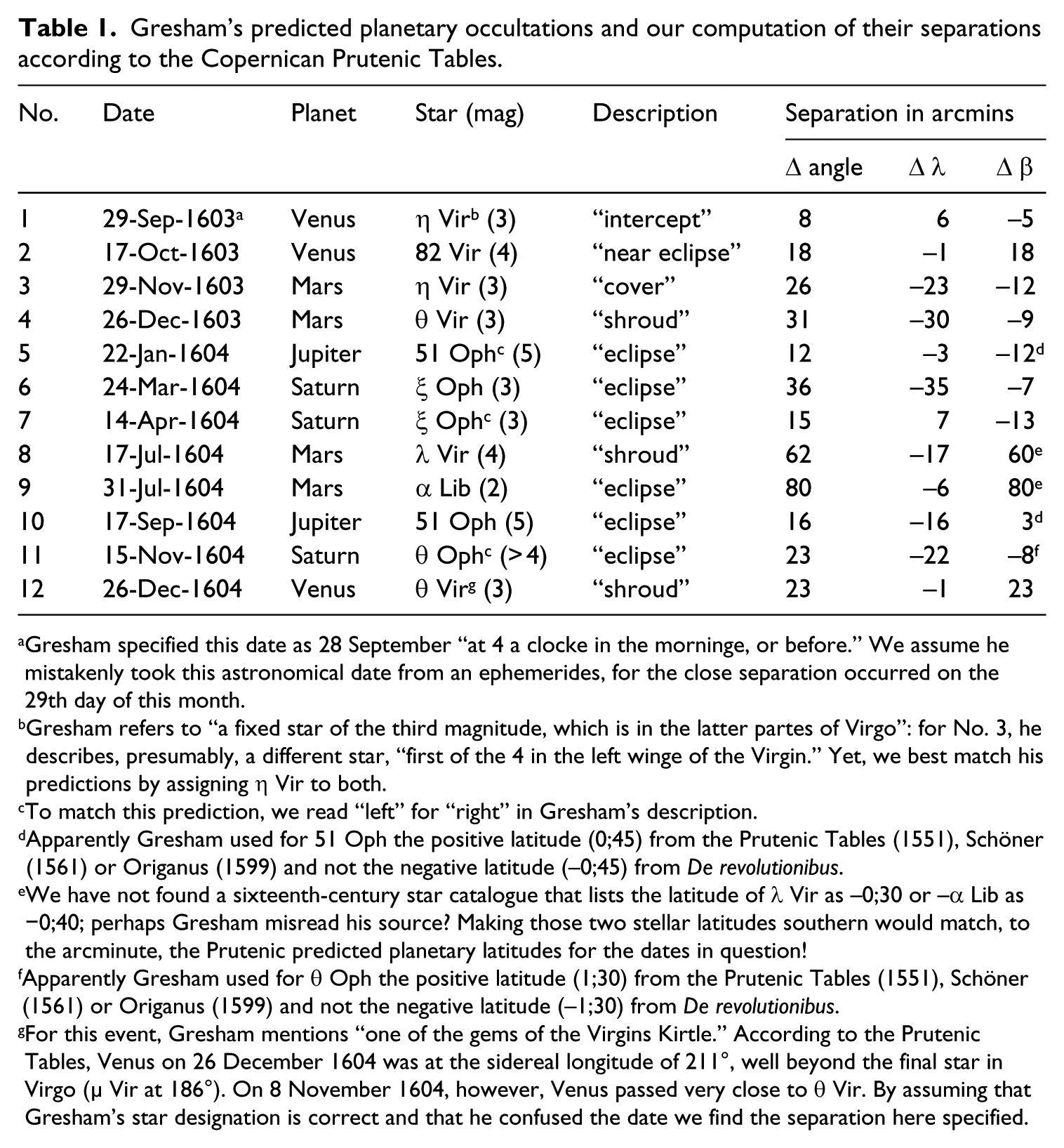
Gresham specified this date as 28 September “at 4 a clocke in the morninge, or before.” We assume he mistakenly took this astronomical date from an ephemerides, for the close separation occurred on the 29th day of this month.
Gresham refers to “a fixed star of the third magnitude, which is in the latter partes of Virgo”: for No. 3, he describes, presumably, a different star, “first of the 4 in the left winge of the Virgin.” Yet, we best match his predictions by assigning η Vir to both.
To match this prediction, we read “left” for “right” in Gresham’s description.
Apparently Gresham used for 51 Oph the positive latitude (0;45) from the Prutenic Tables (1551), Schöner (1561) or Origanus (1599) and not the negative latitude (–0;45) from De revolutionibus.
We have not found a sixteenth-century star catalogue that lists the latitude of λ Vir as –0;30 or –α Lib as −0;40; perhaps Gresham misread his source? Making those two stellar latitudes southern would match, to the arcminute, the Prutenic predicted planetary latitudes for the dates in question!
Apparently Gresham used for θ Oph the positive latitude (1;30) from the Prutenic Tables (1551), Schöner (1561) or Origanus (1599) and not the negative latitude (–1;30) from De revolutionibus.
For this event, Gresham mentions “one of the gems of the Virgins Kirtle.” According to the Prutenic Tables, Venus on 26 December 1604 was at the sidereal longitude of 211°, well beyond the final star in Virgo (µ Vir at 186°). On 8 November 1604, however, Venus passed very close to θ Vir. By assuming that Gresham’s star designation is correct and that he confused the date we find the separation here specified.
Columns 2, 3 and 5 in Table 1 report Gresham’s descriptions of the occultations. Column 4 lists our identification of Gresham’s often vague descriptions of the stars that are based on the language of the Almagest’s star catalogue, essentially reiterated in various sixteenth-century printed versions of Copernicus’s star catalogue. We follow Toomer and Graßhoff in linking Ptolemy’s descriptions to modern star names. Columns 6, 7 and 8 give our computation of the angular separations between the stars and planets, taking positions of the former from the star catalogue of the 1551 Prutenic Tables (identical in the 1585 edition) and the latter as we compute them using the same source. 15 For Nos. 1 and 5 Gresham designates the time of occultation to less than a day (“morning”). In the other cases, he lists only the date; we have chosen times that yield the closest approach of the planet to the Prutenic coordinates of the star for the day in question.
Gresham does not indicate how he identified the planetary occultations listed in Table 1. He does refer, however, to two printed ephemerides, David Origanus’s Ephemerides novae (Frankfurt a.O., 1599), based on the Copernican Prutenic Tables, and Martin Everaert’s Ephemerides novae (Leiden, 1597), based on the author’s “Belgian Tables,” a work not extant. Tropical positions for the eight stars selected by Gresham do appear in Origanus’s work (but not in Everaert’s); tropical values for those stars also appear in a posthumous edition of Johann Schöner’s Opera (1561) and sidereal values in the Prutenic Tables (1551, 1585). These three catalogues (all based on the Prutenic version of Copernicus’s star catalogue) give identical positions for the eight stars, once precession is removed. We think it highly likely that Gresham took his stellar positions from one of these sources.
The format of Origanus’s star catalogue makes us suspect that Gresham used this source. The Ptolemaic tradition of star catalogues (followed by Copernicus) lists stars by constellation. Origanus, however, separated the stars into three groups, those with latitudes greater than 8°, with latitudes less than –8°, and with latitudes between those values. 16 For each group, he listed the stars in order of increasing longitude, keeping unchanged the Almagest’s textual descriptions and quantitative data. It would thus be easy to skim Origanus’s list, looking for stars that match given planetary longitudes.
Using the Prutenic Tables, we have computed planetary positions (sidereal longitudes) for the dates in Table 1. Gresham could have worked directly with these tables or he could have copied tropical longitudes for the planets and stars from Origanus’s ephemerides. We assume that Gresham denoted civil days (except for No. 1), i.e. started counting the hours from midnight. All sixteenth-century ephemerides, including Origanus’s, start counting hours for astronomical time at noon. In any case, the phenomena in Table 1 are out by days if one attempts to compute planetary positions with the medieval Alfonsine Tables. Gresham obviously used Copernican positions.
If we assume that Gresham erroneously recorded positive latitudes for the stars in Nos. 8 and 9, then the average absolute values of the predicted separations would be about 13 arcminutes in longitude and 8 arcminutes in latitude (and 20 arcminutes in angle). Each of the predicted occultations would have had a separation, for at least one coordinate, of no more than 12 arcminutes. The closest predicted passage would have been No. 9, where we compute a Copernican separation of 6 arcminutes in longitude and 0 arcminutes in latitude. Gresham used three different terms (see Table 1, Column 5) to describe the separations; they do not appear to correlate with the degree of predicted separation of the bodies.
If Gresham did indeed prepare a list somewhat like our Table 1 as he drafted his Astrostereon, did he think that separations reaching up to 30 arcminutes would still yield, to the naked eye, examples of the considerably brighter planet “shrouding” or “eclipsing” the fainter star? We are unaware of any studies of how the unaided human eye distinguishes close separations of bright planetary discs and dim point-sources of starlight on the dark nighttime sky. 17 Interestingly, before describing the 12 predicted occultations, Gresham in the Astrostereon reported his own observation of an occultation, on 26 October 1601, of a star in Virgo by Venus. 18 The third-magnitude star, η Vir, Gresham described as “cleane couered and eclipsed.” Gresham did not name the time of his observation, but Venus on that date was a morning star. If we assume he saw the event at 5:30 a.m. in London (Venus was near maximal elongation), our modern computations for that time indicate a separation 25 arcminutes (the closest approach, of 5 arcminutes, occurred at 9 p.m. on 25 October, when Venus would not yet have been above London’s horizon). This suggests that for Gresham’s eyes and sky, the separation of a bright planet and faint star by nearly half a degree appeared as an occultation! Before declaring his “observation” fraudulent, however, we shall, in the second part of this paper, compare his observational report against others made with unaided eyes, i.e., before the age of the telescope.
We must also ask what Gresham might have seen had he looked at the sky on the 1603–1604 dates listed in the Astrostereon. Table 2 presents the positions, computed from modern theory (JPL’s DE431 planetary ephemerides), on Gresham’s dates for night times that we have selected for when the occulting bodies would have been above London’s horizon and at closest separation. Only in two cases are the modern separations less than 0;30°, i.e., within the width of the full moon. Would he have called these phenomena occultations? Or would he have challenged the precision of the received stellar positions or the Prutenic planetary predictions? Indeed, at several points in the Astrostereon, Gresham did raise doubts about planetary predictions: What scrupulositie, then is requisite in this case, all men maie well gather and what good use maie be made of it amongst a thousand other, the better certaintie of our yerely prognostications would quicklie manifest, But in regard it requireth better hypotheses and more rationall Theoricks then are yet extant (unles a man should minse minutes in his muse with Origanus and miss whole degrees in the heavens as he that conferreth the great Luggage of his Ephemerides with the true places of the Plannetts shall quickly discover) …
1
Modern positions computed for Gresham’s dates and our times.
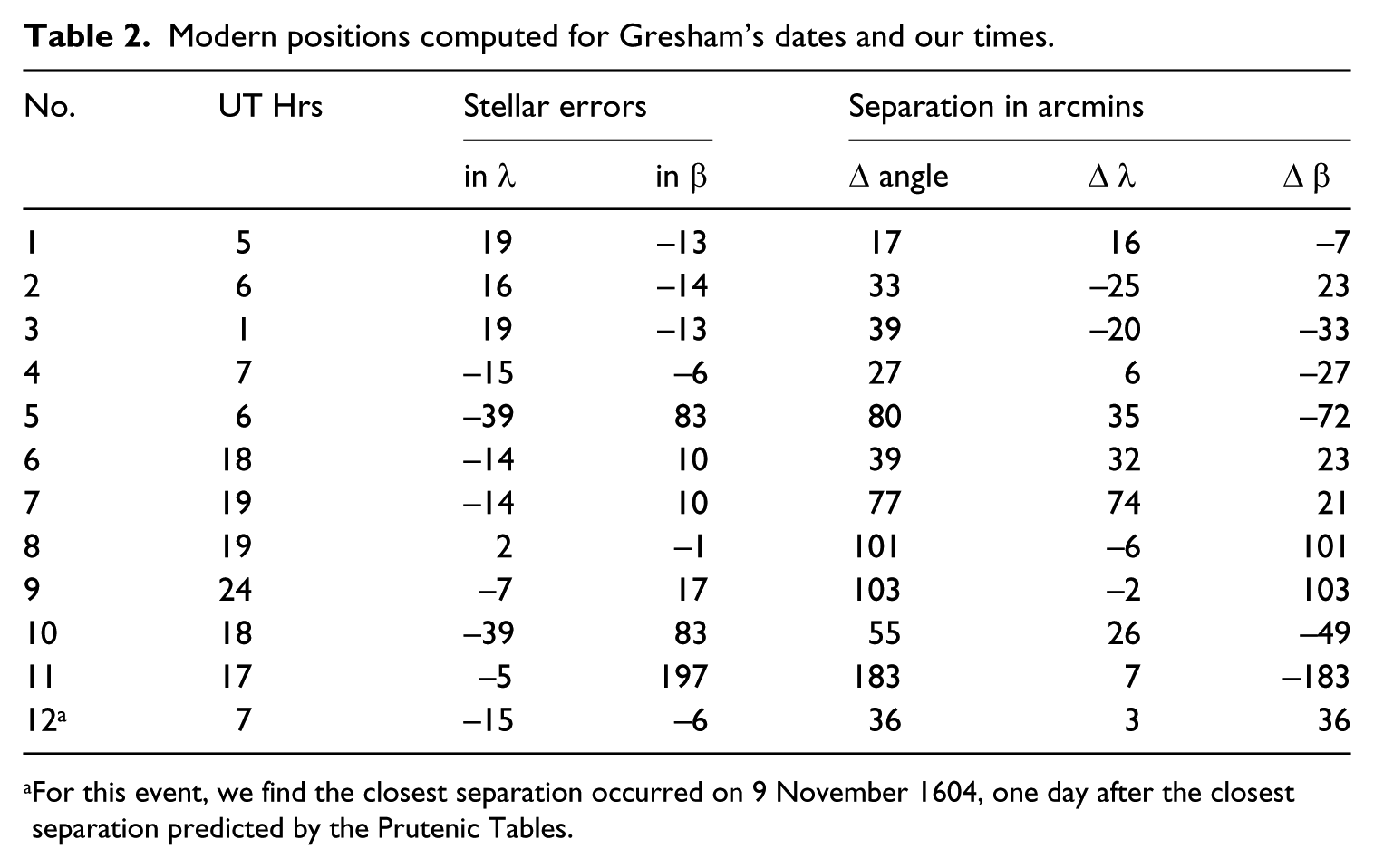
For this event, we find the closest separation occurred on 9 November 1604, one day after the closest separation predicted by the Prutenic Tables.
Or concerning the famous Great Conjunction of Jupiter and Saturn in 1603, he wrote, But of the particuler signification of that coniunction, more shalbe said in a Treatise for that purpose
20
(if I be not prevented, or other occasions lett not) which I deferre untill I haue gotte the true tyme of the same by observation, Least with Origanus (curiously buildinge upon an unknowne ffoundation) I loose my laboure and the worlde the proffitte, who as in nothinge he agreeth with the heavens Phenomenes, so in this Accident dissenting from Everart no lesse then 4 daies in the tyme and one whole degree very nere in place, shall then give notable argument of his owne vanitie, and the others veritie.
21
However, when reporting his own observation of the 1601 occultation, when “the calculation” revealed a difference in latitude of 0;30o that he did not observe, Gresham wondered whether Venus was closer to the Earth with a greater parallax than expected; he challenged neither the received position of the star nor the Prutenic predicted planetary position. 22
We must remember, however, that Gresham’s primary interest in occultations was not to test the predictions of mathematical (positional) astronomy. His goal, as noted above, was to defend the anti-Aristotelian claim that planets are comprised of the same elemental matter as Earth. In his concluding remarks about the nature of the planets, he wrote, Now for this lighte (I hope) I neede not saie more then that which hath ben expressed or implicatiuely deliuered in this former speeche, for seeinge that it is concluded that they are solid grosse impure and indiaphanouse bodies, theare is none so madd will attribute any natiue lighte or luminositye to theire bodilye compaction, unles a man can make a flameinge lampe of this Earthlie masse, which is not possible.
23
For the Copernican Gresham, the Earth is a planet. Since the Earth obviously is opaque, so too are the other planets. Occultations of stars by planets further confirm this claim.
Occultations before Gresham
Although Gresham is the earliest author we know to predict planetary-stellar occultations, such phenomena had attracted some attention from earlier astronomers and philosophers. In the second part of this paper, we shall briefly survey this material, assess how pre-telescopic observers defined occultations, and consider their motivations for attending to these phenomena.
A long set of observations of occultations, preserved in Chinese dynastic histories, sheds light on the problem of how to classify certain phenomena as occultations. Hilton et al. examined 173 Chinese historical records of occultations and small-separation conjunctions of planets with stars, other planets, and extended objects. 24 The observations were made by imperial astronomers in various Chinese capitals. The records contain 66 events characterized as occultations (described with terms such as “conceal, “eclipse,” “enter,” or “not visible”), dating from 12 February 146 BCE to 3 February 1761 CE. Hilton et al. compared these observations with positions derived from modern ephemerides and calculated the “actual” angular separations of the pairs of bodies for the dates in question. 25
Drawing on their analyses, we note that of the 66 records of occultations, 20 star-planet events occurred during the night, i.e. could have been observed at the Chinese locations. As can be seen in Table 3, these 20 occultations range in actual separation from 1 to 32 arcminutes; 8 had separations less than 5 arcminutes, 6 between 5 and 15 arcminutes, and another six between 16 and 32 arcminutes. We note an asymmetry between the separations in right ascension and declination, with the latter, on average, more than 4 times greater than the former. Apparently, the Chinese astronomers defined “concealment” more in terms of identical right ascensions (i.e. the coordinate changing with greater speed) than identical declinations. 26 Gresham’s predicted occultations, interestingly, do not reveal such asymmetry. We also note that the Chinese recorded closer separations (of the 20 phenomena in Table 3, the average separation is only 10 arcminutes) than Gresham predicted. However, Gresham selected his phenomena from a period spanning only 2 years. The 20 Chinese occultations occurred between CE 509 and 1305, a period over which they undoubtedly observed many more occultations (at greater separations) than those recorded in the dynastic histories.
Events extracted from the Chinese dynastic histories that were characterized as occultations and that, by modern analysis, occurred during the night. From Hilton et al., 1988.

Recorded date converted to a Julian Day Number.
We think this Julian day number (23 Aug 757 CE) is in error. On that date, the planets were separated by more than 15°. On Julian day 1997804 (10 Sept 757 CE) at UT 21;00, the planets were separated by –15 arcmins in R.A., –70 arcms in Dec, and 71 arcmins in angle.
On the other hand, the fact that Chinese observers considered separations of up to 32 arcminutes to be occultations seems to confirm Gresham’s understanding of the phenomena; all but one of his events show a predicted separation of less than 32 arcminutes (assuming that he erroneously reversed the signs of latitude in Nos. 8 and 9 in Table 1). Did the eyes of these pre-telescopic observers stop seeing faint stars as bright planets approached to within half a degree? We note that the 13 occulted stars appearing in the 20 Chinese records have an average magnitude of 3.4 (modern). The seven stars in Gresham’s list have an identical average magnitude (Ptolemy)!
The Chinese list also includes five planet–planet occultations (Table 3), four of which had somewhat closer separations than those found in their planet–star occultations. We might wonder whether equally and unequally bright bodies, in close proximity, are seen differently by human eyes (see Appendix 1).
In contrast to the Chinese observers, ancient astronomers of the Mediterranean region apparently did not record systematic observation of occultations. The occasional discussions of such phenomena that we do find were motivated by concerns different from what Hilton et al. called the “astrological-political nature” of celestial events in the Chinese dynasties.
27
Aristotle’s Meteorologica (I 343b) mentions briefly that occultations were observed in Egypt and then describes the occultation of a star in Gemini by Jupiter: … the Egyptians say that there are conjunctions both of planet with planet and of planets and fixed stars … we ourselves have observed the planet Jupiter in conjunction with one of the stars in the Twins and hiding it completely, but no comet resulted.
28
It is impossible to determine when Aristotle observed this conjunction and which of the stars vanished in the light of Jupiter. A probable date is 5 December 337 BCE, when Jupiter was separated from 1 Gem by a distance of 5 arcminutes.
29
Aristotle referred to this observation of the occultation while describing a theory ascribed to Anaxagoras and Democritus, viz., that comets are born in conjunctions. A more extensive description of this cometary theory appears in the commentary on the Meteorologica written by Alexander of Aphrodisias (2nd/3rd cent. CE): As regards comets, Anaxagoras and Democritus claim that the stars considered to be comets are in fact “an apparent meeting of wandering stars,” these in turn being the stars of Kronos, Zeus, Aphrodite, Ares and Hermes. Hence when these stars are in close proximity, an illusion arises as if they merged and became one star called a comet. “An apparent meeting” refers to the illusion when many objects approximating each other [coming together] appear as if they were one object.
30
In these contexts, occultations are related to the etiology of comets.
What about Aristotle’s claim that Egyptians observed occultations? In De caelo (II 292a), Aristotle describes an observation that he had made of a lunar occultation of Mars
31
and adds that observations of lunar occultations of other stars had been made by Egyptians and Babylonians. Simplicius (6th century … the Egyptians and Babylonians have observed the same thing occurring with the other [wandering] stars as well (that is, with those that are higher), so that many of their observations of each of the [wandering] stars have been handed down.
32
Both Aristotle and Simplicius (as did Diodorus Siculus and Pliny the Elder) assume that Egyptian and Babylonian sources refer to planetary occultations. Extant and deciphered Egyptian sources known today do not reference such phenomena. Babylonian sources, on the other hand, mention observed occultations of stars and planets by the Moon, passages of planets near the so-called Normal Stars and planetary conjunctions. 33
Ancient Greeks also mentioned occultations in their discussions of the order of heavenly spheres. Aristotle used his observation of the Moon’s occultation of Mars to prove that the former is the nearest celestial body to Earth. One can interpret in a similar way his reference to the observations of Egyptians and Babylonians if we consider only occultations of the planets by the Moon.
34
In the second century CE, Theon of Smyrna also linked planetary order to the phenomena of occultations in his elementary handbook for philosophy students, Aspects of Mathematics Useful for the Reading of Plato.
35
The discussion of occultations draws on the geometry of vision and the relative distances of the celestial spheres: Since we naturally see in a straight line, with the sphere of stars being the highest and the planetary spheres placed below … it is clear that the Moon, being closest to the Earth, can pass in front of all the other stars that are above it. In effect, it hides for us the planets and stars when placed in straight line between our sight and these stars, and it cannot be hidden by any of them. Mercury and Venus hide the stars which are above them, when they are similarly placed in a straight line between them and us; they even appear to occult each other, when one of the two is higher than the other, due to their sizes and the obliquity and position of their circles. These occultations are not easy to observe, however, because these planets revolve around the Sun, and Mercury, a small star close to the Sun and brightly illuminated by it, is rarely visible.
36
Mars sometimes eclipses the two planets above it, and Jupiter can eclipse Saturn. Each planet also eclipses the stars which it passes in its course (III, 37).
37
Theon apparently did not consider whether the inner planets could also occult a superior planet.
Three hundred years later, Proclus, who presumably knew Theon’s treatise, also referred to occultations while discussing the order of planets. His Outline of Astronomical Theories does not offer detailed information about such phenomena and mentions only three planets; Venus was observed to run beneath Mars, just as Mercury was observed running beneath Venus. 38 In his Commentary on Plato’s Timaeus, Proclus linked the phenomena of occultations to his rumination on the nature of heavenly bodies. Arguing that heavenly matter is composed in a specific way of all four elements (i.e. earth, water, air and fire, with the latter dominating), Proclus evokes, in a fairly general way, the argument about the Moon and other stars obscuring other stars. 39 If celestial bodies were transparent, they would not occult each other.
Ptolemy, on the other hand, did not bring together his discussions of occultations and planetary order. There are no references to planetary occultations in the Planetary Hypotheses, where Ptolemy orders the planets from Moon, Mercury, Venus, Sun, Mars, Jupiter, to Saturn. 40 Ptolemy mentions only that the passage of Mercury and Venus across the solar disc has not yet been observed, but he does not offer this fact as an argument against positioning the spheres of these planets below the Sun’s sphere.
In the Almagest, Ptolemy mentions three phenomena reported by earlier astronomers as occultations, viz., of η Vir by Venus on 12 October 272 BCE (katalambanein = to overtake), of β Sco by Mars on 18 January 272
Ptolemy does not tell us why his predecessors recorded the occultation observations. The first record (Venus) he attributes to Timocharis, a comparatively well-known astronomer, presumably working at Alexandria. (In the Almagest Ptolemy reports also on 4 lunar occultations of stars and 12 stellar declinations that were observed by Timocharis.) The Mars and Jupiter occultations are not attributed by Ptolemy and were made by unknown Hellenistic astronomer(s) using the Dionysian calendar.
43
It is possible that these early occultation observations were part of a larger observational project of tracking the motions of the planets relative to stars near the ecliptic, similar to Babylonian Normal Stars, a project not necessarily motivated by theoretical concerns arising from mathematical astronomy.
44
However, Jones has argued that Ptolemy’s source for the early Jupiter occultation may have been the author of P. Oxy. LXI 4133, a papyrus fragment which reports an observation of Jupiter in
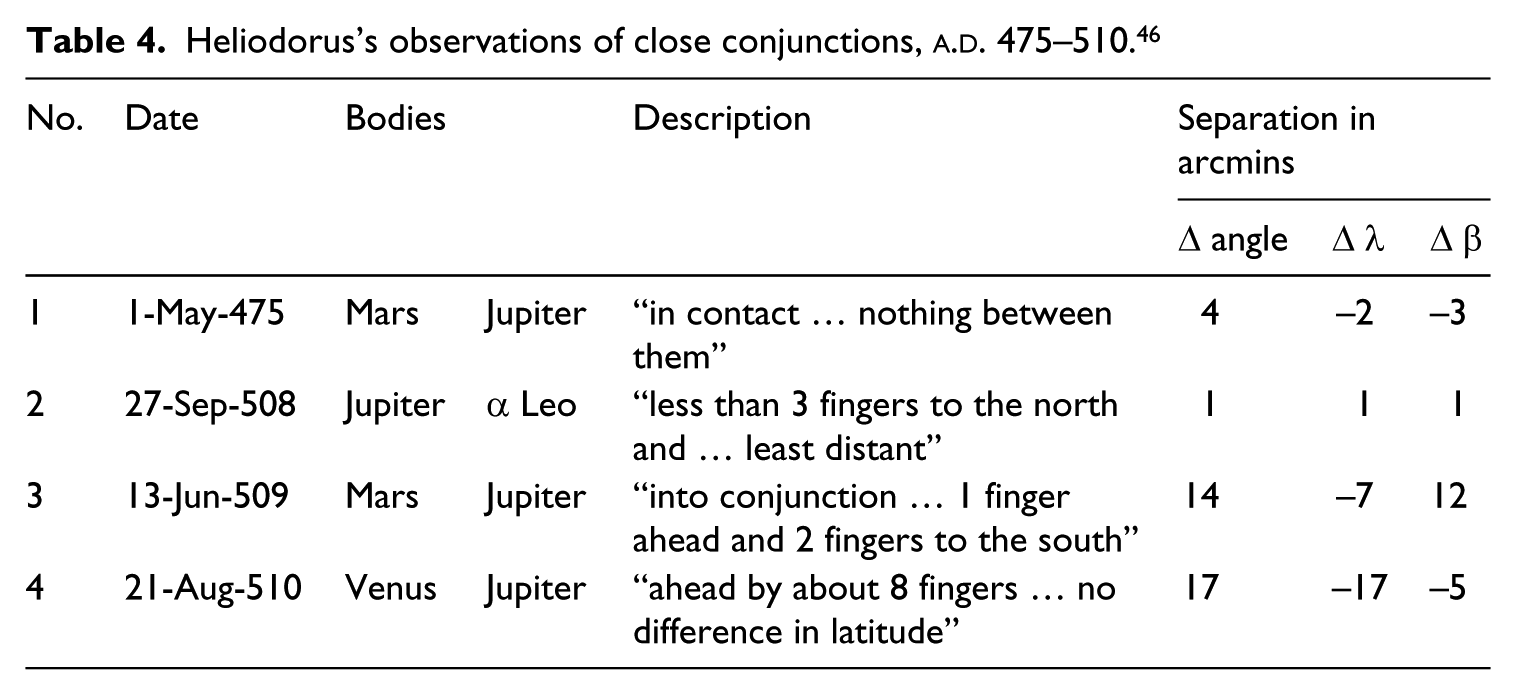
Interestingly, however, the only extant observational report from late antiquity lists occultations or near conjunctions from the years
Heliodorus’s observations of close conjunctions,
Interest in occultations remained very sporadic during the Latin Middle Ages. An interesting example of such observation, apparently free of any philosophical implications, surfaces in a chronicle by the twelfth-century monk Gervase of Canterbury, who recorded that on 12/13 September 1170: … on the Ides of September, in the middle of the night, two planets were seen in conjunction to such a degree that it appeared as though they had been one and the same star; but immediately they were separated from each other.
47
Based on modern calculations, we presume that Gervase of Canterbury described the occultation of Jupiter by Mars (we compute a separation of less than 6 arcseconds!), a phenomenon which is also recorded in the Chinese sources. 48 Interestingly, however, the Latin medieval observer described this phenomenon as a merger of two sources of light rather than the occultation of one source by the other, perhaps related to the fact that this event has the closest computed separation of any occultation event we discuss in this article.
The first systematic Latin astronomical observers, Johannes Regiomontanus (1436–1476) and Bernhard Walther (1430–1504), made planetary observations from the 1460s through Walther’s death in 1504. Like Ptolemy, their goal appears to have been mathematical astronomy, observing to test predictions of the Alfonsine Tables. 49 The preserved records of their observational activity reveal no interest in planetary distances or the structure of the cosmos. 50 The more than 600 individual planetary observations they recorded include no phenomena denoted as occultations. In the first decade, before acquiring large angle-measuring instruments, they occasionally used stars to visually estimate planetary positions. For example, on 5 December 1461, Regiomontanus writes that clouds prevented him from seeing a conjunction of Mars and Saturn; on 2 December, the date of the conjunction predicted by the Alphonsine Tables, he had observed a separation of 2° in longitude. 51 On 16 October 1462 in the morning at the “12th hour of the night” he observed Mars separated by “an estimated four diameters of Venus” from the fourth-magnitude star, σ Leo. According to our computation, at that time (UT 5:00) Mars and σ Leo were separated by 22 arcminutes, which implies that Regiomontanus estimated the apparent diameter of Venus to be about 5 arcminutes. 52
Walther recorded several other close conjunctions. For example, on 19 September 1494 at 5 a.m. he saw Venus “conjuncted” with Regulus, noting that the planet was 10 arcminutes west and 13 arcminutes south of the bright star (our recomputation places the planet 12 arcminutes west and 28 arcminutes south; the actual conjunction occurred around 9:30 a.m., well after sunrise). The Chinese observers and Gresham might well have called this observed phenomenon an occultation; Walther, however, did not. On 8 September 1503 at 4 a.m., Walther observed a “conjunction” in longitude of Jupiter and δ Gem, 53 with a separation in latitude of 2 “digits” or about 7 arcminutes (our recomputation shows a separation in longitude of 5 arcminutes, in latitude of 8 arcminute). Finally, only 2 months before his death, on 28 March 1504 at 7 a.m. Walther described the “closest” (propinquissimus) path of Saturn past 8 Gem (we think the actual star was 12 Gem = δ Gem), separated by “2 or 3 digits” (7–10 arcminutes) in both longitude and latitude (at that time, we find a separation of 7 arcminutes in longitude and 10 arcminutes in latitude). The following night, the planet was “closer” (propinquior) to the star, so that their conjunction (in longitude and latitude) “was to be judged at almost the same instant” (sic que coniunctio iudicanda fuerat eodem instanti fere). We compute the separations at 7 a.m. on 29 March to have been 5 arcminutes in longitude and 10 in latitude, for an angular separation of 11 arcminutes. 54 Never announcing an actual occultation, Walther’s criteria for this phenomenon apparently required closer separations than did those of Gresham or the Chinese astronomers.
It would not be until the 1570s, with Michael Maestlin’s (1550–1631) interest, that occultations began to attract more systematic attention. Maestlin not only observed occultations in the second half of the sixteenth century but also searched for historical descriptions and interested his student, Johannes Kepler (1571–1630), in these phenomena.
Like Walther, Maestlin was a systematic observer of heavenly phenomena. From the 1570s through the 1620s, he observed most of the lunar and solar eclipses and many lunar occultations. 55 He earned a reputation as a careful observer from the publication of two early treatises, one on the new star of 1572 in Cassiopeia 56 and another on the comet of 1577. 57 The observations included in these books helped establish the position of the nova and comet relative to the stars by means of a thread held at arm’s length. 58 Maestlin observed his first planetary occultation in the period between the appearance of the nova and the 1577 comet. On 16 September 1574, he saw Venus occulting Regulus. Maestlin subsequently observed Venus eclipsing Mars on 13 October 1590 and Mars occulting Jupiter on 19 January 1591. We compute the actual separations to have been smaller than the resolution of the human eye for these three events, i.e., less than 1 arcminute (1574 at 22:30 UT, 1590 at 5:00 UT, 1591 at 5:30 UT).
A broader context for Maestlin’s interest in occultations may be provided by some intriguing notes in copies of De revolutionibus linked with the figure of Paul Wittich (fl. 1563–1586). This mathematician was based in Wrocław and held at least four copies of De revolutionibus, two of the 1543 edition and two of the 1566 edition. 59 The books owned by Wittich carry numerous marginal notes. In both first editions (the Liége and Vatican copies) we find information about two conjunctions: Jupiter–21st star of Pisces, dated 8 November 1572, and Venus – Regulus, dated 16 September 1574. Both notes are recorded at relevant places in Copernicus’s star catalogue, i.e., beside Regulus (f. 54r) and at the end of the constellation of Pisces (f. 57v). 60 Palaeographic analysis of the notes appears to confirm Wittich’s hand in both cases. 61
We translate the first note: On 8 November 1572 Jupiter occulted [tegere] the 21st star in Pisces. And Jupiter, according to computations, was in 21°07’ Aries. Thus the longitude of the star amounts to 353°18’ from the beginning of Aries.
62
This longitude of Jupiter (21;07°) was computed according to the Prutenic Tables. 63 The precession for November 1572 given by the Prutenic Tables amounts to 27;49°. Copernicus’s star catalogue lists the longitude of 21st star in Pisces as 353;30° relative to the first star in Aries. If we add the Prutenic precession, this places the stellar longitude at 21;19°, which exceeds Jupiter’s longitude by 0;12°. Deducting this amount from the star’s longitude gives a revised sidereal longitude of 353;18°, matching Wittich’s annotation.
Hence, the note appears internally coherent and can be read as an attempt to verify the longitude of 21st star in Pisces on the basis of Copernicus’s planetary theory. The description of the observation features the verb tego (to hide or bury), which is used in Latin to refer to occultations. Yet, if we identify the 21st star in Pisces (5th magnitude) with π Psc, 64 on 8 November 1572 that star was separated from Jupiter in latitude by almost three and one-half degrees and in longitude by nearly half a degree, hardly an occultation by the criteria emerging in our survey. If, however, we consider the 20th star in Pisces (o Psc, 4th magnitude), the planet and star on said date would be separated by 24 arcminutes in longitude and only 10 arcminutes in latitude. But the longitude for this star does not match the revised value Wittich specified in the marginal note. We speculate that he observed Jupiter near the 20th star in Pisces, but then confused the coordinates for the 20th and 21st stars in Pisces when using Copernicus’s star catalogue.
Wittich’s note pertaining to the meeting of Venus and Regulus is somewhat shorter: On 16 September 1574 at 8 hour Venus occulted [eclipsare] Regulus. By the tables Venus was in longitude 23°27’ of Leo, in southern latitude 48’.
65
Here, the identification of the occulted star is unambiguous. If we assume that the observation was recorded, as the 1572 occultation, to check a stellar position, the following computations would be necessary. The sidereal longitude of Regulus in the catalogue of Copernicus is 115;50°. If we increase it by the value of the procession based on the Prutenic Tables, i.e., 27;50°, we arrive at a tropical longitude in September 1574 of 143;40°. This value exceeds Wittich’s computed longitude of Venus by 0;13° which would imply that the sidereal longitude of the star is too large by 0;13°. Wittich does not comment on the discrepancy.
Yet, the coordinates of Venus that Wittich cited “ex Tabulis” remain puzzling. According to the Prutenic Tables, Venus was at Leo 23;27° at 3 hours after midnight (Königsberg meridian) on 16 September 1574. By 8 a.m., the Prutentic Venus is at Leo 23;42°. (Maestlin had described the time of his observation as 4 hours after midnight.) 66 Furthermore, according to the Prutenic Tables, Venus was positioned 20 arcminutes above the ecliptic which does not match the southern latitude Wittich states. At that time, however, Jupiter had a Prutenic latitude of −0;45°. Perhaps Wittich confused the latitudes of Jupiter and Venus in his ephemerides?
Whatever the case for Wittich and his annotation, observation of the 1574 occultation of Regulus by Venus obviously inspired Maestlin to look for historical records of similar phenomena. He found Aristotle’s description of the occultation of Mars by the Moon and the passing reference to Mercury occulted by Venus and Venus by Mars in Proclus’s treatise, as well as references to Mercury visible against the solar disc. This collection of earlier events, along with his own observation of 1574, was presented in the final section of his discussion of eclipses in his Epitome astronomiae published in 1582. 67
In the early 1590s Maestlin witnessed two further planetary occultations. On 13 October 1590, he observed the occultation of Mars by Venus (we compute the separation to have been 0.2 arcminutes at 5:00 UT) and on 19 January 1591, he saw Mars occulting Jupiter (we compute a separation of 0.6 arcminutes at 5:30 UT). These two observations supplemented the list of the examples he collected, both historical and his own. He included this list in his Disputatio de eclipsibus Solis et Lunae (1596)
68
and in the fourth edition of Epitome astronomiae (1597).
69
In the former text, he linked his two most recent observations to a claim about the order of the planets. After discussing well-known cases of solar eclipses and lunar occultations of stars, Maestlin added, In a similar way each lower star on the sky may obscure another higher star which is passing by… It could be clearly seen that in one case Mars, and in another case Venus were lower due to the white colour of Venus and the fiercely red colour of Mars.
70
Since in a total occultation, it must be the closer body that remains visible, the colours of occulting planets allowed Maestlin to draw conclusions about their relative distances from the Earth. 71 We have not found, in the earlier discussions, any suggestion that observed colours might yield clues about planetary distances.
For our final pre-telescopic example, we turn to Johannes Kepler. In 1590–1591, he was studying in Tübingen and probably had observed the occultations of those years with Maestlin. In a section in his Optics (1604) on “the mutual occultations of the other [non-luminary] heavenly bodies,” Kepler repeated his teacher’s conclusions: for 1590, “… the brilliant colour of Venus again indicat[ed] that Venus was the lower,” for 1591, “The fiery ruddy colour of Mars argued that Mars was the lower.”
72
Kepler also described the occultation of Regulus by Venus that had occurred on 25 September 1598 and the occultation of Mercury by Venus at the turn of June in 1599. Unlike the previous rather brief reports by Maestlin, these references include fuller descriptions of observational conditions. Kepler had seen Regulus covered by Venus: … at Graz on 15/25 Sept. 1598 at hour 3 in the morning, when Venus had barely risen. At the fourth hour, more than one [diameter of] Venus could have fit in between; nevertheless, the line from Venus to Cor [Regulus] fell a little below Jupiter.
73
Our computations show that Venus was closest to Regulus on 25 September 1598 at half an hour after midnight (Graz time) when the bodies were separated by 2 arcminutes. At 3 a.m. in Graz, the bodies were separated by 7.5 arcminutes, at 4 a.m. by 13 arcminutes. Hence, Kepler’s eye on that morning estimated the apparent diameter of Venus, seen close to the horizon, as about 10 arcminutes! The JPL ephemerides computes the apparent physical diameter of the planet at that date to have been 14 arcseconds.
Kepler’s report of a very close encounter of Venus and Mercury at the turn of June 1599 is even more detailed: … on 21/31 May 1599, Mercury was about one degree beyond Venus, it was nearly the same amount further north … on 29 May or 8 June … looking with greatest care at Venus, I nevertheless saw no Mercury, while I saw the Twins and Capella. I was in fact persuaded that I saw certain rather long and thin rays from the eastern part of Venus; Venus, however, did not change colour.
74
In fact, the planets came closest to each other in the early evening on 4 June 1599 when the minimum separation was 9 arcminutes. By the evening of 8 June, the planets were separated by more than 2 degrees. It is not clear to us what Kepler saw that evening; Mercury was elongated from the Sun by 23 degrees, Venus by 25 degrees.
In any case, Kepler’s Optics became the most widely circulated printed source of occultory observations from ancient times to the 1590s.
75
Similar to Maestlin’s Epitome, Kepler’s list appears after a detailed discussion of lunar and solar eclipses.
76
And occultations provided Kepler with the opportunity to speculate on the structure of the cosmos. The opening paragraph recalls Kepler’s earlier claim that planets have their own light.
77
This would mean that occultations involving planets cannot be understood in the same way as lunar eclipses. Kepler notes that “the star Mars will seem not to be entirely free of the suspicion that it may run into the earth’s shadow.” This seems to echo the discussion concerning the parallax of Mars.
78
He hypothesizes a chain of planetary shadows that would create a kind of plenum resulting from the spacing of the planets and physical diameters: … since the point of the lunar shadow falls exactly on the earth, it seems fitting that the point of Venus’s shadow come to an end at the moon, when nearest the sun, the point of the Mercurial shadow at Venus; likewise, again, the earth’s shadow at Mars, Mars’s at Jupiter, and Jupiter’s at Saturn.
79
Kepler does not mention that to test this chain empirically the observer would need to visit the surface of each planet! And he does not draw any cosmic conclusions from planet-star occultations.
On the other hand, Kepler offers a variety of arguments to support his claim that planets have their own light. He refers to several earlier authors (Cleomedes, Albategnius, Witelo) and presents conclusions drawn from his own observations of the light and colour of stars and planets.
80
He recalls his 1601 treatise, On Giving Astrology Sounder Foundations,
81
wherein he had argued that … the five planets do not only make use of light borrowed from the Sun but also add something of their own – which, indeed, there are also other reasons to believe. For, if many of the natural bodies on the Earth have intrinsic light, what is there to prevent other celestial globes besides the Sun having the same? Then, if the planets lacked light of their own, they should show a changing face, as the Moon does. Finally, it is plausible to consider brightness and twinkling as evidence for intrinsic light, and cloudiness and steadiness as evidence for illumination from another source.
82
In 1601, Kepler’s views were congruent with the long-established and multi-faceted discourse on the nature of the light of the planets.
83
Kepler would change his view on this question only after learning of Galileo’s telescopic observations. In a 1610, letter to Galileo, Kepler wrote, Your second highly welcome observation concerns the sparkling appearance of the fixed stars, in contrast with the circular appearance of the planets. What other conclusions shall we draw from this difference, Galileo, than that the fixed stars generate their light from within, whereas the planets, being opaque, are illuminated from without …
84
Here, Kepler did not turn to the example of planetary occultations to discuss the nature of the planetary light.
Conclusions
This survey enables us to draw several conclusions about the role of planetary occultations in the history of pre-telescopic astronomy. First, despite the rarity of known observations of planetary occultations in the second half of the 16th century, it was this period that witnessed a heightened interest in such phenomena. Apparently inspired by his own 1574 observation of the occultation of Regulus by Venus, Maestlin sought to systematize records of these phenomena from Antiquity to his own time. In successive editions of his Epitome astronomiae, he recalled the enigmatic opinion of Proclus about the mutual occultations of Mercury and Venus, but it was only in Disputatio de eclipsibus Solis et Lunae (1596) that Maestlin mentioned the phenomena of 1590 and of 1591 and linked them to the question of planetary order.
Second, we note that many observers reported occultations for bodies that, according to our modern computations, were significantly separated, i.e., by angles of 10 arcminutes or more. Clearly, the experience of occultations, as mediated by the human eye gazing at the nighttime sky, differed from the geometry of straight light rays passing bodies of given physical dimensions and distances. Our survey suggests that the difference in brightness between the occulting bodies was related to the actual separations we computed for phenomena reported as occultations. When two bright bodies were reported as occulted, e.g. two planets or a planet and a first-magnitude star like Regulus, the actual separations were significantly less than when a bright planet and a faint star (magnitudes greater than 3) were reported as occulted. In these latter cases, actual separations of up to half a degree could be reported as occultations.
Third, we note that none of the sources surveyed in this section suggest that the observed planetary occultations were predicted with the help of astronomical tables. Living with the nighttime sky, our scattered observers seem to have recorded the sporadic occultations they noticed, just as they recorded comets or other unusual phenomena when they appeared. It would not be until 1601, at the very end of the pre-telescopic period, that Edward Gresham would systematically study a Copernican ephemerides (or tables) and star catalogue and draft a list of predicted occultations for the next 2 years.
Finally, we have seen that pre-telescopic astronomers turned to occultations for various reasons. For some, occultations provided the occasion to “measure” planetary positions to a precision of arcminutes without use of angle-measuring instruments, provided one knew stellar positions to a given precision. Or as we saw in the case of Wittich, one could use a theoretically predicted position of a planet to confirm the location of a star. For others, the phenomena of occultations could offer evidence for arguments about the relative distances of celestial bodies from the Earth, about the self-illumination of planets, or about their material constitution. For Gresham, occultations supported the idea of planets’ “indiaphanouse” nature, a claim that, in turn, he wielded to defend the Copernican heliocentric cosmology. We are unaware of any other example in which the phenomena of occultations entered debates about Copernicanism.
Footnotes
Appendix 1
Appendix 2
Acknowledgements
The authors thank Dr. Barbara Bienias for her participation in compiling the transcription of the fragments of Astrostereon, Dr. Maciej Jasiński for his cooperation in the analysis of Greek and Latin sources, and both for them for their active engagement in the analysis of marginal notes in Paul Wittich’s copy of De revolutionibus. In the initial stages of our research, Dr. Marek Zawilski kindly shared his opinion on the possibility of analysing planetary occultations with accessible algorithms.
Funding
The research of Jarosław Włodarczyk has been financed by the Polish National Science Centre within the framework of the grant no. DEC-2014/15/B/HS3/02490, titled “Tradition and Novelty: Copernicanism, the Idea of a Plurality of Worlds, and Astrology in Edward Gresham’s (1565–1613) Astrostereon.”