



Abstract
This paper seeks to show that astronomical tables (zījes) belonging to the tradition of Ibn Isḥāq al-Tunisī (fl. 1193–1222) were available to the astronomers in the service of King Alfonso X (r. 1252–1284), who used them both in their astronomical works written in Castilian and for the production of the Parisian Alfonsine Tables which are, nowadays, extant in Latin.
Keywords
No astronomical tables produced in the Maghrib seem to be extant 1 until the thirteenth and fourteenth centuries, during which an astronomical renaissance, strongly influenced by the Andalusian tradition, took place. It shared many of its characteristics and was its obvious continuation at a time in which Islamic astronomy in the Iberian Peninsula entered a period of decline. This can be seen through the appearance of an Andaluso-Maghribī group of zījes which begins with the unfinished zīj of Abū l-‘Abbās ibn Isḥāq al-Tamīmī al-Tūnisī (fl-. ca. 1193–1222). There is no biographical information about him, although we know that he lived in Tunis and Marrakech and that some of his tables were based on observations made in 619 H/1222 CE.
The standard reference to Ibn Isḥāq is a passage in Ibn Khaldūn’s (1332–1382) Muqaddima in which it is said that “the people of our times use the zīj attributed to Ibn Isḥāq, the Tunisian astronomer of the beginning of the 7th /13th century, based on his own observations and on the information transmitted by an unnamed Sicilian Jew. 2 An analysis of the extant materials establishes that what he obtained from his Sicilian correspondent derived mainly from Andalusian astronomical literature. 3 It seems clear that Ibn Isḥāq compiled a set of tables for the computation of planetary longitudes, eclipses, equation of time, parallax and, probably, solar and lunar velocity. This is confirmed by the prologue to the Minhāj of Ibn al-Bannā’ (1256–1321), where the author states that his book is based on Ibn Isḥāq’s zīj 4 and that he discovered it in a collection of tables, noted down on cards, on which he based his [mean] motions of the planets and their equations. 5 These tables were not accompanied by an elaborate collection of canons, although they contained some kind of instructions for the use of a few tables. Ibn Isḥāq’s original zīj seems to be lost, although quite a lot of information about it can be gathered from a set of five “recensions” of this work made in the Maghrib in the second half of the thirteenth and beginning of the fourteenth century. These recensions were prepared by three Maghribī astronomers:
An anonymous Tunisian astronomer who prepared, ca. 1266–1281, the recension extant in ms. Hyderabad Andra Pradesh State Library 298. 6
Ibn al-Bannā’ of Marrakech (1256–1321) in his extremely popular Minhāj. 7
Recensions prepared by the Andaluso-Maghribīastronomer Ibn al-Raqqām (d. 1315): al-Zīj al-Mustawfī (Tunis, after 1280–1281), 8 al-Zīj al-Shāmil (Bougie, ca. 1290) 9 and al-Zīj al-Qawīm (Tunis, after 1280–1281, revised in Granada). 10 This scholar was an astronomer of Andalusian origin who worked most of his life in the Maghrib but established himself in Granada sometime after 1288–1289. With the Qawīm zīj, which was used in that city, we see the return to al-Andalus of astronomical materials that had a clear Andalusian origin.
The derivation of these sources from Ibn Isḥāq’s zīj can be established due to the fact that the five works share the same sidereal mean motion and equation tables for computation of planetary longitudes which, according to Ibn al-Bannā’, derived from Ibn Isḥāq’s original zīj. They all follow the ideas of Ibn al-Zarqālluh/Azarquiel (d. 1100) on trepidation, cyclical variation of the obliquity of the ecliptic, motion of the solar apogee, and correction of the Ptolemaic lunar model.
It seems clear that the Alfonsine astronomers had access to some version of Ibn Isḥāq’s zīj. 11 This can easily be proved from evidence furnished by two small treatises contained in the Libro del sabre de astrología: the Cuadrante para rectificar and the Libro del relogio de la piedra de la sombra. The author of the Cuadrante, Isḥāq b. Sīd, mentions a value of the obliquity of the ecliptic (ε) of 23;32,29º “for our time” as well as declination values for 30º and 60º: 12
30º 11;31,11º 60º 20;14,13º (rec. value 20;14,14º)
This value of ε reappears, rounded into 23;32,30º, in the Libro del relogio, where we find a complete declination table 13 with this maximum value, which seems to be related to Ibn al-Zarqālluh’s model for the computation of ε, although with Ibn Isḥāq’s parameters. In it, the pole of the ecliptic rotates around a polar epicycle with radius 0;10º. The centre of this epicycle is kept, in a fixed position, on a parallel of declination, whose distance from the pole of the equator is 23;42,30º. As a result, the value of ε will reach a maximum of 23;42;30º + 0;10º = 23;52,30º, and a minimum of 23;42,30º – 0;10º = 23;32,30º. 14
Using the mean motion tables that regulate the position of the pole of the ecliptic in the polar epicycle, one can easily obtain 23;32,30º for the end of 1193, the year in which the beginning of Ibn Isḥāq’s astronomical activity has been established. In spite of this, it seems that this parameter might have an observational origin. According to Abū ‘Abd Allāh Muḥammad al-Ḥabbāk (d. after 1562), Ibn Isḥāq himself stated that 23;32,30º had been obtained by an anonymous astronomer from Miknāsa (Meknès, Morocco) through an observation made in 602/1205–1206. 15 This obviously means that Ibn Isḥāq believed that the obliquity of the ecliptic had reached its minimum value in his own time, and it implies that the declination table of the Alfonsine treatise on the sundial (Libro del relogio) is due to Ibn Isḥāq himself and that it belongs to his primitive zīj. In 1992, Mercè Comes remarked that the solar declination table (no. 54 of the Hyderabad ms.) of the anonymous Tunisian recension of Ibn Isḥāq’s zīj is the same as the one appearing in the Alfonsine sundial treatise, as both share the same small computational errors. 16 Finally, it is interesting to note that the same parameter appears in al-Sanjufīnī’s zīj, compiled in Tibet in 1366. 17
The influence of Ibn Isḥāq’s zīj is not limited to the Castilian Alfonsine texts but can also be found in the Parisian Alfonsine Tables (PAT), specifically in the mean motion parameters explicitly given in all the editions. It is interesting to compare these parameters to those underlying the sidereal tables of the tradition of Ibn Isḥāq (Tunisian recension, Ibn al-Bannā,’ Ibn al-Raqqām). 18 Those corresponding to the mean motions in anomaly of Venus and Mercury (not affected by precession) are practically identical, although the same thing cannot be said about the mean lunar motion in anomaly (see Table 1). The mean motions in longitude of the Sun, Moon and planets show similar differences which vary between 0;0,0,7,31º and 0;0,0,8,34º. Previous scholarship has not noticed this relation between the mean motions in Ibn Isḥāq and the PAT.
Mean motions of the Parisian Alfonsine Tables and Ibn Isḥāq’s zīj.
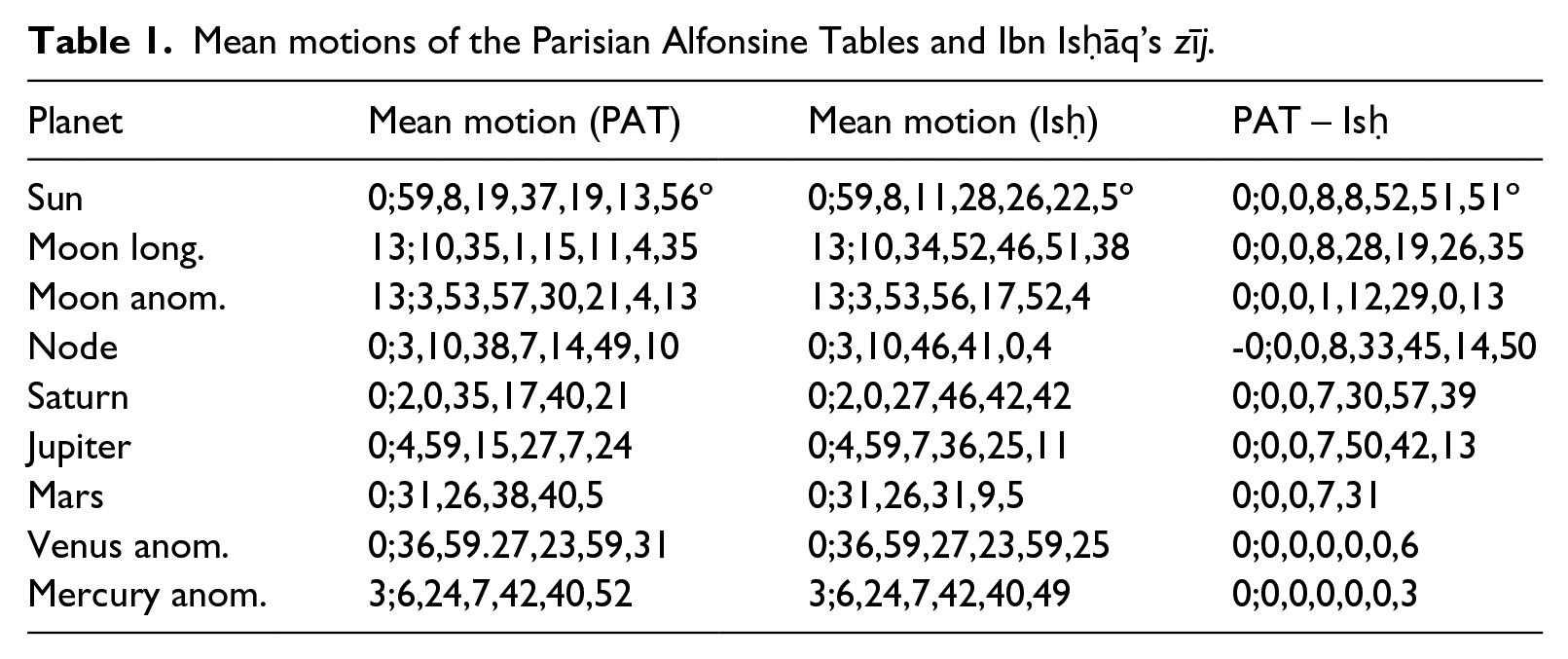
The correction of, approximately, 0;0,0,8º for the mean motions in longitude corresponds to the value of precession which allows the conversion of mean sidereal motions into mean tropical motions. We can easily compute this value using the PAT which combine constant precession and trepidation:
According to the PAT, the argument of trepidation, and hence trepidation itself, attained 0° on 16 May 16 CE (JDN 1,727,038). 19 As the Alfonsine epoch used in the PAT is the 31 May 1252 (JDN 2,178,502):
2,178,502 – 1,727,038 = 451,464 days
PAT constant precession: 0;0,0,4,20,41,17,12º/day
0;0,0,4,20,41,17,12º · 451,464 = 9;4,52º
PAT periodic term: the position of the Head of Aries on 31 May 1252 is:
0;0,0,30,24,49,0º · 451,464 = 63;34,4º
Δλ = arcsin (sin 63;34,4º· sin 9º) = 8;3,9º
(Δλ being the increase of longitude due to the trepidation component)
Addition of the two terms:
Δλ’ = 9;4,52º + 8;3,9º = 17;8,1º,
(Δλ’ being the full increase in precession)
Daily increase of Δλ’:
17;8,1º: 451,464 = 0;0,0,8,12º/day
It seems, therefore, that the Alfonsine tropical mean motions derive from the tradition of Ibn Isḥāq which, as we have seen, is also the source of the declination table. 20 This is, in my opinion, extremely important, as it provides further evidence to dismiss Poulle’s hypothesis, 21 according to which the Latin Alfonsine Tables were totally independent of the work undertaken by the astronomers of King Alfonso X and were actually produced by astronomers (John of Lignères, John of Murs and John of Saxony) in Paris between 1320 and 1330. It seems difficult to conceive that Ibn Isḥāq’s zīj could have been available to the Parisian astronomers. The fact that most Alfonsine mean motions derive clearly from Ibn Isḥāq’s parameters shows the Toledan origin of the Parisian Alfonsine mean motion tables.
Footnotes
Funding
The author(s) disclosed receipt of the following financial support for the research, authorship, and/or publication of this article: This research has been undertaken within ALFA, a European Research Council project (Consolidator Grant 2016 Agreement No. 723085) funded for 2017–2022.
Note on contributor
Julio Samsó is Emeritus Professor of Arabic and Islamic Studies at the University of Barcelona. Most of his research deals with the history of Medieval astronomy in the Iberian Peninsula and the Maghrib. His most important publications are Islamic Astronomy and Medieval Spain (Aldershot: Variorum, 1994); Astronomy and Astrology in al-Andalus and the Maghrib (Aldershot: Ashgate Variorum, 2007); Astrometeorología y astrología medievales (Barcelona: Universitat de Barcelona, 2008); and Las Ciencias de los Antiguos en al-Andalus (Almería: Fundación Ibn Tufayl, 2011). He has just finished a book titled On Both Sides of the Straits of Gibraltar. Studies in the History of Medieval Astronomy in the Iberian Peninsula and the Maghrib.