




Abstract
Between 2017 and 2019, the Smithsonian National Air and Space Museum acquired a collection of photoelectric tubes used in the earliest program of astronomical photoelectric photometry at the University of Wisconsin. The Wisconsin Collection of Photoelectric Detectors represents a unique look inside the development of a pioneering research project and a fledgling technology. The process by which techniques and technologies related to photoelectric photometry developed in the early twentieth century involved a variety of academic disciplines and commercial actors, and this process is reflected in the variety and specific features of the tubes in the collection. This paper attempts to situate the Wisconsin Collection within the wider development of photoelectric tubes as a technology, the development of observation techniques at Wisconsin, and their contributions to astronomical knowledge.
Keywords
Introduction
In 1922, the University of Wisconsin–Madison hired away the director of the University of Illinois Observatory, Joel Stebbins (1878–1966). As Stebbins made the 250-mile trip north from the fields of Champaign County to the slopes of Observatory Hill, he brought with him the still nascent astronomical technique of photoelectric photometry. Under his direction (1922–1948) and that of his successors, Wisconsin and the Washburn Observatory would become the most important and productive outpost for photoelectric photometry in North America and set the Wisconsin astronomical program on a trajectory towards prominence in the foundation of space-based observation.
Nearly a century later, the Smithsonian Institution acquired a representative sample of photoelectric tubes from the University of Wisconsin, which had preserved a large number of historical devices from some of the earliest home-built photodiodes to factory produced photomultipliers used in orbital missions. The Wisconsin Collection of Photoelectric Detectors at the Smithsonian National Air and Space Museum is a document in objects of the history and progression of a pioneering program of photoelectric observation. How that program developed and how the tubes themselves illustrate that development is the subject of this paper, but it presses some questions about the peculiarity of the collection.
Why did Wisconsin’s program of photoelectric photometry take off in the early period when few other astronomical institutions were even attempting these observations? Why, when good results were being produced, did photoelectric photometry remain the practice of just a few astronomers for decades before becoming widespread practice in the field? And why were these devices preserved at Wisconsin when so few of them seem to have survived overall?
A form of answer to questions about the provenance of the tubes now in Smithsonian’s collection might lie in the centrality of not just photometry in general, but the development of photoelectric devices themselves to the activities of the Washburn Observatory throughout the twentieth century. The photoelectric photometry program at Wisconsin developed as the result of a confluence of limitations that drove the program to work outside of the astronomical mainstream. Collaborations with researchers outside of the field of astronomy allowed the development of new scientific tools and methods which could in turn drive the theoretical development of astronomy. This paper will attempt to place the Wisconsin Collection in the context of the operation of Washburn Observatory and also to read what insights can be read about the development of this technology from close study of the items themselves.
Broadly speaking, there are three phases with which we can treat the development of photoelectric cells at Wisconsin and their application to astronomy: early photodiode tubes developed and produced by Jakob Kunz (1874–1938), the application of thermionic amplifiers to photometry by Albert Whitford (1905–2002), and the adoption of mass produced photomultiplier tubes in the post-war period. These events run from the early twentieth century through the 1950s and cover the transition of photoelectric photometry from the fringe of astronomy to its eventual mainstreaming.
During these periods, astronomers at Washburn pursued the development of photoelectric photometry from all angles. Although driven in principle by the desire to make better observations and draw conclusions about the cosmos, the Wisconsin program remained grounded in efforts to improve technologies and techniques and collaborated widely with other academic disciplines and the private sector to improve the entire logistical chain of the photoelectric tube, from design and manufacture to implementation and maintenance. In this sense, it was the photoelectric tube itself, rather than the practice of photometry in general, which guided much the work at Washburn.
Prelude: the selenium cell at Illinois
Before embarking on a history of the photoelectric methods developed by Stebbins and his associates, it is instructive to pick up with his first productive experiments with electrical observation at the University of Illinois, during which a number of technical problems and solutions emerged that contribute to the overall story of photoelectric photometry. Cell irregularity, insulation, and environmental stability all needed careful attention. Moreover, it is this period during which Stebbins developed his close association with the Applied Physics faculty at Illinois, and it is this relationship more than any other factor which allowed for the eventual course of the photometric program’s success.
The earliest application of electrical methods of detecting starlight employed by Stebbins were fundamentally different from the methods that would eventually produce the bulk of his results. Photoelectric detectors take advantage of the photoelectric effect, whereby certain metals will emit an electron after absorbing a photon, to turn incident light into a measurable electrical current. By contrast, Stebbins’s first astronomical detectors were photoconductive. This type of detector works by measuring the change in the conductivity of certain metals, selenium in particular, when exposed to light. The photoconductive method was the one first used to measure star light by Irish astronomer G.M. Minchin in 1895. 1
Stebbins would later relate that he was not aware of Minchin’s work when he first saw University of Illinois physicist F.C. Brown demonstrate the light sensitivity of selenium in 1906. He recalled attending a demonstration by Brown in which exposing a selenium cell to light source would close a circuit and ring a bell. Stebbins was intrigued by the idea that if a lamp could have a detectable effect, then so too might a star. He proposed to Brown the idea of placing a cell at the end of Illinois’s 12″ refractor and found Brown to be an enthusiastic collaborator. 2
Their first attempts had mixed results. Using cells fabricated by J.W. Giltay in Delft, Holland, they were unable to produce a measurable response to the light of Jupiter through the telescope, but in order to produce some result after all their effort, Stebbins exposed the bare cell to the light of the moon which Brown was able to measure by way of a galvanometer. 3 Brown and Stebbins published the results of their moonlight measurement along with other measurements of the colour sensitivity of selenium cells and their measurements of Halley’s Comet. 4
The selenium cells with which Stebbins worked during this period were relatively crude. A cell consisted of wire leads wrapped around a crystallized selenium core. The cell was typically connected as one leg of a Wheatstone bridge, a circuit set up to find the value of an unknown resistance. The bridge was “balanced” when the potential on both branches was equal, so no current flowed in the galvanometer. Then when the cell was exposed to light, generally by opening a hand operated shutter, its resistance became lower resulting in a current that could be measured by a deflection on the galvanometer. This deflection would be in direct proportion to the intensity of the light source. 5
The galvanometer would eventually be something of a luxury, working as it did only with higher currents. It still required a microscope to read, but unlike the later string electrometers, the galvanometer did not need to hang vertically and could be placed at a distance from the telescope (Figure 1). Since Stebbins’s early trials were all on very bright objects: the Sun, Moon, planets, and bright stars, the currents were high enough that the galvanometer would produce measurable results. As the focus moved to photoelectric cells, the less convenient string electrometer would be necessary to make meaningful measurements. With the exception of bright source experiments like the many solar eclipse observations, electrometers would remain in use until the 1930s when the addition of the thermionic amplifier produced currents measurable by galvanometer again.

The galvanometer set-up at Illinois did not need to be in the same room as the telescope. Image appears in: J. Stebbins, “The Electrical Measurement of Star Light,” Scientific American, 111(20), 1914, pp. 408–15, p. 408.
The selenium cells themselves came from at least two sources in Europe, the aforementioned Giltay, a manufacturer in Delft, and a German physicist named Ernst Walter Ruhmer in Germany who had produced his own observations of solar and lunar eclipses with the technique. 6 Brown and Stebbins made some of their own cells as well, at least enough of them to have a good idea how hard it was to do right. Stebbins relates that Mr Giltay’s method for sensitizing the cells was a secret, though it was “often a secret even to himself, for after thirty years of experience making the cells he frequently has surprises, and usually of the disagreeable kind.” 7 The selenium needed to take on a crystalline structure, so it was heated until melting and thereafter cooled slowly to encourage crystal formation. Which factors in the crystals themselves made cells better or worse remained a mystery. 8
Applying this method to actual scientific inquiry presented a number of technical challenges. The selenium was sensitive not only to light but to fluctuations in temperature as well. This irregularity made it nearly impossible to get accurate measurements, especially with fainter sources. Compounding this was the problem of current leakage, especially from static in dry weather, but also from airborne moisture in humid weather, a lose–lose proposition. In 1909, Stebbins discovered a way to mitigate the former problem, as he would later report it, entirely by accident. That winter, Urbana had a blizzard followed by extremely high winds which pushed off the cloud cover. Stebbins sought to take advantage of the clear skies and found that when the cell was cold, though its resistance increased greatly, the irregularity of the reading dropped off almost entirely and the deflection became steady. 9 Refrigeration did create condensation on connection surfaces which had to be managd, but the trade-off was worth it. This story has, as many innovation stories do, the flare of a Eureka moment. Whether or not it is a true story – Stebbins loved a good story – refrigeration would remain an on and off part of photometric practice for decades to come. The structure necessary for packing ice around the cell container birthed the first recognizably modern photometer box mounted on the end of a telescope (Figure 2).

The selenium cell with ice pack attached to the 12″ refractor at Illinois. This image appeared in: Stebbins, “The measurement of the light of stars with a selenium photometer, with an application to the variations of Algol.”
Another problem with selenium cells involved the long resting periods between exposures over which the cell had to be left in darkness to regain its baseline resistance. This slowed observation and Stebbins was well aware that a regular program of photometric observations would benefit greatly from improving the speed at which measurements could be taken.
The improvements made over the period of 1906–1910, particularly the refrigeration method, finally allowed Stebbins to start making observations of star light. He focused almost entirely on variable stars at first, compiling light curves (Figure 3) and especially attempting to better establish minima, which he speculated were overlooked in visual photometry because people simply cared more about a star getting brighter than they did about it getting dimmer. 10 From 1910 to 1916, Stebbins published a flurry of observations of variable stars, most notably Algol, but also Betelgeuse, and more stars in the constellation of Orion. 11

Stebbins produced this light curve, showing for the first time a measurement of the secondary eclipse of the star Algol. Image appears in: J. Stebbins, “The Measurement of the Light of Stars with a Selenium Photometer, with an Application to the Variations of Algol,” The Astrophysical Journal, 32, 1910, pp. 185–214.
Stebbins was quite convinced of the photometer’s superiority to visual photometry, which he felt depended far too much on the observer. It was his stance that while the errors the photometer produced, expressed in magnitudes, increase for faint stars, they stay practically the same for all intensities if expressed in light units and that the same could not be said for visual observations especially where a given star’s variation was less than one magnitude. He even went as far as to chide astronomers for publishing calculations out to four or five significant figures when even the first two places might easily be in error given the inaccuracy of the initial data. 12 The physical or electrical photometer represented not only a new technique with the promise of improvement but also one which could produce viable data for theoretical use in its present form.
Furthermore, Stebbins saw the photometer as a way of mitigating the limitations he felt impinged on astronomers in the Midwest. He knew that larger telescopes and clearer skies in the western United States would always have the better of small less equipped institutions in the cloudy middle of the country. Looking for ways to circumvent these shortcomings, Stebbins sought out something that Illinois had: its rich collection of applied physicists. In a letter to the university president in 1911, Stebbins characterized the program of electrical measurement of starlight as “absolutely unique.”
The reason I have the field to myself is that while the applications are to astronomy, the perfection and manipulation of the apparatus is really a problem in physics, and as you know, our resources in this latter line are unsurpassed. 13
Drawing on resources from the field of applied physics would become a pattern for Stebbins throughout his career. The selenium program emerged as a product of collaboration between disciplines which led not only to the development the practical ideas outlined above but also to theoretical work. In Stebbins’s publications from the selenium era at Illinois, he included, alongside the tables of light intensity data, a number of theoretical models for the structure of binary star systems and the composition of the bodies within them. 14
Stebbins also noted that this new observing paradigm somewhat turned on its head the traditional relationship of astronomer, assistant, and telescope. In visual photometry, the telescope would be operated by the scientist himself and the data relayed to the assistant who would write the measurements down. By contrast, this new technique had the astronomer reading the galvanometer or electrometer through a microscope, sometimes not even in the same room as the telescope and the assistant operating the optics (Figure 4). A reversal of the traditional roles wherein the point of observation is no longer the end of the telescope and the astronomer is no longer peering through it. 15 Modern astronomy continues in this tradition where the telescope is just one in a series of instruments and computers which together produce the collected data.
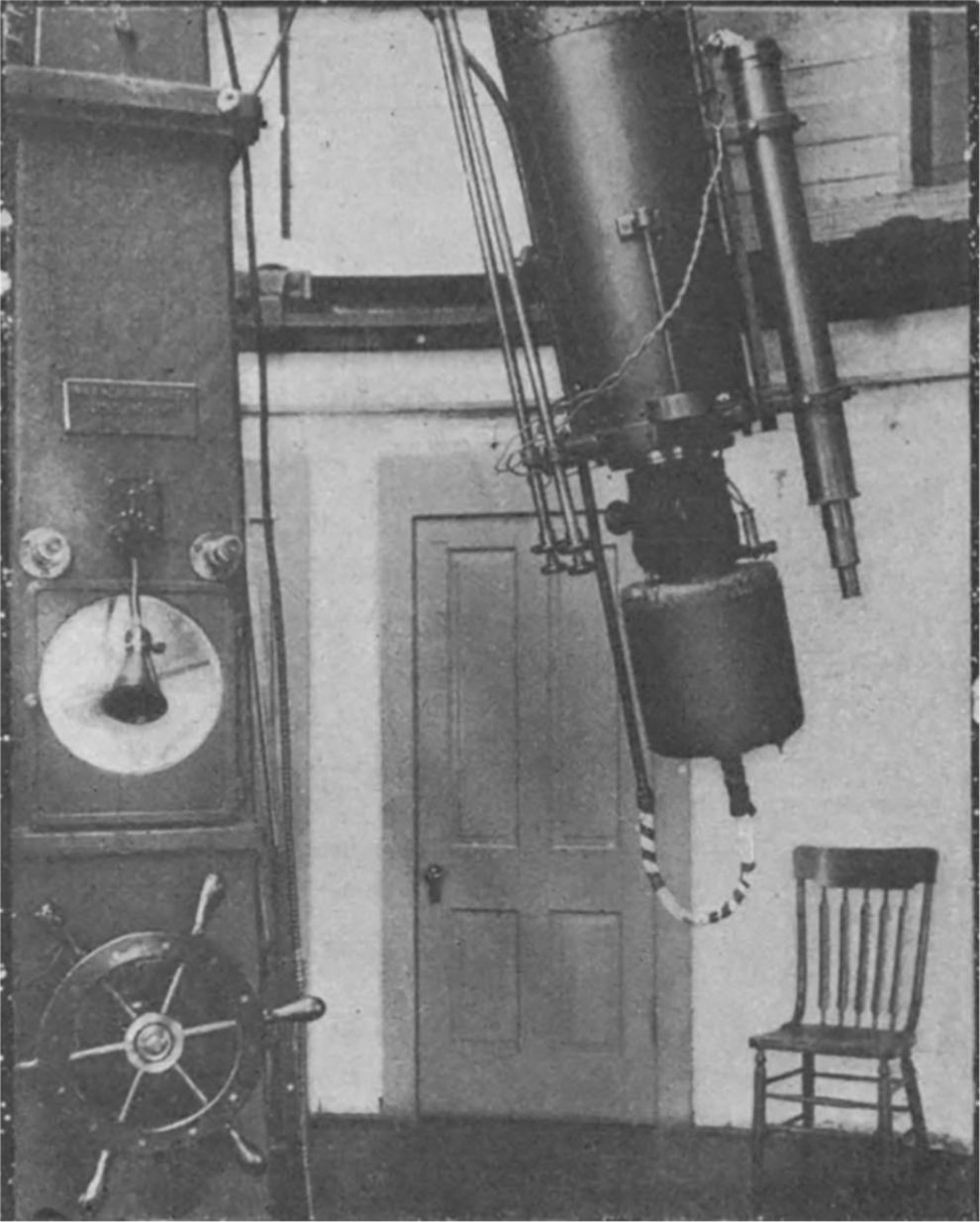
The chair now empty, the astronomer moved away from the eye end of the telescope. Image appears in: J. Stebbins, “The Electrical Measurement of Star Light,” Scientific American, 111(20), 1914, pp. 408–15, p. 408.
Near the end of this period, Stebbins’s professional star began to rise as well. Intending to take a sabbatical to study theory at the University of Munich in 1912, Stebbins entertained offers from the University of Michigan and the University of Virginia to move his photometric program. His stated reason for turning these offers down and staying at Illinois was the opportunity to spend time in Europe, which meant a great deal to him and his family. 16 From his correspondence, it is unclear what he meant when he said he would study theory. It is tempting to assume that he wanted to see the photoelectric observation outfits in place at Munich and Berlin, but if that was indeed his motive, he never stated as much in writing. Either way, it would seem he turned the Michigan and Virginia jobs down in order to preserve this sabbatical.
Perhaps there was another thing on his mind though, one which he could not have had at another university, and that was Illinois physicist Jakob Kunz. Before he left for his year abroad, Stebbins mentions in print that he had seen Kunz demonstrate a light detecting device operating on the photoelectric effect which he saw as having great potential for photometry. 17 He would turn away from photoresistive methods after this and over the course of the next three decades, focus almost entirely on photoelectric devices.
Early photodiodes
If one were to lay all the detectors in the Wisconsin Collection out on a table, two distinct groups would immediately be obvious. One group would be products of assembly line construction generally sharing standard sizes and features. The other group would be the strange and unique phototubes, all much alike but none precisely the same, created in the era of Jakob Kunz (Figure 5). The variation within this set of tubes stems from the many different combinations of materials and conditions of their production. Over time, the form of the tubes changed to meet the various needs of photometric observation. Unlike the commercial products that would permeate astronomical photometry in the later part of the twentieth century, which were often made for general purposes and adapted to their photometric use, the Kunz tubes were made specifically for the purpose of measuring star light. They are also evidence of the collaborative nature that often accompanies a technical innovation. The Kunz tubes and the science they produced involved people from various roles and disciplines and their rapid advancement illustrates the role the technological development plays in the practice of pure science.

Portrait of Jakob Kunz. Image appears in: Stebbins, “Jakob Kunz, 1874–1938.”
Joel Stebbins left Illinois at an awkward time for the development of photoelectric detectors. He recalled that Jakob Kunz first approached him about using a photoelectric in place of a photoresistive one in 1911. Stebbins left that next year for Germany and as such was not able to give the photoelectric cell a proper try until 1913; however, he was able to see Paul Guthnick’s photoelectric operation in Berlin. Guthnick had produced his own prototype phototube according to the methods first developed by German researchers Julius Elster and Hans Friedrich Geitel at Wolfenbüttel and published his first findings with it in 1912, so it would seem that stellar photometry using cells of this nature emerged in a few places at about the same time. 18
Kunz himself was a Swiss born, English and German educated, emigrant who Stebbins described as “an illustration of the cosmopolitan character of science.” Kunz made his American connections during his time at Cambridge and found work as an instructor at the University of Michigan before being poached in what Stebbins characterized as a deliberate effort by Illinois president Edmund J. James to add European influences to his physics faculty. 19 Kunz was, in the first line, a theoretical physicist and not one who excelled in teaching introductory material. His appointment at Illinois was in mathematical physics and he maintained this professorship for the rest of his career. Stebbins would describe the production of photoelectric cells as “only a side line” for Kunz, but the degree to which he participated in Stebbins’s photometric program, travelling on multiple occasions across continents to perform astronomical observations, betrays a real passion for the observational type of work. Kunz was also a capable technician, filling and sealing the many photocells he made himself and helping to design the circuits in which they would operate.
Both polymath and polyglot, Kunz published in a variety of theoretical including photoemission and magnetism. He also possessed the traditional linguistic Swiss army knife of German, French, and Italian to which he had added English and Spanish as well as formal training in Greek Latin and Hebrew. 20 Kunz was also a radical pacifist, if one can use such a phrase, in an era of extreme belligerence, and an ardent internationalist in a period of great nationalist fervour. Much of what remains of his work at Illinois is concerned not with physics at all, but with world peace and the philosophy of religion. Kunz was soft spoken and kind and Stebbins related that it was sometimes difficult to get him to take credit for his own work. 21
Stebbins was not present at Illinois when Jakob Kunz and physicist W.F. Schulz made their first attempt to focus the light gathered by a telescope onto a photoemissive cathode in 1912, but he arrived back at Illinois in 1913 ready to pursue the concept seriously. He found once again that the best astronomical research tool is sometimes a talented physicist. Kunz filled and sealed the tubes himself at the applied physics lab in Urbana, and Stebbins was often present at the bench assisting in the process. A wealth of experimentation led to a peculiar method, which produced cells that not only surpassed those made by the German instrument makers Günther & Tegetmeyer, based in Braunchweig – the only commercially produced photoelectric tubes at the time – but became far superior to anything else available for stellar photometry. Stebbins did acquire two Günther & Tegetmeyer cells, one of which is now in the Wisconsin Collection. This would remain the case for decades, even after Kunz’s death in 1938.
How to make a Kunz tube
Kunz’s cells were the same concept as those invented by Elster and Geitel, meaning that they used a photoemissive surface on the inside of a gas filled tube and gathered the emitted electrons with a positively charged anode. The great variety of cells in the collection suggests a great deal of experimentation in the development of working devices; however, there is very little left to document what failed to work and some of the stranger cell configurations remain a mystery. What did work was described by Kunz and Stebbins throughout various publications and some of the features that developed over time can be identified in the Wisconsin Collection items (Figure 6).

A typical Kunz tube. NASM item: T20170061000.
For photoelectric cells to be useful for stellar photometry, there are two principal concerns. One, that they have high initial yield, and two, that they have low dark current. In both of these respects, the needs of astronomers diverged from those of most commercial concerns with respect to photodetectors. The faintness of starlight and the ambition to precisely measure the difference between the light of various stars meant that not only did astronomers need to generate a measurable current from faint pins of light, but they also needed that signal to rise above any ambient current in the system. A discussion of the various attempts by Wisconsin astronomers to utilize commercial cells will occupy a later section, but suffice it to say that Kunz’s cells were unique because they paid specific attention to reliably measuring extremely low currents.
Although no two Kunz tubes are exactly alike, generally their form was a bulb 3–4 cm in diameter with two arms 6–7 cm long at opposing ends. The tube blanks started with the platinum electrode structure already laid out. The anode, the electrode through which emitted electrons would be gathered, extended though one tube arm and terminated in the tube bulb. The cathode, the electrode through which the emissive surface would be given its charge, was introduced directly to the tube bulb itself (Figure 7).

Kunz’s illustration of the tube layout. A: anode electrode; B: guard ring; C: cathode electrode; D: anode sleeve. Image appears in: Kunz, Jakob and Stebbins, Joel, “On the Construction of Sensitive Photoelectric Cells,” Physical Review, 7, 1916, pp. 62–5.
The tubes were first evacuated by a mercury pump and then heated to 330°C to drive off any remaining atmosphere. The silver coating was applied to the bulb’s interior surface first and then the alkali metal condensed on to the silver in as uniform a layer as possible. The alkali metal, at least in early tubes, was distilled inside the tube itself, pooled from a small reservoir in one arm (Figure 8), condensed on the silver with cold water or ice. At the same time, the arm through which the anode will be drawn and the window through which the light will pass are kept hot, such that the evaporated metal would not condense and those surfaces would remain clear.
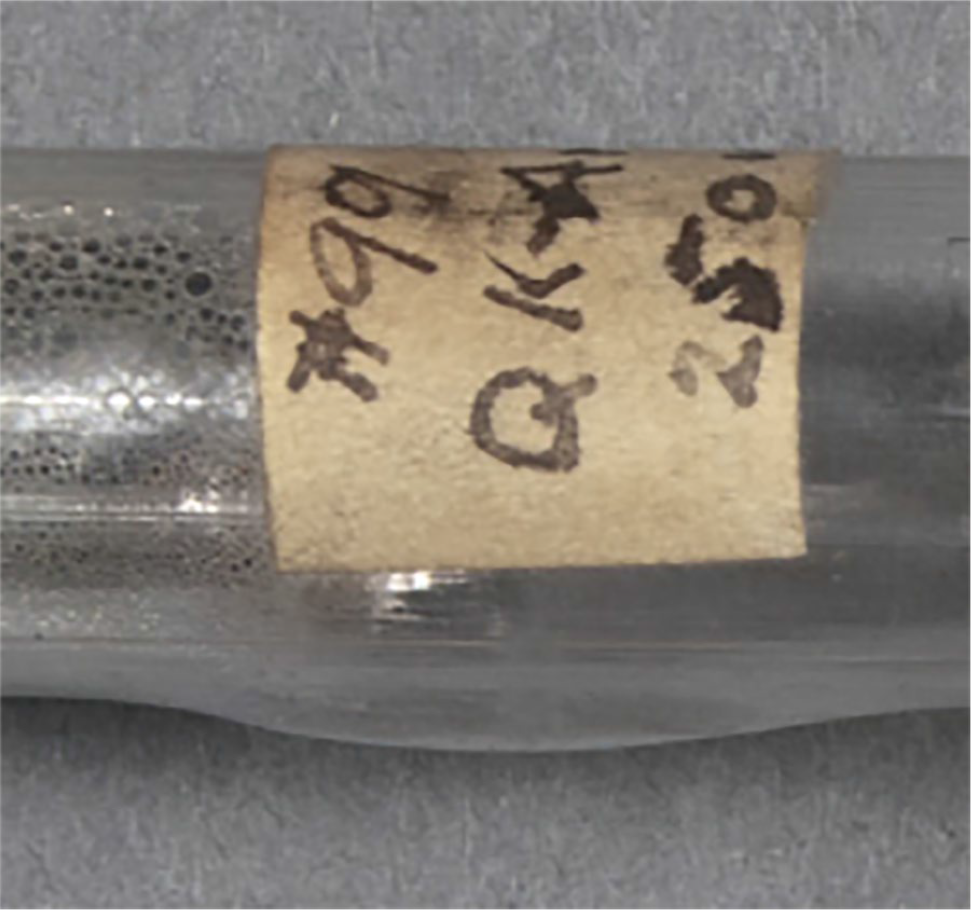
Reservoir on the tube stem where the all important alkali metal was heated to evaporation.
The next and most crucial stage was the creation of a metal hydride association where the alkali metal layer is present. Pure hydrogen was admitted to the cell and then a potential from 280 to 400 volts put across the electrodes which, if the maker was lucky, would create a soft and uniform glow inside the cell as the hydride layer formed. If unlucky, the charge would arc between the electrodes and the cell was ruined (Figure 9).

Kunz’s laboratory set up to sensitize phototubes in Urbana, Illinois. The tube itself can be seen on the left. Image from the papers of Jakob Kunz, (Ser. 11/10/26) University of Illinois Archives. Urbana, Illinois.
Gasses other than hydrogen were tried for the association layer as well. However, ethane produced an unstable association and ammonia did not reach the sensitivity of pure hydrogen. It took just a few minutes to create the hydride layer and once this was done, the cell was tested for its sensitivity immediately. The collaborators described the process as one for which “the best conditions must be found by experience.” 22 If they had arrived at ideal conditions, they never published the specifics. Although it is possible that Kunz and Stebbins felt some proprietary claim over their processes, what seems more likely is that they were not sure enough about the ideal conditions themselves to commit anything to print. The final step was to pump out the hydrogen and fill the tube with an inert gas such as helium or neon. This both protected the hydride association from reactive molecules and also provided some amplification from the ionization of the gas filler. Neon gave the best results initially, but helium and argon worked better at higher voltages. Eventually argon became the standard.
As mentioned above, maximizing initial electron yield was a key factor in sensitivity. Little about cathodes can be gleaned from the collection items as the metal hydrides have all deteriorated over time. Still, the publications of Kunz and Stebbins do lend some insight. The earliest were rubidium though Kunz also tried lithium, sodium, potassium, and cesium all on a silver substrate. Cesium would eventually become a common cathode component in the commercial era, but it was difficult to distil. The same distillation issues came with rubidium and lithium. Sodium and potassium were more easily obtained in pure forms and because of its lower boiling point, potassium became the alkali metal of choice. 23
Anodes represented in the collection are much easier to classify. The most common shape was a small circle with a thin platinum net strung across. Anodes did vary though, in the Smithsonian’s holdings alone, there are linear and circular anodes both with and without nets of various configurations (Figure 10). The nets, difficult to make out in pictures, were sometimes a single cross and sometimes a denser collection of strings not unlike a tennis racket. The stem of the anode was also eventually coated in glass or quartz to try and cut down on current leaking from the sides of the tube onto the anode. Improvements to the anode structure allowed more of the emitted electrons to be caught, but had to be balanced with insulation needs.
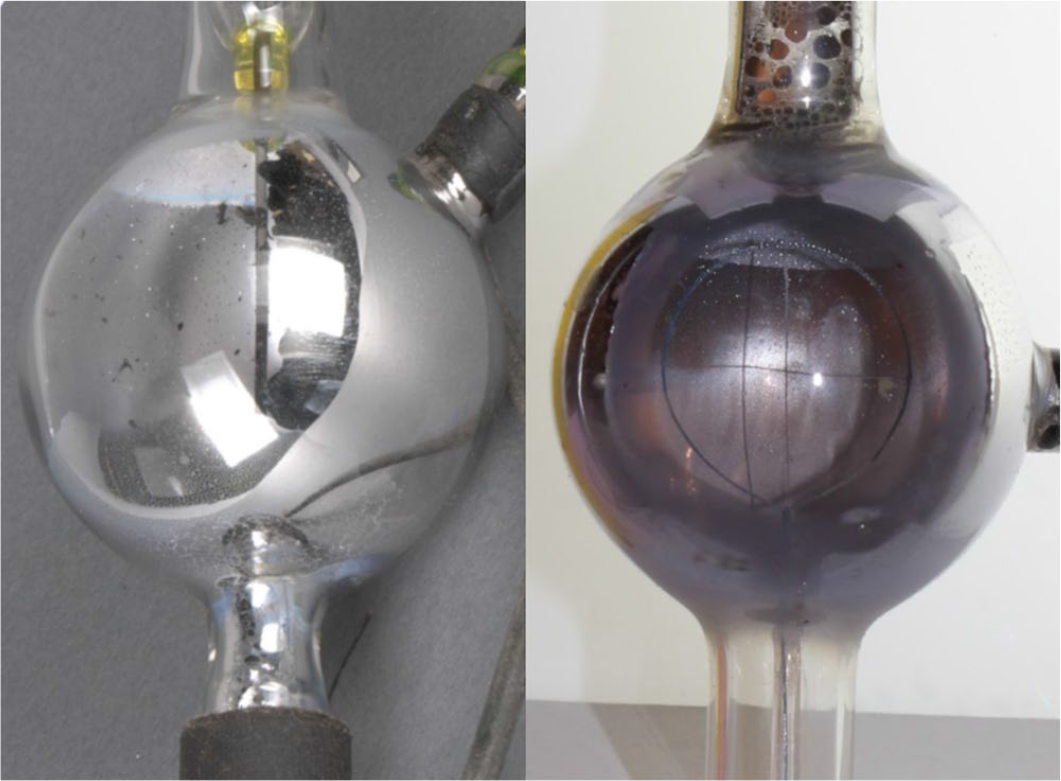
Left: linear anode. NASM item: T20170061001. Right: typical circular anode with cross or net. NASM item: T20170061000.
Because current could leak across the tube surface and even through the tube glass, insulation was paramount. Poor insulation meant high dark current – the current which passed across the cell when it was not exposed to light – and high dark current meant a useless cell. The photocurrents created by stars were minuscule,
Approaches to improving tube insulation were diverse. It was Albert Whitford’s opinion that the cleanliness of Kunz’s process was the main cause of the Kunz tube’s low dark current. 25 If this is true, then the close control Kunz had over the circumstances of manufacture was certainly one aspect of his success, but other insulation features were developed as well. Substituting quartz for glass as the tube’s envelope material cut down significantly on the flow of electricity over the outside of the tube. Quartz was harder to work for the glass blowers than Pyrex (first made available by Corning in 1915), for example, so quartz tubes often had to be fused with glass in places where delicate connections were made. In addition, the quartz blanks had to be acquired from a private firm, Cooper-Hewitt, where glass blanks could be made by the glass workers in Urbana. They fused the envelope in stages with higher proportions of more manipulable glass that created a telltale stair-step pattern (Figure 11). Looking for this pattern remains, for the moment, the best method for identifying quartz cells in the collection.
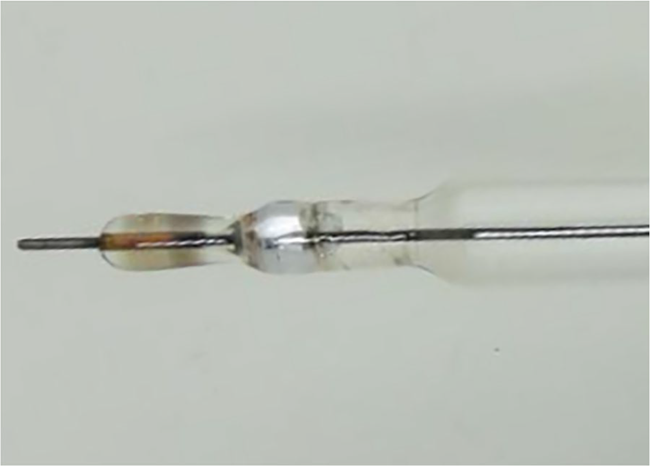
The quartz stair-step pattern formed by multiple fused connections.
Current leaking over the outer surface of the tube’s body could be caught and sent to earth by a guard wire or ring. Sometimes rings were painted on with conductive material and wire, others were made from platinum and fused into the tube surface. 26 The fused rings were a necessary remedy for the relatively poor insulation created by glass. With quartz envelopes, the leakage was low enough not to need grounding. So, somewhat counter intuitively, guard rings actually became more rudimentary or disappeared in later tubes in the collection (Figure 12). In later attempts to help design a viable commercial tube, quartz envelopes and guard rings would be among the suggestions Wisconsin astronomers would give to commercial laboratories. Coating the length of the anode electrode with glass or quartz was another feature introduced to boost insulation. Over time, it would seem, the glass workers kept making the electrode stem coating longer and longer, presumably hoping for lower dark currents.
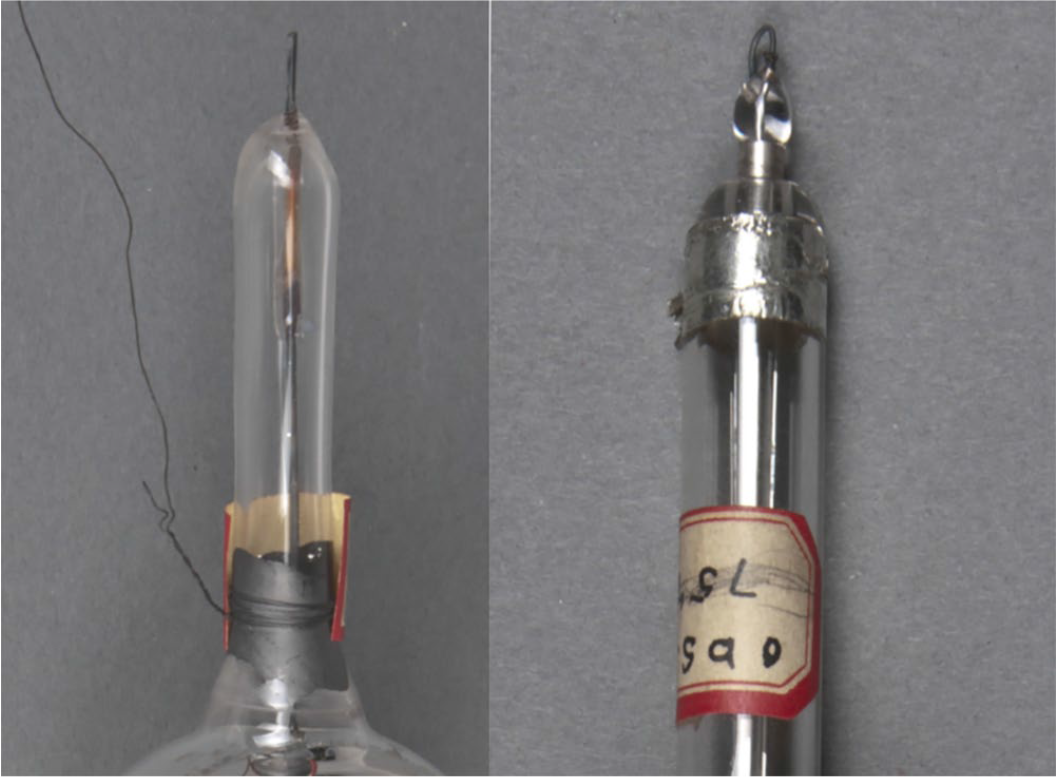
Left: a painted guard ring. NASM item: T20170061004. Right: a fused platinum guard ring. NASM item: T20170061009. The tube on the right also has visible quartz coating on the anode stem.
There was a great deal of luck involved in the creation of Kunz tubes. Their construction was a complex and multifaceted process, and the totality of factors regulating the quality of the end product and their interaction remained enough of a mystery to Kunz and his collaborators that they could not reliably create sensitive devices. The creation of QK99 (Figure 13), perhaps the single most useful Kunz tube, is a testament to this randomness. In 1916, while Kunz was out of town, Stebbins and one of Kunz’s colleagues, L.A. Welo, worked to produce a tube with a quartz envelope and a potassium-hydride cathode filled with argon, as had become the common recipe. The process of sealing the cell after it had been prepared took longer than usual, perhaps because the experienced hand of Kunz was not at the wheel, but when it was completed, it became clear they had made something very different.
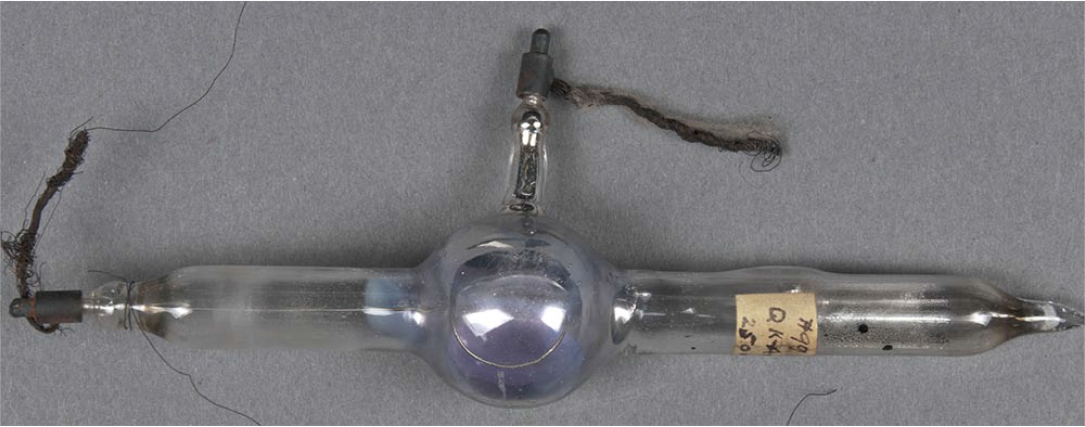
QK99. The accidental success. NASM item: T20170061006.
The cell had a much higher critical temperature than most and as such could be operated at a higher voltage, increasing the sensitivity of the cathode. This tube’s label #99 QK-Ar 250v, stands for the 99th successfully made tube, with a quartz envelope and a potassium cathode (QK), filled with Argon gas, and running at or above 250 volts. This tube, Stebbins reported, “suddenly doubled the aperture of our telescope.” 27 QK99 could not be replicated and after its creation, it spent six straight years in Stebbins’s photometer without interruption. Ten years after it was created, Stebbins would speculate that the extra heating the cell underwent during the elongated sealing process may have contributed to the higher operating temperature. Whether they ever tried to replicate the process is not known, but QK99 remained a fixture of their operation. In a letter to Kunz in 1928, Stebbins reported that Welo had written asking about “that dear old cell QK99.” 28
It was clearly difficult to learn much even from successes. QK99 had been an aberration, but a decade and a half later, there seemed to have been little improvement to the frequency with which outstanding cells could be made. Stebbins wrote to a colleague at Mt. Wilson in 1933: He made us three pretty good cells in 1922, two superlative ones in 1923, then six or eight strung along for a half dozen years none of them good, then about four good ones in 1931, followed by two for yourself no better than fair in 1932. Your guess is as good as mine as to when another fine cell can be made.
29
This discourse, reminiscent more of one between vintners than scientists, is instructive of the relative knowledge vacuum in which Kunz was working. While, by 1930, there were significant resources going into the development of photodetectors for some more industrially focused purposes, this could not really be said about tubes specifically created for astronomy and Kunz’s methods themselves would have little direct influence on future tube makers, with the exception of his Illinois colleague Josef Tykociner.
Stebbins produced a number of papers based on his early observations with the Kunz cell photometer at Illinois. Using a rubidium cell, Stebbins made observations of the variable star β Lyrae establishing light curves and minima for the system. 30 He did the same for λ Tauri and ι H Cassiopeiae in 1920–1921 with QK99 and also revised his earlier observations of Algol with the new equipment. 31
Stebbins also made a number of expeditions to obtain photometric measurements of the sun’s corona during total eclipses. In June 1918, Stebbins, along with Kunz, made the trip to Rock Springs, Wyoming, where they observed the solar corona with a simple photometric device. Having much more light, to sense than with star light, the eclipse photometer was not much more than a pair of boxes, housing the photocells, with 48″ tubes to restrict the light which they stuck to an old equatorial mount. They set up a shed from which to watch the galvanometers and even though they did experience some equipment failures, including “flashing” their rubidium cell by applying too much current, the all important weather conditions were fair and they were able to make the first ever photoelectric measurements of the corona with their remaining good cell. 32
In 1922, Stebbins left Illinois to become the Director of Washburn Observatory at the University of Wisconsin. The move came right in the midst of a real takeoff for his photoelectric observation tactics. Madison had the attractive qualities of a slightly larger telescope and a slightly larger instrument budget, but he would be leaving the applied physics department at Illinois behind. Stebbins remained in close contact with Kunz however; both they and their families were close and the connections between them went beyond phototube engineering. Kunz would attend Stebbins’s eclipse expedition again in September 1923. The group had travelled to Santa Catalina Island, intending to replicate their observations from 1918, but were clouded out on the day of the eclipse. 33
Challenges
While at Illinois, Stebbins had developed his own practices for building and using selenium cell photometer boxes based on the systems developed by German physicist Ernst Walter Ruhmer used by Paul Guthnick. The photometer itself continued to develop throughout the photodiode era. In 1919, physicist Elmer Dershem completely rebuilt the Illinois photometer before taking this experience to Lick Observatory where he and Edith Cummings, with the advice of Stebbins, built the first photoelectric photometer there. 34
At Wisconsin, Stebbins continued to tinker with the instrument’s various problems and shortcomings. Moisture was the bane of electrostatic measurements. The electrometer was kept sealed up in its assembly as often as was possible and surfaces vulnerable to condensation could be heated. Moisture could also be controlled with positive pressure. Stebbins relates this approach in his 1928 description of his methods, relating that air was obtained from the University system and dried by bubbling through sulfuric acid. The dried air was then brought through the cell box to carry off any moisture in the air. 35
Simply having a sensitive instrument on the end of the telescope with the right climate was not enough to make observations. There also needed to be something to measure the photocurrent. This part of the assembly, the electrometer, was in many ways as much trouble as the cell. Stebbins had used free standing galvanometers as part of his earliest set ups at Illinois, using the constant beat of a metronome to note a given amount of deflection, or movement of the string, over time. 36 But this approach only worked for brighter sources. Weaker photocurrents from dimmer sources required the more sensitive string electrometer.
The string electrometer was a crude device. The cathode of the cell would take on positive potential as it lost electrons while exposed to light. A string hanging in an electric field created by two “knives” with opposing charges could then accumulate charge from the cell and gradually pull towards the knife edge with opposing charge. The electrometer could work at either end of the cell, accumulating positive charge on the cathode end or negative charge on the anode end. Figure 14 shows a circuit with the electrometer attached to the cathode. The deflection of the string could then be read against a scale with a microscope. The full photoelectric system thus used one set of optics to gather light (the telescope), converted that light into electrical potential (the photocell), then converted that potential into motion in physical space (the string electrometer), and observed that motion through another set of optics (the microscope). The complexity of this operation gives some insight into the difficult nature of analog measurement and suggests why this method wasn’t widely adopted in its initial form.
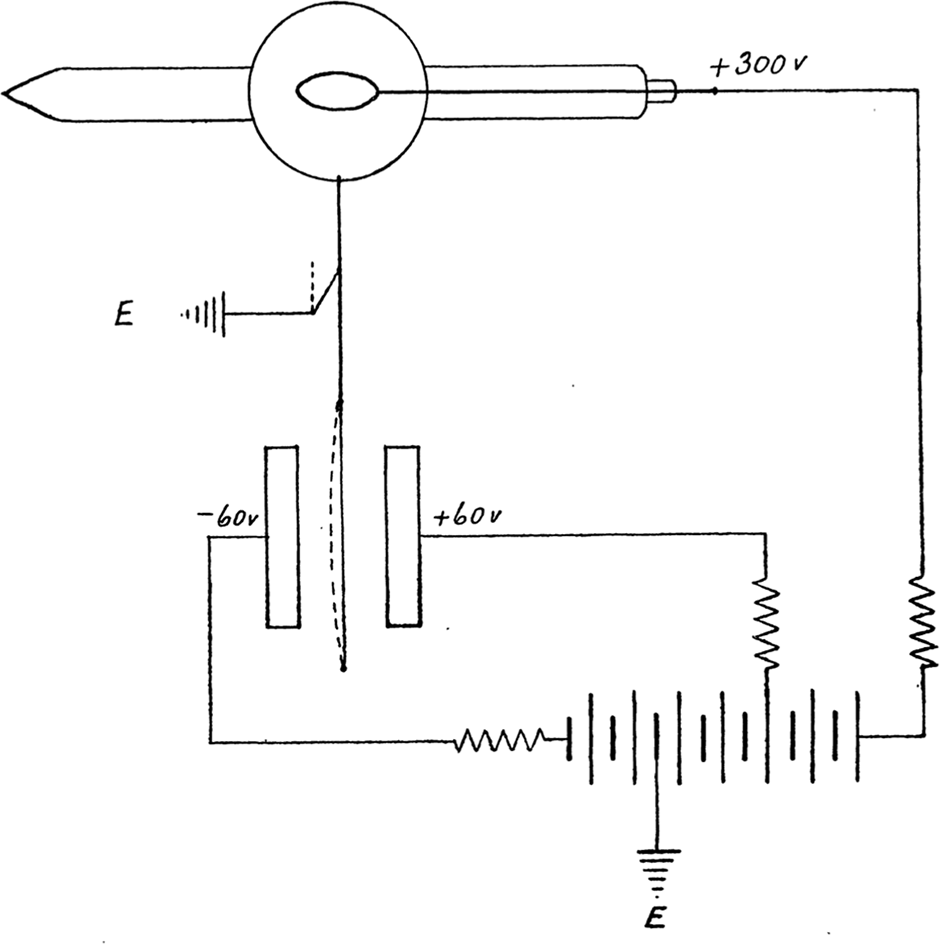
Stebbins’s photometer circuit showing cell, battery, and string electrometer. Image appears in: Stebbins, “Instruments and Methods.”
To avoid passing the current over a long distance and introducing error, the string electrometer needed to hang free and vertical from the end of the telescope. This was a difficult place for a sensitive piece of equipment to be and Stebbins worked with the machine shop at Wisconsin to develop a universal joint which would allow the device to hang securely and vertically at any angle of the telescope tube. 37
In 1924, the British instrument makers A.F. and F.A. Lindemann eventually succeeded in making a torsion electrometer, which could be used at any angle so the stellar photoelectric photometers prior to that all used some version of the string electrometer. The design existing was one thing, such electrometers remained hard to come by. By the mid-1920s, there still was no American manufacturer making quality string electrometers.
Here politics managed to get in the way as well. Stebbins had, during his earliest experiments at Illinois, used an electrometer from Edlemann in Munich. The First World War interrupted this supply chain, causing both Stebbins and Edith Cummings at Lick to note that they had to start building their own electrometers. 38
The pre-war connection to German photometry had initially allowed the method to jump across the Ocean. It was Elster and Geitel who invented the modern cell upon which Kunz’s techniques were based and Guthnick who originated the methods that Stebbins adapted first to selenium and next to photoelectricity. The interruption caused by the war and the subsequent sequestration of the Central Powers from post-war scientific communities hamstrung not just the transmission of scientific work in what were at that point two separate structures, but also disrupted the trade of quality scientific instruments between spheres. The impact of these events on the formation and history of international scientific organizations has been explored elsewhere, but it bears noting that both Stebbins and Cummings directly reference politics as an obstacle to getting effective equipment in the postwar period. 39 This status certainly did not last forever; in fact by 1926, there was a photometer built by afore-mentioned firm Günther & Tegetmeyer, in operation at Harvard. 40
Stebbins was able to get William Gaertner and Co. to build an electrometer to his specifications and the design was copied for the Lick photometer. He tried to have another constructed for his new photometer in Madison but his efforts were frustrated by a year’s delay from the contractor which he chalked up to a “change in management.” It was in the period after his move to Wisconsin that Stebbins resorted to building the devices himself. The most difficult part was treating the string, which involved various coatings and dissolutions to get it sensitive enough for use. Stebbins was clearly frustrated by this work and stated that With an experience of a dozen years, I have no information which will be of much use to anyone else. When occasionally we need a new fiber, I undertake to make it, and after several trials, usually not over a half dozen, I succeed in getting one, but each time I have to learn over again.
41
Experimentation as inquiry
It should be becoming clear at this point that this new method of astronomical observation was not an extension of previously existing ones. It required a completely new infrastructure of astronomers, supported by physicists and engineers, not just during the construction of instruments, as had always been the case with telescopes, but during their maintenance and operation as well. Making, maintaining, and operating photoelectric equipment needed an entirely different skill set and preparation than had been previously necessary. Moreover, the process of constantly developing new equipment and methods while gathering and analysing data represented a challenge to established norms in astronomy. This claim is not simply one of retrospective analysis, Stebbins was publicly discussing the way his methods both challenged and complimented those of other astronomers in the 1920s.
In a 1922 presentation to the American Association for the Advancement of Science, Stebbins gave an address titled “Observation versus Experimentation” in which he constructs a rather polemical characterization of scientists as falling into one of those two categories: observers and experimenters.
42
Astronomers, Stebbins maintains, have been often more of the observer persuasion, preferring to compile vast sets of precise data with respect to things like position and intensity. He identifies the great expense of powerful telescope objectives as playing a part in this. An institution which has invested in an expensive telescope is more likely to want to streamline the gathering of as much data as possible, after all, simply having a bigger light bucket isn’t going to make you a better theorist, and every minute you spend looking at reductions or fooling with your eyepieces are minutes that could be spent making observations with your capital investment. For Stebbins, this was a question of raw economic power, the more resources an institution has, the larger its instruments can be. But there is a certain downside to the possession of these instruments: There is little need of discussing the relative advantages of large and small telescopes, one might as well discuss the possibilities of abundant and meager resources; but there is at least the consolation to a possessor of a small instrument that he does not need to use it all the time simply to justify the capital expenditure in his equipment. He is therefore much freer to try out new ideas, and even to waste a great deal of time, without the immediate necessity of producing results in proportion to his facilities.
43
Stebbins saw the pressure of high capital investment as representing at least the potential for astronomers to get sucked into a narrower space of possibility, where keeping the same old program of observation running becomes preferable to exploring a new one. He also saw the traditional approach as the easier one to teach. If your program is stable and constant, you can always plug new students and assistants into it. It is much harder to teach the spirit of challenging the available methods or apparatus and much harder to continually chase new avenues when so many will lead nowhere. More difficult still is finding assistants and collaborators who are interested in astronomy but also fluent in the theories and techniques that make photoelectric photometry possible.
This casts an interesting light on Stebbins’s role in driving observing technology forward. Saying of the pace of change in photographic photometry, Many an observer during the tedious hours of long exposure must have felt some of his time might better be devoted to increasing the sensitivity of the photographic plate, rather than continuing the drudgery of keeping a telescope accurately on a star for hours at a time.
44
Stebbins sought to be this unusual observer. By pushing detector technology along, he was able to ignore the object differences between the equipment available in the Midwest and that on the West Coast. Each increase in the sensitivity of the instrument, whether that came in the form of initial yield, reduction in dark current, suppression of noise, or amplification of signal effectively made his telescope larger, to the point where the Washburn Observatory’s 15.5″ refractor could continue to produce viable research even as telescopes five times its size were being completed in California. Thus, a limitation in a given area might directly drive expansion in another.
In a more general sense, Stebbins used this address to call for an interdisciplinary effort inside and outside of astronomy. He concedes that things have become complex enough in the physical sciences that it was not really possible for any one human to master every theory or practice relevant to a given problem. Instead he advocated for specialization and cooperation with experimenters, observers, and theorists working together. He wrote, “no matter how well rounded an individual may become, his abilities may easily be surpassed by a group of cooperating workers.” 45
This too seems to have been a value that Stebbins lived. From his earliest attempts at photometry, he involved physicists and engineers deeply and worked to obtain many of their specific skills as well. This interdisciplinary spirit would continue to define the growth of photometry at Wisconsin. Stebbins would bring in his eventual successor at Washburn not from astronomy, but from physics. That physicist, Albert Whitford, would contribute the next big leap in photodetector technology: thermionic amplification.
DC amplification
Throughout the first two decades of photoelectric photometry, the greatest difficulty was always the very low current produced by photocells. One could only ever measure as much signal as was produced by the few photons captured at any given time, aside from the modest gas amplification in the Kunz tube itself. Around the same time that Stebbins began his work with photoelectric cells, some devices for amplifying electrical signals were already being developed, but their adaptation to astronomy would lag behind.
In the early 1930s, Stebbins hired then physics PhD student and electrical engineer Albert Whitford. Whitford would be the first to successfully implement amplification for faint photoelectric signals, an advance that would open up vast new directions for photometric research. Whitford’s addition of an amplification stage to the photometer represents a leap in complexity for astronomical photometers. The photocell had, in the intervening years, become a central part of many signalling technologies including, in the area of the most cultural impact, sound on film, which was first demonstrated in the same Illinois physics lab where Stebbins and Kunz had collaborated. The various approaches to signal amplification would be by far the most important technical innovations of the 1930s with respect to photometry. Originally, Kunz’s photodiode tubes had relied on ionizing gas amplification to boost signal. Whitford would bring in the use of DC amplification for photocurrents, and eventually photomultiplicative amplification would deliver an integrated photodetector sensitive enough for astronomy and cheap enough for mass production. We will return to photomultipliers later.
Albert E. Whitford did not come to the University of Wisconsin to be an astronomer. He obtained his BA from the small Milton College in Milton, Wisconsin, also his birthplace, before enrolling in a doctoral program in physics at Madison. How Stebbins got hold of him remains unclear, but he noticed Whitford’s talent for electrical engineering immediately and consistently made moves to keep Whitford working for Washburn. Stebbins managing to expand the observatory staff in the midst of the Great Depression to keep Whitford on and Whitford’s assistantship went from temporary to permanent after the mid-1930s. He would become Stebbins’s successor as director of Washburn Observatory in 1948. During the War, he worked on microwave physics at MIT’s Radiation Laboratory alongside fellow Wisconsin astronomer Gerald E. Kron and future Wisconsin astronomer Harold Johnson. 46
The amplified photometer
Whitford was not the first to think of trying to amplify the minute currents produced by stellar photometry. In fact, Stebbins had been trying, or having his assistants try for nearly a decade, before Whitford managed to succeed. Stebbins reports unsuccessful work on this problem throughout the 1920s. 47 Hans Rosenberg at the University of Tübingen, another German photometry pioneer, had produced some results with DC amplification of photocurrents in 1921, but these early experiments did not produce any results or a workable solution to certain technical problems. Ordinary triode amplifier tubes, which were suitable for amplifying AC signals, such as those used for audio, had too much interval capacitance to be sensitive to the weak DC photocurrents produced by the light of a star. In other words, the slight changes in low currents necessary for photoelectric photometry would not be detectable after passing through the amplifier.
An amplifier tube built specifically for low grid current was not produced until the General Electric FP-54 hit the market in 1930. The arrival of this tube accelerated work already underway, mostly by Stebbins’s assistants at Washburn, to produce a circuit with a photocell and an amplifier in series. Several assistants tried their hands at producing such a circuit. In 1932, when Whitford published an account of his new device, he named two others, J.C. Cavender and R.P. Winch, who had worked to integrate the FP-54 before him. Stebbins himself had, in 1931, made a dedicated trip to GE’s lab in Schenectady, New York, photometer in tow, to test the integration of the amplifier but was unable to make it work any better than the electrometer set-up. 48
In 1932, Whitford made the breakthrough. By placing the photocell and the amplifier tube in an evacuated cylinder with two chambers, one for the photocell and one for the amplifier (Figure 15), and using some clever changes in circuit resistance, Whitford was able to build a device which would produce currents large enough to be measured with a galvanometer, freeing the process of measurement from the awkwardness of hanging electrometers. Whitford’s photometer circuit was much more complex than previous photometers partly to balance the grid currents in the amplifier but also to be able to easily interchange several different resistance loads in series with the photocell allowing closer manipulation of the cell’s operating voltage.
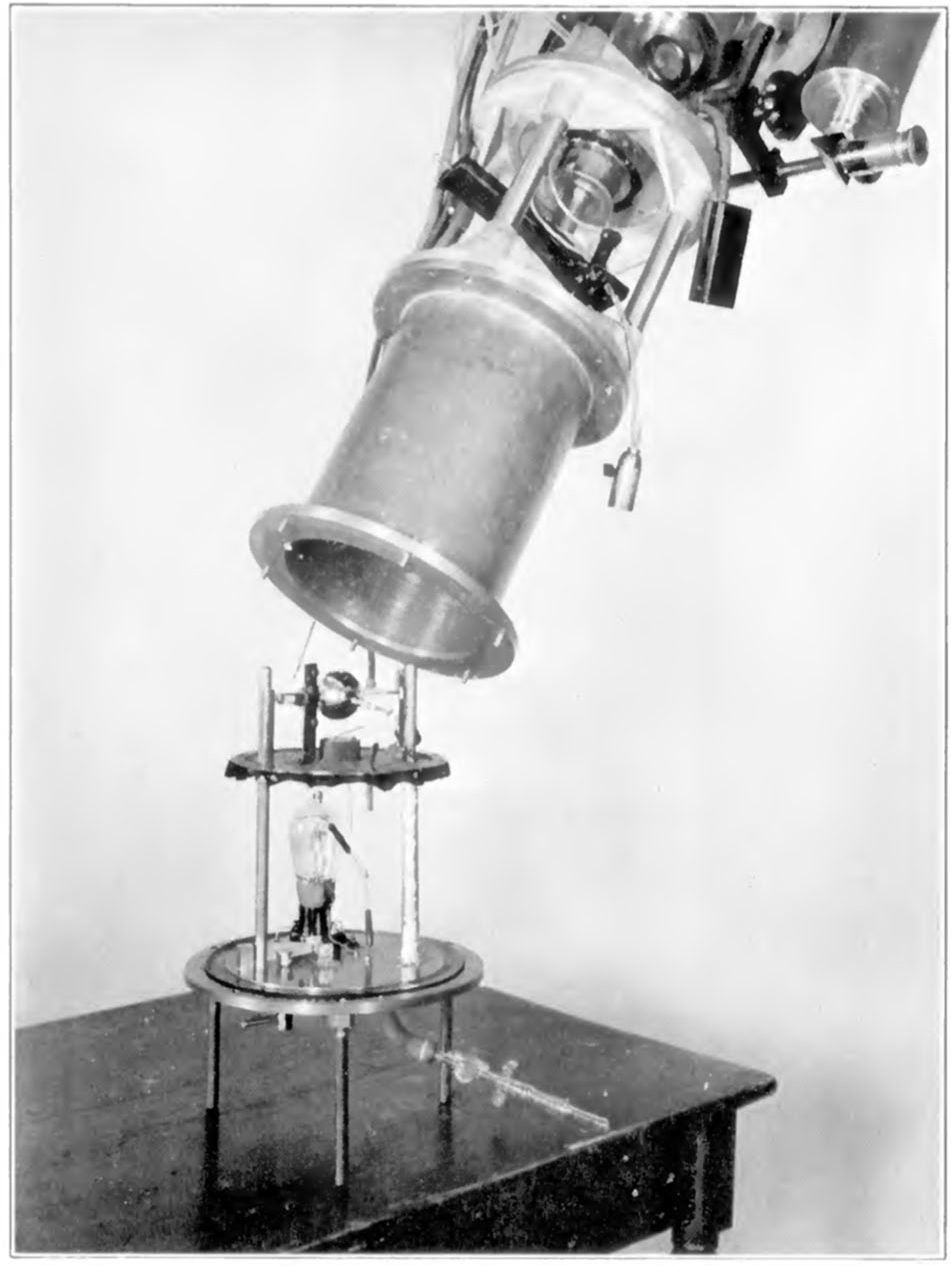
Whitford’s amplified photometer. Kunz cell on top, FP-54 below. Image appears in: A.E. Whitford, “The Application of a Thermionic Amplifier to the Photometry of Stars,” The Astrophysical Journal, 76, 1932, p. 213.
More to the point, the larger currents produced by the amplified photometer represented a dual leap in the measurements which could be produced. On one hand, a higher output current meant that fainter stars could be measured. Whitford stated that the amplified photometer decreased the minimum stellar magnitude they could capture from 7.5 to 9. The greater output also meant that the cell could still detect brighter stars while being operated at a lower voltage, which meant less noise and greater precision, allowing older measurements to be revised. 49 Evacuation additionally reduced noise from outside sources like cosmic rays. 50
Evacuation placed new constraints on photocells which needed to be shrunk to fit inside the vacuum chamber. Aside from getting short tube arms over the course of the early 1930s, Stebbins worked with Kunz to move the cathode stem on the tube blanks more inline with the tube arms, reducing the tubes’ footprint so that it could better fit in the evacuated chamber; cells of both types can be found in the Wisconsin Collection (Figure 16). 51
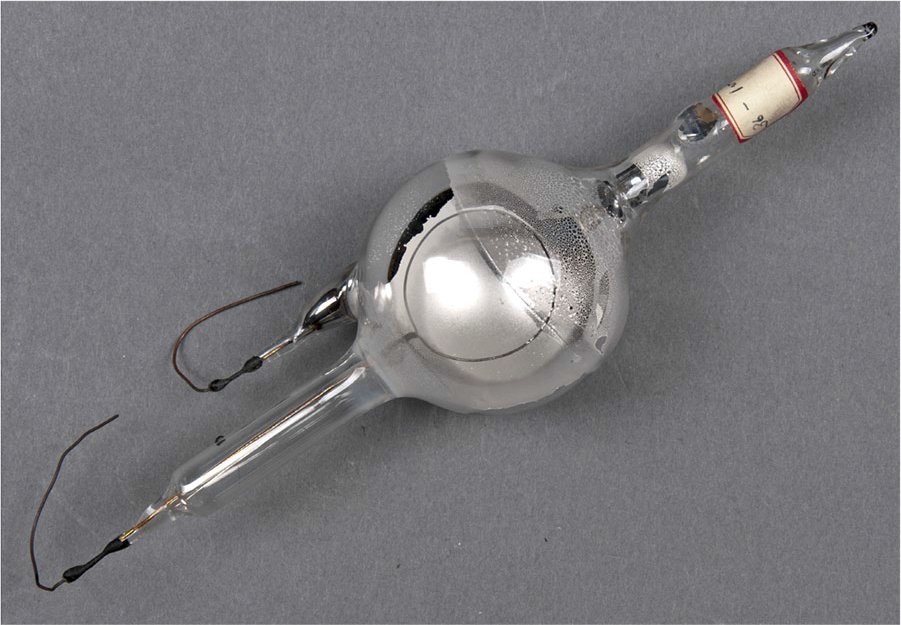
A tube from the Smithsonian’s collection with the cathode lead in parallel with the tube arms in order to better fit the evacuated chamber. NASM item: T20170061005.
The implementation of this new tool led to a flurry of scientific results published over the course of the 1930s. Dealing initially with the reddening of the light from globular clusters as it passes through the interstellar medium and later with the pattern of observable reddening in B type stars, and also by measuring low-level light in the outer regions of the Andromeda nebula, Stebbins and his team resized the universe, arguing that extragalactic nebulae were both much larger and much farther away than had previously been accepted. 52 This conclusion moved Earth and humanity away from the centre of the universe. The predominant cosmology at the time suggested that the Milky Way was large and central and surrounded by smaller outlying nebulae. Stebbins, in a piece in Science held on the contrary that while it might be difficult to accept, “ultimately we shall probably come to the conclusion that we live in just another galaxy, that’s all.” 53
With the scientific output of the amplifier photometer in view, it is important to take stock of how the practice of astronomy was shifting during this period. The complexity of Whitford’s design, shown in Figure 17, is a marked contrast with those that Stebbins had been using throughout the 1920s (Figure 14), and the specialization of the designs would only increase throughout the 1930s. The technical sophistication required to construct and operate these devices had undergone a steep climb and the specifics of their operation were still outside the norms of professional astronomy.
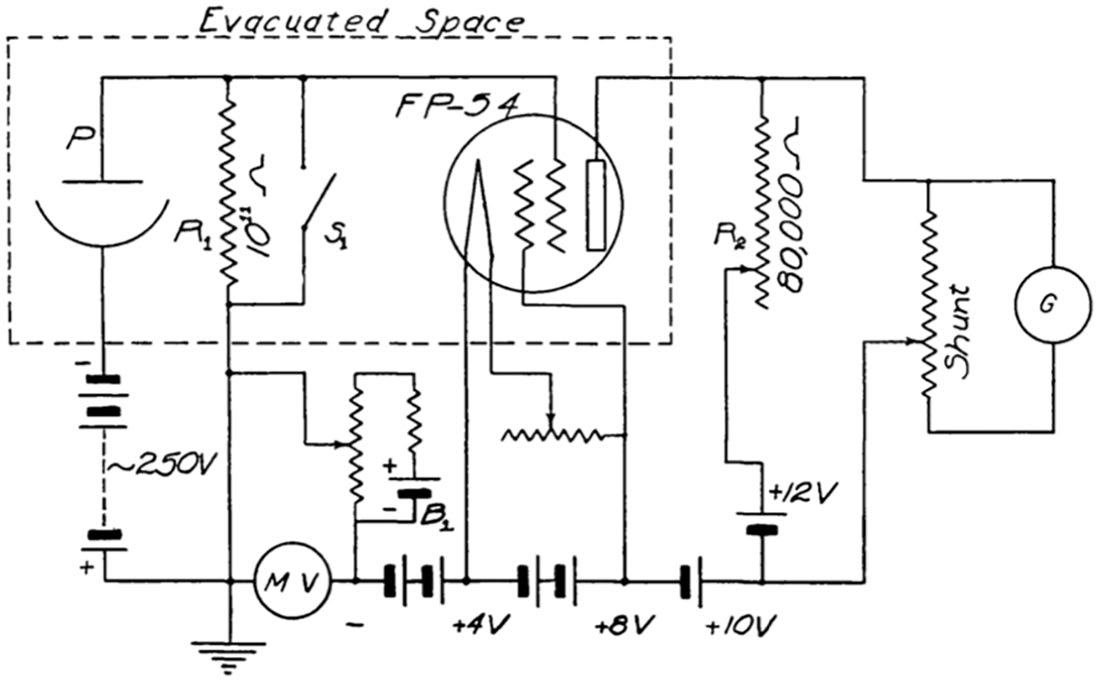
Whitford’s new circuit showing evacuated cylinder. Image appears in: A.E. Whitford, “The Application of a Thermionic Amplifier to the Photometry of Stars,” The Astrophysical Journal, 76, 1932, p. 213.
Electrical engineers in the observatory
Upon travelling to the West Coast and visiting Mount Wilson, first as a research assistant to Stebbins and later as a post-doctoral fellow, Whitford found that there were few in the field of astronomy who had confident command of the finer points of electrical engineering necessary for amplifier photometry, and those who did generally had backgrounds in physics. 54 Whitford remarked that he was viewed at least somewhat as “a wild man who marched around the mountain carrying a soldering iron” and alluded to electronic guiding as a sort of “Buck Rogers” idea to some of the older astronomers. 55
At work here is not just the incorporation of new skill sets to the practice of astronomy, but of the broader incorporation of physicists into the astronomical community. This was not a new phenomenon to be sure, but one that was certainly influenced by the material requirements of new techniques. Observatories in many places were now looking for men (they were still almost always looking expressly for men) who could do this type of work, and not every freshly minted astronomy PhD could. For instance, Whitford worked very closely with his Wisconsin colleague Gerald E. Kron to develop a complex electronic telescope guiding system in the mid-1930s. Kron would, after obtaining his Master’s in mechanical engineering at Wisconsin, pursue an astronomy PhD at Lick observatory and develop a strong photometric program there in the post-war period. The correspondence between the two often consisted of circuit diagrams and tips on where the best components could be got at a buyer’s price.
On the contrary, Whitford described Olin Eggen, another colleague of Whitford’s and Wisconsin doctorate holder, in a 1948 recommendation for a Mount Wilson fellowship as “the observing type of astronomer” and while capable of using photoelectric equipment to make good observations, was not capable of designing it, building it, or maintaining it. Whitford did not mean this as criticism of Eggen, who he heartily endorsed for the fellowship, claiming that the true shortage in astronomy was still competent observers rather than capable technicians, but it does suggest that an analysis of an astronomer’s relationship to technical matters was now something that needed addressing. Whitford went on to mention that in the case that Mount Wilson was looking for an electronics man, the best he knew of was Berkeley student Harold Johnson, whom he characterized as a “wizard.” 56
Johnson became a target for Washburn observatory precisely because of his electronics background, and they succeeded in hiring him in 1949 only to have him poached in 1950 by the other large in-state observatory: Yerkes. Yerkes Director W.W. Morgan apologized to Whitford for snapping up Johnson but made it clear that at the time gifted electrical engineers were simply too much in demand. 57
It is left still for another inquiry to establish whether or not the notoriety produced by the results of the amplified photometer had an impact on the takeoff of the method, but it can at least be said that during the 1930s, more observatories began to build photometers – certainly Lick, Mt. Wilson, and Mt. Palomar did – and to search for astronomers who could run them. 58 Stebbins and Whitford exchanged many letters with other astronomers looking for advice on how to get their instruments working and keep them that way. In the years just prior to the Second World War however, photoelectric photometry suffered a disastrous loss. Jakob Kunz’s failing health finally gave out and he passed away in 1938, leaving no clear way forward for the development and even continued production of the photoelectric cells which still sat at the core of astronomy’s photoelectric enterprise. The search for commercial alternatives to Kunz’s work will be the subject of the next section.
Replacing the Kunz tube
Although the most sensitive photoelectric devices were almost always used for observation, there was a need inside astronomy for more run-of-the-mill equipment as well. Photocells were touchy, fragile, and expensive. Too much current as a result of false moves, mistakes, or wrong connections could fry a good cell in seconds and leave its owner out of luck. Likewise, cells could be dropped, crushed, or fail at crucial connection points. Things happened, Stebbins applied too much voltage to one of his rubidium cells at the 1918 eclipse and destroyed it. 59 It was standard practice to use the best cells only for sensitive observations while leaving the risky business of high voltage operation or testing new equipment to more replaceable hardware.
By the mid-1920s, the demand for a Kunz cell was beginning to mount. Photoelectric photometry was not yet in the astronomical mainstream, but that didn’t mean there weren’t a number of observers looking to try it out; after all, Stebbins had been consistently producing scientific results with his photometers for 10 years running. In 1926, a Kunz cell would cost you in the neighbourhood of $75, more if you wanted a quartz tube body. 60 This was a significant capital investment to get only one part of a functioning photometer, but there was also the cost in time. Stebbins responded to a query by George Ellery Hale that same year that the wait for a Kunz tube was generally around 6 months. You had to first purchase the blank from Cooper-Hewitt, then wait for Kunz to fill it “at his convenience.” 61 Kunz was one man and held an appointment as a researcher. He wouldn’t have needed or wanted to devote all his time to filling orders. Stebbins had the closest access to Kunz and his photoelectric produce, which meant that he could use less than ideal Kunz cells in his testing and development. Only 1 in 10 Kunz tubes turned out well for observation purposes and fewer still were great. Stebbins, no doubt aware of his fragile supply line, began to try out various commercially produced detectors in this period. General Electric was making an all quartz cell designed for ultraviolet sensitivity which Stebbins purchased and tested in 1927, but found that the dark current was far too high. 62 Insulation would be the predominant failure of commercial products throughout. Kunz paid unique attention to this need and this set his cells apart. Commercial photodiodes would never really live up. Still, cells with high dark currents could be used on the test bench and provided a cheaper and lower risk alternative to Kunz’s products.
Later, products from Ives and Osram, Westinghouse, and General Electric, as well as smaller labs like Continental Electric and G-M Labs (not to be confused with General Motors), would all be given a shot. In some cases, Wisconsin astronomers collaborated directly in the development of these products. We will detail some of these collaborations in a later section, but in total, they yielded very few results.
Commercial products needed a market and while consumer and industrial applications for photoelectric products did provide one, the needs of astronomers were simply too different for a viable commercial product to emerge. Often engineers at private companies were initially enthusiastic about developing a tube for astronomers, but when early attempts did not deliver, the companies tended to lose interest in investing the time in such a small market.
In 1938, when things were looking bleak for commercial production of an astronomically viable photocell, Stebbins’s colleague E.A. Fath, of Carleton College’s Goodsell Observatory, suggested that astronomers needed to band together to create a specialized demand large enough to entice some manufacturer into filling it. 63 This union never formed, but astronomers were starting to think along those terms.
By 1938, no commercial cell had shown itself as up to the task, but the supply question would be forced when Jakob Kunz passed away that year. His passing left no viable source for cells of great sensitivity. Stebbins continued to receive inquiries about new cells in the period just after Kunz’s death. According to him, there were no truly good cells left, but he sold off what could be moved and gave the money to Kunz’s widow. 64 Stebbins and his colleagues at Wisconsin would now need to pursue a number of alternatives to keep the photoelectric program going with the world’s supply of Kunz tubes now a decreasing number. While one approach was to generate interest on the part of private companies, Stebbins did also attempt to develop a direct successor to Kunz.
Josef Tykociner
Stebbins travelled back down to Urbana in October 1938. In addition to memorial services for Kunz and some helping with his estate, Stebbins held a meeting with one of Kunz’s colleagues, Polish-born physicist Joseph Tykociner. 65 Tykociner had worked with Kunz before. The first ever demonstration of sound on film was Tykociner’s real claim to fame. He produced a short film with an optical soundtrack captured by way of a new device with a photoelectric cell made by Kunz. Through some patent machinations, Tykociner eventually lost out on the commercial exploitation of sound on film, but continued work on photoelectric problems through the 1930s. His notes from the October meeting with Stebbins indicate that he wasn’t exactly familiar with the needs of astronomers, but thought that some of his experimental cathode formulations might yield good results. Stebbins, for his part, promised that if Tykociner could get results, Stebbins could get research funding for him. 66
Tykociner did eventually get some funding from Stebbins and was able to hire a glass blower and produce some experimental tubes. Tykociner was initially very bullish on the prospects of improving Kunz’s design. He speculated that he could produce cells 12 to 20 times as sensitive as Kunz’s. Stebbins saw the project differently, writing to Tykociner that, while improvements might be desirable, it would be a success even if Tykociner could produce cells exactly like those Kunz had produced. 67 This sentiment was at the centre of the ultimate failure of the Stebbins–Tykociner relationship. Stebbins was looking for someone to produce cells the way Kunz had, incremental progress was fine, but stability and consistency were the primary objective. Tykociner was much more interested in finding that next great technical leap that would greatly increase the tube’s capabilities and less interested in simply filling the supply gap.
The initial results were surprising. The first cell that Tykociner sent to Wisconsin for testing in May 1939 was a striking improvement. It yielded 2 to 4 times the current per lumen than the best Kunz cell on hand at Washburn and it gave Stebbins hope that they were on the right track. T50 (Figure 18) (T for Tykociner) is visibly quite different from the Kunz tubes which preceded it. The asymmetric arms and extremely deep metal reservoir make it stand out. Tykociner himself did not work the glass and his access to and funding to pay glass blowers on campus was a frequent subject of correspondence between him and Stebbins. A month later however, the cell had fallen off in sensitivity and was now no better than their others. Stebbins would initially speculate that a change of weather was to blame for this decline, but the instability of Tykociner’s cells would become a consistent problem. 68
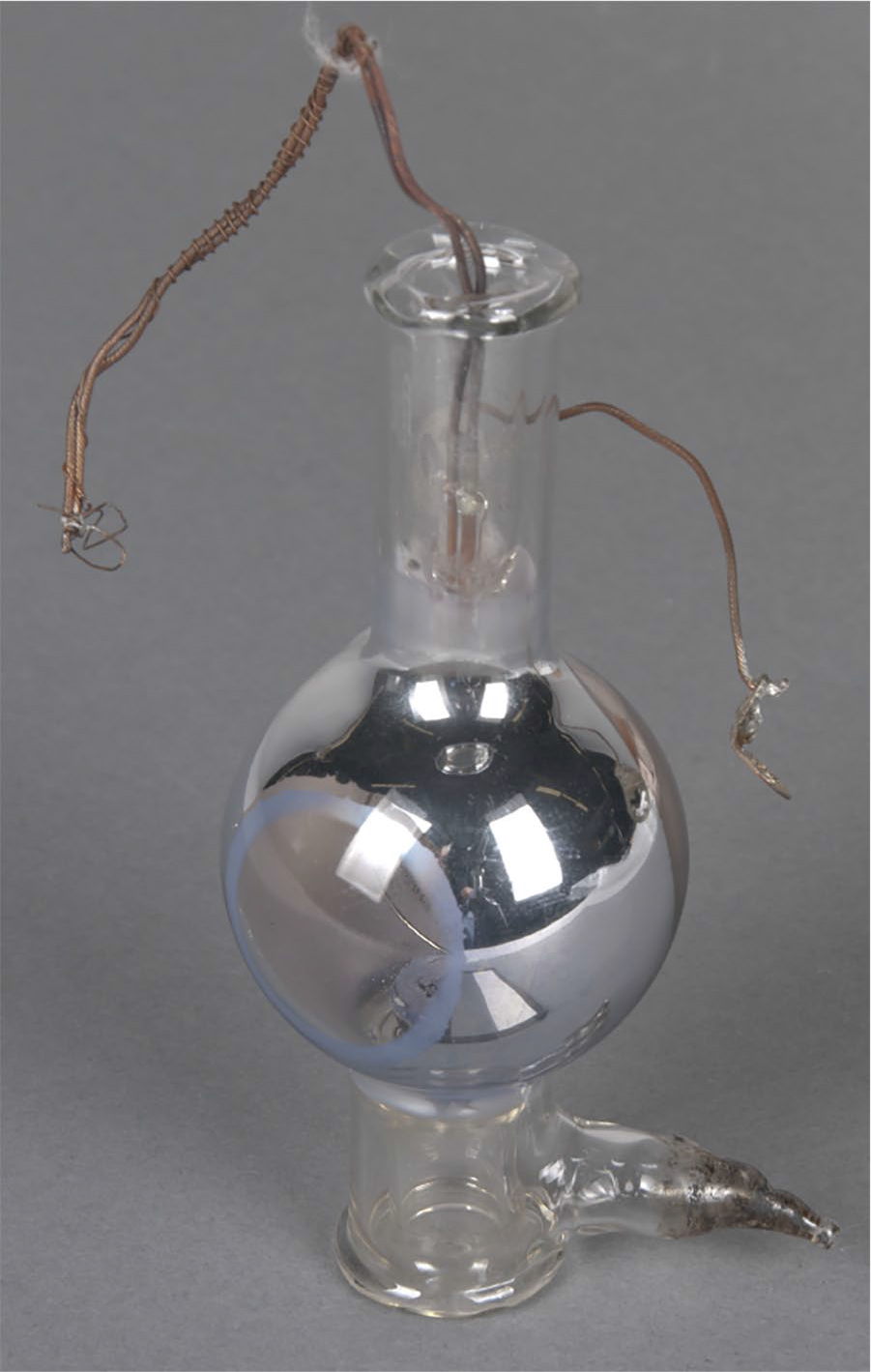
Tykociner’s T50 cell was initially much more sensitive than earlier cells, but the sensitivity could not be stabilized. T50 NASM Item: T20170061010.
By November 1939, Tykociner had secured access to a full-time glass blower but had moved away from the gas-filled tubes which the astronomers preferred. 69 Astronomers liked the gas-filled tubes because of the amplification provided by gas ionization. This caused more noise, but without it their magnitude limit was much higher. Tykociner may have seen the writing on the wall however: Commercial concerns would commit more and more to vacuum tubes over the next decades and eventually, with the addition of secondary emission amplification techniques, vacuum tubes would move into use in astronomy as well.
Tykociner made several more cells for Stebbins, but the instability remained the key issue. Tykociner’s tests would show great results in the lab in Illinois, but by the time the cells made it to Wisconsin, the difference between the values measured by Tykociner and those measured by the Wisconsin astronomers baffled them entirely. They began to suspect that their measurements were not calibrated correctly with Tykociner’s and sent him standard lamps and power supplies so that they could replicate the testing conditions. In the end, they were mistaken, the cells uniformly produced excellent photocurrents initially but never kept them over time. 70 In theory, if slight, the instability could be corrected for by measuring against a fixed reference, as Stebbins nearly always did, but the instability of Tykociner’s cells was enough that they became over a short period of time no more sensitive than the much older Kunz cells. Still, Stebbins remained hopeful that they could break through the stability problem.
The coming of the Second World War complicated things. Stebbins temporarily lost Albert Whitford to the Radiation Laboratory at MIT and as the months went on, there was less and less correspondence between him and Tykociner. Stebbins sent a last letter in early 1941, reminding Tykociner that he was still interested in his work and could look for funding to continue the research, but it would appear that nothing came of it. 71 The attempt to find a direct successor to Kunz now a failure, new photocell suppliers would need to be gotten elsewhere.
Commercial producers
There was an extant market for photodiodes in the 1930s when Stebbins began to search for applicable commercial photodiode cells. Examples of some of these cells, including RCA’s 921 and Cetron’s CE-25 and CE-70, are included in the Wisconsin Collection. While production lines in this era were producing cells which would work, in theory at least, for stellar photometry, these cells were intended for use in much less demanding signal transition. Applying them to photometry would require adaptation or the introduction of a new product. The Wisconsin Astronomer worked closely with a number of commercial concerns to produce a working photodiode, they did not see any significant returns from this process.
One of the earlier attempts to forge a working relationship with the private sector was that which Stebbins and Whitford tried to form with the Chicago-based firm G-M Labs. G-M Labs had produced a photoelectric cell they were calling the Visitron in the early 1930s, and its potassium-hydride cathode, similar to those that Kunz was using, was the only one on the commercial market. Stebbins obtained a Visitron cell and was in contact with G-M’s engineers in 1932, asking if G-M would be willing to try a cell with a quartz body. 72
In 1933, Stebbins sent Whitford down to Chicago to work with G-M on producing a better astronomical photocell. As was generally the case, the problem was cell insulation. Whitford and Stebbins did succeed in building a photometer which could, unaided by a telescope, detect a candle at a mile’s distance with a G-M cell, but this device does not seem to have produced any scientific results. 73 Whitford felt that the sensitivity was there with the Visitron, but they needed better engineering to get the insulation characteristics right. In 1938, Whitford worked again with G-M Labs on a new design with a D-shaped bulb, guard rings, and a different electrode configuration, which he sent to G-M and they dutifully built one. But it still didn’t have the low dark currents that Kunz had achieved. 74 Whitford’s trials with the G-M cell eventually led him back to refrigeration, something they had been able to get away from with the amplifier and Kunz tube. Refrigeration was annoying, but at least it provided a route forward with the commercial devices. 75
Although the G-M Visitron never really was successful, it is important in that it demonstrates how closely Whitford and Stebbins were willing to work with a commercial concern to try and get a good product. G-M for their part, always seemed willing to take on the projects and, although it was Gerald Kron’s opinion that the cells G-M produced were far too expensive, the Wisconsin program continued to try them into the 1940s. 76
Whitford attempted to work with Westinghouse starting in 1937, having heard rumours about some of their wide response cells in development. Westinghouse engineers were initially very confident that the dark current of their cells would be most satisfactory, but as usual, this did not turn out to be the case. 77 As he had done with G-M, Whitford worked with a Westinghouse engineer, V.G. Rydberg, to modify the electrode layouts to get better insulation. 78 Westinghouse never produced the special tube. They were still developing the experimental types that Whitford was interested in, and they asked Whitford to wait 2 months for them to get things sorted out. Two months later, Whitford wrote to them again, but Rydberg replied that they just weren’t in a position to do it. 79
RCA would come to dominate the world of photoelectric cells after the War, and even before the war, Stebbins was keeping an eye on Vladimir Zworykin’s (RCA) development of the photomultiplier tube. By 1939, Stebbins was using RCA 921 and 919 photodiodes on the test bench, though he admitted that the dark current was far too high for there to be much practical application. 80
Whitford got RCA engineer R.S. Burnap to make a high insulation variant of their rubidium cathode 926, which Burnap made for the university free of charge, asking only for the test results they got with it. 81 This was again a disappointment as the sensitivity of the special tube did not out-perform the stock version. 82
It would seem that though there was often initial interest from manufacturers to open up low light photometry as a market, they either underestimated the degree to which the astronomers requirements would challenge their existing production techniques, or overestimated the adaptability of those techniques. Routinely, their interest would fade as it became clear how much investment it would take to open up the small demand for low-light detectors.
Had the war not come when it did, there might have been a greater crisis in photoelectric photometry as the commercial alternatives to the Kunz tube failed repeatedly to pan out. World War II changed the balance somewhat. Researchers like Whitford and Kron shifted gears to defence-related work, and the Navy began to accelerate the development of photodetectors, particularly those which could detect a jet trail against the atmosphere, on its own. In the period after the war, Office of Naval Research funding would produce a leap forward in photoconductive technology with the development of the lead-sulphide or Cashman cell, the red sensitivity of which made it very attractive to astronomers looking to supplement the general trend of blue sensitive photoelectric devices.
There would never be a commercial solution to the Kunz tube problem. But the photomultiplier would render this a somewhat moot point. The Wisconsin cohort were initially very sceptical about the 931, RCA’s first commercial photomultiplier. They tended to think that amplification was unstable and that the greatest gains would be made in the realm of initial output. Whitford did self-consciously admit in a letter to John S. Hall (Lowell Observatory) that he might just be rationalizing the status quo. 83
As an interesting prelude to the photomultiplication devices that would truly turn photoelectric observation into a mainstream technique, Stebbins and Whitford did try a number of early secondary emission devices. It is clear from their correspondence that they obtained a prototype electron multiplier from Zworykin as early as 1936, but had apparently “given up” according to Tykociner’s notes by 1938 because “the current variations during the process of focusing the telescope were so violent that stabilization could not be achieved.” 84 The Zworykin tube has not survived, but there is one other interesting early photomultiplier in the Wisconsin collection. The “Osram secondary emission cell” (Figure 19) hit the commercial market in 1937. It had a single secondary emission stage wound around the anode in a spiral, a crude prelude to the finer electron optics of later photomultipliers. From the documentary record, very little can be said about how this tube was tested or how it performed, but it does show that their interest in photomultipliers remained keen during these early days even if they were publicly pessimistic.
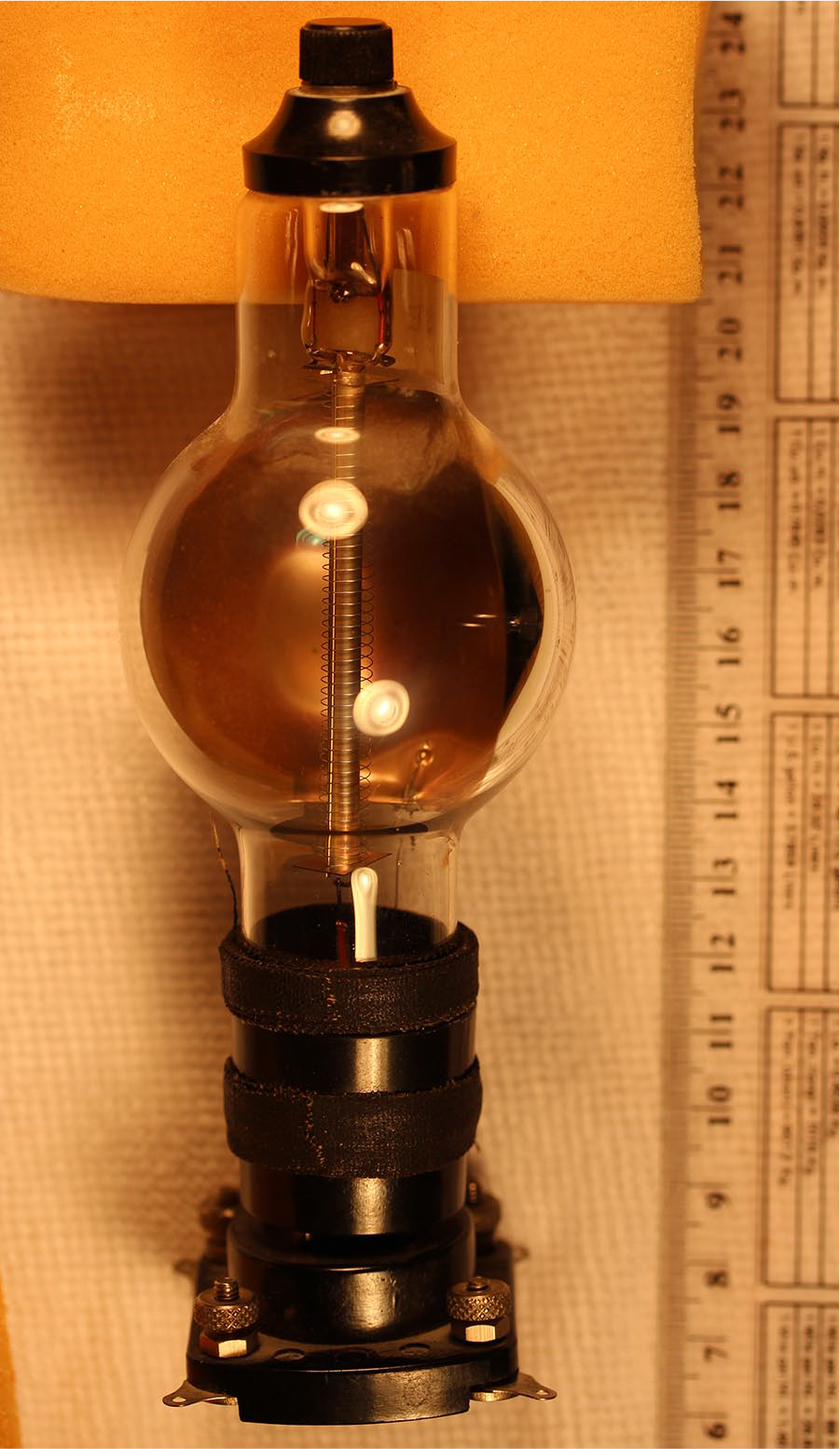
The Osram secondary emission cell.
Conclusion
Following the end of hostilities in the Second World War, as the great number of scientists engaged in defence work began returning to their peace-time research projects, Joel Stebbins managed to convince Albert Whitford to return to Washburn rather than take up teaching applied physics at Purdue. Purdue had hired several of Whitford’s colleagues from the Radiation Laboratory at MIT and Whitford found the prospect invigorating. How exactly Stebbins convinced Whitford return is likely lost to history. Whitford was, in his correspondence with Stebbins, initially very serious about the offer from Purdue, but in a month’s time and after a phone conversation with Stebbins only referenced in their letters, Whitford had been convinced to return. Stebbins was encouraging about Whitford’s prospects in astrophysics, and Whitford had always shown a preference for the questions that astrophysics posed, but in the end, it is more likely that Stebbins informed or reminded Whitford that he intended to retire in the near future and would push for Whitford to succeed him. Stebbins successfully followed through on both of those accounts in 1948.
So it was that a potential break in the chain of photoelectric photometry at Washburn observatory was avoided. Whitford continued to develop those techniques in close association with Gerald Kron, who after the war returned to Lick Observatory. Whitford’s pessimism about photomultiplication would eventually prove to be just that. He and Kron had successfully applied a prototype magnetically focused photomultiplier tube for guiding a telescope in 1936, and their collaboration would continue after the war.
Over the next decades, Whitford and Stebbins would continue to be seen as authorities in the field. Whitford would also, as Director, see Washburn observatory through the siting and construction of the Pine Bluff country observatory outside of Madison, handing off the directorship the day it opened in 1958 to Arthur D. Code. Code would continue work with photomultiplication and eventually contribute to the design and construction of instrument packages for the Orbiting Astronomical Observatory project, continuing the line of photoelectric efforts at Wisconsin through the departure of astronomy from Earth’s surface.
The great number of some commercial photodiode and photomultiplier tubes in the Wisconsin’s possession is the result of bulk purchasing and culling tubes. With some commercial photodiodes as well as the mass produced RCA 931 and 1P21 multiplier tubes, the standard practice was always to buy a much larger number of tubes than needed and sort out those with the highest sensitivity for observational use. Gerald Kron estimated that the number of 931As which qualified as early 1P21s was around 1 in 50 and a further one in ten 1P21s were of observing quality. He relates that astronomers were for a time, the scourge of radio and television shops as they picked over any shipments of 1P21 tubes looking for those most sensitive outliers. 85 This same process was repeated for the EMI 6256, the tube which saw use in Wisconsin’s OAO-2 instrument package. There were always uses for the culled tubes as well, in bench testing, calibration, and even acting as disposable stand-ins for instrument development.
Given the variety expressed in the collection, we can also safely assume that the same method that Stebbins and Whitford had been applying – acquire any promising new commercial tube and test its astronomical capabilities – continued after their departures. There is great variety not only in make and model but also in structure, electron optics, and cathode formulation represented in the Wisconsin Collection.
The central role that photoelectric tubes played in the activities of the Wisconsin Astronomy Department is clear; why the items in Wisconsin Collection itself survived is another question entirely, and one for which there is comparatively little documentation. Stebbins was notorious for his reluctance to throw anything away. He was regularly receiving tubes from Kunz and many of the tubes show up in his or Whitford’s notes before Kunz’s death, and as such their presence in Madison can be rather firmly dated. It seems likely that a number of the cells came from Stebbins taking it upon himself to dispose of the tubes that remained after Kunz’s death. By whatever arrangement, it was Stebbins who distributed those tubes, which he thought could yet be of use to astronomers. It is difficult to tell which, if any, of the tubes in the collection are in the category of leftovers not sensitive or insulated enough to be useful, but almost certainly some of them are.
The process by which some of the Astronomy Department’s tubes came to the Smithsonian began in 2009 when full remodelling of the Astronomy Department’s floor in Sterling Hall forced the usual issues associated with old filing cabinets and storage closets. It was at this time that much of the Department’s records, including a great deal of the material on which this work is based first reached the University of Wisconsin Archives. The tubes transferred to Smithsonian came in two batches between 2015 and 2017.
However, these items came to survive, they offer a great insight into the practices of an innovative branch of research astronomy as it developed from the early twentieth century and into the Space Age. The tubes make evident the myriad of minute adjustments in the process of hand making scientific equipment and also speak to the economic circumstances, small and large, that came from adapting commercial products to a specific technical niche. They also allow us to detect another cast of characters whose presence is only dimly visible in the research literature itself. From university glassblowers to corporate engineers and researchers, approaching the history of astronomical practice in the twentieth century from the perspective of objects, we can plainly see not just the moment of technical or theoretical breakthrough, but the network of interdisciplinary collaboration beneath.
Although in principle it was establishing purely scientific conclusions about the cosmos which drove photometric practise at Wisconsin, what set Wisconsin’s program apart was the centrality of the underlying technical developments. Stebbins engaged repeatedly in very close collaborations with physicists and engineers in order to push his own observational capabilities forward, and that blending of the astronomical, physical, and engineering disciplines continued in the work of Albert Whitford.
The Wisconsin program was always chipping away at the limits of detector technology, whether that meant working closely with physicists in the lab, as Stebbins did; or testing experimental products and visiting commercial laboratories, as both Stebbins and Whitford also did; or building things on their own. The goal was always the same: more signal, less noise. It was this constant contribution to the technology of observation rather than simply focusing on observation itself that kept the Wisconsin program in front. Given the inherent limitations of the Washburn Observatory’s small telescope and cloudy skies, the sucsess of its photometry program may seem counterintutitive. However, seen in the context of the Observatory’s diliberate focus on technical advances supported by broad interdisciplinary collaboration, its possition on the bleeding edge of photometry throughout the 20th century is much easier to understand.