



Abstract
Jan Walery Jędrzejewicz was a medical doctor with active practice in Płońsk and an astronomer by passion. In fact, astronomy was a second profession for ‘Dr. Jedrzejewicz’, as he signed his astronomical publications. He built his own observatory in Płońsk, small village situated about 70 km from Warsaw, which he equipped with professional instruments. Thanks to that, he could perform precise astronomical observations. In the astronomical community, he was known and esteemed for his precise measurements of double stars. He also measured the position of many comets discovered at that times, including long-period ones. This study is devoted to the analysis of precision of Jędrzejewicz measurements on the examples of three long-period comets, today known as C/1885 X1 Fabry, C/1885 X2 Barnard and C/1886 T1 Barnard-Hartwig.
Introduction
Jan Walery Jędrzejewicz was born in Warsaw, the capital of then the Kingdom of Poland (see below), on April 14th 1835. Initially he studied architecture for a year at the School of Fine Arts (1853–1854). However, he interrupted this studies, mainly due to eye disease. In 1856 he began to study medicine at the Moscow University. It should be recalled that at this time the Warsaw University no longer existed, as it was liquidated by the tsarist authorities after the fall of the November Uprising (1830–1831). In its place Szkoła Główna (the Main School) was established in 1862, for a short time of a temporary liberalisation. It was closed in 1869. The Warsaw University, with Polish as the language of instructions, began to operate again only in 1915. 1
After completing exams in 1861, Jędrzejewicz undertook the journey around Europe. He returned to his homeland in 1862 and settled in Płońsk, a small town located 65 km northwest of Warsaw. He started a private medical practice there and practiced it with great devotion for the rest of his life; he died of typhus in 1887.
In 1872, Jędrzejewicz started building his own astronomical observatory. After several years of hardship, he managed to equip it with the high quality astronomical instruments. At that time, the equipment of the Płońsk Observatory was comparable to the professional observatories in Warsaw (Warszawa), Cracow (Kraków) and Vilnius (Wilno). In 1875 Jędrzejewicz began his own observations. He was most interested in double stars observations, but he also traced paths of new comets relative to adjacent stars. Jędrzejewicz published his observations in the prestigious Astronomische Nachrichten journal. Professional astronomers highly valued his research, especially for the precise measurements of over 350 double stars. 2 One of them was Jan Kowalczyk, professor at the Warsaw Observatory. Previously, Kowalczyk assissted Jędrzejewicz in solving problems related to the construction and equipment of the Płońsk Observatory. On the hundredth anniversary of Jędrzejewicz’s birth, Dziewulski 3 professor at the Stefan Batory University in Vilnius, expressed his recognition for Jędrzejewicz’s professionalism in the article published in Uranja. 4
Jędrzejewicz also studied the impact of weather factors on the prevalence of specific diseases in the Płońsk region. This was very important research, because around Płońsk there were a lot of wetlands, environments conducive to the development of malaria, typhus and cholera. Relatively low sanitary standards contributed to the spread of those diseases. Jędrzejewicz often treated poor patients for free. His weather interests quickly evolved into the systematic meteorological notes prepared by the prefessional researcher.
Jędrzejewicz
5
should remain in our memory also thanks to his Kosmografija, the first edition of this book was published in 1886 in Warsaw. Today, this book is known only to a few enthusiasts; however, it was the first astronomy textbook written in Polish, distinguished by a modern approach to the issues discussed. Polish astronomers growing up in the early of 20th century declared that they were educated using this textbook. For example, Dziewulski
3
wrote: We all know Kosmografja written by Jędrzejewicz. Many of us, Polish astronomers, gained our education thanks to this book, for some it was one of the first astronomical books they got. Today, young people often use it; despite the fact that in the field of so rapidly developing astrophysics, the second posthumous edition is outdated, the part dedicated to classical astronomy is written very clearly and has long-lasting value.
This comprehensively educated man was also involved in the cultural activity in Płońsk. Jędrzejewicz played various musical instruments and organised concerts, directed and acted in theatre performances. He led a wide educational activity and was a great populariser of science. He had influenced many young people. One of them was Stanisław Kopczyński (1873–1933), a medical doctor and social-worker, a man distinguished in promoting school hygiene. 6
Poland in those days
The life of Jan Jędrzejewicz and his parents falls in an extremely difficult period for Poland. At the end of the XVIII century, Poland was partitioned by the neighbouring countries – Prussia, Austria and Russia – and ceased to exist as a state in Central Europe for more than a century. Some hopes for the revival of a sovereign state emerged first in the Napoleonic era, and then after the Congress of Vienna. The Duchy of Warsaw materialised as a substitute for Polish statehood in the years 1807–1813. After 1815 the Kingdom of Poland, better known as the Congress Kingdom became a part of the Russian Empire. During the 1832–1918 period the Kingdom was deliberately integrated with Russia and its autonomy was gradually restricted. It was removed completely in 1874. Although, formally a Kingdom, it semiofficially became Привислинский край – ‘the Vistula land’.
After the January Uprising (1863) Russian became the official language of the country in all the offices and schools. Printing the books in Polish was allowed – albeit, they were strictly censored. Thus, ‘Kosmografija’ 5 also has a censor’s stamp.
Father of Jan Walery – insurgent in the November Uprising
A personality of Jan Walery was inevitably shaped by his father’s life whose first name was also Jan. He was born in 1809 in the provincial city of Płock, located 50 km west of Płońsk. Most likely, he studied at the Warsaw University. According to the Płońsk History Documentation Center (PDDMP) 7 he joined the November Uprsing and participated in 1830–1831 battles as an officer in the regiment commanded by general Dembiński (1791–1864).
He was captured and sentenced to exile in Vyatka (today Kirov), 800 km east of Moscow. After return to Warsaw, he married Ewa Konarzewska, ‘the daughter of a citizen of Płock’ as reported by Fiećko. 8 Initially, he made a living by giving music lessons (apparently, Jan Walery ‘inherited’ musical talents from his father). A few years after the wedding, he started working in the judiciary, and in 1862 he was appointed an attorney at the Court of Appeal in Warsaw.
Płońsk Observatory – historical backgroud and equipment
After the fall of the November Uprising, the Astronomical Observatory established in 1825 9 as a branch of the Warsaw University was much more fortunate than the entire university. During the Uprising, all the astronomical instruments were bricked up in basement of the observatory building. The Observatory survived the uprising untouched and its operation was not forbidden, although its teaching activities were banned.
Professional astronomers from the Warsaw Observatory supported with advice and provided technical assistance for two private observatories that existed in these difficult times for the Polish culture. The one was established in 1857 by Kajetan Kraszewski in Romanów (200 km east of Warsaw), and the second by Jan Jędrzejewicz in Płońsk. Kraszewski was a wealthy man and could afford to have equipment from Austria, France and Germany. However, historians have no information on his scientific observations that were published. In turn, Jan Walery Jędrzejewicz was struggling all the time with financial problems. For many years he raised funds from his personal income as a self-employed doctor in a provincial town for the construction of the observatory building, set of modern instruments and necessary textbooks and star catalogs.8,10 It should be emphasised that Jędrzejewicz’s movements to popularise astronomy in Polish in Płońsk and also in Warsaw where he gave guest lectures, played an important role in opposing the Russification of the motherland. This aspect of Jędrzejewicz’s activity was raised by astronomers Rybka and Rybka 11 in the second volume of their History of Astronomy in Poland. Needless to say, Jędrzejewicz joined the nationwide positivist movement, the aim of which was to raise the civilisation level of the entire society. At the same time, he conducted the scientific research at a decent European level.
As was mentioned above, Jan Kowalczyk, astronomer at the Warsaw Observatory was Jędrzejewicz’s consultant on the equipment of his observatory. Kowalczyk was a specialist in precise positional measurements of celestial bodies. He also advised Jędrzejewicz in his later observations of double stars. Planning star observations Jędrzejewicz also used advice of a German astrophysicist, Hermann Carl Vogel, director of the Astrophysical Observatory at Potsdam in the years 1882–1907. 2 Probably thanks to contacts with Vogel, Jędrzejewicz was keenly interested in first achievements of spectral analysis of stars and comets, and this is reflected in the pages of his ‘Kosmografija’.
The most complete description of the Płońsk observatory is given in the article ‘Information on the Płońsk obserwatory and on Jędrzejewicz’s works in fields of astronomy and meteorology’ by Kowalczyk. 12
According to Kolwaczyk’s article, based on the original Jędrzejewicz’s notes, the observatory in Płońsk was equipped with: Collimator of the meridian telescope with 20 mm diameter lens, Telescope for centering also with a 20 mm diameter lens, Theodolite with 28 mm diameter lens, Meridian telescope of 63 mm diameter, Portable telescope of 77 mm, Telescope used as a heliograph of 105.5 mm diameter, Cook’s refractor with 149 mm lens, Steinheil’s refractor of 162 mm diameter. Both refractors and the heliograph were equipped with small auxiliary telescope, that helped to point the instrument on the interesting object. Besides, it was a few hair and ring micrometers, a few larger and smaller spectroscopes, and a wedge photometer obtained from Konkoly of O-Gyalla in Hungary equipped with the Reinfelder’s eyepiece. If we add to this description three pendulum clocks and meteorological instrument, namely: vessel mercury barometer, aneroid, thermometers, psychrometer, rain gauge and a wind vane, then we will come to the conclusion that the observatory in Płońsk, equipped using scant Jędrzejewicz’s funds, was not only very advanced, but also adequately arranged and suitable for the scientific research.
Unfortunately, all of Jędrzejewicz’s private notes describing the observatory equipment and those pointing to the motives of his interest in the comet observations were lost during the World War II. Also disappeared his voluminous library and instruments. Only a few components of some instruments survived (they are specified in the next section).
It seems that the above-quoted Kowalczyk’s description, based on the original Jędrzejewicz’s notes, is the most accurate of all available today’s data. A professional and monumental The Polish Biographical Dictionary (known as PSB), 13 published systematically under the auspices of the Polish Academy of Sciences and the Polish Academy of Arts and Sciences, contains little exhaustive information about Jędrzejewicz and his observatory. The most complete archive of materials related to Jędrzejewicz may be found in PDDMP. 7
Jędrzejewicz and comets
Dziewulski
3
wrote about Jan Jędrzejewicz in the context of comets: Apart from the observation of binary stars, since 1881, Jędrzejewicz eagerly observed all comets, which appeared in the sky and became visible using his instruments. By referring the positions of comets to the reference stars and repeating the measurements many times to achieve better accuracy, he determined the coordinates of comets with his refractor. Over several years, he observed the following comets: 1881 III, 1881 IV, 1881 VII, 1882 I, 1882 II, 1883 I, 1884 I, 1884 III, 1885 I, 1886 I, 1886 II, 1886 V, 1886 VII, 1886 IX, 1887 II, 1887V.
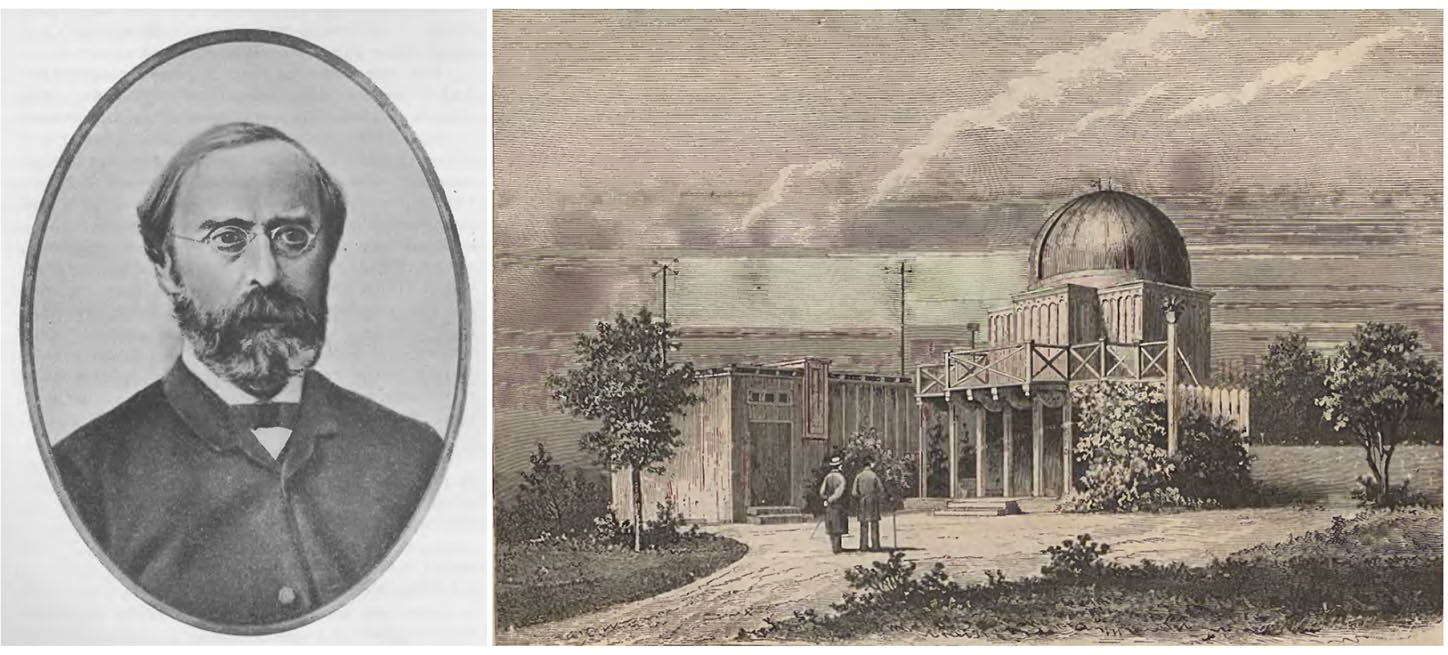
The last cometary observations made by Jędrzejewicz appeared in 1887 in Volume 117 of the Astronomische Nachrichten journal, and included observations of comet C/1887 B2 Brooks (1887 II) taken in February 1887, and measurements of comet 13P/Olbers (1887 V), observed by Jędrzejewicz in September. He died of typhus soon after, in December 1887. About the later fate of the observatory in Płońsk (Figure 1) one can read in articles by Dziewulski 3 and Gadomski, 10 the latter was written on the 120th anniversary of Jędrzejewicz’s birth (both are in Polish).
During these 7 years of dealing with comets (1881–1887), Jędrzejewicz observed 15 of them, measuring their positions relative to stars and next recalculating these measurements to the equatorial coordinate system of right ascension and declination. The short-period comet 2P/Encke Jędrzejewicz observed in its two subsequent appearances (1881 VII and 1885 I). 14
Although, not all publications contain information about the instrument used, probably all observations of comets by Jędrzejewicz were obtained with the Steinheil refractor 162 mm or the Cooke refractor 140 mm at his own observatory in Płońsk. A detailed description and sketch of Cooke’s refractor can be found in his astronomical book mentioned above. 5 Of both Jędrzejewicz’s instruments, most likely only the original lens from the Steinheil refractor survived, which is currently stored in the Astronomical Observatory of Adam Mickiewicz University in Poznań (Figure 2). 15
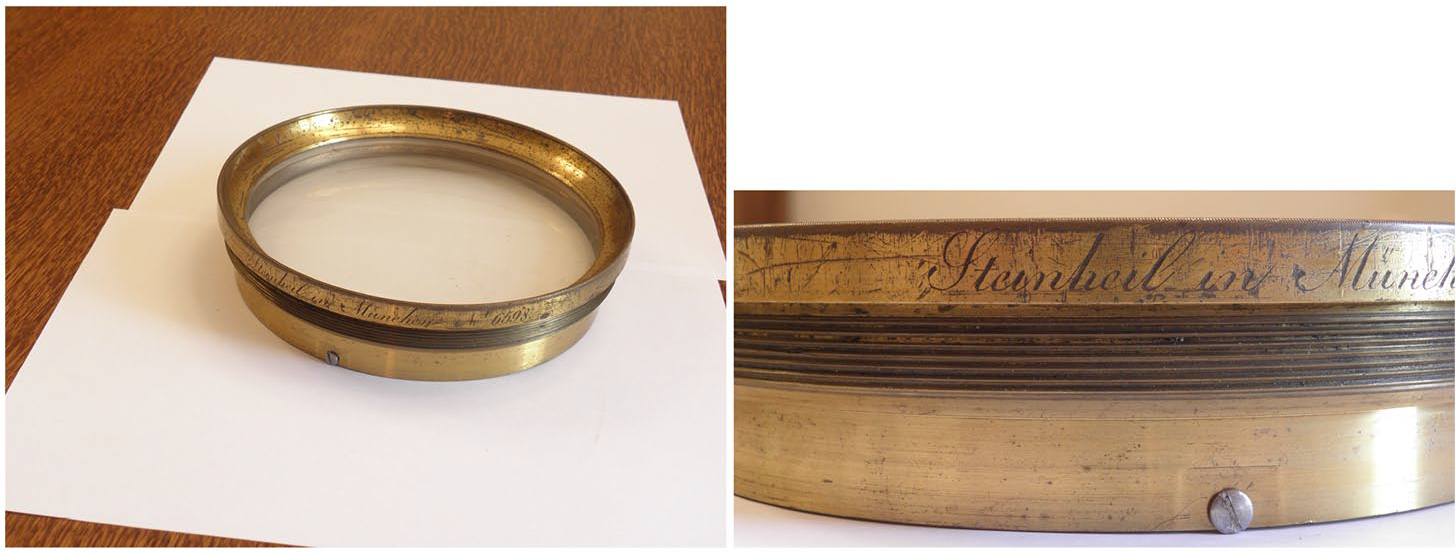
The lens of the historic refractor Steinheil 162 mm installed in the Jędrzejewicz’s observatory in Płońsk. Today it is in the Astronomical Observatory Institute, Faculty of Physics, A. Mickiewicz University, Poznań.
Details of comet observations made by Jędrzejewicz
Table 1 lists the comets observed by Jędrzejewicz. The detailed collection of the published Jędrzejewicz’s observations is given in Table 2. First three columns of Table 1 show contemporary comet designation (columns [1]–[2]), and names used in the times of Jędrzejewicz (column [3]). The remaining columns present the current orbital characteristic of each comet, viz.: perihelion distance (column [4]), eccentricity (column [5]) and orbital period (column [6]). It is important to notice here, that the eccentricities presented in column [5] were given in heliocentric frame and at the epochs close to the moments of perihelion passage, whereas the orbital periods (column [6]) were calculated using so-called ‘original’ orbit which represents barycentric cometary orbit before entering the planetary zone (usually calculated at a distance of about 200–250 au from the Sun, see also descriptions within Table 2 and next subsection).
Comets observed by Jan Jędrzejewicz in the period from 1881 to 1887.
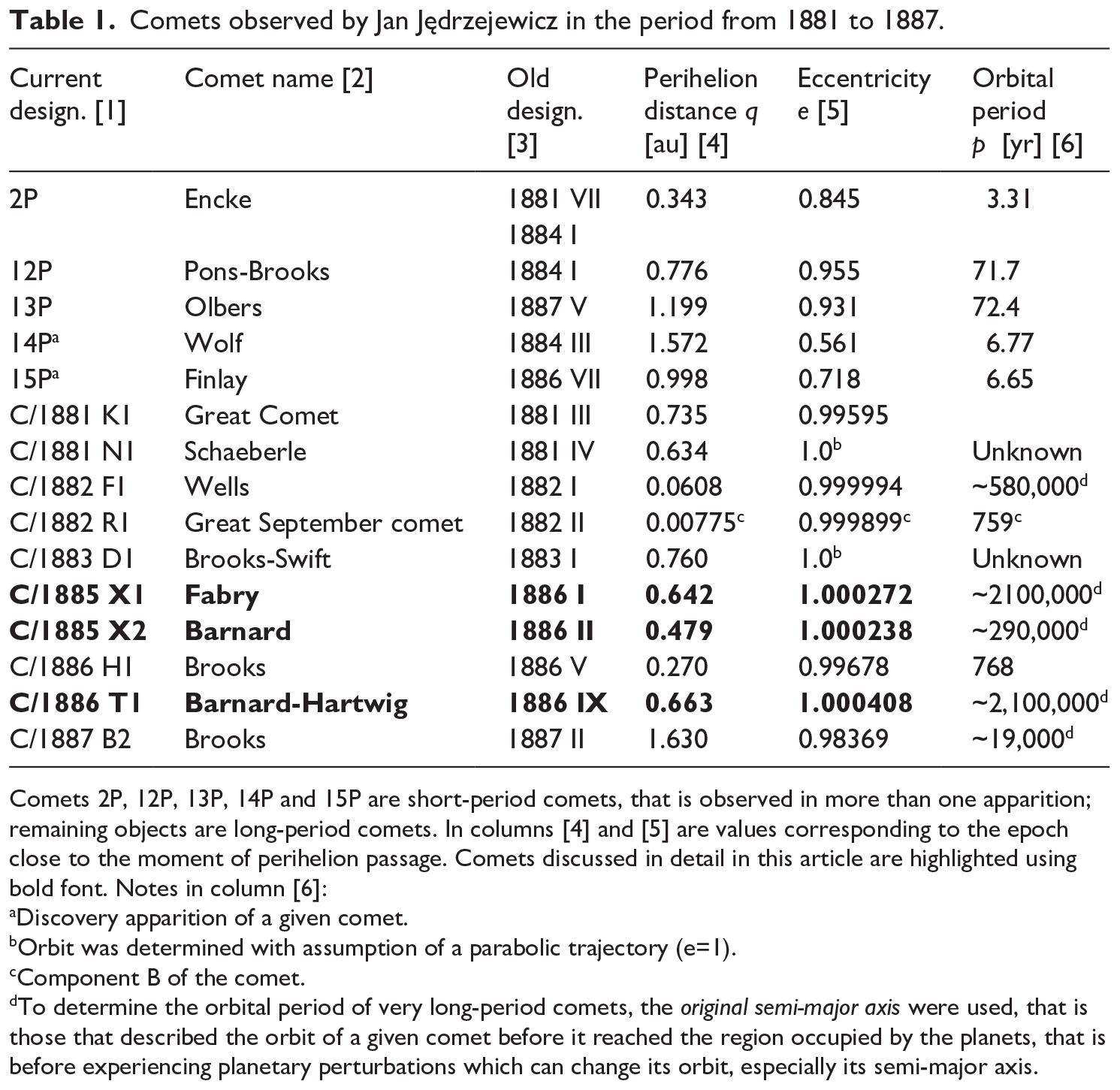
Comets 2P, 12P, 13P, 14P and 15P are short-period comets, that is observed in more than one apparition; remaining objects are long-period comets. In columns [4] and [5] are values corresponding to the epoch close to the moment of perihelion passage. Comets discussed in detail in this article are highlighted using bold font. Notes in column [6]:
Discovery apparition of a given comet.
Orbit was determined with assumption of a parabolic trajectory (e=1).
Component B of the comet.
To determine the orbital period of very long-period comets, the original semi-major axis were used, that is those that described the orbit of a given comet before it reached the region occupied by the planets, that is before experiencing planetary perturbations which can change its orbit, especially its semi-major axis.
Complete list of published cometary observations performed by Jędrzejewicz in Płońsk.
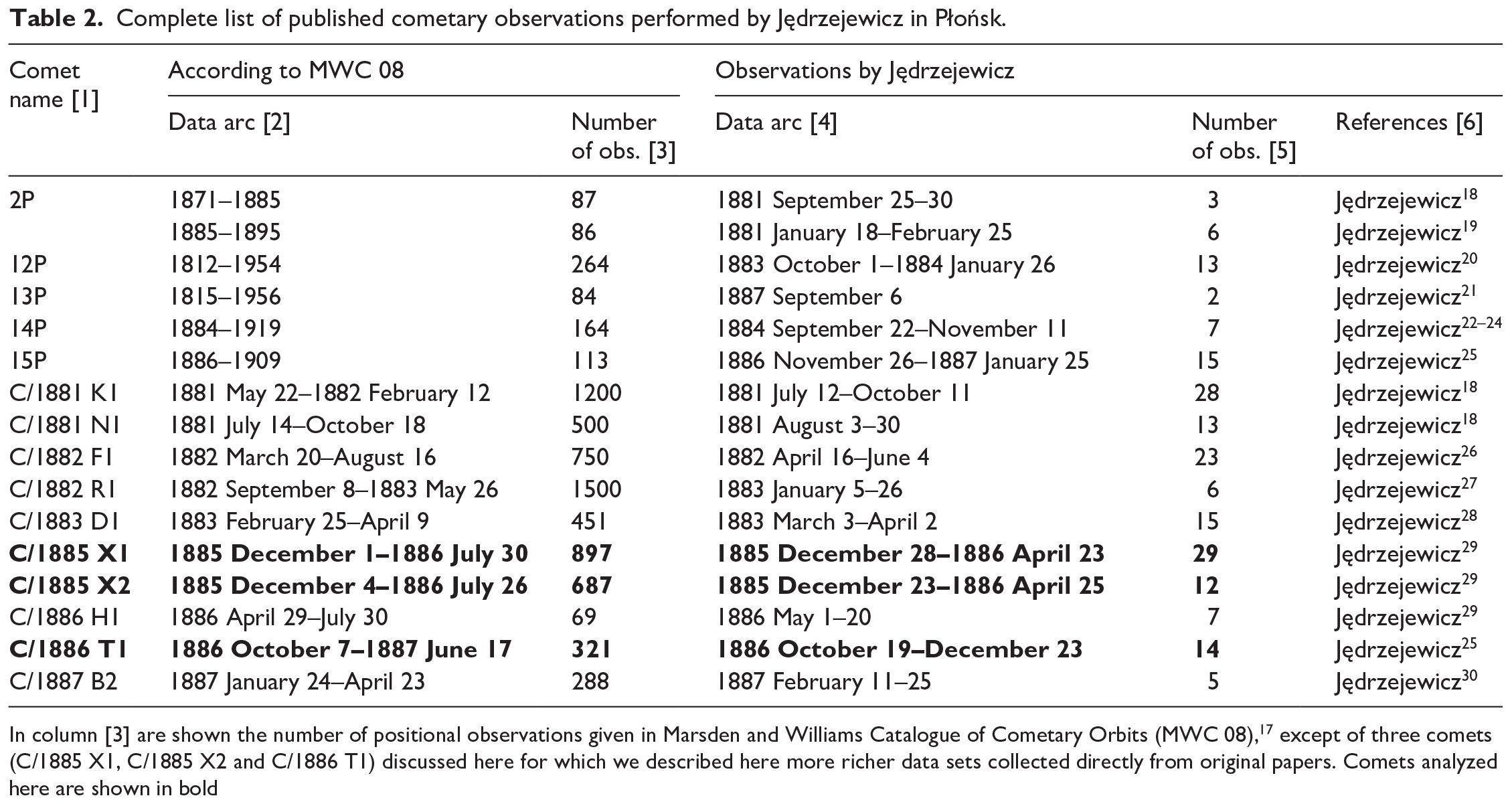
In column [3] are shown the number of positional observations given in Marsden and Williams Catalogue of Cometary Orbits (MWC 08), 17 except of three comets (C/1885 X1, C/1885 X2 and C/1886 T1) discussed here for which we described here more richer data sets collected directly from original papers. Comets analyzed here are shown in bold
It is easy to notice that these comets are very different as the orbital elements are concerned. Two main populations of comets are present: short-period comets and long-period ones. It is known that in the years 1881–1887, 22 long-period comets were discovered. Tables 1 and 2 show that Jędrzejewicz observed almost half of them (10 objects). Most probably, he selected comets suitable for observations from Płońsk on the basis of the current reports on their appearings in the sky. One can notice that positional (visual) comet observations would soon be replaced by micromeasurements of the comet position on photographic plates. 31
It is not surprising that among a dozen long-period comets on the Jędrzejewicz’s list there were two very bright ones, the Great Comet (C/1881 K1, formerly also known as comet Tebbut, see Figure 3), and the Great September Comet (C/1882 R1) that was one of the sun-grazing comets, as today are called icy objects having an extremely small perihelion distance. When in mid-July 1881 Jędrzejewicz 18 began the comet Tebbut observations (in mid-June it passed perihelion), it was still visible to the naked eye. Also comet C/1882 R1, although it was observed more than 3 months after it passed through the perihelion, was most likely still visible to the naked eye. 32 It is known that at the end of September 1882, that is, just after it almost grazed the Sun, comet C/1882 R1 started to break apart. In mid-October at least six fragments of it were reported. 33 The piece measured by Jędrzejewicz 27 in January next year was probably the largest, fragment B; the observer described in his publication that the main part of the comet seemed to be elongated.
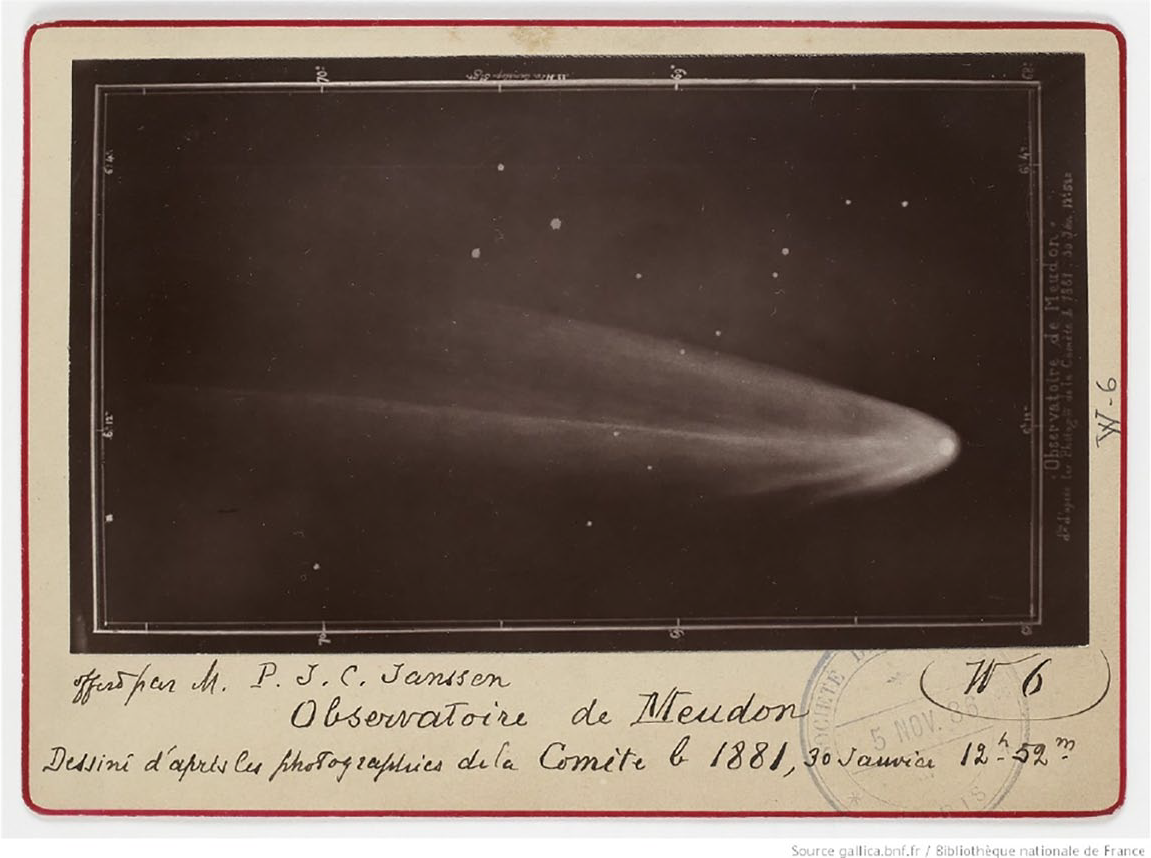
The Great Comet of 1881 (C/1881 K1, also known as Tebbut comet), observed by Jędrzejewicz in the period from mid-July through mid-October 1881. This is the first photographic telescope image of the comet. It was made by the French astronomer Pierre Jules César Janssen at the Meudon Observatory on 1881 June 30/31 (exposure: 30 minutes). 34
Table 2 compares the set of observations for each comet made by Jędrzejewicz with all the available data from other observatories. From this summary, one can see that the comets he observed were also intensively tracked in several observatories around the world. Thus, his measurements constituted at most a few percent of all those made for each of comet given in the table. However, due to the relatively small observational scatter and favourable distribution of observations over time, these measurements, in general, contributed to a better determination of the orbital elements than it would be possible without his data.
An inspiring meeting with Jędrzejewicz’s observations
A few years ago, when dealing with three long-period comets discovered in the late 19th century we found in the literature the observations made in Płońsk by Dr. Jędrzejewicz, as he usually signed his articles. They turned out to be of quite high precision. This inspired us to perform a detailed comparison of the quality of Jędrzejewicz’s observations with the quality of observations made by other professional astronomers of that era.
The following sections of this article focus particularly on three comets originating – as we know today – from the Oort Cloud. The Oort Cloud comets are objects that are weakly gravitational pulled by the Sun. Thus, even tiny planetary perturbations they experience during their traveling through the planetary region can cause the comet to leave the solar system. A measure of gravitational binding energy of such a comet is its inverse of a semi-major axis that it had before entering the planetary zone and suffering the planetary perturbations. Such a semi-major axis and all the remaining orbital elements are called ‘original’, as was mentioned above.
Comets analysed in this paper are highlighted in boldface in Tables 1 and 2. By a convenient, although, accidental coincidence, each of them was followed in the sky for about 8 months. Moreover, each was visible to the naked eye at some periods. Jędrzejewicz observed them for a shorter period. C/1885 X1 Fabry was tracked by him during 4 months, and two remaining comets (C/1885 X2 Barnard and C/1886 T1 Barnard-Hartwig) – for about 2 months.
C/1885 X1 Fabry
This comet was observed in over 50 different observatories around the world from 1885 December 1 to the end of July 1886; about 900 positional observations were published (Table 3). At the beginning of April 1886 it became so bright that it was even visible to the naked eye. It passed through the perihelion on April 6 at the distance of 0.642 au. At the same time, formation of the long tail was reported. Comet Fabry was still bright when it was seen for the last time in the morning sky in the northern hemisphere of the sky on April 26. 32 The last time Jędrzejewicz directed his refractor towards this comet on April 23. It passed closest to the Earth on May 1. Later, it was observed only from observatories in South Africa (Figure 4), Australia and South America.
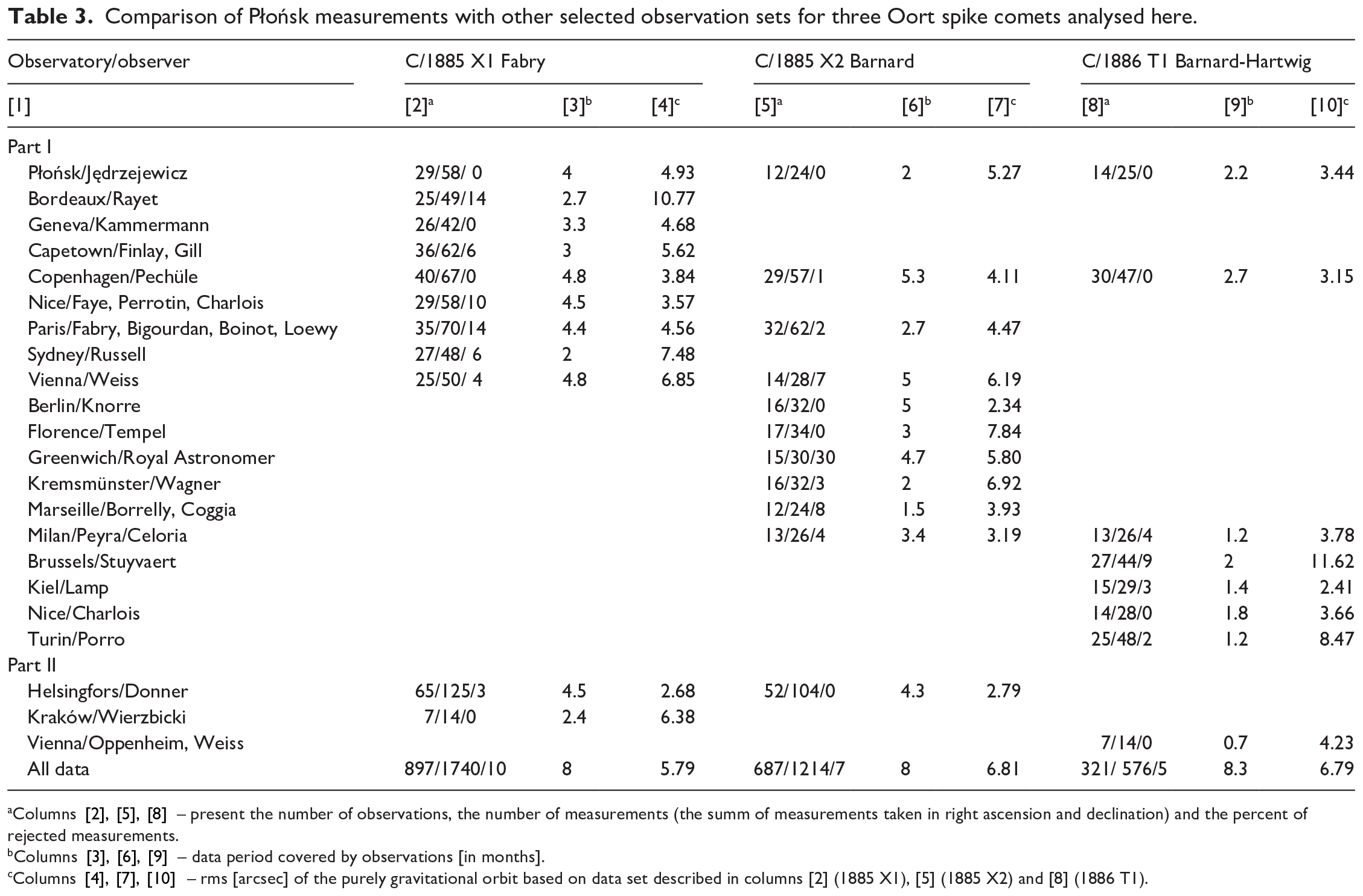
Comparison of Płońsk measurements with other selected observation sets for three Oort spike comets analysed here.
Columns
Columns
Columns
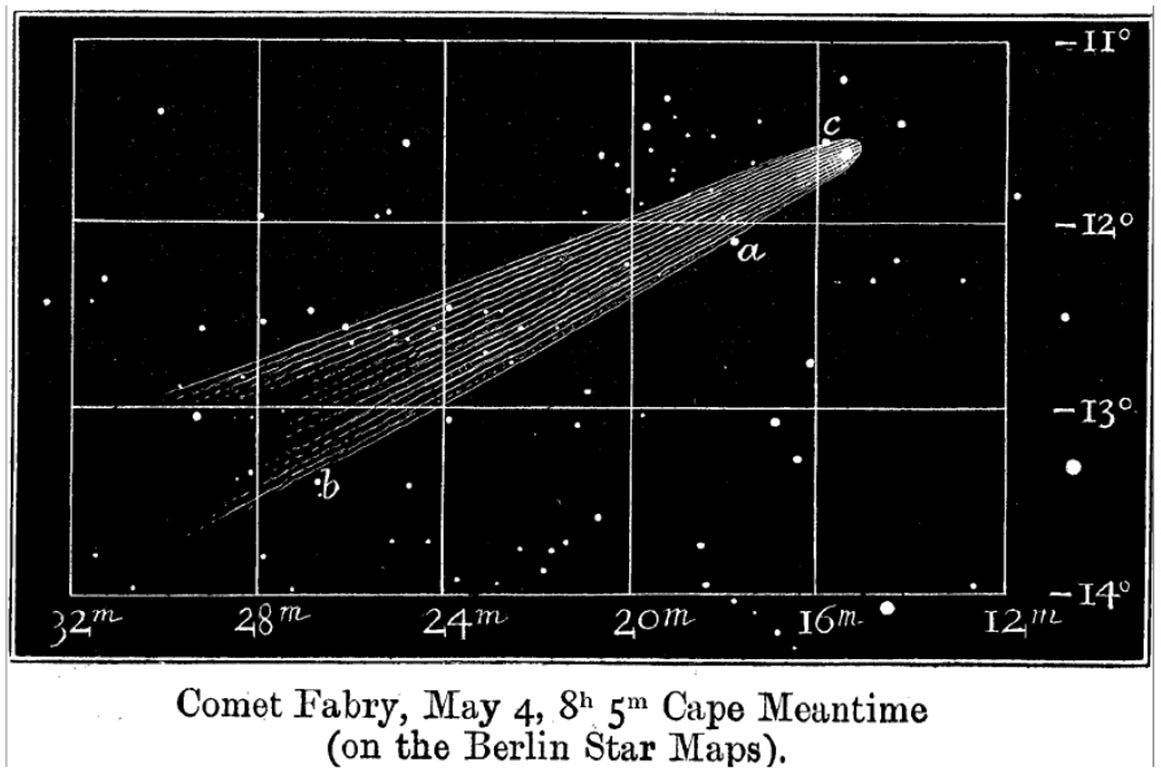
Sketch of Comet C/1885 X1 Fabry observed on 1886 May 4 from Cape Town; retrieved from Gill. 35
To compare the precision of positional measurements from Płońsk with the positions obtained by other observers, we chose eight observatories where the sets of observations are comparable to the set obtained in Płońsk, that is, with similar number of days (25–40 days, see columns [1–2] of Table 3) and similar data arcs (2–5 months, column [3]). Single observation is usually a position in right ascension and declination taken simultaneously, that is consists of two measurements. However, in the old positional observations, based on the comet location relative to reference stars, were sometimes measured first in one coordinate and then in the other. For example, in such a way some observations of comet C/1885 X1 were performed at the Copenhagen Observatory by Danish astronomer Carl Frederick Pechüle (see Table 3). Thus, the number of measurements given in column [2] is not always twice as large as the number of observations. In columns [4], [7] and [10] of Table 3, the root mean square errors (rms) for the data sets described in column [1] are given where the purely gravitational (GR) orbit was determined. Data were selected, but not weighted, and the percentage of observations rejected within the individual observation set is given in columns [2] (comet C/1885 X1 case), [5] (C/1885 X2) and [8] (C/1886 T1), respectively. When determining the orbit from a given set of observations, we used the sharp Bessel criterion for the data selection; for details see Królikowska et al. 36 In column [2] of Table 3 one can see the effects of the data selection in the case of C/1885 X1. No measurement was rejected only for observation sets from Płońsk, Geneva and Copenhagen (see column [2]), that is, from 3 of 9 observatories given in Part I of Table 3. However, this fact alone is not an unequivocal indicator of the good quality of the analysed data set, as attention should also be paid to the value of RMS. If a dispersion of measurements along the orbit determined using this data set is generally large, no measurement may be rejected. We added to this table also observations from Helsingfors obtained by Anders Donner (Helsinki Observatory) and by Daniel Wierzbicki (Kraków Observatory, Part II of the table). The first data set is notably richer in number than that obtained in Płońsk, the second is much poorer. That is why we did not include them to the main group of observatories used for the direct comparisons. In is worth to mention here, that the set of measurements from Helsingfors is of excellent quality and gives the smallest RMS in the whole group of more than 50 observatories involved in tracing in the sky the trajectory of this comet.
Assessing the data from Płońsk against the background of the data obtained from other observatories, known from routine positional measurements of comets, it can be seen that the set of data obtained by Jędrzejewicz give: (i) a larger RMS than data sets received in Copenhagen and Nice (and Helsingfors), (ii) a similar to those obtained in Geneva and Paris and (iii) a noticeably smaller than RMS in Bordeaux, Vienna and Capetown data sets. Thus, Jędrzejewicz not only made precise measurements in right ascension and declination relative to nearby stars, but also very accurately determined all comet positions based on the star catalogues. Moreover, his data set gives a notably smaller RMS (
One can also compare the orbit determined using only the Płońsk data (4 months of observations) with the orbit determined from all the data (8 months). In Figure 5, we have such a comparison for two orbital elements
37
where the filled square symbol (red in colour) represents the solution derived using all the available data, and the dot labelled ‘Pl’ (green) – the orbit determined from the Płońsk data. There are also plotted other solutions based on data from Copehagen (open circle, gold), Helsingfors (labelled ‘H’, magenta), Vienna (‘W’, blue), Paris (‘Pa’, turquoise), Geneva (‘G’, grey) and Capetown (‘Ca’, cyan). Solutions based on the data from Bordeaux and Nice are far beyond the left edge of the horizontal axis range (and only small parts of

Comet C/1885 X1 Fabry. Comparison of two orbital elements at the epoch close to perihelion passage: perihelion distance,
There is no simply relationship between the rms amplitude of a data set obtained at individual observatory (Table 3) and uncertainties of the orbit elements determined from this data set, This is because the precision of the orbit determination depends on many factors, such as the number of measurements (column [2] of Tables 3), the length of orbital arc covered by observations (column [3]), the distribution of measurements within the data arc, and the position of data arc on the trajectory relative to the perihelion position. This effect is adequately illustrated by the Nice data, where we observe the second smallest dispersion of measurements around the orbit obtained from various data sets considered here (column [4]). However, it turns out that the orbit based on the Nice data is characterised by about 10 times larger
It is worth paying attention to the four points adjacent to the square (red), that is to the solution based on all the observations (Figure 5). These are solutions determined using the data from Helsingfors, Copenhagen, Vienna and Płońsk. Of these four, the solution based on Płońsk data (labelled ‘Pl’, green) is furthest in
At the end, it is interesting to notice that the non-gravitational effects (connected with the non-symmetrical sublimations of ices from the cometary surface) are observed in this comet as well as in two remaining objects analysed next. However, the analysis presented here was carried out using the purely gravitational model of motion. Such comparative analysis for the non-gravitational orbits does not give an interesting picture, because the uncertainties of a non-gravitational orbit for a given comet are usually much larger than uncertainties of the purely gravitational orbit because we need some additional non-gravitational parameters to determine simultaneously with orbital elements.
Some remarks on orbit determination on an example of comet Fabry
It is worth devoting a few sentences to the specifics of comet dynamics research at that time. In the case of comets with large eccentricities (
However, orbital calculations based on the entire available set of observations and taking into account the perturbations of most massive planets required high specialisation in celestial mechanics and carrying out cumbersome manual calculations. It is therefore not surprising that at that time the number of astronomers who undertook such calculations was limited and many professional observers left this laborious task to specialists.
Therefore, the first non-parabolic orbit for C/1885 X1 was calculated by Morrison 39 using four observations and neglecting planet perturbations. However, the so-called definitive orbit for comet Fabry was only derived by Redlich, 40 more than 25 years after its discovery. This could also be due to the fact that comet observations were often published with a long delay. In this case, the last observations of this comet were published by observers from Kraków (1898) and Geneva (1904).
C/1885 X2 Barnard
Comet C/1885 X2 was followed in the sky just as intensely as the previous one, also in over 50 different observatories (Table 3). The trajectories of both objects were relatively close together in the sky and both were often observed the same night at a given observatory (see also Table 2). For example, Jędrzejewicz
29
observed both comets in 1886 on February 23, March 8, and 10, and April 10. In December and January, observers reported that sometimes the image of comet Barnard was quite fuzzy, while sometimes more pronounced brighter condensation could be seen within the image. In March, the comet brightened and a tail stretched about half a degree was visible; however, this tail was weaker than in the case of C/1885 X1. At the end of March, comet brightness was estimated at about 7.5 magnitude.
32
At the end of April, it was very low on the northern sky; however, its discoverer, Barnard
41
estimated that on April 29 it was very bright and beautiful with a very slender tail at least
It was more difficult for this comet to select observatories with similar data sets in number and data arc to the data set obtained in Płońsk (Part I of Table 3). Finally, 9 observatories for comparison with the Płońsk data were chosen; however, in four of them (Berlin, Greenwich, Vienna and Copenhagen) the comet was tracked over a period more than twice as long as in Płońsk (column [6] of Table 3). Two of them (Vienna and Copenhagen) were taken as the reference observatories in all three analysed cases. Similarly to the previous comet, the data set obtained by Pechüle at Copenhagen are of good precision, though the Helsingfors data set (Part II of Table 3) are higher quality (similarly to C/1885 X1).
Figure 6 shows the orbital solution obtained from Jędrzejewicz’s data against the background of orbits based on measurements made in observatories listed in Table 3. The square (red in colour) represents the solution based on all the observations. The orbit from Marseille is far beyond the left edge of the horizontal axis range. Not surprisingly, the closest location to the red point and small uncertainties of orbital elements were obtained for sets of observations taken at Berlin (shown in magenta), Helsingfors (very close to the square (red), not shown to avoid the crowding of points) and Copenhagen (gold). This is because these data sets are: (i) the best ones selected from more than 50 observatories involved in tracking this comet and (ii) the data arc of these sets are at least two times longer than the data arc of the Płońsk observations. Also, the sets of data obtained in Greenwich and Vienna (cyan and blue points show the solutions based on these sets, respectively) cover the periods twice longer than the data from Płońsk. Two months is a very short piece of a near-parabolic orbit, and it is not surprising that the uncertainties of the orbital elements of C/1885 X1 obtained using the data set from Płońsk are much larger than those based on two times longer arcs. However, Table 3 shows that RMS of Płońsk measurements around the orbit based on this data set is smaller than RMS derived using all the data, similarly as in the case of C/1885 X1. Moreover, the RMS for Płońsk data calculated using the orbital solution based on all the available data is also notably smaller than global RMS.
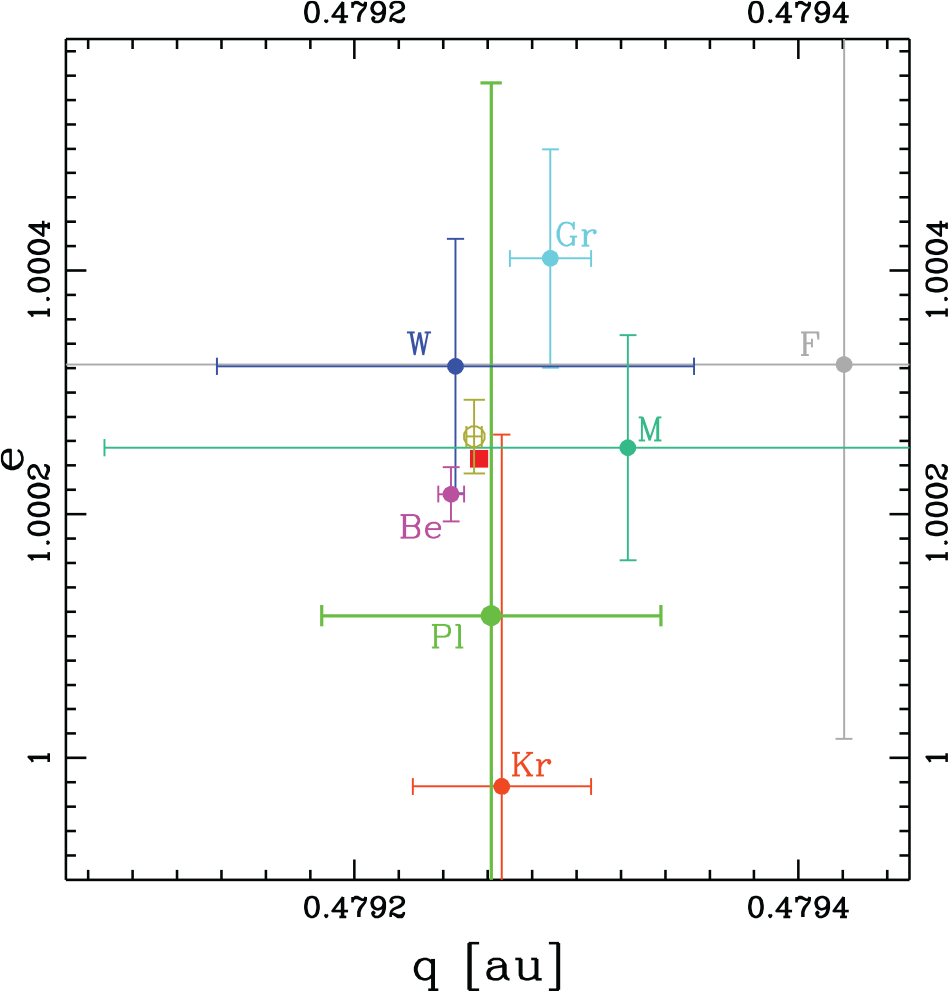
Analogous plot as in Figure 5 for C/1885 X2 Barnard. The orbital solutions based on various data sets are coded as follows: the square (red in colour) – parameters determined using all the available measurements, open circle (gold in colour) – represents solution obtained using only Copenhagen data, dot labelled ‘Pl’ (green) – Płońsk, dot labelled ‘Be’ (magenta) – Berlin, dot labelled ‘Kr’ (orange) – Kremsmünster, dot labelled ‘M’ (turquoise) – Milan, dot labelled ‘W’ (blue) – Vienna, dot labelled ‘Gr’ (cyan) – Greenwich, dot labelled ‘F’ (grey) – Florence.
C/1886 T1 Barnard-Hartwig
This comet was observed in 25 observatories; however, outside of Europe only in Cape Town and Algiers. It was discovered on 1886 October 5, independently by Barnard at Vanderbilt University Observatory (United States) and Ernst Hartwig at Bamberg Observatory (Germany) 42 , and the next morning by Pechüle at Copenhagen Observatory (Denmark). The latter astronomer did not measure its position, and therefore the comet bears names of only the first two discoverers. Already in November it was visible to the naked eye; at that time it reached about 3.6 magnitude Kronk. 32 At the end of November, two notable tails of this comet were also observed. The longer one stretched over a dozen degrees, and was clearly visible to the naked eye. The comet passed closest to Earth on December 6 and 10 days later – it passed perihelion. In January 1887 it was becoming more and more difficult to observe because it was visible at dusk, but it was estimated that its total brightness reached 2.9 magnitude; then it was a notably extended object. The comet was last seen in northern latitudes on January 10. Since then only several measurements were taken from April 30 until mid-June at the Cape Town.
About 300 observations carried out over the period of 8 months from October 1886 to June 1887 were collected from the literature (Table 2). Jędrzejewicz 29 made 14 observations during 2 months. One of these observations was not reduced by the author, that is the original publication only gives the measurement relative to the comparison star. Because in this article we discuss the quality of the comet positions determined by Jędrzejewicz in comparison to the original data from other observatories, this observation was excluded in the analysis presented here.
Similarly to the comet C/1885 X1, it was possible to choose the adequate comparison sets of observations from several known observatories with the similar number of data as in Płońsk (13–30 observations) and within similar period (1.2–2.7 months).
It can be seen from Table 3 that the observations from Płońsk are characterised by low RMS (

Analogous plot as in Figure 5 for C/1886 T1 Barnard-Hartwig. The orbital solutions based on various data sets are coded as follows: the square (red in colour) – parameters determined using all the available measurements, open circle labelled ‘C’ (gold in colour) – represents solution obtained using only Copenhagen data, dot labelled ‘Pl’ (green) – Płońsk, dot labelled ‘N’ (black) – Nice, dot labelled ‘M’ (turquoise) – Milan, dot labelled ‘K’ (magenta) – Kiel, dot labelled ‘T’ (cyan) – Turin, dot labelled ‘B’ (grey) – Brussels.
Conclusions
Based on three comets analysed here, we find that the measurements of cometary positions made by Jan Jędrzejewicz are of high quality and comparable to those obtained in the widely-known professional astronomical observatories. In the case of comets C/1885 X1 Fabry and C/1886 T1 Barnard-Hartwig, the Płońsk observations can be even considered as one of the best, while the measurements of comet C/1885 X2 Barnard are characterised by the quality typical for this kind of observations made in the second half of the 19th century.
During the period from 1881 through 1892, American astronomer Edward Emerson Barnard discovered as many as 15 comets, and was the co-discoverer of two more. Of the three examined here, two bear his name. He discovered C/1885 X2 with a 15 cm refractor and C/1886 T1 using a 13 cm refractor. Is it a lack of luck that Jędrzejewicz has not discovered a new comet? Did he even strive for it? It seems reasonable to suppose that, he did not have enough time for typical long-standing sky surveys for new comets. Therefore, maybe, he seemed to find it more valuable to use his free time to measure the position of comets already discovered than to spend hours searching for a new object in the sky. We did not find other immediate answers to these questions. However, it is worth emphasising that Jędrzejewicz was an active doctor and the medical profession was the main source of his livelihood. Maybe that is the main reason why Jędrzejewicz did not discover any new comet. Additionally, it is important to stress that it seems that Jędrzejewicz devoted most of his free time to observing double stars, so probably he laid comets on the periphery of his main astronomical interests.
Footnotes
Acknowledgements
We are grateful to Piotr A. Dybczyński for sharing the photos of the lens of the original Jędrzejewicz refractor that has survived to our time in Poznań Observatory. We direct our special thanks to Adam Derdzikowski for his kind help in reaching many source materials, in particular for pointing to a public website of Documentation Center of the History of the City of Płońsk (PPDMP). Materials collected in PPDMP turned out to be invaluable in the preparation of this article. We thank the anonymous reviewers for their remarks that helped us to improve the paper.