




Abstract
This is a case of working by analogy to apply successful work from one field, the kinetic theory of gases, to another field, the distribution of stars in globular clusters. The origin of the analogy lies in Henri Poincaré reading a vague suggestion by Lord Kelvin and recognizing the interest and potential value of this suggestion. The result is the application of mechanics to the dynamics of clusters with very many stars. A good idea, even a very clever good idea, still takes significant work to elaborate in all its implications. Here we see assumptions that lead to partial success in providing a relation between the density of stars in a cluster and the distance from the center. Partial success motivated work using assumptions that were less restrictive. We follow the assumptions and work through 1916, when work paused for many years.
Introduction
The analogy used in the research described here involves the kinetic theory of gases and statistical mechanics, developed for application to atoms, and its application to gravitationally interacting stars to infer properties of globular clusters. More abstractly, the analogy goes together with a change from studying two or three interacting bodies (e.g. earth, moon, and sun) to studying many (even many thousands) of interacting stars in a cluster; and a shift from applying mechanics to the motion of planets to applying mechanics to the motion of stars (with mutual gravitational attraction acting on both planets and stars). This is a vast expansion in the scope accessible to the application of mechanics; from solar system dynamics, Henri Poincaré had opened explicit discussion of dynamics of globular clusters and galaxies.
The events reviewed here start with a paper by Lord Kelvin (born William Thomson) that Poincaré discussed in a presentation 1 in 1906, and in which Poincaré found what he thought to be a suggestion to apply the kinetic theory of gases to the stars in the Milky Way. In fact, Poincaré loudly credits Kelvin with the idea of applying kinetic theory of gases to clusters of stars. Reading Kelvin now, I wonder whether Poincaré read more from between the lines than Kelvin had imagined might be there, since there seems to be only a faint basis for the insight in Kelvin’s publications. This is a curious example of influence.
Timing is important for a good idea to flourish. For this idea, the timing was good because work on astrophotography that started decades earlier at the Harvard College Observatory under Edward Pickering was providing photographs of globular clusters and information on star counts as a function of distance from the center of the cluster.
Circumstance matched an idea with data to make a challenge: Could the kinetic theory of gases be used as a basis for a theory accounting for the stellar density in globular clusters as a function of radius and agreeing with observations?
After that inspiration involving a curious transmission of an idea from Kelvin to Poincaré, the story shifts to a young Swedish astronomer working in Paris who picks up the work through an uncertain connection to Poincaré. Hugo von Zeipel, the young Swedish astronomer, published a first article 2 on globular cluster structure based on the kinetic theory of gases and H.C. Plummer presented an alternate model. 3 A subsequent publication by Hugo von Zeipel contributed a significant volume of data and analysis, and was accompanied by summaries of the models. Comparison with theory showed that both models had strengths and shortcomings but no one set of assumptions from the kinetic theory of gases individually provided a consistent relation between stellar density and radius matching the data from the center to the periphery.
I have used the term model in the previous paragraph and elsewhere. This term is not used in works by Kelvin, Poincaré, von Zeipel, James Jeans, and Arthur S. Eddington cited here. Poincaré and von Zeipel refer to hypothèses and Kelvin, Jeans and Eddington introduce hypotheticals with terms such as “let,” “consider,” and “if.” These hypotheses or hypotheticals are used in reasoning and argumentation, and result in what Poincaré, Eddington and H.C. Plummer, for example, each call a “law.” Poincaré also refers to conclusions. I mean model to include the set of hypotheses, assumptions or hypotheticals, argumentation, and conclusions or laws; this usage is convenient but not historical.
The point that there was no one satisfactory model was emphasized by Jeans 4 and Eddington 5 in papers that appeared back-to-back in the Monthly Notices of the Royal Astronomical Society in May 1916. Their work marked a shift from kinetic theory of gases to a statistical mechanical treatment without assumptions about the relation between temperature, pressure and volume. While there are interesting insights, Jeans and Eddington saw the problem as a whole as only partially resolved and as largely intractable. The second of the papers ends with Eddington 6 stating (p. 585) that the problem is unsolved. In the immediately following years, no one stepped in to offer other theoretical explanations.
Before starting to tell the story, a digression is needed. The following paragraphs in this introduction serve to review key concepts from the subject matter, in order to set the context and prepare for the discussion in the body of the work.
Star clusters are particularly good for viewing with small (amateur) and medium (campus observatory) telescopes, for example, on open house nights. Many objects in Messier’s catalog are clusters. There are two types of clusters, open and closed.
Open clusters are generally young stars, formed about the same time in one area. They are now slowly separating, with each star moving with its own, independent velocity. Prominent examples are the Pleiades, Messier 45 (here subsequently written M 45), and Praesepe, M 44. E.C. Pickering, at the Harvard College Observatory, has a discussion (p. 210–19) in an article 7 from 1886 of the spectra of the bright stars in the Pleiades. Most relevant to this paragraph, Pickering writes in this article, 8 commenting on a photograph taken January 26, 1886, “The spectra of nearly forty stars of this group are shown on this plate. . . Nearly all of the brighter stars in the Pleiades have a spectrum of the first type. . .” now cataloged as hot, O-type stars.
Closed clusters are also called globular clusters. They have many, many stars. The stars are old and gravitationally bound. Some stars may reach velocities that allow them to escape; most stars do not. Here, the Hercules Cluster, M 13, is a prominent example and is shown in Figure 1. Poincaré uses a picture of it as in his article 9 and in its translation. 10 In 1904 H.C. Plummer 11 presents measurements of stellar positions and counts from a photographic plate of M 13 taken at the observatory at Oxford University and the following year his father, W.E. Plummer, 12 does the same with a photographic plate taken some time earlier at the Yerkes Observatory and presented to him by George E. Hale. Later, von Zeipel prepares an extensive catalog 13 of stellar positions in M 13.
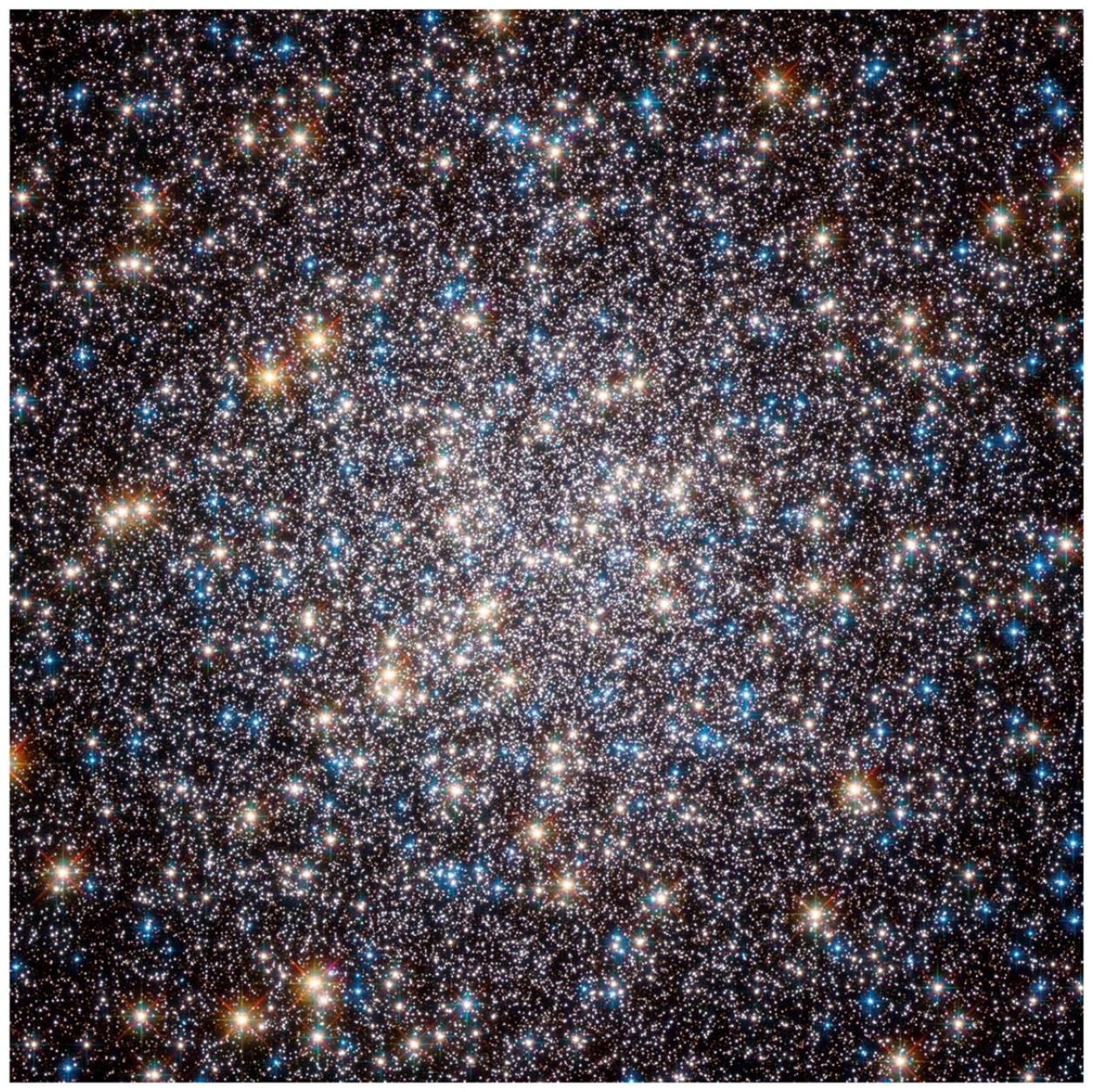
Hercules globular cluster, M 13. Photo courtesy ESA/Hubble.
Some of the works referenced here refer to star streams (in German, Sterngeschwindigkeiten; in French, courant d’étoiles) and these should not be confused with globular clusters (in German, Kugelsternhaufen; in French, amas globulaire d’étoiles). Note 14 provides references to papers from that era on star-streaming. The concept of star streaming originated from observations of the velocity of stars near the Sun. These observations showed groups of stars that appear to move with a consistent velocity and direction (hence, the term star streams). This observation is contrasted with an expected random distribution of relative velocities of stars near the Sun. Observational papers from that time discuss the possibility of two or sometimes three streams, and theoretical papers propose dynamical explanations.
Although work on star streaming has some relevance to motivation and work by Jeans and Eddington, the reader choosing to consult their writing is advised to keep in mind that star streams and star clusters are quite different. Likewise, some papers refer to star clusters (it might have been more precise for them to write, “clusters of stars”) when they mean all stars within a particular radius or stars within a stream and don’t specifically mean open and closed clusters as defined above.
After development over decades, including notable early work by James Clerk Maxwell, the kinetic theory of gases and statistical mechanics reached a milestone with the publication of two volumes of Vorlesungen über Gastheorie by Ludwig Boltzmann 15 in 1896 and 1898 and with publication of Elementary Principles in Statistical Mechanics by Josiah Willard Gibbs 16 in 1902.
The kinetic theory of gases seeks to explain bulk properties of gases from averages over time and space of properties of individual, constituent atoms and molecules. These properties include velocity, kinetic and potential energy, partition of their energy between degrees of freedom (modes of translation or rotation) of individual atoms or molecules, and partition of energy between atoms and molecules. An important consideration, relevant to the following discussion, is the assumption that the atoms and molecules move in straight lines between comparatively short-range and brief interactions (“collisions”) with other atoms and molecules. Since these atoms and molecules are electrically neutral, the forces involved in the interactions are short-range forces between electric dipole and quadrupole moments, commonly known as van der Waals forces. In contrast, gravitation is a long-range force and even acts in between close interactions that result in large deflections.
Luck favors a prepared mind and interestingly both Henri Poincaré and James Jeans were well versed in kinetic theory of gases before this opportunity to apply it. They had each read from the works of James Clerk Maxwell, Ludwig Boltzmann and Josiah Willard Gibbs, and previously published about kinetic theory. Poincaré appears to have been more influenced by Gibbs and Jeans by Boltzmann.
Poincaré’s published work includes both his lectures for a course on thermodynamics and also articles defending the equipartition theorem, and clarifying the definition and understanding of entropy. In other work, Poincaré references work by Gibbs from 1876 and 1902, 17 and I think it is plausible that Poincaré also read the books by Boltzmann mentioned earlier. 18
James Jeans, for his part, wrote a book 19 on kinetic theory of gases. In the preface he indicates that he was motivated by providing a solid basis for supporting discussions of differences between theoretical and experimental values of coefficients of thermal expansion. It eventually went into a fourth edition.
After those digressions to set some of the background, I can now begin my story with the origin of the observations that provided a comparison for the stellar density-to-radius proposed by von Zeipel and H.C. Plummer.
Observations of globular clusters
While the focus in the following sections is on the application of physics theory, I do want to note that before and during the time of this theoretical work there was sustained observational work. Because of the very high density of stars in globular clusters, meaningful observation and measurement did not become possible until there was stellar astrophotography. In the second half of the 19th century, the Harvard College Observatory (HCO) under Edward C. Pickering became a center for astrophotography and analysis of the images.
Solon Bailey working at the HCO in 1893 was the first to count globular cluster stars and measure star densities on a photographic plate. 20 The subject of this work was the globular cluster ω Centauri. Bailey went on to curate a catalog of globular clusters and to identify an extraordinary number of variable stars in globular clusters. These contributions by Bailey were, for example, noted in work 21 by H.C. Plummer in 1915. In that work, Plummer also provides a summary of related work over subsequent years.
Also at the HCO and included in Plummer’s summary, the director of the HCO, Pickering, and the astronomer, Williamina Fleming, published 22 results on photographic measurements of many open and closed clusters in 1897.
Chapter XI of their work considered the density of stars in globular clusters. The technique for this measurement is the same as that used by Bailey 23 and consisted of laying out a square grid, superimposing it in on a photographic plate and counting the stars in each grid cell as described on page 213 of Pickering’s and Fleming’s work. 24 The counts of stars in the grid cells for the Hercules Globular Cluster (M 13), continuing to use it as an example, are presented in two tables on page 216. Based on these counts from multiple globular clusters, they determined that “. . . two constants only are required to define the distribution of stars in the cluster. One is dependent on the total number of stars and the other upon their distance [from the center].” Pickering 25 found in particular that the constants are independent of the specific cluster. They did not give a specific form for the relationship between counts projected onto the photographic plate and radial distance. The Hercules Globular Cluster (M 13) was a subject of continuing interest; star counts were given by W.E. Plummer 26 and a catalog 27 of star positions prepared and published by von Zeipel was previously discussed. In 1916 Bailey provided a collection 28 (pp. 51–76) of counts for many globular clusters.
In interpreting these and other observations, the key consideration is the form and parameters of the relationship giving the dependence of stellar density in space on the distance from the center of the cluster. This is notably considered in by H.C. Plummer who returns to this point several times. 29 The form and parameters from this analysis of the data were used for evaluating the theories of globular clusters, and in this case specifically those theories arising from the application of kinetic theory of gases.
Origin of the idea of applying kinetic theory of gases
Poincaré starts his 1906 presentation, 30 in the first sentence even, by referring to an “an ingenious idea of Kelvin, who opened a new field of research for us.” Similarly, von Zeipel’s note, 31 in the minutes of the Académie des Sciences starts, “Drawing my inspiration from an idea of Lord Kelvin.” In a subsequent, much more detailed paper, 32 von Zeipel (p. 35 sec. 16) states, “It is better to look for the explanation of the phenomenon by starting from a fertile idea of Kelvin taken up later by Poincaré. For them, the stars of the cluster behave like the molecules of a gas bubble.” von Zeipel provides a footnote here referring to Poincaré’s presentation. 33 Jeans’s paper on mean free path 34 (third paragraph) refers to an estimate of stellar density by Kelvin and calculates the corresponding mean free path.
This establishes that Kelvin deserves credit for an interesting application of kinetic theory of gases and that Poincaré and von Zeipel deserve credit for recognizing and working with it. It is therefore best to start with Kelvin’s work. The immediate question is, which publication? No one provides an actual reference. Two possibilities can be identified quickly, in chronological order: the first from August 190135 and the other from September 1901. 36 A review of the content of Kelvin’s collected papers 37 finds that paper 160 in that collection is the August paper just mentioned. There are no other items in the collected papers to which Poincaré, von Zeipel and Jeans might be referring.
On the first page of the first reference, 38 Kelvin provides a long lineage for the paper. The lineage starts with a paper by Kelvin from May 1854 that was reworked as a lecture in 1884 and then continues with a series of dated footnotes. The last footnote concludes, “I did not in 1854 know the kinetic theory of gases.” I hear a dry sense of humor in this statement. There are also blocks of additions within the body of the article dated November 1899. There are no further, explicit, references to the kinetic theory of gases. Of 22 sections, four relate to estimates of the number of stars (about 1 billion) within 1000 pc (parsecs), which Jeans used in his article 39 estimating the mean free path, their velocities (on dynamic grounds that might implicitly involve kinetic theory of gases) and their contribution to the brightness of the night sky.
The second reference, 40 from September 1901, is shorter and does not contain any reference (even humorous) to the kinetic theory of gases. This reference is more narrowly focused but does repeat the estimate of 1 billion stars within 1000 pc that Jeans used in his article. 41 While certainly not identical (the first paper has extensive content not discussed here), the overlapping content of the two papers is similar. They both attempt to estimate the number of stars within 1000 pc, their velocity and their contribution to the brightness of the night sky and they use similar reasoning. This synopsis of Kelvin’s ideas is consistent with Poincaré’s discussions or summaries in his presentation. 42 Although there might have been an opportunity, neither paper explicitly uses the kinetic theory of gases in Kelvin’s discussion of the stars’ velocities. Either of these two papers could be papers that von Zeipel and Jeans refer to.
The situation with Poincaré is more complicated; he appears to credit Kelvin with far more than can be found in either of these papers. Poincaré is clear that he is referring to the Milky Way (in contrast, Kelvin only refers to an area of space within 1000 pc) and Poincaré is explicit and detailed in his discussion of the kinetic theory of gases (aside from a brief remark, Kelvin is not explicit in using the kinetic theory of gases), appearing to give Kelvin credit for both. How did this situation arise?
It is known that Poincaré (and also Albert Einstein) often read papers by deriving and developing the arguments for themselves with little reference to argumentation the author had written. In fact, Poincaré suggests as much in this specific case. Referring to an estimate of the number of stars in the Milky Way, Poincaré in his lectures writes, 43 “. . . Lord Kelvin’s result that I just rederived by an approximate calculation.” And it can be seen that the method that Poincaré used for the estimate (or at least its presentation) differs from Kelvin’s.
Further, Poincaré knew German; as a teenager he grew up in Lorraine under German occupation after the Franco-Prussian war. During the occupation he read newspapers in German for local information. His knowledge of English was not as good. My impression is that, after French, Poincaré references writings in German more frequently than works in English. It is possible that Poincaré read little more than the title of the second Kelvin reference, 44 the curious footnote referring to Kelvin’s knowledge of kinetic theory of gases, perhaps just enough to get a basic synopsis of the content. That nudge may have been all that Poincaré needed to set off on his own in a new direction. This gives us a curious (and plausible) example of influence and inspiration.
The first step by Poincaré in applying the kinetic theory of gases to star clusters (and the Milky Way) appears in a lecture presented to the Société astronomique de France and illustrated with lantern slides. The Société had been founded in 1887 by Camille Flammarion and had an orientation towards amateur astronomers and the general public. Because of the nature of the audience, Poincaré’s presentation is not technical and has no equations; this is in strong contrast to the other works discussed here. Poincaré’s presentation 45 was published in the spring of 1906. An English translation 46 was published that fall and the French version was included 2 years later in the book Science et méthode. 47 That book was translated to English by Francis Maitland and became widely available. A closely related version of the article, but with more technical content, appeared in a collection of lectures published in 1911. 48
Poincaré asks about applicability
Applicability of kinetic theory of gases to stellar clusters depends on several considerations. How is the nature of the interactions between stars different from atoms? Unlike the short-range van der Waals forces between atoms and molecules, the interactions now involve long-range gravitational forces and perhaps very short-range tidal forces. Further, the distinction between long- and short-range is arbitrary. Do the continuous small deflections of the motion of stars from gravitational forces between close interactions matter? Do the tidal forces result in dissipation of energy in the internal motion of stars? How frequent are the interactions, expressed, for example, as the mean free path, the average distance stars travel between close interactions? Is the internal behavior of binary star systems relevant? The internal behavior could involve changes in their orbital parameters and corresponding gravitational binding energy. How frequent are binary star systems?
The authors considered in this paper give different levels of consideration to applicability; among those who do discuss applicability, the factors considered and their significance are different. Note also that beyond implicit or explicit assumptions about applicability, there are further assumptions about conditions and behavior (e.g. adiabatic or isothermal equilibrium).
Of the authors included here, Poincaré gives the most consideration to applicability. In his presentation, 49 Poincaré justifies this recourse to statistical methods as due to the almost overwhelming number of stars in globular clusters and in the Milky Way compared to the application of celestial mechanics to the solar system, a few-body problem. The very large number of stars in a cluster is compelling motivation for a statistical approach.
Poincaré immediately asked questions about applicability of kinetic theory. The first question relates to the shape of the concentration of stars. Is it spherical? This is true of globular clusters, but not the Milky Way, whose shape he compares to the spiral nebular in Andromeda, with the aid of a picture. The second question asks whether the number density of stars is sufficient to result in enough impacts to reach equilibrium. As Poincaré indicates, this is a question about the mean free path. Third is the nature of the equilibrium. Poincaré assumes that the stars in the Milky Way are in convective equilibrium. In this case the pressure and volume are related by an adiabatic law:
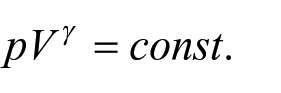
according to which the product of the pressure of the gas times the volume of the gas raised to the adiabatic exponent (
Finally, if an adiabatic law is assumed then there is a question about the applicable value of the adiabatic exponent. Poincaré reasons that the cloud of stars should behave like a monoatomic gas with three degrees of freedom, and thus an exponent
Poincaré argues that for the Milky Way the answer to the first and second questions is no. He estimates that the mean free path is very long compared to the diameter of Milky Way. It is also clearly not spherical. He does observe, in contrast, that globular clusters are spherical. Also, since the stars are gravitationally bound to the cluster (they cannot escape), they could traverse back and forth through the cluster enough times—even if the mean free path is long compared to the cluster diameter—to undergo sufficient collisions to possibly bring the cluster to equilibrium. This condition is therefore related to the age of the cluster. While Poincaré assumes an adiabatic law for the Milky Way, he does not indicate a preferred assumption for globular clusters.
The kinetic theory of gases may be applicable to stars in globular clusters. Poincaré states, “It would be interesting to examine known clusters in order to find out the density law and to see whether it is the adiabatic law for gases.” He then returns to his discussion of the Milky Way; that discussion is interesting in its own right, but it takes us away from the application of the kinetic theory of gases.
Mean free path in a globular cluster
Although Poincaré first raised the mean free path as a consideration for applicability of kinetic theory of gases, he did not make a quantitative estimate in his presentation 50 or later in his lectures. 51 The first article 52 by Jeans that I discuss here focuses on estimating the mean free path of stars as a test of the applicability of the kinetic theory of gases. Jeans follows a quantitative and approximate line of reasoning to get a formula for the mean free path and from that a formula for the distance a star will travel before a cumulative, total deflection of 1°. Using estimates from Kelvin’s second article 53 Jeans states that this distance is 4 × 1023 cm in a galaxy taken to have a diameter of 1 kpc or 3.1 × 1021 cm. Therefore, the mean free path is about 160 times the diameter of the model galaxy. Jeans concludes, 54 “It will be obvious that there can be no question of a universe similar to ours coming to a final steady-state such as we are familiar with in the theory of gases.” He next acknowledges that closely packed star-clusters might be very different but does not provide any computation.
I take this computation as an exercise left to the readers, us, by Jeans. The quantities going into the calculation are the gravitation constant, the average mass of a stellar system, the average relative velocity of pairs of stars, and the number density of the stellar system. Kelvin in the second article 55 assumed that the average mass of a stellar system is five solar masses (p. 169) and I will retain his value. He also assumed that the average relative velocity is 50 × 105 cm/s (p. 170), a value Jeans amended to 60 × 105 cm/s (p. 109). Kelvin provided a reason for his choice of velocity that has not stood the test of time and Jeans only justifies his choice as “a reasonable value.” For expediency I will keep Jeans’s value. Looking for values for number density, I will work directly with the star counts and dimensions from observation, specifically with values from von Zeipel’s review, 56 published several months before this work by Jeans. 57 I’ll stay with my favorite example and use values for M 13, the Hercules cluster. The correct table from von Zeipel’s review is IV 58 and I’ll use the first column. This includes the raw counts plus an approximate correction for stars that were obscured in the dense part of the cluster. (The second column corrects, by interpolation, for variations in the thickness of the rings on the reticle. This correction is not necessary for my purposes). The total of these counts, out through the 28th ring, is 3013 stars. The thickness of each ring is 0.3563′, so the radius of M 13 on the sky is 9.98′. To determine a spatial dimension, I need to know the distance to M 13, and this is where Jeans (or van Zeipel) would have been forced to stop. I instead can consult the results 59 from the Gaia astrometric satellite (Table 2) and find a distance of 8.62 kpc. This distance with the angular radius from van Zeipel leads to an actual radius of 3.98 pc or 1.2 × 1019 cm. This corresponds to a sphere with a volume of 7.6 × 1057 cm3, containing 3013 stars and hence a density of 4.0 × 10−55 cm−3 which is about 50 times larger than the value Jeans used. In Jeans’s formula, the mean free path depends on the inverse square root of the density so for my values for M 13, the mean-free path is about 6 × 1022 cm. This is about 2100 times the diameter of the M 13 cluster, meaning that extending the estimate Jeans started to M 13 by using data from von Zeipel (plus a modern distance measurement) shows that M 13 is even farther from equilibrium than Kelvin’s model universe.
There are three relevant cautions that go with the above estimate. First, the total count of stars is subject to correction: in 1916 Bailey in his catalog reported counting 2146 stars in M 13, 60 and a recent count, 61 also from Gaia (Appendix C, Table C1), finds 15,634 members. With this later number of stars, the mean free path is still about 900 times the diameter. Next, the velocity used in Jeans’s formula for the mean free path is, as already remarked, only his reasonable guess. This guess could be replaced by using the virial theorem to relate the mean square velocity to the potential energy. (Contemporary proofs of the virial theorem from thermodynamics with application to clusters of stars were published by Poincaré in his lectures 62 and by Eddington 63 .) Last, this approach is based on an important implicit assumption: stars are only deflected during discrete close encounters and slow, steady accumulation of long-range gravitation forces are not included. Later estimates compared isolated large deflections from close interactions (the hare, if you’ll accept the analogy) to continuous long-range interactions (the tortoise) and found that that the latter contribute more to the deflection (the tortoise wins the race). These latter two points are discussed in a review. 64
Additionally note, as Poincaré pointed out, that stars in globular clusters are gravitationally bound; hence, a star will continue to move round-and-round through the cluster. Once the cluster is older than several hundred times the orbital period, the cluster will reach thermal equilibrium. For a star on the outer edge of the cluster with a 4-pc radius containing 3000 stars of about five solar masses each, the Keplerian orbital period is 185 years. Several hundred times this orbital period is still less than a million years.
A connection between Poincaré and von Zeipel
As already mentioned, von Zeipel’s note 65 on this subject was published 8 months after Poincaré’s presentation. 66 Von Zeipel begins by referring to an idea of Kelvin just as Poincaré had. In a subsequent, more detailed paper 67 von Zeipel states, “It is better to look for the explanation of the phenomenon by starting from a fertile idea of Kelvin taken up later by Poincaré. For them, the stars of the cluster behave like the molecules of a gas bubble.” Von Zeipel provides a footnote here referring to Poincaré’s presentation, 68 indicates that Poincaré deserves priority for recognizing Kelvin’s idea (and for considering limits on its applicability).
This suggests an interesting question: was there any communication or coordination between Poincaré and von Zeipel in Paris? The quote from von Zeipel in the previous paragraph does not answer this question. Poincaré did not publish work again on this subject, and died in 1912, so there is no answer to be found in that direction. There is no extant record of correspondence between Poincaré and von Zeipel. Von Zeipel is not listed in the table of contents or index of Poincaré’s correspondence, 69 and a search for his name in the catalog of Poincaré’s correspondence at the Archives Henri Poincaré returned nothing.
Von Zeipel had received a PhD from Uppsala University in 1904 and was appointed assistant professor of astronomy there the same year, when he was 31. 70 He arrived in Paris in 1904 and his observational work on globular clusters started at the Observatoire de Paris in 1905. In the full publication of his observational work on the M 3 Cluster, von Zeipel stated 71 that he worked from photographic images taken on three nights in March, April and May 1905. Von Zeipel’s work is mentioned in the annual report 72 of the observatory (pp. 3 and 4) dated March 1906. Von Zeipel left Paris in 1906.
These dates mean that von Zeipel planned and conducted his observational work on M 3 and also started analysis of the data before June 1906, when Poincaré gave his presentation. At the time of the presentation, Poincaré likely also knew, at least generally, about von Zeipel’s work. Certainly, Poincaré had opportunities to become aware of von Zeipel’s work. Poincaré was at that time on the board of the Observatoire de Paris and had previously been director of the Bureau des Longitudes. In the context of his official role there, it seems quite likely that Poincaré would have, at the latest in March 1906, become familiar with the work included in the report.
Observe also that Poincaré presented the note 73 from von Zeipel to the 18 February 1907 session of the Académie des sciences. By that date, von Zeipel had already returned to Sweden; further, since only members of the Académie can submit notes to the sessions, nonmembers, like von Zeipel, needed to find a member, like Poincaré, willing to submit the note for them. There would therefore necessarily have been communication between Poincaré and von Zeipel in the weeks before the February 1907 session, at the least. We can be sure that Poincaré was aware of the content of the article when it was presented, if surprisingly he had not heard about it as much as two years earlier. While the circumstantial evidence is clear that there must have been communication and coordination between Poincaré and von Zeipel, its nature, content and timing is unknown.
Von Zeipel models an isothermal cluster
In modeling a globular cluster as a bubble of gas in thermodynamic equilibrium, an immediate consideration is how to model the state of the gas as a function of the radius in a spherical bubble. For a general ideal gas, the pressure, volume, and temperature are related by
These were assumptions of adiabatic equilibrium or isothermal equilibrium and each led to a relation between the pressure and volume of the gas that did not involve temperature, unlike the ideal gas law. Isothermal equilibrium is more direct; it is assumed that there is no change in the temperature so the ideal gas law is reduced to
In this section I will look at the model developed by von Zeipel, incorporating an assumption that the stars in the cluster are in isothermal equilibrium. With this model, von Zeipel provides mathematical detail that was not present in Poincaré’s popular presentation. There are three key points in the mathematics presented by von Zeipel. First, he writes 74 :
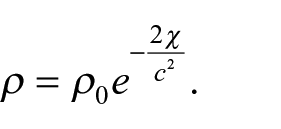
In that equation he assumes that the number density of stars as a function of the radius in a spherical self-gravitating cluster is given by a Boltzmann distribution where
The Boltzmann distribution provides the probability that an atom (or in this application, a star), at a particular temperature, will have a particular energy. Here that energy is the gravitational potential energy that depends on the radial distance from the center of the cluster. As previously discussed, the temperature is taken as proportional to the mean square of the stellar velocity.
Second, von Zeipel makes the explicit assumption that the mean squared stellar velocity is constant. This assumption is equivalent to an assumption that the stellar gas is isothermal. The meaning of this assumption is discussed above and the practical consequence is that it allows progress with his calculations. In the third step
75
the gravitational potential energy at radius
Hydrostatic equilibrium indicates that the gravitational attraction of the mass of each layer (meaning the weight) in a self-gravitating gas cloud is supported by the pressure of the gas in the lower layers. This reasoning is mechanical in nature and leads to a relationship between pressure, density and radial distance from the center of the cluster. Qualifying it as mechanical indicates that this is a matter of stably stacking the gas into a sphere and is not in itself a consequence of the kinetic theory of gases.
The mathematical result of combining these points is a relationship between the number density of stars and radius. This is, of course, the radius in three-dimensional space. To work with counts from photographic plates, the relation between counts in space and the counts projected onto a photographic plate is needed. That is discussed in the next section.
Von Zeipel compares (using the relation mentioned in the previous paragraph) his theoretical result with observed values from Bailey’s study 76 of ω Centauri and with his own values from his catalog for the M 3 globular cluster. 77 From this comparison he concluded, “After several attempts, I found that it is only in the central parts of the clusters considered that the stars are distributed according to the law [equation (8)]. Towards the edges, these clusters are less dense than required by the formula.” Referring back to von Zeipel’s assumptions, this means that only the cores of these clusters are isothermal.
Projecting a spherical cluster onto the plane of the sky
As noted above, comparing the theoretical model with photographic observations requires relating the modeled distribution of stars in small volumes of space with the actual counts of stars in small areas on a photographic plate (also called “the plane of the sky”). Mathematically, determining this relationship requires integrating the model densities in small volumes along the line of sight of the telescope. In all cases stars which are not part of the globular cluster (meaning foreground and background stars) need to be excluded. The choice for the shape of the small volumes in space is set by the shapes of the areas that were overlain on the photographic plate when counting the stars and by the need to integrate along the line of sight.
With these considerations in place, definite integrals can be set up reflecting the geometry used for counting on the photographic plates and the stellar density as a function of radius from the model. This is done by von Zeipel and subsequently by H.C. Plummer in his first major paper 78 about 4 years later and with reference to von Zeipel’s work. 79 Plummer’s exposition is clearer and more explicit; for example, he states that he is setting up the definite integral to correspond to “simple counts of the stars in narrow parallel strips.” 80 It is necessary to look closely at the integrals that von Zeipel sets up in his note 81 to recognize that he is working with concentric annuli centered on the center of the cluster. (This interpretation is further confirmed by Plummer in this paper 82 .) However, they both cover the same surface.
After the integrals are set-up, they then need to be integrated numerically for different parameters. And that calculation required significant labor in that era.
H.C. Plummer models an adiabatic law cluster
After reviewing von Zeipel’s model of an isothermal cluster, including how to compare the three-dimensional models with star counts from two-dimensional photographs of globular clusters, it was understood that the isothermal models were only satisfactory in the cores of globular clusters. That is the point where von Zeipel ended his note 83 and H.C. Plummer started his first major paper. 84 During the time of writing the papers discussed in this section, H.C. Plummer went from Oxford to a position as a professor at the University of Dublin and as Royal Astronomer of Ireland, with responsibility for Dunsink Observatory outside of Dublin.
H.C. Plummer starts to his paper 85 on globular clusters by constructing a model for the portion away from the core of the globular clusters that assumes an ideal gas of stars in convective equilibrium, meaning with an adiabatic law relationship between pressure and volume. (Or as he states it between pressure and density, understanding that density is inversely proportional to volume.) To this assumption, he adds the assumption that the pressure is given by the assumption that the cluster is in hydrostatic equilibrium and adds the logical requirement that the mass in each differential shell of the globular cluster is given by the product of the density and the differential volume of the shell. This assumption of hydrostatic equilibrium is the same assumption that von Zeipel used.
H.C. Plummer in his first paper 86 then uses these three equations to derive a differential equation (equation (7)) giving the density as a function of radius with the adiabatic exponent as a parameter. This differential equation has solutions for two specific values of the adiabatic exponent, but does not have a general, analytical solution.
At this point it is necessary to digress to give specific consideration of the meaning and value of the adiabatic exponent. It is the ratio of the specific heat at constant pressure to specific heat at constant volume. It is therefore sometimes known as the heat capacity ratio or even the adiabatic index. In kinetic theory of gases, the adiabatic exponent,
As applied to stars, what value should be used for the adiabatic exponent? Poincaré and Eddington, and also H.C. Plummer and von Zeipel use different approaches. Poincaré in his presentation 89 and Eddington in his critique 90 reasoned from an analogy between stars and monoatomic gases like helium. In both cases there are three degrees of freedom due to translation along the three orthogonal axes. Poincaré argues that stars with planets are not an exception since the very large majority of mass in the star and its planetary system is in the star. Poincaré also considers binary star systems; here he argues that close stellar encounters will change the translation of the pair before disrupting their orbital parameters so binary star systems should again be treated as indivisible. However, this argument is made without considering the likelihood of impacts that are very close. Eddington argues that the energy associated with the orbital parameters of binary star systems is not accessible as another degree of freedom. Poincaré and Eddington thus argue for an adiabatic exponent equal to 5/3.
H.C. Plummer in this first paper 91 takes a pragmatic approach. Returning to the discussion started above concerning his differential equation, 92 he notes that it has appealingly simple analytical solutions for values of the adiabatic exponent of 1 and 1.2. Since a value of 1.2 is not way out of line for real gases, he rationalizes choosing the convenience of simpler computations. (He also shows that agreement between the model and observations of ω Centauri from the study 93 by S. Bailey is better with an adiabatic exponent taken equal to 1.2 than equal to 1.) Later, von Zeipel in his detailed paper 94 does the heavy computational lifting and concludes from the observations that the adiabatic exponent is about 1.2. The agreement between H.C. Plummer’s pragmatic choice that allowed him to make progress and von Zeipel’s observational value is strictly fortuitous. In contrast, the disagreement between the observational value, and Poincaré’s and Eddington’s value from analogy between stars and monoatomic gases suggests a problem with applicability of the kinetic theory of gases to globular clusters.
Von Zeipel does present several pages of detailed reasoning in his paper 95 supporting an argument for conditions under which a sufficient number of binary systems could lower the adiabatic exponent from 1.67 (monoatomic gas) to 1.2 (observed for globular clusters). This reasoning is hardly persuasive, as Eddington remarked emphatically.
H.C. Plummer in this paper 96 then applies his analytic model with an adiabatic exponent of 1.2 to von Zeipel’s catalog 97 of observations of the M 3 globular cluster. Conversely to the results with the isothermal model, H.C. Plummer finds in this paper 98 that his adiabatic model does not agree with the density in the core of the M 3 cluster and cannot be brought into agreement “by any reasonable change in the assumed density of” background and foreground stars. In contrast H.C. Plummer finds that with the adiabatic model “the representation of the density in the outer parts of the cluster is fairly satisfactory.” He concludes that a combination of an isothermal model for the core and an adiabatic law model for the envelope is a reasonable response to the observations.
Reviews and further comparison with observations
I view von Zeipel’s April 1913 paper 99 as exemplifying the title of this section. On the theoretical side, he reviews both the isothermal model and the adiabatic law model and their derivation in detail. This is followed by a very large quantity of work on the method for calculating stellar density values from theory, including for an undetermined value of the adiabatic exponent, in order to compare it to the values from observations of multiple globular clusters. After 22 pages of discussion and tables, he arrives at a value for the adiabatic exponent for M 2, M 3, M 13, and M 15. The adiabatic exponents for these clusters are all close and their average is 1.198. For comparison, recall that for an ideal monoatomic gas the adiabatic exponent is 1.4.
The next review article, written by H.C. Plummer, 100 appeared in Nature early in 1915. It provides a clear, high-level summary of observation and theoretical work by Bailey, Pickering, and von Zeipel. He acknowledges, in a brief sentence, reservations formulated by Poincaré, Jeans and Eddington about applicability of kinetic theory to globular clusters.
Near the end of 1915, H.C. Plummer provides in his second major paper 101 more calculations to compare his adiabatic model, in the special case with an exponent of 1.2, with observations. This time he uses counts from S. Bailey’s collection, 102 for NGC 362, NGC 5986, M 2, M 3, M 13, M 30, M 55 (an open cluster), M 62, and 47 Toucanae. In his second major paper, 103 H.C. Plummer provides for these clusters the effective angular radius, total population and in the last column a qualitative statement of the agreement of the outer regions with the special case of the adiabatic law model. M 3 has the poorest agreement (despite the close study); even though it is an open cluster, M 55 (NGC 6809) has “excellent” agreement with the adiabatic law model.
One can be excused for thinking that these articles represented a degree of maturity in the field.
Jeans and Eddington critique the adiabatic law model
Although appearing late on the scene, Jeans 104 and Eddington 105 significantly changed the content and direction of the theoretical discussion. In the work of von Zeipel and H.C. Plummer, the fundamental assumptions related to thermodynamics, the relation to use between pressure and volume. We saw this in the choice between isothermal and adiabatic law relations. Jeans and Eddington both step back and apply statistical mechanics.
I find it curious that these two papers were published next to each other in the same issue of the Monthly Notices of the Royal Astronomical Society. I think the papers could have been stronger had they been brought together and published as one with Jeans and Eddington as co-authors, since I see the material as substantially complementary. While there was a growing dispute between them about the philosophy and practice of applying physics to questions of stellar structure, 106 that does not appear to be the case here since the two papers largely follow the same approach without discussing its soundness. Likewise, when Poincaré 107 considers applicability of kinetic theory of gases to globular clusters, as discussed previously, he is not asking about the soundness of the practice of applying physical theory to this problem in astronomy; he is considering whether the various parameters (number of stars, mean free-path) are within the domain of applicability of kinetic theory of gases.
Placed first in the May 1916 issue of the Monthly Notice, Jeans in his detailed analysis 108 dives straight into the deep end. He writes the total energy per unit mass of a star in the cluster as the difference between the gravitational potential and one-half the velocity squared, relates the density to the integral of the statistical mechanical distribution function (a function of a star’s total energy) over the velocity components of phase space, and then relates the density to the gravitational potential. This is a very general approach without thermodynamic assumptions.
At this point, we may gasp for breath, Jeans does not. He continues deeper and assumes power-series expansions both of the gravitational potential (in terms of
Jeans notes that keeping only the first-order term in one expansion (and the related term in the other expansion) leads to a specific case that matches the result considered by H.C. Plummer with adiabatic exponent of 1.2.
Jeans looks at another special case with only a non-zero constant (zeroth-order) term in the expansion. At large radii this special case would dominate over the case with only a first-order term (corresponding to the model considered by H.C. Plummer). Jeans reanalyzes H.C. Plummer’s data and shows that the special case Jeans identified does agree better with the density at the outer edge of the clusters. This is thus a large-radii model for the outermost part of a globular cluster. One may speculate that special cases involving only second- or certain other higher-order terms might provide satisfactory cases applicable to smaller radii; Jeans did not look for such cases.
There is one further important conclusion from Jeans’s discussion. Since he found the case from a general statement of statistical mechanics, it is a potential solution even if the assumption in the derivation by Plummer, that there is an adiabatic law relation between pressure and volume, is not correct. Said another way, the exponent of 1.2 derived by Plummer and shown to agree with observation by von Zeipel could be correct even if the ratio of specific heats is different (e.g. 1.67 as suggested by comparison to a monoatomic gas) and even if the gas is not in adiabatic equilibrium. This point is considered in more depth in the immediately following paper, a critique 111 by Eddington.
Eddington starts by reviewing the density profile from H.C. Plummer with attention to the adiabatic exponent, noting that in kinetic theory of gases a value of the adiabatic exponent of 1.2 can be written as
After those encouraging comment, Eddington turns to the challenges and difficulties of theories based on kinetic theory of gases, and specifically H.C. Plummer’s model with von Zeipel’s explanation of the exponent. The first critique is that the adiabatic law applies to a system in convective equilibrium, but there is no reason to think that the cluster is in convective equilibrium now since it is well mixed by stellar motions and there is reason to think it has no memory of an earlier configuration as a condensing gas cloud. Next Eddington argues (as did Poincaré) that the adiabatic exponent should be 5/3 corresponding to 3 degrees of freedom of a monoatomic gas. Von Zeipel’s arguments involving binary stellar systems would require the mutual orbits of the stars to represent two degrees of freedom. This would require partition of energy through changes in the orbital parameters as the pair moves through the cluster. Eddington in his critique 113 describes this as “fantastic and incredible.” And it would only bring the exponent to 1.4 (7/5) and not 1.2.
Eddington argues, in brief, that H.C. Plummer had arrived at a good formula to explain the data by flawed reasoning. Eddington therefore suggests, as noted above, treating the exponent,
He and Jeans had previously been studying star-streaming and that work did not reach a resolution. The data from von Zeipel precludes streams. Escaping stars truncating the stellar velocity spectrum do not offer a resolution either. Plummer’s law is not a statistical mechanical solution with maximum entropy. Eddington ends his critique by concluding 114 : “the similarity of the distribution in the different clusters constitutes a very striking problem—a problem which is not solved by any of the more obvious theoretical explanations.”
Epilogue
After an active decade, the focus of this paper, culminating with the recognition that globular clusters are not isothermal, there was little work on the dynamics of globular clusters for many years. When the papers started appearing again, they provided little mention of the work from the previous era covered in this paper.
Conclusions
Whether the idea started with Kelvin or with an unexpected elaboration by Poincaré on a seemingly innocuous remark by Kelvin, the application of the new field of kinetic theory of gases (statistical mechanics) to astronomy (and in particular globular clusters) was clearly a rich idea to try that had far-reaching consequences through the rest of the century. In following this idea where it led, H.C. Plummer and von Zeipel developed theoretical models of stellar density in globular clusters based on different thermodynamic assumptions and compared the theoretical results with observations of the counts of stellar density as a function of radius in well-known globular clusters. The comparison showed that a single consistent application of theory from the core to the periphery of the globular cluster did not match observations. One assumption (an isothermal gas) by von Zeipel provided agreement in the core; a different assumption (an adiabatic gas) by H.C. Plummer provided agreement at larger radii but depended on a very unlikely value of the adiabatic exponent; and a special case developed by Jeans worked in the periphery. Jeans and Eddington each tried to shift to describing clusters without assumptions about the thermal structure but found the problem intractable, resistant to various approaches.
The direct application of kinetic theory of gases to a problem in astronomy, understanding the structure of globular clusters, emerged at the beginning of the 20th century but ultimately failed to explain the observational data. Nonetheless, it extended the application of mechanics from solar system dynamics to the dynamics of clusters and galaxies and provided an example of the search for physical theories to explain the explosion of new photographic data from astronomical observatories around 1890 to 1900.
Footnotes
Acknowledgements
I would like to thank Tim Sizemore for careful reading and discussion of a draft of this paper. I was also helped by suggestions from an anonymous referee. Katrin Roos was able to provide a copy of an obituary for Hugo von Zeipel from 1959115 and David Rumsey translated it from Swedish into English. I am thankful to Roos and Rumsey for their assistance. As in previous work, online access to the archives of the Bibliothèque Nationale de France was a tremendous resource. The SAO/NASA Astrophysics Data System was also very useful. Finally, I want to thank Donna Thompson, Librarian at Astrophysics Data System, at the Smithsonian Astrophysical Observatory in Cambridge, for helping to locate scanned copies of articles by Pickering, Bailey, Fleming and others at the Harvard College Observatory.
Notes on Contributor
Bruce D. Popp is a historian of physics with a particular interest in the work of Henri Poincaré in mathematical physics. He is also interested in the practice of physics in Paris in the Belle Époque.
