




Abstract
The total solar eclipse on July 29, AD 1478, went unnoticed by most of Europe. Although several scholars accurately predicted it, very few observations made by professional astronomers have survived, and these contain very little relevant information. In contrast, several observations, many of which unknown or unpublished, made by casual eyewitnesses have reached our days from the different kingdoms of the Iberian Peninsula in the 15th century. We present six such observations. These descriptions, collected in observations, chronicles, or diaries, although not professional, provide interesting information that, in some cases, lead us to obtain valid values for the ΔT parameter.
Introduction
The search and study of ancient astronomical sources is one of the aims of the International Astronomical Union (IAU) and is included in the objectives of Division C: Educational Outreach and Heritage. Several academics have devoted themselves to this research, and after their extensive publications, it has become quite challenging to find new reports of astronomical events, even when studying relatively recent historical periods from which many written documents have been preserved, such as the late Middle Ages and the early Modern Period. In fact, when they are found, new primary sources are often found in local documents, which are sometimes written in vernacular languages, as in some of the cases that we will deal with in this paper.
An excellent introduction and summary of the history of the compilation and analysis of historical solar eclipse records can be seen in the paper by Stephenson. 1 In the compilations of historical eclipses carried out by different authors, there are no records of visual observations of the totality of the solar eclipse of July 29, AD 1478, whose band of totality entered Europe through the NW of the Iberian Peninsula, affected the North of Portugal, and crossed all of Spain (at that time, divided into several kingdoms: Castile, Aragon, Navarra, and Granada). Later, it crossed part of North Africa, including Tunisia, Libya, and the South of Egypt. The Sun went dark in France or Italy by 75% and more than 50% in London or Istanbul (See Figure 1).
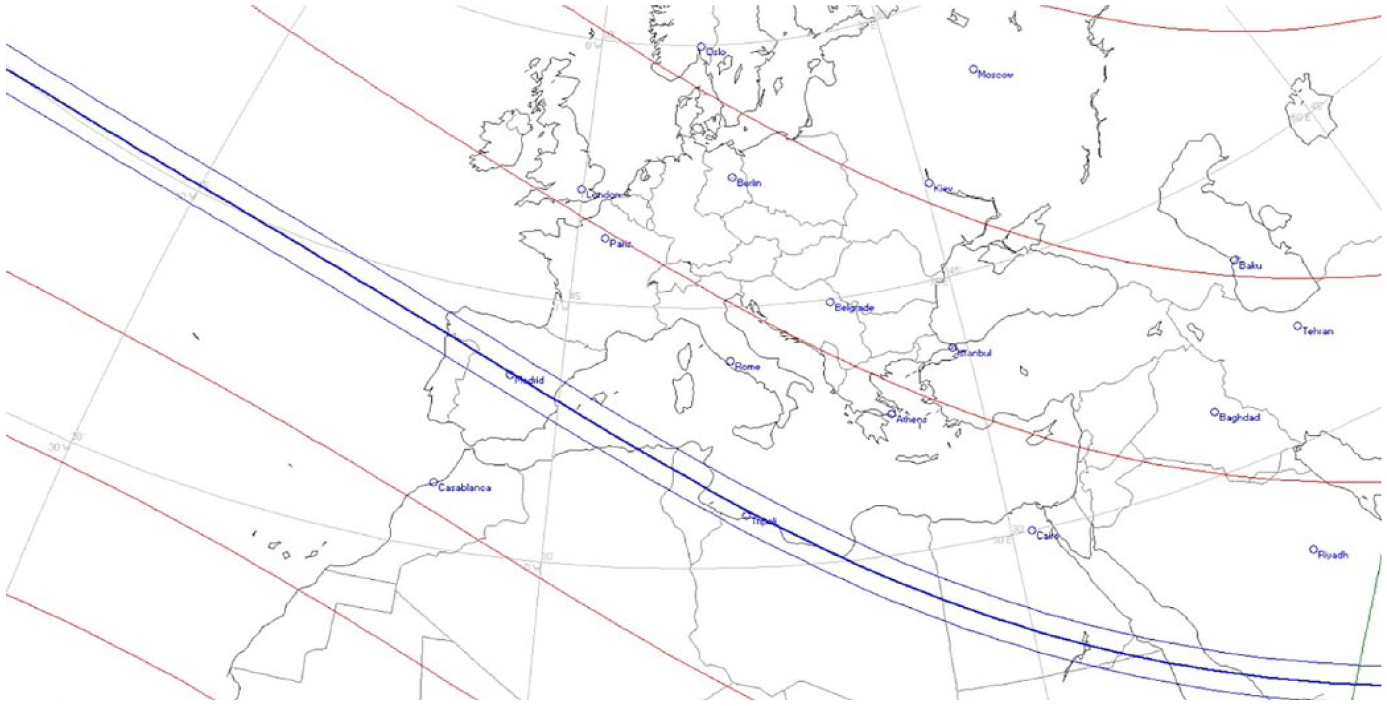
Path of the July 29, AD1478 solar eclipse, using SkyMap Pro v.11. 2 The narrow band (blue in the on-line edition) corresponds to the zone of totality.
The absence of records from West Europe is curious since the Iberian Peninsula was at that time in a period of effervescence, both in the kingdom of Portugal under the reign of Alfonso V, and in the kingdoms of Castile and Aragon, at the beginning of the reign of the so-called Catholic Monarchs who were about to complete the Reconquest. 3 Thus, there were plenty of chroniclers or scholars who could account for such an important phenomenon in such a significant period of history.
In this paper, we will ignore those chroniclers who, even referring to this eclipse, are not contemporary, as well as descriptions from later eclipse catalog listings. 4 Instead, the records we will see in this paper correspond mainly to casual observers who, according to Stephenson’s conclusions, 5 were only aware of the phenomenon if the magnitude was greater than 0.98. However, an observer did see it from a smaller magnitude.
In the first place, we will comment on the precedents in the literature of the epoch since, although the observations collected are scarce, the eclipse was indeed predicted by some of the scholars of the time. Later, we will show the records we have found, providing the original source and the translation and obtaining, in its case, the ΔT values that can be inferred from them.
Precedents: Predictions and astronomical literature
The historical context to this phenomenon is provided by the long reign of the so-called “Catholic Monarchs,” Queen Isabel I of Castile (1474–1504) and King Fernando II of Aragon (1479–1516), whose marriage and joint rule marked the “de facto” unification of Spain. The Monarchs soon understood that written chronicles could serve as an efficient means of propaganda, and to facilitate the extension of the project in society, Spanish (Castillian) soon gained ground over Latin in writing.
It will be in 15th-century Castile, under Juan II (1406–1454), when we find the appointment of a royal chronicler for the first time: Juan de Mena. The position of royal chronicler seems to have been for life, and Alfonso de Palencia replaced Juan de Mena after his death in 1456. Initially, there was only one chronicler per reign, although King Enrique IV of Castile (1425–1474) appointed two at least, and the Catholic Monarchs up to three. They would end up being trustworthy advisers and experts on matters of history, which would make them efficient diplomats and ambassadors. Of course, the chroniclers wanted to please those who paid them and tried to make their stories, chronicles, or memorials favorable to them. 6 Three of the records presented in this paper for the eclipse come from royal chroniclers.
Among the royal chroniclers of the Crown of Aragon and Castile in the 15th century and the beginning of the 16th century, some of the most recognized names are Alonso de Palencia and Juan de Flores. Joan Margarit, Diego de Valera (who was an advisor during the successive reigns of Juan II, Enrique IV, and the Catholic Monarchs), Hernando del Pulgar; Nebrija, Gonzalo de Ayora, Andrés Bernáldez (the first to complete the chronicle of the Catholic Monarchs); Gonzalo García de Santa María and Lucio Marineo Siculo. All of them, to a greater or lesser extent, wrote documents in which political and historical events were recorded, commented on or embellished, always in a favorable manner to the reigning monarchs. After the arrival of Columbus in America, it would be the chroniclers of the Indies who would report on the geography and the indigenous way of life, highlighting Bartolomé de las Casas, Francisco Ximénez, Bernal Díaz del Castillo, Fray Bernardino de Sahagún, among others.
However, this eclipse is not mentioned in the “official chronicle” Chronica de los muy altos y esclarecidos Reyes Catholicos Don Fernando y Doña Isabel, written in vernacular by Fernando del Pulgar, 7 who was appointed royal chronicler by Queen Isabel I of Castile, replacing Alonso de Palencia in 1482. The Chronica was translated into Latin by Antonio de Nebrija, to whom it was wrongly attributed when it was first printed in 1565 in Valladolid.
Regarding European professional astronomers, from whom we already know a significant number of names in this century, we have a few observations of the AD1478 eclipse, and they are surprisingly brief and provide little astronomical data. For instance, in the case of Walther’s brief comment
8
from Nuremberg, far from the zone of totality, he states:
July 29. At about the first hour after midday, namely when the Sun’s altitude was 54 ½ degrees, a solar eclipse began. Further, it ended when the altitude of the Sun reached 41 ½ degrees.
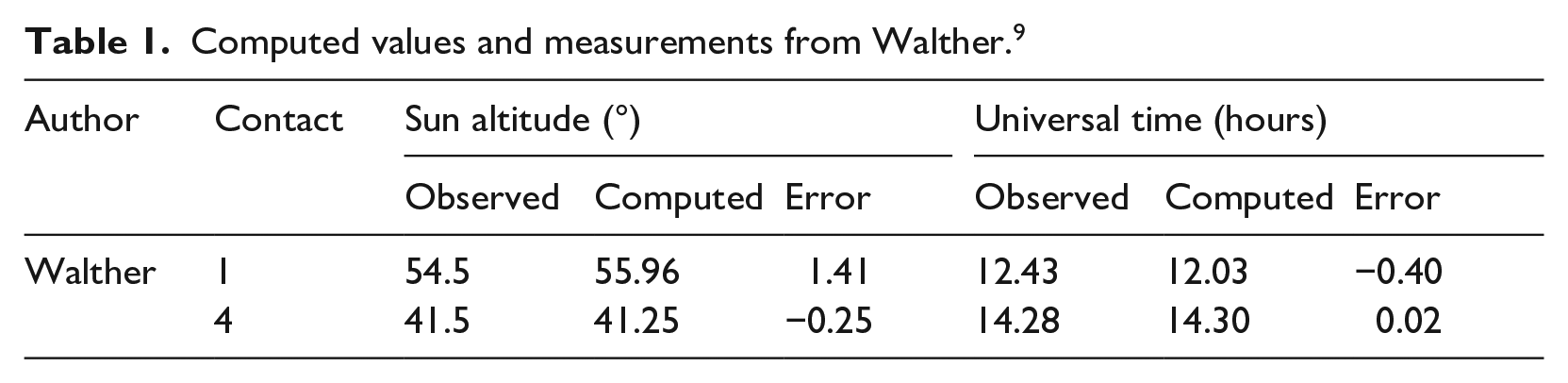
From this report, we can obtain some information, summarized in Table 1, along with the actual eclipse data for Nuremberg.
Computed values and measurements from Walther. 9
The zone of the eclipse’s totality included Salamanca, which had become a prominent center of culture in the 15th century. Two of the most brilliant astronomers of the time are related to this city, Juan de Salaya (mid-15th century-16th century) and Abraham Ben Zacut (1452–1515). Juan de Salaya held the Chair of Astrology at the University of Salamanca from 1464 to 1469, when he left it to assume that of Logic. He was the author of two commentaries on Aristotle’s Physics and De coelo, as well as friend and collaborator of Abraham Zacut, whose main work, the ha-Hibbur ha-gadol 10 (or Great Treatise), translated from Hebrew into Spanish in 1481 (or 1482). Interestingly, neither Diego Ortiz de Calzadilla (1469–1476), Fernando de Fontiveros, who briefly held the chair of Astrology in Salamanca between 1476 and 1480, nor Diego de Torres, 11 between 1481 and 1495, make mention of the eclipse in any of their known works.
Juan de Salaya stated:
Aconteció un horrible eclipse en el que se vieron todas las estrellas y del que se seguirán, entre otros grandes males, muertes de pontífices y de príncipes
12
A horrible eclipse occurred in which all the stars were seen and from which will follow, among other great evils, the deaths of pontiffs and princes.
On the other hand, Abraham Zacut does mention his observation of the eclipse in his Sefer Yubasin (book of genealogies), but but just as a short note, without comment. 13 In addition, he also informs us that the eclipse had been predicted by another astronomer, 14 the Luso-Jewish Judah ben Verga (c. 1455–1480), who worked in Lisbon and was the author of some Astronomical Tables adjusted to the meridian of that city. Finally, we also have evidence of the criticisms that Moses Farissol Botarel, an Avignon astronomer from the late 15th century, made to some anonymous astronomers who wrongly predicted the totality of the eclipse in Avignon. 15
As mentioned, Zacut’s report is brief and states:
En el año 5238, el miércoles 29 Av (29th July 1478) a mediodía en España, hubo un eclipse solar distinto a todo lo que se había visto, pues [el cielo se oscureció] como si fuese medianoche.
16
In the year 5238, on Wednesday 29 Av (29th July 1478) at noon in Spain, there was a solar eclipse unlike anything that had been seen, because [the sky darkened] as if it were midnight.
Until now, there was no record of other documentary evidence of the total eclipse. 17 The eclipse was not “scientifically” observed by astronomers at the time, which is quite surprising since, as previously mentioned, the eclipse was predicted and therefore expected. The prediction of solar and lunar eclipses was already common since ancient times. During the 13th and 14th centuries, many tables were compiled to help in the computation of the different astronomical phenomena. 18 Most of this material was compiled within the framework of the Parisian Alfonsine Tables, which was not challenged until the middle of the 16th century.
As the demand increased, lists of eclipses for a given locality which included the local most significant features for the events, appeared. See, for instance, the list of solar and lunar eclipses in the MS 5371 from the Vienna Nationalbibliothek or the list of lunar eclipses in MS 110 from the Biblioteca de la Catedral of Segovia. 19 This last manuscript contains one of the versions of Abraham Zacut’s predictions for the eclipse of 1478. Chabás provides another prediction from Poblet’s MS 150 and, in his comparison, shows that, although Bonjorm’s Tables, based on the longitude of the city of Perpignan, were used in the compilation of MS150, no correction was made to adapt it to Poblet or Barcelona, while Zacut did correct it to adapt it to Salamanca. 20 We will return to these manuscripts in the following paragraphs.
L. Thorndike
21
collects another prediction of this eclipse from manuscript 868 of the Riccardian Library in Florence (L.II.I in the old catalog of Lami
22
), which is an anonymous document dated in the year 1510. Despite this, Thorndike believes that the date given is that of the copy of the manuscript and not that of the publication of the ephemeris. It includes various astronomical and medical treatises, some of them by known authors such as Andalò di Negro or Regiomontanus. For the year 1478, it reads:
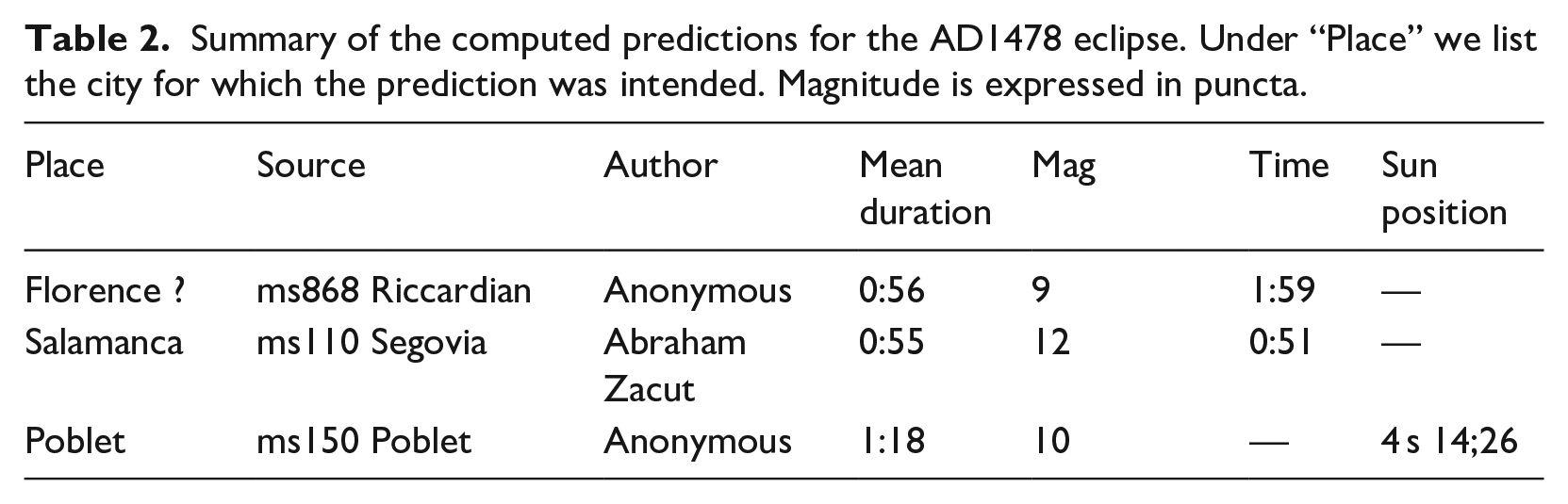
Eclipsis solis 29 1 59 Iulli dimidia duratio 0.56. Puncta novem.
Unfortunately, we do not know for sure the city for which this event was calculated. However, the Florentine doctor Mazzingo Mazzinghi (sec. XV–XVI) was, in part, the copyist and original owner of the manuscript. He worked for Marsilio Ficino and was a friend of Bernardo Machiavelli, 23 so Florence would be a reasonable assumption for the place of the prediction. As Thorndike points out, the eclipse time is given in hours and minutes, as it is the duration. The magnitude is expressed in puncta, a punctum being 1/12 of the diameter of the sun.
The Cathedral of Segovia preserves several manuscripts relevant to the history of astronomy in Spain. We are particularly interested in Segovia MS110, a Latin manuscript of about a hundred folios from the late 15th century that consists of astronomical tables and two brief texts. Although the name of Abraham Zacut does not appear in the manuscript, all these tables can now be identified as part of (or closely related to) his ha-Hibbur ha-gadol. We reproduce this version of Zacut’s prediction from Chabás and Goldstein. 24 Misprints in this manuscript were corrected by these authors using Hebrew manuscripts. We refer readers to that same work and to Goldstein’s paper 25 for a complete analysis and details.
Last, the MS150 of Poblet,
26
a manuscript written in Catalan and dated shortly before 1475. Possibly, it is an extract from another more extensive work, now lost. In the end, it offers a list of predictions of solar and lunar eclipses in the form of a succession of sentences, among which the one in question is found. In the transcription published by Torné
27
it reads:
Any MCCCCLXXVIII
Sol a XXVIIII de juliol, a Iª hora, XVIII menuts, a X dits e a IIII signes, XIIII graus e XXVI menuts
Year 1478, sun on July 29, hour 1, 18 minutes. Magnitude 10, sign 4, 14 degrees and 26 min
As can be seen, the year, day, and time of the eclipse are indicated, as well as the solar latitude. If the magnitude has been given in puncta, it would correspond to 83% of the hidden surface of the sun. It should be noted again that the Poblet manuscript contains data that was calculated for the Perpignan longitude, and the author made no correction to adapt them to the Poblet longitude. 28 The position of the sun in ecliptic latitude appears, expressed in signs, IIII signes meaning 120°, 29 providing λ = 134°, the calculated apparent longitude for the instant of the eclipse is λ = 134.4°.
In Table 2 are listed the summaries of the information provided by each of the mentioned manuscripts. Similarly, Table 3 shows the calculated circumstances of the eclipse for the cities and their geographical coordinates.
Summary of the computed predictions for the AD1478 eclipse. Under “Place” we list the city for which the prediction was intended. Magnitude is expressed in puncta.

A last issue is some recent controversy
32
about the date of the eclipse that Diego de Valera (1412–1488) collects in his Crónica de los Reyes Católicos,
33
which seems to be related to the culmination of the conquest of the Canary Islands (See Table 5 for the coordinates of Gran Canaria), whose traditional date is April 29, AD1483, although the official incorporation to the crown occurred on January 20, AD1487. Some authors have recently suggested that this eclipse could be the one from 1478. The documents place the author in Puerto de Santa María (Cádiz, in the South of the Iberian Peninsula) at the beginning of August of the year 1478, so in no case could he have witnessed the phenomenon that he narrates in chapter XXXVII, corresponding to an event during the conquest of Gran Canaria in the islands:
(. . .)Y otro día siguiente el faycán
34
y los otros canarios salieron de la fortaleza, y los trajo consigo, y se tornaron cristianos, en el cuál día hizo el sol grande eclipse, y después llovió e hizo muy gran viento; y pasaron en aquella isla muchas aves que antes nunca habían visto, las cuáles fueron grullas y cigüeñas y golondrinas, y otras muchas aves que no saben los nombres.
35
(. . .) And the next day the faycán and the other Canarians came out of the fort, and brought them, and became Christians, on which day the Sun made a great eclipse, and afterwards it rained and a great wind blew; and over that island flew many birds that they had never seen before, which were cranes and storks and swallows, and many other birds they do not know their names.
It is doubtful that the mentioned eclipse is that of the year 1478. From an astronomical point of view, the magnitude of the eclipse in the Canary Islands was only 0.55, insufficient to be considered “a great eclipse.” On the other hand, the events narrated take place after the arrival of Pedro de Vera on August 18, AD1480, in Gran Canaria appointed as governor, as the same chronicler indicates at the beginning of chapter XXXVII.
The eclipse occurred after the battle of Ajódar, 36 and shortly before the shipment on April 14, AD1483, of aborigines to the court in Seville. 37 No solar eclipse fits this temporal context, although three partial eclipses were visible in Gran Canaria in 1478–1490.
In our opinion, this fragment corresponds to the author’s desire to give relevance to the events narrated by relating them to a spectacular astronomical phenomenon, and they describe the mixture of two eclipses: the description corresponds to the eclipse of May 28, AD1481, with a magnitude of 0.8. On the other hand, the meteorological conditions seem to describe a sirocco, calima or southern weather episode, 38 which in the Canary Islands can occur throughout the year but has its maximum in winter, including March, so the eclipse that really observed the chronicler could be that of March 16, AD1485.
Eclipse July 29, 1478: Documents and reports
In this section, we will discuss some observations of the eclipse of July 29, AD1478. All of them were made by non-professional observers and appear in chronicles, private diaries, or marginal notes in non-astronomical documents. Some were carried out in the zone of totality, but admiration for the phenomenon is detected in all of them, and, even exceptionally, they provide us with astronomically relevant data. In Table 4 we see, ordered from most to least interesting, the documents in which we have found mentions of the phenomena.
Documents, including the authors and the place where they were at the time of the eclipse (if this data can be determined). T and P indicate if the eclipse was total or partial. We have added a column that includes the ΔT provided by the observation for those cases in which we can obtain a relevant value.

The geographical coordinates for the different sites and cities mentioned are given in Table 5. Negative longitudes imply that the position is West of the Greenwich meridian and positive longitudes indicate East. See Figure 2 for the different positions of the observation sites in relation to the totality band of the eclipse.
Coordinates and altitude of the places named in the paper. 39

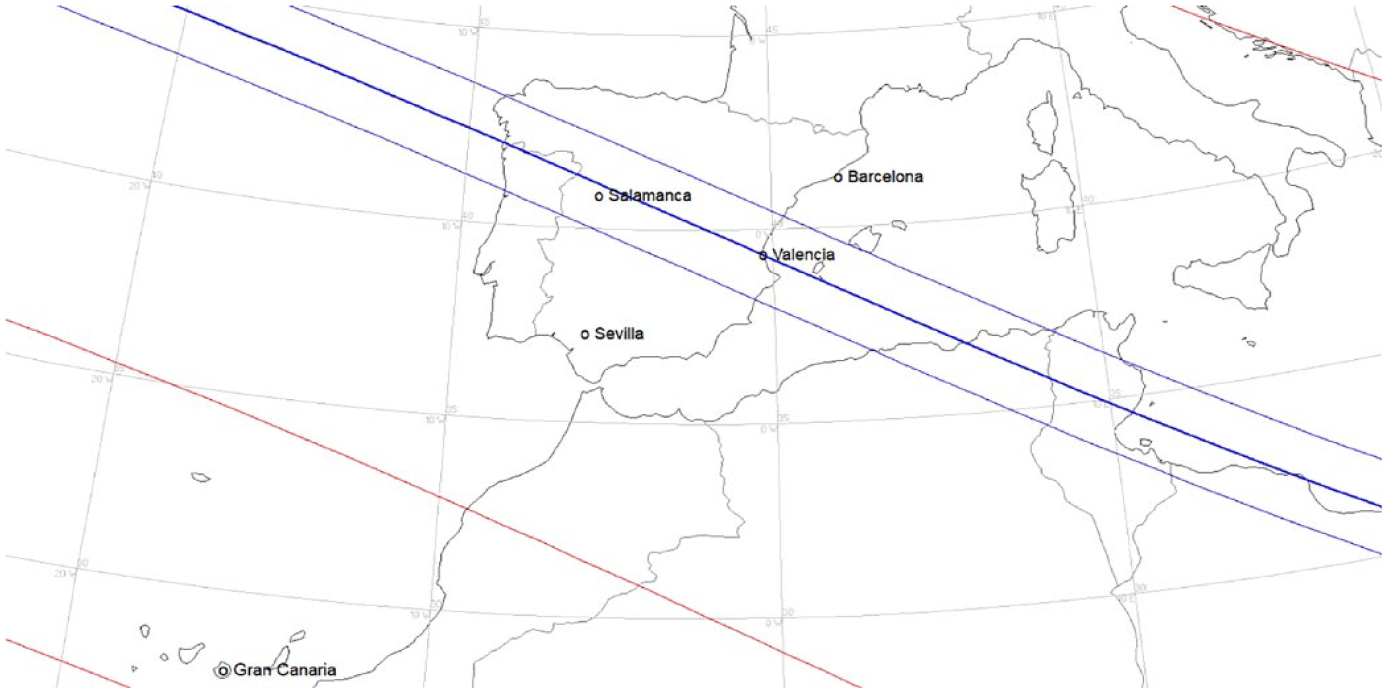
Observation sites in relation to the totality band of the eclipse, using SkyMap Pro v.11. 40 The narrow band (blue lines in the on-line edition) corresponds to the zone of totality, the widely-spaced (red) lines represent the limits of 0.75 and 0.5 magnitude.
The first observation of the eclipse appears in the XXXIV chapter of the Historia de los Reyes Católicos, written by Andrés Bernáldez (c. 1450–1513), priest of Los Palacios. Although first published in 1856, the editor Rodrigo Caro pointed out that “it has always been handwritten,” indicating that it was in circulation in manuscript form for a long time before. This chronicle covers a period between 1454 and 1513, being the author an eyewitness of many of the events. It is known that Andrés Bernáldez served as priest of the Villa de los Palacios, near Seville, from 1488 until his death. In the chronicle, he does not mention the geographical position where he witnessed the eclipse, but we know that he studied theology in Salamanca, graduated from high school, and was later ordained a priest (“received holy orders”). As the university was accessed after having studied grammar, which used to end around the age of 14 or 15, this would place him with some certainty in Salamanca in the year 1478.
41
El dicho año de mil é cuatrocientos y setenta y ocho, á veinte y nueve dias del mes de julio dia de Santa Marta á medio dia, fizo el sol un eclipse el mas espantoso que nunca los que fasta allí eran nacidos vieron, que se cubrió el sol de todo é se paró negro é parecían las estrellas en el cielo como de noche; el cual duró así cubierto muy gran rato, fasta que poco á poco se fué descubriendo, é fué gran temor en las gentes, y fuian á las iglesias, y nunca de aquel ora tornó el sol en su color, ni el dia esclareció como los dias de antes solia estar, é así se puso muy calijinoso.
42
That year of one thousand four hundred and seventy-eight, twenty-nine days of the month of July, Saint Martha’s day at noon, the Sun went into an eclipse, the most frightening that ever those who were born until then saw, as the Sun was completely covered and it stood black and the stars appeared as it were at night; which lasted jammed that way for a very long while, until been uncovered little by little, and people were in great fear, and they fled into the churches, and never again did the Sun return to its color, nor the day made clear as the days before it used to be, and so it became very hazy.
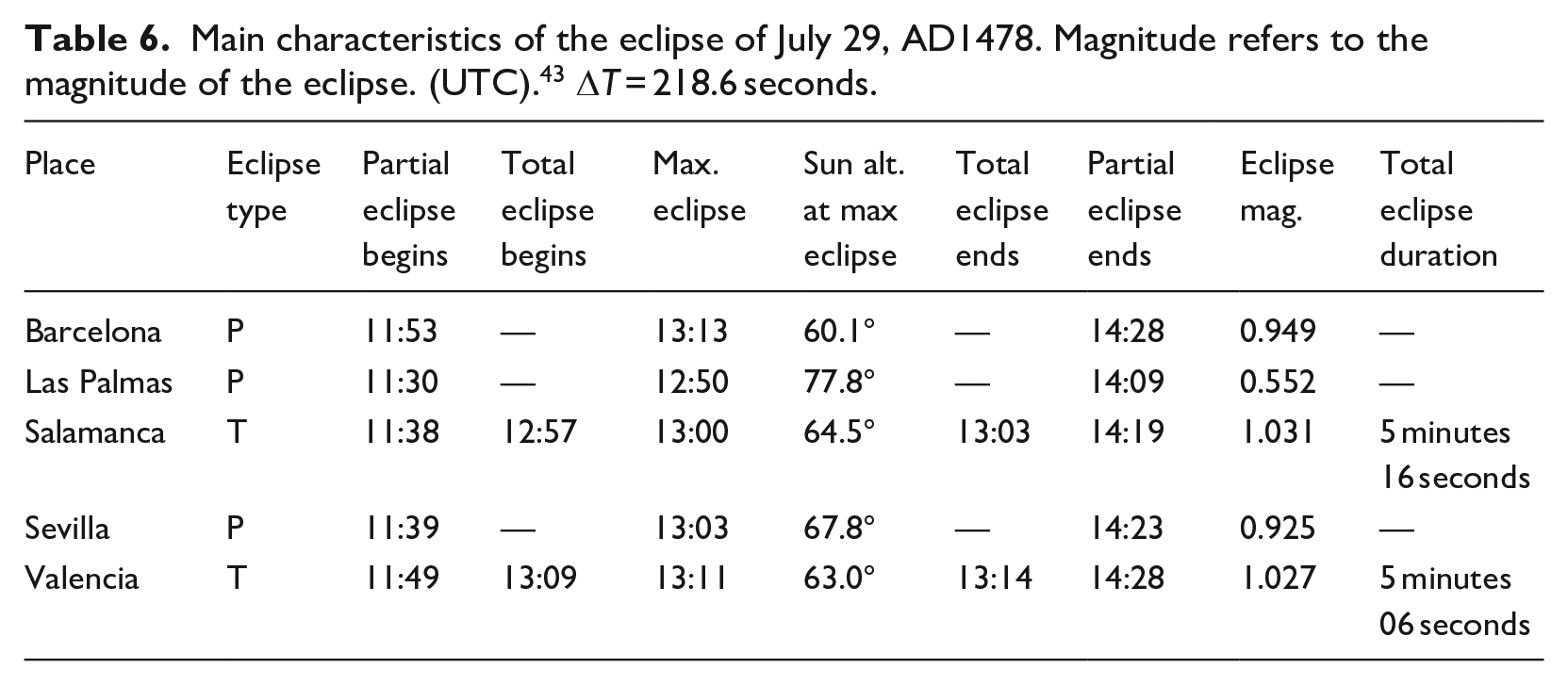
It should be noted that in this record, the author explicitly states that the sun disappeared completely. Hence there is no doubt about its totality, he also adds the usual note that stars appeared, which accompanies many of the descriptions of great eclipses. All this allowed us to calculate the interval for the ΔT value we list in Table 4. Table 6 shows the calculated data of the eclipse at Salamanca.
Main characteristics of the eclipse of July 29, AD1478. Magnitude refers to the magnitude of the eclipse. (UTC). 43 ΔT = 218.6 seconds.
Curiously, Hernando del Pulgar, the considered official chronicler of the time, does not mention it, although the eclipse took place an exact month after the especially expected event of the birth of the infant Juan, the only male child, and heir to kings, and he does mention a subsequent eclipse on March 16, AD1485.
Likewise, this eclipse is also collected by Lorenzo Galíndez de Carvajal (1472–1527), author of the Memorial o Registro Breve de los Reyes Católicos, 44 in what seems to be a copy of the testimony of Andrés Bernáldez, as it appears in a handwritten note in a version of the work that includes critical notes by Rafael Floranes 45 (See Figure 3). However, this version does not provide new data.

Handwritten reference to the eclipse in the Memorial de los Reyes Católicos, which is a Copy of the one mentioned by Andrés Bernáldez. The author, born in Plasencia on the very edge of the zone of totality, could have been an eyewitness, albeit as a young child.
Another report of the eclipse is found in the Anales Valencianos. 46 It is an anonymous manuscript whose original was in the Library of Gregorio Mayans y Siscar, 47 and it was transcribed for the first time in 1750 from this same original. Apparently, the author of these Anales was already unknown at the time of the copy, but through reading, it has been established that he must have written them between 1455 and 1481 in Valencia since he knows the city, according to his topographical descriptions, and focuses all his attention on what happened there. The content is assorted, but we are interested in the last part, which focus on events in Valencia from 1348 to 1481.
The text referring to the eclipse is found immediately after the news of the birth of Prince Juan in Seville. In the rest of the document, no reference is made to any other type of astronomical phenomenon: Dimecres a XXVIIII°. de joliol dit any entre XII hores e una de mig jorn, fon tan gran eclipci en lo sol com james fos vist; de que tot lo sol se escurri, es mostraren les esteles e dura mes de una hora
Wednesday the XXVIII°. of July of that year between twelve o’clock and one in the afternoon, there was as great an eclipse in the sun as had ever been seen; all the sun was darkened, the stars appeared and it lasted more than an hour.
Analogously to the previous case, there is an explicit reference to the totality and the appearance of stars. Again, we can obtain a possible interval for the ΔT (see Table 4).
The eclipse totality is still collected in another manuscript pointed out by Chabás 48 from the Escorial Monastery with the signature ms-ç-IV-11. The manuscript is dated in the 12th century 49 ; it consists of 113 parchment pages with varied Latin content, including texts by Palladio and opuscula iuridica. The curious thing about this case is that on the last page and without any relation to the previous content, we find the astronomical reference by a different hand and contemporary to the eclipse (see Figure 4). It is possible that this record was written by a reader who was consulting the document at the time of the eclipse and decided to report it. Although the annotation is signed by an unknown A. (Antonius?) Cortés, clericus, 50 the specific place where the phenomenon was observed does not appear, and the name of the writer is common enough so that the observer cannot be identified nor located with certainty.
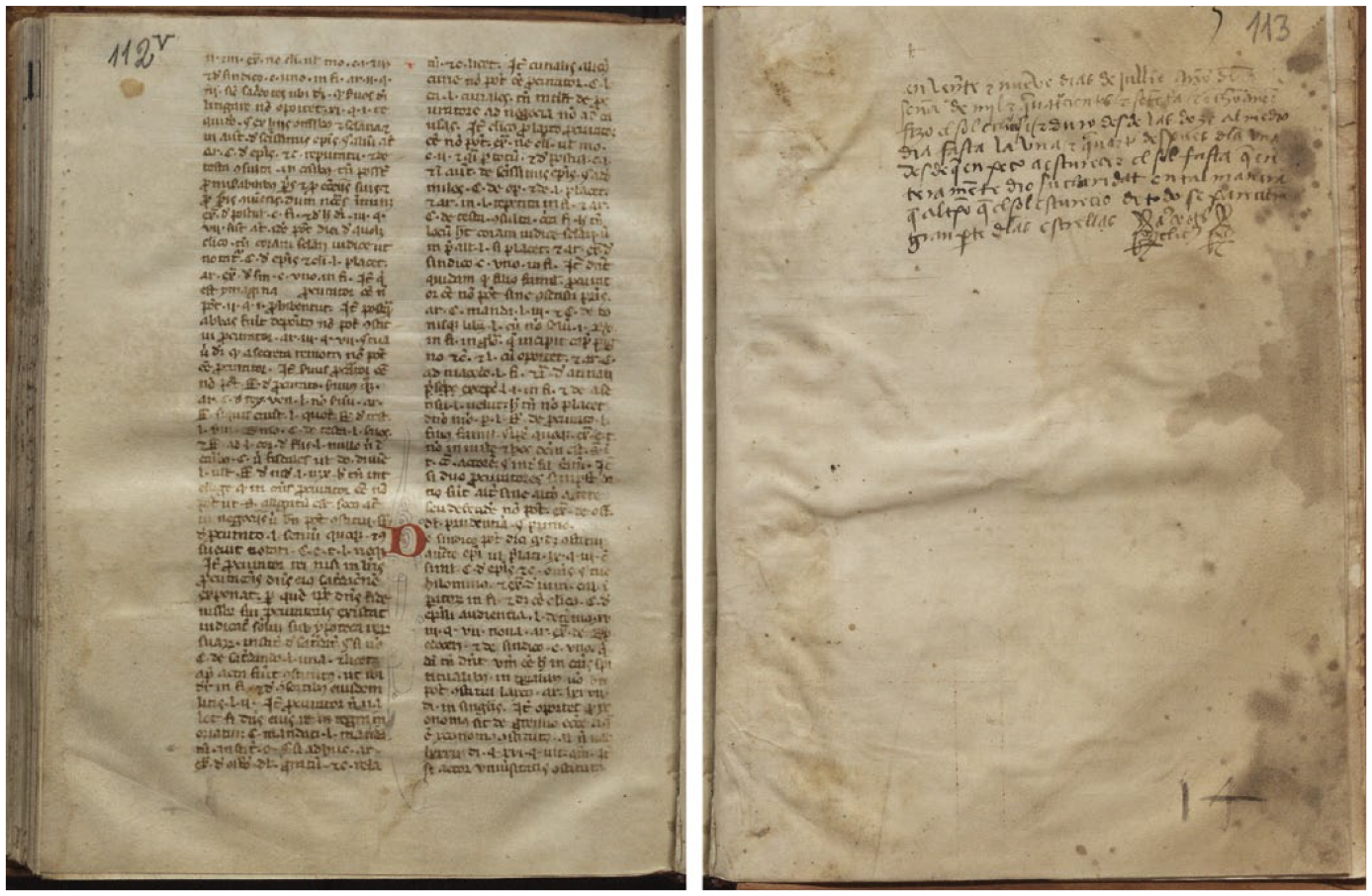
Pages 112v (left) and 113r (right) of the manuscript ms-ç-IV-11. Notice the difference between the Gothic letter that appears in the opuscula iuridica written in Latin on the left (13th century) and the contemporary note referring to the eclipse, in Castilian, on the right. Reproduction authorized by Patrimonio Nacional.
The tracking of the document does not provide us with more information about the author or the place of the annotation. It seems that before the Escorial Library, the manuscript belonged to Antonio Agustín Albanell
51
(Zaragoza, 1517–Tarragona, 1586), known as Augustinus, a Spanish ecclesiastic who stood out as a humanist, polygraph, and precursor of the historical study of Law. He received his doctorate in civil law in Salamanca in 1534, so it could be that it was at this time that he got the manuscript, which provides a possible location for the observation. The text, in Castilian, says:
En veinte e nueve días de jullio año del señor de mil e quatrocientos e setenta e ocho años fizo el sol eclipsi e duró desde las doze de medio dia fasta la una e quart después dela una empeçó a escurecer el sol fasta que enteramente dio su claridad en tal manera que al tiempo que el sol escureció de todo se parecieran gran parte delas estrellas.
On the twenty-ninth day of July, in the year of the Lord one thousand four hundred and seventy-eight years, the sun was eclipsee and it lasted from twelve noon until one quarter after one o’clock the sun began to darken until it completely gave its light in such a way that at the time that the sun totally darkened a large part of the stars appeared.
Once again, it is important to highlight that the author explicitly says that the sun was darkened entirely, the reference to the appearance of stars at the moment of their maximum occultation being already classic. The fact that we do not know with certainty the situation in which the observation was made does not allow us to determine an interval for the ΔT, although, if it were Salamanca, it would coincide with the one obtained for the first record.
The remaining reports correspond to witnesses of the phenomenon that were not within the band of totality. The following text does not identify the eclipse as total but asserts that three-quarters of the sun was covered. It corresponds to Martí de Viciana (?–1492), called “el Vell” (the “old man,” in Valencian, his vernacular language) to differentiate from his grandson, the well-known historian Rafael Martí de Viciana (1502–1582). He was a politician and humanist, and also the author of at least two translations and commentaries on Aristotle and Seneca, and numerous opuscles. It is in one of these opuscles where we find the reference. In particular, in the transcription of folio 116r of the manuscript ms. d-III-2 from the Escorial Library. This document was already mentioned by Chabás,
52
but without actually identifying its author. It is very short and is written in the Valencian of the 15th century. In our case, we use the transcription corresponding to the study by Iborra.
53
It is entitled “Senyals del cel” (signs from heaven), and the author himself states in the introduction that he wrote it with the intention of recording the many astronomical events that he witnessed in person throughout his life: L’any mil CCCCXXXXVIII tro a l’any MCCCCLXXVIII se són seguits e vists per mi los senals següents (Between the year 1448 and 1478 the following signs were followed and seen by me)
A xxviiii de joliol, en l’any MCCCCLXXVIII, fonch un eclipsi de sol tant gran que quatre parts del sol s’escoriren les tres; e més, fonch lo món escur, que no és la prima nit, tant que no avia qui conegués un diner de quina moneda era; en lo qual any foren morts per tot lo món generals.
On xxviii of July, in the year MCCCCLXXVIII, there was an eclipse of the sun so great that four of the three parts of the sun eclipsed; and what’s more, the darkness was like that of the first hour of the night, so that no one could distinguish the type of coin; in this year generals were killed all over the world.
In this case, there is a curious circumstance: Martí de Viciana was appointed Commander of the Order of Calatrava of Borriana in 1476 and governor of La Plana from 1477 and 1492, 54 the year of his death. In this period, he lived in the towns of Borriana or Castelló de la Plana (separated only 12 km, with coordinates Longitude: −0.08472°, Latitude: 39.889°), which should place him exactly inside the band of totality. However, from his description, it is clear that the sun was only ¾ darkened, indicating that he was not in his usual residence. Although it is known that in 1485 he was “conseller e coper” of King Fernando, in 1478 Martí de Viciana was still a servant of the King of Aragon Juan II, father of Fernando, who had been in Barcelona since September 20, 1477, 55 this being a possible location of Martí de Viciana, even when the estimated sun occultation in this city is 0.95, higher than the 0.75 indicated.
The next account comes from Barcelona, from a private diary authored by a well-known character in Barcelona at the end of the 15th century. This is Jaume Safont (c. 1420–1487), the escrivà major of the Generalitat, 56 who was in charge of compiling the Dietaris 57 of the Generalitat de Catalunya 58 (Dietaris henceforth) between 1454 and 1472, although his influence continued until his death.
Initially, the Dietaris had an administrative character because it was used to register the designation of the institution’s officials, together with their travels or absences, to pay them their corresponding salaries, traveling expenses, or reductions in their salaries, but they were also diaries where social, political, economic, or religious events were annotated, including every remarkable phenomenon. As previously stated, for the first volume of the Dietari, Safont is a crucial figure, as he either was the writer or was at least closely involved in the redaction of the entries. It is, therefore, very fortunate that we have another manuscript by the same author, namely the Dietari o llibre de Jornades 1411/1484
59
de Jaume Safont (Llibre henceforth). This Llibre is a private document and complements the Dietaris in some senses. The writer seems freer to express himself in his private recordings, so some additional astronomical reports were added. Generally, these reports are linked to political events and provide clues about Safont’s political sympathies. Regarding the eclipse, the Llibre states:
Dimecres, a XXVIIII de juliol MCCCCLXXVIII, fonch fet eclipse de sol, qui durà entorn a una hora e mige, ço és, que començà entre XII e una e durà fins a II hores aprés migjorn; tornà lo sol molt groch e enforquí la terra, no pas tant com la gent deyen ans que fons fet; dien los stròlechs que aquest eclipsi de sol, segons lo signe en lo qual s’es eclipsat, demostré gran morts de reys e de prínceps e destrucció de magnats. Déus ne gart mon señor lo rey en Johan, muy benebenturadement regnant, qui.ns faria gran fretura si moria.
60
Wednesday, 29 July 1478, there was a solar eclipse, which lasted about one hour and a half, this is, it began between 12 and 1 and lasted until 2 after midday; the Sun became very yellow and the land got dark not so much that the people said that it had not happened in years; the astrologers say that this eclipse of the Sun, according to the sign where it has been eclipsed, shows many deaths of kings and princes and magnates’ destruction. God keeps my lord king Juan, who is reigning; he would cause us a great loss if he died.
At this time, Catalonia was part of the kingdom of Aragon, although keeping its own institutions. Socially, the end of the Middle Age and the beginning of the Modern Age was very turbulent, characterized by endless fights against the royal power, including the Catalonia civil war (1462–1472), and the Second rebellion of the remences (1485–1486) so that King Juan II did not enjoy the sympathies of all his subjects.
Safont seems to follow the mentality of his epoch when he sees a sign of death in the eclipse. However, as he was not a supporter of King Juan II, whom he considers guilty of a civil war whose consequences were catastrophic for the population, his wishes for good health for the king are cynical, to say the least. The prophecy was accomplished with the death of the king the following January.
The eclipse was nearly total in Barcelona, and the time of the beginning of the partiality is accurately recorded (see Table 6).
The last record corresponds to the one collected by Alfonso Fernández de Palencia (1424–1492); he was a royal chronicler, historian, lexicographer, and humanist of the Pre-Renaissance Castile. The main work of Alfonso de Palencia is the monumental Gesta Hispaniensia ex annalibus suorum diebus colligentis, 61 usually called Decadas, because it is divided into decades following the style of Tito Livio. This chronicle covers the events from the end of the reign of Juan II of Castille until 1481, including the reign of Enrique IV, his confrontation with the supporters of his half-brother Alfonso, the conflict over the succession of Enrique IV, the ensuing civil war and the consolidation of the Catholic Monarchs on the throne after the signing of peace.
The fourth decade, whose existence went unnoticed for a long time by most historians, was not published until 1970 by José López de Toro 62 in the original Latin and translated into Spanish by the same author.
(. . .) el día 29 de julio del mismo año de la Natividad del Redentor de 1478, el sol eclipsado durante una hora dejó casi a oscuras la tierra, hasta después del mediodía. A este eclipse precedieron augurios de los astrólogos con amenazas para muchos príncipes especialmente para la nación de Portugal y sus cómplices.
(. . .) On July 29 of the same year 1478 after the Nativity of the Redeemer, the eclipsed sun for an hour left the earth almost in darkness, until after noon. This eclipse was preceded by predictions from astrologers with threats to many princes, especially to the nation of Portugal and its accomplices.
The reference to Portugal is explained in the context of the war of the Castilian succession: after the battle of Toro (March 1, AD1476), the succession in Castile was practically resolved in favor of Isabel against Juana, who was supported by her husband, the King of Portugal. However, the end of the conflict was only concluded with the Treaty of Alcaçobas (September 4, AD1479), with remaining hostilities with France and Portugal until that date.
The chronicles place Fernández de Palencia in Seville in the year 1478, 63 where a huge but no total eclipse happened (See Table 6). He was preparing the conquest of the Canary Islands together with his assistant, Diego de Merlo.
Conclusions
We have presented several unknown records of the total eclipse of the sun on July 29, AD1478, all of them carried out by contemporaneous eyewitnesses from the Iberian Peninsula. These records are of great importance for astronomical literature since no notes on the totality of said eclipse had been found, despite having been predicted by scholars of the time. In addition, the descriptions, although not professional, provide interesting information that, in some cases, have led us to obtain valid values for the ΔT parameter. Considering the values obtained for the different places of observation, we have obtained an interval of ΔT for the epoch between −450 and +1125 seconds.
Footnotes
Acknowledgements
The authors wish to thank Dr. J. Chabás from the Universitat Pompeu Fabra and Dra. Mª Luz Mandingorra from the Universitat de València for their support and help in obtaining and transcribing some of the documents. We wish also express our gratitude to Patrimonio Nacional (Real Biblioteca del Monasterio de San Lorenzo de El Escorial) for allowing us to reproduce the ms-ç-IV-11 manuscript, specially to Jaime Sepulcre for his kindness and speed in facilitating the procedures.
Funding
The author(s) disclosed receipt of the following financial support for the research, authorship, and/or publication of this article: Part of this work was supported by grant P1.1B2012-47 from Universitat Jaume I.
