



Abstract
This study delineates three alternatives to organizational value change and formation: leader-prescribed top-down planned value change initiatives, spontaneous decentralized value formation among employees, and interactive dialogical value formation through joint dialogue between leaders and employees. Data collected from two companies, ETS and HPS (both pseudonyms), show that organizational values were either consciously changed or spontaneously formed through three alternatives between 1980 and the early 2000s. Under the top-down value change alternative, official values were changed and accompanied by status quo and indifferent patterns of value commitments among employees. Under the spontaneous decentralized alternative, multiple value orientations formed and surfaced a competitive pattern of value commitments among employees. Under this alternative, the official values remained unchanged. Under the interactive dialogical alternative, official values were radically changed or incrementally updated. Employees revealed an appreciation for different value orientations and a pattern of reformative value commitments.
Introduction
Organizational values espoused in corporate value statements provide an important reference point for managers and employees (Collins & Porras, 1997; Schein, 1985, 2008). Official values are an organization’s formally espoused beliefs about desirable actions and outcomes (Kabanoff, Waldersee, & Cohen, 1995; Rokeach, 1973; Schwartz, 1992). Generally, values are “conceptions of the desirable” (Kluckhohn, 1951, p. 399; Parsons, 1968, p. 136) that have the potential to provide direction and standards for behavior and relationships. Within an organization, the commitment, or the lack thereof, among employees to values is a component of organizational culture argued to be instrumental in guiding employee actions (Deal & Kennedy, 1982; Schein, 1985, 2008) and building trust (Ouchi, 1981; Powell, 1990).
An organization’s values and its employees’ value commitments are important to understanding approaches and responses to change (Amis, Slack, & Hinings, 2002; Bushe & Marshak, 2009; Greenwood & Hinings, 1996; Van de Ven & Poole, 1995; Woodman, 1989). As organizations initiate radical or incremental changes, values provide a rationale for managers designing change initiatives and for employees committing to or rejecting the underlying value of the change initiatives (Kabanoff et al., 1995; Kotter & Heskett, 1992). Researchers have noted the importance of the coherence between structural change and underlying value commitments (Amis et al., 2002; Greenwood & Hinings, 1993, 1996; Kabanoff et al., 1995), but less research has focused on exploring approaches to aligning values with changes in the organization.
Although some scholars assert that values are shared and exist at a hidden level that is difficult to change (Kotter & Heskett, 1992; Schein, 1985, 2008), others view values as dynamic and assert that they embody an interpretive scheme that can be changed (Greenwood & Hinings, 1993, 1996). Following from the latter perspective, it is possible that in addition to influencing organizational change, values also can be changed or reformulated.
The purpose of this study is to contribute to the research on organizational values and change by exploring the implications of using three alternatives to value change and formation: leader-prescribed top-down planned value change initiatives, spontaneous decentralized value formation among employees, and interactive dialogical value formation through joint dialogue between leaders and employees. We are particularly interested in understanding the impact of these three alternatives on the patterns of value commitments among employees. The context of this exploration is the experiences between 1980 and the early 2000s of two prominent U.S. companies: Energy Transmission Systems (ETS) and Healthcare Products and Services (HPS). Both are pseudonyms used to mask the companies’ true identities. Both of these companies are more than 100 years old and have clear espoused values that characterize the organization.
In the following sections, we first review research on value change and formation. We then describe the research context and methodology and present our analysis of the data. Finally, we discuss our findings in relation to the existing research on value change and formation and provide implications for practice.
Values and Dynamic Patterns of Value Commitments
Values orient employees’ collective action when shared and aligned with taken-for-granted assumptions about priorities and norms of behavior (Deal & Kennedy, 1982; Kotter & Heskett, 1992; Schein, 1985, 2008). They serve as interpretive schemes that underpin structures and processes with a quality of coherence (Bartunek, 1984; Greenwood & Hinings, 1993, 1996). They also provide a basis of trust for coordinating employee interactions for achieving organizational goals (Heckscher & Adler, 2006; Ouchi, 1981; Powell, 1990). Altogether, values guide employees’ collective actions and relations and underpin structural arrangements in an organization’s culture.
Organizations’ founders have prominently been credited with creating organizations’ official values (Kotter & Heskett, 1992; Pascale & Athos, 1981; Schein, 1985, 2008). Famously, Thomas Watson’s “Basic Beliefs” at IBM, Robert Wood Johnson’s “Our Credo” at Johnson & Johnson, and Bill Hewlett and Dave Packard’s “The HP Way” at Hewlett-Packard typify such founders’ values. According to Greenwood and Hinings (1996), these founders’ ideas achieve the status of values and underpin organizations’ interpretive schemes. Organizational values have also been viewed as latent cultural property emerging from customs followed by employees over time (Deal & Kennedy, 1982; Heckscher, 1995; Schein, 1985, 2008).
The commitment to organizational values among employees has been described by Greenwood and Hinings (1996) in terms of four generic patterns of value commitments:
Status quo commitment pattern is characterized by acceptance and support of current or institutionalized values.
Indifferent commitment pattern is characterized by acquiescence to, more so than commitment or opposition to, the current values.
Competitive commitment pattern is characterized by disparate views of current values in which some employees are committed to the current values, whereas others prefer particular value alternatives.
Reformative commitment pattern is characterized by broad agreement on opposition to the current values and preference for particular value alternatives.
These patterns of value commitments are generally stable (Schein, 1985, 2008). However, patterns of value commitments may over time become susceptible to change because of radical or incremental variations in organizational values stemming from external and internal forces (Bartunek, 1984; DiMaggio & Powell, 1983; Greenwood & Hinings, 1996). Externally, for example, changes in the social contract (Osterman, Kochan, Locke, & Piore, 2002), an emphasis on business ethics (Donaldson & Dunfee, 1994), or increased competitiveness in the marketplace (Prahalad & Hamel, 1990) may force radically new values into the interpretive scheme. Internally, forces for change have been known to stem from employees selectively and jointly attributing different meanings to their everyday experiences and to their organizations’ espoused official values (Ferdig & Ludema, 2005; Heckscher, 1995; Kanter, 1977, 1993; Stacey, 1992, 1995). The meaning that they impute to the official values may result in resistance or an openness to change. Therefore, in terms that we will use throughout the rest of the article, official organizational values may undergo planned value change (i.e., externally imposed radical change through management action) or unplanned value formation (i.e., internally stimulated incremental change by employees).
Approaches to Value Change and Formation
A common approach to altering an organization’s values is planned change emanating from top executives or managers. Recognizing the need for planned value change contingent on external pressures has been considered the responsibility of senior executives (Barnard, 1938; Schein, 1985, 2008). Since the late 1980s, leaders’ attention to values have involved a focus on improving cost efficiency through organizational restructuring (Kanter, 1993) and increasing quality and flexibility through reengineered loosely coupled work systems (Davenport, 1995; Hammer & Champy, 1993, 2003). For example, the radical change of valuing quality during this time period required top management team direction (Atkinson, 1990). The type of direction depends on internal and external factors (Dunphy & Stace, 1988; Stace & Dunphy, 1991). A soft paternalistic approach to incremental change works in a monopoly condition, whereas a hard directive approach to transformational change works where there is low external fit. Change initiatives during the early 1990s were mostly oriented toward a top-down approach aimed at radical transformation. According to Kotter and Heskett (1992), change should be leader driven since change initiated from the bottom-up suffers from a Bounce Back effect to an earlier state in the long term. They recommend that leaders balance core and adaptive values while trying to adapt and realign an organization’s capabilities to the external environment.
However, top-down interventions can result in unforeseen consequences (Harris & Ogbonna, 2002; Woodman & Dewett, 2004). For example, attempts to build more certainty have been known to result in more uncertainty (Hinings, Casebeer, Reay, Golden-Biddle, Pablo, & Greenwood, 2003). Restructured and reengineered workplaces have been known to still retain the hierarchical values of the earlier system (Applebaum & Batt, 1994) and middle managers have been found to focus inwardly on their own jobs after restructuring (Heckscher, 1995), resulting in increased rigidity instead of increased flexibility. Program-driven change suffers from a Fallacy of Programmatic Change (Beer, Eisenstat, & Spector, 1990). Contrary to expectations, programs designed and mandated from the top fail as they are often accompanied by an unexpected lack of commitment among employees at the bottom to enact the underlying values of the change initiative.
Although planned value change may be easily and quickly prescribed, it is often limited by accompanying unplanned spontaneous value formation involving employees collectively self-selecting their own values. Collective behavior is complex and has a capacity to self-organize itself (Ferdig & Ludema, 2005; Stacey, 1992, 1995). Merton (1983) famously noted that rational bureaucracies based on impersonal relations were often accompanied by nonrational values and informal relations. At Xerox, for example, this unplanned accompaniment to planned change took the useful form of technicians identifying informal work routines, different from officially prescribed protocols, to solve nonroutine problems (Brown & Dugid, 1991). Since the 1990s, change attempts aimed at empowering employees through loosely coupled work systems have been based on a similar premise: employees will self-select values by committing to relevant values in a restructured workplace (Davenport, 1995; Hammer & Champy, 1993, 2003). An assumption underlying this approach is that this value formation process will result in consensus that over time results in changes to organization’s values (Beer et al., 1990).
A third approach to altering an organization’s values couples leaders and employees in value change and formation through dialogue between them in the organization (Heracleous & Marshak, 2004; Marshak & Grant, 2008). At one level, dialogue among members has been found to be a key step in a Critical Path necessary for focusing attention on strategic renewal (Beer et al., 1990). Leaders and employees jointly through dialogue identify business problems, define a strategic vision, and build commitment. At another level, joint dialogue can reconstruct an interdependent basis for members’ contributing to organizational, group, and individual success (Adler & Heckscher, 2006). Dialogue provides a basis for building interdependent trust that supports change. Dialogue that possesses the qualities of being inclusive, spontaneous, exploratory, and free will purposefully harness identity, capacity, and connectivity and will support continuous and transformative change (Ferdig & Ludema, 2005). For example, public dialogue using Appreciative Inquiry (AI) is known to create positive energy through appreciation of multiple realities (Bushe & Kassam, 2005; Cooperrider & Srivastava, 1987). AI suggests four core principles for arriving at commitment: Inquiry begins with appreciation and is applicable, provocative, and collaborative. Such transformational dialogue has similarly been identified as key in change processes such as Open Space (Owen, 2008), Future Search (Weisbord, 1993), and Dialogical Scripting (Oswick, Anthony, Kennoy, Mangham, & Grant, 2000).
Recognizing the unique characteristics of each approach in altering organizational values, our research question for this study was, “How does each approach to altering an organization’s values impact patterns of value commitments?”
Research Context and Methods
This study was part of a larger study on the link between shared values and business strategy in U.S. corporations. The sampling strategy was based on a purposive logic (Miles & Huberman, 1984, 1994). We sought out U.S. companies that had (a) emphasized their founders’ values in the workplace, (b) faced significant strategic pressures for change since the late 1980s, and (c) undertaken transformation that involved deliberate attention to their founder’s values. We identified a target set of companies with academics researching trust in work and employment relations. Publicly available information on these companies was examined: their corporate websites, founder’s values espoused through official value statements, annual reports, case studies, and Factiva. Three companies had changed their original founders’ values: ETS, General Electric (GE), and HPS. We were able to get access to ETS and HPS for this study.
Research Context
ETS is a pseudonym for a manufacturer of energy transmission equipment and a provider of energy-related services. HPS is a pseudonym for a manufacturer of products and a provider of services in health care. Both companies are more than 100 years old, and after being market leaders till the late 1980s, both lost significant market share. Both of these companies, since the late 1980s, have strategically shifted away from big win innovations to incremental innovations. ETS has increasingly moved away from large-scale stand-alone products toward what analysts describe as an “Integrated Architecture (IA) [of small scale products].” This is also consistent with the view that competitiveness should be derived from core competencies (Prahalad & Hamel, 1990) and a solutions orientation (Heckscher & Adler, 2006). At ETS, services now account for more than 50% of its total annual revenues. HPS, because of the nature of its industry, still derives more than 50% of its revenues from products, but they too have started defining themselves around “offering solutions” based on what analysts describe as “scientific innovation through technology convergence” and the need to “adopt and commercialize new technologies quickly.”
An important consideration for strategic reorientation at both organizations was the founders’ values, espoused through official value statements. At ETS, the Founder’s Corporate Values (FCV) focused on three strategic and human values: innovation, equality, and customer service. At HPS, the HPS Principles (HPSP) focused on ethical responsibilities to four stakeholders: clients, employees, communities, and, last, the shareholders.
The FCVs and HPSPs, since the 1940s, have visibly oriented the collective actions of managers and employees within the companies’ cultures. As a long-tenured employee at ETS put it, “They [FCVs] worked because they were adopted, people believed in them and they were demonstrated on a daily basis.” At HPS, too, a long-tenured employee similarly recalled, “I wanted to model myself the same way and fit in with our existing values [the HPSPs].” This collective orientation around shared expectations among employees is consistent with research on organizational culture (Deal & Kennedy, 1982; Jackall, 1988; Kanter, 1977, 1993).
At both companies, because of the historically important role of the founders’ values and the real influence that they had on employees’ collective actions, official values became a dominant consideration for orienting employees’ collective actions during strategic reorientation. Both companies have consciously attempted to lay out new expectations of employee behaviors. Such planned initiatives to prescribe values have been mostly attempted by leaders through their companies’ official value statements. However, both companies have also experienced unplanned value formation among employees through employees spontaneously committing to different values based on their experiences or by reinterpreting the meaning of the values within the official value statements. These value change and formation initiatives, as well as evidence of dialogical value formation with the organizations, are discussed in the findings section, along with their associated patterns of value commitments.
Research Method
Data collection
We conducted 42 semistructured interviews averaging about 1 hour per interview. The key informants for the interviews were selected based on tenure, function, and level in consultation with a manager at ETS and HPS, respectively. Refer to Table 1 for the number of interviewees by tenure and level at each site. We interviewed technical and nontechnical employees across four levels to gain a diverse perspective: (a) senior managers, who reported directly to the chief executive officer (CEO); (b) supervisors, who had supervisory responsibilities; (c) long-tenured employees; and (d) newer employees.
Details of Interviewees at Research Sites
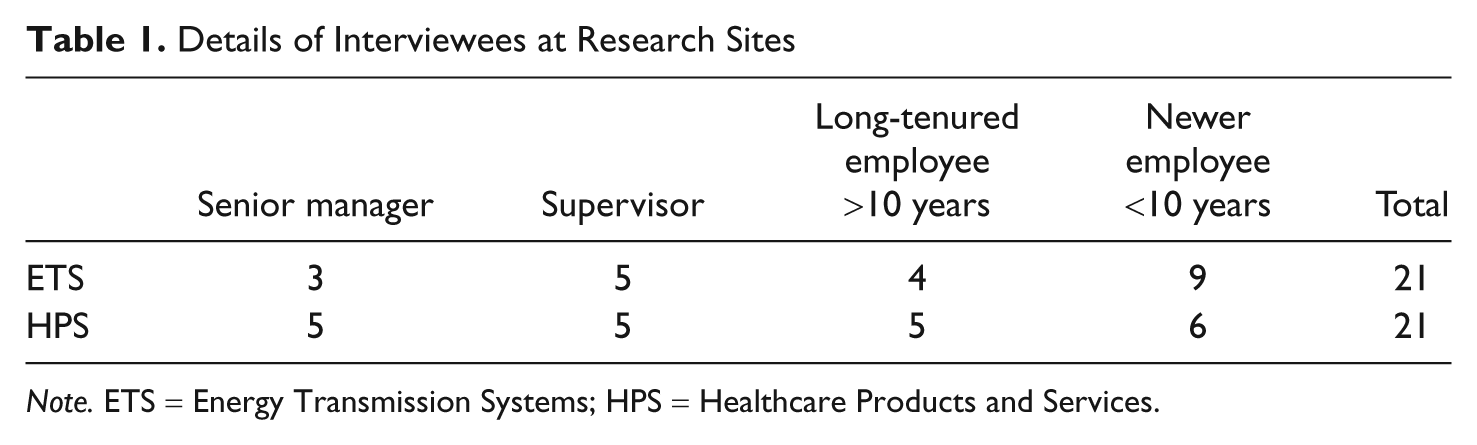
Note. ETS = Energy Transmission Systems; HPS = Healthcare Products and Services.
For value change, questions were asked about key events that led to changes in the value statements, and follow-up questions evolved based on the answers as the interviews progressed. Interview questions were directed toward exploring the words and actions that characterized planned value change, spontaneous value formation, dialogical value formation, and patterns of value commitments within the organizations. We also looked for evaluative language that indicated favorable or unfavorable interviewee impressions of espoused values and the value change or formation initiatives. To investigate the enactment of values, we looked for stories from the employees about how they and their colleagues behaved relative to the value to assess whether the organization was either influenced or not influenced by the new values.
The interviews were recorded on a computer using OneNote. All these interviews were transcribed by us in their entirety. The transcribed interview data were initially sequenced in a data table based on the time period, level, and tenure. We went back to listen to each interview to ensure accuracy of the transcription and discussed any statements requiring clarification. The objective was to achieve an error-free interviews data table for each case across time, level, and tenure.
Some of the data collected were retrospective based on long-tenured employees’ recollection of past events. Retrospective data are valid for understanding meaning through reflective glance (Weick, 1996), and therefore, we contend that it is useful in understanding meaning in the study of values. Retrospective data are also useful for understanding processes through the generation of retrospective histories (Glick, Huber, Miller, Doty, & Sutcliffe, 1990). For strengthening the validity of retrospective data, we triangulated these comments with data from other informants and archival data. For example, one employee described personal experiences during a layoff, and another claimed involvement in rewording HPS’s value statement. In the former case, we found evidence in the archival data of mass layoffs for the time period, and in the latter case, a supervisor confirmed the involvement of the employee in the rewording of the organization’s value statements.
Secondary data from archival records also helped strengthen the validity of the findings of the study. Archival data were from (a) annual reports; (b) interviews of executives since the mid-1980s from Dow Jones, Factiva, and The Wall Street Journal; (c) case studies; (d) books; (e) internal documents; and (f) company and industry reports by market research firms (see Table 2). These data complemented the interview data for constructing key event histories and for confirming factual information on official values, patterns of value commitments, and approaches to value change and formation.
List of Documents of ETS and HPS
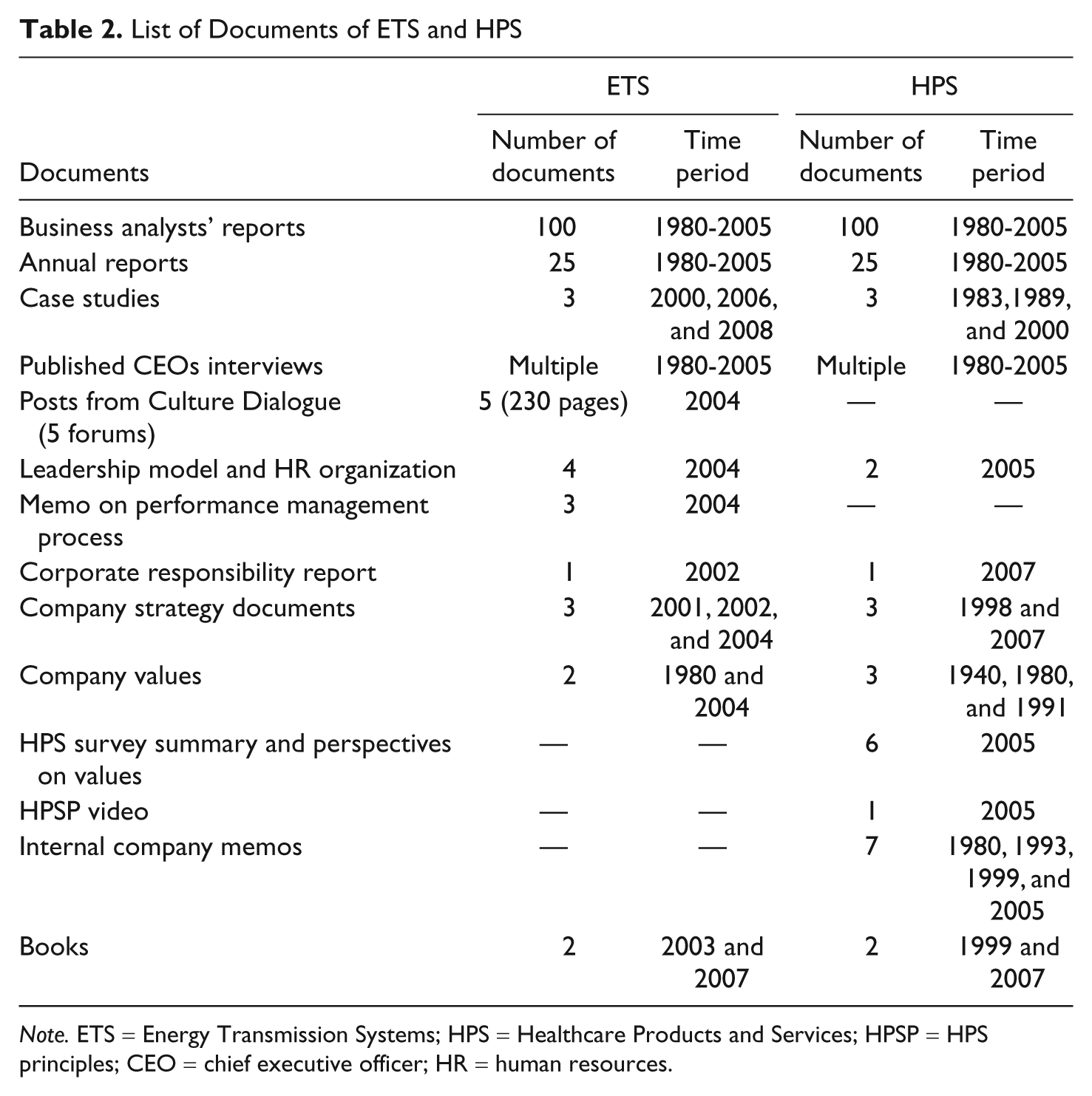
Note. ETS = Energy Transmission Systems; HPS = Healthcare Products and Services; HPSP = HPS principles; CEO = chief executive officer; HR = human resources.
Data analysis
The goals of the data analysis were to identify and confirm approaches to value change and formation and to explore the accompanying dynamic patterns of value commitments. To achieve these goals, we drew meaning from the discourse captured in the data (Miles & Huberman, 1994). “People are meaning-finders; they can very quickly make sense of the most chaotic events” (p. 245). Barley and Kunda (2001) and Miles and Huberman (1984, 1994) recommend a comparative research design using multiple cases that allows for exploring similarities and differences. Organizations from different sectors can provide a valid source for comparative case studies when they face similar pressures for organizational change (Greenwood & Hinings, 1996).
The similarities and differences across these two cases were surfaced through identifying patterns from the data by coding the data as recommended by Yin (2003, p. 162), Miles and Huberman (1994, p. 69, 245), and Strauss and Corbin (1998, p. 57). The first round of coding involved assigning a large number of conceptual codes, some drawn from theory and some inductively gleaned from the interviews. Next, we engaged in pattern coding that involved sorting and grouping similar data together and identifying themes. According to Miles and Huberman (1994):
Pattern coding is a way of grouping those summaries [summaries generated from first level coding] into a smaller number of sets, themes or constructs. For qualitative researchers, it is an analogue to the cluster analytic and factor analytic devices used in statistical analysis. (p. 69)
Third, we then collapsed these themes into categories and emergent patterns that illuminated insights consistent with the theory, surfaced new insights and descriptive labeling. One example of a new insight of the coding relates to the spontaneous decentralized value formation alternative. This was initially conceptualized as a bottom-up value formation alternative. The analysis instead indicated a value formation alternative that was uncoordinated and resulted in lateral value diffusion among employees with similar tenure or groups within the same division. As a result, the description of the approach was revised accordingly. To identify approaches to value change and formation and the accompanying dynamic patterns of value commitments, we looked for quotes, events within the same time period, and existing research that affirmed the patterns we surfaced within the data. Altogether, the analyses led to the development of individual company case studies that provided a rich description of the experiences of the companies.
In the next section, we will first present the analysis of approaches to value change and formation at ETS and HPS and then analyze dynamic patterns of value commitments under these approaches.
Three Alternatives to Value Change and Formation and Accompanying Generic Dynamic Patterns of Employees’ Value Commitments at ETS and HPS
The analysis indicates that at ETS and HPS, from the 1980s to the early 2000s, approaches to value change and formation involved three alternatives: leader-prescribed top-down planned value change initiatives, spontaneous decentralized value formation among employees, and interactive dialogical value formation through joint dialogue between leaders and employees. These three alternatives were accompanied by the four generic dynamic patterns of value commitments as theorized by Greenwood and Hinings (1996).
Three Alternatives to Value Change and Formation at ETS
At ETS, the FCVs were instituted by the founder during the early 1940s and stayed rooted in the company’s culture till the early 1990s. In the face of a business crisis, ETS’s board, breaking tradition, hired an outsider as the new CEO. The new CEO scripted Guidelines, a new set of values for ETS. An executive commented:
The CEO, set out Guidelines for doing business as one company. The break with the past was apparent to employees. The CEO traveled to different company sites, met with employees to explain the Guidelines. He wrote notes directly to all of the employees when he wanted to convey important information. (Case study, 2000)
As one executive noted, “We had no idea when he was going to send them; we got them when everybody else got them.”
By the late 1990s, much of ETS had been restructured and reengineered. Alongside this was a proliferation of value frameworks derived from the FCVs, Guidelines, and employees’ own experiences in the changed workplace. A service engineer recounted, “I was part of the customer service organization, and we did have guidelines that were put in front of us and we had things that we had to remember, and they were mostly customer related.” A newer employee in the product development division similarly described, “When I joined ETS I was given the product Guidelines (by the department manager) that we lived with and if I remember them correctly it was 8 or 10 guidelines.”
The coexistence of multiple values, including the guidelines and FCVs, were a source of strain within the workforce when the company strategically reoriented itself in the early 2000s. Managers and employees jointly sought out new values through a Culture Dialogue. “Employees today just won’t drink the Kool-Aid!” was the explanation offered by a supervisor for the need to foster an interactive dialogue among managers, long-tenured employees, and newer employees. Culture Dialogue involved two online dialogues on official value possibilities that were open to all employees over several days. A team of senior executives drew up these value possibilities, and focus groups across ETS whetted and modified them. Based on managers’ and employees’ posts during the first Culture Dialogue, the senior executives drew up the final values. A second Culture Dialogue was conducted to chart a path for implementing the new values. An ETS employee described this as:
The new values came from us as a company. The management set a proposition before us. We expressed ourselves about the proposition to arrive at these values. It would have been a totally different thing if the values had been pushed down from the top.
Changes made to ETS’s official values between the early 1990s and 2000s are listed in Table 3.
Changes Made to ETS and HPS’s Official Values
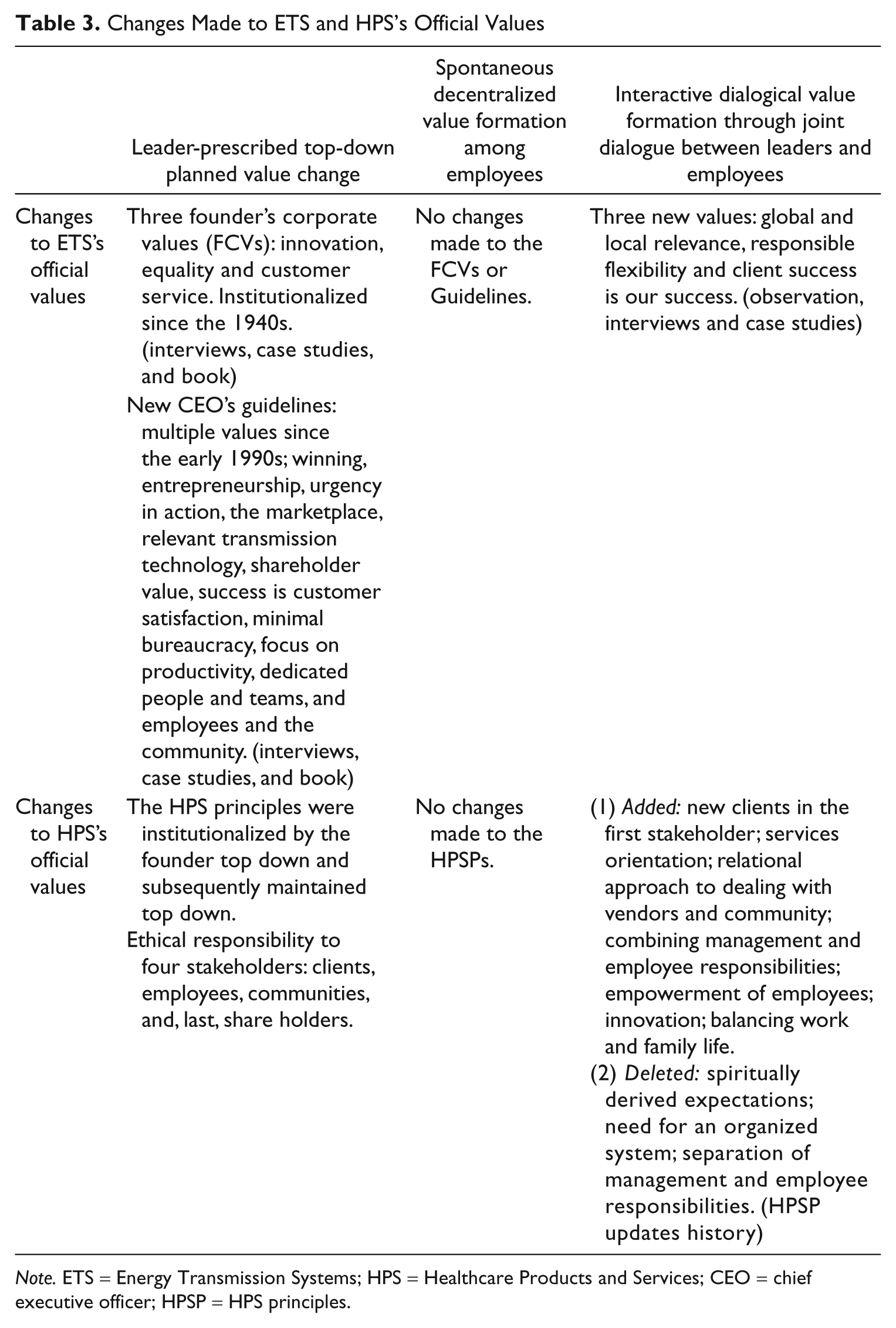
Note. ETS = Energy Transmission Systems; HPS = Healthcare Products and Services; CEO = chief executive officer; HPSP = HPS principles.
Three Alternatives to Value Change and Formation at HPS
At HPS, too, the founder played a key role in introducing and personally maintaining the values between the early 1940s and 1970s. Subsequent CEO’s held town hall meetings, dinner meetings, and one-on-one-meetings and personally enforced the HPSPs:
In the years following the Founder’s death, the HPSPs began losing some of the influence. The CEO conducted dinner meetings attended by some 4,000 management employees. He spoke about preserving the values inherent in the HPSPs and making them a part of the decision making process. (HPS Book, 1999, p. 613)
However, in the late 1970s, the CEO broke with this top-down tradition. He invited senior managers to question the relevance and revise the HPSPs, if necessary, arguing:
Here’s the HPSPs. If we are not going to live by it, let’s tear it off the wall. If you want to change it, tell us how to change it. We either ought to commit to it or get rid of it. (Case study, 1983)
By the early 1990s, this process, HPSP Live, had grown into a systematic company-wide dialogue process for periodically evaluating, deleting, and adding tenets to the HPSPs. Initiated by corporate human resources (HR) and managed independently by different units across the world, the changes recommended were finalized at HPS’s corporate headquarters. According to a senior sales manager, when he was a sales executive:
We went through the HPSPs and we then made recommendations on what we thought the HPSPs should do. We sent our suggestions to the corporate headquarters. They got executives and employees throughout the world to provide input [about the relevance of the HPSPs]. It is a pretty drawn out process of a number of days that people go through this.
After the early 1990s, there was a revival of the leader-prescribed planned top-down value change alternative and HPSP Live changed substantively. It became less open. No changes were made to the HPSPs, and it was oriented to teaching the principles to HPS employees. As a senior manager described, “It [HPSP Live] is really a teaching approach [now], but it is under the HPSP Live label.”
Also, employees spontaneously started forming their own values based on their experiences in a changed workplace. A manager described employee behaviors and decisions that were being influenced by values that emphasized revenues and the business model over the HPSPs: “Decisions were being made by some executives that appeared to be smart on the surface, but they were counter to the value system.” The CEO’s view on this shift was described by another manager:
To quote our former CEO, “There are more important things in this corporation than bringing in numbers. So you can have a rapidly accelerating business model in which bringing in the numbers is critical. However, you can start to lose sight of what is the basis or the foundation”—which is really the value system.
See Table 3 for changes made to the HPSPs between the late 1970s and the early 2000s.
The analysis of ETS’s and HPS’s experiences suggest that over the course of the years, examined approaches to value change and formation involved all three alternatives. Leader-prescribed top-down planned initiatives have been historically useful in institutionalizing values for the first time. Underlying subsequent leader-prescribed top-down initiatives aimed at changing or maintaining values was a current of value formation often unaccounted for and limited in its reach. In neither of the cases did the spontaneous decentralized value formation among employees result in changes to the official values. The interactive dialogical value formation starts off with the realization that changes in values cannot be forced on employees. Instead, interactive joint dialogue, between leaders and employees, provides an alternative for bringing together the competing forces of value change and formation.
In the following sections, we describe four generic dynamic patterns of value commitments (Greenwood & Hinings, 1996), which we found accompanying the three alternatives to value change and formation and that oriented employees’ commitment to ETS’s and HPS’s official values. Key actions in the three alternatives and the accompanying dynamic patterns of value commitments at ETS and HPS are summarized in Table 4.
Summary and Comparison of Value Change and Formation Under the Three Alternatives

Note. ETS = Energy Transmission Systems; HPS = Healthcare Products and Services; CEO = chief executive officer; HPSPs = HPS principles.
Leader-Prescribed Top-Down Planned Value Change
At ETS, the imposition of Guidelines by the new CEO was accompanied by employees’ indifference to the Guidelines and long-tenured employees’ continued commitment to the FCVs. Employees agreed that the Guidelines emphasized winning, but they also felt that the Guidelines were problematic (Table 5, A). Most employees could not recall their specific tenets (Table 5, B). Long-tenured employees were suspicious of their implications. As one put it:
We had a slogan, “Make it your business!” We translated that to mean, “Do it yourself.” Ok, you are on your own. I got nobody behind me. Nobody is going to do this, so I am just going to have to do this by myself.
Dynamic Patterns of Employees’ Value Commitments at ETS

Note. ETS = Energy Transmission Systems; FCV = founder’s corporate values; CEO = chief executive officer.
These suspicions of the top-down initiatives were accompanied by favorable recollections and continued commitment to the FCVs (Table 5, C, D). The long-tenured employees also consistently compared ETS with its past greatness. Although some judged, “ETS has reneged on a social contract,” others judged that it had ceased to be a “Great Corporation” or the “Gold Standard” that it had been in the past. Managers agreed that there was a continued status quo commitment to the FCVs. As a manager put it, “We never retired the Founder’s values.” The FCVs continued to subtly influence employee actions (Table 5, E).
At HPS, leader-prescribed top-down maintenance of the HPSPs, buttressed by a well-developed ethical compliance infrastructure (Table 6, A), was accompanied by a pattern of status quo commitments among employees to the HPSPs and by actions that revealed a pattern of indifferent commitments. There was widespread acceptance of HPSPs as “one leg of HPS’s three legged stool,” the other two being unique loosely coupled structures and strategic objectives. However, this pattern was tempered by periodic instances of actions taken by managers and employees that revealed a pattern of indifference toward the HPSPs, despite senior managers’ attempts to rein in such actions (Table 6, B). Actions such as new drug introduction and recall, which were not as per the HPSP ethical standards; use of unfair advertising techniques; even an illegal document shredding incident; and improper payments in international markets (Table 6, C). Indifference towards the HPSPs also took on the form of newer employees complaining, “Managers tend not to listen to those who actually serve the customer unless there is an ethical angle.” Even die-hard long-tenured employees expressed indifference to the existing HPSPs (as against the original Founder’s HPSPs) by judging them as “tainted.” For others, there was an issue of “being nurtured” on the HPSPs “second hand” (Table 6, D) and a quest for what would make the HPSPs “come alive” (Table 6, E).
Dynamic Patterns of Employees’ Value Commitments at HPS

Note. HPS = Healthcare Products and Services; HPSP = HPS principles; P&L = profit and loss; R&D = research and development; FCV = founder’s corporate values; CEO = chief executive officer.
Leader-prescribed top-down planned initiatives to maintain shared employee commitment or change the official values were accompanied by indifference and status quo value commitments patterns. On one hand, employees acquiesced with the official values, but their actions were oriented by different values that contravened the official value’s tenets. Long-tenured employees doggedly deepened their commitment to the institutionalized values.
Spontaneous Decentralized Value Formation
At ETS, the guidelines, multiple values in divisions, and a changed workplace revealed a competitive value commitments pattern among newer employees, long-tenured employees, and managers. The multiple values accompanying restructuring were confusing for employees. As an employee commented during the first culture dialogue:
It (the Guidelines, 7 divisional values and 3 departmental values) was very confusing. Bring back the original FCVs, instead of the Guidelines. So simple, sort of like the constitution. I could solve so many problems using these simple FCVs. (Table 5, A)
Also, employees were unhappy with the workplace changes (Table 5, B). For one long-tenured employee, “People were reduced to numbers on a balance sheet,” and for another, the shift to a mobile workforce was indicative of a lack of community (Table 5, C).
Internally, ETS had also become divided. On one hand, different divisions were increasingly becoming separated from each other and were operating in silos (Table 5, D, E). On the other hand, newer and long-tenured employees were also divided. Newer employees’ actions were characterized by a long-tenured employee as:
“I need something. Can you answer this question?” There is very little social interaction, very little of the back and forth—“What are you doing today?” The aim is to get an answer to a question, as opposed to building a relationship.
Newer employees, expressed frustration with long-tenured employees’ preoccupation with the FCV’s and ETS’s past. As one newer employee put it, “Old timers were really upset about how ETS was not fair to retirees. We younger people were different.” Newer employees characterized long-tenured employees’ views on discussion boards and in person as “flame wires” or “noise,” which “was not constructive.”
At HPS, a competitive value commitments pattern was visible in the differences among long-tenured employees, newer employees, and managers. This competitive commitments pattern was visible around different interpretations of the HPSPs. In one case, some HPS employees undertook a class action suit against HPS. They contended that the HPSPs, in essence, were a contract ensuring job security, and layoffs and plant closures were a breach of that contract. This issue has periodically surfaced and has been legally contested around, as a senior manager put it, “HPSPs are guiding principles to be aspired to and not a contract to be adhered to.” Even among the long-tenured employees, some believed that they had to do things differently (Table 6, A), whereas there were managers whose own notion of ethics led them to firmly emphasize the HPSPs in the changed workplace (Table 6, B).
These different managerial styles were a source of confusion for newer employees (Table 6, C, D). There were newer employees who were disapproving of the long-tenured employees and supervisors:
There is a somewhat elitist attitude. This is because there are older people with more tenure and this means old ideas and old ways of thinking. If management keeps shutting us (newer employees) out of their circle, then it will not be a shared vision. (Table 6, E)
On the other hand, those with longer tenure were frustrated with the newer employees. A long-tenured employee expressed this frustration as, “You (the old timers) worked for a good company and you give it your all. I don’t know what the younger generation is lacking. I am not sure that the newer employees are here for the long term.”
The spontaneous decentralized value formation was accompanied by a pattern of competitive value commitments among employees. Some employees’ actions were influenced by current values, whereas others desired a particular value alternative. Some value alternatives were derived from earlier versions of institutionalized official values, whereas others were derived from experiences in the changed workplace. Taken together, these multiple value orientations were a source of division among employees and silos in the organization.
Interactive Dialogical Value Formation
At ETS, the decision to jointly dialogue values through the Culture Dialogue energized appreciation of different viewpoints and surfaced a readiness among employees to commit to new values. One newer employee articulated this readiness as, “The Culture Dialogue was exciting. It was saying that we were again going to be a company that was values driven. We were once again aiming to become the gold standard.” Managers too displayed a readiness toward changing values through joint dialogue (Table 5, A). Even long-tenured employees expressed such readiness:
Sure the values would make a difference. I think our values, the old ones, helped us succeed in the past. The new ones [from Culture Dialogue] really help ETS move forward as a culture, and I think they are key to our ongoing and continued success. (Long-tenured employee, 2004)
Underpinning this readiness was an appreciation of joint dialogue as a change process (Table 5, B). A newer employee who appreciated the process commented:
I have to give kudos to ETS on the Culture Dialogue. The form was very free; the dialogue was a perfect exhibition of free speech. There was no facilitation. There was no fear of retribution if you expressed comments not in line with the corporate view.
Even long-tenured employees were appreciative of the process (Table 5, C). As an ETS long-tenured employee put it, “When I was in the online Culture Dialogue I thought—‘Who else does this?’ I do not know if anyone else could do this, but we did. All of us decided on these new values.” Employees saw a link between the new values and business issues that influenced their actions. For a long-tenured employee, “The Culture Dialogue has regenerated our old values and focused us on a core set of values necessary for the integrated solutions strategy of the company.” For a newer employee, the new values had motivated him to stay on with ETS (Table 5, D). For a long-tenured employee, the values influenced the way he pitched to clients (Table 5, E).
At HPS, the CEO’s belief was that “you cannot impose convictions or beliefs on someone else.” The HPSP Live process was consistently marked by an appreciative quality and characterized by a pattern of reformative employees’ commitments in archival data as “helps you to think through the facts and provides a philosophy,” “challenges the HPSPs,” and “make[s] the HPSPs relevant” (Table 6, A). An early illustration of the appreciative quality of this process can be garnered from a story involving the first HPSP Live in the early 1980s:
When the outgoing CEO heard about the [HPSP Live] meeting, he went bananas. It was the only time that the incoming CEO could recall him losing his temper. The outgoing CEO said, “You’re not about to challenge the HPSP as long as I’m here. I’m chairman, and no one has the right to challenge that document.” However, after he saw the tape [tape of the first HPSP Live session] and as he began to think about what was happening, he gradually became a supporter of the idea. (Case study, 1989)
Employees’ actions were widely guided by the appreciation and commitment to HPSPs garnered through HPSP Live (Table 6, B, C).
There are two instances that reveal the pattern of reformative commitments accompanying HPSP Live. One instance deals with the inclusion of balancing work and family as a tenet in the HPSPs that has persevered to the present. A second instance relates to the way HPS’s employees responded to a crisis in the 1980s.The vice president of public affairs recounts that:
The decision to debate the HPSPs helped the company tide other crises in the company’s history, including a famous case of product tampering which resulted in a fatality. Having been part of the evaluation process, HPS’s employees now felt a new sense of ownership in the HPSPs. (HPS Book, 1999, p. 616)
HPS’s workforce came together around the crisis and continued operating in other markets. As a senior manager recalled that period: “Over the next several months, hundreds of employees in different subsidiaries changed their normal work schedules and worked day and night toward a common goal: to save the company’s reputation and bring the product back to market” (Table 6, D).
One of the updates that persevered through the interactive dialogical alternative in the early 1990s was recognition of the ethical responsibility to balance work and family life. In 2005, employees consistently expressed commitment to this particular value and agreed that the company did a good job of balancing work and family life (Table 6, E). According to a long-tenured employee:
The Company has always been very good with the work and family piece of it. At our facility, we have an on-site day care center. We have Live for Life, which is a work out facility. It is very good as far as the family is concerned.
Under the interactive dialogical alternative, long-tenured and newer employees revealed a reformative value commitments pattern energized by a quality of appreciation of the process and others’ viewpoints. They were willing to openly dialogue the relevance of current official values and jointly search and construct a particular value alternative through this dialogue.
Discussion
This study illuminates that approaches to value change and formation in relation to official espoused values within organizations can involve at least three alternatives: leader-prescribed top-down planned value change, self-selecting spontaneous decentralized value formation among employees, and interactive dialogical value formation by leaders and employees. Our analyses suggest that these alternatives yield dynamic patterns of value commitments that either support or temper the usefulness of the structural coherence, trust, and norms that shared values can offer as a critical component of an organization’s culture. Our results are generally consistent with the existing body of research on organizational values and change while extending this research by offering specific insights into patterns of employees’ commitments in the context of changing and maintaining official values over time in two enduring organizations.
The top-down value change alternative serves a purpose. It quickly and clearly identifies a value template for controlling and coordinating work in relation to the external environment (Dunphy & Stace, 1988; Stace & Dunphy, 1991). The accompanying dynamic patterns of value commitments (Greenwood & Hinings, 1996) characterizing planned change singularly driven from the top down will be status quo and indifferent. Employees will be indifferent to the new values underlying structural changes and instead continue commitment to previous values underlying structural coherence or to the values that provide a basis for trust and or cling to values that are aligned with the taken-for-granted assumptions of the organization’s culture. We found evidence of this commitment pattern, with status quo characterizing initial founder’s values and indifference characterizing subsequent top-down attempts to change or maintain official values.
The top-down alternative can also be accompanied by unexpected consequences (Harris & Ogbonna, 2002; Woodman & Dewett, 2004), which, in our case, took the form of accompanying spontaneous shifts in employees’ desired values that became a source of resistance to the new values. The nature of this spontaneous value formation tends to be evolutionary, driven internally by latent patterns of commitments (Van de Ven & Poole, 1995) to desired values, self-selected, and socially constructed by employees (Ferdig & Ludema, 2005; Stacey, 1992, 1995) and, in our study, results in competitive pattern of value commitments among employees (Greenwood & Hinings, 1996). But in our data, we found that the competing commitments were ineffectual in changing official espoused values because of the inability of this process to yield consensus and instead stayed limited to the particular value alternatives desired by employees with different tenure or from different functions.
The failure of top-down or spontaneous alternatives to engender consensus attenuates the usefulness of values in providing structural coherence, building trust, and institutionalizing norms of behavior. The third alternative, interactive dialogical, offers a way to usefully bring together the strengths of each prior approach in a reformulation of the values that are broadly accepted and enacted.
Value preferences underlying structural changes and values desired by employees can be coalesced and reframed through the use of dialogue (Heracleous & Marshak, 2004; Marshak & Grant, 2008). Such dialogue will succeed in transformation when it possesses the qualities of being free, widespread, spontaneous, and explorative (Ferdig & Ludema, 2005) and reframes value commitments (Adler & Heckscher, 2006). The dialogue will draw on the preferred and desired values and reform commitments and gravitate toward alternate values. Surfacing a pattern of reformative value commitments (Greenwood & Hinings, 1996) to the alternate values hinges on appreciation (Cooperrider & Srivastava, 1987) and interdependence (Adler & Heckscher, 2006) between leaders and employees. Consistent with this research, in our study the interactive dialogical process usefully coalesced the value preferences underlying planned structural change driven by leaders derived from shifts in the external environment; spontaneous shifts internally, in desired values framing trust among employees derived from internal employee relations and shared values aligned with taken-for-granted assumptions of the organizations’ culture.
Our research affirms that patterns of employees’ value commitments will be affected by these three alternatives, which in turn will affect the useful enactment of the values. For successful value change to happen, there needs to be a new value alternative for employees to shift their commitment. The three alternatives and accompanying dynamic patterns of value commitments contribute by providing a way for viewing value change and formation in relation to value preferences and desirables. Value preferences are visible in official company values, and employees’ desirable values are visible in the patterns of value commitments. These official values and patterns of employees’ value commitments exist at a sufficient level of awareness to be considered valid for examination.
This study provides tangible evidence of generic dynamic patterns of employees’ value commitments (Greenwood & Hinings, 1996) associated with value formation and change as manifested by employees’ words and actions and in corroborating archival data. For leaders and change agents initiating change in response to external or internal conditions, this study suggests that official values, though often discounted by managers but not by employees, are a useful reference point for understanding and coalescing patterns of employees’ value commitments in response to the value preferences signaled in the change initiatives. This study provides insights into value change and formation in relation to official values across tenure and function and over time. A possible value change and formation trajectory that this study elucidates is that most organizations that have official values would start off with a status quo commitment to a founder’s value successfully institutionalized through a planned top-down process. Because of strategic pressures that result in top-down attempts at value change, the status quo commitment will give way to include indifferent value commitment. Over time, if no action is taken, the status quo and indifferent value commitments will spontaneously diverge into competitive value commitment characterized by commitment to alternate value orientations. Where successful action is taken, the competitive commitment will move toward reformative commitment. This successful action, based on the evidence from this study, may best be achieved through an interactive dialogical value formation process.
The three alternatives to value change and formation and the evidence of associated patterns of value commitments can also be a helpful diagnostic framework to guide interventions to increase the likelihood of patterns of commitments that support the potential benefits of shared values to their organizations. For example, if value change is top-down, particularly as it relates to deciding the values, the importance of communicating the change in a persuasive manner that engages the emotions of employees in understanding the change is essential to gaining acceptance (Kotter & Cohen, 2002). Furthermore, if a change agent recognizes the existence of competing commitments, a change agent can focus attention on the tangible benefits or results associated with a particular value or its interpretation and intentionally disseminate this broadly to gain acceptance (Beer et al., 1990).
A more specific recommendation to change agents, as well as executives undertaking value statement derived cultural change, is to leverage the potential of dialogue and appreciation to coalesce reformative commitment toward new official values. The interactive dialogical value formation alternative will provide them with a way to bring together values underlying structural coherence, taken-for-granted assumptions, and trust. Dialogue and appreciation provides a basis for helping employees consider value orientations different from their own and reformulate them into a new value orientation. The possibility of a new unitary universal value orientation being a basis of exchange across different value orientations may be possible at a meta level involving higher order ultimate values (Pasmore, 1988) such as appreciation (Cooperrider & Srivastava, 1987) and interdependence (Adler & Heckscher, 2006). This raises a related question about the continued relevance of the freeze phase in Lewin’s (1951) change model in dynamic environments. A unitary value orientation may be possible if the value is a higher order ultimate value that straddles different value orientations, but this is an area for future research.
Related to the recommendation of using the potential of dialogue is a limitation that is worth noting. Our research only explores the use of dialogue in two settings; despite the benefits accrued to the use of this approach in both settings, we cannot conclude from the exploration of two organizations that dialogue is the optimal alternative for all organizations. For example, this approach may not be productive in cultural contexts where deference to authority might stifle open dialogue. Additional qualitative research in other organizational and cultural contexts will help fine-tune the use of dialogue in organizational change initiatives.
Based on this study, we can recommend forms of free dialogue on official values among employees across levels, tenure, and function that focus on appreciation across dynamic patterns of value commitments as a basis for constructing and coalescing shared value commitment.
Conclusion
This study finds that approaches to value change and formation in relation to official values involves three alternatives: top-down planned value change prescribed by leaders, spontaneous decentralized value formation constructed by employees, and interactive dialogical value formation centering on joint dialogue between leaders and employees. The study finds that these three alternatives are accompanied by dynamic patterns of value commitments.
The findings of this study are based on the experiences of two U.S. organizations, ETS and HPS, established more than a hundred years ago and having a tradition of emphasizing official values since the 1940s. The delineation of the three alternatives and accompanying dynamic patterns of value commitments are arrived through ETS’s and HPS’s experiences with maintaining and changing official values between the 1980s and the early 2000s. On one hand, the leader-prescribed top-down planned value change alternative resulted in changes to the official values and was accompanied by status quo and indifferent value commitments among employees. On the other hand, the spontaneous decentralized value formation among employees was accompanied by competitive value commitments among employees. In this case, value formation did not result in any changes to the official values. It was through the third alternative, interactive dialogical value formation through joint dialogue between leaders and employees that the official values were radically changed or incrementally updated and appreciation for different value orientations formed, which surfaced a reformative pattern of value commitments among employees.
Footnotes
Acknowledgements
This article has benefited from feedback by Charles Heckscher and Saul Rubinstein. The authors would like to thank the reviewers and, particularly, editors, Richard Woodman and William Pasmore, for their encouraging and constructive comments to improve the article.
Declaration of Conflicting Interests
The authors declared no potential conflicts of interest with respect to the research, authorship, and/or publication of this article.
Funding
The authors received no financial support for the research, authorship, and/or publication of this article.