




Abstract
Historically, professional identity was viewed as a singular construct, and the boundary-spanning dynamics of subidentities remained unexamined. More recently, identity scholars have paved the way to consider the multiple personal and social identities that comprise an individual’s professional identity. These dynamics are exemplified by the unique challenges that scholar–practitioners regularly encounter. To deepen understanding of variations in how scholar–practitioners enact their professional identity, we interviewed young scholar–practitioners who completed their doctorates in the past 7 years, as well as seasoned scholar–practitioners with at least 20 years of experience. We elicited metaphors from the interviewees to explore the complexities of their professional identity and subidentities and the challenges that scholar–practitioners face at different stages of career development. We offer implications for the future socialization of scholar–practitioners and others in boundary-spanning roles.
There has been a long-standing interest in the nature of professional work and identity in the study of careers (Chreim, Williams, & Hinings, 2007; Ibarra, 1999; Pratt, Rockmann, & Kaufmann, 2006; Reay & Hinings, 2009). In the past decade, much progress has been made in clarifying the factors that shape professional identity as well as the personal and situational factors that influence how identity unfolds over time (Ashforth, 2001; Kreiner, Hollensbe, & Sheep, 2006; Hall, 2002). In addition, the notion of identity has been expanded from a singular entity that develops over time to multifaceted social identities, (e.g., nationality, gender, race, work role) and personal identity (e.g., dispositions, abilities, etc.). These multiple dimensions, together, make up a unique, contextually defined identity (Ashforth, 2001; Gergen, 2007; Kegan, 1982, 1994). A number of empirical studies have demonstrated that individuals develop strategies for accomplishing what is now framed as “identity work” (Chreim et al., 2007; Kreiner & Sheep, 2009; Pratt et al., 2006), leading to self-definition and effectiveness in a professional role (Pratt & Dutton, 2000).
Our purpose here is to deepen understanding of how the scholar–practitioner negotiates the boundaries of the dual roles of scholar and practitioner and to highlight the inherent complexities of this professional identity. 1 The identity lens is used to interpret the personal narratives of scholar–practitioners in order to clarify challenges as well as strategies for identity integration and effective performance (Caza & Wilson, 2009). Although the identity work of the scholar–practitioner as studied here is centered on the management and organizational development fields, it is likely to shed some light on professionals in other occupations whose work span across multiple boundaries (Ernst & Chrobot-Mason, 2011; Yip, Ernst, & Campbell, 2009).
In an earlier study (Wasserman & Kram, 2009), prompted by an invitation to honor Ed Schein’s career as a scholar–practitioner, we explored how being a scholar–practitioner 2 is defined by those who identify with the role, and the challenges and opportunities these individuals face as they go about their work. Through the narratives of our interviewees, we learned about the predictable dilemmas individuals in these boundary-spanning roles experience and the strategies they enact to manage them. We confirmed that scholar–practitioners identify with the primary tasks of generating new knowledge and improving practice, yet how they prioritize and go about their work varies with where they are positioned on what we defined as the scholar–practitioner continuum. We identified several key themes that characterize the challenges of combining practice in organizations with efforts to generate and disseminate new knowledge about development, change, and performance in organizational settings.
Interest in this conversation continued to grow among early career scholar– practitioners. Recently, we were invited to participate on a panel, organized by a team of dissertation-staged doctoral students and recent graduates of doctoral programs along with others who had been part of our study, to share our stories. The gap between the students’ desires and their concerns, bordering on despair, inspired us to conduct a follow-up study focusing on early-career professionals who had recently completed their doctoral studies 3 and had desires to bridge scholarship and practice as they designed their career paths.
The identity literature suggests that identity is created by the combined influences of social context and personal attributes (Ashforth, 2001). Moreover, as individuals make meaning (and construct identity), they are likely to develop the multiple facets of their identities, including personal attributes, membership in social groups (e.g., gender, race, age, ethnicity), and various work roles (scholar, practitioner, scholar–practitioner; Kreiner et al., 2006). Each facet of their identity defines goals, values, priorities, and ways of being in the world. Identity work, by definition, is the individuals’ efforts to prioritize and optimally balance the demands of these multiple identities (Ashforth, Kreiner, & Fugate, 2000). Given that early-career individuals were just beginning to construct their scholar–practitioner identities, we suspected that the challenges of effectively moving from one role to the other, integrating the two roles, and addressing inherent conflicts in priorities posed by the multiple roles would be most salient in this group and thus accessible for examination (Pratt et al., 2006).
By examining the personal narratives of newly minted PhDs, we anticipated that we would learn how individuals went about this identity construction (Ashforth, 2009; Pratt et al., 2006). In the quest to answer the question “Who am I?” and “What do I do?” (Stryker & Serpe, 1982, 1994), individuals new to the academic context were likely to experience “identity violations,” or gaps between what they anticipated and what was actually expected of them at work (Kreiner et al., 2006; Pratt & Foreman, 2000). The social context in which newcomers work influences their identity construction through role models (Ibarra, 1999; Roberts & Dutton, 2009) and through adaptation and alignment with organizational expectations (Pratt et al., 2006). Most important, perhaps, is the premise that identity is dynamic and always evolving: that it is socially constructed and reconstructed throughout the course of an individual’s career and life (Ashforth, 2009) Thus, the narratives of young scholar–practitioners would enhance what we learned from senior, experienced scholar–practitioners. The experienced, more senior scholar–practitioners had figured out how to integrate the dual purposes of scholar and practitioner regardless of their home base (Wasserman & Kram, 2009), where external validation was less essential to their sense of identity and well-being (Ashforth, 2001; Hall, 1986). In contrast, the reflections of newcomers to the scholar–practitioner role would highlight how the context in which they were working and their institutional status as junior professionals were more central to shaping their sense of identity (Chreim et al., 2007).
Although issues of identity are at the foreground of our analysis and inquiry, we found the literature on boundary-spanning roles helpful in understanding how the experience of spanning boundaries shaped the scholar–practitioner’s professional identity (Aram & Salipante, 2003; Ashforth et al., 2000; Kellogg, Orlikowski, &Yates, 2006; Mirvis, 2008; Tenkasi & Hay, 2008; Tushman & Scanlan, 1981; Tushman, Scanlan, & Thomas, 1981). In addition, as we considered the anxiety and internal conflict echoed in the brief stories of young and aspiring scholar–practitioners, we found that developmental theory and, in particular, the capacity for self-authorship (e.g., Hall, 2002; Kegan, 1994), was a helpful lens for understanding variations in individuals’ capacity to integrate the sometimes conflicting roles of scholar and practitioner.
Our overarching purpose is to create a more fine-grained analysis of how scholar–practitioners construct their professional identities. We determined that the use of metaphors in organizational analysis would help articulate subtleties in experience and meaning making (e.g., Andriessen & Gubbins, 2009; Morgan, 1980; Rees, Knight, & Wilkinson, 2007). The growing evidence of how metaphors can reveal tacit assumptions to understand how people make sense of their lives (Fauconnier & Turner, 2003; Heracleous & Jacobs, 2008) guided us to pose the following questions:
What metaphors do scholar–practitioners use to describe their work?
What do these metaphors tell us about intrapersonal, relational, and contextual factors that shape the scholar–practitioner’s identity? How does this differ by career stage?
Are particular metaphors associated with different career stages and/or developmental positions?
What do metaphors suggest about how individuals integrate their subidentities of scholar and practitioner?
The metaphors provided by our respondents gave voice to the complexities of professional identity and its subidentities. Furthermore, the metaphors expressed both positive and negative valences—that is, the intrinsic attractiveness or aversion that the subidentities hold for scholar–practitioners. In sum, metaphors offered a framework for understanding these subidentities, the challenges their interaction pose, and their valences for the scholar–practitioner.
The Research Method
We chose a “clinical inquiry” approach for this study (Coghlan, 2009; Schein, 1987, 2006, 2008). Our interview method was designed to invite individuals to reflect deeply on their experiences at work in order to illuminate how they constructed a professional identity. We took great care in our interviews to develop sufficient trust with interviewees in order to support a shared learning process. As with all clinical research, we committed to a process of self-scrutiny to insure that we maximized our learning by examining our own reactions to what we heard (Berg & Smith, 1985a, 1985b). We did this by having at least two of the three researchers interpret each interview.
A clinical approach also assumes that individuals’ experiences are shaped by personal and contextual factors that may not be readily known at the outset of the research process, and it is through joint inquiry between researcher and research participant that the complexities of these multiple influences are discovered and understood (Lewin, 1946; Schein, 1995, 2006). Our hunch that our interviewees’ work identity was shaped by the setting in which they worked and their age and prior career experiences was confirmed by their responses.
In acknowledging the “self” as a research instrument (Alderfer, 1985; Kram, 1985; Mirvis & Louis, 1985), we recognized that our own group memberships would significantly shape the questions we asked, how we engaged in the data collection process, and how we interpreted our data. Our original partnership for the first study (Wasserman & Kram, 2009) demonstrated our differing career histories and current work contexts. We added a third member to our research team precisely because he added further diversity and was most similar in age and experience to the young cohort of recent PhDs that we wanted to interview. His interest and work on metaphor analysis also added methodological diversity to our study. As expected, our shared reflective process enabled us to monitor our own biases and to insure that our interpretations were well grounded in our data.
The Use of Metaphors
Metaphors, as elements of language and thought, provided a rich source of information about how people make sense of their lives, aligned well with our clinical inquiry approach, and generated rich data and methods for analysis. According to Lakoff and Johnson (1980), metaphors are not just descriptors of reality; they reflect cognitive frameworks within which actors make sense of their own actions and those of others (Cornelissen, Oswick, Christensen, & Phillips, 2008; Fauconnier & Turner, 2003; Heracleous & Jacobs, 2008; Lakoff & Johnson, 1980; Turner, 1996). Metaphors provide a rich source of information about how people interpret their world and reveal the distinctions that shape thought and behavior in organizational life 4 (Lakoff & Johnson, 1999; Marshak, 1996).
Sample and Context
In selecting respondents, we identified scholar–practitioners as those with doctoral degrees who are actively engaged in both scholarly activity and practice beyond the academy. We broadly characterized scholarly activity as research, teaching, and publication in academic journals and practice as ongoing activity in service of nonacademic constituents. Our sampling criterion was aimed at purposeful and theoretical representation (Denzin & Lincoln, 1994; Strauss & Corbin, 1990) and was guided by our definition of scholar–practitioners—that is, professionals whose work entails both an active production of academic knowledge (scholarship) and an involvement in organizational practice. Guided by our research questions to examine differences by career stage and professional home, we stratified our sample by the categories of junior and senior scholar–practitioners and differentiated those based in academic institutions and those based in organizations. 5 This allowed us to achieve a triangulation of perspectives, through a constant comparison process (Locke, 2001). In Table 1 we provide a summary of the career backgrounds of the scholar–practitioners who participated in this study.
Career Background of Scholar–Practitioners Interviewed

In our earlier study (Wasserman & Kram, 2009), we interviewed 25 scholar– practitioners, all of who were established in the field and had at least 20 years of work experience. To establish a comparative sample, we interviewed an additional 20 scholar–practitioners for this study, 15 of whom are in the early stages of their career, with less than 7 years of experience since completing their doctoral degree. The other 5 interviewees in the study were senior scholar–practitioners, with more than 20 years of experience. Our analysis of metaphors focuses on this sample of 20 scholar–practitioners, informed by perspectives from our earlier study.
In-Depth Interviews
Our data collection process primarily consisted of in-depth interviews, in which we inquired about the various meanings that scholar–practitioners attribute to their multiple roles. All three interviewers conducted an equal number of interviews, and most of the interviews involved at least two members of the research team. In our interviews, we engaged respondents in a conversation about their work, the multiple roles that they are engaged in, and the meanings they ascribe to the different roles. To allow for comparison, we included a consistent set of questions across all interviews:
What is a metaphor that comes to mind when you think of the work of a scholar?
What is a metaphor that comes to mind when you think of the work of a practitioner?
How would you describe your work in relation to these two metaphors?
What is a metaphor that comes to mind when you think of your own work?
Describe the metaphor that you selected. What is it? What are the details?
What attracted you to this metaphor?
What do you see in this metaphor? What does it represent for you?
All but two of our respondents were able to provide at least one metaphor associated the work of a scholar, practitioner, or scholar–practitioner. Our respondents noted that the use of metaphor to reflect and describe their identities helped them articulate aspects of their identities that they might not have shared if asked to describe their identities in a direct way.
By eliciting metaphors for the three categories of scholar, practitioner, and scholar–practitioner, we sought to investigate differences, if any, among categories. The fluidity with which each interviewee provided us a different metaphor and description for each category suggested to us that they were distinct identities in the minds of the interviewee. Although most of the respondents could easily provide a metaphor, two respondents struggled with this process. One was not able to provide a metaphor for the category of “practitioner” because of her lack of experience in that domain, whereas another revealed that he struggled to provide a metaphor for “scholar–practitioner” because he did not consider himself as such.
When we probed further, we learned that although both interviewees were perceived as scholar–practitioners, their self-perception differed. The interview helped them articulate that they did not consider themselves as scholar–practitioners. As our research was focused on the identities of scholar–practitioners, we excluded these two interviewees from our analysis. In contrast, the other 18 interviewees provided distinct metaphors for each category of scholar, practitioner, and scholar–practitioner.
Metaphor Analysis
Metaphor analysis is a method particularly suited to study the meanings people invest in their actions and the interpretations they make out of them. The methodological strength of metaphor analysis lies in its systematic approach in unpacking the contents of a target domain. Through an iterative process of inquiry and interpretation, metaphor analysis allowed us to engage in a dialogue with respondents, as they opened up their inner world through metaphors. We identified and interpreted metaphorical statements in context (as first-order codes, with the interviewee’s words) and decontextually (at a higher level of abstraction with second-order codes; Cornelissen et al., 2008).
Our analysis of metaphors proceeded with four steps. First, each of us read the interview transcripts, to obtain a gestalt sense of meaning, prior to formal coding. We then identified sections of texts that the interviewee described or referenced the target domain(s) of scholar–practitioner, scholar, and practitioner. We then coded the data by context. Our coding process was informed by Andriessen and Gubbins’s (2009, p. 849) criteria for metaphor identification. 6 At this stage, we focused on identifying first-order in vivo codes, that is, statements in the exact words of the participants as labels for coding categories (Creswell, 2002).
Collectively, we reviewed the first-order codes of metaphorical statements and grouped each code into second-order categories of source domains. A source domain is the underlying conceptual structure from which metaphorical statements are drawn. This is consistent with the Lakoff and Johnson’s (1999) metaphor theory, where the source domain is projected onto the target domain through metaphorical statements, otherwise known as entailments. For example, entailments of the scholar–practitioner as providing a language, code switching, and speaking the language were coded as the source domain of SCHOLAR–PRACTITIONER AS TRANSLATOR. We discussed our interpretations and collectively identified and agreed on conceptual metaphors and their entailments, by systematically answering the following questions: What are the meanings and valences attributed to this metaphor by the interviewee? How is this similar or different from other metaphors in the data? What are limitations to this metaphor?
As we interpreted the metaphors, we sought to establish the meaning of each metaphor in context—how it applied to the subject in the situation it is used (Cornelissen et al., 2008). Through an iterative process of inquiry and interpretation, we distinguished a distinct set of meanings that scholar–practitioners associate with their identity and practice. In addition to eliciting metaphors of the scholar–practitioner role, we asked respondents to provide two additional metaphors based on their perceptions of the scholar and practitioner, respectively. Where the metaphor of scholar–practitioner provided us a window in understanding the meanings and valences associated with the scholar–practitioner role, the metaphors of scholar and practitioner allowed us to identify shared patterns of attributes that respondents ascribe to these identities. The presence of broader logics represented by these attributions was indicated by the consistency of metaphors and associated attributions used to describe the scholar and practitioner. 7
That said, metaphor analysis is not without its limitations. The method in its pure form could not account for nonmetaphorical forms of meaning making expressed in language. As such, we complemented our direct analysis of metaphors with a gestalt reading and interpretation of the data in context. This clinical approach helped illuminate the impact of contextual factors (e.g., relationships and institutional norms) as well as participants’ affect as they told their stories. We remained mindful to avoid overgeneralization and methodological determinism by attending to contextual data in our analysis.
Metaphors for Professional Practice
Our interviewees’ reflections on their work, and the metaphors that they used to describe the work of scholar, practitioner, and scholar–practitioner illuminated how these three professional roles are defined by individuals who see themselves as scholar–practitioners, who live in distinctive home bases, and whose career histories differ in terms of work prior to and after completing PhD studies. As it turns out, there was considerable similarity among the metaphors used to describe the SCHOLAR and the PRACTITIONER. In contrast, the metaphors used to describe the work of the SCHOLAR–PRACTITIONER were far more varied. The boundary spanning required to enact the scholar–practitioner role combined with the inherent ambiguity in the work and the lack of consistent recognition by individuals’ home bases seem to contribute to a wider range of variations in specific metaphors reported (see Table 2).
Interviewees’ Metaphors of Scholar, Practitioner, and Scholar–Practitioner

Note. EC = early career; LC = late career; A = academia; H = hybrid organizations; P = practice organizations.
Ultimately, we identified two or three conceptual metaphors for each of the three roles 8 and delineated the specific metaphoric linguistic expressions (Kövecses, 2002) for each of the conceptual metaphors in the sections that follow. Our purpose was to highlight the attractions and limitations of each role and how these perceptions are shaped by the context in which our interviewees do their work and by their career histories, developmental position, and sources of relational support. Our assumption guiding this inquiry is that these perceptions—embodied in highly descriptive metaphors—express how one makes career decisions and approaches professional practice and constructs professional identities. Guided by the convention of metaphor analysis (Kövecses, 2002), conceptual metaphors are presented in upper case and metaphoric linguistic expressions are presented in italics.
Scholar Metaphors
Two conceptual metaphors emerged from the narratives of scholar–practitioners—SCHOLAR AS DEEP THINKER and SCHOLAR AS PRODUCER. Among our interviewees, half described metaphors based on the conceptual metaphor of DEEP THINKER, and half used metaphors based on the conceptual metaphor of PRODUCER. The former consistently held images that were cerebral and sedentary. The latter held images that included building and moving. Two of our interviewees held images that reflected both of these conceptual metaphors (see Table 3).
SCHOLAR Conceptual Metaphors and Entailments

Note. EC = early career; LC = late career; A = academia; H = hybrid organizations; P = practice organizations.
Scholar as deep thinker
Regardless of home base, our interviewees consistently described metaphors of SCHOLAR in a manner that highlighted the metaphorical depth of thinking as the conceptual model of this professional role (“The Thinker” by Rodin), the solitary time that deep thinking requires (Individual behind a desk with piles of books and papers), and the deep expertise that scholars develop along the way (drawing water from a deep well):
Two of our interviewees explicitly used Rodin’s statue “The Thinker” to epitomize the scholar, as someone who spent much of his or her time in a solitary and reflective mode, pondering novel ideas that would inspire others to think beyond what they already know:
“The Thinker” by Rodin. Philosophically the idea that you can contribute to something bigger than yourself, I think, is very attractive. And that pose, that thoughtful pose, I think it reflects the scholarly contributions in my mind. (ECA1
9
)
The appeal of this role is, for all of our interviewees, the space to retreat from the fast-paced world of practice and people to the quietude of reading, thinking, and writing:
I picture someone sort of sitting in their somewhat dimly lit office thinking and typing. And there are piles of books, the whole, like, the image of the academic kind of sitting there. I don’t know that that’s the kind of image . . . I guess it’s sort of a solitary image, if that’s helpful. It’s sort of the lone scholar kind of. (ECA4)
At the same time, for some, the scholar label seems a bit out of reach, or something that young scholars aspire to but cannot yet claim as their own. Several noted this with imagery that had depth (or height) symbolizing deep knowledge that can only be developed over time with great study and discipline along the way:
The image that comes to mind is in essence this way, almost like a pole . . . Vertical, very vertical and very deep and solid kind of thing. I wouldn’t even know what you call it. But what comes to mind is narrow and deep. (ECH3)
Another interviewee who, at midlife and a recent PhD, is crafting her work as a combination of consulting and adjunct teaching and writing had a similar metaphor:
The image I have in my mind is an old-fashioned well. Stone and a pail attached to a rope and a crank handle. And I imagine just cranking that handle down, and drawing up a bucket of water. That’s the metaphor that comes to mind for me. It’s clean, pure, lovely, cold knowledge, refreshing, new, straight from the spring. (LCP2)
Scholar as producer
The other conceptual metaphor that surfaced from our analysis is that of the SCHOLAR as someone who produces information that can be put to good use (Carpenter, Violin Maker) and generates ideas that help to solve problems (Problem-solver) and whose actions are for the purpose of discovering valuable and new ideas (Old-fashioned Stone Well). These variations on the conceptual metaphor of PRODUCER emphasize effort that involves more than ideas for ideas’ sake and implies ideas with potential for impact:
So when I define a scholar, it’s not just simply creating new knowledge for the sake that it’s out there, but it’s creating new knowledge that then transforms other people, organizations, how things are done. (ECA7)
Yet, as the narratives suggest, the SCHOLAR AS PRODUCER metaphor assumes that generating knowledge is a top priority, and the product—knowledge—is usable and not just knowledge in and of itself. The nature of this product is where scholar–practitioner draws the boundaries between themselves and the prototypical scholar. As the narratives suggest, scholar–practitioners view the production of knowledge as the end work of the prototypical scholar. As one of our interviewees noted:
All scholarly work—if you’re defining scholarly work—is filling some gaps. But just because these gaps or these findings do not look like it, doesn’t mean the scholar is not a practitioner as well. It’s just that there is no reward for scholars to do so, or there isn’t time yet to practice. So for me I’m seeing, for any scholar you see, especially management, there would be implications for management at the end of the article. Or even a question itself. But the researcher himself might not be interested to do the translation work because there’s no reward for them to do that. (ECH4)
Implied in the producer metaphor is more than the notion of creating original ideas. Also implied is that ideas can be useful in practice.
10
At first we wondered whether these were actually descriptive of the scholar–practitioner, rather than the scholar. In response to our follow up questions, these images were of individuals squarely rooted in the Academy, working primarily on developing new ideas from studying existent literatures with a concern for relevance squarely in front of them:
Yeah, I think the metaphor would be a carpenter that has the knowledge and the ability to produce something but that what he or she is producing is being used. So I make violins, that that violin is just not made and set up by a wall for everybody to look and observe, but that that violin is turned around and played and has a reverberating impact. (ECA7)
For several of our interviews, a scholar is someone who not only develops original ideas but also goes one step further to ensure that the discovery will have great practical value in the world—whether it be an expert violin maker or carpenter or a research scientist with acclaim for having changed the world with a discovery:
You know, I think of those posters of Einstein with a light bulb or things like. Or not, he wasn’t the light bulb, Edison was. But I guess I think of people like that, Einstein or Edison or Ben Franklin, that kind of thing. So I think of ideas basically, big ideas that change the world. (LCH1)
Still others suggested that although scholars, like practitioners, are in the business of solving problems in the world, they start from a deep (and sometimes wide) base of empirical and theoretical knowledge, and their prior education and training, rather than from the experiences they have had with clients whom they have previously helped in solving related problems:
The image that came into my mind or the word that came into my mind, a problem solver. When I come into the business school as a scholar, what am I doing? I’m still trying to solve issues, but the content may be different, may be broader. The frameworks that I have at my disposal are wider. The tools that I have are statistical. But essentially at the end of the day, what am I doing? I’m solving problems. (ECA3)
Appeal and limitations
Our interviewees’ metaphors of scholars serve to define the work of the scholar, thus providing a source of professional identity as well as guidelines for enacting the role. For most of our interviewees, these same descriptions elevated the role to a level of expertise and depth that they aspire to but do not yet have. These individuals were in the first 3 years of an academic career and held out tenure as the mark of having become a scholar:
But the pressure at [tier 1 or 2 schools] on PhD students is to go to top, you know, R1 institutions. And to the extent that that’s attractive to people, they’re capable of that, but it’s not that attractive to many people that I know at least. And that’s, I mean, in part because the expectations, frankly with academics, I think you have very little control over whether you publish enough to get tenure at a research-one institution. I mean, the publication process is, the peer review process is such that you could have a fabulous run or you could just get ‘ #*#%#*’ for a couple years and, you only have so many years, so . . . (ECA1)
And for many of our interviewees based in a hybrid or consulting practice, the role of scholar was viewed as a source of great pressure and personal sacrifice that they did not want to experience:
I won’t publish as much. I probably won’t publish in respectable journals, but at least I’ll be writing what I want to write . . . academia feels a lot like a rat race to me. It’s like a factory. And if you want to create a product that the factory wasn’t completely designed for, you have to work extra hard, and it takes toll on you, because you’re trying to create something different and innovative. (ECP1)
The other side of the attraction of time for reflection and solitude (in an office with piles of books and articles) was the loneliness and isolation that come with being a scholar:
Because I think research is one of the more lonely processes that we do. And that’s the big contrast for me between research and teaching. Teaching is so interactive and interdependent, whereas research, even if you have coauthors, you don’t ever need to really meet with them face-to-face or even talk to them. You could do it all through e-mail. So it’s a very different process. (ECA1)
One of our participants, based in a research-oriented university, commented on how the work of a scholar is not only isolating but also, perhaps more important, narrowing:
I think of isolation in two different ways. One is I get extremely de-energized by the continual narrowing down of specialty knowledge. So it’s a tension where yeah, I have and am developing and want to continue to develop a pretty sophisticated expertise However, it’s narrowing to a degree where I can lose track of more interesting lateral or even, yeah, more lateral connections to other pockets of work. (ECA6)
Several recent PhDs in our sample made a decision to locate themselves in hybrid organizations or consulting practices so that they would not have to be isolated in order to accomplish what is expected of a traditional scholar who is striving for tenure in a research-oriented university setting:
Well, I think the appeal of the image for me, I mean, having been in academia, the appeal of the image is more kind of the romanticized version of it, so like, just to have the freedom and the security to kind of just pursue whatever ideas you find interesting and to kind of not really be constrained in many ways. But I also know the reality of it is, it is a very kind of isolated, and it can be a very isolated and disconnected kind of experience. (ECH1)
And several others consciously chose to locate themselves in university settings that more equally value scholarship, teaching, and consulting, so that they could find a balance of research, teaching, and work in organizations that satisfied their desire to achieve synergy among these various roles.
In contrast to the limitations and segmentation of roles that our recent PhD interviewees described, the more senior scholar–practitioners in our first study were noticeably better able to integrate the roles of scholar and practitioner into their professional identity regardless of whether they were in a traditional tenured position at a university, were in a hybrid organization, or had their own consulting business (Wasserman & Kram, 2009). Our hypothesis is that years of experience combined with reaching a self-authorizing developmental position 11 enabled these scholar–practitioners to regularly express valued parts of themselves that were not valued by the culture of their current home base.
Practitioner Metaphors
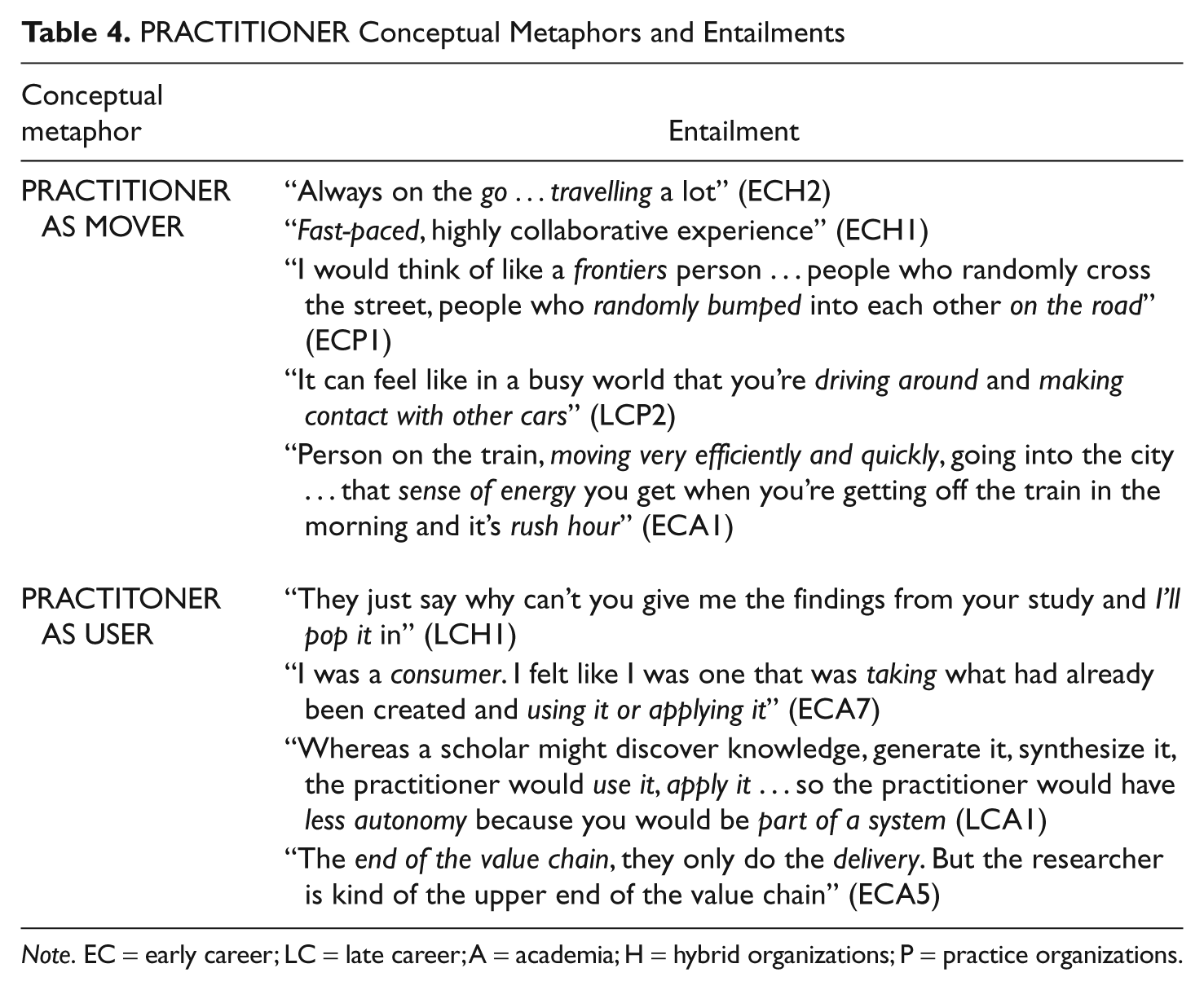
Two conceptual metaphors emerged from the narratives of scholar–practitioners—PRACTITIONER AS MOVER and PRACTITIONER AS USER. The Mover metaphor was espoused by more than half of our interviewees and the User metaphor by at least a third. Table 4 presents an overview of the metaphors and their entailments. These two conceptual metaphors were evident across all career stages and home bases. It is only through subsequent analyses of the appeal and limitations reflected in particular stories that subtle differences because of unique combinations of career history and home bases were noted.
PRACTITIONER Conceptual Metaphors and Entailments
Note. EC = early career; LC = late career; A = academia; H = hybrid organizations; P = practice organizations.
Practitioner as mover
When asked about the meanings and metaphors associated with the words practice and practitioner, our interviewees used metaphors such as bumper cars, a frontier person, a group of running horses, and a person who is always on the go. From these metaphors, we identified the underlying conceptual metaphor of MOVER.
The conceptual metaphor of Mover emphasizes momentum, speed, and a forward-going direction. To the scholar–practitioner, the rhythms of practice are perceived as different from scholarship. Where the scholarly metaphor is associated with attributions of depth and reflection (a slowing down of time), the metaphor of a Mover is ascribed with attributions of speed and rapid movement:
Image of the professionally dressed person on the train, moving very efficiently and quickly, going into the city. I don’t know even know how to describe it, that sense of energy you get when you’re getting off the train in the morning and it’s rush hour, and there’s tons of people around. Everyone’s very intent on where they’re going, has a very strong sense of purpose to their movements. (ECA1) A herd of horses, a big herd of horses, where it’s got subsets, running across the plains together, and little groups are going off and foraging and into the woods for a while, and have a nap. But they’re all going, they’re migrating together.(LCP2)
As the narratives suggest, the Mover metaphor contains themes of being on the go and at rapid speeds. The purpose of the movement is mixed. Where some describe it as intentional and purposeful, others describe it as random crossings. Interviewees also describe the Mover metaphor as a collective movement between groups, illustrative of the collaborative nature of practitioner work. For scholar–practitioners, the attributes of speed and collectivity associated with the PRACTITIONER AS MOVER metaphor represents a stark contrast from the attributes of reflection and individuality associated with scholarship. The emphasis on speed and collaboration are attributes that scholar–practitioners associate with practitioner work and also described as energy generating:
The energy, certainly the energy level. And the pace at which things can get done when you see an opportunity, you can see it enacted and completed in a reasonable amount of time where you can actually see results. (ECA1)
Although the Mover metaphor was generally described in a positive light and as a motivational driver, it had certain aspects that were less appealing for scholar–practitioners. For some, the Mover metaphor represented a crowded space, one that was crowded with activity, leaving little room for reflection. For others, it represented expansiveness and breadth at the expense of rigor and depth. The fast pace of movement is also viewed as a source of stress, as EC describes—“it’s definitely more stressful in that more people are counting on you. They need things faster.”
Practitioner as user
The other metaphor that surfaced from our analysis is that of the PRACTITIONER AS USER. The user metaphor contained the themes of relevance, being part of a system, and a concern with outcome. The metaphor also highlighted a goal-orientation toward problem solving and helping others, as the following quotes illustrate:
A person who is able to use academic work and use it for the purpose of practice effective. (ECH4) Whereas a scholar might discover knowledge, generate it, synthesize it, the practitioner would use it, apply it. (LCA1)
Our respondents described the user metaphor as integral to the work and identity of practitioners. The object of “use’ is not just the knowledge that is generated from research but also the “usability” of ideas that emerge from practice. As an interviewee describes, “I need to constantly go back to the real world to get ideas of what are the challenges.” There is a sense of an operational imperative to practice, and this imperative is associated with a sense of accomplishment and results. As another interviewee describes, “It’s the sense of accomplishment. It’s much easier to see your results when you’re working in practice.”
Although the user metaphor foregrounds practical knowledge and application, it also overshadows the creative and generative process that comes with practice. There is a sense of alienation from process, as described by our interviewees:
I was a consumer. I felt like I was one that was taking what had already been created and using it or applying it. I was never a creator. Now the organization may have liked how I put together what everybody did. So I found in a textbook a process to help group dynamics go better, but I never really understood the roots or the theories behind those things I was selecting. So I was a consumer. I was a user, but I was never a creator. (ECA7) A consultant is kind of the end of the value chain. They only do the delivery. But the researcher is kind of the upper end of the value chain. (ECA5)
By reinforcing “use” and utility, the user metaphor inevitably emphasizes end goals and outcomes in the application of knowledge. A user is focused on problem solving in the service of a client or customer. The user metaphor also suggests a broader logic of market rationality (Friedland & Alford, 1991) where knowledge is seen as a means for problem solving and not an end in itself. 12 This stands in contrast to the logic of scholarship where the creation of knowledge is prized as the penultimate goal. The logic of market rationality, reflected in the user metaphor, is one that emphasizes the exchange value of knowledge and prizes the user utility of knowledge as a signifier of value. This, however, involves subjecting knowledge to the needs and concerns of the end user. As a respondent describes it, the work of a practitioner is about “doing whatever you need to do to make the customer happy.”
Appeal and limitations
As our discussion suggests, metaphors can foreground certain qualities but also blind people to others. The metaphors that scholar–practitioners use to describe the practitioner role were strikingly consistent across interviewees and suggest a dominant logic of market rationality. The metaphors reveal how respondents describe practitioners as being fast and responsive, acting to meet market demands. With the Mover metaphor, practice is viewed through the lens of pace and speed, and it is experienced as both energizing and stress inducing. With the user metaphor, practice is viewed as a problem-solving activity, and this activity generates a sense of accomplishment for some and alienation for others. The metaphors of Mover and User reflect the way scholar–practitioners perceive the world of practice and the attributions they have of the practitioner role. These attributions reflect a broader market-based logic that emphasizes speed, efficiency, and action. This logic, however, stands in contrast to the logics represented by the scholar metaphors. Where the practitioner metaphors reflect an outward responsiveness to external needs, the scholar metaphors reflect internally directed action toward the goal of producing knowledge.
Scholar–Practitioner Metaphors
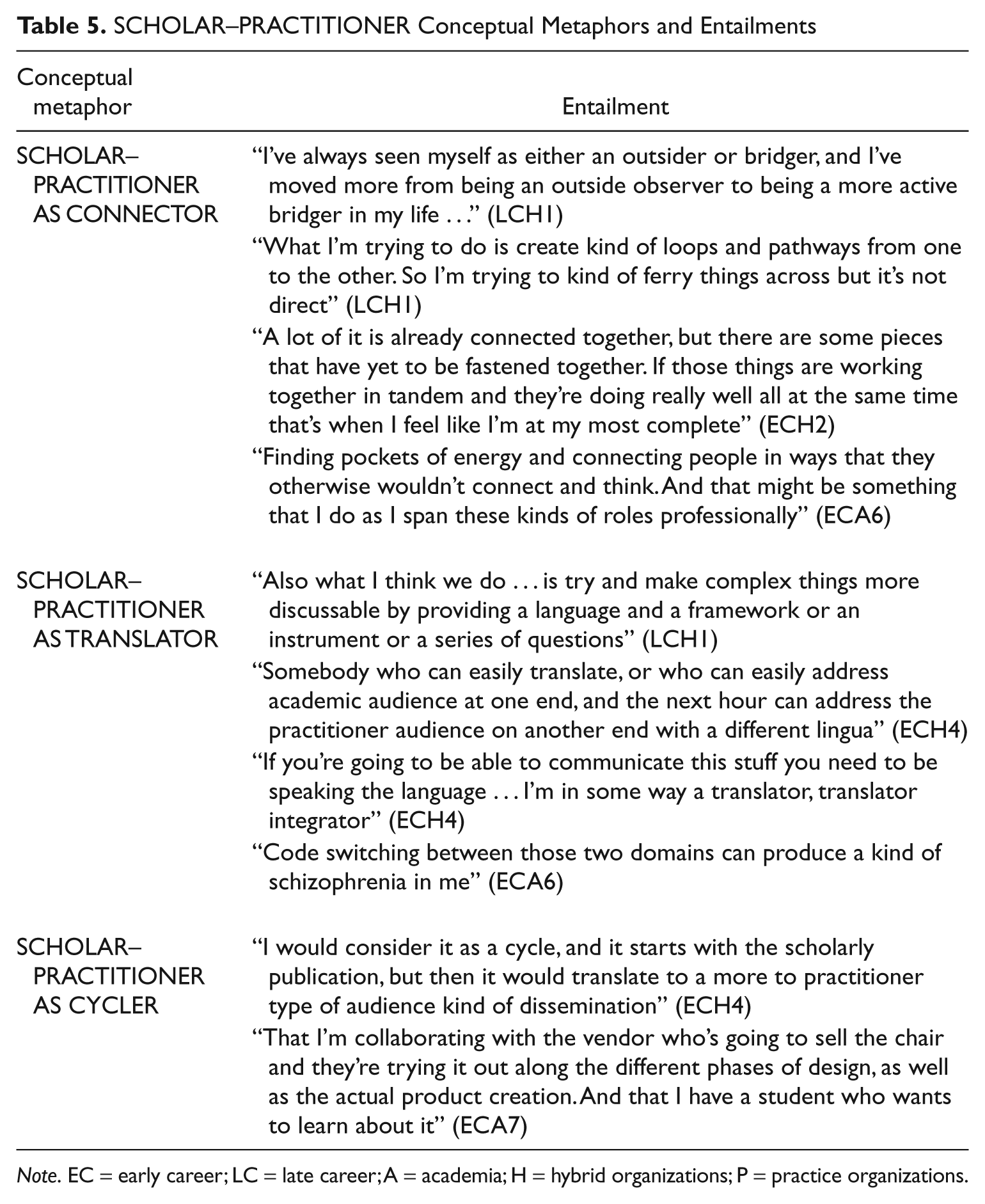
The metaphors that scholar–practitioners used to describe their role were uniquely different and had more variance than those that they attributed to the prototypical scholar and practitioner role. We interpret this, in part, to the complexity and ambiguity of the role. There were three conceptual metaphors that we heard and elicited in response to the specific invitation to express an image or metaphor: CONNECTOR (e.g., highway interchange) TRANSLATOR, and a CYCLER. Although each of these images is closely related, the fine distinctions are quite informative (see Table 5).
SCHOLAR–PRACTITIONER Conceptual Metaphors and Entailments
Note. EC = early career; LC = late career; A = academia; H = hybrid organizations; P = practice organizations.
Scholar–practitioner as connector
Many people we interviewed described their role and the role of other scholar–practitioners as a CONNECTOR between worlds. This choice of metaphor suggests that the world of scholarship and the world of practice were separate and distinct. The following quote, expressed by someone working in a hybrid setting, makes reference to creating these connections for the client:
So, helping others—something like a lot of jigsaw puzzle pieces . . . when you talk about that day-to-day stuff, I do see like that image of a bunch if jigsaw pieces that are on a table. And a lot of it is already connected together, but there are some pieces that have yet to be fastened together. (ECH2)
This quote from a scholar–practitioner is an example of one who is an owner of and thus a creator of a hybrid practice. This further amplifies the self-authorized role of connecting the abstract world of the Academy with the real world of practice through the medium of teaching:
I can imagine being in my MBA class and talking about a specific event that happened, and then I’ll say, so, OK, here’s how it happened with the client. What would you do if you were me now? I’m not going to tell you what I did . . . Then the exciting thing for them is, they know when they give the answer . . . I’m going to tell them eventually what I actually did, so they have a real-world example, which is what they crave, and what they said is missing in academia, and so they appreciate that. (ECP1)
Making a connection between the conceptual world and the world of practice for their students motivated and excited many of the people we interviewed.
Scholar–practitioner as translator
More than half the people we interviewed referred to the translating function of the scholar–practitioner:
A scholar–practitioner is somebody who can easily translate or who can easily address academic audiences at one and the next hour can address the practitioner audience with a different language. (ECH4) Well, what I try and do is look at in a very broad sense challenges that people are experiencing out there and seeing if we can help come up with some way to give people tools, concepts or strategies for dealing with that. Also what I think we do . . . is try and make complex things more discussable by providing a language and a framework or an instrument or a series of questions, a checklist that helps give people the opportunity to kind of identify and label what’s bothering them so that they can then go with that and figure out what to do. (LCH1)
Once again, the need to translate supports the conceptual metaphor of different social worlds where bridges need to be build, connections need to be made, and languages need to be translated. Many see themselves as always living across the worlds of scholarship and practice, poised to find opportunities to bring examples of one world to the other:
I think all of this has to do with sense making . . . when you’re in your academic role, or you’re writing, trying to make sense of the world . . . the teaching role . . . I can sit there and talk about my stories and get questions from students that I wouldn’t necessarily have thought of . . . And then when I’m doing practice, there are thoughts that come to mind based on discussions or ways that I’ve taught things where I’ve seen a hook work really well with adult learners, that I can then do when I’m in my role with a client. So the skills feel like they do transfer really well. (ECP1)
Connectors and translators both speak to a process of bringing the worlds of scholarship and practice together. The next metaphor, scholar–practitioner as a cycler, elevates the dynamic process of growing meaning in the oscillation between the two.
Scholar–practitioner as cycler
The third conceptual metaphor that we heard in describing the scholar–practitioner was one of a cycler: moving back and forth between scholarship, practice, and teaching/mentoring, with each role informing and building on the other. The interplay of scholar and practitioner highlight the complexity of cycling between both action and knowledge. Scholar–practitioners felt that the cycling process inspired their work with each aspect feeding the other:
And what I am trying to do is create kinds of loops and pathways from one to the other. I’m trying to ferry things across but it is not direct. It is not like going on a bridge. It is somewhat more convoluted. So that is why I think like about an aerial view of a very busy interchange where lots of roads come together. (LCH1)
Being a scholar–practitioner was, for some, a form of personal engagement and meaning. This seemed to relate to the degree to which the person we interviewed was at a self-authorized stage of personal development (Kegan, 1982, 1994):
It’s not me in my garage carving a piece of furniture. It’s me surrounded by other people who are interacting and working together to do it. That I’m collaborating with the vendor who’s going to sell the chair and they’re trying it out along the different phases of design, as well as the actual product creation. And that I have a student who wants to learn about it. (ECA7)
The boundary-spanning activities of being a scholar–practitioner make up a virtuous cycle with each of the activities feeding the others. The metaphor of a cycler suggests that scholar–practitioners embody this rhythm within themselves. The experience of this cycling varies, and among the people we spoke to, some were more self-authorizing than others (Kegan, 1982, 1994). Those who were self-authorized saw their feet firmly planted in the boundary-spanning role as the optimal way to serve, regardless of their professional home:
If those things are working together in tandem and they’re doing really well all at the same time that’s when I feel like I’m at my most complete . . . for me to feel like I’m at my total best, those are the times when everything is clicking on all of those roles. And when I might not be at my best is maybe when one of those roles is kind of dragging the other one down. (ECH2)
Appeal and limitations
The scholar–practitioner identity and its associated metaphors seemed to appeal to all of the people we spoke to. This may be somewhat skewed by our pool of interviewees who have high value for this boundary-spanning role.
I think it is enriched because it gives me a broader view and greater perspective. And I get to meet a greater variety of people . . . I like getting something accepted in a good academic outlet and at the same time having some way in which that concept can be helpful to people in real life in the classroom. Whether it be an article, just a flip chart exercise, an activity or an instrument or whatever it may be. So I like to hit both. (LCH4) If those things are working together in tandem and they’re doing really well at the same time that’s when I feel like I’m at my most complete. If one of those things is starting to get in the way, it kind of filters over and kind of floods over into aspects where I cannot really do my job as well. So for me to feel like I’m at my total best, those are the times when everything is clicking on all of those roles. And when I might not be at my best is maybe when one of those riles is kind of dragging the other one down. (ECH2)
Although the role of scholar–practitioner held almost unanimous appeal, respondents who were based in academic or practice home bases were more outspoken about the tensions of balancing:
There is a really interesting dilemma about within myself, about what’s my legitimate voice and then as I transition from role to role, is this a place where my voice of practice actually has primacy versus is this a place where my voice of academia has primacy? (ECA6) I guess the only thing that I sit with that really bothers me about this topic is, are organizations’ unwillingness to go there, into the scholarship place. They have all kinds of excuses. If you publish this, it’s proprietary, or they want it published, because they want to look good. They don’t really want to know what’s going on. And there’s a lot of garbage attached to that conversation, which means a lot of what gets learned doesn’t get shared. And that really bothers me . . . A lot of what gets learned in our field doesn’t get shared. (LCP2)
Still, the role consistently arouses a sense of ambiguity more so for early-career professionals than those whom have a more well-developed professional identity and voice. Perhaps this is attributed to the challenge of managing the performance expectations from the jobs they consider their home base with the integration they seek for their own professional satisfaction.
Discussion
Our interviewees’ career histories and home bases shaped the ways that individuals constructed their identities as scholar–practitioners. For example, those based in the academy found that they necessarily had to prioritize the tasks that were explicitly rewarded in that setting, whereas those in the practitioner world or in hybrid settings encountered other challenges that stemmed from the socialization and culture of these home bases. Our analyses also suggest that career stage (Hall, 2002) and developmental position (Kegan, 1982, 1994) shape the extent to which inherent conflicts created by the dual roles of scholar and practitioner were more troublesome to relative newcomers to the profession. It appears that with time in the role and the opportunity to become more self-authorizing, the more experienced individuals found ways to effectively navigate these tensions and find a satisfying way to balance the competing priorities.
Our clinical inquiry approach—a semistructured interview designed to evoke individuals’ personal reflections on how they enact their work, as well as specific metaphors of the scholar, practitioner, and scholar–practitioner—enabled us to analyze these data using methods outlined by Andriessen and Gubbins (2009), Heracleous and Jacobs (2008), and Lakoff and Johnson (1980). Rich descriptions of the metaphors and systematic examination of linguistic entailments found throughout the interview enabled us to discover and illustrate the nuances and complexities of the scholar–practitioner role and to uncover how particular institutional contexts and career histories shaped the work of clarifying one’s professional identity (see Table 6).
Summary of Conceptual Metaphors

Metaphors and Identity Work
When describing images of THE SCHOLAR, interviewees consistently described high standards for rigor in research and publication efforts (e.g., number of publications in A-quality journals) and the expectation that one must develop deep expertise in a narrow area of study (See Table 2). Whether one lives in the Academy, a hybrid organization, or a consulting practice, the work of the scholar was perceived as requiring total dedication to generating new ideas with the primary purpose of filling gaps in existent theory (rather than with the primary purpose of improving dynamics in organizations). This led to the belief that efforts to engage in collaborative problem solving with practitioners were a distraction from what really counts.
In contrast, images of THE PRACTITIONER included fast-paced problem solving and quick solutions to pressing problems (See Table 3). In addition, they were noticeably void of time for reflection, contributing to theory, or writing. Although the pacing of the conceptual metaphors for each of the two roles differed dramatically, both evoked negative affect from our interviewees that stemmed from the perceived limitations of each role. All of our scholar–practitioners experienced greater satisfaction and effectiveness when they were able to alternate between the two roles, and some had experienced the potential for synergy and integration that the seasoned scholar–practitioners described in our first study. Clearly, both sets of metaphors constrained how interviewees enacted their professional roles.
Rather than constraining behavior, the metaphors of the SCHOLAR–PRACTITIONER broadened the range of activities that our interviewees ascribed to this work role. The opportunity to bridge the two worlds, and to create a synergistic relationship between the two types of work, was universally appealing. At the same time, the fact that most of the home bases represented in our study did not value an important part of their professional identity was a source of frustration, self-doubt, or a wish for better alignment with the employing organization’s culture. Notably, scholar–practitioners based in hybrid organizations felt more valued by their institutions than the others, with the exception of those in a handful of universities whose mission was to train scholar–practitioners or where teaching, research, and consulting were equally valued.
Our analysis of metaphors surfaced more variation among the collection of scholar–practitioner metaphors than among the collection of scholar metaphors or practitioner metaphors (see Table 4). It may be that since scholar and practitioner roles have long been institutionalized by and valued in their respective home bases, these metaphors are constrained by the institutions in which they emerge. The consistency in metaphors represented by the scholar identity and the practitioner identity is a reflection of the dominance and historical roots of these institutions. In contrast, the absence of a consistent scholar–practitioner metaphor reflects its nascent institutional stage. There are far fewer institutions that define, or whole-heartedly endorse, the role of scholar–practitioner. As a consequence, scholar–practitioners face more ambiguity in defining their work. Along with this ambiguity is the opportunity to craft their own image that is not limited by traditional notions that are institutionally rewarded.
Historical, Relational, and Contextual Influences
The narratives of our interviewees reveal how the scholar–practitioner identity is constantly in negotiation and is relationally constructed through the looking glass of dominant logics. This looking glass effect, as described by Cooley (1902), is a reflection of the relational dynamics of identity (Gergen, 1995, 1997; Sluss & Ashford, 2007), where identity work for the scholar–practitioner ultimately revolves around constructing an identity in relation to existing logics of scholarship and practice. By comparing the metaphors that scholar–practitioners ascribe to the two different prototypes of scholar and practitioner, we noted an interesting connection between the SCHOLAR AS PRODUCER and the PRACTITIONER AS USER metaphors. Both metaphors suggest an underlying market logic of exchange value, with perceptions of the prototypical scholar and practitioner as two ends to a value chain. The scholar–practitioner metaphors that we discuss in the subsequent section further suggest how this logic is enacted in the metaphors that position the scholar–practitioner as the middle person of this value chain.
In contrast, the SCHOLAR AS DEEP THINKER and PRACTITIONER AS MOVER metaphors are governed by two different logics—the logic of professionalism and the logic of the market, respectively. These two logics are perceived as contradictory and antithetical in how interviewees describe the metaphors. The negative valences attributed to the SCHOLAR and PRACTITIONER are manifestations of this perceived contradiction—the scholar is too slow and works in isolation. The practitioner moves too fast and is only concerned with pleasing others.
The identity work for young scholar–practitioners is situated in the context of these contrasting logics and can be seen as a struggle for personal and institutional verification (Kreiner et al., 2006; Sveningsson & Alvesson, 2003). This struggle occurs when institutions cease to be the “home” of the scholar–practitioner; instead the institutions of SCHOLAR and PRACTITIONER are experienced as external forces that inject doubt into the formation of a stable boundary-spanning identity. Some of our interviewees astutely recognized the nature of this struggle when they spoke of how their work was devalued and/or simply unrecognized by the formal and informal norms of their home base. Central to the identity work of scholar–practitioners is the dissonance between dominant logics and the construction of a boundary-spanning identity. In particular, we found that the dominant logics of the SCHOLAR and PRACTITIONER influence how younger scholar–practitioners behave in a way to be affirmed by their home institution. In contrast, senior scholar–practitioners have the benefits of social status to redefine these logics. For junior respondents, role conflict ensues as a result of conforming to dominant logics. This is exacerbated through the process of social comparison with peers. Identity struggle ensues, out of the inability to reconfigure or challenge the dominant logic. Not surprisingly, how young scholar–practitioners enact their work and the metaphors they describe appear to be shaped not only by the current institutional context in which they are situated but also by their career histories.
One interviewee who had spent no time in a consulting or business role could not offer a metaphor for the work of THE PRACTITIONER and did not identify at all with the work of THE Scholar-Practitioner. Those who had worked in business or consulting prior to their doctoral studies consistently had a better sense of the connection between scholarship and practice. In fact, most of these individuals had returned for doctoral study because they wanted to deepen their knowledge of the literature, have time to reflect on what they experienced and observed in the fast-paced world of business, and learn how to engage in valid research that would contribute insight and solutions to complex problems. Their prior experiences enabled them to imagine the bridging and cycling that comprise the conceptual metaphors of the SCHOLAR–PRACTITIONER. Those with little or no experience in the world of practice found it more difficult to imagine or enact these synergies without the role modeling and guidance of mentors and peers.
Finally, among our young scholar–practitioners, some were quite self-authorizing, as evidenced by their willingness to define and prioritize their work in a manner that aligned with their personal values and vision, even if the reward system of the current context did not. For example, several of our recently appointed assistant professors, though quite aware of the requirements for tenure, found ways to leverage their client work in to research that they could publish in respectable academic journals. Several other recent PhDs decided to take positions that were not aligned with what their doctoral program mentors expected of them—they chose to go to a lower tier university so that they would have more time for teaching and consulting, or they chose to go to a hybrid organization where consulting was mission critical. In contrast, those who were less self-authorizing were wary of doing any work that was not rewarded and/or sanctioned by their university.
Identity struggles take place as a result of institutionally defined role expectations that are essentially confrontational to the boundary-spanning nature of the scholar–practitioner role (Pratt & Kraatz, 2009). Such expectations take on an objective reality that confronts the individual as an external and coercive fact. Such identity struggles are played out in the everyday realities of the scholar–practitioner (Kreiner & Sheep, 2009). Persistent identity struggle can eventually leads to alienation and the decision to conform to the dominant logic.
Questions for Future Research
There are a number of questions that stand out for future investigation. First, given the differences in metaphors that correspond with home base and career history, we wonder about the early socialization experiences—the career imprinting (Higgins, 2004)—that empower individuals to embrace the scholar–practitioner role. Several university settings stand out for training scholar–practitioners as part of their organization’s mission (e.g., Case Western Reserve University, Fielding University). Yet many in our sample did not study at these programs. What else enabled individuals to define the work of a scholar–practitioner and then to enact the role, and how and when does this occur for young professionals? There are data in our interviews to suggest that mentors and role models are an important source of inspiration and socialization (Ibarra, 2003; Kram, 1996; Sluss & Ashford, 2007).
Second, does our understanding of the complexities of this boundary-spanning role apply to other occupations? Clearly physicians are scholar–practitioners when they are clinicians and also do scientific research to develop new insight in to how to prevent or control diseases. Rosenberg (1999) describes scholar–practitioners as an essential yet fragile link in the medical research chain, and yet, as medical scholars observe (Holcombe, 2005; Ley & Rosenberg, 2005), the physician-scientist career is increasingly endangered. Similarly, lawyers who write, teach, and practice are also scholar–practitioners. Are the conceptual metaphors discovered here relevant to those occupations? Are they relevant to others?
From an identity construction perspective, how do metaphors for SCHOLAR, PRACTITIONER, and SCHOLAR–PRACTITIONER evolve over time? Given what we know about the process of identity development (Ashforth & Mael, 1989; Pratt et al., 2006), and the differences between our first and second samples of scholar–practitioners, we speculate that individuals’ metaphors are refined over time, reflecting regular reassessment, redirection, and identity reconstruction efforts. This developmental process is likely to be shaped by what is occurring in the social, economic and political environment as well. To tease out these various influences, it would be useful to have longitudinal data, in addition to the cross-sectional data that we have analyzed thus far.
The identity construction work reflected in our interviewees’ metaphors are, in part, complementary to the pathways to positive work-related identity construction recently identified (Dutton, Roberts, & Bednar, 2010). These scholars suggest that the work context and in particular the relationships that one develops are critical to helping individuals feel virtuous about the content of their work, evaluate their identity positively, and deepen their understanding of how to integrate various roles (in this case scholar and practitioner) into a viable and satisfying professional identity. Similarly, our findings suggest that the dual-role identities of “scholar” and “practitioner” can be mutually enhancing instead of conflicting or competing. The metaphors of SCHOLAR–PRACTITIONER AS CONNECTOR, TRANSLATOR, and CYCLER provide a dynamic lens into this process. These positive pathways enable individuals to build a complementary identity structure that minimize role conflict. Ultimately this positive identity construction work will lead to positive affect and performance at work. The positive valences associated with the SCHOLAR–PRACTITIONER metaphors are one example (see Table 6).
Since institutional context, doctoral training, and career stage appear to significantly influence how individuals enact this boundary-spanning role, there are implications for developing future scholar–practitioners. First, it seems essential that at the outset of careers, individuals benefit from experiences working in organizations or as consultants to ground future inquiry in the practical world of organizational life. Second, regardless of the organizational context/home base in which the scholar–practitioner works, exposure to experienced scholar–practitioners early in a career provides critical role modeling and guidance in order to establish a vision of this boundary-spanning role and professional identity. This is particularly significant as the role of the scholar–practitioner is not fully authorized by the very professional contexts (i.e., academic or consulting) that shape these careers. To date, job categories, reward systems, and professional titles are primarily validating one aspect of the hyphen or the other. Those concerned with creating an institutional context that helps validate the scholar–practitioner identity must begin to imagine alternatives to the traditional contexts that have served as home bases thus far.
We must continue to ask: What would the ideal socialization of new PhDs who are committed to scholarly and action-oriented activity look like? How might the metaphors we heard be used to foster dialogue and shared reflection among aspiring and experienced scholar–practitioners? How can we create venues that regularly invite and enable these boundary-spanning professionals to improve their craft? Given the complex problems that organizations face, it seems critical to attend to these questions sooner, rather than later.
Limitations of This Study
In both interview studies of scholar–practitioners, we used a clinical inquiry approach to develop think descriptions of our interviewees’ experiences as scholar–practitioners (Coghlan, 2009; Schein, 2006, 2008). However, comparisons across the two samples were difficult and indirect because we made a decision to employ a metaphor approach in the study reported here. Since our primary purpose was to extend the understanding we developed in the first study by focusing on younger, newly minted PhDs, the change in method seemed warranted as it promised to crystallize the identity work undertaken by young scholar–practitioners.
We compensated for this difficulty by regularly reflecting on how the change in method shaped the data and made sure to maximize the shared reflective process that this clinical inquiry approach necessitated. In doing so, we checked one another on comparisons and contrasts indicated in the data to insure that these were grounded in valid information from both studies. Our research team comprised three scholar–practitioners with different career histories: One of us is a practitioner in her own consulting business, and two of us are university based; two of us are senior in our respective fields, and one is in the process of completing his doctorate after a number of years working in a hybrid setting. As a consequence, we alternated between identifying with a particular imagery and taking a more objective stance toward the data. Our variations in experience and backgrounds enabled us to use a balance of empathy, identification, and objectivity in analyzing the metaphorical entailments, labeling them, and interpreting their meaning.
Finally, as already mentioned, the cross-sectional nature of this study limits our insight into the identity construction process over time and throughout the life course. However, we can imagine that following a group of scholar–practitioners over time would further illuminate how changes in developmental position, relational influences, and context (micro and macro) shape this ever-evolving identity work. This study demonstrates the wealth of data that can be mined for these multiple purposes.
Conclusion
In this study, analysis of participants’ metaphors sharpened understanding of the perceived differences between the work of scholars, practitioners, and scholar–practitioners. This approach to the study of how people experience their work was particularly useful in gaining a better understanding of how the institutional context of individuals’ home base shapes how and why they work as they do. In addition, bringing an identity lens to our analysis shed light on how individuals are able to an integrate the roles of scholar and practitioner and construct a professional identity in spite of sitting in a traditional academic or a consulting home base.
Within management studies, there has been a long-standing debate about the boundary-spanning identity of the profession, between scholarship and practice (Ghoshal, 2005; Gulati, 2007; Khurana, 2007; Pfeffer, 2005; Tushman & O’Reilly, 2007). Because metaphors are a critical link between professional identity and institutional expectations, an understanding of them can help inform career planning and policy for scholar–practitioners and the institutions they serve. Applying these new insights to scholar–practitioners in other professions holds wide promise for supporting the enactment of increasingly common, boundary-spanning roles in the future.
Footnotes
Declaration of Conflicting Interests
The authors declared no potential conflicts of interest with respect to the research, authorship, and/or publication of this article.
Funding
The authors received no financial support for the research, authorship, and/or publication of this article.