




Abstract
This study investigates five successful cases of nondominant firms’ learning with their powerful alliance partners and offers a unique perspective for elucidating how organizational politics affects nondominant firms. Based on a qualitative study, this study proposes a four-stage process model that indicates nondominant firms’ progressing from one stage to the next one, moving them from interorganizational learning to intraorganizational learning. To promote or resist either exploitation or exploration in nondominant firms, key interest groups exercise their power bases on one another in two ways: competing against a disapproved interest group or collaborating with an approved interest group. By enquiring about the interplay between politics and learning, the study reveals the effect of organizational politics on the strategic change of nondominant firms and offers valuable implications to both scholars and managers.
Introduction
Power is a key factor in an organization, as it mirrors the ability of individuals to control and achieve their preferred outcomes (Scott, 2001). However, power can influence behaviors of organizational members only when they are actually exercising their powers through political behaviors (Vince, 2001). Christiansen, Villanova, and Mikulay (1997) emphasized that it is the organizational politics among all involved players, which is a process within which power is dispersed and assembled among various interest groups, that can largely determine the outcomes of organizational decisions (Bacharach & Lawler, 1981). Organizational politics thus contributes to the social movements within a firm, based on which individuals may adopt specific types of behaviors while refraining from engaging in others (Coopey & Burgoyne, 2000; Hardy & Clegg, 1996).
This study asserts that politics provides superior understanding of organizational learning, the process through which firms improve performance by enhancing knowledge. Fox and Amichai-Hamburger (2001) regarded organizational learning as a political process in practice. Miller (1996) suggested that learning is a phenomenon involving the political concerns within an organization. Christiansen et al. (1997) found that politics can deeply and frequently invoke individuals to learn (or not). Lawrence, Mauws, Dyck, and Kleysen (2005) reported that politics leads a firm to switching between two organizational learning mechanisms, that is, “exploiting” by refining existing knowledge or “exploring” by developing new emerging knowledge (Gupta, Smith, & Shalley, 2006; Lavie & Rosenkopf, 2006).
Scholars have long debated the relationship between exploitation and exploration (Schildt, Maula, & Keil, 2005). Despite some interaction between exploration and exploitation (Gilsing & Nooteboom, 2006), there remains a trade-off between investment in exploiting existing knowledge to reap profits quickly versus exploring new knowledge to secure future returns for a firm with limited resources (Gupta et al., 2006). Crossan, Lane, and White (1999) emphasized on the tension between exploitation and exploration. Dyer and Singh (1998) found that individuals with different learning preferences engage in political actions to influence the opinions of others to achieve either exploitation or exploration. Thus, this study posits that politics drives a firm’s strategic choice between the two learning mechanisms because politics mirrors the purposes and opinions of managers in a given period. However, the interplay between learning and politics has not been adequately clarified because of inconsistency in the literature. On one hand, DeDreu and Weingart (2003) argued that politics is detrimental to organizational learning since it leads to inequitable knowledge sharing. In contrast, Lewis (2002) asserted that politics incentivizes individual attempts to compete for authority by learning better.
In addition to intraorganizational learning, a firm can also acquire new knowledge from external parties via “interorganizational learning.” Because of the complex environment facing most firms, most firms cannot explore knowledge by themselves and they turn to interorganizational learning to enhance the abilities to search new knowledge jointly with external partners (Gilsing & Nooteboom, 2006). This study argues that the politics of interorganizational learning is relatively sophisticated since external parties bring more powers to the firm (Hardy & Clegg, 1996). Previous studies support the concept: Kale, Singh, and Perlmutter (2000) examined the mechanisms to manage conflicts among alliance partners; Dyer and Nobeoka (2000) revealed an uneven power distribution within a learning alliance; and Li and Rowley (2002) argued that firms control and force their alliance partners to adopt unique knowledge. Under the pressure from external partners, members of a firm may be compelled to learn even if they are not inclined to do so.
Knowledge flow in interorganizational learning may be bilateral among partners or unilateral from one party to another. In a unilateral learning alliance, in which one partner depends on the other partner to get knowledge, the “knowledge recipient” should be especially sensitive to the politics of the “knowledge source” (Hamel, 1991; Mowery, Oxley, & Silverman, 1996). This is because individuals with less knowledge are likely to be politically influenced by those who possess more knowledge (Shen & Cannella, 2002). This study considers a knowledge recipient in a specific alliance context, that is, that of nondominant firms. Nondominant firms are somewhat constrained by the external partners’ commands. The nondominance of a firm can be indicated by its inferior resource position in comparison with its major partners and a unilateral dependence to partners (Dyer & Nobeoka, 2000; Subramani & Venkatraman, 2003). Common examples of nondominant firms include licensees in technology agreements, suppliers serving large buyers, and less-experienced firms or late entrants in a network. This qualitative study thus aims to investigate how and why organizational politics in alliances, either within the nondominant firm or from an external dominant partner, can affect the learning of the nondominants.
Nondominant firms who lack resources may have difficulty controlling disruptive organizational change, and usually turn to key alliance partners for accurate directions (Baker & Cullen, 1993; Kraatz, 1998). Because of the imbalanced distribution of tacit knowledge among firms, Mowery et al. (1996) posited that external networks can help nondominant firms search for new knowledge. Despite the high prevalence of nondominant firms in today’s business world, relatively few studies examine their learning. For example, although many scholars have identified nondominant firms as eager participants in interorganizational learning, they regarded these nondominants as playing supplementary roles with respect to the successful learning of the dominant firms (Dyer & Nobeoka, 2000; Rothaermel & Deeds, 2004; Schildt et al., 2005). Some studies even indicate their “nonlearning” cases in alliances. For example, Cheng (2010) found that the goal of satisfying key partners is more apparent than the exploration of ideas by nondominant firms themselves in the alliances. Miller (1996) indicated that the firms with fewer resources are more likely to be influenced by the politics involved in securing resources from their partners. These social interactions with partners provide a means for external dominant partners to exercise their powers on the nondominant firms. This study argues that learning of nondominant firms may be mixed with their political actions, and attempts to clarify their learning natures in alliances to offer practical suggestions for nondominant firm managers to plan the strategic change through interorganizational learning (Sackmann, Eggenhofer-Rehart, & Friesl, 2009).
Theoretical Background
A review of related literature hereunder helps focus the scope of the qualitative study and yields a set of guidelines to identify key constructs coded from the field data.
Exploitation and Exploration
Exploration and exploitation are two basic patterns of organizational learning (Lipshitz, Popper, & Oz, 1996). March (1991, p. 71) defines exploration as “the pursuit and acquisition of innovation (newness)” and exploitation as “the extension and application of existing knowledge to other situations.” Exploration includes search, experimentation, and discovery actions, in a process with new ideas to be fully adopted by or diffused in a firm. Exploitation consists of refinement, research, and implementation events during which members refine extant organizational routines to other alternatives (Gupta et al., 2006). Exploration can achieve different trajectories: using intraorganizational learning to create new knowledge by the firm itself or using interorganizational learning to acquire new knowledge from other parties. Exploitation, however, often involves the adjustment, extension, and recombination of existing routines through intraorganizational learning (McGrath, 2001).
Although exploitation and exploration may be distinct from each other in nature, previous research still discusses their interaction. Some studies argue for the synchronous pursuit of both exploration and exploitation in different subunits of a firm, that is, “ambidexterity,” whereas other studies indicate a repeating and discontinued temporal cycling between them (Gupta et al., 2006). Rothaermel and Deeds (2004) and Lavie and Rosenkopf (2006) posited that exploration unilaterally leads to exploitation since creating value by exploitation requires prior exploration to identify new skills. Since exploration and exploitation have complementary goals but different costs for a firm, managers must usually switch between them on purposes (Lavie & Rosenkopf, 2006).
Organizational Politics and Power Bases of Interest Groups in Organizational Learning
Politics is the rule of divided societies without undue violence (Coopey & Burgoyne, 2000). Kacmar and Carlson (1996, p. 629) viewed organizational politics as “juggling with authority and power to influence an organization’s objectives and policies,” whereas Ferris et al. (1996) regarded politics as behavior that produces conflict and disharmony by pitting individuals or groups against one another, or against the organization. One actor may attempt to negotiate with, or manipulate another actor so that the interests of the former are satisfied by the effort of the latter. Organizational politics is a cyclical process in which powers are dispersed and assembled and therefore can moderate, modify, and enhance the behavioral changes of members. Organizational politics highlights the conflicts of interest within organizations since it can lead to a complex interaction of various interest groups with different kinds of power bases.
Power bases are derived from an individual’s use of superior resource positions to influence others, whether by design or accidentally (Pfeffer, 1981). Power bases are closely tied to the specific influences of given actors or to disciplinary systems to control members (Hardy & Clegg, 1996). Thus, power bases can be initiated in two ways: either from the discrete actions of members or from organized systems of practices. The first mode of power base refers to relatively discrete and strategic actions that are initiated by self-interested agents through their resource ownership, control, and formal authority in organizations. The second mode of power bases is exerted via ongoing routines and practices, including socialization, accreditation, and other practices performed by an agent who did not establish such practices (Lawrence et al., 2005; Scott, 2001).
Among the wide variety of power bases in organizations (Fiol, 2000), Lawrence et al. (2005) suggested that four forms of power bases appear in organizational learning. First, individual agents need the power base of influence, that is, access to scarce resources, relevant expertise, and appropriate social skills to promote a given new idea. Influence may informally initiate organizational politics such as moral persuasion, negotiation, and ingratiation. Second, new ideas can also be introduced when some agents use the force of their formal authority to limit the options available to other organizational members. Agenda setting, limiting decision alternatives, and eliminating opponents are political examples of using force. Third, the domination power base maintains the superiority of some specific knowledge by formally providing predetermined decision paths and prearranged systems for members to follow. Communication technologies, information systems, and physical layouts are tools to identify dominated decision paths. Fourth, the discipline power base can secure learning by formally offering or informally cultivating a mental system of expertise, understanding, and identification to members so that the members can better judge the usefulness of this learning. Political examples of discipline include training systems, team-based work, and socialization events in an organization.
Despite ongoing debates regarding the relationship between learning and power in literature, Lawrence et al. (2005) argued for a positive relationship between them. Accordingly, powers can contribute to either exploration or exploitation. For exploration, emerging ideas can be successfully interpreted as “useful” only depending on the powers of idea sponsors to influence other people around them. Once the idea is accepted to be experimented under extant organizational settings, it must overcome the doubt and resistance of some group members. To cope with such difficulties, idea sponsors should catch the attention of top management to receive enough power and support from them. Exploitation, on the other way, begins with decomposing organizational routines as assumptions to be recognized by individuals, informing them which routines should be strictly applied and followed. The key effect of power on exploitation is associated with the set of formalized structures and regulatory procedures with which the individual members work. The power rooted in formal structures ensures the application of existing routines by members either by offering them information to a given decision path or by presenting them corporate rules, norms, and values regarding an approved action.
Method
This exploratory study adopts a case-study approach and follows some guidelines of grounded theory to generate a process model (Strauss & Corbin, 1990). Similar to Pettigrew (1990), this study examines past events and connects their sequences with present consequences to determine for the effects. Unlike a structure model, the process model focuses on events from unambiguous qualitative data rather than variables. Events are defined as phases of sequences and given results. This study also explores the relationships between events involving multiple levels of analysis.
Sampling
Although multiple players may exist within a learning alliance, this study selects a one-on-one unilateral learning case with one dominant knowledge source provider and one nondominant knowledge recipient to simplify the qualitative data analysis. The cases were all from the Taiwanese computer industry. 1 This study uses a theoretical sampling and comparative case-study design (Eisenhardt, 1989). Three case selection rules were adopted to ensure replication as follows. First, this study contacted all members of a Taiwanese electronic business executives association via telephone and mail. Among these contacts, the executives of 34 firms reported that their companies had learning experience with a singular dominant alliance partner who shared knowledge with the company. After the initial inquiry, only 15 firms were recognized as one-on-one cases where the case firm regarded itself as the only apparent knowledge recipient in the alliance. Finally, one case was selected for each of five alliance types based on firm willingness to satisfy the research requests (see Table 1). Firm names have been changed and are referred to as Greek alphabet letters to ensure confidentiality.
Profiles of the Five Cases

This study considers the five cases introduced in Table 1: a local retailer ALPHA and its vendor OMEGA with global brand presences (a marketing alliance), a subcontractor BETA and its client PSI (an outsourcing contract), a licensee GAMMA and its licenser CHI (a licensing agreement), a late-entrant DELTA and a market leader PHI (an innovation alliance), and a local supplier EPSILON and its large buyer UPSILON (a supply agreement). This small number of sample cases may raise generalizability concerns, but focusing on only five firms enables this study to extract all information with limited research resources. Bourgeois and Eisenhardt (1988) and Eisenhardt (1989) also suggested that a case study with between 4 and 10 cases is suitable for theory development for phenomena that are insufficiently understood.
Unlike dyad studies, this study focuses only on the perspective of the nondominant firm rather than considering the opinions of both alliance partners. Power bases of dominant partners were considered only when they affected their nondominant firms’ learning. Knowledge from external dominant partners that represented new learning for nondominant firms was the focus of this study since we were interested in the asymmetric exchange that occurs in these situations (Subramani & Venkatraman, 2003). Nondominant firms were the only sources of field data, even for information related to their respective dominant partners. This is because all five cases refused to announce the names of their dominant partners due to the existence of informal confidentiality treaties in forming alliances, an arrangement that is popular in the Taiwanese business culture.
Data
More than three people were interviewed for each case, and each participating individual was interviewed at least twice. Therefore, the data included 45 interviews conducted from February 2006 to June 2007. Interviewees were selected based on three guidelines. First, the general manager of each case firm was interviewed to get a rough picture of the learning with dominant partners. Second, based on the referrals of the general manager, key managers related to the alliance were interviewed. Finally, other managers were interviewed if they were regarded as being engaged in the crucial learning events. There were two types of interviews: unstructured and semistructured. The initial meeting with each interviewee involved an unstructured interview lasting more than 2 hours. The questions to be asked during each interview were faxed to the interviewee 1 week before the interview. Semistructured interviews were then conducted to obtain additional information on specific issues. Because the researchers could not directly contact the powerful partner, other archival data (e.g., documents or meeting records) were also reviewed to corroborate initially collected interview data. Questionnaire–survey data were collected twice because of the inconsistencies remaining among the opinions of different interviewees: first, the ALPHA sales managers were asked to evaluate the power bases of OMEGA and second, the EPSILON order-planning managers were asked to evaluate the power bases of UPSILON.
Three main checkers and five coders reviewed the collected data to ensure interrater reliability. The checkers were business college professors with specialist knowledge, whereas the coders were MBA or PhD students. The coders who performed the interviews first gathered the original interview transcripts. Two checkers then performed a trial analysis of the transcripts, documents, and records to identify emerging concepts. Key constructs were identified based on the guidelines discussed in the literature. Finally, another checker, after reading the trial coding notes, gave approval or requested revision. This process helped ensure construct validity by improving the convergence of single constructs and the divergence among different constructs.
The constant comparative method was used throughout the data analysis process. As new field data were collected, it was continuously coded and compared with prior data to support or revise the tentative conclusions. This process was repeated until “theoretic saturation” was achieved based on three guidelines: first, no new crucial concepts emerged from the field data to alter the main findings; second, all three checkers consistently agreed on the findings identified from the five sampled cases; and third, two colleagues who study Taiwan’s computer industry reviewed the tentative findings and evaluated them as convincing evidences.
Results
As suggested by Langley (1999), this study presents the research findings as a process model in stages. A four-stage model is formulated to elucidate the results. Each stage is identified by classifying these critical events. Thus, the analysis consists of many event sequences in each case and then summarized as a timeline chart to realize how key changes occurred in each case. For instance, the timeline chart of GAMMA–CHI case is illustrated in Figure 1. As shown in Figure 1, a blue square grid with an arrowhead line (e.g., A1, A2, A3, B1, etc.) represents a critical event. The details of all events are described below the timeline chart. Each blue square grid is also labeled in the timeline to point out the approximate time when an event had occurred. The timeline indicates all the events in a sequence to reveal their temporal relationships. The spot(s) of each arrowhead line indicates the main unit(s) that is (are) associated with this critical event. The main learning pattern (either exploitation or exploration) in the unit that is initiated by this critical event is also presented. For example, A1 event is associated with the R&D department of GAMMA and its powerful partner CHI, and A1 then initiates the exploitation in the R&D department of GAMMA. To connect with the process model, the stage that belongs to each event is also remarked above the timeline.
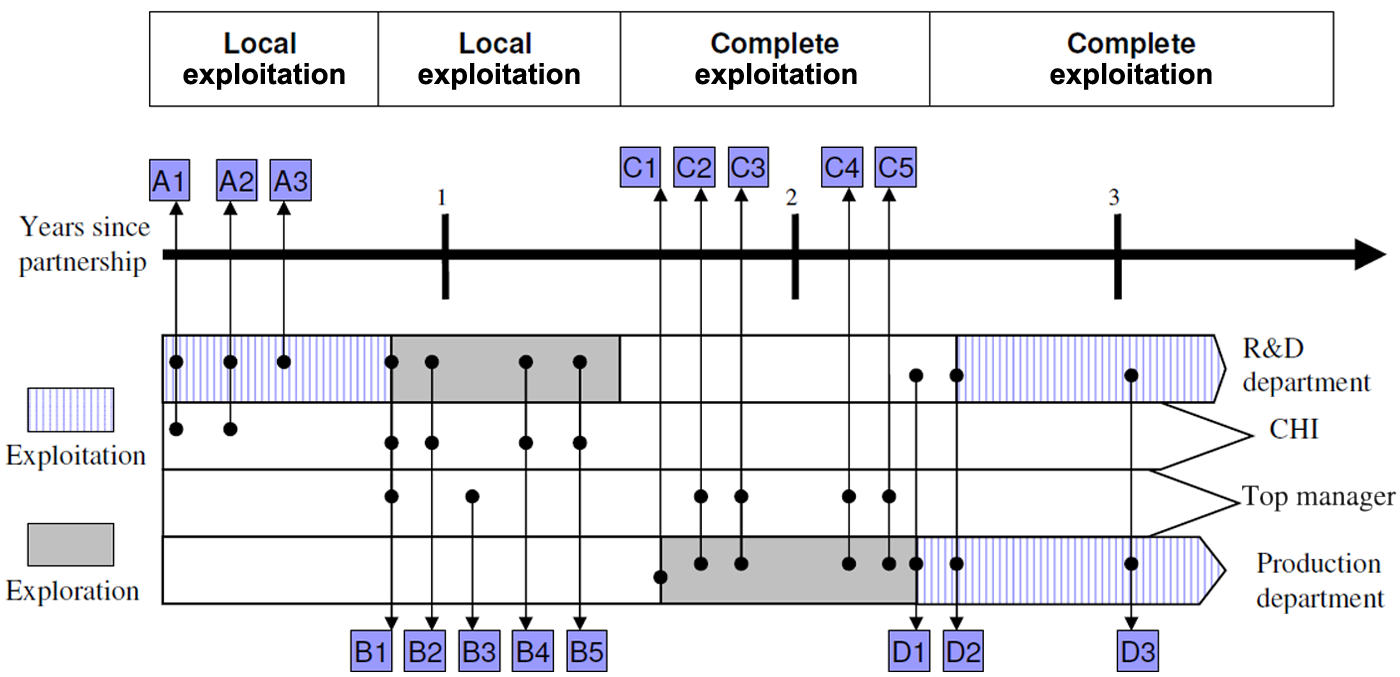
The example timeline chart of the GAMMA–CHI case
Some words are defined hereunder. “A focal unit” is a subunit of a nondominant firm that directly contacts the powerful partner in the alliance. The R&D department in a licensing agreement is an example of a focal unit. “A related unit” is another subunit in a nondominant firm whose operating process is associated with the focal unit. A production department using the licensed technology in a licensing agreement is an example of a related unit. Learning occurs “locally” when it is observed only in a focal unit, whereas learning occurs “completely” when it occurs in related units or other subunits in the case.
Stage 1: Local Exploitation
With little interorganizational learning, by which nondominant firms should receive new knowledge from the partners, nondominant firms only adjust their existing knowledge to quickly implement their familiar ways to finish the alliance duties:
As the only capacitor supplier for its client UPSILON, EPSILON must immediately satisfy the customized orders of UPSILON and deliver the goods to Singapore on time. UPSILON sent two information technicians to Taiwan to share its scheduling practices with EPSILON. However, the two UPSILON technicians later reported that EPSILON did not follow the shared scheduling principles and their opinions were ignored by the EPSILON order-planning managers.
When an antivirus-software designer DELTA and a leading internet-firewall provider PHI designed an integrated platform to jointly sell their software in a package to emerging markets, the plan failed because the DELTA engineers excessively adapted their software design for the personal customers. One DELTA engineer recalled the following:
We presumed that this new product should be easy-to-use and as cheap as those designed for personal-computer users and sold in the large chain stores. However, PHI told us this is not the way to do business in developing markets, where stated-owned enterprises and large firms are the major customers. We had to especially design the multi-functional and professional software for the institutional clients.
3. When the licensee GAMMA received the patents of automobile screws from its licenser CHI, the R&D managers of GAMMA made mistakes by relying heavily on their previous successful experience in designing computer screws. One GAMMA R&D manager stated the following:
We wanted to finish the project as soon as possible, and what we could do was to apply our original computer screw design modules to imitate the automobile screw patents. We called it as “reengineering thinking. But I think that we might have spoiled it.
Because a nondominant firm with a lot of survival pressure hopes to reap profits quickly by the alliance with a powerful partner, reusing its existing knowledge becomes the most efficient way for focal units to achieve this goal. Interorganizational learning does not happen in the focal units or anywhere else in the nondominant firms. The focal units construe the learning requests from powerful partners as a duty to finish rather than the new knowledge to receive. Stage 1 often results in a failure in interorganizational learning and represents maladaptation to the changing contexts of nondominant firms. Because there is only little intraunit learning (focal units superficially exploit their unit knowledge to quickly solve the unfamiliar alliance tasks), Stage 1 is therefore defined as “local exploitation.”
Organizational Politics in Local Exploitation
This stage contains two key interest groups: focal-unit managers (the leaders of the focal units) and the powerful partners. On one side, focal-unit managers adopt the force power to promote local exploitation, using their existing knowledge to accomplish alliance goals. The commands of focal-unit managers based on the formal authorities prevent their subordinates from adopting the external knowledge from powerful partners:
1. The ALPHA sales director warned his subordinates several times:
He always told that you should achieve performance targets as usual as you can, rather than waste too much effort on something you do not know! . . . The fastest way to achieve your performance is to sell OMEGA products to your existing public school customers by employing our best interpersonal relationship advantages. Do not write a stupid marketing plan to promote OMEGA products.
2. One GAMMA R&D manager said that
We must show our director the row-type product design in only three weeks and he always said that we must not waste much effort on new patents. A revised design, rather than a totally new one, was much more efficient for this temporary case.
In contrast, powerful partners fear that if their focal units embrace nondominant firms’ existing knowledge, they may fail to achieve the alliance goals. Powerful partners thus exert the influence power to provoke the changing desires of focal-unit members in two ways: introducing their best practices and providing valuable resources:
The OMEGA product managers usually attended ALPHA sales department meetings and actively shared their superior marketing knowledge with the sales managers.
PHI invited DELTA engineering directors to visit its local agents in India to present the design principle of antivirus software for institutional clients in developing markets. PHI showed DELTA the necessity to search for small-sized but professional local agents to provide easy-to-use products with sufficient after-sale support to the institutional clients. The complex product design of DELTA was inappropriate for the clients in developing markets.
CHI recommended that GAMMA should join in an advanced automobile materials association where it could easily meet potential clients in Asian markets.
Indeed, the external knowledge of powerful partners awakens the changing desires of some focal-unit members who recognize its value and excellence: (a) Several sales managers of ALPHA said that “But how could such a global company with a good reputation share with us this “stupid idea”? I still found that this marketing knowledge was very good at that time!” (b) One GAMMA R&D manager indicated that “We knew it was crucial to fully adopt new patents. I surely wanted to try the new way! The patents seemed to have many advanced technologies I did not know!”
Because focal-unit members are accustomed to complying with internal directives with authority, focal-unit members are still more likely to accept formal force power of focal-unit managers than informal influence power of powerful partners. Regarding alliances as “temporary tasks” to accomplish, focal-unit managers eliminate the effects of powerful partners on focal-unit members as much as possible to avoid change and to maintain the stability of the focal units. For example, the quality control (QC) director was astonished at the high defect rate (almost 11%) of the first finished stationary terminals by its outsourcing supplier BETA. Formerly, two QC managers of PSI had visited monthly to demonstrate the QC guidelines to BETA. Subsequent investigation by PSI indicated that most BETA production employees did not seriously follow the QC guidelines of PSI due to the formal request by the production director of BETA as follows: “Keep the producing procedure as usual as you can to do things stably.” Failures in the power competition against focal-unit managers motivate powerful partners to use other useful powers on the focal-unit members in the next stage to promote their superior knowledge.
Stage 2: Local Exploration
Concerning that the maladaptation of local exploitation may ultimately cause the failure of an alliance, the powerful partners begin to strictly enforce focal units to adopt their knowledge. The poor achievement of alliance goals caused by local exploitation also enforces focal units to adopt the knowledge from the respective powerful partners. During this stage, the real interorganizational learning is clearly observed within focal units. The main purpose of such interorganizational learning performed by the focal units is to better achieve the alliances tasks. Therefore, Stage 2 is defined as “local exploration.”
Such adoption of external knowledge is similar with a case of “trait-based imitation” since focal units are compelled to copy the best practices of their powerful partners (Cheng, 2010):
When ALPHA became an exclusive peripheral products retailer of OMEGA in Taiwan, OMEGA insisted that ALPHA should adopt its marketing practices to protect its global brand image. OMEGA offered many workshops related to sales promotion to train the ALPHA sales managers. The training manuals of these workshops showed that OMEGA strictly emphasized its marketing advantages to the ALPHA sales managers. The OMEGA product managers supervised the ALPHA sales managers to adopt the best marketing practices of OMEGA. A sales manager of ALPHA recalled the following: “Jobs were rearranged, stores were refurnished, and advertising was modified given that everything must be done in the OMEGA way!”
DELTA built an emerging market (EM) subsidiary to design suitable antivirus software for institutional clients in EMs. The subsidiary executive assigned the same professional local agents as those of PHI in the Indian and African markets to provide after-sale services to institutional clients.
PSI complained to the general manager of BETA about the high defect rate, and threatened to suspend the outsourcing agreement. Top managers of BETA then reallocated the “B–P unit” to specifically produce for PSI. PSI also sent another four QC managers to supervise BETA. The design of the B–P unit was mostly based on the opinions of these four PSI QC managers. One BETA production manager recalled the following: “It seemed that there was a colony existing in our department. The B–P unit strongly resembled PSI, and it followed the layouts, routines, and practices of PSI, rather than those of our company.”
Organizational Politics in Local Exploration
The key interest group pushing local exploration is the powerful partners, who lost their superior power positions at the stage of local exploitation given that focal-unit members stick to comply with authorities of focal-unit managers to resist change. To seek power supports from another more powerful internal interest group, powerful partners collaborate with top managers of the nondominant firms. Top managers, who take charges of the entire nondominant firm, assist powerful partners with an aim to better achieve the alliances tasks. By asking focal units to copy similar practices, powerful partners can easily direct and monitor the behaviors of the focal-unit members. Spanning operating boundary to the nondominant firms, powerful partners thus manage focal units as their owned “virtual affiliates.” Cancelling the ineffective and informal influence exerted at the stage of local exploitation, powerful partners perform force and domination powers. Both power bases are embedded with sufficient formal authorities granted by internal directives (top managers) to enforce subordinates (focal-unit members) to adopt the external, unfamiliar, and risky knowledge.
First, powerful partners use their powers based on the legal contracts items to compel (force) focal-unit members to accept their knowledge:
Integrating as many formal joint teams, each product manager of OMEGA led few sales managers of ALPHA and had the resources and authority to monitor these sales managers to strictly follow the best marketing practices of OMEGA in their selling procedure.
The general manager of BETA formally authorized the four representatives of PSI to evaluate the employees in the B–P unit.
CHI became a major stockholder of GAMMA and certainly had the authority to ask the R&D managers to design automobile screws based on new patterns.
Second, powerful partners also predetermine decision paths for focal-unit members by setting up some rules to keep the superiority of their knowledge over that of the nondominant firms through domination:
Both OMEGA and PSI held workshops, and seminars to promote their “best and superior practices” to their respective focal-unit members.
UPSILON asked EPSILON to replace the original scheduling paperwork system by installing the electronic scheduling software of UPSILON. An order-planning manager of EPSILON recalled that
They said that the electronic scheduling system was ten times faster and more precise than our out-of-date paperwork system. One UPSILON technician continuously told me that we wasted too much time waiting for orders. The electronic scheduling could minimize the lead time to an invisible level.
It seems that the alliance types modify the power base exerted by powerful partners in local exploration. In innovation (GAMMA–CHI) and licensing (DELTA–PHI) alliances, CHI and PHI (powerful partners) use less domination power on the respective focal-unit members to promote their knowledge. Given that the presumed goals of nondominant firms to join in both innovation and licensing alliances are to get the superior knowledge from powerful partners, it is not necessary for powerful partners to secure the superiority of their knowledge by playing extra politics, which may waste key resources and provoke further resistances of the focal-unit members (Li & Rowley, 2002).
Under the pressure to obey the legal contracts and to ensure the achievement of the alliance goals, top managers must monitor focal units and thus become the agents for powerful partners to push local exploration:
In face of the vice chairman of UPSILON, the general manager of EPSILON commanded the order-planning director to completely switch to the electronic scheduling software within 2 months.
The general manager of BETA fired out some production managers because they did not seriously meet the QC guidelines suggested by PSI. One BETA production manager recalled the following: “Our general manager sent clear signals to us that PSI was too valuable to be offended.”
The chairman of GAMMA proposed a long-term consulting agreement with CHI. He told the R&D managers that GAMMA should carefully follow every valuable suggestion of CHI to successfully enter the automobile screw market in Japan in the next 2 years.
The general manager of ALPHA quickly changed the corporate human resource policies to support the training requirement of OMEGA. The training workshops with the marketing skills of OMEGA then became the standardized training practice for each ALPHA sales manager to frequently receive. During a formal corporate meeting, the general manager of ALPHA severely reproved the sales supervisor for his mutters against the training program of OMEGA. The general manager later summoned all the sales managers of ALPHA in a sales meeting. One sales manager recalled the following:
I remember the morning when we were all together. The general manager told us that we should devote ourselves to the growth of the company. OMEGA can help us to earn more benefits, and we should do everything that OMEGA hoped us to do, even under the disapproval of our supervisors. You can image what we felt! The real boss was talking! It’s easy to guess who we would listen to.
Stage 3: Complete Exploration
Benefits of local exploration are increasingly realized in the nondominant firms on the basis of the knowledge-sharing advantage of interorganizational learning. Given the interdependency among all subunits within a firm, the continuous adoption of external knowledge (as that copied from powerful partners) by focal units must provoke the needs of change by related units (Miller & Friesen, 1984). To maintain the consistency within the firm, practices copied from powerful partners are diffused from focal units to other related units. Nondominant firms must also discover other new knowledge to support the full adoption. In doing so, top managers hope to further explore the advantages of previous interorganizational learning via the intraorganizational learning by the firms themselves. Accordingly, Stage 3 is named as “complete exploration”:
Since adopting the electronic scheduling system from UPSILON, the order-planning department of EPSILON (a focal unit) suggested that both the production department and the engineering department (related units) must also adopt the electronic system to keep the consistency of the entire operating process. The vice general manager (who was the former order-planning director) also supported this idea. The general manager accepted the proposal and then asked the corporate information technicians to design another comprehensive electronic software system to connect all the operating processes related to production activities.
Terminating the partnership with OMEGA, the general manager of ALPHA found that the performance of the sales department had been actually improved with the accustomed product management (PM) support of OMEGA. As a result, top managers then decided to assign the extant promotion department as the newly established PM department to assist the sales managers by the company itself. By referring to sales managers and imitating the training principles required by production managers of OMEGA, ALPHA built its own PM department in a few months.
The financial problem of BETA was solved because of the achievement of the outsourcing contract with PSI. The production quality of the B–P unit had also continuously improved during the past 15 months. After the returns of the four QC expatriates of PSI, BETA must assign its own QC managers. The general manager of BETA assigned the extant R&D department as the new Research & Quality Control (R&QC) department. Integrating with the only three existing QC technicians in the production department, the R&QC department must discover other suitable technologies to improve the QC expertise for all the products of BETA by imitating and referring to the training materials of PSI.
Organizational Politics in Complete Exploration
Top managers of the nondominant firms are the key interest group to push complete exploration. Restated, top managers are the supportive interest group (with powerful partners) to push local exploration. However, top managers face a dilemma due to local exploration: the improved performance of focal units versus the internal inconsistency between focal units and other related units to cause inefficiency. To solve this dilemma, top managers ask related units (especially for those with bad performance records) to imitate focal units via adopting external knowledge. To fully adopt external knowledge, top managers seek to continuously experiment the advantages of local exploration and to create other related knowledge depending on the firm itself (i.e., intraorganizational learning).
Top managers use two power bases. First, formal force authority is used to enforce related-unit members to change:
One promotion manager of ALPHA recalled the following:
I could tell you that the ideas were all enforced and achieved by the general manager. He was the boss and he initiated all of the processes. He told to us that we needed the new business model to do things and that we must learn from OMEGA the new way to do things.
2. After the EM subsidiary revised its antivirus software to cater to the institutional clients in the Indian market as suggested by PHI, the vice general manager of DELTA asked the poorly performing Southeast Asian (SEA) subsidiary to change its retailing policy to search for other professional local agents and designed antivirus software products for the local public schools or government offices.
Second, top managers build a new discipline system to change the operation guidance and criteria for related-unit members:
EPSILON became a publicly traded company in the stock market and therefore had to provide sufficient internal control and managerial records for their investors. Thus, the top management team at EPSILON announced a policy that every internal operating activity (e.g., production and scheduling functions) should be recorded using a new corporate electronic data system. The information collected from the system was often checked and then feedback was given to make managerial decisions.
The general manager of ALPHA promoted numerous training and recruitment projects to ensure that the best PM practices of OMEGA diffused to the new PM department. The general manager also displayed a PM-based operation plan during an annual business meeting.
Top managers of BETA developed a 5-year strategic plan to become a specialized subcontracting manufacturer with advanced and diverse QC skills. The general manager said that “We wanted to serve more outsourcing clients. Good production quality means efficiency, cost reduction, and a low defect rate. We wasted too much R&D effort on the hopeless telephone products.”
However, related-unit managers (i.e., the leaders of the related units) without any contact previously with the powerful partners resist the internal knowledge diffusion because they recognize huge uncertainty of change. Related-unit managers then exercise the influence power to resist change via negotiation and ingratiation, ultimately refusing to adopt the new practices:
The ALPHA promotion director argued with the general manager through a serious of boycotts, and used his personal relationship with the board chairman to forbid the change.
Some senior R&D managers at BETA argued that the company should develop more advanced telephone products rather than becoming a subcontracting factory. They even invited their largest telephone product client to help persuade the general manager.
The production director of EPSILON provoked the most resistance from his employees, delaying the adoption of the electronic software system in the production department for 5 months.
DELTA received protests from Malaysian labor union because the sales chairman in the SEA subsidiary complained to the local union, saying that the subsidiary hired another new dealer for institutional clients and dismissed 70% of its local salespeople in the personal-customer market.
Since the informal influence power of related-unit managers is less effective than the formal powers (force and disciple) of top managers, top managers overcome the power competition against related-unit managers: (a) One third of promotion managers at ALPHA resigned within 6 months. (b) Two senior R&D managers at EPSILON were finally laid off for their vigorous debates with the general manager at board meetings.
Stage 4: Complete Exploitation
Complete exploration intensifies the conflicts among subunits of a nondominant firm due to the confusion caused by the newly changed business models. Related units must collaborate with the focal units to further research the external knowledge that has been fully adopted at complete exploration. They also should recombine the external knowledge with the existing knowledge system:
Two years after the establishment of PM department, the ALPHA sales department divided into three strategic business units (SBUs): a peripheral product SBU, a personal computer SBU, and a notebook SBU. Based on the practices only related to promoting the peripheral products (as those learned from OMEGA before), the product managers of ALPHA faced challenges in promoting personal computer and notebook products. Because ALPHA was experienced in serving state-owned enterprises by applying its notable public relations skills, the product managers and sales managers were able to refine the marketing guidelines by combining the developing PM practices with the existing public relations practices. The combination set of marketing skills could promote all the three types of major products.
The general manager of BETA redesigned the production department into four production lines to serve more subcontracting clients. Each production line included its own production managers and QC managers, and served one unique client. These managers jointly researched the suitable QC skills and production procedures for the needs of different clients.
Learning now is mainly the results of joint research by the focal units and related units, extending the usefulness of the fully adopted external knowledge with the support of the existing knowledge system. The two units incorporated the valuable and compatible parts of the external knowledge into the existing routines and applied the combined knowledge to other alternatives. Because of its goal of implementing large-scale intraorganizational learning within the firm, this stage is referred to as “complete exploitation.”
Organizational Politics in Complete Exploitation
Related-unit managers primarily promote complete exploitation to better refine the learning results remaining from complete exploration. With the assistance from focal-unit managers, related-unit managers begin to implement the fully adopted knowledge into other operations of nondominant firms. Close power collaboration among managers in related units and focal units satisfy the need to purposely leverage the value of the fully adopted external knowledge in a timely manner, mirroring the typical trait of exploitation (McGrath, 2001). To efficiently implement the adopted knowledge in other organizational situations, managers in both units used the discipline power base to build some systematic routines to lead their members to use more purposeful exploitation. The formally or informally designed teamwork projects mirror the typical socialized routines to strengthen the willingness of members in both units to engage in learning:
There were regular knowledge-sharing discussions between sales managers and product managers in ALPHA. The directors of both departments also promoted a weekly “virtual joint team” program in which one product manager and three sales managers were voluntarily integrated together as a supportive group to share their ideas about refining the sales modules.
The joint team policy and the co-training program between the QC managers and the production managers were formally carried out in BETA. All the interviewees of ALPHA and BETA reported that they received strong support in learning due to the design of these cross-unit teamwork programs.
Teamwork routines also enhance organizational identities of members to willingly research the ways to leverage more values from the fully adopted knowledge, achieving the ultimate goal of local and complete explorations:
When GAMMA first served an Asian automobile screw client, the client asked GAMMA to deliver the customized products in only 2 months. To attain this goal, R&D directors and production directors jointly announced a teamwork project with the frequent discussion and on-time information exchange between both departments. GAMMA, thus, could design and produce the customized products quickly.
When the SEA subsidiary of DELTA begun to serve many Malaysian public schools, it largely depended on the support and practical training from the EM subsidiary to design products and after-sale services for these clients. The two subsidiaries finally united as the New Business Division in 2 years.
Progression From One Stage to the Next: A Four-Stage Process Model
Table 2 summarizes the politics and some example evidences of each of the four stages. Figure 2 illustrates the results in a proposed process model. The power interaction, either power competition or power collaboration, between the most critical interest groups triggers the organizational learning consequences selected by nondominant firms. For local exploitation, it results from the attempt of focal-unit managers, who win the power competition against powerful partners, to keep the internal unit stability by resisting external knowledge. Powerful partners, who hope to fight back their dominancy, then collaborate with top managers to get enough power to successfully achieve the alliance tasks via local exploration. The advantage of local exploration triggers top managers to diffuse external knowledge around the firm and to create other new knowledge by their own effort. After overcoming power competition from related-unit managers who resist change, complete exploration is smoothly pushed. However, complete exploration raises the confusion of related-unit managers about the utility of the external knowledge. By collaborating with the focal-unit managers to efficiently employ powers, related-unit managers use complete exploitation to research the fully adopted knowledge in the support of the existing knowledge system and to exploit more values.
Evidences of Politics in Each of the Four Stages

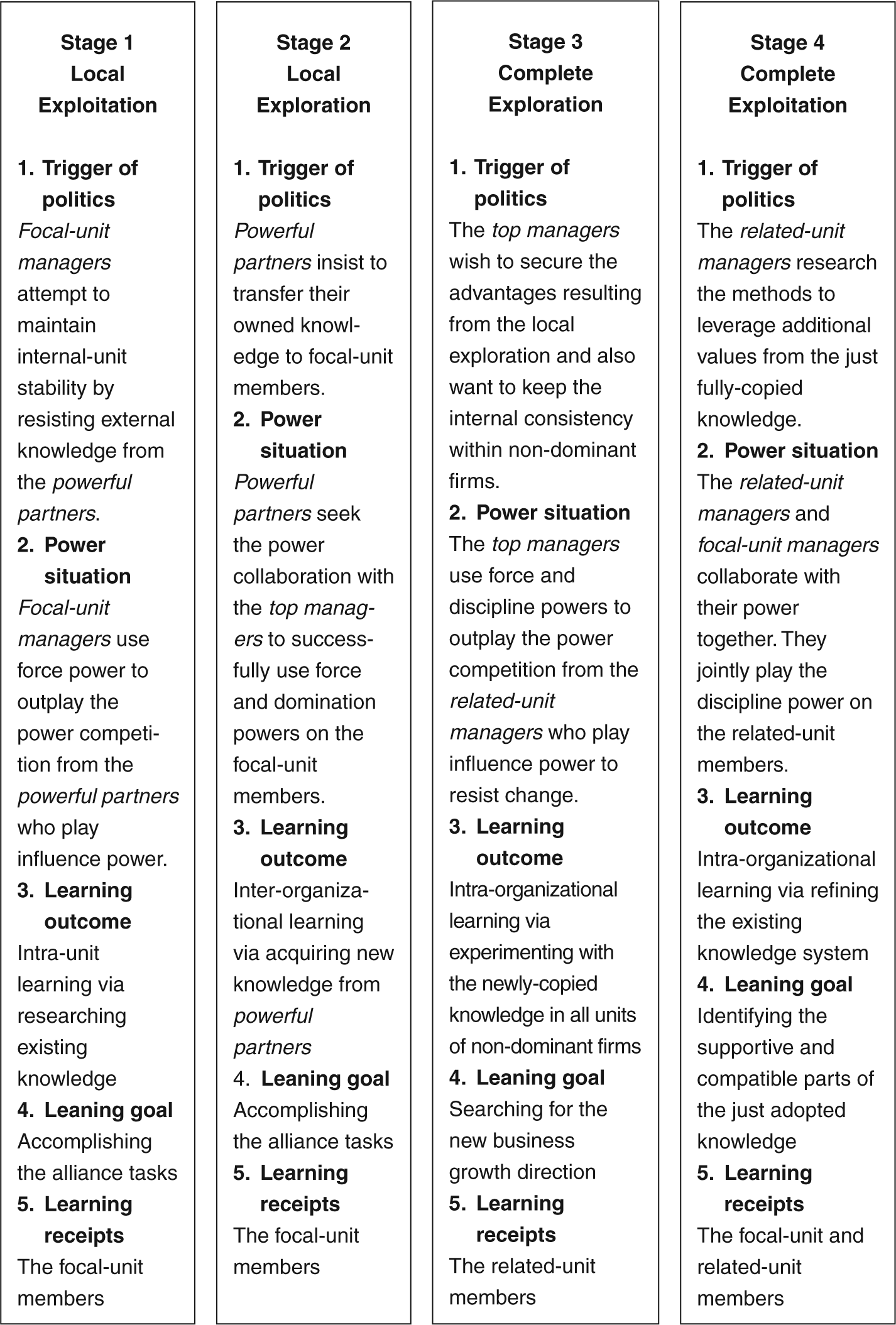
Interplay between organizational politics and organizational learning in the progressive four-stage model
Conclusion and Discussion
Supporting the idea of power in organizational learning (Lawrence et al., 2005), this study reveals how the politics dynamic among key interest groups affects the learning of nondominant firms in alliances. Regarding interorganizational learning as a catalyst to initiate intraorganizational learning, this study concludes some theoretical (as those for interorganizational learning theory and change management theory) and practical implications as follows.
First, this study elucidates the unique and rarely discussed nature of nondominant firms’ interorganizational learning. Because nondominant firms receive both external power and knowledge from their dominant partners, some of their internal members seem to obtain mixed signals, and resist knowledge from dominant partners (Subramani & Venkatraman, 2003). The frequent information exchange among interorganizational learning partners should be evaluated by each partner based on its unique possessed power position. Especially, knowledge sharing by a dominant partner is usually identified by a nondominant firm as a means of exercising powers and, thus, can only initiate quick exploitation of the nondominant firm to face such politics. This is why some previous studies show the “nonlearning” cases among nondominant firms (Cheng, 2010). The difficulty for nondominant firms to push interorganizational learning (i.e., a planned change) should be further identified based on their unique contextual factors (e.g., organizational politics).
Second, the proposed four-stage model indicates the dynamic tension between exploitation and exploration in the nondominant firms and reveals how organizational politics associates with their cyclical progression (Crossan et al., 1999). Exploitation indicates path dependence, and existing routines, whereas exploration implies emerging trajectory and new paths. Because nondominant firms face strong survival pressures, intense stressors may cause them to suffer from “exploitation myopia” in quickly taking advantage of existing knowledge routines in their design of learning mechanisms (Lipshitz et al., 1996; Rothaermel & Deeds, 2004), even in the explorative interorganizational learning. This study posits that the organizational politics can push a nondominant firm to engage in risky exploration. Although the four-stage model was generated based on five successful nondominant-firm learning cases, this study suggests that the inability for a nondominant firm to engage in enough politics to progress through the learning stages represents a crucial reason for their lack of success in planned change, including interorganizational learning (Pettigrew, 1990; Vince, 2001). Thus, effect of organizational politics on firms’ innovative attempts at strategic change should be further tested (Lewis, 2002).
Third, the proposed four-stage model shows that the politics prepared by internal managers (focal-unit managers resist change at local exploitation) contributes to the inertia and maladaptation of nondominant firms (Dent & Goldberg, 1999). It also shows how the politics used by external partners (powerful partners introduce interorganizational learning at local exploration) initiates the internal politics (top managers initiate intraorganizational learning at complete exploration) in nondominant firms. With other internal politics performed by the related-unit and focal-unit managers at complete exploitation, further intraorganizational learning is provoked to exploit values from previous exploration. Internal and external politics, not the external knowledge, can be viewed as complementary “momentum” of change for nondominant firms in interorganizational learning. Organizational politics seems to derive the dynamics of inertia and momentum in the organizational change process (Geiger & Antonacopoulou, 2009; Kelly & Amburgey, 1991). Future organizational change studies should enquire about the interaction nature between internal and external politics in pushing (or limiting) firms’ planned change.
Fourth, this study shows how nondominant firms successfully transform their original templates through careful experiments, similar to a case of second-order change (Amburgey & Kelly, 1993). Although previous studies argue that second-order change with “punctuated equilibrium” should be radically and dramatically promoted to avoid resistances (Romanelli & Tushman, 1994), the proposed four-stage process model reveals a continuous nature of the large-scaled organizational transformation (Brown & Eisenhardt, 1997). A careful organization can also transform its original template to another one through the trial-and-error revision and the step-by-step duplication of local change experiences to diffuse internally shared schemata (Bartunek & Moch, 1987). Siggelkow (2001) suggested that a tight internal fit may increase the difficulties for organizational change. A transforming nondominant firm thus incrementally diffuses local change outcomes around the company to gently mitigate the tight internal fit. Such slow-paced and smooth-rhythmic transformation can be used by careful organizations to avoid disruptive organizational change and should be further enquired by more studies.
Fifth, this study shows that interorganizational learning experiences with tough partners help the nondominant firms identify the future growth by planning changes in blueprints (Brown & Eisenhardt, 1997). By playing the power granted by the dominant partner, managers of a nondominant firm can enforce internal members to accept new thinking required for organizational change. Pfeffer (1981) suggested that power is related to conflicts. The external power of a dominant partner can initiate inconsistency and conflicts of internal members’ behaviors and opinions to debate on the existing templates of nondominant firms (Miller & Friesen, 1984). For example, the results show that complete exploration intensifies the conflicts among internal members because of their diverse opinions about transforming nondominant firms. Managers of nondominant firms must take advantage of the planned internal disagreement and conflicts to encourage changes in employees’ attitudes (Sackmann et al., 2009). For a careful organization which is incapable of provoking enough internal conflicts due to inertia, selecting powerful alliance partners to provoke internal conflicts thus could play as a strategic tool of its planned change development. This idea should be further elucidated by both researchers and managers in organizational change management.
Sixth, this study elucidates the unique nature of interorganizational learning in the type of unilateral-learning alliances. Especially, a case of “learning specification” seems to be observed in unilateral-learning alliances as studied in this article: Two firms collaborated via interorganizational leaning to specifically perform either exploration or exploitation, and then mutually shared their complementary learning effort (Gupta et al., 2006). To highlight, nondominant firms are likely to perform “determinism learning,” in which learning is conservative and arranged by top-level authorities so that exploration happens only through a carefully short-time search and purposeful experiment (Miller, 1996). Without frequently exploring new ideas, determinism learning is driven by managers’ attempts to exploit the value of the firm’s existing knowledge system. As a result, a nondominant firm used to specialize in exploitation prefers to quickly acquire the explorative knowledge externally from its powerful partner in the unilateral-learning alliance. In bilateral-learning alliances, however, the “learning competition” among partners seems to be more readily apparent (Hamel, 1991; Kale et al., 2000). Future research should investigate the effect of alliance type on the nature of different interorganizational leaning.
Finally, this study offers critical new insights for managers in nondominant firms. Organizational politics, not only the newly acquired knowledge, can thus be viewed as a counteracting force to compel members to change. Politics is a useful and multifaced tool to achieve intraorganizational learning. Managers in firms with limited resources should first avoid the usual exploitation myopia to take advantage of existing knowledge in learning alliances. For employees without enough willingness and knowledge to engage in groundbreaking changes, managers should exercise politics with the aid of other eligible external parties to push their members to involve in appropriate exploration by interorganizational learning. Managers must then carefully use internal politics to enable the progression of interorganizational learning into the intraorganizational learning prototype depending on themselves. They also should turn the interorganizational exploration into practical practices to exploit benefits in time. Managers must understand the different political positions of key interest groups and enable group members with the appropriate political skills to strike a balance between exploitation and exploration. Politics and learning should be used as dual tools for managers in nondominant firms to plan strategic change. Instead of using a one-shot and dramatic change to waste critical organizational resources, managers should carefully arrange a step-by-step change with frequent revisions.
Limitation
The value of this study should be evaluated based on the following research limitations. First, the finding is based on only five successful alliance learning cases with little evidence on performance issues, which makes the four-stage model descriptive rather than normative. Future studies should compare the outcomes of the successful cases with those of failed alliance learning cases. Other alliance traits (e.g., various alliance types) could also be further studied. Second, only alliance cases with one nondominant firm were selected in the study and the issue of how several nondominant firms learn together within an alliance is ignored. An investigation of learning alliance cases with more than one nondominant participant is necessary. Third, the data are insufficient given that all the information on the powerful partners was provided by the nondominant firms, which may possess prejudice. The lack of interviews from nonmanagerial employees may also create opinion biases. A better methodology design and the collection of more types of data (e.g., survey) must be applied in future studies.
Footnotes
Declaration of Conflicting Interests
The author declared no potential conflicts of interest with respect to the research, authorship, and/or publication of this article.
Funding
The author disclosed receipt of the following financial support for the research, authorship, and/or publication of this article:
This article was partially subsidized by the Taiwan National Science Council (NSC 94- 2416-H-214-014).