




Abstract
Virtuousness in organizations involves individuals and teams being resilient, or bouncing back from setbacks in ways that allow them to adapt and grow. In two studies, we focus on emotional carrying capacity (ECC), wherein relationship partners express more of their emotions, express both positive and negative emotions, and do so constructively, as a source of resilience in individuals and in teams. Study 1’s findings indicate that ECC is positively related to individual resilience and that ECC mediates the link between relationship closeness and individual resilience. Study 2’s findings indicate a similar pattern for resilience at the team level: ECC is positively related to team resilience and mediates the connection between trust and team resilience. Together, these studies provide insight into how emotional expression in relationships is a key mechanism in explaining resilience, a foundational element for the pursuit of long-term virtuousness for individuals and for teams.
A virtuous organization is one that espouses and nourishes an environment of moral goodness, makes a positive impact on the human experience of its members and customers, and ensures that this positive impact extends to the greater community (Cameron, Bright, & Caza, 2004). Accordingly, virtuousness in organizations implies that the individuals and teams within them are behaving in ways that create “goods” of inherent worth, such as excellence, and “goods” with extrinsic value, such as effectiveness, all of which nurture human life (MacIntyre, 1985). However, the pursuit of virtuousness is complex and challenging. Given that the individuals and teams that comprise organizations necessarily face setbacks and challenges in pursuing excellence, we argue that the propensity to be virtuous is facilitated when individuals or collectives develop the ability to be resilient, or to have “the capacity to rebound from adversity strengthened and more resourceful” (Walsh, 1998, p. 4).
Resilience is often described as an outcome of virtuousness (e.g., Cameron et al., 2004; Sandage & Hill, 2001). This is because virtues such as hope, kindness, and forgiveness help individuals and teams deal with adversity and move forward, sturdier than before (Bright, Cameron, & Caza, 2006). However, we propose that resilience is also an important factor in enabling virtuousness. First, being virtuous in organizations requires that individuals and teams overcome challenges such as sudden illness, loss of funding, or heightened competition. Resilience in the form of considering alternative options and plans and trying out new solutions to problems helps sustain the pursuit of virtuousness (Tugade & Fredrickson, 2004). Second, resilience is necessary for phasic virtuousness, which occurs in direct response to an event or shock (Bright et al., 2006). For example, the virtue of forgiveness arises in the face of being wronged, when individuals do not simply cope with the hurt but demonstrate resilience by transcending and learning from the hurt and by creating a positive connection with the offender (Bright & Exline, 2011). Similarly, teams or collectives display the virtue of courage by not only maintaining calm in the face of danger but also transcending the sense of victimization to think about themselves as capable of changing circumstances for themselves and others (Quinn & Worline, 2008). Resilience is thus not simply an outcome of virtuous behavior but may also be an important facilitator in becoming virtuous.
If resilience matters for virtuousness, what helps individuals and teams in organizations be and become resilient? Research suggests resilience depends a great deal on the existence and quality of interpersonal relationships. For individuals, the ability to connect and interact with others has proven important for resilience (Flach, 1997). For example, caring relationships with parents and other relatives, as well as access to broader social capital (networks of relationships through schools and neighborhoods), are associated with buffering individuals from adversity and allowing them to bounce back from setbacks (Masten & Reed, 2002). For teams, the interactive, relational processes among members can facilitate (or hinder) the sharing of information, learning processes, and the development of adaptive solutions to problems (e.g., Paulus & Nijstad, 2003). For example, top management teams (TMTs) whose members view team relationships as helpful in generating new ideas and seeking out new opportunities tend to be more resilient (Carmeli, Friedman, & Tishler, 2013).
In this article, we examine how a specific aspect of relationships—the quality of emotional expression—is linked to resilience. Resilience in individuals and groups is grounded in the accumulation of and access to adequate resources, and an orientation to learning and improving (Sutcliffe & Vogus, 2003). Relationships can help develop, accumulate, and provide access to resources, some of which include emotionally based resources such as care and concern (Abbey, Abramis, & Caplan, 1985). However, we still need to understand why the quality of emotional expression can be a source of resilience for both individuals and teams.
To test the link between emotional expression and resilience, we adopt the concept of emotional carrying capacity (ECC) from Dutton and Heaphy’s (2003) theory of high-quality connections between and among individuals. ECC is one aspect of connection quality, and refers to the relationship’s capacity to express more emotion overall, both positive and negative emotions, and to do so in a constructive manner. We propose that the ECC of dyadic and intrateam relationships is positively related to resilience in individuals and teams. Furthermore, we suggest that ECC in dyadic and team relationships mediates the effect of relationship closeness (in the case of dyads) and team trust (in the case of groups) on resilience. Our studies contribute to the nascent literature linking emotions to resilience by enriching the discussion that focuses on the presence of positive emotions as a major contributor to human resilience (e.g., Fredrickson, Tugade, Waugh, & Larkin, 2003; Sutcliffe & Vogus, 2003). In doing so, our studies help specify the emotional pathways in which relationships are a source of resilience.
We first present our key assumptions about resilience. This is followed by a description of Study 1, outlining the mechanisms that link ECC in dyadic relationships to resilience in individuals and hypothesizing its mediation of the effects of relationship closeness on resilience. We then outline Study 2, describing the link between team-level ECC and team resilience and further hypothesizing that ECC mediates the effect of intrateam trust on team resilience.
Defining Resilience
Individuals face challenges and adversity in organizations on a regular, even daily, basis, such as working with degrading colleagues (Cortina, Magley, Williams, & Langhout, 2001), executing demanding tasks such as firing employees (Molinsky & Margolis, 2005), or taking on challenges outside of work, such as caring for a relative (Kossek, Colquitt, & Noe, 2001). Resilience refers to the ability of individuals, groups, and organizations to absorb the stress that arises from these challenges and to not only recover functioning back to a “normal” level but also learn and grow from the adversity to emerge stronger than before (Sutcliffe & Vogus, 2003). Resilience describes positively deviant behavior that emphasizes abundance and vitality (Bright et al., 2006; Caza, Barker, & Cameron, 2004). This distinguishes resilience from stress researchers’ focus on coping, which describes strategies of responding to harm, threat, or challenge that may or may not have positive outcomes (Lazarus, 1993). Our definition of resilience captures the growth that is possible after facing adversity (Fredrickson et al., 2003), distinguishing it from the idea of recovery to some prior baseline of normal functioning (see Carver, 1998).
Resilience research suggests that learning and growing in the face of adversity is facilitated by relationships with others. We extend prior research on affiliation responses in stress, which demonstrates that people faced with a novel threat tend to relate to others who are enduring a similar experience, presumably because the other persons are capable of reducing the threat (Rofe, 1984) or because they can provide clarifying information that reduces uncertainty (e.g., Gump & Kulik, 1997). We focus on how individuals draw on their work relationships as a source of strength during times of stress (Kahn, 2005) and on how relationships facilitate the refining and strengthening of capabilities (Sutcliffe & Vogus, 2003). Not all relationships, however, are equally valuable for resilience. In fact, relationships can either facilitate or hinder the sharing of information, learning processes, and the development of adaptive solutions to problems (e.g., Paulus & Nijstad, 2003). Research suggests that high-quality relationships are particularly valuable for resilience because individuals and the teams they comprise are better able to collectively comprehend difficult situations and figure out the best way to deal with them (Carmeli et al., 2013). The following studies examine the specific qualities of emotional expression in relationships that facilitate resilience.
Study 1: Individual Resilience and the Emotional Carrying Capacity of Relationships
In our first study, we examine the link between ECC and individual resilience. We define ECC as a property of relationships wherein relationship partners express more of their emotions, express both positive and negative emotions, and do so in a manner that is constructive. We develop our rationale based on the perspective that relationships can serve as a holding space in which individuals can grow through their connections with each other, in terms of psychosocial development (Miller & Stiver, 1997), energy (Quinn, 2007), or identity (Roberts, 2007). Individuals can feel a sense of safety in their relationships (Edmondson, 1999) by being able to express themselves more fully, which in turn can help them learn. This safe space can enable individuals to speak up, suggest new ideas, and take risks (Edmondson, 1999). We suggest that being able to express more emotion and both positive and negative emotions helps foster a sense of security because individuals can express their true feelings. Importantly, the expression of more and different emotions is constructive when both parties share in the burden of listening to and understanding each other’s emotions and, especially where negative emotions are acknowledged alongside positive ones, a mutually safe and generative space can be created for expressing emotions.
The three characteristics of ECC—the expression of more emotion, the expression of both positive and negative emotion, and the constructive nature of this expression (Dutton & Heaphy, 2003)—are key mechanisms for developing the two factors that underlie resilience in organizations: access to adequate resources and an orientation toward learning and mastery (Sutcliffe & Vogus, 2003). The following sections outline the linkages between ECC and resilience.
Expressing More Absolute Emotion and Individual Resilience
Emotional expression refers to observable verbal and nonverbal behaviors that communicate or symbolize felt, internal emotional experience (Kennedy-Moore & Watson, 2001). Emotional expressions are important informational resources because they communicate individuals’ immediate authentic responses to discrete events in the workplace (Weiss & Cropanzano, 1996). As appraisals of particular events or individuals (Ellsworth & Scherer, 2003), emotions can shape the cognitive processes that influence behavior, such as attention, thought, memory, and decision making (Morris & Keltner, 2000). Fuller expressions of emotion give relationship partners access to more information about the situation, how they respond to that situation, and how their emotions influence the way they relate to each other (Keltner & Haidt, 1999) when faced with adversity. With more information, relationship partners can provide more relevant and helpful responses to adversity. Also, with increased exposure to their own and their partners’ emotional reactions, individuals experiencing greater ECC should be better equipped to anticipate their own and their partners’ emotional needs and thus better understand what kind of support would be most useful.
Expressing Both Positive and Negative Emotions and Individual Resilience
When emotional expressions comprise both positive and negative emotions, more resilient responses to adversity might be expected. Positive emotions broaden the scope of both thinking and action, as well as foster and strengthen interpersonal relationships (Fredrickson, 2003). Positive emotions also allow individuals to reinterpret stressful situations and develop positive meaning (Folkman & Moskowitz, 2000; Lazarus, 2000). At the same time, negative emotions are useful for signaling the need to respond to some change and thus avoid harm (Quigley & Barrett, 1999). Negative emotions are more critical for solving problems of immediate survival, whereas positive emotions help “solve problems concerning personal growth and development” (Fredrickson, 2003, p. 332). Research suggests that expressing both kinds of emotions (though more positive than negative) matters for healthy relationships (Gottman & Krokoff, 1989). Expressing both kinds of emotions allows for more creative coping that facilitates adaptive responses to challenging situations since both kinds are important to individual well-being (Fredrickson, Tugade, Waugh, & Larkin, 2003; Pennebaker & Francis, 1996; Ryff & Singer, 2000).
Expressing both positive and negative emotions is also important because of the effects of each type of emotion on the other. Specifically, each emotion type complements the other’s potential downsides and enables adaptive responses to adversity. For example, negative emotions alone may overwhelm and limit an individual’s focus on what is problematic (Baumeister, Bratslavsky, Finkenauer, & Vohs, 2001). In signaling that things are going well, positive emotions in the face of adversity may distract from directly addressing problems because individuals may feel content with the current situation. Instead, where negative emotional expressions of distress are accepted and met with positive emotional expressions of warmth, sympathy, and compassion, relationship partners are at the same time aware that something is wrong and needs to be resolved, making the search for solutions more likely.
Expressing Emotion in a Constructive Manner and Individual Resilience
Emotions expressed in a constructive manner create more potential for partners to learn from them. Emotional expression that is communicated in a way that does not overwhelm others or is not experienced as incivility (Pearson & Porath, 2009), particularly for negative emotions, is important for developing awareness of unexplored feelings. This helps partners feel more intimate and knowledgeable about each other (Kennedy-Moore & Watson, 2001). With greater knowledge about the range of their emotional experiences, relationship partners can better distinguish among the emotions they experience, and regulate how they cognitively and behaviorally respond to the source of that emotion (Barrett, Gross, Christensen, & Benvenuto, 2001). When emotional expressions are treated as legitimate and valuable, relationship partners can help each other better understand their feelings and gain a sense of control over them, in ways similar to what “emotion-coaching” parents do for their children (Gottman, Katz, & Hooven, 1996; Ryff & Singer, 2000). With a sense of mastery over their emotional and behavioral responses to distress, individuals are more likely to be capable of pursuing paths to resolving distress. With more precise knowledge about how they feel, individuals can craft more differentiated and flexible responses to the adversity they may face, and thus demonstrate more resilience (Kashdan, Ferssizidis, Collins, & Muraven, 2010). Based on these logics, we propose the following hypothesis:
Hypothesis 1: The emotional carrying capacity experienced by individual relationship partners is positively related to individual resilience.
Relationship Closeness, Emotional Carrying Capacity, and Individual Resilience at Work
Emotional carrying capacity explains how emotional expression within relationships enables the two main building blocks of resilience: (a) expressing more emotions overall and both positive and negative emotions provides a valuable informational resource to individuals and (b) the constructive expression of emotions in their relationships helps individuals learn from their emotions. We suggest that ECC is not only positively related to individual resilience at work but also explains how other forms of relationship quality such as relationship strength help predict resilience. Relationship strength has been specifically measured in terms of closeness, which refers to the emotional intensity and intimacy between relationship partners (Granovetter, 1973). Although relationship strength has also been measured in terms of duration or length of time in the relationship, and more frequent communication (Granovetter, 1973), researchers have quite commonly focused on closeness as a measure of relationship strength (see Jack, 2005; Reagans & McEvily, 2003; Sosa, 2011).
Closeness is typically understood in terms of friendship, where less close or weaker relationships are labeled “acquaintances” and closer, stronger relationships are labeled “friends” (e.g., Brissette, Scheier, & Carver, 2002). Friendship is defined as a voluntary interdependence over time that is intended to facilitate the social and emotional goals of the people involved (Hayes, 1988). It is this quality of support and the exchange of valuable resources that would enable friends to aid each other in the face of adversity. Closer relationships provide access to resources (Jack, 2005) and generate creativity (Sosa, 2011) that may lead to useful responses to challenges. However, we suggest that ECC might help explain why closeness enables resilience. ECC focuses on the emotional context in which support and resources might be created and exchanged. Expressing more emotions overall reveals a relationship partner’s reactions to a situation, allowing the other partner to know more about what might be needed. A close friendship would still need the expression of both positive and negative emotions to help with reinterpreting the situation in novel ways and signaling the need to respond. Finally, the capacity to constructively express emotions would be needed for friends to learn about their own and others’ responses to stressful events and to provide a fuller and more immediately felt picture of what an adaptive response might be. Based on these arguments, we propose our second hypothesis:
Hypothesis 2a: Relationship closeness is positively related to emotional carrying capacity.
Hypothesis 2b: Emotional carrying capacity mediates the relationship between relationship closeness and individual resilience.
Study 1: Method
Sample and Procedure
We collected survey data from staff employees at a large Midwestern university. With the assistance of the university’s office of human resources, we selected a random sample of 2,500 employees representative of the distribution of university staff in terms of age, race, gender, level of education, occupation, department, years of service, full-/part-time appointment, and voluntary involvement in a staff empowerment program. We recruited participants via e-mail and asked them to think of one person with whom they interact the most at work (their “Interaction Partner”), and then answer all of the questions with that person in mind. Responses were confidential. In exchange for participation, we entered participants into a raffle for 1 of 10 Apple iPod Shuffles. A total of 108 e-mail invitations were returned undelivered, and 929 surveys were initiated, although not all were completed. Due to missing data, the final sample size for the analysis was 649, for a useable response rate of 27%.
Participants worked in 97 units across the university, in occupations that included accountants, athletic trainers, secretaries, social workers, and university executives. Seventy-seven percent of the sample was female, and 85% was white; the mean age was 44.5 years, 90.5% of the sample was full-time staff, the sample’s total work experience averaged 14 years, and the mean university tenure was 7.76 years. Our response rate was slightly lower than (but within one standard deviation of) the average 34.6% average response rate for web surveys reported in a meta-analysis of web-based surveys (Cook, Heath, & Thompson, 2000). Chi-square goodness-of-fit tests revealed that our sample was representative of the greater university staff population in terms of race (χ2 = 17.087, p > .05); gender (χ2 = 1.967, p > .05), full-/part-time appointment (χ2 = 0.110, p > .05), educational level (χ2 = 18.621, p > .05), and involvement in a staff empowerment program (χ2 = 0.513, p > .05). These analyses suggest that our sample was largely representative of the larger population of university employees.
Measures
Emotional carrying capacity
We developed a scale to measure ECC. First, we generated items based on the available literature and then conducted a Q-sort (Stephenson, 1953) to distinguish it from related constructs. Congruence among study team members’ sorts closely matched the initial scales, and we modified overlapping or closely related item wordings to make items more distinct. Items are shown in Appendix A. The scale response format was a 7-point Likert-type scale ranging from strongly disagree to strongly agree. Cronbach’s alpha for the resulting three-item scale was .83.
Because our measure of ECC was developed for this study, some additional work was conducted to demonstrate its construct validity. We conducted an additional web-based study with a national sample of 508 full-time working adults using Clearvoice Surveys (www.clearvoicesurveys.com). Whereas 25.6% of the sample held managerial positions, the rest of the sample was fairly equally distributed across professional (19.3%), administrative (16.7%), clerical (19.1%), and blue-collar (19.3%) occupations. Cronbach’s alpha for the ECC scale was .79. Using IBM SPSS/AMOS 19, we performed a confirmatory factor analysis (CFA) to test the construct validity of ECC and the discriminant validity of ECC from resilience. The results indicate that the three ECC items load strongly on the ECC factor and that a two-factor model, χ2(19) = 83.06, p < .01; root mean square error of approximation (RMSEA) = .082, Tucker–Lewis index (TLI) = .96, comparative fit index (CFI) = .97, of ECC and resilience fits the data better than a one-factor model, χ2(21) = 1045.7, p < .01; RMSEA = .31, TLI = .55, CFI = .40. Factor loadings for the two-factor model ranged from .62 to .92 (p < .01). Another CFA was performed to test ECC’s distinctiveness from other relational constructs. The results indicate that a three-factor model, χ2(24) = 47, p < .01; RMSEA = .043, TLI = .99, CFI = .99, of ECC, psychological safety (Edmondson, 1999), and empathy (Batson et al., 1988) best fits the data in comparison with a one-factor model, χ2(29) = 659.9, p < .01; RMSEA = .21, TLI = .75, CFI = .79, or a two-factor model, χ2(27) = 377.1, p < .01; RMSEA = .16, TLI = .85, CFI = .89. Factor loadings for the three-factor model ranged from .40 to .92 (p < .01).
Resilience
Individual resilience was measured using five items employed by Caza and Bagozzi (2010). Items are shown in Appendix A, Cronbach’s α = .87. Using the IBM SPSS/AMOS 19 package, we conducted a CFA to ensure that our measures of ECC and resilience were unique. The CFA compared a two-factor model (ECC and resilience) and a one-factor model (with ECC and resilience items loading on the same factor) and found support for a two-factor solution, χ2(19) = 58.16, p < .01; RMSEA = .053, TLI = .98, CFI = .99, rather than a one-factor model, χ2(21) = 1186.66, p < .01; RMSEA = .293, TLI = .45, CFI = .59. Factor loadings ranged from .53 to .94 (p < .01).
Relationship closeness
Building from work done in network theory (Granovetter, 1973), this measure assesses the closeness of dyadic relationships (Granovetter’s other dimensions of relationship strength—the frequency of communication and the duration of the relationship—are included as control variables). Following Perry-Smith (2006), we asked respondents, “How close are you to your Interaction Partner?” (1 = acquaintance to 5 = very close friend).
Control variables
Controls pertinent to the participants included demographics—age, gender, education, occupation, total months of work experience, and total months of work at the university—and participation in the staff empowerment program. Controls pertinent to the Interaction Partner included the partner’s gender, how long he or she has worked with the participant (in years and months), and whether the person was in the same unit as the participant. We also examined duration of the relationship and frequency of communication with the relationship partner. To assess duration, respondents were asked, “How long (years and months) have you known your Interaction Partner?” To assess communication frequency, respondents were asked “Currently, how frequently do you communicate with your Interaction Partner?” (1 = daily, 2 = several times a week, 3 = several times a month, 4 = once a month, 5 = several times a year, 6 = less often).
Study 1: Results and Discussion
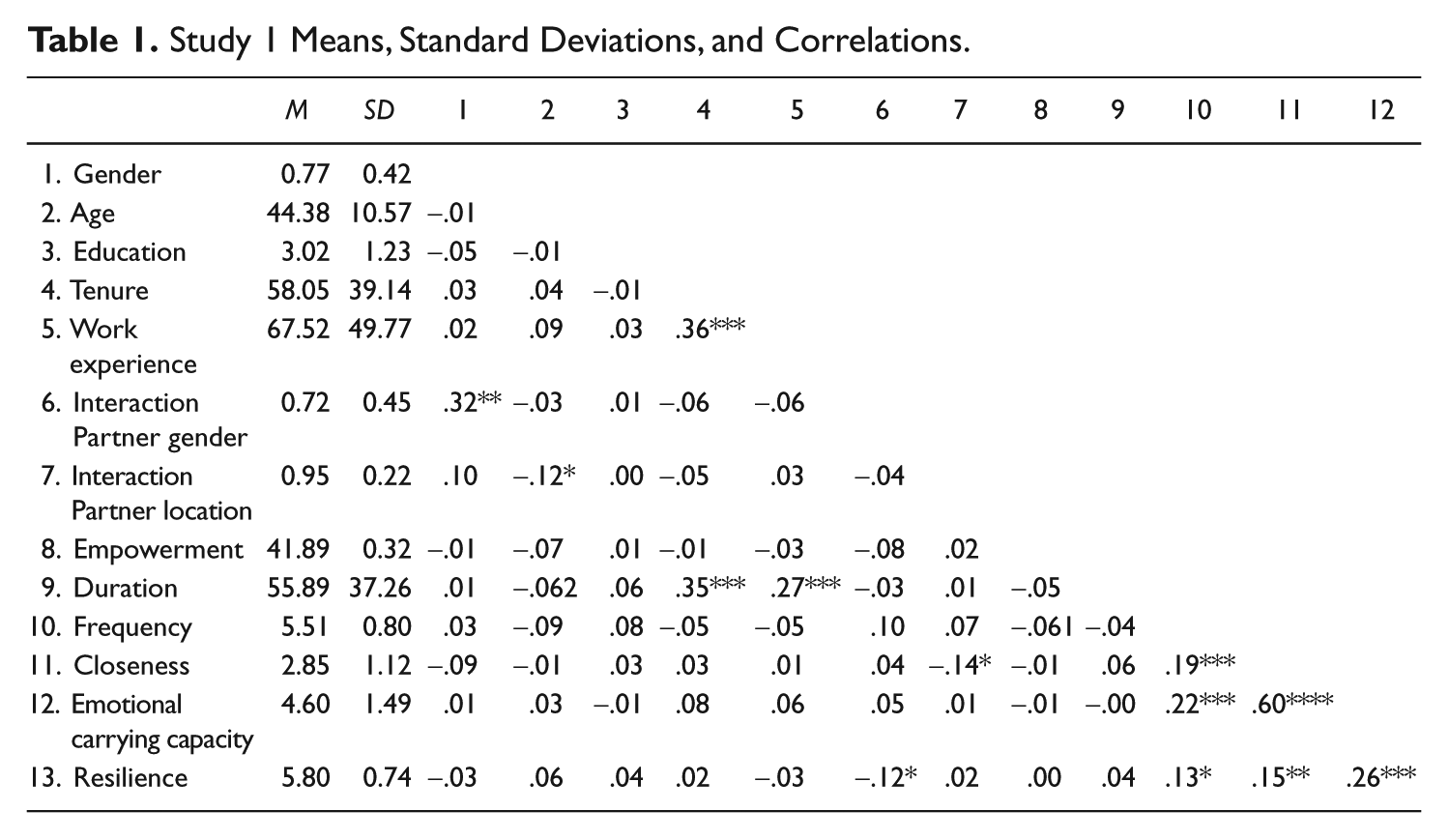
Correlations and descriptive statistics are presented in Table 1. The results indicate that both ECC and closeness are positively related to resilience (r = .26, p < .001; r = .15, p < .01, respectively). Additionally, ECC is positively related to closeness (r = .60, p < .001).
Study 1 Means, Standard Deviations, and Correlations.
Although only Hypothesis 2b concerned mediation, each of the hypotheses was evaluated using the procedures for testing mediation outlined by Baron and Kenny (1986) and Kenny, Kashy, and Bolger (1998). Model 1 in Table 2 shows that relationship closeness was significantly and positively related to individual resilience (β = .14, p < .05). This supports the first mediation condition. Model 2 in Table 2 shows that relationship closeness was also significantly and positively related to ECC (β = .60, p < .001), thus supporting Hypothesis 2a and the second mediation condition. Model 3 in Table 2 shows that ECC was significantly and positively related to individual resilience (β = .25, p < .001). This satisfies the third mediation condition and supports Hypothesis 1. Finally, Model 4 shows the results of the final mediation step, where individual resilience was regressed on both the mediator (ECC) and independent variable (relationship closeness). The coefficient of relationship closeness in relation to resilience decreased in magnitude and became nonsignificant (β = −.01, p > .10). In addition, the coefficient of ECC in relation to resilience remained positive and significant (β = .26, p < .001). These results indicate that ECC mediates the relationship between relationship closeness and resilience, thus providing support to Hypothesis 2b. We also performed Sobel’s (1982) test for mediation. The test statistics regarding the mediating role of ECC in the relationship between closeness and individual resilience were z = 4.25, SD = 0.024, p = .00, which support a full mediation model.
Study 1 Summary of Hierarchical Regression Analyses for Mediation by Emotional Carrying Capacity of the Relationship Between Relationship Closeness and Resilience at the Individual level.

Note. Beta coefficients for all models are based on the last step of the regression.
p < .05. **p < .01. ***p < .001.
Study 1’s results support the idea that more emotional expression, of both positive and negative emotions, that is constructive in nature facilitates more adaptive individual responses to adversity. Furthermore, Study 1’s results suggest that ECC may help explain how relationship closeness facilitates individual resilience. Although these findings generate important insights, further research is needed that examines (a) whether a similar relationship holds for ECC and resilience at the group level and (b) whether ECC also mediates the effects of trust on team-level resilience.
Study 2: Top Management Team Resilience and Emotional Carrying Capacity
In Study 2, we examined the link between ECC and resilience among TMTs and tested whether ECC mediates how trust facilitates team resilience. TMTs are an appropriate context for study because executive team members must work together to navigate the complex work of leading an organization. Furthermore, as a leadership team, TMT members face the challenges of needing to adapt to dynamic environments both inside and outside of the organization (Hambrick, 1994; Kahn, 2005), as well as to internal challenges of working in a team (e.g., relationship and task conflict [Jehn & Bendersky, 2003] and team fault lines [Thatcher & Patel, 2011]). Resilience in response to adversity may contribute to the overall functioning of the team (Hambrick, 1994). Below, we discuss why the characteristics of ECC are mechanisms by which trust among team members is associated with team resilience.
Expressing More Absolute Emotion and Team Resilience
Expressing more emotions provides team members with more information about their own emotional experiences and reactions and those of their fellow team members (Kahn, 2005), thus creating better team understanding. This, in turn, helps to cultivate teamness, which is key for effective collective actions in the face of highly complex environmental conditions (Hambrick, 1994). Second, expressing emotions when facing adversity allows team members to integrate painful experiences into their lives, enabling team members to learn from the experiences rather than be disabled and haunted by them (Frost, 2003; Kahn, 2005). Third, when team members express more emotion, they are more likely to be engaged in the process of facing the challenge, and motivated to learn from their experience. In contrast, team members who do not express emotion to their team members tend to be less motivated and less engaged in facing challenges (Edmondson, Bohmer, & Pisano, 2001). When team members are less comfortable expressing their emotions to their fellow team members, and do so with others outside of the team who share their demographic characteristics (Ancona & Caldwell, 1992) or to whom they feel more committed (Kahn, 2005), this limits the collective team knowledge. Emotional expression within the team facilitates members’ attentiveness and thus increases the speed and ability of the team to assimilate and use knowledge (Sutcliffe & Vogus, 2003, p. 101). Thus, we suggest that more emotional expression within the team would facilitate team resilience.
Expressing Both Positive and Negative Emotions and Team Resilience
Expressing both positive and negative emotions can lead to team resilience through several pathways. First, team members can experience a sense of threat when discussing problems, which can reduce cognitive and behavioral flexibility and responsiveness, despite the need to address the threat (Edmondson et al., 2001). Fredrickson (2003) suggests that positive emotions can help to “undo” the effects of negative emotions, such as feelings of anxiety about discussing problems. Applied to the team setting, this suggests that when team members express positive emotions to one another, it can help them recover from anxiety associated with discussing problems. Second, the expression of negative emotions allows team members to work through anxiety and disappointment that they are likely experiencing as a result of adversity. When negative emotions exist but are not addressed, this can cause groups to become stuck and dysfunctional (Kahn, 2005). Teams often do not learn from their failures because of members’ fear about their status and relationships with other members on the team (Edmondson et al., 2001).
Although positive and negative emotions are independently important, having both positive and negative emotions present also matters. Researchers suggest that some level of group heterogeneity is valuable for teams to be resilient (Sutcliffe & Vogus, 2003). However, group heterogeneity can also be dysfunctional and thus has limited value unless it is well managed (Eisenhardt, Kahwajy, & Bourgeois, 1998). Demographic and functional diversity can be effective for coping with and adapting to adverse situations when executives have a good grasp of their own or others’ points of view (Eisenhardt et al., 1998) and are able to construct a greater variety of ways of interpreting the adverse situation (George & King, 2007). We posit that the expression of both positive and negative emotions by team members facilitates this bridging of perspectives and helps the team have a sense of efficacy (Kahn, 2005) and consider a broader variety of responses and ways to view the adverse situation.
Expressing Emotion in a Constructive Manner and Team Resilience
It is also critical that emotions in a team be expressed constructively, or in a way that serves to improve the team’s behavioral processes. When emotions are expressed in a way that the team relationships themselves feel threatened (e.g., blame or attack), they can produce disengagement (Kahn, 2005), lessening the possibility of learning from one another (Gibson & Vermeulen, 2003) and thus diminishing a resilient response. Conflicts in TMTs can easily turn destructive (Simons & Peterson, 2000), but when they manage to focus on substance and handle differences constructively, TMTs are more effective in making the right choices in highly volatile conditions (Eisenhardt et al., 1998). Expressing emotions in a constructive manner is thus crucial for preventing unproductive conflicts, enabling the team to become more resourceful following setbacks. Thus, when communication occurs in ways that are constructive and caring (e.g., supportive and mutually facilitating), then resilient responding is more likely (Lawrence & Maitlis, 2012). Taken together, these theoretical linkages lead to the following hypothesis:
Hypothesis 3: Emotional carrying capacity within TMTs is positively related to team resilience.
Trust, Emotional Carrying Capacity, and Team Resilience at Work
Just as relationship closeness can be an important predictor of resilience in individuals, trust can be a key quality for enabling resilience in teams. Interpersonal trust is the belief, confidence, or expectation that one person will be responsive (Holmes & Rempel, 1989; Rempel, Ross, & Holmes, 2001) and act in an ethically justifiable manner (Hosmer, 1995). Even under conditions of uncertainty, trust enables individuals to be vulnerable to the person they are trusting (Rousseau, Sitkin, Burt, & Camerer, 1998). Trust among TMT members is likely to help in cultivating team resilience, because members are more likely to see each other as more reliable and competent and thus the group as whole can be more capable of responding adaptively when faced with adversity. Trust thus enables teams facing adversity to focus on the more positive and optimistic possible outcomes for their situation (Mishra & Spreitzer, 1998) and to work together in situations that require a great deal of internal negotiations (Mishra & Mishra, 1994). In addition, trust is important for team members to feel psychologically safe and to voice their opinions and ideas, thus facilitating the learning that may be essential for resilient responses to adversity (Edmondson, 1999).
We suggest that ECC mediates the relationship between intrateam trust and team resilience. When team members trust one another (i.e., members are willing to be vulnerable to one another; Rousseau et al., 1998), they are more likely to develop relationships that enable the expression of more emotions and of both positive and negative emotions. Expressing a full range and amount of emotions may make team members feel vulnerable, because organizations often prescribe a relatively narrow set of socially acceptable emotional expressions (Martin, Knopoff, & Beckman, 1998). As discussed earlier, the emotional aspects are an important part of the experience of adversity, whereas suppressing, ignoring, or not addressing those emotions within a team can be detrimental. Specifically, when people do not feel comfortable expressing their emotional reactions to adversity with team members, it can lead to dysfunctional team dynamics (Kahn, 2005). Thus, trust is not only important for the ability to express one’s opinion but also fundamental to the ability to express the full range and amount of emotions that provide a clearer picture of what kind of response is needed in the face of adversity.
Trust is also helpful in facilitating resilience because it entails an expectation that team members will be responsive to one another’s needs, even if they conflict with an individual’s own preferences (Rempel et al., 2001). When team members trust one another and therefore expect that others will be responsive to their needs, they may have greater capacity to express their emotions in constructive ways. This is because they know that they will be listened to, rather than having to anticipate having their emotions ignored or denigrated. In trusting each other, team members may be able to treat each other’s emotional responses in ways that help the team learn from these responses. For example, when a team member feels devastated by a failed proposal, his or her teammates may be willing to sit with him or her and provide a temporary holding environment (Kahn, 2001), knowing that this will help him or her move through his or her emotions, even if they feel urgency to regroup and start an action plan. Based on this logic, we propose the following:
Hypothesis 4a: Intrateam trust is positively related to emotional carrying capacity.
Hypothesis 4b: Emotional carrying capacity mediates the relationship between intrateam trust and team resilience.
Study 2: Method
Sample and Procedure
We accessed 500 Israeli firms’ TMTs and sent a letter with a request for firms’ CEOs and TMT members to complete a structured questionnaire. We collected usable data (only including for the analysis the TMTs in which at least 50% of their members completed the questionnaires; see Lubatkin, Simsek, Ling, & Veiga, 2006) from 82 TMTs, representing a response rate of 16.4%. We examined and found no significant differences between the participating and nonparticipating firms in terms of size as measured by the number of employees (p > .10). The firms in the sample operated in diverse industries, including food and beverages, medical equipment and pharmaceuticals, computers, infrastructure, construction, and finance.
Measures
Team emotional carrying capacity
We assessed the ECC of TMTs by adapting three items used in previous studies (Carmeli, 2009; Carmeli, Brueller, & Dutton, 2009) and employed in a team context (Brueller & Carmeli, 2011). To further validate the ECC scale for use with teams, we also assessed this scale in a different study among TMTs of strategic business units that serve as profit centers. In that sample, factor analysis results indicated a one-factor solution and all relationships between indicator variables and their corresponding latent variables ranged from .68 to .84 (p < .01). We also performed a CFA where ECC items were loaded onto one factor and three items measuring collaborative behaviors between members were loaded onto another factor. The results indicate that a two-factor structure fits the data better than a one-factor structure, χ2(8) = 14.8, CFI = .95, TLI = .90; RMSEA = .08; χ2(10) = 35, CFI = .84, TLI = .67, RMSEA = .16, respectively. Standardized estimates range from .50 to .88 (p < .01). Cronbach’s α = .71.
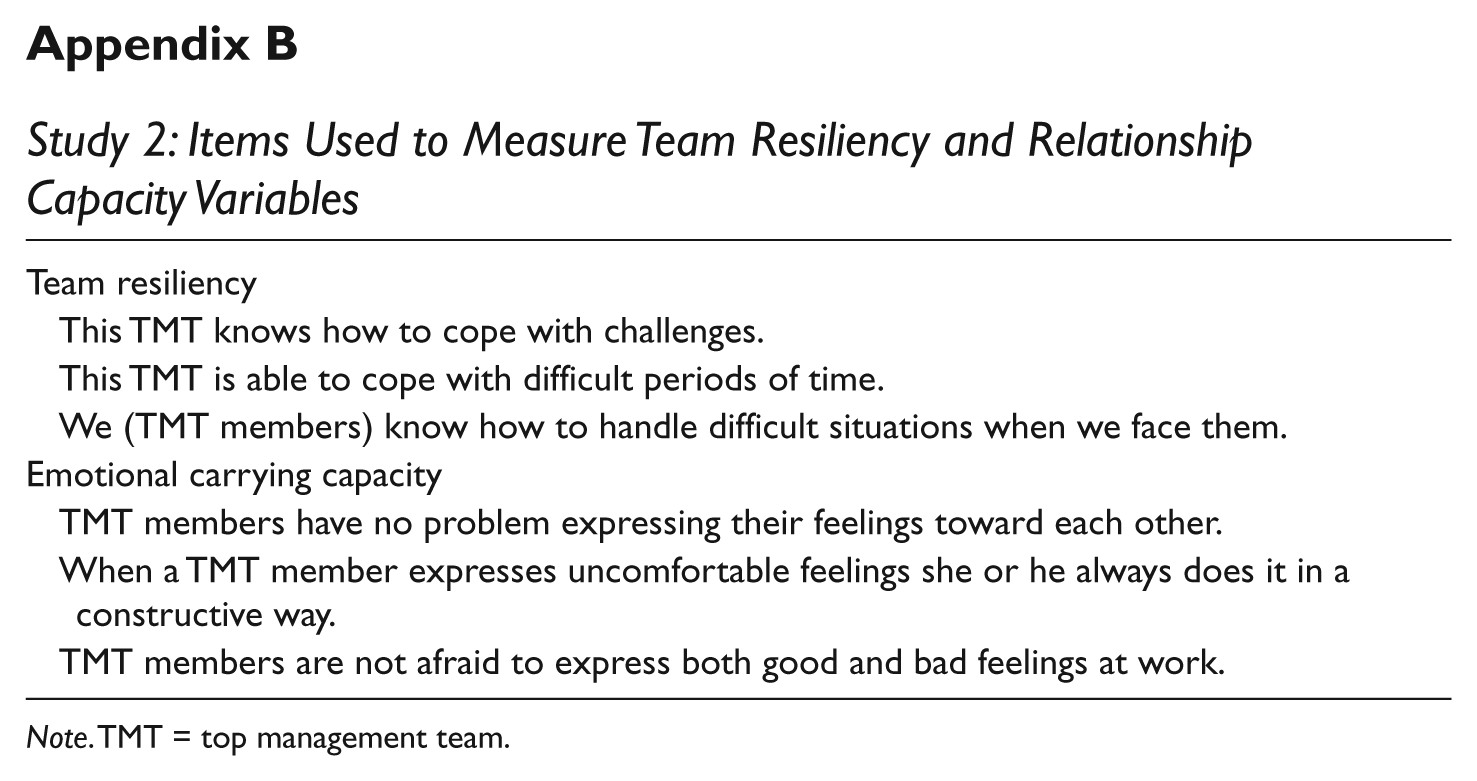
In this study, we asked TMT members to assess the extent to which the connection between them is characterized by ECC. Responses were made on a 5-point Likert-type scale ranging from 1 = not at all to 5 = to a very large extent. The complete set of items appears in Appendix B. The results of both the EFA and CFA appear below. Cronbach’s α = .75.
Team trust
We measured team trust by adapting six items from Robinson’s (1996) trust scale, using the team, not an individual, as the reference point. We asked respondents (CEO and TMT members) to report on the extent to which TMT members experienced trust in their relationships with each other. Sample items were (a) TMT members relate to each other with high sincerity and (b) TMT members are not always honest and truthful to each other (reverse-scored item). Responses were made on a 5-point Likert-type scale ranging from 1 = not at all to 5 = to a large extent. Cronbach’s α = .89, similar to the reliability reported in Robinson’s (1996) study.
The results of both exploratory factor analysis (EFA) and CFA that compared a two-factor model (ECC and trust) and a one-factor model (with items of ECC and trust loading on the same factor) lend support to a two-factor solution. Results of the EFA produced two factors: the first factor, ECC, included three items with loadings ranging from .74 to .81 (eigenvalue = 3.11) and explained 37.28% of the item variance (Cronbach’s α = .75). The second factor, TMT trust, included three items with loadings ranging from .62 to .92 (eigenvalue = 1.18) and explained an additional 19.73% of the item variance (Cronbach’s α = .89). CFA results also supported a two-factor solution, χ2(10) = 73; CFI = .69, TLI = .53, RMSEA = .279, compared with a one-factor solution, χ2(8) = 17.1; CFI = .96, TLI = .92, RMSEA = .09). In addition, the results for the CFA indicated that all relationships between indicator variables and their corresponding latent variables were significant (p < .01).
Team resilience
We constructed three items to assess a team’s capacity to bounce back from a setback. Responses were on a 7-point Likert-type scale (ranging from 1 = not at all to 7 = to a very large extent). Items are provided in Appendix B. We also performed an EFA, which produced a one-factor solution with an eigenvalue of 5.68, accounting for 63.09% of the variance and having factor loadings ranging from .65 to .86. Cronbach’s α = .92.
Control variables
We controlled for potential effects of TMT tenure, which was assessed by the average tenure of TMT members. When members spend a longer period in a team, they develop team familiarity, which is key to understanding each other, building transactive memory systems (Moreland, 1999), and coping with adversaries. We also controlled for TMT size (assessed by the number of members, including the CEO, who constitute the firm’s TMT). Research suggests that TMT size may have an effect on TMT processes (Lubatkin et al., 2006). Finally, we controlled for past firm performance because in high-performing firms, TMTs may sense a higher capacity to bounce back from adversities.
Level of analysis
Research indicates that multiple respondents provide more reliable information and are less subject to superficiality than a single respondent, but an assessment of the consistency of responses within a team is still needed. Following previous research (e.g., James, 1982; Smith et al., 1994), we employed an analysis of variance to assess this consistency. Results show that there was greater variability in the ratings between teams than within teams (p < .01). We also calculated the intraclass correlations (ICCs) to assess group member agreement. ICC(1) indicates the extent of agreement among ratings from members of the same group. ICC(2) indicates whether groups could be differentiated based on the variables of interest. The values of ICC(1) and ICC(2) for the three measures for which we used multiple respondents were as follows: .48 and .74 for ECC; .50 and .92 for resilience; and .48 and .85 for TMT trust. These values are consistent with the conventional standards for aggregating individual questionnaire responses into a team-level response (see Bliese, 2000).
Study 2: Results and Discussion
Correlations and descriptive statistics are presented in Table 3. The results indicate that both ECC and trust are positively related to resilience (r = .30, p < .01; r = .39, p < .01, respectively). In addition, ECC is positively associated with trust (r = .43, p < .01).
Study 2 Means, Standard Deviations, and Correlations.
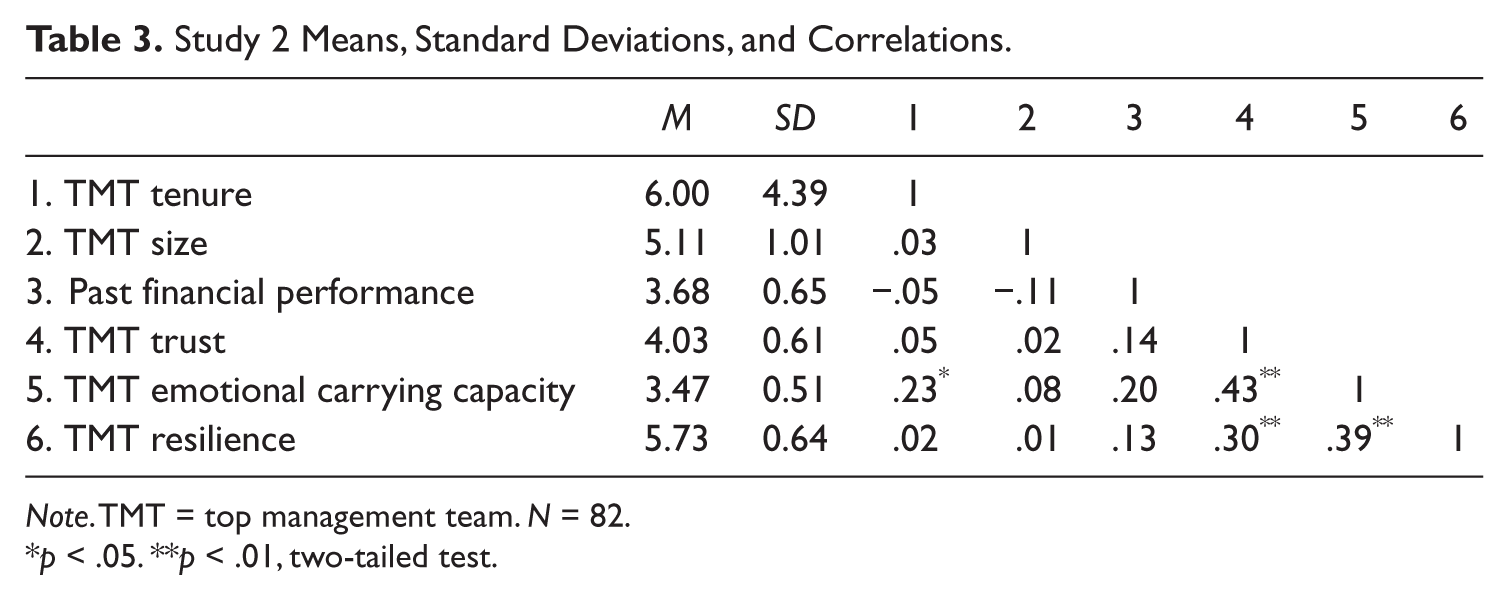
Note. TMT = top management team. N = 82.
p < .05. **p < .01, two-tailed test.
We performed regression analysis to compensate for item to sample size ratio and to be consistent with Study 1. Although only Hypothesis 4b concerned mediation, each of the hypotheses was evaluated using the procedures for testing mediation outlined by Baron and Kenny (1986) and Kenny et al. (1998). Model 1 in Table 4 shows that intrateam trust was significantly and positively related to team resilience (β = .26, p < .05). This supports the first mediation condition and Hypothesis 4a. Model 2 in Table 4 shows that intrateam trust was also significantly and positively related to ECC (β = .45, p < .001), thus supporting Hypothesis 4a and the second mediation condition. Model 3 in Table 4 shows that ECC was significantly and positively related to team resilience (β = .33, p < .01). This satisfies the third mediation condition and supports Hypothesis 3. Finally, Model 4 in Table 4 shows the results of the final mediation step, where intrateam trust was regressed on both the mediator (ECC) and independent variable (intrateam trust). The coefficient of intrateam trust in relation to team resilience decreased in magnitude and became nonsignificant (β = .16, p > .10). In addition, the coefficient of ECC in relation to team resilience remained positive and significant (β = .32, p < .01). These results indicate that ECC mediates the relationship between intrateam trust and team resilience, thus providing support to Hypothesis 4b. We also performed Sobel’s (1982) test for mediation. The test statistics regarding the mediating role of ECC were z = 2.25, SD = 0.007, p = .02, in support of a full mediation model.
Study 2 Hierarchical Regression Results for the Relationships Betwee Emotional Carrying Capacity and TMT Resilience, While Controlling for TMT Trust.
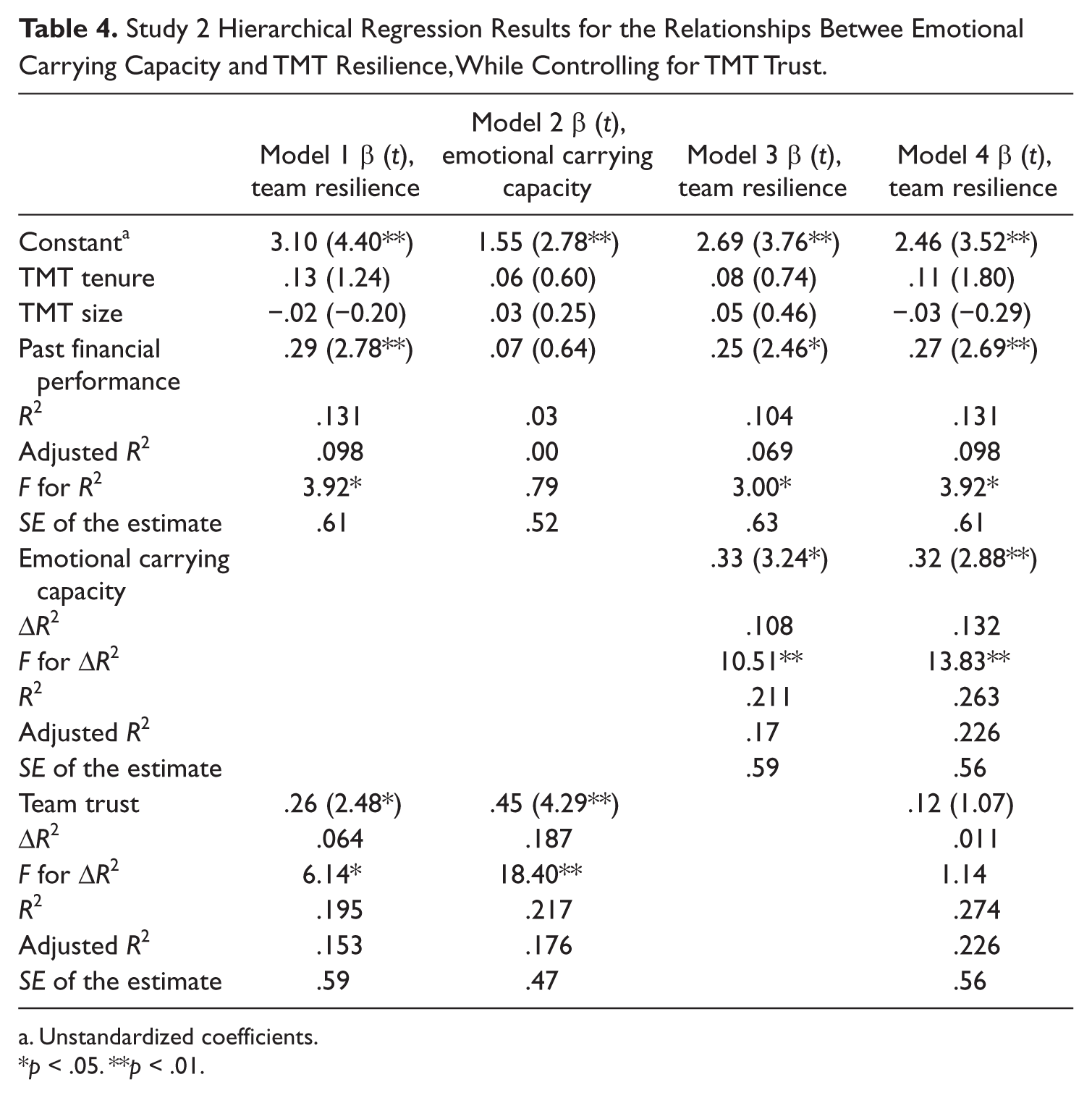
Unstandardized coefficients.
p < .05. **p < .01.
This study suggests that ECC is a relational mechanism that is meaningfully related to resilience in teams. Furthermore, this study suggests that ECC may be an important mediator in explaining how trust makes a difference for team resilience.
General Discussion
The results of the two studies indicate a positive relationship between ECC—the degree to which individuals can express more absolute emotion, express more positive and negative emotions, and do so constructively—and the resilience of individuals and teams at work. Specifically, in Study 1 we examined the ECC individuals experienced with an interaction partner at work, and found that it is significantly and positively related to resilience at work. Furthermore, our study suggests that ECC provides an important explanation for how relationship closeness translates into individual resilience. The findings of Study 2 indicated a positive link between ECC and resilience in teams and lend further support for ECC as an important mediator, in this case mediating the effect of trust on team resilience. Resilience is an important ingredient for individuals and teams as they respond adaptively to adversity faced in the course of pursuing virtuousness and manifesting excellence at work. Taken together, our two studies demonstrate the importance of the capacity for emotional expression in relationships for understanding how relationship quality (i.e., closeness and trust) enables resilience. We elaborate on our findings and their connection to theory on resilience and virtuousness in individuals and teams below.
ECC and Resilience in Individuals
Our research contributes to the literature by positing and empirically confirming that mechanisms of emotional expression can explain how qualities such as relationship closeness facilitate resilience at the individual level of analysis. The construct of ECC suggests that more and different kinds of emotions provide a more complete picture of the felt experience of relationship partners as they face adversity. A fuller picture of the affected individual’s emotional response to adversity would be important for ensuring that attempts at support are relevant and adaptive. When these emotions are expressed constructively, individuals can validate them, learn from them, and adapt. Importantly, constructs such as closeness, or more broadly social support, tend to focus on the unidirectional provision of resources (e.g., Chiaburu, Van Dam, & Hutchins, 2010). By considering the role of ECC, our findings point at the usefulness of both the broadening effects of positive emotions and the signaling effects of negative emotions that are expressed by both relationship partners. This clarifies the role of emotions in how close relationships provide the resources needed for resilience.
ECC and Resilience in Teams
The findings of Study 2 indicated that ECC helps explain why and how trust enables TMTs to respond resiliently in the face of adversity. Trust enables team members to be vulnerable to one another, thus setting the stage for them to express a full range and amount of emotions. In trusting relationships, team members expect to respond to each other’s needs, enabling team members to express their emotions constructively. ECC then helps the team surface a full range of information that can come from the emotional reactions to adversity, as well as be able to experience and move through emotions rather than suppress or be bogged down by them. In stressful organizational situations (e.g., decline or crisis), a team needs to stretch its resources and capacities and ensure that members work together to respond to the challenge. In such situations, it can be easy for a TMT to fall apart because differences are not discussed, and conflict is not effectively managed. This occurs in part because of the inability of team members’ relationships to allow for difficult emotional expression, which limits their learning from failure and, ultimately, their capability to respond effectively to setbacks (Carmeli & Schaubroeck, 2008). Our research underscores the importance of ECC as a mediating mechanism through which trust facilitates resilience in teams.
Looking across both studies, ECC emerged as a significant mediator of the effect of two well-established relational variables on resilience. Rather than adding to the list of relational variables that have an impact on resilience, this research suggests that ECC may be a fundamental mechanism for how different relational variables predict resilience. We suspect that ECC’s unique focus on emotional expression may help explain its power, in that adversity triggers emotions, which are necessary to work through in order to respond resiliently. However, expressed emotions are rarely addressed in our measures of relational quality at work, such as leader–member exchange, mentoring, trust, or social network analysis (see Ferris et al., 2009). We hope the research reported here inspires more careful consideration of the quality of emotional expression, and ECC in particular, in future studies of resilience.
Practical Implications
These findings present a number of potential applications for managers to consider in terms of facilitating emotional expression between relationship partners or team members. First, organizations can encourage the expression of more absolute emotion by providing the time and space for face-to-face meetings, in which nonverbal facial and postural expressions are made apparent along with verbal emotional expressions. It is through these unconsciously expressed elements that individuals and teams can share how they feel (Hatfield, Cacioppo, & Rapson, 1992), and learn about each individual’s emotional experience. Thus, despite the increase in the use of virtual work for individuals and for geographically distributed team members, occasional face-to-face meetings can allow for the emotional expression that allows individuals and team members to feel more connected with their relationship partners (Warkentin, Sayeed, & Hightower, 1997).
Second, organizational and team leaders may be especially influential in modeling the expression of not just more emotion overall for individuals and teams but, specifically, more positive and negative emotions in the course of their work. On the surface, this suggestion may appear to challenge research on effective leadership that describes how such leaders express positive interpretations and emotions about a situation in order to engender a similar response in their followers (Cameron, 2008; Boyatzis & McKee, 2005; Goleman, Boyatzis, & McKee, 2002). However, this same body of research also clarifies that effective leaders are aware of their own and others’ emotions, both positive and negative. By validating their own and others’ negative emotional responses to threats, as well as expressing positive emotional qualities such as passion and encouragement, perhaps leaders can shape work organizations as holding places for the safe expression of emotions in good and in difficult times.
Third, encouraging more emotional expression across the organization will do more good than harm only if emotions are expressed constructively. Training on the respectful and civil expression of emotions, particularly negative emotions, may be necessary especially since incivility is at an all-time high in work organizations (Porath & Pearson, 2009). If individuals and team members can be trained in more frequent but less intense expression of positive and negative emotions, they may be more open to each other’s emotions and thus better able to anticipate the needs of an individual or team.
Limitations and Future Research Directions
While studying how ECC links important relational qualities such as closeness and trust to resilience at different levels of analysis is a strength of this research, our studies are not without limitations. First, because both studies use a cross-sectional research design, it is not possible to draw causal conclusions. A fuller treatment of this topic would involve a longitudinal quasi-experimental design comparing sets of individuals and teams at work that vary in their ECC (Stephens, Heaphy, & Dutton, 2011). Second, it may be beneficial to have independent, multisource ratings of individual and team resilience. For example, immediate supervisors, who have intimate knowledge and understanding of the individual and team, may provide reliable assessments of their resilience. Third, in Study 1, we measured only one person’s perceptions of ECC. Future studies should examine the mutuality of ECC by soliciting established pairs (e.g., assigned mentor and protégé pairs) for the dyad sample. However, the additional validation study data do suggest that the construct of ECC generalizes to a nationally representative U.S. sample, which is promising. Although more validity work is required to more fully establish the generalizability of Study 2’s results, the use of multiple respondents to assess both ECC and resilience provides more reliability and confidence in our findings. Future research could also involve experimental testing of the differential impacts of the various facets of ECC on the display of resilient behaviors. Varying amounts of emotional expression, combinations of emotional valence, and differences in the constructiveness of emotional expressions may all have different degrees of influence on resilience. It would also be worthwhile to examine whether the 3:1 ratio of positive to negative emotional expressions described in prior research on effective dyadic and team relationships (e.g., Fredrickson & Losada, 2005; Losada & Heaphy, 2004) is also necessary for the positive association between ECC and resilience. Finally, as noted by one reviewer of this paper, more fine-grained understandings of the mechanisms linking the ECC of the dyadic relationships within teams can help specify links across the levels of analysis we have treated separately in this article.
Conclusion
Virtuous organizations are places where individuals and teams that work in them are able to bounce back from setbacks in ways that allow them to adapt and grow. In this article, we highlighted how one key aspect of the quality of interpersonal relationships—the ECC between individuals and in teams—helps explain the links between relationship closeness and trust to more resilient responses to adversity. In creating a safe place for individuals and teams to express more positive and negative emotions in a constructive manner at work, new ideas for resilient responses can be developed via relationships. By demonstrating the impact of ECC for resilience in both individuals and teams, this research suggests that ECC matters for resilience in organizational systems. In doing so, this research extends the nascent body of research linking relational features to resilience, and the creation of more virtuousness in organizations.
Footnotes
Appendix
Study 2: Items Used to Measure Team Resiliency and Relationship Capacity Variables
| Team resiliency |
| This TMT knows how to cope with challenges. |
| This TMT is able to cope with difficult periods of time. |
| We (TMT members) know how to handle difficult situations when we face them. |
| Emotional carrying capacity |
| TMT members have no problem expressing their feelings toward each other. |
| When a TMT member expresses uncomfortable feelings she or he always does it in a constructive way. |
| TMT members are not afraid to express both good and bad feelings at work. |
Note. TMT = top management team.
Acknowledgements
We acknowledge the assistance of Mary Ceccanese, Jennifer Huntington, Richard Bagozzi, the Office of the Vice President for Human Resources, and the VOICES of the Staff Program Management and Core Teams, at the University of Michigan.
Declaration of Conflicting Interests
The authors declared no potential conflicts of interest with respect to the research, authorship, and/or publication of this article.
Funding
The authors disclosed receipt of the following financial support for the research, authorship, and/or publication of this article:
We acknowledge the financial support of the Stephen M. Ross School of Business Office of the Associate Dean for Faculty Development and Research.