



Abstract
A parallel organization improves problem solving and decision making by liberating creative, rigorous inquiry blocked or unavailable in the formal organization. This article reports a study of a parallel organization unusual for its structure, size, and duration. Its outputs significantly affected a wide range of organizational policies in manufacturing, strategic planning, and human resources. Its structure, staffing, and process improved organizational practices, relationships, learning, and communication. The case provides a valuable extension and contrast to other cases and enlightens views of theory and practice.
Keywords
Zand (1974) proposed using a parallel organization (PO) as a system-wide, strategic change intervention to define and solve complex, ill-defined strategic issues when those issues have been poorly handled, suppressed, ignored, or missed by the formal operating organization (OO). Formal OOs rely on authority, hierarchy, specialization, and division of labor to produce goods and services by funneling activities into well-defined, predictable, repetitive routines. However, OOs often do not cope well with unique, ill-defined, system-wide, complex, or strategic issues that require the knowledge, experience, and insight of people from many organizational levels and locations working together in a collaborative, creative mode.
Modified to fit an organization’s specific issues, internal conditions, and external context, the PO, with different labels and forms, has been for many years an active, basic intervention for organizational effectiveness, learning, cohesion, and strategic change (e.g., Andriopoulous & Lewis, 2009; Bushe & Shani, 1991).
Our purpose in this article is to enrich knowledge of theory, design, and use of PO by examining the structure, functioning, outputs, benefits, and limitations of an unusual PO in a large, multidivision company. The case touches on several points:
How a PO stimulates and embeds self-directed organization learning.
How a PO developed and implemented a range of strategic policy outputs wider in scope and depth than reported in the literature.
How a key executive played a critical, high-risk, highly visible role in the design and operation of a complex PO in a traditional authoritarian, silo organization.
How a PO was scaled up to a size greater than reported elsewhere, qualifying it as a large system intervention, without giving it that name.
How a complex PO operated for 10 years with practically no organizational development (OD) consultant intervention, in contrast to most cases that involve substantial, continuing OD consultant intervention.
We first review theoretical and empirical PO literature. We then examine the case of a parallel, long-duration, extensive organization that worked on a wide range of strategic policy issues in a high-volume, manufacturing organization. We next compare insights from the study with the existing theoretical and empirical research. We conclude with suggestions for OD practitioners and managers of organizations.
Literature Review
Theory of Organization and Tasks
Management designs an organization’s structure and systems to deliver a set of products and/or services in a competitive environment (Mintzberg, 1979; Thompson, 1967). To maintain effectiveness and efficiency, management continually strives to fit activities into well-defined, routinely performed tasks and procedures, that is, to move work from nonprogrammed to programmed tasks (March & Simon, 1958). For example, banks such as Citibank, automobile manufacturers such as Ford, and credit card processors such as Visa continually organize work into routine, repetitive tasks, and procedures to produce high-volume output.
Ill-defined, nonroutine, unpredictable, unique strategic issues, however, differ from and are more challenging than well-defined, routine, predictable, repetitive issues (Mintzberg, Raisinghani, & Theoret, 1976). Operating management tends to treat nonroutine, ambiguous issues as an impediment to high-volume production. Management’s motivation is to ignore, delay, or reshape those issues to fit existing operations and minimally disrupt output. Often, they miss seeing those issues.
In addition, top management conventionally considers policy issues its domain. Limited knowledge of decentralized production operations, volatile markets, and rapidly changing environments, however, often leads management to flawed policy and strategic positioning decisions. Management needs access to information and insight distributed across divisions and levels of the organization to develop creative policies and strategic direction while maintaining current production (Zand, 1997). Management’s search process for information and insight, however, often inhibits information flow, impedes analysis, and arouses defensive protection of the status quo. Management frequently blames its difficulties on resistance from those lower in the hierarchy rather than examine its processes which often seek to impose misguided or imprudent decisions on the rest of the organization (Dent & Goldberg, 1999; Oreg, 2006; Piderit, 2000).
To improve management’s decision process, installing a PO may be an appropriate intervention. A PO forms new networks that link authority levels, functional specialties, organizational units, and vital information sources in a collaborative, creative, inquiry process.
Parallel Organization Design Principles
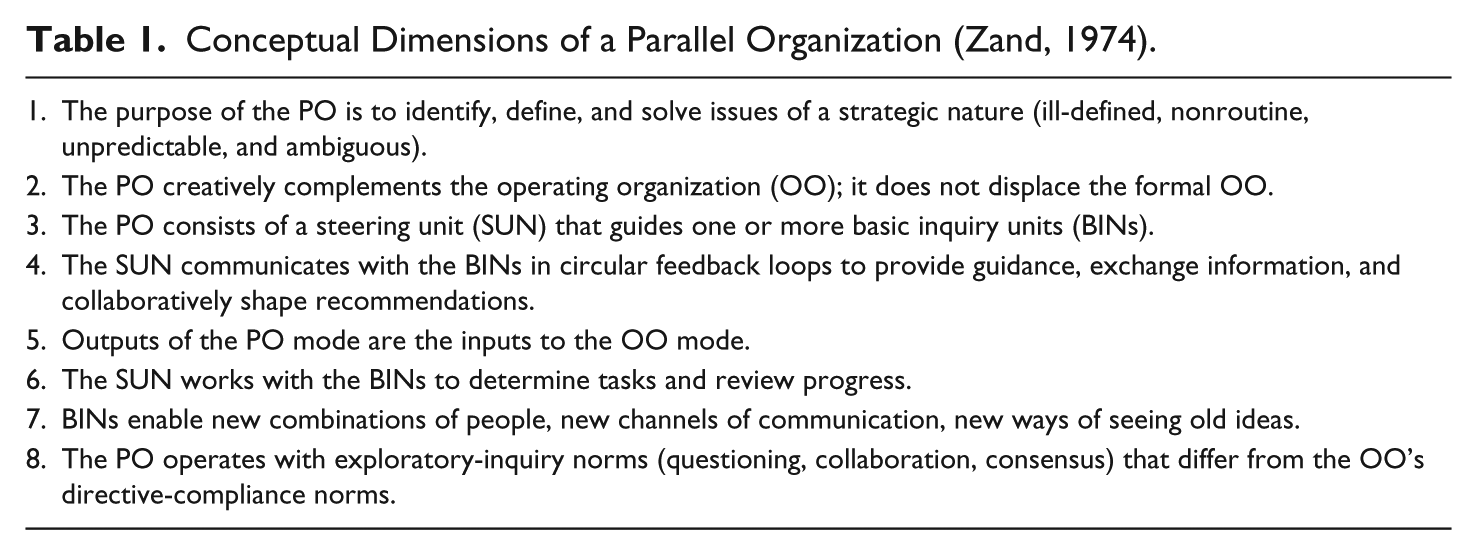
The PO’s original design principles and processes (Zand, 1974), later reiterated and elaborated (Bush & Shani, 1991), are as follows:
The purpose of the PO is to identify, define, and solve problems, usually of a strategic nature, not solved by the formal, primary, OO. The OO uses an authority/production mode and the PO uses a knowledge/inquiry mode. The PO operates beside the formal OO as a coexisting formal organization. Managers choose the PO or the OO depending on which organization they judge would better handle the characteristics of the issue or problem.
The PO creatively complements the OO; it does not displace the formal OO. The members of the PO are the same people who work in the OO. The same people staff the PO as staff the OO.
The PO consists of a steering unit (SUN) that guides one or more basic inquiry units (BINs). The SUN may specify what is not acceptable for the BINs to explore and may accept or reject issues for inquiry. Inquiry units can only make recommendations to the SUN. They do not have hierarchical power and cannot issue directives to the OO.
The SUN communicates with the inquiry units in circular feedback loops to provide guidance, exchange information, and collaboratively shape recommendations.
The outputs of the PO are inputs to the OO. The SUN decides what goes from the PO to the OO. The value and effectiveness of the PO depends on successfully linking it to the OO, so its outputs are used. The linking mechanisms consist of (a) membership—selecting people with formal power, expertise, information, and representational knowledge—for the SUN and the inquiry units; (b) norms supporting inquiry, collaboration, and consensus in all elements of the PO; and (c) members transferring the inquiry and collaboration skills learned in the PO and their new network relationships to the OO.
The SUN works with inquiry units to determine tasks and review progress. The SUN may accept, reject, or ask for modification of proposed issues and recommended solutions from the inquiry units. The SUN and the inquiry units mutually shape the inquiry process and the emerging substance through successive phases of consensus. The parallel SUN determines what issues they will accept or reject and may not give reasons for its decisions, although this rarely happens.
Inquiry units enable new combinations of people, new channels of communication, and new ways of seeing old ideas. All channels are open and connected so managers and specialists can communicate freely without being confined to formal OO channels. An inquiry unit can enlist others in and outside the organization as it works on soliciting, investigating, analyzing, and recommending action on issues.
The PO process operates with exploratory-inquiry norms that differ from the OO’s directive-compliance norms. Parallel norms support careful questioning and analysis of goals, assumptions, methods, alternatives, and evaluation criteria. Parallel norms blend collaborative action research with reasoned problem definition and solving by encouraging new ideas, different perspectives, creative approaches to obstacles, and rapid exchange of relevant information. PO members are encouraged to transfer inquiry and collaboration skills to the OO.
In this case study, management used these principles as the template for structuring its PO and writing its guide manual. These eight principles are core PO dimensions (see Table 1) that were common and essential to PO functioning in the empirical studies reviewed later in this article.
Conceptual Dimensions of a Parallel Organization (Zand, 1974).
Nomenclature and Theory
Since its introduction four decades ago, the PO has been called various names. Also, authors have emphasized one or more aspects of theory such as the PO structural relation to the OO, member learning, and focal purpose. For example, it has been called a parallel learning structure (Boyle, 1984; Bushe, 1987, 1988, 1989; Bushe & Shani, 1990, 1991; Doyle, Gelinas, & Kraus, 1984; Goodman & Dean, 1982; Herrick, 1985; Kanter, 1983; Lawler & Mohrman, 1985; Miller, 1978; Mohrman & Ledford, 1985; Moore, 1986, 1989; Moore & Miners, 1988; Shani, 1987; Shani, Basuray, & Place, 1986; Shani & Docherty, 2003; Shani & Eberhardt, 1987; Shani, Pasmore, & Mietus, 1982; Stein & Kanter, 1980). It has also been called a collateral organization (Kilmann, 1982; Rubinstein & Woodman, 1984; Zand, 1974, 1981, 1997), a dual organization (Duncan, 1976; Goldstein, 1978, 1985), and a fusion organization (Ackerman & Whitney, 1984).
Some propose that total quality management (Juran & DeFeo, 2010), six-sigma (Ternant, 2001), and quality-of-life programs (Danna & Griffin, 1999) have sufficient characteristics to qualify as POs. There is also the term ambidextrous organization (Andriopoulous & Lewis, 2009; Duncan, 1976; O’Reilly & Tushman, 2004; Raisch & Bukinshaw, 2008; Tushman & O’Reilly, 1996) for organizations combining features of effectively addressing both well-defined and ill-defined issues in exploitation and exploration (Andriopoulous & Lewis, 2009; March, 1991). Then there is the strategic fitness process (Beer & Eisenstat, 2004; Fredberg, Norrgren, & Shani, 2011) for which a PO may be a contributing component to the overall cognitive, structural, and procedural foci. To move beyond the thicket of nomenclature and each label’s selective emphasis on one or another facet of PO theory, we will use the inclusive term parallel organization.
Empirical–Theoretical Balance
Historically, OD interventions and theory have advanced by relying on the interplay between empirical case studies and theoretical/conceptual development (French, Bell, & Zawacki, 2000; Shani & Docherty, 2008). Empirical case studies have provided descriptions of varying detail of an actual OD intervention, generally from an action research or grounded theory perspective. The description is usually longitudinal in character, providing sufficient empirical evidence to illustrate the practical results and the theoretical dimensions of the intervention. In contrast, a paper that is essentially theoretical/conceptual in character discusses theory underlying interventions and theoretical characteristics of interventions without empirical evidence to illustrate the theory.
Applying this empirical/theoretical distinction to the 29 parallel literature articles we reviewed, we found that 15 were essentially theoretical/conceptual in character with no empirical evidence or minimal anecdotal information to illustrate and support the conceptual discussion (Ackerman & Whitney, 1984; Boyle, 1984; Bushe & Shani, 1990; Doyle et al., 1984; Duncan, 1976; Goldstein, 1985; Goodman & Dean, 1982; Herrick, 1985; Kilmann, 1982; Lawler & Mohrman, 1985; Mohrman & Ledford, 1985; Moore, 1986, 1989; Rubinstein & Woodman, 1984; Shani et al., 1986). Theory in these articles was congruent with Zand (1974) and Table 1.
Nine of the remaining 14 provided a moderate level of conceptual or theoretical discussion, also congruent with Zand (1974), coupled with limited empirical information for practitioners (Bushe, 1987, 1988, 1989; Goldstein, 1978; Miller, 1978; Moore & Miners, 1988; Shani, 1987; Shani & Docherty, 2003; Shani et al., 1982).
The final five were rich in both empirical description and theoretical/conceptual grounding (Bushe & Shani, 1991; Kanter, 1983; Shani & Eberhardt, 1987; Stein & Kanter, 1980; Zand, 1974). The case in Kanter (1983), however, presents in greater depth the same case as in Stein and Kanter (1980). Also, Bushe and Shani (1991) present in greater depth the same case presented in Shani and Eberhardt (1987). As a result, there are two cases in Zand (1974, 1981), one case in Kanter (1983), and five cases in Bushe and Shani (1991) that offer sufficient empirical information and conceptual discussion to compare with the empirical and conceptual information in the case presented in this article.
Parallel Organization Dimensions
In an earlier review of 17 PO articles, Bushe and Shani (1990) divided the parallel literature into three loosely defined but not mutually exclusive groups, based on combinations of two features: (a) the purpose or focal concern of the PO and (b) the duration of the PO. The first group focused on solving strategic, ill-defined, complex problems and issues with a PO of temporary duration (e.g., Kilmann, 1982; Zand, 1974, 1981). The second group focused on increasing a bureaucratic organization’s adaptability to a changing environment with a PO of permanent duration (e.g., Goldstein, 1978, 1985; Stein & Kanter, 1980). The third group focused on transforming the culture and leadership style of a bureaucratic organization with a permanent PO of evolving structure and process, that is, the PO continues to exist and function but evolves in both its configuration and processes as the OO transforms from a highly bureaucratic form to a less bureaucratic form (e.g., Bushe, 1988; Rubinstein & Woodman, 1984; Shani & Eberhardt, 1987).
Emergent Dimensions
We reviewed dimensions in all 29 PO citations introduced earlier. In addition to the conceptual dimensions presented in Table 1, that are characteristic of essentially all five empirical pieces identified earlier, and the purpose and duration dimensions used by Bushe and Shani (1990), we found eight other dimensions, in the case we present in this article, that are relevant to understanding the use of the PO intervention in organizational development. We call these other dimensions “emergent dimensions,” that is, implicit or barely mentioned facets that we make explicit because of their relevance to PO functioning and theory. We present those emergent dimensions, in addition to the purpose and duration dimensions, in Table 2.
Emergent Dimensions From Review of Empirical Parallel Organization (PO) Literature.
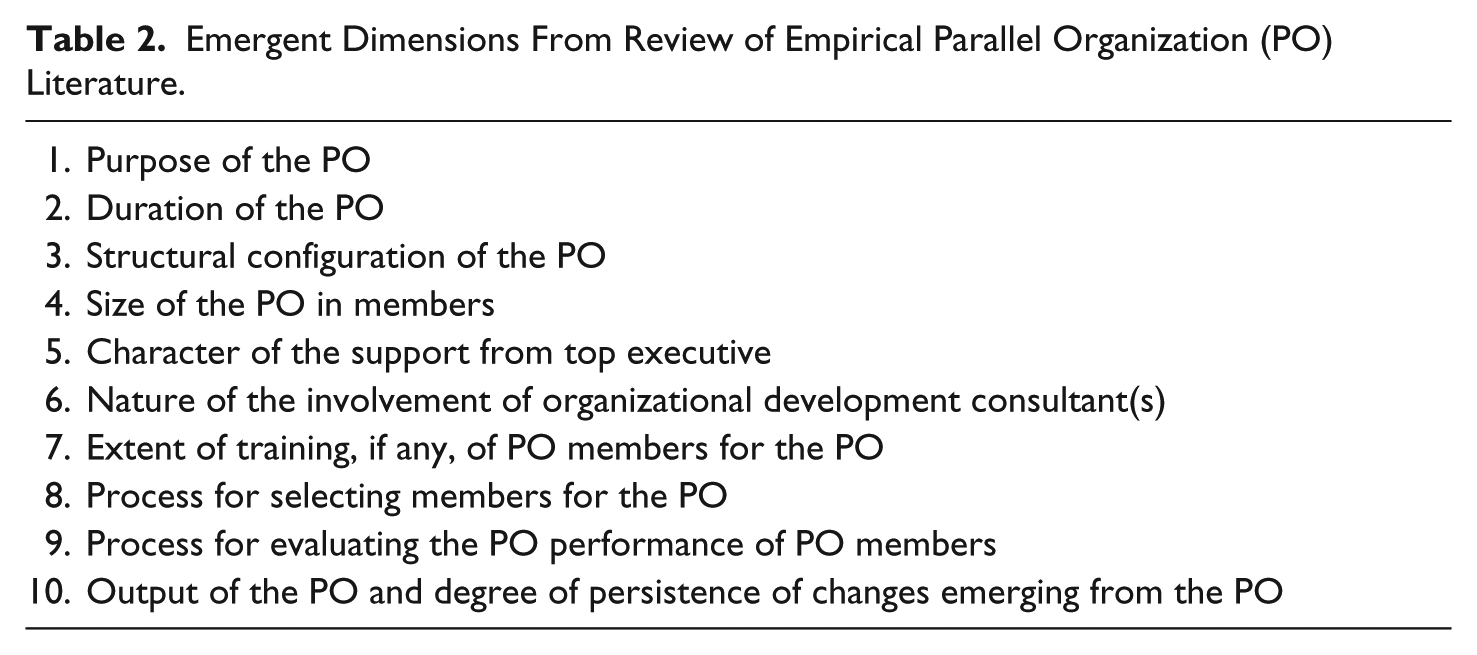
Empirical evidence of the emergent dimensions was either totally absent in most articles or lightly discussed in a small minority of the PO literature reviewed. The dimension of the key executive role received the most coverage in seven of the articles. In the PO case presented in this article, the emergent dimensions are clearly present and significant.
We now describe the case of Simcor’s (disguised name) PO. After the case presentation, we discuss the research methodology which used documents and interviews as the data base for describing Simcor’s PO structure, process, accomplishments and developing implications, and conclusions.
Company Background
George Wilson (all names disguised), newly appointed CEO of Simcor, had spent his entire career of more than 25 years in the company. Simcor, headquartered in the United States, was a large, wholly owned subsidiary of a major, international firm. Simcor’s four divisions, located in different cities, operated as independent profit centers. Each used its own costing methods, pricing policies, product abandonment criteria, and selling activities. More than 80% of Simcor’s production went to the parent firm, which could buy products from Simcor competitors if quality, delivery, or pricing was advantageous. At the same time, Simcor could sell to competitors of the parent firm. Simcor led its industry in production, sales, and process technology for several decades. Its dominant position, however, depended heavily on parent firm sales, which were growing but cyclical.
Simcor was primarily a manufacturing firm. Its divisions were hierarchically and functionally structured with strong top-down, authoritarian management. To get a sense of its size and structure we note that it employed about 7,500 unionized hourly employees and 1,150 managerial employees organized in four levels. There were 50 at headquarters and division top management (A level), 100 in upper-middle management (B level), 300 in lower-middle management (C level), and 700 at the entry management level (D level). A cadre of 400 secretarial and administrative assistants supported management.
Manufacturing dominated the culture and treated all other functions as secondary and subservient. Division Managers came up in manufacturing and historically were the only candidates considered eligible for the CEO position. Manufacturing technology changed slowly and investment was almost exclusively in plant and equipment.
CEO’s Issues Motivating Parallel Organization
Wilson had moved up through manufacturing to division manager, and then to the key headquarters staff position of production manager, overseeing production at all four divisions. After years of service, he had acquired extensive, firsthand knowledge of the company’s operations, culture, and issues. Based on that knowledge, he had several concerns when he became CEO:
There was little communication across functions within and across the divisions and within company headquarters, which led to policy disparities between divisions, poor coordination, and increased costs.
There was little transfer of good practices or useful innovations across Simcor divisions.
There was little strategic planning in Simcor and the parent firm, which increased uncertainty in Simcor’s product and capital investment decisions.
Wilson recognized a need for transformative change to deal with these issues of policy disparities, poor intra- and interdivision communication, and inadequate strategic planning. Believing that the deep authoritarian culture and powerful independent divisions would strongly resist change, he consulted an OD specialist in the parent firm. Their collaboration, during the 5 months before Wilson took office, used much of Zand’s (1974) PO theory, structure and inquiry process—according to the OD specialist—in the design and installation of Simcor’s PO.
Simcor’s Parallel Organization
On assuming his CEO responsibilities, Wilson convened an off-site retreat for all top, A-level managers where he and the OD specialist presented details of the PO project. Small group meetings and plenary discussions resulted in minor modifications and a short list of initial projects for assignment to inquiry units, which were called “Councils.” At the time, Wilson did not indicate that any topics or issues were out of bounds for the PO.
Parallel Structure
Simcor’s parallel structure can be visualized as a stack of flat, cross-sectional networks or pancakes. Each network was a horizontal, cross-division, cross-functional slice of the formal organization designed to facilitate company-wide, consensual policy-making. The chairman of each layer acted as the link to the layer above. The structure was like a stack of pancakes with a pat of butter between each layer.
A steering unit, called the Strategy Council (SC), guided Simcor’s Parallel Organization (SPO; see Figure 1). Wilson, the CEO, chaired the steering unit, which included the four division managers and all nine A-level headquarters staff. Thus, the steering unit, following PO principles, was linked to managers with key decision authority in the formal organization.
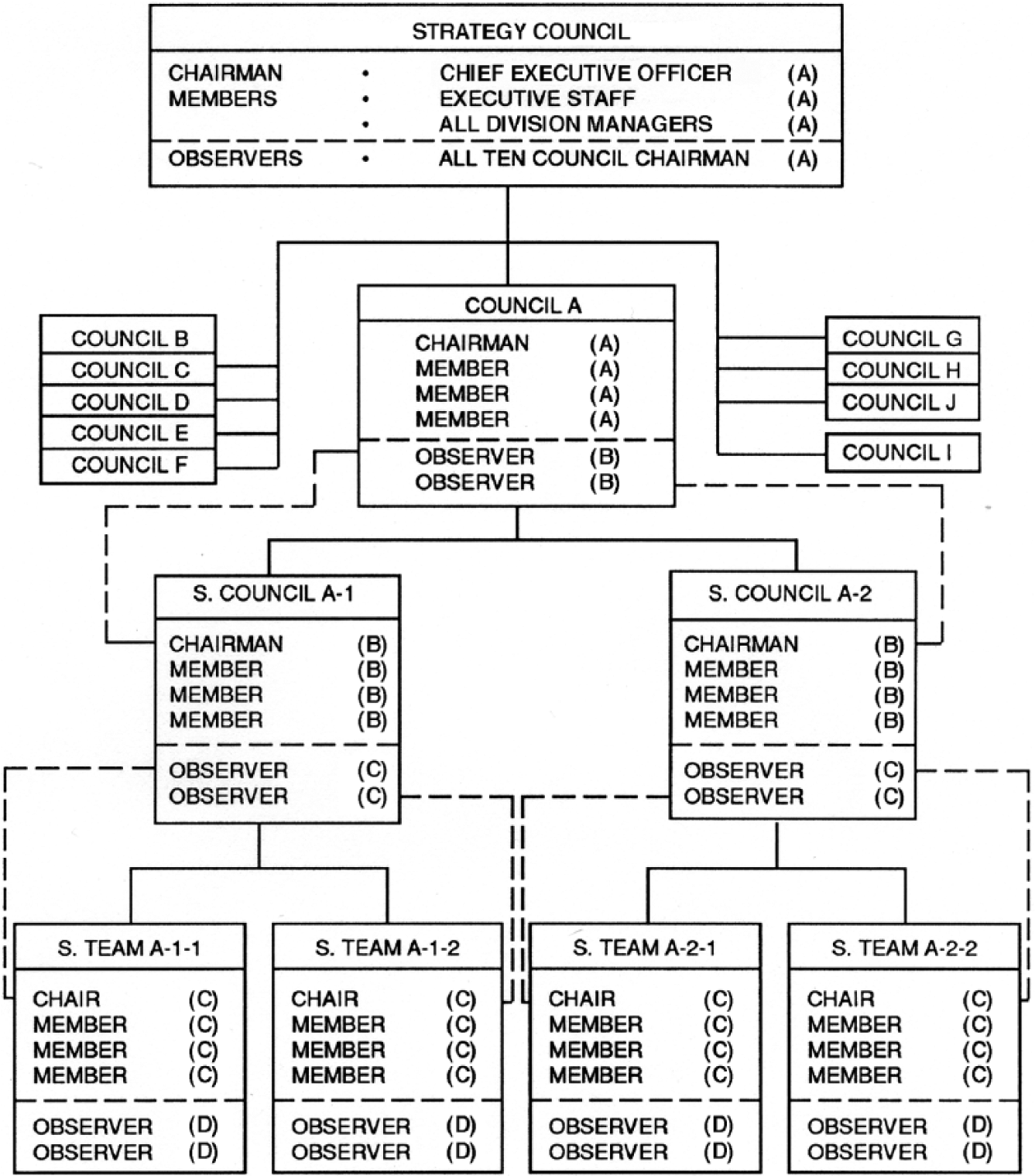
Parallel organization structure.
The inquiry units linked to the formal organization through members with authority and familiarity with organizational concerns. Ten planning Councils, designated Councils A through J, reported to the SC. Each Council consisted of four, A-level, top managers. Every Council had two Support Councils (e.g., A-1 and A-2 for Council A) consisting of four, B-level, upper-middle managers. Every Support Council had two Support Teams (e.g., A-1-1 and A-1-2 for Support Council A-1) with four, C-level, lower-middle managers.
All A-level, top managers were in the Parallel, either in the SC or one of the planning Councils. Participants from middle and lower levels of management were selected by recommendation of superiors, with final approval by Wilson, the SC chair.
The Parallel linked the inquiry units and the steering unit in an extended communication network through their respective chairmen. The 10 planning Council chairs were observers in the SC. The two Support Council chairs observed their planning Council. The two Support Team chairs observed their Support Council. Finally, each Support Team had two participant/observer D-level managers. Thus, all inquiry units were linked through a chain of participant/observers communicating across the four levels of management.
Division and Function Boundary Spanning Connections
To develop communication across divisions, all members of a Council came from different divisions and headquarters. To foster communication across functional specialties, all members of a Council, Support Council, or Support Team came from a different function—manufacturing, marketing, engineering, finance, and human resources. To support communication within divisions, members of each Support Council and Support Team came from different functions in the same division.
Parallel Process
Councils and their support groups were the inquiry units of the PO. Each Council was completely free to investigate its assigned project(s) and develop its policy recommendation(s).
Inquiry and Consensus
Wilson said, in his charge to the Councils, “You have freedom to inquire and independence. I want high quality—I expect you to understand everything about a subject.” Councils could interview and survey anyone in Simcor, its parent firm, and any of its subsidiaries. Councils could visit and interview other corporations, competitors, trade associations, and government agencies. They could attend seminars, consult experts, employ trainers, buy books, and subscribe to journals.
Council member interviews reported they “had tremendous flexibility and could go anywhere and talk to anyone—there were never any questions. There was no cost accumulation nor any accounting of time put into the SPO.”
All Councils, Support Councils, and Support Teams operated by consensus. Typically they commented “we had to learn to listen and work participatively. This was a radical departure from the directive, authoritarian culture of the formal organization.”
Parallel Organization Guidance and Learning
Council chairs received guidance by periodically reviewing their investigation plan and progress with the Strategy Council. All other Council Chairs were present as observers. Wilson believed that learning by observing and working with peers (Bandura, 1986) was an important feature of the Parallel: “I wanted Council chairs to hear each other’s presentation. When they saw better work than their own, they would go back to their Council and try to do even better than what they heard.”
Wilson, as Chair of the Strategy Council, also met with each Council twice a year for a status report and progress review. Council members “used these meetings to test ideas on Wilson and get feedback on potential policy recommendations.”
Councils also sought feedback from the line organization by floating ideas for possible policies. Council members tested ideas on line managers. We’d say we’re thinking of doing such and such. What do you think about it? Their comments helped us understand the situation better and warned us of problems. Also, talking to them eased the way so the policy wouldn’t come as a surprise.
Learning within the Councils, Support Councils, and Support Teams emerged in a social learning process of experimentation, observation, and feedback. The PO requirement of consensus impelled participants to draw on each other’s investigative competencies, skills, and knowledge, develop new competencies, and invent new ways to address challenges to their inquiry processes. Also, the chair of each unit, as observer in the unit higher in the PO, brought back to his unit ideas used by or suggested in the higher unit. Learning was heavily experiential, driven by investigating and creating new ways to develop policy that would pass scrutiny in the SC.
Collaboration With Strategy Council
After a Council reached consensus on the content and language of its policy recommendations, the Chair sent the policy document, often 70 to 200 pages plus exhibits, to members of the SC, and the other Council Chairs. Then the Council Chair made an oral presentation to the SC, with other chairs observing. He described the issues, data gathered, investigative process, analytic concepts, models, conclusions, and rationale for each recommended policy. The SC asked questions and discussed all aspects of the study.
After determining its level of consensus, the SC accepted, rejected, or asked for modification of the recommendation. If there were SC objections, the Council Chair took the policy back to the Council for further work. Consensus by the SC was necessary for acceptance and subsequent transmission of a policy to the line organization. It was then the responsibility of Simcor’s Division Managers and staff to implement the policy.
Through this iterative process of interim consensus and participative review, members learned from each other and continually sharpened their investigative, analytic, and presentation skills. After the Parallel started operating, Wilson was “amazed by the financial, legal, operational, and personnel information Councils got from the parent firm and other companies.”
Wide Scope of Participation
Participation in the Parallel included all 50 of the top, A-level managers. It also included 80 of the 100 B-level managers, half of the 300 C-level managers, and 84 (12%) of the 700 D-level managers. Councils and Support Councils met once a month and were active for the 10-year life of the Simcor PO. Support Teams were intermittently activated, generally for policy audits.
Generating and Processing Proposals
To uncover issues, Wilson asked all managers, top A through lower D level, to propose inquiry projects. Council I collected, cataloged, consolidated, evaluated, and recommended selected Projects to the SC. After 2 years and 4 months of successful Parallel operation, Council I was renamed Council Z and, in addition to soliciting issues from the organization, generated Strategic Issues on its own.
Council-I members evaluated proposals for potential long-range benefit and economic value. We had to screen out many proposals that were personal gripes. We developed categories for proposals: (1) Return to Line—meaning existing system and policies can handle this with proper communication and execution; (2) Cancelled Tactical—meaning it’s a problem but it’s not sufficiently strategic, it’s tactical, and the line should work on it; (3) Cancelled Duplicate—the proposal is, or can be, part of an already accepted proposal; (4) Accepted—it should go to the Strategy Council for consideration.
There was, however, no follow-up by Councils I and Z on issues designated Return to Line or Cancelled Tactical.
Sources of Proposals and Policies
Proposals came from all levels of management (see Table 3); however, the major source gradually shifted from the lower to the upper levels as the PO aged and matured. During the SPO’s first 28 months, Council I considered 218 issue proposals. Almost two thirds (139) came from lower-middle, C-level managers. During the last 7 years, Council Z considered another 167 proposals, 47 of which came from within Council Z. The source shifted to the top two A and B levels of management which together generated almost 70% of the proposals. Council members noted that by the later stages of the Parallel, people had learned the difference between a personal gripe, a tactical issue, and a strategic issue which led to a reduced number of proposals submitted from lower levels.
Projects and Author Management Level.
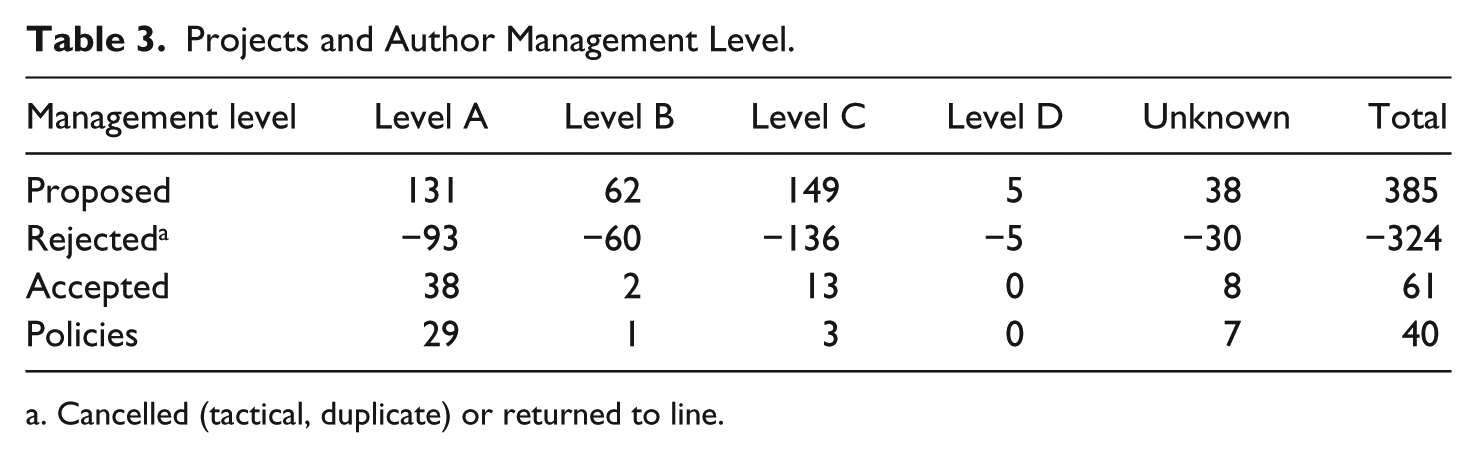
Cancelled (tactical, duplicate) or returned to line.
Although proposals came from all levels of management, the majority of policies—that is, 29 (73%) of the 40 completed policies—came from A-level proposals (see Table 3).
One explanation for the predominance of Level-A proposals in completed policies is that A-level managers, compared with lower managers, had a better strategic overview of Simcor and its problems, coupled with a long employment history at Simcor where they had worked their way up the hierarchical ladder. A second explanation is that their status as A-level managers in the hierarchy gave them significant political influence with Councils I and Z and A-level colleagues on the SC during the approval process in the SC.
In addition to lower levels learning to self-censor nonstrategic proposals, a number of Level-C and -D managers encountered persistent resistance when they submitted proposals challenging the CEO and A-level managers’ fundamental strategic view of Simcor as (a) a captive supplier of existing products to the parent firm and (b) a functionally structured firm across and within the divisions. Given that the parent firm owned Simcor and determined and bought the vast majority of Simcor’s output, those proposals were not acceptable to the CEO and the SC. Furthermore, the SC noted that Simcor was comfortably profitable, a leader in its industry and saw no significant threats to its position.
Wide Range of Completed Policies
Parallel policies focused on an extremely wide range of important issues previously ignored or intractable in Simcor’s autonomous, self-contained divisions. The PO grouped the policies into five broad categories: (a) Administrative-Financial, (b) Facilities-Equipment, (c) Strategy-Markets, (d) Personnel, and (e) Products-Production. For a list of the 40 completed policies, see Table 4.
Simcor Parallel Policies Implemented.

Below we look at sample policies.
Costing for Pricing
Simcor was a high-volume manufacturing firm in a competitive industry with low profit margins. Costs determined prices and cost miscalculations seriously affected profitability and product decisions. Each division had its own costing policy and the price of a product could vary across divisions.
The investigating Council consulted experts and sources in and out of the company. According to the Council, We sharpened our knowledge of costing and evaluated Simcor’s pricing methods. We found allocation of burden, a major component of cost, varied across Divisions. They used volume, or direct labor, or direct materials or a combination so some products absorbed more or less burden, often unrelated to actual usage. Product yields and scrap varied and often was not reflected in costs. We studied a standard set of products and found price variations for the same product across the Divisions.
The Council tested four different costing methods and recommended one the SC accepted for implementation in all divisions. In summary, “The financial department and production planning people strongly supported it. Costing for Pricing changed the entire approach to products, manufacturing, and pricing. It showed what the Parallel could do.”
Future Business Planning
Future Business Planning was an ambitious Parallel project for Simcor, a manufacturing firm largely dependent on its parent company for product demand information and forecasts.
The council noted, We started with little knowledge of forecasting and strategic planning and spent a lot of time investigating the subjects. We distilled our task into a few basic questions: (1) How can we get a clear, relevant picture of the next ten to twenty years? (2) How will changes impact Simcor’s strategic position, technology, and products?
Council members read books and journals and consulted experts. They examined econometric models and consulted econometric modeling and scenario planning organizations. They reviewed strategic planning at the parent company and its subsidiaries and investigated sophisticated planning processes at other firms.
The Council concluded, First, no single model or source could provide all the information needed for effective future planning. Second, external, uncontrollable factors will greatly affect Simcor. Third, there should be continual monitoring and evaluation of events to provide early warning of critical future conditions, even though a reliable, accurate long-term forecast was not feasible.
The Council recommended that the CEO and executive staff closely monitor the parent company’s strategic plans and establish a strategy mechanism in Simcor. A new Support Council (Z-3) was formed to monitor strategic planning processes and develop an integrated business outlook for Simcor. It became a key contributor to Simcor’s strategic planning. The Council’s study of positioning Simcor in the global market, for example, determined there was high excess capacity world-wide. It presciently advised that expansion would face strong rivalry and, if done, should be by acquiring cost-efficient facilities rather than building new plants that would add excess industry capacity and pressure price declines.
Other Sample Policies
Originally, each Simcor division had its own product abandonment policies that led to cross-division product-line conflicts and customer relations difficulties. The PO developed Simcor-wide criteria for product abandonment and installed a central product abandonment committee to review and approve all abandonment decisions. Product-line coverage, manufacturing, and customer relations benefitted as a result.
The PO reviewed division fringe benefit programs and practices such as pensions, medical benefits, sickness insurance, vacations, and so on. It found inconsistent policies across Simcor, an absence of policies in several divisions, and practices that increased fringe benefit costs unnecessarily. The PO standardized policies in all benefit categories resulting in substantial savings across all of Simcor.
Simcor manufacturing was subject to substantial, ongoing environmental and safety regulation. Originally, each division pursued its own practices of anticipating and responding to such regulations. The PO’s policy led to formation of a centralized governmental relations unit. The unit worked with federal and state legislators and regulators to anticipate and shape regulations, and facilitate timely, uniform division responses to regulatory issues.
Transition From Parallel to Staff Teams
In response to declining world demand, the parent firm directed Simcor to absorb three other subsidiaries in the ninth year of the Parallel. Then Wilson retired after 10 years as CEO and John Randle, a CEO from a different business subsidiary of the parent, was appointed CEO.
Randle queried division and headquarters staff top managers at a general meeting about how to improve Simcor. They advised that the critical task was to absorb the three, unfamiliar, low-performing business units while adjusting to declining volume and recession. In their view, the Parallel had been successful and there were no major issues that could not be handled in the line organization. The Parallel could be suspended and restarted if needed.
Randle suspended the Parallel and formed a “Product Team” task force, composed largely of headquarters staff, to study Simcor’s products and organization. Based on Product Team recommendations, Randle approved reorganizing Simcor into product-centered, strategic business units (SBUs). One staff team facilitated the transition by orienting personnel to the SBUs and a second team communicated the changes to the entire organization. Managers were ready for the change because an earlier PO proposal had recommended a shift to SBUs, which the Steering Council had not accepted at that time.
After observing the staff teams and divisions work together to design and transition to SBUs, Randle paid tribute to the learning and transformative effects he inherited from the PO. He “was impressed by management’s analytic and presentation skills and how well people collaborated across Divisions and functions.”
Research Method
Method
This research used descriptive, narrative, qualitative methodology based on richly detailed document and interview sources (Gephart, 2004; Kennedy, 1979; O’Connor, 1999).
The research examined an extensive set of documents covering the entire 10-year period of the Simcor PO. Documents included: (a) Simcor’s PO manual detailing the PO structure, procedures, process, relationships among components, membership composition of components, frequency of meetings, and relation to the line organization; (b) organization charts of Simcor divisions; (c) all final strategic policies with complete Council reports containing all supporting data and analysis; (d) all of several hundred project and strategic issue proposals submitted to the PO, identifying origin and disposition; (e) minutes of all meetings of all elements of the PO.
To obtain information about the actual operation, process, benefits, and limitations of the PO, 59 in-depth, semistructured, recorded, transcribed interviews were conducted. Fifty-six interviews covered a cross-section sample of the 360 PO participants (15% of total), including all levels of management, all functions, all divisions, headquarters, and an administrative employee. In addition, three parent company OD staff were interviewed. A sample of representative interview questions appears in Table 5. All interviewees reviewed their transcript, and only two made minor revisions. Transcripts were content analyzed for key phrases relevant to facets of PO theory and practice. Quotations, assertions, perceptions, and conclusions in the case are based on triangulation (Jick, 1979), that is, confirming agreement among multiple interviewees consistent with documentary evidence.
Sample Interview Questions.

Simcor’s culture and operations were also observed by visits to all divisions and company headquarters observing top management and staff interaction. Neither author participated in the design or implementation of any aspect of Simcor’s PO.
We continually coded and analyzed the collected data using a grounded theory process (Glaser, 1978; Glaser & Strauss, 1967), to inductively generate concepts and themes and triangulate across the data sources until we achieved saturation of each theme. This constant comparative analysis confirmed the eight original theoretical dimensions proposed in Zand (1974) and the eight emergent dimensions discussed later in this article.
Limitations
This is a qualitative, descriptive, interpretive, and inductive research influenced by the experience and interpretive lenses of the researchers. Generalization from this single case study to other situations should be done cautiously. Kennedy (1979) addresses the issue of generalizing from a single case study by suggesting that rich case description allows readers to judge whether the context, circumstances, and details of the research case are sufficiently similar to the readers’ situations to warrant generalization to the their situations. This article captures some, but not all, of the deep, rich description collected in this research.
The research was done after the phenomenon occurred and respondents may have limited, biased recollections or rationalized reasons for their views and actions. Some interviewees may have shaped responses to fit what they believed the interviewer wanted to hear. We tried to minimize these limitations by triangulation (Jick, 1979) with other interviews, documents, and observations.
From management’s performance claims, the duration of the Parallel, and Simcor’s continued dominant position in its industry, we infer that management was satisfied with Parallel financial and operating contributions, although Simcor top management would not release detailed financial information for the SPO period.
Discussion
Benefits of the Parallel Organization
The PO was a major systemic change in Simcor. It introduced a lateral structure and process for investigating important issues and operated in tandem with the formal organization. Participants believed that Simcor’s deeply rooted, authoritarian, manufacturing culture and bureaucratic, line organization would not have uncovered the range of issues or investigated them as thoroughly as the Parallel did.
As one representative participant said, The Parallel broke down organizational barriers. Before the Parallel, people didn’t know each other. For a majority of us the discussions and working with people from all Divisions, functions and headquarters led to a flow of information that changed the company.
The Parallel introduced important policy changes (Table 4) across operations, facilities, finances, personnel, markets, and strategy. Divisions benefited greatly from uniform policies where appropriate and none existed.
The Parallel helped managers see Simcor’s strategic position in its external environment. Managers developed a comprehensive perspective by visiting other subsidiaries, the parent firm, and other corporations. A participant said, “The SPO let me see the big picture. I could understand and take part in many areas of the business that previously I would not know.”
The Parallel developed participants’ skills in collaborating to solve problems across functions and divisions. Participants called on their Parallel connections to consult people in other functions and divisions in the line organization. A participant noted that the SPO exposed people to different disciplines and views of problems. They took that collaborative view into the line organization.
Participants praised the Parallel for improving their investigative, analytic, and presentation skills. They felt more confident discussing decisions in the line organization. Participants said that the Parallel exposed them to consensus decision-making where they had to listen to and discuss different views with people from different functions. They carried that consensus experience into problem solving in the line organization as well.
Intrusions and Difficulties
External events twice interfered with Parallel operations. The parent firm transferred unprofitable manufacturing divisions to Simcor during the Parallel’s third year and ninth year, expecting Simcor to absorb them despite declining volume and economic recession at those times. During the first transfer, Simcor was implementing 21 new Parallel policies. Participants recalled the difficulty of absorbing two failing divisions during recession while implementing new Parallel policies. Then during the ninth year, absorbing three more failed, transferred divisions led to the use of staff teams rather than the Parallel.
Occasional participant disagreement with Simcor’s core strategy was another difficulty that reduced commitment to the Parallel. For example, some middle- and lower-level managers, with a limited view of the organization, had difficulty accepting the premise that “Simcor is, and would continue to be, a high-volume, low-cost manufacturer using evolving technology to produce a limited line of products sold primarily to its parent firm. Parallel proposals that fit that view will be studied, departures will not.”
The dichotomy of strategic and tactical was also a source of difficulty. Although Simcor’s Parallel Manual and process authorized the Strategy Council to reject any insufficiently strategic proposal, some middle and lower managers were disappointed when their projects were judged tactical and rejected or turned back to be resolved in the division, particularly without follow-up to confirm the issue had been addressed in the division.
The apparent priority given to top-management interests reduced lower-management commitment to the Parallel. Top managers dominated as the source of project proposals selected for development into policies (see Table 3). Their higher level in Simcor, we believe, gave them a clearer perspective of what was and was not strategic. In addition to feeling left out as a source of proposals, some lower managers who implemented new policies expressed skepticism when they saw deficiencies in policies, despite the Parallel’s best efforts. Some became particularly cynical after discovering poor implementation of human resource policies at their level.
Implications for Theory
We now introduce a matrix (Table 6) that compares Simcor with the eight published PO cases we earlier considered to be both empirically and conceptually comprehensive (Bushe & Shani, 1991; Kanter, 1983; Zand, 1974, 1981). We use the matrix to discuss how Simcor adds new insight to PO research and theory. We note that the published PO literature addresses and is in general agreement with Zand’s (1974) eight conceptual dimensions of a PO (Table 1). Therefore, we will examine other dimensions often minimally discussed or omitted in empirical PO cases (Table 6).
Comparison of Simcor to Previous Research.
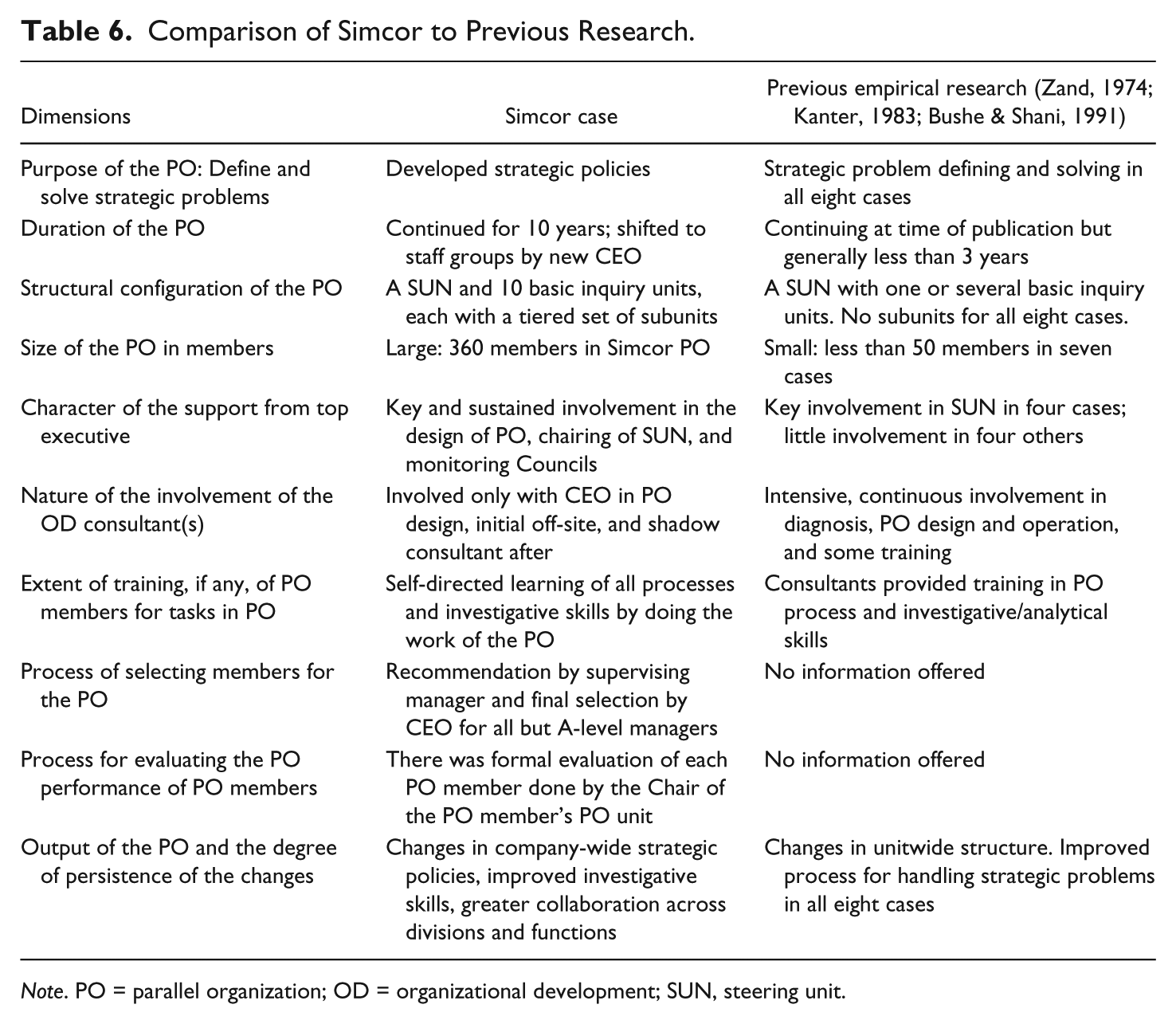
Note. PO = parallel organization; OD = organizational development; SUN, steering unit.
Purpose and Duration of the PO
We observed little discussion of the theory underlying duration of the PO in the case studies reported in the empirical parallel learning structure literature. Theoretically, as originally conceived by Zand (1974), a PO is a temporary supplement, not a permanent fixture, attached to an organization. Bushe and Shani (1990) later develop a three-part typology that recognizes temporary, semipermanent, and permanent parallel learning organizations. The question arises of how long should a PO exist? If the purpose of a PO is to augment the problem-solving ability of the OO, then theoretically, a Parallel should end when there are no more issues to find and solve that are outside the line organization’s problem-solving capacity.
In Simcor, CEO Wilson’s original purpose was to develop and implement beneficial policies and have managers work collaboratively across divisions and functions by supplementing an authoritarian, silo organization with a temporary PO. In practical terms, many managers felt that Simcor’s PO had accomplished most of its work by the end of the third year and should have been temporarily dialed back or suspended while Simcor implemented its new policies and digested two parent-imposed, failing divisions, particularly at a time of temporary recession. By that time, however, Wilson saw the Parallel in a new light. He saw it as a semipermanent or permanent learning mechanism for communication, personnel development, and organizational integration. Also, he did not want to end it as it had become his window into the organization and his signature stamp on the company. It had become part of his management style and process and projected his presence deep into the organization.
Thus, the initial motivation and purpose of the SPO fits the strategic, ill-defined problem defining and solving category of the Bushe and Shani (1990) framework. However, by the third year of its operation, when it would have been reasonable to scale back the SPO, Wilson’s perception moved the SPO into Bushe and Shani’s (1990) second and third categories of building adaptability into a bureaucratic organization and modifying its culture.
Participants, however, continued to see the PO as a problem-solving aid rather than a management development, adaptability, and cultural shift process. The key executive and his OD advisor had not made explicit or engaged PO participants in understanding this fundamental shift in purpose.
The implication of Simcor for OD practice is to be wary of extending the life of a Parallel after it has done its problem-solving work. If the sponsor prolongs it as a pseudo problem-solving entity, participants may lose interest and see the Parallel as a misguided burden rather than a help to the line organization. If PO continuation is intended as a training, communication, adaptability, and cultural shift device, then the PO needs to be evaluated against other methods that may be more effective and efficient.
The implication for PO theory is that duration is a function of organizational context, perceived challenges, management, and participants’ experience with the PO across the time frame of the PO, and the top manager’s preference. The empirical literature on the PO shows differing contexts (e.g., differing industries, differing competitive environments, nonprofit, or governmental organization) differing perceived challenges (e.g., internal dysfunctions or competitor challenges), differing organizational units involved (e.g., a plant, a division, a company), differing motives (e.g., new services and products, improve labor–management cooperation), and differing involvement by the top executive (e.g., arm’s length, strong support but not actively involved, actively involved). In the case of Simcor, it also shows that both unexpected external events as well as changes in the CEO’s purpose for using a PO can affect the duration of the PO.
Structural Configuration and Intensity of CEO Participation
Simcor extends our understanding of parallel theory by showing how extensive, highly articulated and deep a PO structure can be. Simcor’s PO had a SUN as did each of the eight PO cases reported in Zand (1974), Kanter (1983), and Bushe and Shani (1991). Simcor and each of the eight cases also had at least one BIN. Simcor, however, had 10 BINs functioning at the same time, more than any of the eight cases in which the highest reported number of BINs was 3. Furthermore, each Simcor BIN had a two-level support substructure—that is, Support Councils and Support Teams. None of the BINs reported in the eight cases had any substructure.
Simcor highlights the CEO role as another critical structural aspect of PO theory. At Simcor the CEO was an integral part of the entire PO from its design, initiation, and operation for its 10 years life. It could be said that CEO Wilson was the central figure committed to and driving the Simcor PO. The CEO risked that if the PO foundered or failed in any aspect, because of the PO’s extensiveness and depth, Simcor’s performance could have declined, Division Managers could have covertly rebelled, they could have subverted efforts to integrate the divisions, and they could have undermined the CEO by indirectly communicating their displeasure with the PO to the parent firm. In contrast, in a majority of the other eight reported cases the top executive was missing from the guiding SUN, and instead of direct participation, played the more limited, less risky role of supporting and endorsing the activities of the PO.
Size of the Parallel Organization in Members
In all but one of the eight cases in Zand (1974), Kanter (1983), and Bushe and Shani (1991), the total number of people involved in the PO was less than 50. This, of course, reflects the varying sizes of the organizations. All eight organizations had fewer employees than Simcor.
Simcor had 7,500 hourly employees and 1,150 managerial employees, of which approximately 360 managers were involved in the SPO. Simcor’s size, both in employees and in dollar sales, demonstrates that a PO can be scaled up for organizations larger than those reflected in the existing empirical literature. The implication is that parallel theory can apply to organizations larger than reported in the reviewed PO literature.
Character of the Support of the Top Executive as Key Sponsor
A parallel mode can be installed at any level of an organization, but wherever installed, the parallel must have the support of the key manager who guides subject matter, staffing, and implementation. In Simcor the CEO’s commitment was key to the parallel’s success and duration.
Essential to a parallel sponsor’s role is ensuring that parallel outputs mesh with the organization’s overall strategy. Simcor’s managers agreed that Wilson was a strong, respected leader who knew Simcor better than anyone else. No one questioned his integrity or motivation to do what was best for Simcor and the parent company. As a strong leader, to ensure the Parallel did not go astray, he and his OD adviser believed that he should engage in continual mid-course corrections.
For PO theory, the implication is as follows: The key sponsor needs to continually monitor and maintain the delicate balance of ensuring that the formal organization accepts the parallel process and outputs without imposing excessive control that makes the parallel a puppet of the sponsor. An OD practitioner may view a Parallel as participative action research, but to a traditional manager the challenge is how do you manage a controlled revolution without undermining the OO. A common problem for sponsors trying to blend the PO with the OO is that some participants may see the sponsor’s role in the PO as too controlling. On the other hand, too little attention and support by the key sponsor is likely to result in an ineffective PO. Also, practitioners need to be aware of and deal with the sponsor’s concern that the PO may attempt to change the configuration and operating processes of the existing OO in ways she or he does not approve.
Involvement of Organizational Development Consultant(s) Versus Self-Direction
In the Simcor case, the OD consultant played a limited but pivotal role. Using Zand (1974) as a template, he helped design the SPO with the CEO-designate and participated as an observer in the initial start-up off-site. Thereafter, he had a minimal role in the ongoing activity of the SPO and its modifications. He occasionally exchanged ideas and perspectives with Wilson off-site, but he was not present or involved in the PO’s diagnostic or problem search and solving activities, the training of PO members, or modifications to the PO structure.
In contrast, the eight usable parallel cases showed extensive, continuing involvement of the OD consultant(s) in the design, implementation, and actual operation of the POs. Their involvement included assisting in the diagnostic process, providing feedback, designing and guiding procedures for operating the PO, and facilitating process training.
The Simcor PO was essentially a participant, self-directed operation. The idea that a PO could be effective and self sustaining with only initial design input by the OD consultant, stands in sharp contrast to the extensive and deep OD consultant involvement in the cases reported in the literature.
Extent of Training of the Parallel Organization Members
Training PO members for work in the PO is another issue of contrasts. In the Simcor PO, there was no formal training for the inquiry and process tasks in the Councils and the support groups. All learning was by doing on-the-job within each Council, Support Council, and Support Team. Each council assessed its own learning needs and devised methods to meet those needs.
There was also much informal learning/training transfer between groups at Strategy Council meetings. Council chairs observed and learned content, quality, and presentation skills from each other as each Council Chair made his report to the SC and was questioned by the SC members. Even within a Council’s own support structure, the Support Council and Support Team Chair observers to the next level up allowed for both observational dissemination of investigative learning processes as well as the opportunity to ask questions about alternative processes for investigation.
In the eight usable empirical parallel cases, there is little in the way of information on the training of the parallel members for their parallel responsibilities. In the infrequent instances where training is discussed, it was done by the OD consultants and generally focused on meeting process and facilitation skills and not on investigative skills.
There are significant implications for PO theory and practice here. The Simcor PO indicates that after an initial high level of involvement in the design stage, the OD specialist can play a consultative role with the key executive and no role in the processes used by the steering unit and the basic inquiry units.
Process of Selecting Parallel Organization Members
There is limited information on the selection of PO members in the eight cases presented in Zand (1974), Kanter (1983), and Bushe and Shani (1991). At Simcor, however, the process was very clear. All A-level managers at the top of Simcor were always involved in the SPO. For the B-, C-, and D-level managers, however, selection was based on (a) recommendation by the individual’s supervising manager and (b) review by the CEO/SPO chair of the recommendation file, including semiannual evaluations of performance in both the OO and the SPO. Furthermore, continued selection to remain in the SPO as well as selection for promotion in the SPO was contingent on performing well in the SPO and in the OO. It was not uncommon for an individual who did not perform well in the SPO to be dropped from the SPO when there was a hiatus in SPO activities.
Process of Evaluation of Parallel Organization Member Performance
Within the SPO, there was annual evaluation of the performance of each member that became part of the individual’s overall evaluation. Wilson evaluated all members of the SC as well as the Council Chairs. Council Chairs evaluated Council members and the Support Council Chairs, Support Council Chairs evaluated Support Council members and Support Team Chairs, and so forth. A good SPO evaluation meant continuation as a member of the SPO, and, for some, eventual promotion to a higher managerial level at Simcor and in the SPO. A poor SPO evaluation inevitably led to no future assignments in the SPO. Keep in mind, however, that Wilson intended the SPO to be a place where, at least at the C and D levels of management, those with the brightest potential were the ones invited to be on the SPO.
Within the empirical research on cases of parallel organization, information on and discussion of evaluations of performance of the members is extremely limited.
Output of the Parallel Organization and Change Persistence
Common to Simcor and the eight cases was the improvement in the capabilities of identifying, defining, and solving strategic problems well. At the core of this improvement was the enhancement of questioning, investigative, and collaboration competencies of the members of the PO. Similarly, Simcor and the eight cases demonstrated at least some changes in the structural configuration of the organization.
On the other hand, Simcor’s PO is noteworthy for its initiation of fundamental, company-wide, strategic policies of far greater scope and numbers than in other reported cases. The Simcor PO is also noteworthy for the transference of investigative, presentational, and collaborative competencies to the OO, both during and after the SPO experience.
Divergent Thinking and Learning
A PO contributes to problem solving by enabling thinking that diverges from formal organization views. There is tension, however, between the parallel’s divergent thinking and how much divergence the formal organization is willing to accept and implement. Simcor’s CEO continually explained his preferences to his staff, the SC, and each Council. When his position was unclear, managers tried to ferret out his views on specific issues. A number of managers believed that he should have allowed more divergent thinking to emerge, including Council development of proposed issues that focused on alternative configuration arrangements of the OO and consideration of additional markets and products. As CEO, however, Wilson believed that Simcor could not diverge from its role as a captive, major supplier to its parent firm nor from its functional and highly hierarchical organizational configuration, both of which were at the center of the way the A-level managers defined the firm.
The implication for OD practice is that the sponsor and SUN must continually clarify and communicate from the outset the evolving subject boundaries of the PO. On the other hand, the PO must attend to internal and external contextual signals that indicate a need for changes in subject matter boundaries and life of the PO.
Enlarging Scope of the Parallel
One type of PO enlargement relies on managers to transfer the Parallel concept and consensus mode to miniparallel networks in their segment of the line organization. Simcor’s PO enhanced communication at upper levels across Simcor divisions and functions without changing the line structure of the OO. The question for OD specialists is as follows: Should there be a systematic effort to move the parallel, inquiry-consensus mode down to lower levels of a high-volume, standardized-procedure, limited product line operation to deal with short-term issues? If so, how should this be done?
Implications for Practice
Practice here is described as use by consultants and/or managers of a PO as a strategic intervention for systemic, strategic, or transformational change (Beer & Eisenstat, 2004; Fredberg et al., 2011) as well as a change in culture (Schein, 2009). What has the Simcor case offered to further inform practice in the OD field?
Zand’s (1974) eight original dimensions were clearly present at Simcor and remained significant and relevant throughout its life. OD consultants and managers should continue to realize the importance of those dimensions in POs.
At the outset, practitioners should help develop a clear understanding of the intended use and duration of the PO; however, managers, OD consultants, and participants should be open to and clearly enunciate changes in the purpose and duration as the process unfolds and contextual issues emerge. Practitioners need to assist the CEO in his or her critical role in changing the purpose or extending the life of the PO. Practitioners need to help the CEO and participants adjust to contextual issues such as recessions, acquisitions, and competitive threats that may interfere with or temper enthusiasm for the PO.
Practitioners should understand that the structural configuration of a PO may vary across a wider range than previously reported. At Simcor, there were a significant number of BINS operating simultaneously, unlike the previously reported empirical research. Furthermore, unlike earlier reported examples of POs, at Simcor each BIN had multiple formal levels that extended into the lower managerial levels.
Simcor also provides an example of the use of a PO on a larger scale than reported in previous empirical literature. The implication here is that a parallel structure and process may be appropriate for a wide range of organizations.
Practitioners should have well-developed skills for working with a highly involved CEO, such as the one at Simcor, in the design, start-up, and ongoing operation of the PO. Such skills may have been less significant with low to moderately involved CEOs reported in other empirical studies.
At Simcor, the OD consultant, although totally involved in the initial design and start-up of the PO, was essentially uninvolved, except as a private sounding board for the CEO, throughout the life of the PO. For practitioners, this suggests that facilitative and investigative training by OD consultants may not be required for the successful use of a parallel process.
Essentially all of the facilitative and investigative learning in the Councils of the Simcor PO came about as a result of self-directed, trial and adjustment, and observation of other groups. In contrast to the extensive involvement of OD consultants in training PO members, practitioners should, at the outset, devote greater effort to supporting and enabling self-directed learning in a PO.
What should be the practitioner’s role in selection and evaluation of PO members? Members are critical to PO success, yet there is scant information in the parallel structure literature reviewed earlier in this article. At Simcor, in addition to functional specialty, expertise, and representation ability, performance in the OO was a basis for selection into the PO for those at the B, C, and D levels of management. Performance in both the OO and the PO was the basis for continuing as a member of the PO below the A level, with final approval by the CEO. These elements played an important role in the success of Simcor’s PO.
Practitioners should help the CEO and organization understand that a parallel structure will have both intended and emergent outputs. The specific content will be dependent on context—historical, internal, external, and temporal. At Simcor, the CEO’s intended output focused broadly on cross-functional and cross-division communication as well as integrative strategic policies across the firm. Some of the most notable outputs, however, emerged as enhanced investigative, presentational, and collaborative skills that Council members carried into the OO.
The Simcor case reinforces existing empirical research on parallel structures and process for use by managers and OD consultants. It also adds new insight into the role of consultants, the design and duration of PO, its contribution to learning, and its use as a change mechanism.
Conclusion
The Simcor case confirms that, despite the challenge of context, size, and dependence on a parent firm, management can use a PO to operate bimodally, that is, in two different modes, at the same time. Furthermore, the policy outputs of Simcor’s Parallel support the proposition that a PO intervention can diagnose a wide range of ill-structured situations and solve significant problems not identified or solved in the formal organization. The parallel, inquiry mode works on ill-defined, complex tasks to supplement the line, production mode which works on routine, well-defined tasks. The norms of the parallel inquiry mode promote open, well-reasoned, consensus problem solving in contrast to the constraining, authoritarian, directive norms of the compliance, production mode.
The Simcor case reminds us that a Parallel is a demanding intervention with serious potential limitations and conflicts, which is a good reason for OD specialists to appreciate and support a Parallel’s courageous sponsors and participants. As CEO, Wilson could have led Simcor without a PO. He had the knowledge, intelligence, and drive to manage autocratically, like his predecessors. However, he recognized a need to deal with ill-structured issues in a complex environment and opted for collaborative inquiry across Simcor’s divisions and functions. He risked engaging in a high-involvement, participative inquiry process that generated transformative change over an extended period of time.
Footnotes
Declaration of Conflicting Interests
The authors declared no potential conflicts of interest with respect to the research, authorship, and/or publication of this article.
Funding
The authors received no financial support for the research, authorship, and/or publication of this article.