



Abstract
Psychodynamic approaches to the study of organizations note the importance of organizational defense mechanisms, that is, processes and practices that protect the organization from painful realizations. The overuse of defense mechanisms may lead to the organization becoming detached from reality, dysfunctional, unable to learn, and resistant to change. This article develops the concept of therapeutic organizational double bind as a method of intervention to enable “working through” in organizations “stuck” in a specific type of defense mechanism, namely, a pathogenic organizational double bind. The case of the Greenpeace campaign against whaling in Norway serves as an example. This campaign was dysfunctional, yet Greenpeace, being caught in a pathogenic organizational double bind, was unable to change its behavior patterns for quite a long time. A therapeutic organizational double bind enabled Greenpeace to partially work through and remedy this. The article discusses implications for practice and advocates a systemic approach to organizational analysis.
Keywords
Psychodynamic approaches to the study of organizations form a long-standing research tradition and have produced a substantial body of literature (Brown & Starkey, 2000; Diamond, 1993; Gabriel & Carr, 2002; Vince & Broussine, 1996). Simply put, these approaches study the psychological forces that underlie the behavior and emotional life of organizations and organizational members, with a particular emphasis on the active and dynamic role of the unconscious in organizational processes. An important part of the psychodynamics in organizations is individual and organizational defensive mechanisms. Such defensive mechanisms are processes and practices, such as projection or denial, that the individual or organization employs to avoid pain, discomfort, or anxiety. They are employed unconsciously and help ensure that the threat or cause of the pain, discomfort, or anxiety also remains unconscious; in other words, they defend the individual or organization against painful realizations (Argyris, 2006; Freud, 1967; Kets de Vries & Miller, 1984). In so doing, they serve to protect the individual ego or the organization (Freud, 1967; Vince & Broussine, 1996). In and of themselves, defensive mechanisms are not pathological, and to some degree all individuals and organizations use them to maintain their well-being and ability to function. However, exaggerated development or overuse of defensive mechanisms may lead to the individual or organization becoming overly detached from reality, as well as delusional and dysfunctional, and may cause the individual or organization pain and suffering rather than protect from it. It may block learning and make the individual or organization resistant to change, including beneficial change (Argyris, 2006; Gabriel & Carr, 2002; Kets de Vries & Miller, 1984; Vince & Broussine, 1996). The individual or organization becomes “stuck” in his/her/its dysfunctional patterns (on the idea of “stuckness,” see Kahn, 2003, 2004).
This article contributes to our understanding of how organizations that are “stuck” in this way can overcome their dysfunctional defensive mechanisms, inability to learn, and resistance to change with the help of intervention by change agents. Specifically, it is concerned with organizations caught in pathogenic organizational double binds. Pathogenic double bind is a systems-theoretical concept originally developed by Bateson and colleagues (see Bateson, 1983; Bateson, Jackson, Haley, & Weakland, 1956) and describes a situation in which someone feels forced to follow two contradictory injunctions at once, thus ending up feeling “damned if she does and damned if she doesn’t.” Authors such as Hennestad (1990) have suggested that this concept of pathogenic or negative double bind can be transferred to the organizational realm. Organizations caught in such a bind will be characterized by their continuing, varied, unsuccessful attempts to follow two mutually exclusive injunctions at once. They will thus be “stuck” in a dysfunctional pattern and suffer from “institutionalized learning incompetence” (Hennestad, 1990). A pathogenic organizational double bind can be viewed as a defensive pattern that covers up problems in the relationship between the organization and its members, which helps protect from the psychological discomfort that a realization or confrontation of these problems would cause.
Because organizational “stuckness” and defensive mechanisms are not results of “rational” deliberation, they cannot be resolved in a purely “rational” or logic-oriented fashion. Instead, the underlying, (mostly) unconscious psychodynamics must be understood and addressed (see Kahn, 2003, 2004). No matter how dysfunctional and painful an organization’s “stuckness” may be, it is still “useful” for the organization, in that it helps the organization to avoid certain unwelcome realizations or confrontations. In all probability, the organization will not readily or quickly let go of its defensive patterns and resistances to change. Rather, these will need to be “worked through”: The organization needs to analyze them, confront their origins, and learn to behave and relate in more functional and adaptive ways. This often means that the organization needs to tolerate the discomfort it has thus far been attempting to avoid (Kahn, 2003; Kets de Vries & Miller, 1984). Organizational “working through” often requires the help of a skilled change agent (see, e.g., Kahn, 2004), in the same way as “working through” on the level of the individual often requires the help of a psychotherapist.
The contribution of this article—the concept of a therapeutic organizational double bind—is a method of intervention to enable working through in cases of pathogenic organizational double bind. A therapeutic double bind describes a paradoxical injunction characterized by the fact that someone caught in a pathogenic double bind will be “changed if she does and changed if she doesn’t” follow the injunction (Watzlawick, Helmick Beavin, & Jackson, 1968, p. 241). I will transfer the concept to the organizational realm and explore the implications of this.
The structure of the article is as follows: First, I explain the concepts of pathogenic double bind and pathogenic organizational double bind and the implications and consequences of pathogenic organizational double bind. Next, I go on to explain the idea of working through and the concepts of therapeutic double bind and therapeutic organizational double bind. This is followed by a section explaining the methodology of the empirical study. I then present the case of an organization that got caught in a pathogenic organizational double bind and partially overcame this through a therapeutic organizational double bind: the case of Greenpeace in Norway. The article closes with a discussion of implications for practice and future research needs.
Toward a Double Bind Framework for Organizational Analysis
Pathogenic Double Bind and Pathogenic Organizational Double Bind
The pathogenic double bind is a systems-theoretical concept originally developed by Gregory Bateson and colleagues in the context of research on “a general communicational approach to the study of a wide range of human [ . . . ] behavior” (Bateson, Jackson, Haley, & Weakland, 1963, p. 155). In this context, Bateson and colleagues were interested in learning processes and particularly in pathological learning processes, studying (among many other things) communication and learning in schizophrenic families (Bateson et al., 1963; Hennestad, 1990; Visser, 2003). It is beyond the scope of this article to give a comprehensive account of their research framework, which draws on disciplines ranging from mathematics to anthropology (Bateson et al., 1956). Nonetheless, it should be borne in mind (as Bateson et al., 1963, insist) that pathogenic double bind is not a stand-alone concept but instead forms part of a more general approach.
A “classic” pathogenic double bind situation consists of the following parts (the following builds on Bateson et al., 1956, and Bateson, 1983):
A relationship between two or more persons.
One of the parties in the relationship communicates to the other a primary negative injunction in the form of “If you do X (or if you don’t do X) I will punish you.” This is often verbalized.
This primary injunction is accompanied by a secondary injunction that conflicts with or denies the primary injunction on a more abstract level, and which also involves the threat of (often life-threatening) punishment (such as withdrawal of love and care). This is often nonverbal.
Repeated experience: The structure of these conflicting injunctions becomes a habit, an expectation.
An inability to leave the relationship; the parties feel that the relationship is very important to them in one way or another.
Finally, meta-communication—for example, saying “You are giving me two contradictory orders here; I cannot follow both”—is disabled.
Pathogenic double bind situations may be found in organizations (Dopson & Neumann, 1998; Kets de Vries & Miller, 1984; see also Argyris, 1977). Tracy (2004) and Cheek and Di Stefano Miller (1983) explore double bind situations that wardens in correctional facilities find themselves in. They are expected to deprive inmates of their liberty and control them, while at the same time, they are expected to rehabilitate them, serve as role models for them, and respect them. The wardens find it difficult to meta-communicate about the contradictions they experience in their daily work, and this can turn the contradictions into double binds.
A pathogenic double bind can become a dominant feature of an organization, a characteristic of the system, turning all organizational members into victims (Hennestad, 1990; Soldow, 1981). Organizational members repeatedly receive mixed messages that they perceive to come not merely from certain individuals but from their organization. To these discrepancies is added an understanding on the part of organizational members that by pointing out these discrepancies, one would break the rules, compromise oneself, and so on. Organizational members can feel unable to leave the organization because they feel that their relationship with their organization is important to them. This can simply be because they believe they cannot find a job elsewhere, but more important in the context of this article are those organizational members who truly identify with the organization. An organization like this is caught in a pathogenic organizational double bind (Hennestad, 1990, puts it somewhat differently and speaks of “double bind organizations”).
Implications and Consequences of Pathogenic Organizational Double Bind
A pathogenic double bind can be interpreted as a defensive group mechanism or defensive relational pattern. It has been particularly understood in this way in the context of family therapy, where it has been extensively used (see, e.g., Simon, 2000; Wilder, 1979). A pathogenic organizational double bind can then be understood as an organizational defensive mechanism or an organizational defensive relational pattern (cf. Vince & Broussine, 1996). It should not be understood as something imposed by one person on another, or by the organization on its members. Instead, all parties are bound, and unconsciously (or at least not entirely consciously) bind themselves through the pathogenic organizational double bind (cf. Abeles, 1976; Bateson et al., 1963). They do not meta-communicate or break the bind in some other way. They stay in the pathogenic organizational double bind because it covers up a conflict or problem in the relationship between the organization and its members that the organization and its members are (seemingly) unable to solve and that would pose a threat to the organization if brought into the open (cf. Laing, 1976; Weakland, 1976; see also Papp, 1980).
This may take a variety of forms. Teachers may find that their school expects them to enable their students to learn, yet at the same time also expects them to be mindful of statistics and the school’s image in ways that are counterproductive to their students’ progress. Against their own will, they may prep their students to do well in standardized tests, instead of providing them with opportunities to be creative and to learn on their own terms. Or they may exaggerate their students’ attainment because honest attainment reports reflect badly on their school (N. N., 2013). Should the teachers be enablers of children or public relations officers for the institution? In a business firm, “[m]iddle managers [ . . . ] were told to be more participative, then to cut numbers of employees [ . . . ], and then to ‘re-build confidence’ while continually looking for ways to remove positions which ‘don’t add value’” (Dopson & Neumann, 1998, p. S63). What kind of relationship do this firm and its employees have?
For organizational members, a pathogenic organizational double bind creates the illusion that if they succeed in sorting out the double bind, the entire problem will be sorted out. Therefore, they will spend their time attempting to deal with the contradictory injunctions of the pathogenic organizational double bind rather than with the relational conflict that is covered up by it (see also Oakley, 2000). The relationship between the organization and the organizational members is thus maintained and stabilized. The organizational members are protected from the psychological discomfort that would be caused by confrontation with the conflict and by the breakdown of their relationship with the organization to which such a confrontation might potentially lead (cf. Hirschhorn & Gilmore, 1980; Wagner, 1978; Willke, 1999).
From a psychodynamic perspective, this psychological discomfort can be intense because relationships in and with an organization can be as important to those involved in them as family relationships. Organizational members identify with the organization because they are searching for meaning, connectedness, and empowerment and are seeking to enhance their self-esteem (Ashforth & Mael, 1989; see also Diamond, 1993). Even more fundamentally, organizational members identify with the organization because this supports their individual psychological defenses (Brown & Starkey, 2000), and because they hope that being a “good” and accepted organizational member will alleviate their feelings of vulnerability and fear (Stein, 2001; see also Diamond, 1986). Indeed, the relationship between the individual and the organization may be a revival of an earlier narcissistic dependency in a sense, and provide experiences akin to narcissistic gratification (Carr, 2001). The identification with the organization may persist when the affiliation has personally painful consequences (Ashforth & Mael, 1989; see also Schwartz, 2004).
The pathogenic organizational double bind protects organizational members from the pain of realizing that their relationship with their organization is less than perfect or of experiencing a breakdown of this relationship. At the same time, the organizational members will suffer because they are insecure about the validity or nature of the relationship (cf. Olson, 1972; Wynne, 1976; see also Wagner, 1978). They may feel confused, displeased, anxious, frustrated, guilty, or angry about the contradictory messages. Possible responses include taking messages very literally and ignoring everything that is not literally said; constant overanalysis and looking for hidden cues behind what people said or did, that is, paranoia; ignoring the environment and trying to also be ignored by it, either through selective inattention and apperception as well as emotional blunting, or through hyperactivity that drowns out meaningful communication; oscillating between injunctions; defensive avoidance and abstaining from any independent thinking, and denial of any personal responsibility (Bateson et al., 1956; Dopson & Neumann, 1998; Soldow, 1981; Tracy, 2004; Wagner, 1978) (see Figure 1).
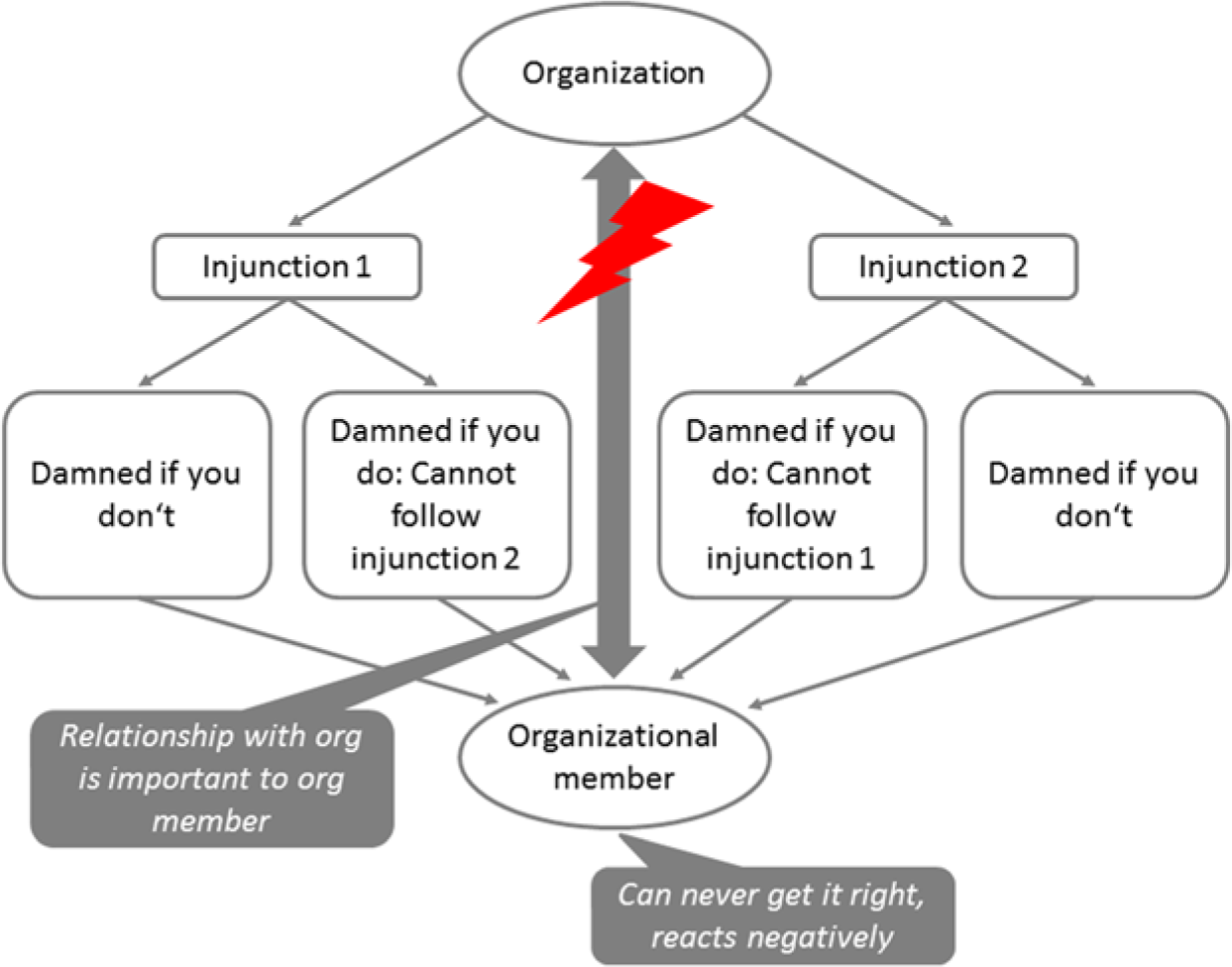
Pathogenic organizational double bind.
Since all or the majority of organizational members are caught in the pathogenic organizational double bind, the organization as a whole will be trapped between contradictory messages. It will switch from following one of the messages received, to following another, to trying to ignore the messages, and so on. But it will never address the fact that there is a paradox and will therefore not be able to search for the origin of the paradox or for constructive solutions to it.
Hennestad (1990) speaks of institutionalized learning incompetence, where despite the fact that an organization seems to try something new or behave differently, this is not a real development. (Part of) what is really going on cannot be named and tackled; there is selective inattention, selective apperception, and so on, to mute cues to the problem. Hence, the organization will be unable to adequately assess its own culture and the situation in which it finds itself with regard to its environment and to adapt and (double-loop) learn appropriately (Argyris, 1977; Hennestad, 1990; Hirschhorn & Gilmore, 1980; see also Gabriel & Carr, 2002). It will be “stuck” with its inconsistent ways of relating and its dysfunctional patterns of behavior. As a consequence, the results of the organization’s activities will be unsatisfactory. Organizational members will be frustrated about this and may begin to perceive all their experiences in double bind patterns, without being able to imagine that different ways of looking at what is happening might be possible. Their perception of their environment may therefore become fundamentally disturbed (cf. Bateson, 1983; Bateson et al., 1956).
Working Through and Resolving Pathogenic Organizational Double Bind
Attempts to change the situation that do not understand and address the (partly) unconscious organizational psychodynamics will usually fail, as they are likely to be incorporated into the pathogenic double bind pattern, and so will not resolve it (Hennestad, 1990). But even if a change agent has understood that the organization is caught in a pathogenic organizational double bind, it will not be easy to get the organization “unstuck” (cf. Vince & Broussine, 1996). This is because no matter how dysfunctional the consequences of the pathogenic organizational double bind may be, organizational members unconsciously bind themselves to it because it maintains and stabilizes the organization, and protects organizational members from pain and anxiety. If a change agent attempts to remove the pathogenic organizational double bind, people will be faced with losing this protection, and will resist (cf. Krantz, 1999; see also Diamond, 1986; Papp, 1980). The organization is a classic case of an organization exhibiting “resistance to change,” even beneficial change. To effect real change, it is necessary for the pathogenic organizational double bind and the underlying problem to be “worked through.”
The term working through was first used by Freud (1978/1914) when he sought to answer the question of why individual psychoanalysis takes a relatively long time: He argued that this is because the patient needs to work through his or her resistances. The concept has subsequently been subject to various interpretations (Aron, 1991; Brenner, 1987; Stewart, 1963). From a relational perspective, Aron (1991) provides the following definition that seems compatible with different psychological and therapeutic approaches, and is also transferable to the level of a group or organization: [T]he working through process refers to the gradual collaborative task between analyst and analysand of transforming the analysand’s inner representational world [ . . . ] constituted [ . . . ] by working models of relationships between the self and others. It is outdated and less adaptive models or schemata which are worked through and newer more highly adaptive relational models or schemata that are worked toward. (p. 103)
An organization caught in a pathogenic organizational double bind must analyze its working models of relationships and transform them into more adaptive or more clearly defined models of relationships. Organizational members will need to realize that their relationship with the organization cannot be a revival of early narcissistic relationships and to tolerate the pain of such a realization. To achieve this, the resistances and defense need to be overcome, or given up (cf. Brenner, 1987; Kets de Vries & Miller, 1984). Part of the process of working through a pathogenic organizational double bind will be for the organization to learn how to meta-communicate: to communicate about its relational and communicational patterns in order to realize how these are inconsistent, contradictory, and pathological. In part, working through may be a change of action patterns: When organizational members choose to act differently on the basis of the insights gained, the new behavior may become habitual and lead to lasting change over time (cf. Valenstein, 1983).
Therapeutic Double Bind and Therapeutic Organizational Double Bind
A particularly ingenious way of inducing meta-communication, reflection, and “working through” in a pathogenic double bind situation is the therapeutic double bind, a special form of “paradoxical intervention” or “therapeutic paradox.” Definitions of these latter terms given in the literature are somewhat overlapping and unclear (e.g., compare Beutler, Moleiro, & Talebi, 2002; Ford, Ford, & D’Amelio, 2008; Papp, 1980; Wilder, 1979). For this reason, I restrict the discussion to the therapeutic double bind concept. It is noted in the literature that paradoxical interventions, such as therapeutic double binds, are useful as a therapeutic strategy particularly where the pathological structure is long-lived and entrenched and does not seem to respond to other attempts at solution (Beutler et al., 2002; Papp, 1980).
One example of a therapeutic double bind is Bandler and Grinder’s (1975) story of a group therapist talking to a woman in the group who feels unable to ever deny someone’s demand on her (to say no to someone). The woman ascribes this to a traumatic childhood experience where her denying someone’s demand seemed to have very painful consequences. She is caught in a pathogenic double bind, because she feels bad if she says no to someone, but she also feels bad about not being able to say no and having to do everything that is asked of her. The therapist gives her the order to say no to each group member about something during the therapy session. The woman strongly refuses for several minutes. The therapist then points out that she has insistently said no to him and that this has not produced any negative consequences. The woman experiences this as a real eye-opener and immediately feels much stronger about saying no to people. This is a “changed if you do and changed if you don’t” prescription because, if the woman follows the therapist’s prescription, she has successfully said no to someone; if she tells him that she will not do it, she has successfully said no to him (Bandler & Grinder, 1975; see also Watzlawick, 1978).
Here, I transfer the therapeutic double bind concept to the organizational realm in the same way that others have transferred the concept of pathogenic double bind to the organizational realm. I argue that change agents may put an organization caught in a pathogenic organizational double bind in a therapeutic organizational double bind. Therapeutic organizational double bind implicitly recognizes the homeostatic function of the pathogenic organizational double bind. The change agents do not attempt to “rationally” argue about or break the organization’s defense and resistance to change, which would merely compound the “stuckness” (cf. Vince & Broussine, 1996). Instead, they try to channel the power of the pathogenic binding in a constructive direction (cf. Beutler et al., 2002).
A therapeutic organizational double bind provides an opening for the organization to learn new and better ways of relating than those it is used to. The woman in Bandler and Grinder’s (1975) example is forced into an experience that contradicts her model of relationships, which implies that it is impossible to say no without grave consequences. Similarly, members of an organization in a therapeutic organizational double bind are forced into an experience that contradicts the model they have of the world (cf. Bandler & Grinder, 1975), and specifically of relationships. This enables meta-communication about this model and about the contradictory injunctions the organization is trying to follow, as well as working through of the organization’s resistances to change and dysfunctional model of relationships. The woman in group therapy learns that it is possible in relationships to say no (see also the case reports in Hare-Mustin, 1976, and Papp, 1980). Likewise, a therapeutic organizational double bind makes new kinds of behavior in relationships and more viable models of relationships accessible or plausible for the organizational members. To use Aron’s words, these can then be worked toward. Because the therapeutic organizational double bind provides experience and practice of meta-communication and conscious change in behavior, the organization’s overall ability with regard to these may also be improved.
For a therapeutic organizational double bind to be successful, three conditions must be met that are analogous to the conditions for a successful therapeutic double bind in psychotherapy, for example, family therapy. First, the change agents need to grasp the core of the organization’s relational problem and how the organization “profits” from the pathogenic organizational double bind. But the change agents’ understanding of the organization’s pathogenic double bind situation must be “meta” to that situation (cf. Wilder, 1979). The change agents must then formulate the therapeutic organizational double bind in such a way that it addresses the underlying problem (cf. Olson, 1972; Willke, 1999; Wynne, 1976), yet signals to the organization that they refuse to be drawn into the pathogenic double bind logic (cf. Aron, 1991; Kahn, 2004). Getting drawn into such a logic is a very real danger for those trying to break it (Hennestad, 1990; cf. Kahn, 2004). The change agents use their understanding of that logic to lead the organization in learning how to escape it (cf. Watzlawick et al., 1968). A therapeutic double bind seems to be a “paradoxical” intervention only if seen within the context of the original, that is, pathogenic interpretation of the situation (Watzlawick, Weakland, & Fisch, 1974).
Second, while the organization is unable to learn and resistant to change, there must be a will to open up and “learn how to learn” on the part of the organization. If the woman who cannot say no simply walks away from the group therapy when the therapist gives her the task to say no, there cannot be any change. Similarly, the organization must admit that there is a problem that needs to be solved, and commit at least to a degree to the therapeutic organizational double bind relationship with the change agents. Organizational “pain” may be a motivation for such an attitude (Kets de Vries & Miller, 1984), although the change agents can also try and motivate the organization to embark on “working through.” They can harness the organization’s strengths for the “working through” process (cf. Schein, 2006). They can also provide concrete opportunities for action through which the new ways of relating that the therapeutic bind makes accessible can be practiced (cf. Valenstein, 1983) and offer an attractive vision of the future (cf. Ford & Ford, 1994; Kotter, 1995).
For the organization to “bind” itself to the therapeutic intervention (cf. Watzlawick et al., 1974), there must be trust between the organization and the change agents. “Working through” can be quite painful and anxiety-provoking for organizational members; indeed, they may feel that their entire identity is threatened if this identity is strongly dependent on organizational membership. The change agents must therefore provide an “organizational holding environment”: they have to create an ambience that holds in place the identities of organizational members (see Van Buskirk & McGrath, 1999). The concept of holding goes back to Winnicott (see, e.g., Winnicott, 1960), who understood it to mean parental care, or environmental provision, in the earliest stages of life. Holding protects from disruptive, anxiety-provoking impingements and enables the child to build up a sense of continuity of being and an identity in his/her own right. A psychotherapeutic setting can be a holding environment in that the therapist signals to the patients that she/he understands the patients’ anxieties and makes it possible for the patients to experience these anxieties in a safe way, so that they are no longer as threatening to the patients’ identities as before (Winnicott, 1963/1990). In a therapeutic organizational double bind situation, organizational members must feel that it is safe to experience and communicate their emotions and that they can reduce their defenses against these emotions without being overwhelmed. This will support them in learning, growing and developing their identities (Kahn, 2001, 2004; see also Van Buskirk & McGrath, 1999).
Methodology of the Empirical Study
When I began the project this article is based on, my original research interest was to improve our understanding of reflection of social systems such as organizations. How does it come about and unfold? Which factors enable or support it? I chose to study this by way of a case study, “a research strategy which focuses on understanding the dynamics present within single settings” (Eisenhardt, 1989, p. 534) and which “allows an investigation to retain the holistic and meaningful characteristics of real-life events” (Yin, 1994, p. 3). It is an advantageous strategy when “a ‘how’ or ‘why’ question is being asked about a contemporary set of events over which the investigator has little or no control” (Yin, 1994, p. 9).
I chose to study the case of the Greenpeace anti-whaling campaign in Norway because, having worked as a full-time volunteer for Greenpeace Nordic for a year in 1998/1999, I knew that it was an interesting example of organizational reflection. For many years, Greenpeace had prioritized this campaign and mobilized massive international support for it, and yet been unsuccessful with it. Greenpeace had been seemingly unable to reflect on this failure for many years and had simply continued campaigning without success. Then at some point, the organization had reflected on the anti-whaling campaign and decided to change its strategy. How did this reflection process come about and develop? What was it that had changed so that organizational reflection occurred at some point when it had not happened before? Conversely, why had organizational reflection not taken place earlier?
The organization Greenpeace Nordic is the result of a merger process between the Greenpeace offices in Sweden, Denmark, Finland, and Norway that took place between 1997 and 1999. The organization’s headquarters are in Stockholm, but there are also offices in Oslo, Helsinki, and Copenhagen, and Greenpeace campaigns are run in all four countries. During my time at Greenpeace, I witnessed the closure of the merger into Greenpeace Nordic and a part of the organizational processes described in this article. For my case study, I conducted 25 semistructured in-depth interviews with 22 current and former Greenpeace employees, from activists to executive directors, in 2005 and 2006. (Individuals are not quoted under their real names here.) Three individuals were interviewed twice. I interviewed all key actors from both the period of “organizational stuckness” and the later periods.
Interviews were guided by a list of questions through which I aimed to make sure they covered relevant time periods and aspects. The interview guide was designed to elicit interviewees’ interpretation of whaling and the Greenpeace anti-whaling campaign, personal involvement in the campaign, interpretation of the organizational processing of and actions on the whaling issue and the issues connected to the campaign, perception of the effectiveness of the organizational processing of these issues, and perception of the organizational context of all of these (inspired by the “variable clusters” in Dutton & Dukerich, 2004). Interviews were transcribed verbatim from tapes.
When interviewing, I made a great effort to bring about a situation in which people could and wanted to freely tell “their story” of the Greenpeace anti-whaling campaign. This was important because only insiders’ perspectives on the campaign could provide me with suggestions about what Greenpeace’s problems with the campaign had been and why Greenpeace had been seemingly unable, and later able, to reflect on and tackle the problems. It was also important because views diverged considerably. Thanks to the candor and trust of my interviewees, I was able to develop a complex picture of the entire process.
For the data analysis, I relied on the inductive constant comparative analysis method (Charmaz, 2000; Czarniawska-Joerges, 1992; Glaser, 1965; Lincoln & Guba, 1985). “Chunks” of text from the interviews were coded into categories, and continuously compared to previous ones in the coding process. The method emphasizes the importance of creating the categories in interaction with the data and not fitting the data into preconceived codes or imposing extant theories or one’s own beliefs on the data. However, researchers bring their own “sensitizing concepts” to the process. These are “background ideas that inform the overall research problem” that spring from researchers’ knowledge, training, experiences, and so on. I created the categories in interaction with the data, taking care to use my “sensitizing concepts” (extant theory on the reflection of social systems, my own experiences from my volunteer time at Greenpeace, etc.) as “starting points for building analysis, not ending points for evading it” (Charmaz, 2000, p. 515). Used in this manner, theory can strengthen analysis, because it “sits in the back of your mind” and argues with you about what the data mean (Piore, 2006, p. 19). Increasingly, I moved from descriptive categories to more abstract, explanatory ones (Lincoln & Guba, 1985), supporting the interpretive process through writing memos on my ideas about the data and patterns I had identified in the data (Charmaz, 2000; Glaser, 1965).
I was familiar with the double bind framework, but in the beginning did not think of using it in this research project. At some point during the described process of constant comparative analysis, I had the idea that the data showed a pattern that was actually a double bind dynamics (this idea was later supported by interviewees). It occurred to me that Greenpeace had been unable to reflect on the unsuccessful anti-whaling campaign because it was “stuck” in a pathogenic double bind. Had the merger process leading to the establishment of Greenpeace Nordic implied changes that improved the chances for organizational reflection? I continued my analysis, linking the work I had done so far to (among other theories) the double bind framework. Ultimately, I was able to construct a complex case history (cf. Dutton & Dukerich, 2004) and produce a detailed, coherent interpretation of the case. It is from these that I drew my theoretical contribution. This article presents the double bind part of my case history and theoretical contribution.
To ensure the trustworthiness (Lincoln & Guba, 1985) of my interpretation, I used a strategy of data source triangulation, including internal and public Greenpeace materials, as well as articles from newspapers in Norway and other countries in my constant comparative analysis. I also kept a reflexive journal, produced comprehensive documentation and conferred with interviewees and colleagues to ensure the trustworthiness of the study (Guba & Lincoln, 1998; Lincoln & Guba, 1985; Stake, 1995; see also Miles & Huberman, 2001). Doing these things also forced me to acknowledge and reflect on my own assumptions, identifications, and cultural imprints. I am German myself, and when I started working for Greenpeace I very much adhered to the non-Scandinavian Greenpeace view on whales and whaling (see below). However, my intensive exposure, during my volunteer time and in the years that followed, to Danish, Swedish, and Norwegian culture provided me with a comprehensive understanding of these cultures and their views on nature. I am not a neutral observer; having worked as a volunteer for Greenpeace Nordic, I sympathize more with that organization than with Greenpeace in other countries, Norwegian whalers, or some other party in this narrative. Indeed, only because I am not an external neutral observer did I have the privileged access necessary for this study. Yet through my contacts with Norwegians, including Norwegians not connected to Greenpeace, and my study of literature on Norway, I hope I understand all the perspectives involved in this case, romanticizing none.
Data collection, data analysis, the writing of my case study report, and the reviewing of it were overlapping rather than strictly separated phases. For example, I presented parts of my emerging interpretation to my interviewees in later interviews and received their feedback, thereby further ensuring that my analysis did not become disconnected from the field and that my interpretations were pertinent and sufficiently complex (Charmaz, 2000).
Case History: Greenpeace Norway in Pathogenic and Therapeutic Organizational Double Binds
How Greenpeace Made the Norwegian Anti-Whaling Campaign Unwinnable
To understand how Greenpeace got caught in a pathogenic organizational double bind, some preceding explanations about Greenpeace and Norway are necessary. (In Riese, 2014, I analyze the interplay between Greenpeace’s public communication and the public communication of its antagonists in Norway. The chapter includes a more detailed version of the explanations provided in this section).
Greenpeace began to do direct actions against Norwegian whaling in the 1980s (see Figure 2). To most Greenpeacers (and many Greenpeace supporters), whales are a symbol of the endangered environment and even Life itself. They are seen as highly intelligent, peaceful, social, special, and vulnerable animals. Consequentially, the theme of the anti-whaling campaign is, “If we can’t save the whales, then what can we save?” On the other hand, whaling is seen as the “bloody slaughter” of wonderful, even spiritual beings (see also Kalland, 2012; Zelko, 2012).
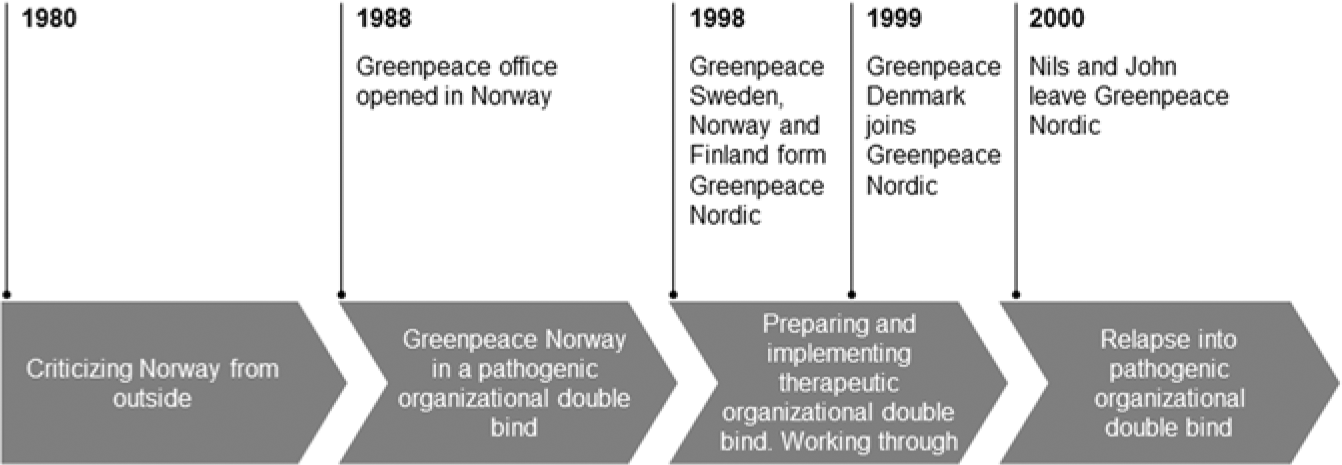
Timeline of the case history as presented in this article.
The Greenpeace strategy was to put pressure on the Norwegian government to make whaling illegal. This was done through direct actions against whaling boats and other campaigning means designed to raise international public awareness of and outrage about whaling. The campaign against whaling is Greenpeace’s second oldest campaign, and it has defined Greenpeace to a degree where it is hard to imagine what Greenpeace would be without it (Weyler, 2004). In the words of one of my Greenpeace interviewees: [T]here is a spiritual dimension to Greenpeace identity that has to do with whales. You know, you could shut down all other campaigns but not the whaling campaign, right? (Alex)
Norwegians usually have a very different perspective on whaling. Norwegians have traditionally relied on fishing, hunting, sealing, and whaling to feed themselves, and whaling is considered natural, legitimate, and a part of Norwegian identity (Grendstad, Selle, Strømsnes, & Bortne, 2006; Hansen & Holt-Jensen, 1982; Ris, 1993; Strømsnes, Selle, & Grendstad, 2009).
Norway was what Kramer (1984) called an “underdeveloped colony” (p. 92, my translation) for more than 500 years, first of Denmark and then of Sweden, until 1905 (see also Barnes, 1954). It was also occupied during World War II by Nazi Germany. Norwegians tend to have a strong dislike of “foreigners coming up here and telling us what to do” (to quote my Norwegian interviewees). There is a strong sense of solidarity and cohesion among Norwegians (Hveem, Lodgaard, Skjelsbaek, & Ringdal, 1984).
Many Norwegians had feelings of dislike toward the foreign anti-whaling activists who were coming up north and telling Norwegians what to do, attacking a legitimate Norwegian tradition. They also had feelings of solidarity with “their” whaling communities. To Greenpeace’s further misfortune, the well-organized Norwegian whalers responded to the anti-whaling campaign with communications that greatly appealed to these emotions in average Norwegians (Lloyd-Roberts, 1991; Maddox, 1992; Wallace, 1992). Greenpeacers talking about horrible slaughter of symbolic animals and so on made Norwegians feel that they were little Davids being unfairly attacked by stupid Goliaths who did not understand Nature but got sentimental and emotional about it, while they, owing to their long-standing experience of living with Nature, did understand Nature and had a rational and sensible attitude toward it (Barrett, 1993; Darnton, 1993; High North Alliance, n.d.; Jonassen, 1993; see also Kalland, 2012). The outcome of Greenpeace’s campaign against Norwegian whaling was that most people in Norway were bystanders on the whaling issue with a leaning toward the pro-whaling cause, a well-organized minority was vocally advocating the pro-whaling cause and attacking and ridiculing Greenpeace, and there was virtually no support at all for the anti-whaling cause (see also Grendstad et al., 2006).
Norwegian politicians sided with the pro-whaling lobby (Barrett, 1993; Brown, 1993; Darnton, 1993; Maddox, 1992). Norway has defied the International Whaling Commission’s moratorium on commercial whaling from 1986 to 1987, and again from 1993 to the time of writing, while in the period from 1988 to 1992 catching small numbers of whales for “purposes of scientific research” (Statistics Norway, 2010; Zangl, 1999). A 2002 survey done by the Norwegian Gallup Institute found that Greenpeace were very well known in Norway, but had less support by far than any other environmental organization in Norway, something that was also reflected in Greenpeace Norway’s membership figures (and income from Norwegian donations; Norsk Gallup Institutt AS, 2002).
Greenpeace in Norway in a Pathogenic Organizational Double Bind
The Norwegian Greenpeace office was established in Oslo in 1988. The Norwegian Greenpeacers soon got caught in a pathogenic organizational double bind. They tried to follow two mutually exclusive injunctions, both of which they perceived to come from the same source—their organization.
The first injunction was to gain the support of (average) Norwegians. This goal was in line with the fundamental organizational beliefs of Greenpeace. Greenpeace only accepts donations from individuals, and sees its influence to be as great (or small) as the degree to which it and its goals are backed by society.
I think that . . . the punch you have in political discussions, the punch you have . . . for when you speak with the people of influence, is based on the support of the people you have behind you. [ . . . ] It must be . . . a strong, strong public support. Indeed, I mean, this is, Greenpeace agree with this. [ . . . ] [W]hich is why they are basing their supports on individuals. [ . . . ] So, why shouldn’t that apply for Norway? (Hans)
Norwegian Greenpeacers understood both the perspective of average Greenpeacers and the perspective of average Norwegians. It was clear to them that the classic Greenpeace anti-whaling campaigning strategy was counterproductive in Norway. They attempted to gain Norwegian support in different ways over the years, one of which was to try and keep Greenpeace activity against whaling in Norway to a minimum, while working on other issues such as climate change.
The reason I was frustrated was that . . . [the whale campaign] kind of . . . made it more difficult to have credibility to the other campaigns, particularly climate, which I was interested in. [ . . . ] I certainly wanted the whale campaign as far away as I could get it . . . to be blunt. (Hans) [We] wanted the Norwegians to view Greenpeace as an environmental organization not an anti-whaling organization. (Søren)
However, if Norwegian Greenpeacers kept their mouths shut about whaling, Greenpeacers elsewhere obviously did not, meaning that Norwegian Greenpeacers’ attempts to gain Norwegian support were constantly counteracted by their non-Norwegian colleagues.
But Norwegian Greenpeacers also tried to follow their organization’s injunction: “Stop whaling!” They tried to use arguments against whaling that were more convincing to Norwegians, for example, that the sustainability of Norwegian whaling was questionable. If this had been accepted as true by Norwegians, it would probably have convinced them to stop whaling and would have contributed to Greenpeace earning respect in the country. The close relationship most Norwegians feel that they have with nature means that they mostly oppose its unsustainable exploitation (Grendstad et al., 2006; Strømsnes et al., 2009). The trouble for Norwegian Greenpeacers was that Norwegian scientists (who enjoy the trust of a majority of the population; see Grendstad et al., 2006) contradicted this argument (Waagbø, 1992). 1 Also, again, while Norwegian Greenpeacers attempted to argue in more “Norwegian” ways, Greenpeacers in other countries did not stop communicating “un-Norwegian” messages about whaling, hence further undermining their Norwegian colleagues’ attempts to gain support in Norway.
Greenpeace UK would always argue out from an animal welfare point of view. [ . . . ] [B]oth Germany and England have a different tradition when it comes to, you know, animal welfare . . . in Norway, it’s not very common to either have an animal welfare point of view or to campaign for it. [ . . . ] [While we Norwegian Greenpeacers were arguing with the Norwegian politicians about sustainable management procedures, other Greenpeacers would argue from an animal welfare point of view,] and then the next day it was all over the papers that Greenpeace says, and it was only animal welfare argumentations. Then the politicians would say well, you’re just into it because [whales are] cute, nananah, [ . . . ] and then you never got any further. It was sort of like we [the Norwegian and the international Greenpeacers] were campaigning against each other. (Mari)
It was therefore impossible for Norwegian Greenpeacers to gain support for their organization, no matter how hard they tried, because Norwegians disliked them for wanting to stop whaling. At the same time, it was impossible for them to stop Norwegian whaling, because their organization did not enjoy any public support in Norway. The pathogenic organizational double bind that Norwegian Greenpeacers got caught in is illustrated in Figure 3.

Greenpeace Norway’s pathogenic organizational double bind.
Over the years, the experience of “being damned whatever you try” became a repeated one for Norwegian Greenpeacers. At the same time, they were very committed to Greenpeace as an organization and to the organizational goals. Their relationship with Greenpeace was a crucial part of their social identity; they felt that their work was necessary; they could not simply pack it in and leave. It is possible that members of civil society organizations working toward ideational goals are at greater risk of getting caught in pathogenic double binds than individuals working for other organizations, to the extent that they “bind” themselves more to their organizations psychologically, draw more personal meaning out of their work.
To complete the pathogenic organizational double bind, Norwegian Greenpeacers experienced meta-communication to be impossible. When they attempted to explain to their colleagues in other countries that “people hate us for being against whaling” or “people here think whaling is okay,” their colleagues did not comprehend that they really were facing two tasks that were mutually exclusive. The non-Norwegian Greenpeacers would merely tell the Norwegian Greenpeacers to tough it out and repeat the message that whaling is not okay until Norwegians got it. They exerted pressure on Norwegian Greenpeacers to do things in accordance with the classic campaign strategy, for example, run direct actions. International Greenpeacers were unable to imagine that there could be valid arguments for whaling or against what Greenpeace was doing (at least for Greenpeacers). They might even communicate to Norwegian Greenpeacers that they compromised themselves by what they said, exposed themselves as cowards, and so on. A British interviewee says: [When I worked for Greenpeace in the UK] I thought that [the Norwegian Greenpeacers] were just hiding. I thought they were being pathetic and stupid. I didn’t give them the credit of having an argument. [ . . . ] I thought it must be really tough. [ . . . ] To be a Norwegian campaigner, it must be really hard. You’re hated by everyone, but that’s your job, and you should be sticking at it, and being strong about it. I never thought [ . . . ] that it was impossible to do their job that they’d been asked to because it was a dumb way to approach people. [ . . . ] [The Norwegians] couldn’t say the things that they really felt to the [Greenpeace] International team, because it was completely inappropriate for a Greenpeace person to say those things, as far as the International people were concerned. [ . . . ] It took me a long time [ . . . ] to understand what the hell was going on. Took me ages to realize that there wasn’t . . . they had an argument. That they were, it wasn’t stupid, it wasn’t utterly ridiculous, what the Norwegians [ . . . ] were saying. [ . . . ] Because I thought I was absolutely right. (John)
Implications and Consequences of Greenpeace Norway’s Pathogenic Organizational Double Bind
Greenpeace Norway’s pathogenic organizational double bind can be understood as an organizational defensive mechanism. It covered up the fact that there was confusion and contradiction in the relationship between the Greenpeace organization and Norwegian Greenpeacers with respect to what the organization wanted its Norwegian employees (and members) to be and do. Greenpeacers have always seen themselves as warriors—Warriors of the Rainbow. They are people who make a stand for their convictions, sometimes against formidable antagonists (witness the well-known pictures of small Greenpeace boats blocking huge ships or even a nuclear bomb). However, Greenpeacers have also always been People Persuaders; in fact, the ways they choose to express their opposition are those they believe will most effectively persuade others to join them (Weyler, 2004; Zelko, 2013).
Norwegian Greenpeacers felt that their organization communicated to them that they should be Greenpeace’s outpost, or extended army, in the High North, holding out against the whale butchers; but they also felt that as Greenpeacers they should be People Persuaders. The two did not seem to be reconcilable in Norway. To exacerbate these relational problems, the possibility that the Norwegian Greenpeace office (which was very far from being financially self-sufficient) would be shut down by the organization always lurked in the background.
Norwegian Greenpeacers bound themselves to the pathogenic organizational double bind because they felt these relational problems to be unsolvable. This dynamic may have been quite unconscious most of the time, although some Greenpeacers may have become conscious of parts of it at different points in time.
Part of [the reason why the problem did not get solved] could also be a sense of inferiority in the Norwegian office because [it was] financially dependent on the [international Greenpeace] organization? [That is] something that small offices have to fight, sense of inferiority. [ . . . ] [T]he rest of the organization will not hesitate to push in your face, but then you should just be strong enough to say: “Don’t give a fuck. Close us down then.” (Alex) [T]here’s no way a Norwegian [Greenpeacer] could have done it [solved the problem]. I’m absolutely certain about it. . . . It’s just too much. [ . . . ] [Y]ou end up fighting the, you end up arguing about the little stuff instead of the big one. . . . Cause that’s what you do, that’s what human beings do. . . . When you have a row with your boyfriend, you don’t actually tackle his major issue, you go and talk about what he’s done last week or the week before . . . and you don’t actually talk about the fact that he’s actually being hurt by something that’s completely, you know, separate and has nothing to do with that. . . . And the closer they are to it, the more they go for the little bits. [ . . . ] I think the [Norwegian Greenpeacers] can be completely excused for not seeing the big picture. And I’m sure on occasions they saw it. . . . But those moments didn’t happen to occur at the same time as a drive to make sure that . . . it was communicated to people. (John)
Norwegian Greenpeacers spent their time dealing with the contradictory injunctions rather than confronting the problems in their relationship with the Greenpeace organization. This protected them from the discomfort of a breakdown of the relationship. At the same time, Norwegian Greenpeacers suffered from the unhealthy relationship they had with their organization. They exhibited both the negative feelings and the dysfunctional responses theory predicts as a consequence of being caught in a pathogenic organizational double bind. They were anxious (not least because they received threatening anonymous phone calls in the dead of night, which they suspected came from supporters of the pro-whaling cause), frustrated, and angry. One of my Norwegian interviewees claims that the Norwegian government “lied from the top level with no problem. No problem to fool the whole population.” Several of them opine that the media were biased against Greenpeace. There is also the hypothesis that the government cleverly “fed” the media with information, using Greenpeace as a scapegoat. It is claimed that cues in this direction can be found in the government and media communications from this time. But these opinions are dismissed by one of my interviewees, who was a Norwegian Greenpeacer himself, as “paranoia.” This man says that the idea of cooperation between media and the government is “ludicrous” and that Norwegian journalists were critical of Greenpeace simply and fundamentally because Greenpeace’s arguments did not stand up to scrutiny.
Norwegian Greenpeacers started to expect trouble at every turn. They oscillated between the two injunctions of the pathogenic organizational double bind (trying to gain support for Greenpeace, or trying to campaign against whaling), or attempted defensive avoidance of the entire problem. And this soon led to a more general problem of relating, also with their Norwegian environment. (Some of my Norwegian interviewees agree that some of Greenpeace’s behavior was rather inappropriate.) Norwegian Greenpeacers felt angry not only with their fellow Greenpeacers in other countries, but also with their fellow Norwegians.
[Norwegians] call me Quisling, traitor and whore (a Norwegian Greenpeace campaigner in 1992, quoted in Helle & Stenerud, 2003, p. 10, my translation). NORWEGIANS ARE LICKSPITS—[ . . . ] Campaign leader Pål Bugge of Greenpeace Norway does not give either the Norwegian people or the Norwegian authorities much credit on the issue of whaling.—Most Norwegians are brainwashed, the authorities are incompetent, and the Norwegian mass media are servile, that is bootlicking and lickspittling towards the power structure, says the professional environmental activist (Schmidt, 1992, my translation). [I]t was never a real fight, because Greenpeace . . . [ . . . ] I think never . . . never really . . . understood or even cared to understand how to win this . . . fight in Norway. [ . . . ] Imagine if Greenpeace did the same for the climate campaign, as they have done for the whales. A tragedy. I mean, Greenpeace could have put all its money, all its efforts together, to get the US to ratify the climate convention. [ . . . ] All this punch that this organization contains, and they used it to save 500 whales. Which they’ve lost. What a tragedy! (Hans)
This situation, in which Greenpeace as an organization, no matter what it did, seemed unable to get its work in Norway on a better track, persisted for years. Greenpeace Norway was “stuck.”
A Window of Opportunity for Change
In the years from 1997 to 1999, Greenpeace Norway merged with the Greenpeace offices in Sweden, Finland, and Denmark to form Greenpeace Nordic. This organization “inherited” the Norwegian pathogenic organizational double bind. My interviewees report that it was clear to all employees of Greenpeace Nordic at the time how difficult Greenpeace’s situation in Norway was. However, as a consequence of the merger there was, for the first time in the history of the Norwegian anti-whaling campaign, an organization in charge of this campaign that was financially self-sufficient (because the Swedish Greenpeace office was financially strong). Moreover, this organization had a reasonable amount of weight vis-à-vis the international Greenpeace organization.
Nils, an experienced Swedish Greenpeacer, became Head of the Greenpeace Nordic Campaigns Department; John, an equally experienced British Greenpeacer, became Head of the Greenpeace Nordic Fundraising Department. Nils had previously worked as a family therapist, which he says was a very useful experience when working for Greenpeace. As a team, John and Nils had a good understanding of both the Norwegian (and more generally Scandinavian) and the British (or non-Scandinavian) view on nature, whales, and so on.
Nils and John realized that the anti-whaling campaign seemed impossible to win and at the same time made impossible any meaningful Greenpeace activity in Norway. They therefore embarked on a joint attempt to “sort out the anti-whaling campaign.” A comprehensive account of this “sorting out” process, which comprised intense discussions and a focus group study in Oslo on Norwegians’ attitudes toward whales, whaling, and Greenpeace, is beyond the scope of this article. It must suffice to say that through this process, Nils and John came to understand the problems with the anti-whaling campaign explained above.
Nils and John also understood that if they wanted to achieve real change, there would be resistances to be overcome, because in one way it was easier for their colleagues to keep oscillating in the double bind than to address the problem head-on. They understood that there was a need for enabling meta-communication (see the aforementioned quotes by John), and for working through.
Greenpeace’s Therapeutic Organizational Double Bind
Nils and John designed a new strategy for the anti-whaling campaign in Norway. To convince Greenpeace Nordic of it, they put Greenpeace Nordic in a therapeutic organizational double bind. They agreed with this interpretation when I presented it to them. In an email to me, John wrote: “I think the therapeutic double-blind [sic] idea is spot-on.” Nils wrote: “Don’t forget that I worked with therapeutic double binds for 10 years!” (my translation). Through their therapeutic organizational double bind, Nils and John wanted to bind Greenpeace to the task of working through the pathogenic organizational double bind in Norway.
Their therapeutic injunction, or prescription, to Greenpeace Nordic was: “Convince Norwegians that whaling should be stopped!” In the context of what has been said about the Greenpeace anti-whaling campaign in Norway, this injunction may certainly seem paradoxical: Wasn’t convincing Norwegians that whaling should be stopped exactly what had been impossible for at least 15 years? With the help of this therapeutic organizational double bind, Nils and John wanted to sort out the “Rainbow Warrior versus People Persuader” relational problem.
Their envisaged solution, their clarification of the relationship, was that Greenpeacers needed to “persuade Norwegians” (Injunction 1 of the pathogenic organizational double bind) that Norway should “stop whaling” (Injunction 2 of the pathogenic organizational double bind) by presenting a rational, convincing argument against whaling, and not care whether Norwegians disliked Greenpeace, so long as they heard the argument. The idea that Greenpeacers should be People Persuaders was thus (re)interpreted to mean not that Norwegians should support or be persuaded by Greenpeace, but support and be persuaded about the idea Greenpeace presents. Conversely, the idea that Greenpeacers should be Rainbow Warriors was (re)interpreted to mean that Greenpeacers should stand up bravely to attack from their antagonists, but in such a way that it would convince the average person of their case.
Nils and John’s prescription was a “changed if you do follow it” prescription because, if Greenpeace Nordic wanted to follow it, it could not go on oscillating in its pathogenic organizational double bind, but instead needed to change the anti-whaling campaign strategy in such a way that Norwegians agreed with its argumentation. Consequently, Greenpeace Nordic would have to reflect on what it had done thus far, why it had not convinced Norwegians, and how it could do better. Furthermore, the Nordic Greenpeacers would have to finally confront their non-Scandinavian colleagues. They would have to make absolutely clear to them, no matter what it took, that the anti-whaling campaign strategy had to change—which implied that the relationship between Nordic Greenpeacers and the rest of the organization would change as well.
The organizational reflection and discussion would have been therapeutic in itself. But if Greenpeace succeeded, the pathogenic organizational double bind would also have disappeared. If Norwegians became convinced that whaling was a bad idea, then they would stop whaling, and Greenpeace’s anti-whaling campaign would not be a reason for them to dislike Greenpeace anymore. This path was the path that John and Nils’ new anti-whaling campaign strategy projected (the new strategy will be further discussed below).
On the other hand, the prescription was a “changed if you don’t follow it” prescription because, if Greenpeace Nordic did not want to follow it, then it had to acknowledge and discuss the reason why. How come it did not care about convincing the relevant public in this case, when for every single other campaign, Greenpeace relied on popular support? And after having this discussion internally, Nordic Greenpeacers would have to take it up with their colleagues outside Scandinavia.
Again, this kind of collective reflection would have been therapeutic. It would have clarified what Greenpeace wanted to be and do: Warriors or Persuaders? It would have resolved the pathogenic organizational double bind—either because Greenpeace Nordic would yet have decided to follow Nils and John’s prescription and new strategy, after all, or because Greenpeace Nordic would explicitly have given up its goal to “gain support” and “persuade people” in Norway, focusing instead on the single goal of stopping whaling (by whatever means necessary).
Nils and John implicitly recognized the stabilizing, defensive function of their Norwegian colleagues’ oscillation in the pathogenic organizational double bind. They did not try to impose the new strategy on the organization or to break the organizational resistance to change. Rather, their prescription attempted to channel the power of the double bind pattern into a constructive direction: A refusal to follow the prescription could have induced meta-communication and collective reflection just as well as an acceptance of the prescription.
The therapeutic organizational double bind provided Greenpeace Nordic with an experience that contradicted the dominant, pathogenic model of relating, with John and Nils making it possible for Nordic Greenpeacers to access, and work toward, new models of relating.
As for the relationship between the Nordic Greenpeacers and their organization, John and Nils showed Greenpeace Nordic’s employees a noncontradictory, consistent path of action that involved being both Rainbow Warriors and People Persuaders (more details on this shortly), and promised support for it. This was a clear departure from the earlier situation, in which people had felt that their organization was putting them under pressure to follow irreconcilable injunctions. John and Nils also did what they could to facilitate the type of discussion that would persuade Greenpeace International to follow their example of consistency and supportiveness. They worked hard to convince the international organization of their new strategy, traveling extensively to meet many international colleagues, and inviting key international Greenpeacers to Oslo for discussions.
As a consequence, a new way of relating to Norwegians also became possible for Greenpeacers. Nils and John’s new campaign strategy was centered on the argument that whaling is against international agreements, namely, the International Whaling Commission’s moratorium on commercial whaling. The Oslo focus group study had shown that this was the only argument against whaling that Norwegians found convincing. The focus group participants argued that obedience to international law was more important than personal convictions; if Norway disrespected international law, other countries would respect it less as well. (That Norway had technically “excepted” themselves from the IWC moratorium by lodging a reservation does not really alter this argument, as international agreements will only be effective if those who are put at a disadvantage by them also respect them.)
This argumentation is consistent with the Norwegian “David against Goliath” attitude. Norway is a tiny country that has suffered in the past because bigger countries did not stick to the rules. Therefore, it makes sense that Norwegians are anxious to make sure that everybody sticks to the rules (see also Riese, 2014).
Norwegian Greenpeacers had in fact used this argument against whaling earlier. However, the focus group research showed that thanks to Greenpeace’s confused communication, Norwegians had not understood a single one of the arguments against whaling presented by Greenpeace. They had only heard “a jumble of mixed message” (John). Nils and John therefore made it very clear that the new strategy would only use a single argument. As another Greenpeacer told me: “Pick a message, you stick to the message. [ . . . ] That was something [Nils and John were] very strong on, you know. [ . . . ] Don’t pick more than one, and stick to it.”
Nils and John also coined the new campaign slogan “Drit i Greenpeace, men redd hvalene”—Norwegian for “Fuck Greenpeace, but save the whales.” Nils and John wanted Greenpeace to communicate to Norwegians that they were free to think of Greenpeace as a bunch of sentimental idiots, but they should listen to the rational argument against whaling. In sum, the new strategy made a new way of relating to Norwegians accessible to Greenpeacers, which involved presenting one convincing rational argument against whaling and not caring whether Norwegians disliked them, as long as the argument was heard.
Nils and John’s therapeutic organizational double bind addressed the core of the Norwegian Greenpeacers’ relational trouble. Their therapeutic injunction clarified both the relationship between the Nordic Greenpeacers and their organization and the relationship between Greenpeacers and average Norwegians. However, it also communicated that while Nils and John understood the Norwegian predicament, they would not be drawn into the logic of the pathogenic organizational double bind. Their interpretation of the situation of Greenpeace in Norway was “meta” to that situation. Indeed, their therapeutic injunction, “Convince Norwegians that whaling should be stopped!” seems illogical or paradoxical only within the logic of the original pathogenic binding. Outside that logic, using Rainbow Warrior stunts and Rainbow Warrior communication to persuade average people to support an idea has always been Greenpeace’s strategy, and is not all that paradoxical for a Greenpeacer.
Nils and John were able to put Greenpeace Nordic in a therapeutic organizational double bind because many in Greenpeace Nordic were fed up with being “damned whatever they did.” They were ready to accept real change, even if it came at a cost.
I think there was probably a feeling there was a lot of other campaigns going on. And a lot of work, other work to be done. And that, every year we were being . . . asked to do something for [Greenpeace] International, that felt like it was taking resources away from other campaigns that we wanted to work with. And so, I think maybe that was what triggered the okay, then at least we’ll have the control of what’s going on. [ . . . ] [W]e’ll [campaign against Norwegian whaling] again this summer, we’ll do it again next summer, we’re gonna continue working on this, but we’re gonna do it our way. (Caroline)
Nils and John motivated Greenpeace Nordic to embark on a “working through” process in the following ways. They deliberately made direct actions a core part of their new anti-whaling campaign strategy, thereby harnessing a core tactic and core strength of Greenpeace. The direct actions provided perfect opportunities for Nordic Greenpeacers to relate differently to average Norwegians by putting out the “Fuck Greenpeace . . .” message. They were also an opportunity to relate differently to the international Greenpeace organization: previously, some Norwegian Greenpeacers had attempted to prevent direct actions against whaling in Norway, but now international Greenpeacers were explicitly asked to come to Norway to help with these actions. Sure enough, my interviewees report instances of “working through” that occurred during direct actions (see the quote by Caroline below). Nils and John’s strategy included a clear and attractive projected outcome, with Nils and John monitoring and organization-internally communicating the strategy’s success—above all a change in media reporting (see below).
Another reason why Nils and John were able to put Greenpeace Nordic in a therapeutic organizational double bind was that they were able to provide a “holding environment” for Greenpeace Nordic, which had not existed in Greenpeace Norway. People working for Greenpeace Nordic trusted and respected Nils and John personally and trusted that Nils and John would invest the necessary time, effort, and patience to “sort out the anti-whaling campaign.”
Nils was really a leader. He really was his office, his campaigns. [ . . . ] I think he did a great job. [ . . . ] [Nils] comes in and he is really, he is the guru building it up. We all look up to him, he is the one to tell us what Greenpeace is, what campaigning is, and we all kind of like go “fearless leader, we go” and we do it. (Alex)
Also, Greenpeace Nordic was financially self-sufficient and more autonomous than Greenpeace Norway had been, and Nils and John convinced international Greenpeacers to support their new campaign strategy. Finally, Nils and John intuitively understood the identity problems involved in the pathogenic organizational double bind. They offered help by showing how their Greenpeace Nordic colleagues could be both People Persuaders and Rainbow Warriors. (In this type of organizational context, the importance of organizational and individual identities and self-images that are stable yet capable of developing is also stressed by Schein, 2006.) Thus, there was a comparatively safe situation in which Greenpeacers were willing and able to accept some discomfort in exchange for a real development.
Results of Greenpeace’s Therapeutic Organizational Double Bind
The therapeutic organizational double bind induced some working through within Greenpeace Nordic. Nils and John engaged in intense meta-communication with their Nordic colleagues about the communication that had been going on around the anti-whaling campaign. Ultimately, the Nordic Greenpeacers accepted both the therapeutic prescription and the new strategy. And they engaged in discussions with their international colleagues, arguing for the new strategy and for the idea that Greenpeacers should be People Persuaders, as well as Rainbow Warriors.
I’ve been on a ship that was preparing for some actions in Norway [in 1999], and the crew was from, a lot actually were from the UK, and [ . . . ] we were discussing how we were going to do the actions. The crew was very intent on stopping whales from being killed. [ . . . ] [E]very whale that they saved felt like a success. And [our point of view was that this isn’t] sustainable for us as a campaign because [ . . . ] if we do this every summer with all our resources, maybe we’ll save 40 whales a summer and then what? You know, we have to [ . . . ] get the debate up and then get a stop on whaling, then we’ve won. In the process, maybe whales will be killed. And so I think, there’s a . . . there is a willingness within Greenpeace to go and to stop things. And that’s a very . . . basic like, activist way of thinking. [ . . . ] [Y]ou can go save your 12 whales if you want. [ . . . ]
But if you fuck up the public opinion in Norway completely [ . . . ]
. . . then you’ll be, have to come back here and save, you know, your 12 whales a year, but you haven’t won, you know, wrong term, you haven’t won anything.
In the event, Greenpeacers in other countries also understood Nils and John’s messages, at least to a degree, and showed a willingness to accept a change of strategy and to support Greenpeace Nordic in implementing it. In the summer of 1999, Greenpeace implemented a “big push” in the anti-whaling campaign in Norway using the new strategy, running direct actions that received quite a large amount of media coverage.
There are signs that the new strategy appealed to Norwegians. There were media reports which must have been quite satisfactory for Greenpeace Nordic (Mikalsen, 1999; N. N., 1999a, 1999b, 1999c; Olaussen, 1999; Tonstad, 1999). The following is a judgment by a Nordic Greenpeacer made in 2005.
I think, in the end, [the new approach] was a success [ . . . ] ‘cause we’d been so afraid in Nordic to do anything about whaling. [ . . . ] Because we [ . . . ] lost the ability for Greenpeace to do any effective campaigning [in Norway, to whaling]. Everything Greenpeace does in Norway now, has like, “whaling whaling whaling” echoing somewhere in their subconscious. It’s like, this campaign we just did now? In the Barents [ . . . ]? That was a tremendous success in the media. We’re like, public heroes. Right? And when you listen to the Norwegian campaigners talk about it like aah, this is great, finally, we’re turning over this leaf of wha . . . you know, it’s like, [in Norway] everything goes back to whaling. Everything [ . . . ]. So, it was good to confront it. You should confront your fears, you know. It’s like if you’re afraid of spiders, you should pick some up. (Alex)
Relapse Into the Pathogenic Organizational Double Bind
However, Nils and John’s new campaign strategy did not last long. After the “big push” in Norway in 1999, both Nils and John resigned from their positions in Greenpeace Nordic to take up positions with other organizations. From 2000 onwards, Greenpeace’s strategy in the anti-whaling campaign in Norway has been to place the whale question in the context of Greenpeace’s general oceans campaign. This new strategy does not use direct actions against whaling and seeks a dialogue with coastal communities. It continues to use the “rational” argument that whaling is against international agreements, but generally avoids emphasizing the whaling issue in Norway too much.
Current Greenpeacers argue that this strategy has helped Greenpeace in Norway to become an accepted voice in environmental debates and is therefore more productive than strategies tried before. I argue that the current strategy in the anti-whaling campaign is a relapse into the old pathogenic organizational double bind, albeit in a mitigated form. Greenpeace is again trying to follow two injunctions in Norway that contradict each other. On the one hand, it is attempting to gain support in Norway, and its work on issues other than whaling is, in principle, certainly apt to reach that goal. On the other hand, Greenpeace has not abandoned the organizational goal of stopping Norwegian whaling. The fact that member figures in Norway continue to be low seems to indicate that Norwegians still see a contradiction here. Greenpeace is simply trying to make this contradiction less acute.
The relational problem that is at the root of the trouble with the anti-whaling campaign has been mitigated, but not solved. What should Greenpeacers be in Norway: Rainbow Warriors or People Persuaders? Greenpeace in Norway has abandoned Nils and John’s solution to this problem: Convince Norwegians that whaling should be stopped, and do not care if they dislike you. It would have taken several years of people such as Nils and John communicating the therapeutic prescription and the new strategy, for these to become truly ingrained in Greenpeace Nordic’s ways and to solve Greenpeace’s relational problem. It would also have taken years for the changed message Greenpeace was sending out to really reach and be understood by the Norwegian audience, thereby making Norwegians less sure about whaling and less disapproving of Greenpeace and thus slowly resolving the pathogenic organizational double bind. Nils and John agree with the interpretation of a “relapse into the old pathogenic organizational double bind.”
The development shows that binding is important in a therapeutic organizational double bind. John and Nils created a “holding environment” for Greenpeace Nordic that made “working through” with the help of the therapeutic organizational double bind bearable. But when these two men left, this very environment made it easier than it had previously been for Greenpeace Nordic to avoid confronting the pathogenic organizational double bind. The fact that Greenpeace Norway was now part of a financially self-sustaining office with a strong voice in the international Greenpeace organization helped alleviate the pain from the anti-whaling campaign. It also helped convince international Greenpeacers to leave Greenpeace Nordic alone with the anti-whaling campaign in Norway and to stop demanding direct actions and so on every summer. It was hence not absolutely necessary for Nordic Greenpeacers to continue following an uncomfortable therapeutic prescription, solving the relational problem they had with their organization, and developing their identities.
However, the experience of the 1999 “big push” suggests that a therapeutic organizational double bind can be successful and overcome a pathogenic organizational double bind. Nils puts it as follows: “[A]ll those who were there back then must have seen that there was something that worked, at least. So [ . . . ] I believe Greenpeace has learned something which is left.” Today, Nordic Greenpeacers feel less defined by, and angry and paranoid about, the whaling issue when working in Norway (witness Alex’s judgment comparing the “big push” to a person suffering from arachnophobia picking up spiders). They have a clearer idea of what they should be and do. They understand that Greenpeace cannot achieve its goals in Norway by merely putting pressure on Norwegians and must aim to function in and with the Norwegian environment, presenting arguments that are apt to convince Norwegians (“People Persuaders”). Greenpeace Nordic’s relationship with the international Greenpeace organization seems to be more constructive.
Discussion and Conclusion
Implications for Practice
For managers and organizational consultants, this article’s argument means that if an organization exhibits certain symptoms, one question worth following up is whether the organization has become tied up in unacknowledged paradoxical messages. The symptoms have been described above and include emotions, behavior, and traits such as anxiety, paranoia, selective inattention, inability to learn, and resistance to change. If it turns out that unacknowledged paradoxical messages are indeed a structural problem in the organization, this may be a defensive mechanism covering up a problem in the relationship between the organization and the organizational members. A therapeutic organizational double bind is one possible intervention to enable the organization to “work this through.” In what follows, I discuss some implications for intervening through a therapeutic organizational double bind.
The organization cannot “work through” its problem on its own, which is why it is “stuck.” Yet, “working through” cannot be done for, or imposed on, the organization by managers or consultants; the organization as a whole must own and go through the process. Those who take the role of change agents must be clear about this tension, since they will otherwise be unable to appreciate their responsibility and the difficulty of their task.
A therapeutic organizational double bind communicates to the organization, often subliminally, the change agents’ understanding of the organization’s problem, refusal of the dysfunctional pattern, and “meta”-interpretation. It prevents the organization from interpreting the change initiative in the familiar pathogenic double bind pattern. The organizational change agents’ task in formulating the therapeutic organizational double bind is similar to the task of the psychoanalyst, who must find a way to enter a patient’s subjective world without being assimilated into an old object schema (see Aron, 1991). Because each pathogenic organizational double bind is unique, and because the change agents must have an understanding of the organization that is not merely rational, there cannot be a complete system or procedure for producing a therapeutic organizational double bind. The change agents must rely on their own “artistic impulse” (Schein, 2006, p. 299), their intuition, to formulate a therapeutic organizational double bind and bind the organization to it.
The necessity for a deep understanding of the organization on the part of the “therapists” makes it questionable as to whether “organizational therapy” can be done by external consultants in all cases. In some cases, such as in the Greenpeace case, organizational members may be more capable of understanding the organization (cf. Hirschhorn & Gilmore, 1980). On the other hand, these organizational members clearly need to be able to sufficiently distance themselves from the problem at hand, so as not to become part of it. John and Nils were British and Swedish, respectively, rather than Norwegian, and profited from their experiences in many countries, which probably enabled them to see a bigger picture than the one the Norwegian Greenpeacers saw.
The change agents need to follow through with the binding for a sufficient period of time, because it can be easier for the organization to fall back on pathogenic double bind patterns than to resolve its relational problems. This is why Greenpeace relapsed (cf. Papp, 1980). The organization needs to understand that “the only way out (of the pathogenic organizational double bind) is (working) through.” The therapeutic organizational double bind needs to be maintained long enough for the organization to properly grow out of its pathogenic organizational double bind.
Just as with individual psychotherapy, a therapeutic organizational double bind should be approached with caution. A pathogenic double bind is a stabilizing structure, and to unbind it when there is no realistic option of solving the underlying relational problem may be provoking destabilization without gain (cf. Papp, 1980). On the other hand, it is possible that partial working through induced by a therapeutic organizational double bind will also have beneficial effects. For example, as in the Greenpeace case, the organization may at least change some practices so that the daily pressure on organizational members decreases. The conclusion here is that the change agents must continuously make judgment calls. They must care for an organization whose members are suffering and vulnerable, yet must not be too timid in their demands that the organization work through its dysfunctional patterns. They must induce a development process that may increase the suffering and vulnerability, but only if it seems worthwhile. When making these calls, the change agents must also be aware of the factors beyond their control that limit their influence on the organization.
Future Research Needs: Strengthening Our Ability to Think Systemically About Organizations
It is possible that modern organizations in the developed world get caught in pathogenic organizational double binds because they are designed to be rational and efficient machine-like units with the single purpose of solving particular problems, or reaching certain goals.
This is because problem-solving, goal-oriented thinking abstracts from unintended side effects, feedback loops, and other aspects that seemingly have nothing to do with the task at hand. Such thinking is linear and does not aim for a systemic understanding (cf. Bateson, 2005). In the eyes of many Greenpeacers, the most important or even the only important task of Greenpeace in Norway was to stop Norwegian whaling. This “tunnel vision” made it impossible to see the complexities of Greenpeace Norway’s situation, and ultimately produced a pathogenic organizational double bind.
When organizations are understood to exist (only) in order to achieve specific purposes, it also makes sense to limit the relationship between an organization and its members to a contract with specified tasks that provides little sense of security and mutual employer-employee loyalty (cf. Kahn, 2001). This may increase the well-known regressive effects organizational membership has on the individual (Brown & Starkey, 2000). Organizational members may try at all costs to avoid losing what little sense of psychological security and belonging organizational membership offers them. They may subsequently be unable to function as responsible individuals who realize when there is a problem in their relationship with their organization and cope with this constructively. It was plausible for the international Greenpeace organization to see Norwegian Greenpeacers as colleagues who got paid to carry out an unpleasant task. Norwegian Greenpeacers were always aware that there was a possibility that the Norwegian Greenpeace office might be shut down by the international Greenpeace organization. At the same time, working for Greenpeace was an important part of their social identity that they did not want to lose. As a result, they were unable to deal with their problem in productive ways.
Furthermore, if an organization is supposed to be an entity geared toward optimal goal achievement, it makes sense to design it as a hierarchical power structure to achieve effectiveness and efficiency. The relationship between the organization and its members may then lack some critical meta-rules, that is, rules for changing the rules if necessary. In a power structure, the less powerful cannot change the rules, although this sometimes might be necessary, for example, when they feel subjected to contradictions. As a result, pathogenic organizational double binds may emerge. A system without workable meta-rules is unable to develop and grow (Cronen, Johnson, & Lannamann, 1982; Watzlawick, 1976). Instead of being in a living and developing relationship, the people in the system come to be bound, controlled, and dominated by power (cf. Oakley, 2000; Radin, 1989-1990; Wilden & Wilson, 1976). The Norwegian Greenpeace office was financed by the international Greenpeace organization, and Greenpeace is organized more hierarchically than many other environmental organizations. This made it hard for Norwegian Greenpeacers to change the rules of the Greenpeace system.
For a short period of time, Nils and John managed Greenpeace Nordic from a more holistic and less single-minded perspective. They wanted Greenpeace Nordic to function in its Norwegian environment, not just to stop whaling at whatever price (in fact, they believed that Greenpeace Nordic needed to function in its Norwegian environment in order to stop whaling). They addressed the troubles in the relationship between the Greenpeace organization and its Nordic employees, as well as between Greenpeace and average Norwegians. They also commanded some power and influence in the international organization themselves and succeeded in gaining more powerful Greenpeacers’ support for their approach (something they say they knew to be important, and worked hard for). To a certain degree, this enabled them to change the rules of the Greenpeace system.
If it is correct that pathogenic organizational double binds emerge because of a lack of systemic understanding, the implications of the double bind framework for organizational analysis are fundamental. We must then question our entire way of organizing and thinking about organizing. There is a great need for research, training, and education that strengthen our society’s ability to think systemically and holistically rather than in problem-solving mode and to organize accordingly (see also Bateson, 2005). Learning to interpret organizational life from a psychodynamic perspective, as this article has done, is certainly part of this type of research, training, and education (Schein, 2006). Further case studies of organizational double binds, comparative case studies if possible, with “thick description” (Geertz, 1973) provided for each case (cf. Wilder, 1979), will also improve our ability to think systemically about organizations and help further develop the double bind framework.
Footnotes
Acknowledgements
I would like to thank Dorle Dracklé, John C. Lammers, Manuel Meyer, Christine Moser, Peter Pelzer, Marshall Scott Poole, Burkard Sievers, and Jean Neumann and two anonymous JABS reviewers for their valuable help in developing this article. I would like to thank all my informants for their trust and their openness. Without their input I could obviously not have written this article.
Declaration of Conflicting Interests
The author declared no potential conflicts of interest with respect to the research, authorship, and/or publication of this article.
Funding
The author received no financial support for the research, authorship, and/or publication of this article.