




Abstract
There is little evidence regarding what makes managerial coaching effective. To explore this topic more deeply, we looked at coaching relationship and performance behavior. We examined the associations between managerial coaching and employee in-role performance, organizational citizenship behavior–individual (OCBI), and organizational citizenship behavior–organization (OCBO), with the mediating effect of manager’s trustworthiness as perceived by employees. Using 280 dyad surveys, we found that managerial coaching had a direct impact on employee performance behavior of OCBI and OCBO as well as employee perception of manager’s trustworthiness. Bootstrapping analytic findings revealed that managerial coaching also indirectly influenced employee in-role performance, OCBI, and OCBO through employee perception of manager’s trustworthiness. The current study findings offer an initial endorsement for coaching effectiveness in this largely uncharted topic area and further provide empirical support to the theoretical underpinnings of managerial coaching based on social exchange theory. Limitations are discussed and directions for future studies are suggested.
Keywords
Coaching has received considerable attention as a novel method of leadership in organizations (Boyatzis, Smith, & Blaize, 2006; Cox, Bachkirova, & Clutterbuck, 2010; Ellinger, Ellinger, Bachrach, Wang, & Baş, 2011; Feldman & Lankau, 2005; Grant, 2006; Liu & Batt, 2010; McLean & Kuo, 2000; Yukl, 2002). Many practitioner articles have been written, and training programs on the topic of coaching have increased in recent years (Hargrove, 2008; Peltier, 2010). The escalated interest in and requests for coaching have resulted in a diversification in genres of coaching (e.g., executive coaching typically offered by an external professional coach, managerial coaching practiced by a supervisor or manger-as-coach, peer coaching taking place between two individuals in a parallel organizational rank; Ellinger & Kim, 2014; Grant, 2006; Grant & Zackon, 2004). Among those, managerial coaching is the main focus of this article. Managerial coaching, defined as an effective managerial practice that improves employee learning, participation, and effectiveness (Ellinger, Ellinger, Hamlin, & Beattie, 2010; Park, 2007; Peterson & Hicks, 1996), has been increasingly discussed as an effective approach for performance improvement, management and leadership development, employee training, organization learning and change, and strategic human capital—particularly succession planning for pivotal positions and talents—among organizational and human resource professionals (Agarwal, Angst, & Magni, 2009; Becker, Huselid, & Beatty, 2009; Boyatzis et al., 2006; Evered & Selman, 1989; Gilley, Gilley, & Kouider, 2010; Hagen, 2012; Hamlin, Ellinger, & Beattie, 2009; McLean, Yang, Kuo, Tolbert, & Larkin, 2005; Yukl, 2002).
Despite growing interest and relevant practice-oriented activities that emphasize the importance of managerial coaching, research on managerial coaching is scant (Beattie et al., 2014). There exist only a few empirical studies on the efficacy of managerial coaching (Agarwal et al., 2009; Boyatzis, Smith, & Beveridge, 2012; Ellinger, Ellinger, & Keller, 2003). Among these few studies, limited outcome variables have been investigated (Hagen, 2012; Kim, Egan, Kim, & Kim, 2013). Moreover, although job performance has been almost always identified as a key outcome variable of managerial coaching, studies have rarely examined performance in a broad context (e.g., task performance, organization citizenship behavior, counterproductive behavior, voice behavior, etc.). In one of the first empirical studies on coaching, Ellinger et al. (2003) examined in-role performance—referring here to work behaviors related to one’s formal job requirements (Katz & Kahn, 1966)—as a main outcome of managerial coaching—followed by a few others with the same in-role performance variable (Agarwal et al., 2009; Kim, 2010; Liu & Batt, 2010). Recently, there has been a call for research to examine extrarole performance as a specific key outcome of managerial coaching in the job performance domain; from both organizational support and human capital development perspectives (Ellinger, Elmadag, & Ellinger, 2007; Kim et al., 2013). However, to our knowledge, no studies have investigated this potential outcome variable to date.
Emerging literature on coaching has now begun to recognize trust as one of the crucial elements for an effective coaching relationship. Because of the nature of coaching—that is engaging others in one-on-one interactions, open communication, teamwork approach, and feedback and learning (Cox et al., 2010; Ellinger & Bostrom, 1999; Evered & Selman, 1989; McLean et al., 2005), the effectiveness of managerial coaching can be determined by an employee’s attitude toward and trust in his or her manager. Relevant studies on coaching proposed that trust could play an important role in an effective coach-and-coachee relationship (Hargrove, 2008; Kim & Egan, 2013; Peltier, 2010; Peterson & Hicks, 1996; Rich, 1998; Smith, Van Oosten, & Boyatzis, 2009). When there is greater trust in a coaching situation, employees are likely to have an increased willingness to accept guided instruction from their manager. Furthermore, organizational theories on trust and social exchange (Blau, 1964; Schoorman, Mayer, & Davis, 2007) also postulated that effective exchange relationships at work are essentially constructed based on an individual’s trust toward another individual or collective entity—necessitating the establishment of trust in an effective coaching relationship.
However, empirical evidence on trust’s influence in a coaching context is lacking. No research has investigated trust-related variables for potential employee outcomes of coaching. Hagen (2012) suggested future studies examine intervening variables and indirect mechanism between managerial coaching and key outcomes (e.g., job performance). Although a few existing studies have investigated one or two intervening variables (e.g., role clarity for the relationship between managerial coaching and task performance; Kim, Egan, & Moon, 2014), trust has not been tested yet as a mediating variable in a dyadic coaching relationship.
Moreover, there has been growing recognition of organizations transferring some human resource and organization development responsibilities to frontline managers and leaders (Liu & Batt, 2010). A survey report released from the Chartered Institute of Personnel and Development (2011) indicated that coaching has been increasingly requested among organizations, both domestically and internationally, and coaching by line managers has been ranked as one of the most preferred forms of learning over the past 2 years. Considerable activity has been taken to build an internal coaching culture and increase managers’ capability to coach (Beattie et al., 2014; Chartered Institute of Personnel and Development, 2007). However, in spite of its popularity, little is yet known about what makes managerial coaching effective.
Accordingly, we conducted the current study to close the aforementioned gaps in the managerial coaching literature. The purpose of this study was to investigate the relationships among managerial coaching, trustworthiness, and job performance. The identified outcome (or dependent) variables were employee perception of a manager’s trustworthiness, in-role performance, and two extrarole performance behaviors of organizational citizenship behavior–individual (OCBI) and organizational citizenship behavior–organization (OCBO). Our particular aim for the study was to examine direct and indirect relations among these variables, along with finding an indirect mechanism between managerial coaching and job performance.
In this study, the research question we sought to answer was:
Theoretical Framework and Hypotheses
In the current study, social exchange theory has been utilized to explore and frame the association between managerial coaching and job performance, with the intervening effect of trust. Social exchange theory is one of the foundational theoretical frameworks in understanding human relations based on the notion of reciprocity in relationships (Blau, 1964). According to Blau (1964), social exchange is “the voluntary actions of individuals that are motivated by the returns they are expected to bring and typically do in fact bring from others” (pp. 91-92). A key concept of social exchange theory is that an individual does a favor for others and, in the meanwhile, normally expects some return from them. The returns are loosely specified in terms of timing and forms in social exchange, as compared with in economic exchange with instant and exact returns. As a result, social exchange is grounded on a long-term and rather uncertain exchange of favors.
Social exchange has attracted many organizational researchers since its conception because it offers the conceptual underpinning and insight for research on employee motivations and behaviors (Aryee, Budhwar, & Chen, 2002; Cropanzano & Mitchell, 2005; Organ, Podsakoff, & MacKenzie, 2006; Settoon, Bennett, & Liden, 1996). It has been applied toward building worthwhile relationships with various subjects, including supervisors (Liden, Sparrowe, & Wayne, 1997), colleagues (Deckop, Cirka, & Andersson, 2003), and the organization (Ensher, Thomas, & Murphy, 2001). Particularly, in a subordinate–supervisor relation context, studies reported that exchanged favors are often based on the goodwill from a manager and the reciprocated trust from a subordinate (Schoorman et al., 2007; Settoon et al., 1996; Whitener, Brodt, Korsgaard, & Werner, 1998). Often, the binding relationship between the two parties seems to be initiated by a favor from a manager, through offering extrinsic (e.g., information sharing and rewards) and intrinsic (e.g., psychological support) factors of motivation (Mayer, Davis, & Schoorman, 1995; Schoorman et al., 2007; Whitener et al., 1998).
In a coaching situation, when managers serve as a coach, their actions can often be perceived as goodwill by subordinate employees. These actions are varied and include such things as providing clear goals and paths, instant feedback for improving performance, supportive instruction and role modeling, learning and developmental opportunity on the job, recognition and reward, and enabling the success and development of subordinates (Ellinger & Bostrom, 1999; Kim et al., 2014; McLean et al., 2005; Park, McLean, & Yang, 2008; Peterson & Hicks, 1996). On receiving perceived favors such as these during coaching interactions, subordinates may feel a diffuse obligation to reciprocate by enhancing positive attitude and in-role and extrarole performance in the organization (Colquitt, Scott, & LePine, 2007; Organ et al., 2006; Settoon et al., 1996).
A fuller understanding of managerial coaching’s effect on performance behaviors can be achieved by comprehending the intervening role of trust. As noted earlier, social exchange is premised on a long-term and continuing expectation and thus involves an unspecified and indefinite return of a favor. The foundational notion of an exchange relationship encompasses establishing commitments with another party (Blau, 1964) so that a problem may be initially formed to prove one’s trustworthiness, toward building a stable trust relationship (Barney & Hansen, 1994; Mayer et al., 1995). In an exchange relation, the volunteerism or obligation of returning the favor is typically viewed as a symbol of trust, as well as a sign of goodwill and support (Aryee et al., 2002; Williams, 2001). Thus, in light of social exchange theory, a manager’s trustworthiness can be a critical component to constitute the effective exchange relationship in a managerial coaching context (as depicted in Figure 1).
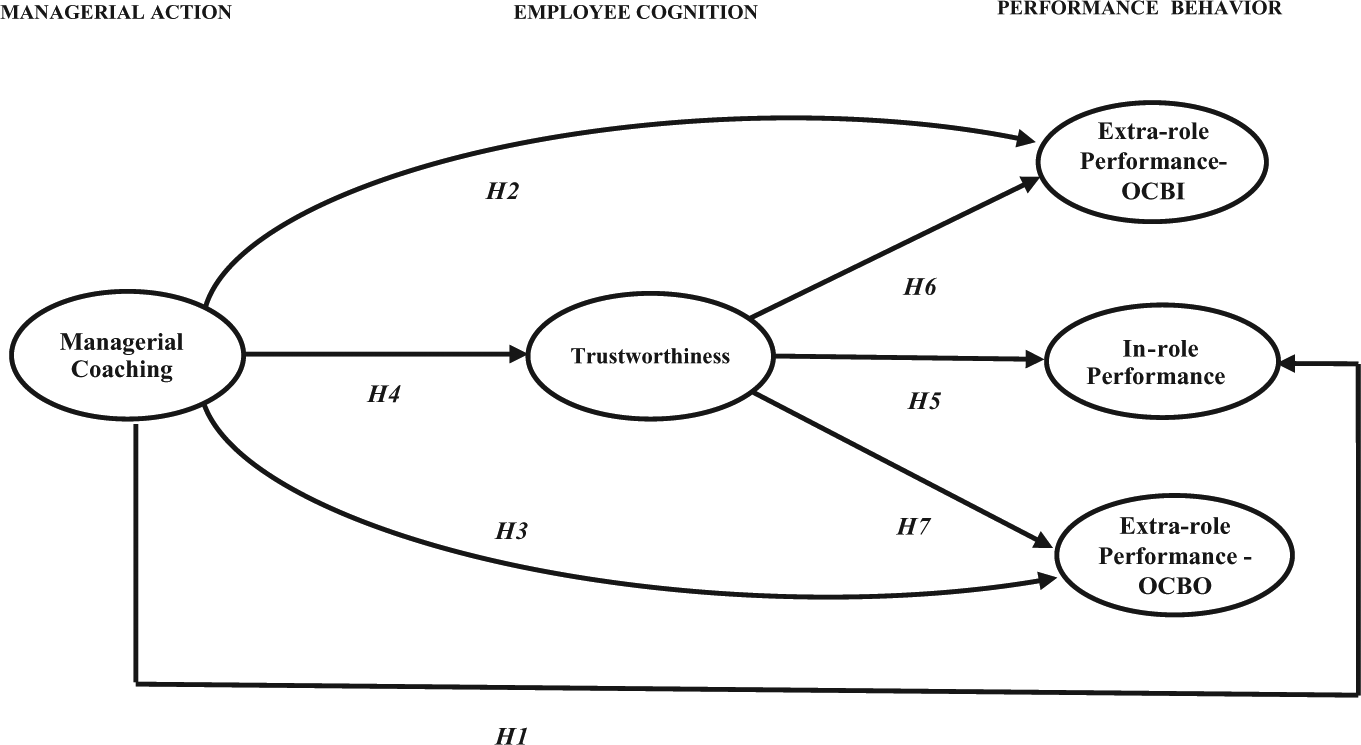
Hypothesized conceptual model of managerial coaching.a
Managerial Coaching and Job Performance
Ellinger et al. (2010) defined managerial coaching as “a form of coaching that is provided by a supervisor or manager serving as a facilitator of learning. The manager or supervisor enacts specific behaviors that enable the employee (coachee) to learn and develop, and thereby improve performance” (p. 277). Managerial coaching is often characterized as a hands-on process, an individualized developmental tool, utilizing feedback and learning, requiring one-on-one interaction, being performance improvement-oriented, reflecting managerial support, and day-to-day activities (Ellinger & Bostrom, 1999; Evered & Selman, 1989; Grant, 2006; McLean et al., 2005; Peterson & Hicks, 1996). Coaching has been differentiated from traditional management in that coaching takes self-directed, empowering, caring, and participative team approaches rather than being directive, controlling, and bureaucratic—it is broadly considered one of the many forms of helping or developmental relationships in the workplace context (Boyatzis et al., 2006; Ellinger et al., 2003). Moreover, managerial coaching mainly focuses on improving or correcting performance on the job through immediate feedback and individualized training, while mentoring emphasizes long-term developmental orientation with career satisfaction and success (Kim et al., 2013). Although there seems to be neither an exhaustive list nor a complete agreement yet—due to the infancy of coaching research, researchers identified a similar or interrelated skill set for effective managerial coaching practice. They included building a rapport, active listening skills, questioning technique, analytical skills, observation, interviewing skills, providing feedback, openness to new ideas, multiple perspectives in decision making, cognitive flexibility, open communication, clarifying goals and paths, being a resource, sociocognitive role modeling, collaboration, and creating a supportive environment (Agarwal et al., 2009; Boyatzis et al., 2006; Cox et al., 2010; Ellinger & Bostrom, 1999; Ellinger et al., 2003; Evered & Selman, 1989; Grant, 2006; Hamlin et al., 2009; Hargrove, 2008; McLean et al., 2005; Park et al., 2008; Peterson & Hicks, 1996). These managerial coaching skills should result in effective coaching interactions between a manager and subordinates.
Steadily increasing literature on coaching has identified several potential outcomes of managerial coaching (Hagen, 2012). Among them, job performance was one of the frequently identified outcome variables of managerial coaching (Ellinger et al., 2003; Evered & Selman, 1989; Hargrove, 2008; Peterson & Hicks, 1996). Job performance, in the current study, refers to employee effectiveness on his or her job (Porter & Lawler, 1968). According to Williams and Anderson (1991), the dimensions of job performance include in-role performance and extrarole performance. Managerial coaching can improve employee in-role performance by clarifying goals and paths and providing resources toward achieving designated goals (Kim et al., 2014). Close observation and instant feedback from an immediate manager can help employees be able to see and effectively react to blind spots (or improve in underdeveloped areas) on the job. A manager being a role model, as well as a resource, assists employees in learning from an experienced superior and their example in resolving work-related problems, and thus enhancing overall employee task performance. Ellinger et al. (2003) reported that in-role performance was a main outcome of managerial coaching among distribution industry employees. Agarwal et al. (2009) and Liu and Batt (2010) also reported similar findings, although Kim et al. (2014) found only an indirect effect of managerial coaching on task performance. In the framework of social exchange theory, managerial coaching, as initiated by a managerial favor, can be considered as the goodwill of a manager for employee success and growth, so that employees may respond to it with a willingness to reciprocate by putting extra efforts toward task performance improvement. Therefore, guided by earlier theory and research findings, we propose the following hypothesis.
Although in-role performance describes technical core behaviors in organizations, extrarole performance supports a broader organizational, social, and psychological environment where technical core functions occur (Motowidlo & Van Scotter, 1994). An example of extrarole performance is affiliative behavior, which is interpersonal and collaborative—it enhances work relationships and is collegial and other oriented (Van Dyne, Cummings, & Parks, 1995). Organization citizenship behavior, which is one of the representative extrarole behaviors, constitutes discretionary behaviors that are not formally included in an employee’s job description (Borman & Motowidlo, 1997; Organ et al., 2006). Scholars have categorized organization citizenship behavior with the specific target of the behavior: (a) organization citizenship behavior directed at other individuals (OCBI) and (b) organization citizenship behavior directed at the organization (OCBO; Williams & Anderson, 1991). OCBI directly benefits peers and colleagues and indirectly contributes to the organization. On the other hand, OCBO implies employee behaviors that directly benefit the organization.
Consistent with social exchange theory, managerial coaching can be regarded as management-initiated support for employee achievement and developmental well-being (Boyatzis et al., 2012) and can facilitate employee extraperformance for the favor of reciprocation. Individualized consideration and customized guidance and training, such as those offered in coaching, are likely considered to be managerial support of and investment in employees. Furthermore, since employees tend to perceive a manager as a representation of the organization, managerial coaching can be perceived as organizational support too (Kim, 2010). Employees may personify the organization and return a manager’s favor via a form of organization citizenship behavior directed at the organization (Eisenberger, Huntington, Hutchison, & Sowa, 1986; Kottke & Sharafinski, 1988). Employees are more likely to reciprocate favors to the manager by helping out his or her unit by filling in for others when they are sick and welcoming new employees. To our knowledge, there exist no studies examining extrarole performance in terms of managerial coaching effectiveness—although Ellinger et al. (2007) casually indicated that there exists a positive relationship between managerial coaching and organization citizenship behavior. In an analogous leadership study, Podsakoff, MacKenzie, Moorman, and Fetter (1990) found that the individual consideration of effective leadership behavior had a positive influence on organization citizenship behavior. Huang, Iun, Liu, and Gong (2010) reported that the participative aspect of leadership behavior positively related with in-role performance and OCBO. Thus, based on theoretical and relevant research perspectives, the following hypotheses were proposed.
Intervening Role of Trustworthiness
The value of trust has been widely discussed from human relations and social exchange perspectives to identify what contributes to developing managers’ trustworthiness and how trust influences work and organization-related variables (Mayer et al., 1995; Organ et al., 2006; Schoorman et al., 2007; Williams, 2001). In the current study, trust refers to “the willingness of a party to be vulnerable to the actions of another party” (Mayer et al., 1995, p. 712). Trust is based on individuals’ expectations that other people will behave in certain ways that are helpful and supportive, or at least not damaging (Williams, 2001), and these expectations are constructed on individuals’ perceptions of other people’s trustworthiness (Caldwell & Hayes, 2007; Mayer et al., 1995). To identify trustees’ characteristics, Mayer et al. (1995) proposed basic features of trustworthiness that can demonstrate the propensity of trustor: ability, benevolence, and integrity—all these constituents can play important roles in the success of managerial coaching.
As a prolific developmental relation, managerial coaching can positively influence employee perception of a manager’s trustworthiness and ability, since effective coaching practice requires a set of competencies, such as specific knowledge, abilities, and skills on the job (Peterson & Hicks, 1996). Significant time along with individualized attention and consideration, invested by the manager-as-coach, can also let employees perceive that the manager has good intentions and motivations toward them (Smith et al., 2009). Next, regular and consistent feedback and balanced information, provided by the manager-as-coach, are likely to give employees a more positive perception of his or her integrity—in that management adheres to a set of principles that employees find acceptable (Mayer & Davis, 1999; Mayer et al., 1995). Extant literature on managerial coaching addressed that building a rapport, active listening, and collaborative partnership are important sources of building trust for an effective coaching relationship (Ellinger & Bostrom, 1999; Hamlin et al., 2009; McLean et al., 2005; Peterson & Hicks, 1996; Watkins, Mohr, & Kelly, 2011). Korsgaard, Brodt, and Whitener (2002) reported that open communication and demonstrating concern for employees were positively associated with trust, as well as organization citizenship behavior. In a relevant quasi-experimental study, Mayer and Davis (1999) found that the implementation of an effective performance appraisal system increased the perceived trustworthiness of top management. Accurate performance assessment and developmentally oriented feedback and support can signify that management possesses important managerial skills and motivations needed to manage and lead the organization’s workforce—thus, these can enhance employee perception of a manager’s trustworthiness. Hence, we proposed the next hypothesis.
From social exchange-relevant perspectives, trustworthiness plays the role of influential initiator in exchange relationships and should bring forth fruitful outcomes (Blau, 1964; Mayer et al., 1995; Organ et al., 2006). Scholars on human information processing reasoned that individuals have a limited amount of attention or cognitive resources so that events that consume the limited processing capacity of an individual can reduce job performance (Kanfer & Ackerman, 1989; McAllister, 1995). Managerial activities that distract employee focus or alter productive energy flow hinder overall performance of in-role and extrarole behaviors. Subordinate employees can be psychologically vulnerable and distracted when they lack trust in management. Their cognitive resources can be easily preoccupied with self-preserving and nonproductive issues, rather than team tasks or goal achievement. Employee reluctance to trust in, or be receptive of, managerial action and information—that is caused by the lack of perceived manager trustworthiness—likely occupies their positive energy and diminishes effective job performance (Argyris, 1964; Mayer & Gavin, 2005).
Positive employee perception of a manager’s trustworthiness, as influenced by managerial coaching, can lessen the chance of employee performance detriment and decrease worries about the same. Shared feedback and honest and developmental information occurring during coaching interactions can be construed as a sign of trustworthy behavior between a manager and subordinates. Active listening and participative team approaches used in managerial coaching can also create a safe and supportive learning atmosphere and lessen unproductive employee efforts, such as self-protective and defensive behaviors on the job. Safe and satisfactory work environments have been related to effective learning and performance as well as trust (Hamlin et al., 2009; Mayer & Davis, 1999; Peterson & Hicks, 1996). Dirks (2000) empirically examined if trust in leadership has a significant effect on job performance and found that a team’s trust in its leadership was an important predictor of the team’s task performance improvement. In meta-analytic studies, it was reported that trustworthiness, and related factors, explained incremental variance in employee behavioral outcomes of task performance and extrarole behaviors (Colquitt et al., 2007; Dirks & Ferrin, 2002). Lapierre (2007) also suggested that supervisors’ ability and benevolence toward their subordinates affected subordinates’ willingness to provide extrarole behaviors. In a few other leadership studies, the impact of effective leadership behavior on in-role performance, OCBI, and OCBO was found to be intermingled with an exchange-based mediator of trust (Huang et al., 2010; MacKenzie, Podsakoff, & Rich, 2001). Therefore, on the basis of theoretical reasoning and research findings, we offer the following hypotheses.
Method
Procedure and Sample
Data were obtained from full-time employees of the insurance industry in Taiwan. At the onset of data collection for this study, we contacted representatives of various life insurance companies. On gaining sponsorship from senior managers in the participating companies, we developed a data coding system to match manager ratings to employee responses. Study participants provided the name of the person whom they directly reported to (immediate manager) or supervised (subordinate employee), and this was cross-checked by survey coordinators in the participating companies. Two different forms of survey questionnaires were used for each group of employees (Form A) and managers (Form B). Those surveys were distributed and collected concurrently. Form A contained the measures of managerial coaching behavior and trustworthiness. Form B contained the measures of employee performance behaviors (in-role performance, OCBI, and OCBO). Both Forms A and B included a section assessing demographic characteristics of participants as well as the code numbers to match two separate responses. Completed questionnaires were directly returned in sealed envelopes to one of the researchers. All survey measures were translated from English to Taiwanese with a back-translation procedure (Brislin, 1980). Prior to primary data collection, a logistic pilot test was conducted with 30 participants to determine the accuracy of the back-translation and the proficiency of paper–pencil survey administration.
Of the 309 questionnaires distributed, 288 completed questionnaires were returned with a response rate of 93.2%. After examining and removing inadmissible responses, a total of 280 manager–employee dyads were used for the sample of the current study. Of the employee sample, 62.1% were women, 50.0% were in the 35 to 44 years age bracket, 60.1% had undergraduate education or above, and 52.1% had less than 4 years of organization tenure. Of the manager sample, 50.4% were men, 60.0% were older than 34 years, 61.3% had undergraduate education or above, and 68.3% had at least 7 years of organization tenure. Most participants were from sales-related departments.
Measures
Managerial Coaching
Managerial coaching was measured by using 11 items from Park’s (2007) scale of managerial coaching skills, which was enhanced and modified from McLean et al.’s (2005) original instrument. Coaching that is provided by a manager-as-coach to subordinates was assessed in this study. Sample questionnaire items used for the current study include “To improve work performance, my manager constantly provides feedback”; “In order to improve my performance, my manager serves as a role model”; “My manager actively provides opportunities for me to take more responsibility”; “My manager appears to view learning and development as one for his/her major responsibilities”; “When a decision is to be made, my manager prefers to participate with others to determine the outcome”; and “In facing new problems, my manager would rather listen to my opinion first.” We used a 6-point response scale ranging from 1 (strongly disagree) to 6 (strongly agree), where higher scores represented higher levels of coaching received from an employee’s immediate manager. Cronbach’s α for the instrument was .89.
In-Role Performance
In-role performance was assessed by employing four items from Williams and Anderson’s (1991) scale of in-role behavior. A sample item used in the present study is “This employee adequately completes assigned duties.” Supervisors provided their ratings of each subordinate employee on a 5-point response scale ranging from 1 (never) to 5 (always), where higher scores represented higher in-role performance. Cronbach’s α for the instrument was .82.
Organizational Citizenship Behavior–Individual
OCBI was measured by applying three items from Williams and Anderson’s (1991) scale of OCB directed at individuals. A sample item is “This employee goes out of his/her way to help new employees.” Supervisors rated each employee on a 5-point scale ranging from 1 (never) to 5 (always). Cronbach’s α was .74.
Organizational Citizenship Behavior–Organization
OCBO was assessed by using three items from Williams and Anderson’s (1991) scale of OCB directed at an organization. A sample item is “This employee conserves and protects organizational property.” Supervisors rated each employee on a 5-point scale ranging from 1 (never) to 5 (always). Cronbach’s α was .60.
Trustworthiness
Manager’s trustworthiness was measured with three items from Mayer and Davis’s (1999) scale of trustworthiness (ability, benevolence, and integrity). In the current study, we were mainly interested in examining the overall relationship of trustworthiness with the other four main study variables. Sample items are “My manager is very capable of performing his/her job,” “My manager really looks out for what is important to me,” and “Sound principles seem to guide my manager’s behavior.” Employees provided their responses on a scale ranging from 1 (strongly disagree) to 5 (strongly agree). The instrument α was .72.
Common Method Variance
Since the data for the two posited variables (managerial coaching and trustworthiness) were collected from employees as a single source, common method bias might occur in the present study. To prevent potential effects of common method variance in the design stage, we applied two different types of response scale (Podsakoff, MacKenzie, Lee, & Podsakoff, 2003) for measuring these variables; 6-point response scale for managerial coaching and 5-point response scale for trustworthiness. During the survey administration process, we also underscored that study participation is completely voluntary, participant identification would be anonymous and protected, and participants should answer as honestly as they could (Podsakoff et al., 2003). To detect potential presence of common method variance in the collected sample data, we conducted Harman’s single-factor test and confirmatory factor analysis (CFA; Conway & Lance, 2010). Results from the unrotated factor solution revealed that one general factor did not account for a majority of the covariance between the two multi-item factors. Confirmatory factor analytical results also indicated that the single-factor model did not fit the data well. Hence, these findings suggested that common method bias was not of great concern for validity in the current study sample.
Analysis Strategy
Hierarchical multiple regression analyses were used to test hypothesized direct relationships between managerial coaching and employee outcomes (Cohen & Cohen, 1983). First, the control variables were entered in the regression equations: gender, age, education, and company tenure for both employee and manager. Next, managerial coaching was entered into the regression equations to determine its incremental contribution to the variance accounted for in the proposed employee outcome variables (in-role performance, OCBI, OCBO, and trustworthiness).
To test indirect relationships between managerial coaching and employee outcomes, we followed Kenny, Kashy, and Bolger’s (1998) restatement to the original causal steps procedures (Baron & Kenny, 1986; also see indirect effect test guidelines by Hayes, 2009 and Williams, Vandenberg, & Edwards, 2009). Based on this revised procedures, two conditions are necessary and sufficient to establish indirect (or mediation) relations: (a) a direct association between the independent variable and the mediator variable and (b) a direct association between the mediator variable and the dependent variable. Thus, we used once again hierarchical multiple regression analyses to examine direct associations between the independent variable (managerial coaching) and the mediator (trustworthiness) and between the mediator (trustworthiness) and the dependent variables (employee outcomes of in-role performance, OCBI, and OCBO).
Furthermore, to increase statistical power in our analyses, we also applied bootstrapping procedures for indirect effect testing (Hayes, 2009). The bootstrapping approach provides a formal estimate of the quantified size of an indirect effect, more precisely detects Type 1 error rates, and outperforms other formal indirect analytic methods, including Sobel test (Cheung & Lau, 2008; Preacher & Hayers, 2008). Based on Preacher and Kelley’s (2011) recommendation, we examined completely standardized indirect effects using bias-corrected (BC) bootstrapping confidence intervals. We also offered unstandardized indirect effects to help readers interpret them with the original, raw estimates of the indirect relationships (Kline, 2005).
Results
Descriptive statistics and correlations are reported in Table 1. Correlation analysis indicated that multicollinearity was not a great concern in the present study sample since all correlation coefficients were below .65 (<.70; Tabachnick & Fidell, 1996). Variance inflation factor tests also provided similar results by having all variance inflation factor scores below 2 (<4; Kline, 2005).
Means, Standard Deviations, and Correlations.
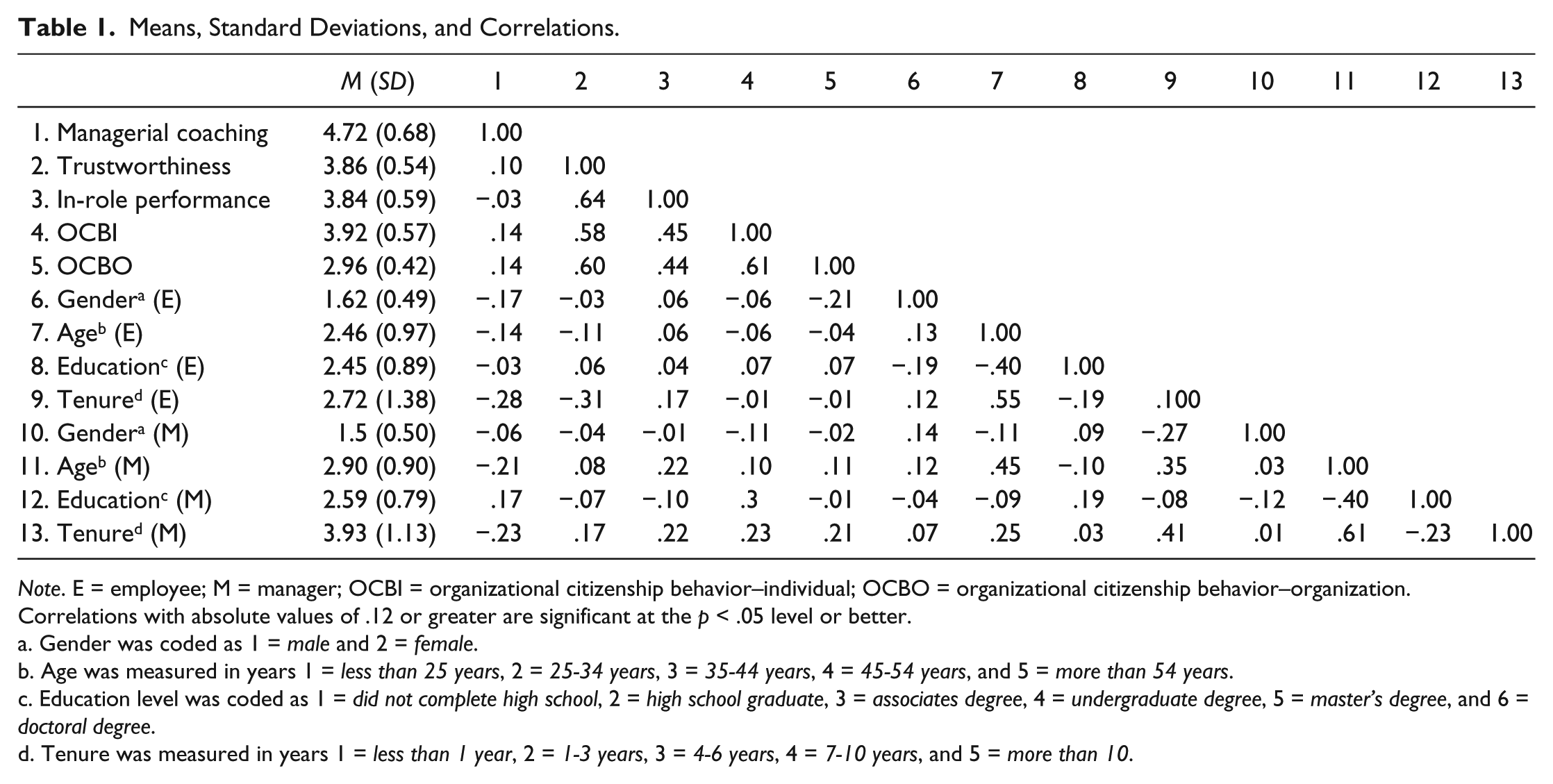
Note. E = employee; M = manager; OCBI = organizational citizenship behavior–individual; OCBO = organizational citizenship behavior–organization. Correlations with absolute values of .12 or greater are significant at the p < .05 level or better.
Gender was coded as 1 = male and 2 = female.
Age was measured in years 1 = less than 25 years, 2 = 25-34 years, 3 = 35-44 years, 4 = 45-54 years, and 5 = more than 54 years.
Education level was coded as 1 = did not complete high school, 2 = high school graduate, 3 = associates degree, 4 = undergraduate degree, 5 = master’s degree, and 6 = doctoral degree.
Tenure was measured in years 1 = less than 1 year, 2 = 1-3 years, 3 = 4-6 years, 4 = 7-10 years, and 5 = more than 10.
Measurement Evaluation
We applied a comprehensive two-step analytical approach to investigate the hypothesized relationships among the study variables. First, the hypothesized measurement model was tested by CFA (Kline, 2005). Once the measurement model was identified, the hypothesized direct and indirect effects were estimated by hierarchical multiple regression analyses as well as bootstrapping estimations.
We first conducted CFA to establish the convergence of each multi-item measure and the distinctiveness of each measure from one another among five multi-item measures. The fit indices for CFA are shown in Table 2. We gauged the overall fit of the measurement model to the data using several fit indices: relative chi-square (χ2/df; <2); incremental fit index (>.90); comparative fit index (>.90); and root mean square error of approximation (≤.08). CFA results indicated that the hypothesized five-factor measurement model fit the data significantly better than various four-factor, three-factor, two-factor, and one-factor measurement models. All items were significantly (p < .01) related to their respective factor in the hypothesized measurement model (five-factor model), except one coaching item “When a decision is to be made, my manager prefers to participate with others to determine the outcome.” This may be because high employee involvement in decision making is considered to be a less desirable managerial behavior in the Taiwanese context (Rosinski, 2008). We dropped this item and used a retained 10-item scale to measure managerial coaching in the subsequent main analyses. Standardized item loadings for the final measurement model ranged from .48 to .80.
Fit Indices for the Measurement Model: Confirmatory Factor Analysis.
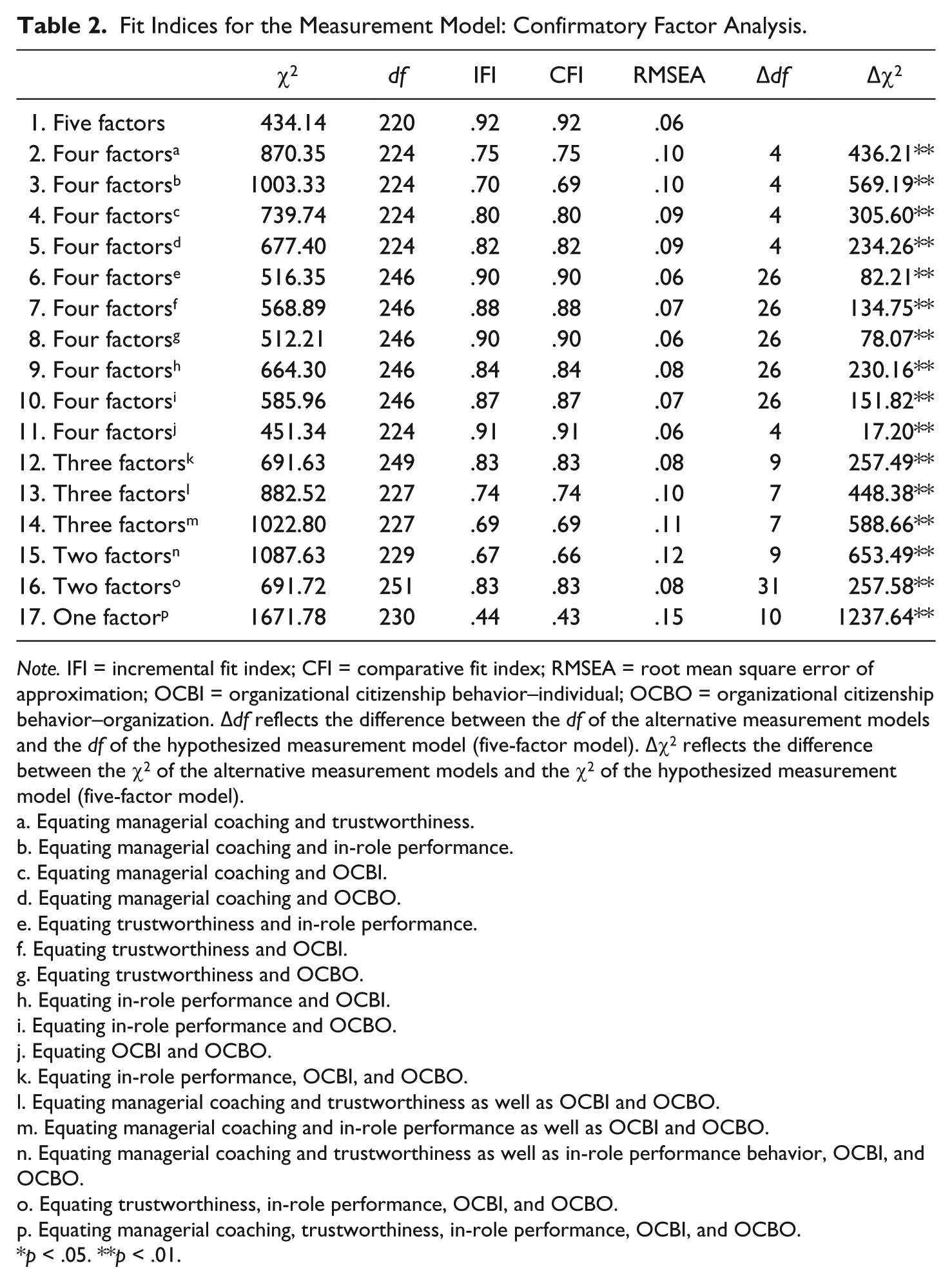
Note. IFI = incremental fit index; CFI = comparative fit index; RMSEA = root mean square error of approximation; OCBI = organizational citizenship behavior–individual; OCBO = organizational citizenship behavior–organization. Δdf reflects the difference between the df of the alternative measurement models and the df of the hypothesized measurement model (five-factor model). Δχ2 reflects the difference between the χ2 of the alternative measurement models and the χ2 of the hypothesized measurement model (five-factor model).
Equating managerial coaching and trustworthiness.
Equating managerial coaching and in-role performance.
Equating managerial coaching and OCBI.
Equating managerial coaching and OCBO.
Equating trustworthiness and in-role performance.
Equating trustworthiness and OCBI.
Equating trustworthiness and OCBO.
Equating in-role performance and OCBI.
Equating in-role performance and OCBO.
Equating OCBI and OCBO.
Equating in-role performance, OCBI, and OCBO.
Equating managerial coaching and trustworthiness as well as OCBI and OCBO.
Equating managerial coaching and in-role performance as well as OCBI and OCBO.
Equating managerial coaching and trustworthiness as well as in-role performance behavior, OCBI, and OCBO.
Equating trustworthiness, in-role performance, OCBI, and OCBO.
Equating managerial coaching, trustworthiness, in-role performance, OCBI, and OCBO.
p < .05. **p < .01.
Hypotheses Evaluation
We then tested the hypothesized associations among the study variables. The results from regression analyses are presented in Table 3. A p value of less than .05 (<.05) was utilized for the criterion statistic to determine whether the predictive values of the direct and indirect effects were significant. Hypothesis 1, which says that managerial coaching is positively related to employee in-role performance, was not supported; managerial coaching was not found to be a significant determinant of in-role performance. Hypothesis 2, which states that managerial coaching is positively related to employee OCBI, was supported; managerial coaching was found to be a significant determinant of OCBI (β = .15, p < .01). Hypothesis 3, which says that managerial coaching is positively related to employee OCBO, received support; managerial coaching was found to be a significant determinant of OCBO (β = .12, p < .01).
Direct and Indirect Effects in the Associated 95% Confidence Intervals (n = 280).

Note. H = hypothesis; OCBI = organizational citizenship behavior–individual; OCBO = organizational citizenship behavior–organization. Unstandardized regression coefficients are presented in the first line and standardized regression coefficients are shown in the second line. For indirect effects, the lower and upper bounds of the 95% confidence intervals (shown in brackets) are based on the findings from a bootstrapping analysis using the bias-corrected method. For direct effects, the lower and upper bounds of the 95% confidence intervals are provided only for unstandardized regression coefficients, as based on the findings from a regression analysis.
p < .05. **p < .01.
Our results also supported the prediction of Hypothesis 4 that managerial coaching is positively related to employee perception of manager’s trustworthiness; managerial coaching was found to be a significant predictor of trustworthiness (β = .11, p < .05). Hypothesis 5a states that employee perception of manager’s trustworthiness is positively related to in-role performance. Our findings supported this view; trustworthiness was found to be a significant determinant of in-role performance (β = .69, p < .01). Hypothesis 6a states that employee perception of manager’s trustworthiness is positively related to OCBI. Our findings also supported this view; trustworthiness was found to be a significant determinant of OCBI (β = .56, p < .01). Hypothesis 7a states that employee perception of manager’s trustworthiness is positively related to OCBO. Our findings supported this view; trustworthiness was found to be a significant determinant of OCBO (β = .45, p < .01). Since the two necessary conditions of the causal steps for indirect effect (Kenny et al., 1998) were established in the aforementioned analytic procedures (Hypotheses 4, 5a, 6a, and 7a), we logically concluded that the posited specific indirect associations of Hypotheses 5b, 6b, and 7b received support too.
Furthermore, our results of BC bootstrapping estimation with 1, 000 resampling and 95% confidence intervals (Cheung & Lau, 2008; Preacher & Hayers, 2008) confirmed these indirect relationship perspectives; managerial coaching was found to have a significant indirect effect on in-role performance through trustworthiness (Hypothesis 5b, β = .14 [.01, .28]); managerial coaching was found to have a significant indirect effect on OCBI through trustworthiness (Hypothesis 6b, β = .11 [.01, .23]); and managerial coaching was found to have a significant indirect effect on OCBO through trustworthiness (Hypothesis 6b, β = .15 [.02, .30]). The direct and indirect effects in the 95% confidence intervals are shown in Table 3.
Discussion
The current study examined the relationships between managerial coaching and employee performance behaviors with the mediating effect of manager’s trustworthiness as perceived by employees. Using the sample of 280 dyads in the Taiwan insurance industry, we tested the hypothesized measurement model and relationships guided by social exchange theory and relevant research perspectives. Our CFA results indicated that the five multi-items measures used in the present study had a substantial convergent and divergent validity. The results from hierarchical multiple regression analyses and bootstrapping estimation revealed that most of the hypothesized direct and indirect relationships were supported by the empirical data—Hypotheses 2, 3, 4, 5a, 5b, 6a, 6b, 7a, and 7b received full support by the reported study sample.
Managerial coaching was a significant determinant for all outcome variables identified in the current study. Managerial coaching had a significant direct impact on employee OCB toward other individuals and the organization as well as employee perceptions of a manager’s trustworthiness. Trustworthiness also had a significant direct relationship on employee performance of in-role and extra-role behaviors. On the basis of Kenny et al.’s (1998) revised causal steps and BC bootstrapping procedures (Cheung & Lau, 2008; Preacher & Hayers, 2008), managerial coaching was found to have a significant indirect impact on employee performance behaviors of in-role performance, OCBI, and OCBO through employee perception of manager trustworthiness. These findings were in line with our proposed theoretical underpinnings, based on social exchange theory and relevant research perspectives.
A key finding of the current study was that employees who received coaching from immediate managers reciprocated with extrarole behaviors toward other individuals and the organization. Related to this, another practical finding of our study was that subordinates who received coaching had more trust for their supervisors and, in turn, performed better than others who were not coached. Trustworthiness was important in a dyadic coaching context, since it mediated the relationships between managerial coaching and employee performance behaviors.
Interestingly, we found no support for Hypothesis 1 in the present study. The strength of the direct association between managerial coaching and employee in-role performance was trivial in magnitude. Most coaching literature identified task performance improvement as a primary potential outcome of managerial coaching (Agarwal et al., 2009; Ellinger et al., 2003; Evered & Selman, 1989; Hagen, 2012; Hargrove, 2008; Liu & Batt, 2010). However, the results of regression analyses in the current study indicated that in-role performance was not a significant direct outcome of managerial coaching, although it was found that in-role performance was an indirect outcome of managerial coaching, mediated by trustworthiness. Similar results, although limited, were reported in previous coaching studies (Kim, 2010). In their recent coaching study, Kim et al. (2014) reported that managerial coaching did not have a direct effect on employee performance but had an indirect effect on task performance via role clarity. Ellinger et al. (2011) also found that managerial coaching strengthened the relationship between a business’s social capital investment and employee job performance only for employees who received little, or low, coaching and not for those who received much, or high, coaching. In certain contexts, selective use of coaching may be more appropriate rather than its exhaustive application—more than selective one-on-one interactions might be perceived as unnecessary and redundant and result in counterproductive reactions for some employees (Ellinger et al., 2011; Kim, 2014). For example, experienced employees on the job (e.g., long job tenure technician) might not appreciate constant coaching guidance given by their superior. For those working in highly formalized jobs and work activities, additional coaching instruction maybe perceived to be redundant or less valued (Kim et al., 2014; Tubre & Collins, 2000).
Another potential reason for this conflicting finding could be because of the different characteristics of respondents, such as developmental process and performance levels. Employees tend to vary in their learning speeds, styles, and preferences (Kolb, 1984). Lower performers might be a stronger beneficiary of coaching over higher performers in at least some cases, as situational leadership approach proposed that managers and leaders would need to offer different leadership styles matching with subordinate developmental levels. It, however, could take more time for them to reach satisfactory performance levels—managers often spend more time coaching lower performers than coaching average performers (Park, 2012). Also, some personality types may be better suited to coaching. Narcissistic subordinates could be less likely to take into account what a manager-as-coach says or shows in their pursuit of goal achievement and performance improvement (Maccoby, 2003). Some employees (e.g., adult ego) may work better autonomously and prefer a more hands-off approach to management while others (e.g., child ego) feel more secure when they have more guidance (Stewart & Joines, 1991)—this is less about high or low performers and more about effective leadership styles mixed with employee personality and working environment preferences. Given the lack of empirical evidence on coaching effectiveness, more close investigation regarding the coaching performance association is warranted.
Implications for Research, Theory, and Practice
These study findings have several implications for organizational researchers and practitioners. First, our study findings make an important contribution to the managerial coaching literature. The current study is one of the few pieces of research that have examined managerial coaching effectiveness. There has been doubt regarding whether or not coaching is really being practiced by managers and if coaching is an effective tool for employee performance improvement (Park, 2007). Particularly, extant studies rarely investigated the coaching outcome variable of employee performance in a broad context by including extrarole performance behaviors, as well as in a specific relation with employee trust in their manager (Boyatzis et al., 2012; Hagen, 2012; Kim & Egan, 2013). Coaching has been criticized for lacking empirical study and being opinion-based (Ellinger & Kim, 2014). In the present study, we sought to fill the aforementioned gaps in organizational literature. Our study results demonstrated full empirical support for the hypothesized potential outcome variables—which are also connected to customer satisfaction, financial performance, and organizational growth (Organ et al., 2006). Thus, our study findings offer one of the earliest sets of empirical evidence for coaching effectiveness in this underresearched topic area.
Our study presents a simple but foundational framework for comprehending the managerial coaching process. Social exchange theory was utilized to address the connection between managerial coaching and employee performance and to lay the theoretical underpinnings of the managerial coaching mechanism in the present study. The social exchange relationship between managers and employees depends on potential reciprocation of investments and returns, such as supervisory support, consistent feedback, and subordinate discretionary role behaviors. The exchange of investments and benefits involves risk, particularly in the early stages of the exchange relationship (Whitener et al., 1998). Guided by social exchange theory and relevant conceptual viewpoints, trustworthiness was hypothesized as a proximal outcome of managerial coaching. Hence, a manager’s trustworthiness was posited as a mediator for the relationships between managerial coaching and employee performance behaviors in the theoretical framework of the current study (as depicted in Figure 1). Since there exist few theories or conceptual models commonly accepted in the area of managerial coaching, our study contributes to the managerial coaching literature by providing a foundational framework for understanding the managerial coaching process and its mechanism.
Our present study implies that managers can utilize coaching and related supportive approaches to enhance employee extrarole behaviors, in addition to overseeing in-role performance. Managers who want to increase employee willingness to spend time helping the organization and its members can do so by demonstrating more ability (e.g., defining and measuring subordinate performance, understanding and resolving performance issues), by signaling more benevolence (e.g., displaying individualized attention, showing genuine interest in subordinate learning and development), and by exhibiting more integrity (e.g., adhering to a set of developmental principles, connecting individual goals to the team’s or the organization’s goals). From a perception management perspective (Caldwell & Hayes, 2007; Elsbach, 2003), managers could improve their image of being trustworthy to subordinates through regularly practicing managerial coaching. The increased level of perceived manager trustworthiness can also positively influence the willingness of employees to accept managerial coaching and guided instruction, thereby further enhancing performance outcomes. Since the coaching relationship as related to trust between a manager and employees can accelerate learning and performance (Smith et al., 2009), managers-as-coaches can focus, particularly, on constructing a solid rapport with employees to continue developing trust and enable subordinates to maximize job performance.
Limitations and Future Research
The participants in this study worked in the life insurance industry. The samples were mostly obtained from northern Taiwan because of convenience, and might not be representative of the entire population. To examine the generalizability of the current study findings, future studies can employ various types of other samples. Next, the OCBO measure (Williams & Anderson, 1991) had a rather low Cronbach’s alpha (α = .60) in the reported study sample. Although this alpha score is acceptable (≥.60; Tabachnick & Fidell, 1996), another measure with stronger internal consistency and reliability can be applied for future research. Third, the coaching and in-role performance relationship was not supported in the current study sample. Future studies may employ another sample or measure for in-role performance. To examine this association more accurately, experimental design (Babbie, 2012) can be adopted.
In this research, we utilized several techniques to control potential common method variance influences (for the two variables of managerial coaching and trustworthiness). Although our statistical tests did not indicate the presence of common method variance, we recommend future researchers take more systematic approaches (e.g., longitudinal research design) to actively prevent potential common method variance effects as well as provide stronger empirical inference. Future studies can also explore other potential mediators, moderators, or control variables—which further explain the relationship between coaching and in-role performance—since the current study did not exhaustively examine all relevant variables. Also, the relatively low confidence intervals with OCBI and OCBO might suggest that there are other possible variables that affect the relationship. Finally, we recommend future researchers examine the potential influence of the length of an employee’s working relationship with their current supervisor with respect to the quality of managerial coaching relationships as well as the effectiveness of managerial coaching—having a longer working relationship may indicate a better or more solid working relationship. Given the increasing interest in managerial coaching, it is hoped that the present study will provide an impetus for future research in this previously uncharted area of managerial coaching.
Footnotes
Acknowledgements
We thank Yen-ju Pan for assistance with data collection.
Declaration of Conflicting Interests
The author(s) declared no potential conflicts of interest with respect to the research, authorship, and/or publication of this article.
Funding
The author(s) disclosed receipt of the following financial support for the research, authorship, and/or publication of this article: We appreciate the research funding from the National Science Council, Taiwan for this study. The project number is 101-2410-H-008-043.