



Abstract
The importance of diagnostic assessments during the design, implementation, and evaluation of change management processes is increasingly emphasized in the change management literature, and in practice. However, evidence-based change management is challenged by the rather fragmented state of research on employees’ reactions to change. Hence, this study proposes a theory-based framework for the design of change surveys that includes and links concrete classes of change management variables with specific employee reactions to change. The framework is applied and tested in the context of organizational changes following an international merger project (N = 240). Structural equation modeling revealed a good fit of the framework to empirical data and demonstrated the usefulness for the systematic and comprehensive identification of relationships between change management variables and employees’ specific reactions to the change process. The results underscore the potential of the framework to guide researchers and practitioners alike in analyzing and optimizing organizational change processes.
Keywords
Introduction
Today’s organizations are faced with a faster pace of technological development, shorter product life cycles and more complex, globalized market environments than ever before (Lüscher & Lewis, 2008). To stay competitive, it is increasingly important for organizations to adjust to these rapidly changing circumstances (Neves, 2011). Hence, the successful management of change in organizations has become one of the most central challenges for researchers and practitioners in the organizational context.
The difficulty of this challenge is not to be underestimated, as organizational change and development initiatives are rarely considered unqualified successes (Taylor-Bianco & Schermerhorn, 2006). Reported failure rates for change initiatives may be as high as 70% (Beer & Nohria, 2000). According to Kotter and Cohen (2002), failure is seldom attributed solely to technical issues; it is more often considered to be a result of personnel and human characteristics. Similarly, Schein (1988, 1999) argued that organizational failure to create readiness for change is the primary reason for the lack of success of many organizational change programs.
The management of organizational change requires a better understanding of the psychological aspects of change (e.g., Evans, 1995; Szamosi & Duxbury, 2002), especially employees’ reactions involved (e.g., Cummings & Worley, 2005; Oreg, Vakola, & Armenakis, 2011). Consequently, in applied settings, change managers are confronted with the challenging task of implementing effective change management interventions while considering the impact of these interventions on employees’ reactions to the organizational change. The selection of adequate change management measures and interventions has been described as an “art”, which demands various skills on behalf of the change managers (Raineri, 2011; Woodman, 2014). Recently, scholars highlight the central role of systematic change assessments for supporting change agents in selecting and designing adequate change management interventions (e.g., Armenakis, Bernerth, Pitts, & Walker, 2007; Vakola, 2013; Woodman, 2014). Accordingly, McFillen, O’Neil, Balzer, and Varney (2013) note, “in the absence of a rigorous diagnostic process, consultants and organizational leaders are likely to address the wrong problems and/or choose the wrong solutions” (p. 224).
Acknowledging the important role of sound diagnostics in change processes, McFillen et al. (2013) point out that organizational change diagnosis is often based primarily on personal experiences and anecdotes, and not on rigorous scientific evidence. They emphasize the need to incorporate theories and research findings in change assessments, to facilitate an effective evidence-based approach to change management (McFillen et al., 2013).
However, evidence-based practices for the implementation of change processes that are sensitive to employee reactions are challenged by the fragmented body of research on change management interventions and their effects on employees. Following their extensive review of the literature on employees’ reactions to change, Oreg et al. (2011) concluded that research on the topic has “led to a disintegrated and convoluted picture of the field” (p. 462). One main reason for this situation derives from the proliferation of change-related constructs, and the lack of comprehensive theoretical foundations and integration in the area of change research (Oreg et al., 2011). This observation is consistent with concerns expressed in Hempel’s (1965) model of scientific progress, which posits that an increasing proliferation of constructs can be seen as a potential indicator of limited scientific progress (Follette & Houts, 1996). Moreover, this observed lack of integration is particularly relevant from a practitioners’ point of view, because the fragmented state of the field makes it difficult to determine the most important factors to consider when attempting to implement comprehensive diagnostics and evidence-based management of employees’ reactions to change.
Therefore, it is not surprising that researchers have called for comprehensive frameworks which integrate the various streams of research on change management interventions and their effects on employees’ reactions to change (e.g., Neves, 2009). This seems particularly important for the systematic assessment and evaluation of change management initiatives and the related design of change surveys. Nevertheless, few attempts have been undertaken to integrate change management literature about employees’ reactions to change based on solid theoretical foundations. A noteworthy exception is an effort by Jimmieson, Peach, and White (2008), who successfully used the theory of planned behavior (TPB; Ajzen, 1991) to explain employees’ reactions to change. Another important step toward the conceptual integration of literature on change management variables was the framework for categorizing organizational change variables proposed by Armenakis and Bedeian (1999) on the basis of an extensive literature review. Their taxonomy has been used frequently and has found empirical support in previous research (e.g., Holt, Armenakis, Feild, & Harris, 2007; Self, Armenakis, & Schraeder, 2007; Walker, Armenakis, & Bernerth, 2007).
However, these two approaches emphasize different aspects of the process by which employees’ intentions to actively engage in organizational change are determined. On one hand, Jimmieson et al. (2008) focused on the psychological processes and variables relevant to generating change readiness, applying the well-established TPB in the context of employees’ reactions to change. On the other hand, Armenakis and Bedeian (1999) provided a taxonomy that organizes actionable change management variables in a comprehensive and distinguishable set of categories, namely content, process, and context factors.
Thus, one framework deals with psychological factors underlying employees’ reactions to change, whereas the other focuses on actionable change management variables affecting employees’ reactions to change. Even though they have different foci, both frameworks contributed fundamentally to the field of change management by providing theoretical rationales for organizing and integrating research on employees’ reactions to organizational change. Moreover, because of their different foci, the ultimate integration of both perspectives could provide a theoretically well-founded, comprehensive, and systematic approach for the design of change assessments. Such theoretically based diagnostic approaches have the potential to facilitate an evidence-based management of change by guiding change managers in the implementation and evaluation of change interventions in applied settings.
Therefore, the objective of this study is to contribute to the theoretical integration of knowledge about change management by providing and empirically testing a theoretically based framework for change assessments (see Figure 1). Specifically, the proposed framework suggests a theoretically founded integration of manageable change variables with employee reactions to change by systematically linking the TPB (Ajzen, 1991), and taxonomy of change variables provided by Armenakis and Bedeian (1999).
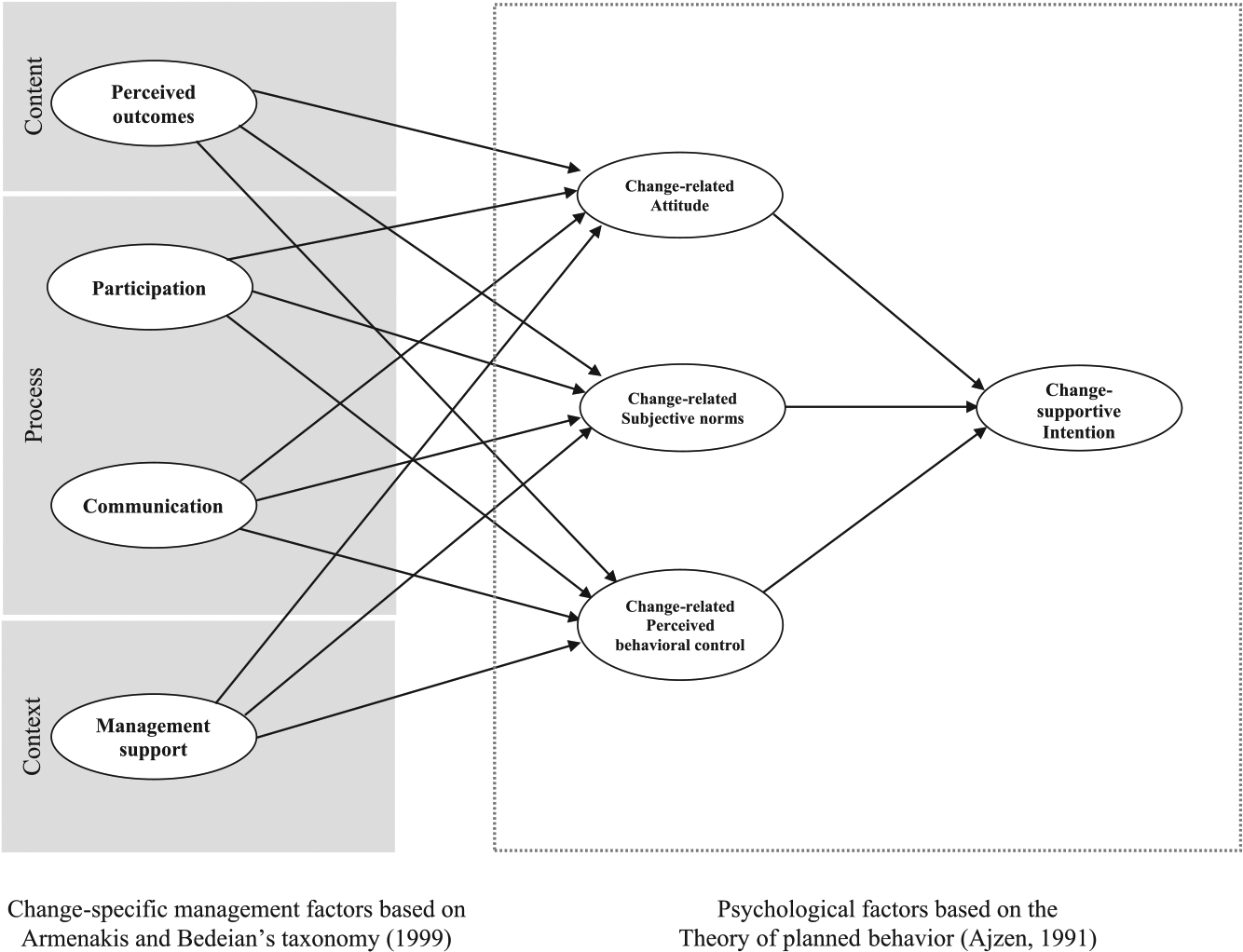
Proposed integrative framework of change-specific management factors and psychological factors.
The proposed framework will allow researchers and practitioners to focus on a comprehensive set of variables to analyze, design, and evaluate change interventions in regards to employees’ reactions to change. Change assessments based on the proposed framework will provide empirical insights into how employees’ intentions are formed in the context of organizational change and how these intentions can be influenced by specific measures to increase change readiness. Consequently, this approach builds on, and contributes to the recent call for more empirical and diagnostic guidance in the design of change management processes, and in the evidence-based selection of specific change interventions (McFillen et al., 2013; Vakola, 2013). In addition, it has the potential to systematically track progress during change implementation, and refine intervention strategies for successful organizational change efforts.
Employees’ Reactions to Change: Applying the Theory of Planned Behavior
Jimmieson et al. (2008) introduced the TPB to change management research in an effort to strengthen the theoretical foundations of the field, arguing that it had promise for understanding the psychological processes underlying employee reactions to change. The TPB is “a theory designed to predict and explain human behavior in specific contexts” (Ajzen, 1991, p. 181). The TPB states that the most proximal determinant of human behavior is a person’s intention to perform a specific behavior (Ajzen, 1988). These intentions are indicative of the individual’s motivation, and reflect how much people are willing to perform a certain behavior and how much effort they are willing to exert (Ajzen, 1991).
This assumption is consistent with suggestions made in research on readiness for change (e.g., Holt, Armenakis, Feild, et al., 2007) and the resistance to change literature (Oreg, 2003; Stanley, Meyer, & Topolnytsky, 2005), in which it is assumed that psychological processes predict whether employees’ behaviors will be supportive or unsupportive of change (Chawla & Kelloway, 2004). For example, Armenakis, Harris, and Mossholder (1993) described a causal process in which they emphasized the need to “influence beliefs, attitudes, intentions, and ultimately the behaviors of a change target” (p. 683) to create change readiness and to implement changes successfully. Moreover, Holt, Armenakis, Harris, and Feild (2007) highlight that “readiness is reflected in the behavioral intentions or reactions individuals have toward change” (p. 317). Hence, the current study follows the TPB and focuses on the employees’ change-supportive intentions as a cognitive precursor of employees’ supportive behaviors. The TPB postulates that behavioral intentions are largely determined by three factors, namely an individual’s attitude toward the behavior of interest, the subjective norms related to the behavior, and one’s perceived behavioral control (Ajzen, 1991).
The first of these determining factors is the attitude that the person holds toward the behavior of interest, and reflects his or her overall evaluation — favorable or unfavorable — of the outcome resulting from the behavior in question (Ajzen, 1991; Ajzen & Fishbein, 1980). Paralleling this assumption, scholars in the field of organizational change have often suggested that when employees have positive evaluations of the change, based on beliefs about the positive consequences for themselves and/or the organization, they are likely to exhibit behaviors that are supportive of the change (e.g., Armenakis et al., 1993; Neves, 2009; Oreg, 2006).
According to the TPB, the second major predictor of intentions is the subjective norm relating to a behavior, conceptualized as perceived social pressure to perform the behavior in question (Ajzen, 1991; Ajzen & Fishbein, 1980). The important role of interpersonal and social dynamics for the interpretation of events in organizational change processes has long been recognized (e.g., Armenakis et al., 1993). For example, influences from colleagues, specific opinion leaders, supervisors, and top management on employees’ change reactions and behaviors can be found in the change management literature (e.g., Armenakis & Bedeian, 1999; Lam & Schaubroeck, 2000; Neves, 2011; Self et al., 2007). Research applying the TPB in the organizational change context has also shown that subjective norms have an effect on employee reactions to change (e.g., Jimmieson et al., 2008).
The final determinant of intention is the degree of perceived behavioral control, defined as “perceived ease or difficulty of performing the behavior of interest” (Ajzen, 1991, p. 183). In the organizational context, employees’ perceptions of control have been found to aid employees in accommodating to organizational changes (e.g., Herold, Fedor, & Caldwell, 2007; Jimmieson, Terry, & Callan, 2004). Moreover, Conner (1992) proposed that being confident about one’s ability to change is an essential determinant of actual behavior. The assumptions of the TPB concerning perceived behavioral control are closely tied to Bandura’s work on self-efficacy (e.g., Bandura, 1991). Indeed, when not defined at a general, but at a specific level, self-efficacy and perceived behavioral control are very similar concepts (Ajzen, 2002). This similarity is consistent with work by Wanberg and Banas (2000), which showed that higher change self-efficacy was related to greater acceptance of change.
Overall, the TPB is a widely accepted model of attitude–behavior relationships (Conner & Armitage, 1998). It has been used successfully to predict behavior in a broad range of fields (Ajzen, 1988, 1991, 1996) and its predictive potential has been supported by meta-analytical research (e.g., Armitage & Conner, 2001; Godin & Kok, 1996). The TPB has been used in organizational research, for example, to study managerial intentions to act on feedback and improve skills (e.g., Maurer & Palmer, 1999), employee turnover intentions (e.g., van Breukelen, van der Vlist, & Steensma, 2004), and intentions to participate in an employee involvement program (e.g., Dawkins & Frass, 2005).
In the context of organizational change, specifically the relocation of employees to a new facility, Jimmieson et al. (2008) used the TPB to predict employees’ reactions to change with promising results. In another study, Jimmieson, White, and Zajdlewicz (2009) used the TPB to analyze how employees’ intentions to support a rebranding process were affected by attitude, subjective norms, and perceived behavioral control. These studies, and the clear relevance of the TPB to organizational change notwithstanding, research on its role in the prediction of employee change behavior is still in its infancy.
In view of the wide variety of organizational change processes and contexts, there is still much to learn about how employees form intentions to support change. For example, Porras and Silver (1991) suggested that changes in organizational work settings could be grouped into four categories: technological changes (e.g., tools, equipment, technical systems), changes in organizational arrangements (e.g., formal reward systems, strategies, goals), changes in social factors (e.g., organizational culture, interaction processes, management style), and changes in the physical setting (e.g., physical ambience, architectural design). Clearly, changes from these categories cannot be treated equally (e.g., Smeltzer, 1991). Changes in the different categories differ in their impact on the daily work of employees and in their influence on the factors most relevant to employee support for change (e.g., Self et al., 2007). For example, changes in physical setting, such as office relocations, will usually have little effect on internal work processes and work behaviors, unless they occur in combination with other interventions. From this perspective, understanding employees’ intention to support organizational changes is likely to be more critical when changes involve work processes, routines, organizing arrangements, and social factors.
In such cases, employees’ need to adapt in a variety of ways, and their engagement is crucial to the success of the change process. According to the TPB, employees’ intentions to engage in change-supportive behaviors depend on their evaluation of the outcomes associated with these behaviors (change-related attitude), on their perception of social influence to perform these behaviors (change-related subjective norms), and on their perceived control over these behaviors (change-related perceived behavioral control). Thus, based on the theoretical assumptions of the TPB and their supporting parallels in previous change management research, the following hypotheses are proposed and tested in the context of an organizational change process involving an international merger, which included changes in business processes, reporting relationships, IT systems, and organizational culture:
Approaches to a Systematic Understanding of Antecedents of Psychological Reactions to Change
The TPB is a theoretically sound approach to predicting and explaining employees’ intention to engage in organizational change processes (e.g., Jimmieson et al., 2008). But the TPB focuses on psychological variables and does not explicitly incorporate managerial decision variables. Understanding specific, systematic relationships between actionable management variables and elements of the TPB can have considerable practical value, because it would provide managers with insights into how implementation practices might be related to underlying psychological processes that promote support for organizational change and encourage employees to become involved.
Fortunately, the TPB describes the integration of external influences in specific settings (Ajzen, 1991; Schifter & Ajzen, 1985). The TPB postulates that, just as behaviors and intentions have antecedents, external influences on individuals’ intentions are mediated by attitudes, subjective norms, and perceived control of the relevant behavior (Conner & Armitage, 1998). For example, Jimmieson et al. (2008) showed that the effects of two common change management variables — communication and participation — on employees’ intention to support an organizational change were partially mediated by psychological processes specified in the TPB.
Integration and Explication of Change-Specific Management Variables
While the TPB offers the possibility of integrating external variables, deciding which management factors should be selected to gain a complete picture can be a challenging task. The change management literature describes a plethora of management variables that may be considered as external factors in this context (Oreg et al., 2011; Rafferty, Jimmieson, & Armenakis, 2013). However, based on extensive literature reviews, Armenakis and colleagues developed a taxonomy of change management factors that distinguished four major categories relevant to psychological reactions to change processes, namely content factors, process factors, context factors, and individual attributes (Armenakis & Bedeian, 1999; Holt, Armenakis, Feild, et al., 2007; Walker et al., 2007). Content factors relate to what is changed; this category encompasses perceptions of the utility, necessity, and consequences of the change process. Process factors relate to how things are changed; this category encompasses classical change management interventions, such as communication or participation opportunities. Context factors are related to the organizational environment in which the change occurs; this category includes organizational culture and management support. The individual attributes category was added later on to encompass internal employee factors, such as negative and positive affectivity, status, age, or organizational commitment, which influence individuals’ perceptions and reactions to the change process (e.g., Caldwell, Herold, & Fedor, 2004; Holt, Armenakis, Feild, et al., 2007; Judge, Thoresen, Pucik, & Welbourne, 1999).
The taxonomy allows for the identification of antecedents of the psychological processes underlying employees’ reactions to change. This is important because content, process, and context variables can be influenced by managerial decisions, and offer an opportunity for practitioners to achieve the desired psychological reactions during organizational change. Although employee characteristics help understand individual reactions to change, they constitute pre-change conditions (Oreg et al., 2011) that are, by definition, often not changeable and, therefore, are of limited use for active enhancement of change support during specific change processes.
Besides its practical potential, the taxonomy has also been frequently applied and found empirical support in change management research (e.g., Holt, Armenakis, Feild, et al., 2007; Self et al., 2007; Walker et al., 2007). For example, Self et al. (2007) used the taxonomy to predict employee reactions to change in a telecommunications company. The authors investigated change-relevant management variables from the content, process, and context categories to provide a comprehensive picture of the factors influencing employee response to change. The results indicated that all three classes of antecedents, namely content (impact of change), process (perceived communication), and context (perceived organizational support) incrementally contributed to employees’ acceptance of the changes, thus demonstrating the utility of Armenakis and Bedeian’s (1999) taxonomy as a guide to systematically identifying relevant change management variables.
However, Self et al. (2007) did not investigate the psychological processes underlying employee reactions to the change process. Understanding the psychological processes linking the interventional categories with employees’ intentions to engage in the change offers the opportunity to tailor change interventions to achieve a particular psychological effect. This suggests that research linking the TPB (e.g., Jimmieson et al., 2008) and the taxonomy by Armenakis and Bedeian (1999) is likely to be a fruitful approach.
Organizing Change Management Variables and Their Relation to Employee Reactions to Change
One major benefit of using the taxonomy of change management variables is that a broad and comprehensive sampling of organizational change management strategies and practices is ensured. The selection of variables should follow a procedure similar to that used and advocated by Self et al. (2007). As suggested, the selection should be guided by the principle of selecting variables that are representative of their category and are important in the context of change management (Self et al., 2007).
Once an appropriate set of change management variables has been selected, it must be related to the psychological variables of the TPB. As noted above, a central assumption of the TPB is that factors external to the individual influence behavioral intentions and behaviors through their effects on attitudes, subjective norms, and perceived behavioral control (Ajzen, 1991). Consequently, we assumed that the influences of content, process, and context factors on employees’ intention to engage in organizational change are fully mediated by psychological factors suggested by the TPB, namely change-related attitudes, change-related subjective norms, and change-related perceived behavioral control. Thus, we formally hypothesize the following:
The content dimension of the taxonomy focuses on what is changed and how the change is perceived by those involved (Self et al., 2007). With regard to the content of the change, previous research emphasized that perceived outcomes and benefits of change have particularly important influences on employee reactions to change (e.g., Fugate, Kinicki, & Prussia, 2008; Hornung & Rousseau, 2007). For example, Hornung and Rousseau (2007) found that higher anticipated benefits from change predicted change commitment among employees involved in a change process. In the same vein, research has focused on the importance of perceived appropriateness of change as a predictor of successful change (e.g., Armenakis & Bedeian, 1999; Holt, Armenakis, Feild, et al., 2007; Neves, 2009). For example, Holt, Armenakis, Feild, et al. (2007) suggested that both perceived personal and perceived organizational benefits underlie employees’ change readiness; they reported that both dimensions loaded on a single factor, which they termed perceived appropriateness of change. Neves (2009) reported that the perceived appropriateness of a change process was a strong predictor of affective change commitment, which in turn was related to higher levels of individual change behavior. Parallel to these findings, the TPB predicts that the perceived outcomes of the behavior in question play an important role in the formation of an individual’s intention to perform the behavior (Conner & Armitage, 1998). Accordingly, the following hypothesis is proposed:
Related to the process of the change initiative, organizational communication has long been recognized among a wide array of organizational change process variables as the key to enhancing employees’ behavioral support for change (e.g., Schweiger & DeNisi, 1991; Wanberg & Banas, 2000). For example, Miller, Johnson, and Grau (1994) found that employees’ willingness to change was influenced by the quality of information received. Similarly, Wanberg and Banas (2000) reported that greater openness to change was linked to receiving adequate and timely information about the change. Communicating the consequences of the change process effectively is recognized as being likely to foster supportive attitudes toward the change effort, as well as to reduce uncertainty and anxiety during change (Bordia, Hunt, Paulsen, Tourish, & DiFonzo, 2004; Jimmieson et al., 2008; Johnson, Bernhagen, Miller, & Allen, 1996). In research applying the TPB, Jimmieson et al. (2008) found that communication and participation influenced employee intentions to support an organizational change project. Taken together, the research on the context of organizational changes suggests:
Employee participation is another prominent variable particularly characteristic for the process dimension of the taxonomy. In an early experimental field study, Coch and French (1948) showed that groups who were directly involved in the change were quicker to regain their original productivity after job transfers than groups in which participation was through representatives or groups which had no opportunity for participation. They also observed that higher levels of employee participation were inversely related to aggressive behaviors and turnover intentions among the transferred employees. More recently, Dirks and Ferrin (2002) argued that creating opportunities for employee participation in the change process may be a signal of management’s confidence in employees. Overall, participation reduces resistance, is associated with feelings of empowerment, and has the potential to evoke a stronger psychological commitment to proposed changes (e.g., Armenakis & Bedeian, 1999; Armenakis, Harris, & Feild, 1999; Lines, 2004; Rafferty et al., 2013). Thus, it is expected that
Management support for change has frequently been noted as an important context factor in the success of organizational change (e.g., Armenakis & Bedeian, 1999; Neves, 2009). Specifically, managers serve central functions during change, such as representing the organization and fostering employees’ acceptance of the change (Neves & Caetano, 2009). In a meta-analytical study, Damanpour (1991) reported that managerial attitudes toward change were positively associated with the success of organizational innovation initiatives. Similarly, Self et al. (2007) argued that change initiatives supported by immediate supervisors were more likely to gain the support of work group members. In the same vein, Neves (2011) showed that perceived supervisor support was positively associated with affective and normative commitment to change. This body of evidence strongly suggests that perceived managerial support for change is an important predictor of employee reactions to organizational change. Therefore, the following relationship is hypothesized:
The complete change assessment model used in this study is summarized in Figure 1. Although perceived outcomes, communication, participation opportunity, and perceived managerial support are all variables that can be manipulated by management to facilitate organizational change, they are by no means the only potential targets for interventions. Nevertheless, in this research these factors have been used because they are representative of content, process, and context factors in organizational change research, respectively, and therefore represent potentially important foci for managerial efforts to promote change.
Method
Sample and Procedure
The context for this study was a post-merger process of organizational integration and transformation, during which the business processes of an Australian company that had been acquired by a larger international firm were harmonized with those of the new parent company. The global enterprise resource planning system of the parent company served as the basis for the process harmonization and standardization. Key business representatives were involved in the business blueprint phase to define and agree on the required tasks and system functionality. A wide range of business processes were in the scope of the post-merger change activities: finance and controlling, plant maintenance, materials management, business warehouse, project system, and human resources. Moreover, new human resource self services were implemented for employees (e.g., time recording, leave requests) and for managers (e.g., update and manage annual performance reviews and annual salary reviews). Overall, the postmerger integration process had effects on the role requirements and day-to-day tasks of virtually all employees of the acquired company.
A change management team consisting of experts from both the acquired and the parent company was established to support this change process. The change management team agreed to analyze employees’ reactions to the change process using a survey administered during the change process. One week prior to the administration of the survey, an e-mail message describing the content of the survey and explaining that participation in the survey was voluntary, anonymous, and would have no consequences, positive or negative for individual participants, was sent by upper management to employees of the acquired company. The survey was administered online using HTML forms and PHP databases, a procedure that was familiar to the respondents. If the participant left an item blank, the missing value was accepted by the survey instrument without any further queries. The survey could be resumed by logging in again, if completion was interrupted because the employee logged off, or the connection was terminated prior to the completion for some other reason.
During the 3 weeks of data collection 255 of the invited 874 employees took part in the survey, resulting in a response rate of 29%. Participants who left 10% or more of the items blank were excluded from the analysis, resulting in a final sample size of 240 employees. The survey participants represented all the business functions that were directly affected by the post-merger integration process (such as finance, controlling, procurement, human resources, and information systems). Participants represented both management roles (17%) and non-managerial roles (71%), and others not indicating their position in the organizational hierarchy. Moreover, 70% of the survey participants were located at the company’s headquarters, 27% of the participants were blue collar workers from various field offices who worked in small production units, and 3% did not indicate their location. Although data to conduct statistical comparisons of respondents and the overall population in the organization were not accessible due to data security and privacy reasons, the sample characteristics indicated that all relevant employee groups affected by the change are represented in the sample.
Measures
The data analyzed in this study were collected using the same survey, however, not all the items included in the questionnaire were analyzed, as some (i.e., open comments, rating of specific events) were not specifically related to the model underlying this study. Participants used a 5-point Likert-type scale (1 = strongly disagree; 5 = strongly agree) to respond to the items.
Measurement of Psychological Factors
We followed Ajzen’s (2006) recommendations when developing the items to measure the three dimensions of the TPB. Ajzen (2006) argued that items designed to measure attitudes, subjective norms, and perceived behavioral control should target the behavior of interest in a specific context, rather than a general behavioral domain or context. In line with this recommendation, the items were phrased in a way that directly related to specific behaviors which might be enacted in the context of the current change processes. The wording of the items was discussed with representatives from the company to ensure that it was adapted to the specific organizational context under investigation.
Change-related attitude reflects the individual’s overall evaluation of the outcome of performing the behavior in question (Ajzen, 1991; Ajzen & Fishbein, 1980). This overall evaluation of the change was assessed by four items (e.g., “I believe it will be good to adopt the changes which result from the project in my daily work”). Internal consistency (Cronbach’s alpha) for the scale was .95 in this sample.
Change-related subjective norms are defined as a person’s perception that others who are important to the person think that the person should perform the behavior (Fishbein & Ajzen, 1975). Social influence and pressure were assessed by four items focusing on the degree to which supervisors and others supported engagement in the organizational change process (e.g., “My manager expects me to apply the changes resulting from the project in my daily work”). The internal consistency (Cronbach’s alpha) of this measure was .90.
Change-related perceived behavioral control is defined as an individual’s perceived probability of succeeding at performing the behavior related to a given task (Ajzen, 1991). This was measured with four items focusing on the respondent’s personal resources and expectation of coping successfully with the change process (e.g., “I am confident that I will be able to adopt the changes resulting from the project in my daily work”). The internal consistency (Cronbach’s alpha) of this measure was .94 in this sample.
Intention to engage in the change process was assessed by four items that focused on the respondent’s intention to engage in the specific behaviors as part of the implementation of the changes taking place in the organization (e.g., “Overall, I intend to implement the changes resulting from the project in my daily work”). Internal consistency (Cronbach’s alpha) for this scale was .92.
Confirmatory factor analyses comparing the hypothetical four-factor model with a single factor model were carried out. The results showed that the proposed four-factor model had a better fit to the data (comparative fit index [CFI] = .912, incremental fit index [IFI] = .913, root mean square error of approximation [RMSEA] = .127) than a single factor model (CFI = .673, IFI = .675, RMSEA = .237).
Measurement of Change-Specific Management Factors
Like Self et al. (2007) we selected change management variables that were representative of each category of the taxonomy for change management variables proposed by Armenakis and Bedeian (1999).
Perceived outcomes (Content) was measured with four items asking whether employees felt that they had a good understanding of the expected outcomes of the change process and the potential benefits for their own work (e.g., Holt, Armenakis, Feild, et al., 2007; Oreg, 2006). Example items include “I know the business benefits that are expected from the change project” and “I think that work processes will improve as a result of the change project.” The internal consistency of the scale (Cronbach’s alpha) was .91.
Communication (Process) was assessed with four items which had an internal consistency (Cronbach’s alpha) of .94. As in previous research (e.g., Wanberg & Banas, 2000), the items were designed to assess employees’ satisfaction with the communication and information provided about the change process (e.g., “The communication channels being used to distribute the information are appropriate for me”; “Overall, I am satisfied with the way information about the change project has been communicated”).
Participation opportunity (Process) focused on the employees’ perceptions of their opportunities to participate actively in change effort by contributing to decisions about the change process (e.g., Wanberg & Banas, 2000). Participation opportunity was measured with three items, including “I have been asked to give my input to the change project” and “Overall, I am satisfied with the level of participation I have within the change project”. Internal consistency (Cronbach’s alpha) for this scale was 80.
Management support (Context) describes the extent to which employees perceive that management is supportive of the change process (Bouckenooghe, Devos, & van den Broeck, 2009). Management support was measured with four items (e.g., “My manager is positive about the change project and supports it” and “Overall, I am satisfied with the management’s support of the change project”). The internal consistency (Cronbach’s alpha) of the scale was .94.
Confirmatory factor analyses were used to compare a four-factor model of the management variables with a single factor model. The results indicated that the four-factor model had a good fit to the data (CFI = .957, IFI = .958, RMSEA = .084) and a single-factor model a much weaker fit (CFI = .736, IFI = .739, RMSEA = .201).
Tests of the Complete Measurement Model
To address the potential of overlapping constructs and common method variance, a series of analyses were performed with all eight constructs (see Table 1). At first a confirmatory factor analysis was performed with the postulated eight-factor model. The model showed an adequate fit to the data (CFI = .910; IFI = .911; RMSEA = .086), with all items loading higher than .65 on their respective latent factors. In a next step, five 7-factor models were tested and compared with the postulated model. The 7-factor models combined factors which correlated higher than .7, as this is generally thought of as indication for high correlation (e.g., Knofczynski & Mundfrom, 2007).
Measurement Model Comparisons.
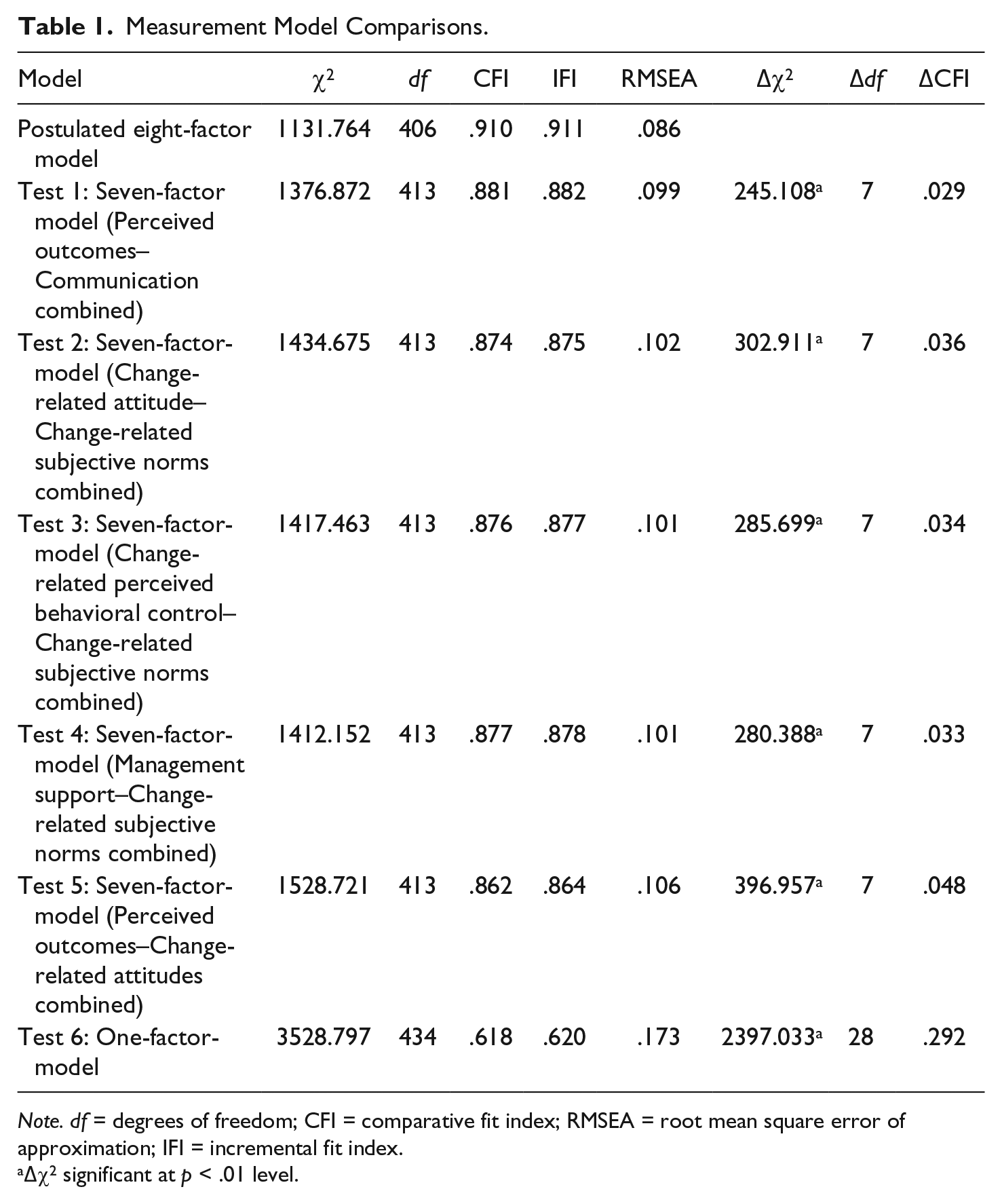
Note. df = degrees of freedom; CFI = comparative fit index; RMSEA = root mean square error of approximation; IFI = incremental fit index.
Δχ2 significant at p < .01 level.
None of the seven-factor models achieved adequate model fit. Moreover, in every case the drop in CFI (ΔCFI =.015) was greater than .10, usually taken as a meaningful decrease (e.g., Cheung & Rensvold, 2002; Vandenberg & Lance, 2000). In addition, Harman’s single-factor test for common method bias was performed (see Podsakoff & Organ, 1986), which also showed a significantly worse and far from adequate model fit (CFI = .618, IFI = .620, RMSEA = .173; Δχ2 = 2397.033, Δdf = 28, p < .01; ΔCFI = .292).
Furthermore, SPSS was used to calculate variance inflation factors (VIFs) in a series of regression analyses for all dependent scales to test potential multicollinearity. In general, VIF values above 10 indicate high multicollinearity (Chatterjee & Hadi, 2006) and values around 5 indicate potential for multicollinearity (Montgomery, Peck, & Vining, 2001; Snee, 1977). The VIF values in this study ranged between 2.05 and 4.39 with a mean of 2.94, showing no evidence of critical multicollinearity.
Taken together, it can be concluded that the measures used in the present study formed distinct factors, as anticipated, and that common method variance seems not to be a serious threat.
Analysis
Figure 1 shows the overall model that was used to test the hypotheses. The overall model was tested by structural equation modeling with maximum likelihood estimation using AMOS 22. A latent factor underlying its corresponding items was modeled for each construct included in the model. For each latent factor, the regression weight of one item was fixed at 1 to define the scale. The latent factors of the management variables were allowed to correlate with each other. Similarly the latent TPB factors, change-related attitude, change-related subjective norms, and change-related perceived behavioral control, were also allowed to correlate, in line with the recommendations of Preacher and Hayes (2008).
Several authors recommend the use of practical fit indices to evaluate model fit, on the grounds that the chi-square index is oversensitive to small deviations, especially with larger samples (Bollen, 1989a; Bollen & Long, 1993). Hence, the CFI (Bentler, 1988), the IFI (Bollen, 1989b), and the RMSEA (Steiger, 1990) were used to examine model fit in the present research. These fit indices are commonly used measures of practical fit and reflect a broad range of statistical characteristics (e.g., Beauducel & Wittmann, 2005). The CFI and the IFI are fit indices that compare the specified model with a model which assumes that all observed variables are unrelated. While CFI and IFI apply different algorithms to determine the model fit (see Tabachnick & Fidell, 2013 for details), higher values indicate better fit of the specified model in both cases. Specifically, values of .90 or above are usually taken as an indication of adequate model fit for the CFI and IFI (e.g., Diefendorff, Silverman, & Greguras, 2005; Vandenberg & Lance, 2000). The RMSEA represents a fit index that assesses how well the sample data are reproduced by the specified model. For the RMSEA, lower values indicate a better fit of the specified model. Concerning interpretation of RMSEA, values lower than .08 are considered to represent a good fit between model and data, values between .08 and .1 still indicate an acceptable fit, and higher values are indicative of a poor fit (MacCallum, Browne, & Sugawara, 1996).
To test the hypothesized mediation, two steps were taken. The first step follows the procedure used by DeRue, Nahrgang, Wellmann, and Humphrey (2011), and compares the complete mediation model with a structural equation model that also includes all direct paths. A significant change in χ2 and a change of CFI greater than .01 were considered as indicators of a meaningful difference between the two models (e.g., Cheung & Rensvold, 2002; Vandenberg & Lance, 2000). If the additional direct paths lead to a meaningful improvement of model fit, a partial mediation can be concluded, otherwise the complete mediation model is a good fit to the data. Moreover, the significance of the direct paths can be indicative of potential full or partial mediation.
In a second step, bootstrapping was performed to have a closer look at the significance of the direct and indirect effects. Bootstrapping is a resampling technique that draws a great number of random samples with replacement from the original sample and infers confidence intervals based on the distribution of parameter estimates in all resampled data sets (Efron, & Tibshirani, 1994; Preacher & Hayes, 2008). Bootstrapping is especially suitable for examining the significance of indirect and direct effects in complex models that have multiple mediating paths (MacKinnon, Fairchild, & Fritz, 2007; Preacher & Hayes, 2008). As bootstrapping in AMOS requires a complete data set, expectation-maximization (EM) imputation in SPSS was performed prior to the analysis. Specifically, parametric bootstrapping was used with 1,000 bootstrapping samples and 90% bias-corrected confidence intervals.
Results
Table 2 presents the means, standard deviations, and correlations among the observed variables in the study. As can be seen, correlations among the change management variables and the psychological variables are highly significant and positive. Overall, the change-related attitudes (r = .69; p < .01), change-related subjective norms (r = .68; p < .01), and change-related perceived behavioral control (r = .63; p < .01) were more strongly correlated with change-supportive intentions than were the change-specific management variables. The highest correlation with change-supportive intentions is found for change-related attitudes, whereas management support (r = .47; p < .01) had the lowest correlation with change-supportive intentions.
Observed Scale Means, Standard Deviations, and Correlations.
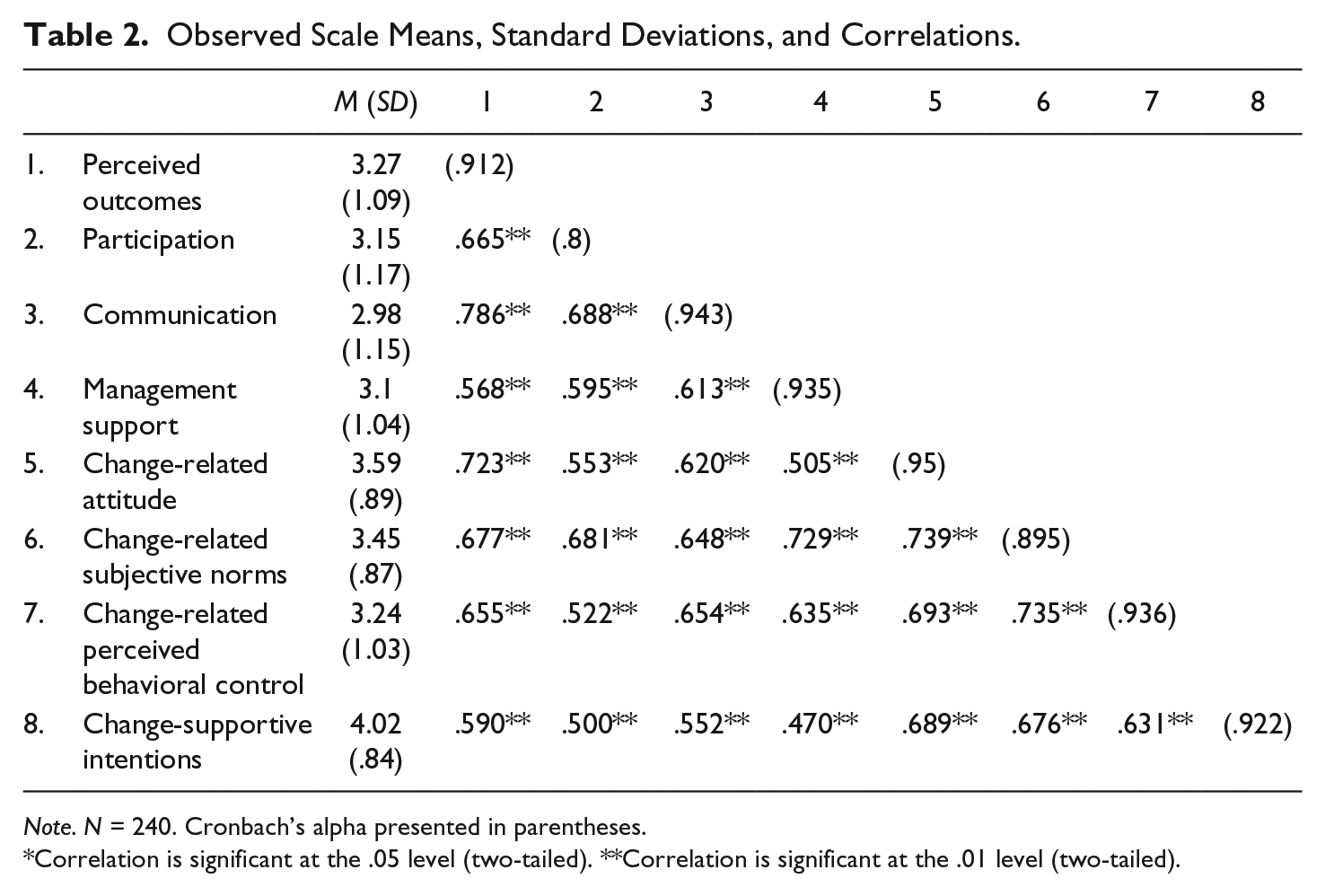
Note. N = 240. Cronbach’s alpha presented in parentheses.
Correlation is significant at the .05 level (two-tailed). **Correlation is significant at the .01 level (two-tailed).
As can be seen in Figure 2, the proposed model demonstrated an acceptable fit to the data (CFI = .910; IFI = .911; RSMEA = .086). Figure 2 also presents the standardized coefficients for the structural relationships in the model and the proportion of variance in endogenous variables accounted for by the model. Overall, 47% of the variance in intention to support the change was explained by the model.
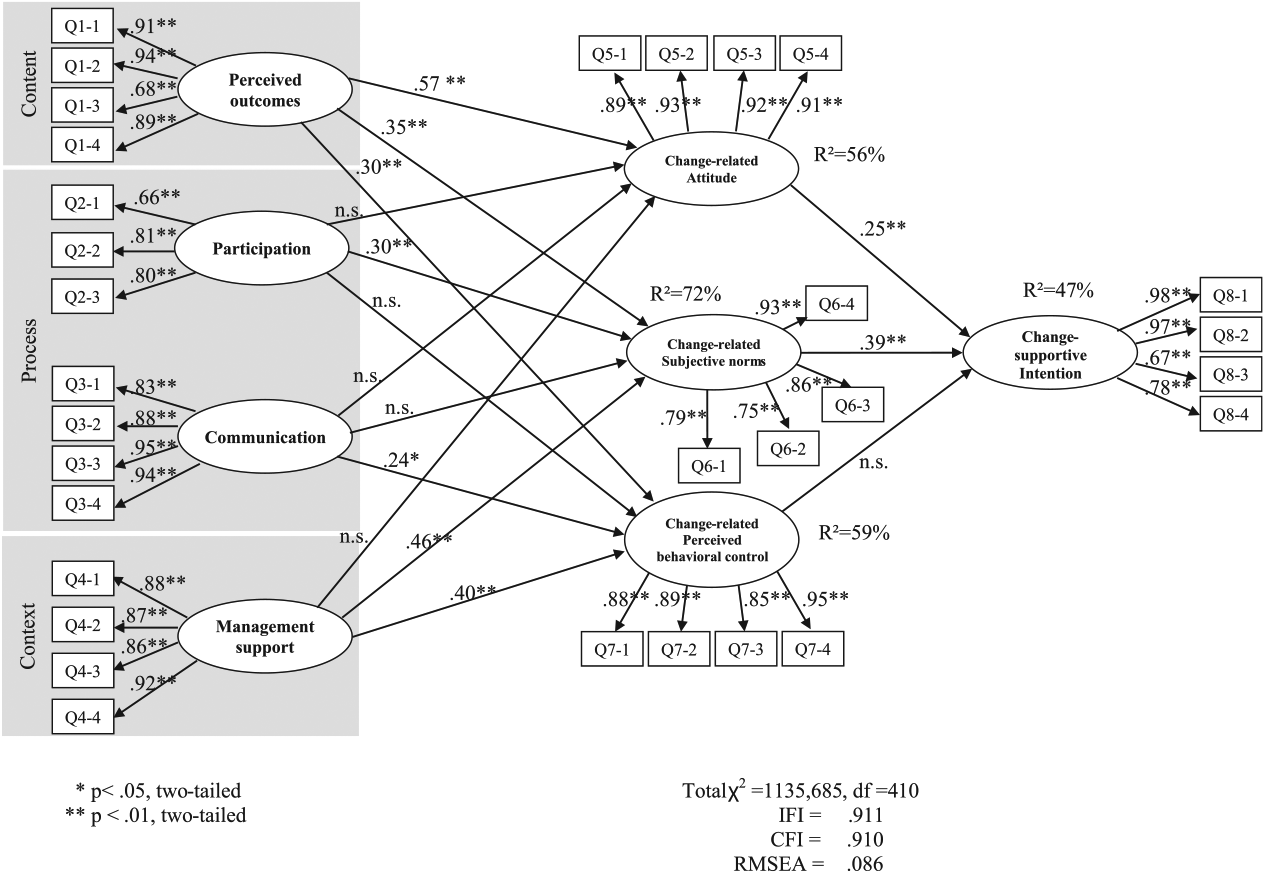
Structural equation model with standardized path coefficients.
The strongest predictors of intention to engage in the change process were change-related subjective norms (β = .39; p < .01) and change-related attitudes (β = .25; p < .01). The path between change-related perceived behavioral control and change-supportive intention was not significant at the 5% level (β = .101; p > .05). The results supported Hypotheses 1 and 2, but not Hypothesis 3.
The mediation suggested in Hypothesis 4 was tested according to the procedure used by DeRue et al. (2011). Hence, the proposed complete mediation model (see Figure 2) was compared with a model that also included all direct effects of the change management variables to determine whether they had significant unique associations with intentions that were not mediated by change-related attitudes, change-related subjective norms, or change-related perceived behavioral control. The overall model fit of the extended model that included all direct effects did not fit the data better than the full mediation model, (χ2diff(4)=3.921; p > .4; no change in CFI). Moreover, none of the additional direct effects was significant. These results indicated that, as suggested by Ajzen (1991), the effects of the change management variables were entirely mediated by change-related attitudes, change-related subjective norms, and change-related perceived behavioral control.
Specifically, perceived outcomes, a content factor, had the largest indirect effect on intention to engage in the change process (standardized indirect coefficient = .307), followed by management support (standardized indirect coefficient = .245), a context factor, and participation opportunity (standardized indirect coefficient = .137), a process factor. Bootstrapping revealed that these paths were all significant (standardized indirect effectPerceived outcomes: p < .01; standardized indirect effectManagement support: p < .01; standardized indirect effectParticipation opportunity: p < .05). These findings provided support for Hypotheses 4a, 4c, and 4d. However, although communication had a significant effect on change-related perceived behavioral control (β = .24; p < .05), the overall effect of communication on employees’ intention to engage in the change was close to 0, primarily because change-related perceived behavioral control was not significantly correlated with intentions to engage in the change process; therefore, Hypothesis 4b was not supported.
Regarding the effects of the change management variables on the psychological variables, the present study revealed that perceived communication, a process factor, significantly predicted change-related perceived behavioral control, but not change-related attitude or change-related subjective norms. Participation opportunity, the other selected process factor had a strong and significant effect on change-related subjective norms (β = .30; p < .01), but no other significant effect on change-related attitudet support, a context factor, was a significant predictor of change-related subjective norms (β = .46; p < .01) and change-related perceived behavioral control (β = .40; p < .01), but not of change-related attitude. Finally, perceived outcomes, a content factor, had significant positive relationships with change-related subjective norms (β = .35; p < .01), change-related attitudes (β = .57; p < .01), and change-related perceived behavioral control (β = .30; p < .01).
Discussion
While the successful management of organizational change has become an important issue for organizations (Neves, 2011), the reported success rates of organizational change initiatives are quite low (e.g., Beer & Nohria, 2000). Recent literature emphasizes the importance of a systematic change assessment for the selection, design, and modification of change management initiatives (e.g., Armenakis et al., 2007; McFillen et al., 2013; Woodman, 2014). However, the systematic assessment of change initiatives is challenged by the fragmented field of change management research, which makes it difficult to determine the important variables for a systematic analysis and management of change readiness in organizations (Khan et al., 2014).
To date, few studies have attempted to systematically examine how actionable management variables, such as participation or management support, influence employee-supportive intentions through their effects on psychological variables like those described in the TPB (Jimmieson et al., 2008). Therefore, the purpose of this research was to integrate psychological variables and change-specific management variables into a comprehensive framework for systematic change assessments. The proposed framework was based on previous research focusing on the TPB (Jimmieson et al., 2008) and research drawing on Armenakis and Bedeian’s (1999) taxonomy of change management variables (e.g., Self et al., 2007). Instead of suggesting new constructs, this study postulated that the effects of various management variables — examples of content, process, and context factors (e.g., Armenakis & Bedeian, 1999) — on employee reactions to change are fully mediated by employee change-related attitudes, change-related subjective norms, and change-related perceived behavioral control, as described in the TPB (Ajzen, 1991). This integrated framework has the potential to help both researchers and practitioners to understand the psychological mechanisms underlying employee change support and to guide the refinement of management variables that are critical to successful organizational change.
Overall, the hypothesized model showed a good fit to the data. About 47% of the variance in intentions to engage in the change process was explained by the constructs included in the model. In previous research, Self et al. (2007) found that a selection of variables from the taxonomy of change variables explained 26% of employees’ change justification. Jimmieson et al. (2008) found that the TPB variables and two management variables, namely communication and participation, explained 30% of the variance in intentions to engage in a relocation process. Hence, the present findings provide further compelling evidence of the potential value of integrating organizational change practices with the psychological processes outlined in the TPB.
Understanding the Underlying Psychological Mechanisms
Alongside the overall fit of the proposed framework, the results of this study showed that change-related subjective norms and change-related attitudes relating to change were the strongest predictors of intentions to engage in the change process prior to implementation. This is a somewhat surprising finding, given that other studies using the TPB in other contexts often report that subjective norms are a weaker predictor of intentions (e.g., Terry & Hogg, 1996). For example, in their meta-analysis, Armitage and Conner (2001) found high average correlations between attitudes and intentions, and lower average correlations between subjective norms and intentions. However, Ajzen (1991) noted that the relevance of attitudes, subjective norms, and perceived behavioral control is likely to vary across situations.
In studies that have applied the TPB to organizations, subjective norms have frequently been shown to be the strongest predictor of intentions. For example, van der Zee, Bakker, and Bakker (2002) showed that subjective norms were the strongest predictor of intention to use unstructured interviews and were as strongly related to intention to use structured interviews as attitudes. Moreover, in both studies of organizational change reported by Jimmieson and colleagues (Jimmieson et al., 2008; Jimmieson et al., 2009), subjective norms were the strongest psychological predictor of intention to support the organizational changes. Thus, it seems that in organizational contexts, subjective norms may be more important than in other behavioral contexts, such as participation in cancer screening (Devellis, Blalock, & Sandler, 1990), or dental hygiene practices (McCaul, O’Neill, & Glasgow, 1988), which account for a large proportion of the studies included in the meta-analysis (Armitage & Conner, 2001). One potential explanation for this lies in the nature of organizational contexts, which are usually characterized by a high relevance of normative demands due to hierarchical structures and processes with clear control and power patterns. Jimmieson et al. (2009) suggested that these characteristics may create dependent relationships with perceived pressure from important others (e.g., supervisor, top-management) combined with the threat of punishment (e.g., demotion) or incentives (e.g., bonuses). Moreover, teamwork and social interaction among colleagues play a central role in organizational life, and therefore, social influence from colleagues and opinion leaders can have a strong effect on employees’ reactions to change (e.g., Lam & Schaubroeck, 2000).
Results of the present study failed to demonstrate a significant relationship between change-related perceived behavioral control and intentions to support the change effort. Previous findings on the role of perceived behavioral control in the context of organizational changes have also been mixed. Jimmieson et al. (2008) found that subjective norms, attitudes, and perceived behavioral control were all significantly related to employees’ intentions, but in another study by Jimmieson et al. (2009), perceived behavioral control was found not to be significantly related to intentions. In line with Ajzen’s (1991) suggestions they concluded that in some cases of organizational change “only one or two of the variables is sufficient to explain employee intentions” (Jimmieson et al. 2009, p. 246). One possible explanation for the nonsignificant relationship between perceived behavioral control and intentions in Jimmieson et al.’s (2009) study is that the specific context may have caused employees to feel that they would have little control over the change activities (Jimmieson et al., 2009). Similarly, in the present study, change-related perceived behavioral control may have failed to predict intentions to engage in the change process because the data were collected at an early stage in the process. When the data were collected, employees may not have had a complete understanding of what specific new behaviors and processes would be required during and after the change. Perceptions that one is capable of behaving in desired ways during change may be more relevant later in the change process, when expectations are clearer or when the changes have been implemented.
Although this study, and other research, shows differential results for the TPB variables, the TPB seems to be applicable to a range of change processes. Hence, applying the TPB to change processes should allow researchers and practitioners to analyze the psychological mechanisms underlying employees’ reactions to changes at work. Moreover, the assessment based on the TPB seems to be sensitive to situation-specific characteristics.
Understanding the Effects of the Change Management Factors
Besides providing insights on the psychological factors influencing employees’ supportive intentions, the framework has the potential to shed light on the effects of a broad range of controllable change management variables on employees’ reactions to change. This knowledge can guide the refinement of intervention strategies for organizational change processes. Based on theoretical assumptions, it was hypothesized that the effects of several external variables representing the various categories of change management variables (Armenakis & Bedeian, 1999) on employee reactions to change are mediated by the psychological dimensions underlying the TPB, namely change-related attitudes, change-related subjective norms, and change-related perceived behavioral control (Ajzen, 1991).
Indeed, the mediation analysis in the present study indicated that the effects of the change management variables are fully mediated by the variables of the TPB. Specifically, a model that included additional direct effects of the management variables on intentions offered no improvement over the full mediation model in terms of overall model fit. Moreover, none of the direct effects was found to be significant. Hence, combining the TPB with the taxonomy of change management variables provides a useful framework for understanding the psychological processes through which controllable change management variables influence intentions to support change.
Looking specifically at the change management variables, the results for the specific change at hand showed that management support was significantly related to change-related perceived behavioral control and change-related subjective norms. This is in line with research by Self et al. (2007), who argued that change initiatives that are supported by the supervisor have a greater likelihood of gaining support from work group members. Another study found that perceived supervisor support was significantly related to normative commitment to change, which may be considered a socially bound variable (Neves, 2011), and thus is in line with the present findings relating to subjective norms. Moreover, the present results indicated that perceived management support is associated with employee confidence in being able to implement change successfully. Taken together, these results highlight the importance of management support and social influences in the context of this organizational change.
Furthermore, the present results showed that perceived outcomes play an important role in the creation of employees’ intention to engage in the organizational change, through their mediating effects on all three of the elements of the TPB. Specifically, employees who perceived the change to be associated with benefits also reported a more favorable overall evaluation of the change process, a greater sense of behavioral control, and felt that the subjective norm was to support the change. Similarly, Neves (2009) showed that perceived appropriateness of the change process was a strong predictor of affective commitment to change, while Fugate et al. (2008) showed that negative appraisals were associated with a reduction in control coping that may have been due to lower levels of perceived behavioral control.
Communication, a process factor, was found to be significantly related to change-related perceived behavioral control, indicating that employees who felt informed about the change also felt they would be able to apply the changes. Jimmieson et al. (2008) reported a similar finding, which they attributed to a higher sense of predictability. However, in the present study the overall effect of communication on intentions was close to zero, as it was only related to change-related perceived behavioral control, and change-related perceived behavioral control was not significantly related to intentions at this stage of the change project. The results indicated that good communication was associated with a greater perception of behavioral control and, thus, fulfilled a central function of a change message (see Armenakis & Harris, 2002). However, it has been argued that successful change communication should clearly establish a sense of urgency (e.g., Kotter, 1995). More specifically, it has been proposed (e.g., Armenakis & Harris, 2002) that change communication should instill a feeling that a change is needed (discrepancy) and a conviction that the proposed change is adequate (appropriateness). These elements of a change message could have had an effect on change-related attitude and change-related subjective norms as well. Hence, the findings in this study provide a basis for refining the communication strategy for this specific change project by putting a stronger focus on discrepancy and appropriateness. This example indicates that insights into the underlying psychological processes can be used to optimize interventions in order to foster a high engagement in the change initiatives.
Finally, employees reporting higher levels of participation opportunities also had a stronger perception that others in their environment desired the change (change-related subjective norms), which was in turn associated with higher intentions to support the change. These results point to the social function of participation, and support the assumption that participation is a central feature of effective change management (Armenakis & Bedeian, 1999; Armenakis et al., 1999; Lines, 2004; Rafferty et al., 2013).
Summary and Implications for Change Management Interventions
Taken together, change-related attitudes were affected primarily by perception about the outcomes of the change, a content factor. Change-related subjective norms relating to the change were influenced by perceived outcomes (content), management support (context), and participation opportunity (process). Similarly, change-related perceived behavioral control over the change was influenced by management support (context), perceived outcomes (content), and communication (process). Some of these relationships have been reported in previous research. However, by making use of the taxonomical framework developed by Armenakis and Bedeian (1999), a comprehensive set of change management variables was selected which represented all the important categories of change variables they proposed. The simultaneous assessment of psychological variables from the TPB allowed uncovering relationships between categories of change management variables and the psychological processes underlying employees’ intention to support the change.
In addition to providing general knowledge about the connection of change management interventions and employees’ reactions to change, the framework is especially useful for guiding the selection, design, and modification of measures in a concrete change management initiative. In the current change initiative, the findings of the change assessment helped the change management team to design and optimize their intervention efforts to increase employees’ supportive intentions. According to the findings that communication showed significant relationships only to change-related perceived behavioral control, and also received the lowest ratings, the communication strategy was adapted. The change team decided to put more emphasis on persuasive communication activities. Specifically, communication was redesigned to more strongly convey the need for and appropriateness of the change. The one-way communication via TV screens, posters, and regular updates on the intranet and employee newspaper was intensified in all affected locations. Employees were more specifically informed about the effects of the change (e.g., new financial and controlling processes, and new business rules) and benefits for the company. In addition, two-way communication activities were established by leveraging a change agent network. Horizontal change agents have been shown to be particularly effective in disseminating the benefits of performing the desired behaviors among employees in an organizational change setting (Lam & Schaubroeck, 2000). The change agents in the present organization were selected covering all affected business departments and were trained to support project-related communication. Their task was to provide local dialogue sessions in all business departments to inform their colleagues about the change, to collect feedback, and to address concerns and questions. Moreover, the change agents also acted as representatives and informants of their corresponding business units and participated in the planning and execution of change management activities to target specific needs of the different business departments.
In addition participation was increased by actively involving subject matter experts and key users from all business departments in the project work. These employees participated in various project stages, for example, by analyzing fit-gaps, user acceptance testings, and train-the-trainer activities to support their colleagues with handling the new software. The strategy of selecting subject matter experts and key users is backed-up by research from Lam and Schaumbroeck (2000), who showed in a field experiment that opinion leaders are particularly effective in building momentum for change. Specifically, opinion leaders provide a credible source of information to the employees which helps convey the benefits associated with supporting the changes. Moreover, opinion leaders are usually respected employees who also can have a positive effect on perceptions of subjective norms regarding the desired behaviors (Lam & Schaumbroeck, 2000).
Management support was further improved by engaging the project sponsor visibly in the promotion of the project via TV spots and in the employee newspaper. Specific activities targeted to middle and frontline managers were implemented to gain further support for the project (e.g., monthly briefings between the general manager and line managers, briefing packages for managers). In addition, project-related objectives were integrated in the annual goal-setting process and cascaded through all management levels to set clear priorities with respect to the project and to avoid goal conflicts with day-to-day activities.
Overall, the present research showed that the systematic understanding of how change management interventions interact with psychological processes at the level of the individual employee can help change managers to specify and optimize interventions to reach the desired psychological goals, and thereby foster acceptance of and support for the change process (e.g., Kohnke, Wolf, & Mueller, 2011). Doing so gives managers the opportunity to proactively promote employees’ intentions to engage in the change, instead of reactively managing change resistance (Armenakis et al., 1993).
In addition, the proposed framework could be used on a continuous basis to monitor the development of change processes. Specifically, it could be used before and during organizational change to provide managers with insights into the main antecedents to employee intentions to support organizational change efforts.
Limitations and Future Directions
As with all research, there are some limitations of the present study that should be considered. One limitation is the cross-sectional design. We hypothesized causal relationships in line with the direction of causal influence as proposed in the TPB, but the cross-sectional design of the study does not allow for specific tests of the direction of causality. Future research should examine the validity of the model using longitudinal methods, which would enable inferences about the direction of causality among variables in the model. Another limitation of the research is the low response rate, although it should be noted that response rates of about 30% are not uncommon in research on organizational change (e.g., Chawla & Kelloway, 2004; Herscovitch & Meyer, 2002; Oreg, 2006). Research by Rogelberg et al. (2003) suggested that the majority of nonrespondents in organizational research are passive nonresponders who, for example, just forget to take the survey. They concluded that in most organizational surveys, nonresponse bias is not a serious concern, as passive nonresponse does not seriously bias results.
A further limitation is that the study relied on self-reports instead of measuring actual behavior. According to Armitage and Conner (2001), the majority of research on the predictions of the TPB has relied on self-report data. Data from other sources would allow extending the framework and investigating the processes underlying employees’ change-supportive intentions and actual behaviors. However, our CFA analyses and analyses of variance inflation indicated that, although some variables were strongly related to each other, multicollinearity did not appear to be a serious problem.
Also, we selected specific variables that we assumed were representative of the various categories of change management variables; however, there is no doubt that other variables such as training, organizational culture, perceived organizational support, or perceived need for change might also be relevant in this context. Future research should expand the range of variables considered by the taxonomy of change management variables with the potential to influence change processes.
The sample consisted of employees in an Australian company undergoing a specific organizational change process. As has been suggested by scholars (e.g., Smeltzer, 1991), different changes might produce different employee reactions and imply other mechanisms leading to change readiness. While the framework can be easily adapted to various change processes, the findings themselves might be relatively specific to the current setting. Thus, further research is needed to determine the usefulness of the framework for the guidance, evaluation, and modification of change management initiatives and to address the potential generalizability of the specific links between actionable change management factors and psychological variables. For instance, it would be interesting to study the proposed relationships implied by the framework in different change contexts or at different stages of change projects. For example, By (2005) identified approaches that classified organizational changes according to the way in which change was initiated (planned change vs. emergent change), the nature of the change process (continuous change vs. discontinuous changes), and the scale of the project (transformational change vs. incremental change). These contextual factors might have an impact on the systematic relationship between change management variables and the underlying psychological processes.
Research into potential moderators of the relationships postulated in our framework is also needed. As noted above, the relevance of the psychological variables to behavioral intentions, and the relationship between the various change management variables and the TPB psychological variables, may be contingent on individual employee characteristics, such as affective commitment, or demographic variables.
Conclusions
Taken together, this research provides researchers and practitioners with a comprehensive framework which can be used to analyze change management processes. From a practitioner perspective, the framework can guide change assessments and facilitate an evidence-based approach. Specifically, the study demonstrated practical solutions for the assessment, evaluation, and development of employee support and engagement for organizational change processes. From a scientific perspective, the framework contributes to the theoretical integration of change management literature and provides a sound foundation for the empirical analysis of the relationships between actionable change management factors and employees’ psychological reactions to change. Moreover, the application and extension of the framework in future research might help to more systematically develop an understanding of the specific moderating and contextual influences that might influence the relationships between actionable change management factors and psychological reactions to change. Hence, we hope that this study will help practitioners in the field of organizational changes and will encourage further research on the proposed integrative framework of change-specific and psychological factors.
Footnotes
Declaration of Conflicting Interests
The author(s) declared no potential conflicts of interest with respect to the research, authorship, and/or publication of this article.
Funding
The author(s) received no financial support for the research, authorship, and/or publication of this article.