



Abstract
This study investigates the role of attributes of organizational change and attitudes toward change as antecedents of well-being at work and how these antecedents vary over the course of an organizational change. Drawing on cognitive theories (a) organization change planning, (b) perceived risk level, and (c) attitudes toward organizational change are examined as antecedents. Attitudes toward change have also been tested as mediators in the relationship between change attributes and well-being. Hypotheses are tested in a three-wave study of 505, 390, and 348 respondents in each wave, involving employees from a Brazilian public organization undergoing a strategic reorientation toward continuous improvement. Attitudes toward change had stable positive effects in each wave, conducted 12, 24, and 48 months after the change was initiated. This study corroborates the findings that uncertainty and risk contribute to the formation of negative cognitions and feelings throughout the process of organizational change but do not necessarily result in discomfort in relation to the work and the organization. The effects of both planning for the change and the perceived risk level were not moderated by time. The results of this study do not support the idea of gradual shifts and discontinuous information processing in employee’s cognitive models. On the contrary, it is possible to conclude that perceptions have been confirmed over time. Implications for managing employee reactions and well-being in different phases of change are discussed.
Introduction
Organizational change is acknowledged as a stressing agent in individuals’ lives (Dahl, 2011; Kieselbach et al., 2009; Smollan, 2015). In fact, literature points out that organizational change may be a factor of risk for the health and well-being of individuals (Armenakis & Harris, 2009; Saksvik et al., 2007), because organizational changes usually involve changes in roles, overload, and, therefore, shifts in skills required from individuals to perform the work and deal with the situation. Therefore, organizations are increasingly required to improve their ability to enhance employees’ support or acceptance for change initiatives (Choi, 2011).
Literature on it suggests that, on the top of being a stressful experience, experiencing organizational change is linked to negative reactions by individuals, such as reduced motivation, increased uncertainty, doubts, fear, and intention of withdrawal (Fugate, Prussia, & Kinicki, 2012; Hellgren & Sverke, 2003; Jackson, & Rothmann, 2006; Martin, Jones, & Callan, 2006). Impacts of organizational change attributes that influence individuals’ change acceptance, keeping their health and well-being, should be understood. Ultimately, to be successful, organizational change must be accepted, supported, and implemented by individuals (Armenakis & Harris, 2009; Oreg, Vakola, & Armenakis, 2011; Vakola, 2016).
Organizational change results in different reactions among individuals (Vakola, 2016), that, in turn, can be expressed in a positive or negative way, containing cognitive, affective, and behavioral components, like attitudes (Lines, 2005; Oreg et al., 2011). Evaluative models of emotions and affects (Lazarus, 1982) presume that attitudes are also associated with other types of human affects, and one could say that they are related with the well-being of individuals in specific contexts of organizational change (Bryson, Barth, & Dale-Olsen, 2013; Dahl, 2011). Considering the influence of some attributes of the context of change, we may argue that if individuals welcome changes these will have less harmful consequences on their well-being and health. Hence, the objective of the present study are (a) to investigate the roles of the attributes of organizational change and attitudes toward change on well-being, (b) to investigate the mediating roles of attitudes toward change on the correlation between attributes of organizational change and well-being, and (c) to verify the moderating effect of time on the mediation model, assessing the different goodness of fit of the model at different phases, namely, T1, T2, and T3.
Generally, the organizational studies associate well-being with quality of life, degree of stress, satisfaction, and mental health (Van Horn, Taris, Schaufeli, & Schreurs, 2004). This term holds multidimensional features, comprising several affective and cognitive responses that emerge in a context of work, many times associated with health indicators, with multiple possible focuses (Quinlan, 2007; Van Horn et al., 2004).
The literature about organizational change points out to associations between attributes of organizational change and well-being at work (Quinlan, 2007; Quinlan, Bohle, & Mayhew, 2001). According to an international review of 68 studies on the impact of downsizing and restructuring (Quinlan et al., 2001), 88% of them found harmful effects, such as increased risk of unfairness at work, occupational violence, and cardiovascular and mental diseases. Downsizing is considered the kind of change that causes more impacts on the individuals’ well-being (Quinlan et al., 2001).
Organization change may require a process of coping and adaptation. Consistent with this view, using the stress-strain-coping paradigm, organization change provides reducing costs, redundancy, or delays, which induces feelings of job insecurity, thus increasing stress; this, in turn, leads to a wide range of adverse health effects, unless one is an active coper (Harenstam, Bejerot, Leijon, Scheele, & Waldenstrom, 2004; Kalimo, Taris, & Schaufelli, 2003; Lindorff, Worrall, & Cooper, 2011). These health effects are reflected in physical and psychological symptoms (Quinlan, 2007); turnover (Fugate et al., 2012; Rafferty & Restubog, 2010); burnout, cortisol, and increased levels of testosterone (Spreitzer & Mishra, 2000); stress and cardiovascular symptoms (Spreitzer & Mishra, 2000); and individual responses such as absenteeism (Cunhingham, 2006).
To track the influence of organizational change on individuals, change should be characterized by specifying which attributes of the context affect individuals’ behaviors, affects, and cognitions (Kalimo et al., 2003; Maes & Van Hootegem, 2011). Past experiences of downsizing and expectations of future downsizing experiences (Kalimo et al., 2003); frequency of programs of change, degree of planning involved in change, and the magnitude of the change (Rafferty & Griffin, 2006); organization background with processes of change (Bordia, Restubog, Jimmieson, & Irmer, 2011; Bordia, Hobman, Jones, Gallois, & Callan, 2004); future perspectives with new processes of change (Cunningham, 2006; Devos, Buelens, & Bouckenooghe, 2007; Kalimo et al., 2003) and; change intensity (Cunningham, 2006) have an impact on the uncertainty of individuals, which is listed as one of the main consequences of change that affects well-being and performance (Bordia, et al., 2004).
The association between organization change context and well-being lies in two assumptions: (1) psychological contract and equity theory and (2) novelty and uncertainty caused by situation events. There is a psychological contract between employees and the organization for which they work. Equity theory thus emphasizes the importance of an equitable balance between investments and rewards for worker’s well-being. Inequity occurs if one outweighs the other. Previous research has shown that inequity in exchange relationships at work is associated with diseases (Kalimo et al., 2003). Furthermore, the situation offers a number of temporal properties that can have a negative impact on individuals, including the imminence, duration, and temporal uncertainty surrounding events and novelty of an event (Lazarus & Folkman, 1984). These properties make the situation harmful or threatening for individuals.
Planning actions contribute to increase the psychological certainty and help individuals evaluate the magnitude of change (Rafferty & Griffin, 2006). Studies show that negative effects on the well-being resulting from organizational changes are associated with interpretations of lack of clarity and controllability (Green, 2011), workers’ overload and stress (Dahl, 2011), and increased anxiety (Bryson et al., 2013) that generate uncertainty and difficulty to predict the future (Bryson et al., 2013).
Planned change is defined as individuals’ perception that deliberation and preparation have occurred prior to the implementation of change. When efforts are made to plan change in advance, change becomes more predictable as people are provided with information about the imminence of change and the likely duration of change. In addition, when planning occurs prior to change implementation, the novelty of a change event is likely to be reduced. (Rafferty & Griffin, 2006, p. 1155)
Planning actions involve informing the individuals of what is going to happen, preparing them to act according to the proposed goals, and structuring the actions in a logical manner and in accordance with the proposed objectives (Bryson et al., 2013).
Hypotheses 1 and 2 were formulated considering such influences:
Planning change and the perception of the reasons and the benefits from it during the process are associated with positive attitudes toward organizational change (Rafferty & Restubog, 2010) and with supportive behaviors (Kim, Hornung, & Rousseau, 2011). The degree of risk of change may be associated with the individuals’ openness to accept the change process and to behave accordingly to what is expected during the process (Devos et al., 2007; Nery, Neiva, & Mendonça, 2016; Oreg et al., 2011).
At the beginning of a process of change in an organization, the first experiences and information about change are enough to bring about several cognitions, emotions, and feelings, such as frustration, enthusiasm, or fear (Bouckenooghe, 2010; Choi, 2011; Lines, 2005). On the other hand, changes can be positively perceived when these eliminate rework and unnecessary routines and also maximize opportunities of growth and development for workers (Kruglanski, Higgins, & Capozza, 2007).
When the organizational change increases the workload or takes away advantages the individuals used to enjoy, negative reactions are almost immediate (Quinlan, 2007). This is due to the fact that individuals understand it as threat and typically experience suffering, anxiety, and stress (Dahl, 2011; Kiefer, 2005; Rafferty & Restubog, 2010). The organizational change tends to be positively perceived when objectives are clearly presented, individuals know what is going to happen, and interventions abolish boring routines and maximize opportunities of growth and development for individuals, bringing about excitement and motivation (Kruglanski et al., 2007). The process of “sense making” (Schwandt, 2005) is based on previous knowledge to assign meaning to new information. It is facilitated by schemes (Huff et al., 2000) that reduce the complexity of the information received, allowing individuals to associate it with past actions and meanings (Schwandt, 2005). This facilitates understanding the process of change. In organizational changes creating a purpose helps members accept the need for changes (Robinson & Griffiths, 2005). Uncertainty refers to the psychological state of doubt about what an event signifies or portends (Rafferty & Griffin, 2006; DiFonzo & Bordia, 1998), and risk level refers to losses and damage perspectives with new processes of change.
Based on the literature, the following hypotheses were elaborated:
The organizational change processes trigger reactions of affective, cognitive, and behavioral nature (Lines, 2005) that may be understood by the evaluative theories that approach the relationship among cognition, emotion, and coping (Fugate, Harrison, & Kinick, 2011). The theory of evaluation of emotion, for example, is based on the proposition that individuals evaluate their environments, and these evaluations cause emotions (Lazarus & Folkman, 1984) that many times are associated with longer lasting affective states (Lazarus, 1982).
Yet the relationship among emotion, affect, and cognition is always a dynamic one—a synchronic mutual relationship that provides an integrative perspective in which emotion and cognition take place together, emphasizing the potential of the cognitive and the emotional information to work as a Gestalt harmonic (Fugate et al., 2011).
Evaluation, emotion, and coping are three core constructs of the theory of evaluation. The cognitive evaluation considers what is at stake for an individual in a specific situation (Lazarus & Folkman, 1984). The employees’ evaluations about the organizational change are particularly crucial because they show how employees respond to changes. Surveys show that individuals typically evaluate organizational changes in a negative way, as damage or threat (Fugate, Kinicki, & Prussia, 2008). Emotions emanate as “short-term responses about something” (Seo, Barrett, & Bartunek, 2004, p. 423) and usually provide crucial and prompt information that may indicate the relative certainty or difficulty of a situation (Seo et al., 2004). Negative emotions are usually associated with organizational change (Kiefer, 2005) and become “instructions for action” (George & Jones, 2001, p. 427). These actions usually take on the form of coping (Fugate et al., 2011). Coping, in turn, comprises behaviors and cognitions that try to restrict negative evaluations and emotions and potentially allow individuals to reread change as positive and beneficial (Robinson & Griffiths, 2005). It helps employees feel capable of dealing with stressors and challenges associated with change. If coping fails and employees engage in intentions of giving up, then they may feel incompatible with the organization and develop negative feelings in relation to the work and the organization (Fugate et al., 2011).
With change, employers should learn to open new paths and build new strategies to achieve the redefined objectives. They should be confident (i.e., perceive efficacy) to fit into the organizational change and have the resilience to overcome setbacks that are unavoidable during the process of change. Moreover, in a successful organizational change, employees undergoing changes must be motivated and have alternative paths defined (i.e., hope) when they find obstacles, and make optimistic attributions when things go wrong, having a positive perspective to the future. These joint affects consist in the individual well-being at work and in organizations, according to Seligman (Avey, Wernsing, & Luthans, 2008).
In summary, the main arguments of this study are based on the idea that risk perceived and planning are contextual features that foster positive and negative change evaluations in the employees. The perceived risk is related to possibility of losses, over workload, role ambiguity, and so on. This context, evaluated negatively, generates anxiety and negative emotions that contribute to less well-being at work.
Planning, in turn, is characterized by the provision of information and rational logic of actions, so that employees know what to expect. Positive attitudes are generated from positive evaluations brought about by the presence of these contextual features. Positive evaluations generate positive affect associated with work and, therefore, well-being. Planning is also characterized by employee preparedness, which generates readiness for change, and, consequently, well-being. Considering the aforementioned, the following hypotheses have been elaborated:
Some authors have a word of caution about the underestimated role of time in the understanding of organizational change and phenomena (George & Jones, 2001; Pettigrew, Woodman, & Cameron, 2001; Sonnentag, 2012), but few empirical surveys approach how the response by those affected by change may vary over time (Kim et al., 2011). In this sense, this study proposes that these mutual relationships between affect and cognition change over time. The core argument is that attitudes toward organizational change, the perception of attributes of the context, and the employee’s well-being, in addition to the relationship among them, change over time (Sonnentag, 2012). Gradual changes in employees’ cognitive schemes of their employment and organization relationships provided by discontinuous information processing are proposed as psychological mechanisms underlying this moderating role of time (Kim et al., 2011). The organization change process is a disruptive event that leads employees to ask and interpret clues about gains and losses involved in it for them. Uncertainty regarding the consequences of an organizational transition and the ambiguity about the role of employees in it are typically high in earlier phases of change. The longer a change program is in place, the more integrated into organizational structures and processes it becomes (Kim et al., 2011). In addition, more information and personal experiences about change are available to employees. As the novelty and the uncertainty of the situation subsides, the employee responses become more and more habitual and oriented by automatic routines or mental and behavioral schemes (Louis & Sutton, 1991).
Hypothesis 7: Time moderates the proposed model in such a way that T1, T2, and T3 will present significant differences.
Figure 1 presents the model to be tested in the present study.

Investigation model of the study.
Method
Participants
The sample of organization X was taken from the stratified random sample based on 11 Brazilian states housing the organization offices. To prevent any bias, the electronic raffle was used with the online software available at www.random.org. This procedure allowed for the random selection of the research participants. The main objective of selecting participants this way was to obtain proper samples of each population layer (Rea & Parker, 1997). During the first data collection phase, 505 questionnaires were selected. The questionnaires provided demographic information and response to the scales. In the second phase, 390 participants were kept in the survey. In the last stage, 348 respondents were held. In all the three phases, the sample was mainly composed of male respondents (77%, 72.6%, and 71%). In the three phases, the sample was composed of professionals who had completed their higher education and graduation courses (e.g., specializations and MBAs). All participants have voluntarily answered the questionnaire, and the sample was composed of all hierarchical levels and departments of the organization. All the research participants were directly affected by the organizational change programs.
Data Collection Procedure
To collect data, contacts were made with the organization, and the research objectives were presented. When the organization accepted the research, the researcher signed the term of commitment and responsibility. Then, the organization provided a list with the names of participants and their e-mails for contact. After the selection criteria of participants, data were recorded on the online software Lime Survey for the collection of structure data through scales. All the instruments were presented in random order. The respondents received the link to access the questionnaire.
Data were collected in three stages. The time span between the first and the second collection was of about 1 year. Between the second and the third collection, the time span was about 2 years. The data collection time frame is represented in Figure 2.

Time frame of data collection.
Data collection periods were defined considering the statement by Pettigrew et al. (2001) that highlights the importance for a researcher to have expediency planned—that is, flexibility to apply the survey. The first phase of data collection took place from May to June 2011. The second phase was from September to October 2012, and the third phase was between October and November 2014.
In all the phases (T1, T2, and T3), the instruments were sent by e-mail to the same participants with an explanatory text, the research online address, and the password to access the questionnaire. The participants received an invitation by e-mail with the link to answer the questionnaire. In the last week of collections, a reminder was e-mailed to those who had not yet completed the research. The questionnaire was made available on a website that further allowed extracting the three databases to be used for analyses.
Before accessing the instruments, the respondents accessed the terms of free and informed consent, which contained a brief text informing the objective of the research and requested the participant’s consent to be identified. The instructions for completion were part of the questionnaires.
Instruments
This research employed three instruments that assessed the attributes of the organizational change context, attitudes toward organizational changes, and well-being at work. The instruments were subjected to confirmatory factorial analyses with samples other than the research sample, involving other five Brazilian organizations.
Organizational Change Attributes: Planning and Risk Level
The organizational changes planning and degree of risk (Franco, Neiva, Nery, & Demo, 2016) were evaluated by 21 items with factorial loads above 0.45 and Cronbach’s alphas greater than .74. All items were evaluated according to the scale, ranging from 1 = fully disagree to 10 = fully agree. The items were translated and adapted from previous works (Kalimo et al., 2003; Rafferty & Griffin, 2006). Examples of the items are as follows: “There was planning prior to the process of changes, “organizational changes trigger losses for employees,” “the employees were prepared to act according to proposed change goals,” and “the organization underwent lots of changes in the past few years.” For the structural equations-based confirmatory factorial analysis, a second sample of 475 respondents from five Brazilian organizations was used. The test of goodness of fit of the models proposed considered the following indexes: ratio between chi-square (χ2) and degrees of freedom (df), normed fit index (NFI), Tucker–Lewis index (TLI), comparative fit index (CFI), goodness-of-fit index (GFI), adjusted goodness-of-fit index (AGFI), and root mean square error of approximation (RMSEA) (Hox, 2010). In this study, the goodness-of-fit indexes found in the confirmatory factorial analysis for the attributes of organizational change were considered acceptable: [χ2 (31, N = 475) = 113.24, p < .005; χ2/df = 3.53; NFI = 0.95, TLI = 0.97, CFI = 0.97, GFI = 0.95, AGFI = 0.92, RMSEA (confidence interval [CI]) = 0.07 (0.06-0.08)]. For this sample, the measure model test using structural equation modeling was also performed (Hair et al., 2010), and the results supported the already tested structure of the instrument.
Attitudes Toward Organizational Change
The attitudes toward organizational change were measured by the scale of attitude toward organizational change, with three factors (acceptance, fear, and skepticism) made up by 46 items with factorial loads above 0.45 and Cronbach’s alpha greater than .85 (Neiva, Garcia, & Paz, 2005). Examples of the items are as follows: “Changes oxygenate the organization,” and “changes raise risks to the organization.” The confirmatory factorial analysis of the scale of attitudes toward organizational change was carried out with 419 participants from five different Brazilian organizations. Only the items with factorial load above 0.50 were selected, and results showed goodness of fit for the three factors: χ2 (38, N = 419) = 108.24, p < .005; χ2/df = 2.84; TLI = 0.96, CFI = 0.96, GFI = 0.95, NFI = 0.95, RMSEA (CI) = 0.06 (0.04-0.08)]. For this sample, the measure model test using structural equation modeling was also performed (Hair et al., 2010), and the results supported the already tested structure of the instrument.
Well-Being in Organizations
Finally, to measure well-being in organizations, a one-factor instrument was used composed of 14 items with factorial loads above 0.45 and Cronbach’s alpha of .91. The instrument was designed from the work by Van Horn et al. (2004) that proposed a structure of well-being at work based on the tradition of psychological well-being and used Warr’s (1987, 1994) model. The authors assumed that well-being at work consists in the positive evaluation of several work characteristics and includes affective, motivational, behavioral, cognitive, and psychosomatic aspects. This instrument had evidence of validity in a previous study (Dessen & Paz, 2010). Example of an item: “I feel good working here.” The confirmatory factorial analysis comprised a sample of 367 cases from five organizations in different Brazilian organizations. The results of the one-factor structure of the 14 items showed proper goodness of fit: χ2 (34, N = 367) = 129.49, p < .005; χ2/df = 3.81; TLI = 0.95, CFI = 0.96, GFI = 0.93, NFI = 0.95, RMSEA (CI) = 0.09 (0.74-0.11)]. For this sample, the measure model test using structural equation modeling was also performed (Hair et al., 2010), and the results supported the already tested structure of the instrument.
Data Analysis Procedure
The analysis was made at different stages. In the first stage, after verifying the statistical assumptions (Hair, Black, Babin, Anderson, & Tatham, 2010; Tabachnick & Fidell, 2013), descriptive and correlational statistical analyses were performed. The second stage of data analysis consisted of the verification of the goodness of fit of the investigation model and was done on each of the three databases after data cleaning. Then, there were two stages to evaluate the model and test the hypotheses: measurement model and structural model (Hair et al., 2010). Models were estimated on the AMOS 20 software through maximum likelihood to verify the goodness of fit of the models based on the following indicators: GFI, CFI, and RMSEA (Byrne, 2010; Kline, 2010). The proposed model was compared with alternative models because this is a more rigorous trial than the isolated analysis of goodness of fit (Hair et al., 2010).
The third stage consisted of the verification of the hypotheses. The mediation model in this study is considered complex because it has more than one mediating variable (Preacher, Zyphur, & Zhang, 2010). Therefore, mediation was verified using structural equations, observing the magnitude and significance of indirect effects through bootstrapping. The indirect effects are estimated based on a population sample and the result from estimates of the regression coefficients. Significant indirect effects are a measure analogous to the use of other methods that suggest the significance of the regression interaction effects (Preacher & Selig, 2012). To that, several analyses were performed with submodels to check the sign, magnitude, and significance of coefficients.
The fourth stage aimed to check the moderating effect of time. To that, the goodness of fit of the investigation model was compared in T1, T2, and T3, using the chi-square statistics. The nonsignificant change on the chi-square, or Δχ2(Δdf), shows that the model does not vary over time—that is, there is not a moderation effect. If any significant changes are found, then there is evidence of a moderating effect of time, and the effect size for the moderation extension should be calculated through t tests (Cohen’s d).
Results
Correlations between variables are supported by many hypotheses in this research. Descriptive statistics and correlations of factors are presented in Table 1.
Means, Standard Deviations, and Correlations of the Research Variables.

Note. M = mean; SD = standard deviation.
p = .05. **p = .01.
Structural Model and Test of Hypotheses
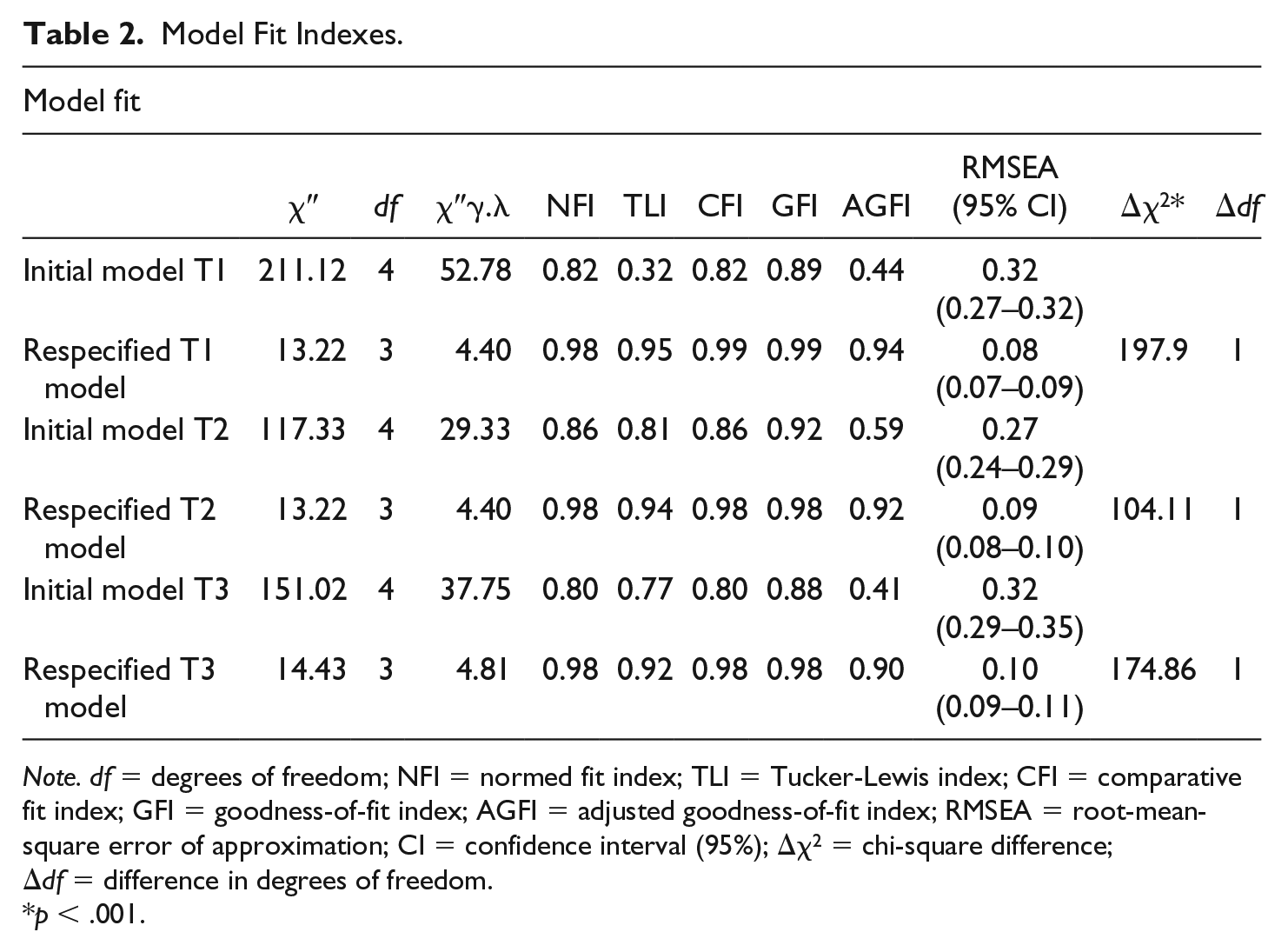
The goodness of fit of the model was verified separately for the groups (T1, T2, and T3). The GFI for the structural model proposed in T1, T2, and T3 are presented in Table 2.
Model Fit Indexes.
Note. df = degrees of freedom; NFI = normed fit index; TLI = Tucker-Lewis index; CFI = comparative fit index; GFI = goodness-of-fit index; AGFI = adjusted goodness-of-fit index; RMSEA = root-mean-square error of approximation; CI = confidence interval (95%); Δχ2 = chi-square difference;Δdf = difference in degrees of freedom.
p < .001.
In principle, the model was tested according to Figure 1. However, the goodness of fit was not considered satisfactory. Based on suggestions by the AMOS software, the relations of correlation between the factors component of the scales were included, generating respecified models. Based on data presented in Table 2, we found that the respecified model has proper goodness of fit in T1 [χ2(3) = 13.22, ns; χ2/df = 4.40; NFI = 0.98, TLI = 0.95, CFI = 0.99, GFI = 0.99, AGFI = 0.94, RMSEA (CI) = 0.08 (0.07-0.09), ns], T2 [χ2(3) = 13.22, ns; χ2/df = 4.40; NFI = 0.98, TLI = 0.94, CFI = 0.98, GFI = 0.98, AGFI = 0.92, RMSEA (CI) = 0.09 (0.07-0.09), ns], and T3 [χ2(3) = 14.43, ns; χ2/df = 4.82, NFI = 0.98, TLI = 0.92, CFI = 0.98, GFI = 0.98, AGFI = 0.90, RMSEA (CI) = 0.10 (0.09-0.10), p < .05].
The first hypothesis was supported by indicators showing that planning of organizational changes is positively associated with well-being in T1 (β = 0.62, p < .001), T2 (β = 0.63, p < .001), and T3 (β = 0.56, p < .001). This means that planning the organizational change affects the employee’s well-being throughout the process of implementing changes.
The second hypothesis was rejected. The degree of risk and uncertainty of organizational changes is not negatively associated with the well-being of individuals. The relation presents weak and nonsignificant effect in T1 (β = 0.005, ns), T2 (β = 0.02, ns), and T3 (β = 0.06, ns). According to these results the degree of risk and uncertainty entailed by organizational change will not necessarily affect the employee’s well-being throughout the process being investigated.
The third hypothesis was partially supported. Well-being is positively associated with the attitude of acceptance in T1 (β = 0.42, p < .001), T2 (β = 0.50, p < .001), and T3 (β = 0.46, p < .001). Well-being is negatively associated with attitude of skepticism in T1 (β = −0.36, p < .001), T2 (β = −0.19, p < .05), and T3 (β = −0.31, p < .001). However, it is not negatively associated with attitude of fear in T1 (β = 0.18,p < .001), T2 (β = 0.11, p < .05), and T3 (β = 0.27, p < .001). This result suggests that employees’ well-being is affected by the attitudes of acceptance and skepticism throughout the process, and the attitudes of acceptance present an effect of greater magnitude than the attitudes of skepticism. However, the fact that individuals perceive the change process with fear does not negatively affect their well-being at work. In the results found, this relation is a weak positive relation.
The fourth hypothesis was partially supported. Change planning positively predicts the attitude of acceptance with high and significant effect in T1 (β = −0.72, p < .001), T2 (β = 0.75, p < .05), and T3 (β = 0.69, p < .001). Attitudes of skepticism are negatively predicted by change planning in T1 (β = −0.38, p < .001), T2 (β = −0.32, p < .001), and T3 (β = −0.18, p < .001). The relation between the variables fear and planning has weak and significant effect only in T1 (β = −0.14, p = .001). These data recall the fact that attitudes of fear are only affected by the lack of planning perceived early in the process of change, while the attitudes of skepticism and acceptance are affected by planning in different phases during the research.
The fifth hypothesis of the study was partially supported. Risk of change positively predicts the attitudes of fear in T1 (β = 0.49, p < .001), T2 (β = 0.46, p < .05), and T3 (β = 0.51, p < .001). Risk of change positively predicts the attitudes of skepticism in T1 (β = 0.34, p < .001), T2 (β = 0.35, p < .05), and T3 (β = 0.38, p < .001). However, the risk of change presents weak and negative effect, significantly predicting the attitude of acceptance of organizational change only in T2 (β = −0.13, p < .05) and T3 (β = −0.11, p < .05).
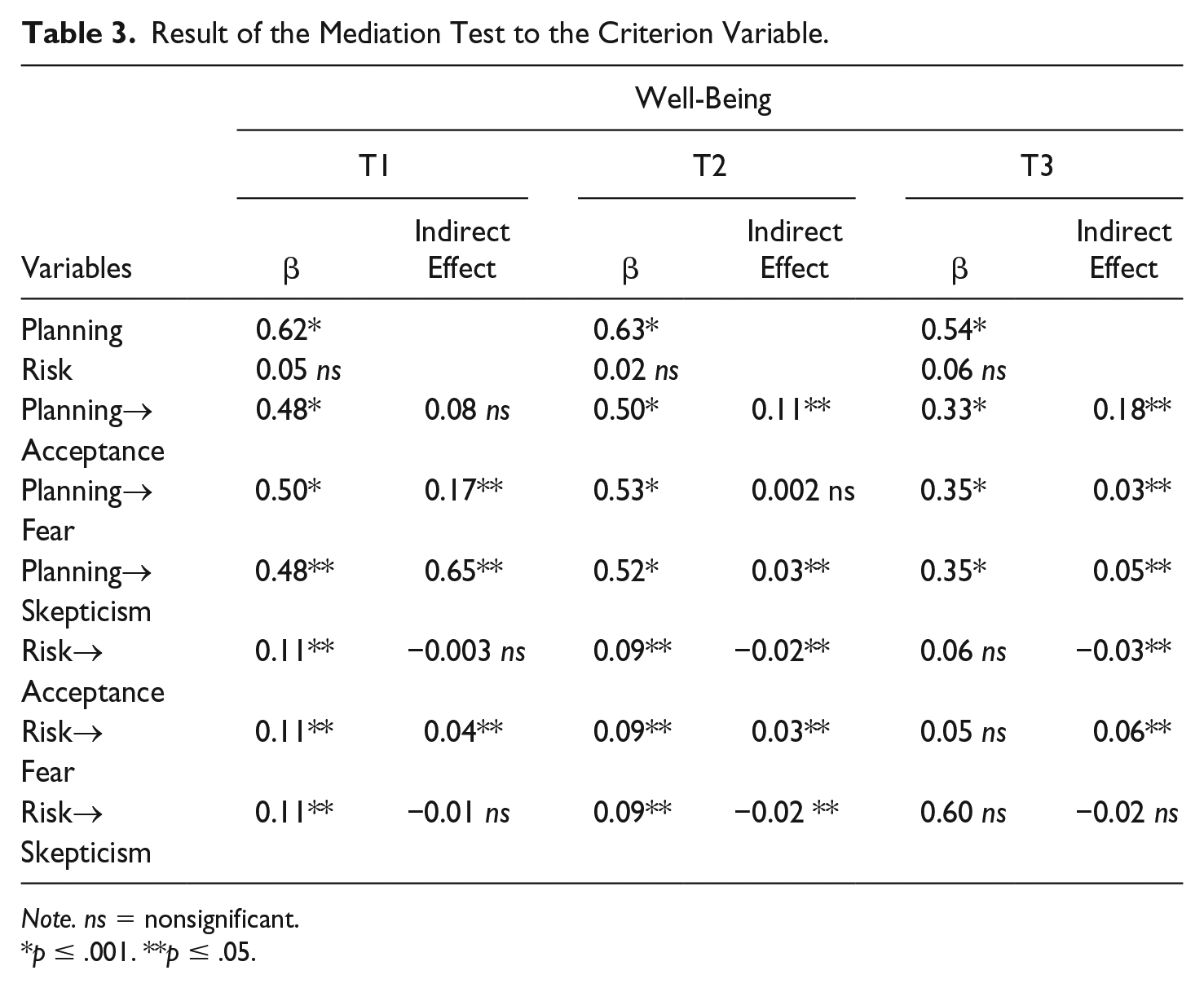
The sixth hypothesis predicts that attitudes toward organizational change mediate the relation between attributes of change (planning and risk) and well-being. The literature affirms that when the mediating variable is included in the regression equation, the impact of the independent variable on the dependent one is reduced or neutralized (Tabachnick & Fidell, 2013). Table 3 shows the results of the mediation analyses.
Result of the Mediation Test to the Criterion Variable.
Note. ns = nonsignificant.
p ≤ .001. **p ≤ .05.
The results of the test of mediation of attitudes toward organizational change regarding the variable of well-being weakly support the hypothesis that the attitude of skepticism mediates the relation between planning and well-being in the three data collection phases—that is, T1, T2, and T3.
The seventh hypothesis predicts that time moderates the relations; as such, planning and risk decrease their influence on well-being over time. To compare the model in the three groups (T1, T2, and T3), the index of change of chi-square, or Δχ2(Δdf), was used. Alteration value was not significant, indicating that there was no moderating effect of time.
Discussion and Conclusions
The findings of this study indicate that the investigation model had good fit indexes in T1, T2, and T3. However, the hypotheses were partially supported, since the attribute of risk of change does not negatively predict well-being. This finding is striking and does not support most research in the field that affirm that risk of change influences diseasing, absenteeism, and well-being of individuals (Devos et al., 2007; Rafferty & Griffin, 2006; Rafferty & Restubog, 2010; Robbins, Ford, & Tetrick, 2012; Spreitzer & Mishra, 2000). Surveys show that individuals typically evaluate organizational changes in a negative way, as damage or threat (Fugate et al., 2008). In this case presented here, relative certainty or difficulty of a situation has become “instructions for action” (George & Jones, 2001, p. 427), but these actions usually have taken on the form of coping (Fugate et al., 2011) that have helped employees feel capable of dealing with stressors and challenges associated with change. Moreover, they must have used alternative paths defined (i.e., hope, resilience) when they found obstacles and made optimistic attributions when things went wrong, having a positive perspective of the future. These joint affects consist in the individual well-being at work and in organizations, according to Seligman (Avey et al., 2008).
This may result in a bias in this sample and may be due to the fact that the research was carried out in a public corporation where employees enjoy apparent stability and, thus, do not assimilate the threats of changes implemented in the organization. A comparative study about the perception of changes among managers in the United Kingdom and Australia identified that organizational change is less effective in the public sector than in the private one in both countries (Lindorff et al., 2011). In light of these findings, we suggest investigating the relation proposed in this article in private organizations to verify the generalization of results. It is worth highlighting that results herein indicated the relation of prediction of attribute of risk of change with attitudes toward changes. This corroborates the findings that uncertainty and risk contribute to the formation of negative cognitions and feelings throughout the process of organizational change (Fugate et al., 2008; Fugate et al., 2012; Kiefer, 2005) but not necessarily result in discomfort in relation to the work and the organization. These data may be indicative of the fact that in the process of coping, individuals resort to internal resources to keep their well-being, despite risk, as suggested by Avey et al. (2008).
The attribute of planning organizational change has a strong relation with the attitude of acceptance. This finding supports other studies (Bouckenooghe, 2010; Devos et al., 2007; Kalimo et al., 2003; Nery, Neiva, & Mendonça, 2016; Rafferty & Griffin, 2006). It is relevant because the individuals’ perception about planning and preparation of organizational changes may interfere with the individuals’ positive evaluation of the interventions and proposals presented by the organization. Planning contributes to acceptance insofar as it shows a path and logic of action. Acceptance can foster other feelings (i.e., hope, resilience) that make optimistic attributions when things go wrong, generating a positive perspective for the future (Avey et al., 2008).
In general, the three dimensions of attitudes toward change seem to mediate (although partially) the relation between planning and well-being. These results are in line with the specialized literature and reinforce the findings of studies carried out by Nery, Neiva, and Mendonça (2016), suggesting the importance of perception about planning as an attribute of organizational change in the formation of individuals’ attitudes toward change. It suggests that the organization’s preparedness denotes to employees that the organization has the capacity to implement the initiatives of change (Robbins et al., 2012).
To confirm the mediation model found by the modeling of structural equations, the indirect effects were verified as instructed by Preacher and Selig (2012). An amazing fact was that some relations confirmed the mediation criteria proposed by Baron and Kenny (1986) but were rebutted by the adoption of indirect effects and its degree of significance. This may result from the bootstrapping that uses the sample, pointing some bias in the present sample.
Although Kim et al. (2011) have found evidence of the moderating effect of time, the results achieved with this sample did not. The effects of both planning for change and the perceived risk level were not moderated by time. The results of this study do not support the idea of gradual shifts and discontinuous information processing in employee’s cognitive models. On the contrary, it is possible to conclude that such perceptions have been confirmed over time. This finding may be due to the time span of the data collection, which may not have been adequate to identify the effect, or due to the type of organization researched—public enterprise. Typically, in Brazil, public organizations do not experience a great deal of change partially due to the high level of institutionalization of public policies in the country. Thus, new studies are recommended to investigate the effect of time on private organizations or other productive sectors. Surprisingly, we found very low correlations among same measures at T1, T2, and T3. It could be a strange set of findings, but we should consider that the respondents in all the three samples are not the same. We had attrition during the data collection phases, which could reduce correlations between the same measures. Furthermore, time could change these measures considering the many interventions the organization has undergone throughout. To evaluate the validity in longitudinal studies, the procedures indicated by Taris (2007) were performed.
This study contributes with the literature, first, by investigating the role of time in gradual shifts of employee’s cognitive models of their individual-organization relationships, which is progressively approached in the academic studies (George & Jones, 2001; Lee & Liebenau, 1999; Sonnentag, 2012). Second, it contributes to organization change theory by investigating attributes of change that, albeit frequently reported as relevant, remain neglected by many studies.
Regarding methodological improvements, this study made the three data collections with the same participants in a context of organizational changes. Despite the setbacks during the research (the impossibility of collecting data with the same time interval), research objectives have been achieved, and some surprising results can foster many other studies. Moreover, as our findings suggest, we expect these individual–work–organization interactions to change with time, and fear does not influence well-being during all organization change process. Maybe in some circumstances this influence will happen. This major finding from this study is an important area for future research.
Alternative explanations, particularly regarding the nonobserved moderating effects of time, need to be taken into account. First, how time sensitive are the constructs previously mentioned? Second, how do interventions occur within the time continuum? The mapping of context interventions is crucial to understand how and why these indices did not vary significantly over time. Regarding the perception of the attributes, the changes in the results are directly influenced by interventions, initial stages, and actions carried out in an organizational environment. In this case, a monthly (or daily) monitoring of this context should be necessary for the understanding, and the lead period of the study did not meet this demand. Changes in well-being at work are also very susceptible to the effect of time. Attitudes toward change, in turn, have been shown by studies to be very constant over time because they depend on the previous repertoire of organizational members (Bordia et al., 2011). Considering these aspects, probably the stability of the attitudes may have been important for the nondifference of the results over time.
In addition, low correlations between T1, T2, and T3 measurements may indicate that time has an effect on the intensity of the variables, but the structure of the model did not change (the fit differences were not significant). If the coefficients of relation between the variables are considered, they are relatively different in the three phases. In other words, the intensity of relations may vary but not enough to significantly affect the entire structure of relationships.
The large-scale organizational changes can only succeed based on the change of thoughts, feelings, and behaviors of the organization members (Smollan, 2015). Therefore, understanding how attitudes influence well-being at work can affect success differentially. This study can provide contribution to the personnel management area to think on elaborated actions. Suggestions are planning strategic action oriented to organizational change, planning internal events to disseminate the stages of the process of changes, and improving communication and transparency of the processes of change, fostering positive attitudes and promoting engagement with the proposed process of change. The negative attitudes, in turn, could be minimized with programs on quality of life and well-being during the implementation of changes, to reduce the negative impacts on the employees’ well-being. The negative aspects of organizational change assessment can be minimized if employees are informed and coping strategies are triggered. Thus, well-being will not suffer deleterious effects. According to the literature and results, when resistance is well managed, it tends to facilitate the process of change. Otherwise, it could lead to unbearable anguish and discomfort (Bordia et al., 2011).
Limitations
While the response rate was better than other studies (Laurie, 2008), there is the possibility that our results are affected by nonresponse bias. We tested for nonresponse bias and found no evidence of it, but we cannot completely rule out the possibility. We speculate that if nonresponse bias did exist and if we were able to collect data from nonrespondents, our results would have been stronger or more pronounced. Other limitation is about variance of common method. To test the influence of variance of common method, a model of one factor that did not present an acceptable fit was used (NFI = 0.46, CFI = 0.39, and NNFI = 0.49). The single-factor model is used to assess whether there is any effect of the common method variance (Podsakoff, MacKenzie, Lee, & Podsakoff, 2003). When there is no adjustment in this model, we conclude that the variance of the common method does not explain the results found.
Footnotes
Declaration of Conflicting Interests
The author(s) declared no potential conflicts of interest with respect to the research, authorship, and/or publication of this article.
Funding
The author(s) received no financial support for the research, authorship, and/or publication of this article.