




Abstract
The purpose of this study is to consider how process consultants can effectively manage challenges both within and across cultures. This study investigates the multidimensional aspects of process consultation for workgroups that consist of diverse individuals in postmodern organizations. A proposed conceptual framework is developed to include factors that are useful for process consultants to consider when working in multicultural contexts. The micro-multicultural framework integrates the cultural mosaic with Schein’s ORJI (Observation, Reaction, Judgment, and Intervention) cycle. The framework represents the multidimensional aspects of cultural identities and explores verbal and nonverbal communication patterns during process consultation. A checklist for micro-multicultural process consultation is also proposed to demonstrate how a process consultant can perform his or her primary role comprehensively while considering process consultation as group-level phenomena.
Introduction
The rapid pace of globalization has meant that process consultants have more opportunities to work with clients who come from multicultural backgrounds (Jaeger, 1986; Nyberg & Jensen, 2009). If process consultants do not take into consideration the role of cultural diversity in the workplace or acknowledge the importance of diversity in their consulting praxis, conflicts that might have otherwise been avoided will undoubtedly emerge. The way in which individuals communicate within and across cultures is a critical factor in establishing more effective process consultation.
The existing model of process consultation is unlikely to take into account cultural diversity or the sociocultural dynamics of diverse workgroups (Jaeger, 1986), and, like other organization development (OD) concepts, these models are grounded in a Western cultural context. This cultural underpinning presumes the importance of employee empowerment for democratic decision making, as well as the mutual reliance and accountability of employees and managers (Cooke, 1998). Consequently, process consultation is likely to be more effective among organizations that share similar cultural backgrounds, where social interactions tend to be more democratic and participatory (Jaeger, 1986; Schein, 1999).
Multicultural OD research has concentrated on identifying indigenous, culture-specific work attitudes and behaviors (e.g., Nyberg & Jensen, 2009). Some previous studies have identified practical considerations that are being adopted in multicultural OD interventions but are based on macro-frameworks, such as Hofstede’s cultural dimensions (e.g., power distance, individualism/collectivism; Khewsomboon, Tayko, & Mullin, 2017; McKnight, 2012). However, this macro-level approach circumscribes the essential aspects of process consultation that emphasizes the micro-relational practice in a multicultural organizational context (Lee & Kramer, 2016; Leung, Bhagat, Buchan, Erez, & Gibson, 2005).
Due to a growing international trade and global migration, the world has attained an unprecedented level of interconnectedness, and the diversity of the workforce reflects the extent to which most countries have become more culturally heterogeneous. Naturally, there may be a large discrepancy between an individual’s classification according to their ascribed national cultural dimension and the individual’s actual internalized cultural values (Zolfaghari, Möllering, Clark, & Dietz, 2016). A macro-level approach may only provide a superficial understanding of the essential components of culture, such as shared values, beliefs, and norms. In the worst-case scenario, this broad approach may result in a subconscious reliance on stereotypes and generalizations distorting each dimension (Kitayama, 2002).
Given these limitations, multicultural OD research is necessary to move toward a new research stream, one that involves examining novel approaches to micro-multicultural models of process consultation. This study investigates the multidimensional aspects of cultural identities based on Chao and Moon’s (2005) cultural mosaic framework and explores verbal and nonverbal communication patterns during process consultation.
Overview of Process Consultation
He had been operating with his clients entirely from a doctor-patient model. He felt he had made careful diagnoses and given sound recommendations and, therefore, could not understand how these carefully thought-out diagnoses and recommendations could be so quickly dismissed (Schein, 1999, p. 50).
Schein (1999) first introduced a model of process consultation that emphasizes the “helping relationship” between a consultant and his or her client. Schein’s model proposes that the client should take ownership of the problem-solving process, while the consultant facilitates a jointly driven inquiry process to identify appropriate steps toward achieving the client’s goals. To establish a continuous helping relationship between clients and consultants, process consultation aligns with the core philosophy of OD (Schein, 1999). Rather than adopting a doctor–patient model that depends on a consultant’s diagnostic ability to solve a problem, a process consultant helps clients uncover problems by themselves in order to develop a sense of psychological ownership of the challenges they should confront, and to use their own expertise to resolve issues (Coghlan, 2009; Schein, 1999).
Consultant as Catalyst for Inquiry
Schein’s approach is distinct from the doctor–patient model often used in management consulting, wherein the medical doctor diagnoses an illness based on particular symptoms and then prescribes medication. A consultant who adheres to this model attempts to identify problems in an organization, ascertains which part of the organization may have triggered or caused the problems, and recommends a way to resolve them to improve organizational health. Schein has argued that this approach inevitably produces a low rate of involvement and creates strong resistance toward change. Clients designated as “sick” are less likely to recognize the root causes of their problems and may purposefully create systemic distortions during the diagnostic data-gathering process. Consequently, consultants tend to misunderstand the client’s system and may have difficulties obtaining an accurate picture of the organization’s current condition. Furthermore, clients tend to be passive and wait for recommendations that often do not address the actual problem. They may also become resistant if the diagnosis and the solution do not align with the client’s informal analysis. Moreover, if the client is not directly involved in the diagnosis and does not take full accountability, debates regarding the best solution may arise, and previous failed interventions will be redirected as the fault of the consultant.
Approaching change from a doctor–patient model may impede the implementation and sustainability of change (Schein, 1999). While consultants within the doctor–patient model attempt to provide formal and written evidence based on sophisticated empirical techniques, process consultants focus on taking a clinical inquiry stance to help clients uncover by themselves how the clients’ systems are organized and processed (Bushe & Marshak, 2009; Lambrechts, Bouwen, Grieten, Huybrechts, & Schein, 2011). Those who can best identify their own problem and its possible solutions in terms of dysfunctional group processes are the clients themselves, and yet they may be susceptible to psychological inertia and a reluctance to implement appropriate solutions—even when those solutions would make their processes more effective. Thus, the process consultant needs to guide his or her client in uncovering the problems and the reasons for failure so that solutions may then be implemented; this allows the client to undertake actions that fit the specific work context (Coghlan, 2009).
Process Consultation Competencies
Schein (1999) proposed the ORJI (Observation, Reaction, Judgment, and Intervention) cycle as a process whereby clinical inquirers and researchers observe their experience (O); react emotionally to what has been observed (R); analyze, process, and come to some judgments based on these observations and feelings (J); and intervene in order to make something happen (I). The process consultant is always working with limited information; for this reason, a key factor for success is the process consultant’s skill in absorbing the relevant data and intervening in ways that help clients solve their own problems.
In order to fulfill their role within the ORJI cycle, process consultants need to develop distinctive competencies. Critical skills for process consultants are using body language and nonverbal behavior effectively, listening actively, paraphrasing thoughts and feelings, summarizing thoughts and feelings, observing body language and small group dynamics, applying skillful questions, expressing one’s own ideas and feelings, focusing the group’s attention, directing group thought, and stimulating small group insights (Schein, 1999). These skills are crucial if the consultant is to be effective when observing how a group of people interact, and in selecting the best method to communicate those observations back to the group.
For clients to perceive, understand, and act on issues that occur in their work, the process consultant’s inquiry should be authentic, empathic, diagnostic, and confronting when necessary (Coghlan, 2009; Lambrechts et al., 2011; Schein, 1999). The consultant’s questions can help the client recognize their existing experience and to reflect on their insights and judgments as a technique to identify an appropriate action to obtain the desired results. In other words, the client conducts a self-diagnosis to identify the problem and determine the appropriate intervention with the process consultant as a guide. Every interaction observed by the process consultant generates a tremendous amount of diagnostic data. As Schein (1999) suggested, everything is a source of data, particularly during a change process. Hence, process consultants are encouraged to employ all data to diagnose a situation and to anticipate possible outcomes to ensure they are developing and creating a helping relationship.
Process Consultation in Multicultural Contexts
The critical challenge facing process consultants is the need to develop multicultural competencies to address the group dynamics of highly diverse workforces effectively. Researchers in multicultural studies have typically considered one’s national culture to be a factor that influences personal work behavior (Jaeger, 1986; McKnight, 2012; Yiu & Saner, 2007). In doing so, researchers have sought to deepen the quality of OD interventions by establishing a better understanding of national culture. While there are various perspectives on culture as a system of shared meaning among individuals who have similar social identities, Hofstede’s (2001) cultural dimensions are frequently used to capture cultural differences and commonalities both within and across diverse groups of employees.
The most noted criticism of universal cultural frameworks is the presumed cultural homogeneity and the failure to account for the subcultural groups and intranational phenomena within a nation (McSweeney, 2002; Tung & Verbeke, 2010). According to McSweeney (2002), “nations are not the proper units of analysis as cultures are not necessarily bounded by borders” (as cited in Jones, 2007, p. 5). National cultural dimensions are likewise contested, particularly the assumption of universality and the perpetuation of stereotypes.
Aggregated national-level dimensions may be meaningful for understanding social- and community-level phenomena, but their importance may also be overestimated at the expense of the individual’s unique cultural orientation. For example, many organizations face various challenges due to employees’ multicultural (two or more cultural) identities (Fitzsimmons, 2013). Furthermore, technological advancement has facilitated the expansion of global virtual teams, which frequently include employees who have multiple backgrounds, orientations, and cultural sensitivities at the same time (Connaughton & Shuffler, 2007). The increasing heterogeneity seen in small groups challenges the ethos and intentions of conventionally applied cultural frameworks. These classifications raise particular questions and concerns given the increasingly globalized work environment (Kitayama, 2002) in which process consultation occurs.
The Need for a Micro-Level Relational Approach
OD researchers have highlighted the uses of alternative, micro-level relational approaches to OD interventions (Wasserman, 2015). Bushe and Marshak (2008) suggested organizational discourse, an approach which focuses on establishing a discursive or conversational platform for catalyzing mutual understanding of multiple social identities through day-to-day meaning-making interactions. Bushe (2009) has suggested that in practice, change in an organization takes place when employees acknowledge their various identities, stories, and contexts, as well as realize that they exert both positive and negative influences on the organizational culture. Oliver (2005) identified reflexive consultancy as a way to enable transformational change without silencing, suppressing, or marginalizing the multiple perspectives found within an organization. Jackson and McKergow (2002) also noted the power of words and language to influence mind-sets regarding organizational change and to sustain change efforts.
The growing interests in the micro-level relational approaches also address consultants’ competencies for compassion and their tolerance of contradictions when managing cultural dynamics in diverse modern organizations (Bennett, 2014). For instance, Wasserman (2015) highlighted the importance of an inclusive mind-set when a group seeks to prevent either privileging or marginalizing the voices that may result from cultural differences. An inclusive mind-set requires paying attention to the voices of those who are less likely to speak up due to personal, positional, and cultural backgrounds. In this way, an inclusive mind-set encourages those on the periphery to engage across their own multiple social identities actively. Since the value of this inclusive mind-set rests in the potential benefits that stem from including multiple, marginalized individuals and groups, process consultants should possess an awareness about any various subgroups and be proactive as they seek to uncover the hidden potential in understanding them within multicultural business settings.
Multicultural Process Consultation as Enculturation
From a sociocultural perspective that views learning as a process of enculturation into a community with its own values, norms, beliefs, and jargons (Brown, Collins, & Duguid, 1989; Wenger, 1998), process consultants are likely to communicate in the OD community’s language with its own recognizable semantic patterns and specific ways of meaning making. As such, the learning processes to become a process consultant involves assimilation of the cultural assumptions (e.g., belief system, social norms, principles, rules, and conventions of behavior) accumulated in the process consultants’ community in which Western culture is embedded. Wasserman (2015) argued that members of a dominant culture consider their cultural assumption as “normal” and do not even recognize the possibility of different perspectives. Consider the example of this multicultural ethnographer: The RAs [research assistants] and I began with asking prepared open questions such as “How did the plan go?” “What worked well or didn’t work so well?” “How did it make you feel?” “What experiences did you have when implementing the action plan?” However, we received short answers such as “it was fine,” “no problem,” “it is done, don’t worry.” We struggled to get any additional details of what had transpired in the villages and continued receiving one-word answers rather than the rich discussions that had previously taken place. I couldn’t understand why there was a change in attitude and asked the RAs to re-structure the questions. Although they tried, they also seemed confused and told me they weren’t sure what I wanted. I felt disenchanted and couldn’t understand what was happening. I had used these questions many times in qualitative research workshops/interviews previously and was confused by the short answers I was receiving here. It was not that participants were reluctant to answer questions but seemed unable to provide detailed, opinionated, critical accounts of an experienced situation. This was at odds with my previous experiences as a UK-based researcher. . . . We tried and tested different communication approaches and found a way through this challenge. I would discuss with them what we would like to know more about and they would spend many hours discussing in their own language the best way to support CHWs [community health workers] in providing a richer report of their experiences. (Ozano & Khatri, 2017, p. 7)
Ravlin, Ward, and Thomas (2014) have argued that cultural distance can act as a communication “noise” that distorts messages, which in turn may alter the sender’s intended message, and mislead the receiver’s interpretation of the message. Due to the complexity of interactive communication in a multicultural context, social or relational uncertainty becomes inevitable. Thus, the need to identify and develop useful communication strategies becomes imperative.
In a multicultural context, a deliberate “enculturation” effort for an OD intervention is necessary to achieve the desired change. In the research of a United States–India biotechnology strategic alliance, using a follow-up assessment after 6 years, Miller, Fitzgerald, Murrell, Preston, and Ambekar (2005) concluded that appreciative inquiry (AI), a strength-based approach to organizational change, did not show continued efficacy over time. In hindsight, the authors pinpointed that, in this case, the AI intervention was not sufficiently modified and recontextualized to include differences in cultural values between the two multicultural organizations. Marquardt, Berger, and Loan (2004) has highlighted the usefulness of multicultural adaptation, and the implementation of multicultural training interventions across cultural boundaries, to ensure that these interventions succeed within the clients’ cultural milieu. First, process consultants need to identify the relevant cultural factors and its impact on the group; then they should synergistically intertwine the cultural variability through the entire intervention process including the design, development, and delivery. By understanding multicultural differences, an enculturated intervention attempts to minimize the roadblocks of facilitation while recognizing the client’s unique experience as they are guided to achieve the objectives of the OD intervention.
A Micro-Multicultural Framework of Process Consultation
The proposed micro-multicultural framework for process consultation includes multiple cultural identities as well as verbal and nonverbal cues as significant data that can be gathered during process consultation. This multidimensional framework synthesizes existing literature and proposes factors that are useful for process consultants to consider when working in a multicultural context.
Such a framework contributes to both theory and practice. In fact, multicultural dynamics in the practice of OD have been a longstanding concern. Several case studies investigated the experience of OD consultants employed in a multicultural setting (Miller et al., 2005; Nyberg & Jensen, 2009). The specific challenges found in multicultural OD practices have been explored based on the entity view, which sees culture as a static entity that exists “in the head” (Kitayama, 2002). The entity view assumes that a certain group is defined as an independent cultural entity that can cause behaviors in people who are within these groups. In contrast, our proposed framework is a system view and adds an approach which takes a growing body of cultural dimensions into consideration: dimensions which capture multicultural phenomena that can be dynamically manifested in a given social context through verbal/nonverbal communications (Chao & Moon, 2005). Our investigation attempts to provide a comprehensive framework to disentangle dynamic interactive patterns between process consultants and their clients. Furthermore, it can be used as a critical behavioral model to develop process consultants, particularly those engaged in a multicultural setting (Figure 1).

A micro-multicultural framework of process consultation.
The Cultural Mosaic
Recent multicultural studies have viewed culture as a construct that comprises of multiple facets (e.g., Fitzsimmons, 2013). Multiculturalism as a philosophy or as a policy that values cultural diversity and respects the unique contribution of each individual to society. Moreover, Roccas and Brewer (2002) have theorized the concept of social identity complexity, which considers multiple identities of an individual to determine their behavior in dynamic group processes. For example, using the concept of intersectionality, the researchers describe a female lawyer who defines her primary identity through a combination of gender and profession. A unidimensional identity provides her with a membership to the law firm when she is categorized as a lawyer, but the identity of her gender creates a multidimensional subgroup affiliating her to other female lawyers. An individual will probably consider their cultural membership, or the combination thereof when determining the appropriate behavior in a given situation. Thus, in order to understand the behavior of different individuals in a multicultural setting, it is necessary to conceptualize the complexity of cultural membership as it is defined and manifested by multiple layers.
Chao and Moon (2005) have introduced a “mosaic” framework to depict the multidimensionality of culture. This framework refers to a composite picture (mosaic) that includes distinctive cultural memberships (tiles). In contrast to the macro approach that identifies an individual as a member of a dominant cultural group, the mosaic framework adopts a bottom-up orientation toward “flexible” cultural identities, seeing each individual as a distinct unit of analysis (Zolfaghari et al., 2016). Chao and Moon (2005) suggested three categories of tiles for this figurative cultural mosaic: (a) demographics, (b) geographic, and (c) associative. Demographic tiles include physical and innate attributes such as age, gender, race, and ethnicity. Geographic tiles focus on an individual’s origins, such as his or her nationality, that nation’s meteorological climate, and urban/rural or coastal/inland divides. Finally, associative tiles consist of social groups such as family, religion, profession, employer, hobbies, and political affiliations.
In the study of employees in multinational companies, Zolfaghari et al. (2016) have found that cultural identity is influenced by attributes from multiple dimensions. The researchers concluded that family and organization cultural tiles, for example, often influence an employee’s behaviors and habits more than their nationality or religion. This does not mean that family and organization cultural tiles are more important than other tiles, but rather that macro-level cultural orientations may be cancelled out or be diminished in their influence among other critical cultural factors in the multicultural workplace setting.
The mosaic approach thus provides a more nuanced understanding of how multiple factors influence individuals’ cultural identities in a given social setting (Chao & Moon, 2005). The cultural mosaic framework acknowledges that all individuals are codified in terms of race, gender, and class, as well as framed by various given social categorizations, whether they desire to be (Bierema, 2010). Individuals shape their unique cultural identities based on idiosyncrasies and their experience of the world. Developing a cultural mosaic is a systemic approach to recognize common or unique cultural identities among individuals in a multicultural context.
The cultural mosaic not only helps identify intraindividual variability in the construction of cultural identity; it also serves as a transforming self-concept that influences a person’s cultural identity by localizing where he or she stands in relationship with others (Hogg & Terry, 2000). Researchers in industrial–organizational psychology generally assume that a specific work behavior represents a combined function of individual differences and the surrounding workplace situation (e.g., Cronbach, 1957). Situational cues are postulated to impose certain psychological burdens on an individual to either increase or decrease particular behaviors. When cultural norms are violated, and an individual behaves in a way to avoid punishment (or exclusion) from a cultural community they belong to or desire to be a part of (Bandura, 2002; Meyer, Dalal, & Hermida, 2010). An individual’s cultural identity is constructed through this act of integrating conflicting or discordant cultural norms.
Lacking a comprehensive view of group-level phenomena inhibits the process consultant’s efficacy to understand the dynamics of a multicultural work setting. Process consultants need to figure out that the dynamic characteristics of a workgroup as a small number of interdependent individuals having a sense of themselves as a social unit with ongoing interactions and acknowledge the unique characteristics of the individual as an intraindividual identity represented by relatively salient and discrete cultural attributes (McGrath, 1984). In group processes, a person’s cultural mosaic can be transformed in various ways, according to his or her interactions with other people in the given social context by comparing, adjudicating, and choosing among various multiple cultural memberships that guide emotion, motivation, and behaviors (Bierema, 2010; Ramarajan, 2014). This is particularly to be considered when there are conflicting cultural values, and an individual is forced to adjudicate them, either by changing cultural identities or reprioritizing them. An individual who internalizes more than one cultural identity can activate certain cultural tiles as a “code-switching” behavior that facilitates his or her adaptation to a social context (Fitzsimmons, 2013; Molinsky, 2007). Therefore, the cultural mosaic is fluid and dynamic, and the shape of the cultural mosaic can shift on its own, or be shifted under the weight of various outside forces. In the illustration in Figure 2, we represent the geographic category as weaker (or smaller). When the demographic and associative categories are paired, they influence behavior more strongly than an isolated demographic that is qualified to as the dominant cultural identity.
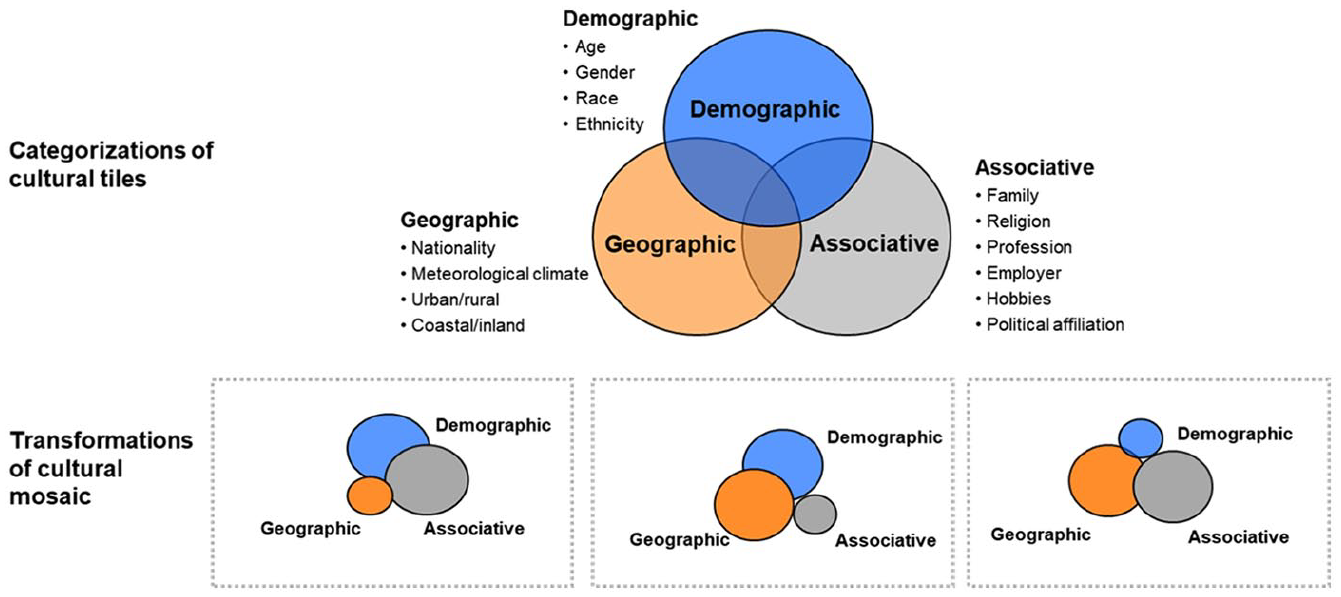
Transformations of cultural mosaic.
The main concern for process consultants is the inability to accurately predict and consider cultural identity in its entirety (Burke & Stets, 2009). For example, using gender and profession as previously discussed, research shows that women experience gender identity threats within the structures of masculinity that are embedded in most organizations (Ely, 1995). Women are not only expected to accept the feminine stereotype but to also embrace the masculine ones. In this case, a person’s gender identity can be a salient focal identity; or, it can be suppressed by choosing a professional (or organizational) identity. Furthermore, in a triad situation, when gender, profession, and nationality interact together, and the consideration of all these cultural identities becomes more challenging. This is because consciously capturing one’s own multiplicity and dynamic identity as they are positioned within these multiple categories is almost impossible (Ramarajan, 2014).
This complexity allows process consultants to consider the skills for effective process consultation in dysfunctional multicultural group processes. They do not necessarily have to thoroughly understand the key elements of unknown cultures or possess sophisticated knowledge of specific cultural customs or mores in order to be sensitized toward all multicultural group members. Rather, the dynamic nature of the cultural mosaic sheds light on the importance of inclusive processes by revisiting the notion of dialogue, active listening, reflective conversation, body language, tone of voice, and emotional content as assimilation processes which are central to all efforts that will lead toward positive change (Schein, 1999; Wasserman, 2015). The cultural mosaic affords myriad opportunities to process consultants and their clients to communicate their cultural values both verbally and nonverbally; this communication manifests individuals’ views of themselves and others and ultimately can be a resource to facilitate a data-driven process consultation (Stets & Harrod, 2004).
Verbal and Nonverbal Communication as Data in Multicultural Process Consultation
Process consultation depends on the consultant and the group’s capacity to become aware of—and derive meaning from—verbal and nonverbal behaviors. In particular, observation is one of the key skills needed to be an effective process consultant, and several critical aspects of small group dynamics merit the process consultant’s special attention (Schein, 1999).
Content and process: What the group is talking about and what the group is doing in the here-and-now.
Communication: How the group members communicate with one another (e.g., Who talks after whom? Who interrupts others? How is body language being used in the small-group discussion? Who talks? For how long? How often? Who looks at whom when they talk? Who supports what a speaker says?).
Decision-making procedures: How group members make decisions (e.g., How are group decisions made? How much consensus appears to exist about decisions that are made? Who within the group most actively takes the lead?).
Task or maintenance behavior versus self-oriented behavior: Task behavior—behavior linked to carrying out the group’s work. Maintenance behavior—behavior linked to helping everyone get along. Self-oriented behavior—behavior linked to achieving personal goals.
Emotional issues: Forces that disturb groups and disrupts their progress (e.g., power, control, and influence; intimacy; goals and needs).
Schein (1999) has argued that the observation of verbal behaviors (e.g., frequency and duration of communication) and nonverbal behaviors (e.g., body posture, facial expressions, and gestures) provides clues about what is occurring beneath the surface for the group. During process consultation, a group of people, including the process consultant, continuously exchanges cognitive and emotional messages via verbal and nonverbal behaviors, which take place concurrently and remain closely intertwined.
Nonverbal Communication in Process Consultation
Nonverbal behaviors repeat, substitute, complement, accent, or contradict verbal behaviors (Bonaccio, O’Reilly, O’Sullivan, & Chiocchio, 2016). Examples of nonverbal behaviors include facial expressions, attire, touch, odor, personal space, voice, gestures, eye contact, talk time, and posture. Schein (1999) has argued that kinesics—communication via body movement—are to be carefully observed during process consultation in order to identify people’s feelings. To increase trust and openness in interpersonal and group interactions, learning to understand and gauge meanings and feelings used by others is critical. Nonverbal cues are a significant source of information in building positive relationships with clients and identifying the attitudes and emotional states of people in a group.
Nonverbal cues, however, can also be a source of misunderstanding. Nonverbal behaviors are learned within an individual’s particular culture (Bonaccio et al., 2016). Some nonverbal behaviors that express basic emotions such as happiness or sadness are universal, but others produce different meanings in different cultural contexts (Jack, Caldara, & Schyns, 2012; Knapp, Hall, & Horgan, 2013; Sue, 1990; Sue & Sue, 1977). For instance, White Americans tend to look at the person who is speaking about 80% of the time (Sue, 1990). In contrast, in Mexico, among some Native American and indigenous peoples, and in Japan, people avoid eye contact as a way of showing respect to the person who is speaking (Burgoon, Guerrero, & Floyd, 2016; Sue, 1990). Since nonverbal behaviors produce symbolic meanings that are attached to valued, cultural attributes, any differences across cultures add complexity to multicultural interactions and often result in miscommunication (Matsumoto et al., 2013).
All people have unique personal, political, and historical cultures (Arredondo et al., 1996; Collins & Arthur, 2007), and their nonverbal behaviors are affected by these various factors. In this regard, all process consultation is multicultural: When a group of people comes together, the interactions among the individuals result in an additional layer of uniqueness (Burgoon et al., 2016). Since nonverbal behaviors and cues do not have “fixed, dictionary-like meanings” (Hall, Carter, & Horgan, 2000, p. 97), careful observation of these behaviors using a micro-level approach is necessary to ensure the correct interpretation.
Careful observation and accurate interpretation necessitate the awareness of one’s cultural values and biases (Arredondo et al., 1996; Golembiewski, 2000). Hess, Blaison, and Kafetsios (2016) found that, when a facial expression is shown, cultural decoding rules are different in social context by country. Knowing one’s values and biases helps an individual understand how he or she interprets the nonverbal behaviors of others to prevent any misunderstanding. In a similar vein, the comprehension and knowledge about individuals’ cultural backgrounds are helpful for process consultants to grasp the meanings behind nonverbal behaviors better, and thus are able to provide appropriate feedback (Burgoon et al., 2016). Exchanging appropriate nonverbal behaviors deepens rapport and trust between the consultant and client, and the correct interpretation of nonverbal behaviors increases the effectiveness of process consultation.
Verbal Communication in Process Consultation
Verbal language is a basic means of communication through which much information is delivered (Vaara, Tienari, Piekkari, & Säntti, 2005). People express their needs, ideas, and opinions by talking to one another. Process consultants build relationships with their clients and understand the clients’ situations by listening to conversations, asking questions, and providing feedback. In this regard, language diversity is a critical factor in multicultural group interaction because language differences affect trust formation among people (Tenzer, Pudelko, & Harzing, 2014), as well as power balance (Marschan-Piekkari, Welch, & Welch, 1999) and the quality of communication (Merkin, Taras, & Steel, 2014).
Since employees in a globalized workforce come from various cultural backgrounds, the languages that are used during process consultation have become increasingly diverse. This language diversity can be conceptualized as either intralingual or interlingual (Tenzer et al., 2014). In the case of intralingual diversity, people in a team speak the same first language, but they use different accents (e.g., U.S., British, and Australian accents; Chen, Geluykens, & Choi, 2006), regional dialects (e.g., Mandarin and Cantonese; Tenzer et al., 2014), or professional jargon or terminology (e.g., legal, medical, accounting, and military terms; Brannen & Doz, 2012). These variances in intralanguage communication can cause misunderstandings and hinder effective interactions among team members and the process consultant. Chen et al. (2006) argued that a strong accent potentially causes difficulties and barriers to lucid communication, and irritates listeners who are not familiar with the accent.
In the case of interlingual diversity, people in a team speak different “first” national languages but work in a shared language. When individuals’ mother tongues are different, the variance creates more complex communication barriers—even when all of the individuals speak English as a common language within the group. When a person’s first language is not English, his or her communication may be more ambiguous due to only being able to articulate thoughts using short sentences and having less grammatical precision than that of a native speaker (Sue & Sue, 1977). This kind of language barrier also creates significant misunderstandings, as the meaning of a statement may be changed, or relevant information may be dropped given the loss of nuance or precision in articulating ideas.
Moreover, different languages have different conceptual schemes. Team members who have different linguistic backgrounds are likely to have different understandings of the same sentence, or even a word (Chen et al., 2006). Since languages reflect different cultural systems, people in diverse groups will inevitably have different communication styles. People from a culture that values avoiding confrontation, for instance, may refrain from saying no and only share their opinions indirectly. In some cultures, young people or people in junior positions are not supposed to interrupt others, particularly while older people or people in more senior positions are talking (Sue, 1990). They may remain silent in a meeting; not because they are negative or uncooperative, but because their cultural norms compel them to do so (Sue & Sue, 1977).
Many researchers have studied how interlingual-level diversity affects individuals’ work (Russo, Islam, & Koyuncu, 2017) and team interactions (e.g., Chen et al., 2006; von Glinow, Shapiro, & Brett, 2004; Ochieng & Price, 2010; Tenzer et al., 2014). At the individual level, Russo et al. (2017) found that a person who speaks with a nonnative accent often feels excluded and devalued at work. Managers tended to lower their expectations for nonnative speakers and adopt more controlling leadership styles when working with them. Researchers have also found that language barriers negatively influence both trust formation (Tenzer et al., 2014) and social interactions within a team (Russo et al., 2017). Tenzer et al. (2014) argued that language is a crucial antecedent for trust formation in multinational teams. This is because team members attribute colleagues’ low task competence and low dependability to language barriers. They also found that team communication in a foreign language creates anxiety, especially among those members who have insufficient command of the language, and that this anxiety weakens the intentions of members to trust other members.
During process consultation, people continuously exchange ideas and make decisions via verbal communication. A process consultant needs to be aware of how language differences affect multicultural group interactions. Even though the people in a given group may use a common language while interacting with one another, language proficiency and other cultural factors affect overall communication quality, trust formation, and power imbalances. Relatedly, the interpretation and influence of the process consultant’s verbal communication on group members should be carefully considered. Knowing about the existence of these influences increases the likelihood of accurate observation and sound judgment.
Discussion
Process consultation is an OD intervention or a philosophical foundation that is grounded in behavioral science aimed to facilitate organizational change (Lambrechts, Grieten, Bouwen, & Corthouts, 2009). Due to multicultural environments of the current workplace, process consultants are required to update the approach to facilitate effective organizational change within a multicultural context. In this study, we proposed a micro-multicultural framework for conducting process consultation that addresses the complexity of cultural identity. This framework is designed to assist process consultants not only with single process consultation practices but also with any OD interventions.
Implications for OD Researchers
This study makes important contributions to existing OD research by filling the theoretical gap in the existing literature on process consultation in a multicultural organizational context (Marshak & Grant, 2008). This study provides a conceptual framework for process consultation, paying particular attention to multicultural settings. The framework is consistent with the process consultation model developed by Schein (1999), which emphasizes the helping relationship between the consultant and the client. Furthermore, the current study is the first to advocate for a new framework that takes into consideration the client’s unique cultural membership and communication cues, which reflects both the surface level, as well as deep levels of cultural identity, allowing for richer and more meaningful information (Harrison, Price, & Bell, 1998).
Firmly established theories and models should be revisited when changes in the environment occur. In particular, if we consider changes that the client undergoes, a different approach may be needed. More and more process consultants are working with multicultural clients—requiring novel approaches and additional knowledge, skills, and abilities. Given that the proposed micro-multicultural framework encourages process consultants to be sensitive to clients’ various cultural memberships and communication cues, future studies can investigate how process consultants can capture and utilize these data more effectively. One way to collect clients’ observable data is to analyze their verbal and nonverbal communication cues through video recordings. Process consultants can obtain significant and accurate information by using recorded video to observe not only clients’ verbalizations but also their facial expressions, body language, and gestures at the individual- and group-level (Kritzer, 1974).
We urge more theoretical and empirical research on OD interventions in multicultural contexts. Several previous studies have identified factors that merit consideration for organizations with multicultural workforces (e.g., Arthur & Stewart, 2001; Connaughton & Shuffler, 2007; Fitzsimmons, 2013; Kim & Markus, 2002; Zolfaghari et al., 2016). Taking into account our proposed micro-multicultural framework for process consultation, future studies should investigate the aspects required for effective multicultural OD interventions. Further research on the success or barriers of OD interventions in non-Western countries could also be conducted since OD principles were developed based on Western culture and does not thoroughly take into account the situational factors, such as cultural variability (Adler, 1983; Jaeger, 1986).
Implications for Process Consultants
Our study offers some important practical implications for process consultants. First, process consultants need to build effective social processes with clients, ultimately aiming for “dialogic OD” (Bushe & Marshak, 2009; Marshak & Bushe, 2013). Derived from social constructionism and postmodern philosophy, dialogic OD focuses on what people think and how they interpret reality. Because this study has emphasized the need for a micro-view of process consultation that acknowledges the client’s multidimensional identity, and the context that influence their lived experience (Bushe, 2009), our proposed framework can be viewed as a parallel approach to dialogic OD, which emphasizes the need to recognize the multicultural variability of individuals and groups.
Second, process consultants require the ability to adjust their common process consultation approaches to accommodate clients’ cultural backgrounds (Marshak, 2014). We believe that process consultants can have a better understanding of the suggested micro-multicultural framework of process consultation through the following case example and checklist:
A leader of Global Talent Development (GTD) team calls the meeting to order. There are six other team members present. The GTD team is newly formed and comprised of employees from diverse cultures such as Indonesia, Japan, Nigeria, Turkey, the United Kingdom, and the United States. The team leader has invited a process consultant named John to help the diverse group members interact with each other more cohesively, harmoniously, and productively.
Before the meeting, John confirms what the leader and team members think their task is. John also identifies not only group members’ personal attributes but also individual cultural backgrounds using the cultural mosaic framework (demographic, geographic, and associative cultural background). John already had individual premeetings with the team members to better investigate the team’s cultural diversity.
At the beginning of the meeting, the team leader introduces John and describes his major role in the meeting as a process consultant. John then introduces himself and confirms his role. After the team members’ self-introductions, the team starts to talk about the topic for the meeting. John starts to observe team members’ verbal communication and nonverbal communication. Using the checklist for micro-multicultural process consultation (see Table 1), John keeps a journal in which he records important details about the verbal and nonverbal cues for the reference points of emotional reaction, judgment, and intervention. John knows it is important to track the group interaction regarding participation, complex interactions, perceived feelings, and conflicts as general observation points of process consultation. He also pays attention to the cultural diversity and socioemotional dynamics of the team because he knows these are important to the team’s effectiveness. For instance, John tries to eliminate the cultural noise factors that distort the intended message. He monitors his own emotional reactions to team members’ communication styles, including their use of idioms, colloquialisms, and jargon in relation to their individual cultural background. He notes emotional reactions of others as well, understanding that his reactions are also culturally influenced.
At the end of the meeting, John reminds the team what his role was. John provides data about how many times, and for how much time, each team member participated in the discussion. He facilitates an exploration of strengths and weaknesses in team interaction using open-ended questions. Furthermore, John capitalizes on the strengths as well as the areas for improvement of the team. At this point, John focuses not on individual cultural differences but on the entire team’s diversity, asking them about ways to improve their interactions. John finishes the session by asking what the team members need so they can improve the next team meeting.
An Example Checklist for Micro-Multicultural Process Consultation.
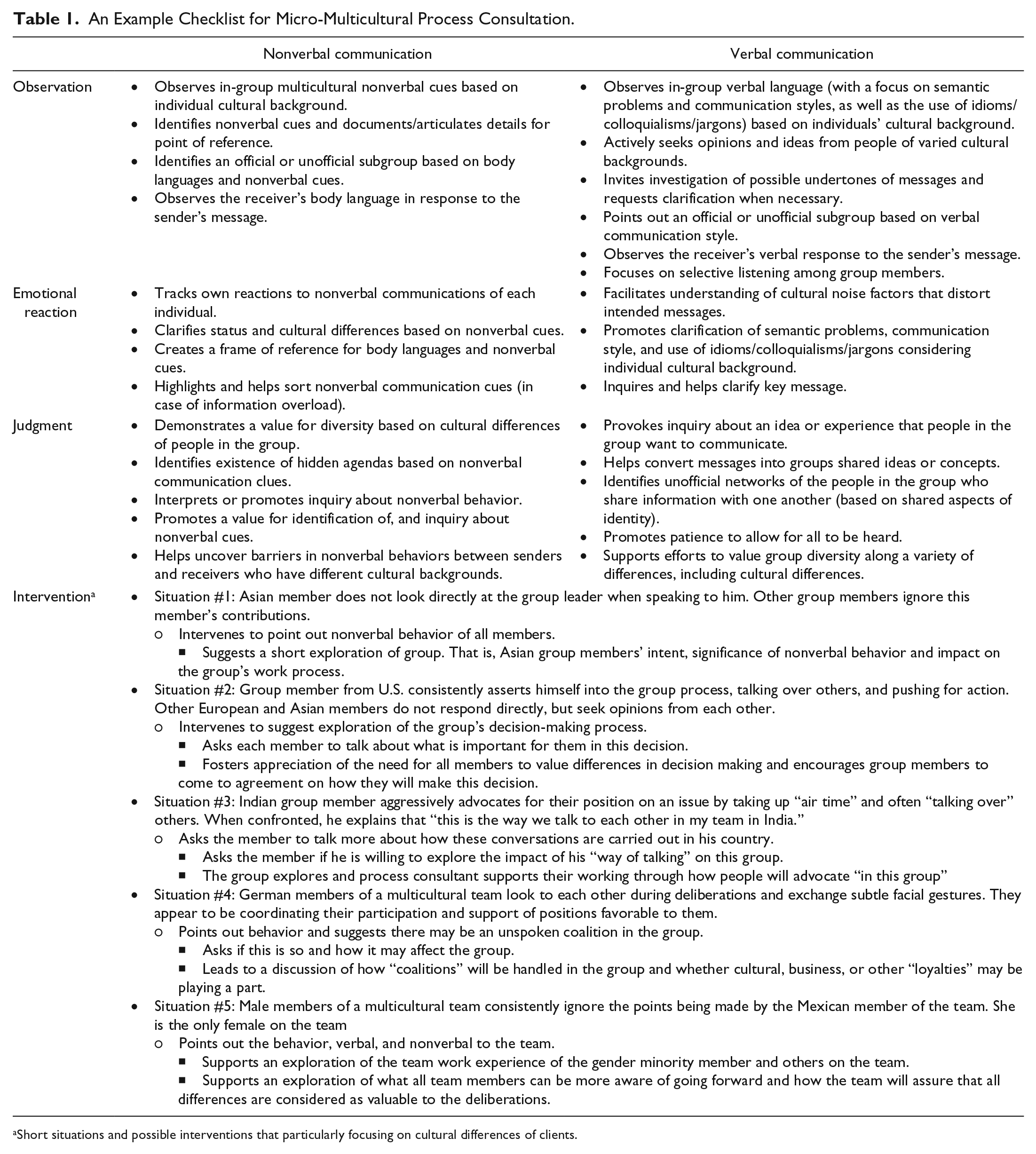
Short situations and possible interventions that particularly focusing on cultural differences of clients.
The case example and checklist demonstrate how a process consultant can perform his or her primary role comprehensively while considering the group-level phenomenon and the complex interactions with and among the workgroups. By using the checklist for micro-multicultural process consultation in Table 1, process consultants can track and record important details about group dynamics as referenced in each ORJI cycle (Schein, 1999).
During the observation/emotional reaction stage, for example, a process consultant can 0observe and document the client’s body language with reference to the entire group’s response to each other and to the message delivered. The process consultation process not only occurs in the cognitive aspects that can illuminate the team’s existing mental model (e.g., sharing information about specific tasks, forming of expectation for the task, coordinating actions to complete the task, and acknowledging the demands of the task) but also in the collective mood, which highlights whose mood can potentially affect others, known as emotional contagion (DeChurch & Mesmer-Magnus, 2010; Totterdell, 2000). During process consultation, the client’s communication cues is an expression of their underlying attitude, often presented directly during the main conversation or in a separate side discussion (Bonaccio et al., 2016). Clients consciously monitor and gauge the others’ verbal/nonverbal cues to position their own attitude, perspective, and commitment on a matter by comparing their feelings with others, and often unconsciously, they will mimic others to synchronize nonverbal behaviors, including facial, vocal, posture, and movement, creating a shared emotional experience (Hsee, Hatfield, & Chemtob, 1992; Totterdell, 2000).
In the judgment/intervention stage, process consultants can use the group-as-a-whole perspective to address cultural noise factors that distort the intended message. The goal is to find critical feedback points about the entire team’s verbal communication style (Burke & Noumair, 2015). Like John, at the end of the meeting, a process consultant should be able to provide the group with some feedback employing a group-as-a-whole perspective (Wells, 1995). A group-as-a-whole perspective explains why an individual may act differently in a group setting then how they act solely as an individual. What is discussed and understood at the individual level can be starkly different from what is discussed and understood within and between groups. Process consultants need to carefully uncover what is the root cause of the problem and recognize the multidimensional and multi-level complexities of organizational systems. Furthermore, process consultants should acknowledge that every intervention inadvertently affects the entire system and can potentially mitigate or aggravate a different problem.
The advantages of this micro-multicultural process are for more clients to be checked in the group process by creating a certain “container” in which multicultural clients can share their view of social reality and enable bottom-up change (Bushe & Marshak, 2009). The recursion between emotional and cognitive dynamics over the ORJI cycle can facilitate deeper awareness and understanding of complicated multicultural social systems and greater action readiness which can be both cognitively and emotionally fueled (Maitlis & Christianson, 2014). For successful facilitation, process consultants should be able to comprehend sociocultural dynamics to ask the right questions, display empathetic emotions, and have an inclusive mind-set. More important, process consultants need a competency for enculturation that modifies their interactions and resonates with their clients (Maitlis & Christianson, 2014; Rouleau, 2005).
In this way, the case example above and checklist for micro-multicultural process consultation can be used as a useful resource for process consultants not only to apply the multicultural framework according to the ORJI cycle but also to consider group dynamics and relations as a group-level intervention.
Implications for Teaching OD
There have been many fluctuations in the popularity of OD (Greiner & Cummings, 2004). Nevertheless, OD plays an important role in shaping organizational change (Rothwell, Stravros, & Sullivan, 2010) and can be strategically critical for organizations if it is linked to “substantive content with social process” (Greiner & Cummings, 2004, p. 389). Globalization is a significant and influential social process, consistently reminding us that social and cultural arrangements are not fixed (Waters, 1995). Therefore, by becoming more sensitive to the needs of multicultural populations and diverse workforces, OD practices can be revitalized (Worley & Feyerherm, 2003). We believe that the teaching of OD needs to keep pace with changes in organizational needs.
We anticipate that our proposed framework will result in greater opportunities for capturing the various facets of clients’ cultural values and expectations, as the framework provides a more comprehensive understanding of client behavior. Within OD training and development programs, this study’s findings may be a useful reference for designing curricula that encourage consultants and students to be more aware of multicultural applicability. We have emphasized the importance of multicultural training for process consultants so that they can recognize their own cultural frameworks and potential blind spots. Process consultants should also be aware of how their biases influence their interactions with the client, aligning with the work of Worley, Rothwell, and Sullivan (2010), who identified self-awareness and self-mastery as essential competencies for OD consultants.
In order to assist OD students in attaining multicultural competence, OD program curricula and the content of OD textbooks need to include more information about multicultural awareness and intercultural communication in OD processes and interventions. As Adler (1983) forecasted, the demand for transnational OD significantly increased between 1980 and 2000, and today multicultural OD is becoming an increasingly important topic in this field (Jones & Brazzel, 2006). In conducting more than 100 interviews with global OD consultants, Yaeger, Sorensen, Tayko, and Gaynor-Butterfield (2010) found that many experienced global OD consultants viewed the importance of geographical boundaries as diminished in multicultural consulting, meaning that global OD consultants today need different competencies. Thus, when multicultural perspectives are incorporated into OD teaching, approaches and interventions become more useful to students and consultants—not only from diverse Western settings but also from non-Western countries where OD is an emerging trend.
Conclusion
The field of OD needs the implementation of a micro-multicultural approach in multicultural organizational contexts. This study contributes to current OD research and literature by suggesting ways that OD can support organizations, which emphasizes the understanding and capturing of individual, cultural perspectives. Our study also offers new competencies that should be expected of process consultants, and which build effective social processes with their clients. Indeed, process consultants need to aim for “dialogic OD” (Bushe & Marshak, 2009; Marshak & Bushe, 2013) to focus on what clients think and how clients interpret their reality. In addition, the content of both OD curricula and textbooks needs to include more information about multicultural OD practices and perspectives to keep pace with the many changes and developments in organizational contexts.
Footnotes
Acknowledgements
This article is the result of process consultation regarding multicultural OD with Dr. Ted Tschudy. We gratefully appreciate his facilitation and continued enthusiasm over the years. We are also indebted to Dr. Kristine Quade, who led 2016 NTL graduate student learning community. Without her support, this article would not have become a reality.
Declaration of Conflicting Interests
The author(s) declared no potential conflicts of interest with respect to the research, authorship, and/or publication of this article.
Funding
The author(s) received no financial support for the research, authorship, and/or publication of this article.
