



Abstract
Despite a call within scientific literature to better account for contextual factors in team studies, very little research has systematically analyzed the potentially critical role of such factors, thus limiting organizations’ ability to provide contextual conditions that would foster team effectiveness. The Supportive Organizational Context for Teams (SOCT) construct effectively captures some of these factors (rewards, information, education, and resource allocation). However, while the internal consistency of the SOCT has been analyzed, its multidimensional representation has never been tested. In this study, we address these limitations by assessing the factor structure of a measure proposed by Wageman et al. (2005) and of its distinctive nature in relation to Perceived Organizational Support. Using a sample of 235 participants and the newly developed bifactor-ESEM framework, this study supports the notion that a high-order model is superior to a first-order model, and SOCT and Perceived Organizational Support are distinct from one another.
Keywords
Kumar (2016) states that 60% of U.S. companies plan to set up more work teams over the next 2 years. Work teams bring a diversity of knowledge, skills, and experiences to provide fast, flexible, and innovative responses to many challenges faced by organizations, supporting them in achieving higher levels of performance (Rico et al., 2010). As a result, work teams can help organizations meet new market demands and seize emerging opportunities (Deloitte, 2016). However, work teams are not a guarantee of success, given that strong variations are typically observed in work teams’ performance levels (Hackman, 2002; Richter et al., 2011), making it critical to study which factors influence their performance. Knowing that team effectiveness depends not only on internal factors related to the teams themselves but also on contextual factors, there has been a call within scientific literature to better account for contextual factors in team studies (e.g., Hackman, 2002; Maloney et al., 2016). However, very little research has systematically analyzed the potentially critical role of these contextual factors (Maloney et al., 2016), thus limiting organizations’ ability to provide contextual conditions that would maximally foster and sustain team effectiveness.
Hackman’s (2002) Supportive Organizational Context for Teams (SOCT) construct effectively captures some of the contextual factors expected to play a key role in team effectiveness (Wageman et al., 2005). SOCT focuses on four distinct yet interrelated organizational support systems that are expected to promote teamwork (Hackman, 2002; Wageman et al., 2005): the reward system, the information system, the educational system, and the resource allocation system. Still even if Eisele (2015) and Wageman et al. (2005) analyzed the internal consistency as well as the discriminant and predictive validity of the SOCT construct, its multidimensional representation has never been empirically tested (Wageman et al., 2005), which would be a critical first step for research aiming to document the role played by SOCT in promoting team effectiveness. In this study, we address these limitations through an assessment of the factor structure of a measure proposed by Wageman et al. (2005) to reflect the various components of SOCT, and their distinctive nature in relation to Perceived Organizational Support (POS; Eisenberger et al., 1986).
By empirically demonstrating the factor structure of the SOCT, this article may help advance the state of knowledge by indicating whether future research on SOCT should focus solely on the contribution of each support system or if it could also focus on the general feeling of support. Furthermore, as it is not yet known whether the SOCT construct is empirically distinct from a broader construct also reflecting employees’ perceptions of the support received from their organization (POS), it is critical to do this demonstration before recommending SOCT for future research. We now turn our attention to a definition of SOCT components, before addressing the distinct nature of this construct.
Supportive Organizational Context for Teams
A SOCT is defined as the perception, by team members, of how their organization values the contribution of their team, provides support to their team, and shows them that they have their interest at heart and that they cater to their needs (Hackman, 2002; Kennedy et al., 2009; T. Kline, 1999; Wageman et al., 2005). The organization can show their support to each team using these four systems: the reward system, the information system, the educational system, and the resource allocation system.
The Reward System
It is assumed that the way team members behave is influenced by how they are rewarded (Aime et al., 2010). More specifically, rewards should increase the likelihood that desirable behaviors will be repeated in the future (Garbers & Konradt, 2014). In a work team, it is important that the reward system focus not only on individuals but also on the entire team’s collective results (Alves, 2017; Aubé et al., 2006; Conroy & Gupta, 2016). By rewarding the whole team, the organization shows members that teamwork is important and that collaboration helps them achieve the desired goals (Hackman, 2002).
The Information System
In a team context, the role of the information system is to provide timely and relevant information that team members need to collectively plan and execute their work collaboratively (Hackman, 2002). An information system that supports work teams should foster cooperation between team members, in addition to the development of shared mental models for the team’s goals and ways to achieve those goals cooperatively (Guchait & Hamilton, 2013). To do so, teams might need a variety of information, such as their organization’s expectations, task requirements, type and quantity of available resources, forecasts, and current performance (Hackman, 2002). Furthermore, the right information system must transmit only relevant information that can be easily interpreted (Hackman, 2002).
The Educational System
In an organization based on work teams, the educational system should allow team members to develop skill such as teamwork (Aguinis & Kraiger, 2009). Kozlowski and Ilgen (2006) identified multiple skills that individuals should ideally possess in order to contribute effectively to a work team. A few examples of such skills include conflict resolution, collaborative problem-solving, communication, coordination, adaptability, and team-based leadership. Therefore, to support teamwork, organizations should provide teams with professional development opportunities aimed at improving the skills that would help members function effectively as a team (Kennedy et al., 2009).
The Resource Allocation System
As team members rely on each other to execute their tasks, resource allocation is another critical form of organizational support that can be capitalized on to maximize team performance (Hackman, 2002). Indeed, team performance is contingent on the availability of, especially, material and financial resources. The adequacy of the allocated resources actually depends on how team members perceive resource sufficiency and suitability (Weiss et al., 2013). Moreover, a Weiss et al. (2013) study showed that team member perception of material resource adequacy positively influences the quality of the product the team delivers.
Wageman et al. (2005) developed items to measure SOCT within a broader questionnaire, called the Team Diagnostic Survey. This questionnaire was created to give researchers and consultants a reliable tool to assess the strengths and weaknesses of different types of teams. The items in the SOCT Scale were adapted from two previous questionnaires (Hackman, 1990; Wageman, 2001) and were validated with two samples. The first sample consisted of 181 teams from different organizations and the second consisted of 140 teams, of which 76 were managerial and 64 performed various analytic work. In their validation studies, Wageman et al. (2005) demonstrated that the correlation between the items within each of the four SOCT subscales was higher (r = .48 to .58) than the correlation between each of these subscales (r = .31 to .36). These results seem to support the hypothesis that the Supportive Organizational Context construct consists of the previous four factors.
According to Kennedy et al. (2009), organizational support to teams can take a variety of forms. The four systems just described each represent a different form of organizational support for teams. However, according to James and Jones (1974), individuals also develop an overall or holistic perception of their work environment. For example, psychological climate is usually considered a high-order construct underlying different attributes of the work environment (James et al., 2008). Actually, individuals form an overall appraisal of their work environment which then influences the evaluation of each attribute of this work environment (Lazarus & Folkman, 1984).
In the same vein, Wageman et al. (2005) state that the presence of proper support systems would help teams feel valued and that they have the kind of organizational support they need to perform well. In this context, even if the four SOCT dimensions differ, they all share one thing in common—they measure team members’ global perception of the extent to which the organization gives importance to their collective success and is willing to provide the team with what it needs to actually succeed. This demonstration of support underlies the reward system, the information system, the educational system, and the resource allocation system, and suggests the presence of a latent high-order construct.
In this regard, theoretically, SOCT is considered a high-order construct grouping four factors: the reward system, the information system, the educational system, and the resource allocation system (Wageman et al., 2005). Indeed, according to Wageman et al. (2005), these four organizational support systems, albeit distinct from one another, are not independent from one another and therefore should contribute to the emergence of a more global perception of SOCT among team members. However, this hierarchical representation of SOCT at the perceptual level has yet to be empirically validated. In the present study, we propose that
Distinctiveness of the SOCT Construct
When trying to establish the validity of a construct, it appears important to be able to demonstrate the added value, or distinctive nature, of this construct in comparison to other conceptually related constructs. For instance, the POS construct (Eisenberger et al., 1986) is already well-established in organizational literature as a key determinant of many desirable attitudes (e.g., commitment) and behaviors (e.g., performance) in the workplace (Krishnan & Mary, 2012). POS is defined as employees’ development of general beliefs about the propensity of the organization to value their contribution and to care about their well-being (Eisenberger et al., 1986). POS is conceptualized as an individual-level construct referring to the support each employee perceives receiving from the organization. Despite the importance of POS, such perceptions are not sufficient in a team context where organizational support systems must meet the needs of individuals as well as those of the teams as a whole (Kennedy et al., 2009). In this context, SOCT, with its explicit focus on team support systems, should be distinct from POS. From this, we can expect that
Method
Participants and Procedures
Participants were recruited using HEC Montréal Panel recruitment tool, which consists of an internal database of student volunteers to participate in studies conducted by researchers at HEC Montréal. To be eligible to participate in this study, participants needed to be at least 18 years old and have been part of an organizational work team for at least 3 months during the past 2 years. This last criterion aimed to ensure that participants had been working on a work team within their organization long enough to be able to make a judgment about the SOCT. Through this recruitment tool, we recruited a total sample of 235 participants working in teams in multiple organizations within the province of Quebec. The demographic characteristics of the sample are presented in Table 1.
Demographic Characteristics of the Sample.
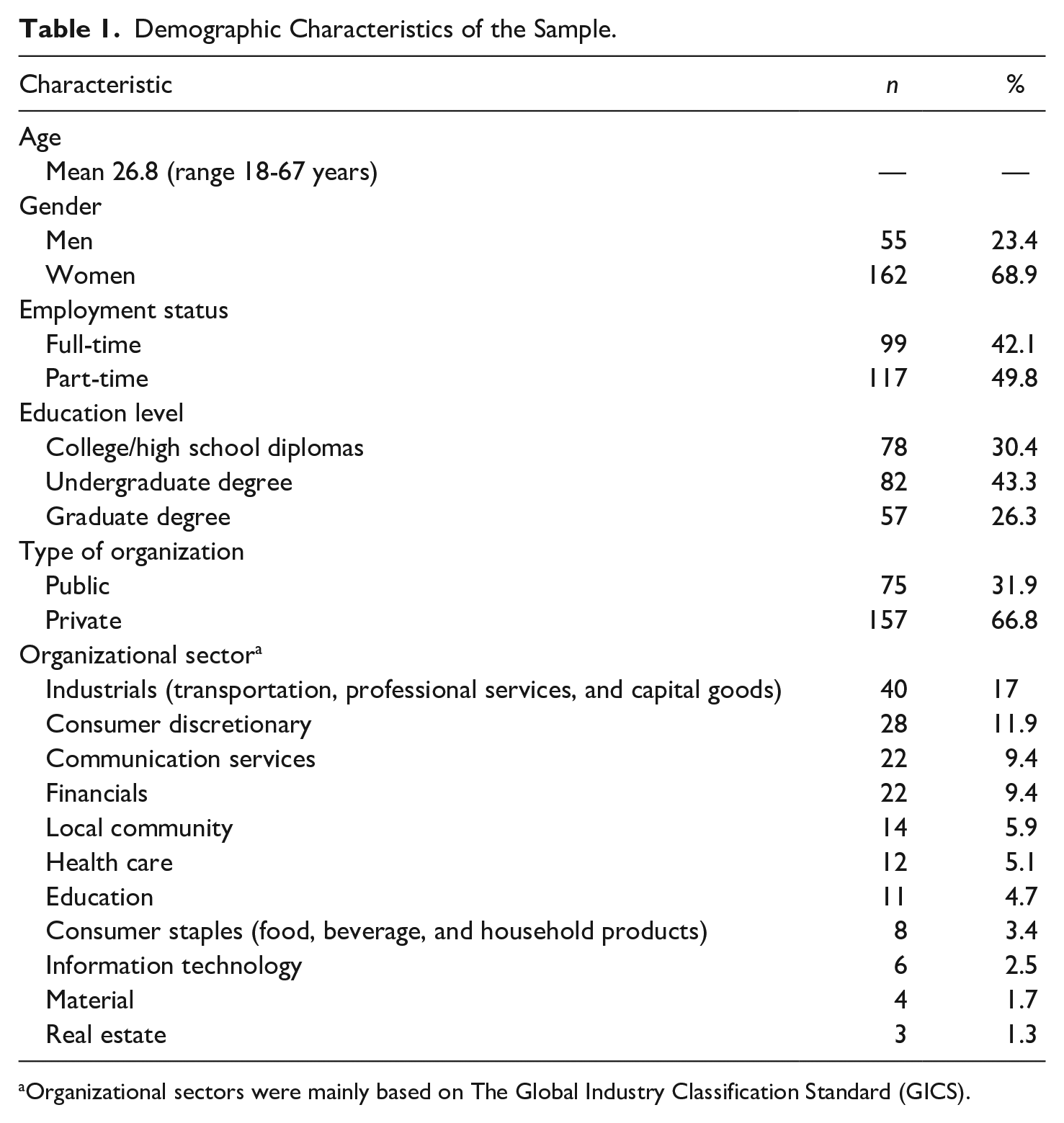
Organizational sectors were mainly based on The Global Industry Classification Standard (GICS).
Measures
Supportive Organizational Context for Teams
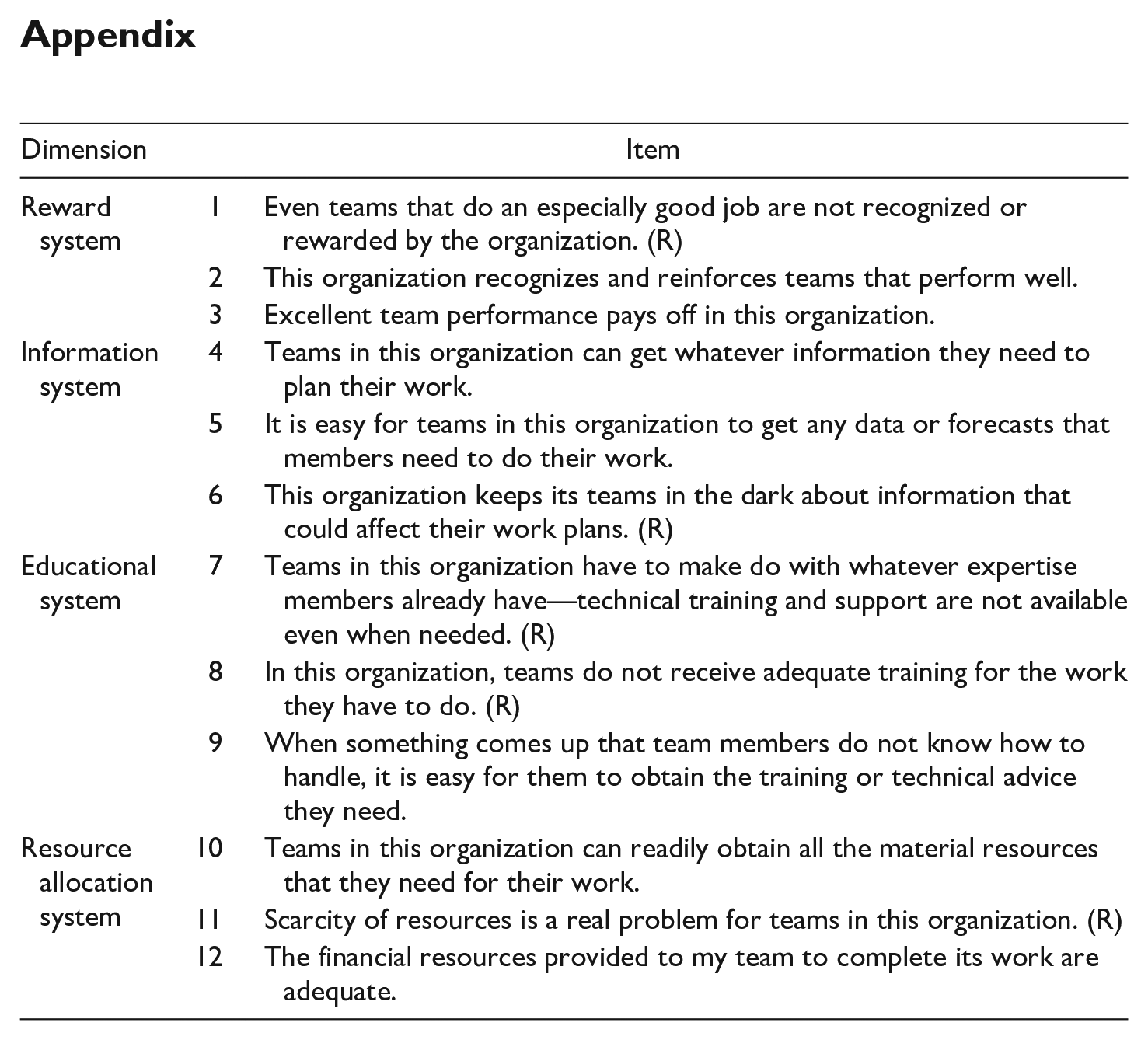
We measured SOCT using the 11 items developed by Wageman et al. (2005). In keeping with the scientific literature on team effectiveness emphasizing the importance of financial resources (Mickan & Rodger, 2000), we added one item to Wageman et al.’s (2005) resources dimension to capture information on the availability of financial resources. More specifically, we used three items to assess each of the four a priori support systems: the resource allocation system (e.g., “The scarcity of resources is a real problem for my team”), the reward system (e.g., “Even when my team does a particularly good job, it is not recognized/rewarded by the organization.”), the information system (e.g., “My team does not have access to all the information that could influence the progress of its work”), and the educational system (e.g., “My team is not getting the proper training to do its job”). All items reported in the appendix. Wageman et al. (2005) show that ratings of all four dimensions produced a satisfactory level of scale score reliability (Cronbach’s α = .88 to .94). All items were rated and answered on a 5-point Likert-type scale ranging from 1 (totally disagree) to 5 (totally agree).
Perceived Organizational Support
We used the Eisenberger et al. (1986) questionnaire to assess POS. More specifically, 17 items focusing on POS (e.g., “The organizational values my contribution to its well-being”) were rated on 7-point Likert-type scale ranging from 1 (strongly disagree) to 7 (strongly agree). Research generally supports the scale score reliability (α = .74 to .97), as well as the criterion and factor validity of this questionnaire (e.g., Eisenberger et al., 1986; Eisenberger et al., 1990).
Analysis
We conducted the tests of Hypotheses 1 and 2 using Mplus 8.0 (Muthén & Muthén, 2017) Robust Maximum Likelihood estimator. This estimator provides standard errors and goodness-of-fit indices that are robust for the nonnormality of the Likert-type response scales used in the present study. We handled the limited amount of missing data (4.3% to 6.4%, depending on which item we look at) using full information maximum likelihood (Enders, 2010). The relative adequacy of the models was assessed using conventional goodness-of-fit indices: The comparative fit index (CFI), the Tucker–Lewis index (TLI), and the root mean square error of approximation (RMSEA) with its confidence intervals (CIs). Acceptable fit is assessed as CFI/TLI ≥ 0.90 and RMSEA ≤ 0.08, while excellent fit is assessed as CFI/TLI ≥ 0.95 and RMSEA ≤ 0.06 (Hu & Bentler, 1999; Marsh et al., 2005).
To test for Hypothesis 1 and thus assess whether the measurement structure of responses to the SOCT questionnaire supports the assumption that SOCT is a high-order construct including four factors, we contrasted with a first-order model a high-order model using an exploratory structural equation modeling (ESEM) framework (Asparouhov & Muthén, 2009; Marsh et al., 2014; Morin et al., 2013). We chose the ESEM framework for its capacity to overcome the weaknesses of CFA models. Indeed, within CFAs, even small cross-loadings between nontarget factors are forced to be zero leading to biased estimates of the factor correlations when cross-loadings are present in the sample model. Furthermore, when the model specifies a high-order construct, CFA forces the ratio of the high-order factor to the first-order factor variance to be the same for all items associated with the same first-order factor. This constraint is very unlikely to be realistic with a complex instrument (Marsh et al., 2014; Morin et al., 2016). Moreover, mounting statistical evidence shows that ESEM tend to result in more accurate estimates of relations among constructs than CFA when cross loadings are present at the population level, yet remain otherwise unbiased (Asparouhov et al., 2015).
We implemented the ESEM first-order model using a confirmatory form of rotation (target rotation), allowing for all factors to be defined based on their a priori indicators as in CFA, but also allowing all cross loadings to be freely estimated yet “targeted” to be as close to zero as possible (Asparouhov & Muthén, 2009; Marsh et al., 2014; Morin et al., 2013). To test for Hypothesis 1, we then contrasted this ESEM first-order model with an ESEM high-order model, called bifactor-ESEM. Bifactor-ESEM was defined as its ESEM first-order counterpart, while allowing for all items to define a global factor in addition to all four a priori specific factors (Figure 1, Morin et al., 2016). In this comparison, observing a well-defined general factor (G-factor) coupled with the identification of at least some well-defined specific factors (S-factors) would support the bifactor solution, thus supporting the presence of a high-order factor.
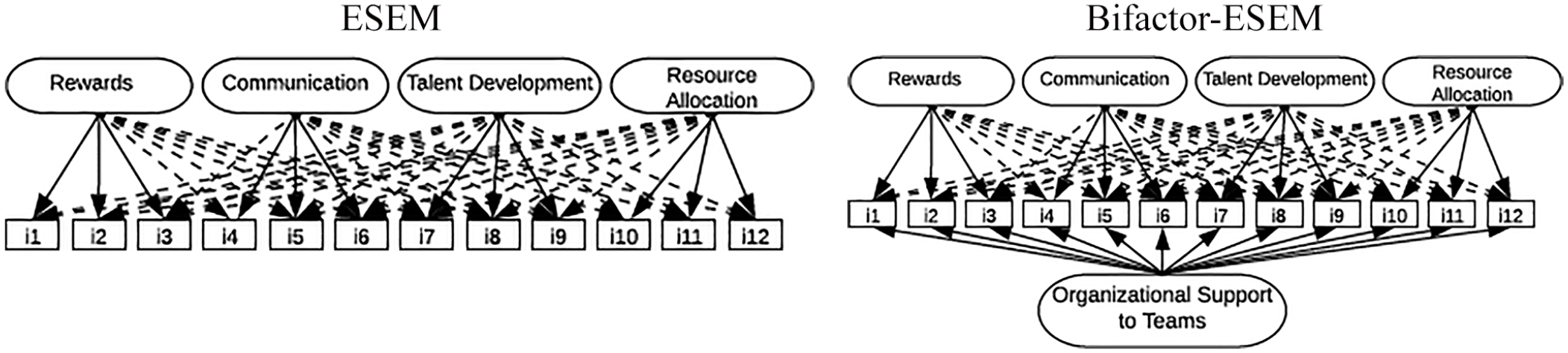
Graphical representation of the alternative measurement models considered in this study.
Across all models, we assessed composite reliability using McDonald (1970) omega coefficient of composite reliability (Morin et al., 2020). According to Perreira et al. (2018; also see Morin et al., 2020), bifactor models require more flexibility in terms of what can be considered satisfactory reliability, given that these models separate two sources of true score variance for all item ratings, one due to the G-factor and the other due to the S-factor.
To test for Hypothesis 2, we analyzed the discriminant validity of the SOCT construct. According to R. B. Kline (2016), discriminant validity occurs when constructs are not empirically identical, meaning that the two constructs are not highly correlated with each other (R. B. Kline, 2016). However, according to Shaffer et al. (2016), discriminant validity should also be demonstrated by comparing two CFA models, unconstrained and constrained. To conduct those analyses and test for Hypothesis 2, we contrasted a CFA model in which SOCT form a single construct that is allowed to freely covary to POS with a CFA model in which the covariance of these two latent variables is set to 1.0. The discriminant validity is supported when the unconstrained model provides a significantly better estimate of the data than the constrained model (Shaffer et al., 2016). Since here we are only contrasting two CFA models with the goal of testing whether SOCT and POS form distinct constructs, the CFA weaknesses described earlier in this article should not influence the conclusion of the discriminant validity analysis.
Results
Comparison Between First-Order and High-Order Measurement Models
The goodness-of-fit indices of both models are reported in Table 1. Parameter estimates from the ESEM and bifactor-ESEM models are reported in Tables 2 (factor loadings and uniqueness), 3 (latent correlations), and 4 (factor loadings).
Goodness-of-Fit Statistics of the Measurement Models and Invariance Testing.
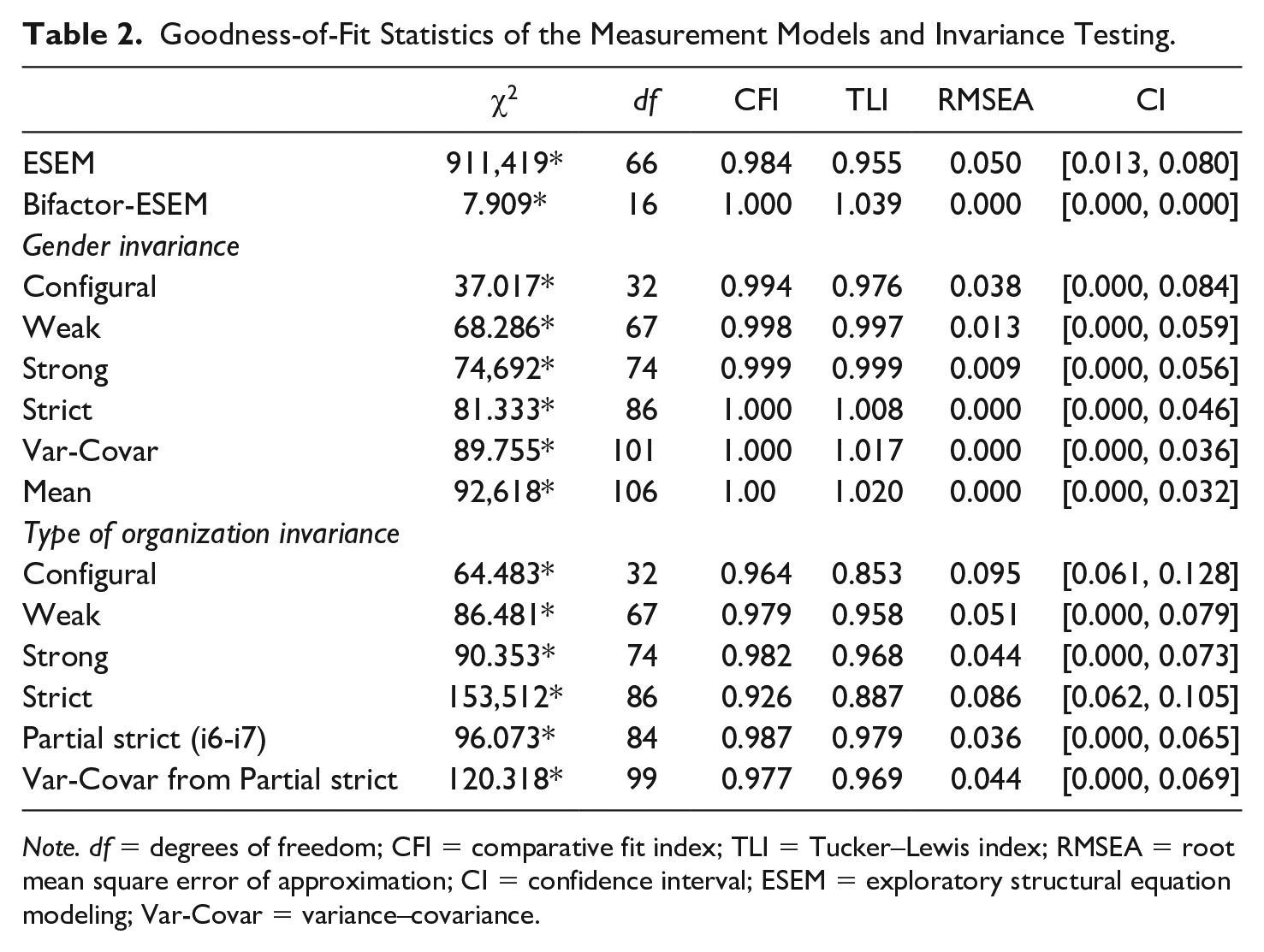
Note. df = degrees of freedom; CFI = comparative fit index; TLI = Tucker–Lewis index; RMSEA = root mean square error of approximation; CI = confidence interval; ESEM = exploratory structural equation modeling; Var-Covar = variance–covariance.
Standardized Factor Loadings (λ) and Item Uniquenesses (δ) From the ESEM and Bifactor-ESEM.

Note. ESEM = exploratory structural equation modeling; ω = omega coefficient of composite reliability.
Factors Correlations From the Confirmatory Factor Analyses (CFA) and Exploratory Structural Equation Modeling (ESEM) Solution.

To begin, we can see that the first-order model seems to result in factors that are well-defined by high target loadings (λ = .393 to .875) and in cross-loadings small enough to be negligible, with the exception of Item 9 (“When something comes up that team members do not know how to handle, it is easy for them to obtain the training or technical advice they need”), which appears to load almost equally on the information factor as on the a priori Education factor. Furthermore, the moderate factor correlations of first-order model support the distinctive nature of the factors but their correlations remain high enough to suggest that it might be necessary to consider employees’ global SOCT ratings, as seen in Hypothesis 1.
In this context, the first-order model was contrasted with a high-order model. The fit indices of both models support the superior level of fit with the high-order model data versus first-order model data (ΔCFI = 0.016; ΔTLI = 0.084; ΔRMSEA = 0.050). Furthermore, the high-order model reveals a well-defined G-factor with strong target loadings from most items (λ = .215 to .733) and a satisfactory level of composite reliability (ω = .899). Although they appear weaker than in the ESEM solution, the S-factors still remain well-defined in this bifactor-ESEM solution (λ = .250 to .818; ω = .538 to .710). In this solution, three Items (3, 9, and 11) appear to be more weakly related to their S-factors (see the appendix for SOCT items). However, for two of these Items (9: “When something comes up that team members do not know how to handle, it is easy for them to obtain the training or technical advice they need”; 11: “Scarcity of resources is a real problem for teams in this organization”), this simply reflects the fact that these items mainly serve to define the G-factor. In contrast, Item 3 (“Excellent team performance pays off in this organization”) rather appears to be weakly related to both its S-factor and to the G-factor, suggesting that this item should be targeted for reassessment in future research. It should be noted that the presence of well-defined S-factors supports the idea that these S-factors reflect some specificity that is not reflected on the G-factor.
Coupled with the superior level of fit with high-order model data versus first-order model data, these results suggest superiority of the high-order model and support Hypothesis 1, that SOCT consists of a high-order construct including four factors.
Discriminant Validity
For these analyses, we included POS (defined as a single CFA factor, but including an orthogonal method factor to control for the negative wording of seven items) to the complete bifactor-ESEM measurement model described above. The results from this model revealed a moderately high correlation between POS and the SOCT G-factor with a CI that excluded zero (r = .662, p < .01; CI [.445, .879]). The correlations between POS and the SOCT S-factors were not, however, statistically significant. The nonsignificant intercorrelations between S-factors and POS, combined with the moderately high correlation between POS and G-factor, confirm the discriminant validity of SOCT ratings, showing them to be empirically distinct from POS. A further demonstration of discriminant validity was done contrasting a CFA model in which SOCT forms a single construct that is allowed to freely covary to POS with a CFA model in which the covariance of these two latent variables is set to 1.0. The results showed that the first model has significantly better fit indices than the second (ΔCFI = 0.066; ΔTLI = 0.071; ΔRMSEA = 0.014). Hypothesis 2 stating that employee perceptions of SOCT and POS represent distinct but somehow related constructs is thus supported.
Supplementary Analysis: Measurement Invariance
Another key condition for successful psychometric validation is in the demonstration that the psychometric properties of a measure generalize across different conditions (Millsap, 2011). Indeed, for example, one cannot simply assume similarity between genders. It has actually been demonstrated that men and women give a different degree of importance to various factors in their work and in their organizational environment (Lindorff, 2010; Schwartz & Rubel, 2005).
For this reason, we decided to test for the measurement invariance of the SOCT for males and females, the results of which we reported in Table 1. Analyses were conducted according to the following sequence (Millsap, 2011): (a) configural invariance (same model); (b) weak invariance (same factor loadings); (c) strong invariance (same factor loadings and item intercepts); (d) strict invariance (same factor loadings, item intercepts, and item uniqueness); (e) latent variance–covariance invariance (same factor loadings, item intercepts, item uniqueness, and latent variances and covariance); and (f) latent means invariance (same factor loadings, item intercepts, item uniqueness, and latent variance, covariance and means).
The results from the measurement invariance tests we conducted across groups of male and female participants first show that the model of configural invariance resulted in an excellent level of fit with the data. The progressive addition of invariance constraints to the factor loadings, intercepts, uniqueness, latent variance–covariance, and latent means never resulted in a decrease in model fit surpassing the recommended guidelines for model comparison provided by Chen (2007) of ΔCFI and ΔTLI ≥ 0.01, and ΔRMSEA ≥ 0.015, thus supporting the complete invariance of this measurement model across genders.
Another important condition in which it is important to demonstrate the generalization of the SOCT measurement model is across public and private organizations, since there are known differences between those two types of organizations, such as personnel and budgeting rules (Rainey & Bozeman, 2000). Indeed, given the differences between those types of organizations in terms of the financial resources available, personnel, and budgeting rules, employee expectations of organizational constraints and incentives could also be different (Euske, 2003). To make sure that those distinct expectations would not affect SOCT measurement model, we also tested for measurement invariance across the public and the private sectors.
From one organization type to the next, the model of configural invariance resulted in an unacceptable level of fit with the data based on the fit indices incorporating a correction for parsimony (TLI = 0.853; RMSEA = 0.095); however, the fit was excellent with the data according to the CFI (0.964). The next model of weak invariance reached an excellent level of fit with the data according to all fit indices, suggesting that the nonvariance of this initial solution could have been due to a simple lack of parsimony (Mulaik et al., 1989). The following model of strong invariance was also supported by the data. However, the model of strict invariance resulted in a substantial decrease in model fit. Looking at parameter estimates, we noted that the imprecision level between the private and public sectors was different for Item 2 (“My team is recognized/reinforced when it performs well’) and Item 11 (“Scarcity of resources is a real problem for teams in this organization”). In response, we tried to relax the invariance constraint for uniqueness in Items 2 and 11. This alternative model of partial strict measurement invariance was estimated and was supported by the data, suggesting that the fit decrease was indeed only due to a different imprecision level between the two sectors for these two items. In this model, the data supported both invariance models for latent variance–covariance and latent means. The analyses thus support the partial invariance of the measurement model across organization types.
Discussion
The main objective of this study was to empirically demonstrate the multidimensional representation of Supportive Organizational Context construct (Wageman et al., 2005). Our results are consistent with the theoretical assumption of Wageman et al. (2005) that SOCT is a high-order construct, with good internal reliability, including four factors—the reward system, the information system, the educational system, and the resource allocation system (Hypothesis 1). The results actually support that high-order bifactor-ESEM representation of the data is superior to a first-order ESEM model. The SOCT global factor therefore provides a direct representation of team member perceptions of global supportive organizational context. The S-factors provide a direct estimation of team member perceptions of each support system, above their perceptions of overall supportive organizational context.
The empirical validation of this structure was a critical first step to document more thoroughly the role some contextual factors might play in team effectiveness. However, as SOCT is part of Hackman’s (2002) effectiveness model, a next crucial step would be to test for the predictive validity of global supportive organizational context on team effectiveness as well as the predictive validity of each support system over and above the global factor. Furthermore, as a next step, it would be important for future studies to verify if the factorial structure of the SOCT still holds at a team level of analysis and across different types of samples, such as different types of teams.
Our results also supported the need to distinguish organizational support directed toward individuals from organizational support directed toward teams (Hypothesis 2). The results are therefore consistent with the assertion by Kennedy et al. (2009) that in a team context, organizational support systems need to meet the individual needs in addition to the needs of teams as a whole. As the distinctiveness between POS and SOCT has been demonstrated, it would be interesting for future research to address the incremental validity of SOCT over POS in predicting various potential consequences.
Another key condition for successful psychometric validation is the demonstration that the psychometric properties of a measure generalize across different conditions (Millsap, 2011). A strength of convenience samples, like the one used in this study, is that they are generally more diverse in terms of types of organizations and sectors of activity (Landers & Behrend, 2015; see Table 1, for more details on the sample). As a supplementary analysis, we thus also tested for invariance across genders and across types of organizations. The results supported the notion that the bifactor-ESEM measurement model functions the same way across genders (male and female) and, with the exception of the noninvariant uniqueness in Items 6 and 7, across types of organizations (public and private). Since the differences between measurement models across types of organizations is limited to these items’ uniqueness, it should not pose problems as long as the measurement models are studied as latent variables which are naturally controlled for measurement errors.
It is however important to note that the convenience sample of this study was taken from a student population and young workers are therefore overly represented (76% of participants were younger than 30 years). It would therefore be useful to verify, in subsequent studies, the degree to which the results of this research can be replicated with a sample of older workers.
Theoretical and Practical Implications
In their article, Maloney et al. (2016) call for more context theorizing within team research. The empirical validation of the bifactor multidimensional representation of the SOCT construct is a first step in that direction, since it will help future team research focus not only on the general support factor but also on the unique contribution of the specific support systems in helping teams be more productive and feel more supported by their organizations. Indeed, bifactor-ESEM representations enable us to test the association of an outcome variable with the general latent factor; at the same time, we test the unique contribution of S-factors (Chen et al., 2012). In this context, the validation of the bifactor-ESEM representation of the SOCT will allow future studies to focus on getting a better understanding of the different forms of organizational support and their respective contributions to different outcome variables.
On a more practical level, this study demonstrates that all four support systems are necessary for organizations to build feeling of support within their teams. To create a feeling of support, management should therefore make sure to reward the whole team for their collective results by administering positive reinforcements contingent on desirable outcomes produced by the team (Bass et al., 2003; Yukl et al., 2002). These positive reinforcements can take many forms: money, prizes, gifts, praises, or acknowledgments (Rousseau & Aubé, 2014). To support effective teamwork, management should also ensure that teams have all the skills they need to accomplish their work (e.g., conflict resolution, collaborative problem solving, and adaptability) and if not, provide teams with training or development opportunities to develop those skills (Kennedy et al., 2009). Furthermore, to build a sense of support, management should work with teams to identify what information they need to accomplish their work (e.g., organization’s expectations, forecasts, type, and quantity of resources; Hackman 2002). Management should also be made accountable to transmit that information in a way that can be easily interpreted by the team (Hackman, 2002). Last but not least, management should regularly ensure with their teams that they have sufficient and appropriate resources to accomplish their collective work tasks and facilitate access to those resources when it is not the case (Weiss et al., 2013).
The results of this study also show that organizational support directed toward individuals is distinct from organizational support directed toward teams. Team-based organizations should keep in mind that teams and individual team members may need different kinds of support. If the organization only provides individual support, the team might not feel supported.
Footnotes
Appendix
| Dimension | Item | |
|---|---|---|
| Reward system | 1 | Even teams that do an especially good job are not recognized or rewarded by the organization. (R) |
| 2 | This organization recognizes and reinforces teams that perform well. | |
| 3 | Excellent team performance pays off in this organization. | |
| Information system | 4 | Teams in this organization can get whatever information they need to plan their work. |
| 5 | It is easy for teams in this organization to get any data or forecasts that members need to do their work. | |
| 6 | This organization keeps its teams in the dark about information that could affect their work plans. (R) | |
| Educational system | 7 | Teams in this organization have to make do with whatever expertise members already have—technical training and support are not available even when needed. (R) |
| 8 | In this organization, teams do not receive adequate training for the work they have to do. (R) | |
| 9 | When something comes up that team members do not know how to handle, it is easy for them to obtain the training or technical advice they need. | |
| Resource allocation system | 10 | Teams in this organization can readily obtain all the material resources that they need for their work. |
| 11 | Scarcity of resources is a real problem for teams in this organization. (R) | |
| 12 | The financial resources provided to my team to complete its work are adequate. | |
Authors’ Notes
Although not reported in this article for parsimony sakes, ESEM and B-factor models were also contrasted with CFA and bifactor-CFA models. The superiority of ESEM and bifactor-ESEM models over CFA and bifactor CFA was supported by the fit indices obtained for these models. On request, the content of these analysis can be transmitted.
Declaration of Conflicting Interests
The author(s) declared no potential conflicts of interest with respect to the research, authorship, and/or publication of this article.
Funding
The author(s) disclosed receipt of the following financial support for the research, authorship, and/or publication of this article: This research was funded by a grant from the Fonds de recherche Société et culture Québec.
