




Abstract
This study explains the process by which significant changes may take place in how organizations operate in the presence of arrogant leadership: their employees start to believe that their leaders are inconsistent in their actions, and the employees, in turn, engage in negative gossip behavior about these leaders. It also proposes that this process is mitigated to the extent that employees can rely on their own resilience levels. Data collected from employees and their peers in the banking and telecommunication sectors confirm these theoretical predictions. For organizational practitioners, this study thus pinpoints a critical mechanism by which a pretentious leadership approach can upset and deteriorate the organizational status quo: it escalates into negative work behaviors in the form of gossip among employees who believe that their leaders are unreliable. This counterproductive spiral can be contained, however, to the extent that employees are able to bounce back from difficult work situations.
Introduction
Extant research on leader development underscores the beneficial role of positive leadership styles—such as authentic (Agote et al., 2016), charismatic (Glynn & Dowd, 2008), or transformational (Afsar & Masood, 2018) leadership—for organizational effectiveness. Relatively less attention in this area has been devoted to employees’ exposure to destructive, resource-depleting leadership, which tends to have detrimental consequences for how employees think about and behave in the workplace (Krasikova et al., 2014; Schilling, 2009; Thoroughgood et al., 2012). When employees feel victimized by dysfunctional leadership, their resource reservoirs decrease and they become deeply preoccupied with their organizational future, especially when they recognize that their career progress depends on their supervisor—the source of not only their work hardships but also their performance evaluations (Naseer et al., 2016; Peltokorpi, 2017; Wu & Lee, 2016).
The focus of this research is on arrogant leadership, which reflects the understudied propensity of leaders to exhibit inflated levels of self-importance and express a sense of superiority over followers (R. E. Johnson et al., 2010), such that they “place little value on other people’s ideas and input, discount feedback, claim to be more knowledgeable than others, and sometimes publicly belittle and disparage those around them to exaggerate their own self-importance” (Borden et al., 2018, p. 346). The study of employees’ exposure to such arrogant leaders is important for scholarship in leadership development, because these leaders tend to undermine employees’ morale and increase the likelihood that employees suffer from burnout (Borden et al., 2018) and make poor decisions (Toscano et al., 2018).
Arrogant leadership is a leadership style that is different from related concepts such as abusive supervision or narcissistic leadership, in that it centers on pretentious and presumptuous claims that leaders make about their own competencies (Borden et al., 2018; Hareli & Weiner, 2000; R. E. Johnson et al., 2010). In studying this particular form of dysfunctional leadership, we examine a generally overlooked outcome of perceived leader arrogance: negative gossip about leaders (Brady et al., 2017). In particular, we propose that exposure to leader arrogance might generate significant changes in terms of how an organization functions internally, as manifest in its employees’ attitudinal and behavioral responses. In particular, employees may engage in negative gossip, because they develop cynical beliefs about their leaders and those leaders’ decisions (Dean et al., 1998; Kouzes & Posner, 2005). In so doing, we focus on the cognitive dimension of employee cynicism, manifest in beliefs about a discrepancy between leaders’ words versus actions (Acaray & Yildirim, 2017; Dean et al., 1998; Scott & Zweig, 2016). The extent to which employees suffer from arrogant leadership may determine their need to protect their own sense of self-worth by developing beliefs that their leaders are inconsistent and unreliable (Borden et al., 2018), which, in turn, provides justification for describing the leaders negatively in conversations with other organizational members (Decoster et al., 2013).
This causal mechanism, associated with beliefs about inconsistent leaders, might be contained though if employees also are equipped with high levels of resilience (Linnenluecke, 2017; Luthans, 2002). This personal resource captures employees’ ability to cope with and bounce back from adverse workplace events (Smith et al., 2008; Youssef & Luthans, 2007). That is, we propose that resilience may serve as a buffer that protects employees against the resource depletion that arises due to perceptions of leader arrogance (Borden et al., 2018), and in turn, the likelihood that the organizational status quo would be severely upset by employees who feel the need to engage in negative gossiping behaviors is thwarted. Their ability to recover from negative work situations, due to their resilience, makes these employees less likely to anticipate that decision making by arrogant leaders will be problematically inconsistent (Al-Hawari et al., 2020), so they experience less need to spread negative rumors to justify their beliefs. Formally, when employees can draw from their own resilience, the effect by which perceived leader arrogance pushes them to undertake negative gossip, through beliefs about inconsistent leader actions, becomes subdued, thereby mitigating the chances that the organization’s internal context changes in a negative direction because of these counterproductive reactions.
Conservation of Resources Theory
Our theoretical arguments are anchored in conservation of resources (COR) theory. According to this theory, employees’ work-related beliefs and behaviors are largely shaped by their desire to avoid resource losses (Hobfoll, 1989, 2001). For employees who feel threatened by adverse, resource-draining work conditions, effective responses help them avoid the escalation of this negative situation into further resource losses (Hobfoll & Shirom, 2000). Similarly, the resource depletion that employees experience when arrogant leaders signal that they are somehow inferior might be countered by beliefs that their leaders are volatile and erratic in their actions (Acaray & Yildirim, 2017; Dean et al., 1998; Kouzes & Posner, 2005). Once they develop such beliefs, employees might seek to emphasize the failures of these leaders during conversations with peers (Dijkstra et al., 2014). Thus, by expressing cynicism about how leaders make decisions, employees can avoid self-depreciating thoughts, even if their pompous leaders make them feel inferior (Borden et al., 2018). In turn, these beliefs can culminate in negative gossip behaviors that are targeted at these leaders.
Yet COR theory also posits that employees respond less forcefully to the threat of resource-draining work circumstances when they possess personal characteristics that diminish the severity of the experienced resource drainage (Hobfoll, 2001). That is, their negative responses should be mitigated to the extent that employees can draw from personal resources that enable them to deal successfully with any form of adversity (Abbas et al., 2014; Hobfoll & Shirom, 2000). We similarly propose that employees’ motivation to protect their self-worth by developing cynical beliefs about inconsistent leaders, and thus their propensity to badmouth those leaders, may be mitigated to the extent that employees can easily recover from challenging work events (Al-Hawari et al., 2020; Linnenluecke, 2017). This resilience, or ability to deal with difficult situations expediently, should serve as a buffer against the diminished self-worth that employees tend to experience in the presence of arrogant leaders (R. E. Johnson et al., 2010). In turn, their tendencies to express cynicism about how leaders make decisions and to gossip negatively about them diminish. In summary, employees’ resilience is a protective shield that helps employees cope with resource-deleting leader arrogance, thereby reducing the chances that their desire to preserve their self-worth escalates into cynical beliefs about their leaders and gossiping behaviors to spread unflattering stories about them.
Study Relevance
This study is highly relevant for both organizational scholars and practitioners. First, we draw on COR theory (Hobfoll, 1989, 2001) to investigate and empirically show how employees’ exposure to resource-draining leader arrogance may upset the organizational status quo so much that it spurs their negative gossip behaviors, targeted at their leaders, because of the cynical beliefs that they form about how their leaders make decisions (Kouzes & Posner, 2005; Pelletier & Bligh, 2008). This research thus offers an important insight for organizations: employees’ convictions that their leaders are highly inconsistent in their actions, and their subsequent propensity to spread negative rumors about them, are unexplored paths through which the victims of leader arrogance may seek to cope. These cynical beliefs provide important but understudied conduits through which exposure to pretentious leaders may cause employees to talk badly behind the leaders’ backs. In so doing, we also alert organizational leaders about a critical challenge: their exaggerated self-importance might backfire, leaving them victims to the badmouthing behaviors of their followers (Brady et al., 2017), which, in turn, may generate a negative spiral that fundamentally changes the quality of their organization’s internal functioning. From a research perspective, we complement previous studies that elucidate how employees’ cynical beliefs link several other sources of workplace adversity, such as psychological contract breach (J. L. Johnson & O’Leary-Kelly, 2003), relationship conflict (Shaukat et al., 2017), or a lack of interactional justice (Zhang & Frenkel, 2018), with negative work outcomes.
Second, we show how the aforementioned negative outcomes of arrogant, resource-draining leadership are dependent on employee characteristics. In particular, we pinpoint a key personal circumstance in which the likelihood of negative responses to perceived leader arrogance gets mitigated, that is, when employees are resilient (Linnenluecke, 2017). By explicating this buffering role of resilience—as manifest in its beneficial impact on employees’ tendency to avoid negative gossip behaviors, due to their diminished beliefs about inconsistent leadership—we provide organizational development professionals with practical insight into how they can prevent unfavorable leadership situations from escalating into detrimental changes in an organization’s internal functioning: by stimulating and honing employee resilience. In so doing, we also add to extant research that has pinpointed the beneficial role of this personal resource in containing the harmful effects of other work-related challenges, such as customer incivility (Al-Hawari et al., 2020) or perceived organizational politics (De Clercq & Belausteguigoitia, 2017).
Third, the empirical setting of this research is the non-Western context of Pakistan, which is highly useful for organizational practice too. This country is characterized by high levels of uncertainty avoidance (Hofstede et al., 2010), such that employees might feel highly upset by adverse, uncertainty-invoking work conditions such as leader arrogance. It also is marked by high levels of power distance and collectivism; condescending behaviors by people who hold leadership positions may not be uncommon (Khan et al., 2018), and employees might prefer to respond by gossiping with organizational peers, instead of directly taking on a superior in the organizational hierarchy by openly complaining about how they are treated. For organizational development professionals who advise clients in global settings, this study of the link between perceived leader arrogance and negative gossip, as well as the beneficial role of resilience in this process, thus should have great practical value, particularly so when the organizations operate in countries that share similar cultural characteristics with this study’s focal country context.
Hypotheses
The study’s research hypotheses include a combination of mediating and moderating effects. First, perceptions of leader arrogance spur negative gossip behavior because employees develop beliefs about inconsistent leader actions. Second, resilience serves as a buffer in this process, such that the translation of perceived leader arrogance into enhanced negative gossip, through inconsistent leader actions, becomes less likely when employees’ have the ability to bounce back from this adverse leadership situation.
Mediating Role of Beliefs About Inconsistent Leader Actions
We expect a positive relationship between employees’ perceptions of leader arrogance and their beliefs that leaders’ decision making is inconsistent. According to COR theory, the beliefs that employees form about their work situation are critically shaped by their motivation to protect their existing resource reservoirs from further depletion, especially when they are victims of negative workplace treatments (Hobfoll, 2001). When employees are exposed to unfavorable work circumstances that undermine the quality of their organizational functioning, they are motivated to protect themselves and alter their precarious situation (Hobfoll & Shirom, 2000). Employees who are exposed to leaders with negative characteristics, such as an exaggerated sense of superiority, experience condescension and a lack of consideration for their capabilities, so they risk developing self-depreciating thoughts. To avoid this painful state, they might form beliefs that their leaders are unreliable (Erkutlu & Chafra, 2017; Pelletier & Bligh, 2008), such that the leaders’ assessments, including their positive view of themselves, are not to be trusted (Borden et al., 2018). Factors that undermine these leaders’ credibility, such as a sense that the leaders are unpredictable because their actions do not match their words (Dean et al., 1998; Kouzes & Posner, 2005), help employees avoid further resource depletion. If leaders’ acclaimed superiority can be dismissed as unfounded or misplaced, employees can feel better about themselves (Hobfoll & Shirom, 2000). These arguments suggest the following hypothesis:
Deviant work behaviors, including gossip (Robinson & Bennett, 1995), can be pertinent responses for employees to unleash their frustrations with negative work settings (Hobfoll et al., 2018). Employees’ beliefs that their leaders are inconsistent in their actions similarly may stimulate their propensity to talk badly about these leaders with other organizational members, as a coping mechanism that helps them express frustration and disappointment with their leaders (Dijkstra et al., 2014; Grosser et al., 2012). When employees grow cynical and convinced of a mismatch between what their leaders do and say—a situation that threatens to undermine the quality of their current work functioning, as well as their future career prospects in the organization (Dean et al., 1998; Scott & Zweig, 2016)—they may seek to protect their current resource bases with negative gossip, which they regard as justified and that also helps them vent their fears (Decoster et al., 2013; Hobfoll & Shirom, 2000). Employees who are cynical about their leaders’ inconsistent, unreliable decision making also likely perceive this situation as reflective of their employer’s general lack of support for their professional well-being (Dean et al., 1998), so they react with negative gossip that might harm the entire organization (Dijkstra et al., 2014; Noon & Delbridge, 1993). Conversely, employees who perceive consistent, appropriate leader decision making should have less desire to badmouth their leaders, who seem to support their professional well-being. On the basis of these arguments, we hypothesize the following:
Combining these arguments, we further posit that beliefs about inconsistent leader actions have a critical mediating role in connecting leader arrogance with negative gossip. Employees whose resources have been drained by their exposure to pretentious leaders (Borden et al., 2018) feel fuelled to undertake gossip about those leaders, because of the enhanced cynicism they develop toward leaders’ decisions (Dean et al., 1998; Kouzes & Posner, 2005). In COR terminology, the victims of resource-draining leader arrogance seek to preserve their self-worth by spreading negative rumors about the leaders, because they believe that those leaders’ claims of superiority are misplaced in light of discrepancies between what they say and what they do. Previous studies similarly propose a mediating role of employee cynicism for the harmful effects of other energy-draining sources of workplace adversity, such as emotion-laden conflicts and broken organizational promises (J. L. Johnson & O’Leary-Kelly, 2003; Shaukat et al., 2017). We complement these studies by hypothesizing:
Moderating Role of Resilience
According to COR theory, negative responses to resource-depleting work conditions are less likely to materialize if employees can draw from personal resources that diminish the likelihood of further resource losses (Hobfoll, 2001). To maintain positive beliefs about how their leaders make decisions, even those who exhibit exaggerated self-importance, employees need to cope with the harmful effects that this condescending leadership style might have on their sense of self-worth (R. E. Johnson et al., 2010). Resilience is a personal resource that can aid in this coping effort, in that it refuels employees’ energy in the presence of challenging work situations and enhances their ability to identify effective solutions (De Clercq & Belausteguigoitia, 2017; Youssef & Luthans, 2007). Employees equipped with high levels of resilience accordingly should suffer less from a sense of inferiority when they are exposed to pompous leaders who are full of themselves (Borden et al., 2018), which then diminishes the likelihood that they develop cynical beliefs about how leaders make decisions, as means to preserve their self-worth (Erkutlu & Chafra, 2017). In contrast, employees with lower resilience are less protected against the hardships imposed by arrogant leaders, including the sense of inferiority they create among followers. In this scenario, employees may grow cynical about how their leaders make decisions and develop perceptions of inconsistent leader action (Kouzes & Posner, 2005).
The personal resource of resilience also stimulates employees’ creative and proactive behaviors (Caniëls & Baaten, 2019; Richtner & Löfsten, 2014; Sameer, 2018), which should help them find novel ways to deal with leaders’ presumptuous claims of superiority (Borden et al., 2018), such as by finding pertinent evidence that undermines these claims. In contrast, if they lack the ability to recover easily from difficult events, the frustrations evoked by arrogant leadership are more likely to culminate in cynical beliefs about leaders’ decision making, as a way to deal with their sense of inferiority (Hobfoll & Shirom, 2000). Moreover, employees’ resilience even may make difficult work situations attractive (Linnenluecke, 2017; Luthans et al., 2010), because finding adequate ways to preserve their self-worth in the presence of arrogant leaders instills a sense of personal satisfaction (Ryan & Deci, 2000). These employees accordingly may experience less need to avoid self-depreciation by forming beliefs about inconsistent leader decision making. That is, the gratification employees derive from their ability to bounce back from resource-depleting leader situations should diminish their desire to blame leaders’ unreliable decision making (Hobfoll, 2001).
In combination with the arguments regarding the mediating effect of employees’ beliefs about inconsistent leader actions, the mitigating role of resilience suggests a moderated mediation process (Preacher et al., 2007). In this process, resilience is a buffer of the indirect effect of leader arrogance on employees’ negative gossip behavior, through their cynical beliefs about how leaders make decisions. When employees recover more easily from challenging leader situations, these cynical beliefs, as causal mechanisms that underpin the harmful effect of resource-draining leader arrogance on gossip, get subdued (Hobfoll & Shirom, 2000). Formally, the ability to deal with difficult leaders with relatively little trouble reduces the chances that arrogant leadership escalates to prompt employees to badmouth their leaders, due to their cynical beliefs about discrepant leader words and actions. Conversely, employees who are not equipped with the same levels of resilience are less protected against a heightened sense of inferiority due to leader arrogance, so they experience a stronger need to avoid self-depreciating thoughts. They can accomplish this goal by developing convictions that the leaders are inconsistent in their actions, which warrants spreading negative gossip about them.
Research Method
Sample and Data Collection
To test the research hypotheses, we collected survey data from employees in three Pakistani-based organizations that operate in two major sectors, banking and telecommunication. These surveys were administered in three rounds, with time lags of 3 weeks between each round. These time lags help reduce concerns about reverse causality, yet they were not too long either, to avoid the chance that critical organizational events could have occurred during the data collection. The surveys were written in English, because it is the official language of business communication in Pakistan.
The rights of the research participants were protected through different measures. In particular, participants were ensured complete confidentiality, and we emphasized that our research interest was detecting general patterns in the aggregated data, not pinpointing any individual responses. Further explanations contained in the surveys noted that each survey included a personal code to allow data matching across the different rounds, but these codes would not undermine confidentiality in any way. To further diminish the chances of biased responses, we made it clear that there were no correct or false answers, that the only “good” answers were honest opinions, and that it would be normal for variation to arise across respondents in terms of how they answer specific questions. Finally, the participants could withdraw from the study at any point in time, if they wished to do so.
The first survey gauged employees’ perceptions of leader arrogance, pertaining to their immediate supervisor, and their own resilience levels; the second survey assessed their opinions about the consistency of their supervisor’s decision making. In the third survey, we gauged employees’ negative gossip about the supervisor, using peer ratings. For this effort, we randomly selected peers who had worked in the same department with the focal employees for at least 6 months; these employees had had plenty of chances to engage in conversations. Each randomly selected peer rated one employee, to prevent data nesting (Naseer et al., 2016). A peer-rated measure of negative gossip behavior reduces concerns about common method bias; it also reduces the risk of social desirability bias among employees who might be hesitant to admit that they engage in negative gossip. Of the 450 originally administered surveys, 391 were returned in the first round, and 340 respondents completed the survey in the second round. In the third round, we received 313 surveys. After omitting surveys with missing data, we retained 299 completed sets of surveys for the analyses. Among these respondents, 37% were women, their average age was 29 years, and they had worked for their organization for almost 5 years.
Measures
Perceptions of Leader Arrogance
To measure employees’ perceptions that their leaders are arrogant in interactions, we applied a 10-item scale of workplace arrogance, as developed and validated by R. E. Johnson et al. (2010). In light of this study’s focus, the surveys clarified that the items pertained to employees’ opinions about their immediate supervisor. The statements used 5-point Likert-type anchors (1 = strongly disagree; 5 = strongly agree), such as “My supervisor believes that she or he knows better than everyone else in any given situation,” “My supervisor takes himself or herself too seriously,” and “My supervisor does not see himself or herself as being too important for some tasks” (reverse coded; Cronbach’s α = .97).
Resilience
To assess employees’ ability to recover from difficult work situations, we relied on the five-item Brief Resilience Scale (Smith et al., 2008), with a 7-point anchor (1 = strongly disagree; 7 = strongly agree). The respondents indicated, for example, whether “I tend to bounce back quickly after hard times,” “I usually come through difficult times with little trouble,” and “It does not take me long to recover from a stressful event” (Cronbach’s α = .74).
Beliefs About Inconsistent Leader Actions
We measured employees’ cynical beliefs about their leaders’ decision making with a five-item scale that reflects the cognitive dimension of organizational cynicism (Acaray & Yildirim, 2017; Scott & Zweig, 2016). The wording of the original items was adapted to capture employees’ beliefs about the actions of their immediate supervisor, instead of the actions of their organization in general. The items were measured with a 7-point anchor (1 = strongly disagree; 7 = strongly agree), including “I see little similarity between what my supervisor says he will do and what he actually does,” “When my supervisor says he or she is going to do something, I wonder if it will really happen,” and “I believe my supervisor says one thing and does another” (Cronbach’s α = .85).
Negative Gossip About the Leader
The peer-rated measure of negative gossip used a five-item scale (Brady et al., 2017). Peers indicated how often they believed the focal employee had engaged in several behaviors in the previous 6 months, using a 6-point anchor (1 = never; 2 = once or twice; 3 = about once a week; 4 = several times a week; 5 = almost every day; 6 = everyday). Three example items were “This employees has criticized his or her supervisor while talking to me,” “This employee has questioned his or her supervisor’s abilities while talking to me,” and “This employees has told an unflattering story about his or her supervisor while talking to me” (Cronbach’s α = .91).
Control Variables
The statistical analyses accounted for three control variables: gender (1 = female), age (in years), and organizational tenure (in years).
Results
Table 1 reports the correlation coefficients and descriptive statistics, and Table 2 contains the hierarchical regression analyses. Models 1 to 3 predict beliefs about inconsistent leader actions, and Models 4 to 6 pertain to negative gossip about the leader. The variance inflation factor for each predictor in each model is lower than the conservative cutoff value of 5.0, so multicollinearity is not a concern (Aiken & West, 1991).
Correlation Table and Descriptive Statistics.
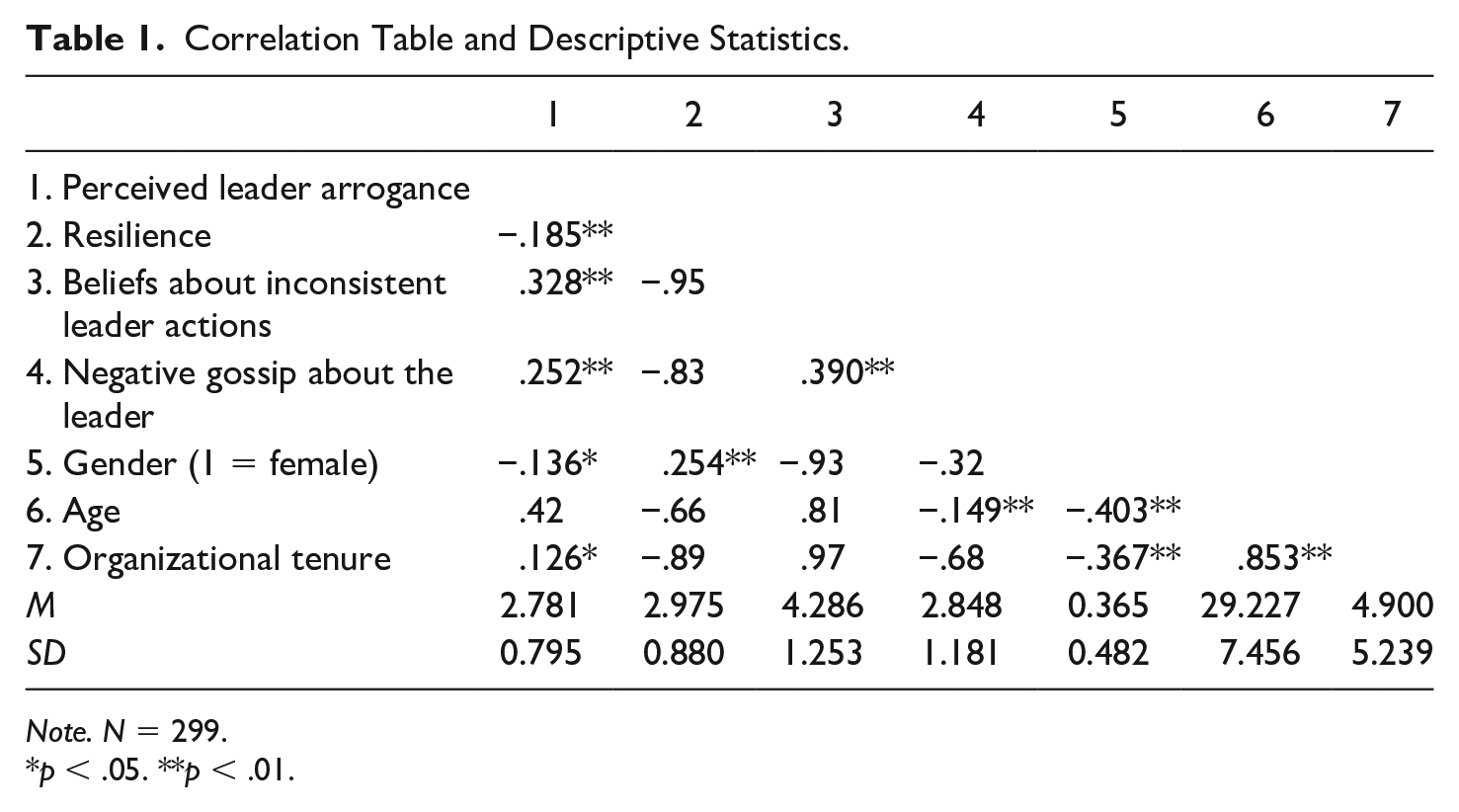
Note. N = 299.
p < .05. **p < .01.
Regression Results.

Note. N = 299 (unstandardized regression coefficients).
p < .10. *p < .05. **p < .01. ***p < .001 (two-tailed tests).
Hypothesis 1 predicted that employees who are exposed to a leader with an exaggerated sense of self-importance are more likely to develop cynical beliefs about how that leader makes decisions. The positive relationship between perceptions of leader arrogance and beliefs about inconsistent leader actions in Model 2 affirms this prediction (β = .502, p < .001). Furthermore, in support of Hypothesis 2, these beliefs prompt employees to spread negative rumors about their leader, as indicated by the positive relationship between beliefs about inconsistent leader actions and negative gossip in Model 5 (β = .336, p < .001).
A preliminary test of the presence of mediation indicated that the strong positive relationship between perceived leader arrogance and negative gossip about the leader in Model 5 (β = .347, p < .001) becomes subdued when we account for the effect of beliefs about inconsistent leader actions in Model 6 (β = .178, p < .05). The formal mediation test uses the bootstrapping method developed by Preacher and Hayes (2004), in the Process macro developed by Hayes (2013). This method generates confidence intervals (CIs) for the indirect effect of perceptions of leader arrogance on negative gossip about the leader, thereby reducing statistical power problems that occur in the presence of asymmetric or other nonnormal sampling distributions of the indirect effect (MacKinnon et al., 2004). Using 10,000 random samples and replacement from the full sample, the CI for the indirect effect of perceptions of leader arrogance on negative gossip about the leader through beliefs about inconsistent leader actions does not include 0 ([.098, .244]), which confirms the presence of mediation.
To assess the moderating effect of resilience, as advanced in Hypothesis 4, we calculated the mean-centered interaction term of perceptions of leader arrogance × resilience to predict beliefs about inconsistent leader actions (Model 3). This interaction term is negative and significant (β = −.284, p < .01), as Figure 1 shows, by plotting the relationship between perceptions of leader arrogance and beliefs about inconsistent leader actions at high and low levels of resilience. The results of the corresponding simple slope analysis (Aiken & West, 1991) indicate that the relationship of perceptions of leader arrogance and beliefs about inconsistent leader actions is positive and strongly significant at low levels of resilience (β = .804, p < .001) but only weakly significant at high levels (β = −.236, p < .10), consistent with Hypothesis 4.
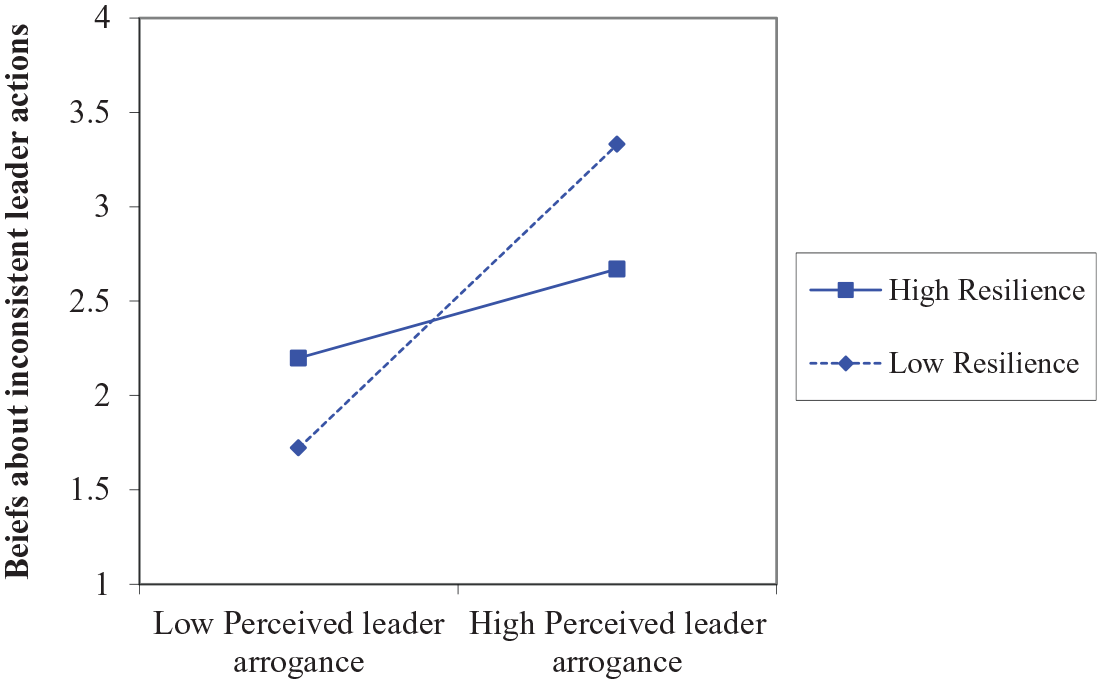
Moderating effect of resilience on the relationship between perceived leader arrogance and beliefs about inconsistent leader actions.
Finally, the assessment of moderated mediation relies on Preacher et al.’s (2007) method and Hayes’s (2013) Process macro. Similar to the bootstrapping method for the test of mediation, this approach calculates CIs instead of point estimates for conditional indirect effects at different levels of the moderator (MacKinnon et al., 2004). 1 The midpoints of the bootstrap 95% CIs for the conditional indirect effect of perceptions of leader arrogance on negative gossip about the leader diminish with increasing levels of resilience (i.e., .252 at the 16th percentile, .172 at the 50th percentile, and .109 at the 84th percentile). As a more formal test of the presence of moderated mediation, the CI of the index of moderated mediation (Hayes, 2013) does not include 0 ([−.174, −.024]). Thus, resilience mitigates the positive indirect effect of perceptions of leader arrogance on negative gossip about the leader, through beliefs about inconsistent leader actions, in support of Hypothesis 5 and the proposed conceptual framework.
Discussion
This study adds to extant research in the realm of organizational change and development by detailing how employees’ exposure to arrogant leaders can fundamentally change the nature of their employer’s internal functioning, by spurring their own engagement in negative gossip about these leaders, with particular attention to the factors that inform this process. Previous research has shown that leaders with an inflated sense of superiority can undermine employees’ resource reservoirs and decision making (Borden et al., 2018; Toscano et al., 2018), but we have sought further insights into why and when their exposure to this resource-draining form of leadership might drive them to spread negative gossip about their leaders. Accordingly, we have drawn on COR theory (Hobfoll & Shirom, 2000) to propose that (a) exposure to arrogant leadership can escalate into badmouthing, because employees seek to preserve their sense of self-worth by developing cynical beliefs about how their leaders make decisions and (b) this explanatory role of beliefs about inconsistent leader actions is weaker among employees who can draw from their personal resource of resilience. The empirical results affirm these theoretical predictions.
First, when employees suffer victimization by arrogant leaders who make excessive claims about their own superiority, they risk self-depreciating thoughts and a sense of diminished self-worth (R. E. Johnson et al., 2010; Silverman et al., 2012). They can counter the resulting resource depletion by forming cynical beliefs about the inadequate decision making exhibited by their leaders—particularly any discrepancy between what they say and do (Dean et al., 1998)—and then gossip about these leaders, an act that seems both warranted and deserved (Grosser et al., 2012). When employees criticize these leaders in conversations with peers, they feel better about themselves and avoid suffering the escalation of condescending leader treatment into ruminating about their own inadequacies (Ellwardt et al., 2012; Noon & Delbridge, 1993). That is, spreading gossip helps victims of arrogant leadership cope, by blaming their leaders for being inconsistent in their actions and words (Grosser et al., 2012; Waddington, 2005). We thus offer organizational change scholars a key insight into why employees’ exposure to arrogant leaders may generate a fundamental change to the interpersonal dynamics of leader–employee relationships: employees start to spread negative rumors about these leaders because they are convinced that their leaders are unreliable in their decision making.
Moreover, the mediating role of employees’ beliefs about inconsistent leader actions is moderated by their resilience levels. As we hypothesized, these cynical beliefs form a less powerful connection between perceived leader arrogance and enhanced negative gossip among employees who easily bounce back from difficult situations (Al-Hawari et al., 2020; Linnenluecke, 2017). This finding is consistent with the logic of COR theory, according to which the resource-draining effect of adverse leader situations is contained to the extent that employees can avoid further resource losses by leveraging their personal capacities (Hobfoll, 2001). Whether employees seek to protect their self-worth by forming beliefs about inadequate leader decision making, in response to presumptuous leader claims about their superiority, thus depends somewhat on whether they can recover from damaging leader interactions (Youssef & Luthans, 2007). Resilient employees feel less intimidated by presumptuous leaders, because they are confident they can handle and adapt to this unfavorable situation or find creative ways to resolve it, by leveraging their positive energy (Luthans, 2002). Resilient employees even may experience personal satisfaction with their ability to handle arrogant leaders, because taking on challenging situations motivates them (Linnenluecke, 2017). Their need to protect their self-worth by forming negative beliefs about leader actions and badmouthing leaders thus is less prominent.
Overall, this study offers organizational scholars and practitioners a more complete understanding of key organizational change processes that may unfold in response to arrogant leadership: employees become convinced that there is a mismatch between their leaders’ words and actions, which serves as an important mechanism that links their exposure to resource-draining arrogant leadership with the undertaking of negative gossip about their leaders. This process is mitigated, however, by employees’ resilience. The scope of the conceptual model admittedly is somewhat narrow, but the objective of this study has been to gain depth, instead of breadth, in uncovering an unexplored conduit through which arrogant behaviors may backfire for leaders, who become the target of negative gossip. In addition, this study complements previous examinations of the direct beneficial effects of resilience for positive work outcomes, such as higher well-being (Avey et al., 2011), commitment to organizational change (Shin et al., 2012), or innovative behavior (Sameer, 2018). We add the complementary insight that the role of cynical beliefs about leader decision making for spurring negative gossip, in response to arrogant leadership, can be contained by employees’ resilience, which counters any threat of a sense of inferiority. To the extent that employees are resilient, they are better equipped to avoid self-depreciating thoughts, so the likelihood of significant internal organizational upheaval, because of employees’ perceived need to get back at their arrogant leaders with negative gossip, is lower.
Limitations and Future Research
This study has some shortcomings, which indicate avenues for research. First, we focused on employees’ beliefs about inconsistent decision making by their leaders as a critical but unexplored mechanism that connects perceived leader arrogance with negative gossip; it would be useful to investigate other mechanisms that might underpin this relationship too, such as employees’ state anger (Harmon-Jones & Sigelman, 2001), revenge seeking (Bordia et al., 2008), or distrust in organizational leadership (Kramer, 1999). In a related vein, we did not directly assess the hypothesized mechanism by which resource-depleting leader arrogance translates into negative gossip behavior, namely, the desire to avoid self-depreciating thoughts due to an imposed sense of inferiority. This mechanism is consistent with the logic of COR theory, but continued studies might measure it explicitly.
Second, we focused on the buffering role of employees’ resilience in mitigating their negative responses to arrogant leadership. This focus could be complemented with an investigation of other personal buffers, such as employees’ passion for work (Baum & Locke, 2004), creative self-efficacy (Tierney & Farmer, 2002), or political skill (Banister & Meriac, 2015). Moreover, pertinent organizational conditions could diminish the risk that employees feel inferior to arrogant leaders and lower their need to address this sense of inferiority, such as when the organization exhibits procedural justice (Cho et al., 2017), establishes private communication channels to allow employees to share their frustrations about negative leader treatment (Harrison et al., 2013), or develops adequate leader development training programs (King & Nesbit, 2015).
Third, our hypotheses are country independent, but cultural factors still might interfere with our conceptual model. The cultural environment in Pakistan is marked by high levels of risk avoidance, so employees may suffer greatly from leaders who are full of themselves and do not care for their well-being, as well as from the beliefs that leader decision making is unpredictable. The collectivistic nature of Pakistani culture also implies that gossip about leaders, spread among like-minded peers, could be a common response to stressful leadership situations. To test the external validity of this study, it would be interesting to undertake cross-country investigations that compare the strengths of the hypothesized relationships across different country settings, as well as the role that pertinent cultural factors might play in these relationships.
Practical Implications
Despite these limitations, this study provides practical insights for organizational change and development practitioners. Employees who are the victims of arrogant leader treatment might be so upset by this situation that they change the internal dynamics of their organization in a fundamental way: they respond with negative gossip behaviors, which may undermine the quality of the interpersonal exchanges that take place within its ranks. Even if their gossip can help employees vent frustrations with how they are being treated by leaders, this behavior tends to harm both the targets and its undertakers. In particular, gossipers may suffer from enhanced anxiety levels and fear for their organizational standing in the long run (Michelson & Mouly, 2004). Organizational practitioners accordingly should do their utmost to eliminate such gossip from their ranks, by avoiding an importance source of it: arrogant leadership. A challenge though is that such leadership may be manifest in subtle ways (Borden et al., 2018), and employees may be reluctant to communicate openly about their arrogant leaders, whether because they do not want to be perceived as overly complaining or out of fear of negative repercussions from the leader. Organizational development professionals accordingly should be proactive in detecting arrogant tendencies among organizational leaders. They also could establish (a) confidential platforms to allow employees to vent their fears and frustrations about arrogant leaders, (b) advancement systems that prevent organizational members with arrogant tendencies from being promoted into leadership positions, and (c) leadership development programs that underscore the importance of treating followers respectfully in the workplace.
In addition to these general recommendations, we offer findings that organizational development practitioners might find especially useful in organizational contexts marked by some unavoidable arrogant leader behaviors, such as when these leaders possess specific, scarce skills that are very valuable for organizational success (e.g., technology gurus). In particular, employees who are resilient and able to recover from adverse work situations are uniquely positioned to avoid engaging in negative responses to arrogant leaders (Youssef & Luthans, 2007). The recruitment and retention of employees who are endowed with this personal resource thus can be beneficial for organizations that cannot avoid assigning people with pretentious tendencies to leadership positions. Adequate selection and evaluation procedures could accordingly be developed to pinpoint specific personal features that make it more likely that employees successfully bounce back from challenging leadership situations.
Fortunately, employee resilience levels are not set in stone, such that this personal resource can be stimulated and nurtured through training (Luthans et al., 2010). Pertinent employee development programs might detail ways for employees to avoid self-depreciating thoughts even in the presence of arrogant leaders, by teaching them necessary skills to persist in finding effective ways to challenge and overcome the damaging implications of such leadership. Another critical aspect of resilience is that it not only speaks to employees’ capability to recover from difficult situations but also their desire to learn from these situations (Stephens et al., 2013). Organizational practitioners therefore could help employees understand that an ability to contain their negative emotions and behaviors, in the presence of leader-related adversity, might offer critical insights that can be leveraged to other adverse situations as well, such as when they are exposed to coworker incivility or experience excessive workloads. Ultimately, their individual resilience and corresponding desire to learn from unfavorable leader treatment can contribute to the development of organizational resilience, that is, a collective ability to withstand and avoid the negative changes that may occur when employees react to this treatment in counterproductive ways (Gover & Duxbury, 2018).
Conclusion
This study adds to extant organizational change and development research by detailing the effect of employees’ exposure to leader arrogance on their negative gossip behaviors, with a particular focus on the roles that their beliefs about leader decision making and their own resilience play in this process. The belief that their leader is unreliable is a hitherto overlooked reason that causes arrogant leaders to become targets of employees’ negative rumors; the strength of this explanatory mechanism is mitigated though, when employees can bounce back readily from difficult work conditions. We hope this study can serve as a stepping stone for further investigations into how organizational professionals can avoid the risk that the presence or even indulgence of arrogant leadership in an organization’s ranks culminates in negative work behaviors that fundamentally change and undermine the quality of its internal functioning.
Footnotes
Declaration of Conflicting Interests
The author(s) declared no potential conflicts of interest with respect to the research, authorship, and/or publication of this article.
Funding
The author(s) received no financial support for the research, authorship, and/or publication of this article.
