




Abstract
One primary mechanism through which leaders influence others in the context of organizational change is their rhetoric. While planning change communication, it is important for a change agent to craft the appropriate message content to foster employees’ commitment to change. Furthermore, the literal meaning of a message can be strengthened by the way it is delivered. This study investigates the content of a change message and how it is articulated by the leader using a vignette-based experimental study. Based on a 2 × 2 × 2 factorial design, 200 participants are assigned to one of the eight hypothetical change scenarios that vary by change message content, message delivery, and change context. The results show the impact of rational versus emotional content and message content versus delivery on commitment differ based on secure or insecure contexts. This study provides cues for practitioners to design change messages to obtain commitment to change.
Introduction
The concept of continuous and disruptive change has become a new reality for today’s business context as companies increasingly engage in multiple and ongoing change events (Wee & Taylor, 2018). Consequently, the ability to manage change successfully has become a required competency of the leaders in the twenty-first century (Fleming & Millar, 2019). Employees’ positive reactions to change (e.g., their commitment) are vital for the success of change initiatives (Armenakis & Harris, 2009; Bartunek et al., 2006; Herscovitch & Meyer, 2002; Oreg et al., 2011; Straatmann et al., 2016), and change communication is a crucial aspect for generating such favorable reactions (Allen et al., 2007; Gilley et al., 2009; Petrou et al., 2018; Schweiger & DeNisi, 1991). Change communication serves to reduce the uncertainty of change, gives a sense of control and perceptions of organizational support to employees, and assists them to go through a process of sense-making where the information they get fosters their understanding about the situation (Armenakis et al., 1993; Bordia et al., 2004; Weber & Manning, 2001). However, despite its importance, features of change communication that enhance positive employee responses remain an underresearched area (Hackman & Johnson, 2013; Luo et al., 2016) and the most effective change message strategies are unclear. Studies have investigated leader communication in general, but very few of them (e.g., Luo et al., 2016) delve into the specifics of communication in the context of organizational change, calling for more research on this field (Helpap, 2016).
We identify two main gaps in the change message literature. First, previous research has not investigated the details of the content in change messages. As mentioned by Pondy (1978), “Leadership is a language game,” and leaders influence others through their rhetoric, especially for gaining acceptance for revolutionary ideas in the context of organizational change (Fiol et al., 1999). Rhetoric, defined by Aristotle (1926) as the art of persuasion, serves as a guide to creating persuasive messages and delivering them. It consists of three pillars: Logos (logical appeal), Ethos (credibility), and Pathos (emotional appeal) all of which should be used in combination as particularly in change situations (Amis & Aissaoui, 2013). While planning change communication, it is important for the leader to craft an appropriate change message that appeals to logic and emotions of change recipients to get positive reactions to change (Armenakis et al., 1993; Fox & Amichai-Hamburger, 2001). However, while many studies have been conducted on emotional and rational appeals in framing persuasive messages in the fields of marketing and advertising (e.g., Zhang et al., 2014), crowdfunding (e.g., Xiang et al., 2019), or seldom on crisis communication (e.g., Claeys & Cauberghe, 2014), to our knowledge, previous research has overlooked the differential role of emotional and rational message framing in the field of change management. Even in the field of marketing, where the type of message appeal has been extensively studied, there are inconsistent research findings on whether rational or emotional message appeals are more effective (Noble et al., 2014). While both rational and emotional content in a message can be persuasive, why and under what conditions each may be more effective needs to be better understood (Yoo & MacInnis, 2005).
Second, previous studies identified both the content of the message (what is said) and how it is communicated by the leader (delivery style) as crucial factors in the effectiveness of the message (Baur et al., 2016). The leader’s choice of words and expressions in the content of the speech to communicate the change vision has been found extremely important in gaining follower commitment (Conger, 1991; Shamir et al., 1994). Moreover, besides content, how the leader articulates the message makes a difference. Den Hartog and Verburg (1997) found many examples of how the literal meaning of a message can be strengthened by presenting it in a specific form of verbal communication (e.g., strong, charismatic). Various studies have employed experiments to examine the effectiveness of content versus delivery of a message. However, many of these previous studies reached inconclusive findings; some (e.g., Johnson & Dipboye, 2008; Kirkpatrick & Locke, 1996) asserting that content matters more, whereas others (e.g., Awamleh & Gardner, 1999; Holladay & Coombs, 1994) demonstrating the superiority of delivery style over content.
To further investigate that controversy, we propose that context may be the cause of diverse results. Deriving from the dual process approach, we assert that how people process and react to a change message will differ according to the contextual factors. During an organizational change, job insecurity is an important contextual variable that is negatively related to commitment to change (Hellgren et al., 1999; Sverke et al., 2008). Given the significance of job insecurity, we suggest that the impact of message content versus delivery style, or the effect of rational versus emotional content may differ across secure versus insecure contexts.
Consequently, this study examines the content and delivery style of a change message and their influence on outcome variables of commitment to change with the aim to (a) address the need for research in leader communication during organizational change, (b) expand the knowledge on rational versus emotional appeal in change message content, and (c) contribute to resolving the controversy on content versus delivery of change message by introducing the job insecurity context as a contingency factor.
This study aims to answer the following research questions: (a) Which content type, rational or emotional, is more influential on generating commitment to change? Does their impact on commitment to change vary in contexts characterized by job security versus insecurity? (b) Does job (in)security make a difference in the impact of content versus delivery style of the change message on commitment? These research questions are investigated by an experimental vignette study based on a 2 × 2 × 2 factorial design. Participants are randomly assigned to one of the eight change scenarios that vary by change message content (rational vs. emotional appeal), change message delivery (strong vs. weak), and change context (job insecurity vs. job security).
Theoretical Background
This study aims to resolve the gaps in the literature regarding the impact of (a) rational versus emotional content and (b) content versus delivery by proposing that the context of job insecurity makes a difference. Dual process theories provide the rationale for this argument. According to the dual process approach, different types of information in a message (e.g., rational versus emotional content) or message related factors (content or delivery) may have a different influence on attitudes, and subsequent behaviors, via distinct types of processes (Kruglanski & Thompson, 1999). In view of that, people process information through two different modes. Kahneman (2003) classifies these two modes of processing as System 1 and System 2, where System 1 thinking is labeled as fast, automatic, affective, intuitive, and effortless, whereas System 2 is more rational, effortful, slow, reasoning based, controlled, and cautious. These two systems operate in parallel and each system can autonomously lead to a different response, independent of the other. On the other hand, these systems are not mutually exclusive, and they interact with and influence each other.
Among the dual process theories, the elaboration likelihood model (ELM; Petty & Cacioppo, 1986) investigates two types of information processing strategies that individuals use to evaluate persuasion components in a message, such as argument content, delivery style, design of the visual information, or the source of a message. In their process, individuals either prefer the central route, where they use more cognitive and careful processing of the message or they choose the peripheral route where they limit their cognitive effort while forming their attitude (e.g., relying on their emotions; Petty & Cacioppo, 1986; Petty et al., 1981). The central route usually considers the logical sequence or content of the messages, while emotional messages or the attractiveness of the source of communication may serve as shortcuts of the peripheral route for forming attitudes. Research shows that contextual factors can be a determining factor about whether a message will be processed using the central or peripheral route (Payne et al., 1993). Also, the degree of involvement or relevance may be a factor on the amount of processing. The central path is mostly used when the receiver is motivated to think about the message or has high involvement. On the other hand, if the recipient has low involvement and does not give high importance to the topic of the message, he or she will lack the motivation to do central processing and use the peripheral route by relying on heuristics.
Job insecurity provides a major contextual factor that makes the situation, and therefore the change message, relevant for the message recipient. Job insecurity has been defined as an overall concern about the continued existence of a particular job (De Witte, 1999). Organizational change is a significant predictor of job insecurity (Ito & Brotheridge, 2007). Uncertainty and unpredictability during times of change may trigger perceptions of insecurity and act as a stressor with negative outcomes (Sverke et al., 2002). Job insecurity makes an employee feel concerned and threatened that his or her job is at risk (Jiang & Lavaysse, 2018; Shoss, 2017). In that case, the employee may be more alert and pay different attention to the message content or the delivery style. Furthermore, rational or emotional content may be processed differently in such situations compared with a secure job context. Therefore, as elaborated in the next section, we expect that the context of security versus insecurity will make a difference in how the change message is processed and thus will moderate the impact of content and delivery of change message on the commitment to change.
Hypotheses Development
Rational and Emotional Content of Change Message
Communication has both rational and emotional components (Fox & Amichai-Hamburger, 2001). Rational elements are related to the cognitive aspects of the message (e.g., arguments, facts, words, numbers, and analyses about the necessity of change, the problems with the present situation, and the foreseen benefits and outcomes of the change), and they affect attitudes toward change by influencing the way employees think about the change, and consequently how they act about it (Armenakis at al., 1993; Fox & Amichai-Hamburger, 2001). The emotional elements are also crucial. Messages with emotional framing involve emotional arguments, metaphors, slogans, positive feelings associated with the change or negative emotions associated with the present situation (Fox & Amichai-Hamburger, 2001; Yoo & MacInnis, 2005). Research emphasizes the importance of both emotional appeals and rational argumentation in persuading an audience in implementing a change (Amis & Aissaoui, 2013). However, it is also criticized that research on change communication prevalently focuses on rational elements, ignoring the emotional component despite change being an affective event (Zagelmeyer et al., 2018). Falbe and Yukl (1992) also assert that emotional influence tactics such as inspirational appeals (creating enthusiasm based on values and emotions) may result in commitment to change more often compared with cognitive tactics such as rational persuasion.
This article proposes that the role of rational versus emotional content on commitment may differ across contexts characterized by job security or insecurity. Among dual process theories, according to Witte’s extended parallel process model (Witte, 1992), a message’s components can be appraised based on the threat perceived by individuals. More specifically, one’s motivation to appraise the message is dependent on the perceived severity and susceptibility of threat. The higher one perceives the threat, the more motivated they will be to evaluate the content and pay more attention to the message. Therefore, they may process rational versus emotional content differently in the context of job insecurity. From a similar reasoning, in ELM (Chaiken, 1980; Petty & Cacioppo, 1986), when personal involvement is high (e.g., in the context of job insecurity), change recipients may prefer to use the central route of processing the message (paying more attention to cognitive facts) rather than the peripheral route. Involvement increases the person’s motivation to engage in a comprehensive deliberation of issue-relevant information in order to form an attitude (Petty et al., 1983). Therefore, their reactions to the change message will be primarily influenced by rational factors and information in the message content rather than the emotional content (MacInnis et al., 2002; Yoo & MacInnis, 2005).
On the other hand, when threat and personal involvement/relevance is low (i.e., job security), individuals spend little effort to deeply consider the information. In that case, peripheral cues such as the emotional appeal of the message appear to be more dominant. Consequently, rational argumentation remains less influential on attitudinal and behavioral reactions (Petty et al., 1983). Based on these arguments, we hypothesize that
(a) in the context of job insecurity, those who receive a message based on rational content will have a higher commitment to change than those who receive the message with emotional content (b) in the context of job security, those who receive a message based on emotional content will have a higher commitment to change than those who receive the message with emotional content.
Content Versus Delivery of Change Message
The delivery style of a message can be strong or weak. Collins and Porras (1991) state that a strong delivery is essential for content to have its intended effects on followers. Leaders with a strong delivery style display powerful nonverbal cues by having lively facial expressions, speaking with a captivating voice tone; making direct eye contact; and having a confident communication style to reinforce the content of their messages (Bass, 1985; House et al., 1988; Howell & Frost, 1989). Responses to a message can be influenced by the rate, pitch, volume, pauses, fluency of delivery, and the appropriate level of enthusiasm and vigor (Bullis & Horn, 1995; Graetz, 2000). Moreover, studies show that speakers with a strong delivery style are perceived to have greater credibility than those presenting the same content with weak delivery (Awamleh & Gardner, 1999; Burgoon et al., 1990).
While studies generally agree that strong delivery is more impactful than weak, the effectiveness of the content of a message versus how it is delivered rather remains inconclusive. As aforementioned, context may be an overlooked factor to explain the inconsistent findings. According to dual process theories—for example, ELM (Petty & Cacioppo, 1986) and heuristic-systematic model (Chaiken, 1980)—various aspects of the change communication, such as content and delivery, may be processed differently through two diverse mechanisms, and consequently affect how people evaluate and respond to change messages. Based on the dual process approach, when recipients have high involvement and are motivated to analyze the message, they will pay more attention to the content and content will have a larger impact on the outcomes; whereas when the recipients are not motivated to carefully inspect the content, its effect is less (Bodie & Burleson, 2008; MacInnis et al., 2002). Therefore, in a situation that involves job insecurity, the recipients will be more motivated to analyze the content of the message since the situation will have more personal relevance for them.
On the other hand, according to ELM, in a context of job security (a relatively low relevance/low motivation situation), the recipient will process the message by using the peripheral route (relying on heuristics) and by observing the audiovisual cues in the message rather than focusing on the argument in the content. Similarly, Braverman (2008) asserts that low-involved individuals are persuaded more by an audio message than by written text. Accordingly, in contexts characterized by job security, recipients will be less motivated to examine the content, whereas delivery of the message, which requires less cognitive processing, will be more influential on attitudes and behavior. Based on these arguments, we hypothesize that
(a) the impact of message content on commitment to change will be stronger than message delivery in the context of job insecurity (b) the impact of message delivery on commitment to change will be stronger than message content in the context of job security.
Method
This is a vignette-based experimental study based on a hypothetical organizational change scenario. This technique has been applied successfully in numerous previous studies (Devos et al., 2007; Giessner et al., 2006; Mottola et al., 1997; Rentsch & Schneider, 1991; van Oudenhoven & de Boer, 1995). Experimental simulations have the advantages of yielding excellent internal validity, altering several factors under controlled conditions, and providing a good alternative to more resource consuming longitudinal designs for examining causal linkages (Devos et al., 2007; Starmer, 1999). Furthermore, vignette studies have the advantage of permitting more real-life role play as opposed to artificial laboratory experiments (Hughes, 1998).
Based on a 2 × 2 × 2 factorial design, we randomly assigned participants to one of the eight scenarios that vary by change message content (rational vs. emotional appeal), change message delivery (strong vs. weak), and change context (job insecurity vs. job security).
The participants were required to have at least 2 years of full-time work experience in a corporate setting and at least one type of major change intervention in their organization so that they could more realistically identify themselves in a change scenario. Hence, the sample of the study constitutes one of its strengths compared with a student sample, which is usually more common in scenario-based studies. In return for their participation in the experiment, they were offered a grocery coupon as an incentive.
The sample consisted of 200 white-collar employees from different organizations. Females and males had an equal distribution. Overall, 49.5% of the respondents had at least undergraduate degrees. Respondents had an average age of 31.3 years, ranging from 20 to 63 years. Also, they had an average of 9.9 years of total full-time work experience, ranging from 2 to 43 years.
The participants were invited to a lab setting for the experiment. They were first given brief information about a hypothetical merger scenario and they were asked to consider themselves as an employee of that organization that has merged with another organization. This information (common module) was the same across all groups and indicated that their firm had to merge with another firm due to financial difficulties, 51% stake was transferred to the new organization, and they would continue their operations under the same umbrella. Participants were then asked to listen to the voice recording of their hypothetical manager, announcing them the details about this change process. Afterward, again considering themselves as an employee in that organization, they were asked to complete a survey.
The vignettes were prepared through a careful process. Leadership intervention speeches were adopted from Awamleh and Gardner (1999) and customized according to a change context by using examples from real merger announcements. Also, the rational and emotional content of the change communication was prepared in line with the rational and emotional elements identified by Fox and Amichai-Hamburger (2001). Message delivery was manipulated using a tape-recorded voice of leader speech, which is superior to written scenarios, to manipulate delivery style via tone of voice, the pace of speech, enthusiasm, and expressive appeal (Avolio et al., 2009). On the other hand, we did not prefer video recording to avoid the influence of the physical appearance of the leader. At the postdesign stage, vignettes were validated by two experts (a change consultant and a top manager) to ensure that they are written in a clear, realistic, and complete manner. After validation, we conducted a pilot simulation on 24 respondents. We also included manipulation checks in these surveys to check the degree of correspondence between the intended variation of the vignettes and the respondents’ perception of these varying cues.
Measures
Content of the Message
Rational and emotional content varied across groups. Consistent with the rational and emotional elements of a change message suggested by Fox and Amichai-Hamburger (2001), the rational group involved facts and figures about the necessity and expected outcomes of the change, and the rational benefits were highlighted. The content was mainly informational, omitting inspirational cues appealing to emotions. On the other hand, the emotional content scenario involved metaphors and emotional adjectives. The need for change and the expected outcomes emphasized emotional statements such as working as a team, a happy working environment, and feeling pride in the new structure. Both scenarios were similar in length.
Delivery Style of the Message
We tape-recorded two contrasting (strong and weak) delivery styles. Consistent with Holladay and Coombs’s (1993, 1994) studies, the leader with strong style exhibited vocal fluency, changing pace and tone of voice, and enthusiastic appeal. In the weak delivery style, the speech of the leader was monotone and direct with no expressions of enthusiasm.
Context of Job Insecurity
In the scenarios that involved job insecurity, the respondents were told that during the change process the company was hoping no downsizing, but they could not guarantee the new top management would not take any actions for layoffs. Also, the respondents were told to expect significant changes in their job definitions or roles, implying insecurity for their job positions or features. On the other hand, in the secure group, the respondents were ensured that there would be no layoffs or downward changes in their benefits packages during the merger process.
Commitment to Change
Commitment to change was measured by using the affective commitment to organizational change scale developed by Herscovitch and Meyer (2002). This scale had six items with a Cronbach alpha score of .81). A sample item is “I believe in the value of this change.” Responses were measured on a 5-point Likert-type scale ranging from 1 (totally disagree) to 5 (totally agree).
Data Analyses and Hypotheses Testing
Initially, we conducted t tests to ensure that the manipulations of content, delivery, and context were effective, and that the treatment groups differed significantly. For content, the rational appeal treatment group had significantly higher mean scores (
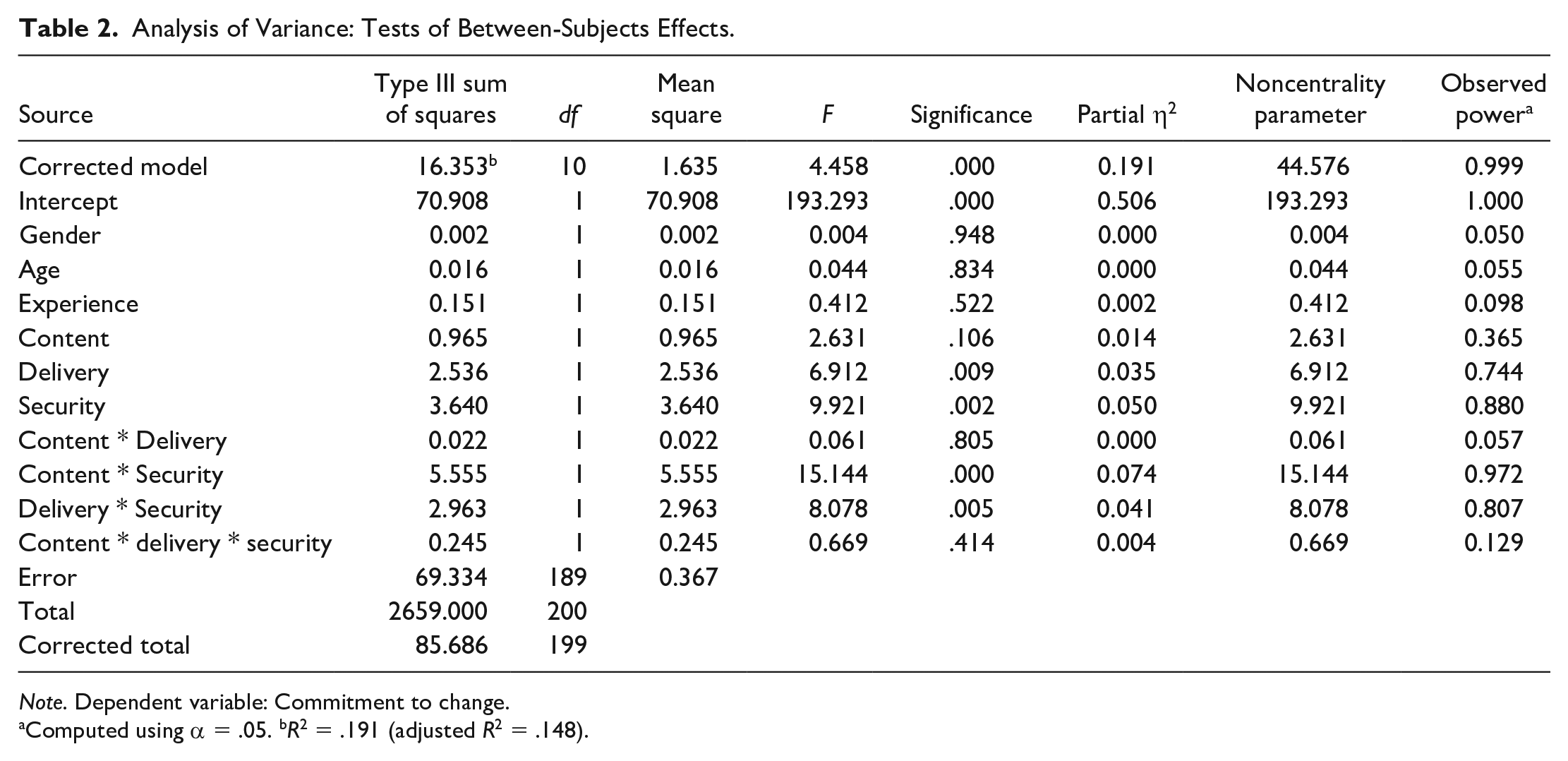
Afterward, we conducted a univariate analysis of variance (ANOVA) to see the significance of the main and interacting effects of content type (rational or emotional appeal), delivery style (strong or weak), and job insecurity (secure vs. insecure) on the outcome variable, commitment. We controlled for gender, age, and tenure, which are typical control variables in organizational change research (Oreg et al., 2011). Univariate tests were significant for delivery, security, the interaction of content and security, and interaction of delivery and security (p < .05). The mean scores for each experimental treatment on the dependent variable are presented in Table 1. Table 2 reports the ANOVA results for the statistical significance of the differences between treatment groups on commitment. In addition, Table 3 presents a summary showing the mean scores across main and interaction effects on commitment and the relevant p values.
Descriptives for Experimental Treatments on the Dependent Variable.

Note. Dependent variable: Commitment to change.
Analysis of Variance: Tests of Between-Subjects Effects.
Note. Dependent variable: Commitment to change.
Computed using α = .05. bR2 = .191 (adjusted R2 = .148).
Summary Table for Significant Differences in Mean Scores.

Note. ns = nonsignificant.
p < .05. **p < .01.
The treatment groups’ mean scores (Table 1) show that commitment is highest with emotional content, secure job context, and strong delivery treatment (
Regarding the interaction terms, the interaction of content and security has significant effects on commitment to change (F = 15.144, p = .000) with the highest effect size on commitment. The mean scores (Table 3) show that in the context of job security, emotional message content provides a significantly higher commitment to change (
In addition, the interaction of delivery and security has a significant effect on commitment (F = 8.078, p = .005). In a secure context, the strong delivery of the message (
As a robustness test, we also conducted a structural equation modeling. The chi-square group differences between security and insecurity groups appeared significantly different. The path analysis results confirmed that in secure job contexts, delivery appears as significantly related to commitment whereas content is not significantly linked. On the other hand, in insecurity contexts, content is significantly related to commitment and delivery is not significantly associated. This also verifies that in different job security contexts, different aspects of the change message (content vs. delivery style) are associated with commitment to change.
Discussion
This experimental study investigates specific aspects of change communication by focusing on the content of a change message and how it is conveyed by the leader. In previous studies, both the content and message delivery style have been identified as important factors in the effectiveness of the message (Graetz, 2000). However, the relative importance of content versus delivery has remained inconclusive in previous studies. This study aims to find whether it is the content or how the message is conveyed by the leader has more effect on commitment to change. It also analyzes whether rational versus emotional-based contents in a change message predict different reactions to change. We propose and investigate the effect of job insecurity as a contingency factor in these relationships. More specifically, deriving from the dual process approach, we assert that how people process and react to a change message content (rational and emotional) and message delivery will differ according to the contextual factor of job insecurity. Using a vignette-based experimental study, we examine the variables of content, delivery, and context; and their interaction effects on commitment to change with eight treatment groups.
Considering the main effects, a strong delivery style and a context of job insecurity emerge as the most important factors for commitment to change. Strong delivery style of message, exhibiting changes in the tone and pace of voice, an energetic style and expression of enthusiasm and liveliness, has a higher influence on commitment to change, compared with weak delivery style with a monotone speech without any enthusiasm conveyed to change recipients, confirming previous studies. Also, a context of job security, where employees do not perceive a threat of job loss, is more influential on commitment compared with an insecure context, as expected.
Moreover, the results show that when the contingency factor of job insecurity is not taken into consideration, both rational and emotional appeal in message content contribute to the commitment to change, as previous research suggests (Amis & Aissaoui, 2013). However, when the context is considered, the effect of rational and emotional content varies such that in contexts characterized by job security emotional appeal leads to higher commitment to change, whereas in an insecure context, rational content leads to higher commitment. This finding is supported by the extended parallel process model (Witte, 1992), which asserts that people may process affective and cognitive cues differently depending on the perceived threat. Therefore, if there is a threat of job loss, the employees generate their reactions according to the factual and rational information they receive. It may be that they rationally evaluate the perceived benefit versus harm through rational cues and logic. Emotional content does not have that much influence, possibly because of the need for rational information to reduce uncertainty and make sense of the situation in a climate of alertness and perceived threat of job loss. Therefore, it is important that managers focus on rational content, consisting of facts, statistics, and information about the necessity and expected outcomes of change under job insecurity conditions. On the other hand, when employees perceive their jobs as secure, emotional content is more influential. Therefore, in such circumstances, managers may generate higher commitment through emotional appeal in their communication, involving inspirational and emotional statements.
Similarly, the context of job insecurity emerges as an important contingency concerning message delivery style. Strong delivery of message matters only in secure change contexts, whereas in insecurity conditions, weak versus strong message delivery no longer has a significantly different effect on change recipients’ commitment to change. Therefore, we can conclude that while strong delivery is effective in secure change contexts, delivery style loses its importance under conditions of perceived job insecurity. This result may also be explained by dual process theories, which assert that when recipients are motivated to analyze the message content (i.e., insecure context); the content will have a larger impact on the outcomes and the delivery style will not have as much effect (Bodie & Burleson, 2008). Employees may not be convinced merely by emotional discourse and strong styles in message delivery if they feel insecure. In that case, their expectation becomes rational explanations in content. This shows that if there is job insecurity associated with the organizational change situation, the leaders need to focus on content and use logic and rationality to gain commitment to change. On the other hand, in contexts characterized by job security, the combination of emotional content and a strong delivery style results in the highest commitment to change. Therefore, change leaders would benefit from using emotional appeals in their messages combined with a strong delivery style when there is no perceived job insecurity.
These findings can be explained by several psycho-social mechanisms. First, the level of uncertainty associated with the nature of job insecurity creates a specific need to seek more information. In line with the uncertainty reduction theory (Berger & Calabrese, 1975), a person in an uncertain context, such as organizational change, will strive for more information to reduce this uncertainty. Smet et al. (2016) similarly argue that in the case of job insecurity, the employees will attentively search for more change-relevant information. Sense making theory (Weick, 1995) provides another appropriate perspective to cope with such uncertain situations (e.g., crisis situations, Stieglitz et al., 2018), where individuals try to make sense of the circumstances and reduce uncertainty by gathering more information. In such cases, the content of the change message may serve to provide that information that employees seek and therefore, bring the need to reduce paying more attention to content.
Another reason why rational content of a message gains more importance in insecure change contexts could be related to active preservation effort and proactive coping (Shoss, 2017). Job insecurity involves threats or stimulates enhanced perceptions of threats; more sensitivity to inputs/outcomes. According to the job preservation motivation (Shoss, 2017), in the face of a possible threat to their jobs, employees may act in ways to avoid loss of the job. In that case they may try to be more alert to the message content to understand the situation and what works better to preserve their job. Additionally, employees may be more sensitive to content of the message under conditions of job insecurity due to proactive coping mechanisms (Shoss, 2017). Feeling the uncertainty associated with job insecurity may also trigger proactive strategies to try to have control over the environment and outcomes (Lam et al., 2015). One way to do so may be by engaging in careful processing of the message content. This way they can proactively seek more details in the information either to reduce personal concerns or increase sense of security or to understand the next steps and possible consequences to take next steps realistically.
Finally, rational choice theory (Coleman, 1990) may be another perspective to explain the results of this study. Rational choice theory posits that individuals choose the best course of action according to their personal preferences and the constraints facing them. To do so, they rely on the available information, make rational calculations, take into account potential costs and benefits to determine their future action aligned with their self-interests. Thus, in the case of job insecurity, employees may pay attention to the rational details and the content of the change message particularly. Through such careful inspection, they may consider possible coping strategies in the face of job insecurity, weigh the possible consequences of their actions (e.g., decreased or increased work effort), and then decide what action to take to ensure their own welfare.
We suggest future avenues of research to delve into the possible psychosocial dynamics behind the differential results across secure versus insecure contexts by qualitative research studies in real organizational settings.
We also would like to draw attention to the interpretation of our findings through the lens of an experimental design. Given that vignettes are a step away from real experience, the participants may not be emotionally involved in a hypothetical situation as opposed to a real one, because the situation has less direct personal relevance for them. In that case, they may use Kahneman’s System 2 (rational) processing more than System 2 (emotional) processing compared with live experiences. Consequently, any results indicating differences between rational and emotional content may even be stronger in real settings. Following the similar logic, respondents who volunteer to participate in a study may be more motivated to pay attention to the content of the message. Evidence showing the importance of content between the experimental conditions would again be powerful because of this more conservative experimental context. As a result, the content effect may be even understated in this study and expected to be stronger in real organizations. Therefore, the vignette design in our study furthermore poses a strength to show that our findings are robust given this type of a controlled environment (i.e., experimental design). 1
Theoretical Implications
This study contributes to the organizational change communication literature in four ways.
First, despite their close linkage, there are surprisingly few studies on leadership and communication, especially in the context of organizational change (De Vries et al., 2010; Helpap, 2016; Luo et al., 2016). This study fulfills the need for more research on the specifics of change communication, by having a finer grained look at various aspects of the change message. Second, there is a scarcity of empirical research on which type of communication framing (e.g., emotional or rational content) is best suited for different change contexts. Moreover, previous studies reached inconclusive findings regarding the different impact of message content versus delivery style in generating positive reactions. Investigating the impact of rational versus emotional message framing and message content versus delivery style is valuable for the research field, because the findings shed light on various overlooked and controversial aspects of change message. This study establishes the impact of emotional versus rational message framing and message content versus delivery in change communication by introducing the significant role of context. Consequently, the findings show that one type of change message does not apply to all circumstances and change agents need to customize messages according to the context of job security or insecurity. Third, this study adds to the academic knowledge on dual process theories, by extending their application in the change communication domain. Finally, although change messages can be processed differently and may require different message strategies in secure versus insecure change contexts, there is scarce evidence of effective announcement strategies in different contexts. Experimentally testing the impact of specifics of change communication provides clear guidelines to change managers, as will be discussed next.
Practical Implications
Bearing in mind the inevitability and necessity of continuous change in organizations, the study also has managerial significance. The results of the study provide practical cues to change managers as to how to design and convey change messages to obtain employees’ commitment to change. The implications of the results are important since change communication is a variable over which managers and organizations have direct control.
This article suggests that leaders need to focus on different aspects of a change message across different contexts of job security or insecurity. Changes that are more severe for the employees (i.e., those that have the threat of job insecurity) require change leaders to plan a different message strategy than those changes that take place in a more secure job context. Understanding which message elements lead to more commitment under which conditions will be useful in crafting and delivering effective change messages.
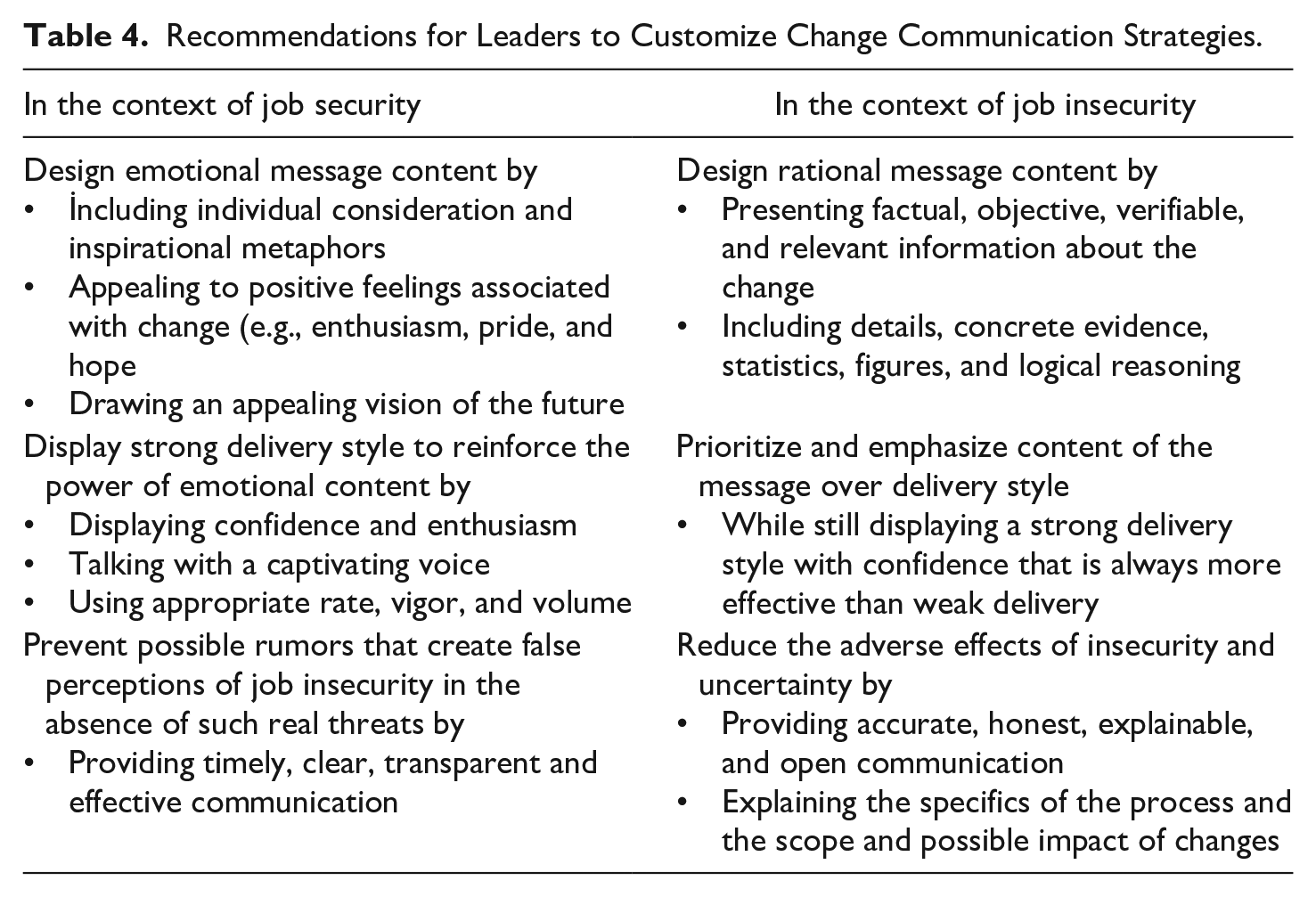
The results show that change leaders need to vary their strategy in crafting and delivering their change communication considering the context of job insecurity. In change contexts characterized by job security, where there is no threat to employees’ jobs or job features, managers must emphasize more the emotional appeal in content and strong delivery style to get a higher commitment to change. More specifically, they should plan their change communication to include personal consideration and inspirational metaphors, and appeal to positive feelings associated with the outcomes of change such as enthusiasm, pride, hope, and joy. They may appeal to individuals’ values as well as drawing an appealing vision of the future. At the same time, managers may benefit from enhancing the emotional framing in the content by a strong delivery style, displaying confidence and enthusiasm, talking with a captivating voice, using appropriate vigor, rate, and volume. With such a delivery style, they can reinforce the content and ensure a higher commitment to change.
On the other hand, in changes, where job insecurity is a concern to employees, change managers must focus more on rational message content. They should present factual, objective, verifiable, and relevant information that is important to the employees in the change process. It is important that managers emphasize as many rational pieces of information as possible to reduce uncertainty. If possible, the message should contain data with concrete evidence, figures, statistics, and logical explanations. This way employees may feel a higher sense of control over the change process, analyze and understand the situation better, and, subsequently, show higher commitment. In these circumstances, managers’ delivery style (e.g., enthusiasm or passion) will not matter as much, since the employees will be more motivated to pay attention to the content rather than the delivery style. Overall, employees will have a more favorable attitude toward change if the change communication matches the right style of content and delivery in different security contexts.
Finally, considering that security has the highest effect on commitment, it is important for change managers to ensure their employees feel a secure environment where they do not feel a threat of job loss during the change. Yet, in many cases, job insecurity may be the reality. In that case, it may be tough to convey a rational and objective change message that will gain employees’ commitment when they are faced with such a threat to their jobs. Even if it means rationally explaining a difficult situation, previous studies show that managers may still offset the adverse effects of job insecurity by providing accurate, honest, and open communication as well as being transparent about the specifics of the process and the scope of changes so that employees can better understand the level of impact on their jobs or their positions (Bayraktar, 2018; Cascio, 2002; Kets deVries & Balazs, 1997). Moreover, Bayraktar (2018) suggests that managers can openly discuss the forces and reasons that caused the organization to be incapable of ensuring job security to their employees, or even realistically discuss with each employee their specific situation and plan future steps with them.
On the opposite extreme, in many change situations, there is a false perception of job insecurity, when there is no such threat to jobs in reality. Especially in downsizing situations, survivors of layoffs may experience stress and worry about their future jobs. In such cases, rumor that arise in the absence of clear communication lead to undesired consequences. As Smet et al. (2016) show in their research, the absence of sufficient change communication may result in rumors, which are often much worse than the reality, cause worst-case scenarios and panic, and subsequently trigger feelings of job insecurity. Therefore, when the ongoing change process does not pose a threat to jobs, it is essential for managers to be even more vigilant about providing adequate and timely communication to assure job security before letting rumors emerge due to the silence of the organization.
Table 4 provides a summary of recommendations for leaders to customize their change message strategies across job security and insecurity contexts. All in all, understanding the practical implications of this study will not only help reach intended organizational goals and success of change efforts but also will support change recipients with a smoother and more effective communication process during the challenging times of change.
Recommendations for Leaders to Customize Change Communication Strategies.
Footnotes
Acknowledgements
We would like to thank Dr. Emre Soyer for his constructive comments on our manuscript.
Declaration of Conflicting Interests
The author(s) declared no potential conflicts of interest with respect to the research, authorship, and/or publication of this article.
Funding
The author(s) disclosed receipt of the following financial support for the research, authorship, and/or publication of this article: This work was supported by Bogazici University Research Fund under Grant No. BAP 13C02D1.
