



Abstract
This article explores Edgar Schein’s sociopsychological model of change by relating Schein’s reflections on how he derived it from and extended Lewin’s model and how it informs contemporary change theory. Schein’s accounts of how he created his change model provides something of a mirror into his process of theorizing. The aim of this article is to reflect on Schein’s change model as to how he created and understands his formulation of his change model, with a view to drawing lessons for practices of creating models or theorizing in the field of organization development and change.
Introduction
How might organization development and change (ODC) scholars create theory or, perhaps less ambitiously, create models out of questioning their empirical experience? What are the cognitive dynamics of model creation in the social science of ODC? Coghlan et al. (2019) articulate the social science philosophy of ODC in terms of reflective discourse on the practice of social science and the structure of human knowing: the empirical level of experiencing, the intelligent level of understanding, the rational level of reflection, marshaling evidence and judging, and the responsible level of decision making and taking action. This essay explores Edgar Schein’s sociopsychological model of change by relating Schein’s reflections on how he derived it from and extended Lewin’s model. The context of this essay is threefold. First, over the past decade although there have been several reflections on Schein’s work none has discussed his change model, particularly from the perspective of how he understood the process of creating it. Second, from the discussions of Lewin’s change model and the criticism of its relevance in today’s world, how Schein’s developed his change model from Lewin’s model of change and how he freed it from the constraints of Lewin’s refrigeration imagery are significant for our understanding of the process of change. Third, how Schein shows how he created his model provides insights into how models may be created and offers learning for ODC scholars.
Schein’s Sociopsychological Model of Learning and Change
Schein articulates his change model in many of his publications. However, it is in his chapter, “Personal change through interpersonal relationships” that he presents the most elaborated articulation of his sociopsychological model of change (Schein, 1979). He describes his theoretical analysis of the complex dynamics of interpersonal influencing and applies it to education, consulting, therapy, coaching, and other helping settings. What underlies his model are the dynamics of deep change or changes to self-identity, where upsetting the current equilibrium involves unlearning and evokes resistance. The change challenges, therefore, are to reduce resistances and to find ways to change and to enable the change to work. It is terms of addressing these challenges that Schein’s change model is directed (Table 1).
Schein’s Sociopsychological Model of Learning and Change.
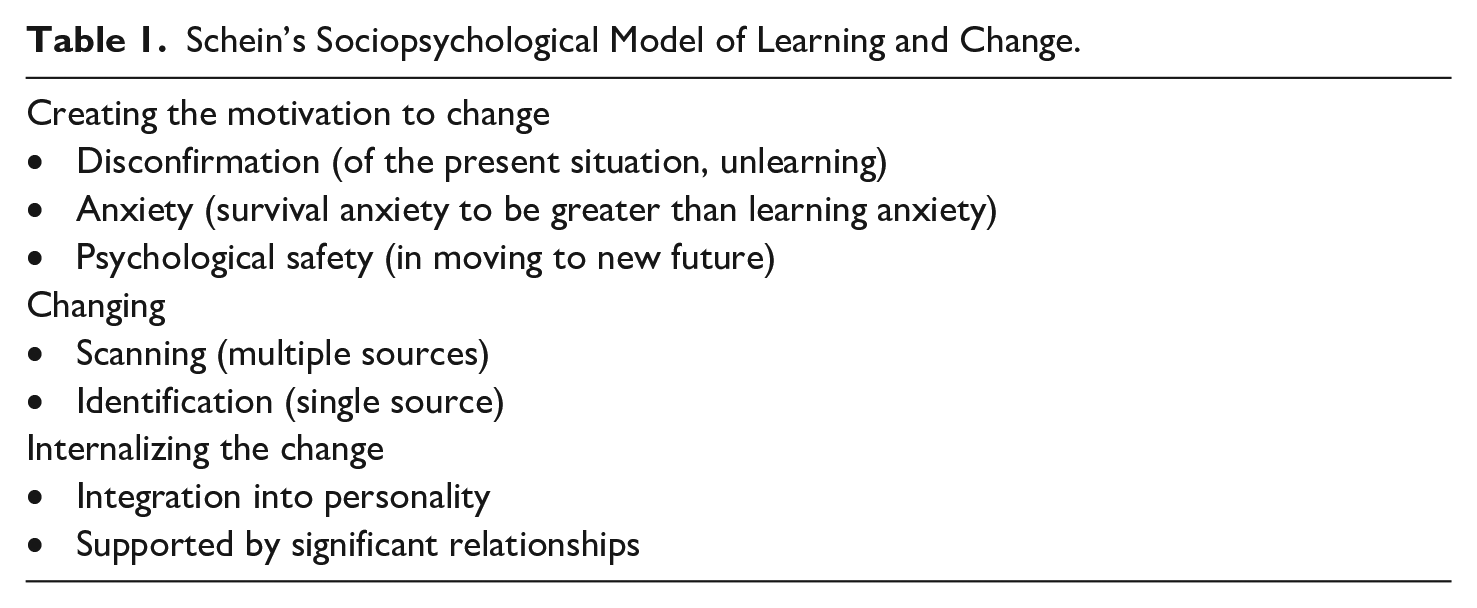
Using Lewin’s terminology of change as a process of unfreezing, moving (changing), and refreezing, Schein explores what psychological and social processes occur when people and organizations change. He describes how change begins with some sort of disconfirmation, that is, that what is expected is not confirmed. But disconfirmation of itself is not sufficient for change. It has to be accompanied by anxiety or guilt about the disconfirmation. But that too is insufficient for change to occur. People need to feel psychologically safe to let get of the present and move to a different future. When they are ready to change, then they can either scan multiple sources of information by reading and conversing with other people to find help. On the other hand, they can engage in a relationship with a single source, such a tutor, therapist, or consultant who acts as a facilitator of their learning and change. When they have changed, they need to integrate the changed state into their personality, behavior, and significant relationships.
For Schein, the basic assumptions of the model are that the beliefs, attitudes, values, and behaviors of adult individuals tend to be integrated with each other and tend to be original within the self-identity of the individual. That self-identity gives stability or continuity, which is stronger than a force for its change unless the change is towards greater integration. Self-identity is enforced by relationships and the support and affirmation of others, and so the change process is both psychological and social. The integration is not static but exists as a dynamic equilibrium, where forces for stability are internalized and will not shift without the reduction of defenses.
Lewin’s Change Model
The source of Schein’s change model is Lewin’s three-step change model. As Lewin (1947/1997) expressed it A successful change includes therefore three aspects: unfreezing (if necessary) of the present level L1, moving to a new level L2, and freezing group life on the new level. Since any level is determined by a force field, permanency implies that the new force field is made relatively secure against change. (p. 330)
Lewin (1947/1997, 1948/1999) grounds his model in his field theory and the dynamics of groups. Field theory is an approach to understanding groups as a complex picture of dynamic forces that affect both the group and individual behavior. A field therefore exists in a state of quasi-stationary equilibrium held together by forces that push for stability and ones that push for change. Burnes (2020) explores Lewin’s three-step model and shows how it is integrally linked to the other pillars of Lewin’s work: field theory, group dynamics, and action research, with each element supporting and reinforcing the others. In these terms, Burnes argues that Lewin’s three-step change model is grounded in a complex theory of competing forces in a group and in a method of cycles of reconnaissance, planning, and fact-finding about the results of the action.
Cummings et al. (2016), in their review of Lewin’s legacy of “change as three steps” (CATS), argue that what Lewin wrote in in his original Human Relations article (Lewin, 1947/1997) was reconstructed later to become a foundation for organization development and stages of change management. In this context, Lewin’s CATS has come under severe criticism as being too linear and simplistic in today’s VUCA (Volatile, Uncertain, Complex, Ambiguous) world. However, such criticisms only hold good if one accepts Cummings et al.’s argument that CATS was a late and underdeveloped addition to Lewin’s work. As Burnes (2020) demonstrates, CATS is built on Lewin’s work on child psychology and field theory begun in Berlin in the 1920s and it incorporates group dynamics and action research, which he developed after his move to the United States in 1933. Thus, Burnes argues that CATS was not new or a simplistic approach to change, but basically a relabeling and bringing together of the change concepts that Lewin had developed over more than 25 years.
Schein played a key role in the extension of Lewin’s original ideas. What Cummings et al. fail to do is to explore the foundations of Schein’s elaboration and how he actually frames these steps in terms of the sociopsychological dynamics of learning and change and thereby provides quite a different focus to the misrepresented view of CATS promoted by Cummings et al. Bartunek and Woodman (2015), on the other hand, pick this up and discuss how Schein added cognitive amendments to Lewin’s model that includes conversation as an integral part. Many of the misunderstandings and misinterpretations of CATS arose because Lewin died shortly before the publications in which he presented it appeared (Burnes, 2020). His death led to a dissolving of the many collaborations that Lewin was involved, with each seeming to focus on a particular aspect of his work, but no one pursuing the whole.
Schein’s Reflections on Creating His Change Model
Schein (1996) shares his thinking about his change model in three publications (also see, Schein et al., 1961; Schein & Schein, 2019), and these publications provide the basis for insights into his thinking.
It is in the 1961 Coercive Persuasion book that Schein articulates the foundation of his model (Schein et al., 1961). In 1953, during his tenure in the U.S. military psychology service, he was assigned to a project that evaluated and treated military personnel who had been captured by the North Koreans. These personnel were considered to have been indoctrinated and had allegedly collaborated with the enemy. Repatriates were returned to the United States from Korea by ship, and on the voyage, they were assessed psychologically and given therapy by psychiatric teams. Schein recounts how his ship was delayed for 3 weeks, and during that time, he set up a booth and interviewed repatriates by asking them to tell him the stories of their imprisonment. They described very sophisticated techniques for manipulating the prisoners, controlling information, and using cellmates, who unbeknown had already confessed, as apparent friendly persuaders. From these interviews, Schein framed his sociopsychological model of coercive persuasion in terms of Lewin’s model of change. He described coercive persuasion as a process of physical and psychological unfreezing and how the unfreezing forces changed some of prisoners’ beliefs and attitudes toward themselves and the Communists and how some made a sincere confession in the manner desired of them by the North Korean guards. Referring to his work with the prisoners, Schein comments I had the opportunity to look at a real case, not an academic case, of how we influence someone. I would call that being very cleverly adaptive. I think that it has always been my strength: to turn whatever is around and what is going on around me into something analytically and practically useful. (in Hansen & Madsen, p. 45)
After his research with the prisoners of war, Schein reflected that he was dissatisfied with the current social psychology of influence which was mainly directed towards marketing and advertising and he focused on the social influences engaged in by organizations as they socialized their employees.
In an article about his course on managing change, Schein (1996) provides new information about how he developed his change model from Lewin’s. What is interesting in this article is his statement.
The power of Lewin’s theorizing lay, not in a propositional kind of theory but in his ability to build ‘models’ of processes that draw attention to the right kinds of variables that needed to be conceptualized and observed. In my opinion, the most powerful of these was his model of the change process in human systems I found this model to be fundamentally necessary in trying to explain various phenomena I had observed, and I found that it lent itself very well to refinement and elaboration. (p. 28)
In the third edition of The Corporate Culture Survival Guide, Schein and Schein (2019) reframe the context of learning and change and drop the Lewin’s refrigeration imagery. They state that the dynamic context of today’s world, termed as VUCA largely “has made staged linear models of planned change obsolete and irrelevant” (p. 95), the point argued by the critics of the use of Lewin’s CATS. While remaining grounded in Lewin’s work, Schein and Schein reframe Schein’s change model in terms other than the traditional CATS. They ground the change model more explicitly in Lewin’s field theory and in the change process as a force field of tensions between forces driving change and forces pushing for stability. An organization in a quasi-stationary equilibrium state engages in continuous adaptive coping cycles of unlearning and changing. Disconfirmation captures the driving forces for the motivation for change, which are counterbalanced by restraining forces that create learning and survival anxiety and an unwillingness to let go of an element of stability. In keeping with Lewin’s insight that it is through a focus on reducing restraining forces that a change in a force field can be achieved, Schein and Schein demonstrate that the relationship between the change agents and change targets is central to reducing learning anxiety, creating psychological safety, and providing options and supports for learning and change. The utilization of scanning and identification mechanisms provide alternative methods for learning and changing, which then need to be internalized in the self-concept and identity and in significant ongoing relationships. It is in these terms that Schein has reframed his change model and has made explicit again his appreciation of Lewin’s sophisticated theory of change that he discussed in Coercive Persuasion in 1961.
Reflection
From Coghlan et al.’s (2019) framing of the social science philosophy of ODC in terms of reflective discourse on the practice of social science and the structure of human knowing, I have adopted the approach of reflecting on Schein’s account of sociopsychological mode of change from his perspective as a process of theorizing. Schein’s change model is more than an extension of Lewin’s CATS. It provides a complementary theory of the dynamics of influencing, learning, and change and enables ODC scholars to gain insight into the sociopsychological dynamics of a change process and to create interventions to engage the participants. Within this framing, Schein’s model is more about human behavior than about structures, systems, and technologies, which is what VUCA connotes.
In constructing his model Schein articulated three basic purposes it would perform (Schein et al., 1961).
It would provide a theoretical structure that would permit the organization of the many and varied experiences through meaningful categories.
It would provide theoretical categories which would make it possible to understand the coercive persuasion process and its effects.
It would provide some basic categories for a more general theory of social influence, which Schein terms coercive persuasion.
Schein’s model of the sociopsychological dynamics of change fulfils the purposes it was designed to do. It provides a structure for understanding how people respond to forces driving change and are enabled to unlearn and reduce restraining forces, change and achieve an appropriate level of sustainability. It provides theoretical categories for understanding the particular dynamics of learning and changing, and a structure for Schein’s theory of coercive persuasion.
Coghlan et al. (2019) propose that the starting point of the exploration of the practice of social science be through the actual operations of human knowing and doing. In a parallel vein, Swedberg (2014) argues for attention to be given to the process of theorizing, that is, the process of what one does when producing a theory, as theorizing is largely ignored, with the emphasis being generally placed on the theory as the outcome. The act of theorizing or model creation turns the attention from the outcome to the act of generation itself. It places the issue firmly in the question, “How do we come to know?” As Coghlan et al. demonstrate, each act of knowledge of concrete reality includes questioning, understanding, critically reflecting, and concluding, a process they call interiority, that is, where ODC scholars are attentive to their process of coming to know. By attending to both the data of their consciousness (how they are experiencing, questioning, understanding, and judging) as well as to the data of sense (what they see and hear in the external data), researchers can engage with the empirical data of their experiencing, the intellectual data of their understanding (by abductive reasoning in the context of discovery), and the rational data of their judgments (by inductive reasoning in the context of verification).
Schein’s account of how he developed his change model provides an insight into how one eminent ODC scholar developed his model of change (Table 2). Schein’s experience of the prisoners’ accounts of their imprisonment gave him insight into sophisticated manipulation techniques that were operative in the prison camps. Through the process of abduction, a further insight was his application of Lewin’s change model and how he extended it in terms of sociopsychological processes of influence.
Structure of Schein’s Cognitive Process of Creating the Model.
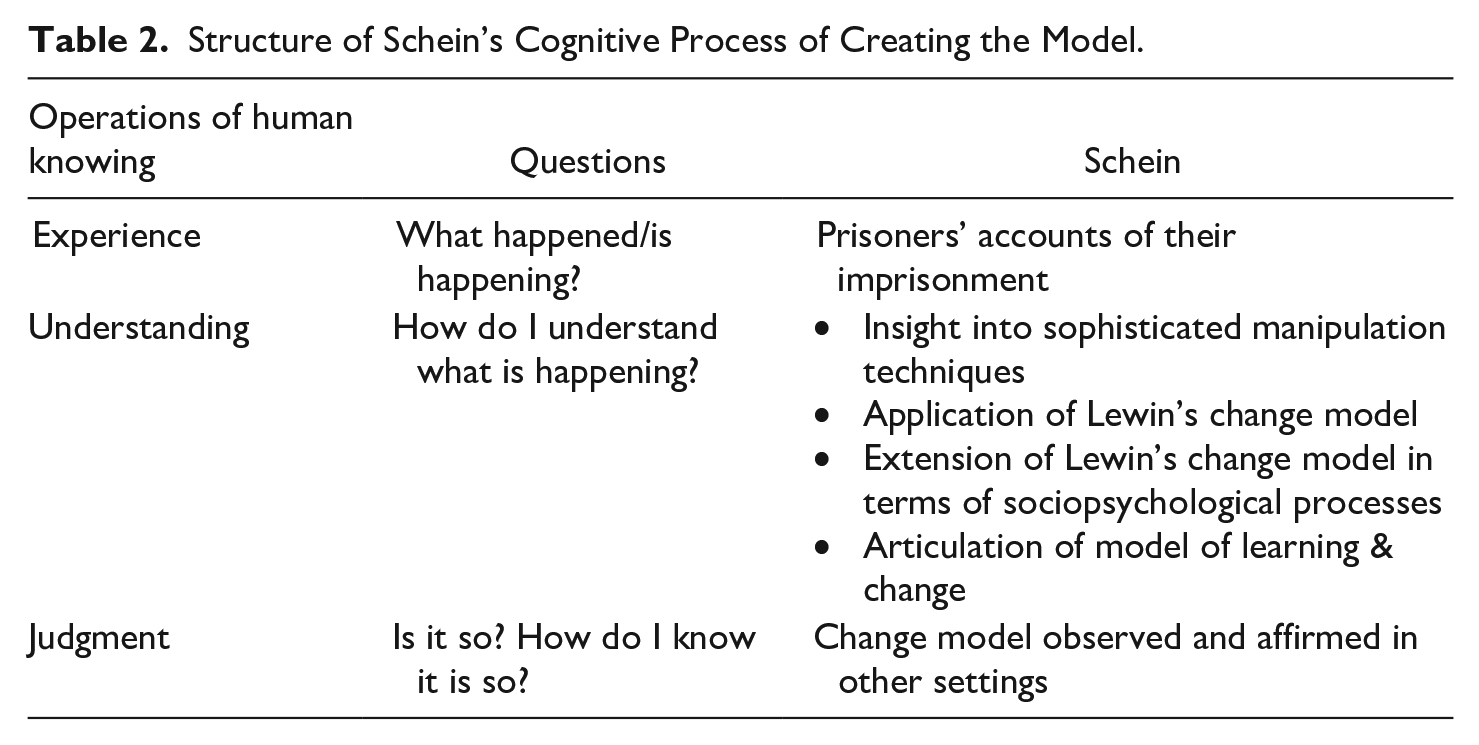
In the 1996 article cited above where Schein reflects on how Lewin’s theorizing emerged from his (Lewin’s) “ability to build ‘models’ of processes that draw attention to the right kinds of variables that needed to be conceptualized and observed” (Schein, 1996, p. 28), he is articulating Lewin’s mode of theorizing as being grounded in “trying to explain various phenomena that he had observed that it lent itself very well to refinement and elaboration” (Schein, 1996, p. 24). He writes “Lewin’s model of change leads to a whole range of insights and new concepts that enrich change theory and make change dynamics more understandable and manageable” and one on which he was “able to build further because of its fundamental concepts were anchored in empirical reality” (Schein, 1996, p. 34). As Schein poses a challenge I think we need to develop a science based on good observation, that is, blended with a well-educated consciousness to make sense of what is going on and write about it so that others can replicate your experience. . . . The challenge is to go see for yourself and if you see something very different write about that. (in Coghlan, 2018, p. 397)
Lessons for ODC Scholars
Schein’s account of how he developed his change model provides lessons for ODC scholars and researchers. Why is this important? In the current academic environment where propositional knowledge is prioritized to the virtual exclusion of practical knowledge developing alterative paradigms of engaging in the philosophy of social science is imperative (Coghlan et al., 2019). As Hansen and Madsen (2019) explore, the process of theorizing is as important as focusing on theory as an outcome, and it involves attending not only to external data but also to the internal data of one’s own thinking and assumptions and engaging in a community through reading, talking, listening, questioning, and writing. In short, theorizing places the emphasis on the scholar in scholarship. The challenges for the formation of ODC scholar–practitioners are that they learn from the giants who have shaped the field and learn to attend to their interiority.
Figure 1, derived from Table 2, provides a structure for understanding the cognitive processes of creating a model or theory. It begins from experiencing what one observes and posing questions to those experiences. The answers or understandings that come have to be subjected to rigorous scrutiny in the light of how they fit the evidence and whether there are alternative explanations. The outcome is a judgment that it is indeed so and the model/theory is affirmed. If not, the process of experiencing. Inquiring, and testing continues.
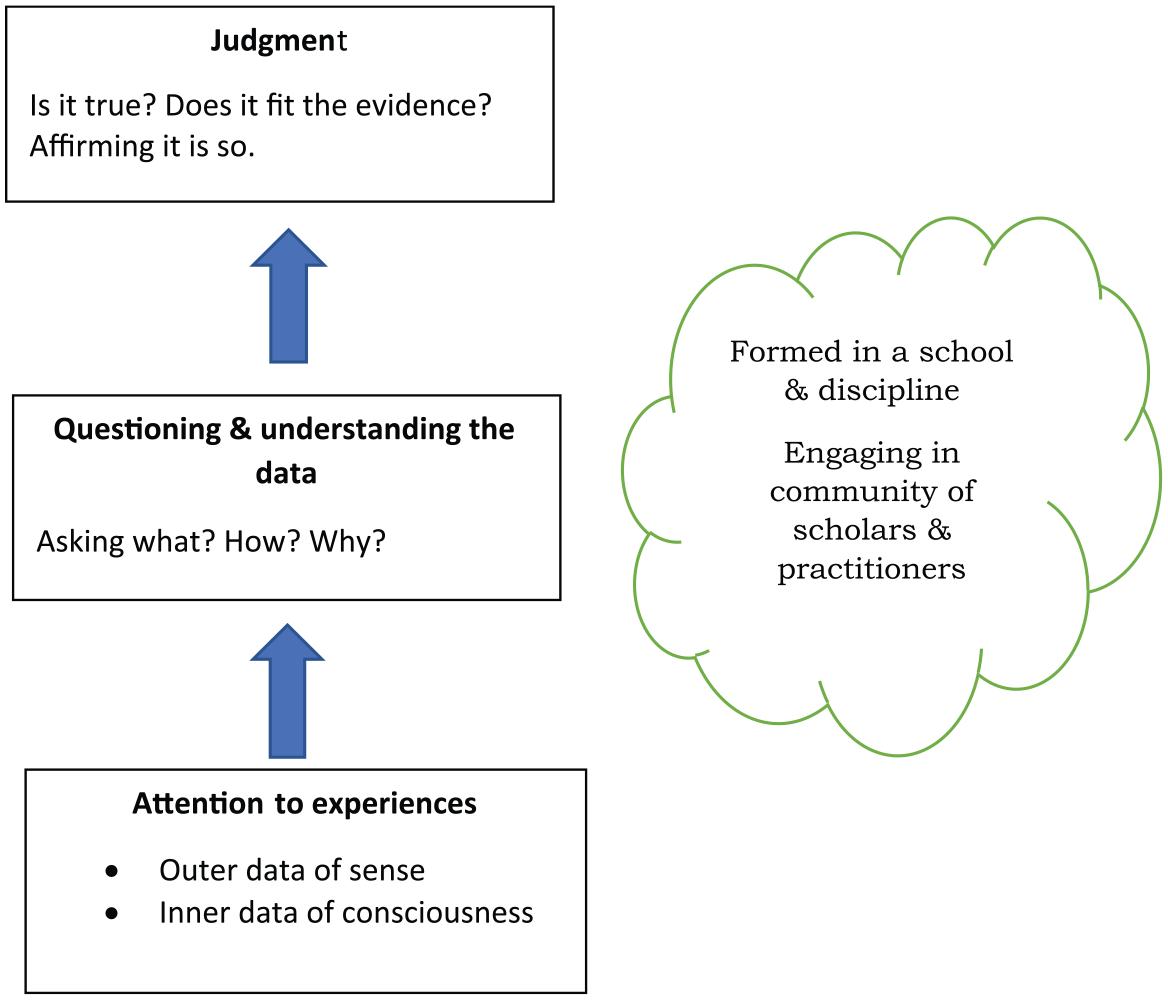
The operations of theorizing.
Conclusions
Over his long career, Edgar Schein has consistently shared his self-insights from which his theorizing flows. Hopefully this essay provokes learning from Schein’s reflections in the creation of his change model so as to challenge us to attend to and develop our theorizing processes.
Footnotes
Acknowledgements
I thank Bernard Burnes, Ed Schein, and Rami Shani for their respective helpful comments in the development of this article and to Gavin Schwarz for his editorial critique and encouragement.
Declaration of Conflicting Interests
The author(s) declared no potential conflicts of interest with respect to the research, authorship, and/or publication of this article.
Funding
The author(s) received no financial support for the research, authorship, and/or publication of this article.
