



Abstract
Qualitative methods have played and are likely to continue to play an important role in scholarship on organizational development and change. One key data source dominates all others, however, in the qualitative lexicon: the one-on-one interview. This has become so common as to seem almost banal and taken for granted. And yet, the interview is actually a very complex phenomenon where many different things may be going on. This essay attempts to elucidate some of this complexity by identifying five different genres of interviewing, each with its specific ontological assumptions and purposes. We identify and illustrate specific techniques and practices associated with each genre, and offer suggestions for further development, while inviting researchers to think through more carefully what interviews can and cannot deliver, and how they can be made meaningful.
Interviews have always been the staple of qualitative research methods in management studies, and in particular for research dealing with organizational change. Interview-based studies have addressed issues such as sensemaking (Balogun & Johnson, 2004), emotions (Boyatzis et al., 2017; Huy, 2002), job transition (Klag et al., 2015), change agency (Cassell & Lee, 2012; Huy et al., 2014), and identity (Dutton & Dukerich, 1991) in the context of change. Interviews are so common within the field that they are largely taken for granted—the obvious default method for the qualitative researcher.
And yet, scholars have also drawn attention to the limitations of interviews. Some have noted the problems of hindsight bias in retrospective interviewing (Huber & Power, 1985; Lamont & Swidler, 2014). Others have argued that interviews cannot adequately capture ongoing practices because these are based on tacit knowledge that cannot easily be articulated (Rasche & Chia, 2009). Moreover, while, interviews are often thought, above all, to be an ideal way to access the unique richness of people’s lived experience (Kvale, 1983), even this common understanding has been questioned. Indeed, several scholars argue that interviews should rather be considered as local interactional accomplishments where what takes place is highly dependent on how the interviewer situates the task, and how interviewees position themselves with respect to the audience they believe they are addressing (Alvesson, 2003; Potter & Hepburn, 2005; Silverman, 2017).
Elaborating on these concerns, Alvesson (2003) argues that far from offering a neutral account of personal meanings and experiences, what is expressed in interviews may reflect a variety of other phenomena such as “identity work” (where respondents attempt to construct appealing images of themselves), “moral storytelling” (in which interviewees situate their own actions in terms of acceptable moral values), the reproduction of “cultural scripts” (e.g., where respondents articulate official storylines), or “political action” (aimed at orienting the interviewer’s understanding toward certain goals). Of course, while for some, this may be seen as problematic undermining the integrity of their research enterprise, it may also suggest that one purpose of interviewing might be precisely to draw out these discursively constituted phenomena.
Finally, other scholars have pointed out that interviewing is far from neutral in another way too: it is entirely possible that the questions asked could inadvertently influence what respondents do next by raising issues not perceived before. Kvale (1983, p. 177) notes that, “During the interview the interviewee may himself have discovered new aspects by the themes he is describing, and he may suddenly see relations which he has not been conscious of earlier.” This could be problematic if researchers are seeking to capture the “natural” evolution of events, especially when several interviews are planned over time. However, another take on this is that interviewing could also be seen as a kind of intervention, something that organizational development practitioners might want to deliberately mobilize for transformational purposes (Roulston, 2010).
Overall, this suggests that the one-on-one qualitative interview is a more complex phenomenon than is usually represented (Gubrium et al., 2012), leaving the conscientious qualitative researcher wondering how to proceed. What, if anything, is the value of interview data for different purposes? How should they be interpreted? The purpose of the present article is to try sort out some of this complexity by (a) offering a typology of five genres of interviewing associated with different purposes, (b) providing suggestions about how interview practices may be designed to fit their purpose, and (c) offering some approaches to enriching interview practices more generally.
To achieve this, we build on the literature in the social sciences, in which the ontological, epistemological, and methodological issues surrounding interviews have been more extensively addressed (Gubrium et al., 2012; Roulston, 2010). We also draw on ideas from previous published studies in management and on some of our own experiences to feed into the discussion. We begin by briefly introducing the typology of interview purposes that will form the backbone of the essay.
Five Interview Genres
Several writers have noted that interviews may play a variety of different roles in qualitative research, and these are related to different ontological and epistemological assumptions. Most commonly, writers distinguish between “neopositivist” and “romantic” or interpretative perspectives (Alvesson, 2003; Roulston, 2018), where the first implies the use of interviews to capture “facts,” based on a neutral objectivist perspective, and the second implies a focus on capturing meaning and experiences through empathetic engagement with interviewees. Beyond these two dominant perspectives, the interview has also been seen as a local interactive accomplishment (Potter & Hepburn, 2005; Silverman, 2017), an approach characterized as “localist,” (Alvesson, 2003) or “constructionist” (Gubrium et al., 2012; Roulston, 2010) because the focus shifts to the way in which interviewers and interviewers discursively construct mutually acceptable accounts in interaction. Alvesson (2003) indeed identifies eight “metaphors” for thinking about interviews, many of which reflect different ways in which they can be seen as discursive constructions. Finally, some have also noted the “transformational” potential of interviews (Roulston, 2010). Here interviewing may be deliberately oriented toward achieving change. This category may have particular resonance for organizational development scholars.
Building on these ideas, we have chosen to focus on five different types of interview genres in this essay. These are certainly not exhaustive of all possibilities, but we believe that they include the perspectives that will be most attractive to readers of this journal, and that are sufficiently varied to illustrate different ways of thinking about what scholars might attempt to accomplish through interviewing. The first two types we discuss—namely the Investigative Genre, and the Apprentice Genre—are both oriented toward capturing interviewee’s knowledge of events and activities. While the Investigative Genre focuses on explicit knowledge and involves tracing events, the Apprentice Genre is aimed at articulating practical (tacit) knowledge. The third Interpretive Genre is directed rather toward respondents’ meanings, building on the assumption that interviews can tap into people’s beliefs, perceptions and experiences. The fourth type (the Discursive Genre) focuses on how people discursively construct their world through talk: it thus focuses on people’s communicative practices in interview situations. Finally, the Interventionist Genre is aimed at stimulating reflexivity: the goal is to help individuals think through the situations in which they find themselves in order to consider pathways toward positive change.
As we shall show, each of these interview genres has different ontological and epistemological implications, and suggests the use of different techniques. Ultimately, however, a key point that we want to raise in the article is to suggest that whatever the explicit purpose of an interview and the technique that is used, the act of interviewing generates material that blurs the different genres. Interviews have the potential to do and create many things. This is part of their attraction. We do not deny that interviews can however also be problematic. As we discuss the various genres in the next sections, we also identify some of the ways that they may go wrong.
The Investigative Genre: Tracing Events
Alvesson (2003) qualifies one of the styles of interviewing as neopositivist, implying the assumption that an objective truth exists and that it is possible to collect such factual information about the world from respondents who essentially act as “witnesses” to what occurred, just as they might in a crime investigation or a courtroom. The multiplication of witnesses (i.e., interviewees) and triangulation with other material evidence (e.g., archival data, observations) is believed to enable the scholar to pinpoint the “facts” of the situations studied. The metaphor of the “courtroom” has in fact been commonly used by Eisenhardt et al. (Eisenhardt & Graebner, 2007; Ozcan & Eisenhardt, 2009) to refer to the type of questioning suitable for this kind of interviewing in the context of inductive case study research. The courtroom metaphor has been taken up by others doing similar kinds of work (Smith & Besharov, 2019; Vuori & Huy, 2016). One of the authors of this essay has also published papers on organizational change processes (Denis et al., 2001) in which the preoccupation with obtaining accurate accounts of events was clearly important. Given the impossibility of following all events in real time, we relied on multiple witnesses to enrich the rather thin and often “sanitized” chronologies obtainable from archival materials in order to construct a unified narrative of what occurred.
Specific Techniques and Practices
The “investigative” genre thus implies an effort to obtain “accurate” and descriptive chronological accounts that can serve as a basis for theorizing. This is far from a simple matter given the limitations of chronological memory, the potential for hindsight-based rationalizations, as well as people’s tendencies to construct stories that place themselves in a favorable light. It is not for nothing that historians take a rather dim view of the value of interview accounts for tracking events. As Rowlinson et al. (2014, p. 255) comment “For historians, retrospective interviews count as “testimony,” which is notoriously unreliable and almost by definition cannot constitute a primary source, especially when it is collected years later.” Yet sometimes, in-person witness accounts are crucial because other sources are unavailable. So how can such accounts be constructed to be as “valid” and “reliable” as possible despite these concerns?
First, while many scholars may take the subjective elements of interview data as precisely what stimulates their interest, from the neopositivist perspective of the investigative genre, these elements need to be stripped away, or at least, separated out, if interviews are to be at all useful. Researchers have identified various ways of achieving this (Huber & Power, 1985) which include selecting interviewees that are best informed, motivating them to participate by the benefits that might be obtained, interviewing them as close as possible to events, and using structured questioning. Ozcan and Eisenhardt (2009) elaborate on three more specific techniques for achieving valid and reliable accounts: “event tracking,” “courtroom questioning” itself, and “nondirective questioning.” Event tracking implies taking respondents step by step through events during the interview. Courtroom questioning involves emphasizing facts rather than interpretations (dates, people, agendas) such as focusing on who did what at which meeting (Who? When? What?), and avoiding speculation (e.g., “Why do you think you were you successful?”), something that indeed might not be allowed in a court of law. This also involves asking for explicit examples when respondents offer vague references or generalities. Nondirective questioning further involves avoiding the use of terms that might orient respondents to the nature of the constructs being studied, at least until the end of the interview.
Perhaps somewhat surprisingly, this type of interviewing has even been used to assess emotions retrospectively. For example, Vuori and Huy (2016) studied how fear among middle managers contributed to the failure of Nokia to alter its technological trajectory to compete with Apple. They argue that using event tracking and courtroom style questioning in tandem works as a means to recapture emotions because, according to episodic memory theorists, remembered emotions become attached to events, and can be partly relived as events are invoked.
Finally, if the purpose is to accurately capture events, one or two interviews are never sufficient to understand what happened in a complex situation, but need to be combined, triangulated and corroborated with interviews from multiple perspectives, and preferably multiple methods (Eisenhardt & Graebner, 2007). This may seem obvious, but as reviewers, the authors have been surprised at how often researchers submit case study work based on very few interviews for a single case, even though the total number of interviews carried out may look quite substantial. For example, if one has the resources to do 60 interviews, it is likely better to study six organizations with ten interviews each, rather 20 organizations with three interviews each, depending of course on the size and complexity of the organizations and situations studied.
Concerns, Critiques, and Remedies
Despite the ubiquity of this genre of interviewing in case study research, there is perhaps a certain irony in the notion of “courtroom questioning,” as a means to capture the truth, because in real life, courtroom questioning by lawyers is often clearly aimed at getting a witness to present events in a light which might favor the cause being prosecuted or defended (Lively et al., 2020). Thus, researchers may, without realizing it, orient respondents to the answers they seek, especially given the difficulty of following an interview guide in a machine-like way.
Moreover, whatever the strategies used to turn the interview into a fact-finding exercise, there is always an element of illusion involved. An interview situation can never be neutral as we noted above. What occurs in conversation between two people inevitably involves subjectivity, impression management, political action, and identity work (Alvesson, 2003). Nevertheless, it may be possible for an interviewer to detect some of what is going on in an interview and even try to document it in a research diary as they go about their research. When the first author was undertaking her doctoral thesis which was based largely on over 80 interviews, many of them retrospective, she began to think about different ways to assess interviewee’s accounts as more or less trustworthy by asking herself various questions: How close was this person really to what was actually going on? How systematic are they in reporting events chronologically? What is the message that this person seems to be trying to get across in the interview? To what degree is the person using language which makes me think they are overstating things? To what extent are they willing to give details, and name names? When does it seem the issue is too sensitive?
Finally, we would like to suggest that there is rarely a pure investigative interview, and that such a one-way interaction might actually be problematic in many ways. If there is no scope for the interviewee to express feelings and interpretations, something has surely been missed in terms of understanding what occurred, and the description may end up being thin and mechanical. Moreover, paradoxically this kind of interaction may not instill the kind of rapport necessary to motivate the respondent. It is however important, we think, for the interviewer interested in using such data for event traces, to be able to step back from the interview and to ask which pieces of it can be taken as evidence of fact, which might involve interpretations and which might suggest personal vulnerabilities, uneasiness or impression management. At the very least, these reactions are possible hints of something else that is just as “real” as the event chronology itself.
The Apprentice Genre: Articulating Tacit Knowledge
By the “apprentice genre,” we refer to the use of interviews to capture embodied, and practical knowledge by rendering it explicit, placing the interviewer in a kind of “apprentice role.” This type of interview may be of particular interest to those who adopt a practice-based ontology in which members’ knowledgeable sayings and doings are the object of study (Feldman & Orlikowski, 2011; Nicolini, 2012). This would be relevant to studies of routines (Feldman & Pentland, 2003), to the strategy-as-practice perspective (Whittington, 2006), as well as studies of expertise and organizational knowing (Gherardi et al., 1998; Orlikowski, 2002).
Using interviews to capture these forms of knowledge may sound counterintuitive, since the essential nature of tacit knowledge is to escape language. It is a knowledge that we draw on in use, but that we may not have direct consciousness of, or be able to express easily in language (Hadjimichael & Tsoukas, 2019). Capturing such ineffable forms of knowledge through interviews is indeed a challenge, and many scholars have argued that ethnographic methods are most suitable for this (Nicolini, 2012; Rasche & Chia, 2009). However, some inventive interview techniques have been developed that seem suitable for investigating them as we see below.
Specific Techniques and Practices
A first approach to capturing tacit knowledge embedded in practices involves using “think-aloud” interviews which require practitioners to verbalize their thoughts while performing a well-defined task. This technique, long associated with cognitive psychology research, is based on Ericsson and Simon’s (1993, p. 1) approach to protocol analysis. While this technique was originally designed to “understand in detail the mechanisms and internal structure of cognitive processes,” it can also be used meaningfully in qualitative research. The technique of verbalizing thinking while performing a task (also known as “concurrent protocol analysis”) requires careful preparation. There is a need to ensure that tasks are realistic, relevant, and ecologically valid, in order to trigger the same thinking processes that would be used in real life (e.g., Green, 1998). Researchers need to prepare a clear set of written instructions so that participants are aware of what is expected of them. Once instructions to think aloud have been provided, researchers can interact with participants by requesting clarifications, or alternatively, they may decide to keep their interventions to a minimum to avoid altering or interrupting participants’ spontaneous cognitive processing (Baldacchino et al., 2014; Ericsson & Simon, 1993).
For example, Baldacchino et al. (2014) used think-aloud interviews to investigate a particular form of tacit knowing—intuition (Dane & Pratt, 2007). Since intuition stems from a nonconscious cognitive process, it can be difficult for people to talk about with traditional interviewing approaches. To understand how intuition contributes to opportunity identification, the researchers engaged entrepreneurs in a simulated scenario-based task during which they were asked to imagine that they were attending a technology fair with the aim of identifying business ideas for a new technology venture. The scenario asked them to think aloud as they successively encountered three different technologies and thought about possible opportunities. The use of verbal protocol analysis lies behind a number of other studies in the entrepreneurship field, notably Dew et al.’s (2009) comparison of the decision-making processes of experienced and inexperienced entrepreneurs.
A second approach to accessing practical knowledge is the critical incident technique. Flanagan (1954, p. 327) first conceived this method as “a set of procedures for collecting direct observations of human behavior in such a way as to facilitate their potential usefulness in solving practical problems and developing broad psychological principles.” Although he saw this as an observational method, in practice it is often mobilized as an interviewing technique in which participants are asked to focus on certain specific incidents relevant to the research topic with a view to capturing practitioners’ behaviors in concrete situations. For instance, in their exploration of how leaders of teams who combat wildfires mobilize emotional and social intelligence competencies, Boyatzis et al. (2017) used critical incident interviews to elicit behavioral examples of leadership during wildfires, where each Incident Commander was asked: “Tell me about a time, recently, in which you felt effective [or ineffective] as an Incident Commander.” Based on their stories, they were able to capture behaviors associated with more or less effective leadership.
A third creative interview technique for articulating the knowledge embedded in everyday practice is the “interview to the double” popularized in organization studies through the work of Nicolini (2007, 2009) and Gherardi (1995). The method builds explicitly on practice theory and is used in investigating work and activity. The interview to the double is a projective technique that requires interviewees to imagine that they have a double who will take their place in their job on the following day. The interviewer, who plays the role of the double, asks the interviewee to provide the necessary detailed instructions that will guarantee that they will not be unmasked. For Nicolini (2009), this type of interview fosters the description of activities and considerations that are not usually articulated explicitly, thus making practice visible.
Nicolini suggests that there are four essential requirements for a successful interview. First, it is important to be clear that the interviewee is being asked to formulate a set of instructions to their double—not to a generic worker. Lack of clarity on this may lead to superficial descriptions of ideal behaviors rather than fine-grained details. Second, it is recommended to give a short example of the level of detail that it would be useful to know. Gherardi (1995) suggests: “tomorrow you’ll go into the university, but not before 9.30 because everyone will be surprised to see you since I am not a morning person.” Third, asking the interviewee to formulate instructions in the second person may help them take reveal details without feeling threatened. Finally, providing as little structure as possible is recommended, to allow the interviewee identify themselves what is important. As can be seen, if successful, the interview to the double can be a playful exercise for both participants while potentially offering rich insight into another’s work life.
Concerns, Critiques, and remedies
Clearly, any attempt at capturing tacit and practical knowledge, and bodily skills, through verbal accounts is subject to constraints. For example, while the think-aloud technique may appear to be an efficient approach to capturing the mental processes involved in activities that are difficult to access in other ways, the contrived experimental scenario that is created to achieve this raises questions about the degree to which the articulations produced reflect the processes that would occur in their natural setting. Moreover, it is possible that the very act of verbalizing might alter the course of the thinking (Ericsson & Simon, 1998). In addition, the simulated character of the interview setting may also lead to scripted ways of performing the task, in order to correspond to what is valued in a particular professional community or organization.
The critical incident technique and the interview to the double both bring the interview closer to everyday work. However, they too have limitations. Critical incident interviewing is clearly enhanced when the technique is used in combination with observations. Otherwise, interviewees become entirely responsible for the selection of critical incidents, which depends on their memories and the aspects they want to highlight, rather than on the characteristics that define a “critical incident” (Flanagan, 1954). Similarly, for Nicolini (2009), one should refrain from using the “interview to the double” as a standalone technique—that is, as a substitute for observation. This suggests that both techniques might be best combined with shadowing. In some circumstances, where the nature of the work allows it, shadowing may offer the potential to mobilize think-aloud interviewing as well, but this time in a natural setting. In arguing for the value of long interviews, Crawford et al. (2020) describe how one of the authors shadow-interviewed fly-fishing guides over several hours as they explored river valleys in the course of ongoing policing work. These experiences suggest the value of creatively combining observations and ad hoc interviewing in studies of practices where the purpose is to articulate tacit knowing.
The Interpretive Genre: Constructing Meanings
While the first two genres we described above focus on accessing respondents’ knowledge, the interpretive genre involves constructing meaning. Alvesson (2003) and others label this the “romantic” style in which it is assumed that interview interactions, when conducted in ways that promote openness, trust, and rapport are capable of accessing the interviewee’s “lifeworld” and capturing the meaning of lived experience. This is perhaps the most commonly adopted perspective on interviewing, inspired in large part by phenomenological thought (Kvale, 1983), which is concerned with the examination of human experience as it is lived.
Most of the approaches suggested for interpretive interviewing thus emphasize the need for openness and flexibility to enable the examination of experience in all its richness, diversity, and complexity, using the interviewee’s terms as far as possible. Giorgi (1997), a phenomenological scholar, merely advises asking broad and open-ended questions. Interviewers are also advised to signal empathy and listening by using expressions of encouragement, by summarizing respondents’ words to verify understanding, and avoiding judgement (Brinkmann, 2014). Some authors have however suggested a few more specific ways of systematically capturing meaning with particular types of questioning oriented toward respondents’ perspectives.
Specific Techniques and Practices
A first technique involves interviewing that deliberately stimulates introspection. For example, Petitmengin-Peugeot (1999) developed an original protocol for studying people’s intuitive experience (see also Vermersch, 2009). First, the interviewee is encouraged to relive a specific experience (not an experience in general) and to place themselves in the setting so that they can connect to the sensations, sounds, emotions, and images associated with the experience. A typical script to follow could be to tell the interviewee: “Choose a precise memory, a pleasant one for instance. Take your time to remember it. Close your eyes, go back to the place it takes place, and go back to this memory” (Petitmengin, 2006). These instructions are expected to render the memory more vivid, with images, colors, movements, bodily sensations and feelings in specific parts of the body, and perhaps sounds, smells, tastes. The researcher would then invite the interviewee to revisit the same experience multiple times, in order to unfold further their experience and to rediscover each time some aspects or details that they did not first recall. Only at a second stage will the interviewer guide the interviewee to put their experience systematically into words. Petitmengin (2006) suggests privileging “how” over “why” questions, in order to dig further into the interviewee’s experience and unveil aspects that may go unnoticed.
A second potentially useful approach is what has been called clean language interviewing, a method that consists of deliberately asking highly neutral questions that do not inadvertently influence interviewees’ responses. Tosey et al. (2014) propose this approach, derived from the clinical work of David Grove (Grove & Panzer, 1991) as valuable for management scholars, and illustrate its application in a study of the metaphors underpinning the meaning of work–life balance. The method involves minimizing the use of presuppositions, assumptions, metaphors, or frames. Clean language interviewing is believed to facilitate in-depth understanding of a person’s inner world by eliciting their own, naturally occurring metaphors and symbolic language (Tosey et al., 2014). The method essentially involves building questions from the interviewee’s own words. For example, if the interviewee mentions a word X or Y in relation to a phenomenon, the interviewer explores that concept and its meaning by posing questions such as: “And what kind of X is that?” “How do you know X?” “What happens before X?” “How is X related to Y?” “Is there anything else about X?” An elaborated list of “clean language” questions was developed by Lawley and Tompkins (2000) and is reproduced by Tosey et al. (2014).
Without taking the notion of clean language interviewing to the extreme formalized approach advocated by Tosey et al. (2014), several scholars have noted that it may be advisable for interviewers in some cases to avoid naming the topic being investigated in their questioning. This may seem paradoxical at first, but there could be at least three reasons behind this quite commonly adopted strategy when interviewee’s meanings are sought. First, when “sensitive topics” are being studied, they may simply be difficult to bring up directly, and if brought up by the interviewer might raise defensive or formulaic responses. Such topics might include phenomena such as suicide at work, socially sensitive topics (violence), or shameful topics (jealously, envy, dishonesty, corruption). It might also be important to avoid exact words to prevent overemphasis when topics might have a positive connotation. For example, in their study of affectual trust in the workplace, Young and Daniel (2003, p. 143) were concerned to avoid the overreporting of trust or giving it too much importance, and asked interviewers to avoid using the word, but instead to focus on the workplace atmosphere and its causes and outcomes.
A second reason to avoid naming topics might be to avoid tapping into cultural scripts that tell more about the interviewees’ “effort[s] to construct a valued, coherent self-image” (Alvesson, 2003, p. 20), than about their inner experience. This was a concern for the second author when she became interested in studying the phenomenon of intuition among filmmakers. People working in creative industries might be naturally tempted to describe themselves as “intuitive, sensitive, emotional, committed, [and] artistic” (Alvesson, 2003, p. 20). To avoid this kind of discourse, she decided not to use the word intuition, but instead presented the topic as an investigation of “decision-making and the creative process.” This required care to avoid pronouncing the word “intuition” or related words such as “instinct” or “hunch,” so that interviewees would not pick up on this vocabulary and introduce “intuition” ex post into every action or decision made.
Finally, a third reason to avoid disclosing the exact topic of investigation is when one is exploring a phenomenon whose scientific definition is different from popular use. The example of intuition is, again, very relevant. Intuition is defined as a rapid, nonsequential, and nonconscious information-processing mode that comprises both cognitive and affective elements, and which results in an affectively charged judgement (Dane & Pratt, 2007); however, people may easily use the word intuition to talk about a feeling, a natural action, or a mere guess.
Concerns, Critiques, and Remedies
Phenomenologically or interpretatively inspired interviews are intended to enable scholars to access participants’ lived experience. The flexibility of this genre allows researchers to adapt their protocols to the object of investigation within broad guidelines concerning open questioning and a listening stance. The specific practices associated with encouraging introspection, engaging in clean interviewing and avoiding topic labeling fit well with the intention to capture participants’ meanings, rather than orienting toward one’s own. And yet, these guidelines may be quite hard to follow, and rub up against a tension between sustaining neutrality and developing rapport. Clean language interviews, for example, invite interviewees to talk about their inner world in their own way which could ideally create openness. Yet they may sometimes sound “scripted, mechanical and inappropriately therapeutic” (Buetow, 2013, p. 53), which could also jeopardize rapport.
Some have indeed argued that developing the trust needed to allow participants to talk freely about their experiences (especially in situations where interviewers might come from different worlds) may require time for socialization, and a more conversational style, with the interviewer taking a larger part in the conversation and allowing themselves more scope to disclose their own perspectives than is usually implied by typical guidelines (Dundon & Ryan, 2010). This is something that other scholars could find disquieting or unprofessional. Moreover, because interviewer questions and interventions are often not revealed in published articles, it is not easy to know what interviewees were responding to.
The three authors of Pezalla et al. (2012) reflexively compared their own styles of interviewing from the same study of adolescent drug abuse based on their transcripts. Their styles ranged from active and affirming (enthusiastically responding to participant accounts), to neutral (limiting emotional displays), to greater self-disclosure (comparing one’s own experiences with that of the respondent). The authors report that while the first and third styles appeared to be more successful in getting participants to talk about experiences when topics were benign or moderately sensitive, the neutral style was more successful when respondents spoke about more traumatic topics.
A final concern here applies specifically to an approach in which scholars do not mention their research topic in interview protocols. For some, this might raise ethical questions of informed consent. This is something that the first author puzzled over when a student was undertaking a study of the meaning of “academic freedom” for university faculty. Would it be best not to mention those words in approaching informants? On the one hand, naming this somewhat controversial topic might generate stereotypical reactions that we wanted to avoid. On the other, not using those words (and approaching the topic indirectly), might be seen as misleading respondents on what the study was about. In the end, we mentioned the term in the initial contact e-mail, though not in the opening phases of the interview protocol. We still wonder whether this was the right call.
The Discursive Genre: Revealing Communicative Practices
So far, we have suggested that the purpose of interviewing is to come as close as possible to a trustworthy rendering of something: whether this is events (the investigative genre), tacit knowledge (the apprentice genre), or meanings (the interpretive genre). At the same time, we have also made references to other phenomena that may be occurring in an interview and that are usually viewed as problematic, such as self-justification, identity work, cultural discourses, and political maneuvering (Alvesson, 2003). For what we have called the “discursive genre” of interviewing, this is not seen as problematic, but becomes the phenomenon of interest in itself. Interviews become a site for studying discursive practices in interaction (Hammersley, 2014; Riessman, 2008). There are many different versions of discourse analysis, and we do not intend to explore all of these here. However, below we discuss two ways of developing this kind of interview study.
Specific Techniques and Practices
Discursive approaches to interviewing are most commonly associated with narrative methods which rely on “the assumption of the storied nature of human experience” (McAdams et al., 2001, p. xi). These methods have gained in importance in management studies, notably in studies of organizational and individual change (Klag et al., 2015; Rouleau, 2010; Sonenshein, 2010). They can take multiple forms, such as life stories, self-portraits, narratives of practice, autobiographies, or collective life histories (Rouleau, 2010). People are invited to narrate a part (or their whole) story and, in so doing, they reproduce a temporal trajectory of events (Bertaux & Kohli, 1984), and locate their story in a specific social context (Klag et al., 2015). Narratives clearly highlight some aspects or parts of experience and overlook others; people also situate themselves with respect to the past and offer perspectives on how that past might affect their future actions (Klag et al., 2015; Rouleau, 2010). Generally, this kind of research may involve multiple interviews to complete emerging storylines.
Narratives may be analyzed using a variety of approaches, many of which focus on the communicative practices, rhetorical strategies, or impression management devices underpinning people’s stories. For example, stories are often seen as a site for “identity work,” in which people develop positive accounts of themselves. In this vein, Maclean et al. (2012) analyzed the narratives of chief executives to show how they legitimized their career trajectories by calling on stories that show how they overcame odds, stuck by their principles despite setbacks, succeeded through merit, and gave back to society. Similarly, Brown et al. (2019) show how business school deans construct positive identities for themselves despite the challenges of their position by constructing themselves as making sacrifices for the good of their institutions, while presenting themselves as strong researchers and hard working professionals.
Note that in these studies, narratives are fully recognized as partly fictional. The discursive approach that is taken to analyze them means, however, that this is not a barrier to their analysis. Thus, concerns about triangulation and verification with other sources that we noted for the investigative genre are no longer particularly relevant. What is important here, is to capture the stories and to reveal how people discursively construct themselves and their worlds, not whether the stories are accurate. Of course, narratives generated in such interviews might also be taken more at face value, as faithful representations of the meanings that people give to events, as for example when Klag et al. (2015) identify four storylines developed by doctors considering a shift in their career trajectories. Thus, there can be an overlap here with the interpretive genre.
A second approach to using interviews discursively is illustrated by scholars who take a constructionist approach based in discursive psychology (Potter & Hepburn, 2005; Silverman, 2017) or ethnomethodology. The purpose of these methods is to understand not simply how respondents construct themselves in their narratives but more broadly how interactions in interviews (including questions, answers, and contextual elements) give rise to the accounts presented. Scholars that take this approach draw on conversation analysis methods to show how the framing of questions (e.g., the categories invoked), and the turn taking that takes place orients responses in particular ways. A recent example is Clifton and Dai’s (2020) fine-grained analysis of an interview with a Japanese executive on the nature of Japanese leadership, which shows how the questioning elicited contradictory expressions from the informant, as he attempted to position himself in relation to the categories invoked by the interviewer. Scholars who adopt this perspective are less interested in what respondents say, than in how the interview situation generates the specific data that it does (Potter & Hepburn, 2005; Silverman, 2017). As such, they have often been highly critical of interviewing inspired by other genres.
Concerns, Critiques, and Remedies
Hammersley (2014, p. 529) raises some interesting ethical concerns about discourse-oriented interview studies, noting that informant’s assumptions are likely to be that “researchers are aiming to document their experiences, feelings, perspectives, etc., as features of a collectively shared world ( . . . ). Yet, in such studies, the purpose of interviews is actually to generate displays of discursive practices.” He argues that this can amount to deception if the intentions are not explained. Yet on the other hand, intentions to engage in discursive analysis might be difficult to explain without undermining the purpose of the research or the motivation of the respondent.
Interestingly, while the narrative interview is often clearly associated with a discursive analysis, interviewing for the purposes of revealing discursive elements may not appear on the surface all that different from interviewing intended to capture meanings. The interpretive and the discursive genres thus overlap. The difference lies in the intentions, and in the modes of analysis applied. This certainly might raise ethical questions. In addition, attributing impression management motives to interviewee discourse needs to be done with care. It may seem less risky to adopt an interpretive perspective similar to that expressed by Denny Gioia: “[I assume] people at work know what they are trying to do and that they can explain to us quite knowledgeably what their thoughts, emotions, intentions, and actions are. They get it.” (Gehman et al., 2018, p. 291). Discourse scholars in some sense step outside these assumptions, by digging deeper beneath the surface of first level meanings. This needs to be done carefully to carry conviction, while respecting the confidences of research participants.
The Interventionist Genre: Stimulating Reflexivity
The interventionist genre implies interviewing that is explicitly action oriented. Several of the approaches to interpretive interviewing discussed above in fact originated in clinical psychotherapy, where action and improvement was a key goal (Brinkmann, 2014; Schein, 1987). But even in other situations, practitioners who engage in academic research have expectations for some kind of return, motivated minimally by the possibility of useful insights, but potentially more. This is where this genre may play an important role, particularly relevant to the area of organizational development and change. We discuss some specific techniques below.
Specific Techniques and Practices
Dialogic inquiry is one interventionist method whose purpose is to raise the awareness of the participant and the researcher, so that “(a) [participants] can improve their effectiveness at work and (b) the [researcher] can generate knowledge about how individuals process reality in action” (Coget, 2009, p. 95). The approach is partly inspired by the critical incident technique (see above), and can be located within the broader umbrella of action research. Coget (2009) describes the approach as composed of four steps. The first step, a life-interview, consists of gaining insight into the participant’s past experiences in order to identify key psychological traits and to understand how the past has shaped their worldview. The second step involves shadowing and filming the participant in action. Third, the researcher selects relevant episodes from the videotaped shadowing for discussion. Fourth, and most important, the researcher and the participant engage in a closing interview in the form of a dialogue about the selected video excerpts to develop their interpretations of the situation and explore possible responses. A parallel can be established here between dialogical inquiry and the “zooming with” technique proposed by Jarrett and Liu (2018) “Zooming with” is an interview technique resembling the fourth step of dialogical inquiry in which the interviewee reacts to recorded video of micro-behaviors previously observed in meetings. This is intended to stimulate reflexivity, and unveil new aspects of social reality not accessible by observation alone.
Appreciative inquiry is another intervention approach for organizational change that builds on interviewing practices among other elements (Whitney & Cooperrider, 2011). The guiding principle of appreciative inquiry is to build organizations around what works, instead of focusing on solving problems (Kluger & Nir, 2010). In so doing, employees’ anxiety, which might normally obstruct change is expected to be reduced. The “appreciative interview,” corresponding to the first stage of the appreciative inquiry process (called “Discovery”), is central in this process (Whitney & Trosten-Bloom, 2010). Following the general principles of appreciative inquiry, the essence of the appreciative interview is therefore to focus on the positive aspects of the employees’ experiences. For that purpose, it is recommended to start by inviting the interviewee to narrate their successes. Interview questions may vary from focusing on facts (e.g., “What was going on?”) to emotions (e.g., “What did it feel like?”). On that basis, it becomes possible to investigate further what helped accomplish these positive performances (Kluger & Nir, 2010).
For instance, in a study of local African nongovernmental organizations (NGOs), Michael (2005) used appreciative interviews to discover the best moments and memories in their history. Her interview protocol comprised questions such as: “Can you tell me about the situations in which your NGO and the government worked well together?” “Can you tell me your favorite story about one of your clients?” “What’s your favorite memory of working here?” The author comments on the value of the approach in stimulating interest from participants, but also notes some struggles in maintaining the positive perspective throughout the interview.
Concerns, Critiques, and Remedies
In thinking about interviews as tools for intervention, it is probably not entirely fair to isolate them from the more complex change management interventions (e.g., dialogic inquiry and appreciative inquiry) within which they are embedded. Nevertheless, this discussion does draw attention to the importance of interviewing as a pathway to stimulating reflexivity, suggesting that this is one of the inevitable “side effects” of any form of interviewing. This might be seen as a strength if it enables scholars to work with and give back to the world of practice through joint learning. Moreover, while appreciative methods, may initially seem idealistic and possibly even a little naïve, the suggestion that interviewing around positive issues might have more generative effects on respondents than interviews that raise problematic issues, certainly offers food for thought for anyone intending to undertake interview-based research of any kind on organizational change in complex settings (Maxton & Bushe, 2018; Michael, 2005).
Discussion and Conclusion
In this essay, we attempt to elucidate some of the complexity underpinning the staged interactions we call interviews by identifying and exploring five interview genres commonly used by management scholars. Each genre is oriented toward a specific purpose: tracing events and facts (Investigative), articulating tacit knowledge (Apprentice), constructing meaning (Interpretive), revealing communicative practices (Discursive), and stimulating reflexivity (Interventionist). For each of these genres and associated purposes, we reviewed some relevant techniques, practices, and styles of questioning (see Table 1, for a summary). We do not claim that our analysis is exhaustive. For example, we did not review more critical perspectives (Roulston, 2010). Nevertheless, we hope that our discussion may prove helpful to others in thinking through how to position what they are doing in relation to their research objectives.
Five Interview Genres: Purposes and Practices.
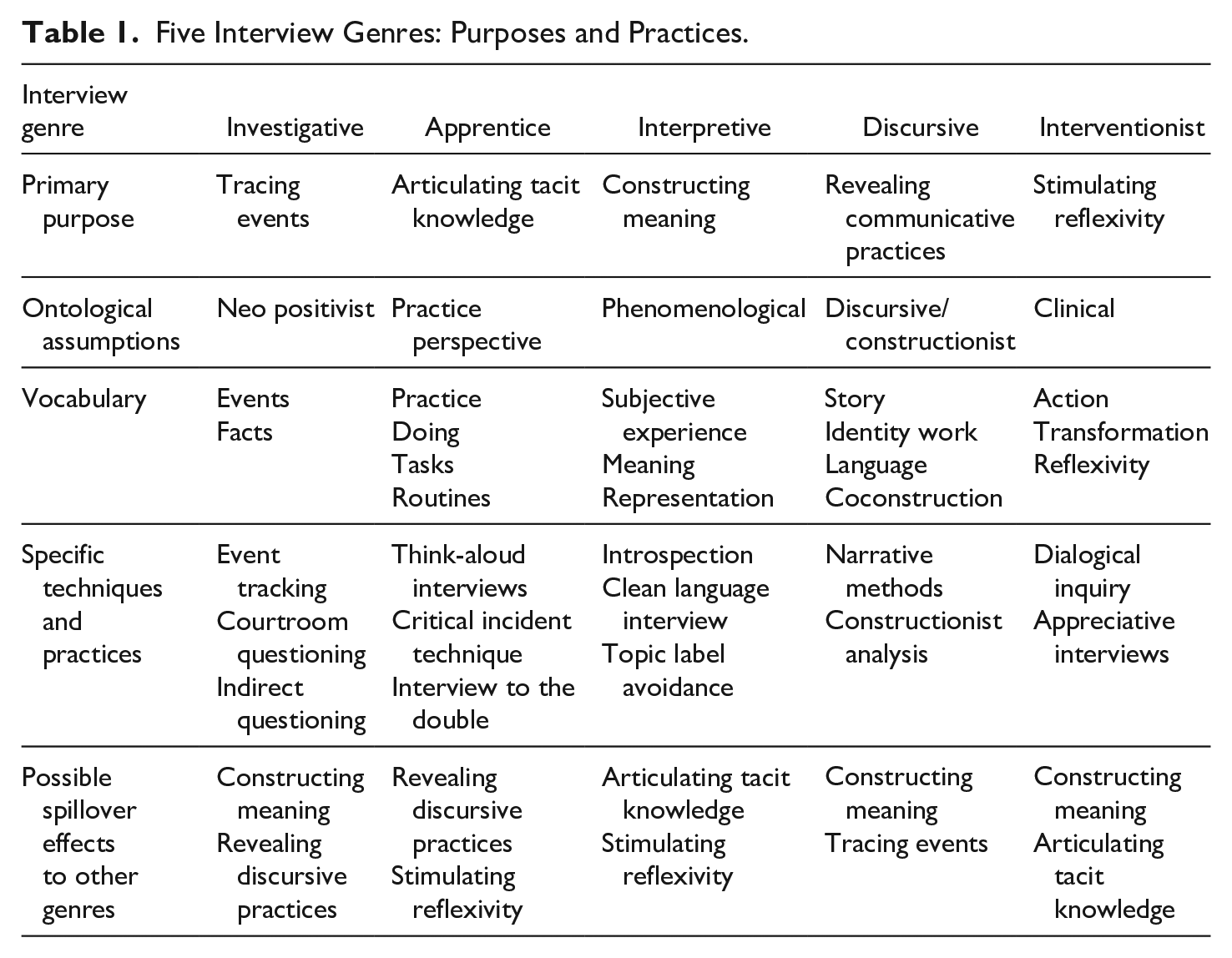
Of course, it is important to understand that the five interview genres in many cases overlap, notably at the level of emerging data. As shown at the bottom of Table 1, there are many possible spillovers to other genres, since regardless of original intentions, interview data tend to be multivocal, allowing a variety of approaches to analysis, even with the same transcripts. For instance, when conducting an investigative interview, interviewers primarily access facts and events (i.e., what happened). However, in offering accounts, interviewees may also construct meaning, and more or less explicitly reveal communicative practices, whether the interviewer was attempting to achieve this or not. In one sense, this might be seen as a problem. The whole point of engaging in certain specific interviewing practices is surely to ensure that the data collected fit the purpose for which they were intended. On the other hand, it is hard to completely isolate those purposes from other things inevitably going on in spite of them. Indeed, doing so might make the interview into a more awkward encounter that would not produce useful data at all. The important thing for us is to be reflexive about what the interview data collected most likely represent, in order to consider how they might legitimately be used.
A second overarching observation is that some of the techniques we reviewed might be seen as hybrid, because interviewing is linked to other data collection approaches. Think-aloud interviewing, for instance, combines a simulation (performing a task) with an interview. Appreciative interviewing is only one element of appreciative inquiry methodology. The interview to the double makes most sense when combined with ethnography. This observation invites scholars to reflect on how to enrich interview data in two ways: first by integrating imaginatively, and perhaps unconventionally, material, or visual elements (e.g., drawings, objects, photographs) into interview designs, and second by blurring the boundaries between interviewing and other data collection methodologies. In closing, we thus step back from the details of the different genres to suggest ways in which all of these might be made richer through multimodal methods.
Notably, several authors have suggested that the use of visual techniques (e.g., expressive drawing, picture completion, diagram construction) can help interviewees elaborate further their thoughts on interview topics (Bravington & King, 2019; Comi et al., 2014). For Comi et al. (2014), using visuals during interviews, both as projection and facilitation techniques, has a number of benefits. It prompts reaction from interviewees, helps them articulate their thoughts and express their feelings, stimulates their imagination, fosters attention, and helps interviewees engage in reflexive practice. In addition, visual data used and/or produced during interviews—in combination with verbal interpretations produced by the interviewees—can foster the elicitation of tacit knowledge, and act as a knowledge repository (Comi et al., 2014). The use of artefacts such as organization charts, timelines, and others diagrams in interviews can also improve recall and stimulate meaning making (Bravington & King, 2019). Interviewers may bring their own visuals to an interview or ask interviewees to engage in drawing, or other construction exercises to represent their situation or some object relevant to the study. The act of drawing requires knowledge production with the visual product as an outcome (Guillemin, 2004). Drawing can be integrated into interview designs to stimulate various forms of verbalization serving as material for both interpretive and discursive analysis.
Integrating physical artifacts and spaces into interview designs may also have the power to foster the production of rich and varied discursive data. Crawford et al. (2020, p. 5) suggest for instance moving beyond the interview as a simple “speech event” by integrating objects and spaces into long interviews and by making them the loci of interaction that may include movement in these spaces. In so doing, they argue that the interview situation can stimulate data generation through seeing, touching, and smelling; and generate data by engaging “all the human senses.” The interview context can therefore become more fully experiential.
Overall, these multimodal forms of interviewing invite us also to reflect on the nature and boundaries of interviews. We may wonder to what extent we are still in an interview context, and what exactly makes an encounter between a researcher and their field research an interview. By bringing in material or visual elements that are meaningful to the participants—that is, which are symbolically or practically connected to their professional activity—, multimodal interviewing may also lead participants to develop alternative and richer forms of verbalization. As a result, multimodal interviewing also leads us to see that people can verbally express themselves during an interview without explicit “question-and-answer sessions” (Crawford et al., 2020). This perspective encourages us to be open to more methodological possibilities, with imagination and reflexivity (Cunliffe, 2018), and to be more inventive in the way we use traditional research methods such as interviews, in order to make them innovative and meaningful.
Footnotes
Declaration of Conflicting Interests
The author(s) declared no potential conflicts of interest with respect to the research, authorship, and/or publication of this article.
Funding
The author(s) received no financial support for the research, authorship, and/or publication of this article.
