



Abstract
Change processes, the activities that enable change, and change leadership, meaning how to lead change processes, both influence the success of change. However, a surprising omission from this knowledge is: how do leaders choose between change processes? This article explores leaders’ choices between two orientations of change processes—illustrated by dialogic and diagnostic organizational development—in 79 cases of organizational change. It identifies that change is successful when leaders choose to oscillate between these two processes as change unfolds. Developing a model that explains this evolution, the article describes how the change leadership practice of concurrent inquiry interacts with the two representations of knowledge described by diagnostic and dialogic theories to inform a choice to oscillate. For scholars, this model further integrates the theoretical perspectives of dialogic and diagnostic theories. For practitioners, it provides a means to navigate between extant theories and, as such, ameliorate outcomes.
For several decades, scholars and practitioners have sought to improve the outcomes of organizational change (change). We assume change is a means to better organizations and the people within them and refer to successful outcomes (success) when transformation to new organizational states is achieved in a way that is positively perceived by the people involved. Change leadership literature has traditionally explored the characteristics of leaders, examining their strategic choices and behaviors (Denis et al., 2010; Oreg & Berson, 2019). The field of organization development (OD) has focused on practices of change, describing change processes, the activities that enable change, together with allied suggestions for change leadership—the desired behaviors and values for leading change processes (Marshak, 2014). A recent contribution by Bushe and Marshak (2009, 2015) orientated change practices into two process-based perspectives. Diagnostic OD (diagnostic) represents processes where organizational states are analyzed objectively, and plans set in place to alter them. Dialogic OD (dialogic) describes processes where action follows dialogue, illustrating conversational-based activities where new possibilities emerge. Despite this advance in knowledge, it also presents a problem. While it is difficult to talk about change leadership without inherently referring to a change process (Bass & Bass, 2009; Oreg & Berson, 2019), change leadership discussion overlooks the possibility of a choice between change processes. Furthermore, within OD discussion, the alignment of change leadership and change process knowledge as either diagnostic or dialogic inherently ignores the possibility that the alternate practice may be more appropriate. With this context, in this paper, we explore: how do leaders choose between change processes?
For practitioners, we assume a key factor influencing this choice is the probability of success. Diagnostic processes have been widely associated with low likelihoods of success (Holbeche, 2007; Hughes, 2011; McKinsey & Co, 2020; Smith, 2002). For dialogic, two analyses associate these processes with higher rates of success (see Bushe & Kassam, 2005; Higgs & Rowland, 2005). However, whether these results are generalizable remains to be tested, another possibility is coapplication (see Livne-Tarandach & Bartunek, 2009), where processes are applied either concurrently (i.e., in parallel) or by temporally oscillating between them (i.e., in sequence). To date, studies of coapplication have explored single cases, making it difficult to establish an understanding of how this approach influences success (see Beer & Nohria, 2000; Bright & Godwin, 2010; Burnes, 2004; Graebner & Eisenhardt, 2004). With this context, a lack of empirical focus between these options, leaves scholars and practitioners less well informed as to preferred applications of change processes. For this reason, in this article, we address our research question in two parts. Initially exploring: which application of change processes facilitates success, and then: which change leadership practices inform the choice of change process?
We consider these questions through a comparative study of 79 cases of organizational change from a diverse range of industries and global contexts. For cases initiated as a diagnostic process (n = 63), those that oscillated to dialogic processes were far more likely to be successful (n = 14; 93% success) than those that continued solely as diagnostic (n = 49; 33% success). We explore these findings with a process method because change is an evolving phenomenon where choices develop over time and this approach focusses empirically on progressions of activities (Langley et al., 2013). Data were collected via semistructured narrative interviews, enabling analysis of patterns of change processes, identification of change leadership practices, as well as exploring the temporal interplay between these two themes. Doing so across our diverse data set enables this article to make four contributions.
First, it puts forward a new change leadership practice that facilitates the choice to oscillate between diagnostic and dialogic change processes. Concurrent inquiry represents simultaneous inquiry on the two representations of knowledge described by dialogic and diagnostic practices. To date, these inquiry practices are illustrated separately. Second, it contributes a model that explains how concurrent inquiry informs a choice to oscillate between change processes. Doing so, we advance discussion on the theoretical and practical integration of dialogic and diagnostic practices. Crucial to this integration is the delineation of change practices into change leadership and change processes. Whereas prior theorizing on co-application considers either oscillating between or concurrent application of these two practices as whole entities, we propose change leadership as concurrent and change processes as oscillating between. By delineating change practices into two components, theoretical and practical integration is possible.
Third, it advances current considerations with respect to the choice of change processes. Often conceived as a single choice at the initiation of change (see Todnem By, 2005; Weick, 2000), this model is agnostic as to whether change is initiated as a dialogic or diagnostic process—this initial choice is less important than subsequent choices as change unfolds. Finally, we highlight a contribution to the practice of diagnostic OD. Often criticized for a low likelihood of success, as our findings confirm, however, organizations continue to utilize diagnostic processes as a means to initiate change. For practitioners, this conceptualization provides support for their continuation of the use of diagnostic processes by presenting an option to navigate between the bifurcated theoretical representations of diagnostic and dialogic change processes with a view to improve their rate of success.
In what follows, we clarify assumptions on leaders and change leadership. We also summarize the current state of theorizing on change leadership and change processes. Then, we describe our study, longitudinal case data and sample diversity. After developing a model that integrates findings, we consider contributions to extant theory, and guidance for practitioners.
Theoretical Basis
To advance our research focus, we first summarize key aspects of existing knowledge with respect to how change practice and change leadership knowledge overlaps and where it differs. Before doing so, we clarify our assumptions on change leadership, leaders, and participants. We define change leadership as how to lead change processes and in doing so refer to the influence that individuals exert over the evolution of change (Oreg & Berson, 2019). We delineate individuals into leaders, meaning those people in formal positions of authority who take responsibility for success, and participants, referring to others who exert influence during change. We recognize that influence can either be top–down, and exerted by leaders, or bottom–up, by participants (Ford et al., 2021; Yukl, 2012). For clarity we assume that leaders provide a significant source of change leadership by creating the conditions and environments necessary to promote these multiple influence processes (Oreg & Berson, 2019). As such, leaders form the primary point of our analysis of change leadership.
Change Processes
Our first interest is change processes. The described activities of change practices make different premises with respect to the basic processes of change. Diagnostic processes typically suggest prescriptive, linear, and sequential sets of activities aimed at “unfreezing” existing organizational states, “creating movement,” and “re-freezing” around desired future states (Lewin, 1947; Schein, 1996). For instance, Stouten et al. (2018, p. 756) provide a summary of seven popular diagnostic change processes identifying an integrative and richer view of change-related activities: for example, explaining how a “sense of urgency” aids “unfreezing,” how “communicating the vision” can aid “creating movement,” and providing insightful approaches that “reinforce” and “strengthen” the change.
While diagnostic processes are known to deliver successful changes, consensus has shifted from the underlying premise that change is a single, episodic event. Newer perspectives take the premise that organizations are in a constant state of flux and that change is more about redirecting the change that is already underway. Dialogic processes explain these interactions; following theories of complexity science, whereby bottom level changes amplify and accumulate to become substantial changes at the organizational level over time (Plowman, Solansky, et al., 2007; Stacey, 2015). Dialogic processes include activities of disruption, storytelling, and organizational learning, to guide change (Bushe & Marshak, 2015; Jabri, 2017; Marion & Uhl-Bien, 2001). For instance, Bushe and Marshak (2015) provide an integrative summary of 40 dialogic practices, distilling both change leadership premises and the core processes that enable change.
Despite the clarity that these two perspectives provide, scholars identify that change is often messy, involving cycling back-and-forth between activities, and where theoretical descriptions are rarely followed verbatim (Burke, 2011; Lawrence, 2015; Quinn, 2010). With this knowledge, some scholars take the view that newer and better theoretical perspectives of change processes are required (see Bartunek & Woodman, 2015; Todnem By, 2005). In contrast, other researchers have promoted an integrative approach. Not long after Bushe and Marshak (2009) coined dialogic and diagnostic frames, Oswick (2009, p. 371) called for consideration of the “shades of grey that exist between these two fixed extremes.” Furthermore, Livne-Tarandach and Bartunek (2009) proposed coapplication of planned and emergent change (each following a similar theoretical alignment to diagnostic and dialogic OD) in a way that gives “equal voice to bipolar positions, first by identifying both of them and then by acknowledging both of them as important” (p. 17).
Crucial to this combined perspective is the place of time and the temporal patterns that characterize coapplication. With this stance, time is used in separating the application of processes temporally by oscillating between change processes, such as in initiating change as a diagnostic process, to identify and clarify problems, and then oscillating to dialogic processes for fostering new ideas and innovations. A study by Gilpin-Jackson (2013) of change at a medical device company explores this approach identifying a “blend of diagnosis and dialogue as needed at different stages of the change process” (p. 62). Time is also portrayed as a concurrent application where both diagnostic and dialogic processes are applied in parallel. For instance, a case example by Beer and Nohria (2000) illustrates diagnostic processes for redesigning organizational reporting lines, applied at the same time as dialogic processes to foster aligned working cultures.
While these conceptualizations of coapplication are established, these theoretical perspectives on coapplication had not been empirically tested. To date empirical analysis of change processes and outcomes has maintained a single view of change practices by comparing either dialogic or diagnostic practices with outcomes. Whether a combined approach improves change success has not yet been explored. For scholars this lack of comparison between patterns of application of change processes—either singly, oscillating or concurrently applied—has limited the ability to target studies toward refining successful patterns. For practitioners, this gap has left them less well informed on how to choose between processes with the view to improve their success. This gap is the basis of testing the question: which application of change processes facilitates success?
Change Leadership Practice
The practice of change leadership is illustrated in different ways between change practice and change leadership literature. Change practice literature describes how to lead diagnostic and dialogic change processes in ways aligned with their respective ontological (i.e., how organizational reality is viewed) and epistemological (i.e., how inquiry is conducted on organizational reality) foundations. Diagnostic processes dictate independence of subject and object (i.e., separation of leaders from both organizations and participants). As such, leaders inquire about organizational reality objectively (i.e., what is true?) and design and implement plans top-down (Bushe & Marshak, 2009; Drath et al., 2008; Osborn et al., 2002). By contrast, dialogic processes take the perspective that organizations are meaning-making systems, where leaders are a part of the process of discovering new futures. Inquiry is no longer a focus on objective facts, instead it becomes a focus on narrative, the shared meanings given to events (i.e., what people are saying is possible? Marshak et al., 2015). This dialogic perspective caters for both top–down and bottom–up change leadership influences; leaders foster environments where learning takes place, and participants contribute to change leadership with ideas, innovations, and new possibilities.
Change leadership discussion mostly aligns with the diagnostic perspective where leadership is a top–down influence process (Ford & Ford, 2012; Oreg & Berson, 2019). With this perspective, researchers examining the relationship between change leadership and outcomes have explored leaders’ strategic choices, referring to target and focus of change (Hambrick & Mason, 1984) and leader behaviors. Strategic choices include the emphasis of change, such as targeting communication, or choices on the design of future organizations (Simons, 1994; Waldman & Javidan, 2009). A common delineation of leader behaviors is between task-orientated behaviors, where leaders shape and implement change top–down, and person-orientated behaviors, where leaders engage followers and challenge them to find their own solutions (Bass & Bass, 2009). A consistent finding is that the latter set of behaviors facilitates higher likelihoods of success (see Gilley et al., 2009; Higgs & Rowland, 2005, 2011; Wren & Dulewicz, 2005). Despite this evidence, studies connecting change leadership and change processes have focused on diagnostic change processes, overlooking the possibility of dialogic processes (see Battilana et al., 2010; Nemanich & Keller, 2007; Sackmann et al., 2009). A key reason for this oversight is a single perspective of only one type of change process. For instance, Oreg and Berson (2019, p. 288) refer to “the mediating role of the change process.” With this view, diagnostic processes are often assumed. For instance Armenakis and Harris (2009, p. 130) refer to the change process as, “organizational diagnosis consists of recognizing problem symptoms (unacceptable profits, high employee turnover and absenteeism) and identifying root causes of these symptoms”—a diagnostic process. Considering the possibility of a choice between diagnostic and dialogic processes, we examine: which change leadership practices inform the choice of change process?
The different conceptualizations of change leadership illustrated by diagnostic and dialogic practices present a consideration for our narrative study design. Diagnostic, top–down, perspectives posit dialogue as between leaders and participants; leaders embellish narratives as a means to influence the progression to future organizational states (Barrett et al., 1995; Gioia & Chittipeddi, 1991) and participants embellish narratives to narrate responses to change (Oreg et al., 2011; Sonenshein, 2010). Categorizations of responses by participants include positive, or supportive of the change, feedback, giving feedback to the change, and resistance, unsupportive of the change (Ford & Ford, 2010). However, this top–down perspective potentially ignores the consideration of narrative presented by dialogic practices. It is already established that the narratives shared between participants are a source of innovation and a valuable positive influence on outcomes (see Chiles et al., 2004; Plowman, Baker, et al., 2007). It is also known that participants can filter the information they share to leaders, often by giving a more positive view upward than what is shared between colleagues (Sonenshein, 2010; Weick, 1995). With this context, leaders and participants may have differing perceptions of change. Thus, we design our study to capture both leader-participant and between-participant perspectives on narrative by collecting data from both leaders and participants.
Studying Change Processes and Change Leadership
The Study
To explore our research questions, we studied 79 cases of change from organizational settings. We selected respondents from a range of global contexts and industries. One of the authors had a previous career as a change practitioner and commenced with known connections of this author. To increase the reach of this study as well as ensuring that we were not interviewing people who were familiar to us or our work, we used a strong and weak tie approach, by asking known connections to introduce us to their connections (Granovetter, 1973). This approach gave access to both leaders and participants of change, perspectives that were important for understanding top–down and bottom–up contributions to change leadership. In several cases, we gathered data from both leader and participant, enabling cross checking of data to validate perceptions.
The Sample
Data were collected in 47 interviews (37% female), resulting in 91 stories of 79 unique cases of change. Of the stories, 2 were told from the perspective of the level above the leader (i.e., business owner), 29 as a leader, and 48 as participants. In seven cases, data were gathered from two perspectives. Case data came from Australasia (n = 48), Europe (n = 19) the United States (n = 10) and South America (n = 2). Industry sectors included armed forces (n = 3), business to business services (n = 8), education (n = 14), financial services (n = 19), health (n = 9), manufacturing and mining (n = 11), and start-ups (n = 4).
Data Gathering
To capture the perspective of time as change evolved, we employed a narrative interview technique, where interviewees tell stories of organizational change that they have been involved with (see Boje, 2001; a technique previously used to understand change process and change leadership research by Burnes, 2004; Higgs & Rowland, 2005). These data also allowed us to analyze stories from both a change process and a change leadership perspective (see Denis et al., 2001; Higgs & Rowland, 2011). To capture outcomes, we asked interviewees to “tell two stories of a change you were involved with, one that was a success and another that was a failure” (as per Dutton et al., 2001; Lawrence, 2015). The assumption being that if interviewees discuss change as a success, then it has been positively perceived by people involved. To check the second part of our success definition—new organizational states—we checked success perceptions by asking for data that confirmed the achievement of new organizational states.
Interviews aimed to understand the organizational context, to identify the roles (i.e., leader or participant), to trace the events associated with change, and to understand the logic behind key decisions. Interviews followed an open question protocol, with clarification questions asked to explore key events. With experience as a change practitioner, the first author was able to draw on interactive expertise (Collins, 2004)—a familiarity with the language that participants used to describe changes, enabled and assisted in the language necessary to prompt sharing, and ask clarification questions to confirm types of change processes and to dig deeper into leadership practices. Interviews were recorded and transcribed, initially by one of the researchers to gain familiarity with the data and subsequent interviews utilizing a transcription service.
These data allowed us to compare and contrast patterns of change processes, leadership practices, and outcomes. We approached this study inductively, and in keeping with the narrative frame, we paused after initial cases to clarify temporal patterns of change processes and search data for leadership practices that were antecedent to successful patterns. As understandings emerged, we added clarification questions to test the presence of identified constructs in later cases (Eisenhardt & Graebner, 2007).
Data Analysis
Analysis was conducted in two passes. A first pass explored our interest in patterns of change processes and success, combining within-case and between-case approaches. Commencing within-case, for each case we built a timeline of events (Burnes, 2004), then following Bushe and Kassam (2005), using NVivo, we coded each event in this timeline as a dialogic or diagnostic process. For diagnostic processes, we compared events to the Stouten et al. (2018) integrative summary, and for dialogic processes we compared to Bushe and Marshak (2015) summary. For example, where a participant informed us that change initiated when leaders “gathered together a guiding coalition,” this event was coded a diagnostic process. In a different case, a leader described a stage of the change as “more like learning, and it wasn’t as obvious how we were going to do it,” which was coded as a dialogic process (see Table 1, for an example of a coded case). Using our timelines, events coded as diagnostic processes were given a value of 0, dialogic events were given a value of 1. We then codified patterns of change processes, following Klarner and Raisch (2013). To check our coding, after an initial batch of cases we engaged a separate researcher to review our work, making several adjustments for clarity. At the completion of coding, we asked a separate independent researcher to recode cases, with an interrater reliability of 87% (as per Miles et al., 2020).
Sample Case Timeline: Events and Data Extracts.
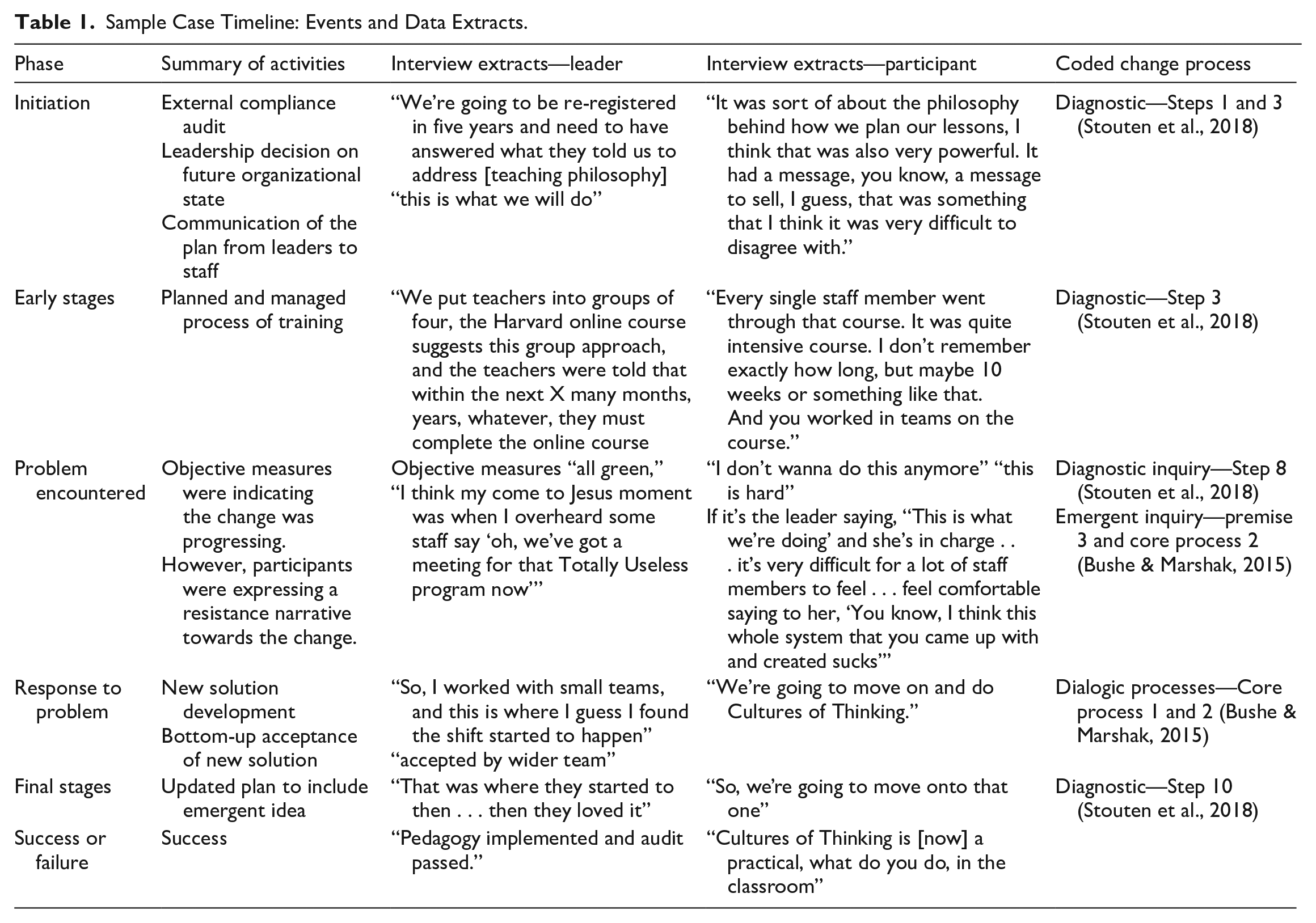
With our first pass analysis finding that success was allied with patterns of oscillating between change processes (see Findings below), we focused our second pass analysis on leadership practices during the events leading up to an oscillation. Our goal was to understand, as completely as possible, a retrospective account of change as it unfolded over time and the change leadership elements that seemed most important in the interviewees’ understanding of the case. This analysis combined the leadership constellation (leaders and participants), the actions of members of this constellation (top–down influences from leaders and bottom–up influence by participants) and the events leading up to an oscillation (as per Denis et al., 2010). We also focused on the actions following these events (i.e., a choice to oscillate or otherwise). Comparison between cases enabled establishing causation between leadership practices and outcomes (Boje, 2001). Finally, codifying practices allowed us to identify key findings.
One phenomenon observed early in our study was the relevance of between participant narratives (BPNs). To ensure that we explored this phenomenon fully, we added to our interview schedule the question “what were people saying about the change?” Our focus was to identify between participant narratives which, in the context of storytelling, represent the shared meaning given to events (du Toit, 2003).
To cross-check our analysis, our data set revealed seven cases where multiple interviewees told stories from the same case. With this set, we conducted cross case checks of key constructs, for instance inquiry practices and narratives. We also checked for perceptions of success, converting one case from a success to failure. Noting that, following clarification, the interviewee stated, “it [the change] kind of disappeared off the radar.” Furthermore, cross checking of shared narratives did not always yield identical narratives, however considering the context of the cases, descriptions were consistent.
This analysis revealed a set of insights linking change leadership practices, change processes, and outcomes. In what follows, we illustrate these findings in the order of our research questions—first considering patterns of change processes, followed with change leadership practices.
Findings
Examining Patterns of Change Processes and Outcomes
Our analysis identified four distinct patterns of change processes. These were (Pattern 1) initiated and remained diagnostic (e.g., 00000), (Pattern 2) initiated as diagnostic, with oscillation to dialogic processes (e.g., 00100; see e.g., timeline in Table 1), (Pattern 3) initiated and remained dialogic (e.g., 11111), (Pattern 4) initiated dialogic, with oscillation to diagnostic practices (e.g., 11011).
Table 2 shows the success rates for each of these patterns. For change that initiated as a diagnostic process (representing 63 of 79 cases), 49 cases continued and concluded solely as a diagnostic process (Pattern 1), with success reported as 33%. In the remaining 14 cases, we observed an oscillation to dialogic processes (Pattern 2), reported at 93% success for this pattern. For dialogic-initiated changes, seven cases progressed as solely dialogic processes (Pattern 3), and nine cases oscillated (Pattern 4). Both these patterns resulted in high success—86% and 89%, respectively.
Success Rates: Change Process and Leadership Practices.

For diagnostic-initiated cases, we find that oscillating to dialogic processes during the course of change led to higher rates of success, when compared with single application of diagnostic processes. For dialogic-initiated cases, we find oscillation however, both oscillating and nonoscillating cases have high rates of success.
Change Leadership Practices in Diagnostic-Initiated Cases
To examine change leadership practices, we focus on the events leading up to an oscillation. We first explore diagnostic-initiated cases because they represented the largest set of cases to explore. This analysis identified three key processes. First, a bottom–up influence that we term Between Participant Narrative, representing shared meanings given to the change by participants. Consistent with prior theorizing, we categorize these narratives as resistance, feedback, or positive narratives. Second, a top–down change leadership practice of concurrent inquiry, where leaders of diagnostic change processes simultaneously inquired on both dialogic and diagnostic representations of reality (i.e., what is true? and what people are saying is possible?). We contrast this practice to single inquiry, representing a sole focus on a diagnostic representation of reality. Third, is the action that leaders took; some leaders made a choice to oscillate, others adjusted their plans, others made no obvious action, we categorized all three.
Findings identify an interaction between these practices that influenced success. While important to our study, BPNs on their own were not allied with success—resistance narratives were found in 41% of successful cases and 50% of failed cases. However, the practice of concurrent leadership inquiry, where leaders inquired about BPNs, was associated with success. Leaders of these diagnostic-initiated changes who practiced concurrent inquiry were far more likely to achieve successful change (n = 30; 80% success). Furthermore, the interaction between BPN’s, concurrent inquiry and action to oscillate were observed to always be successful (n = 13; 100% success). Table 2 illustrates these findings.
Findings also illustrate causation, specifically how the interaction between BPNs and concurrent inquiry informed a choice to oscillate. We illustrate this interaction in three ways. First, via a case example, to overview this interaction for the reader. Second, we provide narrative extracts from cases, explaining our observations of BPNs, leadership inquiry practices and action. Third, we tabulate a wider set of case data that contrasts successful Pattern 2 cases (Table 3; i.e., diagnostic-initiated that oscillated) with failed Pattern 1 cases (Table 4; i.e., diagnostic-initiated that did not oscillate). The purpose of these tables is to illustrate the common nature of this interaction across our sample. Specifically, that BPNs illustrating feedback and resistance were present across successful and failure cases, the key difference between these outcomes was whether leaders inquired on this representation of reality. Table 3 commences with context on the change case, then illustrates the actions leaders took to inquire about BPNs, the type of BPN this inquiry yielded, followed by the observed BPN. Table 4 provides the context of change followed by the BPN’s observed. This set represents the set of cases where BPNs were told to us by participants of change, however, were observed to follow single inquiry, on objective reality.
Successful Oscillating (Pattern 2) Cases.
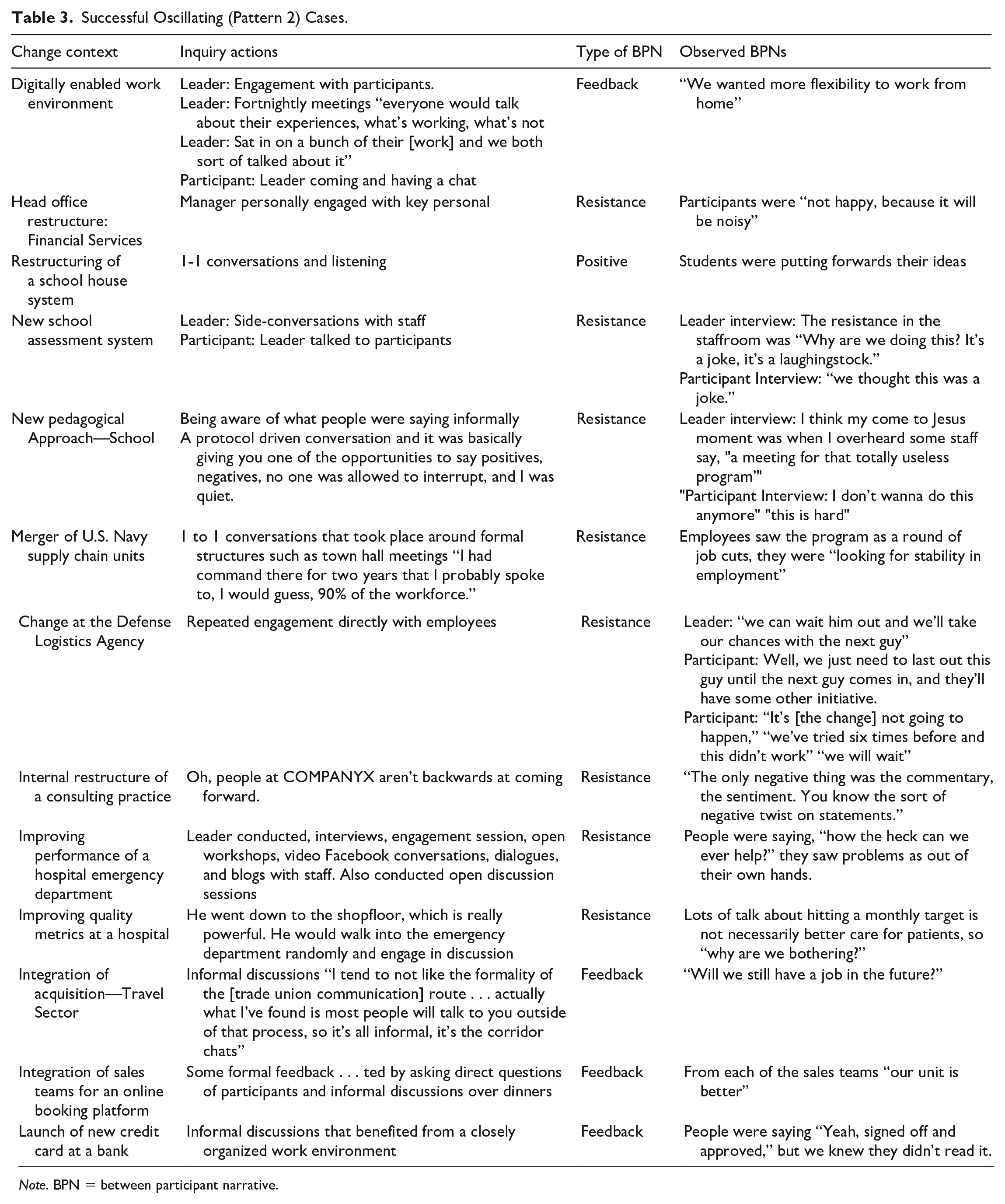
Note. BPN = between participant narrative.
Examples of BPNs From Failure Cases.
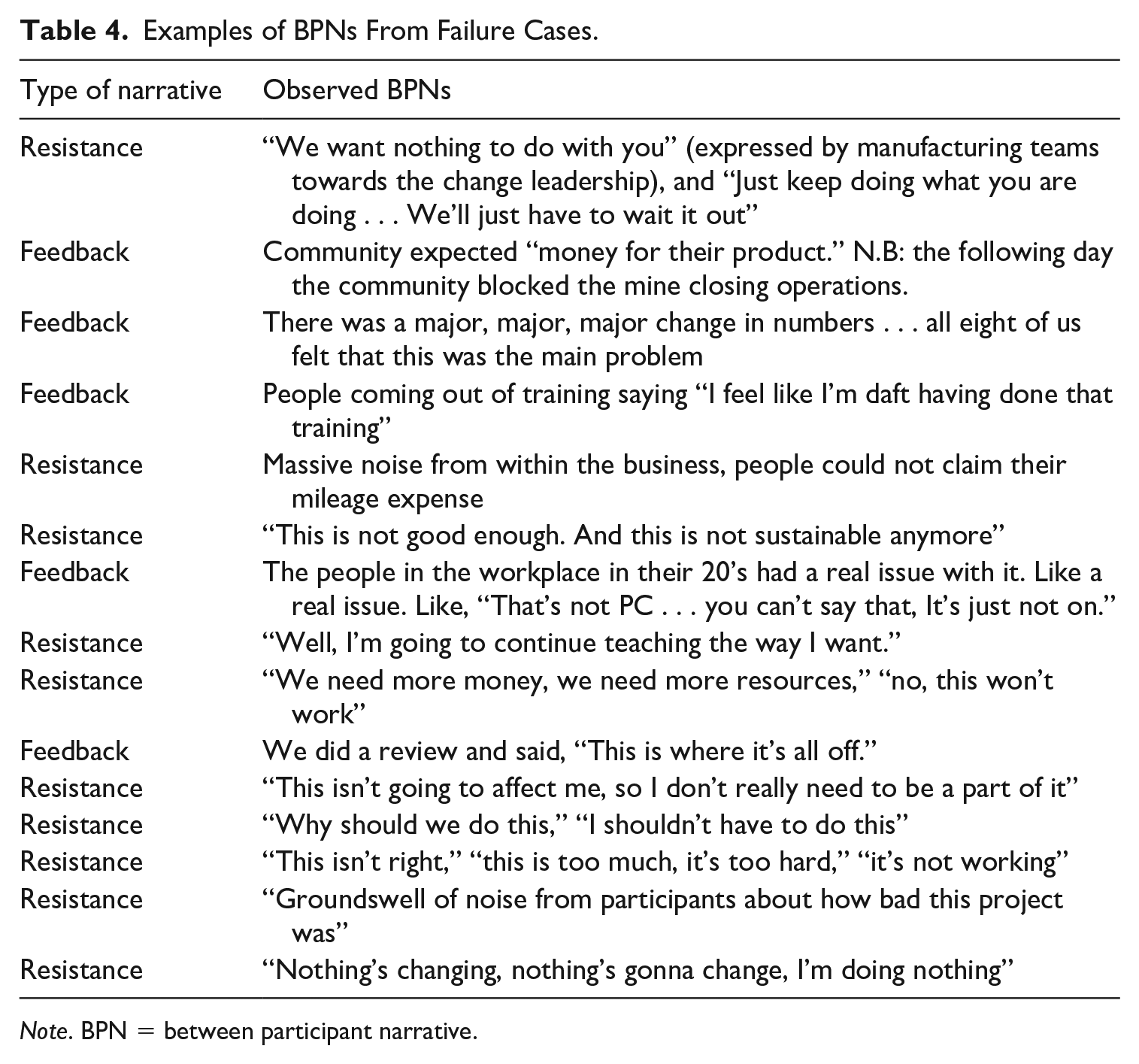
Note. BPN = between participant narrative.
Case Example
The case that we summarize in Table 1 is an example of an oscillating Pattern 2 case. In this case, following an external audit, school leadership set in place a diagnostic process with the objective to implement a new teaching pedagogy. However, this change took a dramatic turn, as the leader, a school executive member with 20 years’ experience, explained, “I think my come to Jesus moment was when I overheard some staff say ‘oh, we’ve got a meeting for that totally useless program now.’”
The discovery of this resistance narrative by the school leader precipitated a shift to dialogic processes; small focus groups were initiated, during which a new solution (a different teaching pedagogy) emerged, that gained acceptance. Ultimately the change reverted to a diagnostic process, incorporating this new solution into top–down plans. The new pedagogical approach was implemented successfully.
Between Participant Narratives
Here, we describe findings on the representation of knowledge that was shared between participants. Consistently across cases, these narratives were exemplified by the use of inclusive language such as “we.” This inclusive language indicates that these narratives are the product of interaction between participants and, as such, represent shared meanings (du Toit, 2003). Consistent with prior knowledge, narratives were expressed as either feedback or resistance narratives. For the latter, we observed both active and passive resistance. For instance, the chief executive of an educational business in the United States explained and example of an active resistance narrative; his team’s reaction to the change was “over our dead bodies.” In a separate case, a teacher participating in a change program observed that the narrative shared between staff was “we thought this was a joke.”
The shared nature of BPNs was also expressed in cases where data was collected from multiple interviewees. Examples of a passive resistance narrative came from a case at the Defense Logistics Agency (DLA) of the United States armed forces. Three interviewees told us stories of this case, highlighting how participants in the organization, having been involved in many failed attempts to transform, developed shared a strategy: Leader (the Admiral in charge of the agency): “This is going to be a year, 2 years, we can wait him out and we’ll take our chances with the next guy” Participant (a senior employee of the agency): “Well, we just need to last out this guy until the next guy comes in, and they’ll have some other initiative.” Participant (a practitioner): “It’s [the change] not going to happen,” “we’ve tried six times before and this didn’t work.”
Loosely translated, this representation of knowledge represents narrative expressing the strategy of we will wait. The consistency of a single dominant narrative is evident in the consistency of the above three interviewees—each from different perspectives. Consistency between interviewees was observed in other cases. For instance, in a change to enable a digital work environment at a leading Australian superannuation business the leader (a 10-year industry veteran) told us that participants had expressed a desire for “more flexibility to work from home.” This meaning was echoed by a participant (a customer service officer) who explained, “we wanted more flexibility to work from home.”
Interaction Between Leadership Inquiry and BPN
BPNs, on their own, were not associated with success. However, BPNs represent a source of information representing organizational reality and, as such, provided a valuable source of insight for leaders that chose to inquire on them. To illustrate the significance of inquiry, we highlight two separate cases that presented the same BPN, with contrasting outcomes. One of these cases, the DLA example above, was successful. As described to us DLA is enjoying right now its highest effectiveness in its history. Yes. And the cost recovery rate . . . was at 25%t and it’s down to 12% right now. The second example, at an aircraft manufacturer, focused on the adoption of efficient work practices by shop-floor workers and technicians, the change failed completely.
At the aircraft manufacturer, as relayed to us by a project engineer with 10 years’ experience, leaders practiced diagnostic inquiry, with a focus on objective matters such as key performance indicators (KPI’s). As the engineer explained: This transformation plan was very, very, very much driven by KPIs. It wasn’t about improving the company. It wasn’t about helping the different departments. It was about these senior managers saying ‘I need to hit this KPI’ . . . The goals were sort of everything. Improve quality. Improve delivery time. Improve costs.
At the same time as the leaders were setting up objective measures, our interviewee was expressing their concerns about the change: I remember arguing with them on many occasions saying: Look guys. There have to be tradeoffs here. You can’t just go after everything. You need to prioritize. Sometimes if you are prioritizing customer satisfaction, well that might hinder costs.
The main focus of this change were the factory workers. Adopting new working practices was key to meeting the KPIs that were targeted. However, this top–down approach was not received well by workers, as our interviewee explained, The attitudes were like “not another one [change initiative],” “well, we’ll just have to wait it out.” That was the attitude with all the people.
Despite efforts by the interviewee to inform the program leader of these problems, the change continued to follow diagnostic processes, resulting in failure. In contrast, the Admiral that led the DLA change, undertook many activities to understand what his people were saying about the change. He stayed around after informal meetings, shaking people’s hands, inquiring about their needs, and asking how participants were experiencing the change. During his tenure, he explained that he “spoke to 90% of his 5,000 staff” in this informal way. It was during these informal discussions that the Admiral began to understand the prevailing narrative of we will wait. He responded first by extending his contract, as he stated, “I was extended from what is usually a 2-year tour to a 5-year tour so I can be held accountable to make this thing work.” Furthermore, he then oscillated from diagnostic to dialogic change processes. The admiral paused the diagnostic implementation program and switched to a small group focus, whereby a focused team took one step at a time. He described this new approach as “small, incremental” and “learning as we went along.”
These two examples illustrate how concurrent inquiry on both objective facts and BPNs can, when contrasted to single objective inquiry, alter the course of change and resulting outcomes. Below, we summarize findings on the nature of concurrent inquiry and single inquiry.
Concurrent Inquiry
We find an inquiry practice by leaders beyond the single representation of reality suggested by diagnostic processes. As with the admiral of the DLA case, leaders made efforts to understand the symbolic consequences of change, concerning the evolution of meaning among participants. They took care to situate themselves alongside participants and understand what participants were saying about the change. These activities were often conducted outside the formal processes of change. For example, a leader of a program to integrate a recently acquired travel business into a parent company described “tea and cake” discussions. Also, the financial director of an internet-based travel business described that during a merger, she sat in on “dinner conversations.” Typically, leaders described an internal desire to find out what people were saying within their organizations, as a business owner who led a restructuring of his 450 employees told us “I’d better get out in front of getting out of here,” and leader of a growth initiative at a travel website business explained, “there were times when we had to listen to people involved.” These were not one-off or isolated practices, as the admiral of the DLA explained, inquiry required “repeated engagement directly with employees.” A leader of a program to integrate an acquired business services company into a larger business highlighted the informal nature of this inquiry, “I tend to not like the formality of the [trade union communication] route . . . actually what I’ve found is most people will talk to you outside of that process, so it’s all informal, it’s the corridor chats.”
Leadership inquiry toward the representation of knowledge presented by shared meanings, as expressed by BPNs, was a common evolution in 13 of 14 oscillating (Pattern 2) cases. However, for nonoscillating (Pattern 1) cases only 17 from 49 cases inquired toward BPNs. In the remaining cases, leaders practiced inquiry singly, focusing only the objective facts.
Single Leadership Inquiry
A practitioner with 20 years of experience explained single inquiry practice. This case targeted the installation of a new software system at a large superannuation company. The consultant explained that “what I heard from the people who were on the ground was they needed to do a lot of customization for it to suit their needs.” When the consultant went to his leader to explain this, the response received was “[the project] is extremely successful because it is installed.” This leader maintained a single inquiry on an objective representation of knowledge.
Other cases provide examples where BPNs were expressed to leaders openly, only for leaders to ignore this knowledge. For instance, a director a logistics company told a story of a business growth initiative where an issue had emerged during the implementation: As a team, we approached the manager, and we told him that this is the issue, and he didn’t take it well. I’m not sure, again, what his logic behind was, but he said, “If someone needs advice, they can write.” That’s what his comment was.
In a case from a United Kingdom-based business services company, executive director told us of a new expenses system being rolled out of a 70,000-person organization. A problem with the implementation meant that frontline staff couldn’t use the system. The leader’s (the chief financial officer of the firm) response was: “I just don’t have the time to deal with this . . . just get on with it. I told you this is the system we’re moving to, we set it up, put a project team on it, crack on.”
In other cases, participants illustrated a perceived barrier in expressing their concerns to leaders. As a participant (a teacher) of a failed change within a school explained: If it’s the [leader] saying, “This is what we’re doing” and she’s in charge . . . it’s very difficult for a lot of staff members to feel . . . feel comfortable saying to her, “You know, I think this whole system that you came up with and created sucks.”
For failed nonoscillating Pattern 1 cases (see Table 4 for examples) BPNs were observed, however there was no observed interaction between this representation of knowledge and leadership inquiry. We found no evidence that these leaders of diagnostic-initiated change expanded their inquiry beyond an objective focus of what is true?
These findings from single inquiry cases help clarify the significance of concurrent inquiry. Leaders who did not value the significance of the representation of knowledge that BPNs provide, failed in most of the cases examined. These single inquiry cases also highlight nuances for consideration when practicing concurrent inquiry. Leaders must recognize that BPNs may not always be expressed participant to leaders. As such to practice concurrent inquiry, they must make active efforts to understand the narratives their followers are sharing between themselves.
Action
Common to successful cases, following an interaction between concurrent inquiry and BPNs, were three observed states, (1) no observed action, (2) adjustments to plans, and (3) oscillation. For no observed action, we observed five cases, of which 40% were described as successful. In these cases, leaders took action to inquire about narrative, understood shared meanings however our stories revealed no apparent subsequent action to alter the change plan. For adjustments, in 12 cases leaders were observed to make adjustments to change plans, with reported success at 92%. These alterations included extensions of timelines, however targeted toward the issues that were raised via shared narratives. For instance, in the case of the integration of an acquired travel company mentioned earlier, part of the change plan included the adoption of a business dress-code for the office. The feedback narrative expressed from participants was “we are not all earning London salaries,” in response the leader states, “‘You’ve got 3 months.’ Which meant that they had three pay-cheque salaries.” This adjustment was received positively by employees. For oscillation, we observed 13 cases where leaders took action to oscillate between change processes. Observed success for these cases was 100%.
Overall, these findings highlight a relationship between leadership inquiry, BPNs and action. We find that in successful cases, leadership manifested itself in the way that leaders were able to immerse themselves in the daily lives of participants, understand the meanings given by participants to the change, and follow with action.
Change Leadership Practices in Dialogic-Initiated Cases
For the 16 cases of dialogic-initiated change, 9 oscillated to diagnostic processes. Within these Pattern 4 cases, we find leadership practices that mirror our findings for diagnostic-initiated change. Where, for diagnostic-initiated cases, we identified the interaction between concurrent inquiry and BPNs, for dialogic-initiated change it was the interaction between concurrent inquiry and objective measures of the change that was antecedent to oscillation. As an example, a business owner of a company set up to commercialize the operations of a government-based scientific advisory group, explained that after a prolonged focus on dialogic bottom–up processes, progress was slow. As he explained, “there were 12 scientists working on an area and . . . there’d been zero income for that service for over 3 years, no one had realized.” This objective focus precipitated a switch to diagnostic processes, the chief executive stepped in and undertook an objective study of the operations. The investor explained this analysis: They did a lot of potato testing at this place, to test for disease in potatoes. So, potatoes get flown in from all over Europe to be tested. Now, the potatoes got dropped off at building 25, but the scientists lived in building 33. This is an 80-acre site, alright. It’s not a small place. Every day, six times a day, the scientist, the senior scientists would walk from building 33 to building 25 to pick up their potato for the next test. So, we re-engineered it really cleverly and said why don’t we drop it at building 33. It actually created the equivalent of two more scientists.
The owner described the significance of this action on employees: “Once we described actually the amount of scientific time that it freed up, rather than walking across this building, then actually there was no issue with that change process.” This objective focus energized the change: they turned that around a minus 2 and a bit million a year to a plus four and a half . . . But more than that, the culture in the place, the place was buzzing because they increased their commercial revenue by over 50% during that period to offset the drop in government revenue. So, not only did they swing the profitability, they actually managed to do it in a way by growing the business.
In another case, a region-based change to health care delivery, a consultant advising the leadership team explained to us a dialogic change that became labelled as “Maggie’s project.” This project had no predefined organizational state, instead it emerged “What the nurses and the staff on the ground were all focused on is keeping people like Maggie safe and healthy” (Maggie is a fictitious name that came to personify patients). As change accumulated over time, the consultant explained, “we started to recognize that what we needed to do was to draw better linkages between what we’re doing and the financial outcomes.” While the change had gained momentum among staff, financial benefits were yet to be seen. This led to that addition of top–down diagnostic processes (i.e., detailed plans and targets) from hospital leadership. This objective focus, aided nurses in understanding some of the barriers to change. As the consultant explained, Then when you or when you’re on the ground and you’re there working with the individuals and you go “Well why is this here and how does this work?” So, working hand-in-hand with say nurse in the emergency department around why fundamentally why they’re spending 45 minutes at the end of each day entering all this data retrospectively into the system as opposed to then then saying understanding why that’s the case.
Maggie’s project became synonymous with the most successful health care change program in its jurisdiction. What these cases share is concurrent inquiry on both dialogic and diagnostic representations of knowledge. When leaders identified that the objective measures indicating change were stalling, they oscillated to diagnostic processes, giving momentum to the effort.
Modelling Leadership Practices and Change Processes
Findings illustrate a temporal interplay between influences of both change leadership and change processes, which result in a change pathway unlike what is proposed by dialogic and diagnostic practices. However, while at first these pathways appeared complex and unstructured, common practices and choices were revealed. We illustrate these findings as a model in Figure 1.

Dynamic Application of Change Processes.
This model makes two assumptions. First, it assumes a dual nature of organizational reality. One following diagnostic practice, where reality is represented by objective facts representing organizational states. The other nature follows dialogic practices, where reality is seen as socially constructed and expressed through narrative. In the present study, leaders of successful change gave both these representations of knowledge equal voice. A second assumption is that for change to be successful, both of these representations of knowledge must advance—organizational states must transform and narratives that support these new states must be shared. The model illustrates these assumptions by illustrating both narrative and organizational states as separate temporal evolutions, from left to right, as change unfolds.
This model is agnostic as to whether change initiates as a dialogic or diagnostic process. Following this initiation, as organizational states and narrative update, leaders should inquire on both representations of knowledge. Concurrent inquiry describes simultaneous inquiry on both organizational states (as represented by objective measures of the change) and shared meanings (as represented by BPNs). With this concurrent inquiry, inevitable dichotomies are revealed. For diagnostic-initiated changes, a dichotomy presents when resistance or feedback BPNs are observed, an indication that the meanings shared between participants are not updating in ways that are supportive of the change. Importantly, leaders should not filter narratives, they should not make a judgment as to whether resistance or feedback narratives were correct, instead, they must put in place inquiry practices to identify dominant narratives (Swart, 2015). For instance, our case example highlights objective measures of the school change were “all green,” however, at the same time, a narrative existed of “meeting for that totally useless program”—a dichotomy. Conversely for dialogic-initiated change, dichotomies emerge when objective measures indicate a lack of evolution in organizational states.
For the resolution of dichotomies, we model the option that was allied to the highest rate of success—oscillation. This oscillation is typically brief, applied only until the dichotomy is resolved, with leaders then switching back to diagnostic processes. For example, for a diagnostic-initiated change, when a negative or resistance narrative emerges, leaders oscillate to conversational activities. Once a resolution is identified, they should return to diagnostic processes—albeit in many cases with an adjustment to plan. For dialogic-initiated change, this oscillation was in reverse, following the identification of a dichotomy, leaders should oscillate to diagnostic practices, then return to dialogic processes when the dichotomy is resolved.
Discussion and Conclusion
In this article, we tested: how do leaders choose change processes, in two parts. First, by exploring: which application of change processes facilitates success, followed by: which change leadership practices inform the choice of change process? We find that successful change is more complex than a single comparison of either change processes or change leadership practices. Instead, success was explained by an evolving interaction between the leadership practice of concurrent inquiry informing choices between change processes.
With these findings, this study makes four contributions. First, it introduces a new change leadership practice—concurrent inquiry. Second, it illustrates a model explaining how concurrent inquiry informed choices between and change processes in the context of success. Third, it expands current consideration of choice of change processes. Fourth, it contributes a way to improve the low likelihoods of success of diagnostic change initiatives. Below we discuss these contributions in turn, concluding with a proposal for a new avenue of research.
Concurrent Inquiry
We find the leadership practice of concurrent inquiry to be a key antecedent to oscillating between change processes and, as such, success. With this finding, we propose that change leadership discussion be expanded beyond consideration of strategic choices and leadership behaviors (see Oreg & Berson, 2019) to consider how leaders inquire about organizational reality. This update should include the theoretical and practical explanations of diagnostic and dialogic inquiry (as per Bushe & Marshak, 2015). This practice should be framed as an important consideration that informs choice between diagnostic and dialogic change processes.
Additionally, for change practice discussion, we suggest that descriptions of inquiry practices in diagnostic and dialogic literature be updated to include explanations of the alternate inquiry practice. Present illustrations of change practices imply organizations are either objective or meaning making systems and therefore guide inquiry to either what is true? or what are people saying is possible? With concurrent inquiry, both narrative and objective inquiry are mutually re-enforcing, one mode of inquiry sees the other as essential (Seo et al., 2004).
Once these updates have occurred, future consideration should be given to developing leaders to apply concurrent inquiry in practice. Despite two separate inquiry processes dictated by theory, aligned with respective ontological foundations of diagnostic and dialogic practices (Bushe & Marshak, 2009), some leaders managed to bridge the ontological paradigms with ease. While this knowledge brings hope that developing leaders to apply concurrent inquiry might simply be a matter of raising awareness, we note that many leaders of failed change applied single, diagnostic-based, inquiry. As such, developing leaders to adopt concurrent inquiry may require new development approaches. Further work is required to understand what sets the leaders who practice concurrent inquiry apart from those that followed single inquiry.
For practitioners, we highlight an important nuance of the practice of concurrent inquiry. As we discuss earlier, diagnostic representations of change leadership explain narrative inquiry as a two-way phenomenon, from leader to participants and vice versa. The evidence in this article illustrates a limitation of this perspective; participants do not always honestly share meanings with their superiors (Sonenshein, 2010; Weick, 1995). As such, concurrent inquiry activities must be directed toward understanding the meanings participants share between each other. The leaders we studied were able to gather this data through informal practices, often at the sidelines of formal communication structures. These leaders made efforts to embed themselves in the stories that their participants were sharing on their journeys (Boje, 2001). Future leaders should be made aware of these different natures of narrative and the practices they can apply to uncover the shared meanings expressed between participants.
Dynamic Application of Change Processes
The dynamic application of change processes model offers several insights to current theorizing of change practices and change leadership. First, it offers an integrative approach to combine extant knowledge on diagnostic and dialogic processes. Interestingly, Marshak and Bushe (2009) confirmed that they never intended for diagnostic and dialogic to be considered as unique practices. Yet more than a decade since they generated their thesis and contribution, a theoretical integration of these perspectives remains uncharted by theory (Hastings, 2020), presenting a source of discord between theory and practice (Oswick, 2009).
This model provides both a theoretical and practical overlay to navigate between these top–down and bottom–up practices. Crucial to this combined perspective is the placement of time and temporal patterns that characterize coapplication. As we explain earlier, prior theorizing considers change practices as single entities that encompass both change leadership and change processes. With this stance, time either separates practices temporally by oscillating between them in sequence or is portrayed as concurrent application. Advancing this knowledge, our model proposes separation of change practices into two components—change leadership and change processes. With this view, we propose that a component of change leadership—concurrent inquiry—is concurrent, while change processes are separated temporally by oscillating between them. Thus, by delineating change practices into these components, theoretical and practical integration is possible.
This integration is important because scholars discussing the poor success rates of organizational change have suggested that existing change processes are inadequate and newer conceptualizations are required (Pasmore & Woodman, 2017; Worley & Mohrman, 2014). With these findings as a basis, we offer an alternate view, arguing that limiting the potential of diagnostic and dialogic practices is their single application. Utilized together, they provide a means to ensure success. This stance does not require the development of new theories, instead it presents a means to integrate what is already known.
This model provides insight for future scholarship of change. Many scholars have highlighted that change is often messy, involving several back-and-forth steps (Peters, 2012; Quinn, 2010). This model posits as a roadmap for future scholarship of change leadership and change processes. It offers clarity to understanding this confusing evolution by identifying a trigger—the identification of dichotomies—that precipitates oscillating between change processes. This identification provides clarity for future researchers attempting to understand this often-confusing evolution. For future inquiry, we also highlight the short temporal nature of oscillation, a consideration that prompts fine grained data collection methods to observe this phenomenon. We propose that this model provides a platform by which change leadership and change processes knowledge can be further integrated.
Choice of Change Process
The dynamic application of change processes model provides insight with respect to leaders’ choice of change process. Where change leadership discussion assumes diagnostic processes, we illustrate the virtues of oscillating to dialogic processes as change unfolds. With this finding, we propose that future change leadership scholarship is extended from the existing axiomatic consideration of diagnostic processes to a focus that explores choice between diagnostic and dialogic processes. Further, for change practice discussion, this knowledge describes either diagnostic or dialogic practices, a bifurcation that presents choice as a single decision at the initiation of change (see Todnem By, 2005; Weick, 2000). Instead, our findings illustrate that this initial choice is less important than subsequent choices as change unfolds. Considering choice in this way acknowledges that change is often messy, involving several back-and-forth steps, and choices between change processes (Peters, 2012; Quinn, 2010). With this context, we propose that change practice literature be updated to telegraph the option of applying the alternate process as change evolves.
Practice of Diagnostic Organization Development
This study makes an important contribution to OD practice. The bifurcation of change process knowledge has precipitated an inevitable debate about which process yields better outcomes (see Pettigrew, 1990; Weick, 2000). Within this debate, diagnostic, top-down processes are often-criticized for low success rates, with some scholars advocating that leaders should adopt dialogic processes (Marion & Uhl-Bien, 2001; Plowman, Baker, et al., 2007). However, as our findings show, organizations continue to utilize diagnostic processes as a common means to enable change. With these findings as a basis, we argue that what limits the potential of diagnostic change is the single application of top–down advocacy approaches. What our model contributes is a means for practitioners to integrate this approach with bottom–up processes to improve the likelihood of success of diagnostic-initiated change.
This combined approach benefits practitioners in three ways. First, it provides a practical explanation of the situations that dictate oscillation between change processes. Second, it gives them comfort that the linear and sequential events of diagnostic change processes do not need to be applied verbatim in practice. Third, it enables them to continue to benefit from the well-developed sets of activities that are already widely known, such as “establishing a vision,” or “creating a sense of urgency” (see Kotter, 1996), while at the same time increasing their repertoire of activities that can respond when “things don’t proceed exactly as planned” (Burke, 2011, p. 12).
Future Scholarship
For future scholarship of diagnostic practices, we offer the following suggestions for consideration. First, we highlight how this practice can be advanced by considering how bottom–up processes influence the evolution and the outcomes of change. Our findings illustrate that success involves the contribution of top–down and bottom–up influences that unfold temporally during the change process. As such, we contribute evidence to support leadership as a dynamic and distributed function, worthy of future focus beyond a single individual. Second, we clarify a component of extant discussion on resistance to change. A traditional perspective on overcoming resistance takes a perspective that leadership should plan and manage activities that alter resistance narratives toward more positive and receptive discussion (Carnall, 2007; Ford et al., 2008; Piderit, 2000). We extend the perspective by Ford et al. (2008) that resistance can be a valuable contribution to the change. Specifically, we put forward dialogic change processes as a valid means to harness the benefits of resistance. In doing so, leaders should approach resistance with the willingness to oscillate between change processes.
We also propose an additional avenue for future research. Previously, scholarship focused on the messy nature of change has suggested that an underlying mindset of leaders guides an evolution of change processes (Higgs & Rowland, 2005; Lawrence, 2015). In this context, mindsets have been conceptualized as fundamental beliefs that guide how leaders see and engage with change. So far, conceptualizations of mindsets have aligned with change processes, for instance, the planned and emergent mindset (Weick & Quinn, 1999) or the dialogic and diagnostic mindsets (Bushe & Marshak, 2015). Finding that leaders span these perspectives, with concurrent inquiry, suggests the possibility of an underlying, unified mindset that guides this combined approach. The possibilities for defining and generalizing a master mindset for change leadership are numerous, positing a worthy topic for future exploration.
Footnotes
Declaration of Conflicting Interests
The author(s) declared no potential conflicts of interest with respect to the research, authorship, and/or publication of this article.
Funding
The author(s) received no financial support for the research, authorship, and/or publication of this article.
