




Abstract
Drawing on conservation of resources theory, this study highlights why and when job security may decrease resistance to change during the organizational change process. Data were collected from 23 subsidiaries in a large manufacturing group enterprise based in a coastal city in eastern China. A three-wave design was used to mirror the different stages in the change process, valid data were received from 469 employees and 86 supervisors. Results showed that job security was negatively related to resistance to change, and this effect was mediated through affective commitment to change. We also found that procedural justice plays a moderating role in the relationship between job security and affective commitment to change and that environmental uncertainty also moderates the relationship between affective commitment to change and resistance to change. This study is quite timely and would have the potential to benefit the practice of change management in organizations.
Keywords
Introduction
In response to internal and external environmental changes, organizations are currently enhancing their core competitiveness through various changes, such as mergers, downsizing, new strategies, management initiatives, technological innovations, layoffs, etc. (Schumacher et al., 2016). Accordingly, the resultant reactions to change for employees have become more and more important to the success of change initiatives (Shin et al., 2015). However, previous studies have focused more on positive change-related outcomes than on negative ones (Bayraktar, 2019), leading to gaps in the literature and inconsistent findings (Smet et al., 2016).
So, in this study, we aim to examine resistance to change as a negative consequence and to explore whether and how its negative effects can be reduced.
As a nonthreatened resource, job security is defined as the extent to which firms offer long-term employment to their employees (Meulenaere et al., 2016), and is more often reflected in the expectations or psychological perceptions of job continuity (Greenhalgh & Rosenblatt, 2010; Batt, & Colvin, 2011). Research on job security shows that companies attach importance to employees’ contribution and experience, and are willing to invest time and resources for them (Schumacher et al., 2016). Resistance to change as a typical negative change-related outcome has in practice had a destructive impact on the process and effects of organizational change (Oreg, 2003). However, no clear explanation has been provided for how job security reduces negative effects during the organizational change context (Schumacher et al., 2016).
Conservation of resources (COR) theory can explain many human behaviors based on evolutionary needs, that is, to acquire and conserve resources for survival, and is mainly used in stress research (Hobfoll et al., 2018), such as absenteeism (van Woerkom et al., 2016), turnover (Reina et al., 2018), and other challenging work environments, to analyze individual behavior under a stressed context from the perspective of resource gain and loss. Organizational change may threaten or lead to resources loss, such as identity, position, and self-esteem, which is mainly manifested as affective resource loss. If employees lose too much affective resources due to their low job security, they will have negative change reactions, such as resistance to change. Therefore, job security, as an individual's subjective perception of the threat for resources loss, may have an impact on employees’ response to change.
Also, COR points out two key points for dealing with stressful events (e.g., organizational change). First, resources can enhance individuals’ ability to do with stressful events in the change process, individuals who feel stressed can defend the psychological dysfunction through various adjustments (Hobfoll, 2001), for example, providing sufficient resources to relieve anxiety and fatigue; second, individuals can use resources to deal with change-related things in a more proactive way, to protect them from the loss of future resources, or recover the losses of the past, or obtain future resources (Hobboll et al., 2018). Researchers increasingly realize that key resources are important for employees not only to overcome the change challenges and pressures, but also to improve their commitment to change and change implementation. So individuals with more resources will not easily lose resources they already have or have more resources in the future. More research is needed to investigate other resources that may affect employees’ reactions to change (Shin et al., 2012). In this study, we assume that two important resources, job security and procedural justice, will reduce employees’ resistance to change, as these resources can help employees cope with change stress caused by environmental uncertainty, and enhance their support for change (Bayraktar, 2019).
However, there is no clear understanding of the relationship between job security and resistance to change so far. So, in this study, based on the COR theory (Hobfoll, 2001), we aim to examine how and when job security reduces resistance to change in the organizational change context.
Literature Review and Hypothesis
Job Security and Resistance to Change
Job security is commonly characterized as a subjective appraisal for less threats to job continuity (Hellgren et al., 1999). Less worry about being dismissed (Jiang & Probst, 2017) has been shown to be related to strain, which can in turn greatly affect employees’ emotions, attitudes, as well as behaviors (Huang et al., 2017). Resistance to change is closely associated with employees’ reaction to a specific change (Oreg, 2006), emphasizing a tendency for individuals to resist or avert, alter, or generally impair the change value of a particular process of change, or a tendency to anticipate unfavorable changes under different circumstances and different kinds of change (Oreg, 2003). Resistance to change has been found useful for understanding employees’ attitudes and behaviors in the change context (Oreg, 2018). It is different from readiness to change, which emphasizes the degree of cognitive and emotional acceptance, tolerance, and adoption of targeted change programs (Holt et al., 2007). Generally, employees’ resistance to change may result from valuable resources facing the threat of loss, some valuable resources having been already lost, a low chance to obtain valuable resources, or the way to cultivate valuable resources is not clear. Any tendency that hinders an organizational change goal, such as open and covert resistance, has a detrimental impact on organizational change effectiveness.
COR emphasizes that some threats of resource loss and the pressure of actual resource loss on employees may make them resist change, as change can bring negative feelings of stress and pain to employees (Kiefer, 2005). In the organizational change process, employees already face the threat of resource loss or actual loss, which in turn increases their job insecurity and may lead to resistance to change (Shin et al., 2012). Therefore, job security can be regarded as a key individual resource for employees to better deal with organizational change, which will make them have more confidence when faced with organizational change. Moreover, Bakker et al. (2010) also confirmed that job security is a primary job resource, as it can help employees build a strong resource pool and cope with change in the change process. Therefore,
Affective commitment to change is considered a positive attitude to support change (Herscovitch & Meyer, 2002). However, job insecurity may threaten employees' core interests, thus undermining their emotional attachment to organizational change efforts. When employees perceive greater job security that will originate from organizational change, they may not worry about the loss of their own resources, including the latent resources (e.g., valued job features) or manifest resources (e.g., job itself) (Vander Elst et al., 2016b), thus increasing their affective commitment to change. Despite many studies confirming that job insecurity is negatively related to employee attitudes (Sender et al., 2017), only limited studies have tested the relationship between job security and affective commitment to change. Generally, individuals always strive to obtain and maintain valuable resources, including psychological resources such as job security, which can motivate them to deal with change problems effectively. Job security is based on mutual trust in the context of an unclear contract. Employees with high job security tend to believe that the organization will cherish their support for change (Buchan et al., 2002), thus supporting more change in the hope of gaining more resources from the organization.
To test the mechanism, we examine affective commitment to change in the change process as a mediating role between job security and change resistance, which reasons are as follows. First, according to the COR theory (Hobfoll, 2001), the large amount of resources provided by organizations to employees will help them enhance their ability to handle resources and overcome change difficulties and challenges. Employees often expect to get more resources from the organization, and they are willing to invest more commitment to promoting the success of organizational change (Shin et al., 2012). So we argue that job security as an important resource can help employees to release from the change pressure, and cause a positive attitude to change (Hobfoll, et al., 2018). Second, employees with higher job security tend to be passionate about their work and treat the organization as their home. As Noer (1993) illustrated through the process of organizational change, job security may be an important variable positively correlated with a commitment to change and change-supportive behavior. Therefore, employees who experience positive attitudes will feel that they are welcome people in the change process. Then their positive evaluation of themselves will make them more willing to support organizational change.
Job Security and Affective Commitment to Change—The Moderating Role of Procedural Justice
Procedural justice, as one of the most important contextual variables, represents the extent to which employees perceive that the resource allocation process is unbiased and consistent, which can enhance employees’ sense of control over the resource allocation results (Colquitt, 2001). Previous studies have shown that procedural justice is more effective than distributive justice in predicting specific outcomes such as change-related attitudes and behaviors (Bayraktar, 2019). Procedural justice can ensure that individuals get the corresponding return in their work, and provides a controllable guarantee to achieve their maximum interests (Lin, 2015). So procedural justice may be also seen as a resource corresponding to COR described earlier in this study, to help employees better achieve their change goals and promote change commitment (Boon & Kalshoven, 2014). Actually, procedural justice has been shown to be a predictor of employees’ response to change, which can improve the commitment to change and support for change (Fedor et al., 2006).
When procedural justice is higher, employees perceive that their own value, status, and future career development are fairer, and feel that their organization has safeguarded their own interests, thus enhancing their trust in the organization. Moreover, procedural justice itself is an important predictor of positive emotions (Lin, 2015).
High procedural justice will alleviate the loss of psychological resources in the organizational change process. On the contrary, when procedural justice is lower, employees are more likely to attribute to the unfair allocation of resources, which will aggravate the negative responses (e.g., hopelessness and lack of confidence), and promote the depletion of psychological resources (Blader & Tyler, 2009). Nevertheless, only limited research to date has examined the moderating effect of procedural justice on job security’s effects. Therefore, the following hypothesis is proposed:
Commitment to Change and Resistance to Change—The Moderating Role of Environmental Uncertainty
Commitment to change is an important determinant to reduce resistance to change (Neves, 2009). Some changes in the process of organizational change, or employees’ view of change or employee's worry about the future, may lead to their resistance to change. Resistance to change will hinder or interrupt organizational change. However, only those who believe in change and are willing to contribute to its success (higher affective commitment to change) are willing to pay more or even make some personal sacrifice on the basis of compliance behavior, while those who are forced to feel the cost of not supporting change may show resistance rather than willing to pay more for the change. Therefore, employees’ affective commitment to change will increase their positive belief in the benefits of organizational change, reduce their resistance to change, and encourage them to devote more time and energy to supporting and adapting to change.
Environmental uncertainty refers to the uncertainty of state, including not only a description of the organizational environment state, but also an environmental feature, which is difficult to predict the change of environment accurately (Miller & Friesen, 1983). COR provides a conceptual explanation for “the role of resources in changing employees’ response to organizational change,” resource gain spirals do gain in saliency in high-loss settings and conditions, which means that the motivation to build a resource gain cycle will increase when losses occur and will have higher payoff under high-stress conditions (Hobboll et al., 2018). Environmental uncertainty is one of the important contingency factors that are difficult to predict and control in the process of organizational survival and development. The degree of uncertainty also affects employees’ behavior in the face of environmental complexity, fuzziness, and turbulence. Individuals have the instinct to strive to obtain and maintain their own resources, environmental uncertainty may help individuals manage changing situational factors. When the level of environmental uncertainty is lower, environmental changes take place at a slow speed and with a high degree of predictability, the environmental pressure is small, the pressure of an incremental change and accept smoothly the values and goals of a change process (Kyootai et al., 2017), and they do not have so much pressure to bear the risk, and may just need to complete the daily work of the organization. They can also have certain resources and energy to ease the change pressure. On the contrary, when the environmental uncertainty is higher, leaders and employees not only bear the environmental pressure, but also think that their daily work and organizational development are at risk. They may feel resources loss or find that new resources are hard to access, and feel negative of life events that exceed their coping abilities. They may also become very careful and self-preservative in times of uncertainty and maybe afraid of losing their jobs closely related to support a family and to make a living, and experience pressure, so they will be involved more in resistance to change (Berglund et al., 2014). Hence, they try their best to avoid the responsibility and consequences caused by this risk; they are more likely to worry about the organizational future and themselves, so they are more sensitive to organizational change and show resistance to change to be stable, which is also consistent with the COR theory. Thus, it is proposed:
An Integrated Moderated Mediation Model
COR postulates that individuals can better maintain resources to get more resources in challenging environments. Employees with high job security will be more fully engaged in their work, calling upon a large number of existing job resources to achieve their work objectives, and may obtain additional new resources. High job resources can increase employees’ work engagement and motivation, thus generating more resource gains. This suggests an integrated moderated mediation model for the mediating effect of affective commitment to change and for the contingent effects of procedural justice and environmental uncertainty at individual and group levels. To sum up, the following integrated moderated mediation hypotheses are proposed:
In conclusion, based on the extensive literature review provided in the previous sections, four hypotheses have been proposed and indicated in the conceptual model (see Figure 1).
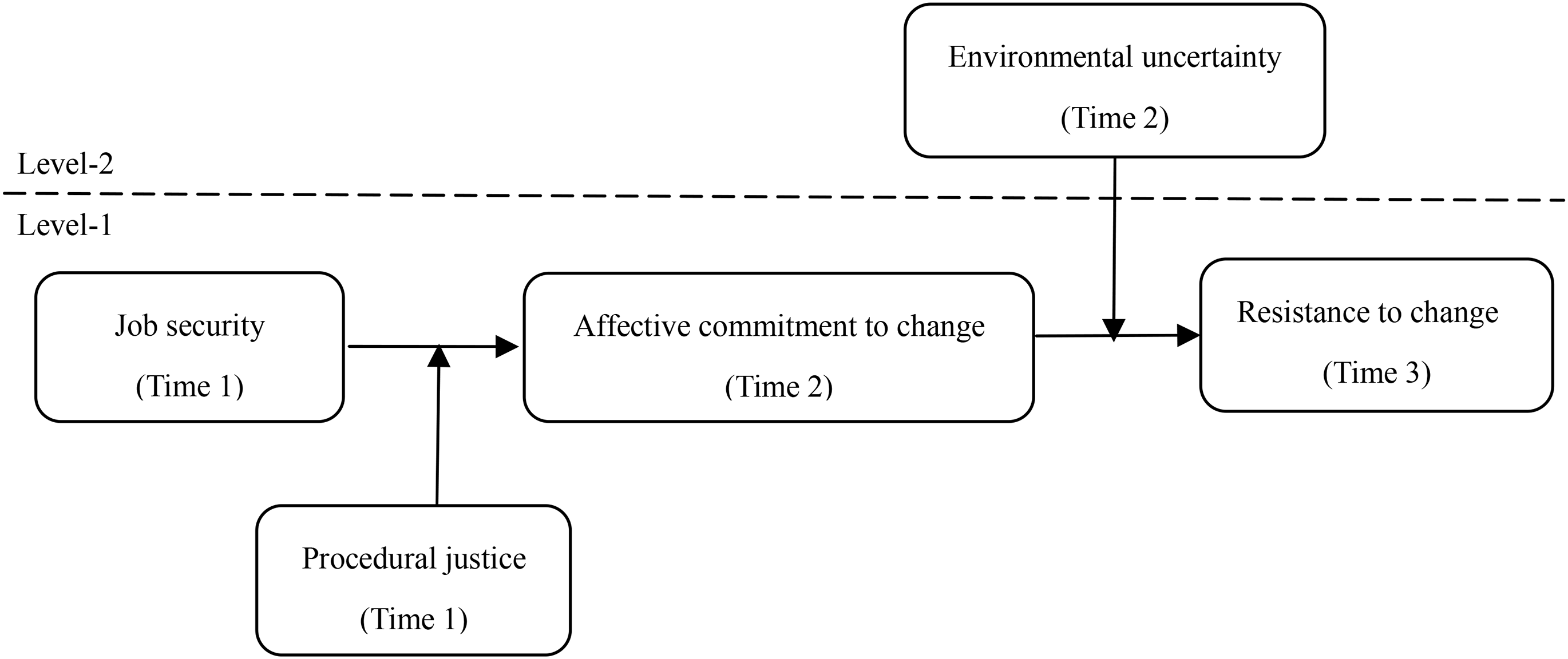
Conceptual model.
Research Method
Sample and Data Collection
The Chinese context was selected for this study, as China is still in the transition to a market-driven economy, which makes organizational change commonplace in enterprises (e.g., organizational restructure, employees’ layoff, and management optimization). In this context, the traditional life-long employment system was broken, which may expose employees to reduced job security and more negative responses to change than ever before. We collected data in 2015 from a large manufacturing group, which is a corporation or a large entity based in a coastal city in eastern China. The group has 31 subsidiaries (manufacturing plants) with private-owned ownership. Its main business is equipment manufacturing, covering a full range of products such as concrete machinery, excavation machinery, lifting machinery, road construction machinery, piling machinery, wind power equipment, port machinery, petroleum equipment, coal equipment, precision machine tools, etc. At that time, the whole group enterprise was undergoing an important planned and progressive change, this change mainly involved strategic change, restructuring, and personnel change throughout the whole group enterprise, which makes job setting, job rotation, promotion, and salary increases become scarce resources, so seeking for job security, not losing specific resources, and striving for protecting resource allocation within the limited resource supply, may be a common and stressed phenomenon in this change.
After preliminary communication, 23 of the 31 subsidiaries participated in the full study (74.19%), a contact person in each subsidiary was responsible for the administration of the survey. Prior to data collection, the 23 subsidiaries were contacted via emails or telephones that set out our purpose and procedures and provided a guarantee for the confidentiality of the results. They offered a list of voluntary employees to contact for the research team. Participants who were experiencing this actual change (strategic change, restructuring, and personnel change synchronously), were asked to participate in the survey voluntarily and promised anonymity, with a token gift of 20 Chinese yuan (about three dollars), which was given once the survey questionnaire was completed in each wave. All participants (department/team leaders and members) in the 23 subsidiaries completed the questionnaires during work hours on company premises and then put their responses into a self-sealing envelope supplied by our research team members. All questionnaires were coded with initials of names (but later removed), to match the data completed by subordinates and with those completed by supervisors across three waves.
A three-wave design was used to mirror the different stages or times in this change process, which may influence individuals’ change-related reactions (Kim et al., 2011). When we collected the first round of data, the group was undergoing strategic change and restructuring, with the purpose of reducing costs, adjusting the business scope, and improving the management system to make it a more standardized and flexible organization. Most employees were directly affected by this change through responsibilities, roles, and new line reports. The first survey (Time 1 [T1]) was conducted two weeks before the implementation of their proposed initiatives, when employees and their department managers received change information (e.g., the change purpose, the change plan, or the expected change goal), and employees had also noticed that their workload was likely to increase to support the smooth progress of change. At T1, employees’ job security, procedural justice, and control variables were measured. A total of 600 questionnaires (500 employees and 100 supervisors) were distributed in the 23 subsidiaries, 494 employees and 93 supervisors (93%) returned their questionnaire, resulting in a response rate of 98.8% and 93%, respectively. Control variables including educational background and team size were investigated every time.
The second-round survey (Time 2 [T2]) was conducted three months after the formal beginning of this change process, as the three-month interval would provide participants with sufficient time to perceive, experience, and observe the whole change process and environmental uncertainty. As a relatively stable variable, affective commitment to change was assessed at T2 via employee self-reports. Lining up with Feng et al.’s (2020) findings, employees’ affective commitment to change tends to be sustained over time; if employees have low affective commitment to change initially, they will continue doing so and resist the change. As supervisors and subordinates can respond appropriately to internal environmental changes during this change process, so environmental uncertainty was rated by them (team leaders and members). The second wave involved a follow-up questionnaire being sent to the same participants who had responded at T1 and agreed to participate in the second survey. Of these, a total of 483 employees (97.8%) and 90 supervisors (96.7%) in the 23 subsidiaries returned the questionnaire.
The third survey (Time 3 [T3]) was conducted three months after the second wave, at which point this change process was still underway, and resistance to change was assessed by subordinates. This interval also gives employees enough time to observe their own resistance to change. In all, excluding uncompleted and nonmatching questionnaires, valid data at T3 was received from 469 employees and 86 supervisors (an average of 5.45 employees per leader or department) in the 23 subsidiaries.
In all, more than half of the participants were male (59%), over three-quarters were between 25 and 40 years old (77.4%), and nearly all were highly educated (∼90% of the sample had completed at least a bachelor’s degree), who worked in various sectors, including human resource, marketing, research & development, manufacturing, etc.
Measures
Job security was assessed by subordinates with a job insecurity scale developed by Hellgren et al.’s (1999) five-point Likert scale, including two dimensions and seven items. Dimension 1—quantitative insecurity comprised three items, which refers to the amount of worrying about future job loss; and the second dimension—qualitative insecurity included four items, which means the quality of perception about the future job value. An example of these items was the statement, “I believe this affiliation will need my ability also in the future.” Each item was scored in reverse. These two dimensions were combined into a total score following Aryee et al. (2012). Cronbach’s alpha in this study was .96.
Procedural justice was measured via employees with a six-item scale developed by Niehoff and Moorman’s (1993) five-point Likert scale, which examines whether job decisions are made with fair and accurate information, and employees have a chance to offer input in the process. The scale was altered to fit it to the context of organizational change, and each item was relabeled “during the organizational change process.” An example was the statement, “the general manager makes job decisions in an unbiased manner during the organizational change process.” Cronbach’s alpha in this study was .93.
Affective commitment to change was developed in the context of organizational change in China by Feng et al.’s (2020) five-point Likert scale. There are four items in total. Examples were “this change serves an important purpose,” “I believe in the value of this change,” “this change is a good strategy for this organization,” “I think that management is making a mistake by introducing this change” (R). Cronbach’s alpha in this study was .91.
Environmental uncertainty was assessed using an eight-item scale developed by Miller and Friesen’s (1983) five-point Likert scale, including two dimensions—environmental dynamism and environmental hostility. All participants including team leaders and subordinates rated it as they can perceive more nuanced and evaluate environmental changes more accurately (Chen & Shen, 2018). An example was “change in production or service technologies is unpredictable.” Following Aryee et al. (2012), the two dimensions were combined into a total score. Cronbach’s alpha in this study was .92.
Resistance to change was assessed by subordinates themselves being related to the current change using a five-point Likert scale (Oreg, 2003), including four dimensions and 18 items, such as routine seeking, short-term thinking, reaction, and cognitive rigidity. As a dispositional variable, we measured it specific to this change process. An example was “I like to do the same old things rather than try new and different ones.” Learning from the work of Aryee et al. (2012), we also analyzed data of the total scale due to the high correlations among the four dimensions (0.76–0.91). Cronbach’s alpha was .88.
Control variables included educational background and team size. Following prior researches (e.g., Foster, 2010; Kalyal et al., 2010), control variables were included at both individual and team levels to eliminate alternative interpretations. Team member's educational background was controlled at level 1, while team size was controlled at level 2 (i.e., the team level). Educational background was coded into three dummy variables: 1 = high school or below, 2 = bachelor, and 3 = postgraduate, while the average team size was 6.41. Effects of the above variables on resistance to change were examined by analysis of variance. Results showed that educational level and team size had significant effects on resistance to change (F = 1.26, p < .01; F = 1.43, p < .01, respectively), consistent with previous research (Foster, 2010), so these variables were incorporated as control variables.
Statistical Technique
Due to the multilevel nature of the data in this study, all the hypotheses were tested by calculating hierarchical linear modeling with software HLM 6.08 (Raudenbush et al., 2004). Then the moderated mediation Hypotheses 5a and 5b were tested by taking the moderated path analysis approach (Edwards & Lambert, 2007) and using the SPSS macro MLMED program for cross-level moderated mediation developed by Rockwood and Hayes (2017).
Results
Descriptive Statistics
Descriptive statistics, correlations, and reliabilities for all the variables are presented in Table 1. Consistent with the predictions made for this study, job security was negatively related to resistance to change (r = −.11, p < .01), while positively related to affective commitment to change (r = .16, p < .01), and affective commitment to change was negatively related to resistance to change (r = −.46, p < .001). While procedural justice was positively related to affective commitment to change (r = .09, p < .05), and environmental uncertainty was positively related to resistance to change (r = .13, p < .05). For control variables, the educational background was positively related to affective commitment to change (r = .17, p < .05); and team size was negatively related to resistance to change (r = −.16, p < .05).
Descriptive Statistics, Correlation Coefficients, and Reliabilities of Variables.
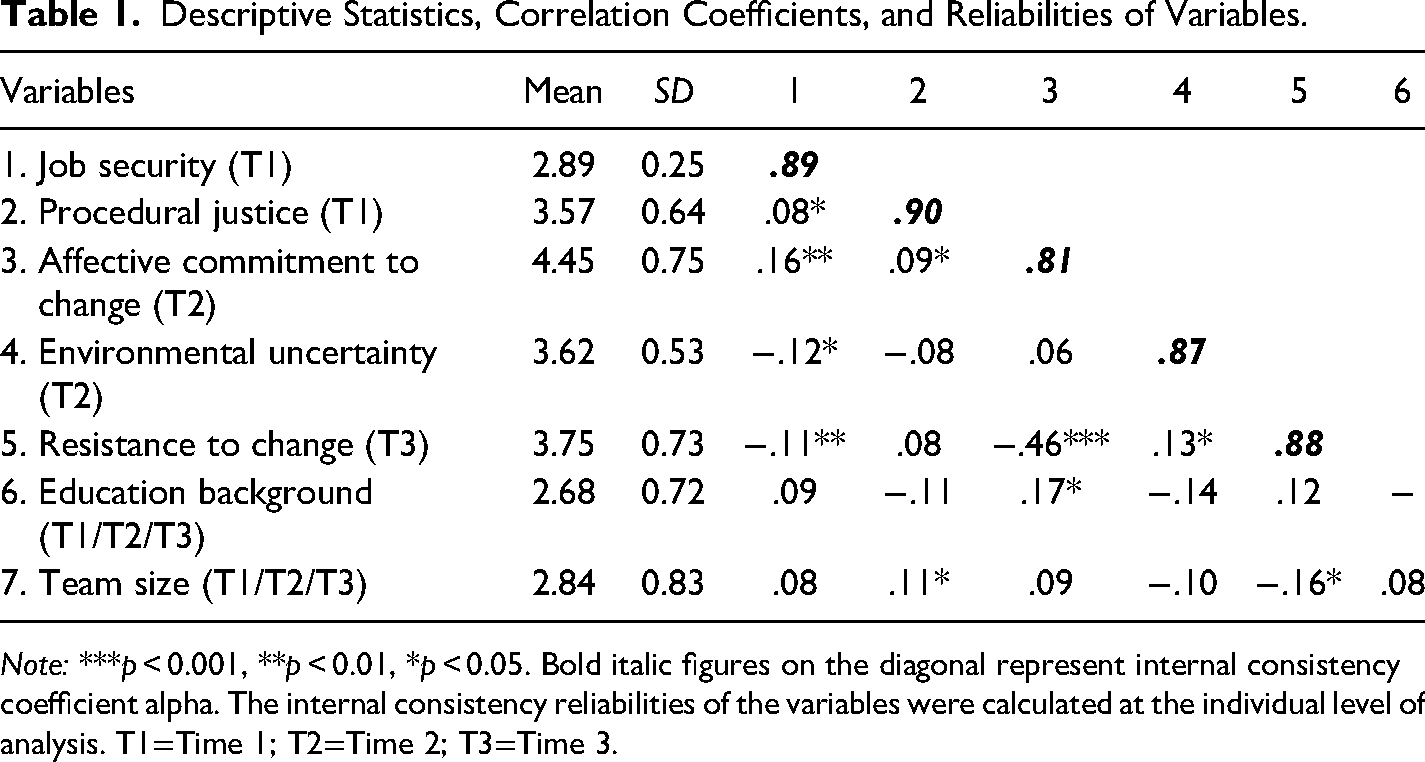
Note: ***p < 0.001, **p < 0.01, *p < 0.05. Bold italic figures on the diagonal represent internal consistency coefficient alpha. The internal consistency reliabilities of the variables were calculated at the individual level of analysis. T1=Time 1; T2=Time 2; T3=Time 3.
Discriminant Validity
Before testing the above hypotheses, multilevel confirmatory factor analysis (MCFA) procedures (Heck & Thomas, 2015) were used to evaluate the discriminant validity of five variables to test for common method variance. A baseline model was examined that specified the above five factors. Job security, environmental uncertainty, and resistance to change were regarded as indicators of their respective latent constructs in the analyses. Results show that the hypothesized five-factor baseline model fits well with acceptable indices (x2/df = 1.61, p < .01; incremental fit index [IFI] = 0.97, Tucker–Lewis index [TLI] = 0.96, comparative fit index [CFI] = 0.98, root-mean-square error of approximation [RMSEA] = 0.05, within standardized root-mean-squared residual [SRMR] = 0.05, between SRMR = 0.13), which is considerably better than those for any of the alternative models (please see Table 1). While the MCFA showed that the single-factor model did not fit the data (x2/df = 11.57, p > .05; IFI = 0.65, TLI = 0.62, CFI = 0.66, RMSEA = 0.27, within SRMR = 0.29, and between SRMR = 0.13). In addition, a Harman's exploration factor analysis (EFA) single-factor model also did not meet acceptable standards through unrotated factor solutions. Five factors were extracted with a total variance explained rate of 73.67%, among which the variance explained rate of the first factor was 28.14%, less than half of the rate (Table 2).
Goodness-of-Fit Summary for Multilevel Confirmatory Factor Analyses. a
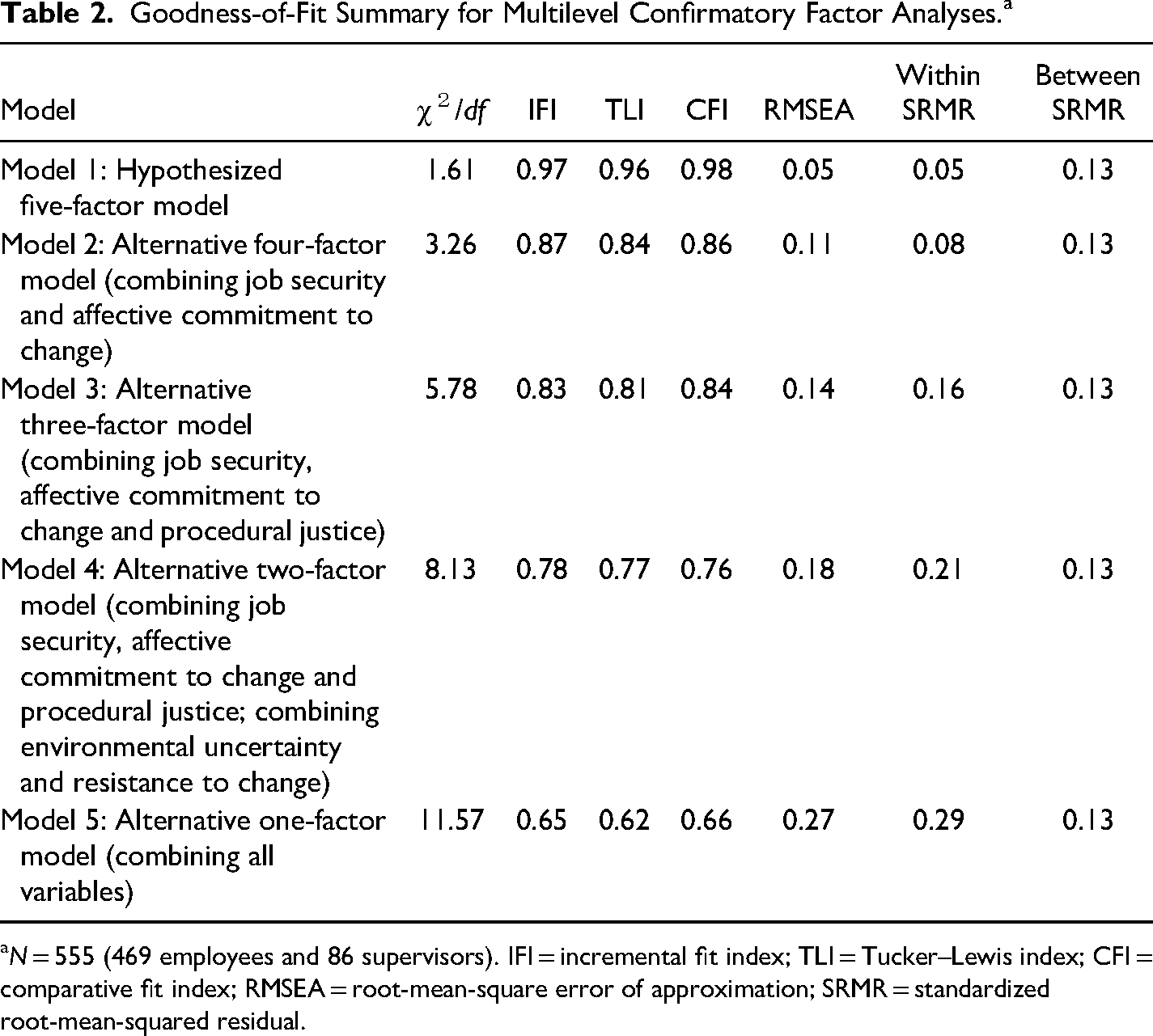
N = 555 (469 employees and 86 supervisors). IFI = incremental fit index; TLI = Tucker–Lewis index; CFI = comparative fit index; RMSEA = root-mean-square error of approximation; SRMR = standardized root-mean-squared residual.
Hypotheses Testing
Job Security and Resistance to Change—The Mediating Role of Affective Commitment to Change
To determine whether affective commitment to change mediated the relationship of job security and resistance to change, we applied four conditions in Mathieu and Taylor (2007) with HLM analysis: (1) job security must influence resistance to change (
HLM Results: The Mediating and Interactive Effects of Job Security, Procedural Justice and Environmental Uncertainty on Resistance to Change.

Note: At level 1, N = 469, at level 2, N = 86 groups; *p < .05, **p < .01, ***p < .001.Two-tailed tests.
Further, we followed Preacher and Selig’s (2012) recommendations to test the indirect effect of affective commitment to change was estimated using a Monte Carlo (MC) approach, i.e., the MC method for assessing mediation—a powerful method of constructing MC confidence intervals for indirect effects in multilevel models. Based on 20,000 random repetitions, which were used to obtain the 95% MC confidence interval (CI) for the effect of job security on resistance to change via affective commitment to change, results showed the indirect effect of affective commitment to change to be significant (estimate = 0.05, 95% CI = [0.03–0.09]), as zero is not contained in the interval. According to the above methods, Hypothesis 1 and 2 are thus supported.
Job Security and Affective Commitment to Change—The Moderating Role of Procedural Justice
A model was developed consisting of education level, job security, procedural justice and affective commitment to change as level-1 predictors, as well as team size as a level-2 predictor of the level 1 intercept of affective commitment to change. Results shown in Table 3 found that procedural justice was significantly related to commitment to change (
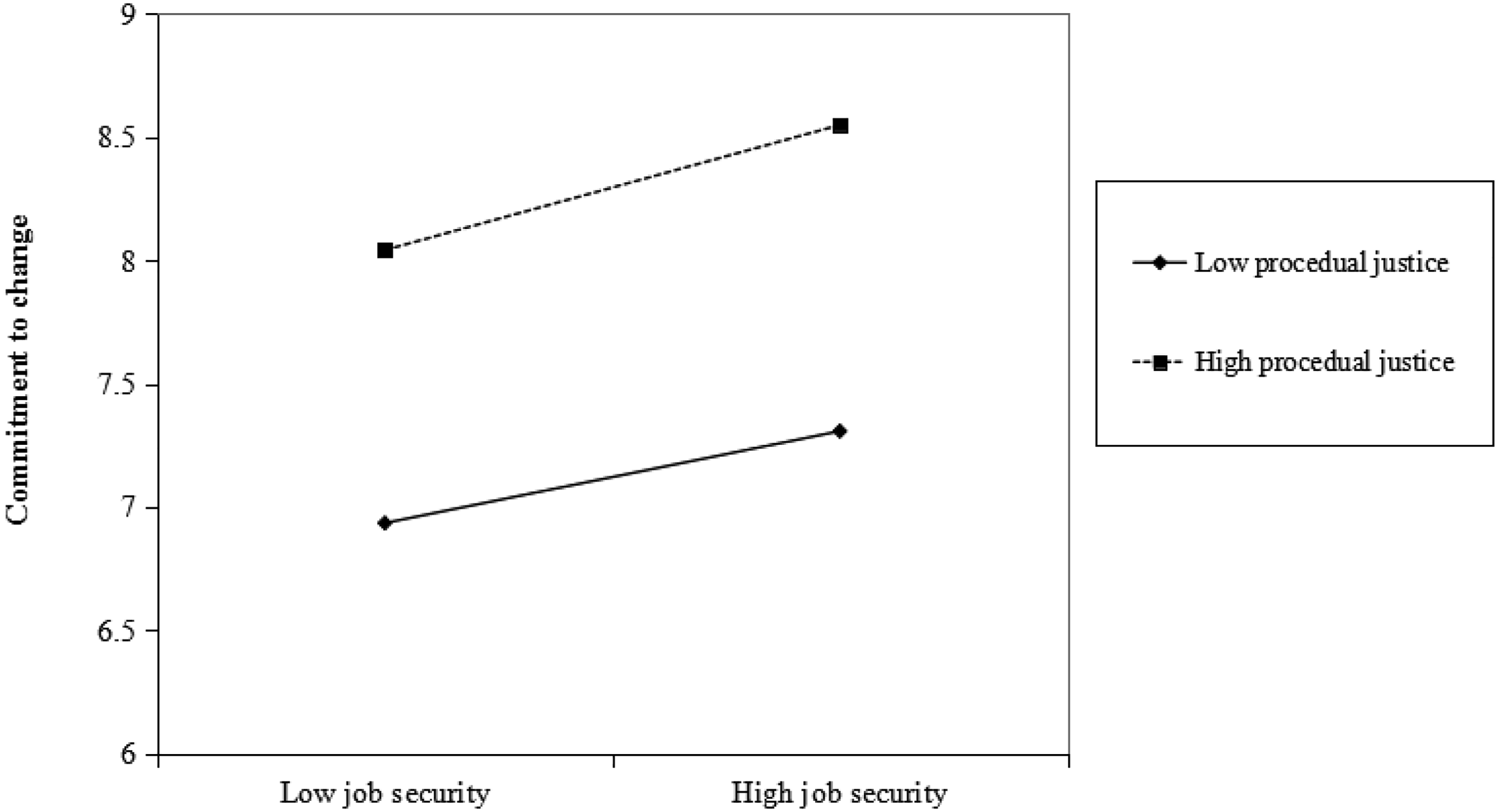
Interaction between job security and procedural justice in predicting affective commitment to change.
Commitment to Change and Resistance to Change—The Moderating Role of Environmental Uncertainty
To test Hypothesis 4, a model was developed consisting of education level, affective commitment to change, and resistance to change as level 1 predictors, as well as team size and environmental uncertainty as level 2 predictors of the level 1 intercept/slope of resistance to change. Following the analysis in the work of Bauer et al. (2006), results in Table 3 indicate that affective commitment to change was negatively related to resistance to change (
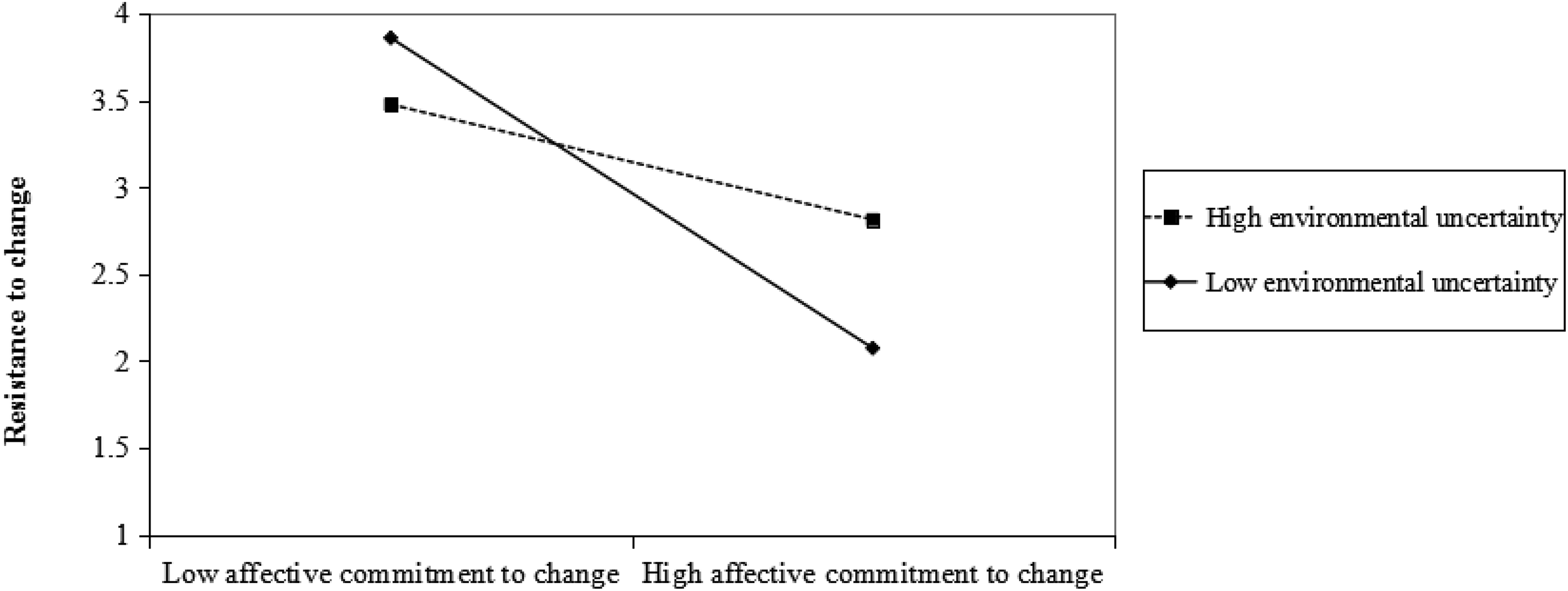
Cross-level interaction between affective commitment to change and environmental uncertainty in predicting resistance to change.
An Integrated Moderated Mediation Model
To further test moderated mediation Hypotheses 5a and 5b, the findings in Edwards and Lambert (2007) and Liu et al. (2012), as well as the moderated mediation analysis approach in Hayes (2013), were applied to estimate four sets of effects at the high and low levels of the moderating variables (i.e., procedural justice and environmental uncertainty). Results shown in Table 4 suggest that the indirect effect was stronger in the presence of higher procedural justice (0.25, [0.05, 0.16]) than in the presence of lower procedural justice (0.11, [0.02, 0.08]); the indirect effect was weaker in the presence of higher environmental uncertainty (−0.09, [−0.09, −0.02]) than in the presence of lower environmental uncertainty (−0.16, [−0.21, −0.11]).
Results of the Moderated Path Analysis.
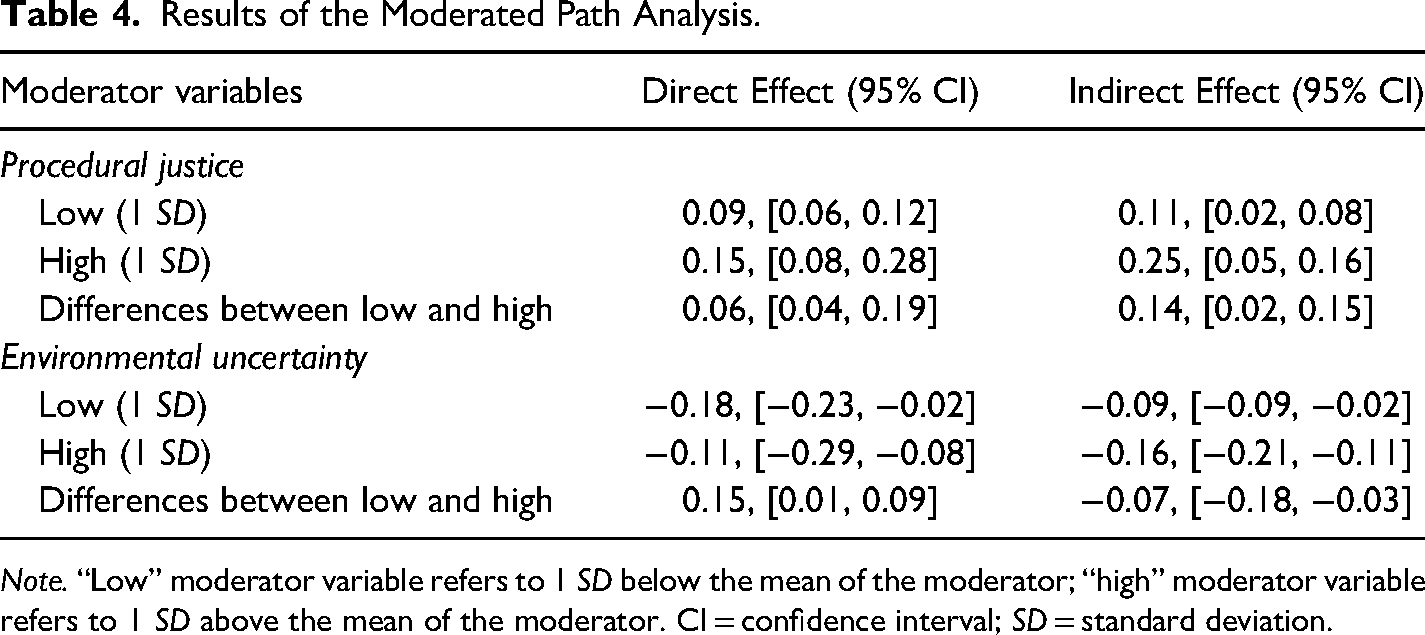
Note. “Low” moderator variable refers to 1 SD below the mean of the moderator; “high” moderator variable refers to 1 SD above the mean of the moderator. CI = confidence interval; SD = standard deviation.
Discussion
Theoretical Implications
This study has four critical contributions to the literature of organizational change. First, we collected data at three points in time to better understand resistance to change timely and notably, and found that alleviating resistance to change by increasing job security would be an expected positive outcome, which verifies and echoes COR theory. COR emphasizes that individuals strive to acquire, retain, protect, and cultivate various valuable resources (Hobfoll et al., 2018). They may feel stressed when these resources are threatened or depleted. In this case, getting enough resources from the organization or supervisor can help relieve the pressure and use more resources to deal with change pressure, so as to treat change less negatively. This not only provides strong empirical support for the above theoretical views, but also makes an empirical contribution to the further development of the COR theory in this context.
Second, this study has broken the theoretical limitations and creatively incorporated affective commitment to change into the COR model, focusing on how job security reduces resistance to change by stimulating affective commitment to change. As such, expands our understanding of the relationship between job security and resistance to change.
Thirdly, this study has also shown that procedural justice can buffer the change-related effects of job security, which further verifies Bayraktar’s research (2019) that job security and procedural justice are important resources for the success of the organizational change. According to organizational justice theory (Colquitt et al., 2013), employees will pay greater attention to the fairness of the rules, procedures, and processes used by their managers in making decisions, and use information about procedural justice to help them make judgments about the credibility of the change and then decide whether to support change or not. Procedural justice as an important resource allows employees to feel the value and significance of the change, and to preserve resources and enhance emotional commitment to change. If the procedures and decisions of the organizational change are fair, employees will have more trust and recognition for this change, thereby increasing employee loyalty to change and motivating individuals to participate in actions to achieve organizational change goals. These results are a powerful expansion on employees’ reaction to change, which provides a new research idea.
Fourthly, another contextual factor discussed in this study is related to environmental factors such as uncertainty about the environment, which is consistent with the COR principle that employees become more defensive in their resource investment strategies as they lose resources (Halbesleben & Wheeler, 2015). During times of organizational change, resistance is common, especially to the extent that employees feel that their jobs may be at risk. Generally speaking, when the loss is not serious, employees tend to pursue risk, while when the loss becomes too large, they may tend to avoid risk. That resistance is lessened if employees are committed affectively to the change they are experiencing, and especially if they believe they are being treated fairly by the company (procedural justice). So more uncertainty leads to resistance. It also undermines affective commitment which means more resistance. When employees are faced with more job insecurity, they will realize that their valuable job resources are threatened (e.g., unemployment and lower pay), they may focus on protecting existing resources and resources, they may become defensive when investing and conserving resources (Sender et al., 2017). Hence, the overall effect is stronger with low uncertainty. It is hard to find another job under conditions of high environmental uncertainty, their resistance to change will be increased (not decreased). They tend to actively compile preparatory actions and effective psychological resources to reduce the impact of stress events (such as environmental uncertainty) on them.
Implications for Practice
This study is quite timely and would have the potential to benefit the practice of change management in organizations.
First, we can effectively prevent and suppress the harm of employees’ resistance to change through strategic and reasonable intervention policies. Organizations need to build or improve the control system and punishment mechanism for the occurrence of resistance to change, such as change implementation linking with the annual bonus, inspection, and supervision of the change progress, change effectiveness's evaluation. Also, organizations can develop open, inclusive, and communicative resources for employees, for example, encouraging them to provide timely feedback to problems encountered in the change process, providing good suggestions during the change process, thus curbing the occurrence of resistance to change.
Furthermore, managers can take effective measures to improve employees’ affective commitment to change and make them feel actual benefits from the change, such as increased pay, improved working environment, and better interpersonal relationships in the workplace. Employees may be asked to increase their workload, change their tasks and workflow at any time during times of change, even some employees do lose their jobs. If employees’ benefits can be appropriately increased, it is also the most intuitive way to make them anticipate tangible benefits. To gain employees’ sincere support for change, their legitimate rights and interests must be fully protected, including allocation of sufficient resources to ensure sufficient social and emotional information to understand their status and value. When employees are affectively dependent on this change and agree with this change value and goal, they are more willing to participate in activities that are beneficial to organizational change.
Moreover, organizations should try to manage employees’ change commitment, create a fair climate, and strive to provide open and honest communication during organizational change. As pointed out above, change is constant in contemporary organizations, and change is commonly met with resistance. Any factors which can attenuate the change-resistance connection will prove valuable to researchers and practitioners alike. Organizations can ensure procedural justice by describing a clear vision, creating a fair climate, formulating an open and transparent distribution system, and setting up a monitoring mechanism for the effective implementation of the distribution system. Establishing an opening change communication system (e.g., an intervention program) can also help employees embolden trust and adapt quickly to the changing environment, motivating them to dedicate themselves to the change with lower resistance.
Finally, organizations can stimulate change vitality through moderate environmental uncertainty, as well as appropriately and timely adopt change practices. Because the impact of environmental uncertainty on resistance to change is consistent, managers should also make flexible work plans by means of job redesign, job rotation, and clearer descriptions about changes, so that employees can actively participate in the change even if in an unstable external environment.
Limitations and Future Research
There are some limitations in this study that have also indicated areas for future studies. First, as 23 subsidiaries belong to the same group enterprise, our results are easily disturbed by the overall corporate culture. In the future, organizational culture can be set as a control variable to reduce the cultural effect on research results.
In addition, we can choose to expand the sample to test our model to obtain more representative conclusions. Moreover, while this study used matched, three-wave and multisource methods to collect data, and we detected the interference of the same source bias, but there is a scope for longitudinal organizational change research to be designed and supplemented by scenario experiments, which would improve the accuracy and the external validity of findings for the organizational change field.
Footnotes
Declaration of Conflicting Interests
The authors declared no potential conflicts of interest with respect to the research, authorship, and/or publication of this article.
Funding
The authors disclosed receipt of the following financial support for the research, authorship, and/or publication of this article: This work was supported by the National Natural Science Foundation of China (grant numbers 71402067, 19YJCZH029, ZR2019MG002, and 18CGLJ14).