



Abstract
Intermediary actors have been recognized for their role in facilitating collaborations to achieve sustainability goals. Yet how voluntary sustainability collaborations, guided by intermediary actors, unfold in practice remains underdeveloped. Building on empirical data from the Principles for Responsible Management Education (PRME) network and using a network brokerage lens, we unfold dynamics of voluntary sustainability collaboration in the presence of an intermediary actor. We find that intermediaries act as sustained iungens brokers in voluntary sustainability collaborations, by connecting other actors and coordinating new collaborations in a multi-level network. Their activities are affected by tensions inherent to iungens brokerage in a voluntary setting, and factors influencing the success of the network collaborations. We contribute to the sustainability literature by offering a firsthand view on the dynamics of sustainability collaborations through an autoethnographic approach. We provide implications for sustainability collaborations in voluntary settings and recommendations for advancing responsible management education through collaboration.
Keywords
Introduction
“The Global Goals can only be met if we work together. (…) To build a better world, we need to be supportive, empathetic, inventive, passionate, and above all, cooperative.”
Excerpt from “Sustainable Development Goal (SDG) 17: Partnerships for the Goals”
The United Nations Sustainable Development Goals (SDGs) have drawn our attention to the importance of collaborating to achieve sustainable development. Specifically, SDG 17, “Partnerships for the Goals”, stresses the importance of multi-stakeholder partnerships to mobilize and share knowledge, expertise, technology, and financial resources to support the achievement of the SDGs (UN, 2022). The need for collaboration for sustainable development stems from the fact that the underlying challenges are highly complex and interrelated, and therefore cannot be resolved by single actors in an individual manner (Bansal, 2019; Bode et al., 2019; Ferraro et al., 2015; Gray & Purdy, 2018). Multi-actor collaboration has, therefore, been proposed as a way to lead to joint decision-making among key stakeholders in a specific problem domain (Bouwen & Taillieu, 2004), such as sustainable development (Craps et al., 2016).
As previous research on sustainability collaborations and partnerships has predominantly focused on collaborations of businesses with other actors (e.g., NGOs or government organizations) (Gray & Dewulf, 2021), we remain in the dark on how sustainability collaborations function when they engage actors from outside the corporate sphere. Moreover, intermediary actors have been recognized as potential facilitators of collaborations for sustainability, yet little is known about how such intermediaries facilitate collaboration for sustainability in practice (Bansal et al., 2012; Bode et al., 2019; Williams et al., 2019). This is especially the case for voluntary settings, in which an official mandate to ‘solve’ the sustainability challenge at hand is absent (Williams et al., 2019). To tackle this issue, we address the following question: How do dynamics of voluntary sustainability collaboration unfold in the presence of intermediary actors?
Drawing on an in-depth qualitative study, we use the empirical context of the Principles for Responsible Management Education (PRME) network to study the activities of the PRME Chapter France-Benelux in fostering voluntary collaboration for sustainability. UN PRME is a global network that gathers business schools and faculties worldwide committed to training the next generation of managers and business leaders to become generators of a sustainable global economy, and to manage the complex challenges faced by business and society in the 21st century, thereby supporting the achievement of the SDGs (PRME, 2022a). PRME brings together its signatories through a global network and sub-networks (PRME Champions, Regional Chapters and issue-specific Working Groups) to advance jointly on sustainability topics (Finstad-Milion et al., 2021).
Using collaborative autoethnography, we study the experience of three Steering Group members of the PRME Chapter France-Benelux, to gain deeper insights into the Chapter’s activities, focused on facilitating collaboration towards sustainability. We contribute to the scarce literature on collaboration for sustainability (e.g., Bode et al., 2019; DiVito et al., 2021; Sharma & Kearins, 2011; Williams et al., 2019), by providing a unique, firsthand perspective on how voluntary sustainability collaborations unfold in the presence of an intermediary actor. Moreover, we take a new step in theorizing dynamics of voluntary sustainability collaborations by using network brokerage, a concept identified as important for fostering collaborations, especially in complex and multi-faceted circumstances (Obstfeld et al., 2014; Reinecke et al., 2018). We add to the existing stream of literature on sustainability collaborations (Bansal et al.,2012; DiVito et al., 2021; Williams et al., 2019), by identifying voluntary intermediary actors in sustainability collaborations as sustained iungens brokers, who perceive tensions inherent to their brokerage activities and depend on process facilitators for successful brokerage activities and collaboration in the network. Finally, based on our findings, we provide recommendations for business schools and faculties to move towards responsible management education.
The remainder of this article is structured as follows. First, we review the existing literature on collaboration for sustainability. Second, we present our research methodology, where we provide information on the PRME network and Chapter as our research setting and detail the collaborative autoethnographic method used. We then present our findings and discussion, where we expound dynamics of collaboration for sustainability in the presence of an intermediary actor, by using a network brokerage lens. The paper concludes with new insights for voluntary sustainability collaborations and offers avenues for further research on the topic.
Research on Collaboration for Sustainability
Collaborations between societal actors can be defined in many ways, with a focus on either the process or the outcomes of partnering up (or a combination of both). In a processual view, collaborations can be viewed as networks of relationships that are beneficial to all participating actors (Sharma & Kearins, 2011), or as co-creative utopian processes that inspire communities to engage in high-quality practices, beyond mere self-interest and through involvement in relations with others (Craps et al., 2016). When the emphasis is set on the outcome, they can be defined as “the attainment of goals beyond the capabilities of organizations [or actors] acting alone” (Vangen et al., 2015, p. 1240).
From the point of view of an individual actor or organization, collaborations can be perceived as a way to avoid spending resources and costs on problem-solving that could be shared with others, and to find more innovative solutions and spend less time doing so (Sharma & Kearins, 2011). Successful collaboration requires tuning of the participating actors’ expectations, interests, identities, and perspectives through reframing and connecting issues, as well as creating trust between actors, and joint ownership for the process and its outcomes (Craps et al., 2016; Vangen & Huxham, 2003; Wood & Gray, 1991). Collaborations include both relational and problem-solving activities (Bouwen & Taillieu, 2004). Managing those activities well requires formal or informal governance, to enable the achievement of goals set jointly by the participating actors (Termeer et al., 2019; Vangen et al., 2015). Leadership in collaborations can be taken up by one or more of the participating actors or by an intermediary (Gray, 1989; Huxham & Vangen, 2000).
In general, collaborations are mostly beneficial when actors depend on each other for their own survival and wellbeing, for example, when addressing sustainability challenges (Craps et al., 2016). Nevertheless, collaborations can be transactional, when they are focused on costs and benefits, direct (economic) value for the actors, and incremental change, or transformational, when they focus on a larger purpose with outcomes that exceed the benefits of the individual actors, and long-term, sustainable change (Craps et al., 2019; based on Senge et al., 2007). Sustainability challenges are highly complex and multi-faceted, and therefore rely on the input and competencies of a variety of actors from society to be successfully addressed (Gray & Dewulf, 2021; Gray & Purdy, 2018; UN, 2022).
The inclusion of a diversity of actors is often stressed as an important condition for successful sustainability collaborations (Curseu & Schruijer, 2017; Ferraro et al., 2015). The more complex and interdisciplinary the sustainability challenge addressed is, the greater the number of concerned stakeholders will be (Ferraro et al., 2015; Freeman, 1984). At first glance, including a multiplicity of actors can appear simple and straightforward; it is about presence, participation, safety, voice, authenticity, equity and equality for more people across multiple identity groups (Ferdman, 2017). However, inclusion can be complex and multifaceted when applied in practice (Ferdman, 2017). While inclusion is one of the most powerful mechanisms for distilling value from the unique perspective and experience inherent in a diverse population (AACSB, 2021; Legler & Reischl, 2003), certain populations remain less represented, visible, or vocal in organizations and society at large for historical, cultural, social and economic reasons (Curseu & Schruijer, 2017).
Sustainability collaborations allow a variety of actors to interact on a voluntary basis towards a common sustainability goal (Craps et al., 2016; Lozano, 2007), yet one must be careful with the expectations, since they realistically do not provide the answer to fully resolving sustainability issues (Ferraro et al., 2015; Termeer et al., 2019). Sustainability collaborations can result in “small wins”, or concrete, implemented outcomes of moderate importance, that can lead to change when accumulated (Ferraro et al., 2015; Termeer et al., 2019; Termeer & Dewulf, 2019). Collaborations also have the potential to create critical intangible benefits; they may facilitate mutual learning and value creation (Sharma & Kearins, 2011). While the benefits of sustainability collaborations between actors are multiple, typical obstacles to collaboration are coordination costs, benefits of information for certain actors over others, bargaining tensions, value conflicts, conflicts of interests of organizations, and impressions of free riding (Bode et al., 2019; Carley & Christie, 2000; Lozano, 2007). There is also a potential for paralysis to appear, especially when collaborating to address wicked problems – as they are complex and can be overwhelming (Gray & Dewulf, 2021; Termeer & Dewulf, 2019).
Collaborations that address sustainability challenges can take many different forms. For example, according to Ferraro et al. (2015), they can be organized in three ways: through a participatory architecture, multivocal inscription, or distributed experimentation. Collaborating though a participatory structure means that a platform is provided where diverse and heterogeneous actors can interact constructively around a sustainability topic over prolonged timespans (e.g., collaboration on sustainability reporting through the Global Reporting Initiative—GRI). Multivocal inscription means that collaborative activities are undertaken while different interpretations of sustainability concepts are sustained among audiences, without requiring explicit consensus (e.g., collaboration around the broad concept of “sustainable development” or using the framework of the United Nations’ Principles for Responsible Investing—PRI). Finally, distributed experimentation means that collaborations are organized through iterative action that generates small wins and increases engagement, while unsuccessful efforts are abandoned (e.g., greenhouse gas reduction initiatives, or the Forestry Stewardship Council) (Ferraro et al., 2015).
While sustainability collaborations and partnerships have been discussed in the literature (e.g., Ferraro et al., 2015; Gray & Dewulf, 2021; Heuer, 2011), empirical evidence of such partnerships and their dynamics is scarce (Bode et al., 2019; DiVito et al., 2021; Sharma & Kearins, 2011; Williams et al., 2019). In addition, most studies addressing sustainability collaborations in practice are focused on cross-sector partnerships, i.e., combining private, public, and non-profit organizations (Bode et al., 2019; DiVito et al., 2021; Henry et al., 2022), as opposed to studying collaborations for sustainability outside the corporate sphere and between more homogenous actors. Moreover, research on the topic tends to be focused on strategically managed collaborations, while there is a lack of knowledge about collaborations that emerge from serendipitous connections or from collaborations that appear without an official mandate to solve a specific sustainability problem (Williams et al., 2019).
Considering the importance of governance and leadership in sustainability collaborations (DiVito et al., 2021; Gray & Dewulf, 2021; Termeer et al., 2019), intermediary actors have been recognized as potential facilitators of collaborations for sustainability. Among the few examples studied in the literature are the Canadian Network for Business Sustainability (Bansal et al., 2012) and the World Business Council for Sustainable Development (WBCSD) (Williams et al., 2019), which were both identified as boundary spanners connecting loosely networked actors in the sustainability field. For example, Williams et al. (2019) studied how two unrelated collaborative processes between different boundary organizations resulted in the endorsement of the SDGs by the WBCSD. The authors described process dynamics of intersecting interorganizational collaborations and specified common antecedents and triggering mechanisms of such collaborations. Bansal et al. (2012) focused on the role of intermediary actors in bridging between the conflicts and competing priorities of researchers and practitioners, by convening, facilitating and supporting collaborations between them. However, in general, very little is known about the dynamics of voluntary sustainability collaborations in the presence of an intermediary actor (e.g., types of activities performed by intermediary actor, tensions perceived, or context operated in).
In order to tackle this lacuna, we conducted an inductive study that guided us to the literature on network brokerage. Network brokerage is traditionally defined as “an activity of a network actor (broker) occupying a structural position between two or more otherwise disconnected actors (referred to as alters), and it typically involves an exchange or interaction between the broker and the alters” (Kwon et al., 2020, p. 1,093). While the fore-mentioned studies of Bansal et al. (2012), DiVito et al. (2021) and Williams et al. (2019) loosely allude to concepts of network brokerage, they do not use this theoretical lens to explain the dynamics of sustainability collaborations. This is somewhat surprising, as the concept of network brokerage has recently started to cover processes that go beyond mere transactions and economic exchanges, to also include activities such as facilitating social relations or patterns of social engagement (Reinecke et al., 2018). Moreover, network brokerage has been identified as important for fostering collaborations, especially in circumstances that are complex and multi-faceted (Obstfeld et al., 2014; Reinecke et al., 2018), which makes them potentially suitable to address sustainability topics. This is the issue we venture to address in the current work: through an inductive, qualitative study, we provide new insights as to how voluntary collaborations for sustainability unfold in the presence of an intermediary actor, by using a network brokerage lens. The next section will outline the research setting and methods of the study.
Methods
In this section, we explain the research setting of this study, the PRME network, in which we investigate the activities of the PRME Chapter France-Benelux, an intermediary actor operating in a voluntary sustainability network. To do so, we begin by presenting the PRME Global network, followed by the PRME Chapter France-Benelux. Afterwards, we detail the collaborative autoethnographic method used to collect and analyze our data.
Research Setting: the PRME Network
PRME Global
The United Nations Global Compact (UNGC) strategy to grow sustainable business leaders gave way to the PRME initiative, first presented at the UNGC Leaders Summit in 2007 (PRME, 2022b). At the time, management education was increasingly criticized for not sufficiently addressing topics such as sustainability, business ethics, and corporate social responsibility (CSR) in its activities (Ghoshal, 2005; Giacalone & Thompson, 2006). Similar to the commitment to continuous improvement that Global Compact member companies make, PRME signatory schools (i.e., business schools and university faculties of business/management) pledge to ongoing development and enhancement of their research, curricula and pedagogical innovation, community outreach, and campus operations (Høgdal et al., 2021). The goal is to instill a commitment to sustainable, inclusive practice in all management-related higher education institution endeavors, thereby supporting the achievement of the SDGs adopted in 2015 by the UN General Assembly.
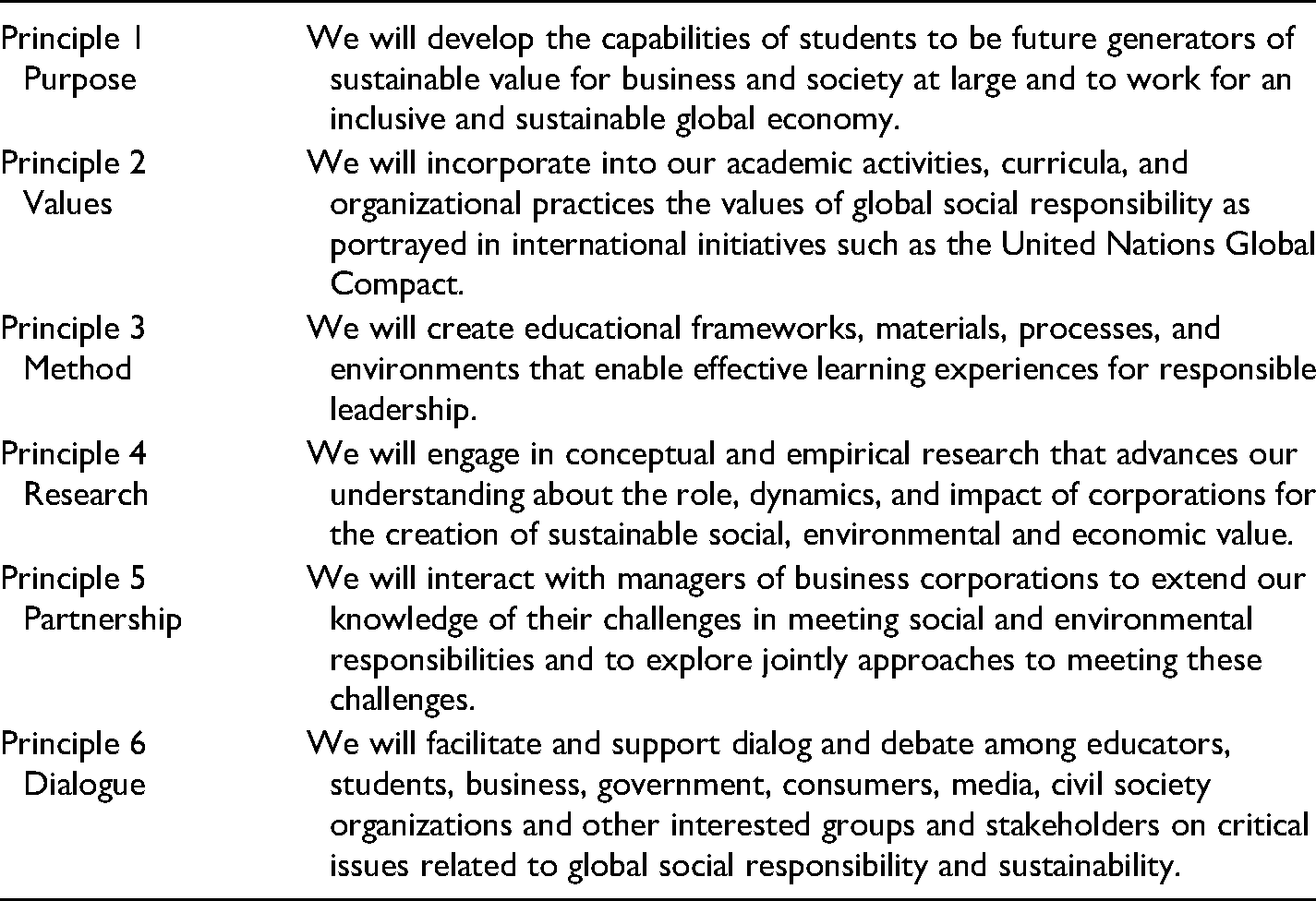
Since its launch, the PRME initiative has grown to more than 860 leading business schools and faculties from over 95 countries (PRME, 2022a). Signatory institutions declare their willingness to progress on the implementation of the Six PRME Principles (PRME, 2022a; Walsh, 2021) as presented in Table 1, and put them in practice in ways that fit their respective contexts (Moratis, 2013). PRME acts as a catalyst and facilitator, to accelerate and channel the very process of thinking about the future of business education (Alcaraz & Thiruvattal, 2010). It consists of different actors and groups within the network: PRME signatories, Champions, Regional Chapters and issue-specific Working Groups (Finstad-Milion et al., 2021). We now turn to presenting our research context - the PRME Chapter France-Benelux and its brokerage activities within the global PRME network.
The Six PRME Principles (PRME, 2022a).
The PRME Chapter France-Benelux
Starting three years after the launch of PRME Global, the first PRME Chapters were conceived, on a voluntary basis, to gather signatories from particular regions and enable them to incorporate local contexts and perspectives in their quest towards responsible management education (RME) (PRME, 2022c). As of 2022, seventeen regional PRME Chapters are fully established; they function as autonomous platforms for localized engagement from business schools and faculties to facilitate and develop initiatives that support the SDGs regionally. The PRME Chapter France-Benelux was launched in 2017, when over 40 deans and representatives of business schools and faculties from the Netherlands, Belgium and France came together to form a regional network to jointly respond to sustainability challenges (Avetisyan et al., 2021). The Chapter’s vision is to “transform the mindset of business and society in the France and Benelux region, by making ethics, sustainability, and responsible management education the norm” (PRME Chapter France-Benelux, 2019). To achieve this, the Chapter intends to collaborate with all relevant stakeholders, through proactive co-creation of projects and solutions that lead to RME in the region. The PRME Chapter France-Benelux convenes, facilitates, and supports its members and their stakeholders on their journeys towards RME (Finstad-Milion et al., 2021). The Chapter operates around four distinct themes, that together form a Framework for the Development of Collaborative Projects (PRME Chapter France-Benelux, 2019):
Sharing of practices; Research collaborations; Education collaborations; Outreach / stakeholder engagement.
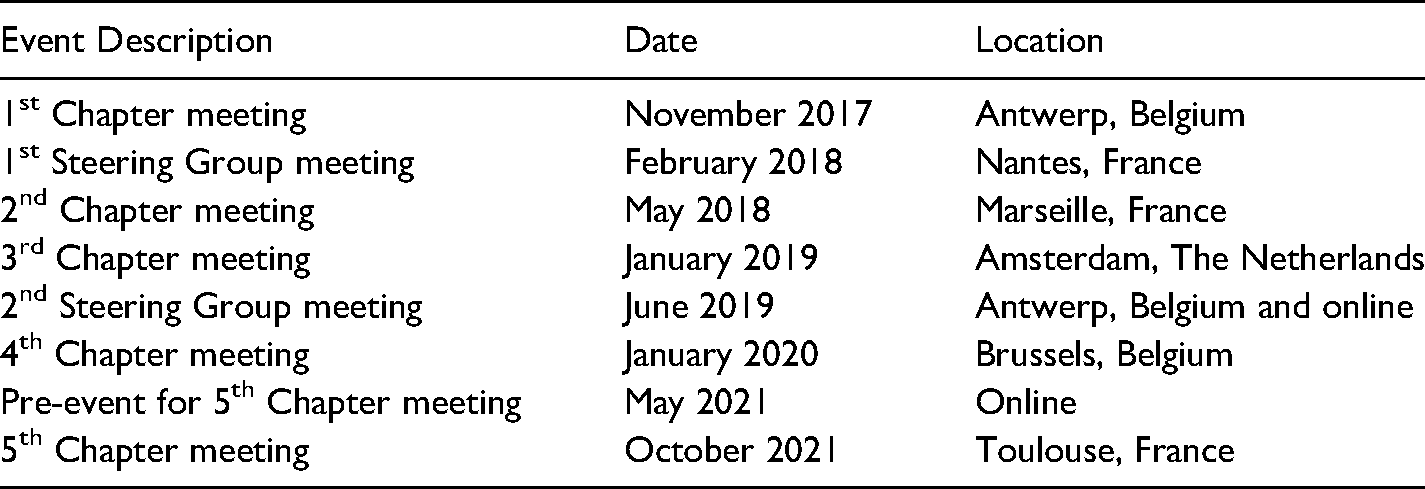
Avetisyan et al. (2021) and Finstad-Milion et al. (2021) provide examples of collaborative projects of Chapter signatories started within the France-Benelux region. For a full overview of the history of the Chapter, including its formation, development, activities and achievements, and governance, we refer to Avetisyan et al. (2021). An overview of the signature events of the Chapter between 2017 and 2021 is provided in Table 2.
Overview of PRME Chapter France-Benelux Events (2017–2021) (Avetisyan et al., 2021).
At the inception of the Chapter, a Steering Group was installed to take up leadership, draft a governance proposal, and initiate meetings and collaborative projects. In addition, the Steering Group was mandated to liaise and network with PRME Global, increase the visibility of PRME and its signatories in the region, and ensure regular reporting on Chapter activities (Avetisyan et al., 2021). The Steering Group consists of representatives from six to eight signatory schools, with minimally one representative per country, who accept joint responsibility for the development of the Chapter and fostering RME in member institutions. The Steering Group members hold three-year mandates, once renewable.
The first and third author of this article have been PRME Chapter members since the inception of the Chapter. The third author was one of the founding Chapter Steering Group members while the first and second author have been Steering Group members since June 2019. This study is based on the experiences of these three Steering Group members of the PRME Chapter France-Benelux, all representing French business schools.
Collaborative Autoethnography
In order to study collaboration and inclusion in the PRME Chapter France-Benelux, we used a collaborative autoethnographic approach. We used ethnography, since it is one of the inductive approaches that is highly appropriate to study sustainability challenges, while simultaneously focusing on theory development (Bansal, 2019; Eisenhardt et al., 2016). More specifically, this qualitative approach unveils how sustainability issues play out in the everyday work and interactions of individuals (Bass & Milosevic, 2018; Hibbert et al., 2014).
Autoethnography is a qualitative approach that combines elements from autobiographical research and ethnographic research (Cunliffe, 2010; Ellis & Bochner, 2000; Winkler, 2018). While many different forms of autoethnography exist, we used reflexive or analytic ethnography, which focuses on a culture or subculture and in which “authors use their own experiences in the culture reflexively to bend back on self and look more deeply at self-other interactions” (Ellis & Bochner, 2000, p. 740). In this type of autoethnography, the researchers are full members of the research setting (i.e., the PRME Chapter France-Benelux), present their own narratives along with studying other participants in the setting, use analytic reflexivity, and focus on theoretical understandings of social phenomena (Anderson, 2006; Ellis & Bochner, 2000; Haynes, 2011; Learmonth & Humphreys, 2012).
Our autoethnographic approach was collaborative (see also Cohen et al., 2009; Easter et al., 2021; Winkler, 2018), as it reflected on the individual and joint experiences of three authors in their journey as Chapter Steering Group members. Collaborative ethnography helps avoid the risk of privileging only one perspective of an experience in a particular setting and adds multiple voices to (autobiographical) stories (Winkler, 2018). By providing these different perspectives, the method counters criticisms about it offering a self-indulgent, narcissistic perspective and potentially lacking rigor when undertaken by one author only (Karra & Phillips, 2008; Lapadat, 2017; Winkler, 2018). Following Cassell and Johnson (2006), we distinguish our ethnographic approach from action research. While action research is a family of inquiry aimed at intervening to improve a situation, collaborative autoethnography is focused on describing and explaining phenomena by revealing and understanding shared experiences through multiple lenses (Cassell & Johnson, 2006; Lapadat, 2017; Winkler, 2018). As a result, collaborative autoethnography will not immediately generate change but rather serves as a starting point for future action or change (Lapadat, 2017).
In line with Cunliffe (2010), our autoethnography offers rich descriptions of micro-interactions in the field, captured through the use of different methods. More specifically, we investigated our own experiences, observations, notes and joint discussions about events, processes, developments and activities of the Chapter covering the 2017–2021 period as well as written documents detailing the activities and governance mechanisms. Individually, we wrote autobiographical accounts of our experiences related to the research question (in line with Cohen et al., 2009; Easter et al., 2021; Peticca-Harris et al., 2016; Williams et al., 2019). They were based on a number of questions we jointly developed around research topics which we deemed important to help surface and explicate our lived experiences. Afterwards, we held multiple autoethnographic conversations (Cohen et al., 2009; Easter et al., 2021) among the three authors, by e-mail and mainly via Zoom conversations, where we searched for similarities and differences in our stories and identified important and recurring categories and themes (Cassell & Bischop, 2019). This approach allowed us to analyze the meaning of our experiences in connection to those of others (Hibbert et al., 2014; Peticca-Harris et al., 2016), and to relate our narratives to each other’s notes, observations and existing documents (Williams et al., 2019).
During our analysis, we iterated between our emerging findings and the literature, to move from initial fuzzy categories to clearer conceptual structures (Gioia et al., 2012; Suddaby, 2006). In line with Gioia (2021), we started from the informants’ experience to identify important themes, after which we identified theory-centered concepts and interrelationships to describe and explain our phenomenon. For autoethnography specifically, this means moving back and forth between experiencing and examining ‘the self’, since we are ‘the informants’, and revealing the broader context of our experience (Ellis, 2007). This process requires carefully practicing researcher reflexivity and being mindful of our role in the research project (Easter et al., 2021; Hibbert et al., 2014).
The data analysis process resulted in our data structure (see Figure 1; based on Gioia et al., 2012; Gioia, 2021) consisting of three types of codes, progressing from more concrete, first order codes that were discussed in our stories (e.g., ‘personal engagement of individuals acting as intermediary’ or ‘influence of COVID on interactions’), giving way to broader explanatory categories (e.g., ‘benefits for intermediary actor’ or ‘general contextual factors affecting collaboration’), that in turn generated more abstract, aggregate theoretical dimensions. In the following section, we will explain in more detail our three emerging theoretical dimensions (i.e., ‘multi-level brokerage activities’, ‘tensions of voluntary brokerage’, and ‘process facilitators’). To further strengthen our systematic approach (in line with Gioia, 2021), we demonstrate data-to-theory connections by using proof quotes in the narrative and by providing additional illustrative quotes for each theoretical dimension in Tables 3, 4 and 5 of the findings section (in line with Pratt, 2009).
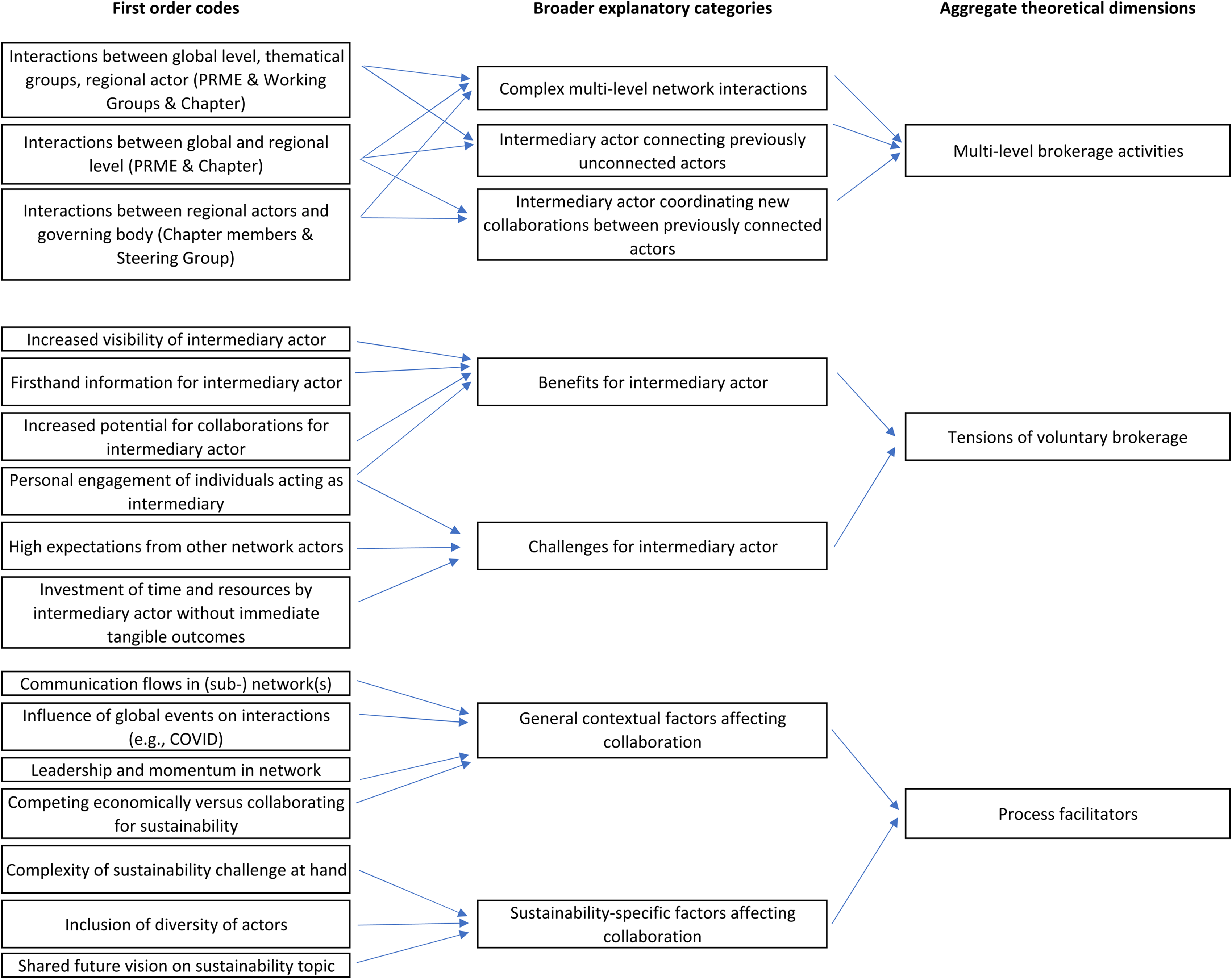
Data structure with codes, explanatory categories and theoretical dimensions.
Illustrative Quotes for Dimension ‘Multi-Level Brokerage Activities’.
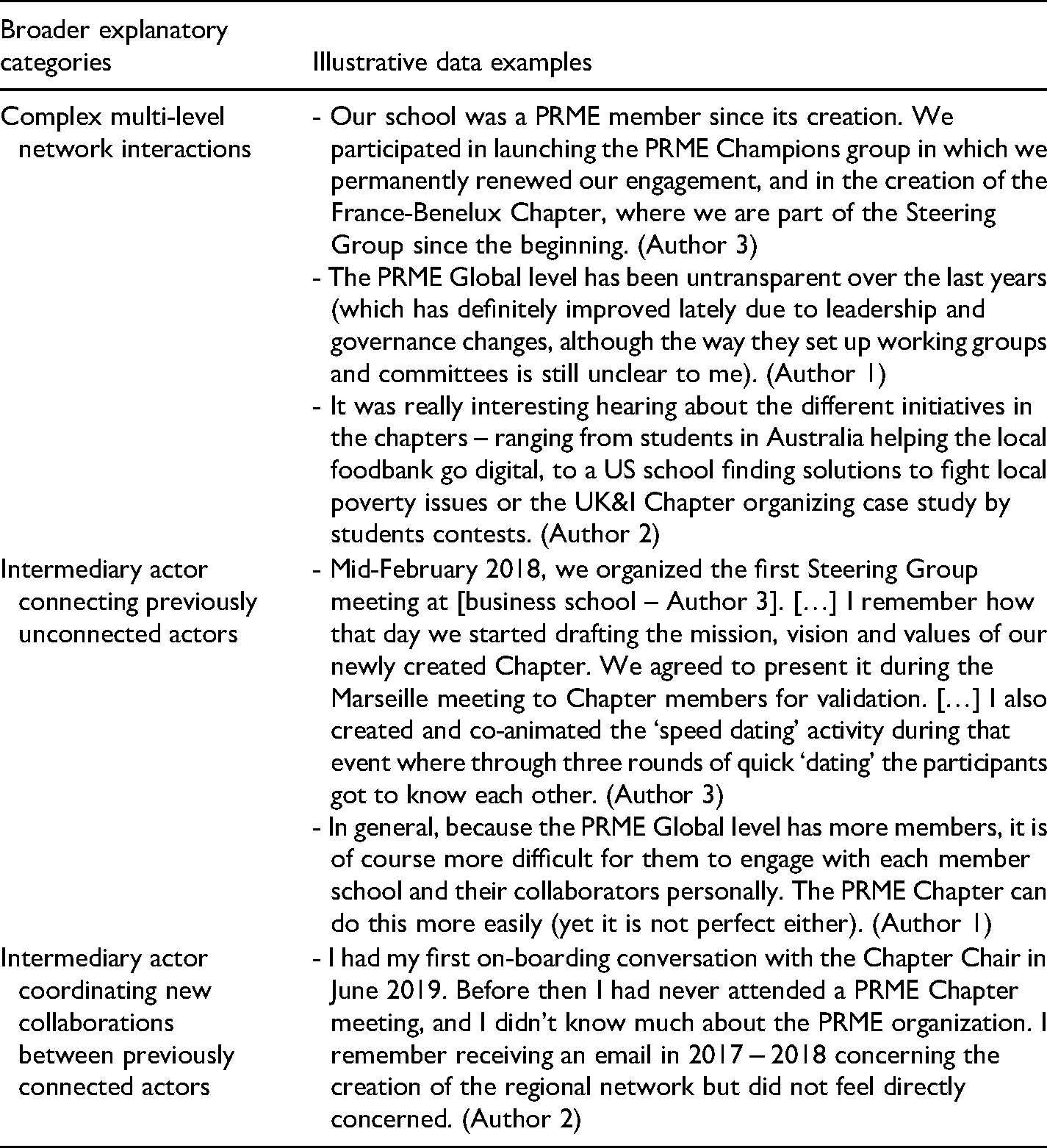
Illustrative Quotes for Dimension ‘Tensions of Voluntary Brokerage’.

Illustrative Quotes for Dimension ‘Process Facilitators’.
Findings
Our study unfolds dynamics of voluntary collaboration for sustainability in the presence of an intermediary actor, through a collaborative autoethnographic analysis of activities in the PRME Chapter France-Benelux. We first detail how brokerage activities play out in a multi-level network, after which we describe tensions inherent to brokerage in voluntary settings, as well as two types of process facilitators affecting how brokerage and collaborations unfold. We support each section with quotes coming directly from the authors’ autoethnographic accounts. To conclude, we bring these elements together in a model emerging from the data to show the dynamics of voluntary sustainability collaboration.
Multi-Level Brokerage Activities
Since its conception in 2007, the PRME network has evolved from a global network with individual signatory schools as its members, into a more complex, multi-dimensional one, consisting of different levels. In this section, we detail some of the brokerage activities that take place in this network, with a main focus on the Chapter level of PRME and its Steering Group. Supplementary illustrative quotes for each explanatory category within this dimension of ‘Multi-level brokerage activities’ are provided in Table 3.
Complex Multi-Level Network Interactions
As outlined in the methods section, PRME is a network consisting of different actors and groups, such as PRME Champions, different issue-specific Working Groups, and Regional Chapters. Besides being a global network of signatory schools, PRME also became a more complex network where individuals of active signatory schools personally engage in sub-groups and committees, and among each other. We will clarify some of the interactions existing between the different levels, by explaining how the PRME Chapter France-Benelux came about and how the three authors got engaged.
Through her school’s engagement in and interactions with other PRME sub-groups, the third author of this study was part of the initial discussions on starting the regional Chapter: In 2017, our school organized a first Skype call among French schools and universities to discuss the possibility of creating a France-Benelux Chapter. While some of our faculty members were active in PRME Working Groups, we were definitely lacking a smaller/regional network to engage within PRME. (Author 3) Our school’s involvement evolved a lot over the years: from being one of the French schools that were not part of the start of the Chapter, to participation in the second annual event and trying to become part of the Steering Group (without success) at the Marseille meeting in 2018, to actively participating in the following annual events. In June 2019, we became part of the Steering Group after responding to a call for new Steering Group members. From then on, I represented my school in the Steering Group, where I initially had an observer role to get to know its functioning and gradually became more active. (Author 1)
Our school’s Dean forwarded me an email from the initial Chapter Chair in July 2019. The Chair was calling out for candidates to renew the Steering Group. It was just when I was deciding to not renew my six-year mandate as a mayor of my village and was wondering what my next professional challenge would be in the year ahead. This seemed to be an interesting prospect that would allow me “air” and “space” and a more international CSR perspective after six years of high commitment to local governance in a rural county. (Author 2)
At the end of 2020, the second author became the new Chair of the regional PRME Chapter France-Benelux after the founding Chapter Chair finished her three-year mandate.
While this example shows interactions between PRME Global, the Chapter level, the Champions group, individual signatories and the Chapter Chair, interactions also take place between, for example, PRME Global and the Working Groups, the Working Groups and the Champions groups, and in other configurations, leading to a complex PRME network consisting of interactions between multiple levels and sub-networks.
Intermediary Actor Connecting Unconnected Actors and Coordinating New Collaborations
In the multi-level PRME network, we see two types of brokerage activities unfold. We describe these by detailing the experiences of our focal intermediary actor: the PRME Chapter France-Benelux.
The PRME Chapter France-Benelux was born in 2017, when Belgian, French and Dutch university and business school representatives came together to form a new regional PRME sub-network. Over the years, the Chapter progressively became a solid regional network within the PRME Global network. This was, among others, because of the foundational work of the Steering Group members and the engagement of the Chapter members in the annual events (see Table 2 and Avetisyan et al., 2021).
As the governing body of the PRME Chapter France-Benelux, the Steering Group is at the center of most of the activities of the Chapter. The Steering Group takes up the following activities in the Chapter: they hold intake conversations with new signatories, co-organize the annual events with different, mostly regional stakeholders, act as the first point of contact for any communication and requests from PRME Global or Chapter signatories, and try to encourage members to take part in PRME initiatives and collaborate amongst each other. The annual Chapter meetings are crucial for the Chapter in convening and facilitating connections between signatories, for example by organizing speed dating activities (see illustrative quote in Table 3), allowing space for sharing best practices of responsible education, research or service (e.g., The Plastic Forum; the Sustainable Development Pathway—see Finstad-Milion et al., 2021) or initiating new Chapter projects (e.g., Sustainability Competencies Project; the Regional SDG Barometer Project—see Finstad-Milion et al., 2021). Through our data analysis, we found that two different activities were performed by the intermediary actor, which can be considered as brokerage activities: (1) bringing together actors that were previously unconnected, and (2) coordinating new collaborations between actors that were already connected through the global network but were not yet collaborating.
In sum, we refer to the PRME network as a complex multi-level network, because it consists of different layers and dimensions, with several sub-networks (or intermediary actors) potentially performing brokerage activities, of which the PRME Chapter France-Benelux is just one example. Interactions and brokerage activities take place between and among multiple levels and sub-networks: the community level (e.g., PRME Global interacting with its signatories directly or through Chapters, Champions or Working Groups), the group level (e.g., PRME Chapter or PRME Steering Group engaging with Chapter signatories, as well as with other Chapters, Champions or Working Groups), and the individual level (e.g., Chapter Chair engaging with individual signatories), resulting in multiple connections that are maintained and facilitated by different sub-networks (or brokers) within the network. Figure 2 maps the different networks that co-exist within PRME and their interactions. Typical of the voluntary setting of PRME is that the sub-networks of the group level emerge rather spontaneously from serendipitous connections between engaged actors in the network. For example, the PRME Chapter France-Benelux was founded ten years after the start of the global network by engaged signatories from the region. Analogously, new PRME Chapters have emerged more recently, such as the PRME Chapter Africa in March 2021 (PRME, 2022d).
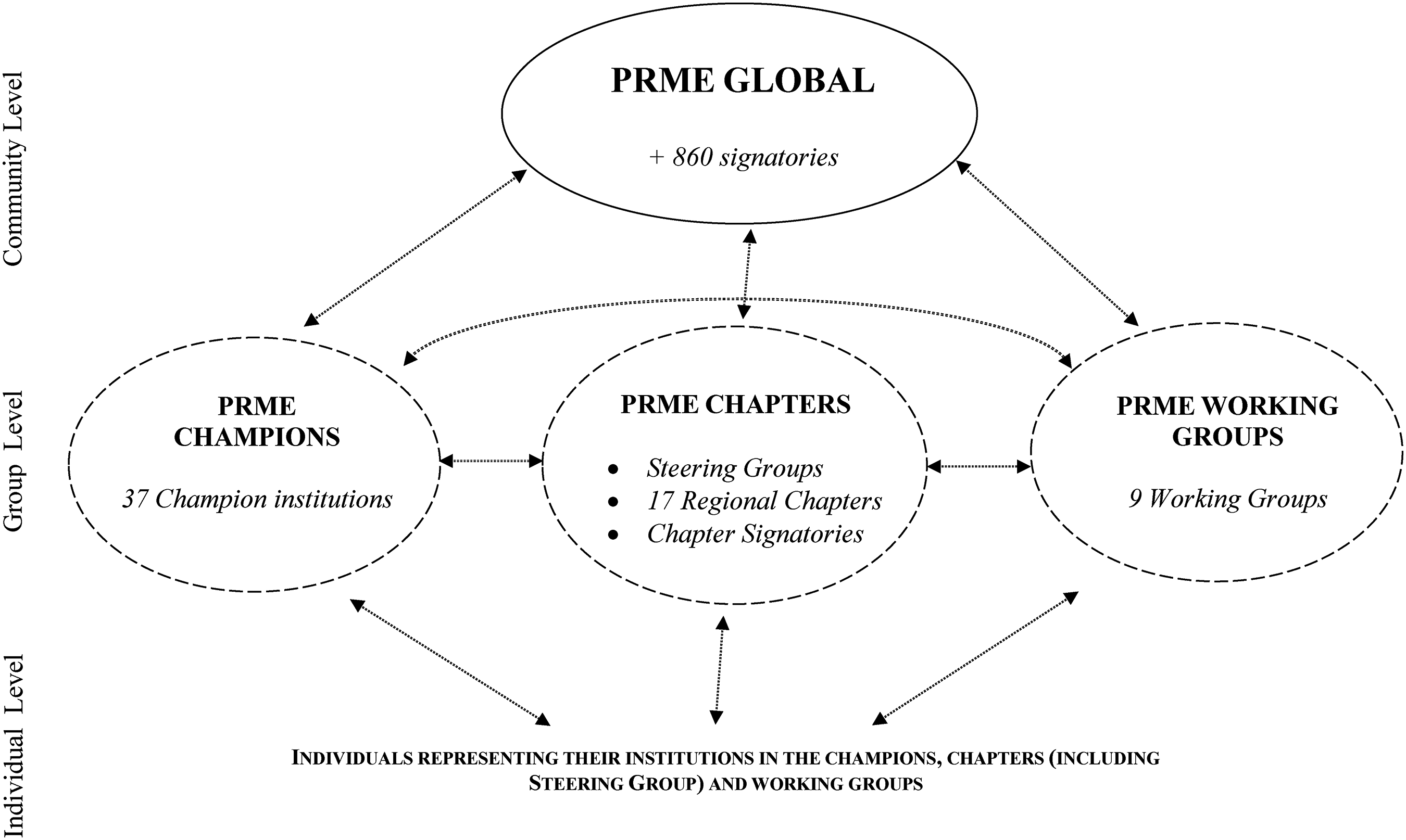
PRME as a multi-level network.
Tensions of Voluntary Brokerage
As described above, different sub-networks (e.g., PRME Champions, PRME Chapters, PRME Working Groups) present in the main network, such as PRME Global, may act as intermediary actors performing brokerage activities. Inevitably, these brokerage activities come with benefits and challenges for the intermediary actor, which we will detail in this section (with supplementary illustrative quotes provided in Table 4). In addition, we will focus on the tensions these benefits and challenges may generate for the intermediary that acts as a broker, especially in a voluntary context. While several intermediary actors are present in a multi-level network, we focus on one particular intermediary actor: the PRME Chapter France-Benelux.
Benefits for Intermediary Actor
By mid 2019, all three authors of this study were in leadership positions in the PRME Chapter France-Benelux, by becoming Steering Group members for their member institutions. Moving from initially being a regular Chapter member to joining the Steering Group, represented a significant change for the first and second authors in terms of their engagement in the Chapter, but also showed them the benefits of acting as an intermediary actor. The Chapter helped me engage more with other signatory schools in the region, especially in familiarizing with the French academic sustainability landscape. The biggest boost came when I joined the Steering Group, since the collaborations between these members are constant (e.g., we meet every month, work on projects together and prepare the annual meeting). It also brought me closer to some of the Dutch and Belgian signatory schools, and resulted in new, fruitful research collaborations with two French Steering Group members. (Author 1)
The member schools that take up voluntary positions in the Chapter become more visible in the regional and global network through performing brokerage activities, for example, communicating directly with Chapter signatories or collaborating with other stakeholders on projects or event organization. They receive firsthand information from higher up in the global PRME network, such as invitations to join strategic committees and working groups or to participate in events and networking activities. As a result, they have more frequent and direct opportunities to engage in new collaborative activities within the different levels and across sub-groups of the global network.
Challenges for Intermediary Actor
Taking leadership positions in the PRME Chapter France-Benelux (e.g., as a Chapter Chair or Steering Group member) requires a strong commitment and investment, both from the signatory school, as well as from the professor or staff member representing the school. This is time- and resource-consuming, while the direct benefits of the brokerage are not necessarily immediately visible or tangible. Combined with the fact that the Chapter has no official mandate to facilitate RME in the region, this may provoke negative emotions, such as feelings of frustration, for the intermediary actor engaged in brokerage activities. Because it’s a voluntary engagement and much time-consuming, I assume some members of the Chapter do not want to take a leading role in running/proposing collaborative projects, as I believe this is not officially recognized in their institutions, maybe even not encouraged. (Author 3)
I know, by discussing with other key members of our Chapter, that very heavily engaged staff members can be particularly vulnerable to fatigue and frustration if they perceive an imbalance between their high level of engagement to the PRME Chapter and the recognition they receive within their own school. (Author 2)
In addition, the Chapter grew significantly over a short period of time. For signatory schools outside the Steering Group, however, progress may still appear slow. Starting a new Chapter involves defining a mission statement, setting rules, and agreeing on a strategy and action plan. This preoccupied the Steering Group members for an extended amount of time, while other signatory schools were expecting frequent communication and relationship-building with signatory members to come first. On the one hand, even though the brokerage activities of the Steering Group are fully voluntary, the expectations of the Chapter signatories towards the Steering Group are high. On the other hand, Steering Group members may feel that there is a lack of enthusiasm or participation in projects on the side of Chapter signatories, or that their work is not fully appreciated in their own institution.
In sum, taking part in brokerage activities of the Chapter by becoming a Steering Group member requires an important engagement level of the school and high personal investment of the school’s representative(s). It comes with potential benefits, such as firsthand information, increased visibility and enhanced collaborations, but also generates expectations from the other signatories, and potential frustration for the individuals who take up voluntary leadership positions. Some of the main tensions perceived by the intermediary actors, stem from the fact that the brokerage activities of the intermediary actor are based on voluntary engagement. The PRME Chapter acts as a regional intermediary actor that performs brokerage activities without an official mandate from the PRME Global network to advance RME in the region. This means that time and resources are scarce, while expectations from other network actors are high, as they may not be aware that the brokerage positions are voluntary and for some individual representatives only informally part of their activities at their signatory school. Therefore, transparency about the brokerage activities and their resulting workload are key to avoid misunderstandings between different actors of the network. Finally, tensions may also be perceived by the intermediary actor as they perform brokerage activities, because the overall aims or rewards of their actions (i.e., moving to RME) are situated at the community level and so do not automatically benefit the brokers individually and immediately.
Process Facilitators
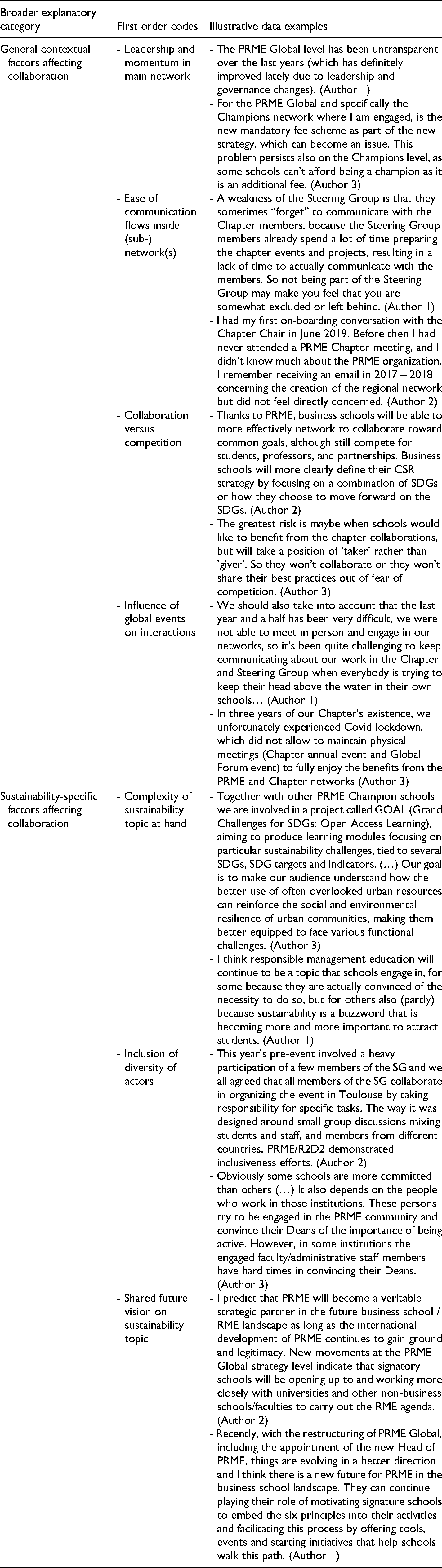
The previous section identified tensions of voluntary brokerage in a complex multi-level network. However, the broader context in which intermediary actors operate, in this case the PRME Global setting with its variety of sub-networks, also gives rise to certain factors affecting the success of the brokerage activities and collaborations in the network. Based on our data, we categorize them into two types of process facilitators (i.e., general contextual factors and sustainability-specific factors) and provide supplementary illustrative quotes for each of them in Table 5.
General Contextual Factors Affecting Collaboration
The process of collaboration and brokerage in voluntary sustainability networks is facilitated by general contextual factors of the network. Four factors emerge from our ethnographic approach: (1) leadership and momentum in the main network, (2) ease of communication flows in the network, (3) collaboration versus competition, and (4) influence of global events.
First, leadership and momentum in the main network is a factor that strongly determines the ease of collaborations and brokerage activities the intermediary actor engages in. In our study, this was focused on the momentum and leadership capacities present in the PRME Global network, as well as in the business school/faculty context in general. The governance crisis appearing some years ago in PRME Global was a challenge for the entire PRME community, including the PRME Chapter France-Benelux. During that time, the Chapter’s Steering Group had the impression of not being included in important decisions of PRME Global: To my view, we are not seen as valuable to PRME Global as we would have liked to. It is changing now but, for example, a few years ago we gave detailed feedback for the strategic planning of PRME Global and we didn’t feel it was taken into consideration. (Author 3)
Recently, with the restructuring of PRME Global and with the appointment of a new Head of PRME, things are evolving in a better direction, and I think there is a new future for PRME in the business school landscape. (Author 1)
The arrival of the current head, Prof. Mette Morsing, in the PRME Global network and the leadership she showed in reorganizing PRME and engaging differently with signatories, changed the momentum in the network significantly. On the regional level, the planned leadership change in the PRME Chapter France-Benelux after the mandate of the previous Chair ended, inevitably changed the internal dynamics in the Steering Group too, as different Chairs have different leadership styles and different priorities that they will pursue during their limited time available to invest in brokerage activities for the PRME Chapter.
Second, the ease of communication flows in (sub-) network(s) strongly influences the success of brokerage activities and collaboration in the network. In the case of PRME, for example, individual signatories may perceive the PRME Global network or some of its sub-networks (e.g., PRME Champions or PRME Working Groups) as inaccessible, or as black boxes, as compared to how PRME Chapter Steering Group members perceive them. Being a Steering Group member, I feel that we have access to PRME Global. Specifically, our Chapter Chair is engaged in various meetings at the PRME Global level. She liaises with other Chapter members and updates us about the Global level activities. Since last year, we are also involved in some of those activities: we organized a Chapter talk, wrote a book chapter, and presented a session for the PRME Global level. I doubt it is the same when you are a Chapter member only. (Author 3)
Through its brokerage activities, it is the role of the PRME Chapter to bring individual signatories closer to the other network actors (PRME Global and its other sub-networks). However, timely communication about activities happening in other parts of the network is challenging for the PRME Chapter, again because of this voluntary position where time is a scarce resource and different brokerage activities are executed simultaneously. Overall, effective communication flows between the different community levels and sub-networks can have an important effect on how actors perceive the interactions, and this might (positively or negatively) affect their willingness to engage further in the network.
Third, collaboration versus competition is a factor that is strongly determined by the type of sector or field we are dealing with. Even in settings outside the corporate sphere, there are certain levels of competition between actors in the field, such as business schools/faculties competing for the best students, rankings, research funds etc. Maybe we will never be fully inclusive because in the end schools stay competitors, who achieve a certain level of collaboration but then it may be difficult to go even further since it may make them lose their unique identity that they like to connect to certain flagship projects. (Author 1)
A fourth factor emerging from the data was the influence of global events on the interactions. In the study at hand, the global event affecting collaborations was the COVID-19 health crisis. In a crucial development phase of the PRME Chapter, physical network meetings became impossible for an extended time due to the pandemic lockdowns. As this situation was new to all actors and crisis management focused mainly on their own school’s survival, the PRME Chapter communicated inefficiently with signatories during this period. I feel that CSR issues, especially during the pandemic, seem to be of great interest to a number of student associations and a growing number of professors but that the challenge is information dissemination and coordinating on school-wide projects. (Author 2)
Acknowledging the importance of staying connected with actors during global events such as the COVID crisis is important to facilitate collaboration. The PRME Chapter tried to tackle this partly by organizing an online 2021 pre-event to the regular in-person event to stay more connected to the signatories and allow direct discussions between them. Overall, however, the sudden reshuffling of priorities and resources because of the crisis impeded collaboration in the PRME Chapter in 2020-2021.
Sustainability-Specific Factors Affecting Collaboration
Our autoethnographic approach also unfolded three sustainability-specific factors that may facilitate the collaborations and brokerage processes taking place in the network: (1) understanding the complexities of the sustainability topic, (2) the inclusion of a diversity of actors and (3) a shared future vision on the sustainability topic.
First, we find that a thorough understanding of the complexity of the sustainability topic is a factor that facilitates collaborations in the network. The topic at hand in our study was RME, which is generally known as a complex topic, since it does not only include transforming curricula, but also research and service activities (Kanashiro et al., 2020), in addition to encompassing issues that may include all 17 SDGs. Collaborating with other schools within the Chapter is a source of inspiration and stimulation, especially when you collectively address urgent societal issues. Working towards the SDGs necessarily requires collaboration – no one school will make an impact on an SDG, although together we can create a ripple effect that can gain in magnitude over time and have an impact within our ecosystems. (Author 2)
A second important factor is the inclusion of a diversity of actors. The presence of diverse actors in the network facilitates transformation towards a type of RME that is of interest for all parties involved. The PRME Global network counts over 860 signatories from countries and continents around the world. The PRME Chapter France-Benelux consists of over fifty business schools and faculties (Avetisyan et al., 2021), that belong to one of the four countries represented in the network. Within the PRME Chapter France-Benelux, the Steering Group members made attempts to better include diverse actors in the Chapter through their brokerage activities. This was visible in the events that took place every year, for example, during the 4th Chapter annual meeting in Brussels in 2020: I was impressed by the European/Greater Region flavor of the annual event at Solvay in Brussels. I couldn’t help but notice right away the prominent role strong women leaders were playing at a governance level, and I found myself very much at home. (…) I quickly warmed up to the subtle cultural differences and enjoyed the different accents, mentalities, and practice-oriented change agenda. I liked the multi-stakeholder dimension and the well-structured program including teaching workshops, and symposium on policy issues as well as off-site visits. (Author 2)
The authors also stressed the importance of physical presence to grow a diverse and collaborative Chapter, to get inspired by other members and to start new collaborations. The more diverse the event participants, the more likely that potential collaborations arise that take into account the needs and requirements of a diverse range of regional PRME actors.
Third, a shared future vision on the sustainability topic also facilitates the process of collaboration and brokerage in the network. In the PRME network, this is in part guided by PRME’s Six Principles (see Table 1), which PRME signatories sign on to as they join the network. This includes pursuing RME within all functions of the school (education, research, community service), as well as a strong focus on students and helping them become responsible future leaders. Our future students are very sensitive to Grand Challenges and are more and more looking for institutions that are responsible in the way they teach, the way they do research and overall in their institutional engagements. In that sense, being a PRME school can facilitate the implementation of RME. (Author 3)
While conceptualizations of this future vision on RME will certainly differ for stakeholders present in the network, some shared ideas on what the future should or could look like can help facilitate collaborations in the network.
To conclude, the brokerage activities and collaborations taking place in the PRME Chapter are affected by the general context the intermediary actor is operating in, in this case the PRME Global community, as well as sustainability-specific factors. During the time of the study, the main general process facilitators were leadership and momentum in the main network, ease of communication flows in the network, collaboration versus competition, and influence of global events (here: COVID). These general factors affecting collaboration processes are very specific and dependent on the context studied (e.g., COVID or leadership styles). They differ from the sustainability-specific factors (i.e., complexity of sustainability topic, inclusion of a variety of actors, and a shared future vision on the topic), which are expected to emerge in each context of voluntary sustainability collaboration.
Model of Dynamics of Voluntary Sustainability Collaboration in the Presence of Intermediary Actor(s)
In this section, we present the model emerging from our collective autoethnographic study in the PRME Chapter France-Benelux and based on the data structure (see Figure 1) used for the analysis. The model, presented in Figure 3, shows dynamics of voluntary sustainability collaboration in a network that consists of multiple levels (community, group and individual—in line with our findings for the PRME network shown in Figure 2).
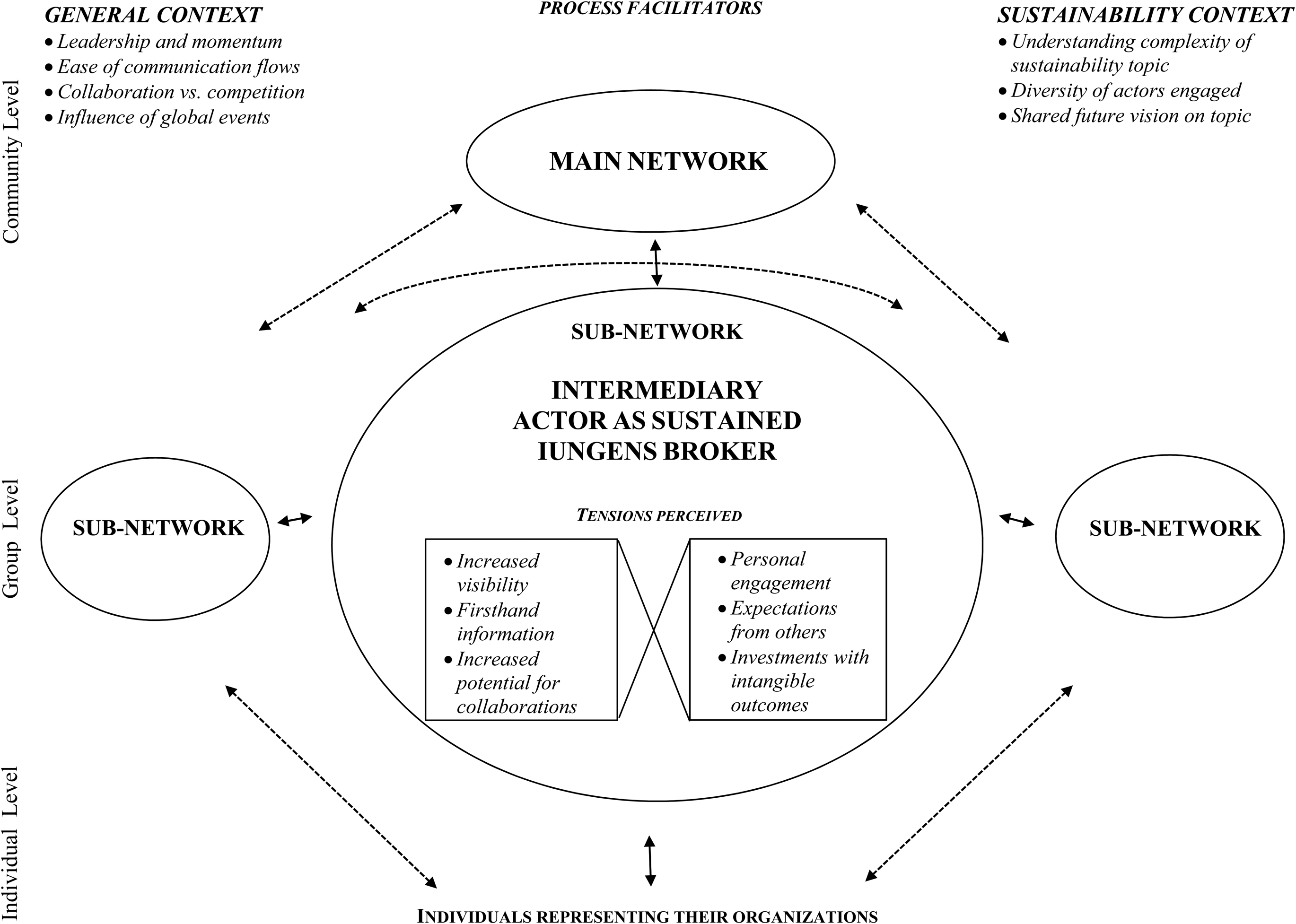
Dynamics of voluntary collaboration for sustainability in presence of intermediary actor(s).
Central in our model is the group level, where we find one, or potentially more, sub-networks that perform brokerage activities, to build connections between the different levels of the network and facilitate collaboration for sustainability. The arrows in Figure 3 represent such brokerage activities. We use full lines for brokerage activities taking place between our focal sub-network shown in the middle and other actors, and broken lines for the brokerage activities potentially taking place between other sub-networks and other actors of the network.
The brokerage literature describes three main types of brokerage processes that can take place in networks, depending on the activities performed by the broker: conduit, tertius gaudens and tertius iungens brokerage (Kwon et al., 2020; Obstfeld et al., 2014; Soda et al., 2018). Conduit brokerage is concerned with passing information from one alter to another, without attempting to change the relation between the alters. Tertius gaudens, also called separens, is a type of brokerage where the broker purposely keeps the alters disconnected and strategically uses this position to its advantage (Kwon et al., 2020). We assert that in voluntary settings, brokerage activities are focused on a third type of brokerage behavior, tertius iungens, which is about introducing previously unconnected alters to each other, or about coordinating new collaborative action between previously tied alters (Obstfeld, 2005). Indeed, our findings show that the brokerage activities of the intermediary actor were twofold: they consisted of the intermediary (1) facilitating collaboration for sustainability by making new connections between actors and (2) initiating new collaborations between individual actors of the community.
While information exchange between alters occurs in both conduit brokerage and iungens brokerage, the distinguishing factor of the iungens type is the deliberate aim of the broker to induce collaboration (Obstfeld et al., 2014). Tertius iungens brokerage has been described as having a catalyst function in networks, creating a potential for social transformation and structural change, and thus also benefiting the alters in the network (Bräuchler et al., 2021; Clement et al., 2018; Sgourev, 2015). This is exactly what takes place in voluntary sustainability collaborations: new connections are made, and new projects are started by the intermediary actor to facilitate change towards a sustainability topic (in our case focused on RME). Since this can only happen through continuing brokerage activities, we identify the brokerage behavior of intermediaries in voluntary collaborations as of the sustained iungens type (as opposed to brief iungens), since there is a need for the broker to remain engaged to keep the alters connected (Obstfeld, 2005). As Kwon et al. (2020) stressed, the broker may continue to provide value for the network over time, even if at some point all the parties know each other (e.g., for helping to implement new ideas in the network).
Our model also shows that, during their sustained iungens brokerage activities, the intermediary actor perceives tensions between the challenges and benefits that are inherent of its role as a broker. Traditionally, brokers are known to have certain advantages over the alters in the network, such as having access to a broad range of information and receiving information earlier than others, receiving more entrepreneurial opportunities or capturing some of the value created for others (Burt & Soda, 2021; Kleinbaum, 2012; Kwon et al., 2020). These advantages are largely in line with our findings for voluntary brokerage in sustainability collaborations, as visible in our model. However, in combination with the challenges specific to voluntary brokerage in sustainability collaborations (e.g., large personal engagements, investment of resources with few tangible outcomes and high expectations from others), they may lead to tensions in the network if not well managed. We assert that the most important tension in voluntary brokerage in sustainability collaborations lies in the gap between the self-motivation of the broker, combined with the outcomes of the brokerage that are situated on the community level and in the long run.
Finally, our model shows two types of factors that can facilitate the sustained iungens brokerage processes taking place in the network: general contextual factors and sustainability-specific factors. While these process facilitators are characteristics of the community level, or the entire network, they do affect the brokerage activities and thus influence the strength of the tensions the intermediary actor perceives. For example, the stronger the leadership and momentum in the main network, the more motivated brokers may be to operate voluntarily in the network, potentially generating less negative emotions caused by the tension between their engagement and the intangible outcomes of their activities.
Discussion
In this article, we use the empirical setting of the PRME network, with a particular focus on the PRME Chapter France-Benelux, to discuss the dynamics of voluntary collaborations for sustainability facilitated by an intermediary actor. We start by discussing our model in more depth, as well as its theoretical contributions. Afterwards, we provide insights and recommendations for achieving RME through voluntary collaboration in the presence of intermediaries.
Intermediary Actors as Facilitators of Sustainability Collaboration
While academic research on intermediary actors in sustainability collaborations is scarce (Bansal et al., 2012; DiVito et al., 2021; Williams et al., 2019), even less is known about how dynamics of voluntary collaborations unfold in their presence. Our study provides insights into how sustainability collaborations unfold in practice in the presence of intermediary actors (as called for by Bansal et al., 2012; Bode et al., 2019; Williams et al., 2019). Our contribution lies (1) in the way we are able to detail such dynamics in a model (see Figure 3), through using a network brokage lens, and (2) in our collaborative autoethnographic approach that provides a close and firsthand perspective on such dynamics in practice.
Our use of a network brokerage lens stems from the fact that this concept has been identified as important for fostering collaborations, especially in complex and multi-faceted circumstances (Obstfeld et al., 2014; Reinecke et al., 2018), which makes them potentially suitable to address sustainability topics. The brokerage literature is traditionally focused on investigating economic actors in buyer-seller situations, and typically studies settings such as securities trading, real estate, or employee recruiting (Burt, 2007; Pollock et al., 2004; Zhelyazkov, 2018). More recently, some studies on network brokerage have also started focusing on settings outside the corporate sphere. Among the few examples present in the literature are brokerage in indigenous activism (Bräuchler, 2021), education (Malin et al., 2018), or post-war countries (Stewart, 2012). We add to the stream of literature on sustainability collaborations (Bansal et al., 2012; DiVito et al., 2021; and Williams et al., 2019), by identifying voluntary intermediary actors in sustainability collaborations as network brokers, who perceive tensions inherent to their brokerage activities and depend on process facilitators for successful brokerage activities and collaboration in the network.
Voluntary brokers operate in what Ferraro et al. (2015, p. 376) call “distributed experimentation”, with a central role for intermediaries who engage with other actors over time, through iterative action and evolutionary learning. Analyzing the brokerage processes present in the PRME Chapter France-Benelux, led to the discovery of complex brokerage processes of the sustained tertius iungens type (see Kwon et al., 2020; Obstfeld et al., 2014; Soda et al., 2018), which take place on different levels and primarily consist of relational activities (Bouwen & Taillieu, 2004), rather than having immediate tangible outcomes. We identify multilevel interactions, affected by a number of general contextual and sustainability-specific process facilitators.
A reason why even an important, global network may need such intermediary actors, is because of its multi-level character, in which the intermediaries are positioned closer to the local context and to the action in the field, allowing more focused brokerage activities. In our study, for example, the PRME Chapter France-Benelux is smaller in size and geographically more accessible for PRME signatories of the region. Nevertheless, PRME Global remains the main network with international visibility that is the reason why signatories join the community, and which may influence how signatories perceive the sub-network. Our study shows that voluntary brokerage is an important activity that contributes to tying the different actors and sub-networks more closely together. Voluntary brokers must be agile, as they invest time without seeing the direct benefits, and must allow and accept setbacks to arise (see also Termeer et al., 2019; Termeer & Dewulf, 2019).
We assert that the methods used in this study, collaborative autoethnography, allow a unique, firsthand view on the dynamics of sustainability collaborations facilitated by an intermediary actor. While autoethnography, and to a lesser extent collaborative autoethnography, is slowly becoming more present as a method to study the management field (e.g., Cohen et al., 2009; Easter et al., 2021; Empson, 2013; Karra & Phillips, 2008; Learmonth & Humphreys, 2012; Peticca-Harris et al., 2016), to our knowledge we are the first ones using the latter method to study how sustainability collaborations unfold in practice. Even in the field of network brokerage, studies on the dynamics of brokerage in practice have been rarely based on empirical evidence of actual brokerage behavior in real-life situations (Zhelyazkov, 2018). Moreover, the brokerage literature has identified ethnographic approaches as most suitable to acquire in depth insights in how processes and dynamics of brokerage unfold over time (Kwon et al., 2020; Obstfeld, 2005). Nevertheless, it remains important to stress that the purpose of collaborative autoethnography is not to create generalizability of the findings. Because the experiences of the three authors of the current study are treated analytically and are compared and contrasted to existing research, they can lead to theoretical insights on social phenomena (Ellis & Bochner, 2000). Therefore, while the individual experiences of the three Steering Group members represent their personal journeys within the PRME Chapter, through collaborative autoethnography, they can lead to new insights on collaboration for sustainability.
Collaboration for Responsible Management Education
PRME Chapter signatories interact, share best practices, and collaborate on a voluntary and long-term basis, driven by a common goal to improve RME in their region (concurring with the description of “sustainability collaborations” by Craps et al., 2016; Lozano, 2007). In an earlier study on the PRME Chapter France-Benelux, Finstad-Milion et al. (2021) shortly indicate that the Chapter acts as a boundary spanning intermediary organization (see Bansal et al., 2012), that supports its members in their engaged research, education and service activities toward RME. However, their study is focused on how the PRME Chapter promotes engaged scholarship and remains descriptive as it is focused on providing examples of projects and activities that have been outcomes of collaborations within this sub-network. Instead of focusing on outcomes, the current study dives deeper into the brokerage activities of the Chapter as an intermediary in the PRME network, the tensions perceived by the broker and the factors facilitating voluntary brokerage processes.
In line with our general findings on sustainability collaborations, we stress the importance of relational activities (Bouwen & Taillieu, 2004) that voluntary brokers engage in, as a crucial way to help business schools and faculties move toward RME. The creation of the PRME network in 2007 stemmed from a need to develop a culture in management education that was more focused on sustainable gains for the eco-system and society, rather than the traditional focus on an ego-system (Sharmer & Laufer, 2013), personal and business gains (Giacalone & Thompson, 2006), or an economic deterministic discourse (Millar & Koning, 2018). The sustained iungens brokerage activities of its sub-networks, such as the PRME Chapter France-Benelux, encourages educators to engage with other signatory schools, students, businesses, and other stakeholders to extend knowledge on sustainability topics for moving towards the SDGs together. Nevertheless, some authors have stated in previous studies that PRME is mainly used to promote past events, or reproduce the dominant market logic, rather than as a means for change toward RME (Godemann et al., 2014; Millar & Koning, 2018; Perry & Win, 2013). Rather than putting the emphasis on the outcomes of these interactions, our study asserts that brokerage activities are important to create links and relationships between signatories, which are necessary to generate trust and long-term connections to eventually advance together toward RME.
While voluntary brokerage benefits the community by allowing for new connections and collaborations to arise, it is also strongly dependent on factors that may facilitate brokerage processes. An important element among those is the inclusion of a diverse range of actors for effective sustainability collaborations (see Curseu & Schruijer, 2017; Ferraro et al., 2015; Sharma & Kearins, 2011). In the context of this study, this entails engaging different types of stakeholders in collaborations to advance jointly towards RME. By formally addressing inclusion in Principle 1 of PRME (see Table 1), the PRME mandate underlines the need for members to engage with voices, experiences, and perspectives often marginalized in business and society. Critics warn that the PRME discourse needs to move beyond an unquestioning acceptance of a “canonical list” of values, to develop a less Western, more inclusive understanding of fairness and equity, as a foundation for a more sustainable and inclusive economy which it seeks to promote (Cullen, 2020; Millar & Koning, 2018). In our study, we contribute to this discussion by stressing the importance of inclusion for allowing successful brokerage activities in voluntary sustainability collaborations (in line with Legler & Reischl, 2003). For the PRME Chapter France-Benelux in particular, this would mean that the brokerage activities of the Chapter and Steering Group systematically include equal opportunities for signatory schools and their staff and even students to share ideas, collaborate, and take up leadership roles, regardless of their geographical location, language(s) spoken, or the size or availability of resources of their schools (as addressed by Ozbilgin, 2014; Perry & Win, 2013).
Another important factor affecting brokerage processes are global events, such as the COVID-19 crisis. Indeed, Worley and Jules (2020) stressed that the COVID crisis showed that we are collectively unprepared to react adequately to unexpected events. Nevertheless, such events may occur more often, as we are operating in what we call a Volatile, Uncertain, Complex, and Ambiguous environment (or VUCA world) (Worley & Jules, 2020), which tends to impact the education sector heavily (Coyle-Shapiro, 2021; Farnell et al., 2021). Due to the COVID-19 public health crisis, many of the PRME networking activities were canceled or postponed, while some took place in virtual formats. The latter created opportunities in terms of including a more diverse range of actors, as it was an unprecedented opportunity for signatories who, for financial or time reasons, could not normally afford to attend networking events. On the negative side, this impeded further regional development of the Chapter, as for this sub-network physical presence and proximity are important motivational factors. To achieve responsible management education, collaboration between PRME signatories is key, as it can accelerate the achievement of a shared vision of sustainability goals in teaching, research, and community outreach, which we identified as another important process facilitator in voluntary sustainability collaboration.
Conclusion
The SDGs have drawn worldwide attention to the importance of multi-actor collaboration to advance towards sustainable development. This study investigated the dynamics of voluntary collaboration for sustainability in the presence of intermediary actors through a network brokerage lens. Our main contribution lies in offering a firsthand view on the dynamics of sustainability collaborations through an autoethnographic approach, which sheds light on how voluntary collaborations unfold in practice. We find that an intermediary actor acts as a sustained iungens broker in voluntary sustainability collaborations, by connecting other actors and coordinating new collaborations in a complex, multi-level network. The activities of the intermediary actor are affected by tensions inherent to iungens brokerage in a voluntary setting (e.g., increased visibility but also high expectations from other network actors), as well as by factors influencing the success of the brokerage activities and collaborations in the network (e.g., complexity of the sustainability topic or presence of leadership and momentum).
As avenues for future research, we propose to further investigate the dynamics of voluntary sustainability collaboration in other settings outside the corporate sphere to provide more empirical evidence of how such networks function in actuality. For the field of responsible management education, it would be valuable to look deeper into other regional networks and also to study their capacity to catalyze change towards RME. Concerning the PRME network, future studies could focus on further analyzing ongoing collaborations and brokerage activities within and across other sub-networks, such as other PRME Chapters, Champion schools and Working Groups, to gain a better view on the complementary roles of various PRME network actors in facilitating RME worldwide.
Footnotes
Declaration of Conflicting Interests
The author(s) declared no potential conflicts of interest with respect to the research, authorship, and/or publication of this article.
Funding
The author(s) received no financial support for the research, authorship, and/or publication of this article.
