



Abstract
According to the United Nations, in order to avoid some of the worst outcomes of climate change, the world must achieve net zero carbon emissions by 2050 at the very latest. That is the aim of the Race to Zero Campaign. Since 2019, more than 10,000 organizations around the world have embraced Race to Zero, which has been able to successfully create a relevant, global, and diverse cross-sector partnership, tearing down the barriers that have emerged from uncertainty. Building on three key cross-partnership elements (strategic, institutional, and learning), combined with the uncertainties faced by the partners, we describe the resources and activities that have made that possible.
Arguably, climate change is the biggest challenge of our time. Given that, it is a fundamental and complex problem with broad economic and scientific impacts, the solution of which requires the collaboration of multiple and multidisciplinary agents (Hallegatte et al., 2016). Scientists have warned that the impacts of climate change will be devastating if the 1.5°C temperature goal defined by the Intergovernmental Panel on Climate Change (IPCC) is not achieved (IPCC, 2018). However, there is no simple answer about how to achieve the tremendous global target of net zero emissions by no later than 2050, while advancing well-being for all and preventing loss of nature. One of the most ambitious projects pursuing that goal is the Race to Zero (R2Z) initiative. R2Z is a global campaign backed by the United Nations (UN) that rallies non-state actors—including companies, cities, regions, and financial and educational institutions—to take rigorous and immediate action to halve global emissions by 2030 and deliver a healthier net zero carbon world in time. It came about in 2019 at the COP 25 Climate Change Conference with the support of the United Nations Framework Convention on Climate Change (UNFCCC). R2Z is currently the world's largest carbon neutral initiative, mobilizing a growing coalition of 52 regions, 1,103 cities, 7,126 companies, 1,103 educational institutions, 541 financial institutions, over 3,000 hospitals from 60 healthcare institutions, and 24 other institutions.
Due to the magnitude of the challenge and the paucity of knowledge that exists today on how to handle a complex system of partnerships, the road has not been smooth. By analyzing the experience gathered with R2Z 1 , we found that the main obstacles to overcome were linked to three sources of uncertainty experienced by actors (Bradley & Drechsler, 2014; Milliken, 1987): empirical, interdependence, and ethical (see Table 1). For instance, committed organizations were unsure about the implications of the challenge, their capabilities to implement a R2Z strategy considering that the outcomes of the net zero pledge are not under their exclusive control (e.g., large firms usually have offshore manufacturing facilities, so they must coordinate efforts along the supply chain and comply with the environmental regulations of different countries), and the fair and equitable treatment they will receive compared with the rest of the partners, bearing in mind the diversity of organizations, industries, and home country regulations.
Sources of Uncertainty Faced by R2Z Partners.
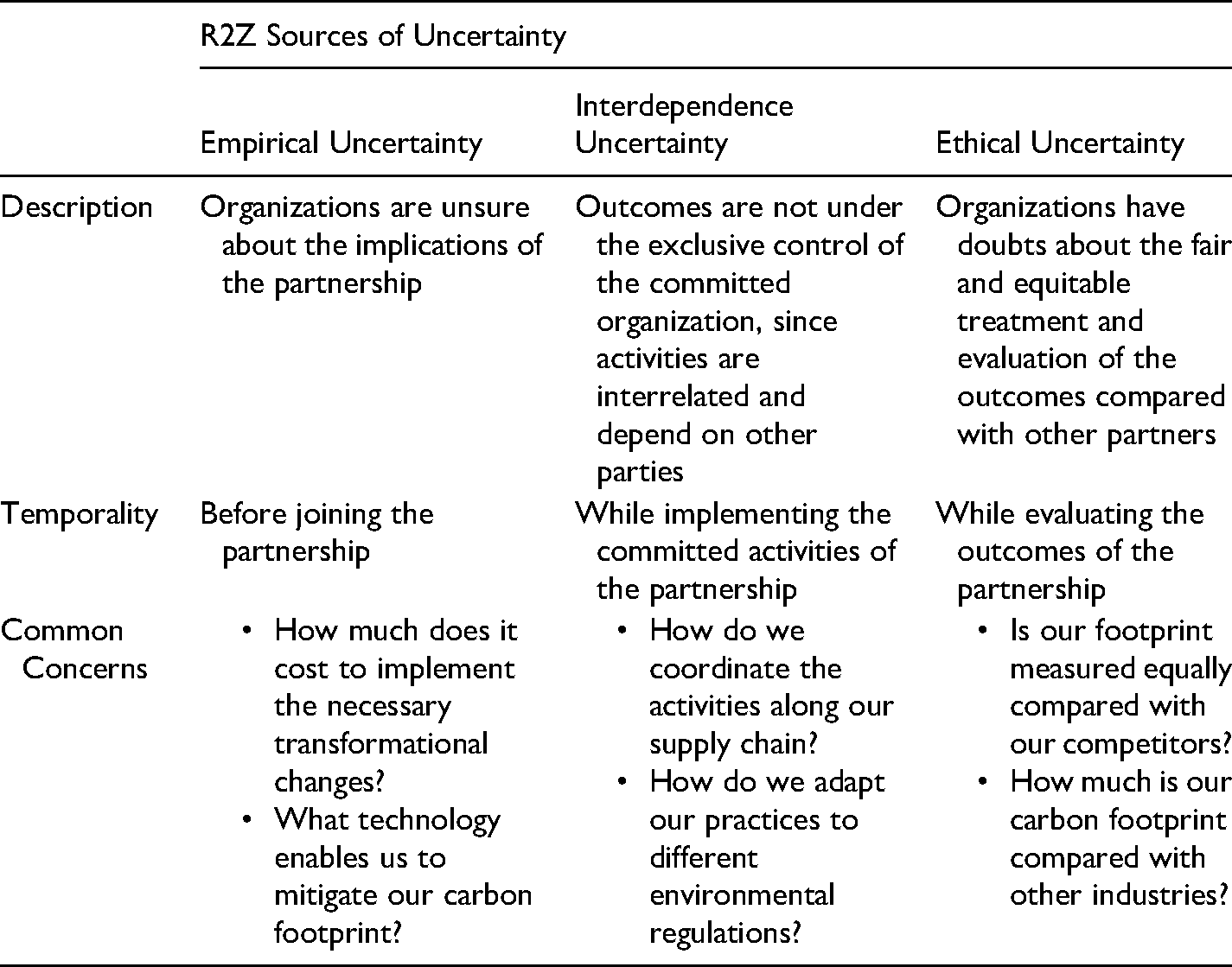
Given that scenario, the question that arises is: How has R2Z been capable of tackling the obstacles of uncertainty to promote cross-sector partnerships that support social and environmental system-level impacts? To address this question, we draw upon the framework of cross-sector partnerships outlined by Dentoni et al. (2021) to explain how R2Z effectively mobilized actors and overcame the barriers of uncertainty faced by organizations. This framework identifies key strategic, institutional, and learning elements of partnerships on which organizations rely to support socio-ecological resilience.
Strategic elements refer to those interdependent resources and activities that allow expected outcomes to be realized, influencing and impacting agents inside and outside the boundaries of the partnership. R2Z addresses the strategic element of cross-sector partnerships by delivering a standard set of procedural criteria and leadership practices to all new partners, defining the main areas, processes, and initiatives by which firms must reach the current frontier of best practices and indicating how leaders can push beyond them. Additionally, a common and transparent set of metrics is provided by R2Z to all the partners, so they can develop voluntary self-regulating processes and evaluations. The evaluation is performed by an Expert Peer Review Process to guarantee the fairness of the evaluation system.
Institutional elements are institutional arrangements that support cross-sector partnerships in the form of formal and informal structures. One of the most effective institutional elements, and a key pillar for R2Z, is the figure of the High-Level Champion. These are individuals whose main role, for a two-year term, is to connect the work of governments with the many voluntary and collaborative actions taken by cities, regions, businesses, and investors. In other words, High-level Champions are facilitators of the emergence of new, sustainable logics by building trust and confidence among partners. Their leadership style is non-hierarchical and is built upon dialogue and storytelling, which helps to create a vision and narrative that influence and inspire. Both the narrative and vision transcend multiple logics and boundaries, acting as a catalyzer of self-organized actions within and outside the partnership. High-level Champions embody the values and normative orientations of committed organizations, becoming a strong motivational force to build shared meaning on past, present, and future collective actions. For instance, High-level Champion Gonzalo Muñoz provided support and counsel to cities signing up to the Cities R2Z campaign, a specific initiative headed by global city partners around the world to promote a net zero future. Another institutional initiative implemented to reduce ethical uncertainty was an open consultation process, comprising feedback procedures that allowed R2Z to revise and strengthen the criteria governing the partnership and thus avoid misalignments and greenwashing.
Finally, the learning element refers to transformations at the organization and system levels that are achieved through processes of sensemaking, experimentation, and adaptation. When the incumbent partners of R2Z developed powerful actions and practices, they influenced organizations outside the boundaries of the system. For example, Amazon and Ikea committed to achieve net zero carbon emissions before 2040 and 2030, respectively, giving a clear signal of the required adaptations not only to their own supply chains, but to the global logistics industry. The challenge of changing the resources and activities of one organization and its supply chain, in different countries, requires the adaptation of the general set of procedural criteria to specific and diverse environments. Learning processes also stimulate collective learning, such as the net zero Retail campaign founded by retailers H&M Group, Ingka Group (IKEA), Kingfisher plc, and Walmart, which targets the acceleration of the adoption of net zero roadmaps. The Retail campaign helps retailers achieve these goals by providing sector-specific guidance, science-based targets, and access to networks and best practices.
Concluding Remarks
R2Z is an example of how to successfully implement a cross-sector partnership on a worldwide scale. By analyzing this experience, we learnt that committed organizations faced three main types of uncertainty—empirical, interdependence, and ethical—during the partnership process. We identified key strategic, institutional, and learning elements of partnerships that enabled organizations to tackle the three uncertainties and inspire multiple and diverse actions for a positive global-level impact.
Footnotes
Declaration of Conflicting Interests
The author(s) declared no potential conflicts of interest with respect to the research, authorship, and/or publication of this article.
Funding
The author(s) disclosed receipt of the following financial support for the research, authorship, and/or publication of this article: This work was supported by the Fondo Nacional de Desarrollo Científico y Tecnológico, Fondo de Financiamiento de Centros de Investigación en Áreas Prioritarias, (grant number 11220210, 15130015).
