



Abstract
Based on a collaborative auto-ethnographic approach, this paper examines how external stakeholders can influence organizational change processes and outcomes in a public sector context. Existing change literature suggests that stakeholder management and collaboration are critical for achieving change results. Although the role of internal stakeholders has been documented, we know less about how external stakeholders can influence planned change. To explore this, we adopted a variant of collaborative auto-ethnography in which the first-hand experiences of a top manager combined with extensive media coverage were retrospectively made sense of through joint reflection and theorizing with an outside academic. Drawing on stakeholder theory and the concept of momentum for change, we show how external stakeholders can either amplify or suppress the momentum for change, thereby ultimately affecting goal attainment. The slightly adjusted CAE methodology offers new opportunities for academic/practitioner collaborations to advance change practice and theory.
Keywords
Introduction
Planned organizational change requires careful attention on stakeholders. In a seminal study of 400 strategic decisions, Nutt (2002) found that one of the major reasons for the failure of implementing change was the inadequate attention given to the interests and information held by key stakeholders. The organizational change literature has a long tradition of emphasizing participatory processes in which internal stakeholders (e.g., employees) are invited into the change process in various ways, either to have a voice or to collaborate more actively in the planning and shaping of change (Bartunek et al., 1999; Lines, 2004; Pasmore & Fagans, 1992). At the core of organizational change research lies the need to understand forces both for and against change (Lewin, 1947) and what motivates actions for and against change. Most of the research on change has focused on stakeholders within the organization, such as employee groups, professional groups, or managers at different levels, thereby effectively excluding what is going on outside the organization. Yet, powerful external stakeholders can also mobilize for or against change, particularly in the public sector.
According to Feldman (2005), public management is at least as much about managing the external environment as it is about managing the internal organization. External stakeholders can both speed up and slow down planned change processes. However, compared with internal stakeholders, top management does not typically have the same ability to interact with and involve external stakeholders in organizational change, nor do the same expectations for participation in the process apply.
Our interest in this topic emerged based on the first author's experiences as general director (GD) of Statistics Norway, with a mandate from the finance minister to modernize and change the organization. A number of changes were initiated to deliver on the mandate, and the processes were designed to ensure employee participation. While certain changes were successfully implemented, the first author ultimately had to leave the organization due to controversies around one of the change initiatives. Here, we focus on two change initiatives that are particularly interesting because of their distinct and amplifying process dynamics. The first change process was characterized by stakeholder dynamics that resulted in increasingly positive energy for change, while the second process was characterized by stakeholder dynamics that interfered with change, thereby resulting in failed goal attainment. External stakeholders played a pivotal yet differential role in both processes, thus leading us to the following question: How can external stakeholder dynamics influence a planned change process and, ultimately, goal attainment?
Methodologically we explore this by combining collaborative auto-ethnography (CAE) (Roy and Uekusa, 2020) with the insider/outsider approach (Bartunek & Louis, 1996), which is well-known within collaborative research. More specifically, our study and findings are based on the personal experiences of a practicing top manager along with various documentary data. These data are (mostly retrospectively) made sense of by reflecting and theorizing together with an outside academic. We build on the key tenets of collaborative research, while relaxing some of its core features. Collaborative research typically takes place in the field and in real time (Shani & Coghlan, 2014). It involves prolonged interaction between practitioners and academic scholars, for instance, through action research (Bradbury-Huang, 2010) or insider/outsider collaboration (Bartunek, 2008) for the purpose of changing praxis (MacIntosh et al., 2017). While extremely valuable, gaining access to ongoing change processes is difficult as these are often sensitive, political, and time-consuming. In contrast, our variant of CAE draws on the rich personal experiences of a practicing top manager and combines this with retrospective probing and theorizing through joint inquiry with an academic scholar. We argue that this approach to collaborative research creates opportunities to advance theory and propel change practice in new directions as it opens up for vast sources of data and allows for deep and lengthy reflections on managerial experiences. We describe this novel approach to CAE in further detail and discuss its inherent challenges and limitations.
The findings gleaned through CAE contribute to both practical and academic knowledge on the dynamics of planned change processes (Jansen, 2004; Lewin, 1947) by illustrating how forces for and against change play out over time and unpacking the role of external stakeholders. Our study also contributes to stakeholder theory by explaining how the momentum for goal-directed change in the public sector can be either amplified or suppressed as external stakeholders collaborate with internals, engage with the press, and/or shift the change agenda.
Theoretical Background
Momentum for and Against Organizational Change
Since its inception, the literature on organizational change has focused on process dynamics (Lewin, 1947). Because change challenges ingrained ways of working and existing power structures (Greenwood & Hinings, 1988), organizational change may trigger system-level forces that are both for and against change. Successful change requires mobilizing sufficient energy to move the organization (and its people) in a new direction. An abundance of research exists on the sources and nature of inertia, explaining why change can be difficult to achieve (Hannan & Freeman, 1984; Kelly & Amburgey, 1991). Inertia refers to avoiding change and instead routinely repeating past actions and familiar activity patterns.
To account for the different types of energy that can be featured during change, we draw on the notion of momentum for change, which was introduced by Jansen (2004). Momentum for change has to do with “the perceived energy of change implementation once the change is underway, acting as a barometer of intensity of effort, progress and timely completion” (Jansen et al., 2016, p. 676). As such, the concept captures the dynamic and fluctuating nature of most change processes, with their ebbs and flows (Barker et al., 2017).
Further, Jansen (2004) distinguishes between different types of momentum. Stasis-based momentum refers to energy directed toward staying on the same trajectory and pursuing incremental change. Thus, maintaining the same course of action requires some effort and energy commitment (Gersick, 1994). In contrast, according to Jansen (2004), inertia essentially requires no energy. Meanwhile, change-based momentum involves substantial energy and commitment, as it is directed toward a new trajectory, such as during frame-breaking change (Jansen, 2004). Movement along a new trajectory requires the creation of new routines and behavior patterns. Substantial effort and energy are required to redirect the organization toward less familiar paths. Thus, the concept of momentum for change can be used to compare and contrast how perceptions of the energy (or buzz) associated with pursuing a new trajectory develop over time (Jansen, 2004).
Existing research suggests that initial momentum is required to move the change process forward (Armenakis et al., 1993). A chief executive officer (CEO) can create initial momentum, for example, by developing a shared understanding of the need for and ability to change (Dutton & Duncan, 1987), by conveying a clear and compelling vision of the future (Kanter et al., 1992; Kotter, 1995; Unsworth et al., 2013), or by framing the change in specific ways (Logemann et al., 2019; Murphy et al., 2021). If momentum is first achieved, there may be an amplifying effect through which initial goal achievement spurs further momentum (Jansen, 2004); however, empirical studies have shown that this is not always the case.
Momentum must also be sustained over time in order to effectively attain long-term goals (Greenwood & Hinings, 1988; Kotter, 1995), and it can be boosted or sustained by clearly showing progress, such as by communicating quick (Kotter, 1995) or small wins (Reay et al., 2006).
Change participants and their social interactions constitute an important source of energy in the change process (Jansen, 2004). If key influential leaders or a sufficient number of organizational members express support for change, this can create energy and momentum (Jansen, 2004), as it indicates that sufficient resources will be allocated for the change. In addition, commitment at the individual level is necessary for momentum. Participatory processes that engage employees in shaping change can contribute to commitment and ownership (Pasmore, 2011); these processes can also create a shared understanding among the members of the organization (Stensaker et al., 2008). In contrast, momentum is negatively affected if internal stakeholder groups have divergent views on change goals (Jansen, 2004). Moreover, the frequency of daily conversations on change impacts momentum. Frequent social interactions create momentum (Ginsberg and Venkatraman, 1995), while the absence of interaction reduces momentum.
In an empirical study in the public sector context, Barker et al. (2017) identified two factors that accelerated momentum for change in the early stages of a change process: enthusiasm for change and the creation of small wins. Meanwhile, four factors decelerated the momentum for change: the management's failure to respond effectively to employees’ concerns, a challenging work environment, limited change history, and a highly bureaucratic public context. Barker et al. (2017) specifically indicated the central role of politics within the public sector context and the need to prevent political activities from snowballing, which can hamper the momentum for change. In Barker et al.'s (2017) study, political activities took place among the organization's internal members (i.e., employees and influential leaders). However, external stakeholders may also engage in political activities that influence the momentum for change.
Indeed, influential and well-connected external stakeholders can impact momentum through their interactions. Yet, extant literature has primarily examined how internal stakeholders influence the momentum for change (Jansen, 2004; Jansen et al., 2016). External stakeholders may be equally influential, particularly in the public sector. Our interest lies in the interactions among a broader set of stakeholders, particularly focusing on the role of external stakeholders and how they can impact the momentum for change and goal attainment. Here, interaction is defined as the communication or direct involvement with someone or something. Although internal stakeholders can be engaged in participatory processes, interactions among external stakeholders are likely to assume a different form. Therefore, we take a broader look at the political activities that take place among external stakeholders and how they interact with each other as well as internal stakeholder groups to influence planned change.
Stakeholder Theory
Since the publication of Freeman's seminal book, Strategic Management: A Stakeholder Approach in 1984, the concept of stakeholders has been widely applied both in private and public sectors (Lamplume et al., 2008). While there appears to be little controversy around the need for managers to attend to a broader cadre of stakeholders, there is an ongoing debate on how to identify the relevant stakeholders and determine who has legitimate claims on a given organization (Mitchell et al., 1997; Parent and Deephouse, 2007; Klein et al., 2012).
Freeman (1984) introduced a power-interest grid to bring the number of stakeholders to manageable numbers. In this grid, stakeholders can be classified depending on their relative power and interest, and generally stakeholders with high interest and high power should be prioritized (Ackerman and Eden, 2011; Bryson, 2004). Stakeholders are then mapped in terms of their specific interests in the organization and whether they have high or low levels of interest. In the context of organizational change, it is also important to reflect on where stakeholders stand on the issue of change—whether they support or oppose the organization or the issue at stake (Bryson, 2004), which corresponds to the discussion of change and statis momentum above. Power is another important attribute of stakeholders (Frooman, 1999). To classify different power sources, various taxonomies have been suggested. Ackerman and Eden (2011) warn against being excessively focused on finding the “correct” labels of power arguing that managers often recognize powerful stakeholders without paying too much attention to the power sources. This is an approach we will apply in this paper.
While intuitive and practical, the classification of stakeholders according to their interests and power provides a rather static picture and assumes that this remains constant throughout the change process. There are three important problems with this static view, and we address each of these below.
First, stakeholders’ salience may change over time (Buysse and Verbeke, 2003; Cennamo et al., 2009; Parent and Deephouse, 2007), for instance, as the change progresses or due to developments in the external environment. Yet, we currently have limited knowledge of how and why new external stakeholders emerge or how and why existing ones suddenly enroll themselves and claim to have a legitimate role in the change process.
Second, stakeholders do not act in isolation. Stakeholder relationships often expand beyond hub and spoke conceptualizations (Frooman, 1999), where dyadic ties exist between the organization and its stakeholders. Different stakeholders may be interconnected (Freeman and McVea, 2001; Neville and Menguc, 2006; Rowley, 1997; Rowley and Moldovenau, 2003) in formal or more informal relationships (Ackerman and Eden, 2011). Complex networks in which various stakeholders are connected in triadic or even more complex constellations may potentially become a source of power for a specific stakeholder group. Stakeholders may exert influence through their centrality and/or density in a network (Rowley, 1997) or through allies (Frooman, 1999). Moreover, stakeholders who are adversaries in situations in which their interests diverge may become allies in another situation when their interests converge (Ferrary, 2009). How stakeholders connect and collaborate with each other at various stages in the change process is therefore key to understand the evolving change and statis momentum.
Third, relationships between internal and external stakeholders appear to be rather unexplored territory (Korschun, 2015). Indeed, the stakeholder theory has primarily emphasized stakeholders in the external environment (Wolfe and Putler, 2002), with only a few notable exceptions that examine how employees and unions can function as boundary spanners (Korschun, 2015) and increase the engagement of external stakeholders (Winkler et al., 2019)—for example, by mobilizing the media (Ferrary, 2009).
In sum, we combine existing insights on change dynamics and change momentum with stakeholder theory to study how external stakeholders influence planned change processes and outcomes. By bringing in stakeholder theory with its focus on external stakeholders, we complement the literatures on planned change and momentum which mostly have been concerned with internal stakeholders. In particular, we focus on the various ways in which the external stakeholders interact over time with other stakeholder groups—both internal and external—and how they through such collaborations influence the stasis and change momentum.
Methodology
We adopted a variation of the CAE design (Roy and Uekusa, 2020) to make sense of how external stakeholders can influence change processes and outcomes. Since our methodological approach includes some distinctive features as compared with more traditional auto-ethnography, CAE, and collaborative inquiry, we describe our approach in greater detail below.
Auto-ethnography is an observational, participatory, and reflexive research method that uses writing about the self in contact with others to illuminate the many layers of human, social, emotional, theoretical, political, and cultural praxis (Poulos, 2021). Our study includes an auto-ethnographic element as it draws on the first-hand experiences and retrospective reflections of the first author, who was the general director (GD) of SSB between September 2015 and November 2017, at which time she returned to academia as a professor. The first author used auto-observation of the self in a manner that “The self and the field become one” (Coffey, 2002, p. 320). As such, the first author was a complete participant during change without any covert objective to observe the process (Adler and Adler, 1994), thereby enabling us to convey “the perspective of those who experienced organisational and managerial phenomena” (Plakoyiannaki and Budhwar, 2021, p. 3). Being a complete participant (Adler and Adler, 1994) with no explicit aim to conduct research has both advantages and disadvantages. First, there were no ethical concerns regarding whether the observation occurred covertly (Waddington, 1994), and a potential research agenda did not influence the actions as a complete participant. Moreover, using the opportunity to write from these experiences also provides a unique insight into an insider's perspective of strategic change processes.
CAE allows auto-ethnographers to combine their energy and data to create a richer pool of data (Roy and Uekusa, 2020). The researchers can interview one another, collect archival data about each other, and observe and analyze each other’s identities. We adopted a slightly different approach to CAE based on external collaboration with an academic scholar. The second author did not have first-hand experiences but instead reflected together with the first author over conversations and through dialogue and shared sense-making of the first author's experiences both in real time and retrospectively. Collaborative reflections between the insider who had first-hand experiences and an outsider attempting to understand and explain those experiences helped challenge and deepen the thinking of the first author and minimized the potential bias of the first author's subjective biases.
The collaborative nature and particularly the involvement of an outside academic can strengthen the analytical quality and rigor of the theorizing. While the use of auto-ethnography in organizational studies has increased substantially over the last decades (Boyle and Parry, 2007; Learmonth & Humphreys, 2012), this has not been without controversy. Although auto-ethnography can be characterized as more analytical than other self-narratives (Reed-Dabahay, 1997), there is a vivid and ongoing debate on how analytical, rigorous, and committed to theoretical analysis the research that applies auto-ethnography needs to be (see, e.g., Anderson, 2006; Ellis and Bochner, 2006; Learmonth & Humphreys, 2012). Anderson (2006) argues that auto-ethnography should aim to contribute to a better theoretical understanding of a broader social phenomenon. Our collaborative approach, involving a scholarly expert on organizational change, corresponds to and attempts to further develop this view on CAE.
Combining auto-ethnography with an outsider perspective aligns with collaborative research traditions, where the benefits of joint insider/outsider inquiry have been documented methodologically (Bartunek, 2008) and empirically (see e.g., Gioia et al., 2010). We build on the underlying assumption within collaborative research, which has to do with the value of bringing together academic knowledge and practical knowledge (Shani & Coghlan, 2014). Practitioners are thus partners in knowledge creation (Bradbury-Huang, 2010), and knowledge is gleaned through shared reflections on actions (Shani & Coghlan, 2021). However, our CAE approach also differs to collaborative research in two important ways. In contrast to collaborative research that is typically conducted in the present tense (Shani & Coghlan, 2014) to allow for rapid response and action, our approach to CAE relies heavily on retrospection and reflecting on the past. While this obviously entails a risk of memory loss and skewed representation, it also provides opportunity to deeply reflect on alternative explanations. The practitioner (in our case the top manager) is no longer in the midst of managing an ongoing change process; hence the time pressure has been relaxed. The passage of time may also provide some distance to events which can be beneficial and shed new light on the process.
A second distinctive feature of CAE has to do with the assumed shared interest in purposefully influencing the (ongoing) process described in collaborative research (MacIntosh et al., 2017; Pasmore et al., 2008). CAE, as we describe it here with the retrospective component, focuses primarily on understanding, theorizing, and learning for future change processes rather than influencing the ongoing process (which may be too late given the retrospective nature). Notwithstanding the value of real-time studies and the benefits of reflecting and learning as the change is ongoing, the retrospective element in CAE can add to collaborate research by opening up for systematic learning in a collaborative manner also from processes “after the fact,” of which there must be an immense number of cases.
While most of our theorizing took place retrospectively, our collective reflections began in real time, while the first author was in the field in the role of GD. A prolonged collaboration, friendship, and shared interest in organizational change were the bases of the conversations that took place as the changes were ongoing. While the history of collaboration enabled joint reflection, it was the mutual respect and trust that laid the foundation for shared sense-making and reflections and not necessarily the number of years we had known one another. In this context, the collaboration resembled the well-known insider/outsider approach, with the first author being the insider and practitioner, while the second author was an outsider with academic expertise on organizational change processes (Bartunek and Louis, 1996; Bartunek, 2008), thus bringing together practitioners and researchers (Benington and Hartley, 2004; Beer, 2021). However, the decision to write the experiences was not made until after the first author had resigned as GD.
One of the most challenging tasks in performing auto-ethnography is to convert the vast amount of data based on personal experiences into an academic paper. The second author was instrumental in identifying the most important experiences and excluding the numerous details that were neither important to tell the story nor to respond to the need to make auto-ethnographic research analytical and rigorous.
For our analysis, we selected two change processes in SSB with vastly different dynamics, as they appeared particularly relevant for examining the influence of external stakeholders. The two change processes represent opposite outcomes: one change attained its goals, while the other did not. We make no attempts to present the two change processes objectively, but instead deliberately and in line with the CAE take the GD's perspective to understand how external stakeholders can influence change. We acknowledge that others within the organization (e.g., employees) may have a different perception of the change process. As such, the research approach falls within the paradigms of interpretative and retrospective qualitative research.
Although we explicitly adopt the perspective of the senior manager, we sought to corroborate facts, stakeholder involvement, and the turn of events by supplementing the insider accounts with additional sources of data. Nevertheless, there is a risk that observational material may have been lost and that the recollection of events is scattered, unsystematic (Silverman, 1993), as well as over-reliant on personal memory (Chang, 2008). It is also likely that the first author, as a GD, failed to catch a few of the activities behind the scenes.
To avoid memory loss, the first author began writing up her experiences immediately after leaving the field, and her initial recollections were presented in a book chapter; this chapter was reviewed by two members of her top management team. Moreover, she presented her recollections to the Standing Committee for Scrutiny and Constitutional Affairs, which opened a case against the minister of finance to investigate the grounds for forcing the GD to resign. These recollections were discussed with a third member of the top management team.
The first author maintained detailed documentation from both processes. Furthermore, there was substantial media attention in both cases. Media articles that were extracted from a media clipping company database were used to map the actions and reactions of internal and external stakeholders. As expected from these sources, the opponents of the change processes were more vocal than the supporters. The media may also have had its own agenda, tending to favor stories involving tensions and conflicts. However, there was also more objective documentation of the process because it was officially scrutinized. Further, data from three hearings in the Standing Committee for Scrutiny and Constitutional Affairs included written material documenting the process of change in the research department and the correspondence between the parties. Table 1 and Figure 1 provide an overview of the data.
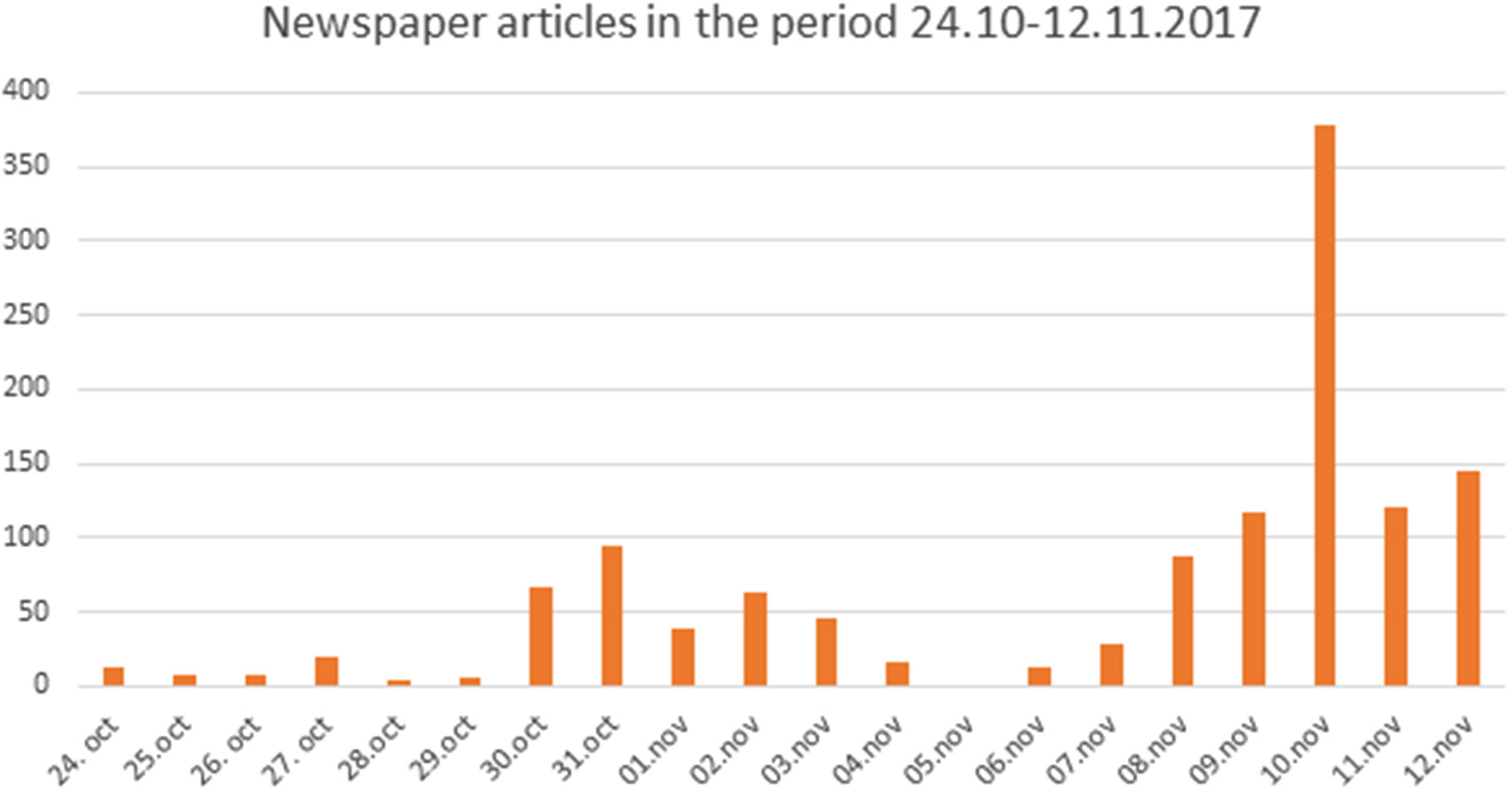
Overview of media coverage intensity.
Overview of Documentary Data.

Initially, we approached the data inductively, searching for key themes and explanations for the differential dynamics in the two change processes. Powerful external stakeholders and the interactions between various stakeholders emerged as a theme, thereby leading us to look further into the role of external stakeholders and stakeholder dynamics during change. Over time, we developed detailed chronologies that mapped key events and stakeholders for the two processes and color-coded data on external stakeholders to create a visual mapping that could reveal potential patterns (Langley, 1999). This allowed us to analyze actions and interactions across stakeholder groups and to assess how this influenced momentum and goal attainment. Throughout this process, we compared and contrasted the dynamics and outcomes of the two change processes.
In this process, we found Jansen's (2004) two categories of change-based and stasis-based momentum to be particularly useful for explaining the different change dynamics. Although research has shown that change requires a substantial amount of energy (Jansen, 2004), the lens of stasis momentum (Gersick, 1994) illustrates that considerable effort is also involved in remaining on the same trajectory and pursuing incremental change. Moreover, by mapping both change-based and stasis-based momentums, we were able to visualize how these developed in relation to each other and identify critical shifts, such as when one momentum overtook the other and the role external stakeholders played in such shifts.
Throughout the analysis, the second author could challenge potential personal biases and unearth implicit knowledge by probing and contributing to developing interpretations. Joint inquiry requires a safe space which can be developed based on reflexion and openness (rather than defensiveness) on behalf of the insider combined with curiosity and respect on behalf of the outsider (McKenzie & Bartunek, 2023). The long-lasting friendship and mutual interest and respect between the insider and the outsider created an initial safe space, but maintaining and developing a generative collaboration will also require a certain tolerance for tensions (McKenzie & Bartunek, 2023).
The Research Context: Statistics Norway
Established in 1976, Statistics Norway (SSB) is the national statistical institute of Norway. The institution is responsible for collecting, producing, and communicating statistics related to the economy, population, and society. In 2017, SSB had approximately 850 employees, with two-thirds of the employees located in the capital city of Oslo and one-third in Kongsvinger, a small town in the eastern part of Norway with approximately 18,000 inhabitants. SSB was one of the major employers in Kongsvinger.
The GD of SSB reports to the finance minister. In the period in which the current study took place, the central government of Norway consisted of a minority coalition of the Conservative Party, the Progressive Party, and the Liberal Party, and the finance minister belonged to the Progressive Party.
In Norway, changes in the central government sector are regulated by a common agreement between the state and the main labor unions. This agreement states that for all major organizational changes there must be an agreement among parties. If the parties do not manage to reach an agreement, the decision is appealed to the relevant ministry, which decides on the matter. However, if the organizational changes are directives from the parliament or cabinet, then the unions have no say.
Analysis: How External Stakeholders Influence Momentum in Two Change Processes
In this section, we combine the first-person voice (in cursive) describing personal experiences with a more neutral voice describing facts and externally documented stakeholder activities. The first-person voice in the quotes emphasizes our attempt to portray the experiences and reflections of the GD. Supplementary data such as newspaper clips are exhibited in Tables 2 to 4.
Newspaper Citations for Changes Involving Functional Relocation.

Newspaper Citations for Changes Involving Personnel Reallocation.

Newspaper Citations on Immigration.

As a new GD, I was recruited to SSB in 2015 with a mandate from the Norwegian Ministry of Finance and SSB's board of directors to fundamentally change the institution (see Table 3 10.10.2017b). To deliver on this mandate, I set in motion several changes with the aim of making the organization more efficient and future-oriented.
Two major change initiatives are analyzed in this paper: (1) reallocating functions between SSB's two main locations and (2) downsizing the research department and attuning it to the main purpose of SSB to produce high-quality statistics.
Below, we present these two change initiatives in further detail. Then, we describe the two change processes. For each change, we map ebbs and flows in momentum, describe stakeholder activities, and explain how these relate to shifts in momentum over time and ultimately affect the change outcome.
Relocating Functions: External Stakeholders Amplify Momentum for Change
The first change initiative aimed to relocate functions between Oslo and Kongsvinger. A key challenge involved making the Kongsvinger location attractive to highly skilled labor workers. Low-skilled workers constituted a rather stable workforce, but because they were getting closer to retirement age, they were to be replaced by fewer high-skilled workers. Although Kongsvinger managed to recruit young people with master's degrees, few stayed for long, and some used the position as a springboard to the Oslo office. It was believed that relocating future-oriented functions, such as environmental and climate statistics, to Kongsvinger would make it more attractive for young, high-skilled labor. Overall, 70 employees were directly affected by the relocation, and these employees could either change location, leave SSB, or change their area of expertise. This process was initiated in 2016 and completed in the first half of 2018.
The analysis below shows how stakeholder dynamics involving both internal and external groups amplified momentum for change, ultimately leading to goal attainment. Please refer to Figure 1 for an account of the evolving change and stasis-based momentum. The figure shows that the momentum for change amplified over time, while stasis momentum initially increased but subsequently wavered. The below analysis illustrates the important role that stakeholder interactions played in the momentum for change.
In January 2016, as a new GD, I met with the Norwegian Minister of Finance to clarify my change mandate. Given the need to technically modernize SSB, my initial proposal to the minister was to shut down the Kongsvinger location to save costs and become more efficient. However, the minister of finance feared that the majority of parliament would mobilize against this, and I needed to rethink how the organization could become more effective while keeping both locations intact.
I sought to collaborate with important external stakeholders, such as the mayor and municipality of Kongsvinger, to attract and retain workers to the region and obtain their support to transfer tasks. The mayor followed up and took the initiative to a meeting. This was the first of several meetings with the mayor and municipality.
Collaborating with the local municipality was important for creating change momentum early in the process, and it turned out to also become important to be able to mitigate statis momentum subsequently in the process.
To further create change momentum and build trust in the process, in September 2016, an internal commission was appointed that consisted of employees and union representatives from both locations. Their task was to provide a thorough description of the demographics of the two locations. The commission was also charged with suggesting areas of expertise that could be transferred between the two locations. To build a shared understanding and change momentum in the organization, the report was presented to all employees in a series of town halls in April 2017; thereafter, an internal hearing process was organized where everyone in SSB had the opportunity to voice their opinion.
Based on the report and hearing, the top management team made a few adjustments, and the revised proposition of relocation was presented to the employees and discussed and negotiated intensively with the unions. Based on the unions’ input, additional adjustments were made.
As expected, the plans caused unrest among those employees who were directly affected by the change. The employees feared that their carefully honed expertise would deteriorate and many had no desire to relocate or change their field of expertise (see Table 2, 8.11.2020b).
One organizational unit affected by the relocation to Kongsvinger was the unit for income and wage statistics. This unit provided important input to the public commission (TBU), which was responsible for delivering data to centralized wage settlements. Key SSB employees were part of TBU. In June, the head of TBU, also an employee in SSB's research department, together with the chief economists of the largest employee federation (LO) and largest employer federation (NHO), expressed their worries that the wage statistics would be negatively affected by a transfer (see Table 2, 16.06.2017). Although this resistance from TBU that included both external and internal stakeholders strengthened the statis momentum, it did not establish a strong foothold.
A possible reason for the limited influence external stakeholders had at this time may have been that one of my directors responsible for this area immediately invited the leader of TBU to a meeting asking him to explain his reasoning. This meeting appeared to have calmed the situation, and no further actions were taken by these external stakeholders.
Further, internal stakeholders, such as the unions in Kongsvinger repeatedly mobilized the press, voicing their concerns in the local newspaper Glomdalen (for examples of this resistance, see Table 2, 03.07.2017 and 10.11.2017a) and reached out to external stakeholders.
In meetings with the mayor, it became obvious that the unions kept him informed about the internal processes in SSB, but the unions also actively worked to mobilize other politicians against relocation. The key issue here had to do with the distribution of jobs between Oslo and Kongsvinger. Long before the process of relocation was launched, this was a recurring theme in the meetings I had with the unions in Kongsvinger; however, the suggestions to relocate functions heightened the unions’ attention to maintain the balance and, thus, explains their attempts to mobilize other external stakeholders against change.
On July 6, 2017, an MP from the Socialist Left Party from the Kongsvinger region wrote a letter to the ministers of finance and of the municipalities, thereby questioning the distribution of jobs between Oslo and Kongsvinger. She demanded that the previous balance of 40% of jobs be upheld in Kongsvinger. In addition, another parliamentary member from the Labour Party posed a written question to the minister of finance (see Table 5).
Questions to the Minister of Finance From MPs.

In an attempt to mitigate the change resistance mobilized in Kongsvinger, I met with the local press and expressed SSB's faith in Kongsvinger. I also met with other external stakeholders, such as the regional council, to reassure them that SSB intended to stay and wanted a strong foothold in Kongsvinger (see Table 2, 12.07.2017 and 31.08.2017).
To keep the process on track and avoid opposing forces getting a stronger foothold, I realized that I needed to maintain the balance between the two locations. Although I had the discretion to downsize disproportionally, I viewed altering the balance between the two cities—in particular disfavoring Kongsvinger—as detrimental to the process; this could turn the interest of the municipality from being supportive to opposing and trigger more reactions from political parties on the left, which would create problems for the minister of finance. Furthermore, for the Kongsvinger unions, a disproportionate relocation could be a deal-breaker. With this backdrop, I made a promise to maintain the balance between the two locations.
Though the statis momentum did not waver until the process was finalized, the energy from the external stakeholders fighting for the Kongsvinger location appeared to subside after this (see, e.g., Table 2, 10.11.2017b). In addition, employees working in Oslo who were affected by the relocation also mobilized external stakeholders. They reached out to ministries and politicians who had an interest in keeping a strong foothold in Oslo. Consequently, on September 27, 2017, the Ministry of Climate and Environment invited the top management of SSB to a meeting in which the purpose was to account for the relocation of climate statistics from Oslo to Kongsvinger (see Table 2, 15.11.2017).
Other stakeholders followed suit. A central MP from the Labour Party worried about the loss of competence (see Table 2 8.11.2017a), and the Ministry of Justice expressed concerns regarding the transfer of migration statistics from Oslo to Kongsvinger. At a later stage, the Oslo employees also conveyed their concerns in a major Norwegian newspaper (VG), thereby attempting to create an opportunity to backtrack the process (see Table 2, 7.11.2017). However, these actions happened at a rather late stage in the process and did not appear to have much impact on the statis momentum.
Throughout this process, the Ministry of Finance (who as the owner of SSB can be viewed as an internal stakeholder) remained supportive. After my initial meetings with the ministry, it requested to be informed regarding what the further process would entail. They were continuously informed but showed limited interest in the process. In the summer of 2017, when MPs asked critical questions regarding the process, the ministry reached out to SSB and asked for our help to draft letters to parliament. As such, the ministry rather passively supported the process.
The result was that functions were relocated according to plan, and 70 employees changed their location or line of work. External stakeholders, such as the mayor of Kongsvinger, boosted the early change momentum and continued to pick up throughout the process. Negotiations with the unions were a bit of a rugged path, particularly as they mobilized other external stakeholders (e.g., the media and MPs); nevertheless, the continued support (albeit passive) from the Ministry of Finance and from the local municipality was decisive for mitigating stasis momentum while maintaining and increasing the momentum for change that allowed for attaining change goals. Particularly when stakeholders were assured that there would be a balance between the two locations, stasis momentum waned.
Reallocating Personnel: External Stakeholders Kill Momentum for Change
The second change initiative followed a different trajectory. This change was characterized by substantial energy, both for and against the change, until the momentum for change was killed. In this process, external stakeholders played an important, albeit somewhat different, role. This change involved downsizing the research department and aligning it closer to SSB's purpose, which was to produce high-quality statistics.
Like the relocation initiative, a commission was appointed; however, in this case, it consisted of both internal and external representatives. The reason for inviting external representatives was to create legitimacy among external stakeholders in the research community and to obtain an objective external review of the quality of the department. The commission made several radical proposals that were strongly resisted by both internal and external stakeholders. To secure sufficient momentum for change and mitigate potential stasis momentum, the most radical proposals were toned down. Figure 2 illustrates the trajectory of the reallocation process, depicting the evolving change- and stasis-based momentum. As evident, the momentum for change gradually built up along with statis momentum; however, rather late in the process, stasis momentum took over, while the momentum for change was effectively killed off through withering support from the Ministry of Finance and collaborations between external and internal stakeholders. The analysis below describes how the stakeholder interactions influenced the momentum for change.

Momentum in relocated functions.
The reallocation process was triggered by two parallel developments. In April 2016, the director of the research department resigned. With his resignation, bitter conflicts and disagreements surfaced regarding the departments’ future strategies. One faction argued that the SSB's main purpose was to produce relevant analysis, economic forecasts, and projections for the Ministry of Finance. Many researchers in this camp perceived publishing in international journals as a nuance. The other faction argued for the need to serve the public at large in close relation to the purpose of the agency and publish internationally to secure the quality of the research. The recruitment of a new research director was difficult as long as there were pending conflicts in the department. Simultaneously, the Ministry of Finance questioned the need for SSB to have a research department, as this was highly unusual among the statistical bureaus. These two developments led to the decision to evaluate the future of the department (Figure 3).
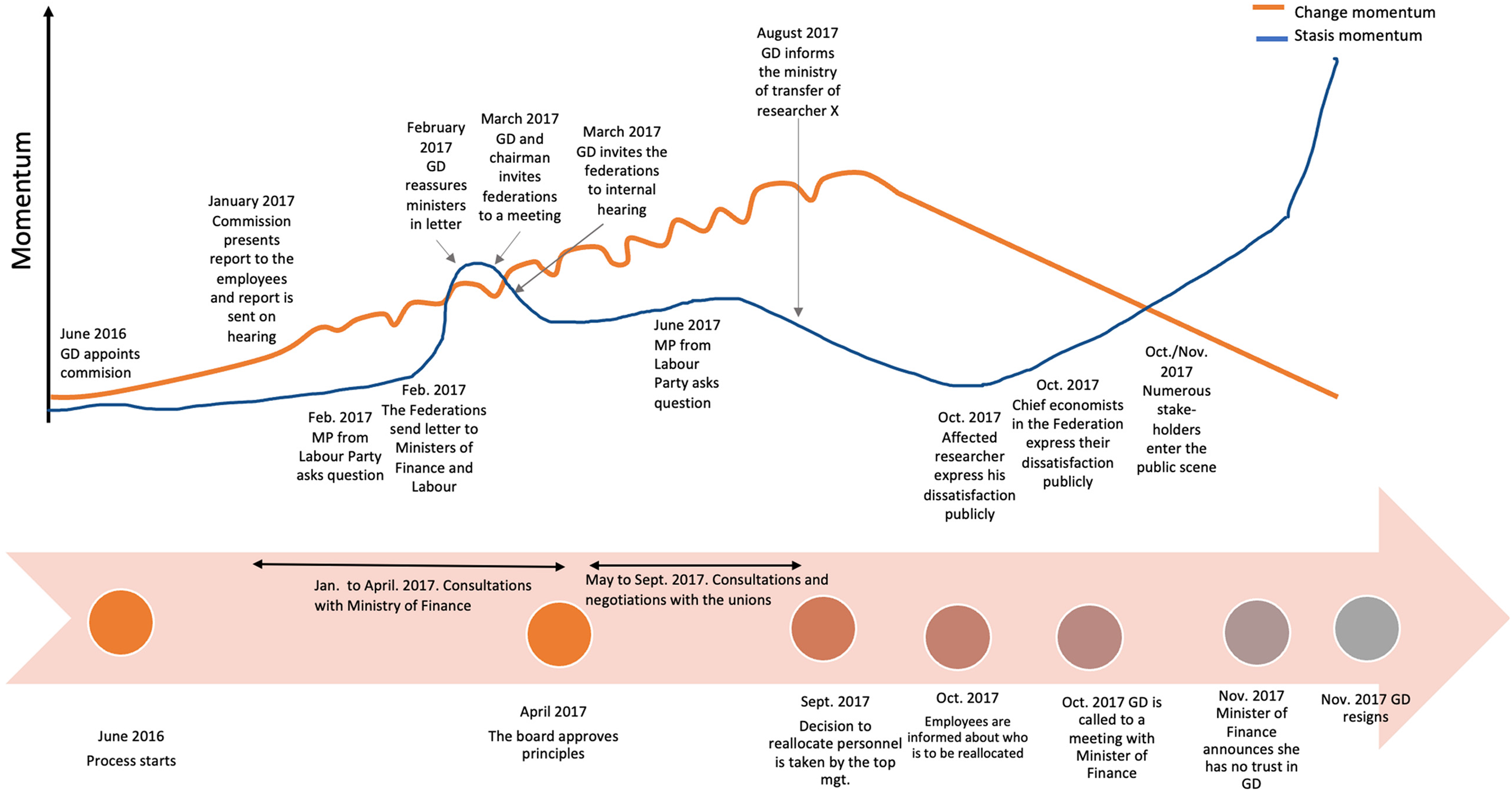
Momentum in reallocated personnel.
When presenting their report in January 2017, the commission proposed that SSB should continue to host research but on a smaller scale. It was recommended to downsize the research department from 80 to 25–35 researchers because the research was seen as too vested in old-school economic models and the research quality questionable. These proposals were perceived as radical, thereby making it particularly important to ensure a participatory process and enabling employees’ voices to be heard. However, the public sector context also implied that the proposal was picked up by the press, and numerous actors voiced their opinions, both internally and externally, against the proposal in the media.
In January, the proposal was presented to the ministry. In contrast to the relocation process, the ministry wanted a hand on the wheel. The top management in the ministry welcomed a change but deemed the proposal too radical at this stage. This was also expressed in the minutes of the meeting (and subsequently referred to in media articles; see Table 3, 10.11.2017c). At the lower levels in the ministry, there was more resistance to the change (see letter from the employees to the GD in Table 3, which is also referenced in the media article dated 14.01.2022).
As expected, the proposals met resistance among researchers who believed that SSB's main responsibility was to produce analysis and projections for the ministry. Some voiced their opinions anonymously to the press (see Table 3, 20.01.2017), while others openly proclaimed their reservations to the proposals by engaging in debates, speaking directly to the press, or giving the press access to internal hearings (see Table 3, 27.02.2017, 1.3.2017, 16.02.2017a, 17.02.2017, 18.02.2017).
However, the resistance to the proposals went beyond the SSB's own employees, thereby contributing to strong statis momentum. Two of the most powerful federations in Norwegian society—the Norwegian Confederation of Trade Unions (LO) and Norwegian Confederation of Enterprise (NHO)—entered the scene and promptly wrote off the proposal (see Table 3, 26.01.2017, 11.02.2017). The strength of this resistance from stakeholders outside SSB and the subsequent effect on statis momentum came as a surprise because, up to this point, the commission had only delivered a proposal that would be subject to an extensive internal hearing process.
LO and NHO characterized the proposal as too radical to be taken seriously and mobilized heavily against it. In a letter to the ministers of finance and labor dated February 9, 2017, the two confederations—together with the other federations of trade unions and employers—expressed their deep concerns regarding the proposed changes to the research department (Minister of Finance, 2017a). They argued that these changes would jeopardize the important input on inflation and sectoral wage growth that the research department provides to centralized labor negotiations.
It came to my knowledge that LO played an active part in mobilizing the other confederations to take a stand and sign a letter to the ministers of finance and labor warning against the change. To counteract this potential detrimental action to the change process, I crafted a formal letter to the ministers clarifying that the changes to the research department would not negatively affect the deliveries to centralized labor negotiations (Minister of Finance, 2017b).
In the following meeting of the three-party collaboration (body consisting of the government and the employer and employee federations), the opposing parties strongly argued against the proposal for change, but the ministers chose not to interfere with the ongoing process, thereby allowing the change momentum to build further.
To retain the support of the Ministry of Finance, I suggested we take a step back and formulate three guiding principles. Because of the external stakeholder concerns and activities, I also deliberately chose to involve the ministry much more than in the Oslo-Kongsvinger process.
The chairman and vice-chairman of the SSB board were deeply involved in formulating the principles. The principles stated that the research should be empirically based, feed back to the statistical departments, and analysis should be connected to international research. The principles were approved by the SSB's board of directors in April 2017. Hence, the radical path suggested by the commission was abandoned.
Consultations with the Ministry of Finance throughout the process resulted in further modifications to the proposal, including a lesser reduction of employees (with a research department consisting of 50 instead of 25–35), hence allowing old economic models to be retained, among other things (see Table 3, 06.04.2017).
These modifications were made in an attempt to keep the process on track and to secure the ministry's support. Some of my colleagues thought I went too far in giving the ministry a hand on the wheel, leaning backward to accommodate their wishes. However, given the strong and non-withering resistance from the external stakeholders, I was dependent on strong support from the ministry.
Given the federations’ strong opposition to the commission's proposal, the chairman of the board and I took measures to attempt to mitigate the increasing resistance. We invited them to voice their concerns and also to express an opinion on the guiding principles for research. This involvement reached beyond their formal role in the process, which normally would be to involve the local unions.
The claims by external stakeholders demanding to have a say in the process did not go unnoticed, and several people questioned their role in the process. For example, one of the commission members behind the radical proposals questioned their interference in the internal processes of an independent agency (see Table 3, 14.07.2017).
The federations supported the proposed move away from a “small elitist department” but simultaneously expressed a concern that the process was too internally focused, not involving the parties throughout. They stated, “… in our view this matter reaches way beyond SSBs’ internal operations, and we ask that these questions become part of the Three-Party-Collaboration” (Letter: March 30, 2017). Although NHO and LO still remained skeptical of the change (see Table 3, 07.04.2017), these actions temporarily served to decrease the stasis momentum.
In the period leading up to summer 2017, the statis momentum got a stronger foothold as the Labour Party, which is closely connected to the Federation of Trade Unions, also began to voice their opinion against the change and questioned the finance minister (see Table 5). This was the first of two written questions from the Labour Party representative (the other was in June) that involved the finance minister. The response illustrates the ministry's hands-off policy toward SSB to questions regarding internal reorganizations (see also Table 3, 16.02.17b).
While giving the federations a say in the process, I also negotiated with the unions in SSB, which had a formal role in the process. I aimed to have an open and constructive dialogue with the unions throughout the process and initiated several informal meetings, attempting to speak openly and build trust. This reorganization was difficult for the unions because many of their members were opposed to a change of direction and downsizing. The unions had a strong standing within the organization. The negotiations were tough, and I was uncertain whether an agreement with the unions could be reached. To keep the process on track, we agreed to take one step at a time. We would first decide on who should remain in the research department and then discuss the department's future strategy and organization.
After consulting and negotiating with both internal and external stakeholders, a decision to transfer 15 researchers to other departments while maintaining their pay level and title was communicated to SSB employees in October 2017.
At this point in time, I thought we had found a compromise and that the fulfillment of the change process was within reach. However, one delicate issue remained unresolved, and this issue could potentially jeopardize the support from the minister of finance. The issue concerned the transfer of one specific researcher who was responsible for forecasting the long-term costs of immigrants. These forecasts were important for the finance minister, who was the head of the progressive anti-immigration party. The minister had earlier reprimanded me for voicing my concerns with regard to making such projections, qualms that were shared by other researchers in SSB as well (see Table 4, 24.03.2017, 21.11.2017). Furthermore, SSB turned down a request from the party to produce statistics on immigration and crime earlier that year, something that hurt the relationship between SSB and the progressive party (see Table 4, 26.01.2016). With this in mind, I warned the administration of the ministry weeks before the actual relocation that the researcher responsible for the immigration projections might not meet the qualification requirements to remain in the research department and was therefore likely to be transferred. I was somewhat surprised that there were no objections from the ministry to this information, and as such I proceeded with the plans (also see Table 4, 18.11.2017a).
After the researchers were informed of the relocations, the researcher responsible for the immigration cost projections publicly voiced his opinion against the transfer in the media (see Table 4, 24.10.2017). In the media article, he hinted that his transfer was linked to his immigration research, something he subsequently withdrew. Consequently, the support from the finance minister withered, and after 2 weeks she pulled her support for reallocation (see Table 4, 10.11.2017). Shortly after the media statement by the immigration researcher, the Progressive Party warned SSB and that if it did not continue to deliver immigration cost projections, actions would be taken (see Table 4, 27.10.2017).
At the same time, I received a phone call from the ministry asking me to place this researcher back in the research department. This would fix things in the ministry. I feared that such a turn at this stage, when all the transfers had been communicated to the relevant researchers, would jeopardize the legitimacy of the process and cause unrest in the entire department. Hence, I argued against the request but promised that the researcher could continue to make immigration projections once transferred.
Up until this point, the momentum for change had been upheld through the internal negotiations with the unions and support from the minister of finance, despite the strong frontier of external stakeholders who, through collaboration with internal employees, had increased the stasis momentum. After the researcher's media appearances, the two chief economists from the federations stepped up their criticisms in the media; then the minister of finance called the GD to her office, which was the first of three meetings. Stasis momentum then got hold of the process and accelerated quickly.
The requests of the minister of finance to meet me were made public (see Table 3, 9.11.2017a). All major national newspapers and TV channels reported on this upcoming meeting as well as the two subsequent meetings. These actions signaled withering support from the minister of finance, and the control of the process was slipping through my fingers. I wanted to install measures to mitigate the increasing resistance but was warned by the ministry that I would lose the minister’s support if I took action. Hence, my hands were tied, and I felt like I sat on the side lines watching the process spin out of control.
This was followed by mass mobilization from internal and external stakeholders (see, e.g., Figure 1, Table 3, 9.11.2017b, and 10.11.2017a). The opposition parties in parliament accused me of getting rid of researchers who did not share my immigrant-friendly opinions. Others accused me of being tone-deaf to signals from the ministry and of running a Machiavellian change process. Still others sent me threatening e-mails related to the immigration issue (see Table 3, 18.11.2017b). Despite the earlier agreement, the unions now distanced themselves and began voicing their criticism in the media, sensing an opportunity for renegotiations (see Table 3, 8.11.2017).
Increasing unrest in the Progressive Party was reported in the media, thereby pressurizing the finance minister to act. However, it was not legitimate to fire the GD for pro-immigrant attitudes. Hence, the finance minister claimed no confidence because of a lack of trust from key stakeholders, including the confederations, lack of control of SSB, and failing to adjust to signals from the ministry (see Table 3—8.11.2017a, 10.11.2017c, 11.11.2017).
The process culminated with the minister publicly expressing that she no longer had confidence in me as the GD, and I resigned on November 12, 2017. As such, the key stakeholder for change had shifted sides and now allied with external stakeholders who were lobbying against change.
Thus, the momentum for change was effectively halted as the reallocation process was put on hold.
Aftermath
The finance minister's direct interference in SSB prompted the Standing Committee for Scrutiny and Constitutional Affairs to open a case against the minister. In this process, which took place in the first quarter of 2018, the minister was criticized for the manner in which she had handled the situation, even tampering with evidence (see Table 4—21.02.2022 and 02.03.2018). Despite the harsh criticism, the decision to stop the reorganization was never challenged by the Standing Committee (see Table 3—11.01.2018 and 9.12.2017).
Discussion: External Stakeholder Influence
The above analysis illustrates how a planned organizational change can take on accelerating momentum along a new trajectory, such as in the first change process, or be overtaken by stasis momentum, even quite late in the process, as revealed in the second process. Below, we compare the two processes to identify the different ways in which external stakeholders influence the change processes and outcomes.
From our data, we observe three patterns of external stakeholder influence: (1) collaborating with internal stakeholders; (2) mobilizing other external stakeholders, such as the press; and (3) shifting the change agenda (please refer to Tables 6 and 7 for an overview).
How External Stakeholders Influence the Functional Relocation Process.

How External Stakeholders Influence Personnel Reallocation Process.

Collaborating With Internal Stakeholders
In a conceptual paper, Jansen (2004) argued that social interaction among employees amplifies change momentum. For example, the participatory processes that engage employees in shaping change contribute to building momentum. Both change processes in SSB relied on extensive employee participation. Employees were included in the initial analysis underlying the formulation of change and were provided an opportunity for their voices to be heard subsequently in the process through hearings. What distinguishes the momentum in these two change processes from those portrayed in the literature is the role of external stakeholders and their interaction and collaboration with internal stakeholders.
Internal stakeholders can mobilize external stakeholders for the purpose of rallying support either for or against change. In our study, external stakeholders were mobilized to amplify both statis and change momentum. In the first change process, the GD allied with the mayor and local community; this amplified the change momentum early on and subsequently offset a potential increase in statis momentum. In the second change process, the senior management invited external researchers to collaborate in the process in an attempt to strengthen the change momentum. However, the radical proposal from this group triggered other external stakeholders and, thus, instead resulted in increased stasis momentum. This suggests that there is an inherent risk in bringing in external stakeholders, as their influence may take unexpected turns.
The deliberate mobilization of external stakeholders was even more evident among employees attempting to build the statis momentum. These collaborations against change occasionally took the form of direct personal contact with politicians, ministries, and federations or backstage meetings; hence, these interactions were often much less transparent than participatory processes. When alliances were built behind closed doors, senior management and other stakeholders were less able to respond, as they typically would not be aware about it. At other times, internal and external stakeholders allied based on more publicly open communication voiced in the press or in formal questions by MPs to the minister.
Communication through open sources, such as the press, can serve to mobilize others (Ferrary, 2009), thereby potentially increasing the power of stakeholder groups. In the context of this paper, mobilizing the press was particularly prevalent among the opponents of the changes, who actively used this channel to bring attention to the change and express their concerns. Existing research suggests that the weaker party typically has an interest in bringing issues to the press because it can then potentially mobilize other stakeholder groups (including public opinion) to voice concerns (Rolland, 2002). The press also tends to prefer critical voices and drama that have a click-bait potential, thereby increasing readership (Coleman et al., 2009). While previous research has argued that external stakeholder engagement can be raised by mobilizing the media (Winkler et al., 2019), it has not tied such stakeholder activity to change or stasis momentum. Our analysis shows how the use of open sources of communication (such as the media), on the one hand, provides an opportunity for senior management to respond and attempt to mitigate increasing stasis momentum; on the other hand, it also provides an opportunity for all other stakeholders to engage for—or more likely against—change.
Successfully counteracting statis momentum depends on a number of factors. On the one hand, it might be easier for senior management to counteract and attempt to reduce the stasis momentum when stakeholder concerns are expressed publicly either through the press, formal questions, letters, or official meetings. On the other hand, voicing one's opinion in the press can also trigger other stakeholders to follow suit, and the process can spin out of control. In our study we observed this in the later stages of the second process, where an internal stakeholder successfully triggered external stakeholders, which again led to mass mobilization and loss of control of the process. As stated by Ackerman and Eden, “One stakeholder's actions can generate a dynamic of responses across a range of other stakeholders” (2011: 186).
Mobilizing Other External Stakeholders
External stakeholders can also influence the change process by collaborating and allying with other external parties. In both change processes that we studied, we observed how externals collaborated to increase the statis momentum. The collaboration among external stakeholders was particularly profound in the second process, in which the largest employee federations mobilized other federations to adopt a stance against the change proposal. These external stakeholders emerged over time and mobilized others through letters to ministers, meetings with the government, and the media. Such interactions had a profound effect on the stasis momentum early in the process. While previous research has shown how activists and grassroots movements can use the press to call attention to the need for change (Gamson et al., 1992; Hilgartner and Bosk, 1988), our study illustrates how the press can be used to preclude a planned organizational change during its implementation. As discussed in the previous section, when concerns and resistance are communicated openly, such as in the media, it provides opportunities both for senior management and other stakeholders to respond.
Our analysis showed that the SSB management established a channel for communication with the external stakeholders, which temporarily dampened stasis momentum, thereby allowing the change process to move along. However, the stasis momentum persisted, as the dialogue and adjustments to the change agenda were not perceived as sufficient by the stakeholders. Therefore, the second process was more vulnerable, and goal attainment depended on strong and amplifying change momentum.
A relevant question is whether more extensive involvement of these emerging external stakeholders could have either secured change momentum or dampened statis momentum. Our case analysis suggests that more extensive involvement can at least temporarily move the change process forward. However, in SSB, this was a difficult call, as these organizations had no formal role in the changes, and the internal participatory processes with the unions were complex from the outset. Hence, more extensive involvement risked interfering with internal participatory processes and further sanding down the edges (Molinsky, 1999) of the already amended change agenda. On the other hand, the federations were powerful, and their interactions could (and did) amplify the statis momentum.
Shifting the Change Agenda
A third manner in which external stakeholders can influence change involves shifting the change agenda. We observed two ways in which the change agenda was shifted in the cases described in this paper: by deliberately adjusting change content in the manner that we have hinted at above and by manipulating the conversation. The first tends to require a formal decision and, thus, is primarily available to management as a response to stakeholder pressure; the second way of shifting the agenda is discursive and, thus, potentially available to all stakeholders.
By voicing their interests and demonstrating their power, external stakeholders can cause shifts in the change agenda. For example, if management eliminates the most controversial issues or includes attractive components in response to external pressure, this can serve to sustain the change momentum while dampening stasis momentum. This was evident in the reallocation process, in which a number of issues were taken out of the change initiative by management to uphold the support from the ministry and to attempt to accommodate the federations. Thus, management can attempt to take control of the process and alter the change content to accommodate external stakeholder interests, which can help avoid the proposals from being further sanded down (Molinsky, 1999) as a result of extensive involvement of groups, which is beyond management control (Feldman, 2005; Meyer, 2012).
What is perhaps more interesting is how external stakeholders can shift the change agenda by discursively connecting it to broader issues. In both of the processes we studied, the federations argued that the proposed changes could jeopardize the inputs to the centralized wage settlements. Hence, they legitimized their own involvement in the process by linking the change processes to the broader issue of centralized wage settlements, which were of national concern far beyond SSB and where these federations had expertise and played a central role. This discursive manipulation, in certain ways, resembles Dutton and Duncan's (1987) notion of issue selling; however, instead of attempting to rally support for a specific issue, the change content is negotiated or manipulated in ways that make it more interesting or salient to other stakeholders.
Another example of how the specific change within SSB was linked to a broader societal issue was the connection of the reallocation of one specific researcher to broader immigration issues. Framing the change as an immigration issue (in the press) resulted in mass mobilization and pressure on the finance minister (who was anti-immigration), thereby making it increasingly difficult for her to uphold her support of the change process. Although research has argued that political leaders need to be conscious of how they frame proposals to the public (Graetz and Shapiro, 2005; Zahariadis, 2003), our study illustrates how various stakeholder groups can attempt to frame change in a specific manner to rally support for their position. Furthermore, research has shown how widening the manner in which a change (or problem) is framed can create a more receptive context for the change (Murphy et al., 2021); however, our study illustrates that framing can also work in the opposite manner: change can also be framed in ways that create a less receptive context for change. Connecting the change to broader issues, such as immigration, can activate latent preferences among other stakeholders (Kingdon, 1995).
The above three ways in which external stakeholders influence the change processes and outcomes can be conceptually distinguished; however, as our case analysis shows, in practice, these may occur simultaneously and interact in complex ways. We observed the three types of stakeholder influence in both the change processes we studied, but they interacted in ways that had differential effects on momentum.
Thus, our analysis suggests that the effect of external stakeholder interactions depends on how change and stasis momentum develop relative to each other. If change momentum is amplifying and, thus, creating a substantial gap between change and stasis momentum, external stakeholder interactions will have less of an effect, as it will struggle to get a foothold. This is what we observed in the first process. Early change momentum combined with successful mitigation of stasis momentum resulted in amplifying momentum for change that became too strong for subsequent stakeholder influence. However, in the second change, statis momentum persisted over time, and momentum for change was not sufficiently strong to counter the alternative agenda by both external and internal stakeholders. Therefore, the effects of external stakeholder influence and stakeholder interaction must be understood and assessed in light of how the two types of momentum develop relative to each other.
Contributions and Conclusion
This paper used CAE methods to explore how external stakeholders can influence change momentum and, ultimately, goal attainment. Through rare access to a top managers’ experiences of two change processes and a novel variety of CAE, we combined rich practice-based experiences and reflections with academic rigor and theorizing, enabling us to make four important contributions.
First, our findings extend the change dynamics literature (Barker et al., 2017; Jansen, 2004; Jansen et al., 2016) by showing and explaining how in the public sector in particular, external stakeholders can influence change. Existing literature has suggested that change dynamics can be mapped through the concept of momentum and indicated the importance of social interaction (Jansen, 2004). However, explanations tied to social interactions among internal stakeholders fall short of explaining the role of external influence on momentum. Our study shows how external stakeholders influence the evolving dynamics of change by allying with other stakeholder groups. More specifically, we identified three ways in which external stakeholders can influence change: (1) collaborating with internal stakeholders, (2) mobilizing other external stakeholders, and (3) shifting the change agenda.
Furthermore, while previous research has argued that momentum can shift over time (Jansen, 2004), it has primarily addressed the amplification of momentum. Our findings illustrate the role of stasis momentum and demonstrate how and why statis momentum can ebb and flow over time. By focusing on the evolving change momentum and stasis momentum simultaneously, we gain important new insight into how these fluctuate and can overtake one another to either amplify or kill the momentum. Barker et al. (2017) argued that in a public sector context it is important to prevent political activities from snowballing, potentially hampering the momentum for change. Our study shows that such prevention may be a way for managers to mitigate statis momentum while maintaining change momentum, thereby providing a more fine-grained repertoire of actions that can be taken by managers to influence the momentum.
Second, the findings contribute to stakeholder theory by deepening the understanding of stakeholder dynamics. Our findings show how external stakeholders can mobilize latent interests among other groups and how externals—through various forms of mobilization and collaboration—can increase their power base, either in favor of or resistance to change. Some of the most influential stakeholders in the second SSB process were not included in the initial stakeholder analysis, which demonstrates the difficulty in identifying key actors and interests (Klein et al., 2012). Our study shows how latent stakeholder groups may emerge over time, claim their legitimacy to influence the change process, and ally with other to increase their power base. This suggests that stakeholder analysis is not a one-time endeavor; rather identifying key actors, their power, and interests needs to be reassessed throughout the process.
Our findings demonstrate how and why the salience of stakeholders is likely to change over time (Buysse and Verbeke, 2003; Cennamo et al., 2009; Parent and Deephouse, 2007). We found this salience to be particularly important when explaining the role of emergent stakeholders who invited themselves to join the process. There were two reasons why these emergent stakeholders entered the scene; some opposed the content and claimed to have legitimate and urgent concerns (Mitchell et al., 1997), and others were mobilized by other stakeholders underscoring the importance to map relations between different groups of stakeholders (Frooman, 1999; Neville and Menguc, 2006; Rowley and Moldovenau, 2003).
External stakeholders and their dynamic interaction with other stakeholders (both external and internal) can create, sustain, and/or destroy the momentum for change. Our fine-grained analysis of the stakeholder dynamics illustrates how this can play out in the public sector context, which is characterized by transparency and where external stakeholders have always been important (Feldman, 2005). Nevertheless, external stakeholders can also play an important role in the private sector, particularly with the increased focus on environmental and social sustainability (Freeman et al., 2010; McGahan, 2020). Future research would benefit from exploring the role of external stakeholders in the private sector as well as probing the non-transparent ways in which external stakeholders can seek to influence planned organizational change across sectors. CAE involving practitioners with experience in stakeholder activity could be one fruitful avenue to gain access to backstage influence.
Third, our findings contribute to practice by demonstrating that managers need to attend to external stakeholders and providing insights on various ways in which external stakeholders can influence and how this can be mitigated. For managers, there are two fundamental ways to influence momentum. One, which is the most commonly discussed, is to build change momentum. The other way, which is much less debated, is to mitigate statis momentum. In our cases, this mitigation occurred in several ways, including making the content less radical (Molinsky, 1999), changing the content, inviting external stakeholders to participate, and informing and reassuring both internal and external stakeholders.
Our fourth contribution, which is perhaps most important for this special issue, consists of extending existing approaches to collaborative inquiry on organizational change and changing. The collaborative method of research (Benington and Hartley, 2004) is still rather rare, particularly in management studies. Perhaps because conducting collaborative inquiry on change processes as they are ongoing is highly demanding in terms of time, engagement, access, and researcher skills. Our approach to CAE builds on key tenets within collaborative research, while it opens up for new voices in the organizational sciences. Academic papers written by top managers relating their own stories to existing research literature are almost non-existent. CAE allows top managers to reflect on and share real-time experiences together with an academic scholar not only while in the middle of a change process but also after having completed the change—whether successfully or not. Joint inquiry and reflexion in retrospect provide distance and allow for deep analysis of potential explanations. The collaboration and retrospection we have described in this paper were essential for creating distance to the experiences and documentary data and also for connecting the experiences to the existing literature and making the conceptual leap needed to contribute to the academic literature. Combining personal reflections through auto-ethnography with insider/outsider collaboration thus relaxes some well-known challenges with real-time collaborative inquiry and thereby provides new and additional opportunities for academic and practical insights based on the rich experiences of managers at different levels.
As emphasized throughout this paper, the current study should not be viewed as an objective account of a change process, but rather a systematic and analytical depiction of the perspective and reasoning of the senior manager in charge of change. Through the CAE approach, the study thereby provides unique insights into a senior manager's thinking and judgments in two distinct change processes, answering calls for research from the perspective of those who have experienced change (Plakoyiannaki and Budhwar, 2021).
Footnotes
Declaration of Conflicting Interests
The authors declared no potential conflicts of interest with respect to the research, authorship, and/or publication of this article.
Funding
The authors received no financial support for the research, authorship, and/or publication of this article.
