




Abstract
In Pakistan, Hystrix indica is abundant and distributed all over the country. It has been identified as a serious pest of traditional as well as non-traditional crops, fruit orchards, vegetables, flowering plants and grasses of forage importance in rangelands. The most important porcupine damage, however, occurs in forestry and range areas. Damage estimates are 15.18 ± 1.79% to Dalbergia sissoo, 12.38 ± 1.86% to Morus alba, 15.16 ± 2.04% to Eucalyptus camaldulensis and 3.44 ± 0.04% to Albizzia procera in different irrigated forest plantations of Punjab have been reported. Severe stock damage figures of 58.4 ± 4.00% to Bombax ceiba, 9.81 ± 2.69% to Dalbergia sissoo and 6.79 ± 2.23% to Albizzia procera were recorded in different areas of the Punjab. Crops of economic importance such as wheat, maize, sugar cane, groundnut and melon are severely damaged in the irrigated plains and rain-fed Pothohar belt. Among the vegetables, okara, pumpkin, bitter gourd and onions are badly damaged.
Introduction
The Indian crested porcupine, Hystrix indica, is widely distributed throughout southeast and central Asia and in some parts of the Middle East: India, Nepal, Bhutan, Bangladesh, Sri Lanka, Pakistan, Iran, Afghanistan, Israel and Saudi Arabia (Grzimek, 1990; Nowak, 1991). In Pakistan, they are commonly found in man-made and natural forest plantations, agricultural landscapes, the sandy deserts of Punjab and Sindh, the mountainous areas of Khyber Paktunkhwa (KPK) province, as well as being abundant in the steppe mountain regions of Balochistan up to 2750 m elevation (Greaves and Khan, 1978; Geddes and Iles, 1991; Roberts, 1997; Khan et al., 2000). Along with the upland valleys of Jehlum and Neelum of Azad Jammu and Kashmir (AJ&K) they have been reported in the moist temperate deciduous forests of the Machiara National Park at 3200 m elevation, the highest point of its distribution (Awan et al., 2004). In addition to these habitats, the high raised, soil dirt built embankments of link and barrage canals of the Indus river system have provided the most suitable denning sites for it, which helped in its marked distribution in the crop lands of Punjab and Sindh provinces.
The Indian crested porcupine is a generalized forager that damages a wide variety of cultivated and wild plants by consuming above ground as well as sub-surface plant material (Gutterman, 1982; Alkon and Saltz, 1985; Ahmad et al., 1987; Brooks et al., 1988; Khan et al., 2000; Pervez, 2006). The most significant porcupine damage in Pakistan was observed in reforested areas. As early as 1967, a common occurrence of girdling of Morus alba was reported in the croplands of Punjab (Taber et al., 1967), while Ahmad and Chaudhry (1977) reported that the damage to the same species and Melia azedarach was very serious in five irrigated plantations of Punjab. Nawaz and Ahmad (1974) calculated a loss of increment amounting to 3853 cubic meters of wood in various blocks of Changa Manga plantation (5263 ha). Greaves and Khan (1978) investigated porcupine damage in Chichawantni plantation and quantified damage to different mature tree species. Accordingly, M. azedarach and M. alba received 72% and 50% damage, respectively, followed by 4% to Dalbergia sissoo. Khan et al. (2000) reported severe stock damage of 60% to Pinus roxburghii and 42% to Robinia pseudoacacia in the Tarbela water-shed areas of KPK province. Damage to Azadirachta indica in the range lands of Sindh and 5–28% damage to wild pistachio (Pistacia khinjuk) in Balochistan have also been reported (Ahmad et al., 2003; Pervez, 2006). In India, H. indica, as a vertebrate pest, caused damage to Acacia spp., Zizyphus mauritiana, A. catechu, A. leucophloea, Butea monosperma, P. roxburghii, A. indica, Eucalyptus spp. and young coconut plants through uprooting (Sharma and Prasad, 1992; Idris and Rana, 2001; Girish et al. 2005). Sheikher (1998) recorded 90% debarkation of the young P. roxburghii planted along the hillocks in Himachal Pradesh, which resulted in killing 54.4% of these plants. In Iran, H. indica is also one of the major pests of the reforestation of the western oak forests (Fattahi, 1997).
Materials and Methods
The Punjab (31° 19′ 48″ N, 74° 12′ 36″ E) is the north-eastern province of Pakistan. Leaving aside the northern parts, the main part of the province is plain, which mainly constitutes the central Punjab. The north-eastern parts of the province are extensively cultivated and thickly populated, while towards the south and the west the agriculture and human settlements become sparse. Under the recent development and constrains on the biotic resources, agriculture has extended to previously unexploited tracts through the development of irrigation networks. The porcupine tract in the Punjab is constituted mainly by the areas where agriculture has recently extended and which are relatively sparsely inhabited by the human population. For the purpose of the present study, the prospective porcupine belt of the central Punjab has been divided into four ecological zones, that is, the rain-fed Pothohar belt, the irrigated forest plantation, the embankments of link canals and desert. Most of the plain area of Punjab is irrigated by barrage and irrigational canals. Apart from agricultural exploitation, vast areas in these tracts have been set aside for the development of irrigated forests by the Forest Department. Kundian (Mianwali), Shorkot, Changa Manga, Daphar and Lal Sohanra are some of the important irrigated forest plantations. Dapher and Shorkot plantations were selected for the study. Each plantation is divided into different subdivisions, blocks and compartments for administrative convenience. Each plantation has its own plant composition but Shesham (D. sissoo), Eucalyptus (E. camaldulensis), Frash (Tamarix aphylla) and Mulberry (M. alba) were the dominating tree species (Sheikh, 1993).
Thal represents the sandy desert ecosystem of Punjab. Rakh Goharwala and Rakh Chobara were selected for the desert ecosystem. Faisalabad and Qaidabad were selected for the agricultural lands.
A general idea on the type of damage caused to different types of vegetation was developed through observations in the area and sharing the experiences of the local farmers. This helped in further designing the sampling techniques and the mode of operation for future studies.
The tree damage was assessed in two major forest plantations of the Punjab, Daphar (Gujrat) and Shorkot plantations. In each forest, age-related types of plantations that is, very young (< 1 year), young (> 2 years) and mature (5 or more years) were marked on the map, and randomly selected compartments, representing each type of plantation were visited for a detailed survey. Every fifth row was selected and the number of damaged (with characteristic marks of gnawing) and undamaged trees were counted. In the case of mature trees, the plants having debarkation of more than 20% of the stem girth at d.b.h. (diameter at breast height – i.e. 1.5 m above ground level) were regarded as damaged, as this is expected to seriously affect the radial growth of the plant, and hence the quality of wood. For younger and or very young plants, the number of uprooted (associated with characteristic porcupine digging) and chopped off plants were counted as damaged.
In the study area two types of nurseries were observed for damage in the forest plantations of Punjab, that is, D. sissoo (Sheesham) and B. ceiba (Simal). The quadrate (2 × 2 m2) technique was adopted for the damage assessment, where the normal and uprooted plants were counted and damage was estimated.
The survey was done by driving the roads traversing the selected crop growing area, using a road transect, stopping at every 5 km if crops fields were available. At each stop, four fields were surveyed. Four quadrate samples were taken from each field, generally near the corners. The number of plants, both damaged and undamaged within the quadrate, were counted.
The damage in the crop was assessed by randomly selecting four quadrates (two in the periphery and two some 50 m deep) of 1 × 1 m2 for the wheat field. Onion (Bhakkar), melons (Bhakkar), and groundnuts (Quaidaabad) crops were sampled using a 2 × 2 m2 quadrate. The normal and damaged plants (cut and chewed) were directly counted. The percentage damage was calculated using following formula:

Results and Discussion
Crops
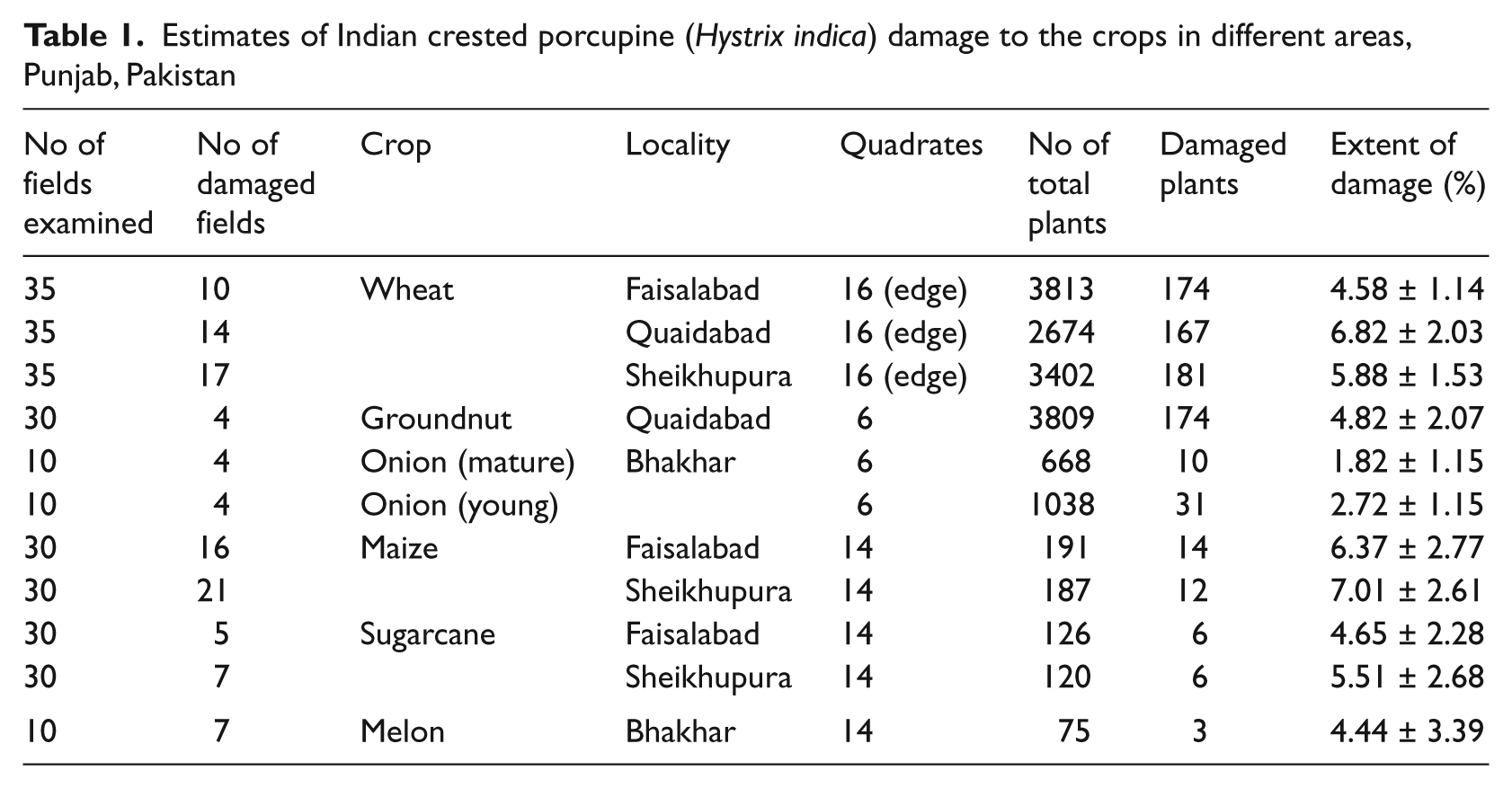
The collected data revealed that porcupine damage was observed in 41 fields of wheat crop out of 105 fields in growing areas of the Punjab. The damage was 4.58 ± 1.14% in Faisalabad, 6.82 ± 2.03% in Quaidabad and 5.88 ± 1.53% in Sheikhupura. The previous estimates on wheat damage in the Pothowar belt was 8.50 ± 0.96% (Mian et al., 2007). This appeared to be a heavy damage, but it was quite as expected from such a large rodent. The porcupine is herbivorous in diet. The natural vegetation in the area is limited during the winter, while wheat damage is confined to the boundaries of the fields. However, the degree of damage to crops in Punjab was non-significant (F value = 3.97, P < 0.05).
Groundnut (A. hypogea) is one of the major oilseed crops grown in Pakistan and provides a rich source of energy to the porcupine due to its extensive digging habits. The data collected from Quaidabad showed relatively higher damage (4.82 ± 2.07%). However, it varied from 3.19% to 11.92%. Brooks et al. (1988) reported damage to groundnut crops, with 30–40 plants damaged per night and Mian et al. (2007) estimated 20.2 ± 7.2% damage in Chakwal.
The porcupine damaged the younger onions (Table 1) (2.72 ± 1.15%) whereas the ripe and marketable onions faced considerably less damage (1.82 ± 1.15%). Mian et al. (2007) found onion damage of 0.9–5.4% in Bhakhar, during 2004. Onions are considered to be a lower preference food.
Estimates of Indian crested porcupine (Hystrix indica) damage to the crops in different areas, Punjab, Pakistan
Maize is the third most important cereal crop grown in Pakistan. In the Punjab the crop is mainly planted during the mid-monsoon rains and harvested in October and late November. It is one of the few crops that can be grown in the irrigated areas during this period and still leave ample time for wheat crop cultivation.
During the survey, a total of 60 maize fields were visited. Porcupine infestations were noted in 37 fields. In Faisalabad the damage range of maize was 6.37 ± 2.77%, 16 fields out of 30, while in Sheikhupura the damage was 5.51 ± 2.68%, with 21 fields out of 30 infested by porcupine. Khan et al. (2000) estimated 10.7% porcupine damage in Azad Jammu and Kashmir. Before this Ahmad et al. (1987) recorded 0.83% damage in the central Punjab.
The porcupine inflicted 4.44 ± 3.39% damage to ripe melons in Bhakhar, whereas the vegetative part of the plants was not damaged.
Very little information on damage to sugar cane has been published. Twelve out of 60 fields were found to be damaged. In Faisalabad damage (4.65 ± 2.28%) was observed in five fields. In Sheikhupura damage (5.51 ± 2.68%) was found in seven fields. The damage pattern in sugar cane showed that porcupine first attacked the roots of the crops and then they damaged the stems of the crop. The damage extended into the soil by about 2.5–7.5 cm. On the basis of information collected through talking to the farmers, the porcupine inflicted significant damage to cauliflower, cabbage, seed potatoes, orange and mango fruit (picked from lower branches), the roots of pepper, sorghum, turnip, radish, carrot and okara (lady finger). The porcupine has also been reported to cause damage to millet, barley, clover, mustard, gram, lucerine, mongi, pea flower, potato, radish, rice, sweet potato, sunflower and tara mera. Khan et al. (2000) reported 17.56% porcupine damage to potatoes near Attack, Punjab while Pervez (2006) reported 2.20% damage to potatoes and 4–36% damage to sweet potatoes in Balochistan. Damage to cabbage, pea and carrot was estimated at 1–4% in different areas of Balochistan.
Forest Plantations
Nursery/Stock Damage
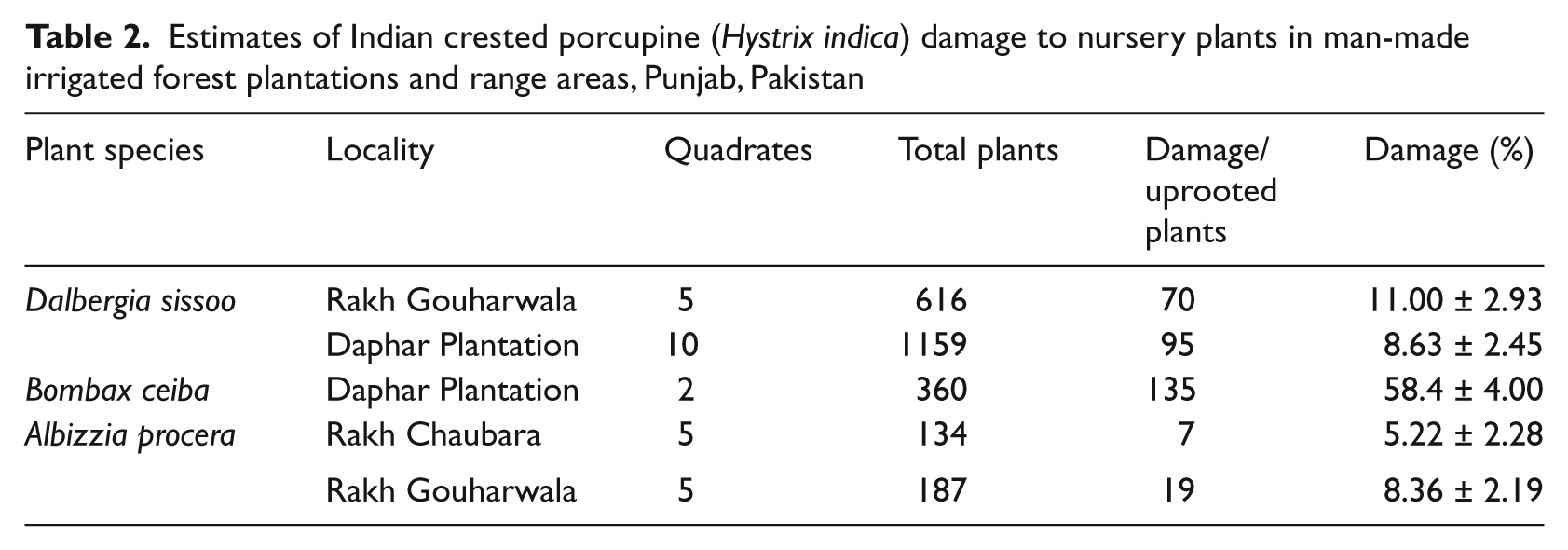
The damage to the nursery plots of D. sissoo (Table 2) was around 11.00 ± 2.93% in Rakh Gouharwala and 8.63 ± 2.45% in the Daphar plantations. Data collected on the Simal (B. ceiba) nursery in the Daphar plantations revealed very heavy damage (58.4 ± 4.00%) to the nursery plantation. In Rakh Gouharwala the damage to A. porcera was 8.36 ± 2.19% and 5.22 ± 2.28% in Rakh Chobara. It appeared that both A. porcera and D. sissoo were equally susceptible to porcupine damage. According to Mian et al. (2007), porcupine attack B. ceiba’s woody stem when it starts to develop in the plantation. The younger plantations do not attract the porcupine; while the older trees, with fleshy roots and woody stems, are more vulnerable to the damage. Ahmad and Chaudhry (1977) reported that in a 4 ha, six-months old D. sissoo nursery at Kundian, only 25% of plants escaped porcupine damage. Porcupine damage has become a limiting factor in raising D. sissoo and B. ceiba nurseries in Jhang where only 11% of living plants could be recorded in a mixed nursery of the two affected species. Greaves and Khan (1978) observed the same type of damage to seedlings. During the survey the Forest Officer of Chichawanti reported that damage to M. azedarach nurseries was 100% and 75% in 1972 and 1973, respectively. Reports from India indicate that 30% of Neem seedlings (Azadirachta indica) and 12% of Eucalyptus spp. were damaged by cutting the plants at 5–7 cm above the ground level in the Aravelli hills near Jodhpur.
Estimates of Indian crested porcupine (Hystrix indica) damage to nursery plants in man-made irrigated forest plantations and range areas, Punjab, Pakistan
Ahmad and Chaudhry (1977) reported that in scrub forests Agave spp. was completely wiped out, while A. modesta was quite safe. Also, newly planted D. sissoo stumps were usually pulled. Nawaz and Ahmad (1974) reported uprooting of 4700 B. ceiba plants from two compartments (31 ha) at Changa Manga plantation. Damage to suckers of date palm (P. dactylifera) by uprooting is also very serious in Punjab and Balochistan. One of the farmers (Dr Jasra per. comm.) reported the loss of 500 suckers (100% damage) within a month on a farm near Bhakhar.
Damage to Trees
The data on debarking of mature irrigated plantation (Table 3) showed that M. alba, D. sissoo and E. camaldulensis are the most susceptible to porcupine damage, while P. deltodes and T. aphylla are not attacked by this rodent. Higher debarking (15.35 ± 2.10%) in areas significantly infested by the porcupine was observed in Eucalyptus camaldulensis. This is quite contrary to previous reports which indicated a complete absence of damage to Eucalyptus in Pakistan (Khan et al., 2000; Mian et al., 2007). This indicates a natural phenomenon; moreover exotic Eucalyptus spp. have started adopting the ecosystem of the area, and local pests/parasites have started attacking these too. This trend is expected to increase with the passage of time. There has been virtually no debarking of T. aphylla in Rakh Gouharwala. There is no explanation for the complete immunity of the Tamarix to porcupine attack.
Estimates of Indian crested porcupine (Hystrix indica) damage to trees in man-made irrigated forest plantations and range areas, Punjab, Pakistan
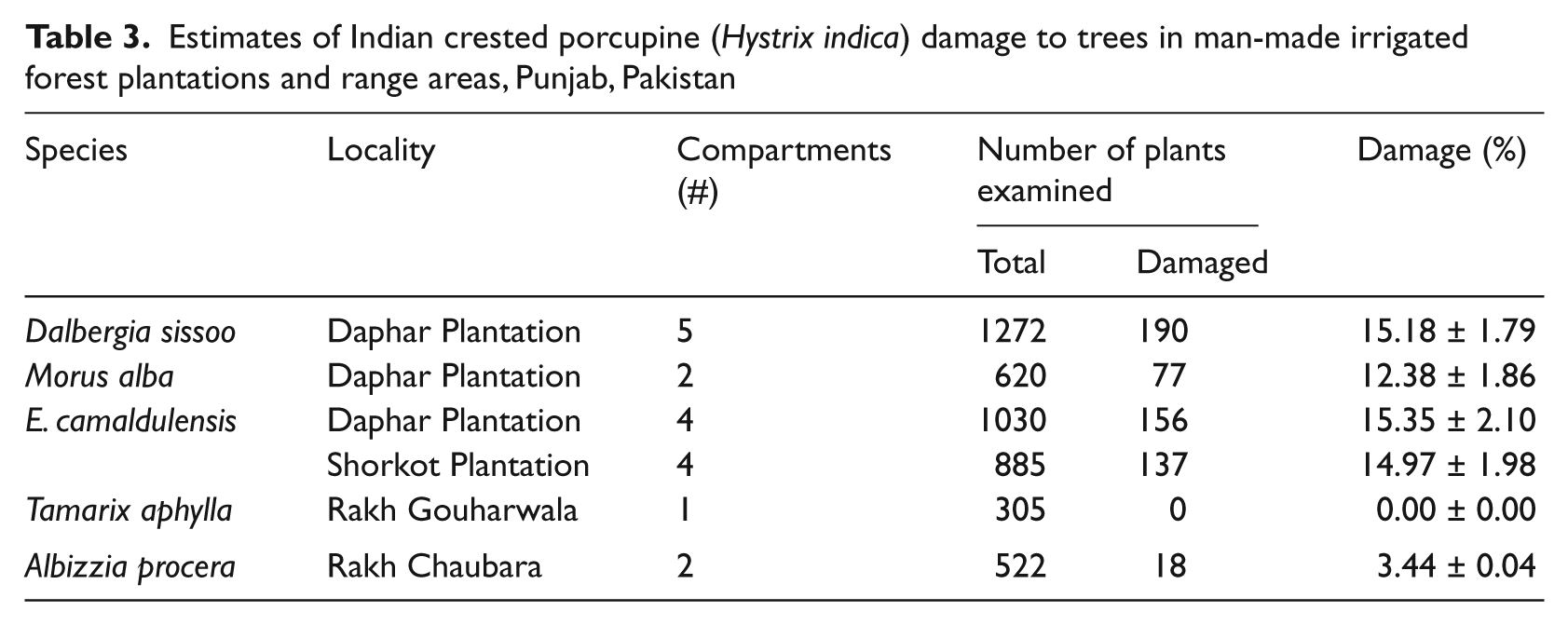
E. camaldulensis faced the highest damage (15.35 ± 2.10%) in Daphar plantation followed by D. sissoo (15.18 ± 1.79) and M. alba (12.38 ± 1.86%). Shorkot plantation faced the damage of E. camaldulensis (14.97 ± 1.98%) and Rakh Chaubara plantation showed damage to A. procera (3.44±0.04%). P. deltoides showed almost no damage by porcupine attack. The damage in most cases was in the form of the debarking of the lower parts of the trees, up to a height of 25 cm. Sometimes it results in complete girdling.
General observation suggests that dead bark of tree is not favored by porcupines. They just peel off the bark in order to access the inner part, that is, the cortex, xylem and phloem. The characteristic signs on the inner bark appear as scratching/engravings which are prominent through the collective efforts of both upper and lower incisors. However, in the case of tree stock (< one year in age) and mature nurseries of D. sissoo, there is a complete cutting of the parts above ground at an angle of 45°, which is a characteristic sign of porcupine damage. Eglitis and Hennon (1987) observed that Sitka spruce (33% damage) appeared to be preferred over western hemlock (15% damage) by E. dorsatum (North American Porcupine), as a host tree in conifer stands in southeast Alaska. Similarly, Woods and Zeglen (2003) reported E. dorsatum damage to Sitka spruce (80% damage) forests of north-costal British Columbia, Canada. In Kundian, D. sissoo was preferred over E. camaldulensis and the reverse preference is observed in Bhakhar plantation. In AJ&K, Ahmad (1990) observed that P. roxburghii and M. azedarach were the most preferred trees while Ailanthus altissima and R. pseudoacacia were the least preferred ones in terms of porcupine damage. In India, porcupine preference for coconut palms (46% damage) was significant to Agave americana (15–30%) and Caryota urens (15–20%) in Dakshina in the Kannada region of Karnataka (Girish et al., 2005). The debarking activity varied within young palms (< 5 years) and old palms (> 30 years), with young palms receiving more damage than the old ones.
Footnotes
Acknowledgements
We thank the Divisional and Range Forest Officers and their local staff for the use of their facilities made during these surveys of plantations. Our sincere thanks to Abdul Aziz Khan, Ex Senior director (Plant protection), Pakistan Agriculture Research Council; without his keen interest and positive criticisms we would not have been able to complete this work.