




Abstract
This study examines the use of the Internet and computer-mediated communication for Christian worship in Nigeria. The seven largest and fastest growing churches in Nigeria are selected for the study, highlighting the benefits and dangers associated with online worship. The utilization of the Internet to disseminate the Christian message and attract membership across the world, and the dissemination of religious tenets and fellowship online, have resulted in the emergence of the ‘Internet church’ for members who worship online in addition to belonging to a local church. Most interesting is the increasing widespread claim of spiritual experience or ‘miracles’ through digital worship. However, there is fear that online worship endangers the offline house fellowship system, which is viewed as the reproductive organ of the local offline church. Exclusive online worshippers are also said to be susceptible to deception and divided loyalty.
Keywords
Introduction
Most of the world’s religions are currently practised on the Internet, thus making religion and spirituality in the context of computer-mediated communication (CMC) more flexible for worshipping God and reaching more people. By enabling virtual communities, the Internet has the advantage of increasing access to new people, weakening geographical barriers, and providing access to information, which otherwise would have been impossible (Garton and Wellman, 1995). This has enabled adherents of different religions around the world to sustain connections to distant homeland communities and traditions (Helland, 2007). In Nigeria, Pentecostal and Charismatic churches are taking advantage of the new media technologies to disseminate their message and attract and mobilize membership across the world. Nigerian Christians in Diaspora are also connected to their homeland churches through the Internet, while new forms of religious practices and networks are increasingly prevalent. Not only does the Internet provide opportunity for disseminating religious tenets and fellowship, there is the increasing prevalence of the ‘Internet church’ or ‘Internet worshippers’ for members who worship online in addition to belonging to an offline local church. This new cyber culture has meant adopting the Internet and CMC with some notable degree of success never witnessed before in the history of Pentecostal religion in Nigeria. Most interesting is the increasing widespread claim of spiritual experience and ‘miracles’ that have been recognized by the practitioners as proof that God has indeed gone online.
Nigeria has been noted as a leading religious nation with about 91% of the population attending offline religious services and 95% praying regularly (British Broadcasting Corporation [BBC], 2004; Chiluwa 2008; Emenyonu, 2007). Christianity, fairly predominant in the south, and Islam, in the north, are the main religions accounting for about 93% of the entire Nigerian population (Mandryk and Johnstone, 2001). Online churches as the extension of the physical offline ones now provide an alternative for worshippers who may decide to stay at home and worship online.
This study is a contribution to the growing research on the relationship between religion and new media communication and supports the view that society shapes technology and, in the context of CMC, that spirituality can also shape technology (Campbell, 2005). This view opposes the secularization theory and argues that religious institutions and churches have indeed used information technology and the new media to initiate and enhance religious worships and practices. The study examines the online activities of the seven largest and fastest growing Pentecostal/Charismatic churches in Nigeria. These churches constitute about 65% of regular Christians (Mandryk and Johnstone, 2001). They are:
The Redeemed Christian Church of God (RCCG)
Deeper Life Bible Church (DLBC)
Living Faith Church Worldwide (LFC; aka Winners Chapel)
Christ Embassy (CEmb; aka Love World)
Mountain of Fire Ministries (MFM)
Sword of the Spirit Ministries Intl (SSM)
Church of God International (CGI)
These interdenominational churches believe in being ‘filled’ with the Holy Spirit and speaking in unknown tongues. They are often referred to as ‘Charismatic’ largely due to their belief in and claim of supernatural healings and miracles by praying in the name of Jesus Christ. One such ‘testimony’ obtained from the website of Deeper Life Bible Church, for example, is reproduced here:
T. C. 30 years old man from BURUNDI had his right leg swollen because of an accident. But, while he was being rushed to the hospital he decided to attend the Great Transformation Crusade and when Pastor Kumuyi prayed the ‘balloon‘ leg became normal. (Deeper Christian Life Ministry, n.d.)
These churches whose critics refer to as ‘modern’ or ‘I feel alright churches’ have been selected for this study for the following reasons: (1) they have membership and branches/parishes in all 36 states of Nigeria and in most African countries; (2) they have branches and worship centres across the world; (3) all seven churches have a large online membership in Africa, Europe, Asia and America, with evidences of members who worship primarily online as a result of non-access to a local assembly; (4) they have standard websites/WebTV where online publications and activities such as revivals, Bible studies, anointing services, healing school, feet-washing etcetera are promoted; and (5) all seven churches have independent world-class satellite facilities and modern media centres where activities are transmitted via satellite to members across the world. This paper attempts to provide answers to the following questions:
How have these churches used cyberspace and what have been the results?
What new forms of religious practices are performed by the churches’ virtual communities?
What promise or challenge does the spread of online churches and reported miracles pose to the church and the general public?
What is the future of the church in Nigeria with the application of new media technologies?
Online Religion and Religion Online
‘Online religion’ and ‘religion online’ are used interchangeably in this study using Helland’s terminologies. On the one hand, the former, according to Christopher Helland (2007), developed as people and institutions began to take advantage of the interactive elements of the Internet and cyberspace. Religion online, on the other hand, which he associates with the Roman Catholic Church, is non-interactive and, if at all, stops at the level of hierarchical interaction mode – a one-way website construction patterned after a one-to-many of the other broadcast media. The Nigerian Pentecostals construct their websites within a structure that combines both elements of interactive forum and non-interactive presentation of church programmes and activities. The latter comprises normal church services, sermons and other leadership-based functions like ‘anointing services’, ‘healing school’ or ‘communion services’. All of these make up what is known as ‘Internet spiritual worship’ in Nigeria.
These activities are to ensure that virtual participation is not lacking in terms of meeting the spiritual needs of worshippers. Hence online worship easily supplements real life church attendance. Second, it re-enforces religious authority contrary to fears that virtual worship endangers religious authority and control (Campbell, 2007). By making online worship a one-to-many direction, pastors and overseers of these churches simply transmit church programmes which are received and performed incontestably by members and non-members alike. Significantly, interactive forums are not widespread, and where they exist, are provided only for members to return feedback in the form of prayer requests, counselling and testimonies. Since the churches’ websites are mainly text based, they do not yet provide online chats, or video supported interactions. Hence discussion or debate forums where individuals may discuss personal feelings and beliefs, questions, complaints and religious-based ideologies are generally not available. This implies that the non-interactive mode attributed to the Catholic Church also applies to Protestant churches. This is similar to Kenshin Fukamizu’s findings in his article ‘Internet Use among Religious Followers: Religious Postmodernism in Japanese Buddhism’ (2007). According to the study, only a few sites have the possibility of dialogic interaction which is why religious use of the Internet is very low in Japan compared to the United States (Fukamizu, 2007). Akira Kawabata and Takanori Tamura (2007) attribute this low use of the Internet for religion in Japan to demographic reasons rather than the interactive profiles of the websites. According to the study, Japanese believers are much more likely to be older than the American adherents of religion, thus may have a low attitude towards the Internet. These studies believe that online interactive religion is much more likely to meet the needs of worshippers.
Interestingly, Mitsuharu Watanabe’s (2007) study of ‘Conflict and Intolerance in a Web Community: Effects of a System Integrating Dialogues and Monologues’ argues that a monologue system might always exist and in fact be preferred. He compares the users of the bulletin board system (interactive) and those of the weblog system (monological), and concludes that there is a sudden shift from the interactive and dialogical to the weblog (or blog) because those that subscribe to the bulletin board system encounter serious difficulties while trying to engage in religious dialogue online, because worshippers generally tend to be intolerant of other people’s views in matters of spirituality, religious tradition and institution. This also explains why the Nigerian churches under focus subscribe to the non-interactive system. There is the fear that a forum for debate on spirituality would engender a ‘holier than thou’ attitude and may result in conflict and confusion, especially as matters of divine worship are perceived as beyond human reasoning.
Theoretical Framework: Secularism versus Religion on the Internet
The works of Karl Marx and Max Weber emphasized the relationship between religion and the economic or social structure of society. In contemporary times, debates on the roles of religion have continued and centred on issues such as secularization, and the relevance of religion in the context of globalization and multiculturalism. The secularization thesis refers to the belief that as societies ‘progress’, particularly through modernization and rationalization, religion loses its authority in all aspects of social life and governance (Berger, 1967, cited in O’Neil, 2004; Wikipedia, n.d.d, n.d.e, n.d.f, n.d.g, n.d.i, n.d.m, n.d.n). From the earlier works by Marx and Weber, religion is viewed as undermined by intellectual and scientific developments and one can infer from aspects of Marx’s and Weber’s thoughts on religion to posit that religion will eventually become socially irrelevant and culturally extinct as modernization and secular thinking become increasingly prevalent around the world (Armfield and Holbert, 2003; McGrath, 2004; Norris and Inglechart, 2004).
Karl Marx had viewed religion as an expression of material realities and economic injustice. Thus religion has no independent relevance and is one social institution that depends solely on the material and economic conditions of a given society. Religious problems are, therefore, viewed as essentially social problems. And since religion itself depends on what social purpose it serves and not the content of its beliefs, religious doctrines become irrelevant and used by oppressors to make people feel better about the distress they experience due to exploitation (Cline, 2001). Religion thus becomes an ‘opium of the people’. Marx’s opinion was that religion is an illusion that provides reasons and excuses to keep society functioning just as it is. Much as capitalism takes the productive labour of the exploited worker and alienates him from its value, religion takes the worker’s highest ideals and aspirations and alienates him from them, projecting them onto an alien and unknowable being called God.
In his Contribution to the Critique of Hegel’s Philosophy of Right: Introduction (1844), Marx contends that religion is meant to create illusory fantasies for the poor. Economic realities prevent them from finding true happiness in their present life, so religion assures them of true happiness in the afterlife. People are in distress and religion does provide solace, just as people who are physically injured receive relief from opiate-based drugs. Unfortunately, opiates do not provide healing for an injury, rather a temporary relief from the pain and suffering. Similarly, religion does not heal the underlying causes of people’s pain and suffering; instead, it helps them forget why they are suffering and causes them to look forward to an imaginary future when the pain will cease instead of working to change the present circumstances. To make matters worse, this opium is being administered by the oppressors who are responsible for the pain and suffering.
Marx argued that opium and religion could actually be said to be contributing to human suffering by removing the impetus to do whatever is necessary to overcome it which, for Marx, is to relinquish religion and turn to revolutionary politics (Udis-Kessler, 2001). The description of religion as ‘the heart of a heartless world,’ thus becomes a critique not only of religion but also of the world as it exists. What this shows is that Marx’s consideration of religion, politics, economics and society as a whole was not merely a philosophical exercise, but an active attempt to change the world, to help it find a new heart (Thompson, 2011).
While Karl Marx provides an account in which religion is viewed as a mere social opiate and agent of social control, Max Weber offers a different argument, one in which religion is considered as an independent variable and can in some instances be a source of social change. In his work The Protestant Ethic and the Spirit of Capitalism (1958), Weber argues that religion (specifically Calvinism) helps to define motivation and actually promoted the rise of modern capitalism. In The Protestant Ethic, Weber argued that capitalism arose in Europe in part because of how the belief in predestination was interpreted by the English ‘Puritans’. Puritan theology was based on the Calvinist notion that not everyone would be saved; there was only a specific number of the elect who would avoid damnation, and this was based on God’s predetermined will and not by any individual’s personal actions. Official doctrine maintained that one could not really know whether one was among the elect.
Weber noted that this was psychologically problematic because people were anxious to know whether they would be eternally damned or not. Thus Puritan leaders began assuring members that, if they began doing well financially in their businesses, this would be one unofficial sign they had God’s approval and were among the saved (McKinnon, 2010). This along with the rationalism implied by monotheism led to the development of rational bookkeeping and the calculated pursuit of financial success beyond what one needed simply to live – and this is the ‘spirit of capitalism’ (McKinnon, 2010). Over time, the habits associated with the spirit of capitalism lost their religious significance, and rational pursuit of profit became its own aim. In sum, Weber’s sociology of religion is notable for its claims that religion can be a source of social change, as opposed to Marx’s position that it is a reflection of material causes of change or a source of capitalist oppression (Wikpedia n.d.a, n.d.c, n.d.j, n.d.k, n.d.l, n.d.p).
Emile Durkheim, another renowned sociologist, whose pioneering theory of religion was influenced by his view of society as ‘accumulated body of facts’ that operates on a set of laws, argued that religion was a mere expression of social cohesion. In his The Elementary Forms of Religious Life (1912) he contended that the totems the aborigines (of indigenous Australia) worshipped were actually expressions of their own conceptions of society itself. He argued that this was true not only for the aborigines, but for all societies. Therefore religion is not ‘imaginary’, it is very real as an expression of society itself and, indeed, there is no society that does not have a religion. In Durkheim’s view, we perceive as individuals a force greater than ourselves, which is our social life, and give that perception a supernatural face. We then express ourselves religiously in groups, which for Durkheim makes the symbolic power greater. Thus religion becomes an expression of our collective consciousness, which is the fusion of all of our individual consciousnesses, and then creates a reality of its own (Oakley, 2005).
It follows, therefore, that less complex societies, such as the Australian aborigines, have less complex religious systems, involving totems associated with particular clans. The more complex the society, the more complex the religious system. As societies come in contact with other societies, there is a tendency for religious systems to emphasize universalism to a greater and greater extent. Durkheim’s functional definition of religion identified a church comprising a unified system of beliefs and practices relative to sacred things, beliefs and practices, which unite into one single ‘moral community’ called a church, comprising all those who adhere to them. This functional definition of religion explains what religion does in social life: essentially, it unites societies (Wikipedia n.d.b, n.d.h, n.d.o, n.d.q, n.d.r).
As already highlighted, the secularization argument actually developed from these earlier theories (discussed earlier) based on the belief that religion and modernism are incompatible because, as traditional people become more and more educated and conversant with science and technology, more empirical explanations for existence would make religious belief unnecessary. Also, as other forms of social authority (e.g. education) begin to confront religion, they would eventually replace religious authority and religious leaders would lose their power to use religious doctrines and practices to control the lives of people and the course of events in society. Greg Armfield and Lance Holbert (2003), for instance, have argued that the more religious an individual is, the less he is likely to use the Internet and since the Internet embodies the secular world view, religious persons are less likely to use it. In Nigeria, however, not only is religion flourishing, churches are using the modern technology of computers and Internet to enhance religiosity and religious practices. There is extensive literature, some of which are discussed below, that have established that in fact the more religious a person is the more s/he uses the Internet. As a matter of fact, the new media technologies appear to have become a horse on which modern religions ride the nooks and crannies of the world.
According to time.com (n.d.), topics about God and religion account for about 1,772,945 documents, against sex with 683,645 – almost three times fewer than the former. And according to Christopher Helland (2005, 2007), a Yahoo directory for ‘Religion and Spiritual Beliefs’ showed that the category containing Christian websites increased by 234 sites within 24 hours in 2002, and more people used the Internet for religious purposes than they used it for commercial or business purposes (Larsen, 2004). In what is termed ‘spiritualising of the Internet’ Heidi Campbell (2005) shows why and how common discourses and narratives employed by worshippers are suitable for religious purposes. The study argues that religion indeed shapes technology because social groups may employ a particular technology uniquely in order to maintain or reinforce certain patterns of life. Contrary to the postulations of the secularization theory, Randolph Kluver and Pauline Cheong (2007) similarly argue that various religious communities in Singapore have embraced the Internet as a functional strategy for growth, social mobilization and recruitment. Religious leaders in Singapore, according to the study, had enthusiastically supported information technology since they believed this would ‘exacerbate the stress points between religions’, since religious conflict was a key concern to the government.
Helland (2007) shows that some Jewish, Hindu and Muslim worshippers have successfully used the Internet to develop virtual pilgrimages, visit important temples and religious sites. Members also engage in dialogue with one another using chat rooms, hyperlinks, and multimedia to advance Hindu Diaspora communities. Furthermore, Campbell (2005) stresses that individuals use the Internet for personal spiritual enhancement, the Internet being a sacred or spiritual space for a variety of religious experiences on individuals’ own terms and in the privacy and comfort of their homes. Spiritual networks are formed which include forming social structures to support spiritual activities and creating or promoting a common belief and religious understanding. Thus using the Internet as a spiritual network interprets online activities or experiences to be part of a person’s spiritual’s life whether these pursuits are individual, communal or informational (Campbell, 2005: 54).
Heidi Campbell and Patricia Calderon (2007: 261) identify a steady growth of technologies and the practice of religion online, showing that in many aspects ‘Christian groups and users have led the way in using the web for spiritual practices’. This ranges from church websites becoming ‘a common form of congregational advertising and communication to the rise of cyber churches and online prayer meetings’ (2007: 261). This takes the form of forums, newsgroups or weblogs to invite people to take active part in practising their religion as well as perform online rituals (Miczek, 2008).
Methodology
On the appropriate methodology for studying religion on the Internet, Oliver Kruger (2005) recommends that a comprehensive study should provide answers to what is on the Internet, who put it there and for what purpose, how many people use it and how often the use of the online resources has influenced religious worship. In answering the questions of what, who, how, how often, etcetera, the approach adopted in this study is discursive while applying some personal knowledge of these institutions. Consultations and interactions were held with some personnel and members of the churches. A few interviews were also conducted when possible, while other information were obtained through email communication. In classifying computer-mediated communication (CMC), Susan Herring (2007) identifies two basic factors that shape CMD, namely: (1) medium factors (an attempt to discover under what circumstances specific systems affect communication and in what ways); and (2) situation factors (information about participants, their relationships to one another, their purposes for communicating, what they are communicating about and the kind of language they use) are also examined. The present study examines some questions that reflect Herring’s ‘situation factors’, such as information about participants (e.g. worshippers) and their relationship to one another, topics of interaction (e.g. forms of online worship), and goals of interaction. Data comprises mainly online resources; that is, written texts showing features and uses of the websites under study as well as the activities of the churches.
The special events and programmes of these churches, as shown in Table 1, are in the form of weekly radio/TV programmes (e.g. CEmb.) or as monthly activities (e.g. MFM and RCCG) or as quarterly or yearly events (e.g. DLBC, LFC etc.). The quarterly programmes are held at the various church offline locations, which are usually different from the headquarters church. RCCG, DLBC and MFM, for instance, have their camp sites known as ‘Redeemed Camp’, ‘Deeperlife Camp Ground’, and ‘Prayer City’ respectively at the Lagos/Ibadan expressway, on the outskirt of Lagos, whereas their headquarters are at Ebute-Metta, Gbagada and Onike-Yaba, all in Lagos. The ‘Faith Tabernacle’ (Headquarters) of the Winners Chapel at Ota was quoted by the Guinness Book of Records (2009) as the largest church building in the world.
An overview of the churches. A general overview that provides the age, location, numerical size affiliation and other information of the churches

Key: RCCG: Redeemed Christian Church of God; DLBC: Deeper Life Bible Church; LFC: Living Faith Church; CEmb: Christ Embassy; MFM: Mountain of Fire and Miracles; SSM: Sword of the Spirit Ministries; CGI: Church of God International.
The size of each local church, as shown in Table 1, is conservatively put being numbers quoted inconsistently as at 2005 for some (e.g. DLBC) and 2011 for others (e.g. LFC). Some annual events of some of these churches have also attracted between 500,000 and three million participants. This not only indicates that Nigeria is a highly religious nation, but also suggests that religion holds a special meaning for the Nigerian population. It also goes further to indicate that religion may be expressing collective consciousness but, much more, it possesses great potential to unite a people, going by Emile Durkheim’s postulation. In Nigeria, however, the situation appears a bit complex and ironical because, despite large crowds in churches and mosques, the country is still being torn apart by sectarian crises, some of which are religiously motivated. The recent and incessant Jos crisis that has claimed hundreds of lives is a good example. One wonders if indeed religion unites people as Durkheim postulated.
Significantly, in the last seven years, five out of the seven fastest-growing and richest Nigerian churches have established universities in Nigeria. The universities are: (1) Covenant University, Ota and Landmark University, Omu-Aran (by LFC); (2) Benson Idahosa University, Benin city (by CGI); (3) Redeemers University, Mowe (by RCCG); (4) Mountain Top University, Mowe (by MFM); and (5) Anchor University (by DLBC), which is expected to open in 2011. Interestingly, the wealth and fervour of material investments by these modern churches tend to validate Weber’s concept of the ‘spirit of capitalism’ that champions especially the establishment of fee-paying universities. While the spirit of capitalism may not have lost its religious significance to rational pursuit of profit making in these churches, Weber’s claim that religion can foster social change (and development) is unmistakable. Not only do the Christian-based foundations and universities founded by these churches offer scholarships to some of their less-privileged members, their health centres also offer free medical services to some of their members. This development negates Marx’s argument that religion is a mere source of capitalist oppression. Rather, Weber’s observation that religious Puritans equated material prosperity with salvation is almost true of some of these churches, especially the LFC, where the general assumption is that a Christian has no business being poor. One main proof of God’s approval of an individual is that he/she prospers materially. Thus the pursuit of money and material wealth in these modern churches is almost more important than spirituality itself.
Visits to the Church Sites
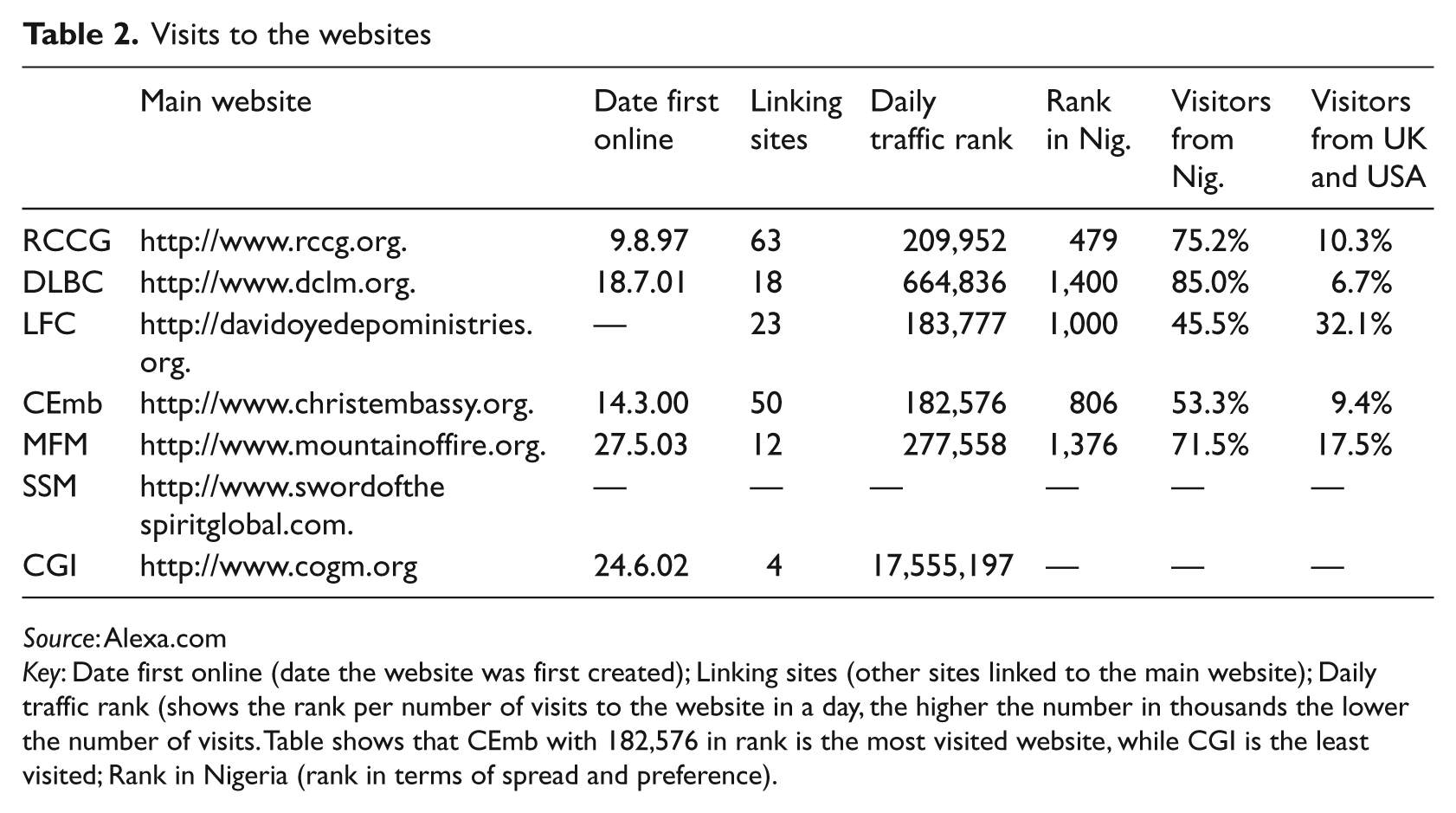
Alexa.com (n.d.) documents the number of visits to the churches’ websites from all over the globe per day, per seven days and per three months. Because the figures are updated daily, it becomes difficult to give the exact number of visits and traffic rank trends. The statistics given in Table 2, compiled in January 2010, give a general convenient picture of the subscription to the websites. Some demographic information (given in Alexa.com), shows that the highest group of visitors (Nigerian and non-Nigerian) to these websites are men and women from between the ages of 35 and 44; the next highest group are youths aged 18–24.
Visits to the websites
Source: Alexa.com
Key: Date first online (date the website was first created); Linking sites (other sites linked to the main website); Daily traffic rank (shows the rank per number of visits to the website in a day, the higher the number in thousands the lower the number of visits. Table shows that CEmb with 182,576 in rank is the most visited website, while CGI is the least visited; Rank in Nigeria (rank in terms of spread and preference).
Activities on the Websites
The different programmes and activities of these churches are reflected in the design of the websites. While all the websites display menus like ‘home’, ‘about us’, ‘news/events’, ‘contact us’, etcetera, some include special page icons such as ‘join us’, ‘need help’, ‘come to Christ’, ‘blogs’, ‘pay your tithes’, etcetera (SSM). ‘Forum’, also known as ‘RCCG Internet Outreach’ of the Redeemed Church, for instance, is a site where members are said to be encouraged to ‘discuss relevant topics of major events’. Members are, however, warned to ensure that their contributions are ‘seasoned with salt’. That is, they are not to be highly critical of the church or its leadership or make derogatory comments about church members. This does not, however, explain whether opposing views or criticisms are tolerated at all. In contrast, the ‘ask Pastor Chris’ forum of the Christ Embassy encourages members to ask questions or pass comments on any Bible topic that they need answers for. They may also share their experiences with the church. This approach appears more liberal than all the others. Interestingly the ‘criticisms and persecutions’ link of the church (i.e. CEmb) lists comments and criticisms by the media and individuals about the miracles and healing practices of the church and the analyses of these criticisms. For instance in its ‘criticisms and persecution’ link, it was reported that ‘a Sowetan newspaper created and published laughable fabrications claiming Pastor Chris paid people to pretend they were sick and receive healing at the healing school and ministry programmes’ (Christ Embassy International, n.d.). In the analysis that followed, the writer claimed that such comments were false and were in fact ‘persecutions’, which are part of the experiences of Christ and should be expected by all Christians.
Significantly the RCCG and LFC operate online offerings. This is similar to Elena Larsen’s (2004) findings, showing that about 7% of American online worshippers contribute to relief charities online. In the Nigerian context, however, electronic payment of tithes (one-tenth of gross income), is not common. Where they exist (e.g. LFC), it makes it easier for members to donate money to the headquarters church in Nigeria using credit cards. Material offerings to local churches are stressed as a very important and compulsory aspect of religious worship. In Weber’s views, religion consists of morality, customs, values and traditions which enable a society to worship itself. Going by this argument, offering to a church would form part of the essence of society’s service to itself and is not ultimately a form of exploitation or oppression as Karl Marx would contend. In Nigeria, tithes and offerings are believed to be an essential commandment of God, and not a service to man or the local church.
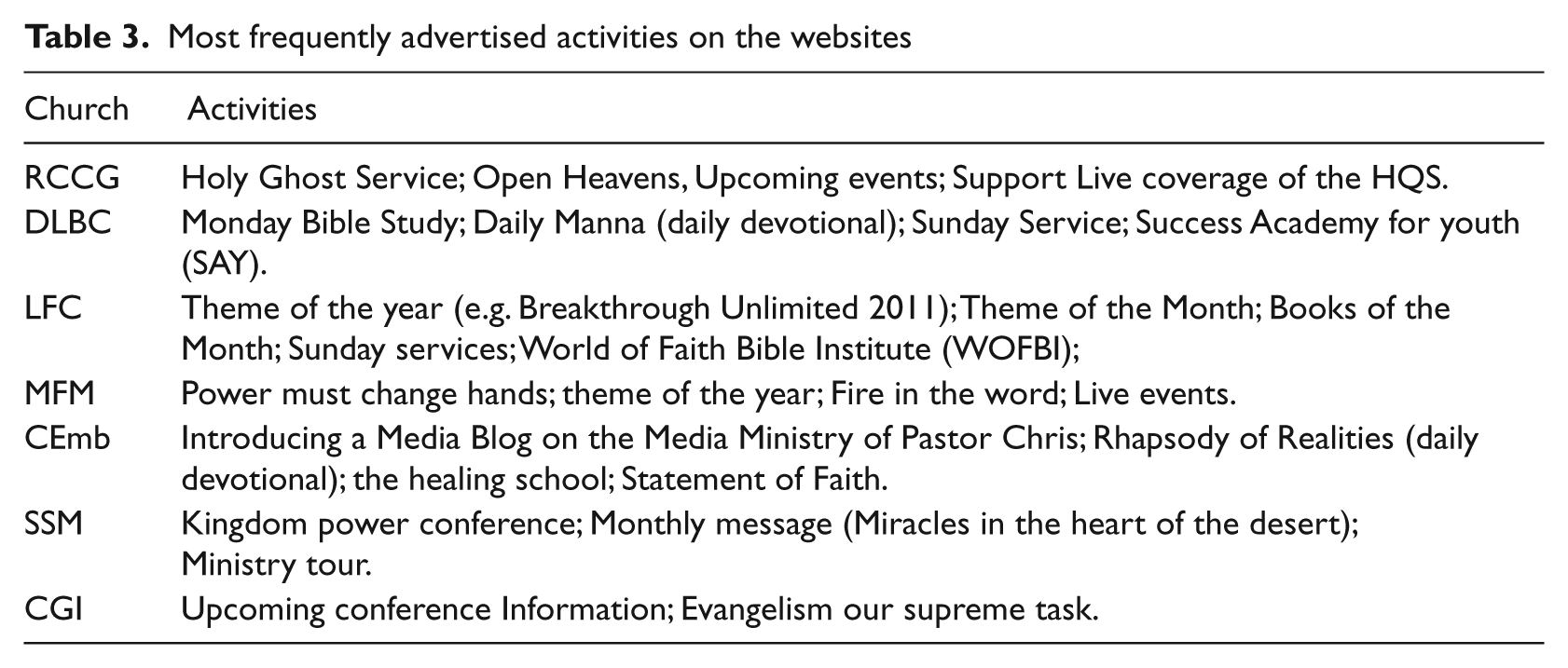
In the Pentecostal/Charismatic tradition, many church activities are not fixed. Most of the activities are said to emerge as the Holy Spirit leads, so different activities are advertised and subsequently practised on the websites from time to time. However, certain fixed programmes are observed to occur frequently on the websites, especially those held on a monthly, quarterly and yearly basis. Some of the programmes are often modified and featured as new titles. Table 3 shows the most frequently advertised activities on the websites.
Most frequently advertised activities on the websites
Advertised information on the websites is simply meant to create public and global awareness of the teachings, orientation, and activities of the particular church. Church services and conferences often include activities such as ‘holy communion’, ‘healing and miracle services’, ‘feet-washing services’, ‘anointing services’, etcetera. An online worshipper only needs to provide the items needed for these services such as wine, oil, bread, and follow the instructions of the pastor as the activities progress. Anointing services also demand that an online worshipper have his oil with him as he watches the service on the screen. He follows the instructions of the officiating minister and anoints himself. In some cases handkerchiefs are anointed and kept as ‘prophetic mantles’ which the worshipper can put on himself or send to the sick at home or hospital. There have been claims of healings as these mantles are dropped on sick people. The claims of miracles and supernatural healings totally discredit the scholarly theories of Marx, Weber, and Durkheim that view religion as a mere social phenomenon, either as a mere economic and class struggle or as a contributor to social change or a mere instrument of social cohesion. The claim of miracles presupposes the existence of a sensitive and responsive supernatural being called God, contrary to the postulations of atheism.
Significantly the Internet has greatly bridged the spatial gap which once restricted spiritual worship in Nigeria to the urban areas. It is true that the rate of computer literacy among the youths and the working class is still quite low compared to western countries, but the cost of acquiring a used computer has made the Internet more accessible, and the average Nigerian is increasingly getting a fairly good education in computer and Internet operations.
Another important aspect of online worship, however, is that worshippers in a particular church are not restricted to just one system of worship provided by their churches alone. They now have a variety of worship opportunities on the Internet. While offline worship confines a worshipper to one type of ‘spiritual diet’, an online worshipper can participate in an ‘anointing service’, for example, at one church and also take part in a ‘healing service’ at another at the same time. As a matter of fact, online worship provides worshippers the option of changing churches or religions if they choose. Some Internet surfers actually go online to seek more a convenient or comfortable church or religion (Larsen, 2004), since the Internet provides the opportunity for those who wish to ‘be’ religious outside the control of an organized religion (Helland, 2004). It is also easy to download and store past messages or videos of church programmes; this saves worshippers the money they might have otherwise spent on tapes and CDs of these services. Also, the Internet now provides a forum for Nigerian preachers and pastors to collaborate and compare notes. Lastly, the Internet appears to have brought God nearer to home for online worshippers who do not have to travel long distances to get miracles and healings.
Reports of Miracles from Websites
The websites of the churches under study maintain ‘testimonies’ links where members report claims of supernatural experiences and testimonies of healing and miracles. From the website of the CEmb in particular is a defence of miraculous occurrences due to the various criticisms the church had received about certain claims of miracles. The writer blamed the ‘unbelievers’ and those that supposed that the age of miracles was past:
Testimonies and praise reports pour daily into our offices from different parts of the world, telling of the impact Pastor Chris’ ministry is having on people’s lives. We want to use this medium to thank those who call in and send their e-mails to share with us and the rest of world what God has done for them. (Christ Embassy Healing School.)
Seven of the testimonies from the RCCG and CEmb that were said to result directly from online worship are reproduced here. Testimonies posted on SSM and DLBC’s websites were not directly from Internet worship and are therefore excluded. Interestingly, some of the testimonies reproduced in this study are from both Nigerian and non-Nigerian worshippers living abroad (www.rccg.org; www.christembassy.org).
Hi pastor, it is nice writing to you, I want to give glory to God for giving you the wisdom that you share with the world; one morning I was praying with you on the screen and the pile that had been worrying me for the past three years was healed. Pastor, I have spend a lot of money on this illness, the pile was protracted outside, the doctor told me that I cannot be cured except I go on operation, but thank God today I am healed. Glory to God. Jackline Mbah from Cameroon. All glory to God the Father for making me laugh, as a matter of fact my new aka is now laughter (lol). I attended this month Holy Ghost service online as I try to do by the grace of God and all my blessings came to me right where I was in Bucharest through the Internet. Daddy G. O. said some time during the week that if we call one, millions will answer and they are really answering me now when I call. A world project of mine that was dead before has now come back to live as very soon, I will be shaking hands with leaders of the world in Jesus’ name – amen. Thank you Jesus. Amb. Adjarho David Obaroakpo – Bucharest, Romania. Well, it happened that I’ve someone very dear to me that normally attend the holy ghost services and she hasn’t seen her period for many months which is disturbing but one way or the other she couldn’t attend June holy ghost but to the glory of God her case was mentioned and I stood for her in front of my computer becos in London monitoring the holy ghost services every blessed month. So the following morning I made a phone call to her in Nigeria that daddy mentioned your case and I stood for u and believe you me that very week when I gave her a call again (Friday) she told me she has seen her period. Glory be to God in the highest who see all hidden problems and also answer our prayers according to our faith. HIS THE ONLY INCOMPARABLE GOD (Majekodumi). Am Esther Adelani, am based in California, USA. I’m thanking God for his divine healing through ministration on net, Holy Ghost congress, I’m so blessed. Dear Pastor Chris, I thank you for the healing I have received during the time we watched live the Cell Leader’s Conference. I was delivered from the oppressive powers which clouded my life and I received my divine healing. This has led to my promotion and the manifestation of happiness. The power of God has been demonstrated by casting out and declaring that every knee should bow to the word of God. Blessed be the Lord God Almighty, His Mercy Endures Forever! I thank the Lord for the divine healing I have received. Ms. Rosa N. P. Fihla. My name is Aidenoje Ehiguese, from Port Harcourt. I would like to testify to the glory of God. I was suffering from demonic oppression, I held to the word of God in Isaiah 10:27 ‘the yoke shall be destroyed by the anointing’ and I was also convinced in my spirit that I would receive a special miracle from God during the May 8th Edition of Pastor Chris online. During the Programme as Pastor Chris was praying for us, I claimed my deliverance by faith and immediately the power of God came over me. I knew I had received my miracle. Right now I am totally free. Glory to God. . . ! Greeting you in the name of Jesus. I want to be thankful to God, because two weeks ago, I WAS expecting some money, and I did not get it. But did not give up soon. I was keep praying for that. And I watch Pastor Chris online, at the end of the session he prays for us. He release the financial blessings, and I receive it. And at the end of the week, I received what I was waiting for by the grace of God. Thank you Pastor Chris for the teaching. Kozy.
As already pointed out, important positions of Marx, Weber and Durkheim denied the existence of a God who is capable of involvement in human affairs. But the above claims suggest that there could be a God who responds to human worship. Contrary to Durkheim’s argument that religion is at its best society worshipping itself, religion to the Nigerian worshippers transcends the social and can result in some kind of supernatural experience. Spiritual worship in the contexts of these Nigerian Charismatic Christians appears to involve a credible interaction between man and a supernatural God.
Interestingly, all the healings and miracles reported earlier were attributed to online worship and linked with either ‘praying . . . on the screen’, ‘attending. . . Holy Ghost service online’, ‘stood. . . in front of my computer’, or ‘through ministration on net’. These ‘testimonies’ simply reveal the new forms of christian practice and the manner in which Internet technology and cyberspace are being spiritualized in Nigeria. According to Campbell (2005) the Internet becomes ‘a sacred space’ for a variety of religious experiences.
Worries, Fears and Challenges of Online Worship
As this new form of worship euphoria becomes increasingly widespread there are, however, worries on the minds of some of the church leaders. First, while there is no doubt that Internet worship has contributed to the growth of Nigerian Pentecostal Christianity in recent times, the House Caring Fellowship (HCF), viewed as a reproductive organ of the local church, is endangered. The house or ‘cell’ fellowship is a home-based gathering where church members meet in smaller groups in members’ homes. The DLBC, for instance, began this system as far back as the early 1980s and the church’s subsequent astronomical membership growth was attributed to its vibrant HCF. Since the Nigerian churches are so large, it is often difficult to meet the needs of members on a personal level, hence, the cell fellowship enables the leadership to respond appropriately to membership needs. So, in most of the churches, membership of the cell fellowship is mandatory. In the LFC, for example, active participation in the HCF, also known as ‘Winners Satellite Fellowship’ (WSF), is a condition for welfare benefits. The regular welfare provisions (e.g. college scholarships, food, clothing, soft loans, etc.) made to members are administered at the WSF; members who do not participate in such fellowship are not eligible to benefit. Again, the fact that modern church leadership is sensitive to the material needs of its members, and has deliberately put certain mechanisms in place to meet these needs, proves that religion is not all about the capitalist interest of the church as an institution. Karl Marx had argued that religion always served the interest of those in control (the oppressors) and church leaders were accused of being hypocritical because the Christian church merged with the oppressive Roman state, taking part in the enslavement of people for centuries. In the middle ages the Catholic Church preached heaven, but acquired as much property and power as possible (Cline, 2001).
Secondly, the online worship encourages the ‘secret discipleship’ phenomenon where active believers do not identify with a particular local church. This trend is viewed as endangering the services and contributions of such members. The ‘secret disciple’ also denies himself of the love of the leaders and members of the church.
There is also the fear that some members might be deceived by ‘false prophets’ and ‘false teachings’ resulting from random online worship. Since the Internet church is mobile, flexible, and constantly uncontrolled, new forms of religious practices are posted daily online and worshippers are said to be in danger of being deceived. It is also possible that some ‘weak’ Christians might be converted to other religions via the Internet. Unfortunately, church leaders do not possess any readily available mechanisms to control this.
Future of Nigerian Churches with the Internet/ CMC Technologies
As noted, the advantages of online worship appear to outweigh its disadvantages, especially in that it attracts a global audience. Most of the testimonies reported here are from Nigerians and non-Nigerians alike, thereby alerting pastors to the possibilities of online worship. There is a general excitement about the reports of miracles resulting from direct online worship. And it is most likely that more than 70% of all churches in Nigeria have an online presence, many with the latest CMC technologies; a good example is the Christ Embassy. Interestingly, online worship is viewed as a fulfillment of a prophecy about the Internet being a tool for serving God and reaching more people in the last days. Therefore, rather than impede the tradition of modern Christian faith in Nigeria, the Internet and CMC technologies are likely to enhance its spread. As a matter of fact, this is already in progress. Though the rate of quality education and computer literacy is still quite low, many schools – especially in the urban areas – have introduced computer education as part of their compulsory academic programmes, thus enabling Internet literacy for more children and youths.
Although churches lack a direct mechanism to control online worship, they have their methods of making the offline church more attractive to members, especially the house fellowship system. For example, many of the members are committed church workers in the local church, serving as deacons, ushers, choristers, Sunday school teachers etcetera. This makes it almost impossible for them to be physically absent in church on a Sunday morning. Most of these people also perform important functions at the cell fellowship. At the beginning, the Internet church was not intended to replace the usual offline worship. It was targeted particularly at those outside the immediate environment who lacked a local church to worship. Online worship was therefore meant to be used as a method of evangelism and not to replace the local church. With this understanding, the Internet and CMC technologies are likely to remain a functional tool to be used by the Nigerian Pentecostal churches for growth and sustenance of church work.
Conclusion
We can conclude therefore that the church in Nigeria (represented by the seven churches under study) has successfully spiritualized the Internet and CMC technologies according to Helland’s (2007) and Campbell’s (2005) arguments. Rather than secularize religious activities, new forms of worship such as anointing services, feet worshipping, Holy Ghost services, communion services and other practices are successfully practised online. With the claims of healings and miracles resulting directly from Internet worship, it is clear that certain church people have had their faith boosted and have become more committed to their churches. The claims of miracle and spiritual experiences in online worship negate the theories of Karl Marx, Max Weber and Emile Durkheim, who view religion merely from the point of view of its social functions or as a mere instrument of capitalist exploitation.
Footnotes
Acknowledgements
The preliminary version of this paper was presented at the Conference of the International Association for Media and Communication Research (IAMCR) Braga, Portugal, 18–22 July, 2010, under the media and religion working group. I thank the conference organizers. I also thank the anonymous reviewers and the editor for their kind criticisms and contributions to this paper.