




Abstract
Accepting that the Land Question was only limited to former settler colonies in Africa such as Kenya and Zimbabwe, dominant opinion in the literature has tended to trivialize the bitter struggles for land, many of which began during the colonial dispensation in many African nations. With globalization, democratization, structural adjustment and intensification of identity politics, many of these land conflicts have lingered. Yet studies of the conflicts, as in the case of Aguleri/Umuleri, have been scanty and almost ignore their historical and colonial roots. This paper explores colonial foundations of Aguleri/Umuleri conflicts, colonial policies designed to manage them and why they failed.
Introduction
Generally African land practices involve a complex bundle of rights intrinsically linked to membership of specific communities (Lentz, 2006). Among the Igbo of Southeastern Nigeria, land is seen as a spiritual force that connects the living, the dead and unborn members of a family, kinship group, clan or community. As such land belongs to primordial groups as much as the groups belong to land. Land can neither be commercialized nor privatized under traditional land practices (Uchendu, 1966). For this reason land is revered, respected and its inalienability rehashed in indigenous Igbo and African philosophies. Hence ownership, control and access to land, its abundance and scarcity evoke strong sentiments. Unsurprisingly, struggles over land have remained sources of conflicts in developing nations of Africa and the global south. Indeed, studies claim that land struggles constitute the largest single cause of ethnic and communal conflicts in both developing and even developed countries of the world (Kymlicka, 1999; Fernandes and Barbora, 2008).
Notwithstanding this, until recently the dominant opinion in the literature contends that the Land Question is peculiar to nations of Asia and Latin America with population–land densities and extensive history of land alienation and expropriation (Bassett, 1999; Council for the Development of Social Science Research in Africa [CODESRIA], 2004). The Land Question is used here to refer to contradictions, struggles, antagonisms and conflicts generated by government – colonial and post-colonial – policies on land which seek to initiate profound redefinition of pre-capitalist customary rules and regulations guiding access, control and ownership of land in order to prepare and present land for capitalist production. Except former settler colonies such as Algeria, Zimbabwe, Kenya and South Africa which had similar experiences of land alienation and expropriation from their colonial overlords, the rest of Africa, it is argued, never really had a Land Question. And where there was one outside the former settler colonies in east and southern Africa, it arose only insofar as it was connected to the Agrarian Question (Mafeje, 1999, 2003).
To suggest that the Land Question is about settler colonial land expropriation or particular generic social formations, such as feudal and semi-feudal tributary systems (CODESRIA, 2004; Moyo, 2007) and to dismiss states without these features or experiences as never having a Land Question is to undermine the ‘the contested meanings of land transfers in changing political and economic contexts’ (Lentz, 2006: 4) and growing pressures and unequal access to land among groups, communities and nations in Africa. In the context of contemporary processes of globalization, democratization, neo-liberal polices of structural adjustment, resuscitation of identity politics and citizenship struggles such as Ivorite in Cote D’Ivoire and xenophobia in South Africa, the Land Question has become a priority issue in the development and nation-building project of many a nation in Africa (Egwu, 1998; Jega, 2003). Put together, unequal access and pressures on land have promoted struggles over ownership and control of land among various groups and communities. In Nigeria this situation intensifies ethnic and communal identity politics and promotes ethnic disharmony and persistent bloody confrontation between communal groups. While many of the conflicts were inspired by the dynamics of colonial rule, many more are products of recent developments (Egwu, 1998; Otite and Albert, 1999; Jega, 2003).
This paper focuses on the protracted land conflicts between Aguleri and Umuleri communities in Anambra State of southeastern Nigeria. Published studies of the conflicts have remained scanty and devote greater attention to recent manifestations of the conflicts. This way they trivialize significant aspects of the colonial foundations of the conflicts. Or at best, they treat them defectively. Whereas recent expressions of the conflicts are examined in terms of the violation of economic, social and cultural rights of women and children in the course of establishing Nigeria’s incipient democracy, other studies simply narrate the legal tussles and court judgements emanating from the numerous litigations on the contested land (Chinwuba, 1981; Idigo, 1990; Fagbemi and Nwankwo, 2002; Imobighe, 2003). Colonial state policies that promoted such litigations and the conflicts ab initio have not been investigated. Consequently their contributions in prolonging the conflicts have also not been thoroughly interrogated.
Apart from the heavily biased accounts by local historians from the belligerent communities, nuanced and objective analysis of the contributions of European Christian missionaries and merchant companies such as the Royal Niger Company and John Holt in laying foundations of the conflict is yet to be made clearer. In all these the colonial dimension and, to a large extent, historical dynamics of the conflicts have remained vague (Onwuzuruigbo, 2009). We are yet to understand how the conflict differs from similar land conflicts in other regions of Nigeria and Africa. In this regard, Carola Lentz notes:
It is high time to inject historical depth, but also regional specificity into the debate of African land tenure. Despite many similarities, the ways in which land and power are connected, dynamics of legal pluralism, tenure reform projects and popular strategies seem to be somewhat different in different parts of the continent. (Lentz, 2006: 4)
Furthermore, ‘historical context is essential’, asserts Ashley Jackson, ‘in order to understand the nature of African war and violence’ (Jackson, 2008: 970) and ‘building a more accurate historical picture is therefore extremely important’ (Jackson, 2008: 971). Hence this paper seeks to raise and respond to these unresolved but pertinent questions. What were the colonial land policies and how did they sustain the conflict? What was the policy response of British colonial administration to the conflict?
On the strength of revelations from archival documents, the paper identifies two major policy thrusts adopted by the colonial authorities to deal with the conflicts. They include the policy of ‘unobstructive withdrawal’ and colonial land policies. Specific social and historical forces that informed the conception, design and adoption of the policies are discussed. The paper further argues that, rather than resolve the conflicts, the policies prolonged land litigations and intensified bloody encounters between the communities. The first part of the paper provides background information on the communities and their conflicts. Part two examines colonial land policies deployed in managing the conflicts. In part three, the focus shifts to the policy of ‘unobstructive withdrawal’ and its application to the conflicts. Part four provides reasons for the failure of the policies. Some conclusions are drawn in part five.
Foundations of Aguleri and Umuleri Conflicts
With the abolition of trade in human beings in the 19th century, Britain encouraged trade in articles and agricultural produce in its colonial possessions. Subsequently the British crown empowered the Royal Niger Company ‘to administer, make treatise, levy customs and trade in all territories in the basin of the Niger and its affluents’ (Coleman, 1986: 41). The company moved into Otuocha, a settlement inhabited and owned by Aguleri and Umuleri communities. Otuocha, at the time, was a rustic settlement located on the banks of River Anambra, a tributary of the River Niger. In pursuance of its mandate, the Royal Niger Company acquired land, established trading outposts and promoted trade, especially trade in palm produce (Idigo, 1990). European interest in palm produce was reinforced by the revolution of the soap industry in Europe. Tallow was the main fat used in the production of soap. However, to produce good lather the fat needed to be blended with palm oil which could only be extracted from a breed of palm tree, eloesis guineensis, growing abundantly in Igbo land and the Niger Delta region (Flint, 1960). These developments had severe implications for Otuocha.
First, Otuocha became a commercial entrepôt and gateway into neighbouring Igbo hinterland communities. The growth of trade and commerce drew the interest of other European trading companies such as British John Holt and French Campaigne Française de L’Afrique Occidentale. They too established trading posts in Otuocha for the purposes of participating in the booming trade in palm produce (Idigo, 1990). Next were European missionary organizations, the Roman Catholic Church (RCM) and the Church Missionary Society (CMS), who set up bases in Otuocha in order to penetrate communities and settlements in the Anambra River basin and beyond (Idigo, 1990). Unlike the trading companies, the missionaries were interested in Christianizing and educating the mainly illiterate native population.
Second, fundamental transformation of physical structure and population of Otuocha was initiated through the agency of European merchant companies and missionaries. Trade encouraged migration and rapid urbanization of Otuocha. Most of the migrants were local traders of European goods and servants of missionaries, drawn from Hausa, Nupe and Yoruba ethnic groups, who accompanied their European masters into Otuocha (Albert, 1993). Apart from these groups, there were also members of neighbouring Igbo communities such as Umuoba-Anam. In addition to engaging in the trade in palm produce, Umuoba-Anam dispersed to Otuocha to escape from wars and natural disaster plaguing their villages. 1 In 1900 Aguleri and Umuleri communities, including Otuocha settlement, came under colonial domination. Colonial administrators established a native court, built a dispensary, motor park, market, and guest house for colonial officials. Added to churches and schools built by the missionaries, these infrastructures, in turn, facilitated trade, increased migration and intensified the urbanization of Otuocha. Such was the trend of developments that prompted BG Stone, Assistant District Officer in Onitsha Province in 1932, to describe Otuocha in these words: ‘the opportunities for trade have attracted a cosmopolitan crowd to what is known as the water side town in the Anambra River’. 2
Despite their positive consequences, the renaissance of Otuocha presaged great danger for Aguleri and Umuleri future relations. Each of the group that converged in Otuocha demonstrated insatiable hunger for land. Although most of the groups had similar reason – trade and commerce – for migrating to Otuocha, diverse reasons informed their quest for land in Otuocha. Colonial authorities wanted to usurp ownership of land from traditional institutions and agents to consummate their sovereign authority over the local population. Besides, the imposition of sovereignty was a necessary condition for the ultimate entrenchment of capitalist model of production in the colonies. The missionaries wanted land to build mission schools and churches to propagate Christianity in the region. Yet European merchants required land to establish trading outlets, eliminate local middlemen and gain access to a direct supply of palm produce from the hinterlands. For the local groups land was essentially required for habitation and farming. In all cases the quest for land was expressed in tones that prioritized land privatization and commercialization. According to Sara Berry, ‘as new economic opportunities and pressures led to increased migration and changing patterns of production and trade, colonizers and colonized both struggled to position themselves advantageously with respect to the allocation and use of land and land-based resources’(Berry, 2002: 641).
The Aguleri and Umuleri response to the mounting pressures on Otuocha land showed very little resistance against imported notions of land. They also demonstrated minimal respect for traditional land practices. Tensions generated by the meeting of the two contradictory and inherently conflicting notions of land laid the foundation of the lingering dispute between the two communities.
Essentially for material upliftment, the Aguleri community, in 1855 and 1891, granted some portions of Otuocha to the Royal Niger Company which built its trading shops on the land (Chinwuba, 1981; Idigo, 1990). The Umuleri, in 1898, sold another portion of Otuocha to the same company. Each of the parties came into the land deal holding steadfastly to its own cherished notion of land. Believing that land was a sellable property, the Europeans saw the deal as a perpetual transfer of ownership of the land to the company. The Umuleri held a contrary meaning and interpretation of the land agreement. Remaining faithful to its notion of land as an inalienable cultural asset, the Umuleri saw the land deal as a temporary transfer of its ownership of the land to its European guests. In other words, the Umuleri saw the land deal as merely suspending its right of ownership, a right it thought could be reclaimed. On its part, the Aguleri completely opposed the 1898 land transaction for two reasons. First, the Aguleri claimed ownership of the land insisting that it merely granted the land to the Umuleri to establish a settlement in Otuocha. Second, the Aguleri further contested the right of the Umuleri to sell the land to a third party without its consent.
In 1900 British colonial administration revoked the powers and authority of the Royal Niger Company. The Niger Lands Transfer Ordinance of 1916 was made to facilitate the transfer of land titles of the Royal Niger Company to the colonial government. Section 2 of the Ordinance effectively transferred the land the Umuleri sold to the Royal Niger Company in 1898 to the Governor of Nigeria. This meant that the land, registered as No. 110 in the Register of Deeds and mentioned in the First Schedule of the Ordinance, became crown land. 3 Again there emerged different understandings and interpretations of the intention and provisions of the ordinance. Drawing from the contrasting notions of land, the Umuleri interpreted the ordinance as an invitation to exercise its hitherto suspended right of ownership of the land. For the Aguleri the ordinance provided opportunity to achieve a dream it had nursed for long. That dream was to reclaim the land it strongly considered as belonging to it ab initio.
The Royal Niger Company had always occupied and developed lands it acquired in Otuocha. Nevertheless the land it acquired in 1898 was left unoccupied and undeveloped, the reason being that the company committed itself ‘not to disturb present tenants or their heirs who may wish to continue in personal occupation of their lands and houses’ in the land agreement. 4 Likewise the colonial government did not take effective possession of the land after it officially revoked the ownership right of the Royal Niger Company to the land. 5 Thus the land became the cynosure for the Aguleri and Umuleri elders and chiefs whose penchant for disposing communal lands knew no bounds. As the Aguleri embarked on chasing away Umuleri from Otuocha, bitter struggles for the land ensued (Onwuzuruigbo, 2011a). To stop Aguleri incursion, the Umuleri instituted the first litigation over Otuocha land in a native court in 1920. Litigations and counter litigations on the land continued until 1982 and sustained perennial bloody clashes between the Aguleri and Umuleri since colonial times (Chinwuba, 1981). Apart from the contested Royal Niger Company land, ownership of Aguakor, another portion of Otuocha land, was also the subject of controversy between the two communities.
Land struggles, no doubt, constituted threat to peace and stability required to promote capitalist production and, above all, propel the colonial mission. Seen from this perspective, colonial administrators were averse to conflicts that disrupted the colonial enterprise and promptly adopted policies to respond to the conflicts. The policies were drawn from the spectrum of colonial land policies and the policy of ‘unobstructive withdrawal’ specifically designed to contend with Aguleri and Umuleri conflicts.
Colonial Land Policies
Generally speaking British colonial land policy was deeply influenced by the consequences of the French and Industrial Revolutions in Europe. The Revolutions had phenomenal impact on land tenure and property relations in Europe which, according to Eric Hobsbawn, was a necessary pre-condition as well as a consequence of the creation of bourgeois society (Hobsbawn, 1999). Three kinds of changes were institutionalized by the two revolutions:
In the first place land had to be turned into a commodity, possessed by private owners and freely purchasable and saleable by them. In the second place it had to pass into the ownership of a class of men willing to develop its productive resources for the market and impelled by reason, i.e. enlightened self-interest and profit. In the third place the great mass of rural population had in some way to be transformed, at least in part, into free-mobile wage-workers from the growing non-agricultural sector of the economy (Hobsbawn, 1999: 31).
All over Europe the complex of traditional, legal and political arrangements of land relations, commonly referred to as feudalism, had to be abolished. Industrial capitalism, a more vibrant system of production, replaced feudalism. Under capitalism land became a freely saleable and purchasable asset. This was achieved mostly by the direct or indirect agency of the French Revolution.
The emerging European bourgeoisie who had welcomed the capitalist transformation of land constituted the bulk of European merchants and colonial administrators. It must not be easily forgotten that the colonial enterprise in Africa was propelled by the desire to extract and appropriate the resources of Africa’s peripheral states for the development of European metropoles. For although the technology needed to facilitate the course of European capitalism existed in Europe, most of the resources needed to drive its development resided in Africa and African land. The top of their priority was the encouragement of capitalist production and exploitation of resources of African communities. In their mindset alienability of land, expressed in state and individual ownership of land, was the only way to achieve these goals. Going against the dictates of traditional land practices, land commercialization and privatization, the administrators reasoned, must be encouraged or enforced as the overall guiding principle of land relations.
So in the first decade of colonial rule ‘sale of land to private capital was promoted’ and ‘individual ownership by Africans was encouraged’ (Phillips, 1989: 59). Land in the communities, as elsewhere in the colonies, was designated as crown or communal. The former was the exclusive property of the colonial state while the latter belonged to community members who had legitimate right to sell the land if they so desired. One of the several consequences of the incipient policy was that it exposed the hitherto unexplored and untapped commercial value of land. Furthermore, it threw up a group of Aguleri and Umuleri elders and chiefs who recklessly disposed of land to European merchants and missionaries for financial gain. Most of the transactions were conducted in utter disregard to traditional norms regulating land relations. Not too long altercations and contestations over ownership and access to land became a recurring feature of Aguleri and Umuleri relations.
Searching for a solution to the endemic land disputes, colonial administrators returned to the same policy of land privatization and commercialization which was partly a prima facie reason for the conflicts. Predictably this decision achieved very little success. Instead it complicated the situation and deepened land struggles between Aguleri and Umuleri. Given the controversies and litigations generated by the 1898 land deal, for instance, colonial administrators were at serious pains to harmonize the various conflicting interests on the land. Although they had successfully imposed British land policy in the public and official realm, they were yet to fully eliminate traditional land practices in the consciousness of the local people and their daily interactions in the private domain. Alongside commercialization and privatization, communal ownership of land continued to thrive. This presented an enormous task, indeed a quandary, to the officials. Not only was the quandary practically left unresolved but it was further compounded by yet another challenge: the 1934 Provincial Court judgement on Otuocha land.
Granted that lands inherited from the Royal Niger Company were categorized as crown land, colonial administrators in Otuocha were at a loss in determining the status of Aguakor land. Was the land crown or communal? This question proved a hard nut to crack. Colonial officials then turned to the law courts to resolve the dilemma. Unfortunately Dermot O’Connor’s Provincial Court judgement on the land, delivered in 1934, was not clear on the matter: the court ‘would not say whether this land is Crown land or Aguleri land’. 6 In a memo to the Resident Officer dated 30 August 1934, RO Ramage, Acting Secretary of the Southern Province, instructed that ‘a policy of delay should be adopted until the legal position on the land is established. I am to suggest that possibly the law officers may be able to advise as to how this will be practicable in the usual circumstance’. 7 The anticipated advice from the legal officers never came: the dilemma lingered and the conflicts raged.
By the beginning of the 20th century the colonial administration embarked on a rethink and subsequent reversal of its land policy. Sir Moore, High Commissioner of the newly created Southern Province, declared that all land in the protectorate was ‘tribal property which cannot be alienated’ (Mbajekwe, 2002: 264). On colonial land policy, Anne Phillips noted:
In the first decade of colonial rule, the dissolution of communal tenure was widely favoured, and officials pursued policies whose principles were totally contrary to those adopted in later years. The sale of land to private capital was promoted, individual ownership by Africans was encouraged and African tradition was derided as an obstacle to progress. In the course of the first 20 years, colonial administrators learnt their limitations and retreated to the dream of a thriving peasantry. Communal ownership was the cornerstone on which this dream was constructed. (Phillips, 1989: 59)
The policy retreat was a clear acceptance of the limits of colonial power which, having despised traditional land practices, could not totally eradicate it, no matter how it tried.
Administratively the new policy was necessitated by the need to strengthen indirect rule. Local administration was increasingly depending on African chiefs and leaders as adjunct administrative staff of colonial administration. It was thought that the chiefs could be mobilized to ensure steady supply of African labour if their position and powers in the context of communal land tenure were strengthened. But the more fundamental reason for the policy rethink must not be diminished. It had to do with the amazing capacity of the African peasant farmers to satisfy the raw material needs of European industries in Britain relying on indigenous land and agricultural practices (Mbajekwe, 2002). Between 1900 and 1914, palm oil export grew from 46,236 to 73,659 metric tons and palm kernels moved up from 86,994 to 165,050. But the sudden shift in land policy did not ameliorate the conflicts (Austin, 2009). If anything, it exacerbated them.
Indirect rule was based on the principle that Britain could govern Africans through their local chiefs and leaders. It emphasized the role of chiefs who, in British official thinking, held land in trust for their communities. Colonial administrators felt that ‘individual ownership of land and the attendant freedom of alienation of land could undermine the authority and powers of chiefs and, by extension, the colonial experiment’ (Mbajekwe, 2002: 266). The Native Land Acquisition Proclamation of 1900 and its subsequent amendments were made to partly strengthen communal ownership of land and partly discourage foreigners, including Europeans, from acquiring interest in lands in Southern Nigeria without the approval of the High Commissioner. Writing to the Resident Officer of Onitsha in 1929, the Secretary of the Southern Province stated:
The Native Land Acquisition Ordinance is a law which, inter alia, permits an alien to acquire a documentary title to a lease of land from a native subject to government’s approval but without government’s guarantee to the leaser’s right . . . Government intervention is not contemplated except, according to the original intention of the Ordinance, for the purpose of preventing undue alienation of land for ridiculous consideration, which might be necessary to protect unsophisticated natives from an unconscionable bargain which they did not properly bargain.
8
A similar policy was adopted in the Northern Nigeria Protectorate where Lord Lugard advocated ‘ownership of land by the major classes . . . so that native rulers and Akalis who devote their time to executive and administrative work, may be provided with a private income’ generated through land leases and sales to supplement their official salaries’ (Shenton, 1986: 33). The new policy, the legislations that strengthened it and their implementation favoured Aguleri against Umuleri.
Warrant Chiefs and traditional leaders rather than families and communities became key figures in the management of land affairs even as colonial officers adopted policies that promoted their own conception of communal ownership of land. Judging from the pronouncement of the District Officer in 1954, six years before Nigeria’s independence, we can conclude that the policy remained in place until the termination of colonial rule. The District Officer asserted that ‘all powers for transaction in all alienation of Aguleri lands is vested in Chiefs and elders of Aguleri’ while meeting with members of the Aguleri local council. He concluded with a warning: ‘council members, land owners and Aguleri electorate shall have no say in the alienation of Aguleri lands’. 9 Thus Chief Raphael Akwuba Idigo, the traditional ruler of Aguleri, having been elevated to a Warrant Chief in 1910, was empowered to lease or sell land even in Otuocha. With the approval of colonial administrators, Idigo leased Otuocha land to European trading companies.
By 1932, Idigo and Aguleri had contracted the following land leases:
Chief Idigo of Otuocha Aguleri and elders of the Eziagulu quarters of Aguleri to the Royal Niger Company Limited. Dated 30 June 1924 for 30 years at ¤20 a year. Registered as No 12/1924 on pages 843/844 Volume 1 ‘C’ of Lands Registry at Warri.
Chief Idigo of Otuocha Aguleri and the elders of Eziagulu quarter of Aguleri to Messr John Holt and Company (Liverpool) Limited. Dated 19 February 1926 for 10 years at ¤25 a year. Registered as No. 2/1926 at page 29 Volume 1 ‘D’ of Lands Registry at Warri.
Chief Raphael Akwuba Idigo to the Campaigne Française de L’Afrique Occidentale of Merseilles and Lagos. Dated 2 December 1931 for 30 years at ¤35 a year. Registered as No. 1/1932 at page 29 in Volume ‘2’ E of Lands Registry at Warri.
Chief Raphael Akwuba Idigo for and on behalf of the people of Eziagulu quarter to Messr John Holt and Company (Liverpool) Limited. Dated 20 March 1932 for 20 years at ¤15 a year. Registered as No. 7/1932 at page 335 in Volume 2 ‘E’ of Lands Registry at Warri. 10
Government approval of the leases further dimmed the prospects for resolving the disputes.
The Umuleri was enraged by government complicity in the whole affair. Specifically, they abhorred government approval of land sales and leases by Idigo and Aguleri chiefs. It could not gain access to Otuocha let alone appropriate the huge financial benefits flowing from land sales and leases. In anger, Umuleri men beat and raped Aguleri women on their way to fetch water from Akor stream in August 1934. Aguleri men who turned out to protect their wives and sisters were equally assaulted. A team of policemen was dispatched by Jones Lloyd, Assistant District Officer, from the provincial headquarters in Onitsha to quell the situation and investigate the disturbances. RWH Ballantine, Commissioner of Police of Onitsha and Ogoja Provinces, promptly dispatched the report of the investigation to the Inspector-General of Police in Lagos. Thirty-seven persons of Aguleri and Umuleri indicted by the report were prosecuted and sentenced to three months imprisonment with hard labour. 11
Nevertheless, the sale and lease of land pitched Aguleri elites against Idigo. Growing distrust and suspicion characterized land deals and the management of rents derived from them. Accused of mismanaging land rents, opposition against Idigo began in earnest. Chief Okeke Egbuche and others of the Egbagu family of Eziagulu quarter in Aguleri contested the right of Idigo to lease Otuocha land to the Europeans. They claimed that the Egbagu family of Eziagulu, the first Aguleri clan to settle in Otuocha, had the solitary right to lease the land. 12 Their position was anchored on Igbo tradition which confers ownership of land on autochthonous families, clans and groups. Another group of Aguleri elite petitioned Harold Frank Paxton Wethrell, District Officer of Onitsha in 1940. The group led by Agbalaka accused Idigo of corruption and mismanagement of land rents accruing to the community. 13 Under the policy of ‘unobstructive withdrawal’ both Idigo and his detractors were encouraged to seek redress in the court.
‘Unobstructive Withdrawal’ Policy
Whereas colonial land policies preceded the conflicts and were merely deployed to respond to the conflicts, the policy of ‘unobstructive withdrawal’ was specifically conceived to manage the conflicts. It reflected the official position of the colonial government on the conflicts up until 1950 when the crown relinquished its interest in Otuocha land. Two important developments culminated in the conception and adoption of the policy.
First was Ramage’s memo, referred to earlier, which advocated for a policy of delay pending when the legal position on Aguakor land would be established. The second was the decision of the colonial authorities against transferring the dispute to the Inter-Tribal Boundaries Settlement Committee for mediation. The decision was hinged on O’Connor’s advice:
I consider the High Court is the court to hear the cases because the subject matter has already appeared in the Supreme Court, and because I do not consider the Inter-Boundaries (No. 49 of 1933) would be the best procedure to invoke. For one thing, it would be undesirable for me as District Officer to inquire into and to decide upon boundaries between these units since I had previously sat in judgement in the Provincial Court – for another, I consider that there is too much involved, and it would be preferable to allow either party, if it so wished, to take appeal right up to the West African Court of Appeal.
14
Both decisions favoured the legal option in mediating the conflicts.
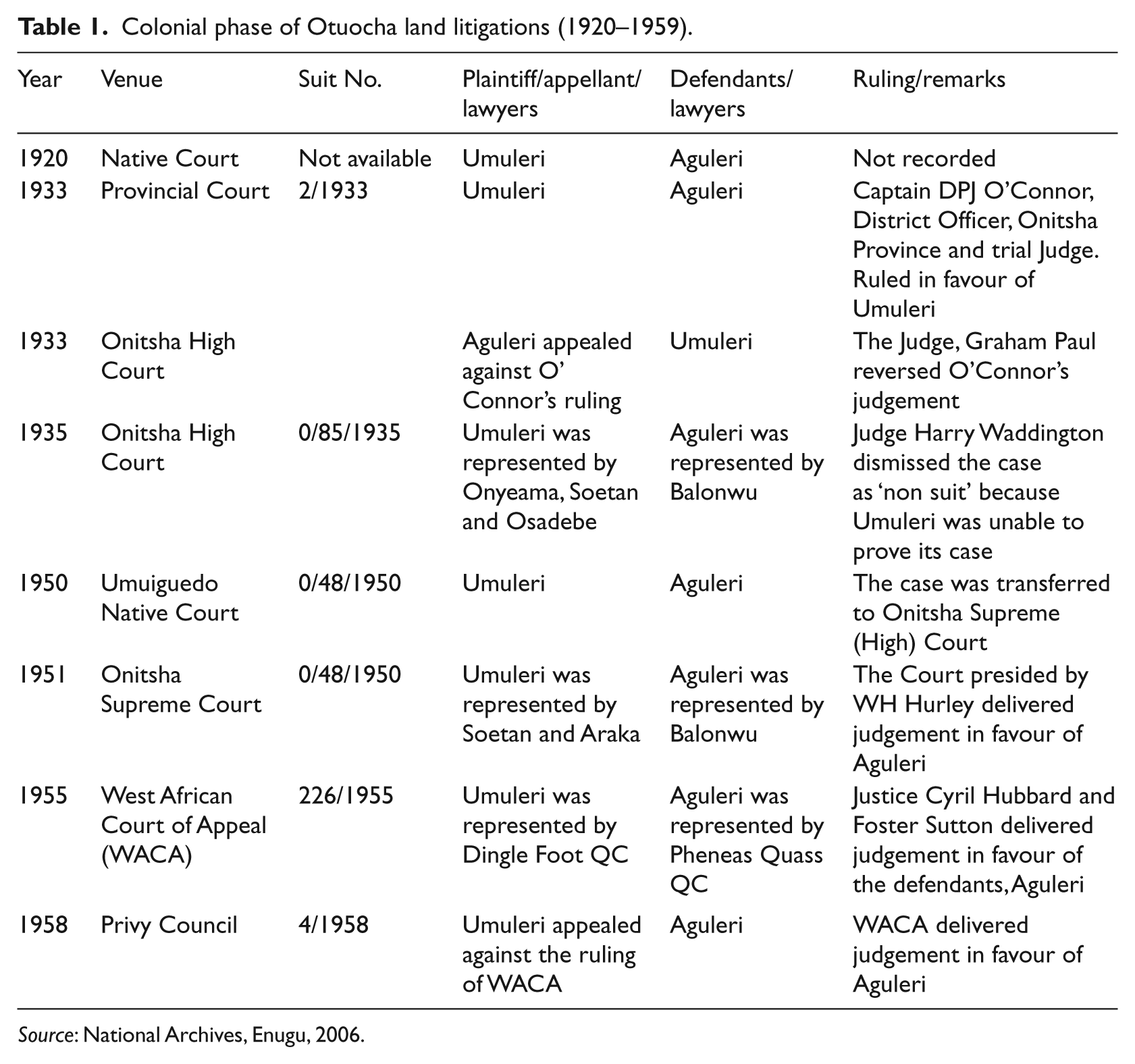
Consequently the Secretary of State approved the policy of ‘unobstructive withdrawal’ for managing the dispute. The approval was communicated to the Resident Officer of Onitsaha Province through Confidential Dispatch No. 2 of August 1937. ‘Unobstructive withdrawal’ prescribed non-interference of the colonial authorities in the legal processes to determine ownership of the land. It also required the abandonment of the crown’s interest in the land only after right of ownership of the land had been legally determined. The policy discouraged colonial administrators from attending to the flood of complaints and petitions from Aguleri and Umuleri communities concerning the controversial land. Until 1950 when the crown finally relinquished its interest on the land, every petitioner was encouraged to seek justice in the court (see Table 1). Petitioners rather resorted to ‘self-help’ and violent means in resolving their grievances initially. This reign of violence culminated in the planned attack of Umuleri by a combined force of Umuoba-Anam and Aguleri after the crown divested its interest in the land under the Niger lands (Divesting No. 3) Order of 30 October 1950. 15
Colonial phase of Otuocha land litigations (1920–1959).
Source: National Archives, Enugu, 2006.
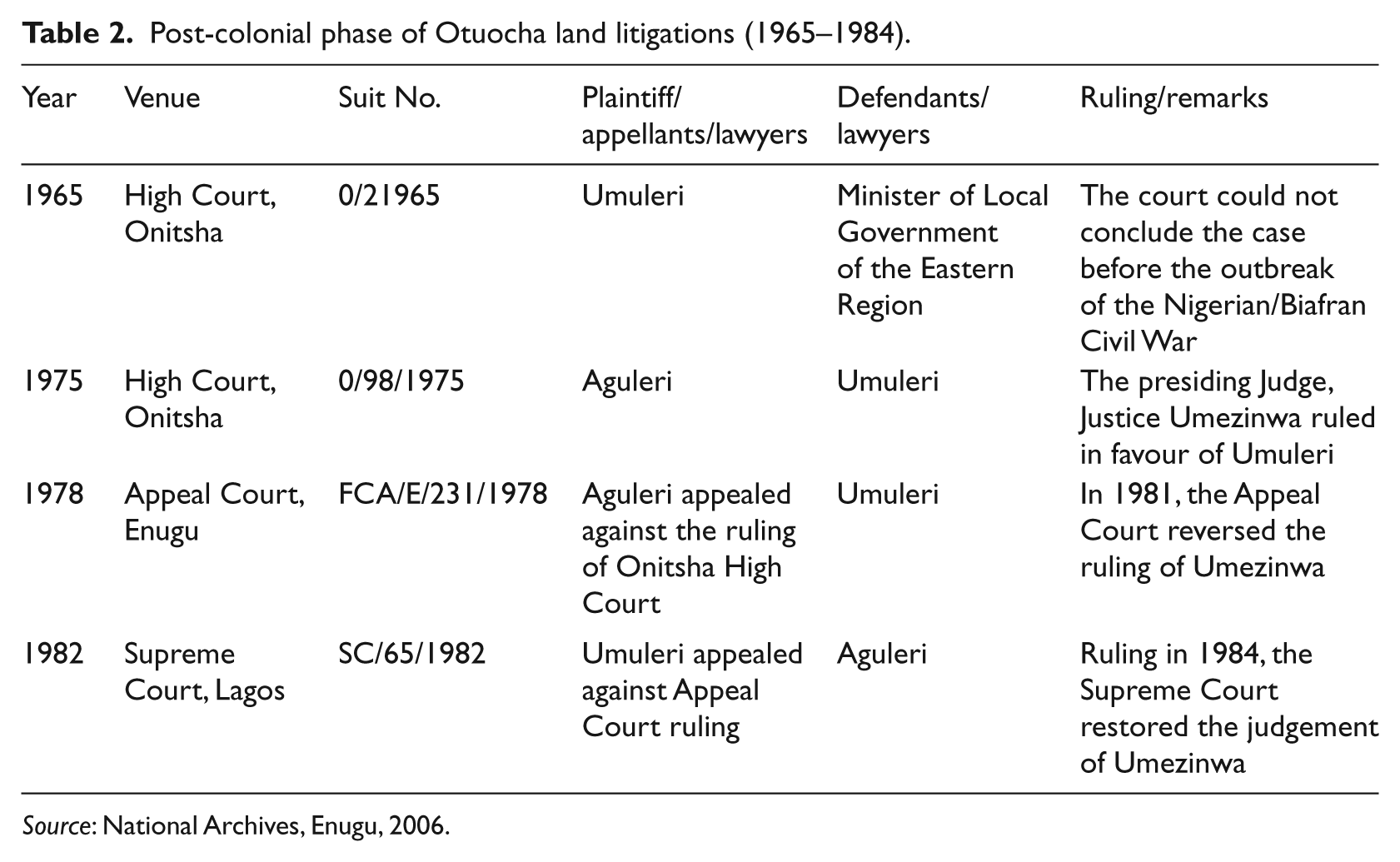
With time the disputants resorted to court action. ‘Unobtrusive withdrawal’ opened a floodgate of litigations and counter litigations stretching right into the post-colonial era. Between 1934 and 1958 litigations on the contested land generated seven court cases and rulings from the lower Provincial Court to the Privy Council in London. None of the court rulings resolved the dispute. The court option inherited from the colonial government was adopted by the post-colonial state (Onwuzuruigbo, 2011b). Claude Ake has repeatedly made the point that the transition from colonial to post-colonial state was merely a change of leadership guard from the Europeans to local elites (Ake, 1985). Not much changed in terms of policies and philosophies of governance. Suffering temporary setback during the civil war years, the court process resumed in 1978 and dragged on until 1984 when the Supreme Court of Nigeria dismissed the case without awarding title to the land to any of the feuding communities (see Table 2).
Post-colonial phase of Otuocha land litigations (1965–1984).
Source: National Archives, Enugu, 2006.
This second phase of litigations generated four court cases and judgements. The folly and futility of depending on the courts for amicable settlement of the conflicts was once again demonstrated by the Supreme Court judgement. The 64 years (1920–1984) of continuous legal battles on Otuocha land thus ended in a stalemate, failing to produce the urgently-needed peace in the area and, more importantly, unable to determine who among the disputing communities owned the land.
Why the Policies Failed
From the onset of conflict, colonial administrators did not seem to be interested in achieving peace through negotiations and consultations with the people. Instead the use of police and court actions were considered enough to handle the situation. In the particular case of the policy of ‘unobstructive withdrawal’, court litigations were the only approved medium for resolving the deepening conflicts. Adoption of the policy meant that subsequent complaints relating to the land would not receive the attention of the colonial authorities. Complainants and petitioners were directed to lodge their petitions and complaints in the court of law where they were encouraged to seek legal redress. All other possible avenues – such as negotiations – through which the complaints and petitions could have been treated, a negotiated settlement of the conflicts achieved and the process of peace-building initiated were ignored and left unexplored. Indeed the repertoire of local mechanism of conflict resolution which emphasized negotiations and peace-building rather than police action and court litigation as more effective avenues of settling dispute was derided as archaic and irrelevant in the colonial situation.
In fact archival documents recorded only one feeble attempt made by an Assistant District Officer to engage elders and chiefs of the two communities in some form of negotiations on the way out of the conflicts. In 1955 a meeting to discuss Otuocha land dispute was held between the officer and representatives of Aguleri at the Roman Catholic Mission building in Ifite, Aguleri. The officer stressed the wastefulness and futility of prosecuting court cases and the need for peace in the territory. The meeting ended with a promise from the officer to hold a similar meeting with Umuleri in the search for peace. 16 Although archival record is silent on what happened thereafter, but from hindsight it is likely that the more superior officers in Onitsha, abiding strictly to the policy of ‘unobstructive withdrawal’, were not enthusiastic about the peace meeting and did not encourage it. This left the court process as the only official option for managing the conflicts.
The fact was that court processes were not only complex but completely strange to the local people still struggling to understand the intricacies of court process and the operations of several alien institutions foisted on them. Litigations also consumed too long a time to treat cases and required huge sums of money to engage the services of counsels and lawyers. Although the latter difficulty was solved through levies apportioned to taxable adults of the community for the purpose of raising funds to procure the services of legal experts, it also created fresh problems. With stupendous sums of money at their disposal each of the rival communities was as ready as the other to challenge any unfavourable court pronouncement on the land. Every court action led to a counter court action and each court judgement in favour of one community elicited an appeal from the disfavoured community. No one community was willing to let any judgement go unchallenged. As has been shown, the courts, including the Privy Council, could not determine the community that actually owned the land. Added to this was the accusation and counter accusation of embezzlement of communal funds against Chief Idigo by a faction of Aguleri elite which culminated in another legal tussle between Idigo and a fraction of Aguleri elite.
By 1942 colonial authorities had come to the conclusion that the policy of ‘unobstructive withdrawal’ ‘proved in practice to be a failure’. 17 The courts could not determine who owned the land, a condition for the crown’s withdrawal of its interest on the contested land. Moreover, litigations provided an avenue for the elite who represented their communities to corruptly enrich themselves by pilfering on communal funds set aside to prosecute court cases. Worst still, the elites were fraudulently acquiring and converting communal lands to their personal asset. These developments further intensified and opened up opportunities for more litigation, stretching right into the post-colonial era. In sum, the several court actions and rulings on the land produced a stalemate. None could establish the authentic owner of the land.
Similarly the conception and application of colonial land policies were fraught with inherent problems. Commercialization and privatization of land, the main doctrines of colonial land reforms, were extremely opposed to indigenous land practices which emphasized communal ownership of land. And no matter how popular the principles of land commercialization and privatization had become among the Europeans and a few locals, they had to contend with the resilience of pre-existing symbolic meanings and notions of land held by the majority of Aguleri and Umuleri. Whereas British administration pulled through its land policies at least in the official and public domains, remnants of traditional land practices, anyhow, still dominated the private and primordial realms. With a social structure deeply entrenched in subsistence agriculture and what Goran Hyden refers to as ‘economy of affection’, it was difficult for the people to completely relinquish traditional land norms.
Peter Ekeh has pointed to the propensity of colonialism to bifurcate the social structure of the colonies into two realms: the public and private realms, with the public realm developing along two publics: the civic and primordial realms with distinct levels of morality. Ekeh holds the existence of the two publics and their varying degrees of morality responsible for the many problems of the post-colonial state (Ekeh, 1975). In this connection, the existence of two opposing notions of land held by Europeans and the local people – the former applied in all official transactions and the latter observed largely in informal interactions of the indigenous people – led to differential understanding and interpretation of the land policies. The strong respect for traditional land regulations held by colonial subjects sometimes crept into land transactions in the public domain. This explains why Umuleri thought it merely suspended its right of ownership of the land it sold in 1898 to the Royal Niger Company and therefore misinterpreted the Niger Lands Transfer Ordinance as reinstating the hitherto suspended right of ownership.
Even when colonial land policies reverted to the so-called communal ownership of land after 1900, some of the analysis upon which the reversion was based drew from wrong perceptions, distorted notions and totally inaccurate information sieved from a kaleidoscope of information from African subjects and informants. Desirous of acquiring detailed information and knowledge about native customs and traditions, especially as they concerned land practices, colonial officials engaged commissioned anthropologists to identify and sort out authentic customs from invented ones. The quest for indisputable knowledge of the native proved a frustrating venture. According to Berry:
In the process, they found themselves engaged in an on-going quest for knowledge which proved frustratingly elusive – partly because Africans gave conflicting accounts of ‘custom’, but also because African societies were themselves undergoing change. Far from the timeless web of accepted practices that colonial officials imagined (or hoped for), custom proved in practice to be a sifting kaleidoscope of stories and interests that eluded codification. Officials’ efforts to get the customs right – by inventing them, if necessary – were often as destabilizing as they were oppressive. (Berry, 2002: 642–643)
The result was that, more than the families and communities, local chiefs were endowed with tremendous powers in the management of land affairs. Such a decision did not go down well with elite members of the Aguleri council who used every opportunity to oppose it. 18
Lastly, the attitude of both the Royal Niger Company and the colonial government to the disputed land tended to undermine steps taken to contain the conflicts. The Royal Niger Company ‘never entered into possession’ nor ‘did any overt act of ownership in respect of the land it acquired from Umutshezi Umuleri in 1898’. 19 The failure of the Royal Niger Company, for whatever reason, to take possession of the controversial land was a flaw. But a greater flaw was the reluctance of the British crown to assume full and effective control of the land after the 1916 Niger Land Transfer Ordinance. After all, the ordinance completely handed over ownership of the land from the Niger Royal Company to the crown. The land by implication became crown land. As Lord Lugard instructed in No. 16 of his Political Memoranda, written in 1906, crown land ‘was the private property of the government’. And government was at liberty to use the land as it deemed necessary, including citing of government institutions and development projects (Shenton, 1986: 31). But 18 years after the ordinance took effect, Justice Graham noted in 1934 that ‘there has been no occupation or any overt act of ownership by the Crown since 1916’. 20 The failure of the crown to establish its presence on the land can be attributed to two major reasons.
The first was the inconsistency of the colonial land policy. At one point land was privatized. Yet at another breath land was officially perceived as communally-owned and held in trust for communities by their chiefs, elders and leaders. To worsen matters, the appeal court, which had the opportunity in 1934 to resolve the confusion over the status of particularly Aguakor land and restate what should be government position on the land, declined to do so. The second point refers to the overt policy of minimal and selective development of the colonies adopted by the colonialists. Several requests and petitions to the authorities to assist in developing facilities and upgrading existing infrastructure in Otuocha were rebuffed. The demand of Otuocha town council that the authorities build a hospital and upgrade the postal agency to post office fell on deaf ears. At one point the Aguleri conference, constituting Aguleri elders, chiefs and elite, painfully lamented British apathy to its development initiatives. Hear them: ‘We beg to remark that Aguleri has never benefited from the development programmes of the government since the British government took over from the old Niger Company’. 21
Had the Royal Niger Company or the colonial administration taken possession of the land and located social infrastructure and facilities on it they would have warded off the prying eyes of Aguleri and Umuleri away from the land. Regrettably these preventive steps were never taken. To the extent that the land remained unoccupied, it continuously attracted the attention of Aguleri and Umuleri who desperately wanted to assert ownership right over it.
Conclusion
Central to the colonial project was the appropriation and exploitation of African human and natural resources for the development of the economies of the colonizing states. This project was vigorously pursued through ancillary policies which in themselves made demands that were totally strange to the colonized peoples and enacted fundamental transformation of their social structure. Crisis and confusion became major features of the colonial situation. As the colonizers sought to simultaneously dominate and exploit natural resources in the colonies, they exacerbated the situation. Conflict erupted between the colonizers and the natives on the one hand and between the colonized peoples on the other. Because colonial land hosted most of the resources needed to support the development of capitalist production in the colonizing nations, it became one major source of conflicts in the colonial situation.
This paper has argued that most of the policies deployed by colonial administrators to ameliorate conflicts and create a peaceful atmosphere for the exploitation of Africa’s resources yielded discouraging results. All over Africa the failure of such colonial policies has continued to reverberate in not only former settler colonies but also countries like Nigeria, Ghana, Burkina Faso – to mention a few – several years after the demise of colonialism. With the onslaught of the forces of globalization, identity politics, population pressures and structural adjustment, many of the conflicts have remained intractable.
Similarly the so-called colonial policies strongly favoured the development of capitalist production in Africa. Often this meant the retention of stubborn pre-capitalist formations which resisted the forces of change alongside externally-imposed capitalist formations and relations of production. Geoffrey Kay has argued that capitalism created ‘underdevelopment not simply because it has not exploited the underdeveloped countries but because it has not exploited them enough’ (Kay, 1975: 55). Exploring the wider implications of this flaw, Issa Shivji identified post-colonial African societies as neither pre-capitalist, nor capitalist (developed) or socialist. Post-colonial Africa is therefore an underdeveloped capitalist society within the world capitalist system (Shivji, 1975). What then emerged from the capitalist contraption in Africa was neither a total annihilation of the old society nor the emergence of a totally new one. What, indeed, emerged were a coalition and collusion of the new and the old, the traditional and the modern as well as conflicts usually associated with such contraptions.
It is in this context that the Land Question can be understood as a critical issue in most, if not all, colonized societies, no matter where they are located. The Land Question is certainly not a peculiar phenomenon of Asia, Latin America and former settler colonies in Africa. It is, indeed, a problem mostly rooted in the colonial experiences of affected colonized societies and feeds into nascent global challenges to perpetrate crisis and confusion in several African nations.